
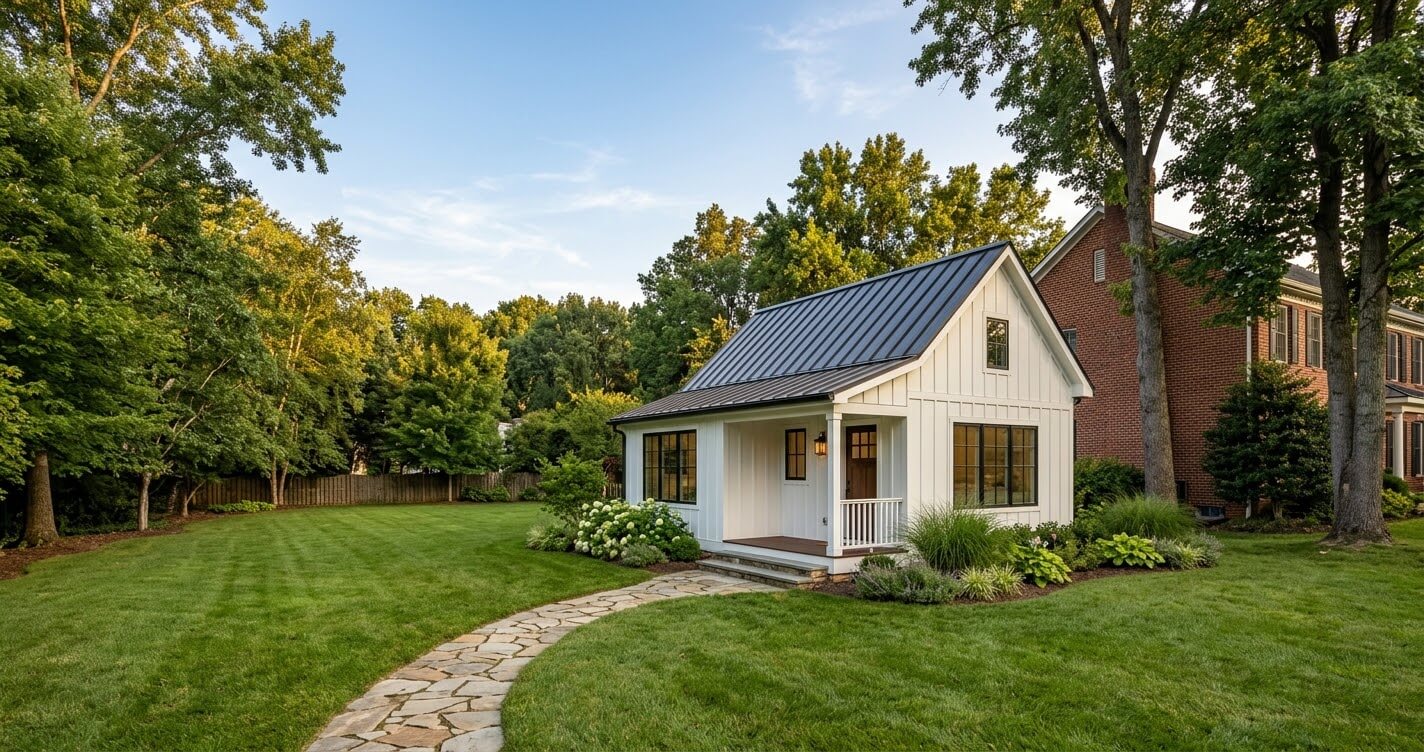
Fairfax County ADU rules are changing on paper, but not yet in law. County planning staff have drafted a zoning amendment that would allow more detached accessory living units (ALUs), mainly on larger lots. When we reviewed the county’s project page, no public hearings had been scheduled. Homeowners in McLean, Vienna, Great Falls, Clifton and Burke should plan with that gap in mind.
Fairfax County calls these units accessory living units, or ALUs, not ADUs. The county adopted the term to avoid confusion with affordable dwelling units, according to FFXnow.
At US Home Design Build, our design-build team plans and builds accessory dwellings across Northern Virginia. This guide explains what the draft says, what is still undecided, and how to prepare. If you want a builder’s view of your lot first, start with our ADU builder services in Northern Virginia.
One correction before we begin. Arlington County did not pass new detached ADU rules in 2026. Arlington has allowed detached accessory dwellings since 2019. We compare the two counties later in this guide.
What Are the Current Fairfax County ADU Rules for Detached Units?
Under the current Fairfax County ADU rules, a detached accessory living unit generally needs a lot of about two acres and a special permit approved after a public hearing. The owner must live in the primary home. Detached units are capped at 1,200 square feet.
Fairfax County loosened its accessory unit rules during its Zoning Ordinance Modernization (zMOD) project. Interior units are easier to approve, because many can use an administrative permit. Detached units face the harder path. They generally need a minimum two-acre lot and Board of Zoning Appeals approval, as described in our Fairfax City detached ADU analysis.
Use of the rules has been lower than officials hoped. FFXnow reported in February 2026 that Fairfax County had not seen the growth in accessory units that officials expected after zMOD. The county’s own staff direction then led to the current amendment effort.
The county’s parking table also shows an additional parking space for accessory living units approved by administrative permit. See the county’s adopted amendment ZO 112.2-2023-1 for the table.
For a step-by-step view of today’s process, read our ADU permit guide for Fairfax County.
What Has Fairfax County Staff Proposed for Detached ALUs in 2026?
Fairfax County staff have proposed allowing detached ALUs by right or with an administrative permit on conventional R-1 lots of 36,000 square feet or more. R-2 lots of 15,000 to 36,000 square feet would need a special permit. Lots under 15,000 square feet would not qualify. These are drafts, not adopted rules.
Table 1 compares the current rules with the staff draft. The draft changes the Fairfax County ADU rules in five areas: lot size, approval path, size, parking and owner occupancy.
Table 1: Fairfax County Detached ALU Rules, Current vs Proposed Staff Draft (Not Adopted)
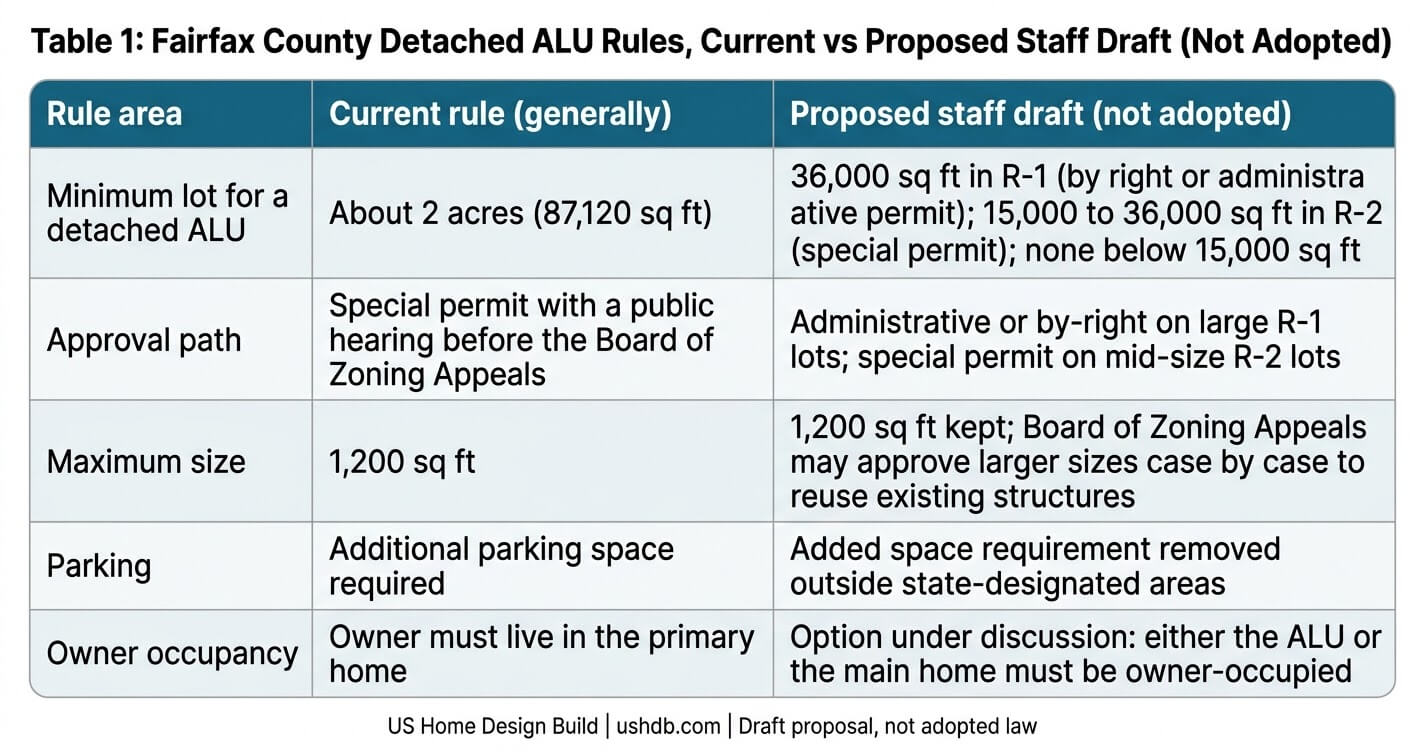
Fairfax County zoning staff presented these concepts in a July 2026 community webinar. According to a public-meeting summary, staff recommended detached ALUs on R-1 lots of at least 36,000 square feet. Staff also proposed special permits for R-2 lots from 15,000 to 36,000 square feet and no detached ALUs below 15,000 square feet. The same summary says staff want to keep the 1,200 square foot cap while letting the Board of Zoning Appeals approve larger sizes for existing structures.
Staff also floated other changes:
- Larger interior ALUs and higher occupancy limits.
- Fewer administrative permits for some unit types.
- Removal of the added parking-space requirement outside state-designated areas.
- Two owner-occupancy options, including a version where either the ALU or the main home must be owner-occupied.
The county’s draft text lists these as options, so each could change before a hearing.
How Would Lot Size Decide Whether Your Detached ALU Qualifies?
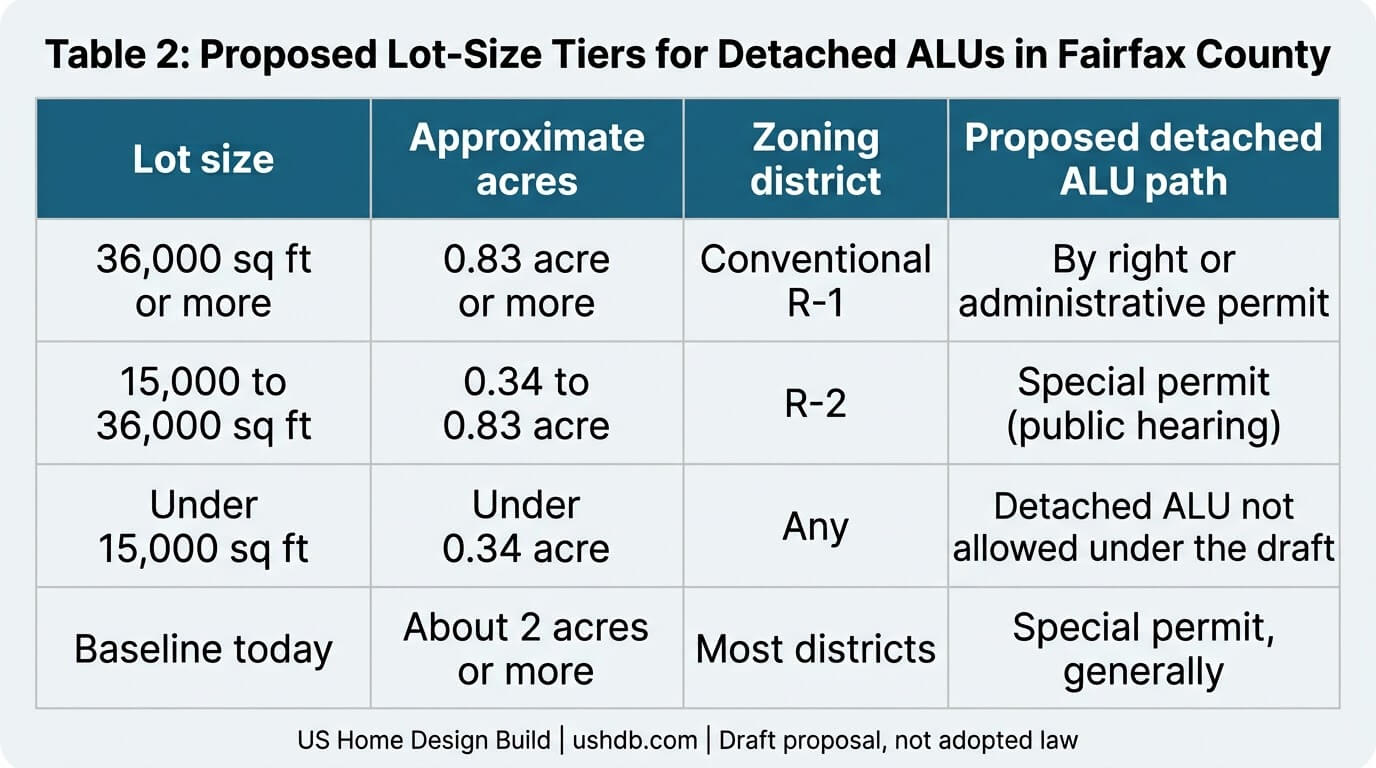
Under the staff draft, lot size is the main gatekeeper. A 36,000 square foot lot is about 0.83 acre, so the proposed R-1 threshold is well below today’s roughly two-acre baseline. A lot between 15,000 and 36,000 square feet needs a special permit. Under 15,000 square feet, a detached ALU is not allowed.
The math matters. Two acres equals 87,120 square feet. The proposed 36,000 square foot R-1 tier is about 41 percent of that baseline. That change would put detached ALUs within reach of many more Fairfax County lots, if the draft survives public hearings.
Table 2: Proposed Lot-Size Tiers for Detached ALUs in Fairfax County
Lot size is only the first test. Setbacks, utility capacity, stormwater, tree protection and Chesapeake Bay Preservation Act limits can still shrink the buildable area on a large lot. A survey and a zoning review should come before any design fee.
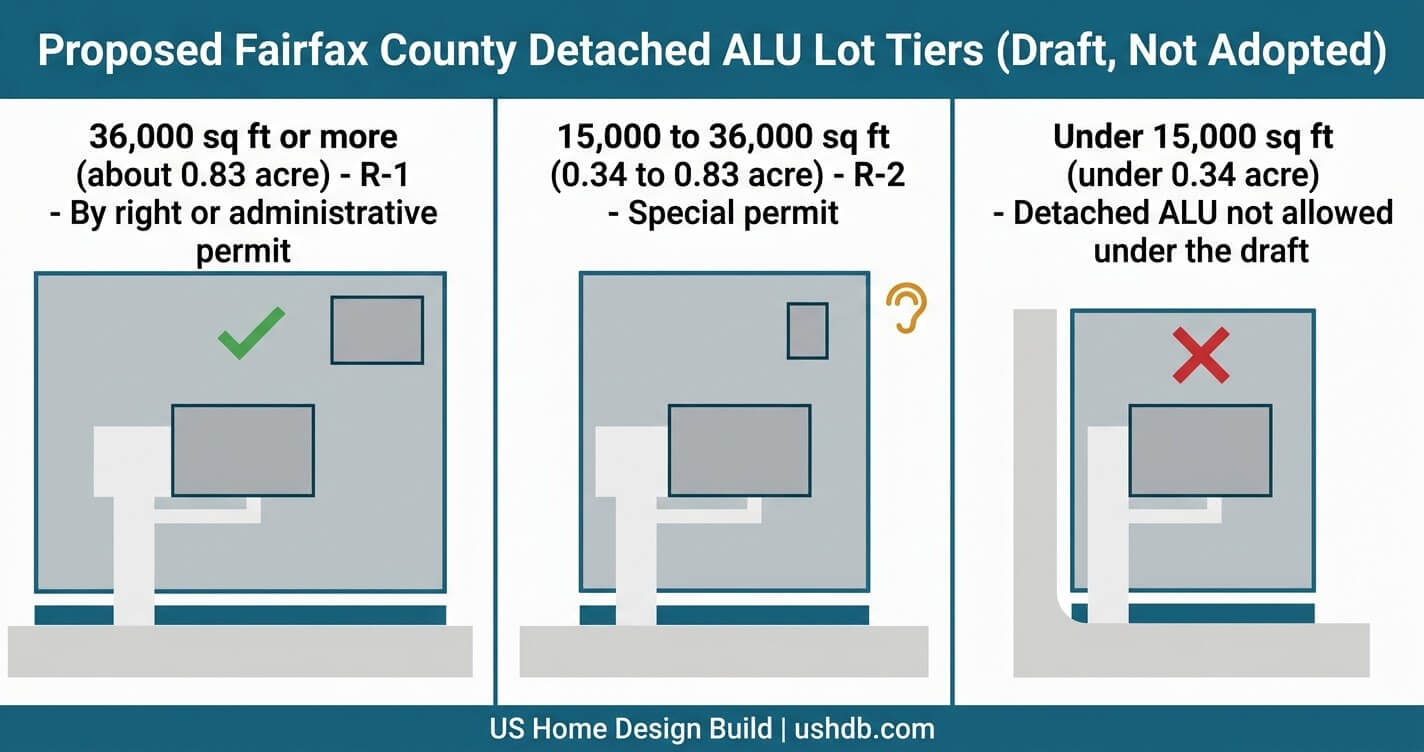
Table 3 shows how five common situations line up with the draft. Homeowners in larger-lot areas such as Great Falls and McLean may be the likeliest to benefit, but each parcel must be checked on its own.
Table 3: Which Path Fits Your Lot? Detached ALU Scenarios in Northern Virginia
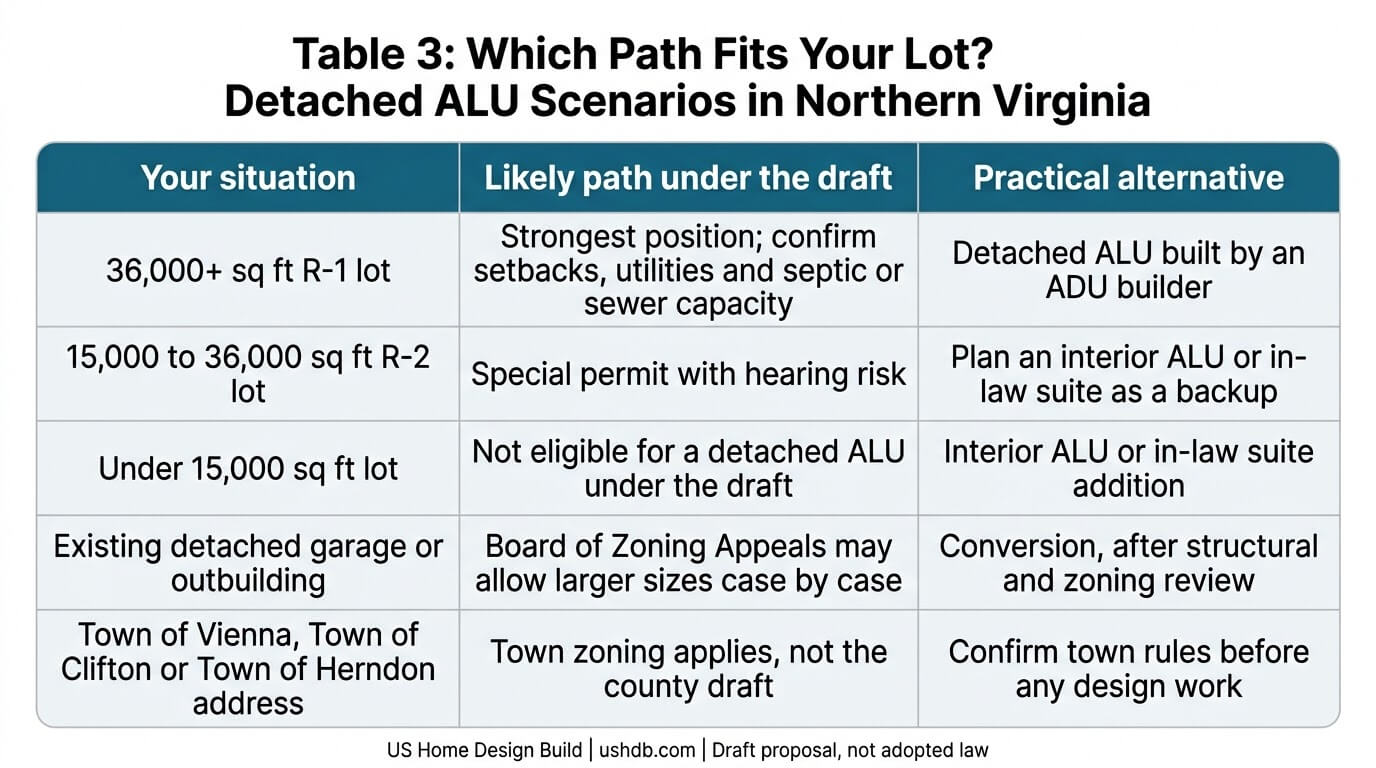
Smaller lots still have options. An interior ALU or an in-law suite addition does not depend on the detached-unit tiers.
Residents with a Vienna, Clifton or Herndon address should check one more thing. The Town of Vienna, the Town of Clifton and the Town of Herndon are incorporated towns with their own zoning. The county draft may not apply to those lots, so confirm your jurisdiction first. Our Vienna ADU builder page and Clifton ADU builder page explain local considerations.
What Is Still Undecided About the Fairfax County ADU Rules?
Hearing dates, final lot-size thresholds, parking, owner occupancy and the effective date are all undecided. Fairfax County’s project page listed community meetings through July 2026 but no public hearings. Staff said they hope to reach hearings by the end of 2026.
Fairfax County’s project page lists ten meetings since December 2025 and states that hearings for this amendment have not been scheduled. Table 4 shows the public timeline. A Citizen Portal summary of the July webinar says staff hope to bring the amendment to public hearings by the end of 2026.
Table 4: Fairfax County ALU Amendment Timeline (Public Meetings to Date)
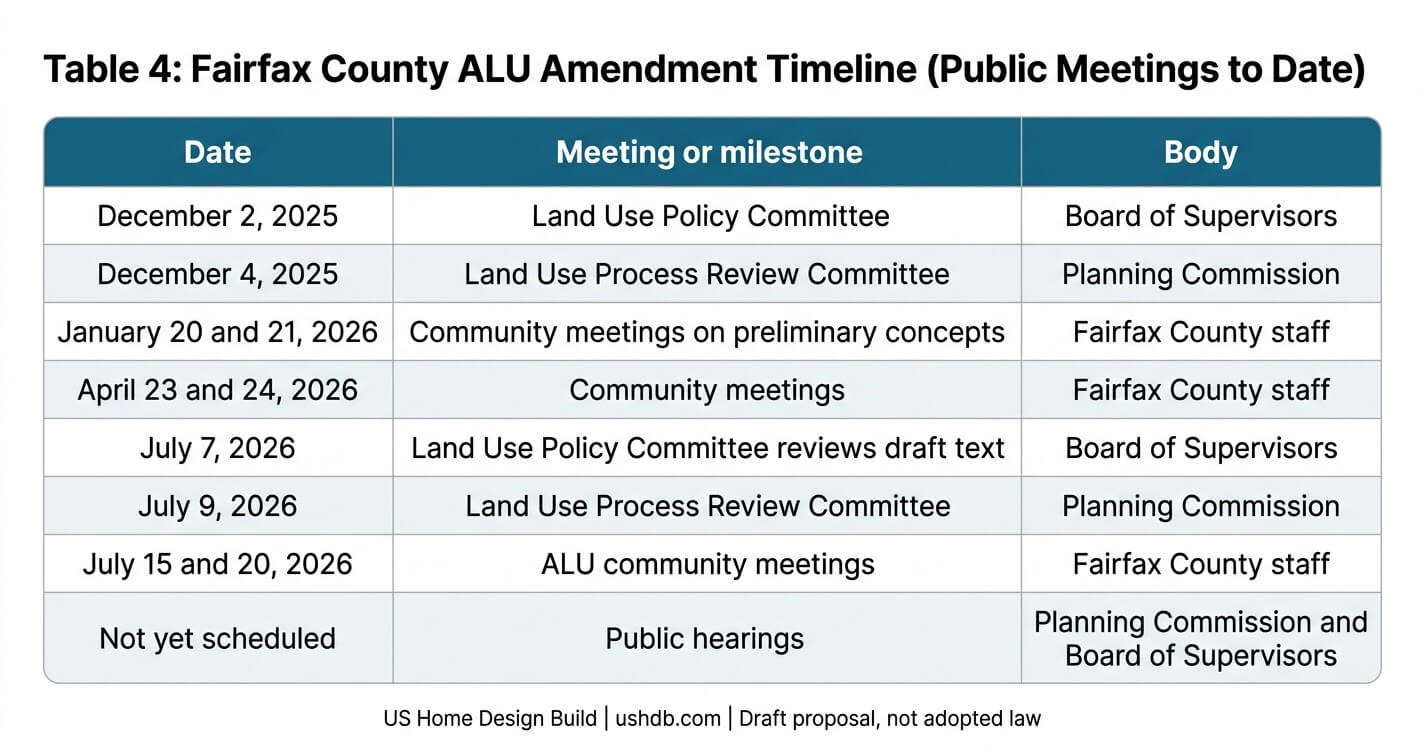
Table 5 separates what is proposed from what is open. Treat every proposed number as a planning range, not a permit standard.
Table 5: What Is Decided and What Is Still Open for Fairfax County ALUs
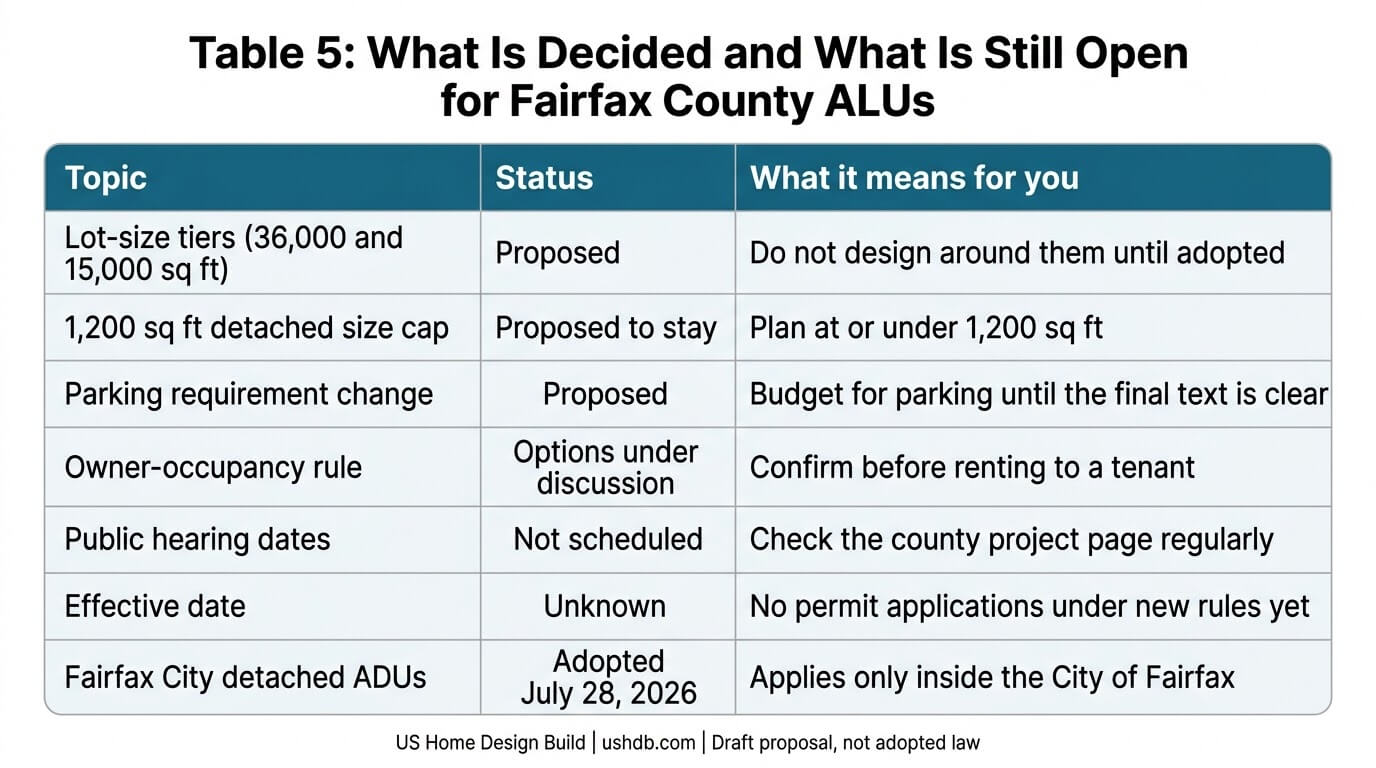
Homeowners considering a detached ALU may benefit from a feasibility review with an experienced design-build team before final rules and budgets are set. Our ADU gallery shows completed accessory dwelling projects in Northern Virginia.
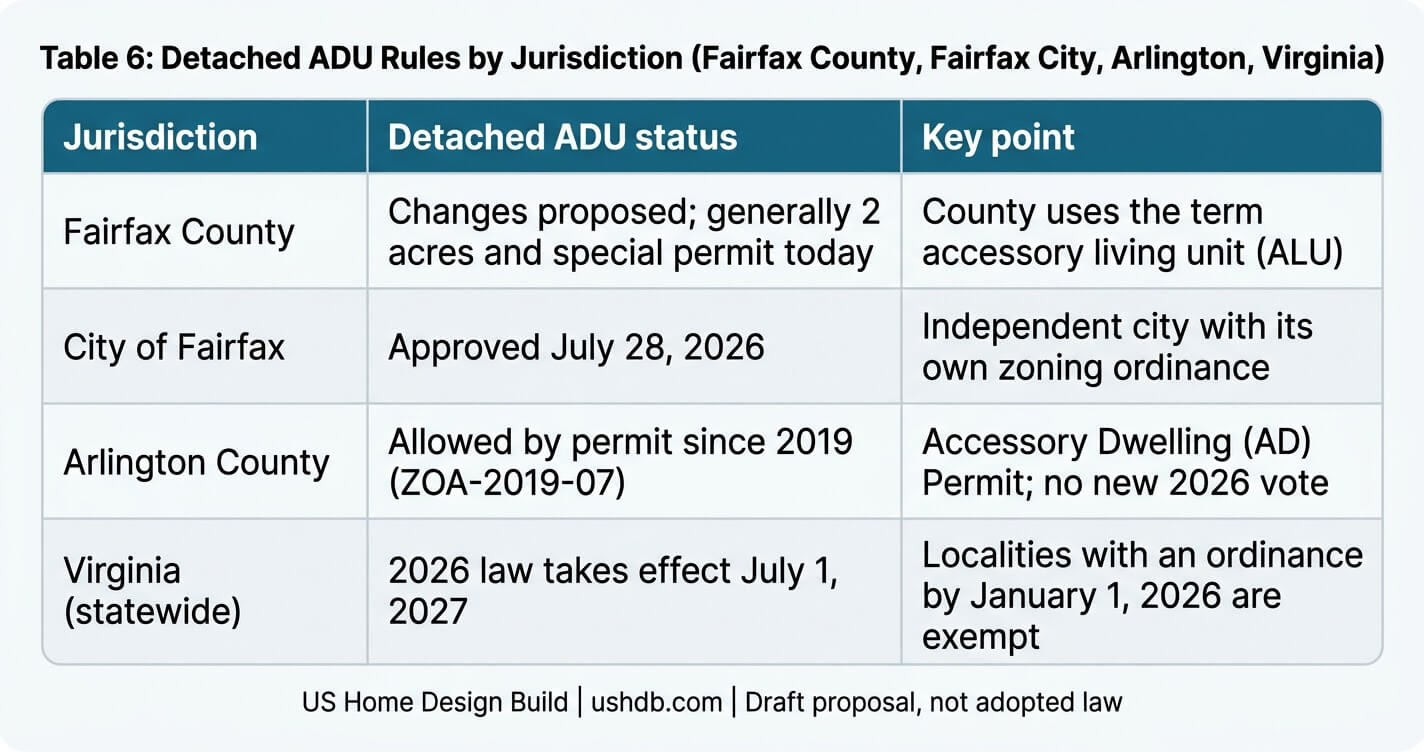
How Do Fairfax County, Fairfax City, Arlington and State ADU Rules Differ?
They are four separate rulebooks. The City of Fairfax approved detached ADUs on July 28, 2026. Arlington County has allowed them by permit since 2019. Fairfax County’s changes are proposed. Virginia’s 2026 statewide law takes effect July 1, 2027, with an exemption for localities that already had ADU ordinances.
On July 28, 2026, the City of Fairfax Council approved a zoning ordinance permitting detached accessory dwelling units, according to the city’s engagement page. The City of Fairfax is an independent city, so its ordinance does not change the rules for homeowners in unincorporated Fairfax County. Our Fairfax City detached ADU guide breaks down the vote.
Arlington County followed a different timeline. The County Board approved new detached accessory dwellings in May 2019, according to Alliance for Housing Solutions. ARLnow reported the unanimous vote at the time. Arlington’s permit is an Accessory Dwelling (AD) Permit handled by county zoning staff. Our Arlington ADU rules guide covers the details.
Virginia’s 2026 statewide ADU law requires most localities to allow ADUs in single-family zones by right starting July 1, 2027. Localities that already had an ADU ordinance as of January 1, 2026 are exempt. That exemption covers Fairfax County, Arlington County and the City of Fairfax, so local rules still control. Our Virginia ADU law SB 531 explainer covers the state bill.
Table 6: Detached ADU Rules by Jurisdiction (Fairfax County, Fairfax City, Arlington, Virginia)
What Permits Would a Detached ALU Need in Fairfax County?
A detached ALU needs two tracks: zoning approval and a building permit. Zoning approval is a special permit today and could become administrative on large R-1 lots under the draft. The building permit adds plan review and inspections under the Virginia Uniform Statewide Building Code.
Table 7 lists the steps in order. Zoning approval comes first because it decides whether the project can proceed. Utility review often runs in parallel, so start it early.
Table 7: Approval Steps for a Detached ALU in Fairfax County, Today vs Draft
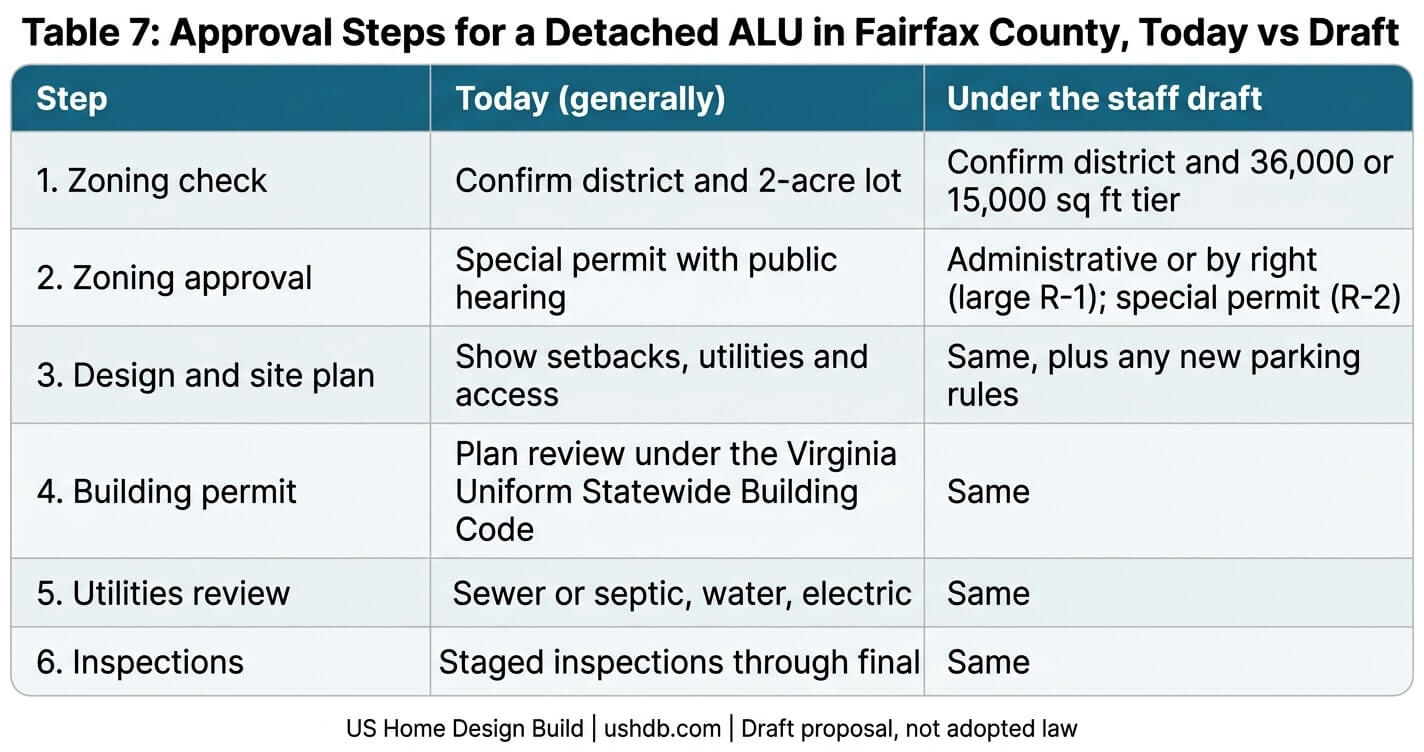
Special permits add time because they require a public hearing. Administrative approvals are faster and more predictable. That predictability is the real value of the draft. Our Fairfax County ADU permit guide walks through the paperwork homeowners see today.
How Much Does a Detached ADU Cost in Northern Virginia?
A detached ADU in Northern Virginia typically costs from about $75,000 to $350,000 or more in 2026, depending on size, utilities, site work and finishes. The 1,200 square foot cap limits the top end. Special permits can add design and approval costs.
US Home Design Build’s 2026 cost guide reports that ADU costs in Northern Virginia typically range from $75,000 to $350,000 or more. The range depends on whether the project is a conversion, an attached unit or a detached build. See the full breakdown in our ADU cost guide for Northern Virginia.
Table 8: Detached ALU Cost Drivers in Northern Virginia
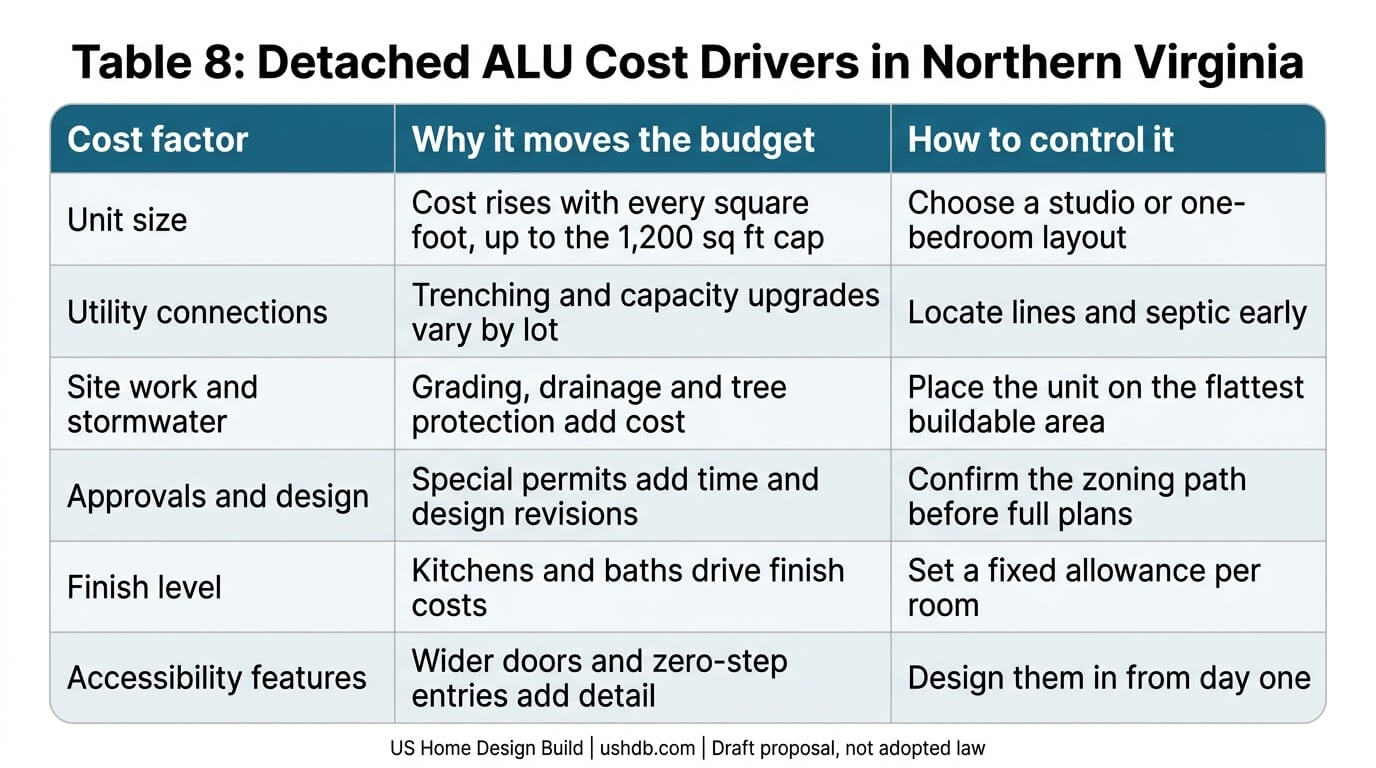
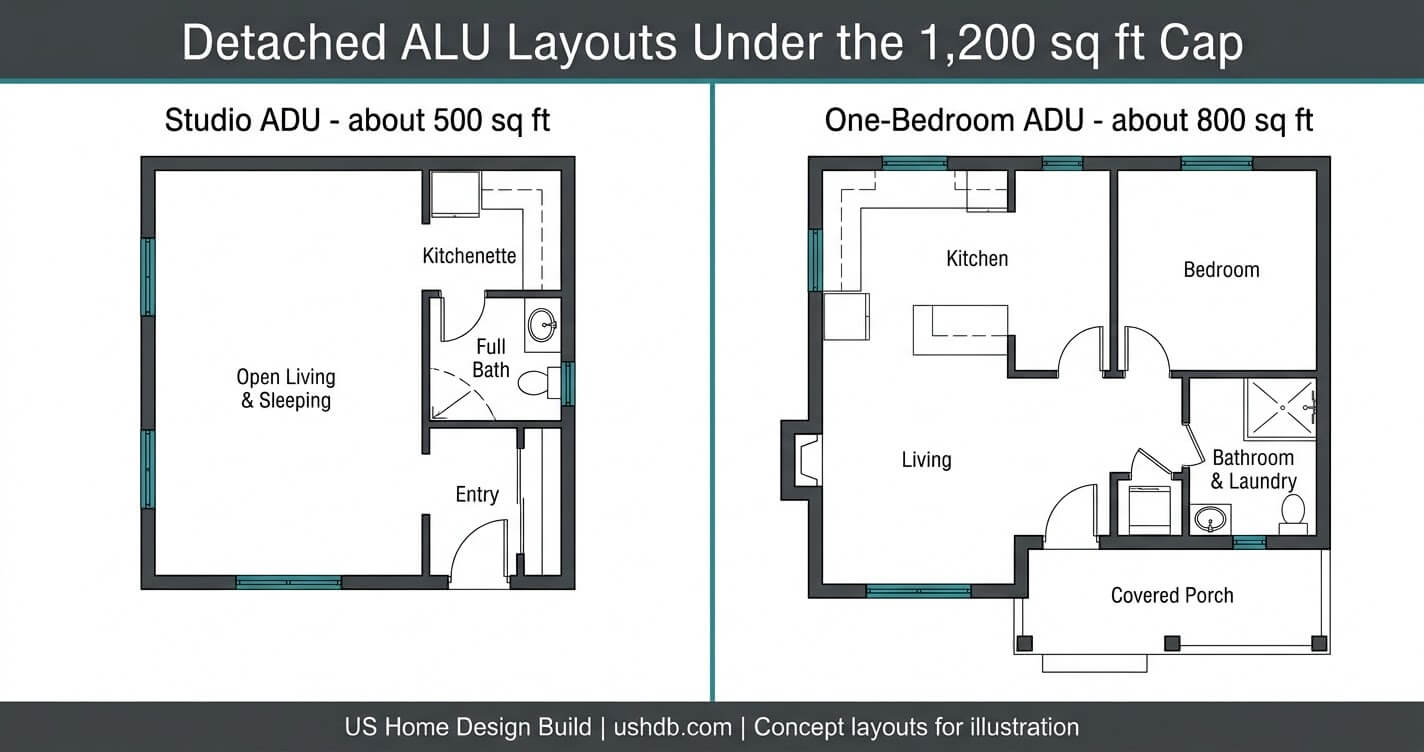
Layout choice also changes cost per square foot. Our studio vs one-bedroom ADU comparison explains the tradeoff. Financing may help, and our FHA ADU financing guide covers current options.
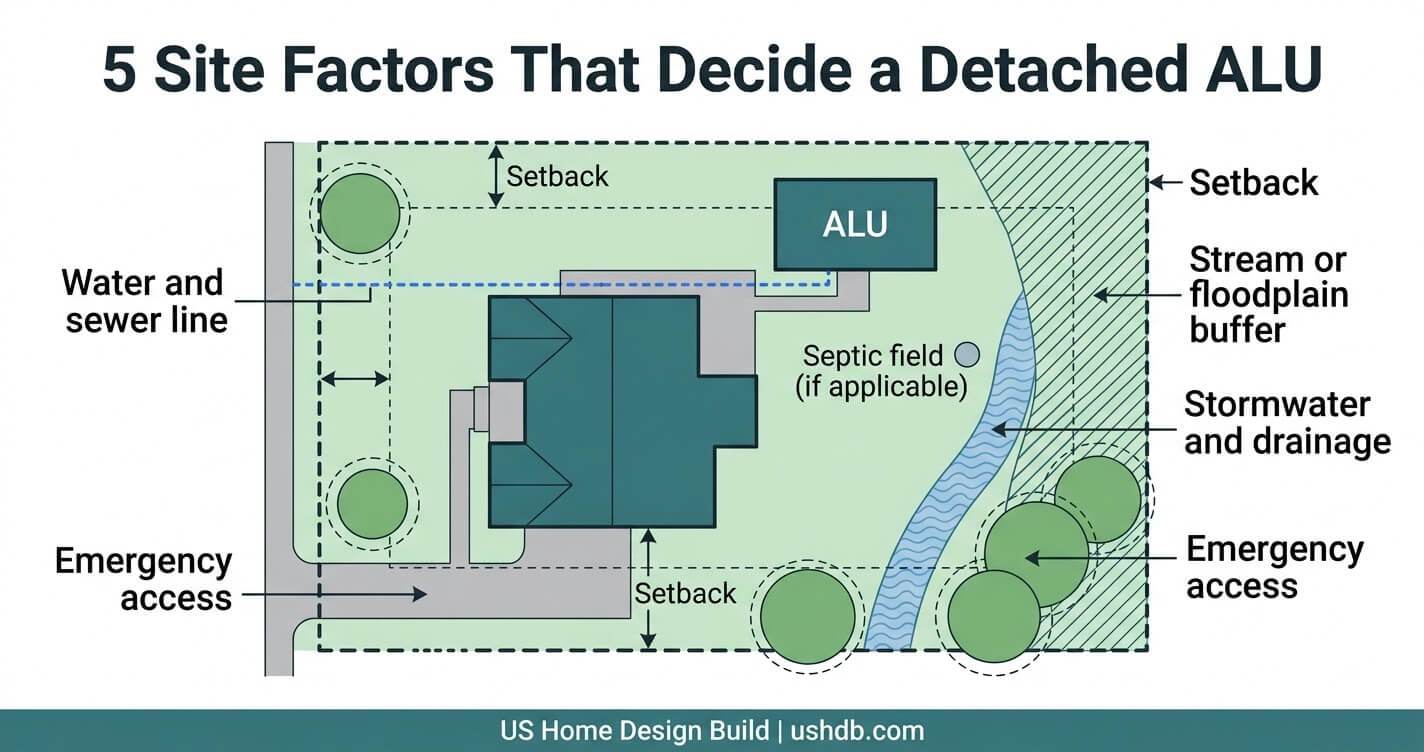
What Site Factors Affect a Detached ALU on a Large Fairfax County Lot?
Five site factors decide whether a large lot can hold a detached ALU: utility capacity, stormwater and grading, environmental limits, setbacks, and access for fire and emergency vehicles. A zoning-eligible lot can still fail on site conditions.
- Utilities. Confirm sewer or septic capacity and the route for water and electric lines. Long trenches raise cost.
- Stormwater and grading. New roofs and paving add runoff. Fairfax County stormwater review can shape the footprint.
- Environmental limits. Chesapeake Bay Preservation Act rules and floodplain areas can restrict building near streams.
- Setbacks and tree protection. Setbacks decide where the unit can sit. Mature trees often decide where it should sit.
- Access and safety. Plan clear paths for emergency access, plus smoke and carbon monoxide alarms under the building code.
Design should also fit how the unit will be used. A unit for an older parent needs step-free entries and wider doors. Our guide to an ADU for aging parents in Northern Virginia covers those details. For resale effects, read our ADU home value guide.
Our ADU build case study in Reston shows what a finished accessory dwelling project looks like in Northern Virginia.
Which Homeowners Should Act Now and Which Should Wait?
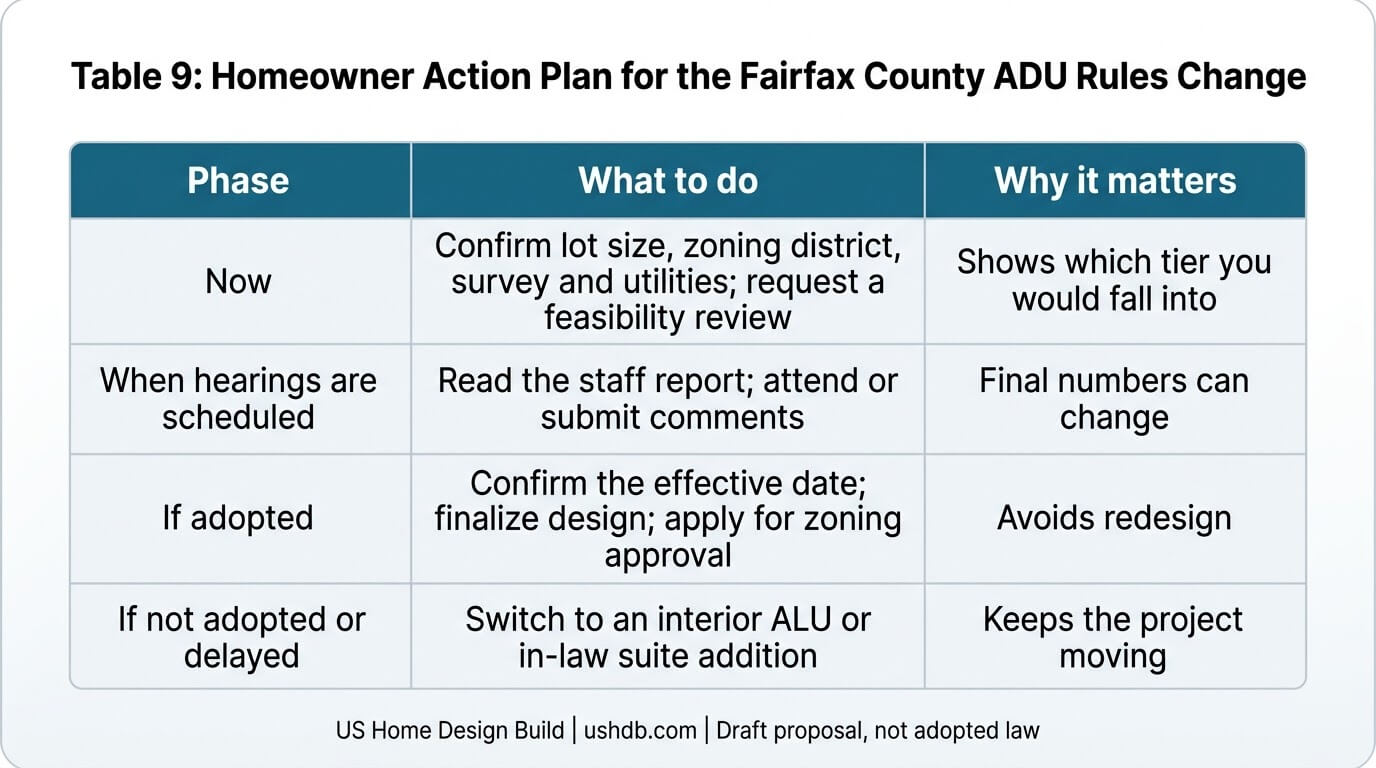
Homeowners with 36,000+ square foot lots should start feasibility work now, because they are best positioned under the draft. Owners of 15,000 to 36,000 square foot lots should prepare for a special permit. Owners of smaller lots should plan an interior ALU or in-law suite instead.
Feasibility work costs little compared with a build. It also keeps your options open if the final rules change. Table 9 gives a phased plan.
Table 9: Homeowner Action Plan for the Fairfax County ADU Rules Change
What Mistakes Should Homeowners Avoid While the Rules Are Changing?
The biggest mistake is treating the draft as adopted law. Others include assuming Fairfax City rules apply, ignoring town boundaries, designing above 1,200 square feet, skipping utility checks and paying for full plans before the zoning path is clear.
Table 10: Seven Mistakes Homeowners Make While ADU Rules Are Changing
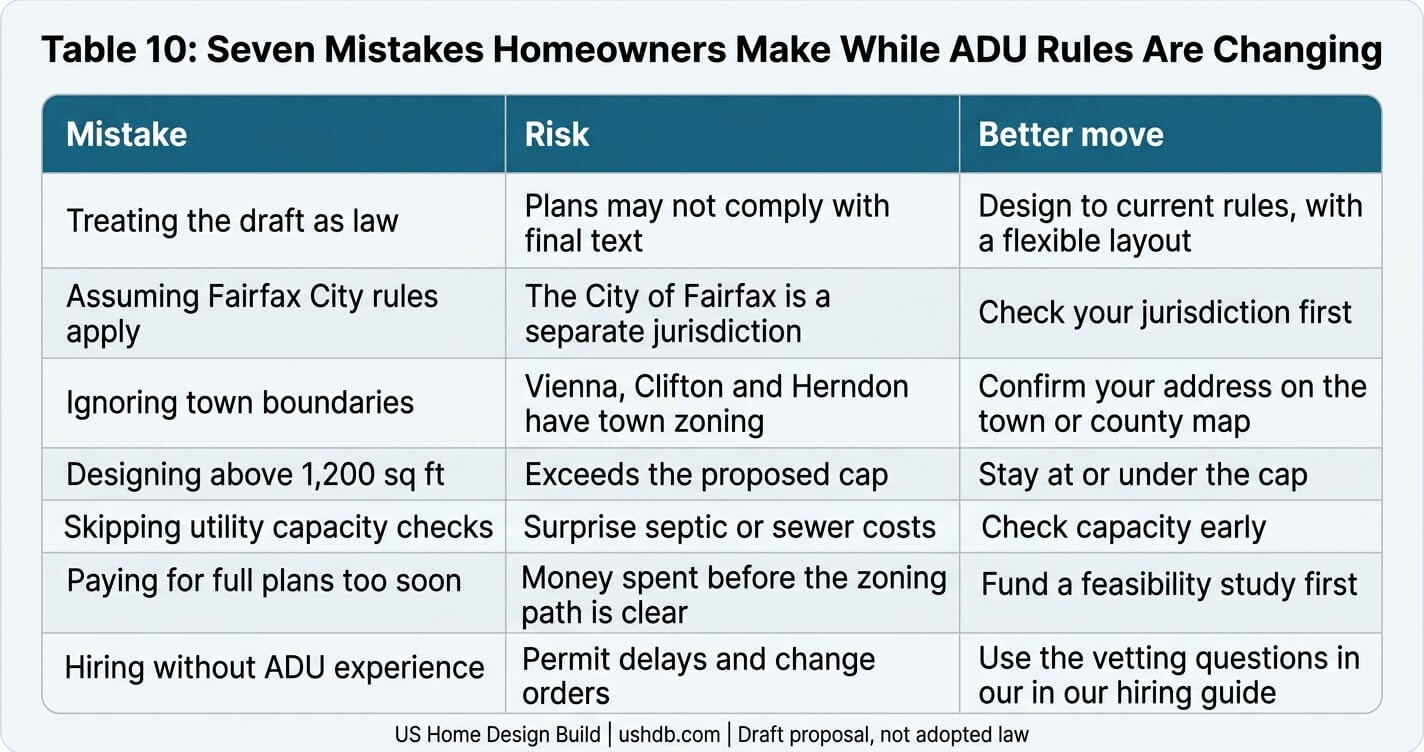
A qualified builder helps you avoid all seven. Use our questions to ask before hiring an ADU builder when you compare contractors.
Frequently Asked Questions
Are detached ADUs allowed in Fairfax County?
Generally yes, but only with a special permit and usually on a lot of about two acres or more. County staff have proposed easing this, but the draft is not adopted. Check the county project page for hearing dates.
What is the difference between an ADU and an ALU in Fairfax County?
They describe the same type of unit. Fairfax County uses the term accessory living unit (ALU) to avoid confusion with affordable dwelling units. Most other jurisdictions say ADU or accessory dwelling unit.
How big can a detached ADU be in Fairfax County?
The cap is 1,200 square feet, and staff propose keeping it. The Board of Zoning Appeals could approve larger sizes in some cases to reuse existing structures. Plan your design at or under 1,200 square feet.
What lot size do I need for a detached ADU in Fairfax County?
Today it is generally about two acres. The staff draft would set 36,000 square feet for R-1 lots and 15,000 to 36,000 square feet for R-2 lots with a special permit. Lots under 15,000 square feet would not qualify.
When will the new Fairfax County ADU rules take effect?
No effective date exists yet. The county had not scheduled public hearings when we reviewed its project page. Staff said they hope to reach hearings by the end of 2026.
Does the Virginia ADU law override Fairfax County ADU rules?
Not automatically. The 2026 state law takes effect July 1, 2027 and exempts localities that had an ADU ordinance by January 1, 2026. Fairfax County had one, so local rules still apply unless the county aligns them.
How much does a detached ADU cost in Fairfax County?
Detached ADUs in Northern Virginia typically cost from about $75,000 to $350,000 or more in 2026. Final cost depends on size, utilities, site work and finishes. Request a site-specific estimate before budgeting.
Do the Fairfax City ADU rules apply to my home in McLean or Vienna?
No. The City of Fairfax is a separate jurisdiction. Homes in McLean are in Fairfax County, and homes in the Town of Vienna follow town zoning, so confirm your parcel’s jurisdiction.
Final Thoughts
The Fairfax County ADU rules may soon open detached ALUs to far more lots, but the changes are proposed, not adopted. Plan to current rules, run a feasibility review now, and stay flexible until hearing dates and final text are published.
The Fairfax County ADU rules are moving in a clear direction: lower lot-size thresholds, more administrative approvals and fewer parking hurdles. The details remain open. Homeowners in McLean, Vienna, Great Falls, Reston and Burke who prepare now will be ready when the final text arrives.
Our design-build team at US Home Design Build serves homeowners across Northern Virginia and tracks each jurisdiction separately, so you do not have to. Learn more on our ADU builder page.
Planning an ADU in Fairfax County? Contact US Home Design Build to discuss your lot, budget and timeline with our team. Call (703) 202-3520, email project@ushdb.com, or visit us at 8200 Greensboro Dr Suite 900, McLean, VA 22102.
