
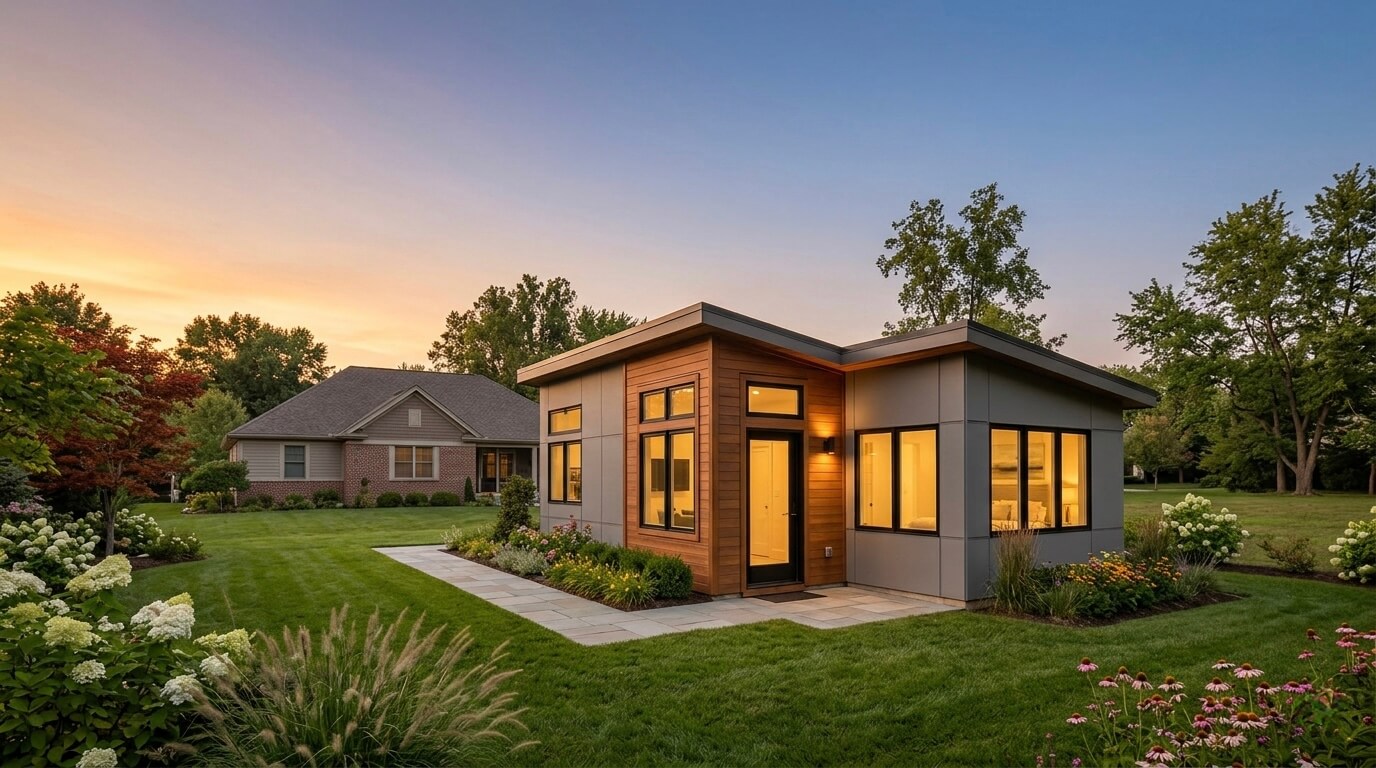
An ADU can increase home value in Northern Virginia, but there is no reliable one-size-fits-all percentage. The strongest value case comes when the unit is legally compliant, professionally built, functional as independent living space, and supported by comparable sales that demonstrate buyer demand.
A frequently cited National Association of REALTORS® estimate has put the potential value premium for homes with an accessory dwelling unit at roughly 35% in large metropolitan markets. That figure is useful as a broad market indicator, but it should not be treated as a guaranteed 35% increase for a Fairfax County, Arlington, Alexandria, or other Northern Virginia property. Local appraisal evidence, zoning, construction quality, lot characteristics, and comparable sales ultimately determine how much value an individual ADU contributes.
Northern Virginia is particularly interesting because the underlying housing market already places a high value on usable residential space. For example, the U.S. Census Bureau reports a 2020–2024 median value of $732,800 for owner-occupied homes in Fairfax County, compared with $895,000 in Arlington County. Those figures do not establish an ADU premium by themselves, but they illustrate why even a relatively modest percentage change in property value can represent a substantial dollar amount in this region.
The more important question, therefore, is not simply “Does an ADU increase property value?” It is: How will an appraiser and the resale market recognize the specific ADU on your property?
That distinction matters. A permitted detached apartment with its own entrance, kitchen, bathroom, utilities, and strong market comparables is fundamentally different from an unfinished garage conversion or an unpermitted basement apartment. Federal appraisal guidance requires the ADU and its effect on value and marketability to be analyzed rather than simply adding the construction cost to the home’s existing value.
If you are evaluating the project from a design, construction, and resale perspective, working with an experienced ADU builder in Northern Virginia can help you evaluate the property before committing to a design.
Does an ADU Increase Home Value in Northern Virginia?
Yes, a well-designed and legally compliant ADU can increase a Northern Virginia home’s market value, but the amount depends on how the local market recognizes the additional living space. Appraisers look at comparable properties, legal status, quality, utility, and marketability rather than applying a fixed ADU percentage to the home’s existing value.
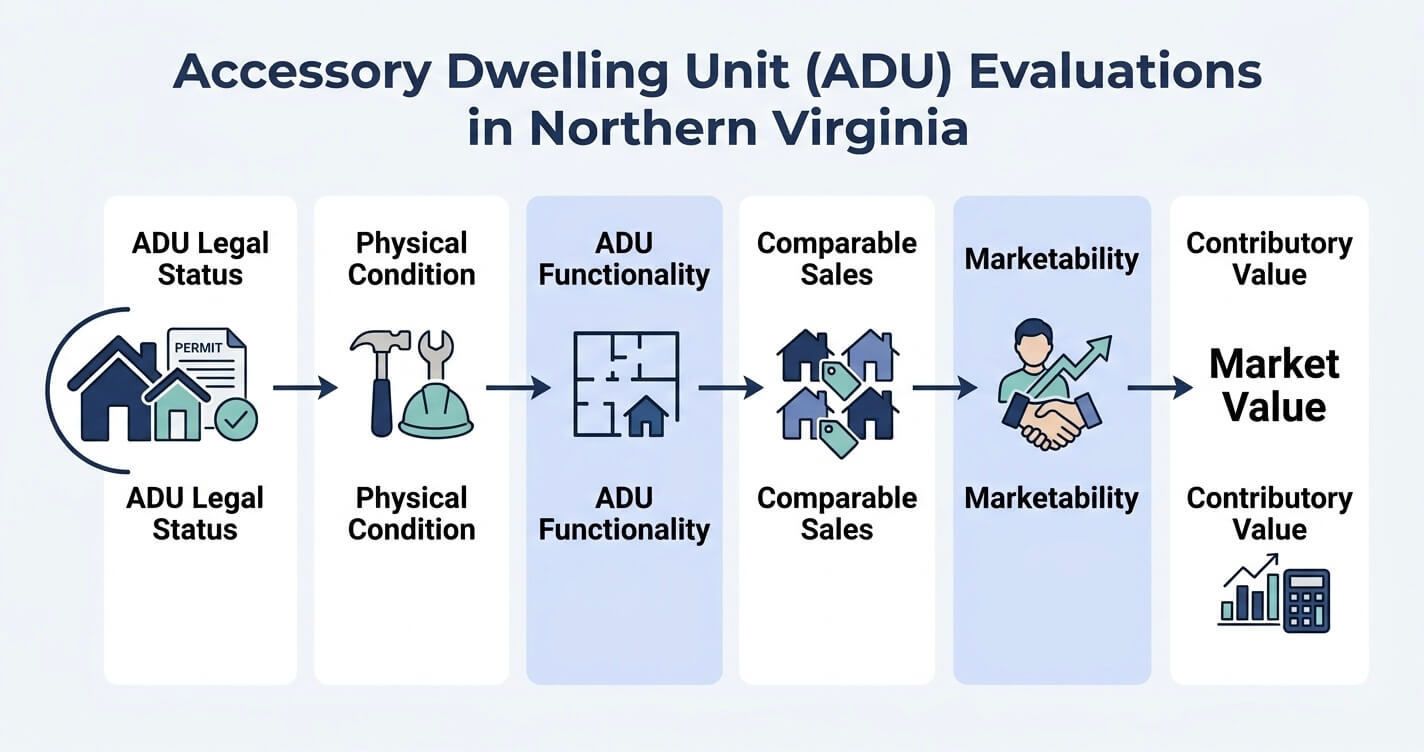
The potential upside is significant because an ADU adds something that conventional remodeling does not always provide: independent residential utility on the same parcel. Depending on its configuration, an ADU can provide a private bedroom and bathroom, kitchen or kitchenette, separate entrance, dedicated living area, and space suitable for an adult child, aging parent, guest, caregiver, or tenant.
That flexibility can make the property more attractive to several categories of buyers.
At the same time, homeowners should avoid treating an ADU as an automatic dollar-for-dollar investment. If you spend $250,000 building an ADU, for example, an appraisal does not automatically add $250,000 to the property’s value. The relevant question is how much the market would pay for the completed property compared with similar properties without that feature.
Why the 35% figure needs context
The commonly cited 35% figure is best used as a directional benchmark rather than a Northern Virginia valuation formula. NAR has recognized ADUs as a housing strategy that can help homeowners capitalize on existing home value while creating additional living space and potential rental income.
The problem is that national or large-metro estimates combine markets with very different land values, zoning systems, housing inventories, buyer preferences, and appraisal evidence. A 35% premium in one market does not mean a $1 million Northern Virginia home automatically becomes a $1.35 million property after adding an ADU.
For Northern Virginia homeowners, the more defensible approach is to ask four questions:
- Is the ADU legally permitted and recognized for its intended use?
- Are there comparable properties showing buyer demand for similar ADUs?
- Does the construction quality match the primary residence and the surrounding market?
- Does the ADU provide functional living space that buyers actually value?
These factors determine whether the ADU becomes a meaningful contributor to market value or simply an expensive improvement with limited measurable return.
Northern Virginia’s existing home values make the equation important
The underlying value of the primary residence also matters when considering the potential financial impact.
According to the U.S. Census Bureau’s latest QuickFacts data, the median value of owner-occupied housing units for 2020–2024 was $732,800 in Fairfax County and $895,000 in Arlington County.
Those are not ADU appraisal figures. Instead, they provide useful market context: when the underlying property is already valuable, even a relatively small percentage change in market value can represent tens of thousands of dollars.
For example, a hypothetical 10% increase on a $732,800 property would equal $73,280, while the same percentage on an $895,000 property would equal $89,500. That calculation is not an estimate of what an ADU will add; it simply demonstrates why percentage-based assumptions can produce very different dollar outcomes across Northern Virginia.
The actual ADU contribution still has to be supported by market evidence.
Legal status can directly affect how the ADU is treated
One of the most important distinctions in an ADU home value Northern Virginia analysis is whether the unit is legally established.
Fannie Mae’s current appraisal guidance specifically requires an appraisal to describe an ADU and analyze its effect on the property’s value and marketability. The guidance also distinguishes an ADU’s reported living area from the primary dwelling’s finished above-grade square footage in many configurations.
That means an appraiser is not simply looking at the total number of finished square feet.
The analysis can include questions such as:
- Is the unit allowed under the applicable zoning regulations?
- Does it have the characteristics of an independent living area?
- Can it legally function as an ADU?
- Does the property have separate utilities or meters?
- Does the unit have a separate entrance?
- Is the layout typical and marketable for the neighborhood?
- Are there comparable properties with similar ADUs?
- Would typical buyers in the market pay more for the property because of the ADU?
Fannie Mae specifically notes that the determination of whether a property is a one-unit dwelling with an ADU can involve characteristics such as separate utility meters, a unique postal address, and whether the unit can be legally rented.
This is why an ADU should be designed around its eventual appraisal and resale characteristics from the beginning, not treated as an isolated construction project.
Northern Virginia’s ADU value is market-specific
Northern Virginia does not operate as one uniform real estate market. Fairfax County, Arlington County, Alexandria, Fairfax City, Reston, McLean, Vienna, and other communities can have different zoning frameworks, housing stock, lot characteristics, and buyer expectations.
That creates an important appraisal principle: the same physical ADU can contribute a different amount of value depending on where it is located.
A detached 800-square-foot ADU on a large suburban lot may be highly desirable in one market because it provides independent accommodation without materially compromising the primary home’s yard. On another property, the same structure could create a less favorable result if it consumes valuable outdoor space, creates parking limitations, or does not conform to neighborhood expectations.
The market therefore evaluates the complete property, not just the ADU’s floor area.
This is also why the strongest ADU projects tend to balance three objectives:
Legal compliance → functional design → demonstrated market demand.
When those three elements align, the ADU has a much stronger foundation for contributing to resale value.
How Appraisers Actually Value an ADU (Not Just “Add It Up”)
Appraisers do not normally determine ADU value by adding the construction bill to the home’s existing value. They primarily analyze comparable sales and the market’s reaction to the ADU, with cost and income analysis used when appropriate to support a credible valuation.
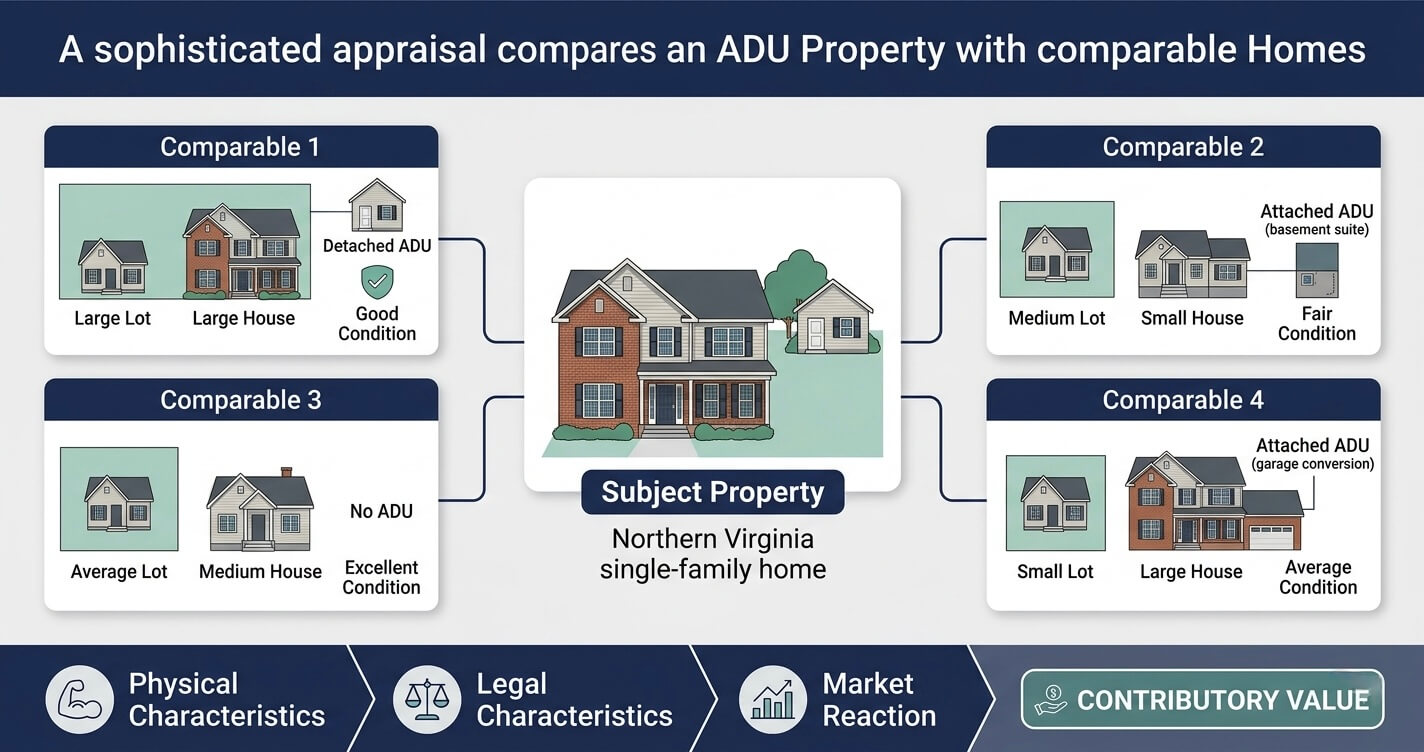
This distinction is critical for anyone calculating ADU appraisal Northern Virginia expectations.
Suppose a homeowner spends $300,000 constructing a detached ADU. That $300,000 represents the cost of the improvement, not automatically its contributory value.
The market may value the finished ADU at less than its construction cost, approximately equal to its cost, or, under favorable market conditions, at a contribution greater than the cost. The appraiser’s job is to determine the property’s market value based on available evidence, not to guarantee the homeowner’s return on construction spending.
The sales comparison approach is the primary framework
Fannie Mae describes the sales comparison approach as an analysis of comparable sales, contract sales, and listings that are most comparable to the subject property. The appraiser analyzes differences that could affect the property’s value as of the appraisal date.
Freddie Mac similarly requires appraisal reports to include a sales comparison approach and requires comparable sales to be analyzed for similarities and differences. Any adjustment must reflect the market’s reaction to the difference, rather than simply reproducing the homeowner’s construction cost.
For an ADU property, that means an appraiser may look for comparable homes with:
- A detached or attached ADU
- Similar overall lot characteristics
- Similar primary-home size and quality
- Comparable ADU size and functionality
- Similar bedroom and bathroom configurations
- Similar location and neighborhood characteristics
- Similar legal or zoning status
- Similar construction quality and condition
- Similar utility and access arrangements
The closer the comparable property is to the subject property, the easier it becomes to isolate the ADU’s contribution to market value.
What happens when there are few ADU comparables?
This is one of the biggest challenges for homeowners asking does an ADU increase property value in a specific Northern Virginia neighborhood.
ADUs remain a relatively specialized property feature compared with ordinary bedrooms, bathrooms, kitchens, garages, and finished basements. Consequently, an appraiser may not always find several recent closed sales with nearly identical ADUs within the immediate neighborhood.
That does not automatically mean the ADU has no value.
Freddie Mac’s appraisal guidance recognizes situations where a comparable sale with an ADU is unavailable. The appraiser may use an older ADU sale in the market area, a comparable ADU sale from a competing market area, or a comparable without an ADU when the appraiser can justify and support that approach. Freddie Mac also states that at least three closed comparable sales are required for the sales comparison approach, while additional listings or pending sales may be used to support the analysis.
That makes the quality of the appraisal analysis particularly important for an uncommon property configuration.
FHFA’s Uniform Appraisal Dataset also provides a large-scale source of appraisal information. FHFA reports that more than two-thirds of Enterprise-backed appraisals from 2013–2021 included five or more comparable properties, although the share declined over that period. The agency explains that appraisers select comparable properties based on similarities in legal and physical characteristics and then make market-supported adjustments.
For homeowners, the practical takeaway is simple: an ADU with strong comparable evidence is easier to defend in an appraisal than an unusual ADU with no meaningful market precedent.
FHFA data confirms that ADU properties can behave differently in appraisal data
FHFA began incorporating an “Accessory Dwelling Unit Present” characteristic into its Uniform Appraisal Dataset Aggregate Statistics in 2023. Its analysis of California Enterprise-backed single-family appraisals found that properties with ADUs experienced higher relative growth in median appraised value than properties without ADUs between 2013 and 2023. (FHFA.gov)
However, this is an important distinction for a Northern Virginia homeowner: the FHFA study is California-specific and should not be presented as a Virginia ADU value premium.
It is nevertheless valuable because it demonstrates that federal appraisal data can distinguish properties with ADUs from those without them and can be used to study differences in appraised value over time.
FHFA’s broader UAD program now provides appraisal-level and aggregate data that include property, site, neighborhood, and comparable-property characteristics. The agency’s public-use appraisal dataset is based on a nationally representative 5% sample of Enterprise appraisals for single-family mortgages, although the currently published appraisal-level release covers historical appraisal years rather than providing a live 2026 Northern Virginia ADU valuation calculator.
The ADU is analyzed separately from ordinary finished square footage
Fannie Mae’s current guidance provides an especially important technical point for ADU owners.
When an ADU is present, its living area generally should not simply be combined with the primary dwelling’s finished above-grade square footage. Depending on the configuration, the ADU is reported and adjusted separately in the sales comparison grid.
This matters because homeowners sometimes assume that adding 800 square feet of ADU space means the property can automatically be valued at another 800 square feet multiplied by the neighborhood’s typical price per square foot.
That is not how a credible appraisal necessarily works.
An ADU has a different functional and market profile from ordinary additions to the primary residence. Its independent entrance, kitchen, bathroom, utility arrangement, privacy, rental potential, and relationship to the primary dwelling can all affect how buyers perceive the property.
The appraiser therefore evaluates its contributory value within the context of the entire property.
Permitted and unpermitted ADUs are not necessarily treated identically
An unpermitted ADU deserves particular caution.
Fannie Mae’s guidance states that when an appraiser identifies an addition that does not have a required permit, the appraiser must comment on the quality and appearance of the work and its impact, if any, on market value.
For ADUs specifically, Fannie Mae also provides circumstances under which certain noncompliant zoning uses can remain eligible for financing, but additional conditions and comparable-sale evidence may be required. The appraisal must disclose the noncompliant use and demonstrate that the improvements are typical for the market through comparable sales.
That is very different from saying that an unpermitted ADU has no value.
The correct conclusion is more nuanced: legal status can materially affect marketability, financing, appraisal analysis, and buyer confidence, and the effect depends on the circumstances of the property and local market.
For Northern Virginia homeowners, the safest value strategy is therefore to resolve zoning and permit requirements before construction rather than hoping the finished unit will receive full recognition later.
If your property is in Fairfax County, the dedicated ADU permit process in Fairfax County guide can be used alongside this valuation discussion to understand the permitting side before treating the ADU as a resale asset.
Quality and market conformity matter too
An ADU does not exist in isolation from the primary residence.
Fannie Mae’s appraisal guidance states that improvements should conform to the neighborhood in terms of age, type, design, and materials. If a property has characteristics that create market resistance because of design, quality, size, condition, or other factors, the appraiser must address their effect on value and marketability.
That principle is particularly relevant to high-value Northern Virginia properties.
A professionally designed ADU that visually and functionally complements the main house may be perceived very differently from a cheaply executed structure that looks disconnected from the property. The same applies to interior finishes, HVAC, plumbing, electrical systems, windows, insulation, accessibility, storage, parking, and outdoor circulation.
In other words, adding more square footage is not the same as adding more market value.
The strongest ADU home value Northern Virginia strategy is to create a legal, durable, independently functional living space that fits the property and the expectations of its local buyer pool, and then make sure the project’s documentation, permits, plans, and completed features are clear enough for an appraiser to analyze accurately.
ADU Value by Type – Detached, Attached, Garage Conversion, Basement Unit
The type of ADU affects both its construction economics and its contributory value. Detached ADUs generally offer the strongest combination of privacy and independent functionality, while garage and basement conversions can produce a stronger return relative to construction cost when the existing structure is suitable.
There is no appraisal rule stating that a detached ADU is automatically worth more than an attached or converted ADU. Instead, the market evaluates what the completed space contributes to the property.
Fannie Mae defines an ADU as an additional living area that is independent from the primary dwelling and provides basic living, sleeping, cooking, and bathroom facilities. Its current appraisal guidance also requires the ADU to be described separately and its effect on value and marketability to be analyzed.
That distinction makes the ADU home value Northern Virginia calculation more complicated than simply comparing square footage.
Detached ADUs
A detached ADU is usually the most independent configuration. Because it is physically separated from the primary residence, it can provide greater privacy, a separate entrance, independent living areas, and clearer separation between occupants.
For multigenerational households, guests, or long-term tenants, that independence can be a major functional advantage.
From an appraisal perspective, however, the detached structure still has to demonstrate market acceptance. Fannie Mae requires the appraiser to analyze whether the ADU’s improvements are acceptable for the market and to consider appropriate comparable sales or supplemental market evidence.
A detached ADU can therefore be particularly attractive when:
- The lot has sufficient land for a second residential structure.
- The ADU maintains reasonable privacy from the main house.
- Parking and access remain functional.
- The design is consistent with the primary residence and neighborhood.
- The unit has a legal and clearly documented use.
- The finished space provides genuine independent living functionality.
The drawback is that detached construction generally requires more new infrastructure than a conversion. Site work, foundation construction, exterior walls, roofing, utility connections, grading, drainage, and access can all increase the project budget.
That means highest absolute value potential does not necessarily mean highest ROI.
Attached ADUs
An attached ADU can be incorporated into the primary residence, added as a connected addition, or configured within an existing portion of the structure.
Its major advantage is infrastructure efficiency. Depending on the property, an attached configuration can make use of existing structural elements, utilities, mechanical systems, or circulation.
However, the exact layout matters considerably.
A private entrance, dedicated bathroom, kitchen facilities, appropriate egress, and a reasonable separation between the ADU and primary living areas can make the unit function much more like an independent residence.
Fannie Mae’s guidance specifically recognizes that an ADU contained within or part of the primary dwelling with interior access can be treated differently from a detached or non-contiguous finished area when the appraiser reports the living area.
This is one reason homeowners should not assume that two ADUs with identical square footage will receive identical appraisal treatment.
If your project involves expanding the primary structure to create the additional living space, it may also overlap with the broader home addition contractors service category.
Garage Conversions
Garage conversions can be financially attractive because the basic enclosure already exists.
Instead of constructing an entirely new building envelope, the project may be able to reuse the existing foundation, walls, roof, and portions of the electrical or mechanical infrastructure. The actual savings depend heavily on the garage’s existing condition and the requirements for bringing it to residential standards.
A garage conversion becomes more valuable when the finished space feels like a deliberately designed living unit rather than a garage that happens to contain drywall, flooring, and a bathroom.
Important considerations include:
- Ceiling height
- Insulation
- Heating and cooling
- Natural light
- Emergency egress
- Plumbing
- Electrical capacity
- Moisture control
- Fire separation
- Parking requirements
- Legal ADU status
The financial advantage is therefore primarily a cost-versus-contributory-value question.
A homeowner who spends less to create a legally compliant, functional ADU may achieve a stronger return on investment than someone who builds a substantially more expensive detached unit, even if the detached unit ultimately contributes more dollars to the property’s resale value.
Basement ADUs
Basement ADUs can be another efficient option when the existing basement already has adequate ceiling height, access, windows, mechanical capacity, and a layout that can accommodate independent living.
The primary limitation is that below-grade space does not necessarily receive the same appraisal treatment as above-grade living area.
Fannie Mae’s appraisal guidance requires below-grade areas to be reported separately from above-grade finished area in the appraisal comparison grid. The same guidance also requires appropriate adjustments based on the market’s reaction to those differences.
That does not mean a finished basement ADU has no value. It means the homeowner should not assume that every finished basement square foot will receive the same contributory value as an equivalent amount of above-grade living area.
For a Northern Virginia property, the basement configuration should therefore be evaluated on its complete functionality: legal use, ceiling height, natural light, egress, private access, finish quality, bathroom and kitchen facilities, and comparable market evidence.
ADU Type Comparison
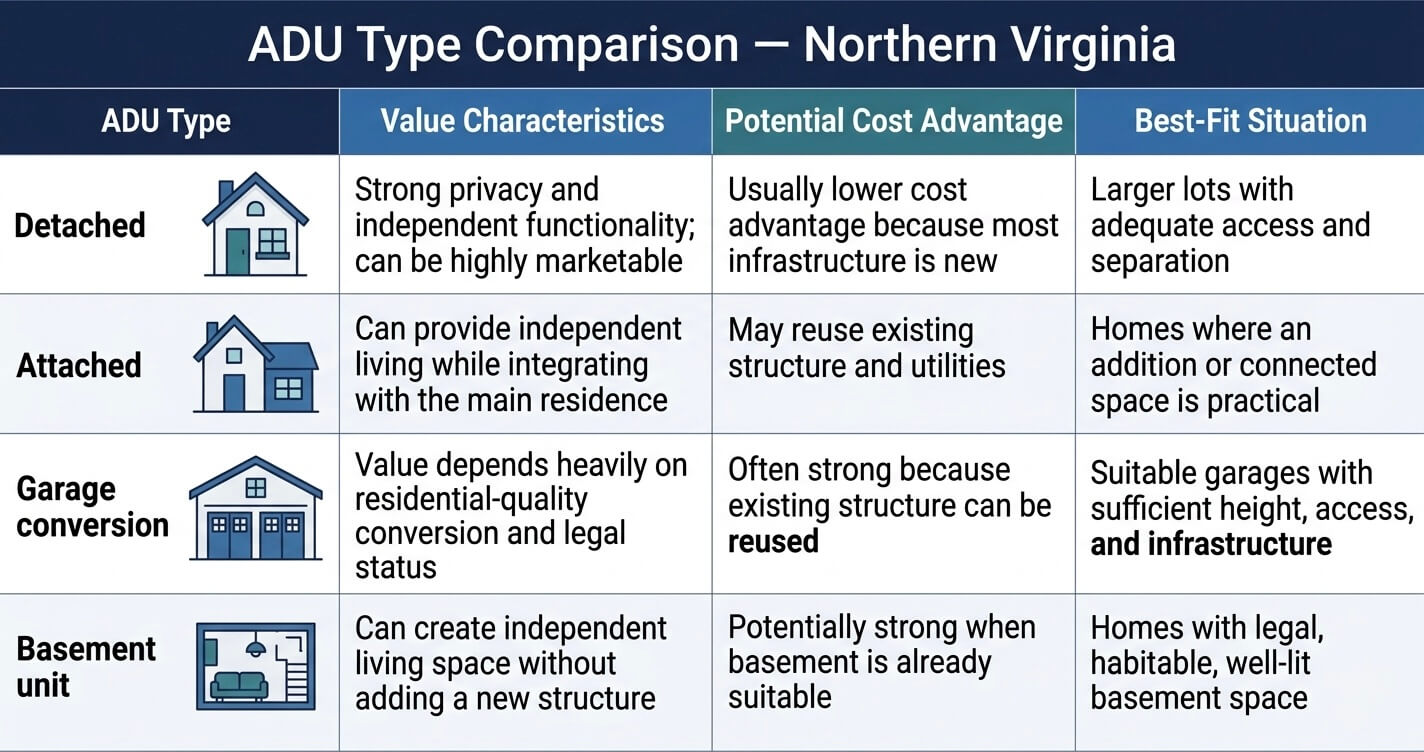
The table should be interpreted as a relative framework, not an appraisal schedule. Neither Fannie Mae nor the federal appraisal standards assign a universal dollar premium to one ADU type. The market-supported contribution depends on the specific property and comparable sales.
For homeowners still determining whether the financial equation works, the detailed ADU cost in Northern Virginia guide is the natural next step because construction cost must be evaluated separately from eventual contributory value.
County-by-County Snapshot: Fairfax County, Arlington, Alexandria, McLean, Vienna, Reston
ADU value does not move uniformly across Northern Virginia. Local land values, housing stock, zoning, lot configuration, buyer demand, and the availability of comparable properties can all influence how strongly an ADU contributes to resale value.
Northern Virginia should therefore be treated as a collection of interconnected but distinct housing markets rather than a single appraisal market.
Fannie Mae’s current comparable-sales guidance defines the relevant market area around where most demand and competition for the subject property exist. Comparable properties should be physically and legally similar, and an appraiser may expand the geographic search when appropriate comparables are not available locally.
That principle is especially important for ADUs because they are less common than standard bedrooms, bathrooms, garages, or conventional additions.
Fairfax County
Fairfax County is one of the most important ADU markets in Northern Virginia because of its large and diverse single-family housing stock.
The U.S. Census Bureau reports a 2020–2024 median value of owner-occupied housing units of $732,800 in Fairfax County. The county also had an estimated 1,167,873 residents in 2025, illustrating the scale of the underlying housing market. (U.S. Census Bureau)
For an ADU homeowner, those numbers provide market context rather than an ADU premium. The actual contribution still depends on the individual property’s location, lot, zoning, design, and comparable sales.
Fairfax County also contains very different submarkets. An ADU on a larger suburban lot can have a different market profile from one incorporated into a more constrained property closer to major employment and transportation corridors.
Homeowners should therefore evaluate the specific zoning and permit requirements before treating an ADU as a resale asset. The dedicated ADU permit process in Fairfax County guide provides the regulatory context that complements this valuation discussion.
Arlington County
Arlington presents a different housing environment because of its relatively high underlying property values and more urbanized development pattern.
The Census Bureau reports a 2020–2024 median value of owner-occupied housing units of $895,000 in Arlington County.
That does not mean an ADU in Arlington automatically generates a larger percentage or dollar premium than an ADU elsewhere.
Instead, the higher underlying property values mean that the financial significance of relatively small changes in contributory value can be substantial. At the same time, lot size, setbacks, parking, existing site improvements, and neighborhood configuration can constrain what type of ADU is practical.
Arlington homeowners should also distinguish valuation questions from regulatory questions. The existing ADU regulations in Arlington guide addresses the local regulatory framework, while this article focuses on how the completed improvement can affect market value.
Alexandria
Alexandria is another distinct market within Northern Virginia, with a mix of older housing stock, established neighborhoods, and properties where additions or conversions can be more practical than entirely new detached structures.
The Census Bureau reports a 2020–2024 median value of owner-occupied housing units of $735,100 for Alexandria City.
For Alexandria properties, the relationship between an ADU and the existing house can be particularly important. A thoughtfully integrated addition or conversion can increase functional utility while preserving the character and usability of the primary residence.
Conversely, a poorly planned ADU that compromises parking, outdoor space, circulation, or the property’s architectural character can limit the amount buyers are willing to pay.
The valuation question is therefore not simply “How much ADU square footage was added?” but “How did the completed property become more useful and competitive in its market?”
McLean
McLean should be approached as a higher-value Northern Virginia submarket where the quality and integration of an ADU can matter as much as its size.
Large homes and lots can create opportunities for detached or attached accessory living spaces, particularly when the ADU is designed to complement the primary residence rather than appear as an unrelated secondary structure.
In this type of market, finishes, architectural consistency, privacy, landscaping, parking, and site planning can become important components of marketability.
An expensive ADU does not automatically create an equivalent increase in value. Fannie Mae’s guidance specifically requires improvements to be considered in relation to neighborhood conformity and market demand, including design, quality, size, condition, plumbing, heating, and electrical adequacy.
Vienna
Vienna’s established residential neighborhoods can make lot utilization particularly important.
An ADU that provides additional independent living space while preserving the property’s overall usability can offer a strong functional proposition. However, a design that consumes too much yard area, creates access problems, or changes the property’s relationship with surrounding homes may produce a weaker market response.
The strongest valuation strategy is therefore to treat the ADU as part of the site’s complete design rather than as an isolated building.
This includes considering the primary home’s architecture, outdoor living space, parking, privacy, drainage, landscaping, and pedestrian circulation before deciding where the ADU should be located.
Reston
Reston presents another useful example because housing types, lot configurations, and neighborhood characteristics vary considerably.
An ADU’s value in Reston should therefore be evaluated against properties that compete for the same buyers rather than against an arbitrary Northern Virginia-wide price-per-square-foot figure.
A real project can also provide useful context. USHDB’s real ADU build in Reston case study gives readers a project-specific example of how an ADU can be designed and constructed within a Northern Virginia setting.
The case study should not be interpreted as proof of a particular resale premium. Instead, it demonstrates why the physical characteristics of the completed project matter when discussing value.
Northern Virginia Local-Market Comparison
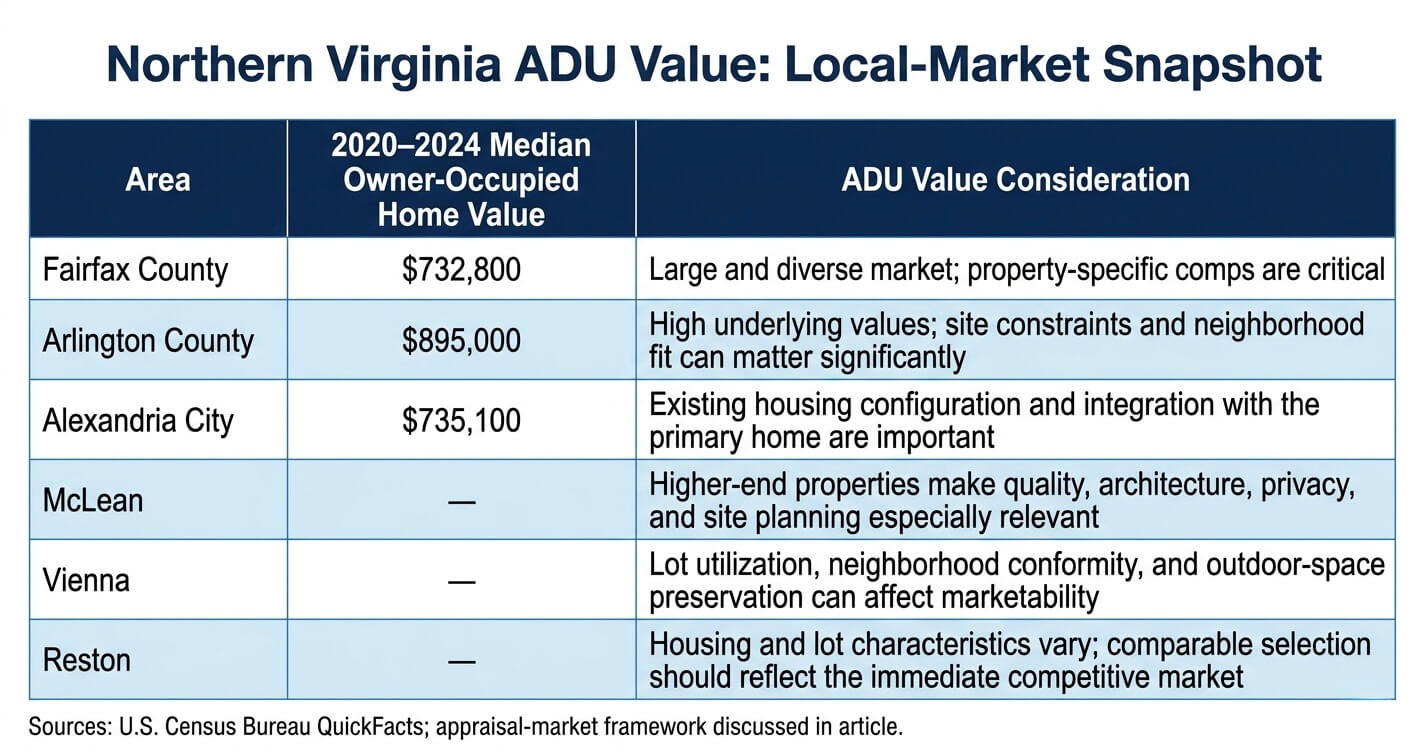
Source for published Census figures: U.S. Census Bureau QuickFacts for Fairfax County, Arlington County, and Alexandria City.
The absence of a Census median-value figure for McLean, Vienna, and Reston in this table is intentional. They are not equivalent Census county-level geographies, and inserting a different dataset merely to fill the cells could create a misleading apples-to-oranges comparison.
The more important lesson is that ADU value should be localized at the comparable-sale level, not manufactured from broad regional averages.
ADU Value vs. Rental Income – Two Different Numbers
An ADU’s resale value and rental income are separate financial benefits. Rental income measures recurring cash flow, while resale value measures the additional market value the completed property can command at sale or support during a refinance.
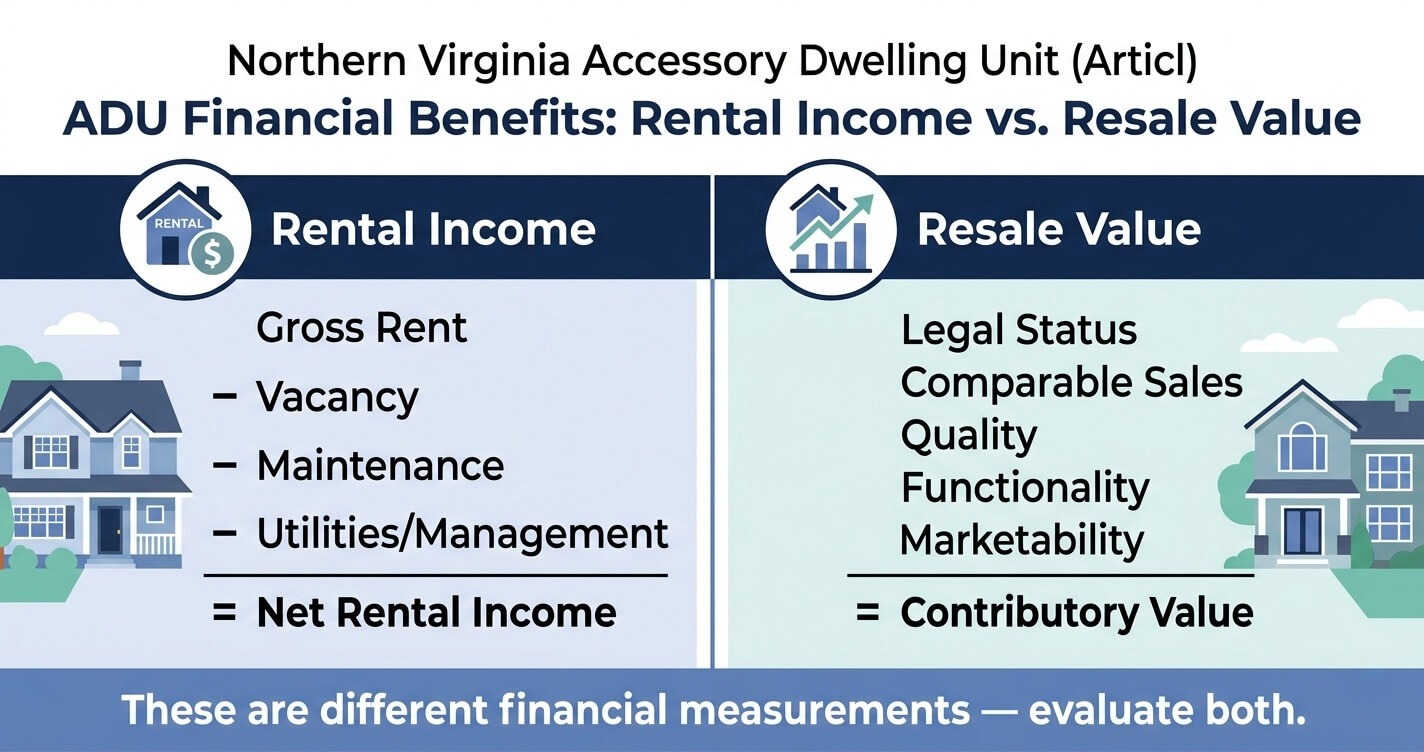
This distinction is essential when calculating the potential ADU ROI Fairfax County or anywhere else in Northern Virginia.
A homeowner can have a successful ADU investment even when the two numbers do not move together.
For example, an ADU may generate strong monthly rental income because tenants value the location and privacy, while its appraised contributory value remains more modest because there are few comparable ADU sales.
The reverse can also happen. A beautifully designed ADU in a high-demand market may make the property significantly more attractive to future buyers while generating relatively modest rental income because of local rents, vacancy risk, operating expenses, or owner-use restrictions.
Rental income is a cash-flow calculation
Rental income is relatively straightforward to conceptualize.
The homeowner estimates expected gross rent and subtracts the expenses associated with operating the unit.
A simplified annual model is:
Net rental income = Gross annual rent − operating expenses − vacancy allowance − applicable management/maintenance costs
The resulting figure can then be compared with the ADU’s construction cost to estimate a rental payback period.
This is fundamentally different from an appraisal.
An appraiser is estimating the property’s market value as of a specific valuation date, based primarily on market evidence and comparable properties. Fannie Mae’s guidance requires comparable-sale adjustments to reflect the market’s reaction to differences between properties, not simply the owner’s investment or expected income.
Resale value is a market-value calculation
When evaluating resale value, the relevant question becomes:
How much more would a typical buyer pay for this completed property compared with a competitive property without the ADU?
That answer can be influenced by:
- Legal status
- ADU size and layout
- Quality of construction
- Separate entrance
- Kitchen and bathroom functionality
- Privacy
- Parking
- Lot size
- Primary-home condition
- Neighborhood demand
- Comparable ADU sales
- Potential rental use
- Multigenerational functionality
The homeowner’s construction invoice is only one part of the investment analysis.
This is why the statement “I spent $300,000, so the house should be worth $300,000 more” is not a reliable appraisal assumption.
An ADU can create value before the property is sold
Resale is also not the only way homeowners can benefit from increased property value.
A higher appraised value can potentially increase available equity and influence refinancing decisions, although the actual financing outcome depends on the lender, loan program, appraisal, borrower qualifications, and market conditions.
FHFA’s UAD data provides an important large-scale example of why this distinction deserves attention. Its California analysis found that median appraised values for Enterprise-backed single-family purchase properties with ADUs rose from $550,000 in 2013 to $1.064 million in 2023, compared with $405,000 to $715,000 for properties without ADUs. FHFA also reported annualized growth of 9.34% for properties with ADUs versus 7.65% without ADUs over that period.
However, this evidence must be interpreted correctly.
Those are California appraisal statistics, not Northern Virginia ADU premiums. FHFA itself describes the analysis as California-specific, and the data does not establish that a Northern Virginia ADU will produce the same dollar increase or growth rate.
The value of the FHFA research is that it demonstrates how large-scale appraisal data can identify differences between properties with and without ADUs.
Rental income and resale value can reinforce each other
The strongest ADU investment cases can combine both benefits.
A legally compliant ADU can provide:
Immediate utility → rental or family-use benefits → potential long-term equity contribution.
For example, a homeowner may use the ADU as a rental unit for several years, generating recurring income, and later sell the property as a home with an established independent living space.
Another homeowner may never rent the ADU but use it for an aging parent, adult child, caregiver, or guests. In that case, the financial benefit is not captured by monthly rent at all.
This is why an ADU should be evaluated according to the homeowner’s use case, not just a generic ROI calculator.
Which financial case is stronger?
Can rental income, utility, and future resale value justify the investment?
There is therefore no universal answer to whether an ADU is a better investment for rental income or resale value.
The right calculation depends on how long the homeowner expects to hold the property, the construction budget, expected rent, financing costs, maintenance requirements, local regulations, and the property’s likely resale market.
For homeowners specifically comparing rental economics, the detailed ADU rental income in Northern Virginia guide provides the complementary cash-flow analysis.
The key takeaway is that rental income tells you what the ADU can earn while you own it; appraisal and resale analysis tell you what the improvement may contribute to the property’s value. A complete 2026 ADU investment decision should examine both rather than treating either number as a substitute for the other.
Cost vs. Value – Is the ADU “Worth It” in 2026?
An ADU can be worth the investment in Northern Virginia, but construction cost and added property value are two different measurements. The project makes the strongest financial sense when the expected market value, rental income, personal utility, and holding period collectively justify the total development cost.
The most important mistake homeowners can make is treating an ADU as a guaranteed dollar-for-dollar investment.
If an ADU costs $250,000 to construct, that does not mean the finished property will automatically appraise for $250,000 more. In fact, federal appraisal guidance specifically cautions against relying on a mechanical cost-to-value calculation. Fannie Mae states that the cost approach cannot be the sole basis for market value and that appraisal adjustments must reflect market reaction rather than simply reproducing construction costs.
That distinction is especially important in Northern Virginia, where construction costs can be substantial but the underlying housing market is also relatively high-value.
Construction cost is the starting point, not the return
The total cost of an ADU can include much more than the building itself.
Depending on the project, homeowners may need to account for:
- Architectural and design services
- Engineering
- Permit and review fees
- Site preparation
- Foundation work
- Framing and exterior construction
- Roofing and insulation
- Plumbing
- Electrical
- HVAC
- Kitchen and bathroom finishes
- Windows and doors
- Utility connections
- Landscaping and drainage
- Driveway or parking modifications
- Project management
- Financing costs
- Contingency reserves
This is why a construction estimate should be compared with both potential contributory value and potential income, rather than with resale value alone.
A homeowner considering a new detached structure should also compare its economics with an attached, basement, or garage-conversion ADU. The cheapest configuration to construct is not necessarily the one that produces the highest absolute increase in property value, while the most expensive configuration is not necessarily the one that produces the strongest ROI.
For a detailed breakdown of regional construction economics, homeowners can review the ADU cost in Northern Virginia guide before establishing an investment target.
A simple ADU value model
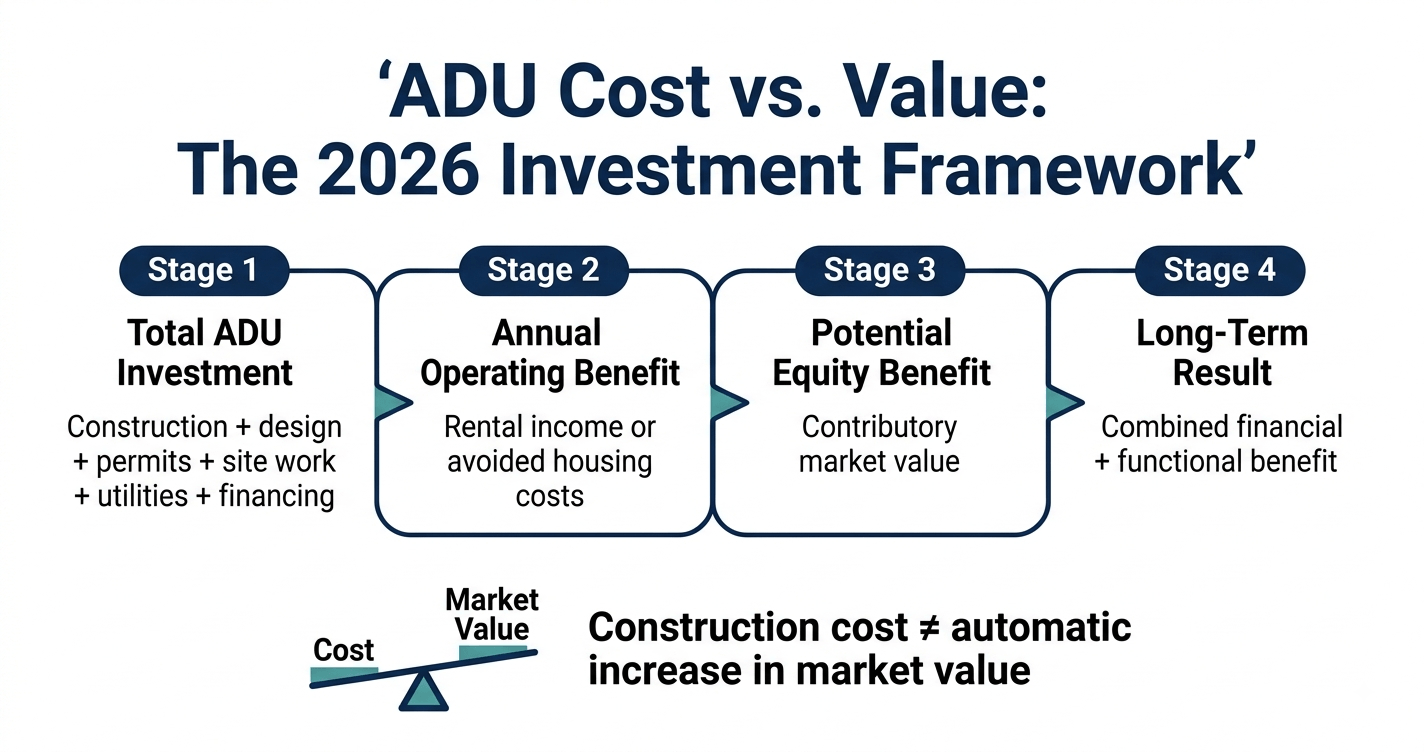
A useful way to think about the project is to separate four financial components:
Total ADU investment → construction and development cost
Annual operating benefit → rental income or avoided housing costs
Potential equity benefit → contributory market value
Long-term result → combined benefit over the expected ownership period
This framework prevents one metric from being mistaken for the entire investment return.
For example, imagine a hypothetical homeowner spends $300,000 on a legal ADU.
If the homeowner rents it, the unit may generate recurring income while also providing a potential resale benefit later.
If the homeowner uses it for an aging parent, adult child, or guest, the financial benefit may instead come from avoiding another housing arrangement and improving the property’s functionality.
If the homeowner sells shortly after construction, however, there may be insufficient time to recover the development cost through rental income.
The same $300,000 project can therefore produce very different economic outcomes depending on the owner’s objective and holding period.
Why appraisal value may differ from construction cost
Fannie Mae’s appraisal guidance requires the appraiser to analyze the ADU’s effect on value and marketability and demonstrate that the improvement is acceptable for the market.
The appraiser’s question is essentially:
What does the market pay for this completed property?
That is different from:
How much did the owner spend building it?
The difference is called contributory value in practical appraisal analysis.
A highly customized feature can cost significantly more than typical buyers are willing to pay for it. Conversely, an improvement that solves a strong local housing need can have substantial market utility even when its construction cost is relatively modest.
This is why design decisions should be made around market usefulness, not simply around maximizing square footage.
A practical 2026 break-even framework
Rather than promising a specific ADU value percentage, homeowners can evaluate three broad scenarios.
Scenario 1: Selling soon after construction
If the owner expects to sell shortly after completing the ADU, resale contribution becomes the dominant consideration.
The key questions are:
- Is the ADU legal and documented?
- Are there comparable properties supporting its marketability?
- Does the finished unit match neighborhood expectations?
- Does it provide a feature buyers actively seek?
- Does the completed property remain competitive after considering the cost of the project?
A short holding period creates greater risk because there is less time for rental income or personal-use benefits to offset the initial investment.
Scenario 2: Holding and renting the ADU
A longer holding period changes the calculation.
Rental income can gradually offset the development cost while the homeowner retains ownership of the property and its potential future appreciation.
The appropriate metric becomes net operating benefit over time, rather than immediate resale value.
However, rent should never be treated as guaranteed profit. Vacancy, maintenance, repairs, insurance, utilities, management, taxes, and financing can reduce the actual return.
Scenario 3: Holding for personal or multigenerational use
The financial return can be even harder to express when the ADU is not rented.
An ADU may allow a family member to live independently while remaining close to relatives. It may provide space for a caregiver, guest, or adult child without requiring another housing purchase or rental.
Those benefits have economic value to the homeowner even though they do not appear as monthly rental income.
What should “worth it” mean?
For an ADU home value Northern Virginia decision, “worth it” should mean that the project meets the homeowner’s financial and functional objectives—not that the appraisal necessarily matches the construction invoice.
A strong project may provide:
- Meaningful additional living space
- Rental income
- Multigenerational functionality
- Increased marketability
- Potential equity growth
- Better long-term use of the existing lot
The best projects are therefore designed backward from the owner’s objective: What do you want the ADU to accomplish, and what level of investment is justified by that outcome?
Before committing to construction, homeowners weighing the numbers may benefit from discussing the specific lot, budget, intended use, and timeline with an experienced design-build team.
What Actually Moves the Needle on ADU Value?
Permit status, market-supported functionality, construction quality, independent access and utilities, site design, and comparable sales generally matter more than raw ADU square footage. A smaller, legally compliant and highly functional ADU can therefore contribute more value than a larger but poorly designed or difficult-to-market unit.
The appraisal process supports this principle.
Fannie Mae requires comparable properties to have similar physical and legal characteristics and requires the appraiser to account for factors that affect value. Its guidance also requires adjustments to reflect the market’s reaction to differences between the subject property and comparable sales.
That gives homeowners a useful framework for understanding what actually drives ADU resale value Virginia.
1. Legal and permit status
Legal status is one of the most important value variables because an ADU’s zoning and permit condition can affect marketability, appraisal analysis, financing, and buyer confidence.
A legally established ADU gives an appraiser clearer evidence about its intended use and allows comparable properties to be selected based on similar legal characteristics.
Fannie Mae requires the appraisal to address an ADU’s zoning status and, where an ADU represents a non-compliant use, requires specific market evidence demonstrating that the use is typical and acceptable for the market.
Freddie Mac’s current 2026 guidance similarly requires at least one comparable sale with an ADU when available for an eligible property with an ADU. If no recent ADU comparable exists in the subject market area, an older sale or a sale from a competing market area can be used.
For Northern Virginia homeowners, this makes permitting more than a construction requirement. It can be part of the property’s future valuation story.
2. Functional independence
An ADU should function as a genuine independent living space.
Fannie Mae describes an ADU as an additional living area independent from the primary dwelling that can provide living, sleeping, cooking, and bathroom facilities.
That means features such as these can materially affect marketability:
- Private entrance
- Full or appropriate kitchen facilities
- Bathroom
- Sleeping area
- Living area
- Adequate heating and cooling
- Natural light
- Emergency egress where required
- Reasonable privacy
- Functional circulation
A 700-square-foot unit with excellent functionality may be more marketable than an 850-square-foot unit with an awkward layout.
3. Construction quality
An ADU should be finished to a quality level that is appropriate for the primary residence and surrounding market. Cheap finishes can limit marketability, while unnecessary luxury upgrades may not produce equivalent market value.
Fannie Mae requires appraisers to consider the quality, condition, design, size, and other characteristics of improvements in relation to the market.
For a Northern Virginia property, that can include:
- Durable flooring
- Appropriate cabinetry
- Quality plumbing fixtures
- Efficient HVAC
- Modern electrical systems
- Proper insulation
- Energy-efficient windows
- Durable exterior materials
- Appropriate lighting
- High-quality kitchen and bathroom finishes
The objective is not to build the most expensive ADU possible.
It is to build an ADU whose quality is consistent with what buyers expect for that property and neighborhood.
4. Separate access and utilities
Independent access can make an ADU substantially easier to understand and use.
A separate entrance improves privacy and reinforces the unit’s independent function. Separate or clearly allocated utilities can also make the property’s configuration easier for future owners to understand.
Fannie Mae’s ADU guidance specifically identifies characteristics such as separate utility meters, a unique postal address, and whether the unit can be legally rented as factors that can help determine whether an area qualifies as an ADU.
This does not mean every ADU needs separate meters or a unique address to have value.
It means the more clearly the unit functions as an independent residential space, the easier it can be for buyers, lenders, and appraisers to understand what they are evaluating.
5. Lot utilization and site design
An ADU adds value only when the complete property remains functional. Poor placement can sacrifice parking, outdoor living space, privacy, drainage, or access and offset some of the benefit created by the additional living area.
This is particularly important for detached ADUs.
Before construction, homeowners should evaluate:
- Building setbacks
- Access
- Parking
- Yard area
- Privacy
- Stormwater and drainage
- Landscaping
- Utility routes
- Fire access
- Relationship between the primary home and ADU
Fannie Mae’s site guidance requires the appraiser to consider factors affecting the property’s use, value, and marketability, including adjoining properties and site characteristics.
A technically compliant ADU can still be a weak design solution if it makes the rest of the property less desirable.
6. Comparable-sale evidence
Comparable sales are ultimately what convert an attractive ADU concept into defensible market-value evidence. The closer the comparable properties are in physical characteristics, legal status, location, and functionality, the easier it is to support the ADU’s contributory value.
Fannie Mae requires appraisers to select comparable sales based on relevant physical and legal similarities and to analyze differences that affect value.
Freddie Mac’s 2026 ADU guidance goes further by requiring at least one ADU comparable when available for eligible properties with ADUs. If an appropriate ADU sale is unavailable locally, the appraiser may use an older ADU comparable or a comparable from a competing market area.
This is why homeowners should not rely exclusively on a generic online estimate of “ADU value per square foot.”
The relevant evidence is what buyers have actually paid for properties with similar characteristics.
The six-factor value test
Before construction, a homeowner can use this simple test:
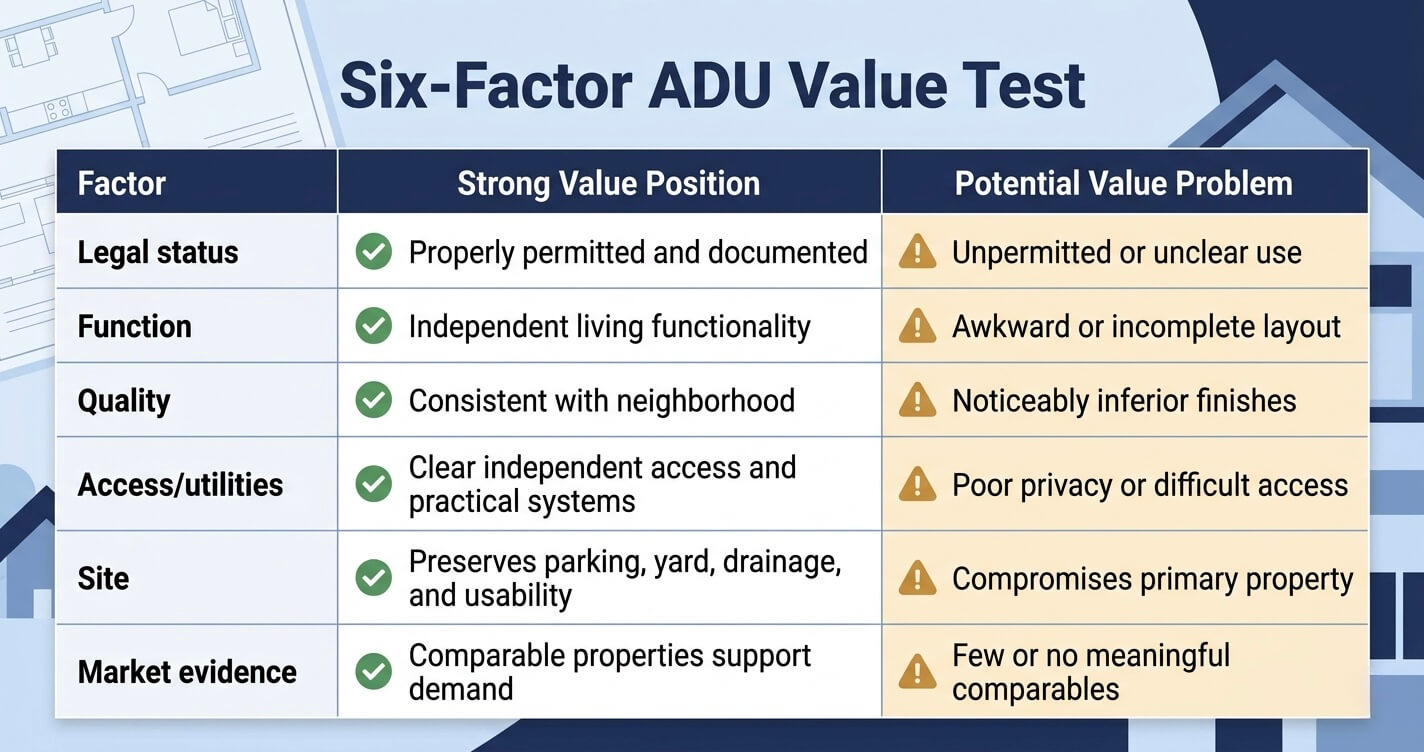
The goal is not to maximize every category at the highest possible cost.
The goal is to avoid weaknesses that can prevent the market from recognizing the improvement.
Common Mistakes That Shrink ADU Value
The biggest ADU value killers are usually not a lack of square footage; they are legal uncertainty, poor-quality construction, weak functionality, and design decisions that reduce the usability of the overall property. These problems can make an expensive ADU harder to market and harder to support through comparable sales.
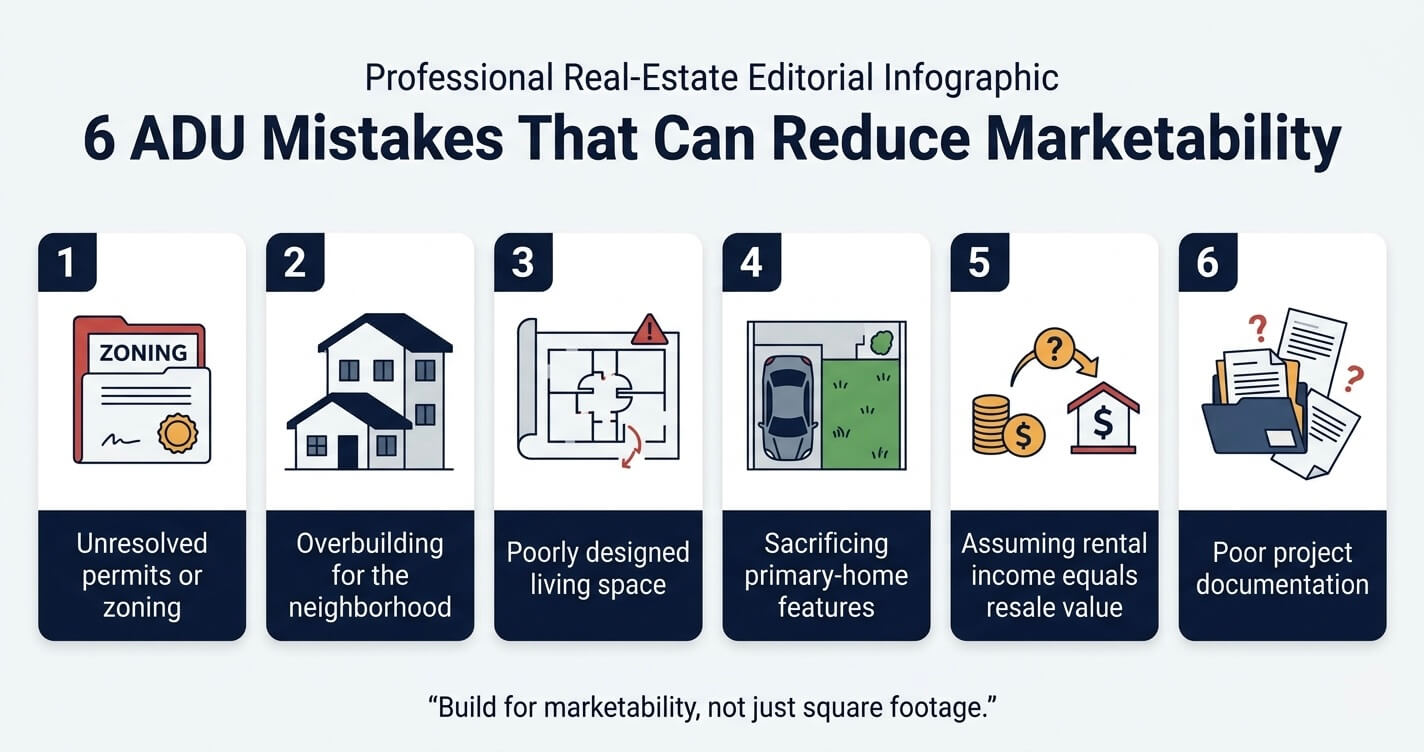
The good news is that most of these problems can be addressed before construction begins.
1. Building without resolving permit and zoning requirements
An ADU that does not have clear legal status can create uncertainty for future buyers, lenders, insurers, and appraisers.
Federal appraisal guidance does not say that every non-compliant ADU automatically has zero value. In fact, Fannie Mae and Freddie Mac provide specific circumstances under which certain properties with non-compliant ADUs may remain eligible. But those situations require additional appraisal analysis and market evidence.
For a homeowner focused on maximizing resale value, avoiding that uncertainty is generally preferable.
The better approach is to confirm the applicable zoning, building, fire, parking, utility, and occupancy requirements before finalizing the design.
2. Overbuilding relative to the neighborhood
More expensive does not automatically mean more valuable. An oversized or excessively customized ADU can exceed what buyers in the surrounding market are willing to pay for the additional feature.
This is the same fundamental reason construction cost cannot be treated as equivalent to market value.
Fannie Mae requires appraisal adjustments to reflect market reaction, and its guidance does not permit a mechanical approach based solely on the cost of an improvement.
A homeowner should therefore ask:
Would a typical buyer in this market actually pay for this upgrade?
That question can prevent unnecessary spending on features that produce little measurable resale benefit.
3. Treating the ADU as an unfinished add-on
A common mistake is designing an ADU around the idea that any additional square footage automatically increases value.
Poor circulation, inadequate storage, low-quality finishes, insufficient natural light, inconvenient entrances, or weak separation from the main residence can reduce the unit’s marketability.
The ADU should instead be designed as a complete living environment.
This is especially important for buyers considering the property for multigenerational living or rental use. They are evaluating whether the space can realistically function as a home, not merely whether the floor plan contains a certain number of square feet.
4. Sacrificing the primary home’s best features
A detached ADU can add useful living space while simultaneously reducing the value of the original property if it consumes too much usable yard, eliminates important parking, creates privacy problems, or makes outdoor space less functional.
The appraisal is ultimately for the entire property.
Fannie Mae’s site and improvements guidance requires the appraiser to consider the property’s overall characteristics and factors affecting value and marketability.
That means a good ADU design should improve the property without unnecessarily compromising what already works.
5. Assuming rental income guarantees resale value
Strong rental demand can support the financial case for an ADU, but rent is not the same thing as resale value. A unit can generate excellent monthly income without producing a proportionate increase in appraised value, and the reverse can also occur.
Rental economics should therefore be modeled separately.
FHFA’s ADU research recognizes rental income as one economic benefit of ADUs, but its appraisal analysis measures appraised property values, not homeowner rental profits.
Homeowners should calculate both:
Rental return = net income generated by the ADU
Value contribution = market-supported increase in the property’s value
Neither should be substituted for the other.
6. Failing to document the completed improvement
A well-built ADU can be harder to value when its permits, plans, square footage, specifications, and legal status are poorly documented. Good documentation gives the appraiser and future buyer clearer evidence about what was actually built.
Homeowners should retain documents such as:
- Approved permits
- Final inspection records
- Architectural plans
- Site plans
- Engineering documents
- Certificates or approvals applicable to the project
- Contractor invoices
- Major equipment specifications
- Warranty information
- Final photographs
- Utility information
- Documentation of the ADU’s legal status
This documentation does not create value by itself.
It does, however, reduce ambiguity and make the property’s characteristics easier to verify.
The bottom line: build for marketability, not just square footage
An ADU becomes a stronger resale asset when it is legal, functional, durable, appropriately sized, well integrated into the property, and supported by market evidence.
Federal appraisal guidance reinforces this principle: Fannie Mae requires the ADU’s effect on value and marketability to be analyzed, while comparable-sale adjustments must reflect actual market reaction rather than simply reproducing construction cost.
For Northern Virginia homeowners, that creates a practical design principle:
Build the ADU that the local market can understand, use, finance, and value—not simply the ADU that adds the most square footage.
Frequently Asked Questions
Does an ADU increase home value in Northern Virginia?
Yes, a legally compliant and well-designed ADU can increase a Northern Virginia home’s market value, but there is no fixed percentage that applies to every property. The actual contribution depends on comparable sales, legal status, quality, functionality, location, and buyer demand.
Fannie Mae requires appraisers to describe an ADU and analyze its effect on the property’s value and marketability. The agency’s appraisal guidance also emphasizes comparable sales and market-supported adjustments rather than automatically adding construction cost to the property’s value.
FHFA’s national appraisal data program has also incorporated an “Accessory Dwelling Unit Present” characteristic, allowing researchers to analyze appraisal trends for properties with ADUs. Its published California analysis found higher median-appraised-value growth for properties with ADUs, although those results should not be converted into a Northern Virginia-specific premium.
For a Northern Virginia property, the most defensible estimate comes from analyzing comparable homes with similar ADUs and similar location, lot, quality, and legal characteristics.
How much value does a detached ADU add compared to an attached one?
There is no universal appraisal premium for detached ADUs over attached ADUs. A detached unit may offer greater privacy and independent functionality, but the value difference depends on what buyers in the specific market are willing to pay for those characteristics.
Detached ADUs can be particularly attractive when the lot provides sufficient space for independent access, parking, privacy, and a well-designed relationship between the primary residence and secondary structure.
An attached ADU can be equally valuable when it provides strong independent functionality while using existing building infrastructure efficiently. Fannie Mae requires the appraiser to analyze the ADU’s characteristics and effect on value rather than applying a predetermined premium based solely on its physical configuration.
For that reason, homeowners should compare the total project cost against the expected contributory value, rather than assuming that a detached structure automatically produces the highest ROI.
Do unpermitted ADUs count toward home value?
An unpermitted ADU is not automatically assigned zero value, but its legal and permit status can create appraisal, financing, marketability, and resale complications. A permitted and properly documented ADU generally provides a clearer valuation case.
Fannie Mae’s guidance requires an appraiser to address additions without permits and consider their quality, appearance, and impact on value. For ADUs involving zoning issues, the appraisal may also need to demonstrate that the use is acceptable for the market through appropriate comparable evidence.
That distinction is important because “has value” and “has the same value as a permitted ADU” are not equivalent statements.
An unpermitted unit may still provide useful living space, but uncertainty surrounding its legal use can affect a buyer’s willingness to pay and can complicate mortgage underwriting or future resale.
For homeowners in Fairfax County, understanding the regulatory side before construction is therefore essential. The dedicated ADU permit process in Fairfax County guide provides additional information about the local permitting framework.
Does an ADU increase property taxes in Fairfax County or Arlington?
An ADU or other substantial improvement can increase a property’s assessed value and therefore potentially increase the real estate tax obligation. The tax assessment is different from a private appraisal or eventual resale price, so the increase in assessed value should not be treated as a guaranteed increase in market value.
Fairfax County defines improvements as permanently attached components of real property and explains that major improvements can result in a supplemental assessment when the value change is at least $50,000 after the general January 1 assessment. The county gives the example of a completed family-room and kitchen addition producing a prorated supplemental assessment for the remainder of the year.
Arlington County similarly states that when certain renovations, additions, or new construction occur, new value is typically added to the dwelling. County appraisers monitor permitted construction and can reassess the property when the improvement is substantially complete. Arlington provides an example in which a $200,000 addition increased the assessed improvement value by $200,000, with the supplemental assessment prorated for the remaining months of the year.
This distinction is important:
Market value = what the property could reasonably command in an open-market transaction.
Assessed value = the value determined by the local taxing authority for property-tax purposes.
Fairfax County defines market value as the most probable price a property would bring in an open-market transaction, while tax assessment is used to calculate the property’s tax liability.
Therefore, an increase in the assessed value following an ADU project does not establish that the ADU increased resale value by the same amount.
Is an ADU a better investment for rental income or resale value?
Neither is universally better; rental income and resale value measure different benefits. Rental income produces recurring cash flow during ownership, while resale value represents the market’s contribution to the completed property when it is sold or appraised.
A homeowner focused on rental income should calculate expected net income after vacancy, maintenance, utilities, management, insurance, financing, and other applicable expenses.
A homeowner focused on resale should instead concentrate on legal status, comparable sales, quality, functionality, site planning, and buyer demand.
The strongest long-term ADU strategy can combine both.
For example, an owner might rent the ADU for several years, use the resulting income to offset part of the construction investment, and later sell a property that includes a legally established independent living unit.
However, rental demand should never be treated as proof of a specific resale premium. The two financial models should remain separate when calculating the project’s expected return.
For homeowners primarily evaluating rental economics, the detailed ADU rental income in Northern Virginia guide provides the complementary cash-flow analysis.
Crux of the Matter
An ADU can increase home value in Northern Virginia, but the increase is not a guaranteed percentage and should never be calculated by simply adding construction cost to the property’s existing value. The strongest value case is a legal, well-designed, independently functional ADU that fits the property and is supported by local comparable-sale evidence.
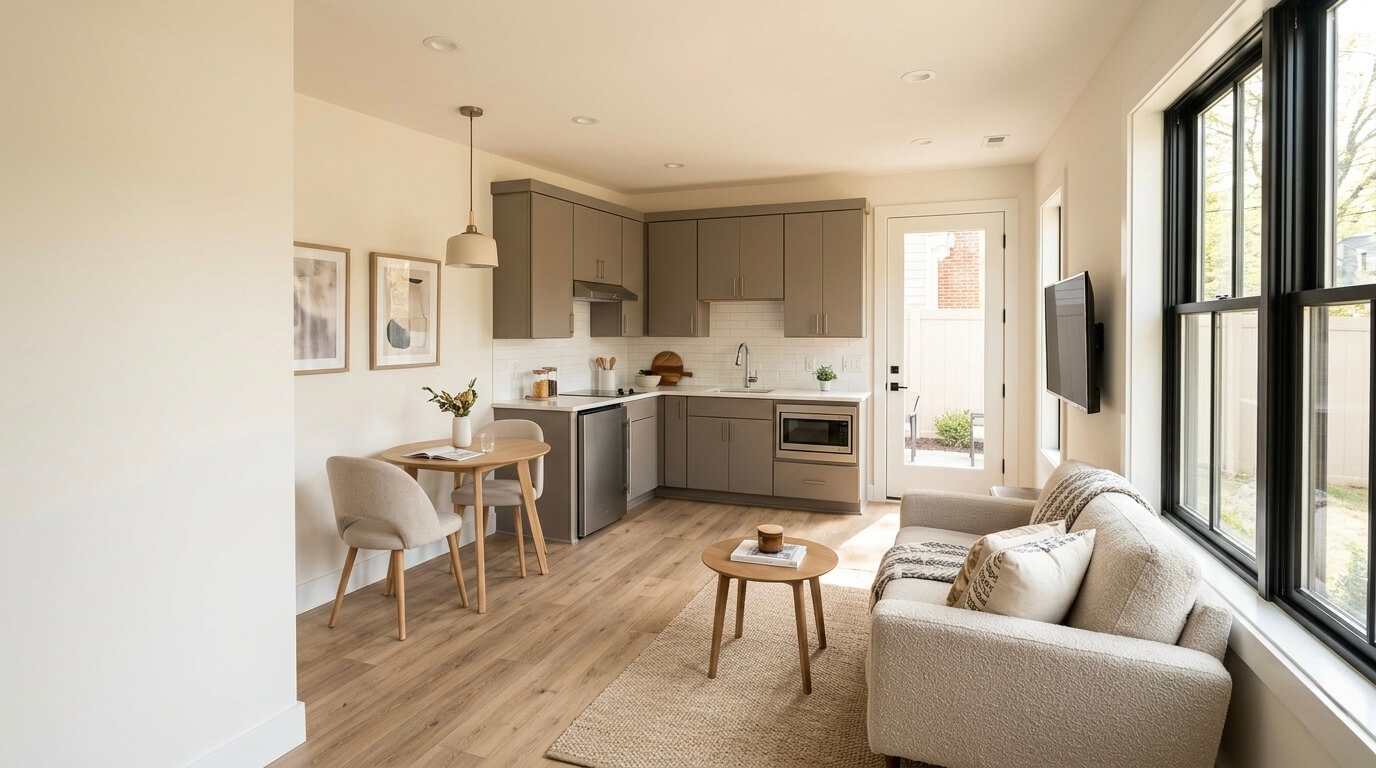
The available appraisal research supports the broader conclusion that ADUs can be meaningful residential improvements. FHFA’s California analysis, for example, found that the median appraised value of Enterprise-backed single-family properties with ADUs increased from $550,000 in 2013 to $1.064 million in 2023, compared with an increase from $405,000 to $715,000 for properties without ADUs. FHFA also reported higher annualized median-appraised-value growth for properties with ADUs during that period. However, these figures are California-specific and should not be interpreted as a Northern Virginia appreciation rate.
For Northern Virginia homeowners, the more useful question is whether the particular ADU improves the property’s marketability, functionality, and competitive position.
Permit status matters. So does construction quality. A detached unit with a private entrance, appropriate utilities, a functional kitchen and bathroom, adequate egress, and a design compatible with the primary home can present a much stronger value proposition than an improvised or poorly documented conversion.
The local market matters just as much. Fairfax County’s 2020–2024 median value of owner-occupied housing units was $732,800, according to the U.S. Census Bureau, while individual Northern Virginia communities can have substantially different property characteristics and buyer expectations. (Census.gov)
That is why homeowners should evaluate an ADU from three separate financial angles:
Construction cost: What will it actually take to design, permit, build, and complete the unit?
Income potential: How much net rental income or avoided housing expense could the ADU provide during ownership?
Contributory value: How much additional value does the completed property receive from the market’s perspective?
Those three numbers can be different, and a financially successful ADU does not necessarily require them to be identical.
If your objective is to maximize ADU home value Northern Virginia, the best strategy is to design the project around legal compliance, functional independence, appropriate quality, efficient site planning, and market evidence rather than chasing a generic percentage increase.
US Home Design Build can help homeowners evaluate those factors before construction begins. If you are considering an ADU for resale value, rental income, multigenerational living, or long-term equity, contact US Home Design Build to discuss your property, budget, design requirements, and timeline with a Northern Virginia design-build team.