
The questions to ask before hiring an ADU builder in Northern Virginia should cover six essentials: Virginia licensing, ADU-specific experience, local zoning and permitting knowledge, insurance, contract terms, and verifiable references. A builder who can answer those questions clearly, and support the answers with documentation, is far easier to evaluate than one who simply provides a low construction estimate.
An accessory dwelling unit is also more technically demanding than a typical room renovation. Depending on the design, an ADU can require a complete residential living environment with a kitchen, bathroom, dedicated electrical and mechanical systems, life-safety features, independent access, and connections to existing or new utility infrastructure. Detached units can add foundation work, site development, utility trenching, drainage, and other construction outside the building itself.
That complexity makes contractor selection particularly important in Northern Virginia, where zoning and permitting requirements can vary between jurisdictions. Fairfax County, Arlington, Alexandria, Fairfax City, and other localities do not necessarily apply identical ADU standards. A builder who understands general remodeling but lacks experience with accessory dwelling units may overlook a site constraint or regulatory requirement that becomes expensive to correct later.
This is also a growing area of residential construction. Research from the Mercatus Center at George Mason University found that only about 4% of U.S. adults currently have an ADU, while more than 60% would consider building or living in one for reasons including housing costs, proximity to others, or everyday assistance.
For Northern Virginia homeowners, the goal is therefore not simply to find the cheapest contractor. It is to identify a properly licensed builder with demonstrated ADU experience, a clear understanding of the applicable jurisdiction, appropriate insurance, transparent pricing, and a documented process from feasibility through final inspection.
If you are comparing firms before requesting proposals, the ADU Builder in Northern Virginia service page can also provide an overview of the design-build approach, including detached ADUs, garage conversions, basement ADUs, permitting, and project management.
Why Hiring the Right ADU Builder Matters More Than a Typical Remodel
An ADU is not simply another room addition; it is a separate residential-use project that can combine zoning, building-code, utility, structural, and life-safety requirements in one construction scope. Hiring a builder without relevant ADU experience can therefore create problems that may not become apparent until permitting, inspection, or construction is already underway.
A conventional interior remodeling project may involve updating an existing kitchen, bathroom, basement, or group of rooms within the home’s existing structure. The contractor is generally working with an established building envelope and existing utility systems.
An ADU can require much more coordination.
An ADU Has More Than a Construction Scope
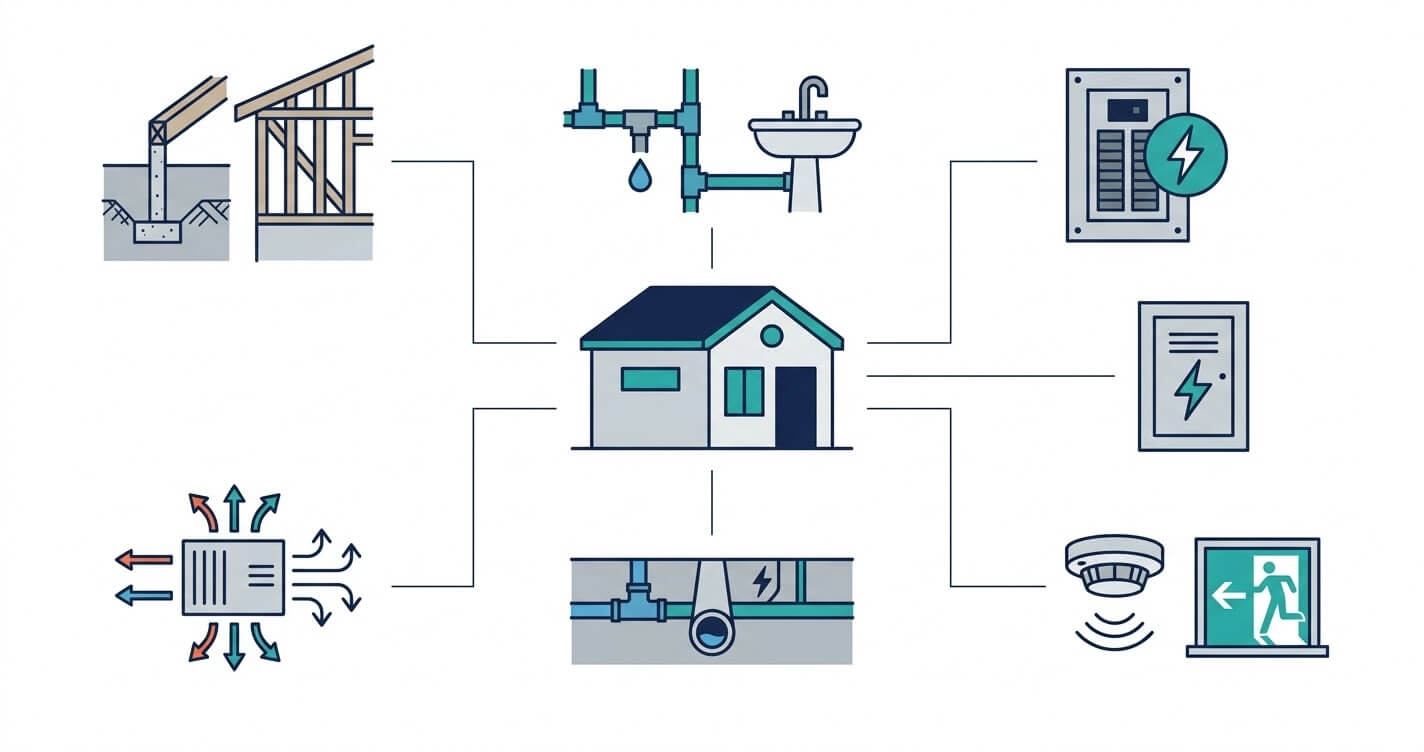
A properly planned ADU may need its own:
- Kitchen and cooking facilities
- Bathroom and plumbing fixtures
- Electrical distribution and circuits
- Heating and cooling
- Insulation and air-sealing
- Emergency egress where required
- Smoke and carbon-monoxide protection
- Exterior entrance and access
- Fire- and life-safety assemblies
- Water and sanitary connections
- Structural modifications
- Utility metering or distribution arrangements
The requirements become even more involved when the ADU is detached from the primary residence. A detached structure may require a new foundation, framing, roofing, exterior envelope, site preparation, utility trenching, grading, drainage work, and connections back to the property’s existing infrastructure.
This is one reason a simple construction-rate calculation can be misleading. US Home Design Build’s 2026 Northern Virginia cost guide currently places broad planning costs at approximately $85,000 to $300,000 or more, depending on whether the project is a simpler conversion or a larger detached unit with substantial site and utility work. Those are planning ranges rather than government-set prices or guaranteed contractor quotes.
ADU Work Requires Coordination Across Multiple Systems
The biggest difference between an ADU and a conventional remodel is often not any individual component. It is the interaction between them.
For example, moving a bathroom in an existing home may primarily involve plumbing, framing, electrical, and finishes. In a detached ADU, the plumbing layout may affect the location of the building, utility trenching, sewer connection, foundation penetrations, finished-floor elevations, and site grading.
Similarly, the proposed location of a detached ADU can affect setbacks, available building area, utility routing, stormwater considerations, access, and the feasibility of connecting the structure to existing services.
That means an experienced ADU builder should be able to discuss the project as an integrated system rather than treating the structure as a collection of individual trades.
Local Regulations Can Affect Whether the Project Works
Northern Virginia homeowners should also understand that there is no single set of “Northern Virginia ADU rules.”
The applicable requirements depend on the property’s jurisdiction. Fairfax County, Arlington County, Alexandria, and Fairfax City can have different standards governing matters such as unit size, placement, setbacks, occupancy, parking, and approval procedures.
This is not merely a paperwork issue. Local regulatory requirements can affect the physical design and, consequently, the construction budget.
For example, a proposed detached ADU that looks feasible from a homeowner’s perspective may become impractical after setbacks, lot coverage, access, utility routing, or other site requirements are evaluated.
The ADU Regulations Arlington VA guide and other jurisdiction-specific resources can be useful for understanding individual local requirements, but a builder should still evaluate the actual property before promising that a particular ADU design can be built.
ADU Experience Is Different From General Remodeling Experience
A contractor can have years of experience remodeling kitchens, bathrooms, basements, or additions without having completed a significant number of ADUs.
That distinction matters.
When interviewing a prospective builder, ask:
- How many ADUs have you completed?
- How many were detached versus attached or converted from existing space?
- Which Northern Virginia jurisdictions were those projects located in?
- Can you show photographs of completed ADUs?
- Can you provide references from recent ADU clients?
- What permitting challenges did those projects involve?
- Who handled the design, engineering, permits, and inspections?
- How were utility connections and site work coordinated?
A credible answer should contain specifics rather than generic statements such as “we build all types of residential projects.”
For example, a builder who can explain how a previous detached ADU was positioned on the lot, how its utilities were connected, which jurisdiction reviewed the plans, and what site constraints had to be addressed is demonstrating a substantially different level of project knowledge.
Ask for Evidence, Not Just a Portfolio
Photographs are useful, but they should not be the only evidence of experience.
A serious homeowner should ideally ask for a combination of:
- Completed project photographs
- Client references
- Project locations or jurisdiction information
- Permit information where publicly available
- A description of the builder’s role
- Examples of similar ADU configurations
- Evidence of current licensing and insurance
Permit history can be particularly useful because it provides an independent way to verify that the contractor’s claimed experience corresponds to actual permitted construction.
The objective is not to investigate a contractor unnecessarily. It is to reduce the difference between what a builder says it can do and what it has actually completed.
The Cost of Choosing the Wrong Builder
The consequences of choosing an inexperienced ADU contractor can extend well beyond poor workmanship.
A builder who misses a zoning limitation could produce plans that cannot be approved as designed. A contractor who underestimates utility work may request substantial change orders after construction begins. A team unfamiliar with detached ADU construction may also underestimate site development, drainage, structural, or mechanical requirements.
These problems can lead to:
- Permit delays
- Redesign costs
- Change orders
- Schedule extensions
- Unexpected site-work expenses
- Failed inspections
- Disputes over contract scope
- Reduced confidence in the final budget
The National Association of Home Builders has identified owner-occupancy requirements, parking requirements, and discretionary permit review as significant regulatory hurdles that can affect ADU construction.
While the exact rules vary by jurisdiction, the broader lesson is relevant to contractor selection: the builder needs to understand the regulatory environment before construction begins, not after a problem appears during permitting.
What a Qualified ADU Builder Should Be Able to Explain
Before signing a contract, the builder should be able to walk you through the project logically:
Property evaluation → ADU feasibility → design → zoning and permit requirements → engineering → construction scope → utilities → inspections → final completion.
You should also understand which responsibilities belong to the builder, which belong to an architect or engineer, and which decisions require your approval.
This is particularly important when comparing a design-build company with a contractor who only enters the process after architectural plans have already been completed. The more fragmented the process, the more important it becomes to establish who is responsible for coordinating information between the designer, permitting authorities, engineers, subcontractors, and homeowner.
For homeowners considering an ADU as part of a broader home improvement strategy, the How to Choose a Home Remodeling Contractor in Northern Virginia guide provides a useful comparison point. An ADU, however, warrants additional questions because of its dwelling-unit-specific zoning, utility, and permitting requirements.
The right builder should not simply tell you that your ADU can be built. They should be able to explain why it can be built, what approvals are required, what could make the project more difficult, and how those risks are reflected in the proposed scope and budget.
Is the ADU Builder Properly Licensed in Virginia?
For an ADU project, verify the contractor’s Virginia DPOR license before signing a contract, and make sure the license class and specialty classifications are appropriate for the work and contract value. Virginia uses Class A, Class B, and Class C contractor licenses based on the monetary value of contracts, while the contractor’s classification or specialty determines the type of work the business is authorized to perform.
The Virginia Department of Professional and Occupational Regulation (DPOR) Board for Contractors states that contractor licenses have two components: the class of license, which determines the monetary value of contracts or projects the contractor may perform, and the classification or specialty, which determines the type of work permitted.
For a Northern Virginia homeowner, that distinction is important because simply seeing a contractor’s license number is not enough. You should verify the current license status, applicable class, and relevant classifications through the state’s official records.
Virginia Contractor License Classes
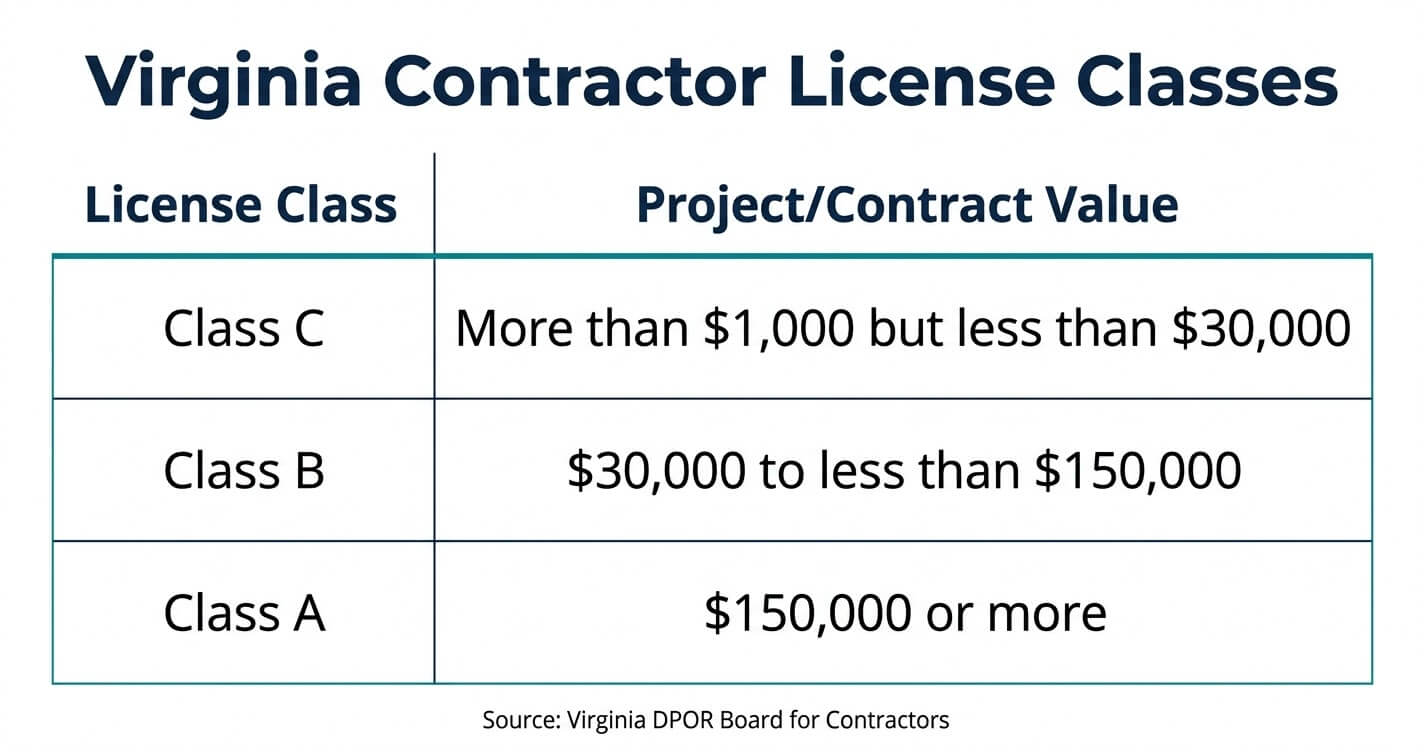
Under the current DPOR consumer information, Virginia’s contractor classes are divided according to contract value:
Virginia DPOR also explains that the Board licenses businesses engaged in construction, removal, repair, or improvement of facilities on property owned by others.
This threshold structure matters when evaluating an ADU builder because the expected project value can quickly move beyond the limits of a lower license class.
Why Class A Is Commonly Relevant to Larger ADU Projects
A homeowner should not automatically assume that every ADU requires a Class A contractor. The correct license class depends on the value of the contract.
However, Class A becomes particularly relevant for higher-value ADU projects because Virginia requires a Class A license for contracts valued at $150,000 or more.
That is significant in Northern Virginia, where the site’s current ADU cost guide places broad 2026 planning ranges at approximately $85,000 to $300,000 or more depending on the project type, existing structure, utility requirements, site conditions, size, and finish level.
For example, a relatively straightforward conversion could fall within a Class B contractor’s monetary range, while a detached ground-up ADU with substantial site development could exceed $150,000 and therefore require a Class A license for the contract.
The important point is to match the contractor’s license class to the actual contract value, rather than selecting a builder based only on the fact that the company advertises itself as an ADU contractor.
Class A, B, or C Is Only Part of the Check
The license class tells you how much contract value the contractor is authorized to undertake. It does not, by itself, prove that the contractor has the specific expertise required for your ADU.
DPOR separates license class from classification or specialty for precisely this reason. The class addresses monetary limits, while the classification or specialty addresses the type of work the contractor is authorized to perform.
Therefore, your verification should answer at least four separate questions:
1. Is the contractor’s license active?
Confirm that the license is current rather than relying on an old proposal, website, business card, or license number supplied without verification.
2. Is the license class appropriate for the contract value?
Compare the proposed contract amount with Virginia’s Class A, B, and C thresholds.
3. Does the contractor have the appropriate classification or specialty?
The class alone does not establish authorization for every possible type of construction work. Review the contractor’s classifications in the state record.
4. Does the licensed entity match the business signing your contract?
Make sure the legal business entity or contractor named in the agreement corresponds with the entity shown in the state licensing records.
How to Verify an ADU Builder’s Virginia License
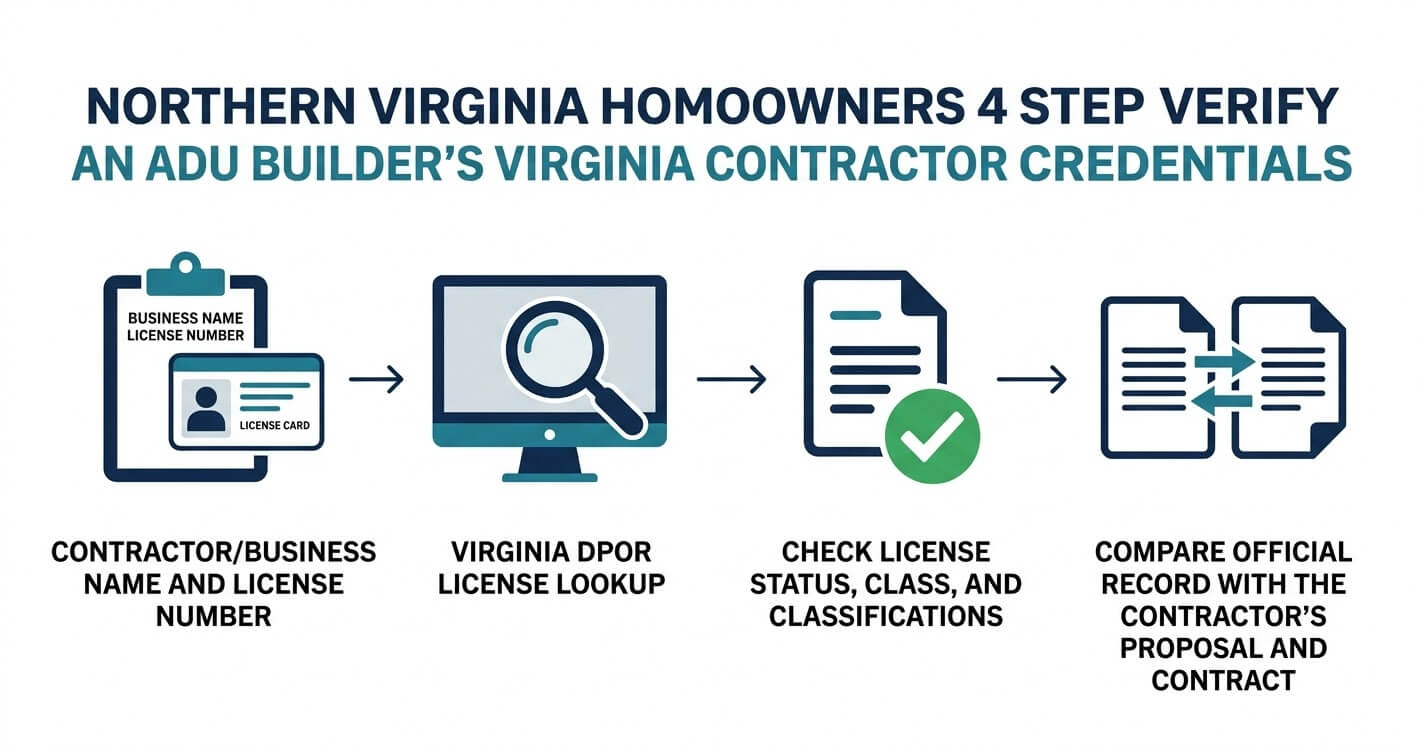
The safest approach is to use the official Virginia DPOR license lookup rather than relying on screenshots or information supplied by the contractor.
Use the Virginia DPOR License Lookup to search for the contractor and review the available licensing information. DPOR is the state’s professional and occupational regulatory agency, and its Board for Contractors administers contractor licensing.
When reviewing the record, compare the information against the proposal or contract, including:
- Business name
- License number
- License status
- License class
- Classifications or specialties
- Any available disciplinary or regulatory information
If something does not match, ask the contractor to explain the discrepancy before proceeding.
Why You Should Not Rely on the License Alone
A valid contractor license is an essential baseline, but it is not a substitute for ADU-specific due diligence.
Licensing does not tell you whether the builder has successfully completed detached ADUs in Fairfax County, understands Arlington’s current requirements, manages subcontractors effectively, provides accurate estimates, or communicates well during construction.
Think of licensing as a minimum qualification check, not a complete contractor-vetting process.
The same principle applies to price. A low bid from a properly licensed contractor can still become expensive if the estimate excludes site work, engineering, utility connections, permit-related responsibilities, finish allowances, or other necessary components.
That is why the license check should be performed alongside the questions about ADU experience, insurance, references, project management, and contract scope covered later in this checklist.
What Should Make You Cautious?
Several situations deserve additional scrutiny:
- The contractor refuses to provide a license number.
- The license cannot be found in the DPOR database.
- The license belongs to a different business entity than the one signing your contract.
- The proposed contract value exceeds the contractor’s applicable license-class limit.
- The contractor gives vague answers about classifications or specialties.
- The contractor pressures you to sign before you have verified the license.
- The contractor suggests splitting one ADU project into multiple contracts solely to avoid a licensing threshold.
The last situation is especially important. The purpose of checking license class is to confirm that the contractor is properly authorized for the project being undertaken, not simply to find a technical way around a monetary threshold.
The Practical Question to Ask
Instead of simply asking, “Are you licensed?”, ask:
“What is your current Virginia DPOR contractor license number, what class are you licensed under, what classifications do you hold, and does that license cover the full value and scope of my proposed ADU project?”
A professional builder should be comfortable answering this question and allowing you to independently verify the information.
For a homeowner, that transparency is a positive signal. The contractor is not asking you to take licensing claims on faith; the information can be checked against Virginia’s official regulatory records.
That is exactly the standard you should apply before moving on to the next stage of vetting: determining whether the builder has actually completed ADUs similar to yours.
Does the Builder Have Specific ADU Experience – Not Just General Remodeling?
When hiring an ADU builder in Northern Virginia, ask for documented experience with completed ADUs, not simply kitchens, bathrooms, additions, or whole-home remodels. Ideally, the builder should be able to show several comparable ADU projects and explain the permitting, utility, structural, and site challenges involved in each one.
General remodeling experience is valuable, but it does not automatically translate into ADU expertise.
An experienced remodeling contractor may be excellent at renovating an existing kitchen or finishing a basement while having limited experience constructing a legally compliant independent dwelling unit. An ADU introduces another layer of coordination because the project has to function as a complete residential space while also satisfying the requirements applicable to accessory dwelling units in the property’s jurisdiction.
Ask How Many ADUs They Have Actually Completed
One of the most revealing questions you can ask a prospective builder is:
“How many ADUs have you completed, and how many of those were in Northern Virginia?”
Do not stop at the number.
Ask whether those projects were:
- Detached ground-up ADUs
- Attached ADUs
- Basement conversions
- Garage conversions
- Above-garage ADUs
- Additions designed as independent dwelling units
- Projects with separate utility arrangements
- Projects in the same jurisdiction as your property
The distinction matters because the technical challenges can be substantially different.
For example, converting an existing garage may involve adapting an established structure, while a detached ADU can require an entirely new foundation, framing system, roof, exterior envelope, mechanical systems, utility connections, grading, drainage, and site access.
A builder who has completed ten bathroom remodels and one garage conversion should not necessarily present that experience as equivalent to completing multiple detached ADUs.
Ask for Three or More Comparable Projects
For serious contractor vetting, ask the builder to provide at least three completed ADU projects that are reasonably comparable to yours.
“Comparable” does not have to mean identical. Instead, look for similarities in:
- ADU type
- Approximate square footage
- Attached versus detached construction
- Existing versus new construction
- Site conditions
- Foundation requirements
- Utility configuration
- Jurisdiction
- Intended use
- Overall project complexity
For example, if you are planning a detached two-bedroom ADU on a large Fairfax County property, a builder’s experience with a small basement conversion in another state provides less useful evidence than a recently completed detached ADU in Northern Virginia.
Ask whether the builder can provide photographs, a general project description, and client references. Where appropriate and publicly available, you can also use local permit records to independently confirm that the project existed and determine the nature of the permitted work.
The goal is not to obtain private client information. It is to establish that the builder’s claimed ADU portfolio represents actual projects rather than generic residential construction photographs.
Look Beyond Finished Photos
A polished portfolio can demonstrate design and craftsmanship, but finished photographs rarely show the most difficult parts of an ADU project.
Ask the builder to explain what happened before the finished photographs were taken.
For example:
- How was the site evaluated?
- What zoning restrictions affected the design?
- Who prepared the drawings?
- Was structural engineering required?
- How were utility connections handled?
- Was a new sewer or water connection required?
- How was electrical service sized and routed?
- Were there drainage or grading concerns?
- What inspections were required?
- Were any plan revisions necessary?
- Were there significant change orders?
- What caused the biggest schedule risk?
These questions reveal whether the contractor actually managed the project or simply performed construction after someone else had solved the difficult feasibility and design issues.
ADU-Specific Technical Experience Matters
An ADU builder should understand that the project is not simply a smaller version of the primary residence.
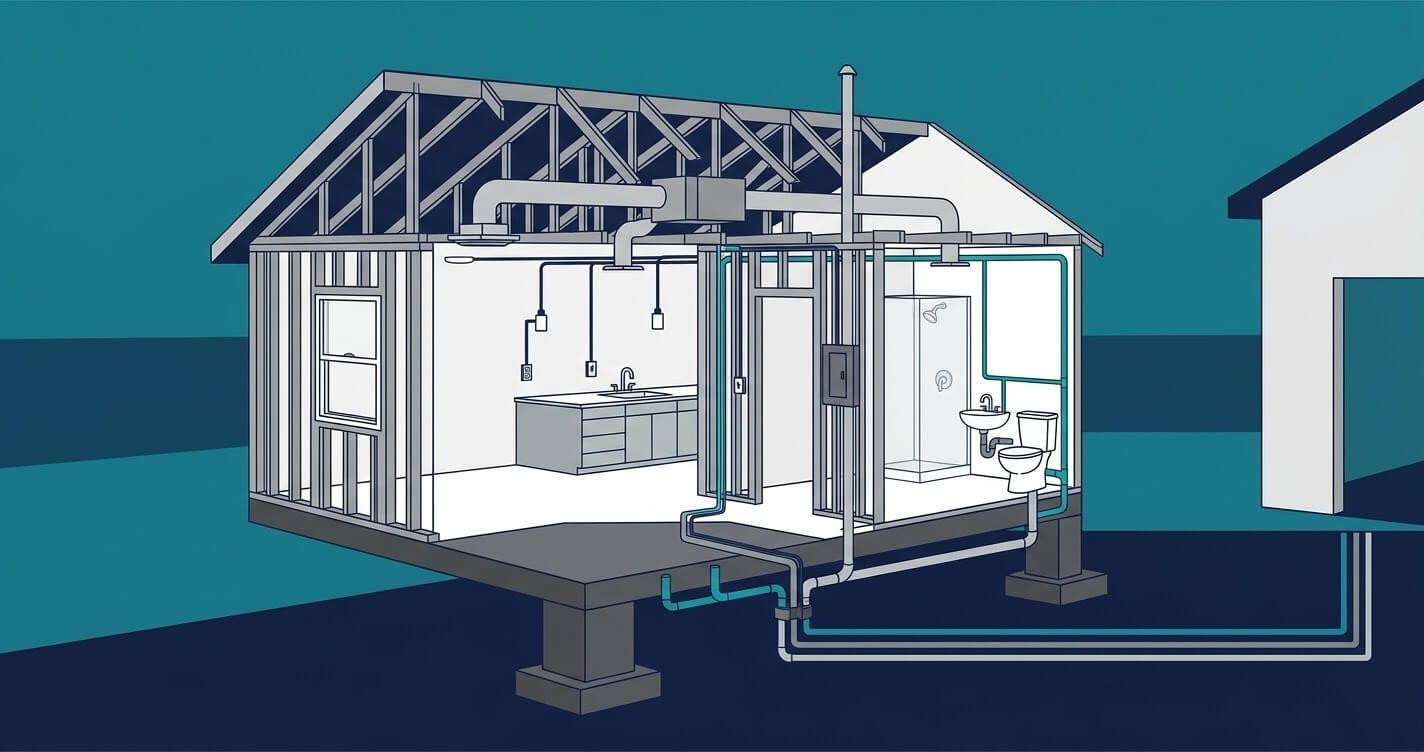
A detached unit, for example, can require coordination between the building itself and the property infrastructure.
Egress and Life Safety
The builder should understand how required emergency escape and rescue openings, doors, stairs, smoke alarms, carbon monoxide alarms, and other life-safety elements affect the design.
These requirements can influence window dimensions, bedroom layouts, stair configurations, door locations, and other architectural decisions.
Plumbing and Drainage
A detached ADU can require new plumbing runs between the unit and existing utility infrastructure. The distance, elevation, pipe routing, available capacity, and site conditions can affect both design and construction cost.
A builder who routinely handles ADUs should be able to discuss these issues before construction begins rather than discovering them after excavation.
Electrical Service
An ADU can substantially increase electrical demand through heating and cooling equipment, water heating, kitchen appliances, lighting, receptacles, and other loads.
The contractor should understand whether the existing electrical infrastructure can accommodate the proposed unit and when an electrical service upgrade, new panel, subpanel, or other configuration may be necessary.
HVAC
A dwelling unit needs a properly designed mechanical system rather than simply an extension of the main home’s existing HVAC arrangement.
The appropriate solution depends on the ADU’s size, envelope, occupancy, layout, equipment requirements, and applicable code requirements.
Building Envelope
Insulation, air sealing, windows, doors, roofing, moisture control, and weather-resistant assemblies become especially important when creating a new conditioned living space.
An experienced ADU builder should be able to explain how these components are integrated rather than treating them as isolated finish selections.
Ask Who Handles Design, Engineering, and Permitting
Another important question is:
“Who is responsible for coordinating the design, engineering, zoning review, permits, and construction?”
The answer can reveal how fragmented, or integrated, the project will be.
Some homeowners work with an architect or designer first and then hire a separate general contractor. Others choose a design-build firm that coordinates design and construction through one company.
Neither approach is automatically better. What matters is that responsibilities are clearly assigned.
Ask specifically:
- Who prepares the construction drawings?
- Who coordinates structural engineering?
- Who reviews zoning feasibility?
- Who prepares permit submissions?
- Who communicates with the permitting authority?
- Who schedules inspections?
- Who coordinates subcontractors?
- Who is responsible if information between the designer and builder conflicts?
A clear answer reduces the risk of gaps between professional teams.
Check Experience in the Same Northern Virginia Jurisdiction
Local experience can be particularly valuable because ADU requirements are jurisdiction-specific.
A builder who has successfully completed an ADU in one Northern Virginia locality may understand the general process but still need to evaluate a different jurisdiction’s requirements for your property.
For example, US Home Design Build’s ADU Build Reston VA: Real 2026 Case Study provides a useful example of a completed ADU project within Northern Virginia.
When interviewing builders, ask:
“Have you completed an ADU in my county or city recently, and what was the most difficult part of getting that project approved?”
The answer is often more informative than simply asking whether they “know the local rules.”
Request Client References
Ask for two or three recent ADU clients you can contact.
Do not only ask whether the homeowner was happy with the finished product. Ask questions that reveal how the project was managed:
- Did the final cost remain close to the original contract?
- How were change orders handled?
- Did the builder communicate delays promptly?
- Were permits and inspections handled properly?
- Was the site kept reasonably organized?
- Did subcontractors show up as scheduled?
- How responsive was the project manager?
- Would the homeowner hire the same builder again?
A builder who is comfortable providing recent references is giving you an opportunity to verify the experience independently.
A Useful ADU Experience Test
Before moving to the next stage of contractor selection, ask the builder to explain your project in their own words.
A strong candidate should be able to identify:
your ADU type → jurisdiction → likely zoning constraints → design considerations → permitting pathway → structural requirements → utility strategy → construction sequence → major cost risks.
If the conversation immediately turns into finishes, countertops, flooring, and paint colors without first addressing feasibility and regulatory constraints, that can be a warning sign.
The best ADU builders understand that the project begins long before the first foundation excavation.
Does the Builder Understand Your County’s Specific ADU Zoning Rules?
ADU regulations are not uniform across Northern Virginia, so your builder should understand the rules governing the specific jurisdiction and property where the unit will be built. Ask the builder to identify the applicable zoning framework, dimensional restrictions, occupancy requirements, and permitting considerations before you commit to a design or construction price.
A builder does not necessarily need to memorize every provision of the local zoning ordinance. However, they should know how to determine which rules apply and when an architect, zoning professional, surveyor, or other specialist needs to be involved.
Why Jurisdiction Matters
The phrase “Northern Virginia ADU” describes a geographic market, not a single regulatory system.
A property in Arlington County is governed by a different local framework than a property in Fairfax County, Fairfax City, or the City of Alexandria.
The differences can involve:
- Permitted ADU types
- Maximum floor area
- Setbacks
- Lot coverage
- Building height
- Placement on the lot
- Owner-occupancy requirements
- Parking
- Entrance and access requirements
- Utility considerations
- Administrative versus discretionary approvals
- Permit requirements
This is why a builder should never tell a homeowner that an ADU is “allowed in Northern Virginia” without first evaluating the actual property.
Ask This Question Before Discussing Construction Price
A useful screening question is:
“Before you give me a construction estimate, how will you confirm that my property can legally accommodate the ADU I’m proposing?”
A knowledgeable builder should describe a process rather than provide a vague answer.
That process may include reviewing:
- Property jurisdiction
- Zoning district
- Lot dimensions
- Existing structures
- Existing setbacks
- Available building area
- Proposed ADU location
- ADU size and configuration
- Access
- Utility connections
- Applicable permit requirements
- Site-specific constraints
Depending on the property, a survey, zoning verification, site plan, architectural drawings, or other professional analysis may also be necessary.
Northern Virginia ADU Rules Can Differ Significantly
A simplified comparison illustrates why local knowledge matters:
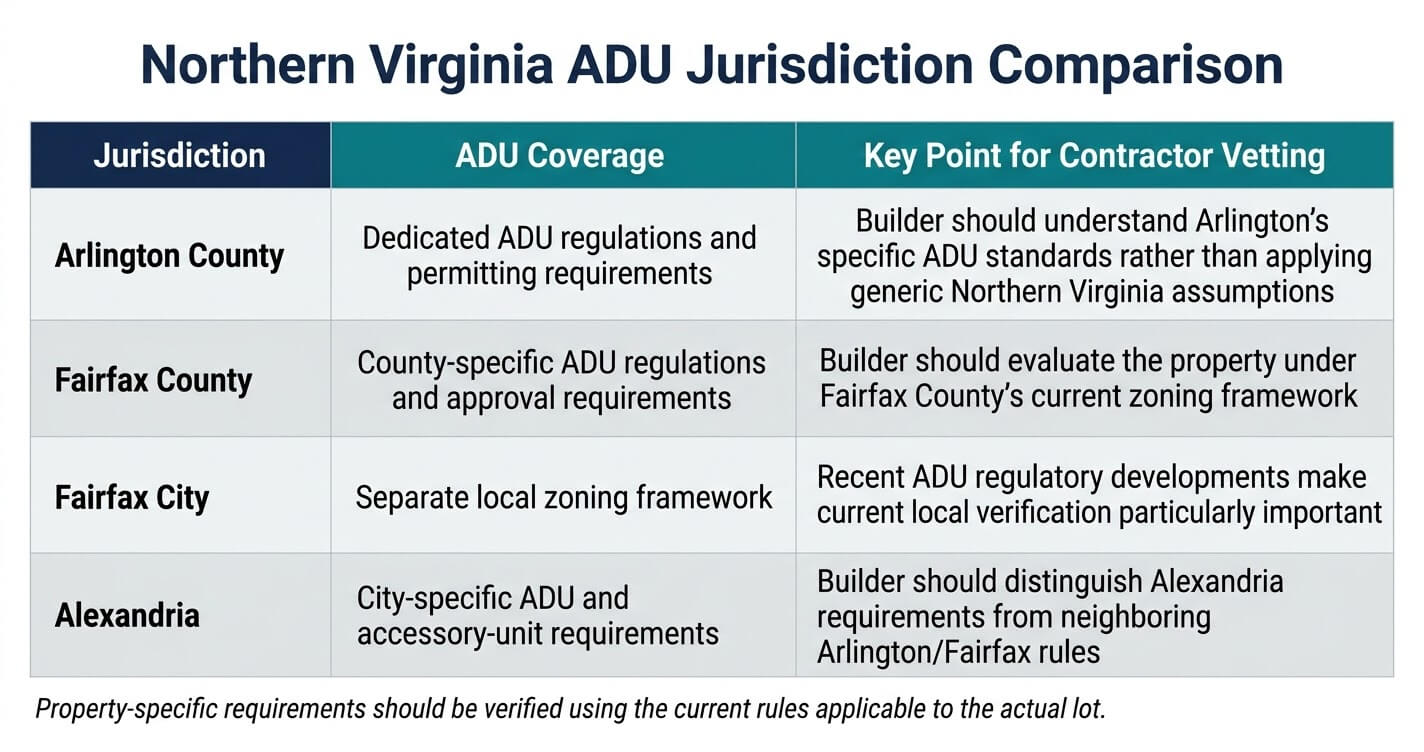
For property-specific decisions, homeowners should rely on the applicable local government’s current zoning and permit information rather than an old article or a contractor’s general statement.
US Home Design Build’s jurisdiction-specific resources can provide additional background, including ADU Regulations Arlington VA, Detached ADU Fairfax City VA: What 2026 Vote Means, and ADU Cost Alexandria VA: Complete Pricing Guide 2026.
Owner-Occupancy and Parking Requirements Deserve Special Attention
Some ADU regulations impose requirements beyond the physical dimensions of the unit.
The National Association of Home Builders identifies owner-occupancy requirements and parking mandates among the regulatory hurdles that can affect ADU construction.
These requirements can affect whether a proposed project works for a particular homeowner.
For example, if an owner-occupancy requirement applies, a property intended primarily as an investment may need to be evaluated differently from an owner-occupied residence. Similarly, parking requirements can affect the site plan and usable yard area.
A builder should therefore ask questions about the property and intended use, not just the desired square footage.
Do Not Confuse Zoning Approval With Building-Code Approval
This distinction is particularly important during contractor interviews.
Zoning determines whether the proposed use and physical placement are permitted under the local land-use regulations. Building codes address how the structure must be designed and constructed to satisfy applicable safety and construction standards.
A project may therefore require both zoning analysis and building-permit review.
A builder who says, “The county allows ADUs, so your project is approved,” is skipping an important part of the process.
Instead, ask:
“What zoning issues do you see with my proposed ADU, and what building-permit requirements will need to be addressed after zoning feasibility is established?”
The answer should demonstrate an understanding that these are related but distinct parts of project planning.
Ask How the Builder Handles Zoning Uncertainty
Not every property will be straightforward.
A site may have:
- An unusually shaped lot
- Limited setbacks
- Existing accessory structures
- Steep grades
- Easements
- Utility conflicts
- Environmental constraints
- Limited driveway access
- Existing nonconforming conditions
- A proposed ADU that approaches dimensional limits
A professional builder should not promise approval simply to win the project.
Instead, they should identify uncertainties and explain what additional information is needed.
That may mean recommending a survey, preliminary zoning review, design adjustment, engineering analysis, or consultation with the appropriate local authority.
Ask Whether the Builder Has Worked With Local Permitting Authorities
Experience with local permitting processes can improve project coordination, but homeowners should be careful about what this claim actually means.
Ask:
“Which ADU projects have you permitted in this jurisdiction, and what issues did you encounter during plan review?”
A useful answer should identify actual project experience rather than simply saying that the builder “works with the county.”
You can then follow up:
- How many review cycles were required?
- Were revisions requested?
- Who responded to plan-review comments?
- Did the contractor coordinate engineering revisions?
- Who scheduled inspections?
- How were permit-related delays communicated?
These questions help distinguish genuine local experience from marketing language.
Do Not Let the Builder Skip the Feasibility Stage
One of the biggest warning signs is a contractor who provides a firm construction price before establishing whether the proposed ADU is feasible.
A preliminary budget is reasonable. A guaranteed construction scope without adequate site and regulatory information is different.
For example, the cost of a detached ADU can change significantly if the project requires additional utility work, substantial grading, foundation modifications, drainage improvements, or design revisions caused by zoning restrictions.
The builder should identify these variables rather than burying them inside a vague allowance.
Use the County’s Rules to Test the Builder
You do not need to become a zoning expert to test a builder’s knowledge.
Choose two or three property-specific questions and see how the builder responds.
For example:
“My property is in [jurisdiction], and I’m considering a detached ADU of approximately [size]. What are the first zoning limitations you would verify?”
Then ask:
“Would the proposed location create any setback, access, parking, or lot-coverage concerns?”
Finally:
“What information would you need from me before confirming whether the concept is feasible?”
A good builder may not immediately give you every answer. That is not necessarily a problem.
In fact, caution can be a positive sign.
A professional who says, “I need to review the current zoning regulations, survey, and site conditions before confirming that” is often demonstrating better judgment than someone who confidently promises approval without reviewing the property.
Use Existing Local Guides as a Starting Point, Not a Substitute for Property Review
For homeowners researching individual jurisdictions, the ADU Permit Arlington VA: The Ultimate 2026 Guide can provide additional context on Arlington’s permitting process.
The important distinction is that an article or general zoning guide explains the regulatory framework; it does not establish that a particular lot qualifies for a specific ADU design.
Your builder should ultimately evaluate the actual property and coordinate the appropriate professionals and permitting process before construction begins.
What Insurance and Bonding Should the Builder Carry?
Before hiring an ADU contractor, verify current general liability insurance, workers’ compensation coverage where required, and the surety bond associated with the contractor’s Virginia license. Ask the builder for documentation rather than relying on a verbal assurance that the company is “fully insured.”
Licensing and insurance serve different purposes.
A contractor license establishes regulatory authorization to perform contracting work under Virginia’s licensing framework. Insurance and bonding address different financial and risk considerations associated with the contractor’s operations and obligations.
General Liability Insurance
General liability insurance is intended to address certain claims involving third-party bodily injury, property damage, and related liabilities arising from business operations, subject to the policy’s terms and exclusions.
For an ADU project, this matters because construction takes place around an occupied residential property and can involve excavation, heavy materials, electrical work, plumbing, structural work, and multiple subcontractors.
Ask the builder:
“Can you provide a current Certificate of Insurance showing your general liability coverage and policy expiration date?”
The important word is current.
An old certificate attached to a previous proposal does not necessarily establish that the policy remains active today.
Request a Certificate of Insurance
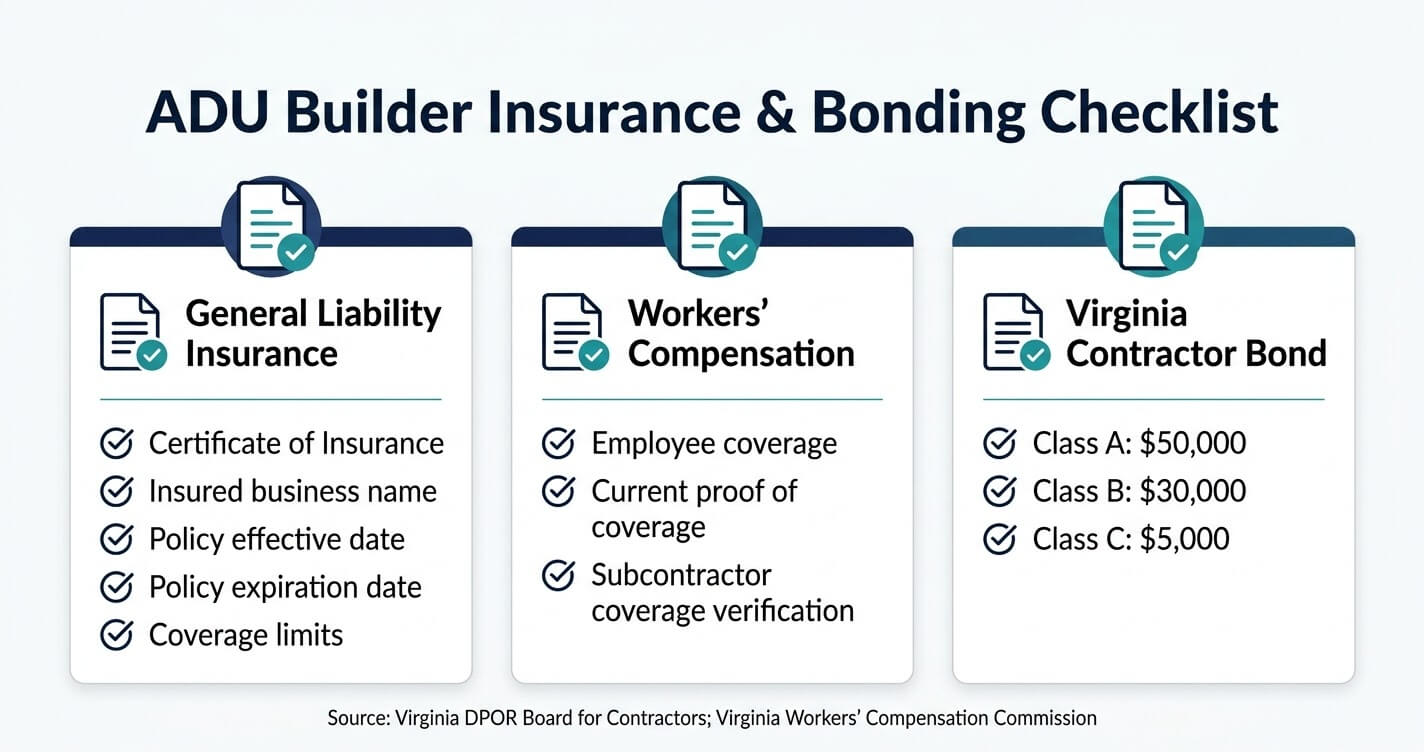
A Certificate of Insurance (COI) is a standardized document used to provide evidence of insurance coverage.
When reviewing a COI, check that:
- The insured business name matches the company you are hiring.
- The policy is currently effective.
- The expiration date extends through the relevant project period, subject to renewal.
- General liability coverage is shown.
- The coverage limits are stated.
- The insurance carrier is identified.
If the project will continue for a significant period, ask how you will be notified if coverage changes or expires.
Do not assume that the existence of a COI means every possible construction risk is covered. The certificate summarizes coverage; the actual insurance policy controls coverage, exclusions, and conditions.
Ask About Workers’ Compensation
Workers’ compensation is another important issue when a contractor has employees.
Virginia’s Workers’ Compensation Commission states that the Virginia Workers’ Compensation Act generally applies to employers with three or more employees, including those who are part-time, seasonal, or family members, with certain statutory considerations and exceptions.
For a homeowner hiring an ADU builder, the practical question is not simply whether the contractor says, “We’re covered.”
Ask:
“Do you have workers’ compensation coverage for your employees, and can you provide current proof of coverage?”
This becomes especially important on a construction project involving multiple workers and subcontractors.
Subcontractors Need to Be Considered Too
An ADU project can involve numerous trades:
- Excavation
- Concrete
- Framing
- Roofing
- Siding
- Plumbing
- Electrical
- HVAC
- Insulation
- Drywall
- Flooring
- Cabinetry
- Painting
Ask the general contractor how subcontractors are selected and whether they maintain their own required licensing and insurance.
You can also ask:
“Are your major subcontractors insured, and how do you verify their coverage?”
The answer tells you something about the builder’s risk-management process.
A reputable general contractor should have a defined procedure for qualifying subcontractors rather than bringing unknown trades onto the site without documentation.
Virginia Contractor Bonds
Virginia’s contractor licensing framework also includes surety-bond requirements.
The DPOR Board for Contractors regulations specify bond requirements based on the contractor’s license class. The current regulations provide for a $50,000 bond for Class A contractors, $30,000 for Class B contractors, and $5,000 for Class C contractors.
This is an important distinction:
A contractor’s surety bond is not the same thing as general liability insurance.
The bond is connected to the contractor’s licensing and regulatory obligations, while liability insurance addresses covered risks under the insurance policy.
Do not interpret the existence of a bond as proof that every construction defect, accident, delay, or dispute will automatically be paid by the bonding company.
Ask the Builder for All Three Documents
For a high-value ADU project, your contractor-vetting file should ideally include:
- Virginia DPOR license record
- Certificate of Insurance
- Bond information
They will help verify (respectively):
- License status, class, and classifications
- Current insurance coverage and policy information
- Compliance with applicable Virginia contractor bonding requirements
These documents should correspond to the same business entity that will sign your contract.
If the company proposal is from “ABC Construction LLC” but the license, insurance certificate, and contract are all under different names, stop and ask why.
There may be a legitimate corporate relationship, but you should understand it before signing a six-figure construction agreement.
Ask About Coverage Before Work Begins
Do not wait until the first day of construction to ask for documentation.
Ideally, verify the contractor’s credentials during the bidding and selection stage, then confirm that the documents remain current before work begins.
For a longer project, it is also reasonable to ask what happens if an insurance policy or subcontractor credential expires during construction.
The goal is straightforward: you want to know who is responsible for the project, whether the responsible business is properly licensed, and whether appropriate risk protections are in place before people and equipment arrive at your property.
Insurance Should Be Part of Your Comparison, not the Entire Decision
A contractor with strong insurance documentation can still be a poor fit if the company lacks ADU experience, provides an incomplete scope, or has weak project management.
Likewise, a builder with excellent craftsmanship should not get a pass on licensing or insurance verification.
For this reason, treat insurance and bonding as one part of a broader ADU contractor checklist:
License → ADU experience → Local zoning knowledge → Insurance → Bonding → References → Contract → Project management.
That sequence gives you a much stronger basis for comparing builders than price alone.
If two builders submit similar proposals, the one that can clearly document its credentials, explain its risk-management process, and demonstrate recent ADU experience is generally easier to evaluate with confidence.
What Should Be in the Written Contract Before You Sign?
Before hiring an ADU builder in Northern Virginia, require a detailed written contract that clearly defines the scope of work, price, payment schedule, timeline, permits, materials, warranties, and change-order procedure.
Virginia DPOR specifically advises consumers to insist on a detailed written contract and states that licensed contractors are required to provide a written contract for residential work.
An ADU contract deserves particular attention because the project can involve design, engineering, permitting, site work, utility connections, structural construction, interior finishes, and multiple subcontractors.
A proposal that says “build 800-square-foot ADU” is not a sufficiently detailed scope for a project of this complexity.
Start With a Clearly Defined Scope of Work
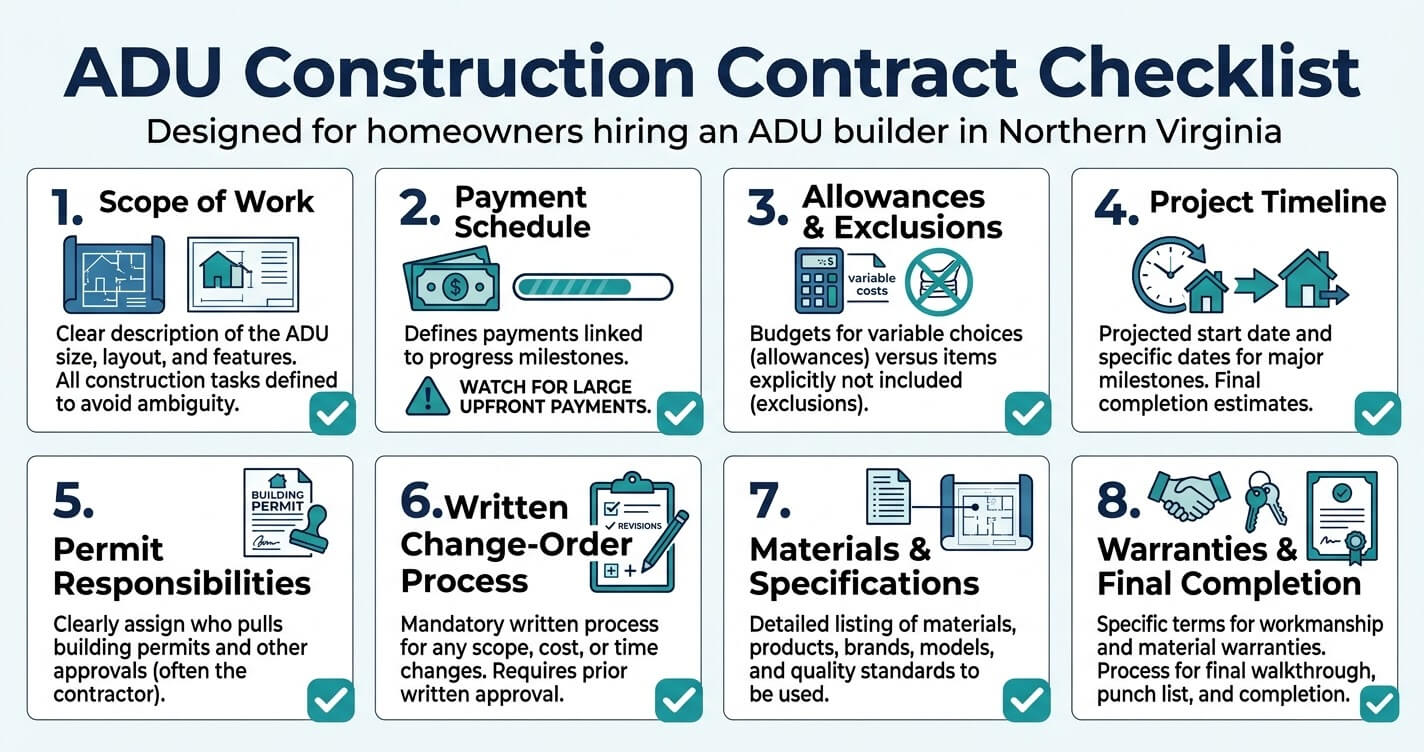
The contract should make it possible to determine exactly what the builder has agreed to construct.
At minimum, the scope should address:
- Site preparation
- Demolition, if applicable
- Excavation
- Foundation
- Framing
- Roofing
- Exterior siding and finishes
- Windows and exterior doors
- Insulation
- Drywall
- Electrical
- Plumbing
- HVAC
- Kitchen
- Bathroom
- Flooring
- Interior doors and trim
- Painting
- Exterior work
- Utility connections
- Cleanup and debris removal
- Required inspections
- Final completion
For a detached ADU, site-related work deserves particular attention.
Ask whether the contract includes:
- Utility trenching
- Water and sewer connections
- Electrical service work
- Gas work, if applicable
- Grading
- Drainage
- Concrete walks
- Driveway modifications
- Landscaping restoration
- Erosion and sediment-control measures where required
If these items are not included, the contract should clearly state who is responsible for them and whether they are included elsewhere in the budget.
Virginia DPOR advises homeowners to make sure the contract includes everything important to the job, including cleanup and other project-specific requirements.
Make Allowances and Exclusions Explicit
ADU proposals frequently contain allowances for items that have not yet been selected.
For example, a proposal might include:
- $8,000 kitchen allowance
- $3,000 plumbing-fixture allowance
- $2,500 lighting allowance
- $5,000 flooring allowance
An allowance is not necessarily a problem. The issue is whether you understand what happens when the actual selection costs more, or less, than the allowance.
Ask:
“Which items in this proposal are allowances, and what happens to the contract price if my final selections exceed those amounts?”
Also ask for a written list of exclusions.
A contractor’s low bid may be less attractive once you discover that engineering, permit fees, utility work, site restoration, appliances, painting, or other necessary work has been excluded.
The Payment Schedule Should Follow Project Progress
Your contract should explain when payments are due and what completed work triggers each payment.
For example, a construction draw schedule might be tied to objectively identifiable milestones such as:
- Contract execution and permitted preconstruction work
- Foundation completion
- Framing completion
- Rough mechanical/electrical/plumbing completion
- Drywall/interior milestone
- Substantial completion
- Final completion
The exact structure should reflect the project and contract, but the principle is important: payments should correspond to progress.
Virginia DPOR specifically advises consumers not to allow payments to get ahead of the work and recommends making payments contingent on completion of specified tasks.
Be Careful With Large Upfront Deposits
Virginia DPOR’s consumer guidance recommends an initial deposit of no more than 10% or $1,000, whichever is less, except where custom-made items or special orders are required, in which case DPOR says the initial payment should be no more than 30% of the total contract value.
This is important to phrase correctly: these figures are DPOR’s consumer guidance, not a universal statement that every Virginia residential contract is legally limited to those percentages.
For a homeowner, the practical question is:
“Why is this deposit required, what does it cover, and how does the remaining payment schedule correspond to actual construction progress?”
A contractor demanding a very large upfront payment without a clear reason should receive additional scrutiny.
DPOR also warns consumers against contractors who demand the entire job cost upfront and advises against allowing payments to get ahead of completed work.
Establish a Realistic Start and Completion Date
A contract should identify the anticipated start and completion dates or otherwise establish a clearly defined scheduling framework.
That does not mean an ADU builder can guarantee an exact completion day months in advance.
Weather, material availability, inspections, permitting, unforeseen site conditions, and owner-selected changes can affect construction.
The important point is that the contract should establish:
- Anticipated start date
- Estimated completion date
- Major construction milestones
- Circumstances that may justify an extension
- How delays are communicated
- How schedule changes are documented
Virginia DPOR specifically recommends that the contract specify start and finish dates while recognizing that external factors can cause delays.
Define Who Pulls the Permits
Never leave permit responsibility ambiguous.
Your contract should identify whether the builder, design-build firm, architect, engineer, or homeowner is responsible for:
- Preparing permit documents
- Submitting applications
- Paying specified permit fees
- Responding to plan-review comments
- Scheduling inspections
- Obtaining required approvals
- Closing out permits
For an ADU, this matters because the permitting process can involve more than the basic building permit depending on the jurisdiction and project scope.
If the builder says, “The homeowner handles permits,” ask exactly what that means.
Does the homeowner merely sign an owner authorization form? Or are they expected to prepare the application, coordinate revisions, communicate with the permitting department, and schedule inspections?
Those are very different responsibilities.
Require a Written Change-Order Procedure
ADU projects can change after construction begins.
A utility conflict may be discovered during excavation. A homeowner may upgrade finishes. An inspector may require a modification. A design decision may change the scope.
The problem is not necessarily the existence of change orders. The problem is uncontrolled change orders.
Virginia’s contractor regulations require residential contracts to contain a statement that modifications changing the cost, materials, work to be performed, or estimated completion date must be in writing and signed by all parties.
Your contract should therefore explain:
- Who can authorize a change
- How the change is priced
- Whether markup applies
- Whether the schedule changes
- How materials are substituted
- When payment becomes due
- Whether work proceeds before written approval
A homeowner should never rely on a verbal statement such as, “We’ll figure out the price later.”
Ask How Change Orders Are Priced
Suppose an ADU requires additional excavation after an unexpected site condition is discovered.
There are several ways the contractor might price that work, including:
- Fixed additional price
- Unit pricing
- Time and materials
- Cost plus agreed markup
Your contract should establish the applicable method.
Ask:
“If an unforeseen condition requires additional work, how will you document and price that change before proceeding?”
This question can prevent significant disputes later.
Identify Materials and Performance Specifications
A contract should not simply say “quality materials.”
Where material selection affects price, appearance, performance, or warranty, specify the relevant product or performance standard.
This can include:
- Window manufacturer and series
- Door type
- Roofing system
- Siding
- Insulation type
- HVAC equipment
- Water heater
- Cabinets
- Countertops
- Flooring
- Plumbing fixtures
- Appliances
The exact level of specification depends on the project stage.
If selections have not yet been finalized, document the allowance and selection deadline rather than pretending the final specification is already known.
Clarify Warranty Responsibilities
Ask:
“What warranties apply to the work, which products carry manufacturer warranties, and who handles warranty claims after completion?”
The answer should distinguish between:
- Contractor workmanship warranty
- Manufacturer warranties
- Equipment warranties
- Roofing warranties
- Window/door warranties
- Subcontractor warranties
Also determine when the warranty period begins and what documentation you will receive at project completion.
Include Cleanup and Final Completion
“Substantial completion” and “final completion” are not necessarily identical.
Your contract should establish what must be completed before final payment.
Consider items such as:
- Final inspections
- Permit closeout
- Punch-list completion
- Appliance installation
- Fixture installation
- Door and hardware adjustment
- Paint touch-ups
- Debris removal
- Final cleaning
- Restoration of disturbed areas
DPOR recommends that consumers not make the final payment until the work is complete and they are satisfied with the job.
The Contract Should Match the Proposal
Before signing, compare the final contract with the proposal you originally received.
Look for differences in:
- Total price
- Scope
- Allowances
- Exclusions
- Materials
- Payment schedule
- Timeline
- Permit responsibility
- Warranty
- Change-order provisions
If something was promised during the sales meeting but does not appear in the written agreement, ask for it to be added.
The safest assumption is that the written contract controls the project, not a promise that was made verbally during the sales process.
What Questions Reveal Whether a Builder Will Manage the Project Well?
The best ADU builder questions go beyond construction experience and reveal how the company handles communication, scheduling, subcontractors, inspections, change orders, and unexpected problems. Ask the builder to describe the actual process you will experience after signing, including who will manage the project day to day.
Two contractors can offer similar pricing and construction scopes while providing completely different project-management experiences.
That difference can become extremely important during an ADU build because the homeowner may be coordinating with a builder while the project simultaneously moves through permitting, inspections, material procurement, site work, and multiple construction trades.
Ask Who Your Day-to-Day Contact Will Be
Start with:
“Who will be my primary point of contact once construction begins?”
Then ask whether that person will actually be on the project.
You should know the difference between:
- Sales representative
- Project manager
- Site superintendent
- Lead carpenter
- Company owner
- Designer
- Permit coordinator
If the person who sells you the project disappears after the contract is signed, you should know who takes over.
Ask How Often You Will Receive Updates
Communication should be defined rather than assumed.
Ask:
“How often will I receive project updates, and what information will those updates include?”
A useful project update might cover:
- Work completed
- Work scheduled next
- Upcoming inspections
- Material deliveries
- Decisions needed from the homeowner
- Schedule changes
- Change orders
- Budget status
- Issues requiring attention
For a long ADU project, consistent communication is more useful than occasional reassurance that “everything is on track.”
Ask How Delays Are Handled
Every construction project carries schedule risk.
The question is not whether the builder can guarantee that nothing will go wrong. The question is how the company responds when something does.
Ask:
“If the project falls behind schedule, when will you tell me, what information will you provide, and how will you update the completion date?”
A strong answer should include a communication process.
For example, the builder might explain that delays are documented, the affected activity is identified, the cause is recorded, and the revised schedule is communicated to the homeowner.
That is much more useful than a general promise to “keep you updated.”
Ask How Change Orders Are Managed
A well-managed change-order system should prevent surprises.
Ask:
“Will I receive the price and schedule impact of a change in writing before the work is performed?”
Virginia’s contractor regulations specifically address written, signed modifications when changes affect contract cost, materials, work, or estimated completion date.
Also ask whether the builder maintains a running record of approved changes so that you can see how they affect the overall contract value.
Ask Who Coordinates Subcontractors
An ADU may involve many specialized trades.
Ask:
“Who schedules and coordinates your subcontractors, and who is responsible if one trade delays another?”
This is a project-management question, not merely a construction question.
For example, the sequence of rough plumbing, electrical, HVAC, framing, insulation, drywall, and inspections matters. A scheduling problem in one trade can affect several downstream activities.
The general contractor should have a defined process for coordinating that sequence.
Ask How Inspections Are Managed
Ask:
“Who schedules inspections, tracks inspection results, and handles corrections if an inspection does not pass?”
A builder should be able to explain the process without suggesting that the homeowner is responsible for coordinating every inspection personally.
You should also ask how inspection-related changes affect the schedule and whether additional work is documented when an issue is discovered.
Ask How the Builder Documents the Project
Documentation is one of the easiest ways to distinguish a structured project-management process from an informal one.
Ask whether you will receive:
- Updated schedules
- Change orders
- Invoices
- Payment records
- Product information
- Warranty documentation
- Inspection records where applicable
- Permit-related documentation
- Final completion documentation
Virginia DPOR advises consumers to maintain records of payments and project documents, including contracts, change orders, and warranties.
Ask What Happens When Something Unexpected Is Found
Construction rarely proceeds exactly as imagined.
Ask:
“If you discover an unexpected structural, utility, drainage, or site condition, what happens before additional work is performed?”
The builder should explain:
- How the condition is documented
- Whether additional investigation is required
- Who determines the appropriate solution
- How the cost is calculated
- Whether the schedule changes
- How homeowner approval is obtained
This question is particularly valuable for detached ADUs because excavation and utility work can expose conditions that were not obvious during initial planning.
Ask How the Builder Controls Site Quality
Project management also includes quality control.
Ask:
“Who inspects the work before the next trade begins?”
For example, before walls are closed, someone should verify that relevant rough-in work has been completed correctly and that required inspections have occurred.
A builder should have a process for identifying deficiencies before they become hidden behind drywall, finishes, or other completed work.
Ask About Site Protection and Occupied Homes
Many Northern Virginia ADUs are built on properties where the homeowner continues living in the primary residence.
Ask:
- How will construction access be controlled?
- Where will materials be stored?
- How will dust be managed?
- How will debris be removed?
- What areas of the property will remain accessible?
- How will utilities be protected?
- What happens during particularly disruptive phases?
The answers reveal whether the builder has thought about the project from the homeowner’s perspective rather than only from the construction team’s perspective.
Ask These 10 Questions Verbatim
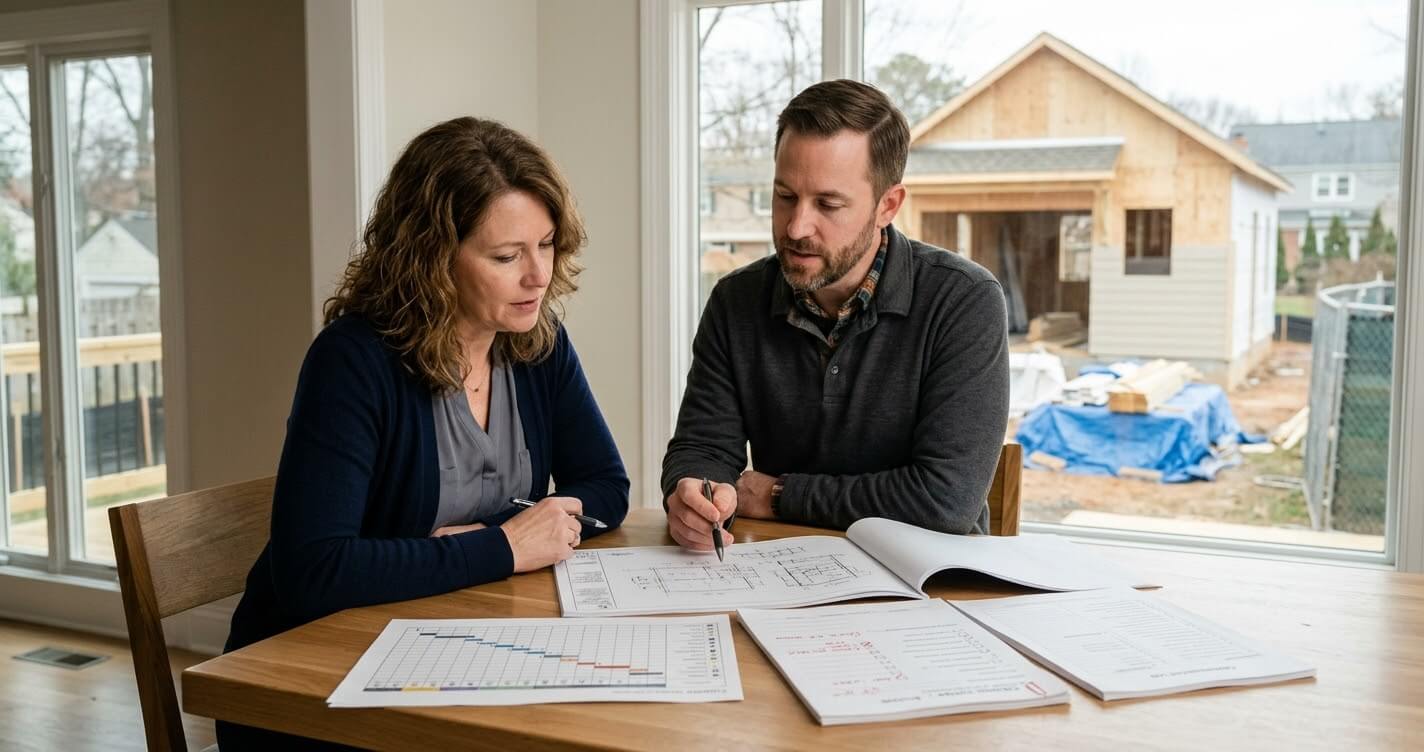
If you want a simple interview checklist, ask every shortlisted builder the same questions:
- Who will be my day-to-day project manager?
- How often will you provide written project updates?
- How do you document and approve change orders?
- How do you communicate construction delays?
- Who coordinates subcontractors and inspections?
- Who handles permit-related communication and inspection scheduling?
- How do you document unexpected site conditions before performing additional work?
- What quality-control checks do you perform before walls and ceilings are closed?
- What documentation will I receive at project completion?
- Who handles warranty issues after the ADU is finished?
Then ask the same questions to each finalist.
The goal is not to find the contractor who gives the most polished answer. It is to find the builder whose process is specific, repeatable, documented, and easy to understand.
Pay Attention to How the Builder Answers
The interview itself is evidence.
A contractor who answers every question with “don’t worry, we’ve got it” may be confident, but the response gives you little information about the actual process.
A stronger answer sounds more like:
“Your project manager will provide weekly updates. Any change affecting cost or schedule will be documented in a written change order before we proceed. Our superintendent coordinates the trades and inspections, and you’ll receive the final warranty and project documentation at completion.”
Specificity is valuable because it gives the homeowner something against which the builder’s performance can later be measured.
Red Flags That Signal You Should Walk Away
The biggest ADU builder red flags include an unverifiable license, reluctance to provide insurance documentation, pressure to make a quick decision, vague contracts, payments that get ahead of construction, and promises of permit approval without adequate property review.
One warning sign does not automatically prove that a contractor is dishonest, but multiple warning signs should make you reconsider the relationship.
Virginia DPOR itself warns consumers about high-pressure sales tactics, full upfront payment demands, cash-only arrangements, and contractors who are unlicensed or otherwise unqualified for the work.
Red Flag #1: The License Cannot Be Verified
If the builder gives you a license number but you cannot verify the business through Virginia DPOR’s records, stop the process until the discrepancy is resolved.
Use the Virginia DPOR License Lookup to independently check the contractor.
Compare:
- Legal business name
- License number
- License status
- License class
- Classifications
Do not rely solely on a screenshot supplied by the contractor.
DPOR also provides a searchable disciplinary-action system through its licensing records.
Red Flag #2: The Builder Cannot Show Comparable ADU Work
A contractor does not need dozens of ADUs in its portfolio.
But if the company claims to specialize in ADUs and cannot show credible examples of completed projects, ask why.
Be particularly cautious if the portfolio consists almost entirely of:
- Kitchen remodels
- Bathroom remodels
- Decks
- Generic additions
- Stock photographs
- Projects performed by another company
General remodeling experience is useful, but it should not be presented as proof of extensive ADU experience.
Red Flag #3: The Contractor Promises Approval Without Reviewing the Property
Be cautious if a builder says:
“Yes, you can definitely build that ADU.”
before reviewing the property’s jurisdiction, zoning, site conditions, proposed location, and other relevant information.
A professional builder should distinguish between:
- General feasibility
- Preliminary feasibility
- Zoning confirmation
- Permit approval
- Construction approval
No responsible contractor should guarantee a government approval that depends on a regulatory review they have not yet completed.
Red Flag #4: The Estimate Is Extremely Vague
A one-page estimate containing only:
“ADU construction — $200,000”
does not give a homeowner enough information to compare proposals intelligently.
A meaningful proposal should identify the scope, major materials, allowances, exclusions, payment schedule, and assumptions behind the price.
A low number can become expensive if major components have simply been omitted.
Red Flag #5: The Builder Wants a Large Upfront Payment Without Explanation
DPOR advises consumers to limit initial deposits and warns against contractors who demand payment for the entire job upfront.
A contractor may have legitimate reasons for requesting money before certain custom materials are ordered. The important issue is whether the payment is reasonable, documented, and connected to a clear contractual obligation.
Be particularly cautious when the builder:
- Wants most of the contract price immediately
- Cannot explain what the deposit covers
- Wants cash
- Refuses to provide receipts
- Wants payment before the contract is finalized
- Requests payment ahead of completed work without a clear reason
Red Flag #6: Everything Is “Verbal”
A builder who says:
“Don’t worry, I’ll take care of it.”
instead of putting commitments into the contract creates unnecessary risk.
Important promises should be documented, including:
- Scope
- Price
- Schedule
- Materials
- Warranty
- Permit responsibility
- Allowances
- Exclusions
- Change orders
- Cleanup
Virginia DPOR explicitly advises consumers not to rely on verbal agreements and recommends putting guarantees, warranties, and promises in writing.
Red Flag #7: Change Orders Are Handled Informally
A contractor who says:
“We’ll just keep track of changes on text messages.”
may be creating a documentation problem.
For significant changes, you should have a written record showing:
- What changed
- Why it changed
- Additional or reduced cost
- Schedule impact
- Approval
Virginia’s contractor regulations require written, signed modifications when they change contract cost, materials, work, or estimated completion date.
Red Flag #8: The Builder Cannot Explain Who Handles Permits
If the builder cannot clearly tell you who is responsible for permit applications, plan revisions, inspections, and final approvals, the project may have an avoidable coordination gap.
Ask for the responsibility in writing.
The same applies to engineering and design.
If three different companies are involved, the contract should make clear who coordinates them.
Red Flag #9: The Price Changes Dramatically After the Site Is Investigated
Some cost adjustments are legitimate.
For example, a preliminary estimate may change after a survey, structural evaluation, utility investigation, or detailed design reveals additional work.
The warning sign is not a change itself. It is a contractor who intentionally gives an unrealistically low number to win the project and then repeatedly increases it.
Ask:
“What assumptions are you making in this estimate, and what conditions could cause the price to change?”
A transparent builder should be able to identify the major cost variables.
Red Flag #10: High-Pressure Sales Tactics
Be cautious if a contractor says:
- “This price is only good today.”
- “You need to sign before someone else takes the slot.”
- “You don’t need to compare other bids.”
- “The permit process is just a formality.”
- “We can start tomorrow if you pay today.”
DPOR specifically identifies high-pressure tactics as a potential scam signal and recommends obtaining multiple estimates rather than automatically selecting the lowest bidder.
For a high-value ADU project, pressure is unnecessary.
You should have time to review the proposal, verify the license, compare the scope, check references, and understand the contract before committing.
Red Flag #11: The Builder Discourages Independent Verification
A trustworthy contractor should not object when you say:
“I’d like to verify your Virginia license and insurance before signing.”
Nor should they discourage you from contacting references or reviewing their previous work.
Virginia DPOR specifically recommends checking a contractor’s license and references before hiring.
If a builder becomes defensive about routine due diligence, consider that information when evaluating the relationship.
Red Flag #12: Disciplinary History Raises Unresolved Concerns
A disciplinary record does not necessarily mean a contractor is automatically unsuitable.
However, it is information worth understanding.
Virginia DPOR provides access to disciplinary information through its License Lookup system, and the agency publishes contractor license revocations and other disciplinary actions.
If you find a disciplinary action, look at what actually happened rather than relying on the existence of a record alone.
Consider:
- What was the violation?
- How recent was it?
- Was it resolved?
- Was the license suspended or revoked?
- Does it relate to the type of work you are hiring the company to perform?
This is a due-diligence exercise, not an automatic rejection rule.
When Several Red Flags Appear Together
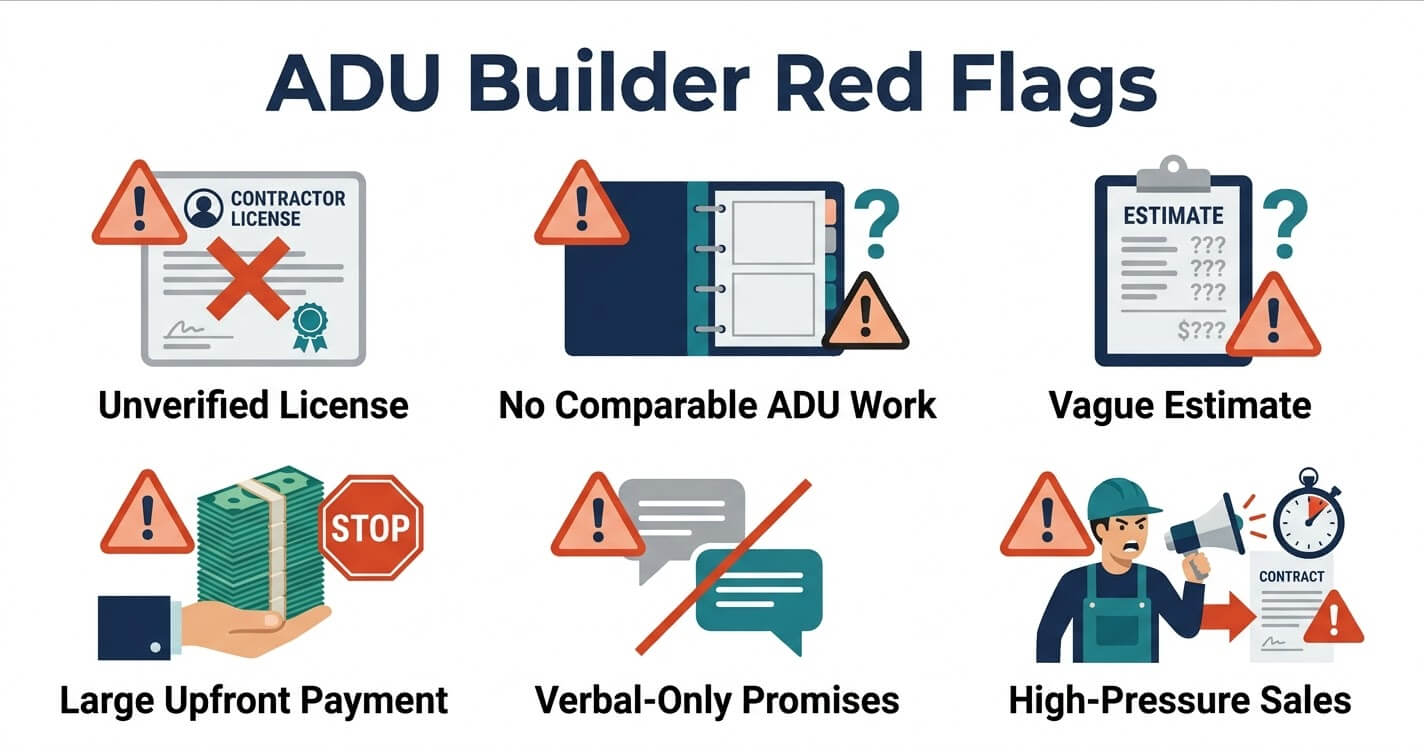
One minor issue may have a reasonable explanation.
Multiple problems are different.
For example, imagine a builder who:
- Cannot produce a current license record
- Has no comparable ADU projects
- Wants 50% upfront
- Provides only a verbal scope
- Cannot explain who handles permits
- Pressures you to sign immediately
You do not need to wait until something goes wrong to walk away.
The purpose of a contractor-vetting process is to identify these problems before signing the contract.
A Simple Walk-Away Test
Before hiring an ADU builder, ask yourself:
Can I independently verify this company’s license, understand exactly what it is proposing to build, confirm its relevant experience, verify its insurance, understand how I will pay, identify who manages the project, and explain what happens if something changes?
If the answer is yes, you have completed much of the fundamental due diligence.
If several answers are no, do not let an attractive price or an urgent sales pitch override the unanswered questions.
For homeowners comparing multiple firms, the goal of this checklist is not to find a contractor who makes the fewest promises. It is to find an ADU builder Northern Virginia homeowners can evaluate based on verifiable credentials, relevant experience, transparent documentation, and a clearly defined construction process.
Final ADU Builder Checklist
Before signing an ADU construction contract, you should be able to answer “yes” to the following questions:
- Is the contractor’s Virginia DPOR license active and independently verified?
- Is the license class appropriate for the contract value?
- Does the contractor have relevant ADU experience?
- Can the builder show completed, comparable ADU projects?
- Has the builder worked in your Northern Virginia jurisdiction?
- Has the property’s zoning feasibility been evaluated?
- Are the builder’s insurance documents current?
- Have you asked about workers’ compensation and subcontractor coverage?
- Is the entire construction scope documented?
- Are allowances and exclusions clearly identified?
- Is the payment schedule tied to project progress?
- Are change orders required to be documented in writing?
- Are permit responsibilities clearly assigned?
- Is there a realistic project schedule?
- Do you know who will manage the project day to day?
- Have you contacted recent client references?
- Have you checked for relevant disciplinary history?
- Are warranties and final completion requirements included in the contract?
If the answer to several of these questions is “no,” you may not have enough information to make an informed hiring decision yet.
The best time to identify a contractor’s weaknesses is before construction begins, not after your ADU is already under contract.
Ready to Evaluate Your ADU Builder?
Choosing an ADU builder is easier when you have a structured checklist for comparing licenses, experience, zoning knowledge, insurance, contracts, and project-management practices.
Use the questions in this guide during your initial consultations so you can compare builders on more than price alone.
If you are planning an ADU in Northern Virginia, the next step is to discuss your property’s specific requirements with an experienced design-build team.
Learn more about ADU Builder Northern Virginia and use your initial consultation to ask about project feasibility, design, permitting, construction, budget, and timeline.
Frequently Asked Questions
What license does an ADU builder need in Virginia?
An ADU builder in Virginia needs a contractor license appropriate for the contract value and the work being performed. Virginia uses Class A, Class B, and Class C contractor licenses, with the applicable monetary threshold determining the required class.
Under Virginia’s contractor regulations, Class C covers contracts of more than $1,000 but less than $30,000, Class B covers contracts from $30,000 to less than $150,000, and Class A applies to contracts of $150,000 or more.
However, homeowners should also check the contractor’s classifications or specialties because the license class and the type of work authorized are separate components of Virginia’s contractor licensing system.
You can independently verify a contractor through the Virginia DPOR License Lookup.
How much does it cost to hire an ADU builder in Northern Virginia?
ADU construction costs vary substantially based on the unit type, size, site conditions, utility requirements, structural work, finishes, and jurisdiction. A broad 2026 planning range for Northern Virginia is approximately $85,000 to $300,000 or more.
A garage or basement conversion may have a very different cost structure from a detached ground-up ADU because an existing structure can eliminate some foundation and exterior construction while introducing its own conversion requirements.
Site work can also have a major impact on the final budget. A detached unit may require excavation, foundation work, utility trenching, sewer or water connections, electrical work, grading, drainage, and other site improvements.
For a more detailed discussion of project variables, see ADU Cost Northern Virginia: 2026 Ultimate Guide.
Any published range should be treated as a planning estimate rather than a guaranteed construction price. The final cost should be based on the property’s actual conditions and the specific scope documented in the builder’s proposal and contract.
How do I verify an ADU builder’s license and insurance?
Verify the contractor’s license independently through Virginia DPOR, then request a current Certificate of Insurance showing applicable coverage and policy dates.
Start with the Virginia DPOR License Lookup and compare the official record with the business name and license information shown on the contractor’s proposal.
Then request a current Certificate of Insurance and check that the insured entity corresponds with the company you intend to hire.
You should also ask whether the builder carries workers’ compensation coverage for its employees where required and how it verifies insurance for major subcontractors.
Virginia’s Workers’ Compensation Commission states that the Virginia Workers’ Compensation Act generally applies to employers with three or more employees, subject to applicable statutory provisions and exceptions.
Do ADU rules differ by county in Northern Virginia?
Yes. ADU requirements can differ substantially between Northern Virginia jurisdictions, so homeowners should evaluate the actual property under the zoning and permitting rules of its specific county or city.
Arlington County, Fairfax County, Fairfax City, and Alexandria each have their own local regulatory frameworks. Requirements can address matters such as ADU size, placement, setbacks, occupancy, parking, access, and approval procedures.
That is why an ADU builder should establish the property’s jurisdiction and evaluate its applicable zoning requirements before committing to a final design or construction price.
For example, homeowners researching Arlington can review ADU Regulations Arlington VA, while those researching the permit process can consult ADU Permit Arlington VA: The Ultimate 2026 Guide.
These guides are useful for understanding the general regulatory framework, but property-specific feasibility should always be confirmed using the current requirements applicable to the actual lot.
What red flags suggest an ADU builder isn’t qualified?
Major ADU builder red flags include an unverifiable Virginia license, no relevant ADU portfolio, refusal to provide insurance documentation, vague contract terms, excessive upfront payment demands, undocumented change orders, and pressure to sign immediately.
You should also be cautious if a builder promises that your ADU will definitely be approved without first reviewing the property’s jurisdiction and site conditions.
Other warning signs include a proposal that omits major components of the work, a contractor who cannot explain who handles permits and inspections, and a builder who discourages you from checking references.
Virginia DPOR advises consumers to verify licenses, obtain references, avoid high-pressure tactics, and avoid allowing payments to get ahead of completed work.
One red flag may have a reasonable explanation. Several unresolved warning signs appearing together are a much stronger reason to choose another contractor.
How long does it take to build an ADU once a builder is hired?
There is no single construction timeline for every Northern Virginia ADU; the total schedule depends on design complexity, permitting, site conditions, procurement, utility work, inspections, and the type of ADU being constructed.
A detached ground-up ADU generally involves more construction stages than a straightforward interior conversion because the project may include site preparation, foundation work, framing, exterior construction, utility connections, and new mechanical systems.
Before signing, ask the builder for a project schedule showing the major phases rather than relying on a single completion-date estimate.
The schedule should distinguish between preconstruction activities, such as design and permitting, and the physical construction period.
You should also ask which events can extend the schedule, including permit-review delays, weather, material availability, unforeseen site conditions, and homeowner-requested changes.
Should I hire a design-build firm or a separate architect and contractor for an ADU?
Both approaches can work, but a design-build firm can simplify coordination by placing design and construction responsibilities under one integrated team. A separate architect and contractor can also work well when responsibilities, communication, and scope are clearly defined.
With a design-build approach, the same organization may coordinate design development, estimating, engineering consultants, permitting, subcontractors, and construction.
With separate professionals, the homeowner may have greater control over selecting the architect and contractor independently, but also takes on more responsibility for coordinating the transition between design and construction.
The right choice depends on the project’s complexity, the homeowner’s preferred level of involvement, and the capabilities of the professionals involved.
In Summary: How to Choose the Right ADU Builder in Northern Virginia
The best way to approach the questions to ask before hiring an ADU builder in Northern Virginia is to treat contractor selection as a due-diligence process rather than a simple price comparison. Verify the builder’s Virginia DPOR credentials, confirm relevant ADU experience, evaluate local zoning knowledge, review insurance and bonding, and insist on a detailed written contract before signing.
Your final shortlist should include builders who can demonstrate actual ADU experience, not merely general remodeling expertise. Ask for comparable projects, client references, and evidence that the builder understands the jurisdiction where your property is located.
You should also verify that the contract clearly identifies the scope of work, payment schedule, allowances, exclusions, permit responsibilities, timeline, warranties, and written change-order process. A low initial estimate is less meaningful if important work has been excluded or if the pricing structure leaves substantial room for unexpected costs.
Most importantly, pay attention to how a builder answers your questions. A qualified contractor should be willing to explain uncertainties, identify potential project risks, provide documentation, and tell you when additional professional review is necessary.
If a contractor cannot provide basic licensing information, refuses to document important promises, pressures you to make an immediate decision, or cannot explain how the ADU will be evaluated for your particular property, those are reasons to slow down, or move on to another candidate.
For homeowners planning an ADU in Northern Virginia, the objective is not simply to find someone who can construct the unit. It is to find a builder who can coordinate the feasibility, design, permitting, construction, inspections, and completion of the project in a transparent and professionally managed way.
If you are ready to discuss your project, contact US Home Design Build to explore your ADU plans, project requirements, and next steps with a Northern Virginia design-build team.
