
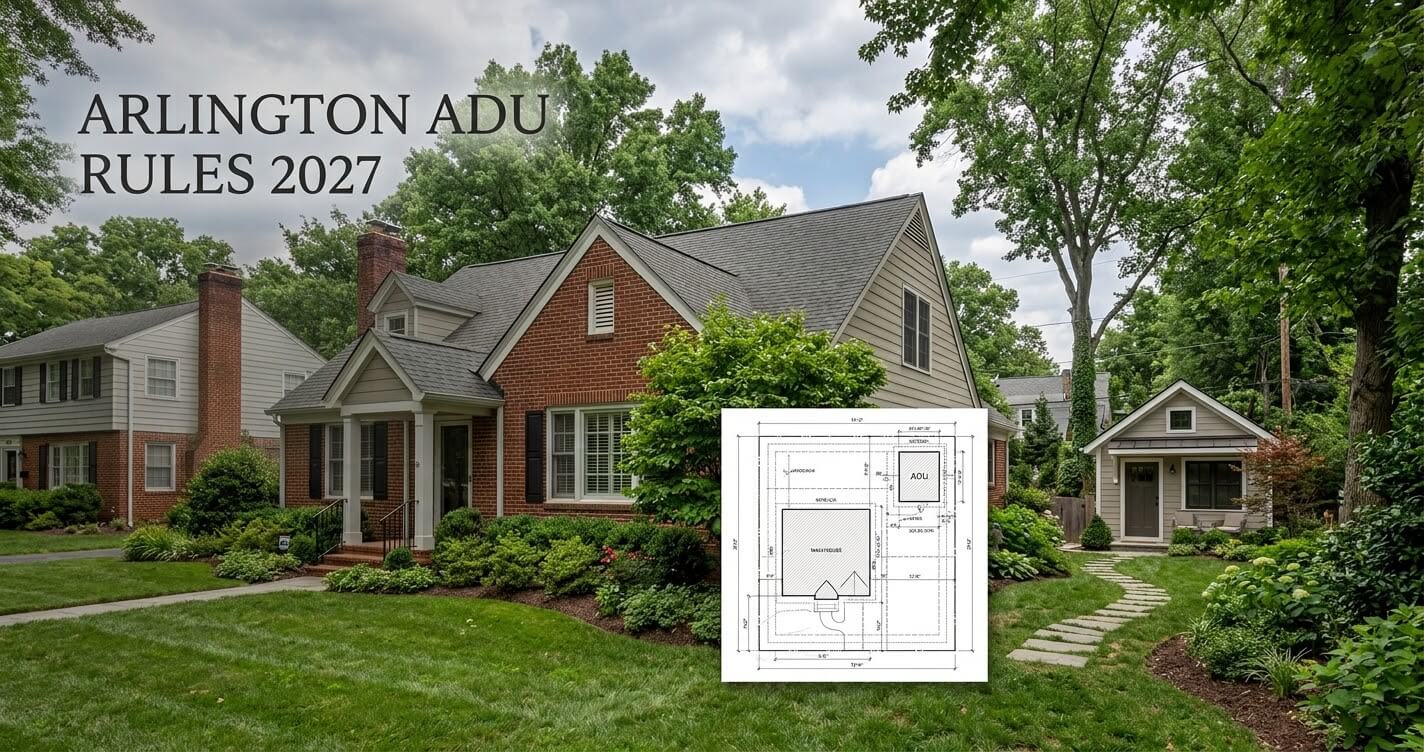
If you have been following Virginia’s new accessory dwelling unit legislation, you may have heard that Arlington ADU rules 2027 will change when Senate Bill 531 takes effect. That assumption, however, misses one of the most important provisions in the law: SB 531 does not apply to localities that adopted an ADU ordinance before January 1, 2026.
For Arlington County homeowners, that distinction matters. Arlington has had local accessory dwelling regulations for years, beginning with County Board action in 2008 and subsequent amendments in 2017 and 2019 that expanded where and how ADUs could be created. Arlington’s current ADU program is therefore not simply waiting for the statewide framework to arrive in 2027; it already operates under its own local zoning standards.
Virginia enacted SB 531 in 2026 as part of a broader effort to make ADUs more widely available in single-family residential areas. The law establishes a statewide framework that includes by-right ADU approval, a $500 permit-fee limit, and restrictions on certain local zoning requirements. The statute becomes effective July 1, 2027. However, the enacted law expressly states that it does not apply to a locality that adopted an ADU ordinance before January 1, 2026.
For Arlington homeowners, this means the key question is not simply, “What will SB 531 require in 2027?” The more important question is whether the statewide law overrides Arlington’s existing ADU framework at all. Based on the enacted exemption and Arlington’s documented history of ADU regulations, it does not.
Does Virginia’s SB 531 Apply to Arlington County?
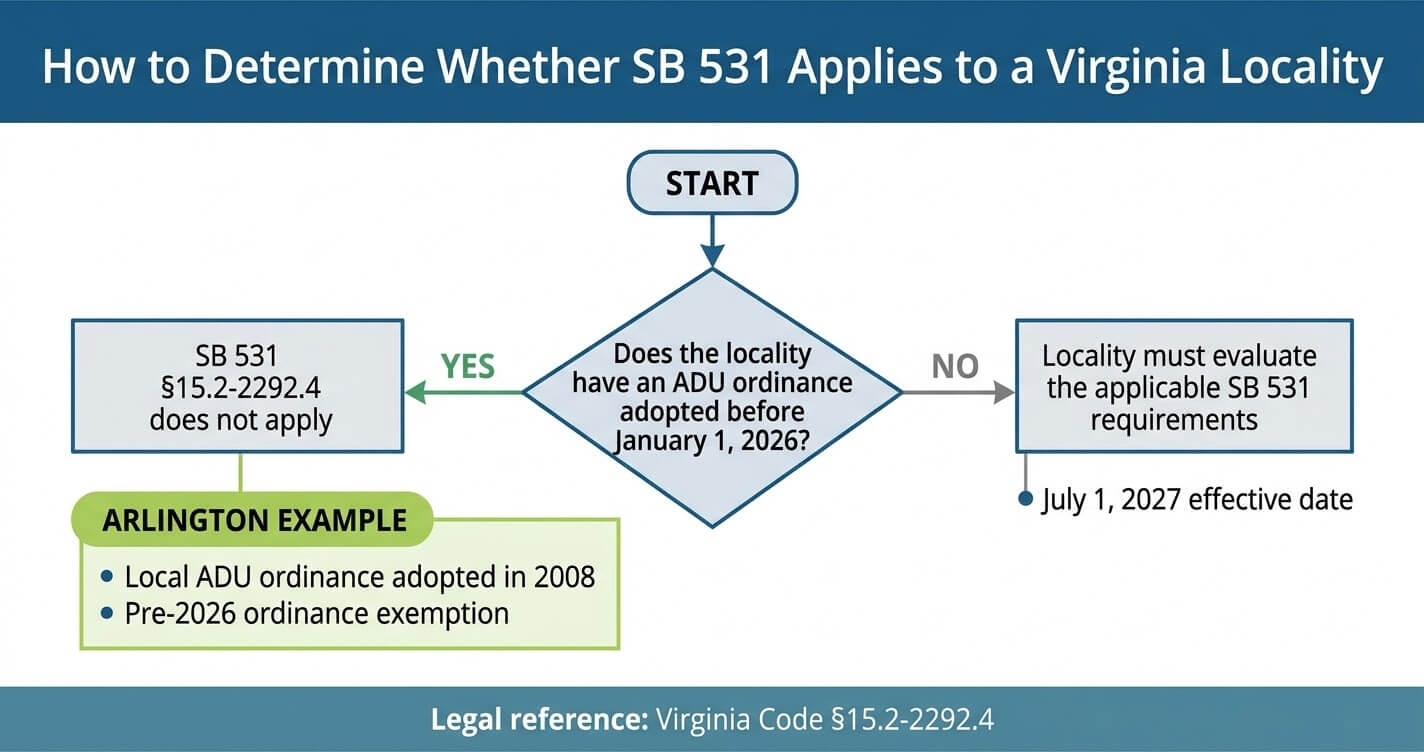
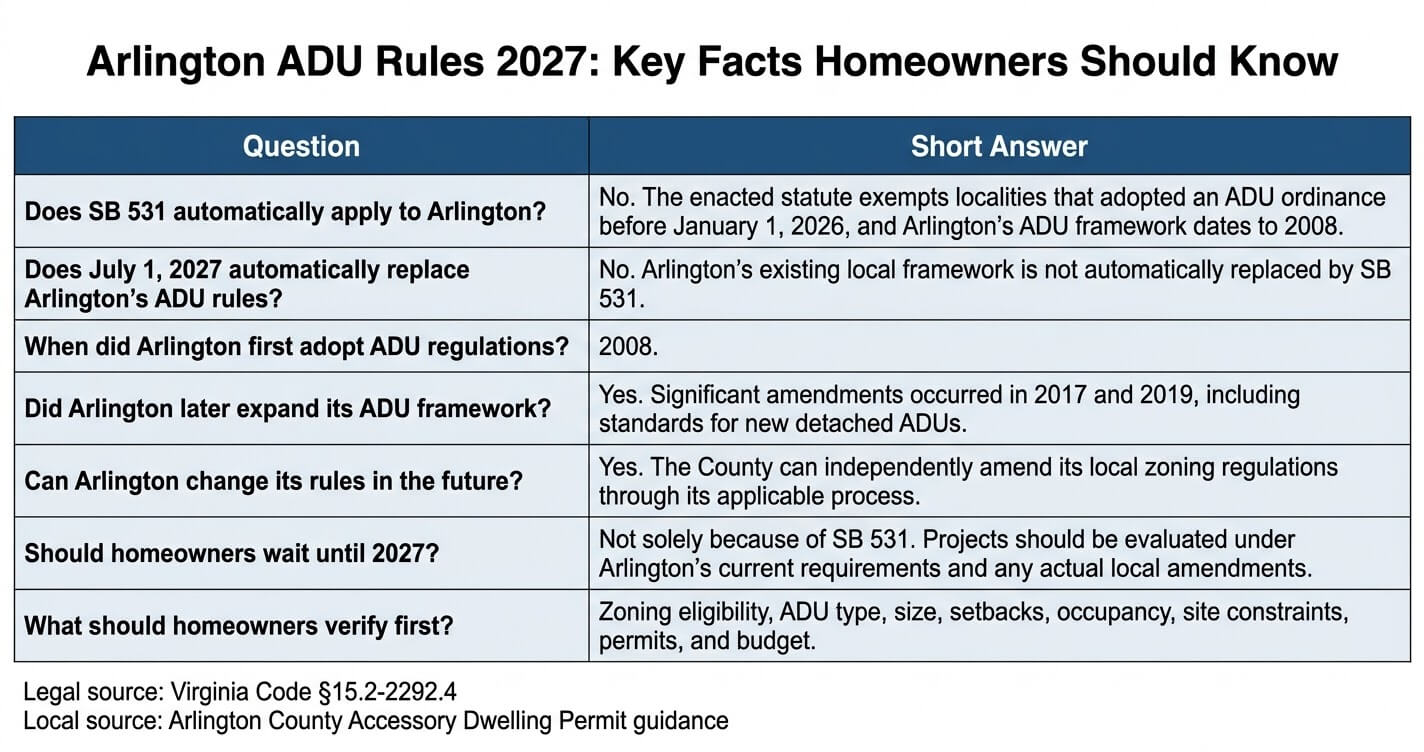
No. Based on the enacted statutory language, SB 531’s mandatory statewide ADU framework does not apply to Arlington County because Arlington adopted an ADU ordinance before January 1, 2026.
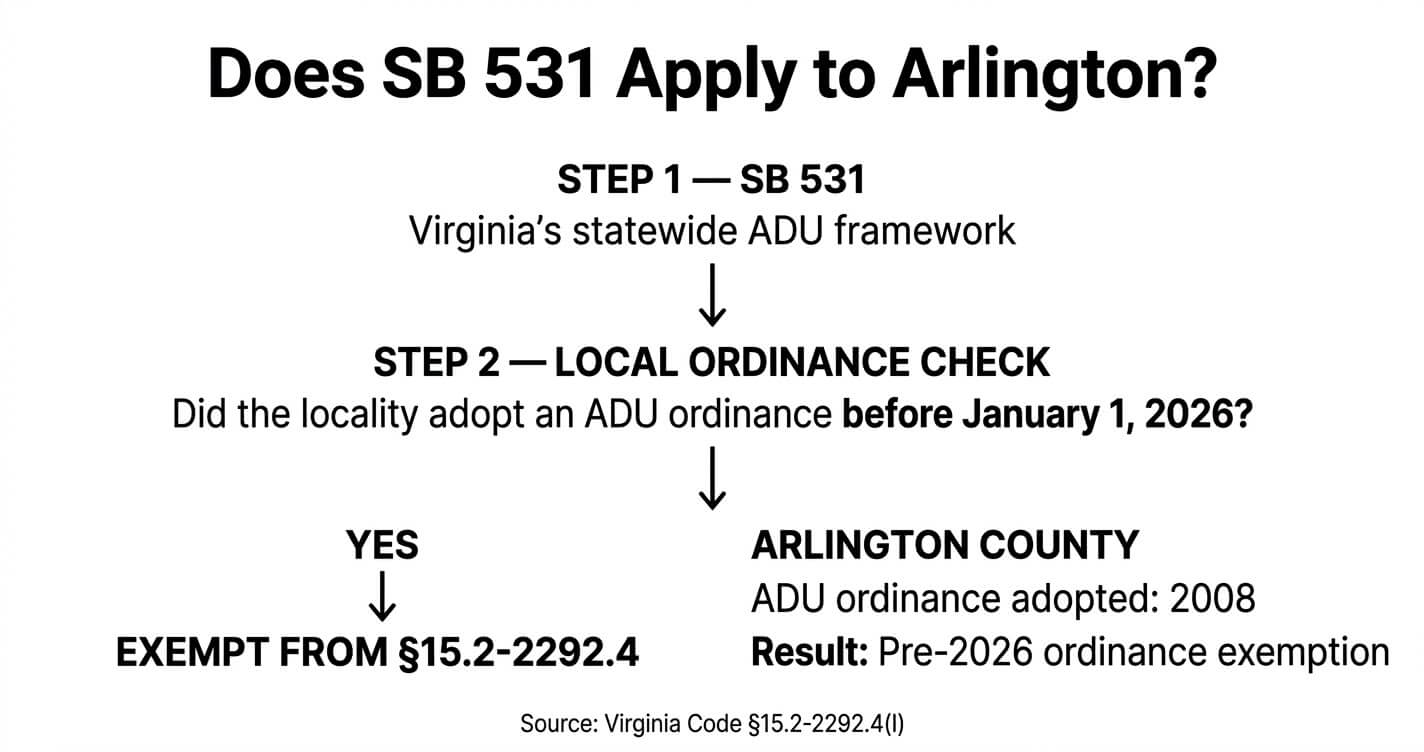
Arlington’s local ADU regulations therefore remain the governing framework unless the County Board independently changes them.
The exemption is found directly in § 15.2-2292.4(I) of the Code of Virginia, which states that the new ADU requirements do not apply to a locality that adopted an ADU ordinance before January 1, 2026.
This is not simply an interpretation based on Arlington’s current zoning practices. It is an express exemption written into the enacted law.
What Does SB 531 Actually Do?
To understand why the exemption matters, it helps to separate the statewide requirements from the local rules that Arlington already has.
SB 531 establishes a framework under which localities covered by the law must allow accessory dwelling units as a permitted accessory use in single-family residential zoning districts. Among other provisions, the law limits the ADU permit fee to $500 or less and restricts certain local requirements involving setbacks, dimensional standards, parking, and relationships between occupants of the ADU and the primary dwelling.
The law’s effective date is July 1, 2027.
The critical point for Arlington is subsection I. It creates a carve-out for jurisdictions that had already adopted an ADU ordinance before the January 1, 2026, cutoff.
Why Arlington Falls Within the Exemption
Arlington’s history makes the answer particularly straightforward.
The Arlington County Board first adopted accessory dwelling use standards in July 2008. Those regulations became effective for accessory dwellings on January 1, 2009, and initially allowed ADUs within single-family detached homes, such as basement or second-floor units. Arlington subsequently revised the regulations in 2017 and expanded them again in 2019 to permit new detached accessory dwellings.
That chronology places Arlington’s ADU ordinance well before SB 531’s January 1, 2026, cutoff.
In other words, the relevant legal sequence is:
This distinction is important because the existence of SB 531 does not mean every Virginia locality must replace its existing ADU regulations on July 1, 2027. The statute itself recognizes that some localities already had ADU ordinances in place.
What This Means for Arlington Homeowners
For someone planning an ADU in Arlington, the practical takeaway is relatively simple: do not assume that July 1, 2027, automatically unlocks a new set of statewide ADU rights in Arlington.
Instead, homeowners should continue to evaluate their property under Arlington County’s own zoning framework. Arlington’s current ADU permit guidance requires an eligible property, compliance with the applicable zoning standards, and adherence to building-code requirements. The County also recommends determining property eligibility before submitting an ADU permit application.
That does not mean Arlington’s rules can never change. The County Board could independently amend its zoning ordinance in the future. It simply means that SB 531 itself does not automatically require Arlington to replace its existing ADU regulations in 2027.
For homeowners who want the detailed local requirements, including current eligibility, zoning districts, owner-occupancy requirements, and detached ADU standards, the existing ADU Regulations Arlington VA guide is the more appropriate resource rather than repeating those rules in this article:
Arlington’s Accessory Dwelling Ordinance Timeline: Why the Exemption Applies
Arlington’s ADU regulations clearly predate SB 531’s January 1, 2026, cutoff: the County adopted its original accessory dwelling provisions in 2008, revised them in 2017, and expanded them to new detached ADUs in 2019.
Because the statute exempts localities that adopted an ADU ordinance before January 1, 2026, Arlington already had a qualifying local framework years before SB 531 was enacted.
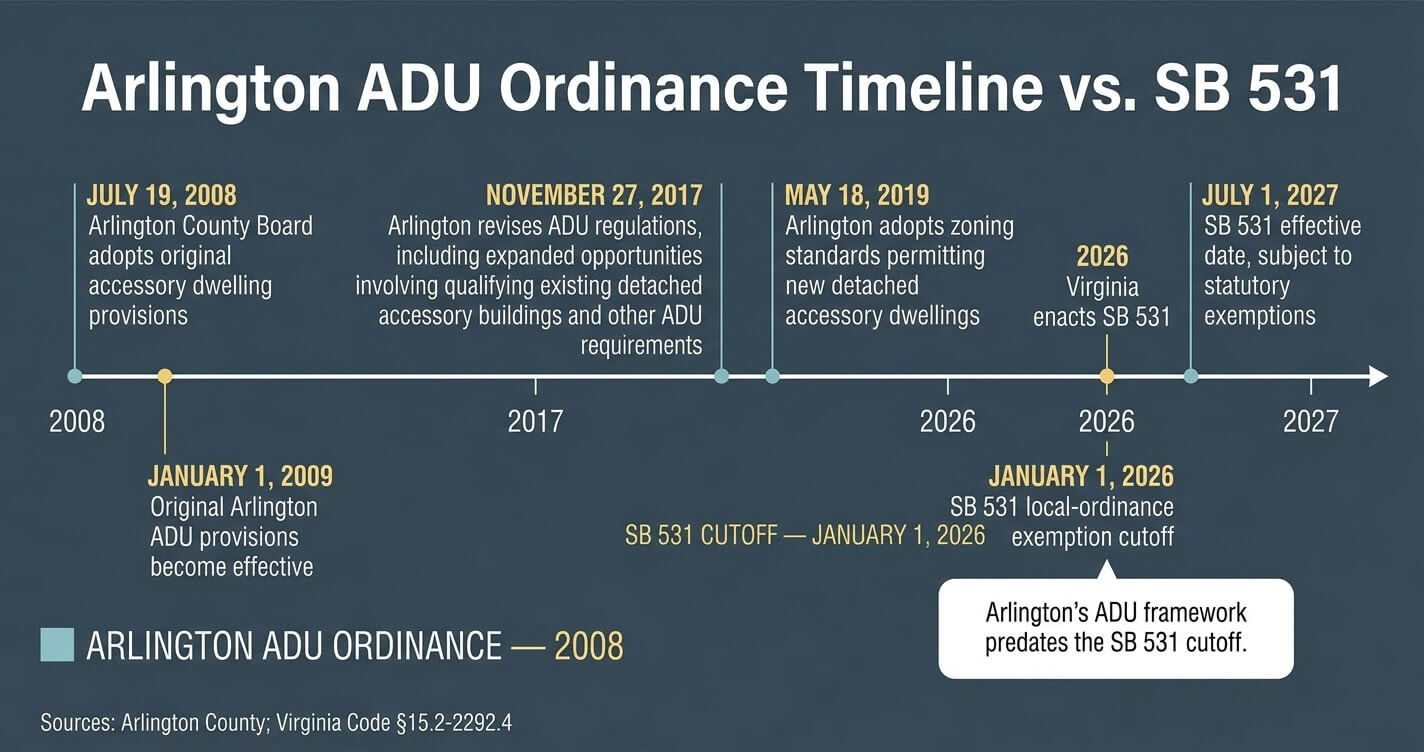
The history is important because the word “adopted” in the exemption refers to the existence of a local ADU ordinance, not to when Arlington most recently amended its rules.
2008: Arlington Establishes Its Original ADU Framework
Arlington’s accessory dwelling framework dates back to a County Board action on July 19, 2008.
The original provisions created a formal zoning framework for accessory dwellings in single-family detached homes. At that stage, ADUs were primarily contemplated as secondary living units within the main residence, such as basement or second-floor units.
The County’s historical document describes an accessory dwelling as a second dwelling with a kitchen, bathroom, and separate entrance on a single-family lot. The original framework also included eligibility, occupancy, parking, and owner-occupancy requirements.
The provisions for accessory dwellings became effective on January 1, 2009.
This date distinction is worth making clear: Arlington adopted the ADU provisions in 2008, while the accessory-dwelling provisions became effective in January 2009. For purposes of SB 531’s exemption, the adoption date is the critical point.
2017: Arlington Expands the ADU Framework
On November 27, 2017, the County Board adopted another significant amendment to its accessory dwelling regulations.
The amendment was designed to make ADUs more practical while retaining local controls. Among other changes, it allowed certain existing detached accessory buildings to be converted into accessory dwellings. It also revised ADU size standards and other requirements.
According to Arlington County’s zoning amendment history, the 2017 changes allowed detached accessory buildings that existed before November 27, 2017, to be converted into ADUs through interior alterations, subject to the applicable zoning requirements.
The amendment also established a maximum ADU size of 750 square feet or 35% of the combined area of the main and accessory dwelling, whichever was smaller, with a specific exception for accessory dwellings wholly within a basement.
The 2017 amendment therefore did not create Arlington’s ADU framework from scratch. It modified and expanded an existing ordinance that had already been adopted years earlier.
2019: New Detached ADUs Become Possible
Arlington took another major step on May 18, 2019, when the County Board adopted zoning standards permitting new detached accessory dwellings.
This amendment expanded upon the 2017 changes. It allowed property owners to establish new detached accessory dwellings under defined zoning and dimensional standards and also provided additional flexibility for converting existing accessory buildings.
For new detached ADUs on interior lots, the County established minimum 5-foot side and rear yard setbacks. On corner lots, the standards included a 5-foot side-yard setback and 10-foot rear-yard setback.
The 2019 amendment is especially relevant to today’s homeowners because Arlington’s current ADU program expressly recognizes detached accessory dwellings and provides specific standards for new accessory buildings containing ADUs.
The Timeline Makes the SB 531 Exemption Clear
When Arlington’s local history is placed next to the state law’s cutoff date, the legal distinction becomes much easier to understand:
Arlington had an ADU ordinance in place nearly 18 years before SB 531’s January 1, 2026, cutoff. The County subsequently amended and expanded that framework in 2017 and 2019, but those later amendments do not erase the fact that the underlying ADU ordinance predates the statutory cutoff.
That is why the 2027 discussion should not be framed as “Arlington will finally get ADU rights under SB 531.” Arlington already had a local ADU framework long before the statewide law was enacted.
The better question for an Arlington homeowner is whether the County chooses to amend its existing rules independently before or after July 1, 2027. That is a local zoning question, not an automatic consequence of SB 531.
What Arlington’s Current ADU Rules Actually Say: Size, Setbacks, and Occupancy
Arlington’s current ADU requirements are governed by the County’s own zoning framework, not by the 2027 statewide standards in SB 531.
For homeowners, the important requirements include ADU size, setbacks, occupancy, owner-occupancy, and property eligibility, and these rules should be verified against the County’s current zoning and permit requirements before design work begins.
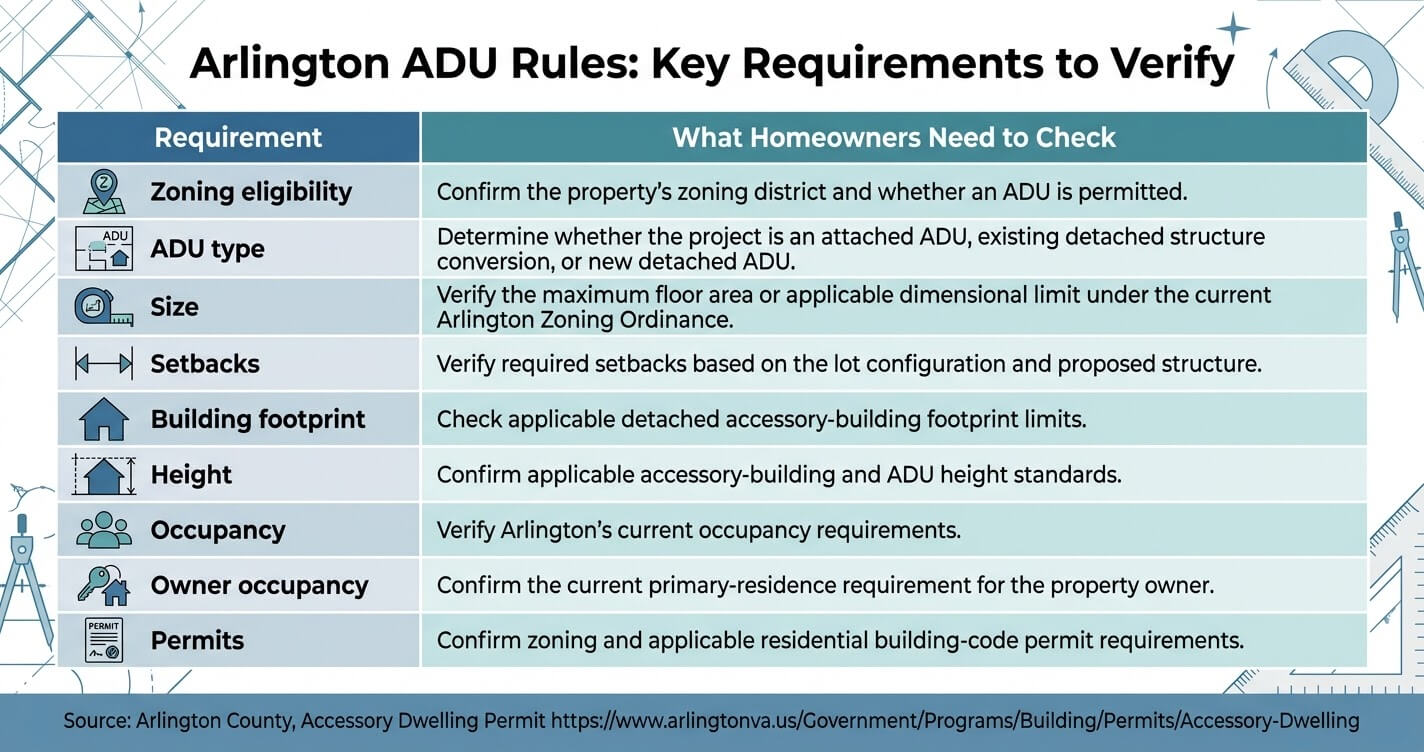
Because Arlington already regulates accessory dwellings locally, homeowners should not use SB 531’s statewide standards as a substitute for checking their property’s actual Arlington zoning requirements.
Arlington Regulates Both Attached and Detached ADUs
Arlington’s ADU program covers accessory dwellings created within or attached to the primary residence as well as qualifying detached accessory structures.
That distinction matters when evaluating a potential project because the applicable dimensional requirements can differ depending on whether the ADU is incorporated into the main house, located in an existing detached structure, or proposed as a new detached accessory building.
The County’s current accessory-dwelling guidance explains that an ADU is a secondary dwelling unit located on the same lot as a primary dwelling and provides separate living accommodations, including sleeping, cooking, and bathroom facilities.
For a detailed breakdown of the local requirements, including the specific size, setback, occupancy, and eligibility standards, homeowners can review ADU Regulations Arlington VA.
ADU Size Limits Depend on the Type of Unit
Arlington’s zoning framework does not treat every accessory dwelling as an identical structure. The permitted size depends on the type and location of the ADU and the applicable provisions of the Arlington County Zoning Ordinance.
For homeowners evaluating an attached ADU, the County’s regulations provide a maximum floor area of 750 square feet or 35% of the combined floor area of the main dwelling and accessory dwelling, whichever is less, subject to the specific exceptions contained in the zoning ordinance.
Detached ADUs are subject to their own dimensional framework and may be larger under the current rules, subject to applicable lot, building, and zoning requirements.
The practical lesson is that a homeowner should not determine ADU feasibility from square footage alone. Lot configuration, existing structures, setbacks, building footprint, height, and other zoning standards can all affect how much of the theoretical ADU allowance can actually be used.
Setbacks Still Matter
Setback compliance is another reason homeowners should evaluate an Arlington property before finalizing architectural plans.
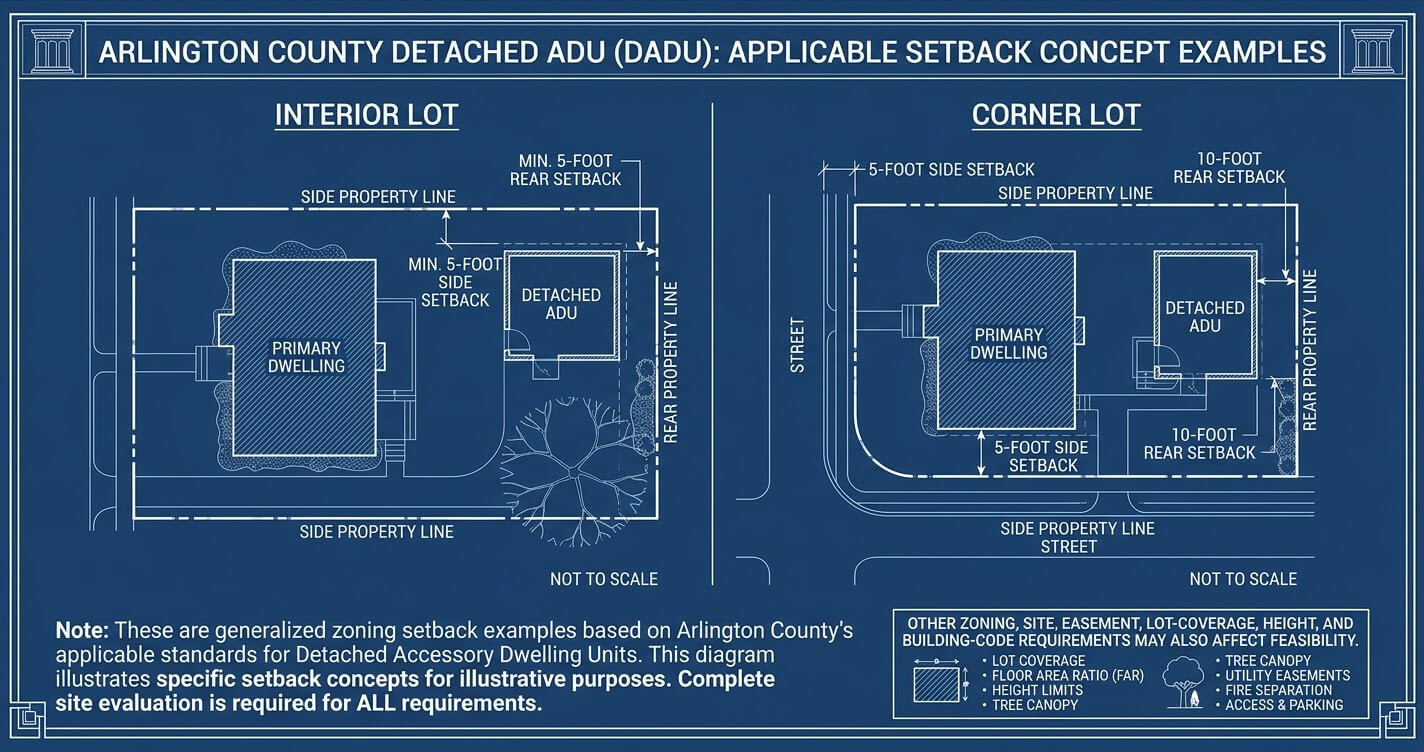
For detached accessory dwellings, Arlington’s zoning standards establish minimum yard setbacks. The rules can vary according to the lot configuration and the location of the proposed structure.
For example, Arlington’s 2019 detached-ADU amendment established a 5-foot minimum side and rear setback for new detached ADUs on interior lots, while corner lots are subject to different yard requirements.
However, homeowners should not assume that a simple five-foot measurement automatically determines whether a proposed detached ADU can be built. Other zoning provisions—including lot coverage, building height, location of existing structures, easements, and applicable building-code requirements, can affect the final design.
Occupancy and Owner-Occupancy Requirements Remain Local Issues
Arlington also maintains local requirements concerning who may occupy an accessory dwelling and how the primary residence and ADU relate to one another.
These requirements are particularly important because an ADU is not simply an additional standalone house on the same parcel. It remains an accessory use associated with the principal dwelling and is subject to Arlington’s local zoning framework.
For that reason, a homeowner should confirm current owner-occupancy, occupancy, rental, and eligibility requirements directly with Arlington County before relying on an ADU concept for long-term rental income, multigenerational housing, or another intended use.
Why You Should Verify the Rules Before Designing
An ADU concept can look feasible on paper and still encounter zoning problems once the actual property is reviewed.
Before investing heavily in architectural drawings, homeowners should confirm:
- Whether the property is located in a zoning district where an ADU is permitted
- Whether the proposed ADU type is allowed
- Maximum permitted floor area
- Required setbacks from property lines and other structures
- Building height and lot-coverage limitations
- Parking requirements, where applicable
- Owner-occupancy and occupancy requirements
- Building-code and life-safety requirements
- Any easements or site constraints affecting construction
Arlington County provides an official accessory-dwelling permit process and recommends reviewing eligibility and applicable requirements before submitting plans.
Homeowners weighing an ADU project under Arlington’s current rules may benefit from confirming their property’s zoning, dimensional constraints, and permitting requirements before finalizing plans. A property-specific review can prevent an attractive ADU concept from becoming an expensive redesign later.
What SB 531 Changes for Homeowners Elsewhere in Northern Virginia and Why Arlington Is Different
SB 531 establishes a statewide ADU framework for localities covered by the law, including by-right approval and limits on certain local requirements. Arlington is different because the enacted statute expressly exempts a locality that adopted an ADU ordinance before January 1, 2026, a condition Arlington satisfies through its longstanding local ADU regulations.
This distinction is critical for homeowners researching ADUs across Northern Virginia. A rule that applies to a locality without a qualifying pre-2026 ordinance should not automatically be assumed to apply in Arlington.
The Statewide Framework Is Designed to Reduce Local Barriers
SB 531 was enacted to establish broader statewide standards for accessory dwelling units.
For localities subject to the statute, the law requires certain ADUs to be permitted by right in single-family residential zoning districts beginning July 1, 2027.
The legislation also addresses several other local controls. Among its provisions, the law establishes a maximum ADU permit fee of $500, restricts certain minimum lot-size and dimensional requirements, and establishes standards concerning setbacks, parking, owner-occupancy, and other conditions that localities may impose.
The policy objective is straightforward: make ADUs easier to create by preventing local zoning rules from unnecessarily eliminating otherwise viable accessory-dwelling projects.
But the statute does not apply this framework uniformly to every locality.
The Pre-2026 Ordinance Exemption Changes the Analysis
The most important provision for Arlington homeowners is the statutory exemption.
SB 531 provides that its requirements do not apply to a locality that “adopted an accessory dwelling unit ordinance prior to January 1, 2026.”
Arlington meets that condition.
The County’s accessory-dwelling regulations were adopted in 2008 and subsequently expanded in 2017 and 2019.
This creates an important distinction:
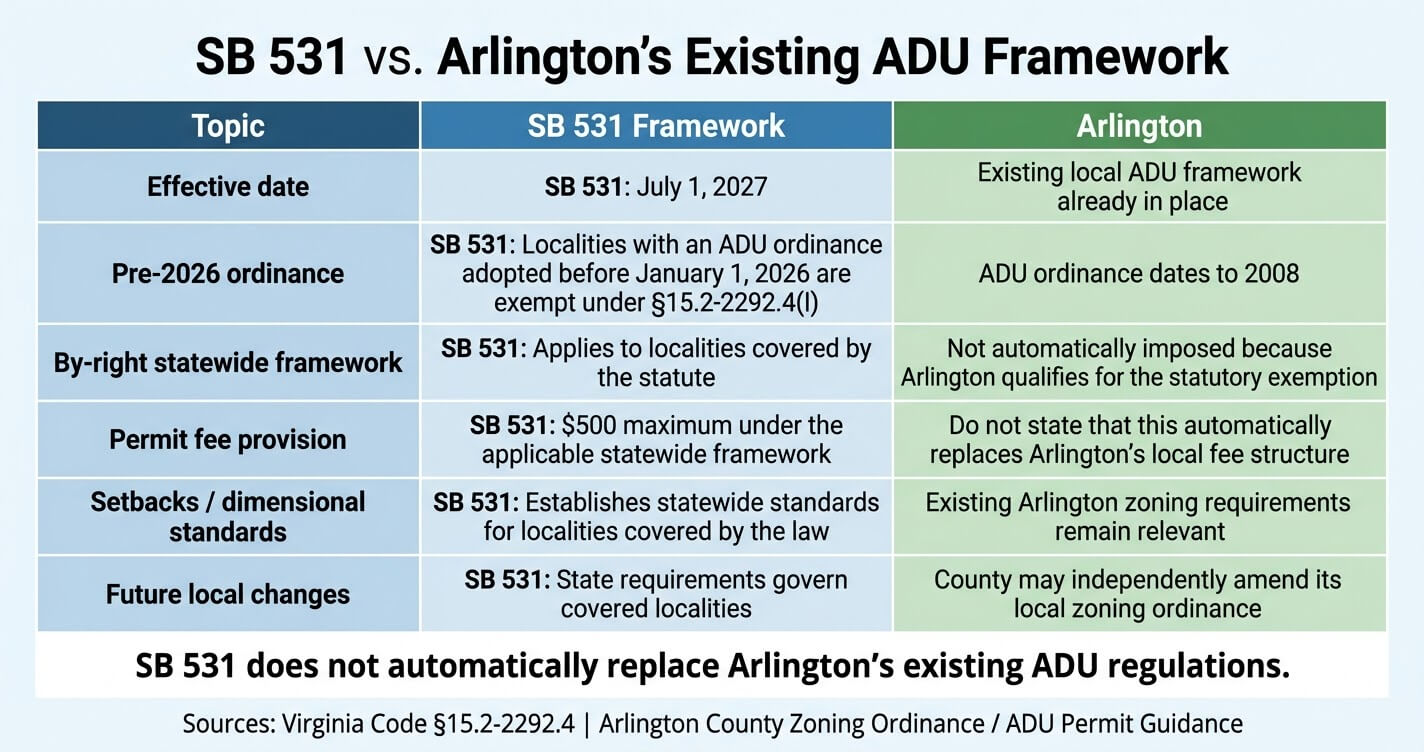
What About Fairfax County and Other Northern Virginia Jurisdictions?
This is where homeowners should be careful with broad statements about “Virginia ADU law.”
Northern Virginia does not operate under one single local zoning ordinance. Each jurisdiction has its own zoning authority and regulatory history.
For example, Fairfax County has had its own accessory-living-unit framework for years, while Arlington County has its separate accessory-dwelling regulations. Alexandria likewise has its own zoning framework.
That means determining whether SB 531 applies requires looking at the specific locality’s ordinance history, rather than simply assuming that every Northern Virginia homeowner receives the same treatment.
For readers interested in the broader statewide legislation, the site’s Virginia ADU Law SB 531 Explained article provides additional background on the legislation:
Why This Matters for ADU Planning
The distinction has a direct practical consequence.
A homeowner in a locality that must implement SB 531 may reasonably be planning around the statewide standards that take effect in 2027. An Arlington homeowner, however, should begin with Arlington’s existing zoning rules.
That means the safest planning sequence is:
Property → Arlington zoning → current ADU standards → design → permit
rather than:
Property → SB 531 2027 standards → assume Arlington approval
The second approach can create false expectations about allowable size, setbacks, occupancy, or permitting.
This is also why homeowners comparing ADU opportunities across Northern Virginia should examine local ordinances individually. Two properties only a few miles apart can fall under completely different zoning regimes.
Could Arlington Change Its ADU Rules Anyway?
Yes. Arlington could voluntarily amend its ADU regulations even though SB 531 does not require the County to replace its existing framework. The exemption means the state law does not automatically impose the new statewide standards on Arlington; it does not prevent the Arlington County Board from changing local zoning rules through its own legislative process.
This is an important distinction between “SB 531 requires Arlington to change” and “Arlington could choose to change.”
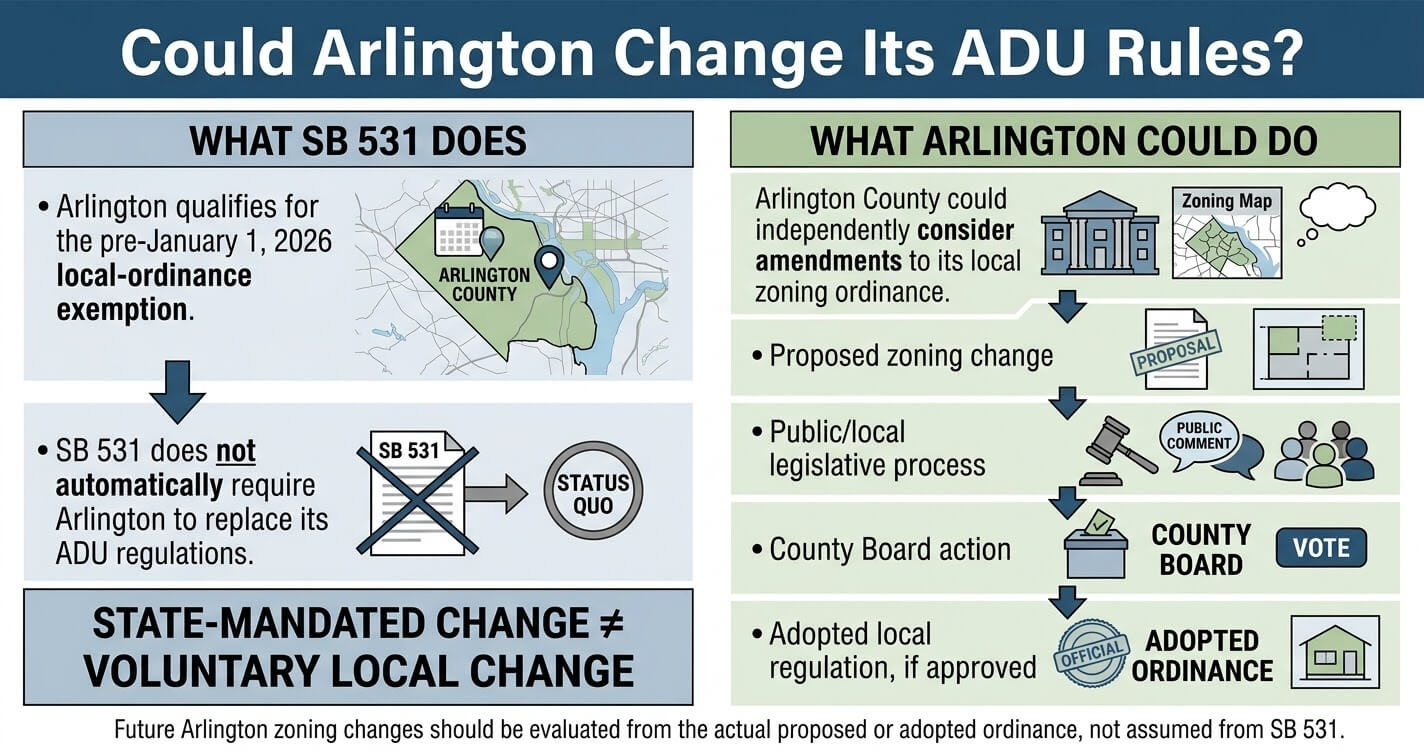
The first statement is not supported by the enacted exemption. The second remains a possibility because Arlington retains authority over its local zoning regulations.
Exemption Does Not Mean Arlington’s Rules Are Frozen
The fact that Arlington qualifies for the SB 531 exemption does not permanently lock its zoning ordinance in place.
Local zoning ordinances can be amended by the appropriate local governing body through the applicable public process. Arlington has amended its ADU regulations multiple times in the past, including significant changes in 2017 and 2019.
The County could therefore decide to modify ADU regulations independently, for example, by changing dimensional standards, eligibility requirements, permitting procedures, or other local provisions.
But such a change would be a local policy decision, not an automatic consequence of SB 531.
Arlington Could Choose to Align With the Statewide Standards
One possible scenario is that Arlington voluntarily changes some of its ADU regulations to resemble provisions contained in SB 531.
For example, the County could independently decide to modify certain requirements related to ADU size, setbacks, parking, fees, or approval procedures.
That possibility should not be presented as a prediction, however.
There is currently a major difference between what the law requires and what Arlington could voluntarily decide to do. SB 531’s exemption removes the statutory requirement for Arlington to implement the statewide framework; it does not provide evidence that the County Board will, or will not, adopt similar provisions later.
This distinction is particularly important for an article intended to answer homeowner questions. Predicting a future County Board zoning decision without an adopted ordinance or official proposal would turn a legal clarification into speculation.
What Homeowners Should Watch
If you are planning an ADU in Arlington and are concerned about potential 2027 changes, the most useful sources to monitor are official County zoning and County Board materials.
Look for:
- Proposed Arlington County Zoning Ordinance amendments
- County Board meeting agendas and adopted ordinances
- Official changes to Arlington’s accessory-dwelling permit guidance
- Public notices concerning ADU-related zoning changes
- Updated County zoning maps and development standards
These sources are more useful for tracking an actual Arlington rule change than relying on generalized articles about Virginia’s 2027 ADU legislation.
The Bottom Line for 2027
At present, Arlington homeowners should distinguish between a state-mandated change and a possible local change.
SB 531 does not automatically replace Arlington’s existing ADU regulations on July 1, 2027 because the enacted statute exempts localities that had already adopted an ADU ordinance before January 1, 2026.
Arlington had such an ordinance years before that date.
If Arlington changes its rules in the future, the change would need to come through the County’s own zoning process and should be evaluated based on the specific ordinance or amendment actually adopted, not assumed from SB 531 alone.
For homeowners planning an ADU today, the practical approach is to work from Arlington’s current requirements and monitor official County updates rather than delaying a project solely because of the July 1, 2027, state-law date.
What Arlington Homeowners Should Do Now
Arlington homeowners planning an ADU should work from the County’s current zoning and permitting requirements rather than assuming SB 531 will automatically change those rules in 2027. Before committing to architectural plans or construction costs, verify property eligibility, applicable setbacks and dimensional standards, ADU size, occupancy requirements, and the current permit pathway.
The most important planning mistake to avoid is designing around a future statewide standard that does not automatically govern Arlington.
Because Arlington already has its own accessory-dwelling framework, the property’s actual zoning conditions should remain the starting point for an ADU project.
1. Confirm That Your Property Is Eligible
Not every single-family property should be assumed to have the same ADU potential.
Start by identifying the property’s zoning district and reviewing Arlington County’s current ADU eligibility requirements. The County’s accessory-dwelling program establishes specific conditions that must be satisfied before an ADU can be permitted.
This step is particularly important before purchasing property specifically for an ADU project. A property that appears large enough for an additional dwelling may still have zoning, site, building, or other constraints that affect feasibility.
2. Determine Whether an Attached or Detached ADU Makes More Sense
Once basic eligibility is established, determine which type of ADU fits the property.
An attached ADU may be created within the primary residence, while a detached ADU involves an accessory structure separate from the main dwelling.
The distinction affects more than architectural appearance. It can influence:
- Maximum usable floor area
- Setbacks
- Building footprint
- Height
- Lot coverage
- Existing accessory structures
- Utility connections
- Site access
- Construction complexity
- Overall project cost
Arlington’s current accessory-dwelling guidance should be used to establish which standards apply to the specific project.
3. Verify Setbacks Before Finalizing the Floor Plan
Setbacks should be checked during the feasibility stage, not after the architectural design has already been completed.
For example, Arlington’s detached-ADU standards establish specific minimum setbacks, but the actual site must also be evaluated against the property’s configuration and other applicable zoning provisions.
A site plan should therefore account for the relationship between the proposed ADU, property lines, the primary dwelling, existing accessory structures, easements, and other relevant site conditions.
A few feet of difference in the available building envelope can materially affect the layout of a detached ADU.
4. Check Current Size and Occupancy Requirements
Do not use SB 531’s statewide standards to calculate the maximum ADU size that can be built on an Arlington property.
Arlington’s own zoning framework contains local standards governing accessory dwellings. Those requirements can depend on the type of ADU and the property’s circumstances.
For a detailed explanation of Arlington’s current ADU size, setback, eligibility, and occupancy requirements, homeowners can review ADU Regulations Arlington VA.
This approach also prevents this article from duplicating the detailed regulations covered on that existing page.
5. Understand the Permit Process Before Construction
Zoning eligibility and building-permit approval are related, but they are not the same thing.
An ADU project must satisfy the applicable zoning requirements and then comply with the building, fire, electrical, plumbing, mechanical, and other applicable construction requirements.
Arlington County maintains a specific accessory-dwelling permit process and provides application information through its official permitting resources.
Homeowners should therefore avoid treating a zoning review as equivalent to final construction approval.
If you are evaluating an ADU conversion or new detached unit, understanding the permit process early can help identify documentation, site-plan, structural, or code issues before construction begins.
For a step-by-step overview of the local permitting process, see ADU Permit Arlington VA: The Ultimate 2026 Guide.
6. Build the Budget Around Today’s Requirements
Another reason not to wait for July 2027 is that construction costs do not become predictable simply because a state law has a future effective date.
ADU costs can vary significantly depending on whether the project involves an interior conversion, garage conversion, addition, or new detached structure.
Existing conditions can also affect the budget. Older homes may require electrical upgrades, plumbing modifications, structural reinforcement, HVAC changes, insulation improvements, or other work before an ADU can be completed to current standards.
The National Association of Home Builders reports that the median age of owner-occupied homes in the United States has increased and that nearly half of owner-occupied homes were built before 1980.
For homeowners planning a Northern Virginia ADU, the age and condition of the existing house can therefore be an important part of the preliminary feasibility assessment.
For broader cost-planning information, see ADU Cost Northern Virginia 2026 Ultimate Guide.
7. Don’t Make a 2027 Decision Without Checking the Actual Law
If Arlington County proposes a zoning amendment before or after July 1, 2027, evaluate the actual proposed or adopted language.
Do not rely on headlines such as “Virginia ADU law changes in 2027” to determine what is permissible on an Arlington property.
The legally relevant questions are:
- Does the amendment apply to Arlington?
- Has Arlington actually adopted the change?
- What effective date applies?
- Which ADU types and properties are covered?
- Are there transition provisions for applications already submitted?
- Does the amendment change zoning requirements, permitting requirements, or both?
The official Arlington County zoning resources and County Board records are the appropriate places to verify an actual local change.
A Practical Pre-Design Checklist
Before spending heavily on architectural drawings, an Arlington homeowner should ideally have answers to these questions:
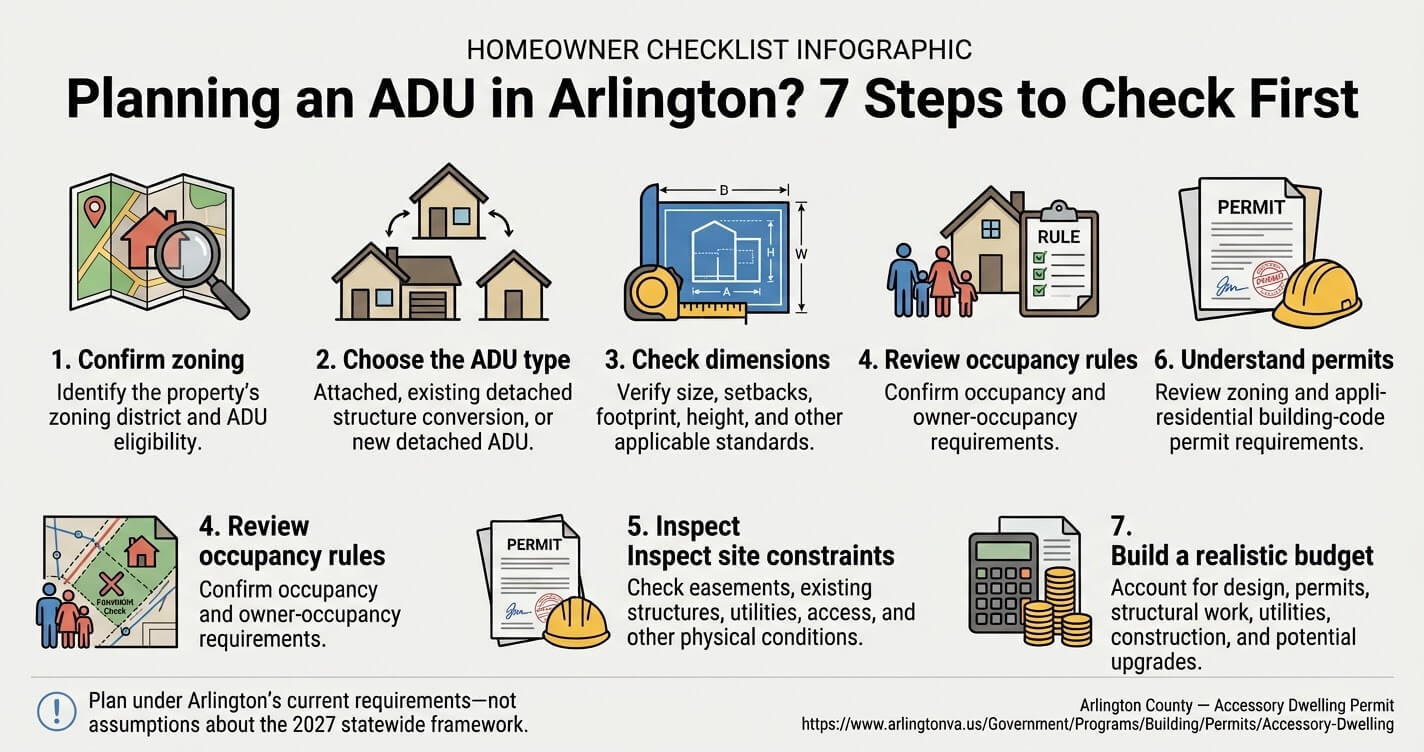
The best time to identify an ADU constraint is before design development, not after construction documents are complete. A property-specific feasibility review can help align the concept, budget, and permitting strategy with Arlington’s actual requirements.
Planning an Arlington ADU?
If you are considering an attached conversion, garage conversion, or detached backyard ADU, a design-build team can evaluate the project from both the planning and construction perspectives.
For homeowners considering a broader renovation strategy, Design-Build Northern Virginia can also provide useful context on coordinating design, permitting, and construction under one project approach:
Frequently Asked Questions
Does Virginia’s new ADU law, SB 531, apply to Arlington County?
No. SB 531’s mandatory ADU framework does not apply to Arlington because the statute expressly exempts localities that adopted an ADU ordinance before January 1, 2026. Arlington had already adopted ADU regulations in 2008.
The exemption appears in §15.2-2292.4(I) of the Code of Virginia.
Arlington’s zoning history documents its original accessory-dwelling regulations in 2008, followed by significant amendments in 2017 and 2019.
Will Arlington’s ADU size limits or setback rules change on July 1, 2027?
Not automatically. July 1, 2027, is the effective date for SB 531’s applicable statewide requirements, but Arlington falls within the statute’s pre-2026 local-ordinance exemption.
Arlington’s current size and setback requirements therefore remain relevant unless the County independently amends its zoning ordinance.
Homeowners should verify the current requirements through Arlington County rather than assuming that the statewide 2027 standards will replace them.
What are Arlington’s current ADU rules?
Arlington regulates ADUs through its own local zoning framework, including requirements governing eligibility, size, setbacks, occupancy, owner occupancy, and the type and location of the accessory dwelling.
Because individual properties can have different site and zoning constraints, homeowners should verify the requirements that apply to their specific parcel.
For the detailed local regulations, see ADU Regulations Arlington VA.
Why does SB 531 apply differently to some Virginia localities?
SB 531 is designed as a statewide framework, but the enacted statute expressly excludes localities that had already adopted an ADU ordinance before January 1, 2026.
That means the answer depends on the locality’s regulatory history. A homeowner should not assume that a rule applying to one Virginia jurisdiction automatically applies to another.
For broader background on the state legislation, see Virginia ADU Law SB 531 Explained.
Could Arlington change its ADU rules even if SB 531 does not require it?
Yes. Arlington could independently amend its local zoning regulations. The SB 531 exemption removes the automatic state-law requirement; it does not prevent the County Board from voluntarily changing Arlington’s ADU ordinance.
Arlington has already amended its ADU regulations multiple times, including major changes in 2017 and 2019.
Any future change should be evaluated based on the actual ordinance or amendment adopted by the County rather than inferred from SB 531.
Should I wait until 2027 to start an Arlington ADU project?
No. There is no need to delay an Arlington ADU project solely because SB 531 takes effect on July 1, 2027. Arlington’s existing ADU framework predates the statute’s cutoff, so homeowners can evaluate projects under the County’s current rules.
Waiting may make sense for an individual project for other reasons, such as financing, design development, construction timing, or a pending local zoning amendment. But the existence of SB 531 by itself is not a reason to assume that Arlington’s ADU rules will automatically become more permissive in 2027.
Does SB 531 mean Arlington homeowners can automatically use the statewide ADU size or setback standards?
No. Arlington homeowners should not assume that SB 531’s statewide dimensional standards automatically replace the County’s existing requirements. Arlington qualifies for the statute’s pre-2026 ordinance exemption.
The applicable standards for an Arlington project should therefore be determined from Arlington’s current zoning ordinance and permit requirements.
Crux of the Matter
Arlington ADU rules 2027 are not automatically changing because of Virginia’s SB 531. The enacted law expressly exempts localities that adopted an ADU ordinance before January 1, 2026, and Arlington’s ADU regulations date back to 2008.
For now, Arlington homeowners should plan around the County’s existing zoning and permitting framework while monitoring official County actions for any voluntary changes.
The distinction between statewide legislation and local zoning authority is the key to understanding Arlington’s situation.
SB 531 creates new statewide ADU requirements for localities covered by the statute. But the law itself contains an exemption for jurisdictions that had already adopted an ADU ordinance before January 1, 2026.
Arlington clearly had such a framework. The County adopted its original accessory-dwelling regulations in 2008 and subsequently expanded them through amendments in 2017 and 2019.
Therefore, homeowners should not interpret July 1, 2027 as an automatic deadline when Arlington’s existing ADU rules will disappear or be replaced by the statewide framework.
The County could still change its regulations in the future. But if that happens, it would be the result of an Arlington zoning action that should be evaluated on its own terms.
For homeowners considering an ADU today, the most reliable approach is to:
- Confirm the property’s zoning and ADU eligibility.
- Determine whether an attached or detached unit is feasible.
- Verify current size, setback, occupancy, and other local requirements.
- Evaluate building-code and site constraints.
- Understand the permit process.
- Build a realistic project budget.
- Monitor Arlington County for any future zoning amendments.
If you are ready to evaluate an ADU on your Arlington property, ADU Builder in Arlington, VA can be a natural next step for discussing the property’s potential, design requirements, construction scope, budget, and timeline.
The most important takeaway is simple: SB 531 does not automatically rewrite Arlington’s ADU rules in 2027. Your property’s actual Arlington zoning requirements, not a generalized interpretation of the statewide law, should be the starting point for planning an ADU project.
