
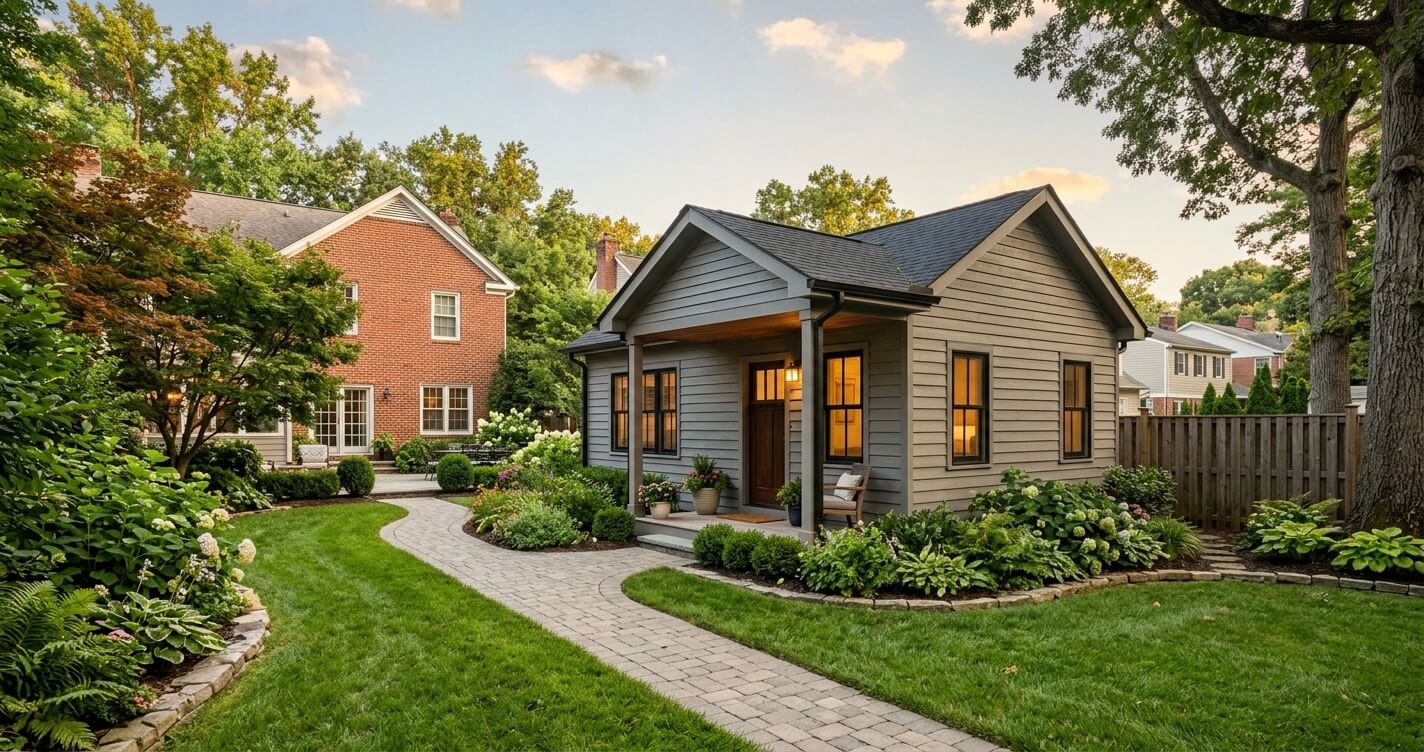
FHA ADU financing Northern Virginia homeowners can now access is no longer a workaround, it’s a formal HUD policy that lets homeowners in Fairfax County, Arlington, and McLean finance accessory dwelling unit construction and count ADU rental income toward their loan qualification. For years, homeowners who wanted to add a backyard cottage, convert a garage, or build an in-law suite had to rely on cash savings, a HELOC, or a conventional renovation loan, because FHA underwriting simply didn’t recognize ADUs as a financeable feature. That changed in October 2023, when the U.S. Department of Housing and Urban Development (HUD) updated FHA guidelines to allow rental income from ADUs to count toward a borrower’s qualifying income, and to make ADU construction eligible under FHA 203(k) Rehabilitation loans and FHA new-construction financing.
For Northern Virginia specifically, this shift matters more than in most of the country. Fairfax County, Arlington, and the surrounding jurisdictions carry some of the highest FHA loan limits in the nation, and property values here mean that closing the gap between what a homeowner can save in cash and what an ADU project actually costs often comes down to understanding exactly how FHA financing works. With years spent designing and building ADU projects across Northern Virginia, our design-build team has fielded this financing question from homeowners in Vienna, Reston, and Great Falls just as often as questions about permits or design. This guide walks through how FHA ADU financing works, what it costs, and where it fits alongside other options.
What Is FHA ADU Financing and How Does It Work?
FHA ADU financing refers to a 2023 HUD policy that allows FHA-approved lenders to count rental income from an accessory dwelling unit toward a borrower’s qualifying income, and to finance ADU construction through FHA 203(k) Rehabilitation loans or FHA new-construction loans. It does not create a separate “ADU loan,” it expands what existing FHA loan products can already be used for.

In October 2023, HUD announced that it would allow FHA-approved lenders to factor rental income from ADUs into a borrower’s qualifying income, and extended that flexibility to FHA 203(k) Rehabilitation mortgages and new-construction financing. Before this update, FHA appraisal and underwriting guidelines had no standardized way to value or count income from ADUs, which effectively locked many ADU-equipped properties out of FHA financing altogether.
HUD framed the change as a response to the national affordable housing shortage and a way to help homeowners build generational wealth through ADU rental income. The policy affects three distinct areas of FHA financing: rental income counted toward loan qualification, 203(k) renovation financing for adding an ADU to an existing home, and new-construction FHA loans that treat an ADU as an eligible improvement type from the ground up.
According to the National Association of Home Builders’ summary of the HUD policy, the update also introduced ADU-specific appraisal requirements so that appraisers can identify, analyze, and report on ADU characteristics and estimate achievable rent, a step that previously left many ADU-equipped properties inconsistently valued in FHA appraisals.
FHA Loan Limits in Fairfax County, Arlington & McLean for 2026
Fairfax County, Arlington County, Loudoun County, and Prince William County all qualify for FHA’s 2026 high-cost loan ceiling of $1,249,125 for a single-family home, the same maximum FHA will insure in Manhattan or downtown San Francisco. The national floor for lower-cost counties is $541,287.
FHA recalculates its loan limits every year using a formula set by the National Housing Act, tying the floor and ceiling to the national conforming loan limit the Federal Housing Finance Agency sets for Fannie Mae and Freddie Mac. Counties fall into one of three tiers: the national floor for lower-cost areas, the high-cost ceiling for the most expensive metro areas, or a “between” tier set at 115% of the local median home price. Northern Virginia’s proximity to Washington, D.C. and its home-price levels place Fairfax, Arlington, Loudoun, and Prince William at the high-cost ceiling every year.
Northern Virginia FHA Loan Limits for 2026:
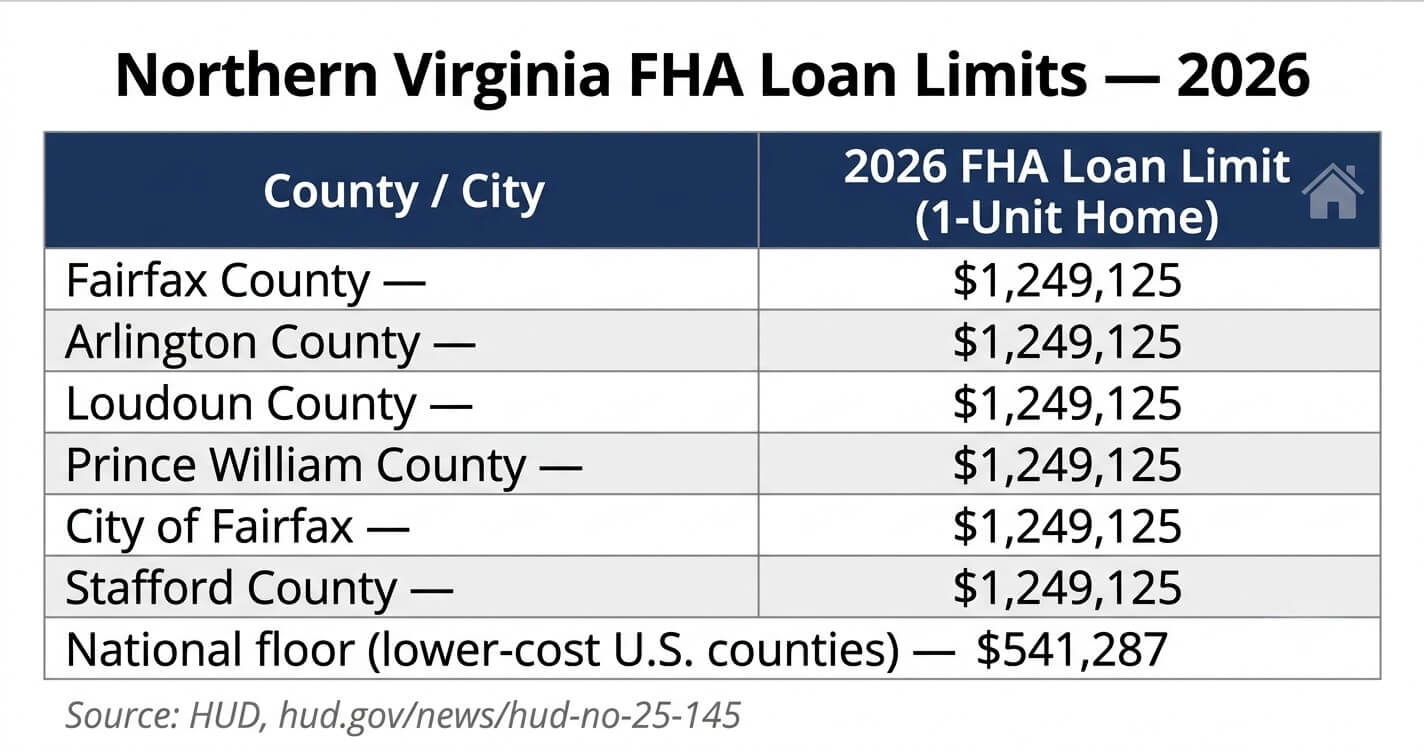
This matters directly for ADU financing. In most of the country, the FHA loan limit itself becomes the ceiling on how much construction cost a homeowner can roll into a 203(k) or new-construction loan. In Fairfax, Arlington, and the surrounding counties, the $1,249,125 ceiling leaves considerably more room to finance a primary home and an ADU together, a structural advantage Northern Virginia homeowners have that buyers in lower-cost markets typically don’t.
FHA 203(k) Loans for Building or Adding an ADU
An FHA 203(k) Rehabilitation loan lets Northern Virginia homeowners finance ADU construction, a garage conversion, basement ADU, or new detached unit, inside a single mortgage against their existing home, rather than juggling a separate construction loan. There are two versions: Limited 203(k) for smaller-scope work and Standard 203(k) for structural additions or major construction.
A Limited 203(k) loan is designed for renovation work that doesn’t involve structural changes and is typically capped well below the cost of most ground-up ADU builds, which makes it a better fit for cosmetic upgrades to an existing accessory structure than for new construction. A Standard 203(k) loan, by contrast, allows for structural work, additions, foundation work, new detached structures, and requires a HUD-approved 203(k) consultant to oversee scope, cost estimates, and inspections as the project moves through draws.
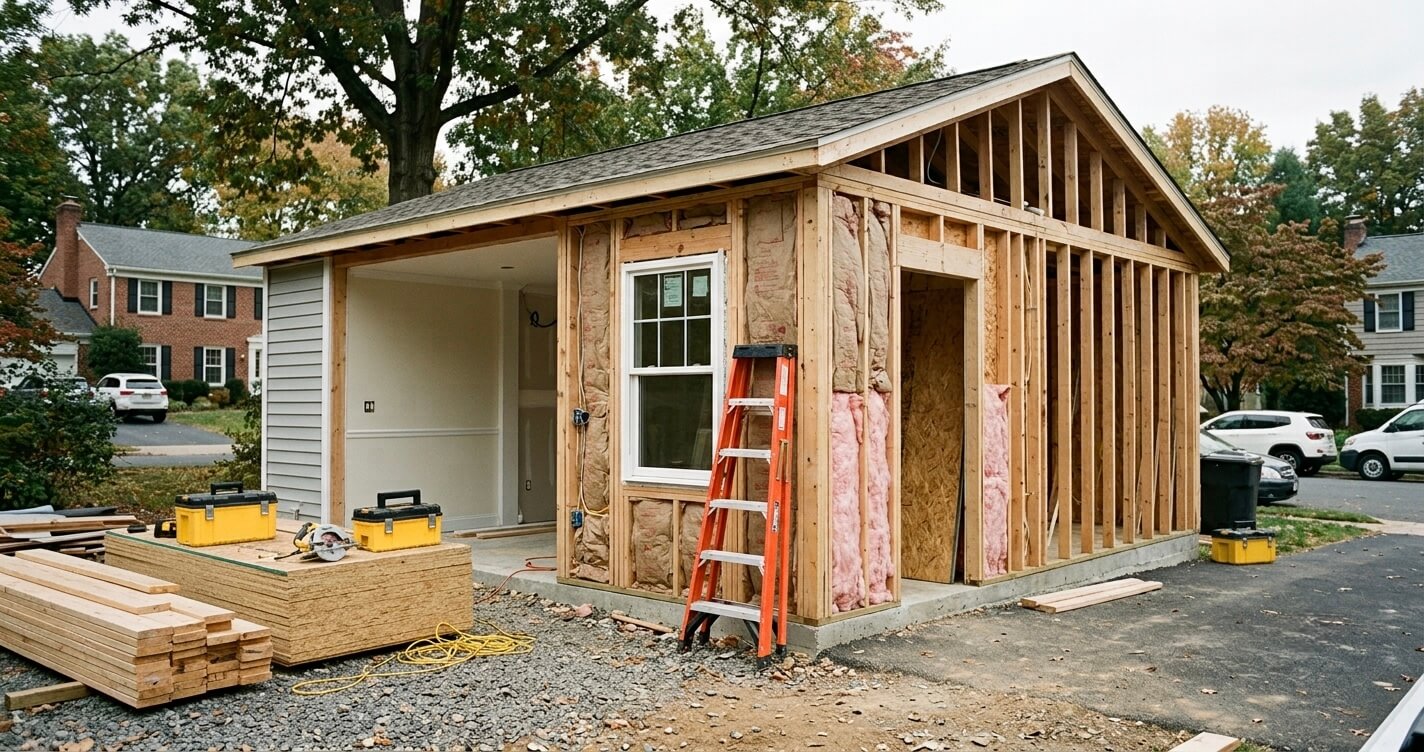
For a homeowner in Arlington converting a detached garage into a legal rental ADU, a project our team documented in the ADU garage conversion project in Arlington, a Standard 203(k) loan can fold both the conversion cost and any structural upgrades into one mortgage payment, rather than requiring a separate loan or a full cash outlay.
Before requesting a 203(k) loan amount, homeowners need a realistic construction budget. Our ADU cost in Northern Virginia guide breaks down 2026 price ranges by ADU type, which is the starting point most lenders will ask for before underwriting a 203(k) request.
Financing New Construction With an Attached or Detached ADU
Since the 2023 HUD policy update, ADUs are an eligible improvement type under FHA’s new-construction financing, meaning a Northern Virginia homeowner or buyer can use a single FHA-insured construction loan to build a primary home and an ADU together from the ground up, rather than financing the ADU as an afterthought.
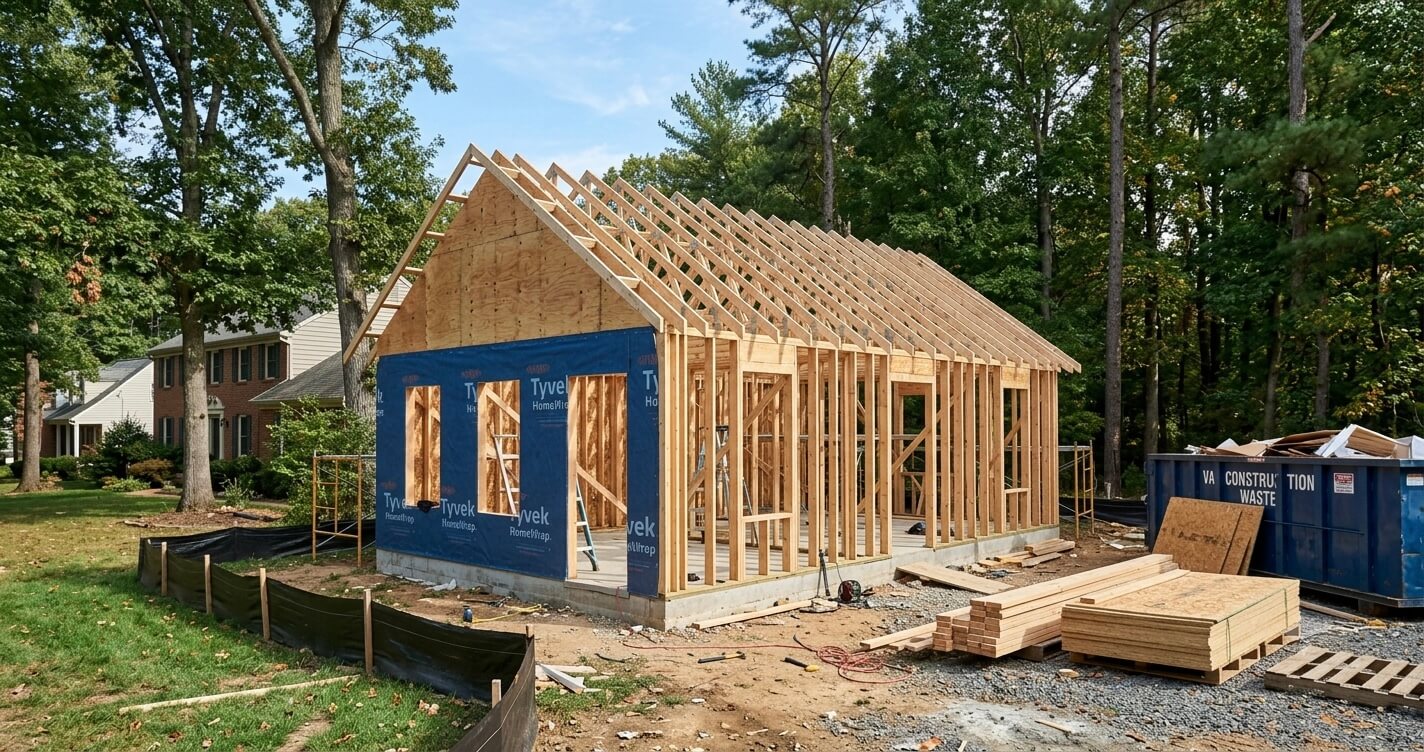
This path applies most directly to homeowners planning a full teardown-rebuild or a new-construction project that includes a detached ADU from the start. Because the ADU is scoped and appraised as part of the overall property rather than added later, the construction loan converts to a single permanent mortgage once the project is complete, avoiding the need to refinance or take out a second loan specifically for the ADU.
A ground-up ADU build, like the one detailed in our ADU build case study in Reston, illustrates how a detached unit is typically scoped, permitted, and constructed alongside a primary residence project, the same sequence a lender will expect to see documented before approving new-construction financing that includes an ADU.
Can ADU Rental Income Count Toward Your FHA Loan Qualification?
Yes. FHA-approved lenders can count up to 75% of a property’s estimated ADU rental income toward a borrower’s qualifying income, which can measurably increase how much home, and how much ADU, a Northern Virginia buyer can afford under FHA debt-to-income guidelines.

The estimate itself comes from an FHA appraiser’s opinion of achievable market rent for the ADU, not a homeowner’s own projection. Lenders will typically require documentation distinguishing between an ADU that already exists on the property and one that is only planned, since underwriting treatment differs between the two. The property must also remain the borrower’s primary residence, FHA ADU financing is not structured as an investment-property loan.
HUD’s October 2023 policy specifically allows FHA lenders to count 75% of a property’s estimated ADU rental income for qualifying borrowers when the ADU already exists on the subject property, a flexibility designed to help buyers and refinancing homeowners with modest incomes qualify for FHA-insured mortgages on ADU-equipped homes.
For Northern Virginia homeowners estimating what an ADU could realistically rent for in Fairfax, Arlington, or Reston, our ADU rental income in Northern Virginia guide breaks down current local rent ranges by unit type, useful context before a lender’s appraiser produces their own estimate.
FHA vs. Conventional vs. Cash: Which Financing Fits Your ADU Project?
FHA offers the lowest down payment (3.5%) and the most flexible credit requirements for ADU financing, which suits homeowners with limited cash reserves, but conventional loans, HELOCs, or cash often give homeowners with strong home equity in Fairfax, McLean, or Great Falls more building flexibility and no permanent mortgage insurance.
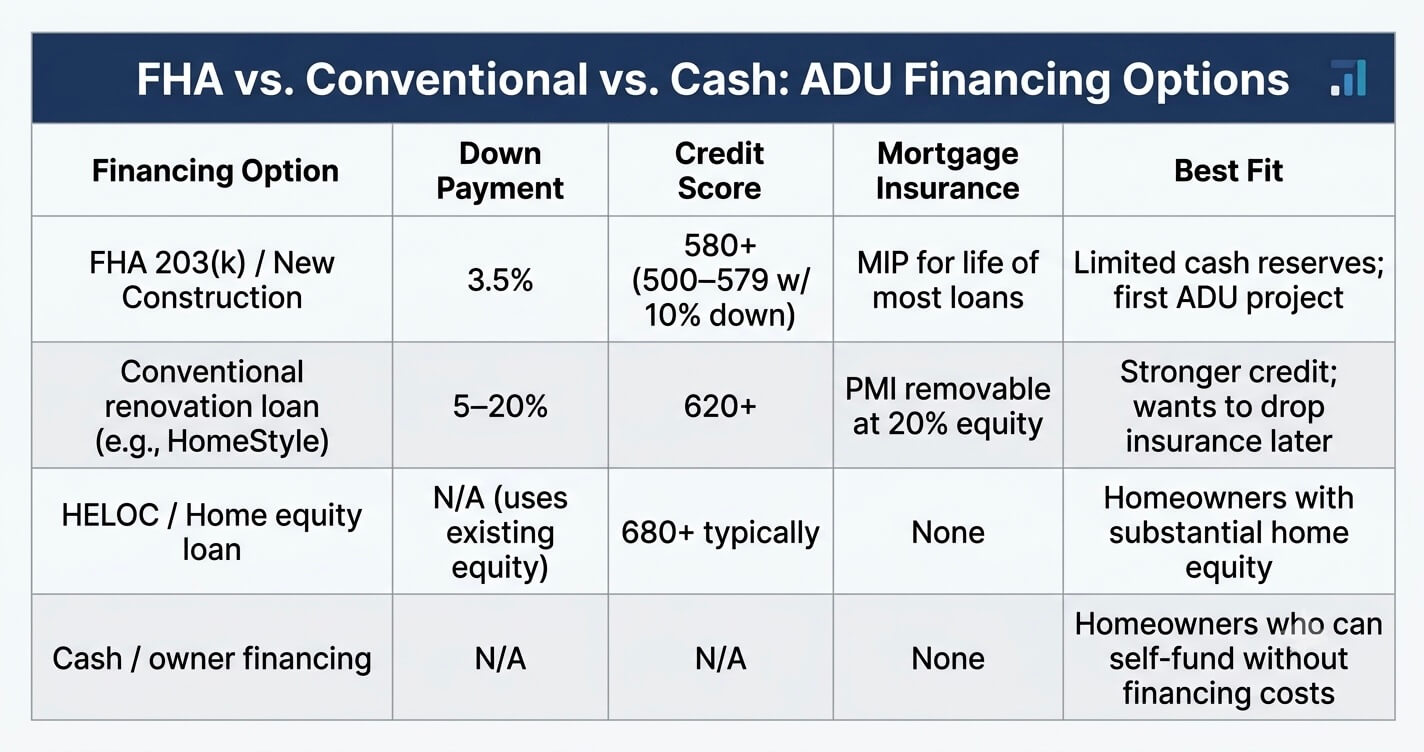
FHA mortgage insurance premium (MIP) is one of the least understood costs of FHA ADU financing. Unlike conventional PMI, which can be removed once a borrower reaches 20% equity, most FHA loans carry MIP for the life of the loan when the down payment is below 10%. On a high-value Northern Virginia property near the $1,249,125 loan limit, that ongoing premium can add a meaningful amount to the monthly payment — a tradeoff worth running against a conventional renovation loan before committing, especially for homeowners with strong credit and existing equity.
For homeowners whose project is closer to an attached in-law suite than a standalone ADU, it’s also worth comparing financing against our broader home addition and renovation services, since financing options and construction scope can differ meaningfully between an attached addition and a detached ADU.
Local Considerations for Fairfax County, Arlington & Vienna Homeowners
FHA ADU financing does not override local zoning or permitting requirements, Northern Virginia homeowners still need county-level ADU approval before a lender will finance or appraise the unit, since FHA underwriting treats an unpermitted ADU as unfinanceable square footage.
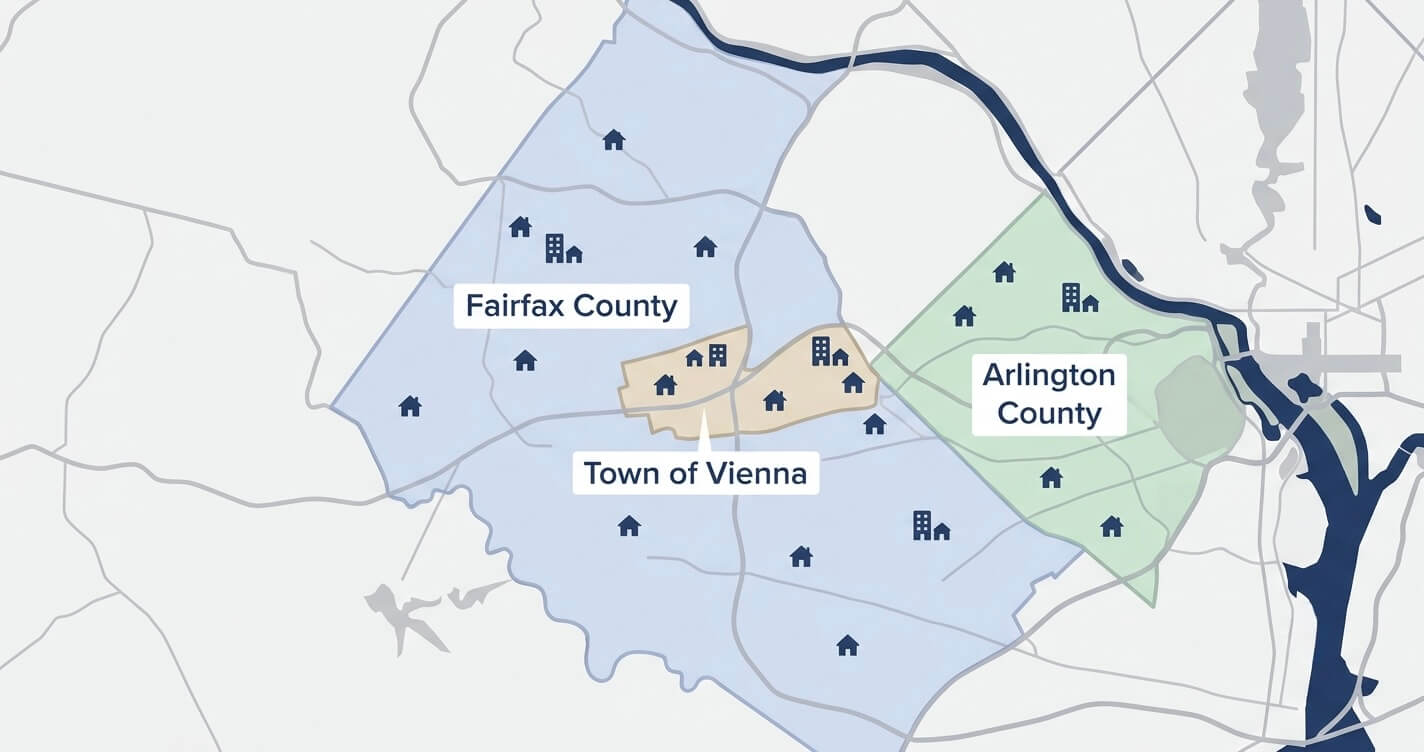
Virginia’s statewide ADU law gives homeowners the by-right ability to build an accessory dwelling unit on a single-family zoned lot, but permitting still runs through the county. The framework behind this right is explained in our guide to Virginia ADU Law SB 531, and the county-level approval process, including the two-step zoning and building permit sequence, is covered in our ADU permit process in Fairfax County guide.
Arlington homeowners should also review ADU regulations Arlington VA for zoning and setback specifics before applying for financing, since lenders typically require evidence that the ADU complies with local code before including it in a loan amount.
Homeowners weighing FHA financing against other options for an ADU project may find it useful to walk through the numbers with an experienced design-build team before finalizing a budget or applying for a loan.
Common Mistakes Homeowners Make With FHA ADU Financing
The most common FHA ADU financing mistakes involve assuming rental income counts automatically, underestimating FHA mortgage insurance costs, and applying for financing before confirming the ADU is legally permittable in the applicable county.

- Assuming rental income counts automatically, an FHA appraiser must produce the rent estimate; a homeowner’s own projection is not sufficient documentation.
- Skipping the appraisal conversation early, lenders need an appraiser familiar with ADU-specific reporting requirements, and not every appraiser in a given area has handled one.
- Applying before confirming county-level ADU legality, zoning and permit approval typically must be established, or at least clearly path-able, before a lender will finance the unit.
- Underestimating FHA mortgage insurance costs, MIP often lasts the life of the loan and can outweigh the lower down payment advantage for homeowners with strong equity.
- Choosing the wrong 203(k) tier for the project, using a Limited 203(k) for work that involves structural changes typically leads to delays or a required loan-type switch mid-project.
Frequently Asked Questions
What is the FHA loan limit for a single-family home in Fairfax County in 2026?
The 2026 FHA loan limit for a single-family home in Fairfax County is $1,249,125, the same high-cost ceiling that applies to Arlington, Loudoun, and Prince William counties.
Can I use FHA financing to build an ADU in Northern Virginia?
Yes. Since HUD’s October 2023 policy update, FHA 203(k) Rehabilitation loans and FHA new-construction loans can both be used to finance ADU construction in Northern Virginia, provided the ADU complies with local zoning and permitting requirements.
Does ADU rental income count toward FHA loan qualification?
Yes, FHA lenders can count up to 75% of a property’s estimated ADU rental income toward a borrower’s qualifying income, which can increase the loan amount a homeowner qualifies for.
What’s the difference between an FHA 203(k) loan and a regular FHA loan for an ADU?
A regular FHA loan finances the purchase of an existing home as-is, while a 203(k) loan wraps renovation or construction costs, including adding an ADU, into the same mortgage, disbursed through inspected draws as work is completed.
Do I need county approval before I can get FHA financing for an ADU?
Yes. FHA lenders require confirmation that an ADU is legally permittable or already permitted in the applicable Northern Virginia county before financing or appraising it, since an unpermitted structure typically cannot be included in the loan amount.
How much down payment is required for FHA ADU financing?
FHA financing generally requires a minimum 3.5% down payment for borrowers with a credit score of 580 or higher, the same standard down payment requirement that applies to other FHA-insured loans.
Is FHA or conventional financing better for an ADU project in Arlington or McLean?
It depends on the homeowner’s credit, equity, and cash reserves. FHA typically suits buyers with limited savings and moderate credit, while conventional or home equity financing often costs less over time for homeowners with strong equity in high-value Arlington or McLean properties, mainly because conventional PMI can be removed while FHA mortgage insurance often cannot.
Final Thoughts
FHA ADU financing Northern Virginia homeowners can use today looks very different than it did just a few years ago. The 2026 loan limits give Fairfax, Arlington, and the surrounding counties some of the highest FHA ceilings in the country, the 203(k) and new-construction paths make it possible to fold ADU costs into a single mortgage, and the ability to count 75% of ADU rental income toward qualification opens the door for buyers who previously couldn’t make the numbers work. None of that replaces the groundwork, confirming zoning eligibility, understanding permit timelines, and budgeting realistically for construction costs, but it does mean financing no longer has to be the reason an ADU project stalls. With experience guiding Northern Virginia homeowners through ADU design, permitting, and construction, our team can help you think through how financing fits into your specific project before you apply for a loan.

Planning to finance an ADU in Fairfax County, Arlington, or elsewhere in Northern Virginia? Contact US Home Design Build to discuss your project scope, budget, and how it fits with FHA or other financing options.