

ADU Rental Income Northern Virginia has become one of the most frequently researched topics among homeowners looking to maximize the value of their property. With housing costs continuing to rise throughout Fairfax County, Arlington, McLean, Vienna, and surrounding communities, many homeowners are exploring Accessory Dwelling Units (ADUs) as a way to create flexible living space while generating additional monthly income.
An ADU is a secondary residential unit located on the same property as a primary residence. Depending on local zoning regulations, an ADU may be built as a detached backyard cottage, attached addition, garage conversion, or finished basement apartment with a separate entrance.
While many articles promote ADUs as a guaranteed source of passive income, the reality is more nuanced. Rental income varies significantly based on location, unit size, local regulations, construction quality, and market demand. Homeowners who approach ADU planning with realistic expectations are typically better positioned to achieve strong long-term returns.
The financial opportunity is supported by broader housing trends. According to the National Association of Realtors (NAR), the United States continues to face a significant housing supply shortage, creating ongoing demand for smaller housing options in high-cost markets. [Source: National Association of Realtors]
For Northern Virginia homeowners, this housing shortage has helped strengthen rental demand in many neighborhoods, particularly near employment centers, transit corridors, and highly rated school districts.
At the same time, ADUs offer benefits beyond rental income. Many homeowners use them for multigenerational living, aging-in-place planning, guest accommodations, home offices, or future downsizing strategies. This flexibility often makes an ADU valuable even before rental revenue is considered.
Homeowners who are still evaluating whether an ADU is feasible for their property can review USHDB’s ADU Builder Northern Virginia dedicated page for this purpose.
As we will explore throughout this guide, the most successful ADU projects are typically those that balance rental income potential with long-term property goals, zoning compliance, and realistic construction budgets.
Why More Northern Virginia Homeowners Are Building ADUs
Interest in ADUs has increased substantially across Northern Virginia over the past several years. Rising home prices, increasing property taxes, evolving family needs, and changing housing preferences have encouraged many homeowners to view their properties as long-term assets capable of serving multiple functions.
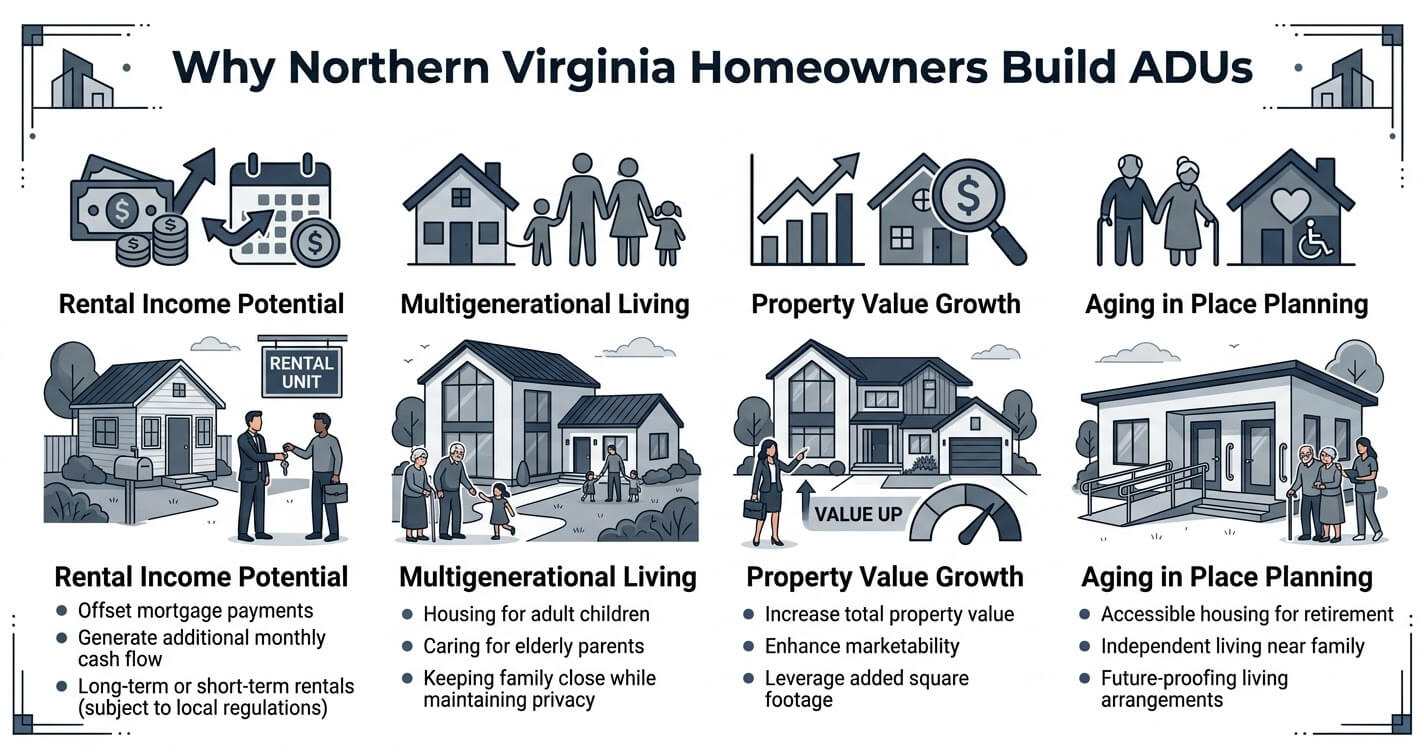
Unlike traditional home additions, ADUs can provide both additional living space and potential income generation. This dual-purpose benefit is one of the primary reasons demand continues to grow.
Rental Income Potential
For many homeowners, rental income is the primary motivator behind an ADU project.
Rather than relying solely on future property appreciation, an ADU may create an additional monthly revenue stream that can help offset mortgage payments, property taxes, maintenance expenses, or future retirement costs.
In high-demand Northern Virginia markets, even modest ADUs can attract strong tenant interest when designed with privacy, functionality, and independent access in mind.
However, successful income generation depends heavily on factors such as:
- Location
- Parking availability
- Separate entrances
- Unit size
- Local zoning regulations
- Construction quality
- Access to employment centers
Homeowners who evaluate these factors early in the planning process often achieve stronger financial outcomes than those focused exclusively on maximizing square footage.
Multigenerational Living Flexibility
Not every ADU is built for immediate rental purposes.
Many Northern Virginia homeowners initially construct ADUs to accommodate aging parents, adult children, visiting family members, or caregivers. Over time, these same spaces can transition into rental units as family needs evolve.
According to the U.S. Census Bureau, multigenerational households have become increasingly common across the United States. [Source: U.S. Census Bureau]
Increased Property Value
While rental income often receives the most attention, many homeowners underestimate the impact an ADU can have on overall property desirability.
Properties with well-designed ADUs frequently appeal to a broader range of buyers, including:
- Multigenerational families
- Remote workers
- Investors
- Homeowners seeking supplemental income
- Buyers planning for future aging-in-place needs
The value increase varies by market conditions and property characteristics, but flexibility itself has become an increasingly important selling point in Northern Virginia’s competitive housing market.
Aging-in-Place Planning
Another growing motivation involves long-term retirement planning.
Rather than leaving their neighborhood later in life, some homeowners build ADUs that can eventually serve as caregiver housing, guest accommodations, or downsized living space while family members occupy the primary residence.
This strategy allows homeowners to adapt their property over time without relocating from communities where they have established social, professional, and family connections.
What Types of ADUs Generate Rental Income?
Not all ADUs perform equally from a rental perspective. The ideal configuration depends on lot characteristics, zoning restrictions, construction budget, and target tenant demographics.
Understanding the strengths and limitations of each ADU type can help homeowners make more informed investment decisions.
Detached Backyard Cottage ADUs
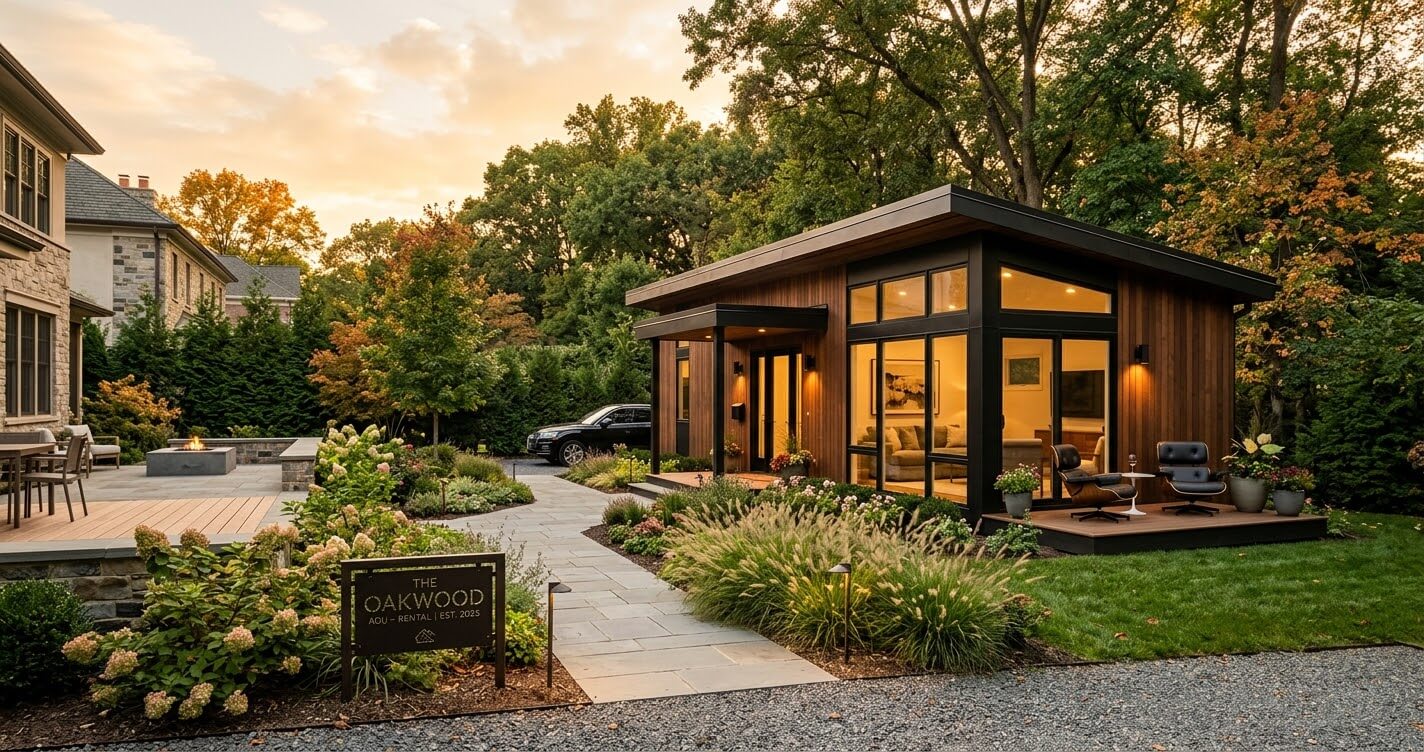
Detached ADUs are standalone structures built separately from the primary residence.
Because they offer the highest level of privacy for both tenants and homeowners, detached units often command some of the strongest rental rates in Northern Virginia.
Advantages
- Maximum tenant privacy
- Strong rental appeal
- Greater long-term flexibility
- Potential for higher monthly rents
- Reduced interaction between occupants
Challenges
- Highest construction costs
- Utility connection requirements
- Additional site work expenses
- Longer permitting timelines
Detached ADUs are often attractive in larger-lot communities such as Great Falls, McLean, Clifton, and portions of Fairfax County where sufficient yard space exists.
Basement ADUs
Basement ADUs remain one of the most common and cost-effective options throughout Northern Virginia.
Because the primary structure already exists, homeowners can often create a rental unit at a lower cost than constructing a detached building.
Advantages
- Lower construction cost
- Existing building envelope
- Faster project timelines
- Efficient use of unused space
Challenges
- Limited natural light
- Potential sound transmission
- Separate entrance requirements
- Lower privacy compared to detached units
In many neighborhoods, basement ADUs provide one of the strongest ROI opportunities due to their relatively favorable construction-to-income ratio.
Garage Conversion ADUs
Garage conversions transform existing attached or detached garages into independent living spaces.
When zoning allows and parking requirements can still be satisfied, garage conversions can offer a cost-effective path to ADU creation.
Advantages
- Lower structural costs
- Existing building footprint
- Faster construction schedules
Challenges
- Loss of vehicle storage
- Utility modifications
- Potential zoning limitations
- Parking compliance concerns
Garage conversions tend to perform best in areas where off-street parking remains readily available.
Attached ADUs and In-Law Suites
Attached ADUs share at least one wall with the primary residence while maintaining independent living functionality.
These units often strike a balance between affordability and privacy.
Advantages
- Lower cost than detached structures
- Easier utility integration
- Efficient use of lot space
Challenges
- Reduced tenant privacy
- Sound transmission considerations
- Potential design limitations
For many homeowners, attached ADUs offer a practical middle ground between basement conversions and detached cottages.
ADU Rental Income Northern Virginia: Typical Monthly Rent Ranges
One of the most common questions homeowners ask is: “How much can I realistically charge for an ADU?”
The answer depends on several variables, but understanding general market ranges can help establish realistic expectations during the planning phase.
The table below illustrates typical rental ranges often observed across Northern Virginia markets. Actual rents vary based on location, finishes, size, amenities, parking, and local market conditions.
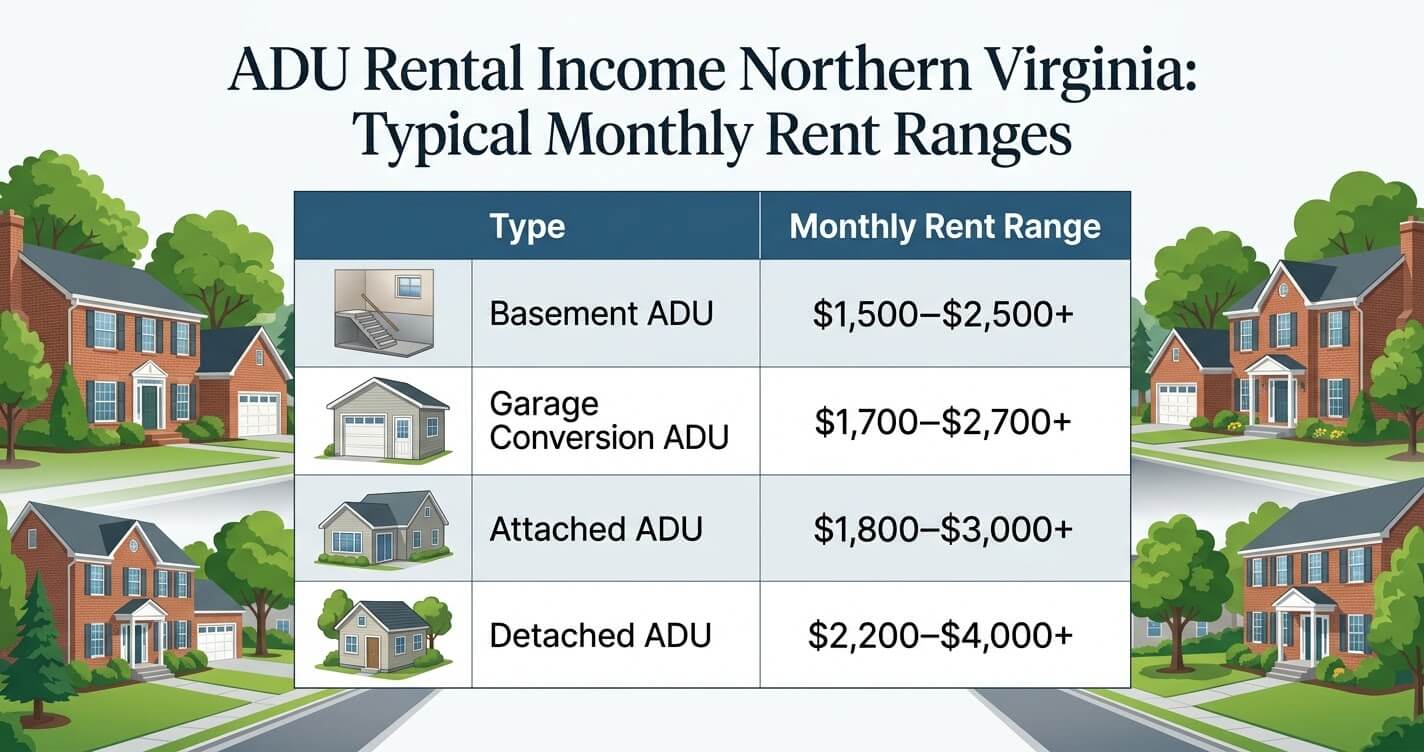
These figures should be viewed as broad planning estimates rather than guaranteed rental outcomes.
Several factors can significantly influence rental performance:
- Location
A detached ADU in Arlington near Metro access may command substantially higher rent than a comparable unit in a less transit-oriented location.
- Unit Size
Studios, one-bedroom units, and two-bedroom ADUs serve different tenant demographics and rental markets.
- Parking Availability
Dedicated off-street parking often increases tenant demand and marketability.
- Interior Finishes
Modern kitchens, durable flooring, upgraded bathrooms, and energy-efficient systems frequently improve perceived value.
- Privacy Features
Separate entrances, outdoor living areas, dedicated utility systems, and sound insulation can influence tenant willingness to pay premium rents.
While rental income remains an important consideration, homeowners should avoid making investment decisions based solely on optimistic rent projections. A successful ADU project typically balances realistic revenue expectations with construction costs, long-term maintenance obligations, and future property goals.
What Determines How Much Rental Income an ADU Can Produce?
While average rental ranges provide a useful starting point, actual earnings can vary dramatically from one property to another. Two ADUs with similar square footage may generate significantly different rental income depending on location, design decisions, and tenant demand.
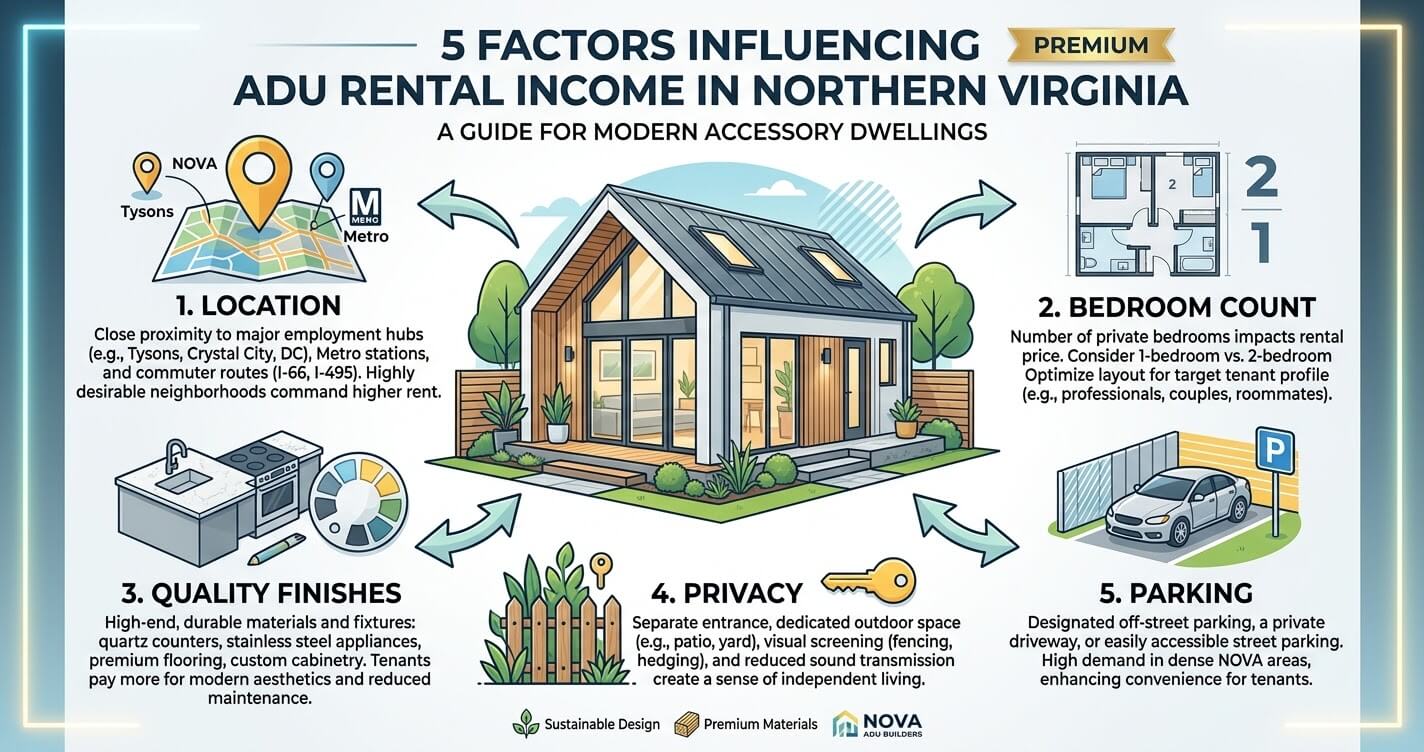
Understanding the primary drivers of rental performance can help homeowners make more informed design and investment decisions before construction begins.
Location within Northern Virginia
Location is often the single most important factor affecting ADU rental income.
Northern Virginia contains several distinct housing markets, each with different rental demand patterns, price points, and tenant demographics.
Arlington
Arlington typically commands some of the highest rental rates in the region due to its proximity to Washington, D.C., Metro access, employment centers, and walkable neighborhoods.
ADUs located near Metro stations, commercial districts, and major transportation corridors often experience strong tenant demand.
McLean
McLean attracts professionals, executives, government contractors, and relocating families seeking access to premium neighborhoods and highly regarded schools.
Well-designed detached ADUs in McLean frequently appeal to tenants seeking privacy and convenience without committing to larger rental homes.
Fairfax
Fairfax offers a broad range of housing opportunities and tenant profiles, making it one of the most versatile ADU markets in Northern Virginia.
Basement ADUs and attached units often perform particularly well due to relatively strong rental demand and lower construction costs.
Homeowners researching local regulations should also review accessory living unit Fairfax County VA guide for detailed analysis.
Vienna and Falls Church
Vienna and Falls Church continue to attract renters seeking suburban amenities with convenient access to employment centers.
Properties near town centers, transit options, and established residential neighborhoods often generate stronger rental interest than more isolated locations.
Size and Bedroom Count
Rental demand often increases as ADUs become more functional for long-term occupancy.
Although studio units may cost less to construct, one-bedroom and two-bedroom layouts frequently attract a broader tenant pool.
Potential tenants may include:
- Young professionals
- Traveling healthcare workers
- Government employees
- Graduate students
- Retirees
- Small families
- Remote workers
In many cases, a thoughtfully designed 700–900-square-foot ADU may outperform a larger but less efficient layout.
Quality of Finishes
Not every upgrade increases rental income, but certain design choices can significantly influence marketability.
Features that often improve tenant appeal include:
- Quartz or stone countertops
- Durable luxury vinyl plank flooring
- Energy-efficient windows
- Modern kitchens
- Walk-in showers
- Dedicated laundry facilities
- Smart thermostats
- Enhanced sound insulation
These features may not dramatically increase construction costs relative to the overall project budget but can improve perceived value and tenant retention.
Separate Entrance and Privacy
Privacy remains one of the most important considerations for both tenants and homeowners.
Features that often improve rental performance include:
- Independent entrance
- Separate outdoor seating area
- Sound separation measures
- Dedicated parking
- Independent utility metering
Many renters are willing to pay a premium for ADUs that feel like standalone residences rather than extensions of the primary home.
Parking Availability
Parking requirements vary by jurisdiction, but practical parking availability remains an important consideration regardless of local regulations.
Properties with dedicated off-street parking frequently appeal to a broader tenant base and may experience shorter vacancy periods.
Local Rental Demand
Economic conditions, employment growth, housing inventory, and demographic trends all influence rental demand.
Northern Virginia continues to benefit from a diverse employment base supported by:
- Federal government agencies
- Defense contractors
- Technology companies
- Healthcare systems
- Professional services firms
This economic diversity has historically contributed to relatively stable housing demand throughout the region.
Realistic Annual ADU Income Examples
One of the biggest mistakes homeowners make is assuming every ADU will generate identical returns. Actual income depends on construction costs, market conditions, tenant demand, and operating expenses.
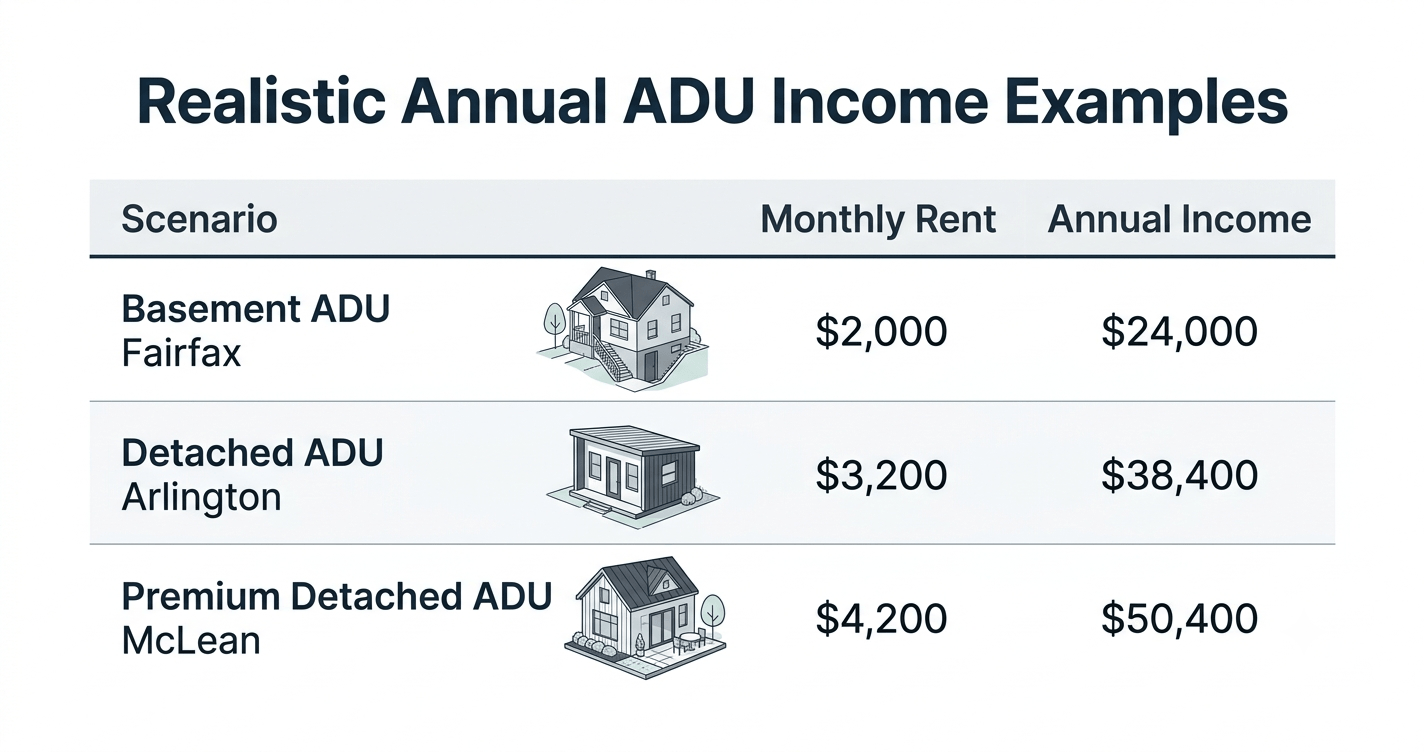
The following examples are hypothetical planning scenarios designed to illustrate how rental income may vary across Northern Virginia.
Example #1: Basement ADU in Fairfax
Property Characteristics
- 850-square-foot basement ADU
- Private entrance
- One bedroom
- One bathroom
- Dedicated parking space
Estimated Monthly Rent
$2,000 per month
Gross Annual Income
$24,000 annually
Potential Considerations
- Lower construction costs compared to detached ADUs
- Strong demand from professionals and small households
- Existing structure reduces overall project complexity
For many homeowners, basement conversions provide one of the shortest paths toward positive cash flow due to lower upfront investment requirements.
Example #2: Detached ADU in Arlington
Property Characteristics
- 750-square-foot detached cottage
- One bedroom
- Full kitchen
- Separate utilities
- Outdoor living space
Estimated Monthly Rent
$3,200 per month
Gross Annual Income
$38,400 annually
Potential Considerations
- Higher construction costs
- Strong privacy appeal
- Excellent rental demand in transit-accessible areas
Detached units often command higher rents because they provide greater independence than attached alternatives.
Example #3: Premium Detached ADU in McLean
Property Characteristics
- 1,000-square-foot detached ADU
- High-end finishes
- Dedicated parking
- Premium landscaping
- Separate utility systems
Estimated Monthly Rent
$4,200 per month
Gross Annual Income
$50,400 annually
Potential Considerations
- Significant construction investment
- Luxury renter demographic
- Potentially stronger long-term appreciation benefits
Higher-end ADUs generally require larger budgets but may attract longer-term tenants and stronger rental rates.
ADU ROI Northern Virginia: Is Building an ADU Worth It?
Evaluating an ADU solely on rental income can lead to incomplete financial analysis.
A more accurate approach considers:
- Rental income
- Construction cost
- Property value appreciation
- Tax considerations
- Future flexibility
- Potential resale benefits
When these factors are considered together, many homeowners view ADUs as long-term property investments rather than simple rental projects.
Initial Construction Cost
Construction costs vary significantly based on:
- ADU type
- Site conditions
- Utility requirements
- Foundation work
- Design complexity
- Finish selections
Detached ADUs generally require the largest investment, while basement conversions often represent the most cost-efficient entry point.
Homeowners comparing options may also find value in reviewing Northern Virginia home addition cost guide.
Potential Rental Income
Rental income should be evaluated using realistic market assumptions rather than best-case scenarios.
Factors to account for include:
- Vacancy periods
- Maintenance expenses
- Insurance costs
- Utility obligations
- Property management fees
Conservative projections typically provide a more reliable basis for decision-making.
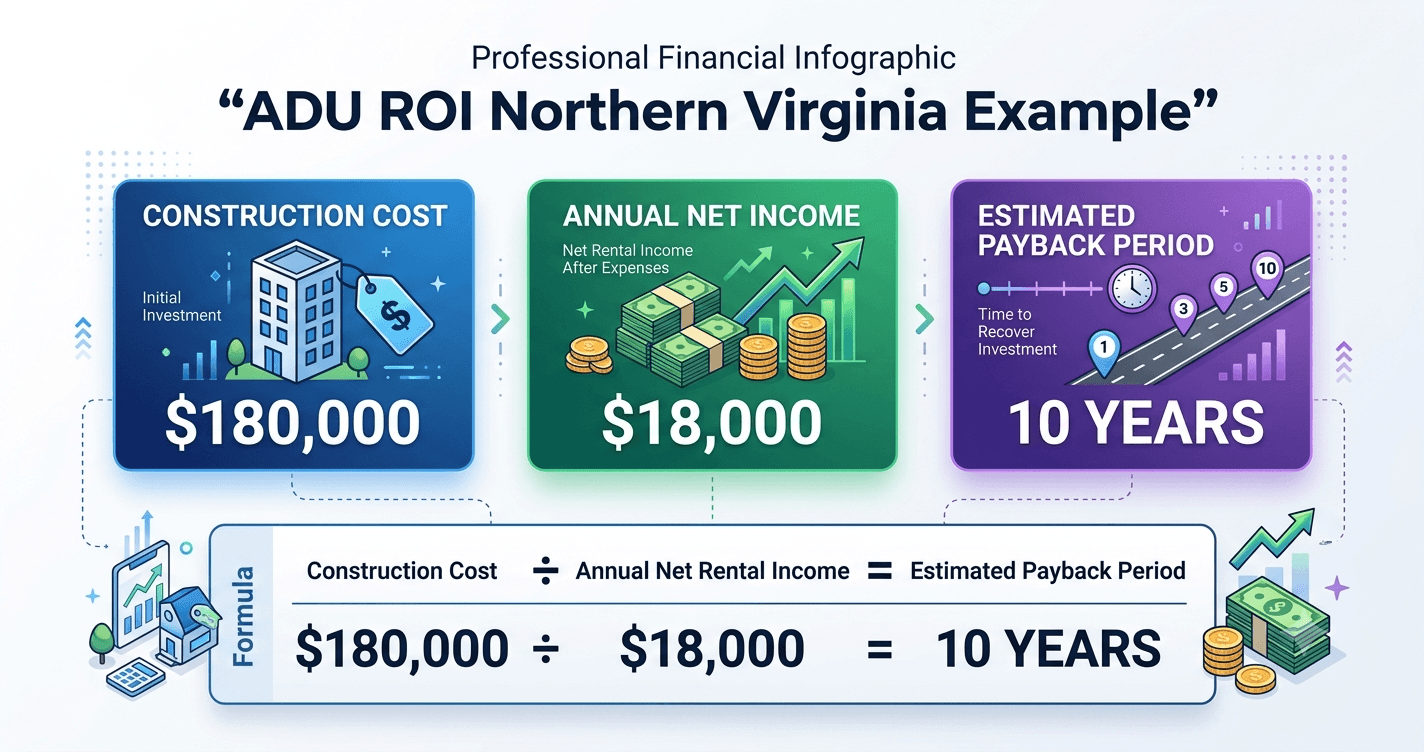
Understanding Payback Period
A common ROI metric is the payback period.
Formula:
Construction Cost ÷ Annual Net Rental Income = Estimated Payback Period
Example:
- Construction Cost: $180,000
- Annual Net Income: $18,000
Estimated Payback Period:
10 Years
While this calculation is useful, it should not be viewed in isolation because it does not account for appreciation or equity growth.
Long-Term Appreciation
Beyond monthly income, ADUs can contribute to overall property value by increasing functional living space and expanding potential buyer appeal.
According to Freddie Mac, ADUs have increasingly become part of broader housing affordability and housing flexibility strategies across the United States. [Source: Freddie Mac]
Equity Growth
Unlike many traditional investments, ADUs may simultaneously generate income while contributing to property equity.
This combination of cash flow and asset appreciation is one reason many homeowners view ADUs as long-term wealth-building assets rather than short-term rental opportunities.
Expenses Homeowners Often Forget to Include
Construction costs are only part of the financial picture.
Many homeowners underestimate ongoing expenses that can affect actual ADU profitability.
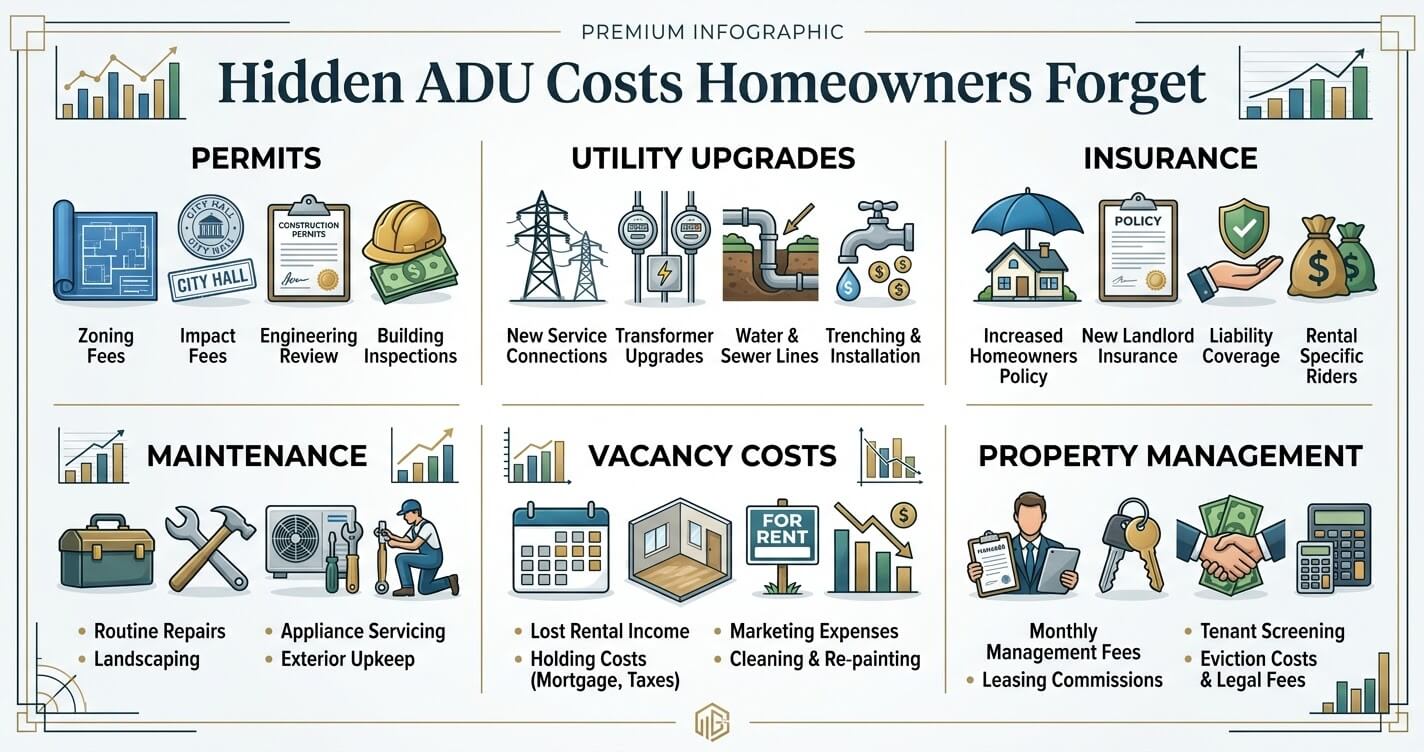
Understanding these costs early can help create more realistic financial projections.
Permits and Approvals
Permit requirements vary by jurisdiction and project scope.
Potential costs may include:
- Building permits
- Engineering reviews
- Site plans
- Utility approvals
- Inspections
Homeowners evaluating Arlington regulations should also review ADU regulations Arlington VA guide to before making any decision.
Utility Upgrades
Some ADUs require:
- Electrical service upgrades
- Water service modifications
- Sewer capacity improvements
- HVAC system expansions
These expenses are often overlooked during early budgeting.
Insurance Adjustments
Adding a rental unit may affect homeowners insurance requirements.
Property owners should consult their insurance provider before construction begins to understand potential coverage changes.
Maintenance and Repairs
Like any residential property, ADUs require ongoing upkeep.
Typical expenses may include:
- Appliance replacement
- HVAC servicing
- Plumbing repairs
- Landscaping
- Exterior maintenance
Budgeting for annual maintenance helps avoid unexpected financial surprises.
Vacancy Periods
Even in strong rental markets, vacancies occasionally occur.
Most long-term projections should account for potential periods between tenants.
Using realistic occupancy assumptions generally produces more accurate ROI calculations.
Property Management Costs
Homeowners planning to outsource tenant management should budget for management fees.
Services may include:
- Tenant screening
- Rent collection
- Maintenance coordination
- Lease administration
These costs vary but should be incorporated into long-term financial planning.
Homeowners considering an ADU for rental income should evaluate zoning requirements, construction costs, and long-term operating expenses before making investment decisions. Consulting with an experienced design-build team early in the planning process can help identify opportunities, limitations, and realistic income expectations for a specific property.
Rental Income vs Property Value: Which Benefit Is Bigger?
When evaluating an ADU investment, many homeowners focus exclusively on monthly rental income. While cash flow can be a significant advantage, it is only one component of an ADU’s overall financial impact.
In many cases, the long-term increase in property utility, buyer appeal, and market value may ultimately rival or exceed the rental income generated during ownership.
The relative importance of each benefit depends on a homeowner’s goals, expected length of ownership, and local market conditions.
Immediate Cash Flow Benefits
Rental income provides a direct and measurable financial benefit.
Depending on the ADU type, location, and rental strategy, homeowners may use this income to:
- Offset mortgage payments
- Reduce the effective cost of homeownership
- Cover property taxes and insurance
- Fund future home improvements
- Supplement retirement income
Unlike appreciation, which may fluctuate based on market conditions, rental income can provide ongoing financial support throughout ownership.
For homeowners nearing retirement, this predictable income stream is often one of the most compelling reasons to pursue an ADU project.
Long-Term Property Appreciation
Property appreciation is less predictable than rental income but can be equally important.
A well-designed ADU increases a property’s functional flexibility, which may improve its attractiveness to future buyers.
Potential buyers often recognize value in properties that offer:
- Multigenerational living options
- Private guest accommodations
- Home office opportunities
- Caregiver housing
- Future rental income potential
As housing affordability continues to challenge many markets, flexible housing solutions may become increasingly desirable.
According to Freddie Mac, ADUs play an expanding role in providing housing flexibility and additional living options. [Source: Freddie Mac]
Resale Considerations
Not all ADUs contribute equally to resale value.
Factors that often influence buyer perception include:
- Quality of construction
- Permit compliance
- Architectural integration
- Privacy features
- Parking availability
- Utility configuration
- Maintenance history
A legally permitted ADU that blends seamlessly with the primary residence generally creates stronger resale appeal than a poorly executed conversion.
The Reality for Most Homeowners
For many Northern Virginia homeowners, the strongest financial outcome comes from combining both benefits:
- Rental income during ownership.
- Increased property desirability at resale.
Rather than viewing rental income and appreciation as competing benefits, homeowners should evaluate how both contribute to overall return on investment.
Common ADU Rental Income Mistakes Homeowners Make
Many ADU projects fail to meet financial expectations not because the concept is flawed, but because early assumptions were unrealistic.
Understanding common mistakes can help homeowners make more informed investment decisions.
Mistake #1: Overestimating Rental Rates
One of the most common errors involves assuming top-of-market rents without considering actual property characteristics.
Factors that may reduce achievable rent include:
- Limited privacy
- Lack of parking
- Smaller floor plans
- Older finishes
- Poor natural light
- Less desirable locations
Conservative rent projections generally produce more reliable financial planning.
Mistake #2: Ignoring Vacancy Periods
Even in strong rental markets, units are not occupied 100% of the time.
Tenant turnover, maintenance work, and market fluctuations can create temporary vacancies.
Financial projections should account for realistic occupancy assumptions rather than assuming uninterrupted rental income.
Mistake #3: Underestimating Construction Costs
Unexpected costs frequently arise during ADU construction.
Examples include:
- Utility upgrades
- Drainage improvements
- Site preparation
- Structural modifications
- Permit revisions
- Material price fluctuations
Comprehensive budgeting helps reduce the likelihood of cost overruns.
Homeowners comparing project costs may also find value in reviewing Northern Virginia home addition cost 2026 guide.
Mistake #4: Skipping Zoning Research
Local zoning regulations can significantly influence project feasibility.
Requirements may affect:
- ADU size
- Placement
- Occupancy
- Parking
- Utility connections
Beginning design work before verifying local requirements can create delays and unnecessary expenses.
For Arlington-specific guidance, homeowners can review ADU regulations Arlington VA here.
Mistake #5: Choosing the Wrong ADU Type
The highest-rent option is not always the best investment.
For example, a detached ADU may generate more income than a basement conversion, but the additional construction cost could extend the payback period significantly.
Evaluating both costs and revenue potential is essential when comparing ADU configurations.
How to Maximize ADU Rental Income in Northern Virginia
Successful ADUs are rarely accidental. The strongest-performing projects are usually the result of intentional planning, thoughtful design decisions, and realistic financial analysis.
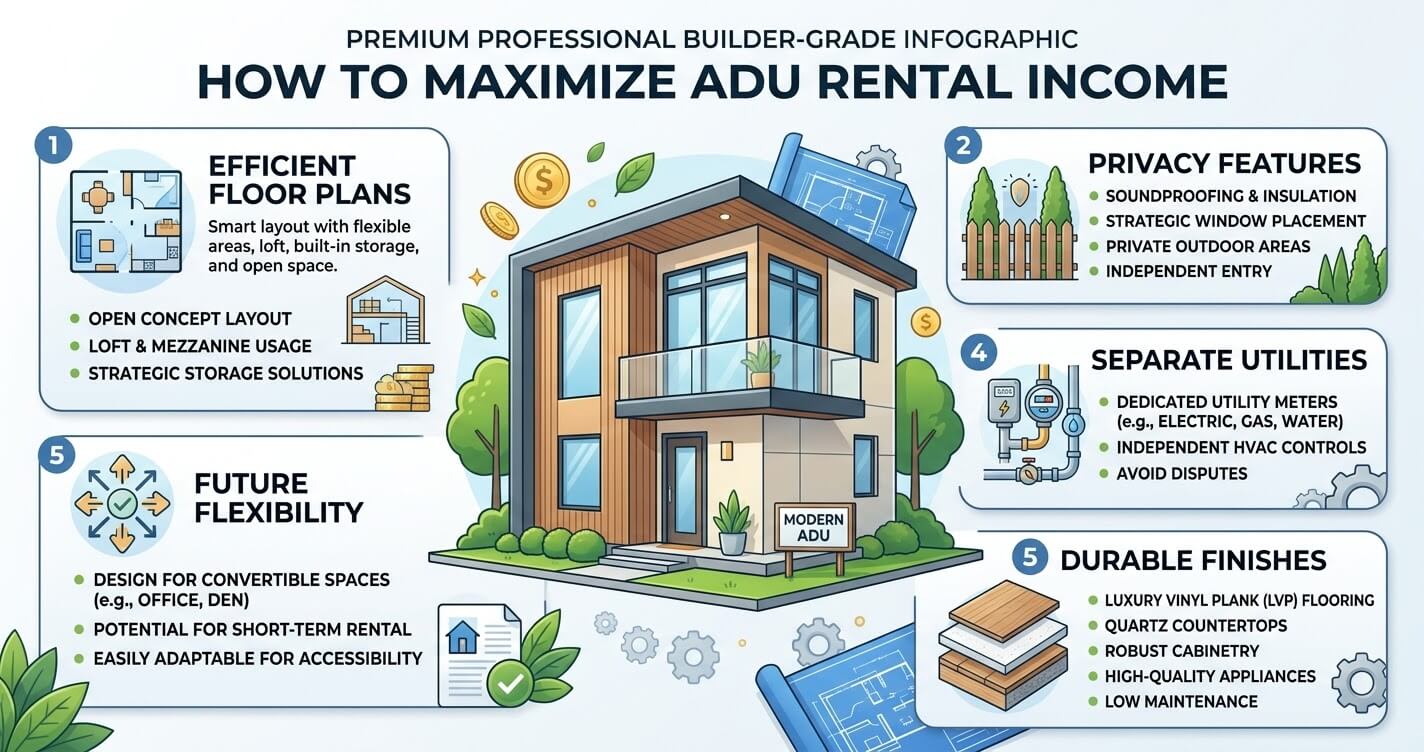
Homeowners who prioritize long-term usability often achieve better rental outcomes than those focused solely on minimizing construction costs.
Choose the Right Floor Plan
Efficient layouts frequently outperform larger but poorly organized spaces.
High-performing ADU floor plans often emphasize:
- Open living areas
- Functional storage
- Flexible furniture arrangements
- Comfortable kitchen design
- Dedicated work-from-home space
A smaller but highly functional ADU may attract stronger tenant interest than a larger unit with inefficient circulation.
Prioritize Privacy
Privacy consistently ranks among the most important factors influencing tenant satisfaction.
Features that improve privacy include:
- Separate entrances
- Private outdoor space
- Strategic window placement
- Sound insulation
- Independent parking
Detached ADUs often command higher rents partly because they naturally provide greater separation between occupants.
Consider Separate Utility Systems
Although separate utility systems increase upfront costs, they may simplify future property management.
Potential benefits include:
- Easier tenant billing
- Reduced disputes
- Improved expense tracking
- Greater operational flexibility
The appropriateness of separate utilities depends on project goals and local conditions.
Invest in Durable Finishes
Rental properties experience more wear than owner-occupied spaces.
Durable materials often reduce long-term maintenance expenses.
Examples include:
- Luxury vinyl plank flooring
- Quartz countertops
- Quality plumbing fixtures
- Moisture-resistant finishes
- Energy-efficient windows
Choosing durable products may improve lifecycle value even when initial costs are slightly higher.
Design for Future Flexibility
One of the greatest strengths of an ADU is adaptability.
Today’s rental unit could become:
- A guest house
- A caregiver suite
- Housing for adult children
- A home office
- A downsized retirement residence
Designing with future flexibility in mind can significantly enhance long-term value.
Is an ADU a Better Investment Than a Home Addition?
Homeowners often compare ADUs with traditional home additions when evaluating ways to expand living space and increase property value.
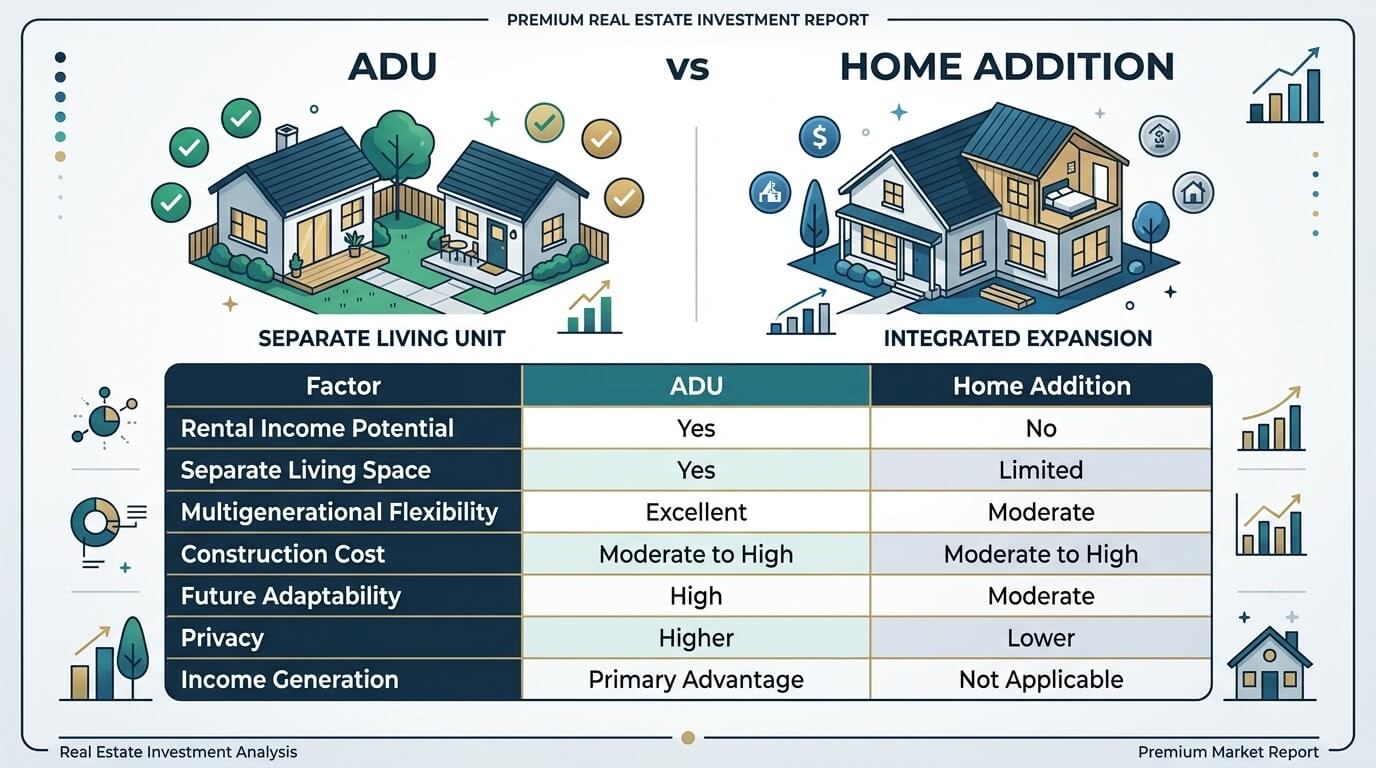
The right solution depends on financial objectives, family needs, lot characteristics, and local regulations.
When an ADU May Be the Better Choice
An ADU may be preferable when homeowners want:
- Rental income
- Independent living space
- Long-term flexibility
- Multigenerational housing options
- Potential retirement income
When a Home Addition May Be Better
A traditional addition may make more sense when homeowners need:
- Larger primary living areas
- Additional bedrooms
- Expanded kitchens
- Larger family gathering spaces
- Improved owner occupancy experience
The decision ultimately depends on how the space will be used over time.
Frequently Asked Questions
How much ADU rental income can homeowners earn in Northern Virginia?
Rental income varies based on location, size, privacy, finishes, and local demand. Basement ADUs often rent for less than detached units, while premium detached ADUs in markets such as Arlington and McLean may command significantly higher rents.
Are detached ADUs more profitable than basement ADUs?
Detached ADUs often achieve higher rental rates because they provide greater privacy. However, basement ADUs usually cost less to build, which can improve ROI and shorten payback periods.
Do ADUs increase property value in Northern Virginia?
A well-designed and properly permitted ADU may increase property desirability by providing flexible living space, multigenerational housing options, and potential rental income opportunities.
How long does it take for an ADU to pay for itself?
Payback periods vary based on construction costs, rental income, maintenance expenses, and occupancy rates. Many homeowners evaluate both rental income and long-term appreciation when assessing return on investment.
Can I legally rent out an ADU in Fairfax County?
Requirements vary based on local zoning regulations and property characteristics. Homeowners should review current county requirements and permitting rules before planning an ADU project.
What type of ADU generates the highest rental income?
Detached ADUs frequently command the highest rents because they provide independent living space and greater privacy. However, they also tend to have the highest construction costs.
Are ADUs better investments than home additions?
The answer depends on project goals. ADUs can generate rental income and provide independent housing, while home additions typically focus on expanding owner-occupied living space.
What expenses should homeowners budget for beyond construction costs?
Additional expenses may include permits, utility upgrades, insurance adjustments, maintenance, vacancy periods, landscaping, and property management services.
Final Thoughts
ADU Rental Income Northern Virginia can vary significantly depending on location, design decisions, construction quality, market demand, and long-term management strategy. While some homeowners focus primarily on monthly rental income, the most successful projects typically balance cash flow, property flexibility, and long-term value creation.
For many Northern Virginia homeowners, ADUs serve multiple purposes simultaneously. They can generate rental income today while providing future housing options for family members, caregivers, guests, or aging-in-place plans. This adaptability often becomes one of the most valuable aspects of the investment.
Before moving forward with an ADU project, homeowners should carefully evaluate zoning requirements, permitting considerations, construction budgets, operating expenses, and realistic rental assumptions. A thoughtful planning process can help avoid costly surprises and improve long-term financial performance.
Whether the goal is supplemental income, multigenerational living, or increased property utility, an ADU can be a powerful tool for maximizing the potential of an existing property when designed and executed properly.
Planning an ADU project in Northern Virginia?
US Home Design Build helps homeowners navigate design, permitting, budgeting, and construction considerations for custom ADUs throughout the region. Whether you’re exploring rental income opportunities or creating flexible living space for future family needs, our team can help you evaluate the options available for your property.