
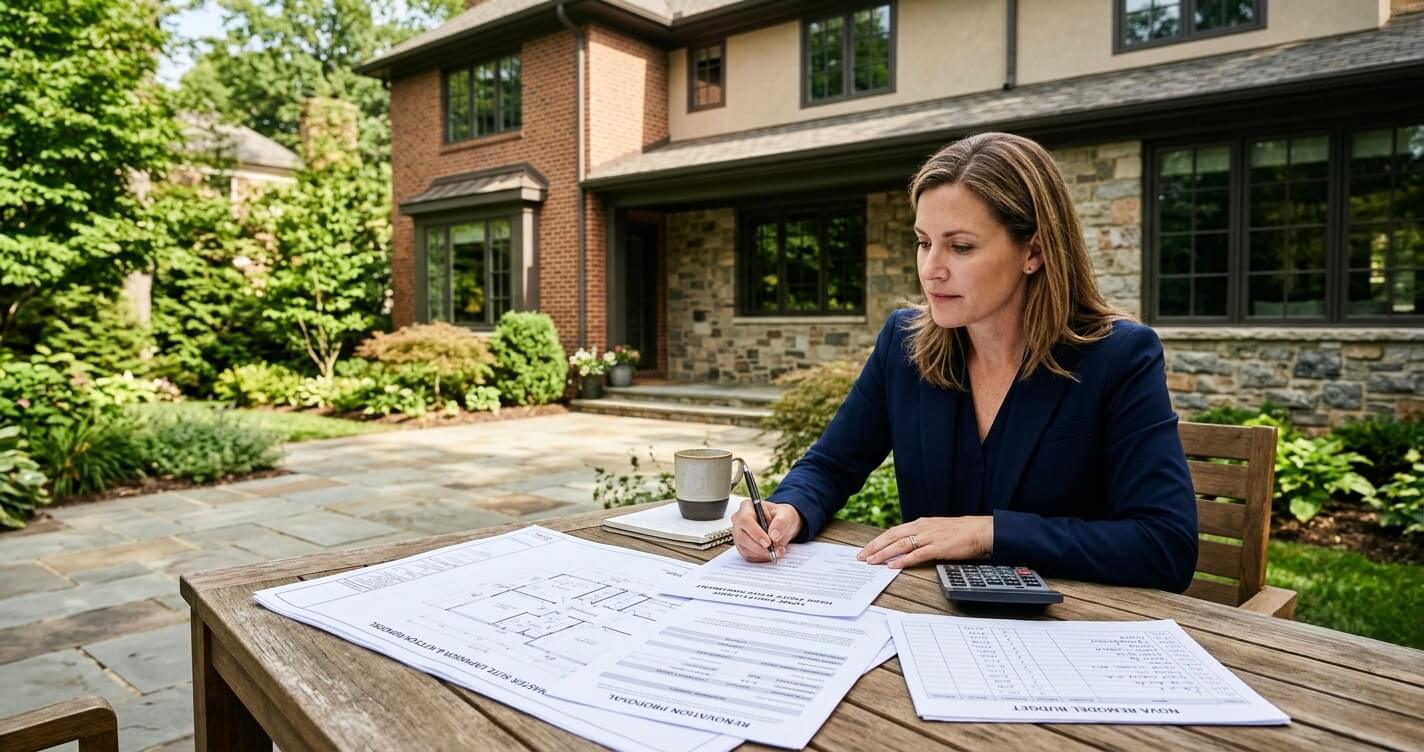
For many homeowners, deciding how to pay for a remodeling project can be just as challenging as choosing the right design or contractor. Whether you’re planning a modern kitchen renovation, a luxury bathroom upgrade, a home addition, or a whole-home remodel, understanding your home remodeling financing Northern Virginia options is essential for making informed financial decisions and keeping your project on budget.
In Northern Virginia, rising home values and limited housing inventory have encouraged many homeowners to improve their existing properties instead of purchasing a new home. Financing allows homeowners to spread project costs over time while preserving cash flow, making larger renovations more accessible without compromising on quality or long-term goals. This trend has contributed to sustained investment in residential remodeling nationwide. According to the Harvard Joint Center for Housing Studies, annual spending on home improvements and repairs has exceeded $600 billion, reflecting the continued demand for home renovation projects across the United States.
However, choosing the right financing option isn’t simply about finding the lowest interest rate. The best solution depends on your home’s available equity, the size and scope of your renovation, your long-term financial plans, and how quickly you need access to funds. A financing strategy that works well for a kitchen remodel may not be the ideal choice for a second-story addition or a full-home renovation.
At US Home Design Build, we’ve worked with homeowners throughout Northern Virginia, including McLean, Fairfax County, Vienna, Reston, Great Falls, Burke, Falls Church, Clifton, and Annandale, helping them carefully plan remodeling projects that balance design goals with realistic budgets. Our integrated design-build process emphasizes early budgeting, thoughtful planning, and transparent communication, allowing homeowners to understand the financial implications of their renovation before construction begins.
If you’re still determining which type of renovation best fits your needs, our guide to Design Build vs General Contractor Northern Virginia: Which Is Better in 2026? provides additional insight into selecting the right project delivery method before exploring financing.
Likewise, homeowners considering a major renovation may find our Home Renovation Services overview helpful for understanding the types of projects that can benefit from strategic financing.
What Is Home Remodeling Financing?
Home remodeling financing is the process of borrowing money or using available home equity to pay for renovation projects instead of covering the entire cost upfront. Financing can make major improvements, such as kitchen remodels, bathroom renovations, home additions, roofing replacements, or whole-home renovations, more affordable by allowing homeowners to repay the investment over time.
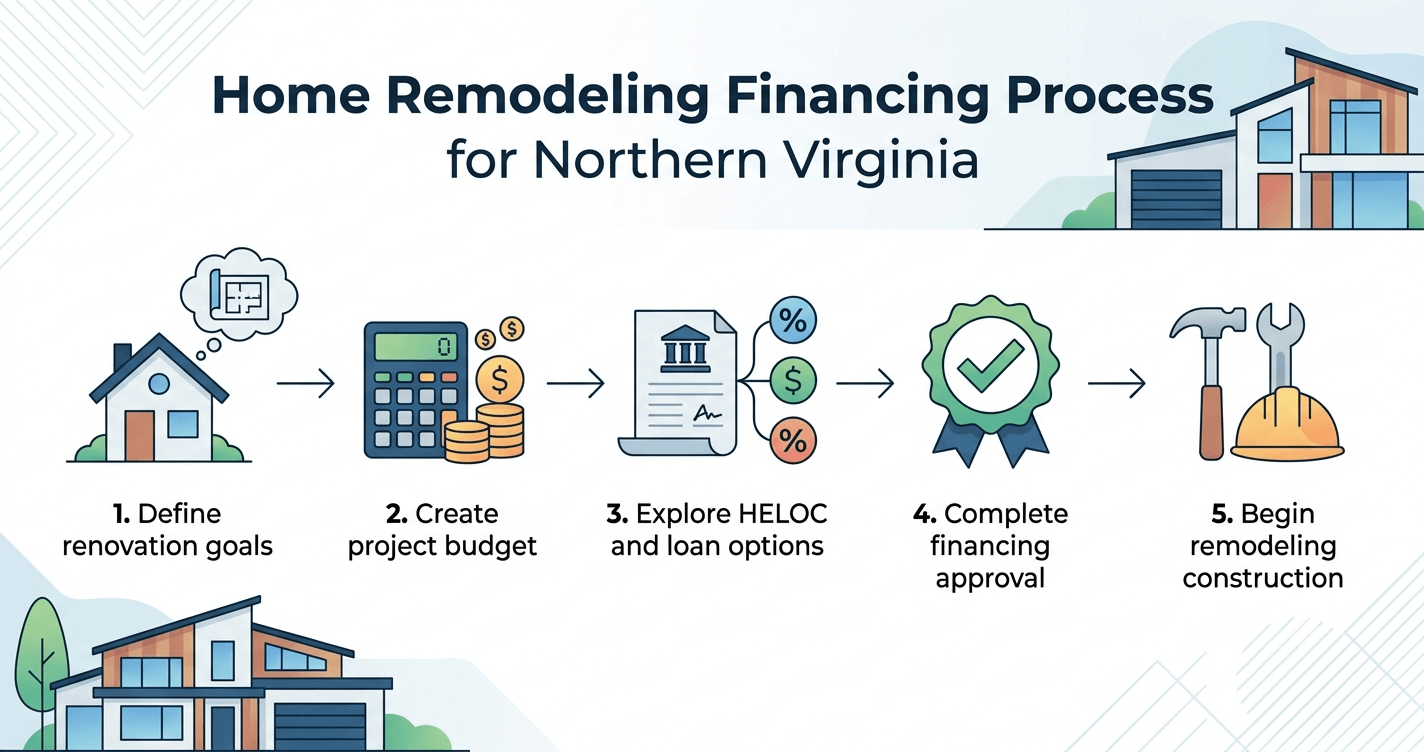
The right financing option depends on several factors, including your available home equity, credit profile, project budget, repayment preferences, and long-term financial goals. Rather than focusing solely on interest rates, homeowners should evaluate which financing solution best aligns with both their renovation plans and overall financial situation.
Home remodeling financing isn’t a single loan product. Instead, it refers to several financing methods that homeowners can use depending on the size, complexity, and urgency of their project. Common options include:
- Home Equity Lines of Credit (HELOCs)
- Home Equity Loans
- Cash-Out Refinancing
- Personal Loans
- FHA 203(k) Rehabilitation Loans
- Construction Loans
- Builder or Contractor Financing Programs
Each financing method offers different advantages. For example, a HELOC may provide flexible access to funds throughout a phased remodeling project, while a fixed-rate home equity loan can offer predictable monthly payments for homeowners who already know their total renovation budget.
For projects involving multiple living spaces or structural improvements, financing also allows homeowners to complete work simultaneously rather than delaying essential phases because of cash-flow limitations. This often results in more efficient scheduling and can reduce the disruption associated with living in an active construction environment.
Before selecting a financing option, it’s equally important to understand your project’s anticipated costs. A detailed remodeling budget should account not only for construction expenses, but also for design services, engineering, permit fees, inspections, material selections, contingency allowances, and potential temporary living arrangements if required.
Homeowners planning larger renovations may also benefit from reviewing How to Choose a Contractor in Northern Virginia before committing to financing, since contractor selection directly influences project scope, scheduling, and budget accuracy.
If your renovation includes multiple living areas or an extensive redesign, our Home Renovation Services page explains how a comprehensive design-build approach can improve budgeting accuracy by integrating design, estimating, permitting, and construction into one coordinated process.
Is Financing a Home Remodel Better Than Selling and Moving?
For many Northern Virginia homeowners, financing a remodel is often a more practical and financially advantageous option than selling their current home and purchasing another. Renovating allows homeowners to improve their living space while preserving an existing mortgage, avoiding relocation costs, and continuing to build long-term equity in a desirable neighborhood.
Although every situation is unique, homeowners should compare remodeling costs, available home equity, neighborhood property values, moving expenses, and long-term lifestyle goals before deciding whether renovating or relocating provides the better overall return.
This question has become increasingly relevant as many homeowners purchased their homes during periods of historically low mortgage interest rates. Moving today may require replacing that mortgage with one carrying significantly higher borrowing costs, even if the new home offers only modest improvements.
In established Northern Virginia communities such as McLean, Vienna, Reston, Fairfax County, and Great Falls, many families already own homes in neighborhoods with excellent schools, established infrastructure, and convenient commuting options. Renovating allows homeowners to improve functionality without giving up the location they’ve already invested in.
Financing can also provide greater flexibility than moving. Rather than purchasing a larger home with features they may not need, homeowners can invest directly in improvements that match their lifestyle, such as:
- Expanding the kitchen for better entertaining.
- Adding a primary suite for multigenerational living.
- Finishing a basement to create additional living space.
- Building a home office for hybrid work.
- Modernizing outdated bathrooms.
- Improving energy efficiency through roofing, insulation, or window upgrades.
According to the National Association of Realtors (NAR) Remodeling Impact Report, many remodeling projects not only improve homeowner satisfaction but can also recover a substantial portion of their cost at resale, depending on the project type and local market conditions.
Of course, financing a remodel isn’t automatically the right decision for every homeowner. Factors such as existing debt, available equity, future relocation plans, and expected project scope should all be evaluated before selecting a financing strategy. Consulting both a qualified lender and an experienced design-build contractor early in the planning process can help homeowners understand realistic budgets and avoid committing to projects that exceed their financial comfort level.
If you’re considering expanding rather than relocating, our Home Addition Services page outlines how thoughtfully designed additions can increase living space while maintaining the character and functionality of your existing home.
Similarly, homeowners evaluating the financial benefits of renovation should also review our article on Best ROI Home Improvements Northern Virginia 2026 to understand which remodeling projects typically deliver the greatest long-term value.
What Financing Options Are Available for Home Remodeling in Northern Virginia?
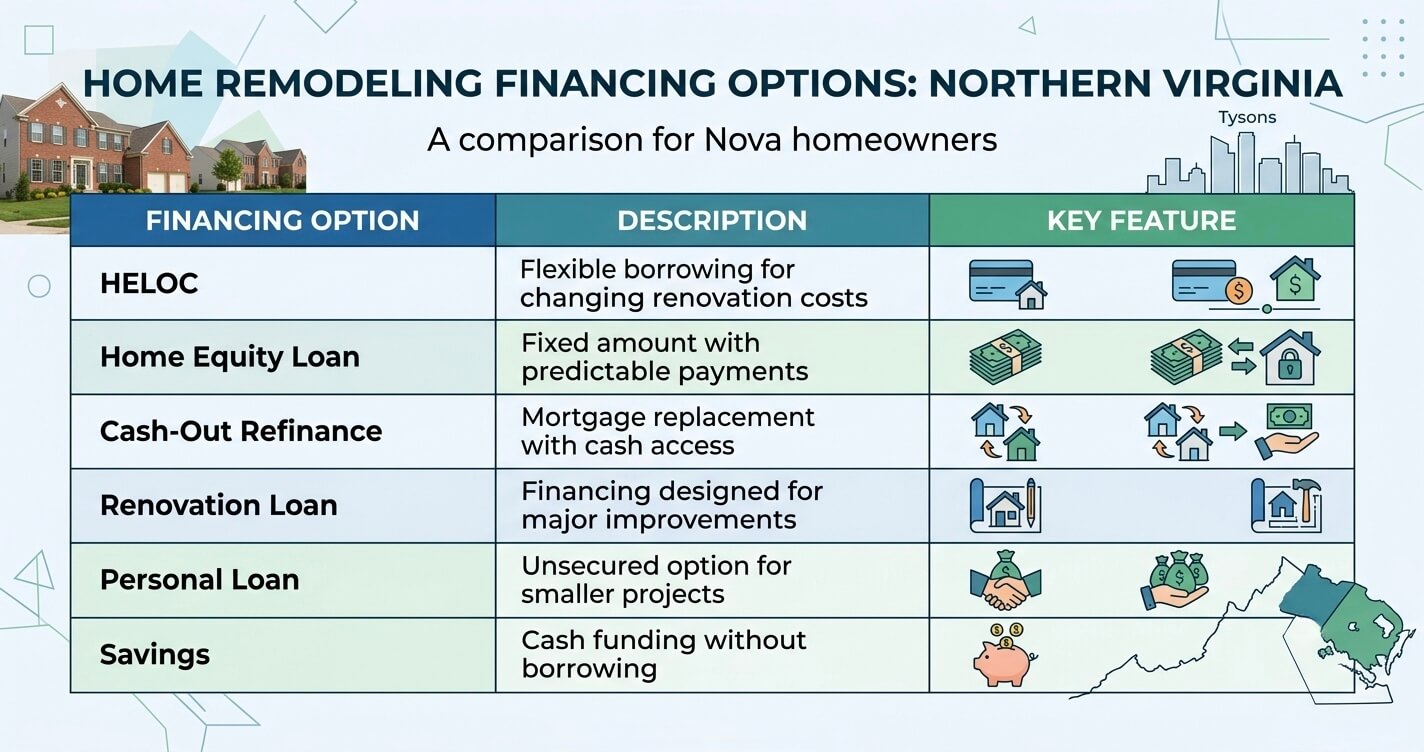
The best home remodeling financing option depends on your project’s size, available home equity, financial goals, and how you plan to complete the renovation. While many homeowners immediately think of a Home Equity Line of Credit (HELOC), it is not always the most suitable solution. Larger, one-time renovations may benefit from a fixed-rate home equity loan, while phased remodeling projects often require greater flexibility.
Rather than choosing a financing product first, homeowners should begin by defining the scope of their renovation, establishing a realistic budget, and understanding the total investment required. At US Home Design Build, our design-build process emphasizes planning, budgeting, and design development before construction begins, helping homeowners make financing decisions based on accurate project costs instead of rough estimates.
One of the biggest misconceptions homeowners have is that financing should be the first step in a remodeling project. In reality, financing is only one part of a much broader planning process. Before applying for any loan, you should have a clear understanding of your renovation goals, anticipated construction costs, design priorities, permitting requirements, and contingency budget.
For example, financing a $35,000 bathroom renovation differs significantly from financing a $300,000 whole-home remodel or second-story addition. The appropriate loan structure, repayment strategy, and funding timeline often depend on the project’s complexity just as much as its overall cost.
This is where working with an experienced design-build contractor becomes valuable. Because design, budgeting, permitting, and construction planning are developed together, homeowners gain a much clearer understanding of the true financial commitment before approaching a lender. US Home Design Build follows this integrated design-build approach throughout Northern Virginia, beginning with an in-home consultation, progressing through design and budgeting, and then moving into construction only after the project scope has been fully defined.
If you’re still evaluating whether a design-build firm is the right fit for your renovation, consider reading Design Build vs General Contractor Northern Virginia: Which Is Better in 2026?
Although lenders offer numerous financing products, most remodeling projects in Northern Virginia are funded using one of the following solutions.
1. Home Equity Line of Credit (HELOC)
A HELOC is a revolving line of credit secured by your home’s available equity. Instead of receiving a single lump-sum payment, homeowners can borrow funds as needed during an approved draw period and repay only the amount used.
Because funds remain available throughout the draw period, HELOCs are often well suited for projects completed in multiple phases, such as whole-home renovations, large additions, or remodeling plans where design changes may occur as construction progresses.
Typical situations where a HELOC works well include:
- Multi-room remodeling
- Whole-home renovations
- Basement finishing
- Home additions
- Projects with phased construction schedules
However, homeowners should also recognize that most HELOCs carry variable interest rates. Monthly payments can change over time, making long-term budgeting more challenging if interest rates increase.
2. Home Equity Loan
Unlike a HELOC, a home equity loan provides a single lump-sum payment with a fixed interest rate and predictable monthly payments.
This financing option generally works best when the total remodeling budget has already been established and significant design changes are unlikely after construction begins.
Examples include:
- Kitchen remodeling
- Bathroom remodeling
- Roof replacement
- Window replacement
- Single-room renovations
Because payments remain fixed throughout the loan term, many homeowners prefer this option when financial predictability is more important than borrowing flexibility.
3. Cash-Out Refinance
A cash-out refinance replaces your existing mortgage with a new mortgage that exceeds your current loan balance, allowing you to receive the difference as cash for remodeling.
While this strategy can provide access to substantial funding, it also replaces your existing mortgage. For homeowners who currently have historically low mortgage rates, refinancing may increase their long-term borrowing costs even if the renovation itself adds value.
Before pursuing this option, homeowners should carefully compare:
- Current mortgage interest rate
- New mortgage rate
- Closing costs
- Expected monthly payment
- Planned length of home ownership
These factors often have a greater impact on overall affordability than the remodeling budget alone.
4. Personal Home Improvement Loan
Personal loans do not require home equity because they are unsecured.
Approval typically depends on:
- Credit score
- Income
- Existing debt
- Employment history
Personal loans are commonly used for:
- Small kitchen updates
- Bathroom refreshes
- Flooring replacement
- Interior painting
- Cosmetic remodeling
Although approval may be faster than equity-based financing, interest rates are often higher because the loan is not secured by the property.
5. FHA 203(k) Rehabilitation Loan
For homeowners purchasing older properties that require significant improvements, an FHA 203(k) loan combines the home’s purchase price and eligible renovation costs into a single mortgage.
This financing solution is generally intended for buyers acquiring homes that need extensive rehabilitation rather than homeowners remodeling an existing residence.
6. Builder Financing Programs
Some contractors partner with financing providers to offer payment programs for qualified homeowners.
While these programs can simplify the application process, homeowners should carefully compare:
- Interest rates
- Promotional offers
- Loan duration
- Fees
- Early repayment penalties
The convenience of contractor-arranged financing should always be weighed against independent financing options available through banks or credit unions.
HELOC vs Home Equity Loan: Which Is Better for Remodeling?
For most Northern Virginia homeowners, a HELOC is generally better for phased or flexible remodeling projects, while a home equity loan is usually better for projects with a fixed budget and a clearly defined scope. A HELOC provides ongoing access to funds as construction progresses, whereas a home equity loan provides a single lump-sum payment with predictable monthly payments and a fixed interest rate.
Neither option is universally better. The right choice depends on whether your remodeling project is likely to change during construction, how much financial flexibility you want, and whether payment stability or borrowing flexibility is more important for your long-term budget.
This is one of the most important financing decisions homeowners make before beginning a renovation. Both HELOCs and home equity loans allow you to borrow against the equity you have built in your home, but they function very differently during a remodeling project.
At US Home Design Build, homeowners often ask which option works best for projects such as kitchen remodeling, bathroom renovations, basement finishing, home additions, and whole-home renovations. The answer usually depends less on the loan itself and more on how the project will be planned, designed, permitted, and constructed.
If your renovation will be completed in a single phase with a clearly established contract price, a fixed-rate home equity loan may provide greater financial certainty. If your project involves multiple phases, potential design revisions, structural discoveries, or ongoing material selections, a HELOC may provide the flexibility needed to fund construction efficiently without borrowing the entire amount upfront.
How a HELOC Works During a Remodeling Project
A Home Equity Line of Credit (HELOC) functions similarly to a revolving credit line. After approval, the lender establishes a maximum borrowing limit, and homeowners can withdraw funds as needed during the draw period.
This structure is particularly useful for remodeling projects where expenses occur gradually rather than all at once.
For example, a whole-home renovation may involve:
- Architectural design
- Engineering
- Permit fees
- Demolition
- Structural framing
- Mechanical systems
- Interior finishes
- Final inspections
Because these costs occur at different stages of construction, a HELOC allows homeowners to access funds only when needed, potentially reducing interest costs compared with borrowing the full amount immediately.
For projects involving multiple living spaces, structural modifications, or phased construction schedules, many homeowners prefer a HELOC because it provides flexibility if project costs change during the renovation process.
How a Home Equity Loan Works for Remodeling
A home equity loan provides a one-time lump-sum payment based on the available equity in your home. The interest rate is typically fixed, and monthly payments remain consistent throughout the repayment period.
This financing structure works best when:
- The remodeling scope is clearly defined.
- Construction costs are already established.
- Design selections have been finalized.
- The contractor’s pricing is fixed.
- Major changes are unlikely after construction begins.
For example, a kitchen remodeling project with finalized cabinetry, appliances, flooring, and construction plans may be an excellent candidate for a home equity loan because the homeowner knows the total investment before work starts.
The greatest advantage of a home equity loan is payment predictability. Homeowners know exactly how much they are borrowing, what the interest rate will be, and what the monthly payment will remain throughout the loan term.
For many families, this predictability makes long-term budgeting easier, especially when managing other financial obligations such as tuition, retirement contributions, or investment planning.
The Key Difference: Flexibility vs Predictability
The simplest way to compare these options is to think of a HELOC as a flexible financing tool and a home equity loan as a predictable financing tool.
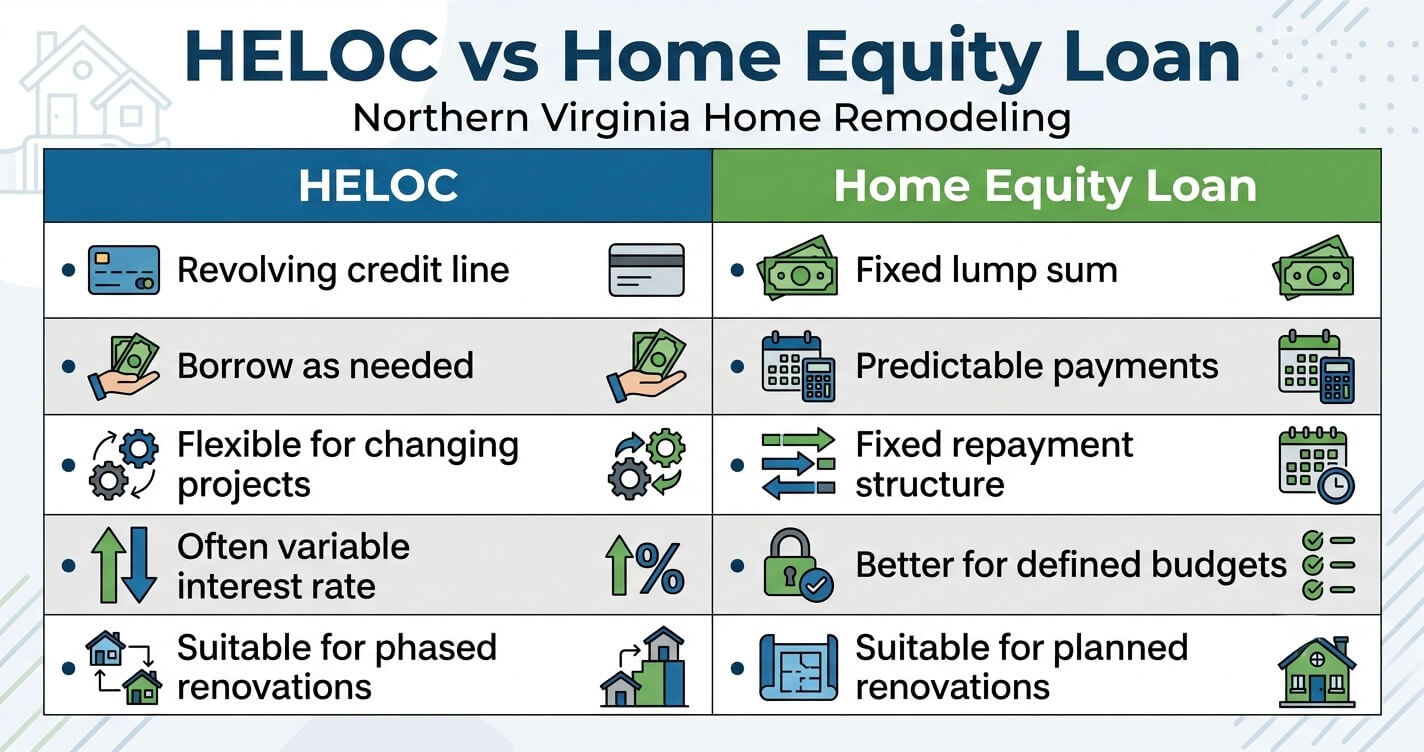
For many Northern Virginia homeowners, the decision ultimately comes down to whether the project is fully planned before financing or whether significant decisions will continue throughout construction.
Which Option Is Better for a Kitchen Remodel?
A home equity loan is often the stronger choice for a kitchen remodel because kitchen projects typically involve a well-defined scope once the design has been completed.
After finalizing:
- Cabinet layouts
- Countertops
- Appliances
- Flooring
- Lighting
- Plumbing fixtures
- Construction plans
the total project cost becomes much easier to estimate accurately.
A fixed-rate loan allows homeowners to finance the project with predictable monthly payments, making it easier to manage the renovation within a predetermined household budget.
If you are planning a kitchen renovation, the Kitchen Remodeling service page provides additional information about project planning, design development, and construction budgeting.
Which Option Is Better for a Home Addition or Whole-Home Renovation?
A HELOC is often more appropriate for home additions and whole-home renovations because these projects frequently involve phased construction and changing financial requirements.
For example, a home addition may require:
- Architectural drawings
- Structural engineering
- County permitting
- Foundation work
- Framing
- Roofing
- Electrical and HVAC systems
- Interior finishes
Costs are distributed across multiple stages, and homeowners may choose to upgrade finishes, expand the project scope, or address unexpected structural conditions discovered during construction.
A HELOC provides the flexibility to finance these evolving costs without borrowing the entire estimated budget on day one.
Homeowners considering a larger expansion project may also want to review Home Addition planning considerations before selecting a financing strategy.
How Interest Rates Affect the Decision
Interest rates play a significant role in the HELOC vs home equity loan comparison.
A HELOC typically has a variable interest rate, meaning payments can increase or decrease as market rates change.
A home equity loan usually has a fixed interest rate, meaning payments remain consistent throughout the repayment period.
Homeowners who prioritize payment stability often prefer fixed-rate financing, while homeowners who value borrowing flexibility may accept variable-rate risk in exchange for greater access to funds during construction.
The appropriate choice depends on:
- Risk tolerance
- Income stability
- Project duration
- Long-term homeownership plans
- Expected future borrowing needs
A Practical Example
Consider a homeowner in Vienna, Virginia planning a $180,000 whole-home renovation.
HELOC Scenario
- Borrow funds as each construction phase begins.
- Pay interest only on funds already used.
- Adjust borrowing if material selections change.
- Maintain flexibility throughout the project.
Home Equity Loan Scenario
- Receive the full $180,000 upfront.
- Begin fixed monthly payments immediately.
- Benefit from predictable long-term budgeting.
- Less flexibility if additional funds become necessary.
Neither scenario is inherently better. The more important question is whether the renovation has been fully designed and budgeted before financing is secured.
The Design-Build Advantage Before Choosing a Loan
One of the strongest advantages of working with a design-build contractor is that financing decisions can be based on real project costs rather than preliminary estimates.
At US Home Design Build, the design-build process includes consultation, design development, budgeting, permitting coordination, and construction planning before construction begins. This helps homeowners understand:
- Total project cost
- Construction timeline
- Permit requirements
- Material selections
- Contingency planning
- Cash-flow requirements
before selecting a financing strategy.
For homeowners comparing different project delivery methods, Design Build vs General Contractor Northern Virginia: Which Is Better in 2026? explains how integrated planning can improve budget accuracy and reduce financial surprises during construction.
Industry Statistic
According to the Federal Housing Finance Agency (FHFA), homeowners across the United States continue to hold substantial home equity, making equity-based financing one of the most common funding sources for major remodeling projects.
For most Northern Virginia remodeling projects, the better financing option is the one that aligns with your project’s construction schedule, budgeting accuracy, and long-term financial goals. A well-planned renovation supported by accurate design-build budgeting is often more important than choosing between two similar loan products.
How Much Does Home Remodeling Cost in Northern Virginia?
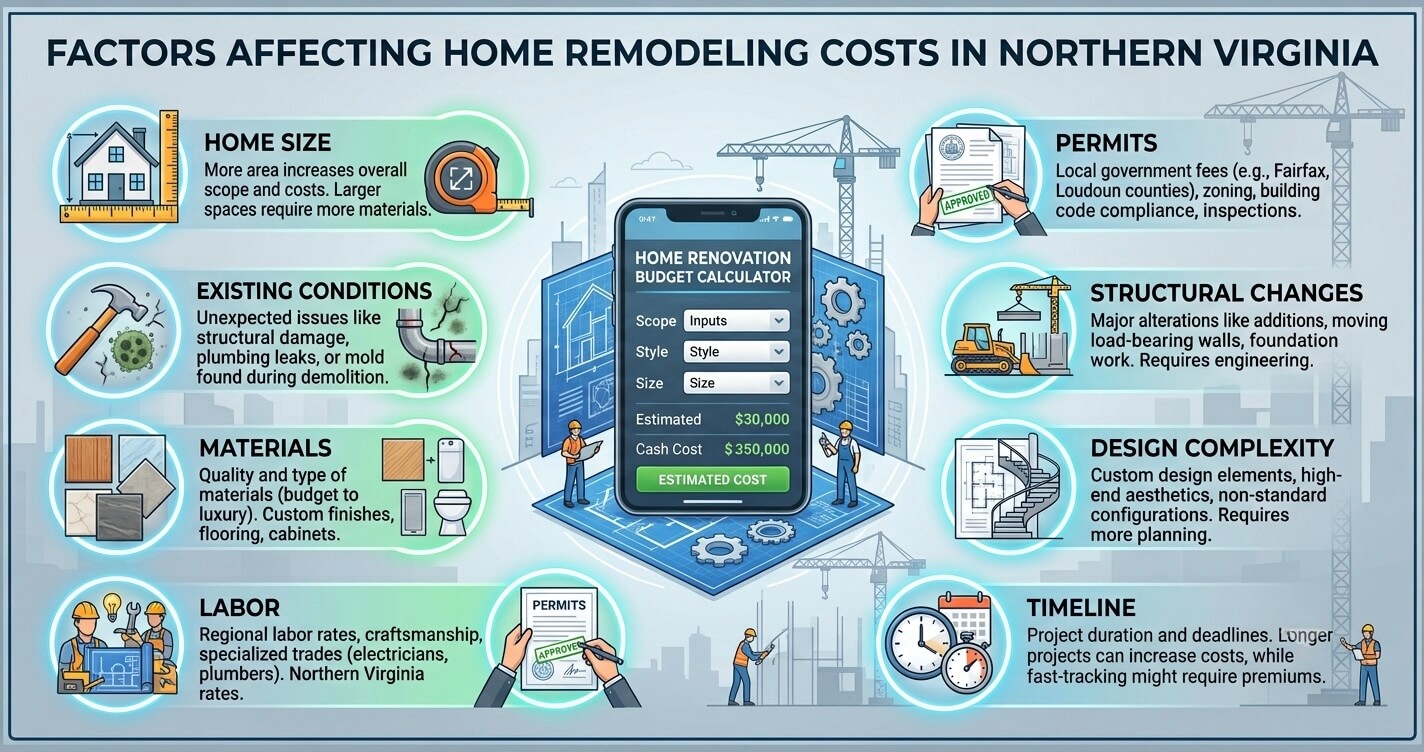
Home remodeling costs in Northern Virginia vary widely depending on the project’s size, location, materials, design complexity, structural requirements, and the condition of the existing home. Smaller renovations may cost tens of thousands of dollars, while major additions and whole-home remodels can require significantly larger investments. A realistic budget should account for design, permits, labor, materials, and potential unexpected conditions before homeowners decide how much financing they need.
Because Northern Virginia includes diverse housing markets, from older homes in Fairfax County and Falls Church to larger properties in McLean, Vienna, Great Falls, and Reston, remodeling costs are highly project-specific. The most accurate way to determine financing needs is to develop a detailed renovation plan and construction estimate before selecting a loan or equity-based financing option.
One of the most important steps before applying for remodeling financing is understanding the potential cost range of your project.
Many homeowners begin by asking, “How much can I borrow?” However, the more practical question is:
“How much will my specific renovation actually cost?”
The answer depends on multiple factors, including:
- The type of renovation
- Square footage involved
- Existing home conditions
- Material selections
- Structural changes
- Permit requirements
- Labor complexity
- Design expectations
A detailed project budget provides a more reliable foundation for financing decisions than generalized online averages.
At US Home Design Build, remodeling projects are evaluated based on each homeowner’s goals, property conditions, and desired outcomes. This helps homeowners understand realistic investment expectations before construction begins.
Factors That Influence Remodeling Costs in Northern Virginia
Home Age and Existing Conditions
The condition of the existing home is one of the biggest factors affecting remodeling costs. Older homes may require additional updates to electrical systems, plumbing, insulation, structural components, or building code requirements before or during renovation.
Many homes throughout Northern Virginia were built decades ago and may require modernization beyond the visible renovation.
For example, a homeowner planning a kitchen remodel may discover that the project also requires:
- Electrical panel upgrades
- Additional circuits
- Plumbing improvements
- Structural adjustments
- Improved ventilation
Addressing these conditions during the planning stage helps prevent unexpected costs after construction begins.
Project Scope and Structural Changes
Structural modifications typically have a greater impact on remodeling costs than cosmetic improvements because they often involve engineering, permitting, specialized labor, and additional construction requirements.
Projects involving:
- Removing load-bearing walls
- Expanding square footage
- Adding new rooms
- Creating open floor plans
- Modifying foundations
usually require more detailed planning compared with surface-level updates.
For homeowners considering additional living space, the Home Addition Services page provides more information about planning, design considerations, and construction requirements.
Material and Finish Selection
Material choices can significantly affect remodeling costs because finishes represent both a major portion of the budget and one of the biggest opportunities for customization.
Examples include:
- Standard versus custom cabinetry
- Basic versus premium countertops
- Traditional versus high-end flooring
- Standard versus specialty fixtures
- Energy-efficient versus conventional products
A successful remodeling plan balances appearance, durability, maintenance, and budget rather than focusing only on the lowest initial cost.
Permits and Local Requirements
Many remodeling projects in Northern Virginia require permits, inspections, or approvals depending on the type and scope of work. Permit requirements can affect both project costs and timelines, making early planning essential.
Requirements vary by jurisdiction, including areas such as:
- Fairfax County
- Arlington County
- Falls Church
- Vienna
- Reston
- Other Northern Virginia communities
Projects involving additions, structural changes, electrical modifications, plumbing work, or major renovations often require additional review.
Before finalizing a financing amount, homeowners should understand which permits and approvals may apply to their specific project.
For example, homeowners planning additions or major renovations can review local permit guidance before beginning construction.
How Remodeling Costs Affect Your Financing Decision
Your renovation budget should determine your financing strategy—not the other way around. Once homeowners understand the expected project investment, they can compare financing options based on affordability, repayment structure, and long-term financial goals.
For example:
A homeowner completing a smaller renovation may prefer:
- Savings
- Personal loan options
- Smaller equity-based financing
A homeowner completing a major renovation may consider:
- HELOCs
- Home equity loans
- Renovation financing products
The appropriate option depends on the project, homeowner goals, and financial circumstances.
Why Professional Budget Planning Matters Before Borrowing
One of the biggest advantages of working with an experienced design-build company is improved cost clarity.
Before construction begins, a professional team can help evaluate:
- Design options
- Construction requirements
- Material choices
- Potential challenges
- Local permitting considerations
- Project sequencing
This information allows homeowners to approach financing decisions with a clearer understanding of the investment involved.
At US Home Design Build, homeowners throughout Northern Virginia receive guidance through the planning process so that design decisions, construction expectations, and budgets are aligned from the beginning.
What Does the Home Remodeling Loan Approval Process Look Like?
The home remodeling loan approval process generally involves evaluating your financial profile, verifying your home’s value, reviewing the proposed renovation, and determining whether you meet the lender’s borrowing requirements. While the exact process varies by lender and loan product, most applications follow a similar sequence, from prequalification and documentation to underwriting, appraisal, approval, and funding.
One of the best ways to simplify the approval process is to begin with a clearly defined remodeling plan. Homeowners who have already established their project scope, estimated construction costs, and renovation timeline are often better prepared to discuss financing with lenders and provide the documentation needed to support their application.
Although every financial institution follows its own lending policies, understanding the typical approval process can help homeowners prepare the necessary information, set realistic expectations, and avoid unnecessary delays.
Rather than viewing financing as a separate step, it should be considered part of the overall remodeling planning process. By coordinating project planning with financing preparation, homeowners can move from concept to construction more efficiently while reducing the likelihood of unexpected financial obstacles.
Step 1: Define Your Remodeling Goals Before Applying
One of the biggest mistakes homeowners make is applying for financing before they fully understand what they want to renovate.
Before contacting a lender, it’s helpful to answer questions such as:
- Which areas of the home will be remodeled?
- Is the project cosmetic, structural, or both?
- What are your primary goals, improved functionality, additional living space, energy efficiency, or increased home value?
- Do you expect the renovation to be completed in one phase or multiple phases?
- What is your preliminary budget?
Answering these questions early provides a stronger foundation for discussing financing options and helps prevent borrowing decisions from being based on incomplete project information.
Step 2: Develop a Realistic Project Budget
A lender can help determine how much you may qualify to borrow, but only a detailed project budget can determine how much financing you actually need. An accurate budget reduces the risk of underfunding or overborrowing and supports better financial planning throughout the renovation.
A comprehensive remodeling budget should consider far more than visible construction work.
Depending on the project, your budget may include:
- Design and architectural services
- Structural engineering
- Permit and inspection fees
- Demolition
- Materials and finishes
- Skilled labor
- Mechanical, electrical, and plumbing work
- Site preparation
- Temporary living arrangements (if needed)
- Contingency funds for unforeseen conditions
At US Home Design Build, project planning includes developing a detailed understanding of the renovation before construction begins. This integrated design-build approach helps homeowners establish realistic cost expectations and supports more informed financing decisions.
Step 3: Gather Financial Documentation
Once the project scope has been established, lenders generally request documentation to evaluate your financial qualifications.
Although requirements vary, commonly requested documents may include:
- Government-issued identification
- Proof of income
- Recent pay stubs
- Tax returns
- Bank statements
- Existing mortgage information
- Property tax records
- Homeowners insurance information
Some financing products may require additional documentation depending on the loan structure and lender policies.
Preparing these documents in advance can help streamline the application process and reduce delays during underwriting.
Step 4: Property Valuation or Appraisal
For equity-based financing options such as HELOCs and home equity loans, lenders typically need to determine the property’s current market value.
This may involve:
- A professional appraisal
- An automated valuation model (AVM)
- Another lender-approved valuation method
The appraisal helps establish available home equity and supports the lender’s risk assessment.
Because property values vary throughout Northern Virginia, factors such as neighborhood demand, recent comparable sales, property condition, and location can all influence the valuation.
Step 5: Underwriting and Loan Review
During underwriting, the lender reviews both your financial qualifications and the property’s value to determine whether the requested financing aligns with its lending guidelines. This stage is designed to evaluate risk, verify information, and ensure that all required documentation has been provided.
Depending on the financing product, underwriting may involve reviewing:
- Credit history
- Debt-to-income ratio
- Employment verification
- Income stability
- Available home equity
- Property valuation
- Supporting financial documentation
If additional information is needed, the lender may request clarification before issuing a final decision.
Step 6: Loan Approval and Closing
If the application is approved, the lender provides documentation outlining the financing terms.
Homeowners should carefully review:
- Interest rate
- Repayment schedule
- Closing costs
- Fees
- Draw period (if applicable)
- Repayment period
- Any additional loan conditions
Before signing any financing agreement, homeowners should ensure they fully understand the terms and ask questions if any aspect of the agreement is unclear.
Step 7: Funding and Project Preparation
After closing, funds become available according to the loan structure.
For example:
- A home equity loan generally provides a lump-sum payment.
- A HELOC allows homeowners to access funds as needed during the draw period.
- Other financing products may follow different funding schedules.
Rather than beginning construction immediately after funding, homeowners should confirm that design development, material selections, permitting, and scheduling have been completed whenever possible.
This preparation helps minimize interruptions and supports a smoother construction process.
How Long Does the Approval Process Take?
The timeline for loan approval varies depending on the lender, financing product, documentation requirements, and appraisal process. Some applications move through the process relatively quickly, while others require additional review before funding is available.
Because approval timelines differ significantly between financial institutions, homeowners should begin financing discussions well before their desired construction start date.
Starting early also provides time to compare financing options, review loan terms, and complete any additional documentation requested by the lender.
Common Home Remodeling Financing Mistakes to Avoid
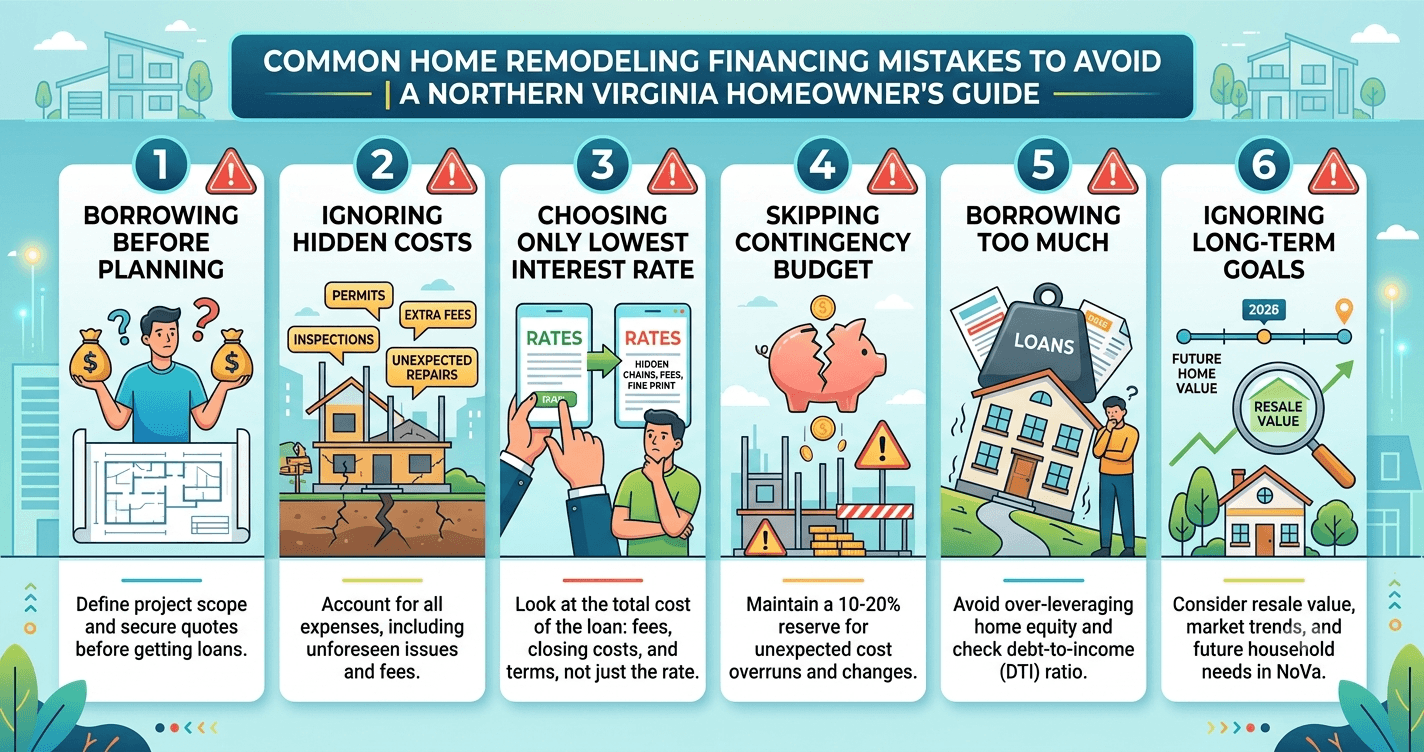
Many remodeling financing problems can be avoided with proper planning. The most common mistakes include borrowing before defining the project scope, underestimating total renovation costs, overlooking contingency funds, choosing financing based solely on interest rates, and failing to compare multiple loan options. These mistakes can lead to budget overruns, project delays, or unnecessary financial stress during construction.
Successful remodeling projects begin with a well-defined plan, not a loan application. By understanding your renovation goals, developing an accurate budget, and working with an experienced design-build team before seeking financing, you can make more informed financial decisions and reduce the likelihood of costly surprises later in the project.
Financing is one of the most important aspects of any remodeling project, but it should support the renovation, not dictate it. In practice, many homeowners encounter financial challenges not because they selected the wrong loan product, but because financing decisions were made before the project had been properly planned.
Below are some of the most common financing mistakes homeowners make—and how to avoid them.
1. Applying for Financing Before Defining the Project Scope
One of the biggest mistakes homeowners make is seeking financing before they have clearly established what they want to renovate.
Without a detailed project scope, it is difficult to estimate construction costs accurately. As the design evolves, homeowners may discover that the approved loan amount is either insufficient to complete the project or significantly higher than necessary.
Instead, begin by identifying:
- Which rooms will be remodeled
- The primary goals of the renovation
- Desired materials and finishes
- Structural or layout changes
- Timeline expectations
Developing these details before approaching a lender provides a stronger foundation for selecting an appropriate financing option.
2. Underestimating the Total Cost of the Project
Construction costs represent only one portion of a remodeling budget. Homeowners should also account for design services, engineering, permits, inspections, material upgrades, temporary living arrangements (when applicable), and a contingency allowance for unforeseen conditions.
Many homeowners build their budget around visible finishes such as cabinetry, flooring, or countertops while overlooking the many behind-the-scenes costs that contribute to the total investment.
A comprehensive budget should include:
- Design and architectural services
- Structural engineering (if required)
- Permit and inspection fees
- Demolition
- Skilled labor
- Mechanical, electrical, and plumbing work
- Interior finishes
- Site preparation
- Cleanup
- Contingency funds
Planning for these expenses from the beginning reduces the likelihood of financial surprises after construction starts.
3. Choosing a Loan Based Only on the Lowest Interest Rate
A lower interest rate is certainly important, but it should not be the only factor influencing your financing decision.
Homeowners should also compare:
- Loan flexibility
- Repayment terms
- Closing costs
- Fees
- Variable versus fixed interest rates
- Draw periods (for HELOCs)
- Prepayment policies
In some situations, a loan with a slightly higher interest rate but more suitable repayment terms may better support the renovation than the option with the lowest advertised rate.
Understanding the complete financing package, not just the interest rate, helps homeowners make more informed long-term decisions.
4. Borrowing More Than the Project Requires
Qualifying for a larger loan does not mean you should borrow the maximum available amount. Financing should reflect the actual cost of your remodeling project while preserving financial flexibility for future expenses and unexpected needs.
Borrowing beyond your renovation budget increases:
- Long-term interest costs
- Monthly payment obligations
- Overall financial risk
Instead, finance the amount necessary to complete the planned renovation while maintaining a comfortable financial cushion for future homeownership expenses.
5. Failing to Include a Contingency Fund
Even the most carefully planned remodeling projects can uncover hidden conditions once construction begins.
Examples include:
- Water damage behind walls
- Outdated electrical systems
- Plumbing issues
- Structural deficiencies
- Code compliance upgrades
- Foundation repairs
Without a contingency allowance, homeowners may be forced to pause construction or seek additional financing unexpectedly.
Including contingency funds in the original budget provides greater financial stability throughout the project.
6. Ignoring Long-Term Homeownership Goals
Financing decisions should support both your current renovation and your future plans.
Before selecting a loan, homeowners should consider:
- How long they expect to remain in the home
- Future maintenance needs
- Potential family changes
- Retirement planning
- Property appreciation
- Neighborhood market trends
A financing strategy that works well for someone planning to remain in their home for twenty years may not be the ideal choice for someone expecting to relocate within the next few years.
7. Delaying Contractor Selection Until After Financing
Many homeowners focus on financing first and choose a contractor later. In reality, selecting an experienced design-build contractor early often leads to more accurate budgeting, better project planning, and financing decisions based on realistic construction costs rather than rough estimates.
An experienced contractor can help homeowners:
- Refine the project scope
- Identify potential cost drivers
- Recommend practical alternatives
- Develop phased construction plans
- Improve budget accuracy
- Reduce the likelihood of costly design changes
This collaborative planning process helps ensure that financing supports a realistic renovation rather than an uncertain concept.
If you’re still evaluating contractors, our guide How to Choose a Contractor in Northern Virginia explains the qualities homeowners should look for before beginning a major renovation.
8. Focusing Only on Today’s Costs Instead of Long-Term Value
Some homeowners prioritize the lowest initial cost while overlooking long-term performance, maintenance, and durability.
Investing in quality materials, professional craftsmanship, and thoughtful design may increase the initial project cost but often delivers greater value through:
- Improved durability
- Lower maintenance requirements
- Better energy efficiency
- Enhanced functionality
- Increased homeowner satisfaction
- Stronger long-term property value
Evaluating remodeling decisions through a long-term perspective often leads to better financial outcomes than focusing exclusively on upfront savings.
Contractor Insight: Financing Should Follow Planning, Not Replace It
One of the clearest patterns experienced remodeling professionals observe is that the smoothest projects begin with careful planning rather than immediate financing.
At US Home Design Build, homeowners are encouraged to establish their goals, complete the design process, understand realistic construction costs, and evaluate project priorities before selecting a financing solution. This planning-first approach helps reduce uncertainty, improve budgeting accuracy, and minimize unexpected changes during construction.
Whether you’re renovating a kitchen, expanding your home, or undertaking a whole-home remodel, financing should support a clearly defined project, not determine what the project becomes.
Industry Statistic
According to the Consumer Financial Protection Bureau (CFPB), consumers should compare multiple financing options, review all loan disclosures carefully, and ensure they understand the total cost of borrowing, including fees, repayment terms, and interest obligations—before signing any financing agreement.
Frequently Asked Questions
How much does it cost to remodel a home in Northern Virginia?
The cost of remodeling a home in Northern Virginia varies depending on the project’s size, materials, design complexity, existing home conditions, and required construction work. Smaller renovations may require a lower investment, while major additions, whole-home renovations, and luxury upgrades can involve significantly higher costs.
There is no fixed price for a remodeling project because every home has different requirements. A renovation budget is influenced by factors such as the condition of the existing property, whether structural modifications are needed, the quality of materials selected, permit requirements, and the complexity of the design.
For homeowners in areas such as Fairfax County, McLean, Vienna, Reston, Great Falls, and Burke, local housing conditions and construction requirements can also affect overall project costs.
Before choosing a financing option, homeowners should first develop a realistic project scope and detailed budget so they understand the actual investment required for their renovation.
What is the best way to finance a home remodel in Northern Virginia?
The best way to finance a home remodel depends on the homeowner’s financial situation, available home equity, renovation size, repayment preferences, and project timeline. Common options include HELOCs, home equity loans, renovation loans, personal loans, or using available savings.
There is no single financing method that works for every renovation project. A homeowner completing a smaller bathroom update may approach financing differently from someone planning a major home addition or whole-home renovation.
The most important factor is ensuring that the financing decision matches the actual project requirements. Developing a clear renovation plan and understanding the expected cost before borrowing helps homeowners avoid taking on unnecessary debt or discovering that available funds are insufficient during construction.
Is a HELOC a good option for home remodeling?
A HELOC can be a suitable option for homeowners who need flexible access to funds during a remodeling project. Unlike a traditional loan that provides money upfront, a HELOC allows homeowners to borrow from an approved credit line as renovation expenses occur.
HELOCs are often considered for larger or phased remodeling projects where costs may develop over time. For example, a homeowner completing a major renovation may begin with one phase and later decide to complete additional improvements based on construction discoveries or changing needs.
However, homeowners should carefully review the terms because many HELOCs have variable interest rates, meaning monthly payments may change over time. Understanding repayment requirements, fees, and borrowing limits is essential before selecting this option.
Should I use a HELOC or home equity loan for a renovation?
A HELOC may be better for homeowners who need flexibility during an evolving renovation, while a home equity loan may be better for projects with a clearly defined scope and fixed budget. The right choice depends on the project requirements and the homeowner’s financial goals.
A home equity loan provides a fixed amount upfront, which can make budgeting easier when construction costs are already established. This may work well for renovations such as planned kitchen remodels, bathroom updates, or other projects with a predictable scope.
A HELOC provides more flexibility because homeowners can access funds as needed, which may be helpful for larger renovations where costs can change during construction.
Before choosing between these options, homeowners should compare repayment terms, interest structures, and the overall financial impact of each choice.
How much equity do I need to finance a home renovation?
The amount of equity needed to finance a renovation depends on the lender, financing product, property value, existing mortgage balance, income, credit profile, and other financial factors. There is no universal equity requirement for every homeowner.
Home equity represents the difference between the current value of your home and the remaining mortgage balance. While greater equity may provide more financing opportunities, lenders typically evaluate several additional factors before approving a loan.
Homeowners should consider their overall financial position rather than focusing only on available equity. A realistic renovation budget combined with professional financial guidance can help determine the most appropriate financing approach.
Final Thoughts
The right home remodeling financing strategy begins with a clear understanding of your renovation goals, realistic project costs, and long-term financial priorities. Whether you choose a HELOC, home equity loan, renovation loan, or another financing option, careful planning helps ensure that your funding supports a successful remodeling project.
For homeowners planning renovations in Northern Virginia, financing should be viewed as one part of a larger remodeling process that includes design, budgeting, permitting, and construction planning. Working with an experienced design-build team can help create a clearer path from initial ideas to a completed home transformation.
A successful renovation does not start with choosing a loan, it starts with understanding what you want to accomplish and what the project realistically requires.
Homeowners considering home remodeling financing in Northern Virginia should first evaluate their renovation priorities, establish a detailed budget, and understand the factors that influence construction costs. This preparation makes it easier to compare financing options and select an approach that aligns with both the project requirements and personal financial goals.
From kitchen renovations and bathroom upgrades to home additions, basement finishing, and whole-home transformations, every remodeling project involves unique decisions. The right financing solution depends on the scope of work, available resources, timeline expectations, and the homeowner’s long-term plans.

At US Home Design Build, our design-build team helps homeowners throughout Northern Virginia, including Fairfax County, McLean, Vienna, Reston, Great Falls, Burke, Falls Church, Clifton, and Annandale, approach remodeling projects with greater clarity and confidence. By combining design expertise, construction knowledge, and local experience, we help homeowners understand their options before moving forward.
Planning a remodeling project in Northern Virginia? Contact US Home Design Build to discuss your goals, budget considerations, and renovation plans with an experienced design-build team.