
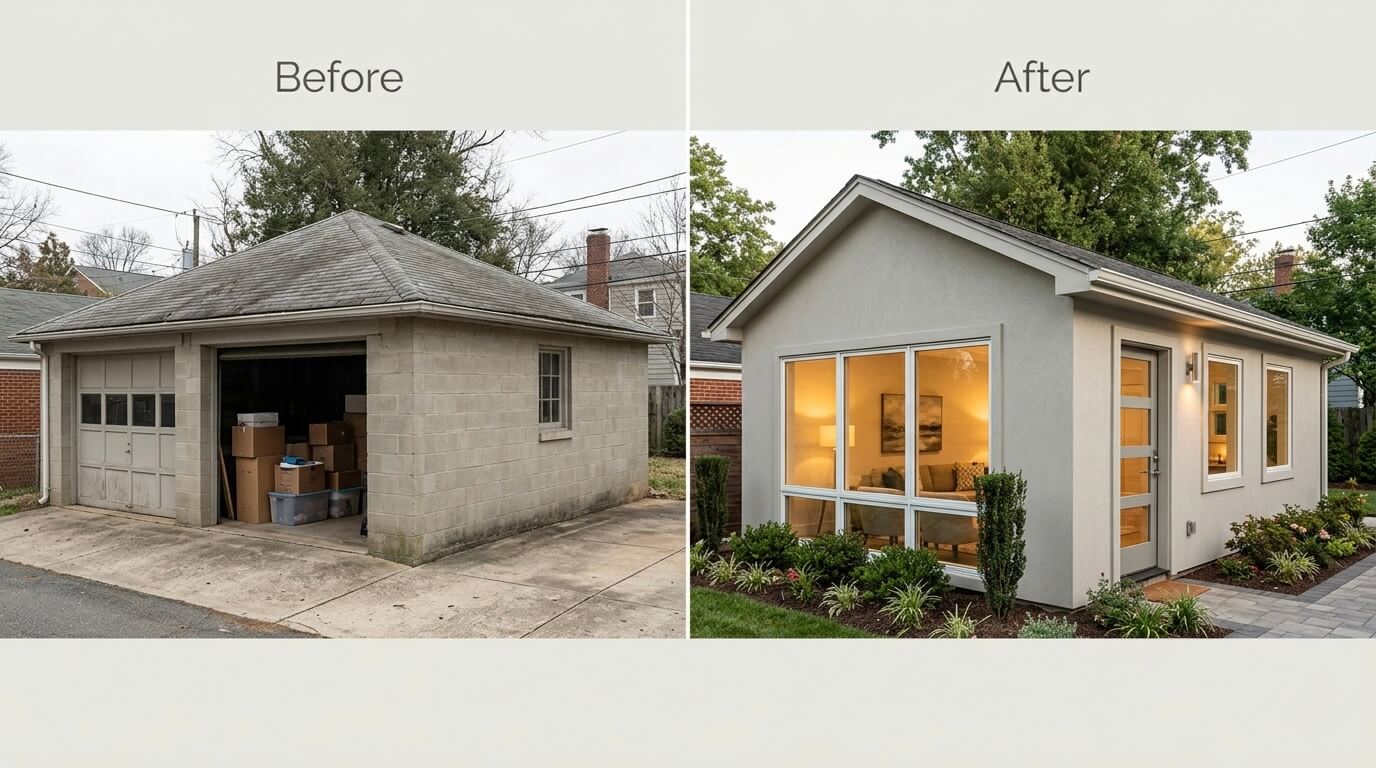
An ADU garage conversion before after Arlington VA project is one of the clearest examples of how homeowners are creating additional living space and generating income without purchasing a larger property. Across Arlington VA and the broader Northern Virginia market, detached garages that once served primarily as storage are increasingly being evaluated as potential accessory dwelling units (ADUs), particularly as housing costs and rental demand continue to rise.
This case study follows the Okafor family, owners of a 1958 brick split-level home in Arlington VA’s Westover neighborhood. Their property sits on a typical 0.18-acre residential lot and includes a detached two-car garage positioned at the rear of the property with direct alley access. With Arlington’s median home sale price reaching approximately $815,000 in March 2026, maximizing the utility of existing structures became a more practical financial strategy than relocating to a larger home.
The homeowners had two goals. First, they wanted to create a legal, fully permitted accessory dwelling unit capable of generating rental income. Second, they wanted a private living space their college-age child could use during school breaks and after graduation. Their detached garage, a 22-foot by 24-foot structure totaling 528 square feet, offered an ideal starting point. The footprint already fit within Arlington County’s detached ADU size limitations, and the garage’s 9-foot ceiling height provided sufficient volume for a comfortable residential layout without requiring major structural expansion.
The financial motivation was equally compelling. According to ADU Zoning’s Arlington VA ADU market data, one-bedroom accessory dwelling units in Arlington typically rent for approximately $1,700–$2,200 per month, while two-bedroom units can command between $2,100 and $3,000 per month due to Arlington’s proximity to Washington, D.C., strong employment base, and limited housing inventory. [Source: ADU Zoning]
What began as an underused garage ultimately became a fully functional accessory dwelling unit. This is the complete story of that transformation, from the original structure and Arlington County eligibility review to permitting, construction, costs, and the finished rental-ready ADU completed in November 2025.
The Before: The Garage That Became the Opportunity
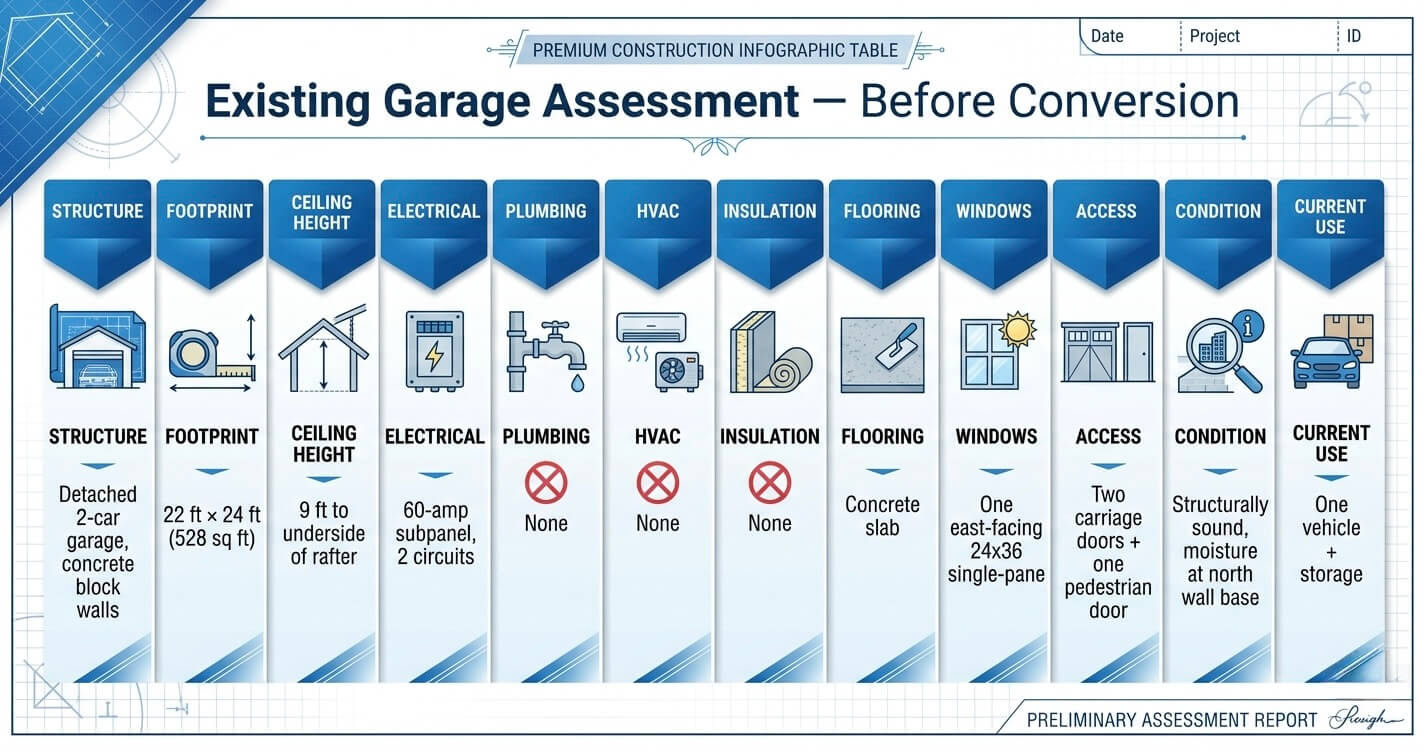
Before construction began, the detached garage looked much like thousands of similar structures found throughout Arlington VA’s post-war neighborhoods. Built alongside the original home in 1958, the building measured approximately 22 feet by 24 feet and was constructed with concrete block walls supporting a conventional wood-framed gable roof.
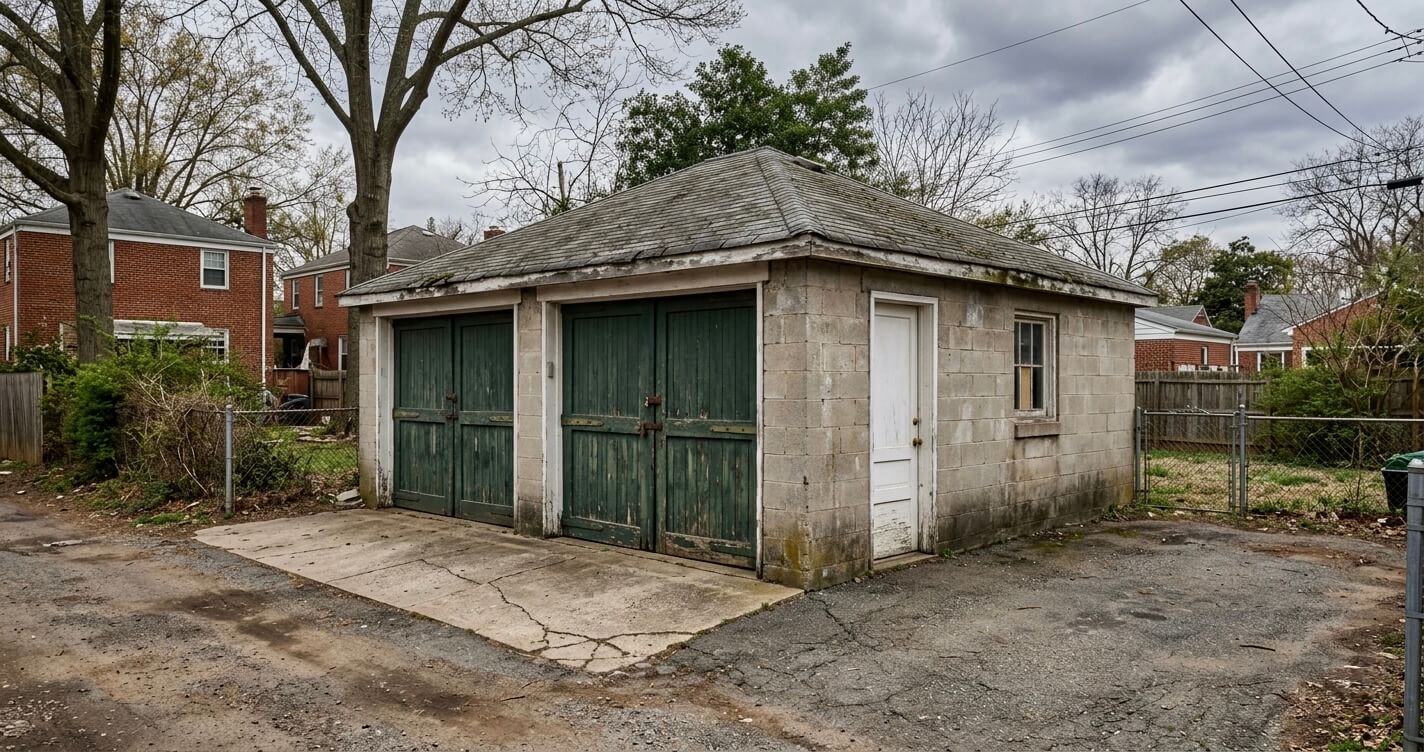
Viewed from the rear alley, the garage presented a distinctly utilitarian appearance. Two original carriage-style swing-out doors faced the alley, accompanied by a single pedestrian entry door on the north elevation and one small east-facing window. The asphalt shingle roof had been replaced in 2009 and remained in serviceable condition. However, the structure had never been designed for year-round habitation. There was no insulation, no plumbing system, no heating or cooling equipment, and only a modest 60-amp electrical subpanel supplying two fluorescent fixtures and a pair of duplex outlets.
Inside, the garage reflected more than a decade of accumulated storage. One parking bay remained functional, while the remainder of the space was occupied by shelving units, seasonal items, household storage bins, and miscellaneous equipment. The original concrete slab floor remained exposed throughout. During the initial inspection, minor moisture staining was observed along the base of the north wall, an issue that would later require remediation as part of the conversion process.
Before Conversion Specifications
The significance of structures like this extends beyond a single property. Throughout Arlington County, rising property values and limited buildable land have encouraged homeowners to look inward rather than outward when creating additional living space. Existing garages, backyard cottages, and accessory structures often provide a far more cost-effective path to increasing usable square footage than purchasing a larger property elsewhere. [Source: ADU Zoning]
For homeowners interested in comparing conversion projects with new detached structures, the case study on the Recent Garage Addition in Arlington VA provides a useful contrast between ground-up construction and adaptive reuse approaches.
Eligibility Check: Did This Property Qualify for an Arlington County ADU?
Before any design work could begin, US Home Design Build conducted a comprehensive eligibility review to determine whether the detached garage could legally be converted into an accessory dwelling unit under Arlington County regulations. This step is critical because not every garage in Arlington VA automatically qualifies for ADU conversion.
Step 1: Zoning Verification
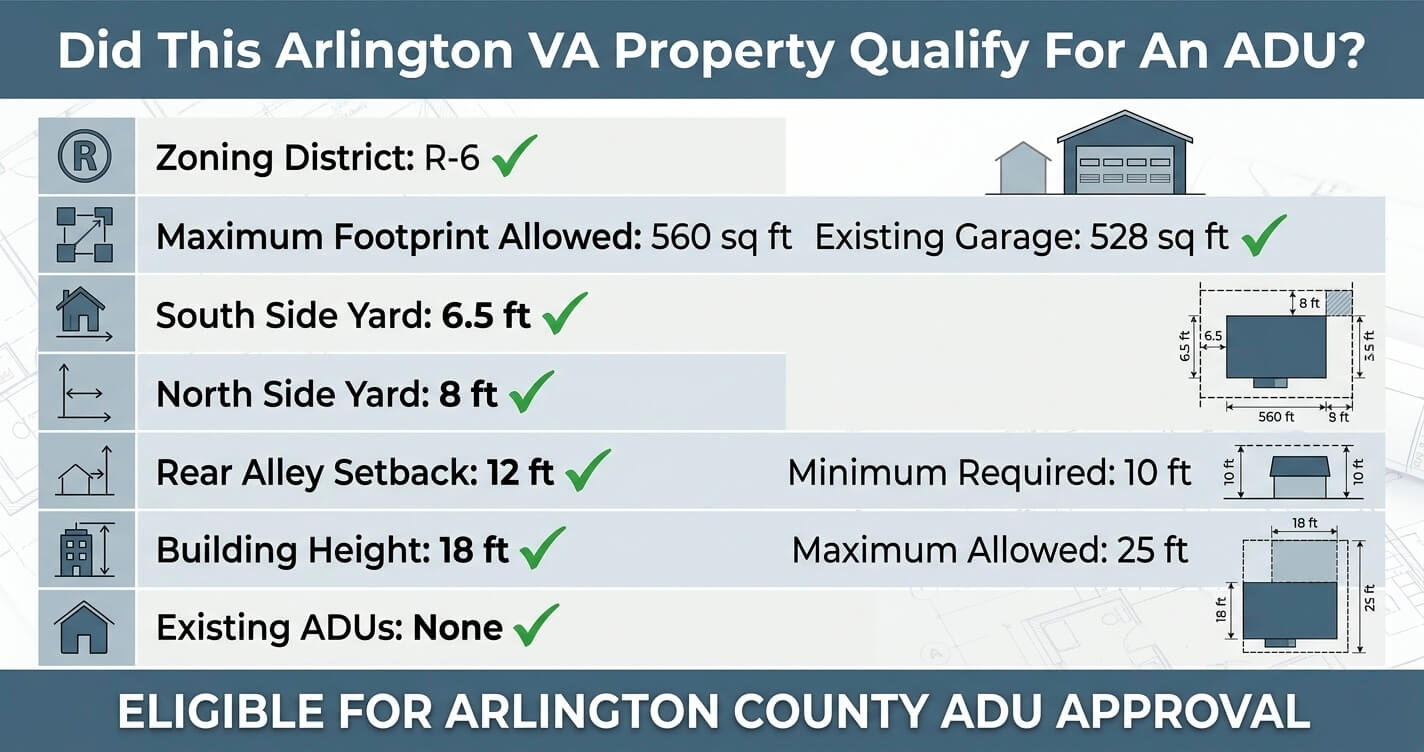
The first review involved confirming the property’s zoning classification through Arlington County records. The home was located within an R-6 zoning district, one of the residential districts where accessory dwelling units are permitted.
According to Arlington ADU guidance, eligible zoning districts include R-20, R-10, R-8, R-6, R-5, R-10T, R-15-30T, and R-2-7.
Because the property was zoned R-6, it satisfied the first eligibility requirement.
Step 2: Footprint Compliance
Detached ADUs in Arlington County must remain within specific size limitations. In R-5 and R-6 districts, detached accessory dwelling units are limited to a maximum footprint of 560 square feet.
The existing garage measured 528 square feet, placing it comfortably below the maximum permitted footprint. No footprint expansion was required, and none would have been permitted under the selected design.
Step 3: Setback Review
Arlington County setback regulations represent another major compliance checkpoint. Detached ADUs must maintain a minimum setback of 5 feet from side property lines and 10 feet from the rear property line or alley.
Field measurements confirmed full compliance:
- South side setback: 6.5 feet
- North side setback: 8 feet
- Rear alley setback: 12 feet
- Distance to primary residence: approximately 24 feet
All setback requirements were satisfied without modification.
Step 4: Height Verification
Detached accessory structures containing ADUs are limited to 1.5 stories or 25 feet in height, whichever is lower.
The existing garage featured a single-story configuration with a roof peak of approximately 18 feet. No height modifications were necessary.
Step 5: Existing ADU Review
Arlington regulations allow only one accessory dwelling unit per residential property.
Because no ADU existed on the parcel, the property remained eligible.
The Pre-Submission Meeting
Prior to preparing permit drawings, US Home Design Build attended a recommended pre-submission meeting with Arlington County’s Zoning Division. Arlington County encourages these meetings so property owners can identify potential compliance issues before formal permit review begins.
During this meeting, county reviewers identified the moisture intrusion visible at the north concrete block wall as a condition requiring remediation before occupancy approval could be granted. Addressing that issue during the planning stage prevented costly redesigns and construction delays later in the project.
For a complete breakdown of zoning requirements, permit procedures, setback standards, and Arlington County ADU regulations, homeowners can review our detailed guide on ADU Regulations in Arlington VA.
THE DESIGN PLAN: EVERY DECISION MADE BEFORE DEMO
The success of this ADU garage conversion before after Arlington VA project was determined long before demolition began. Once the Okafor family’s detached garage was confirmed as eligible under Arlington County zoning requirements, the design-build team focused on maximizing functionality, natural light, rental appeal, and long-term flexibility within the existing 528-square-foot footprint.
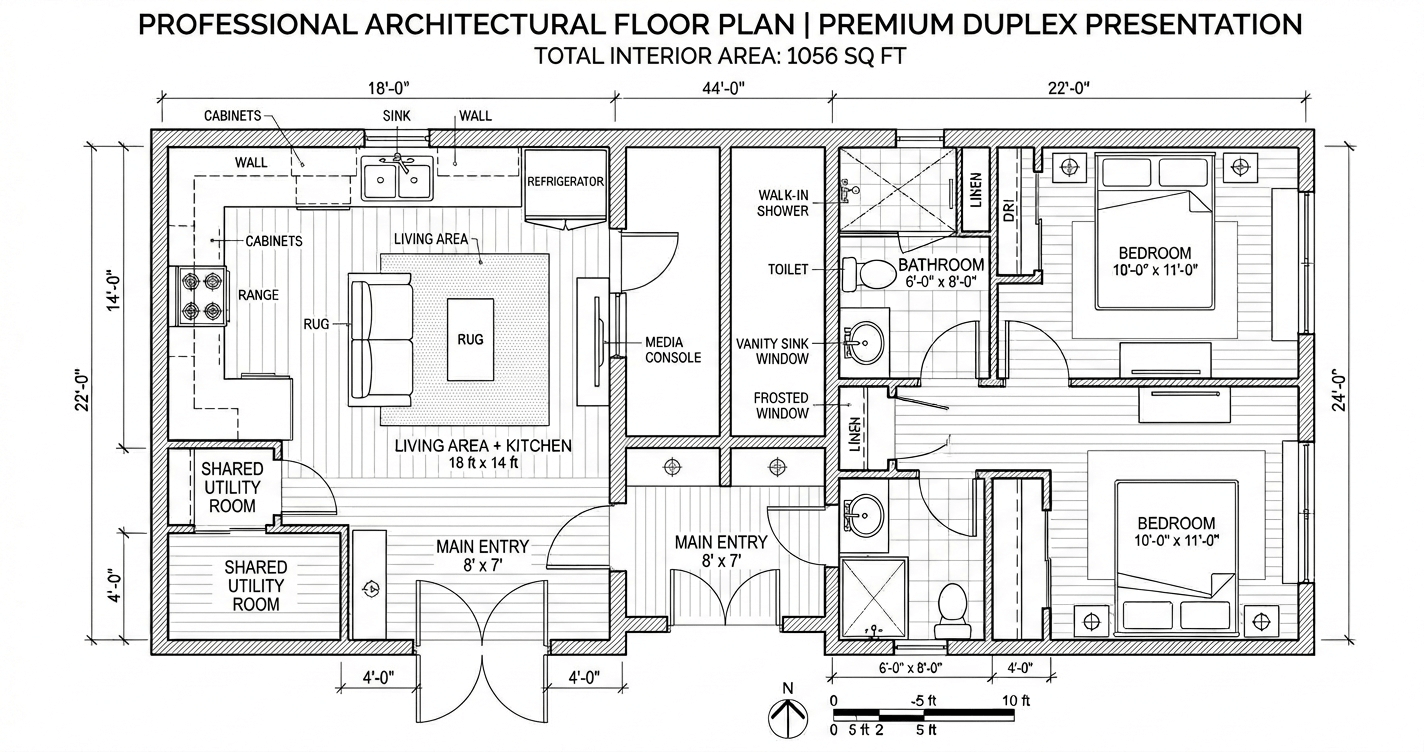
The most transformative design decision involved the removal of the original carriage doors. While these openings had served the garage well for decades, they severely limited daylight penetration and made residential use impractical. The larger 16-foot-wide south-facing opening was reframed into a contemporary window wall consisting of two fixed 48-by-72-inch energy-efficient windows positioned on either side of a 36-inch glazed entry door. This immediately changed the character of the structure, transforming what had been the darkest side of the garage into the primary daylight source for the living area. The smaller north-side carriage door opening was converted into a 36-by-48-inch casement window to improve cross-ventilation and provide balanced natural lighting throughout the unit.
Because the structure measured just 22 feet by 24 feet, efficiency became the guiding principle of the floor plan. Rather than attempting to create multiple small rooms, the design team prioritized open circulation and visual spaciousness. The resulting layout included an 18-by-14-foot open-concept living and kitchen area, a private 10-by-11-foot bedroom, a full bathroom measuring 6 by 8 feet, a compact entry vestibule with integrated storage, and a concealed utility closet housing the water heater and electrical equipment.
The bathroom was designed specifically for long-term usability rather than short-term rental aesthetics. A tiled 36-inch walk-in shower replaced the space-consuming tub typically found in smaller apartments. Waterproof luxury vinyl flooring transitions to large-format porcelain tile in the bathroom, where an electric heated floor system improves comfort during Northern Virginia winters. Ventilation is provided by a Panasonic WhisperFit 80-CFM exhaust fan vented directly to the exterior.
The kitchen was intentionally designed as a complete residential kitchen rather than a limited kitchenette. Research consistently shows that fully equipped one-bedroom ADUs command higher rents and attract longer-term tenants than units with restricted cooking facilities. The final design incorporated 12 linear feet of semi-custom cabinetry finished in Benjamin Moore’s “Newburyport Blue,” paired with Caesarstone Statuario Nuvo quartz countertops. Apartment-scale appliances, including a 24-inch range, 24-inch dishwasher, and counter-depth refrigerator, provided full functionality while preserving floor area.
Mechanical design was equally important. Rather than extending ductwork from the main house, which would have complicated permitting and future maintenance, the team installed a dedicated Mitsubishi Mr. Slim 12,000-BTU mini-split system. This provided independent climate control for the ADU while maintaining energy efficiency appropriate for a 528-square-foot structure.
One of the most important discoveries occurred before permit submission. During the Arlington County pre-submission review process, moisture staining was identified along the north concrete block wall. Further investigation confirmed the need for crystalline waterproofing treatment before insulation could be installed. Drylok Extreme waterproofing was applied across the affected surfaces, adding approximately $2,800 to the project budget and four days to the schedule. Because the issue was discovered early, it became a planned improvement rather than a costly construction surprise.
The final exterior design was intentionally subtle. Existing concrete block walls received a stucco finish and were painted in Benjamin Moore “Revere Pewter” to complement the primary residence. This allowed the ADU to feel like a natural extension of the property rather than a visibly converted garage. In Arlington County, where design review places significant emphasis on neighborhood compatibility, this level of architectural integration contributes to both permit approval and long-term property value.
PERMITS: THE FULL ARLINGTON COUNTY PROCESS FOR THIS ADU CONVERSION
Unlike many smaller home improvement projects, a detached garage conversion into a legal accessory dwelling unit requires comprehensive permitting and code compliance. Because Arlington County operates as an independent jurisdiction rather than under Fairfax County administration, all approvals for this project were processed through the Arlington County Department of Community Planning, Housing & Development (CPHD).
All work was designed and constructed in accordance with the 2021 Virginia Uniform Statewide Building Code (USBC), which became effective statewide on January 18, 2025. [Source: Virginia Department of Housing and Community Development]
The project required multiple permits because the garage was being converted into a fully habitable residential unit rather than a simple storage or workshop space.
The primary approval was the residential building permit, which covered structural modifications, framing, insulation, drywall installation, window and door replacements, and conversion of the garage from accessory storage space into legal living space.
Additional trade permits included:
- Electrical Permit — required for the upgrade from the existing 60-amp service to a 200-amp subpanel, new appliance circuits, lighting, receptacles, mini-split HVAC equipment, heated bathroom flooring, and future EV charger rough-in.
- Plumbing Permit — required for installation of the complete bathroom, kitchen sink connections, water supply lines, drainage piping, and venting systems.
- Mechanical Permit — required for installation of the Mitsubishi mini-split heating and cooling system.
According to Arlington ADU permitting guidance, permit review timelines generally range from 50 to 75 days, while permit-related fees typically fall between $2,800 and $4,500. [Source: ADU Zoning]
For the Okafor project, the timeline unfolded as follows:
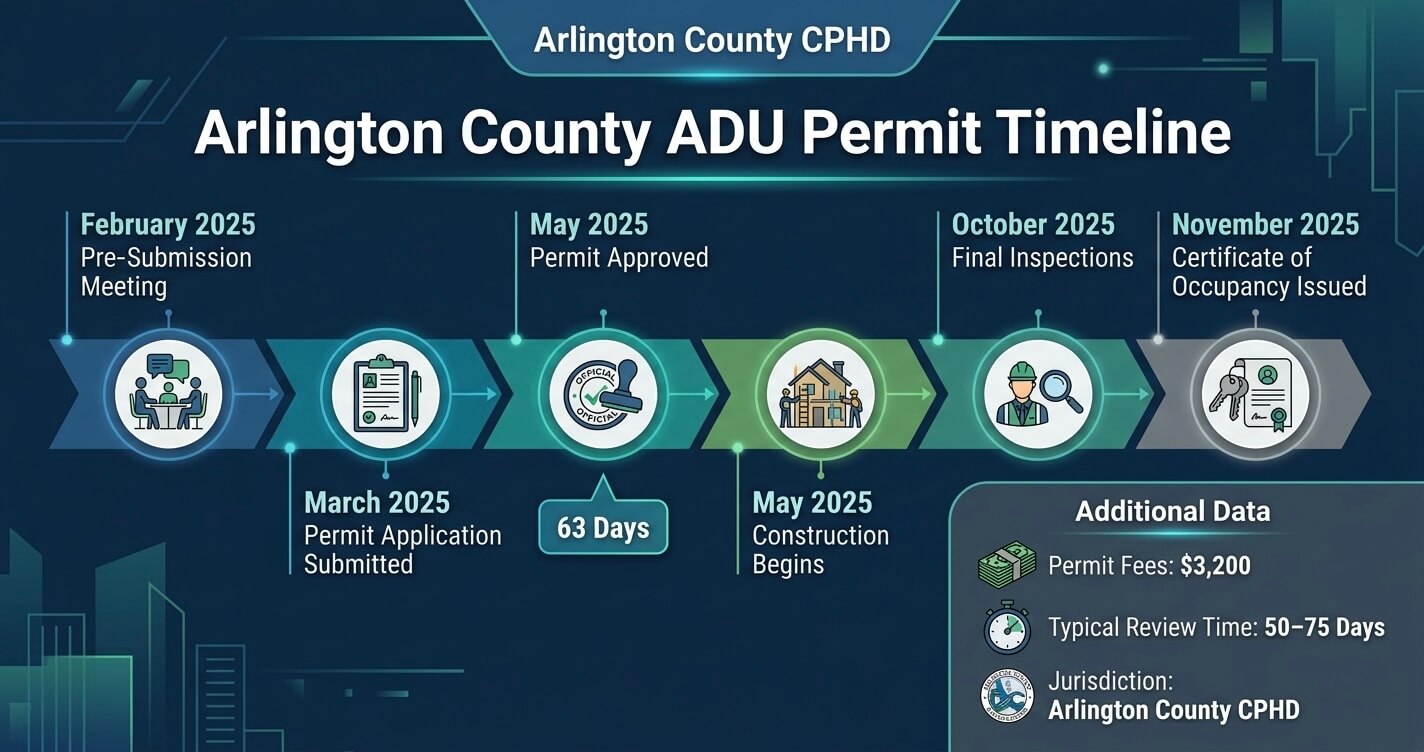
Total permit and review fees for the project were approximately $3,200, placing the conversion squarely within Arlington County’s expected range.
An additional consideration involved Arlington’s ADU design review requirements. The county evaluates exterior appearance, neighborhood compatibility, and architectural integration to ensure accessory dwelling units complement surrounding residential development.
This requirement directly influenced material selections, exterior finishes, window placement, and the decision to match the converted structure’s color palette to the main residence. It also highlights why many Arlington homeowners choose experienced design-build firms rather than contractors unfamiliar with local review standards.
For a complete explanation of zoning requirements, setbacks, occupancy regulations, and permit procedures, see our guide on ADU Regulations in Arlington VA.
PROJECT COST BREAKDOWN
One of the most common questions Arlington homeowners ask is whether converting an existing detached garage into an ADU provides a better return than building a completely new accessory structure. In this case, the answer was clearly yes.
The Okafor family’s total investment was $127,400, resulting in a fully permitted, code-compliant, one-bedroom accessory dwelling unit measuring 528 square feet.
Industry data indicates that garage ADU conversions in Arlington VA generally range between $90,000 and $200,000, depending on structural condition, utility requirements, finish level, and permitting complexity. [Source: ADU Zoning]
Because the existing garage foundation, walls, and roof structure remained largely intact, the project avoided many of the expenses associated with new construction. Reusing these major structural components significantly reduced overall costs while preserving the property’s existing footprint.
The final budget was allocated as follows:
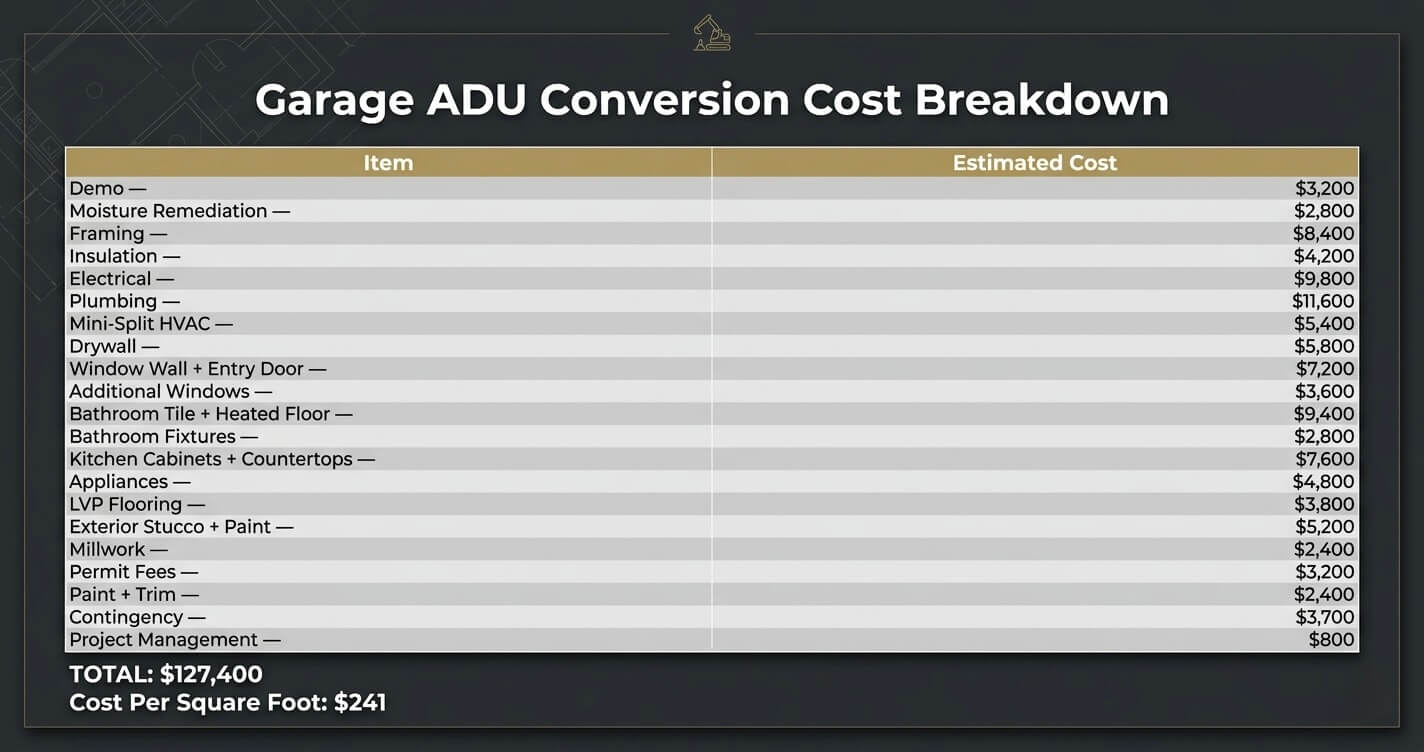
At 528 square feet, the project achieved a final construction cost of approximately $241 per square foot.
This figure falls comfortably within the expected mid-range finish category for Arlington County and Northern Virginia ADU conversions. More importantly, it remains substantially below the cost of constructing a detached accessory building from scratch, where new foundations, framing, roofing, and utility infrastructure can dramatically increase per-square-foot expenses.
For homeowners evaluating alternative expansion options, our guide on Home Addition Cost in Northern Virginia provides a broader comparison of garage conversions, room additions, second-story additions, and detached structures throughout the region.
THE AFTER: THE FINISHED ADU REVEALED
Six months after construction began, the detached garage that had spent decades serving as little more than storage had become something entirely different: a legal, fully permitted accessory dwelling unit capable of generating income, housing family members, and adding long-term value to the property.
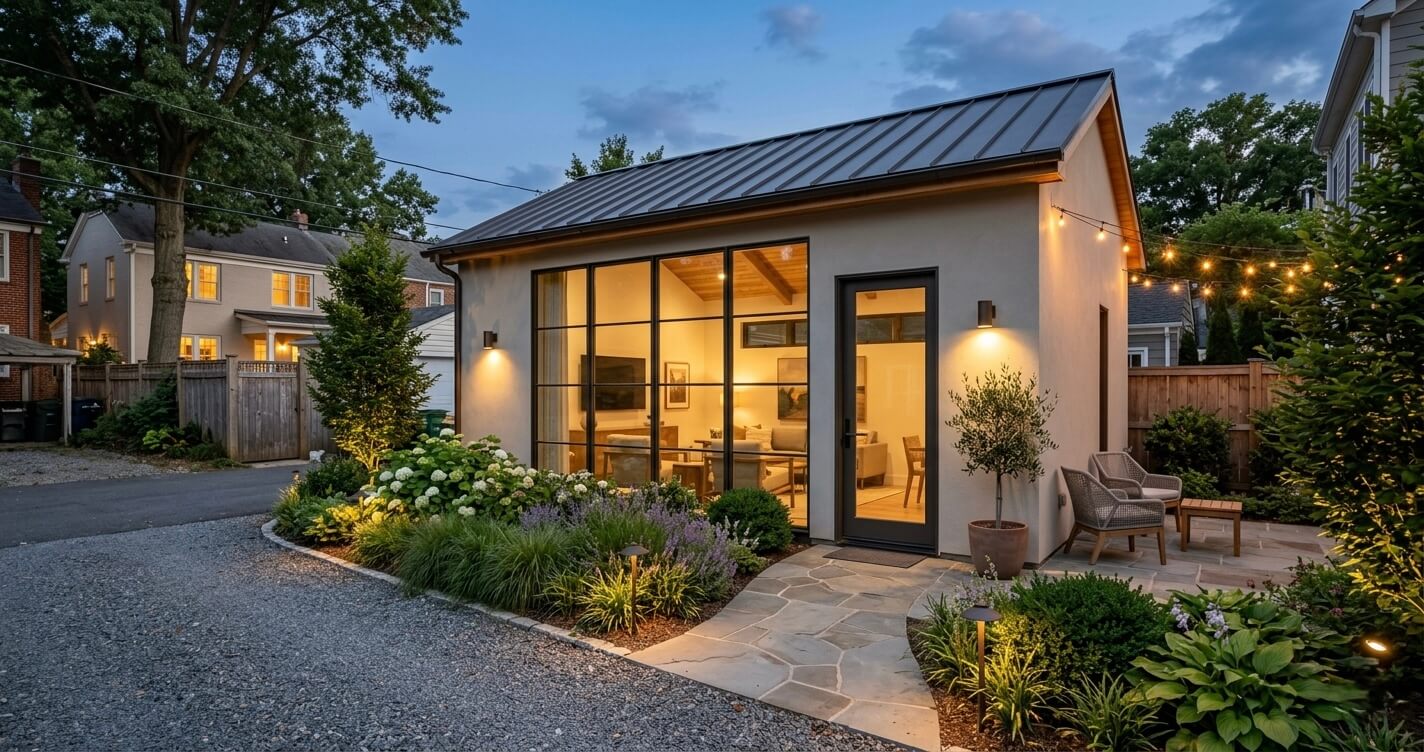
From the rear alley, the transformation is immediately apparent. The original carriage doors that once dominated the facade have disappeared. In their place stands a modern south-facing window wall that fills the interior with natural light. The combination of large fixed glass panels, a glazed entry door, and the stucco exterior finished in Benjamin Moore Revere Pewter gives the structure the appearance of a purpose-built cottage rather than a converted garage. Most visitors would never guess the building’s original use.
Inside, the 252-square-foot open living area serves as the visual centerpiece of the ADU. Afternoon sunlight enters through the south-facing glazing and extends deep into the interior, eliminating the dark, enclosed feeling that characterizes many garage conversions. The continuous warm-ash luxury vinyl plank flooring creates visual continuity throughout the unit, while recessed LED lighting and the wall-mounted Mitsubishi mini-split maintain comfort without consuming valuable floor space.
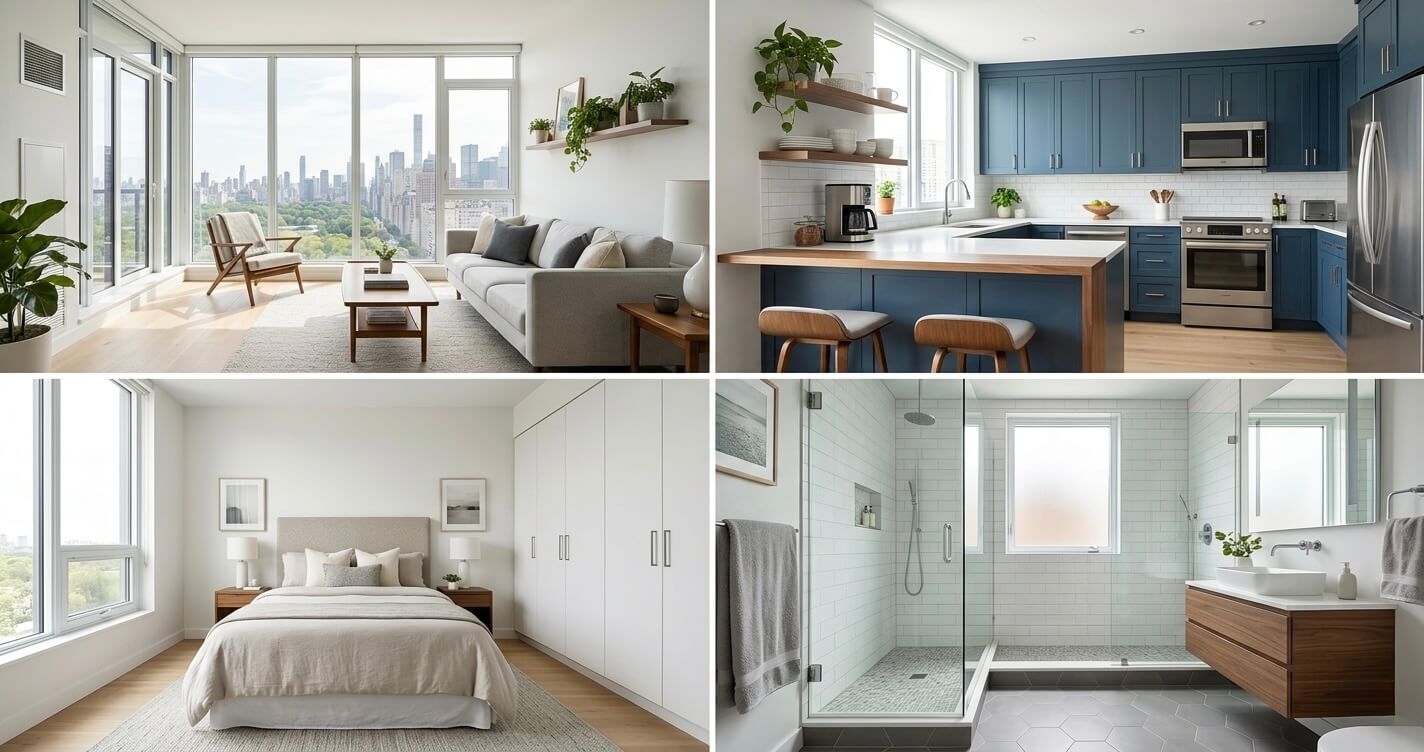
The kitchen successfully achieves the project’s primary objective: providing full residential functionality within a compact footprint. Newburyport Blue cabinetry, quartz countertops, apartment-scale appliances, and under-cabinet lighting create a space that feels comparable to a modern condominium kitchen rather than a rental-unit compromise.
Beyond the living area, the private bedroom and adjacent bathroom provide everything needed for full-time occupancy. The tiled walk-in shower, heated bathroom flooring, dedicated climate control, upgraded electrical service, and independent utility systems allow the ADU to operate as a true standalone residence.
The finished unit received its Arlington County Certificate of Occupancy in November 2025 and was listed for rent in February 2026. Within three weeks, it was leased to a federal government professional working near the Pentagon for $1,850 per month.
That rental performance aligns closely with documented Arlington ADU market rates. According to ADU Zoning’s 2026 Arlington ADU market analysis, one-bedroom ADUs in Arlington typically command between $1,700 and $2,200 per month due to the county’s proximity to Washington, D.C., and its concentration of federal, technology, and professional employment. [Source: ADU Zoning]
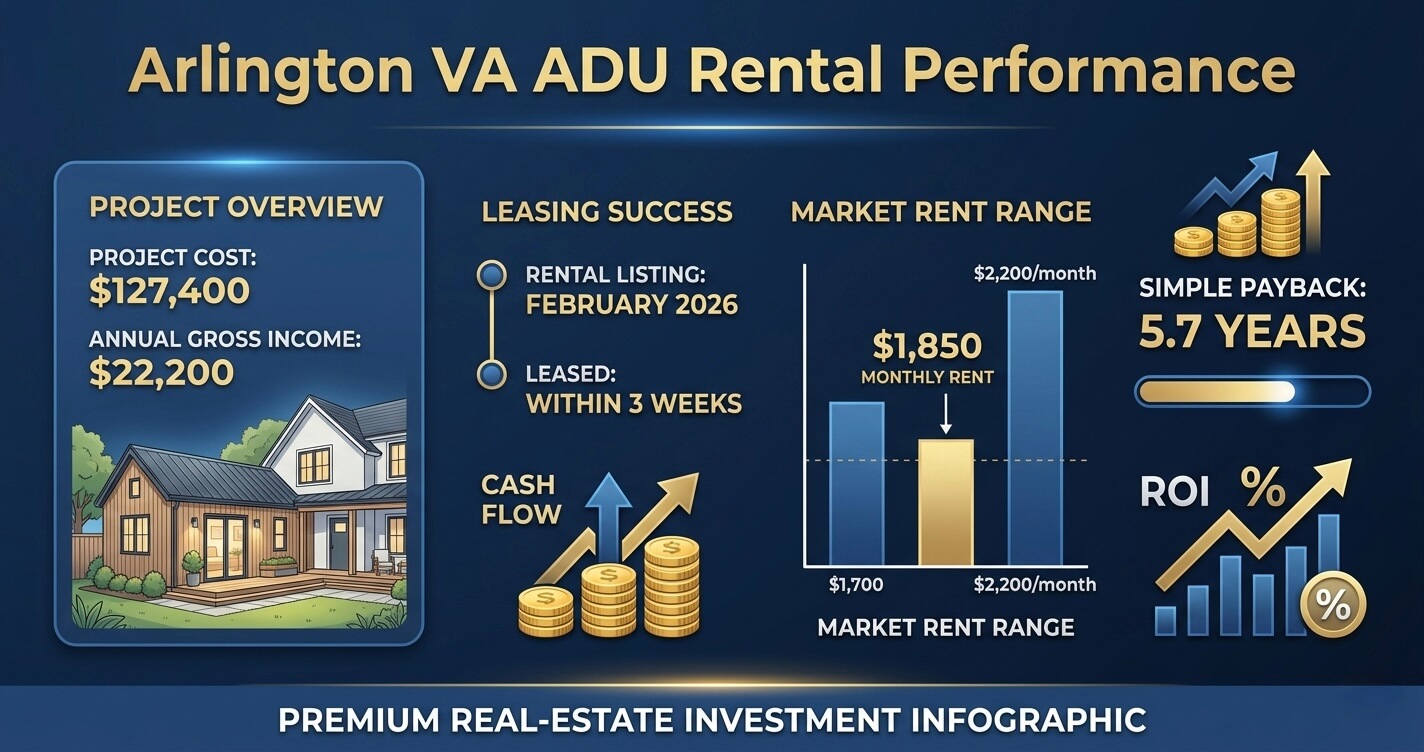
At $1,850 per month, the finished ADU generates approximately $22,200 in annual gross rental income. Based on the project’s total investment of $127,400, the simple payback period is approximately 5.7 years. After that point, the unit continues producing income while simultaneously contributing to overall property value.
LESSONS LEARNED AND THE DESIGN-BUILD ADVANTAGE IN ARLINGTON VA
Looking back on the project, several decisions stand out as major contributors to both the ADU’s financial success and the smoothness of the construction process.
The most important was scheduling the Arlington County pre-submission meeting before finalizing the design package. That meeting identified the moisture intrusion issue at the north concrete block wall during planning. Addressing the problem at that stage cost approximately $2,800. Had it remained hidden until framing and insulation began, repairs could easily have exceeded $15,000 while creating significant schedule delays.
The homeowners also remain convinced that choosing a full kitchen rather than a kitchenette was the correct financial decision. In Arlington’s rental market, the difference between a studio-style unit and a true one-bedroom residence with complete cooking facilities often translates into an additional $300–$500 per month in rental income. That premium substantially accelerated the project’s return on investment.
The dedicated mini-split HVAC system was another successful decision. Independent climate control eliminated the complexity of extending ductwork from the primary residence and created a self-contained living environment more attractive to future tenants.
If they were starting over, the Okafors would make a handful of minor modifications. They would add an additional dedicated electrical circuit to the bedroom, install a complete EV charging circuit rather than rough-in conduit alone, and consider moving to an 18,000-BTU mini-split system to better address Arlington’s peak summer humidity conditions.
Perhaps the most important lesson, however, was the value of working with a design-build team. US Home Design Build managed every stage of the project, from the Arlington County zoning review and permit applications through construction, inspections, and final Certificate of Occupancy issuance. That unified process reduced coordination errors, maintained accountability throughout the project, and ensured design decisions remained aligned with both code requirements and long-term rental performance.
For homeowners evaluating a project of similar complexity, our guide on How to Choose the Right Contractor in Northern Virginia provides a detailed framework for vetting contractors, reviewing proposals, and avoiding common mistakes.
FREQUENTLY ASKED QUESTIONS [FAQs]
How much does a garage ADU conversion cost in Arlington VA in 2026?
Garage ADU conversions in Arlington VA typically cost between $90,000 and $200,000 depending on structural condition, utility upgrades, finish level, and permitting requirements. The featured project in this case study converted a 528-square-foot detached garage into a fully permitted one-bedroom ADU for $127,400, or approximately $241 per square foot.
What are the ADU rules for a garage conversion in Arlington County VA?
Arlington County permits ADUs in eligible zoning districts including R-20, R-10, R-8, R-6, R-5, R-10T, R-15-30T, and R-2-7. Detached ADUs in R-5 and R-6 districts are generally limited to 560 square feet, with side setbacks of 5 feet, rear setbacks of 10 feet, and maximum building heights of 25 feet or 1.5 stories.
How long does it take to get an ADU permit in Arlington County VA?
Most Arlington County ADU permits require approximately 50–75 days for review and approval. A pre-submission meeting with the Zoning Division is strongly recommended before submitting plans.
How much rent can a garage ADU earn in Arlington VA?
One-bedroom ADUs in Arlington typically rent for $1,700–$2,200 per month. The completed ADU featured in this project leased for $1,850 per month within three weeks of listing, generating approximately $22,200 annually in gross rental income.
Is a garage ADU conversion worth it in Arlington VA?
For many homeowners, yes. Arlington’s strong rental demand, limited housing inventory, and relatively high property values make garage conversions one of the most efficient methods of creating additional living space and generating long-term income. The best candidates are structurally sound detached garages located within eligible zoning districts and setback requirements.
FINAL THOUGHTS
The Okafor family’s project demonstrates exactly why ADU garage conversion before after Arlington VA searches continue to grow across Northern Virginia. A detached 528-square-foot garage that once stored boxes and a vehicle now functions as a legal income-producing residence with its own Certificate of Occupancy, dedicated utilities, and long-term rental potential.
The project also highlights several realities of Arlington County ADU development: eligibility must be verified before design begins, permit requirements are substantial, and thoughtful decisions regarding layout, kitchen design, HVAC systems, and exterior integration have a direct impact on both rental income and future resale value.
At Arlington’s current rental rates of approximately $1,700–$2,200 per month for a one-bedroom ADU, a well-executed conversion can recover its cost in less than six years while continuing to generate income for decades afterward.
The most underused asset on many Arlington VA properties is already standing in the rear yard. The question is whether it is working for the homeowner, or simply storing boxes.
US Home Design Build works with homeowners across Arlington VA, McLean VA, Fairfax VA, Alexandria VA, Falls Church, Vienna, and throughout Northern Virginia on ADU conversions and home additions, from property eligibility reviews and Arlington County permit applications through construction and a two-year workmanship warranty.
If you own a detached garage and want to understand whether it qualifies for an ADU conversion, schedule a free on-site consultation to evaluate the property’s potential, expected costs, and projected rental income.
703-202-3520 | https://ushdb.com/ | 8200 Greensboro Dr Suite 900, McLean, VA 22102
