

ADU tax benefits Northern Virginia homeowners can actually claim in 2026 fall into three categories: local real estate tax relief programs, federal depreciation on a rented unit, and interest deductions tied to how the project is financed. There is no dedicated “ADU tax credit” waiting to be discovered, what exists is a set of ordinary IRS and Virginia tax rules that happen to apply cleanly to an accessory dwelling unit once it is permitted, built, and, in many cases, rented out.
For homeowners who have already worked through Virginia’s by-right ADU law or started pricing out FHA ADU financing, tax treatment is usually the next question, and often the one that decides whether the numbers actually work. With years spent designing and building ADU projects across Fairfax County, Arlington, Vienna, and Reston, our design-build team at US Home Design Build fields tax questions almost as often as permit questions, though the specifics always deserve a conversation with a licensed CPA before anyone files.
This guide walks through what applies, what does not, and where Northern Virginia’s local tax rules add a layer that national ADU guides typically skip.
What Tax Benefits Are Available for an ADU in Northern Virginia?
Northern Virginia ADU owners can access three categories of tax benefit in 2026: local real estate tax relief for qualifying seniors and disabled homeowners, federal depreciation on a rented ADU structure over 27.5 years, and deductible interest on money borrowed to build it. There is currently no dedicated Virginia or federal ADU-specific tax credit, these are existing tax mechanisms that apply to an ADU, not a standalone incentive program.
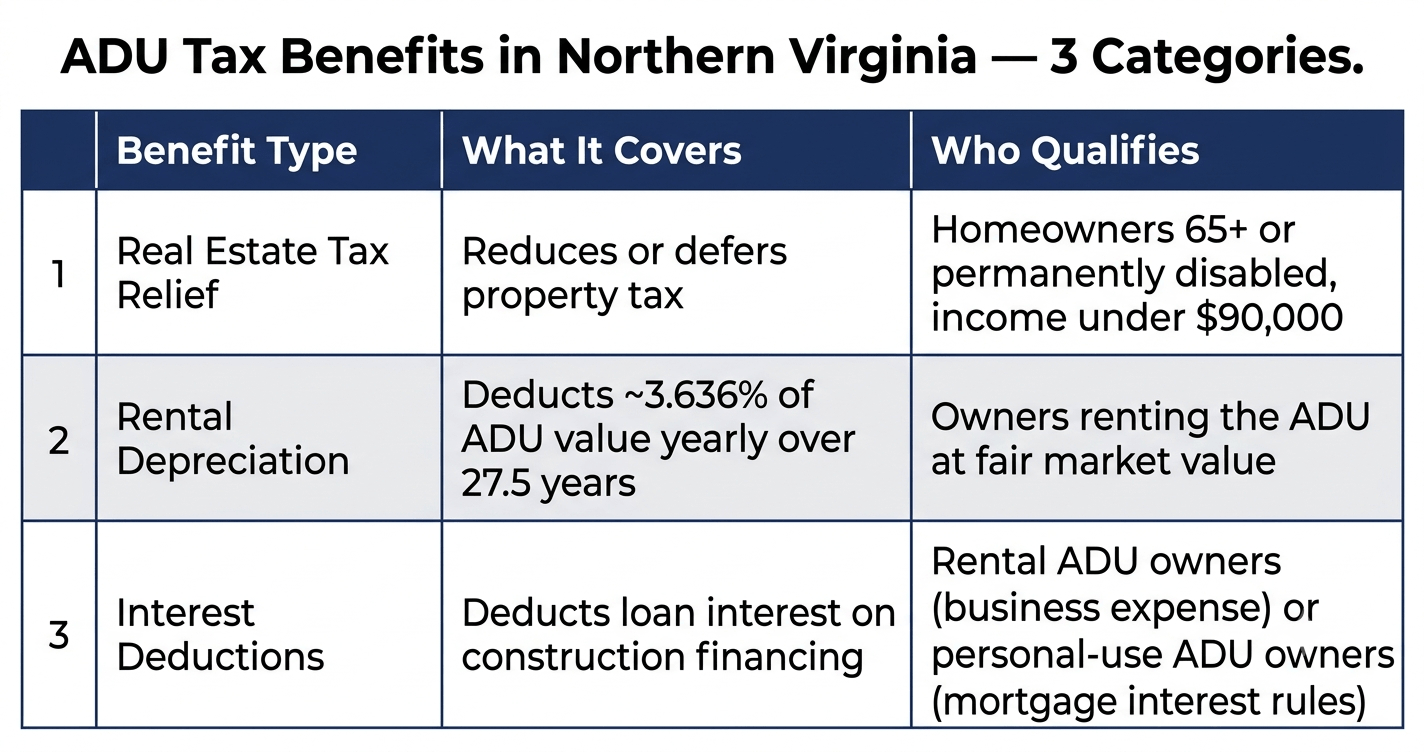
Which of the three actually applies to a given household depends almost entirely on how the ADU is used. A detached backyard cottage rented to a tenant at fair market value opens the door to full rental tax treatment: depreciation, deductible operating expenses, and potentially the passive loss allowance covered later in this guide. An in-law suite addition occupied by a family member rent-free is treated as personal-use space for tax purposes, which rules out depreciation but can still intersect with Fairfax County’s senior and disabled tax relief program if the resident qualifies.
Setting expectations correctly matters here: homeowners searching for Virginia ADU Law SB 531 already know the state gives them the by-right ability to build. That legal right doesn’t come bundled with a tax break, the benefit only shows up once the ADU is generating rental income, carrying deductible debt, or the household qualifies for an existing relief program on its own merits.
How Does ADU Rental Depreciation Work Under IRS Rules?
If a Northern Virginia homeowner rents out an ADU to a tenant, the IRS allows the structure, not the land beneath it, to be depreciated over 27.5 years under the Modified Accelerated Cost Recovery System (MACRS), per IRS Publication 527. That works out to roughly 3.636% of the depreciable basis deducted from taxable rental income every year.
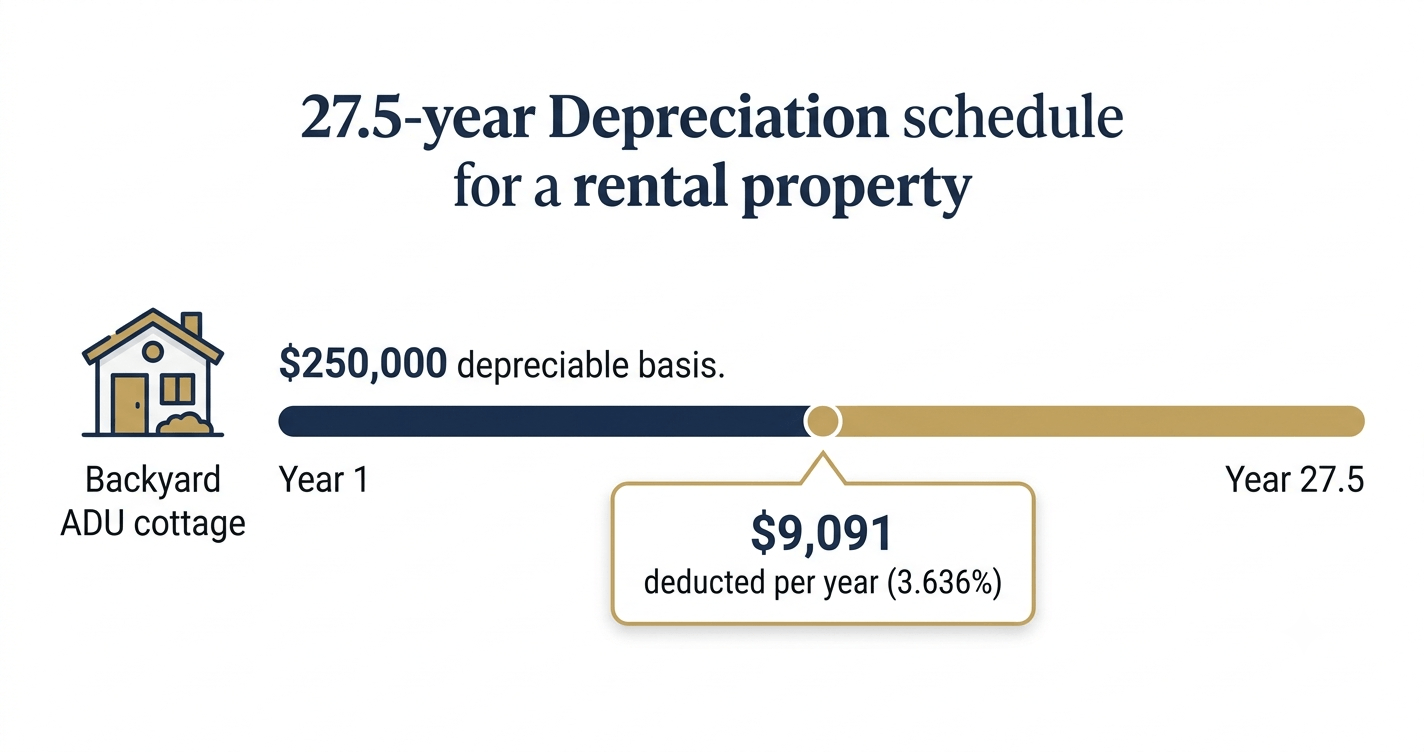
The depreciable basis is the ADU’s construction cost minus the portion of value attributable to land, since land itself never depreciates. For a detached ADU built at a cost in line with the ranges covered in our ADU Cost Northern Virginia 2026 Guide, a $250,000 depreciable basis produces an annual depreciation deduction of roughly $9,091 ($250,000 ÷ 27.5), taken every year the unit is in service and rented at fair market value.
Per IRS Publication 527, residential rental additions placed in service after an existing home was already being depreciated must begin their own 27.5-year schedule as of the date the ADU is placed in service, a new dwelling unit does not inherit the depreciation timeline of the primary residence. The IRS also applies a mid-month convention, treating the ADU as placed in service at the midpoint of whichever month it was ready to rent, which prorates the first year’s deduction accordingly.
One tradeoff worth flagging for trustworthiness: depreciation deductions taken over the years are recaptured at sale, taxed as unrecaptured Section 1250 gain at a rate of up to 25%. Depreciation is a deferral of tax, not a permanent elimination of it, a distinction a CPA should walk through before a homeowner treats the deduction as free money.
Can You Deduct Mortgage or Construction Loan Interest on an ADU?
Interest on a HELOC, FHA 203(k), or construction loan used to build an ADU is deductible differently depending on how the unit is used: as a fully deductible rental business expense if the ADU is rented, or subject to the standard home mortgage interest rules, including the $750,000 acquisition-debt cap, if the ADU is used personally, such as an in-law suite.
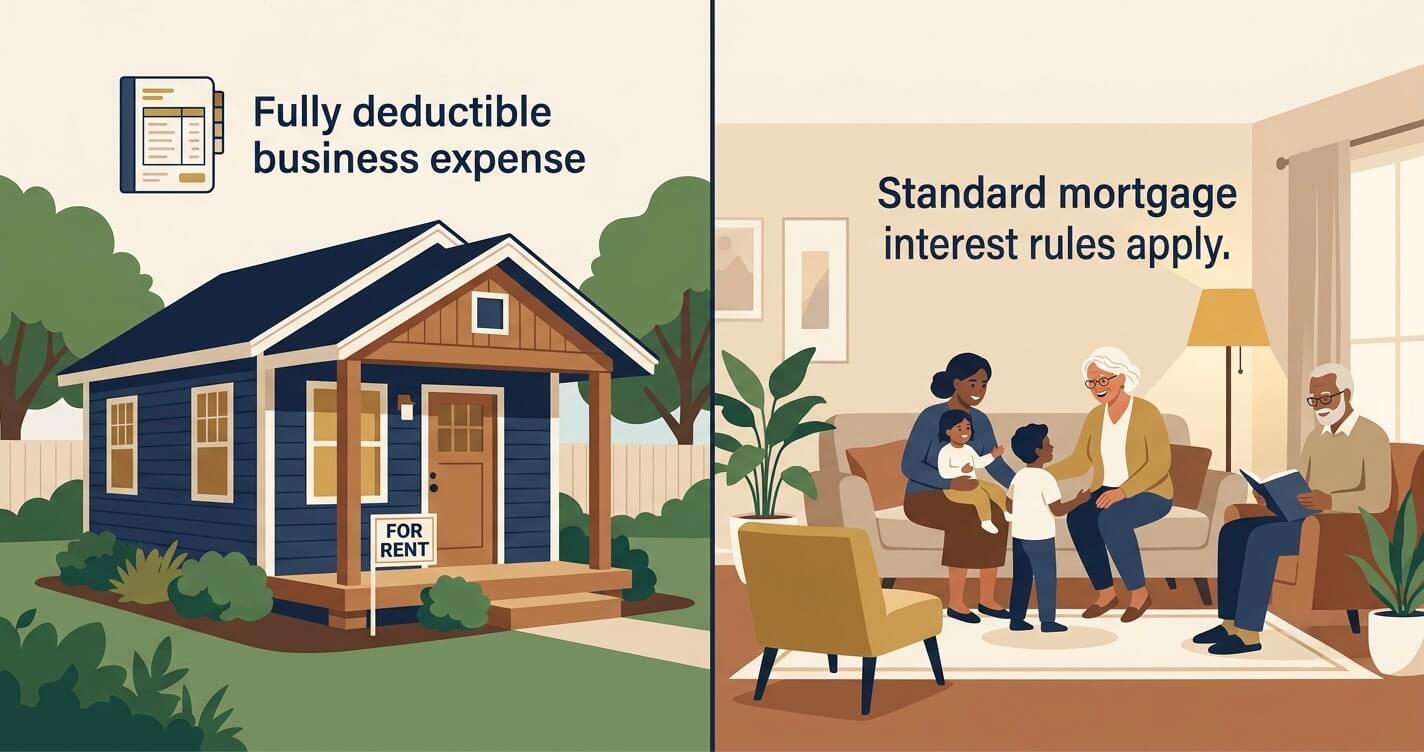
For a rented ADU, loan interest is netted against rental income on Schedule E along with depreciation, property tax allocated to the unit, insurance, and maintenance, the same treatment as any other residential rental property. For an owner-occupied ADU or ALU, the loan is treated as part of the primary residence’s acquisition or home-improvement debt, and interest deductibility follows the same federal mortgage interest rules that apply to the rest of the home.
The loan product chosen changes the paperwork, not just the process. Homeowners comparing options should read alongside our Home Remodeling Financing Northern Virginia: HELOC & Loans Guide and our FHA ADU Financing Northern Virginia guide, since an FHA 203(k) loan, a conventional construction loan, and a HELOC each carry different interest structures and mortgage insurance costs that affect the net deduction.
Homeowners weighing the tax tradeoffs of a rental ADU versus an in-law suite may find it useful to talk through the numbers with an experienced design-build team before finalizing the project scope.
What Is the $25,000 Passive Loss Allowance and Does It Apply to Your ADU?
Homeowners who actively participate in managing a rental ADU and have modified adjusted gross income (MAGI) of $100,000 or less can deduct up to $25,000 in rental losses, including depreciation, against ordinary income each year, per IRS Publication 925. The allowance phases out by 50% of MAGI above $100,000 and disappears entirely at $150,000 MAGI.
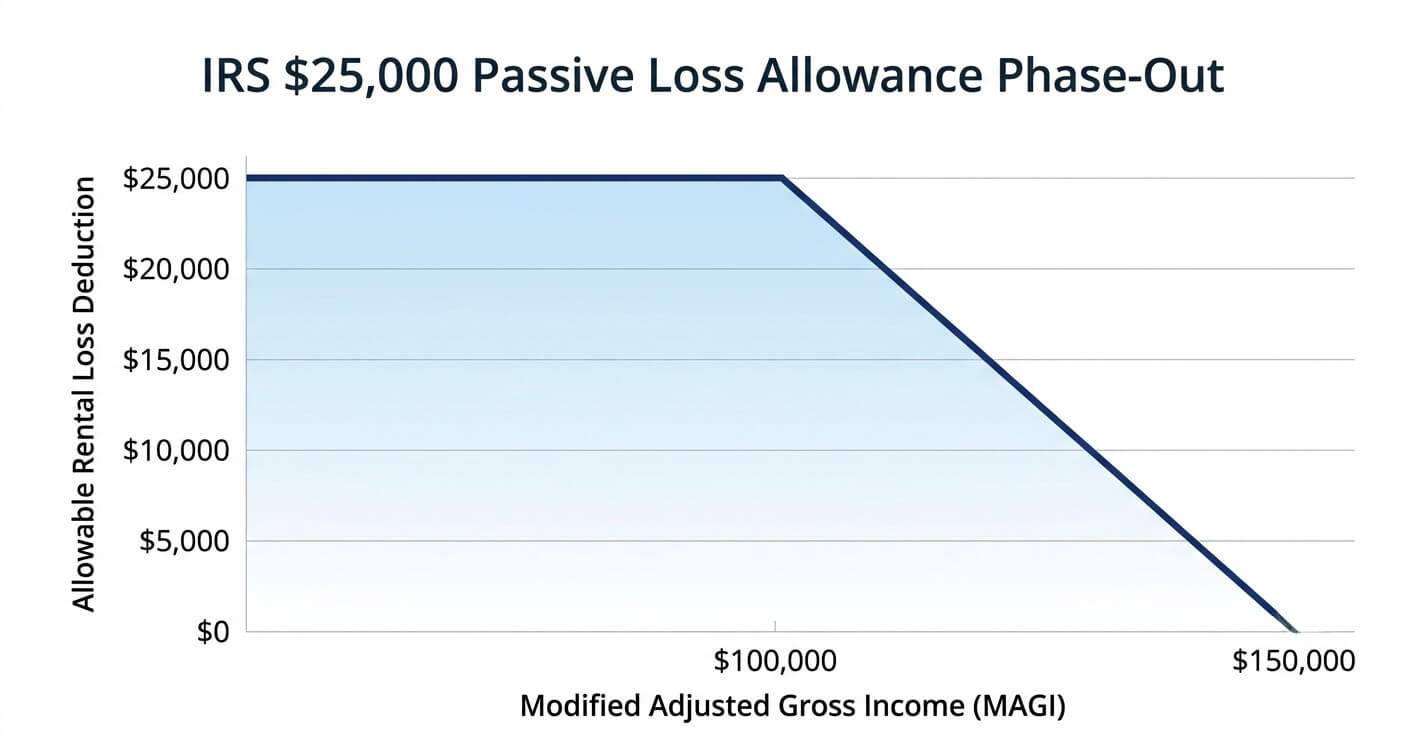
“Active participation” is a lower bar than the material participation standard the IRS uses for other rental real estate professionals, approving a tenant, setting the rent, and authorizing repairs is generally enough, even when a property manager handles day-to-day operations. Per IRS Publication 925, a taxpayer must also own at least 10% of the rental to qualify for the special allowance.
This is the section where Northern Virginia’s income levels matter more than almost anywhere else in the country. Fairfax County’s median household income runs well above the $150,000 MAGI ceiling for many dual-income households, which means a meaningful share of ADU-owning homeowners in McLean, Vienna, and Great Falls will see this allowance reduced or eliminated entirely. Losses that can’t be used in the current year aren’t lost, they carry forward to offset future rental income or gain on sale, but homeowners shouldn’t budget an ADU project around a $25,000 deduction without confirming their own MAGI falls under the threshold.
Does Building an ADU Increase Your Fairfax County Property Tax Bill?
Yes. Adding an ADU increases a home’s assessed value, and Fairfax County reassesses real property annually at 100% of fair market value, so the added square footage and utility work will raise the annual real estate tax bill at the county’s FY 2026 rate of $1.1225 per $100 of assessed value.
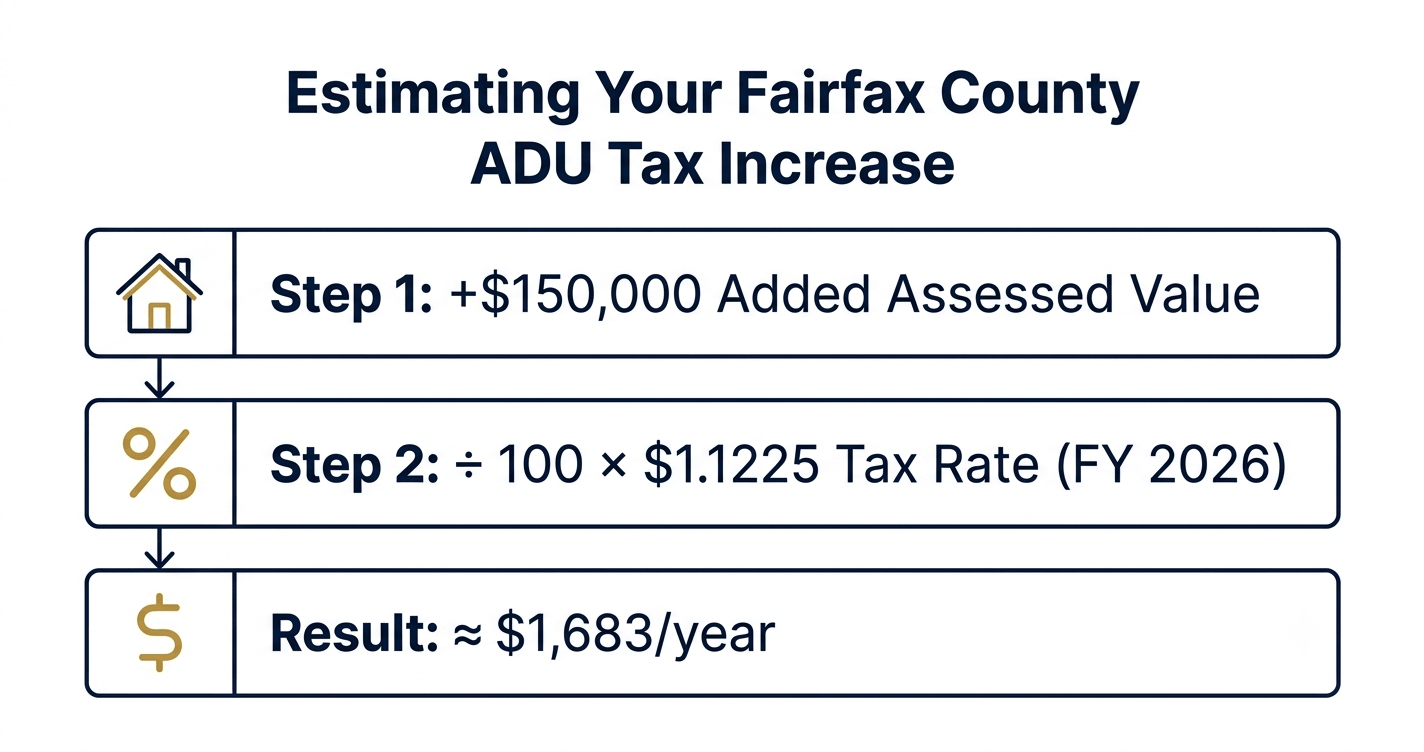
Fairfax County’s real estate tax rate for fiscal year 2026 is $1.1225 per $100 of assessed value, according to the Fairfax County Department of Tax Administration. Because the county reassesses every property annually at full fair market value rather than on a multi-year cycle, a permitted ADU typically shows up in the very next assessment cycle after the county issues a certificate of occupancy, not years later.
Estimating the impact is straightforward: take the ADU’s expected added assessed value, divide by 100, and multiply by the current rate. A detached ADU that adds $150,000 in assessed value in Fairfax County would add roughly $1,683 per year to the real estate tax bill at the FY 2026 rate ($150,000 ÷ 100 × $1.1225). This is the one line item in this guide that is a cost rather than a benefit, and it belongs in the budget from day one, not discovered on the following year’s tax bill.
Fairfax County Real Estate Tax Relief and In-Law ADUs
Fairfax County’s Real Estate Tax Relief Program can reduce or defer property taxes for homeowners who are 65 or older or permanently and totally disabled, with the income limit recently raised to $90,000 and the net worth limit to $400,000, relevant for families building an ADU or in-law suite so an aging parent can live on the property.

The Fairfax County Board of Supervisors expanded the Real Estate Tax Relief Program to raise the maximum gross income limit from $72,000 to $90,000 and the net worth limit from $340,000 to $400,000, while adding a new 75% relief bracket for households with combined income between $60,001 and $70,000, according to the Fairfax County News Center. The program also added a deferral option for households with income up to $100,000 and net worth up to $500,000, letting qualifying homeowners defer rather than eliminate their tax bill, subject to interest.
Per the Fairfax County Department of Tax Administration, relief applies up to 125% of the average assessed value of all properties in the county, with returning applicants required to file by May 1 each year. This program is tied to the qualifying resident’s age, disability status, income, and net worth, not to the presence of an ADU itself, so it matters most for families where the parent or relative moving into the unit is also on title or otherwise structured to benefit from the exemption. A project like the one documented in our ADU build case study in Reston illustrates how a detached unit gets scoped and built for exactly this kind of multigenerational arrangement.
ADU Tax Considerations by Jurisdiction: Fairfax, Arlington & Loudoun
Real estate tax rates vary meaningfully across Northern Virginia jurisdictions: Fairfax County’s FY 2026 rate is $1.1225 per $100 of assessed value, Arlington County’s 2026 rate is $1.053 per $100, and Loudoun County’s 2026 rate is $0.805 per $100, so an identical ADU’s tax impact differs by jurisdiction even before relief programs are considered.
All three counties assess real property at 100% of fair market value and reassess annually, but the rate differences compound over the life of an ADU. On a $150,000 assessed-value ADU, the added annual tax runs approximately $1,683 in Fairfax County, $1,580 in Arlington County, and $1,208 in Loudoun County, a meaningful gap for homeowners comparing where to build across county lines.
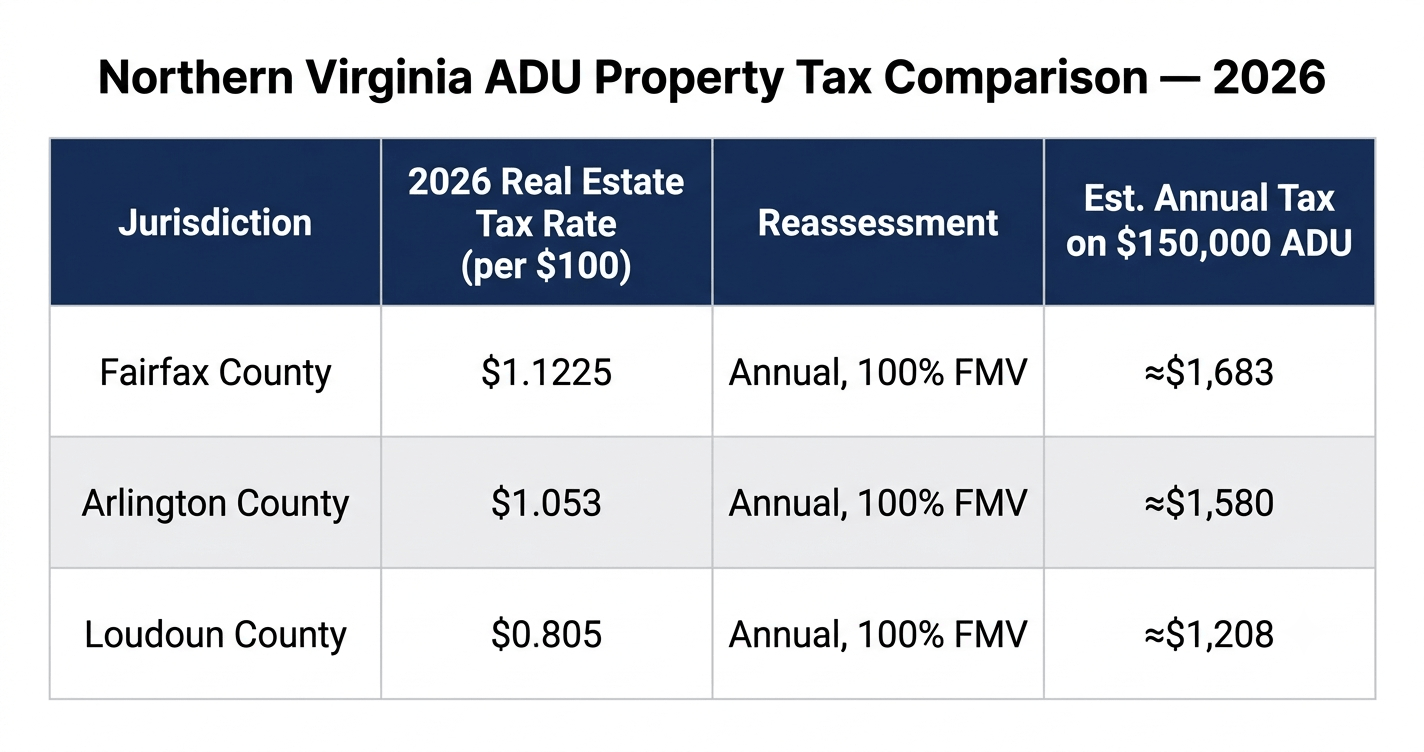
Arlington County’s 2026 real estate tax rate of $1.053 per $100 of assessed value reflects a 2-cent increase adopted as part of the county’s FY 2027 budget process, per the Arlington County Board. Loudoun County kept its real property tax rate unchanged at $0.805 per $100 of assessed value for tax year 2026, according to Loudoun County’s official budget page, making it the lowest of the three for homeowners weighing an ADU project near the Fairfax or Arlington county line.
Each jurisdiction also sets its own senior and disabled tax relief thresholds independently, so a household that qualifies for relief in Fairfax County under the $90,000 income limit should not assume the same limit applies if they own property in Arlington or Loudoun, those programs should be confirmed directly with each county’s Commissioner of the Revenue before budgeting.
Common ADU Tax Mistakes Northern Virginia Homeowners Make
The most common ADU tax mistakes are claiming depreciation on a space that isn’t actually rented at fair market value, forgetting that adding an ADU triggers a property tax reassessment, and assuming the $25,000 passive loss allowance applies without checking the household’s MAGI against the phase-out range.
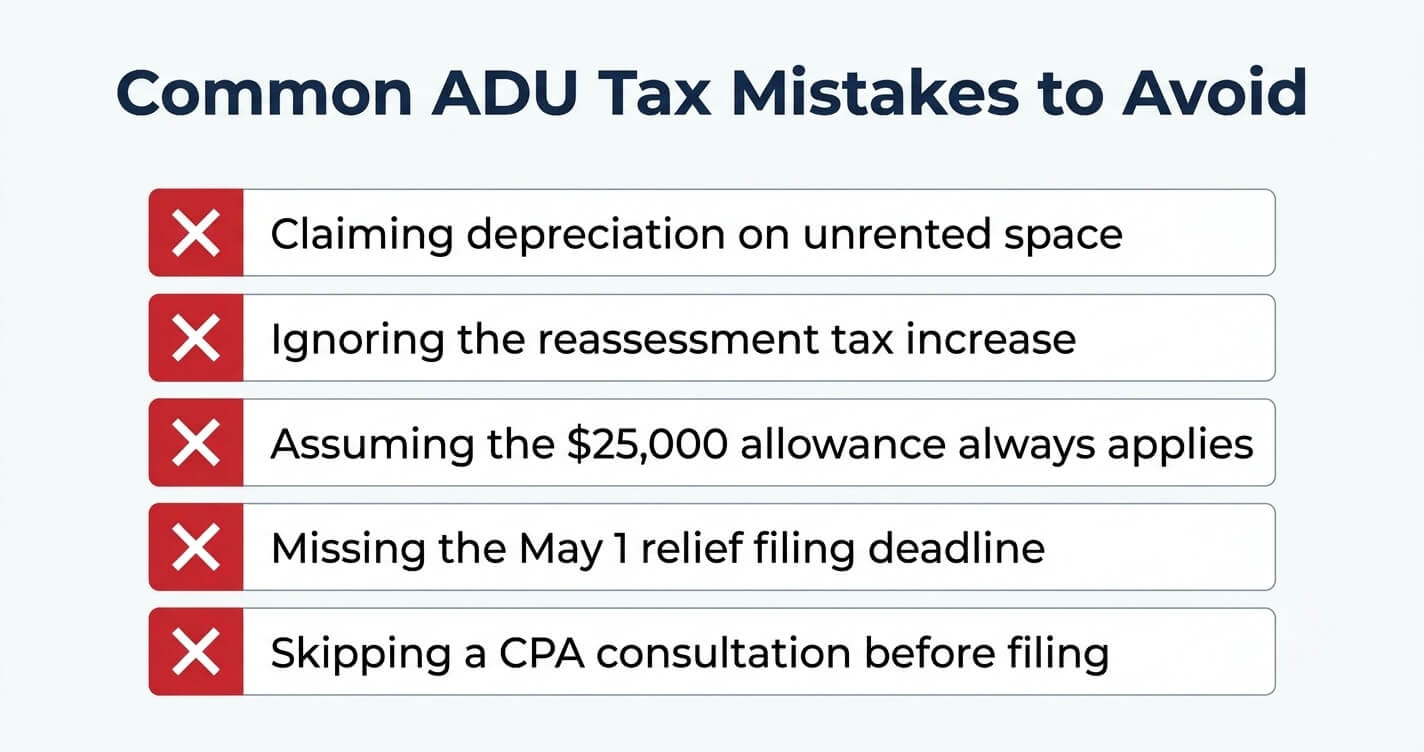
- Claiming rental depreciation on an ADU occupied by a family member rent-free or below fair market rent, the IRS treats below-market rentals to relatives differently, and depreciation generally does not apply the same way.
- Not budgeting for the reassessment-driven tax increase in the first year after the county issues a certificate of occupancy.
- Assuming the $25,000 passive loss allowance applies regardless of income, when many dual-income Northern Virginia households exceed the $150,000 MAGI phase-out ceiling.
- Missing the Fairfax County Real Estate Tax Relief Program’s May 1 filing deadline for otherwise-eligible senior or disabled household members.
- Treating this guide, or any general tax article, as a substitute for confirming specific numbers with a licensed CPA before filing, individual ownership structure, income, and how the ADU is used all change the outcome.
Frequently Asked Questions
Do I have to pay property tax on an ADU in Fairfax County?
Yes. An ADU adds assessed value to the property, and Fairfax County reassesses real estate annually at 100% of fair market value, so it will increase the homeowner’s real estate tax bill at the county’s current rate of $1.1225 per $100 of assessed value.
Can I depreciate an ADU I use as a rental?
Yes. A rented ADU’s structure can be depreciated over 27.5 years under IRS rules for residential rental property, though the land itself cannot be depreciated, per IRS Publication 527.
Is interest on an ADU construction loan tax deductible?
It depends on how the ADU is used. Interest on financing for a rented ADU is generally deductible as a rental business expense, while interest for an owner-occupied ADU falls under standard home mortgage interest deduction rules, subject to the $750,000 acquisition-debt cap.
Does Virginia offer a tax credit for building an ADU?
No. There is currently no dedicated Virginia or federal ADU tax credit; the available benefits come from existing depreciation, deduction, and local tax relief rules applied to ADUs rather than an ADU-specific incentive program.
Can building an ADU for an aging parent reduce my property taxes?
Not directly, but if the parent qualifies for Fairfax County’s Real Estate Tax Relief Program based on age, disability, income, and net worth, the household’s overall tax situation may improve depending on how the property is titled.
What is the $25,000 rental loss deduction and does it apply to ADU owners?
It is an IRS allowance letting active participants in a rental activity deduct up to $25,000 in losses against ordinary income when MAGI is $100,000 or below, phasing out completely at $150,000 MAGI, per IRS Publication 925, so many higher-income Northern Virginia households will see it reduced or eliminated.
Is the ADU tax rate the same in Fairfax, Arlington, and Loudoun County?
No. Fairfax County’s 2026 rate is $1.1225 per $100 of assessed value, Arlington County’s is $1.053, and Loudoun County’s is $0.805, so an identical ADU’s annual property tax impact differs across the three jurisdictions.
Should I talk to a CPA before claiming ADU tax benefits?
Yes. Tax outcomes depend on individual income, ownership structure, and how the ADU is used, so a licensed tax professional should confirm specific figures before filing.
Final Thoughts
ADU tax benefits Northern Virginia homeowners can put to work in 2026 come down to three moving parts: whether the unit is rented or owner-occupied, which jurisdiction it sits in, and whether the household’s income and circumstances line up with an existing relief program or deduction. None of these benefits change the legal right to build established under Virginia’s ADU law, and none of them replace a realistic construction budget, they simply determine how much of the project’s cost the tax code eventually offsets. With experience guiding Northern Virginia homeowners through ADU design, permitting, and construction across Fairfax County, Arlington, McLean, Vienna, Reston, Great Falls, and Burke, our team can help you think through how a project fits your budget before a CPA finalizes the tax side.

Planning an ADU in Fairfax County, Arlington, or elsewhere in Northern Virginia? Contact US Home Design Build to discuss your project, budget, and how it fits your long-term tax and financing picture.
Explore related guides: ADU Builder Northern Virginia | ADU Cost Northern Virginia 2026 Guide | ADU Rental Income Northern Virginia
Disclaimer: This article provides general information for educational purposes and is not tax, legal, or financial advice. Tax outcomes vary by individual circumstances; consult a licensed CPA or tax attorney before making decisions based on this content.