
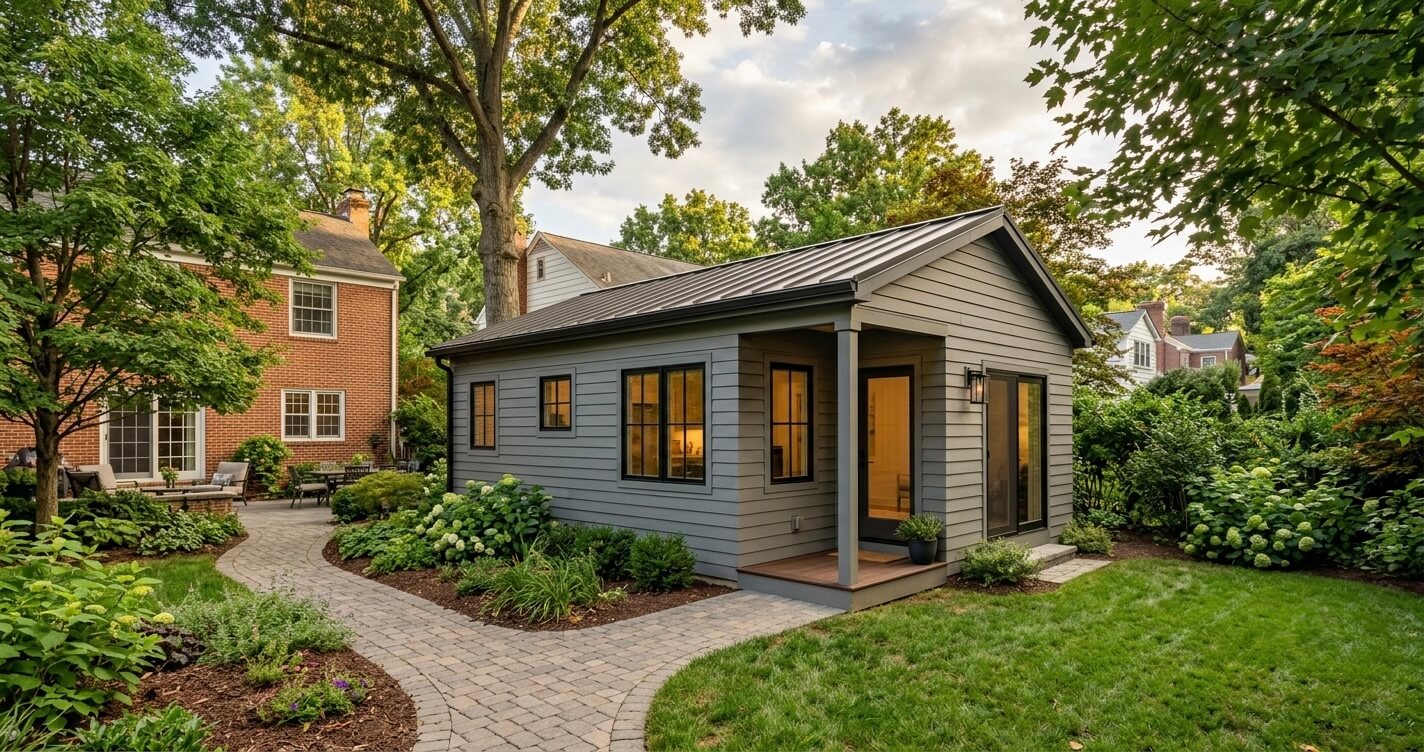
An ADU permit Arlington VA application involves two separate approvals: an Accessory Dwelling (AD) Permit from the Arlington County Zoning Division, and a Residential Building Permit from Inspection Services. Arlington’s official term for these secondary living spaces is “Accessory Dwelling” (AD), while “ADU” remains the phrase most homeowners search for nationally, this guide uses both interchangeably so the terminology never gets in the way of the process.
This guide walks through eligibility, zoning and size limits, the exact application sequence, a realistic timeline from application to move-in, permit costs, and the mistakes that most often stall an Arlington ADU project. US Home Design Build has guided homeowners throughout Arlington, McLean, Vienna, Falls Church, and the wider Northern Virginia region through the zoning and permitting process for accessory living spaces, including our ADU Builder Northern Virginia service, and this guide reflects the process our design-build team works through on every Arlington accessory dwelling project.
What Is an ADU (Accessory Dwelling) in Arlington County, VA?
An Accessory Dwelling (AD) in Arlington County is a complete, independent living unit with its own kitchen and bathroom, located on a lot that already has a single-family detached home. It must share the same owner as the main house, and Arlington permits only one AD per lot.
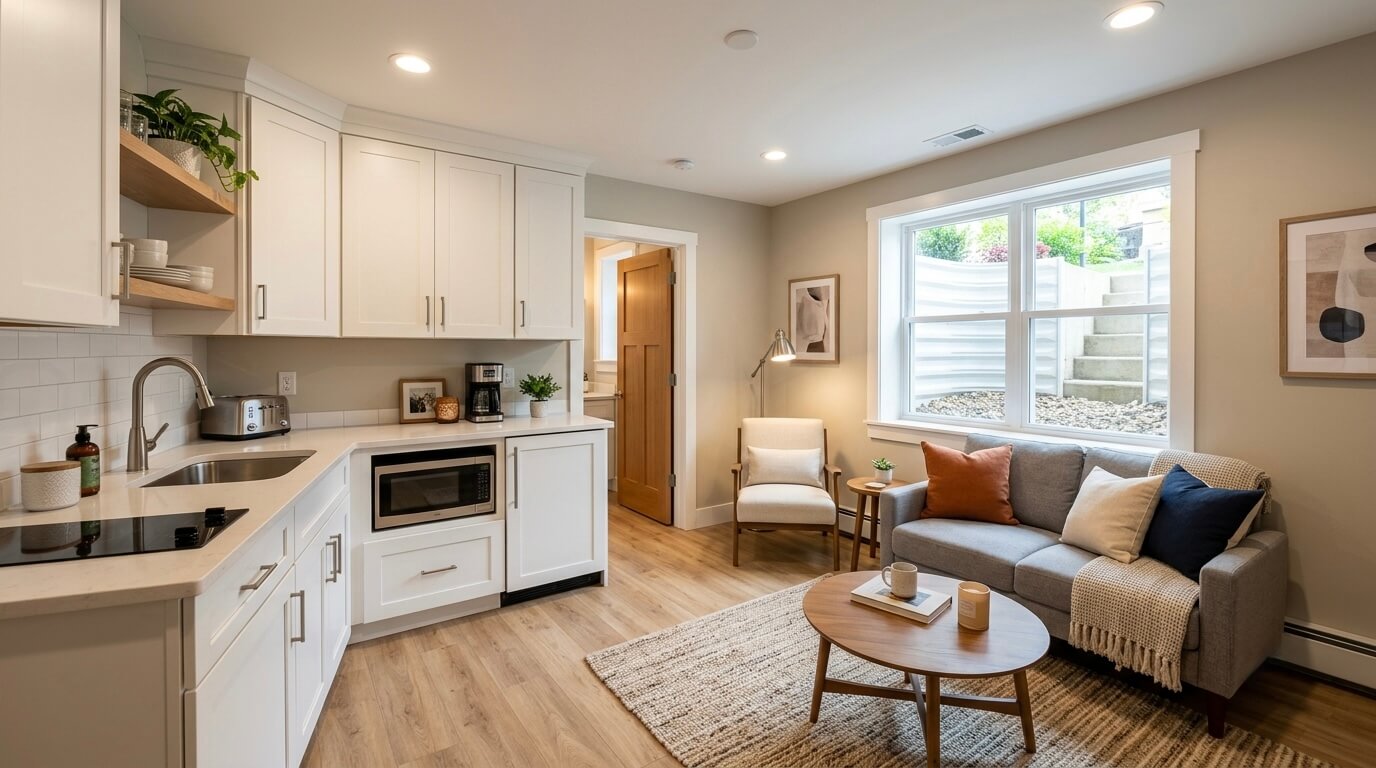
Arlington’s Zoning Ordinance (§12.9.2) allows an AD to take two forms: built within a detached accessory building, such as a garage, or built within or attached to the main dwelling, such as a basement apartment or a small addition. Eligible properties must sit in one of the following zoning districts: R-20, R-10, R-8, R-6, R-5, R-10T, R-15-30T, or R-2-7, and must already be improved with, or planned for, a one-family detached dwelling. A lot cannot already contain an AD or a family/caregiver suite, and the applicant must be the property owner.
Homeowners weighing an AD against a larger structural project should also review our In-Law Suite Addition service page, which covers attached suite layouts that fall outside Arlington’s AD size caps.
Do You Need a Permit for an ADU in Arlington VA?
Yes. Every accessory dwelling in Arlington County requires two separate permits: an AD Permit from the Zoning Division confirming the unit meets eligibility and design standards, and a Residential Building Permit from Inspection Services covering the actual construction. The Building Permit cannot be issued until the AD Permit is approved.
Because eligibility depends on lot zoning, existing floor area, and parking conditions, Arlington strongly recommends a pre-submission meeting with the Zoning Division before drawing up plans. This consultation also previews the related requirements of the Virginia Uniform Statewide Building Code that Inspection Services will apply once the Building Permit stage begins.
Homeowners can reach the Zoning Division directly at zoningadmin@arlingtonva.us or 703-228-3883 to schedule this review before submitting an application.
Arlington ADU Zoning Rules & Size Limits
An Arlington ADU cannot exceed 35% of the combined floor area of the main dwelling and the ADU, up to a maximum of 750 square feet, when the main home is at least 1,000 square feet. If the main home is smaller than 1,000 square feet, the cap rises to 45% of combined floor area, up to 500 square feet. Detached AD structures are additionally capped at 560–650 square feet of footprint depending on zoning district.
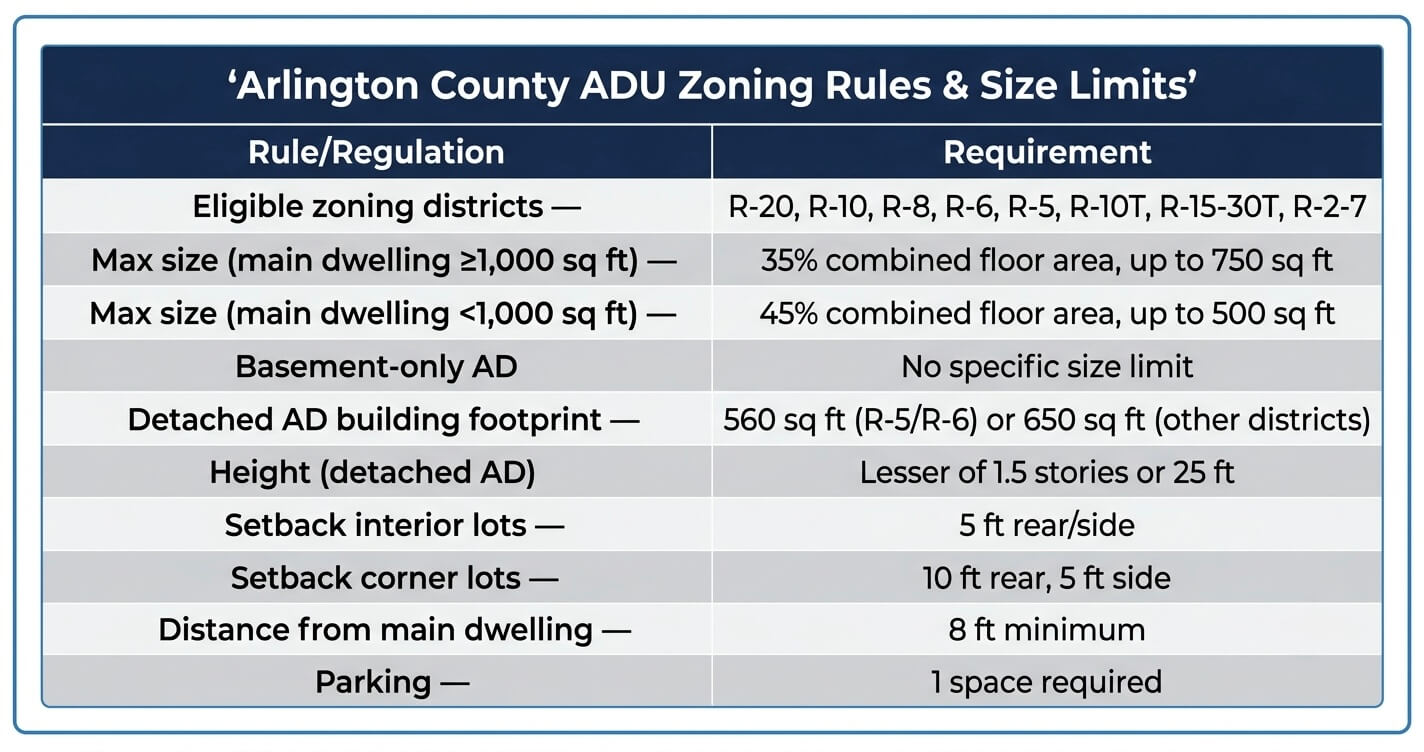
Basement-only ADs are treated differently: because they are bound by the existing perimeter walls of the basement, Arlington does not apply a specific size limit to them. Every other size calculation uses “gross floor area” as defined in §3.1.1 of the Zoning Ordinance, which counts all horizontal surfaces across a building’s floors, including attic and basement space.
Step-by-Step: The Arlington ADU Permit Application Process
The Arlington ADU permit process runs through six stages: an eligibility consultation, the AD Permit application through Permit Arlington, Zoning Division review, recording the Declaration of Covenants, the Residential Building Permit application, and a final Certificate of Occupancy after inspection.
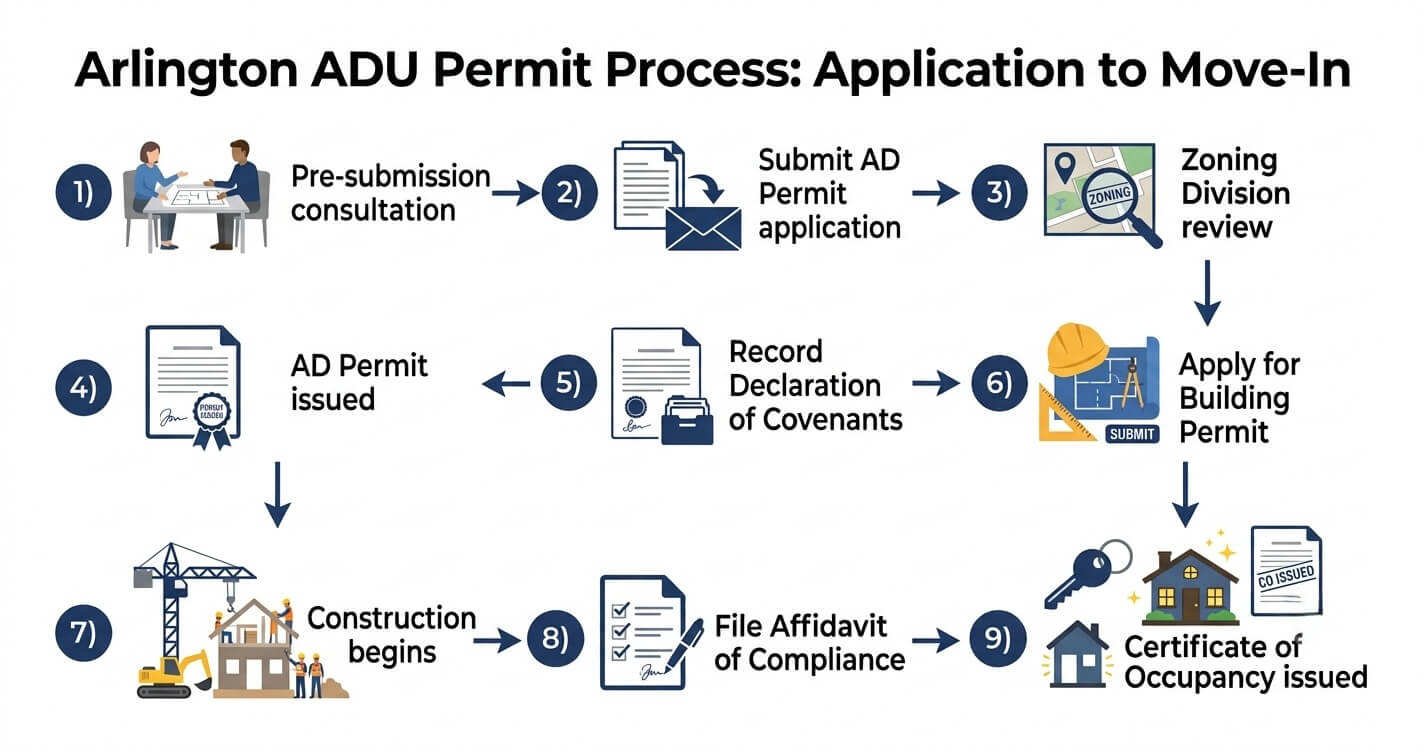
1. Schedule a pre-submission eligibility consultation with the Zoning Division to confirm the lot and proposed AD meet minimum requirements.
2. Submit the AD Permit application online through Permit Arlington (aca-prod.accela.com/ARLINGTONCO), selecting “Zoning Application.”
3. Submit required materials: the Acknowledgement and Agreement to Comply with the Conditions of an Accessory Dwelling, a Declaration of Covenants, an Affidavit of Compliance, floor plans for both the main and accessory dwelling, and a certified plat, along with the filing fee.
4. Zoning Division staff complete a preliminary review, followed by review from the Zoning Administrator, who signs and issues the AD Permit if no issues are identified.
5. Record the signed Declaration of Covenants with the Land Records Division of the Circuit Court of Arlington/Falls Church (1425 N. Courthouse Rd., Suite 6200), proof of recording must be submitted before a Building Permit can be issued.
6. Apply for the Residential Building Permit (and associated trade permits: electrical, mechanical, plumbing) through Inspection Services. Arlington recommends submitting the AD Permit application at least two weeks before the Building Permit application.
7. Once the Building Permit is issued, construction can begin. Schedule required inspections as work progresses.
8. Before the project can be occupied, file the Affidavit of Compliance with the Zoning Administrator.
9. After inspections and the Affidavit of Compliance are accepted, the Chief Building Official and Zoning Administrator jointly issue the Certificate of Occupancy, the AD is now legally ready for occupancy.
Because this sequence spans two county divisions and a court recording step, many homeowners coordinate the process through a design-build team. Our Design-Build Northern Virginia: 2026 Complete Guide explains how single-team coordination reduces the back-and-forth between zoning, construction, and inspection stages.
Homeowners considering an ADU permit Arlington VA application may benefit from discussing zoning eligibility, design options, and realistic sequencing with an experienced design-build team before finalizing plans.
ADU Permit Arlington VA Timeline: What to Expect
Arlington’s Zoning Division allows approximately 30 days to process an AD Permit once an application is accepted as complete. Once design work, the Residential Building Permit review, construction, and final inspections are added, most Arlington ADU projects run roughly 6 to 12 months from application to move-in.
According to Arlington County’s Department of Community Planning, Housing and Development, homeowners should allow approximately thirty (30) days to process an AD Permit after the Zoning Division accepts the application as complete, a timeline confirmed on the county’s official Accessory Dwelling Permit page. That 30-day window covers zoning review only; the separate Residential Building Permit review, construction period, and final inspections typically add several additional months before a Certificate of Occupancy is issued.
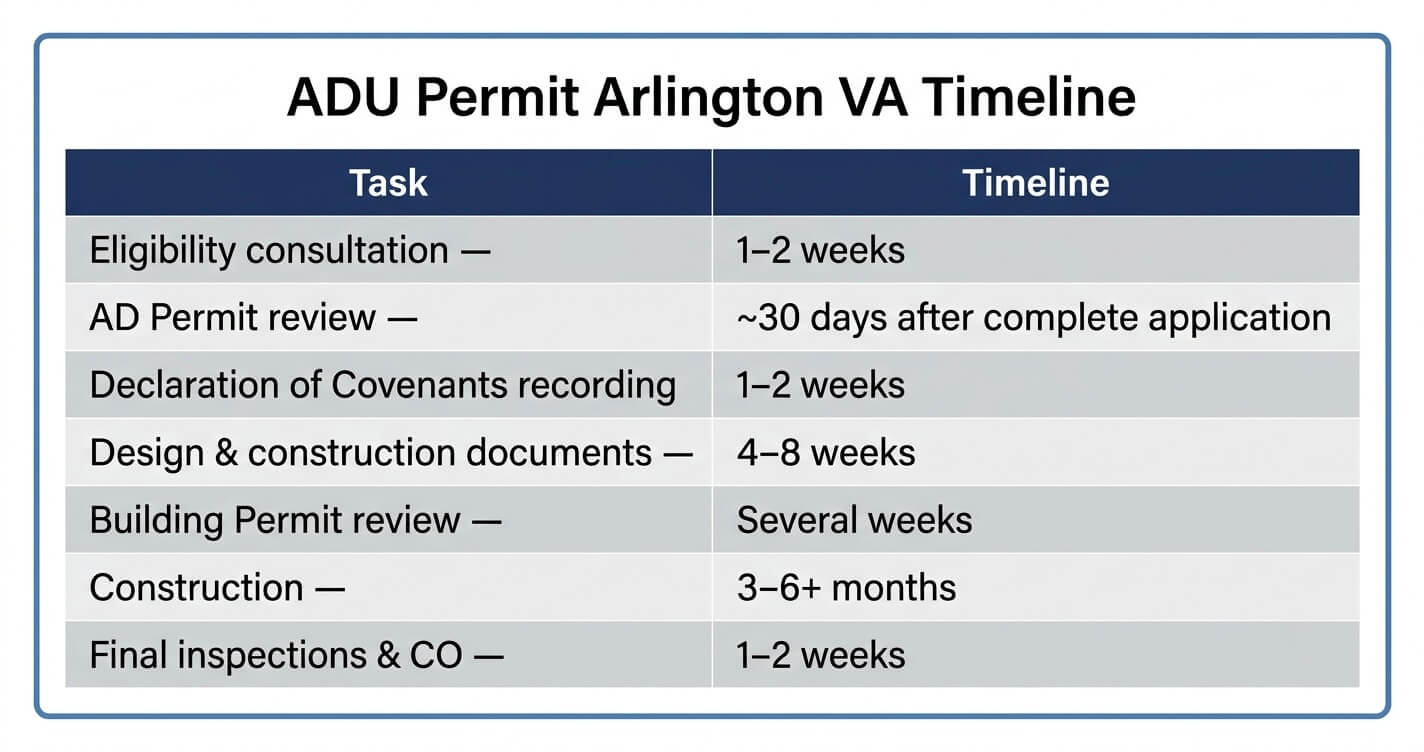
For comparison, Fairfax County’s administrative ALU permits are typically approved within about two weeks, though the full project timeline including design and construction runs several months longer, a process detailed in our ADU Permit Fairfax County VA: 7 Rules You Can’t Ignore guide.
Arlington ADU Permit Costs & Fees
Arlington ADU permit costs include a separate AD Permit filing fee from the Zoning Division plus Residential Building Permit and trade permit fees from Inspection Services. Total permit-related costs, excluding construction, typically fall in the low thousands of dollars depending on project scope and whether a parking study is required.

Arlington publishes separate fee schedules for the Inspection Services Division, the Zoning Division, and the Department of Environmental Services, since an AD project can touch fees from more than one schedule. Homeowners can view current fee schedules and pay online through the Permit Arlington customer portal.
Virginia’s Senate Bill 531, signed April 13, 2026, caps ADU permit fees at $500 for localities newly required to allow accessory dwelling units, but the law carries a delayed effective date of July 1, 2027 and includes an exemption for jurisdictions that already had an ADU ordinance in place. Because Arlington County already regulates Accessory Dwellings under its own zoning ordinance, its existing AD Permit fee structure is not automatically subject to SB 531’s $500 fee cap.
Homeowners budgeting the full project, not just the permit fees, may also want to review ADU Tax Benefits Northern Virginia and FHA ADU Financing Northern Virginia for financing options that apply across Northern Virginia jurisdictions, including Arlington.
Arlington vs. Fairfax County ADU Rules: Key Differences
Arlington regulates accessory dwellings as “Accessory Dwellings (ADs)” under a single AD Permit plus Building Permit process that includes a required Declaration of Covenants recording. Fairfax County uses “Accessory Living Units (ALUs)” with a two-tier system: an administrative permit for interior units and a special permit with a Board of Zoning Appeals hearing for detached units.
The two jurisdictions share the same underlying goal, allowing a secondary living space while keeping it clearly subordinate to the primary residence, but the mechanics differ enough that a contractor experienced in one county’s process should not assume it transfers directly to the other.
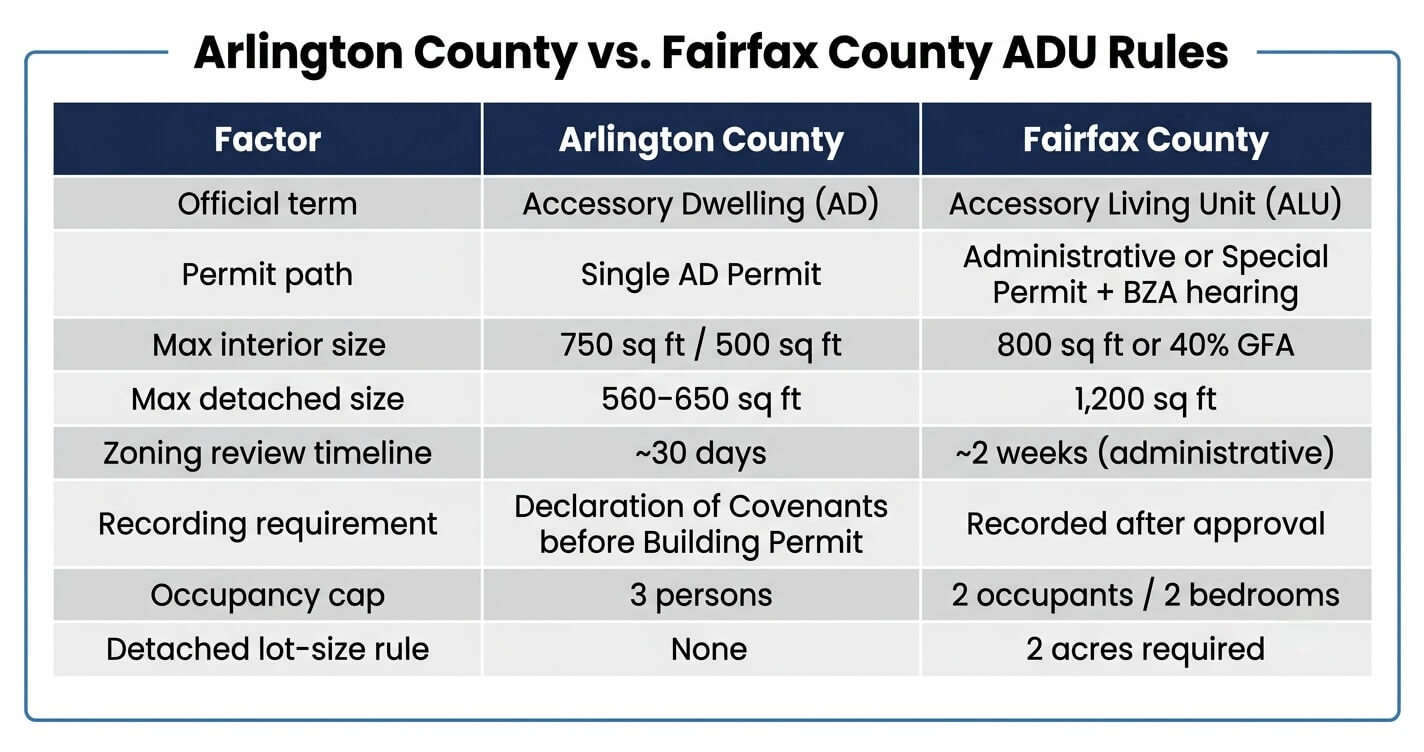
Homeowners near the Arlington–Fairfax line, or comparing options across Northern Virginia, can review the full Fairfax process in Accessory Living Unit Fairfax County VA: Rules, Permits & 2026 Updates Guide and Virginia ADU Law SB 531 Explained for how the new statewide law interacts with each county’s existing ordinance.
Common Mistakes That Delay an Arlington ADU Permit
The most common causes of Arlington ADU permit delays are skipping the pre-submission eligibility consultation, starting construction before the Building Permit is issued, and failing to record the Declaration of Covenants before applying for the Building Permit.
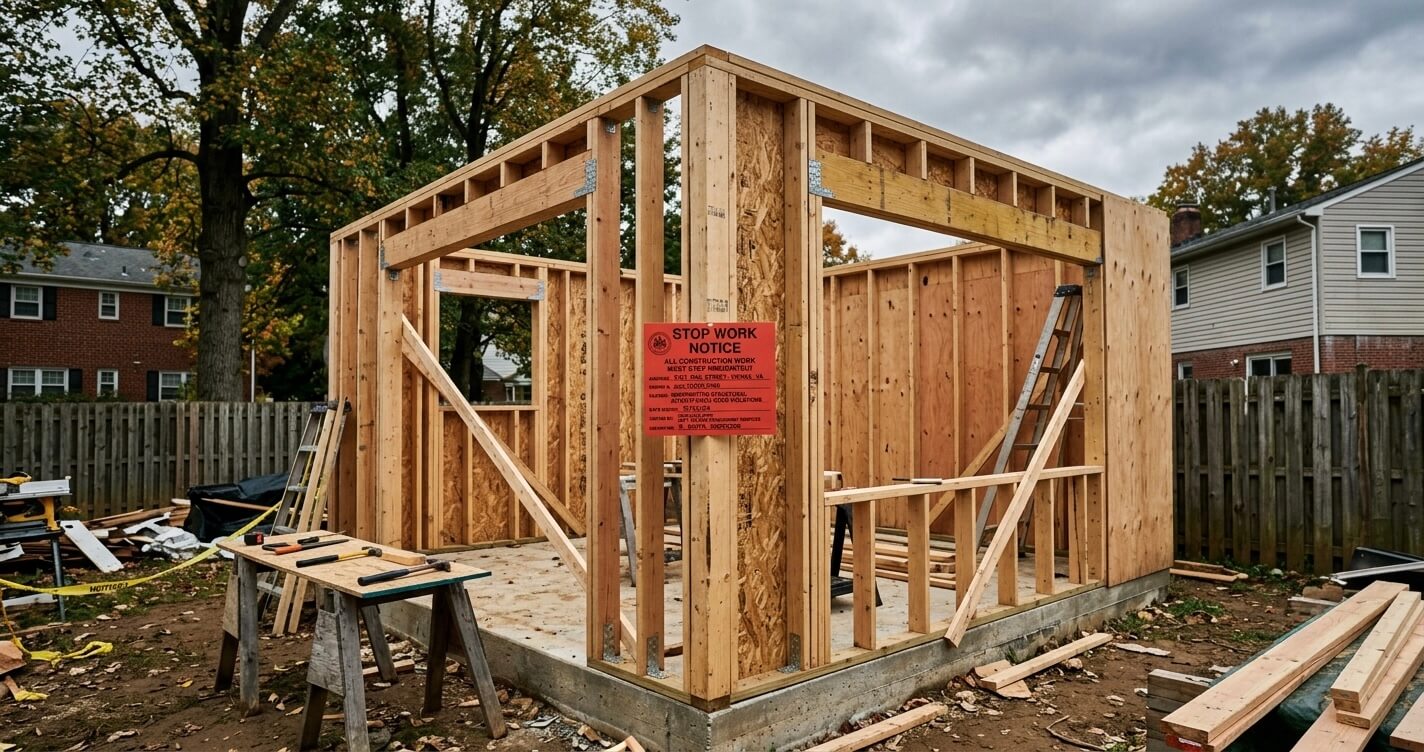
- Skipping the Zoning Division pre-submission meeting, which is the fastest way to catch an eligibility problem before paying for design work.
- Assuming the AD Permit and the Residential Building Permit are the same approval, they are sequential, and construction cannot legally begin until both are issued.
- Delaying the Declaration of Covenants recording, which pushes back Building Permit issuance since proof of recording is a prerequisite.
- Underestimating parking requirements on blocks where on-street parking utilization is high enough to trigger the county’s parking study threshold.
- Assuming HOA approval satisfies County requirements, the two are entirely separate review processes.
- Designing a detached AD that violates the 8-foot minimum distance from the main dwelling or the 25-foot street-facing setback.
- Filing the Affidavit of Compliance late, which delays the Certificate of Occupancy even after construction and inspections are complete.
Homeowners comparing pitfalls across jurisdictions can also read ADU Mistakes Fairfax County VA: What Homeowners Need to Know Before Construction for a parallel look at how similar missteps play out under Fairfax County’s ALU process.
From Permit Approval to Move-In Day: Construction, Inspections & Certificate of Occupancy
After the Building Permit is issued, construction can begin immediately, but the ADU cannot be legally occupied until Inspection Services and the Zoning Division complete final inspections, the homeowner files an Affidavit of Compliance, and the county issues a Certificate of Occupancy.
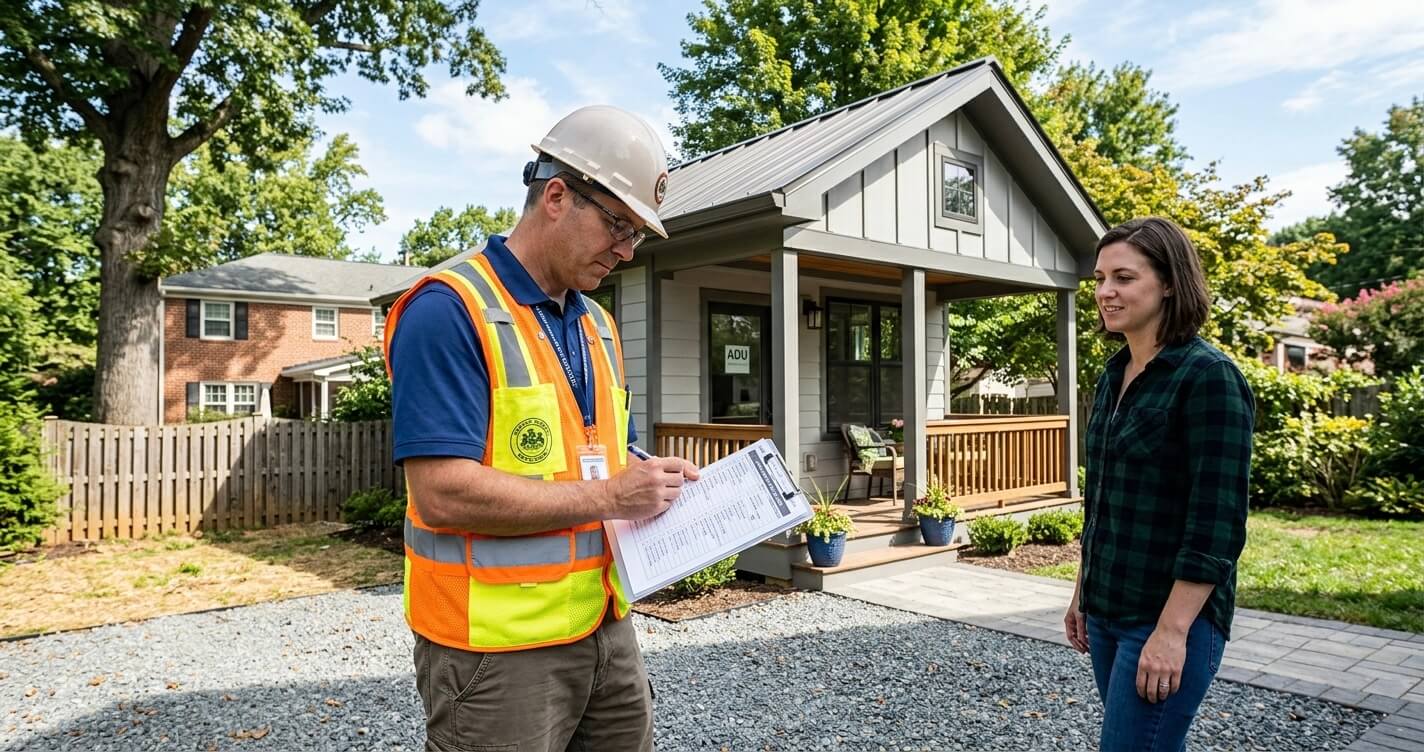
Once permits are approved, Zoning Division and Inspection Services staff conduct inspections tied to each construction milestone, from framing through final utility connections. Arlington’s Zoning Administrator also reserves the right to conduct an annual inspection of the AD after occupancy to confirm ongoing compliance with §12.9.2 of the Zoning Ordinance, and the Affidavit of Compliance must be re-filed if the AD is structurally altered or if ownership of the main dwelling changes.
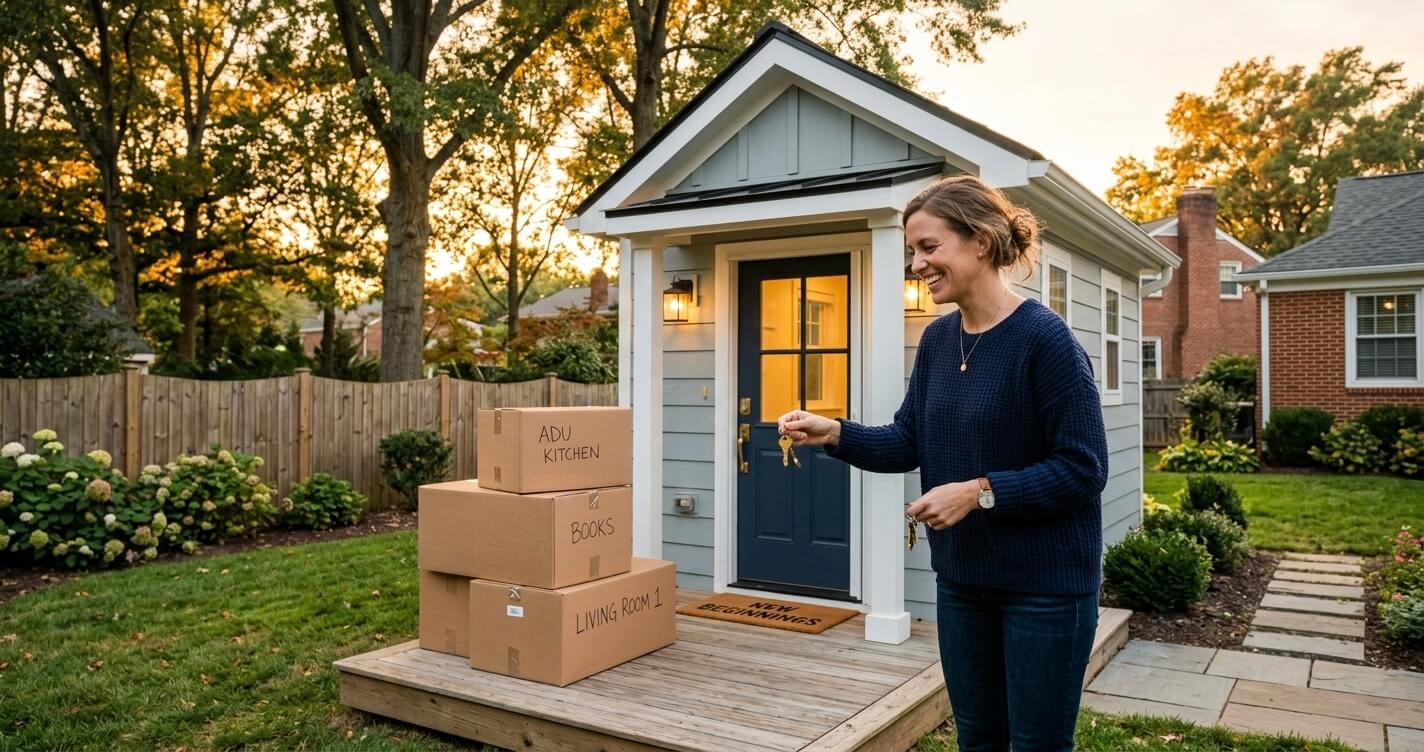
Move-in day, in practical terms, is the day the Certificate of Occupancy is issued, not the day construction finishes. Homeowners who build in the Affidavit of Compliance and inspection scheduling as planned steps, rather than last-minute paperwork, avoid the most common final-stage delays.
Frequently Asked Questions
Do I need a permit for an ADU in Arlington VA?
Yes. Every accessory dwelling in Arlington requires an AD Permit from the Zoning Division and a separate Residential Building Permit from Inspection Services; the Building Permit cannot be issued until the AD Permit is approved and the Declaration of Covenants is recorded.
How long does the ADU permit Arlington VA process take?
Zoning review alone takes about 30 days once an application is accepted as complete. Factoring in design, the Building Permit review, construction, and final inspections, most Arlington ADU projects run 6 to 12 months from application to move-in.
How much does an ADU permit cost in Arlington County?
Permit-related costs combine a Zoning Division AD Permit filing fee with Inspection Services Building Permit and trade permit fees, typically totaling in the low thousands of dollars before construction costs. Current fee schedules are published on Arlington County’s Fee Schedules page.
What size ADU is allowed on my Arlington property?
An AD generally cannot exceed 35% of the combined floor area of the main home and the AD, up to 750 square feet, when the main home is 1,000 square feet or larger. Smaller main homes allow up to 45% combined floor area, capped at 500 square feet, and basement-only ADs are not subject to a specific size limit.
Can I rent my Arlington ADU to someone who isn’t a family member?
Yes. Arlington does not require a family relationship between AD and primary dwelling occupants, though the property owner must occupy either the main dwelling or the AD as a primary residence, and total occupancy is capped at three persons.
What’s the difference between Arlington’s ADU rules and Fairfax County’s ALU rules?
Arlington uses a single AD Permit process with a required Declaration of Covenants recording, while Fairfax County splits its ALU process into an administrative permit for interior units and a special permit with a public hearing for detached units. Size caps, terminology, and occupancy limits also differ between the two counties.
Do I need a separate building permit after my AD Permit is approved?
Yes. The AD Permit only confirms zoning eligibility. A Residential Building Permit, along with associated trade permits for electrical, mechanical, and plumbing work, must be issued separately by Inspection Services before construction can begin.
Crux of the Matter
An ADU permit Arlington VA application is really two coordinated approvals, zoning eligibility and construction authorization, tied together by a Declaration of Covenants that has to be recorded at the right moment in the sequence. Homeowners who start with a pre-submission consultation, budget realistic timelines of 6 to 12 months, and treat the Building Permit and Certificate of Occupancy stages as distinct milestones tend to avoid the delays that catch other Arlington ADU projects off guard.
Planning an ADU in Arlington VA? Contact US Home Design Build to discuss zoning eligibility, design options, and a realistic budget and timeline for your accessory dwelling with our team.