

Home renovation financing Northern Virginia homeowners can use in 2026 comes down to four realistic options: a home equity line of credit (HELOC), a fixed-rate home equity loan, a RenoFi after-renovation-value loan, or cash. For most Fairfax County homeowners who have built equity, a HELOC or home equity loan is the practical default. A RenoFi loan fits when a project costs more than today’s equity supports. A cash-out refinance rarely makes sense while 30-year mortgage rates sit near 7%.
The average adjustable-rate HELOC was 7.54% on November 3, 2026, up from an October low of 7.09%, according to Curinos data reported by Yahoo Finance. The average fixed-rate home equity loan was 7.50%. Those averages describe borrowers with credit scores of 780 or higher and combined loan-to-value ratios below 70%, so many homeowners will see different offers.
Our design-build team at US Home Design Build, based in McLean, works with homeowners across Fairfax County, Vienna, Reston, Great Falls and Burke. The financing question almost always arrives before the design is final. This guide explains what each loan costs, how each one pays a contractor, and which one fits a given project size. Homeowners planning a full scope can also review our home renovation services in Northern Virginia.
What Is the Best Way to Finance a Home Renovation in Northern Virginia?
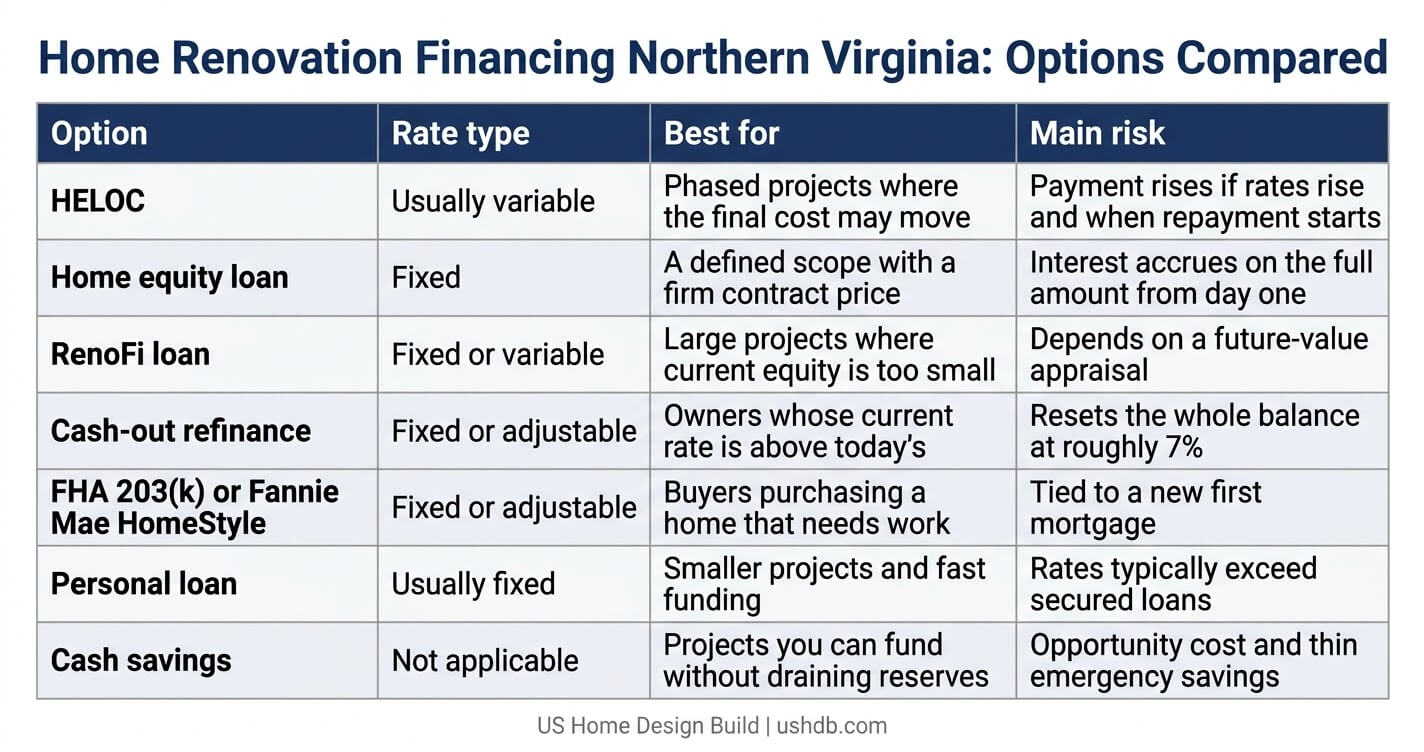
The best home renovation financing Northern Virginia homeowners can choose is usually a HELOC or fixed-rate home equity loan, because either one leaves a low-rate first mortgage untouched. A RenoFi loan can raise the borrowing limit on a large project. A cash-out refinance usually costs more at current rates.
Table 1 compares the seven options Northern Virginia homeowners most often weigh. The right choice depends on three numbers: how much equity you have, what rate your first mortgage carries, and how firm your project price is.
Rebates shrink the amount you need to borrow, so subtract them before you size a loan. Our guide to home energy rebates in Northern Virginia for 2026 explains which incentives homeowners can still use this year.
What Are HELOC Rates in Northern Virginia Right Now?
HELOC rates average roughly 7.4% to 8.1% nationally in early November 2026, depending on the survey. No public data series tracks Northern Virginia alone, so local offers follow national averages and then adjust for your credit score, loan-to-value ratio and lender. Always check each survey’s method before comparing two numbers.
Home renovation financing Northern Virginia lenders offer is priced off the same national indexes as everywhere else. Table 2 gathers the most recent published averages and shows why they differ.
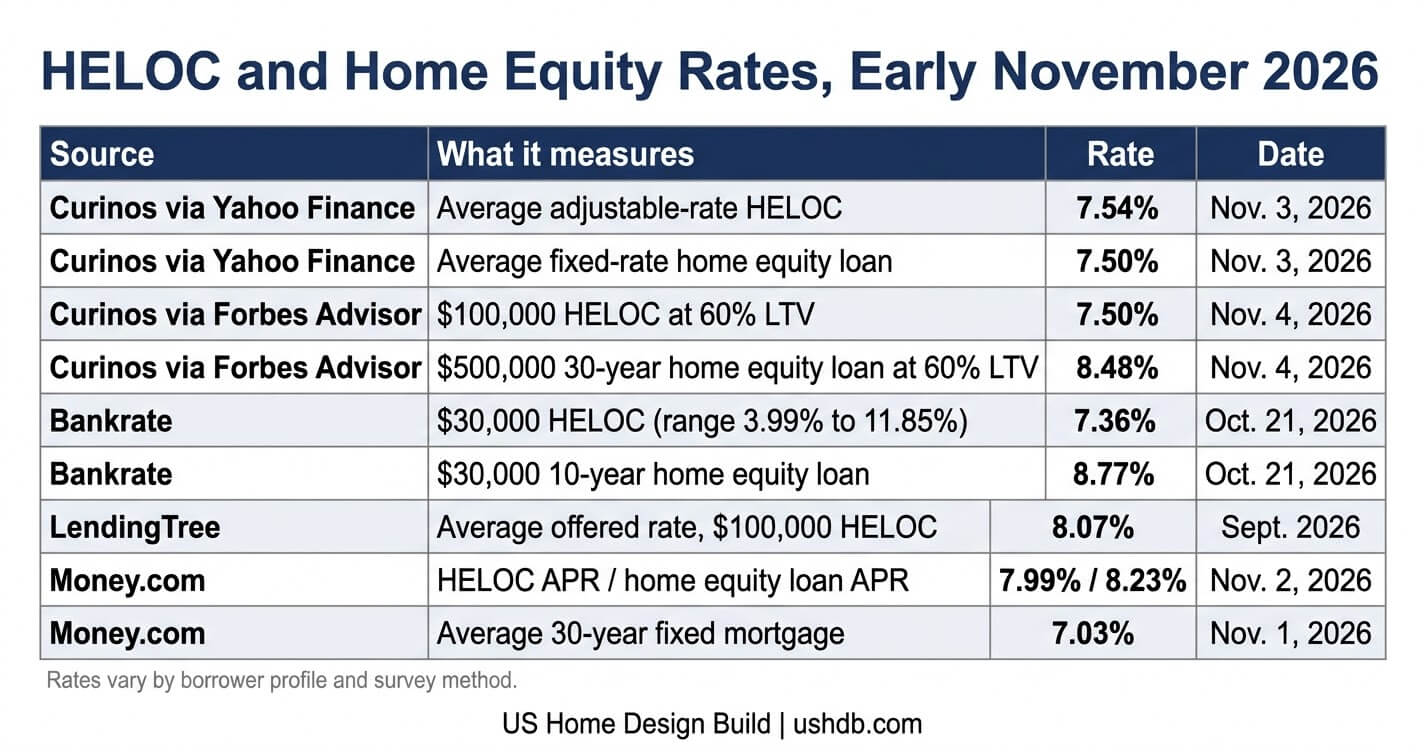
Bankrate’s national survey of large lenders put the average $30,000 HELOC rate at 7.36% on October 21, 2026, with offers ranging from 3.99% to 11.85%. The same report cites Equifax data showing HELOC originations through July 2026 rose 6.6% from 2025. Homeowners are still borrowing against equity despite higher rates.
LendingTree reported that the average rate offered on a $100,000 HELOC was 8.07% in September 2026, compared with 7.94% in September 2025.
The numbers differ because each survey uses a different borrower profile. Curinos reflects strong credit and low loan-to-value. LendingTree reflects offers across every credit band. A quote between 7.4% and 8.1% sits inside the early-November range. A quote far above it is a reason to ask what is driving the margin.
Most HELOCs are variable-rate products, so the rate follows an external index and can change after you open the line.
How Does a HELOC Work When You Are Paying a Contractor in Stages?
A HELOC is a revolving credit line you draw on as invoices come due. The draw period can last about 10 years, followed by a repayment period of often 10 or 20 years. You pay interest on what you have drawn, and because the rate is usually variable, your payment can rise during the project and again when repayment begins.
The Consumer Financial Protection Bureau describes a HELOC as an open-end line of credit that lets you borrow repeatedly against your home equity. After the draw period ends, you can no longer borrow, and the lender sets a schedule to repay the full balance, often over 10 or 20 years.
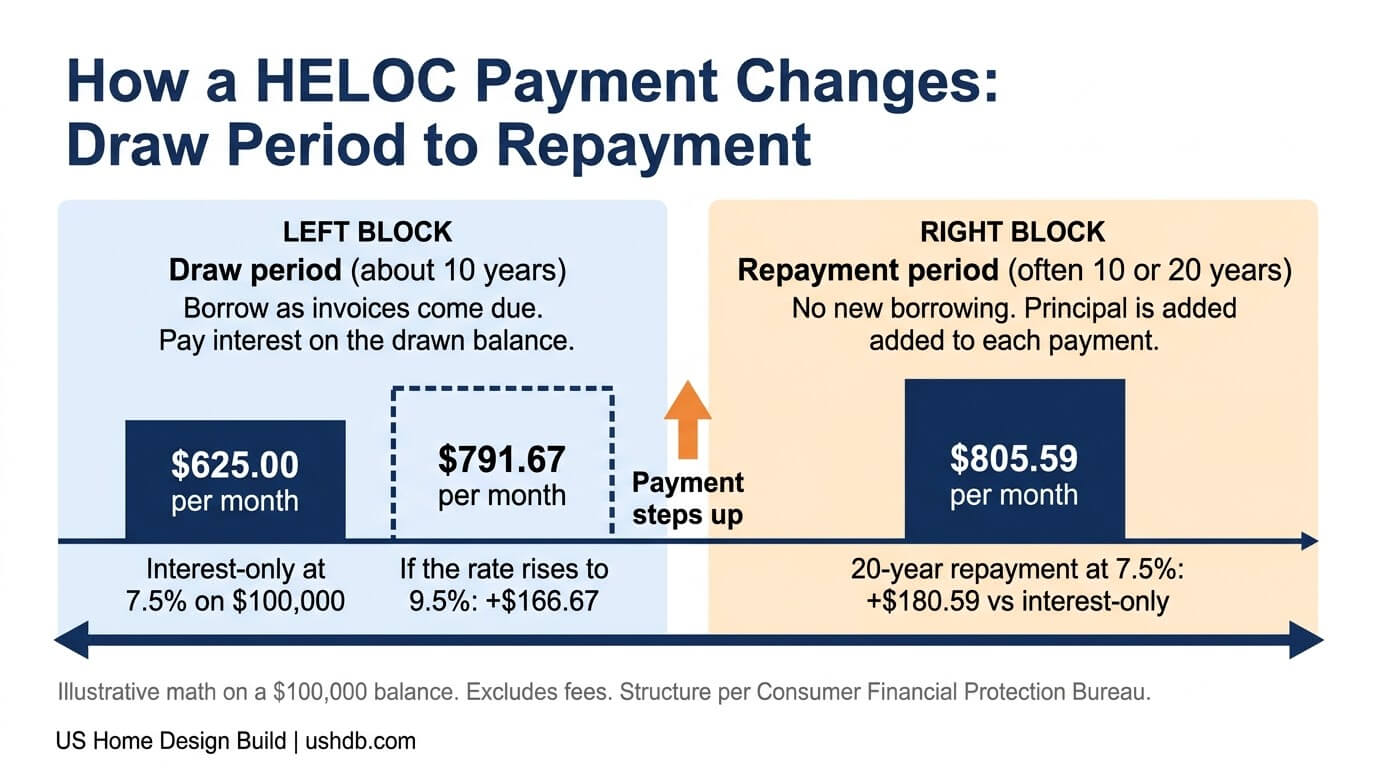
HELOC payments change in two ways, and both belong in your budget. A rate increase changes the payment during the draw period. The start of repayment adds principal. Table 3 shows both effects on a $100,000 balance.
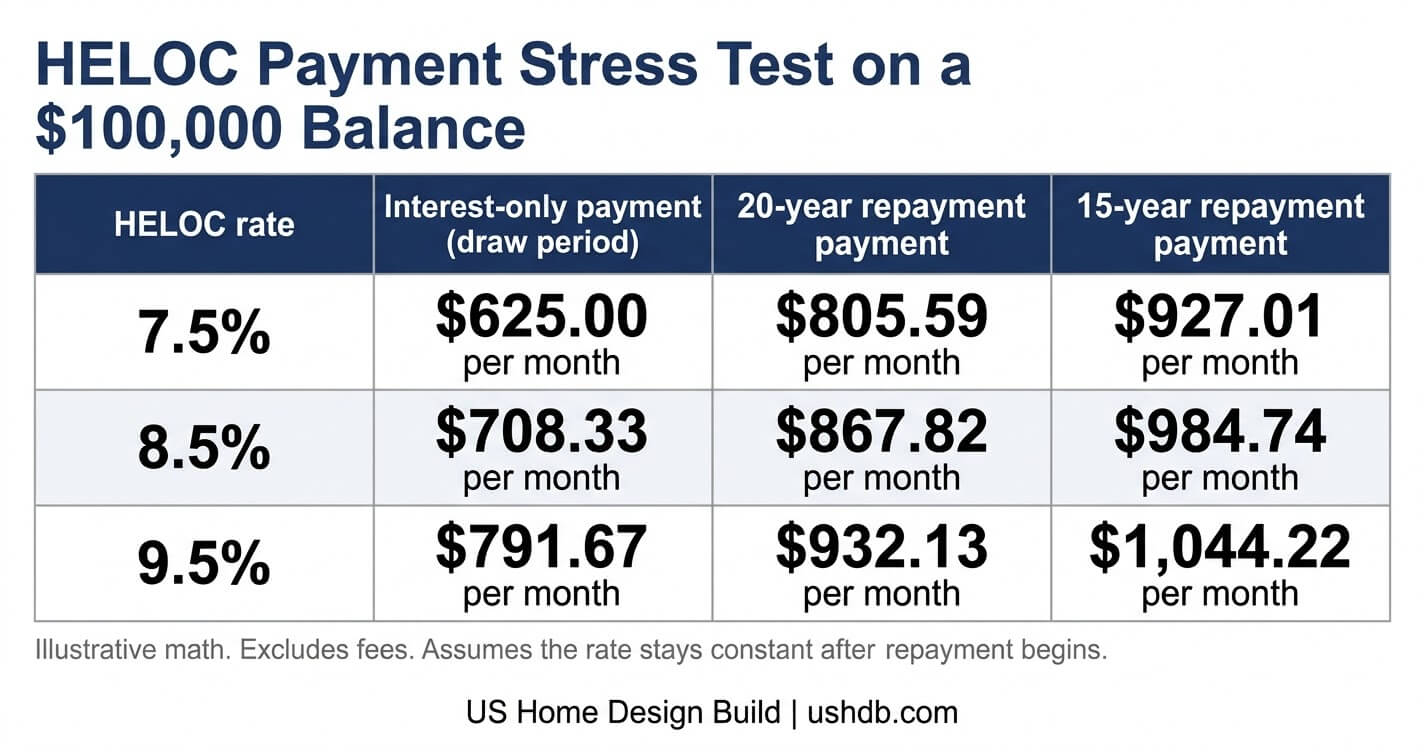
A two-point rate increase, from 7.5% to 9.5%, adds $166.67 to the monthly interest-only payment. Moving from interest-only to a 20-year repayment schedule at 7.5% adds $180.59 per month. Test your own budget at a rate two points above today’s quote before you sign.
Federal rules give you a cooling-off period. If the home is your principal dwelling, you have three business days after opening the account or receiving the disclosures, whichever is later, to cancel a HELOC.
How Does a RenoFi Loan Work, and Is It Worth Considering?
A RenoFi loan sizes your borrowing limit on what your home will be worth after the renovation, not what it is worth today. RenoFi states that homeowners can borrow up to 90% of after-renovation value, capped at 150% of current value. It works through partner lenders, so confirm that a lender serves your Virginia address before you plan around it.
RenoFi says its loans range from $25,000 to $750,000 and may be fixed or variable, and that the lending limit is 150% of current home value or 90% of after-renovation value, whichever is lower. RenoFi describes itself as a technology partner rather than a lender.
Standard home equity products usually lend against 80% of current value, minus your mortgage. RenoFi replaces current value with the appraised future value. Table 4 shows how that changes borrowing power in an illustrative Fairfax County scenario.
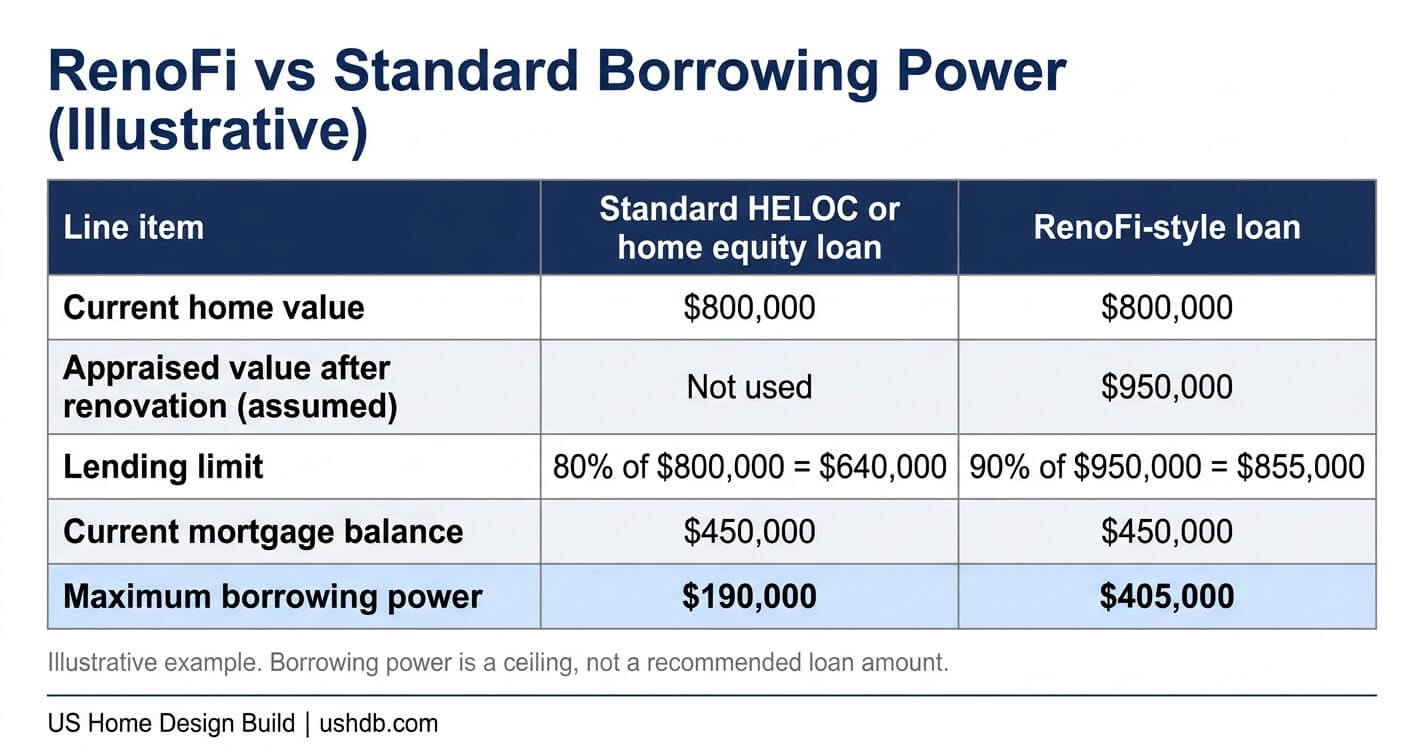
More borrowing power means more debt, so treat the ceiling as a limit and not a target. Bankrate reports that RenoFi closing costs are typically 1% to 3% of the loan amount, and that the appraisal covers both current and after-renovation value. LendEDU adds that RenoFi lenders generally require the money to be used on your primary property.
This type of loan matters most on large scopes. Our second story addition cost McLean VA guide shows second-story additions running $300 to $550 or more per square foot in 2026. A 600-square-foot second story at those rates is roughly $180,000 to $330,000, which can exceed what a standard HELOC offers on a home with a larger mortgage.
Should You Do a Cash-Out Refinance to Pay for a Renovation in 2026?
A cash-out refinance usually costs more than a HELOC or home equity loan in 2026 because it replaces your entire first mortgage at today’s rates. With 30-year fixed rates near 7.03%, it makes sense mainly when your current mortgage rate is already at or above that level.
Money.com reported the average 30-year fixed mortgage rate at 7.03% as of November 1, 2026. A homeowner who locked a much lower rate in earlier years would give that rate up on the whole balance, not just the renovation cash.
Table 5 compares two hypothetical paths for a homeowner who owes $450,000 at 3.5% and needs $150,000.
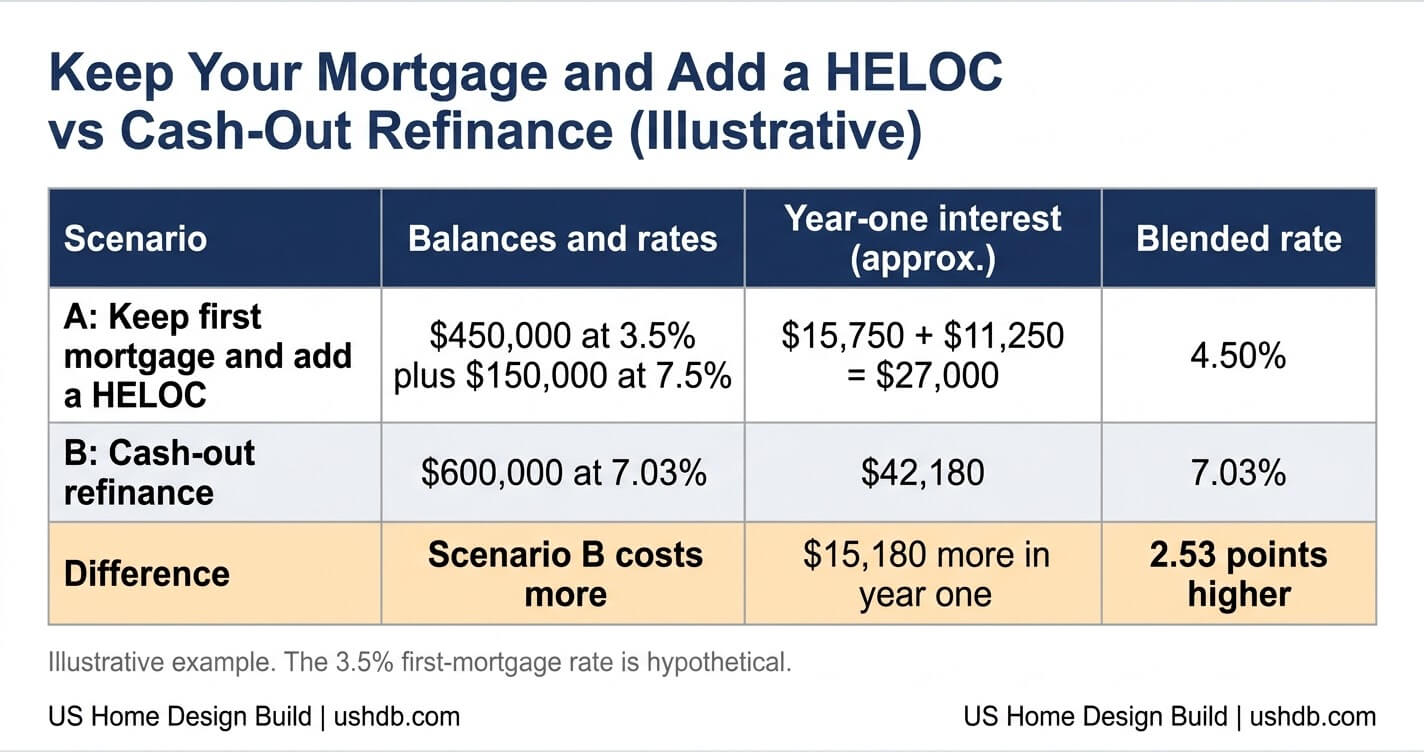
Run the same comparison with your own first-mortgage rate. If your rate is lower than today’s, keep the first mortgage and borrow only the renovation amount in a second loan.
How Should Loan Draws Match Design-Build Payment Milestones?
Match every loan draw to a completed construction milestone, not to the calendar. Virginia’s Department of Professional and Occupational Regulation (DPOR) advises homeowners not to let payments get ahead of the work, and not to pay 100% of the bill until the work is 100% complete. A HELOC makes this easy because you draw only when an invoice is approved.
DPOR’s Top 10 Tips for hiring a contractor tell homeowners to hire only licensed contractors, insist on a written contract, avoid letting payments get ahead of the work, and withhold final payment until the work is complete. The same guidance advises limiting the deposit and notes a higher allowance for custom-made items. The document is dated August 2015, so ask your contractor how current rules and any design retainer apply to your contract.
Verify any contractor’s license before you sign, using Virginia DPOR’s license lookup. Our guide to hiring a home renovation contractor in Northern Virginia lists the questions to ask, and our design-build remodel cost guide for Northern Virginia explains how design fees and construction costs are structured.
Table 6 shows one illustrative way to link draws to inspected milestones. Your signed contract controls the actual schedule.
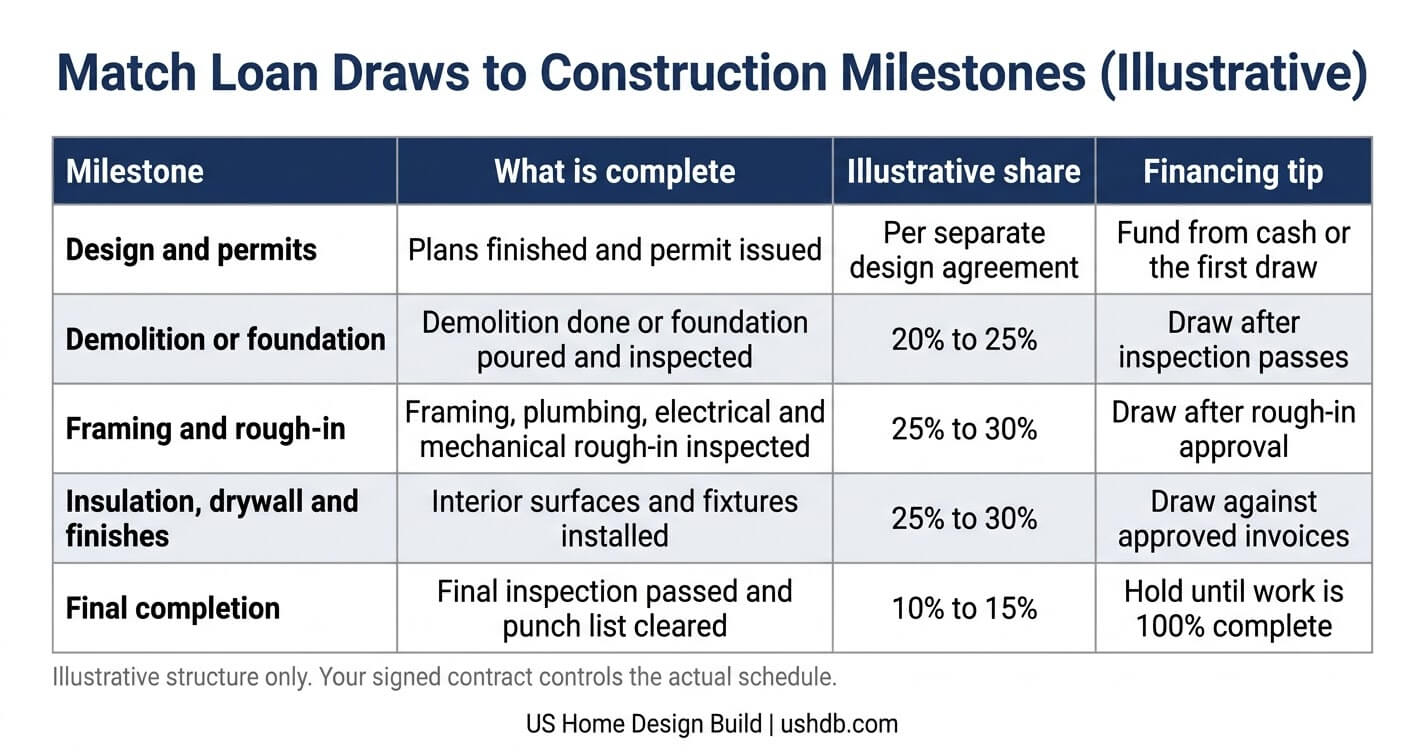
For a real example of a phased design-build scope, see our home addition before and after McLean VA case study, which covers a 960-square-foot, two-level family room and primary suite.
Homeowners comparing home renovation financing Northern Virginia options may benefit from reviewing the payment schedule with an experienced design-build team before choosing a loan product. Matching draws to milestones is easier when the contract is written with the financing in mind.
What Do Renovation Loans Cost in Fairfax County?
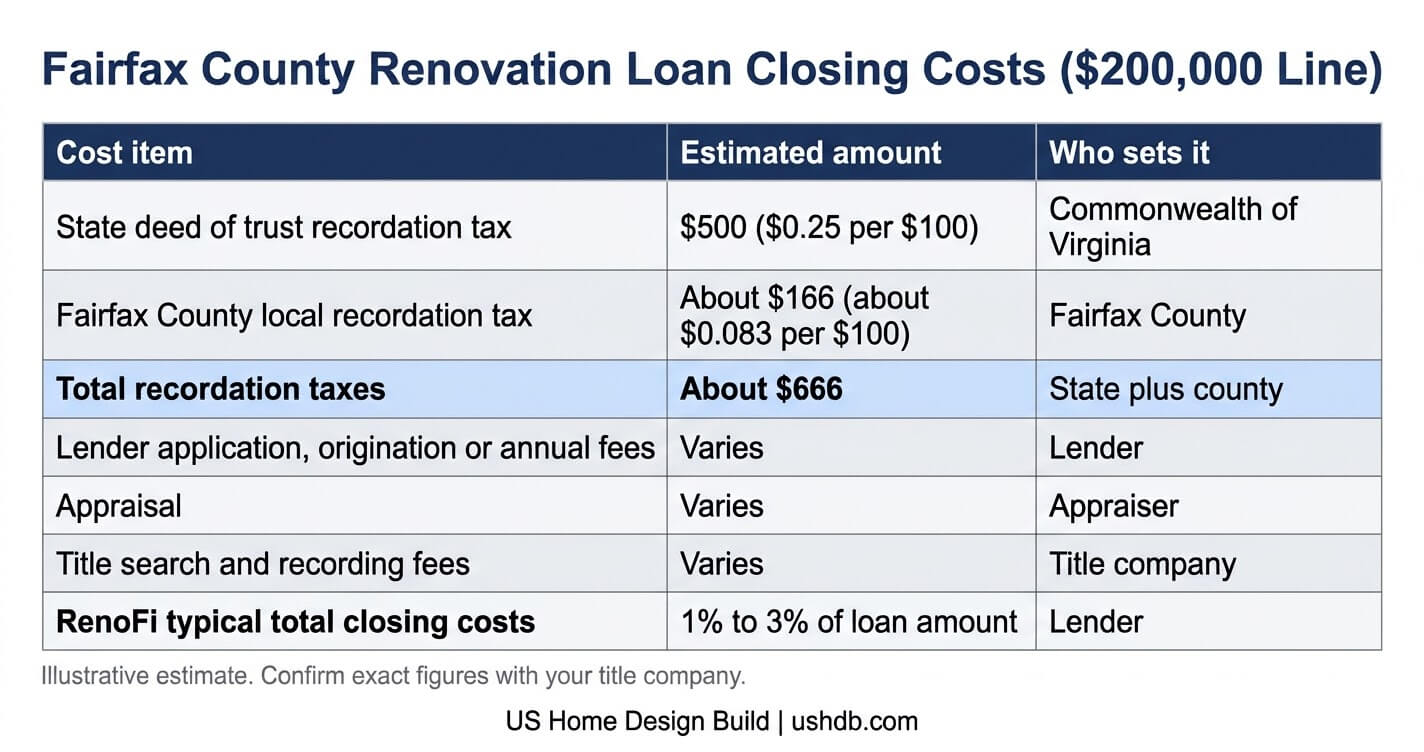
Expect closing costs on a Fairfax County renovation loan to include lender fees, an appraisal, title work and Virginia recordation tax. Virginia taxes a credit-line deed of trust on the maximum line, not the amount you draw. On a $200,000 line, the state tax is about $500 and Fairfax County’s local share is about $166.
The local costs in home renovation financing Northern Virginia lenders pass on to borrowers start with recordation tax. A Virginia Attorney General opinion holds that recordation tax on a credit-line deed of trust is calculated on the maximum credit authorized. A larger line therefore costs more in tax even if you never draw it all.
The state recordation tax on a deed of trust is 25 cents per $100, and Fairfax County adds a local recordation tax of about 8.3 cents per $100. Some lenders advertise “no-fee” lines and pay the recordation tax themselves. In a 2009 ruling, the Virginia Department of Taxation noted that when the same lender increases an existing line, tax applies to the increase and not to the original line.
Is Renovation Loan Interest Tax Deductible?
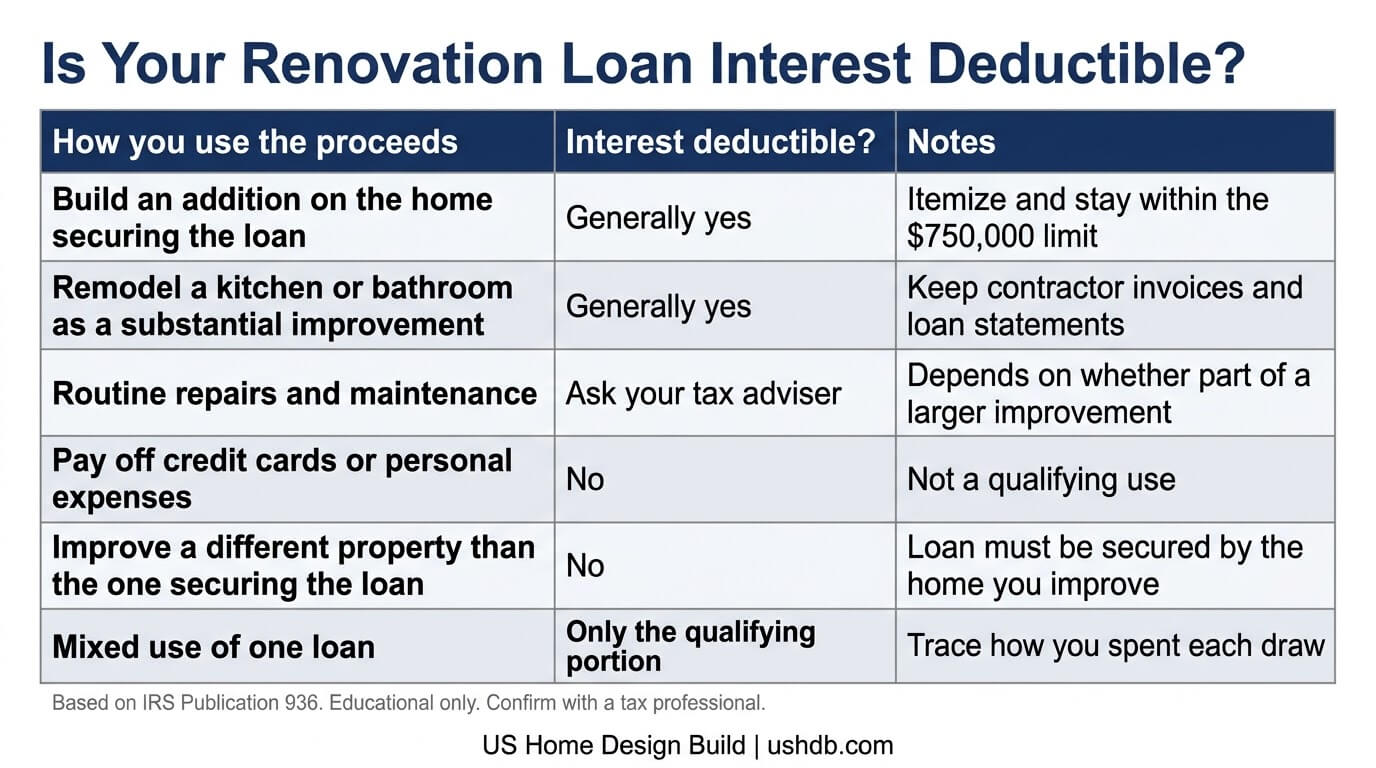
Interest on a home equity loan or HELOC is deductible only when you use the money to buy, build or substantially improve the home that secures the loan. You must itemize, and combined mortgage debt above $750,000 limits the deduction. Interest on money spent on anything else is not deductible.
IRS Publication 936 states that you can no longer deduct interest on a loan secured by your home to the extent the proceeds were not used to buy, build or substantially improve that home. The IRS gives building an addition as an example of a deductible use, and paying personal expenses such as credit card debt as a non-deductible one.
How Much Should You Borrow for a Renovation?
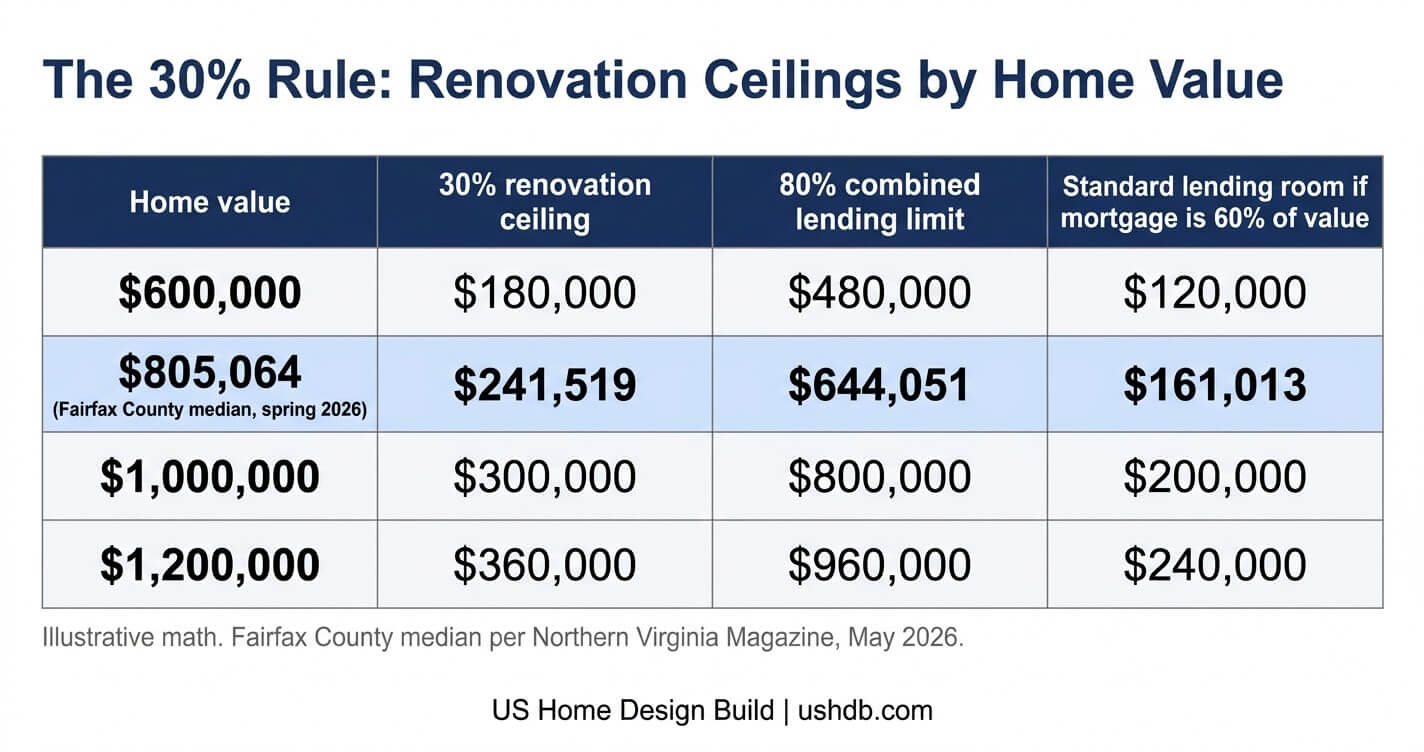
Keep renovation spending near 30% of your home’s value, and keep total borrowing against the home at or below about 80% combined loan-to-value. In Fairfax County, where the median sale price reached $805,064 in spring 2026, that guardrail is roughly $241,500. Then test the payment at a rate two points above today’s.
Northern Virginia Magazine reported, using Bright MLS data, that the Fairfax County median sale price hit $805,064 in spring 2026, up 4% from a year earlier. Fairfax County also recorded 9,374 home sales from January through September 2026, according to FFXnow, compared with 3,850 in Loudoun County and 1,786 in Arlington County. Fairfax County is the region’s deepest equity market, which is why home renovation financing Northern Virginia homeowners pursue is so often tied to it.
Our guide to the 30% rule for home renovation in Northern Virginia explains why capping spending near 30% of value protects resale. Table 7 applies that ceiling to four home values.
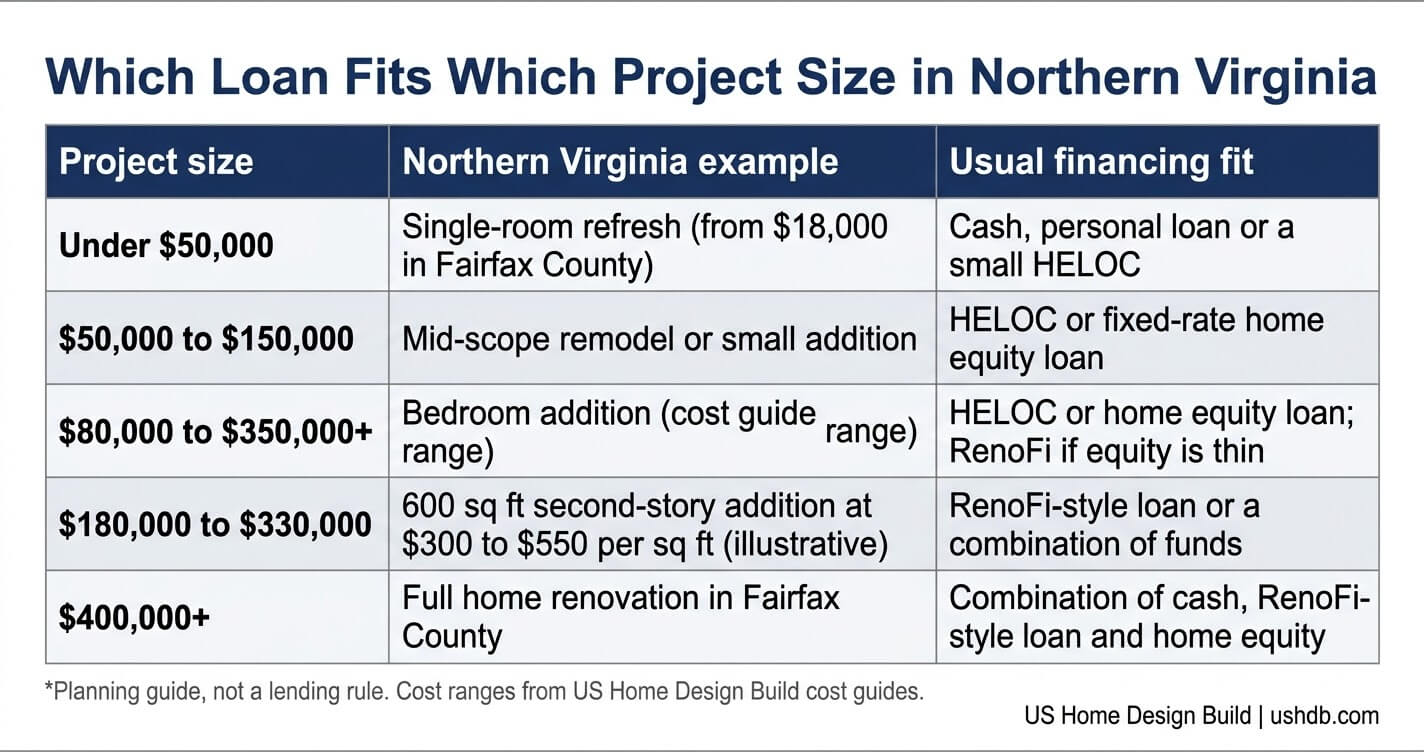
Next, match the loan to the project size. Our home renovation cost guide for Fairfax County VA puts Fairfax County projects between $18,000 for a single-room refresh and $400,000 or more for a full home renovation. Our home addition cost guide for Fairfax County VA puts ground-floor additions at $150 to $350 per square foot. Our bedroom addition cost guide for Northern Virginia shows bedroom additions from $80,000 to $350,000 or more.
If your project involves a new kitchen or larger scope, review our kitchen remodeling services and home addition services to scope the budget before you apply for a loan.
What Should You Check Before Signing a Design-Build Contract and a Loan?
Before you sign, confirm your equity, compare at least three lender quotes, stress-test the payment at a higher rate, verify your contractor’s license and tie every draw to a completed milestone. Doing these six things prevents most financing surprises on Northern Virginia renovations.
- Get a current value estimate and your mortgage payoff balance so you know your real equity.
- Compare at least three quotes on APR, fees, index and margin, rate cap, and draw and repayment length. Ask whether the lender allows fixed-rate conversion.
- Stress-test your budget at a rate two points above today’s quote, using Table 3 as a model.
- Verify the contractor’s license at Virginia DPOR’s license lookup and read the contract before signing.
- Tie every draw to an inspected milestone and avoid paying ahead of the work, as DPOR advises.
- Confirm coverage during construction. Our guide to home renovation insurance in Northern Virginia explains what to ask your insurer.
- Subtract available rebates before you size the loan, using our home energy rebates guide.
- Hold a contingency reserve outside the loan or in a line you will not otherwise use, and ask your design-build team what fits your scope.
- Confirm tax treatment with a qualified tax professional before you claim any interest deduction.
Frequently Asked Questions
What is the best home renovation financing Northern Virginia homeowners can use in 2026?
For most homeowners with equity, a HELOC or fixed-rate home equity loan is the best home renovation financing Northern Virginia lenders offer, because it leaves a low-rate first mortgage in place.
A RenoFi loan helps when the project is large relative to current equity. A cash-out refinance usually costs more with 30-year rates near 7.03%. Use Table 1 and Table 4 to compare.
What is the current HELOC rate in Northern Virginia?
There is no separate public index for Northern Virginia, but early-November 2026 national averages ranged from 7.36% (Bankrate, Oct. 21) to 8.07% (LendingTree offered average, Sept. 2026). Curinos put the adjustable average at 7.54% on Nov. 3.
Your actual rate depends on credit, loan-to-value and lender.
Can I use a HELOC to pay a design-build contractor in draws?
Yes. A HELOC lets you draw funds as invoices come due and pay interest only on the drawn balance.
Tie each draw to an inspected milestone and avoid paying ahead of the work, as Virginia DPOR advises. See Table 6.
Is RenoFi available in Virginia?
RenoFi works through partner lenders, so availability depends on whether a participating lender serves your address. Use RenoFi’s rate tool to confirm eligibility for your Virginia home before basing a budget on it.
RenoFi describes itself as a technology partner and not a lender.
Is HELOC interest tax deductible for a renovation?
Generally yes, if you itemize and use the money to buy, build or substantially improve the home that secures the loan, within the $750,000 combined debt limit.
Interest on money used for personal expenses is not deductible. Confirm with a tax professional.
How much equity do I need for a $150,000 renovation in Fairfax County?
Under a typical 80% combined limit, your mortgage balance must be at or below 80% of your home’s value minus $150,000. On a home valued at the $805,064 county median, that means a balance of about $494,000 or less.
Math: 80% of $805,064 is $644,051, and $644,051 minus $150,000 is $494,051. Lender limits vary.
Should I refinance my mortgage to pay for a renovation?
Usually not, unless your current mortgage rate is already above today’s roughly 7% level. A refinance resets your entire balance at current rates.
Table 5 shows how keeping a low first mortgage and adding a HELOC cost about $15,180 less in year-one interest in one hypothetical case.
To Sum Up
The right home renovation financing Northern Virginia homeowners choose in 2026 depends on three numbers: your equity, your first-mortgage rate and your project cost. Use a HELOC or home equity loan for most projects, consider RenoFi when the scope outgrows your equity, and avoid cash-out refinancing unless your current rate is above today’s.
- Start with a realistic ceiling: about 30% of home value and about 80% combined loan-to-value.
- Stress-test the payment two points above today’s quote.
- Tie every draw to an inspected milestone and verify the contractor’s DPOR license.
- Budget for recordation tax and lender fees, and confirm tax treatment with a professional.
Our design-build team at US Home Design Build helps homeowners across Fairfax County, McLean, Vienna, Reston, Great Falls and Burke line up scope, budget and payment milestones before construction starts. Read more on our home renovation services page.
Planning a similar project in Northern Virginia? Contact US Home Design Build to discuss your goals, budget, and timeline with our team. Call (703) 202-3520, email project@ushdb.com, or visit us at 8200 Greensboro Dr Suite 900, McLean, VA 22102. You can also find US Home Design Build on Google Maps or use our contact page.
