
Home energy rebates Northern Virginia homeowners can actually use in 2026 look very different from what many online guides still promise. The federal tax credits for efficiency upgrades ended on December 31, 2025, and Virginia’s federally funded rebate programs have not opened yet. That gap is where homeowners lose money, because equipment gets bought on the strength of incentives that no longer exist or have not launched.
The Internal Revenue Service states in its Instructions for Form 5695 that taxpayers cannot claim energy efficient home improvement credits for expenditures or property placed in service after December 31, 2025. The same instructions say residential clean energy credits cannot be claimed for expenditures made after that date.
At US Home Design Build, our design-build team plans energy upgrades alongside kitchens, additions, and whole-home renovations for homeowners in Fairfax County, McLean, Vienna, Reston, Great Falls, and Burke. The most expensive mistake we help homeowners avoid is committing to a project because of a rebate that cannot be claimed. This guide separates what ended, what is pending, and what is open today.
In this guide you will learn:
- Which federal credits ended, and how 2025 installations can still be claimed.
- What Virginia’s HOMES and HEAR rebates will offer, and why they are not available yet.
- Five programs of home energy rebates Northern Virginia homeowners can use right now.
- Which upgrades to do first, what to document, and when to wait.
What Happened to the Federal Energy Tax Credits for Home Upgrades?
The federal Energy Efficient Home Improvement Credit and Residential Clean Energy Credit ended for 2026. Upgrades placed in service after December 31, 2025 do not qualify. Only 2025 installations can still be claimed, and only on a 2025 tax return.
The IRS describes the energy efficient home improvement credit as allowed for property placed in service through December 31, 2025. For 2025 installations, each qualifying item must also carry a manufacturer identification number, known as a QMID, which the taxpayer reports on Form 5695.
Table 1: Federal Energy Tax Credits for Home Upgrades – Status for 2026
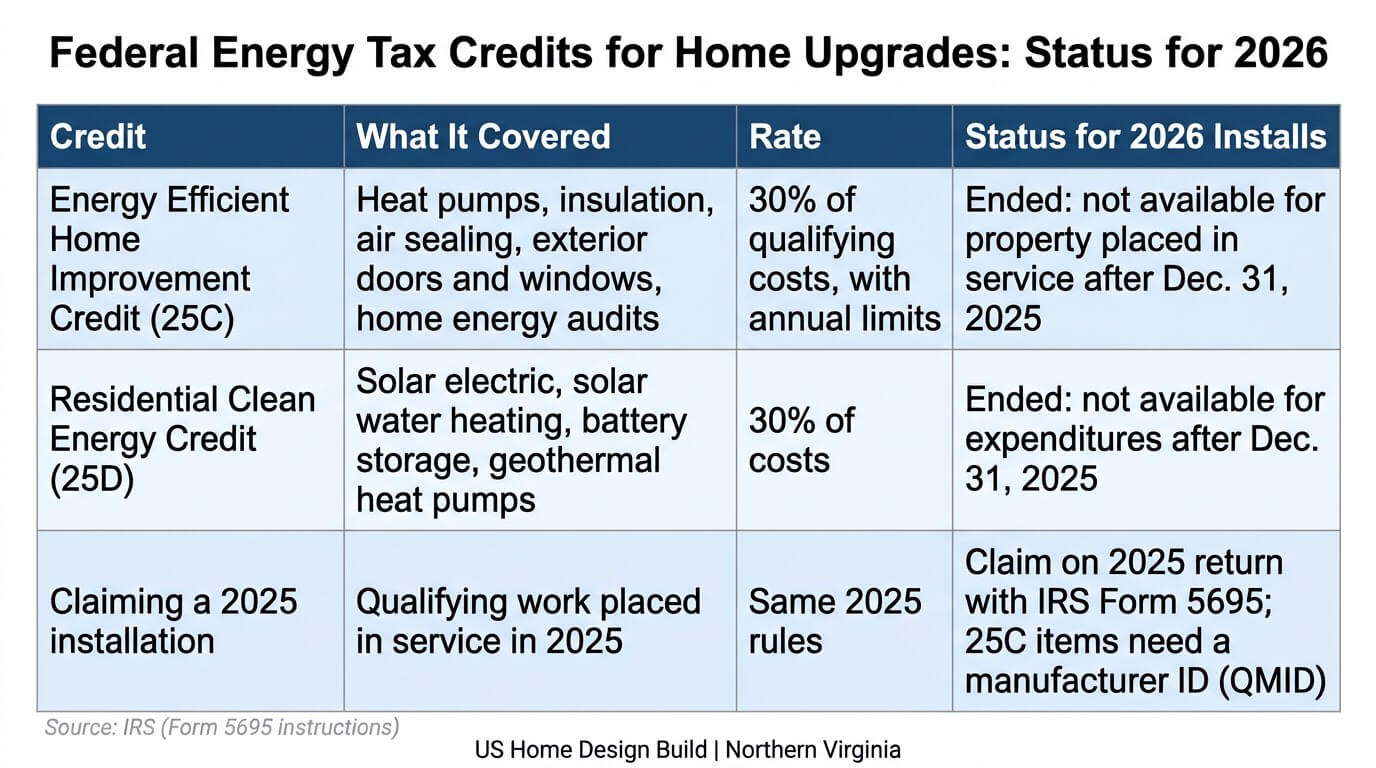
For home energy rebates Northern Virginia homeowners should plan around, no federal credit replaced these incentives for 2026 installations. If you installed a qualifying heat pump, insulation, windows, or doors in 2025, keep your invoices and manufacturer certification statements and review them with a tax professional. We are not tax advisors, and eligibility rules depend on your individual return.
What Are Virginia’s HOMES and HEAR Rebates, and Are They Available Yet?
No. The state layer of home energy rebates Northern Virginia homeowners are waiting for has not opened. As of Virginia Energy’s October 13, 2026 update, the HOMES and HEAR rebate programs have not launched. Virginia Energy cannot give a launch date, and rebates will not open until the U.S. Department of Energy approves the state’s application.
Virginia Energy, the state agency running the programs, reports that it submitted updated application materials in September 2026. Its proposed budgets are approximately $75.2 million for HEAR rebates and $75.6 million for HOMES rebates, and both remain subject to federal approval.
Virginia’s original federal allocation for the two programs was $188,334,635, according to Virginia Energy’s program design document. The proposed rebate budgets now total about $150.8 million, so homeowners should treat all figures as provisional.
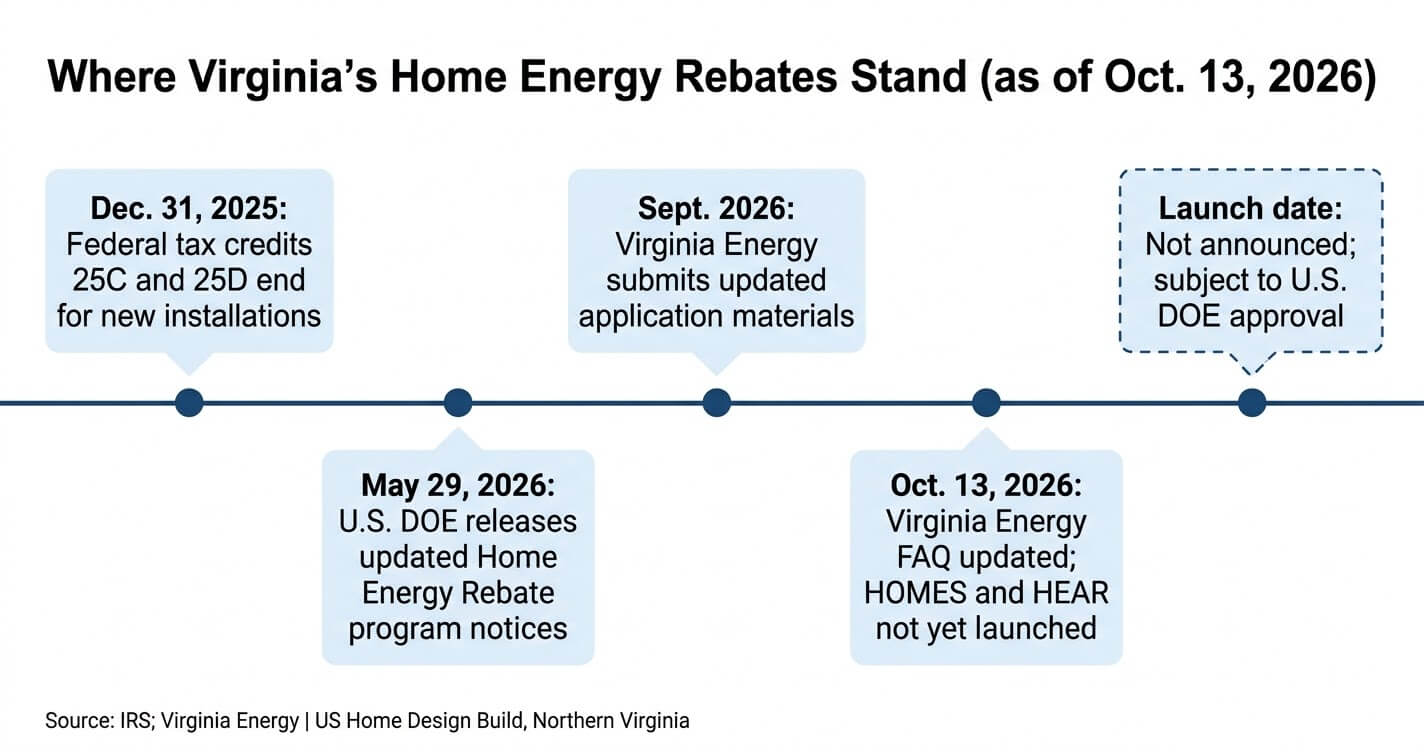
How HEAR rebates are capped by measure
HEAR pays for specific technologies, with a maximum per category. The table below shows the federal caps that Virginia Energy lists.
Table 2: HEAR Rebate Caps by Measure (Virginia, Not Yet Launched)
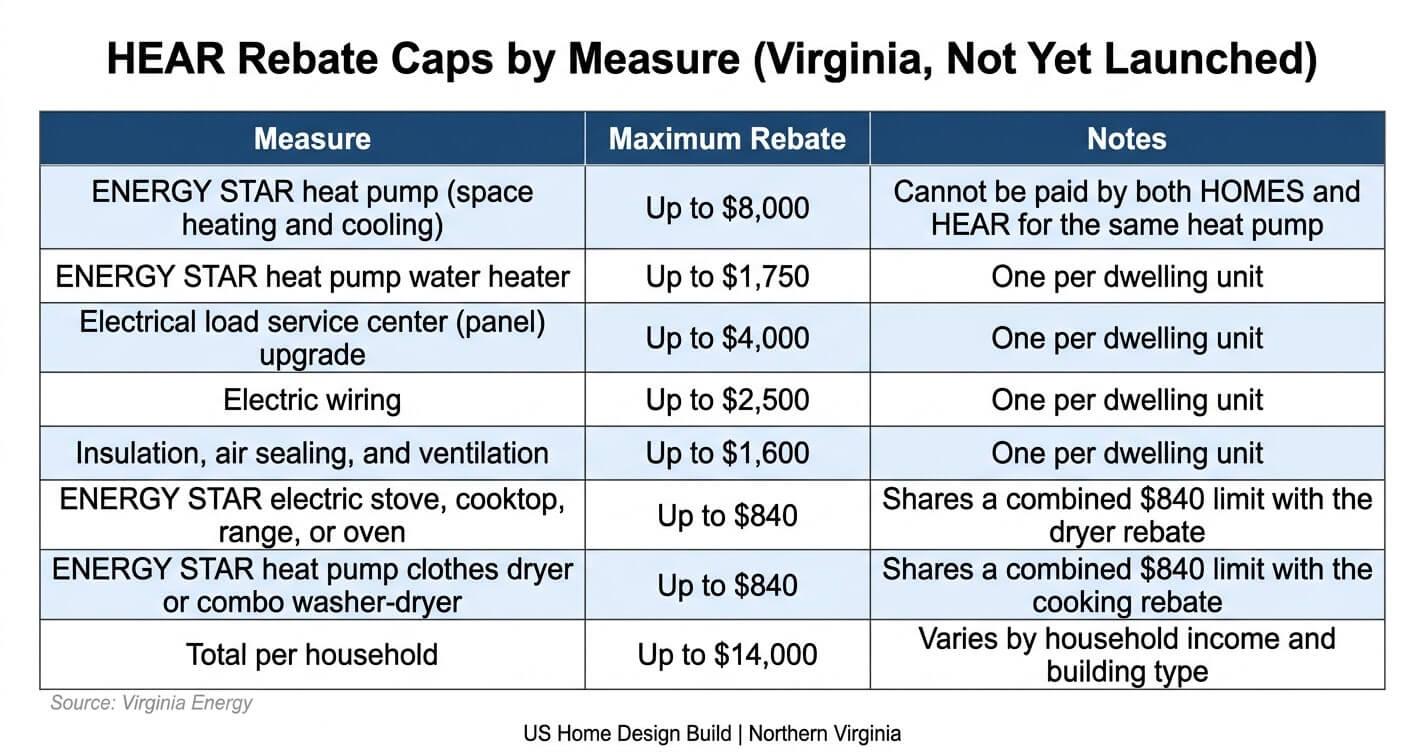
How HOMES and HEAR compare
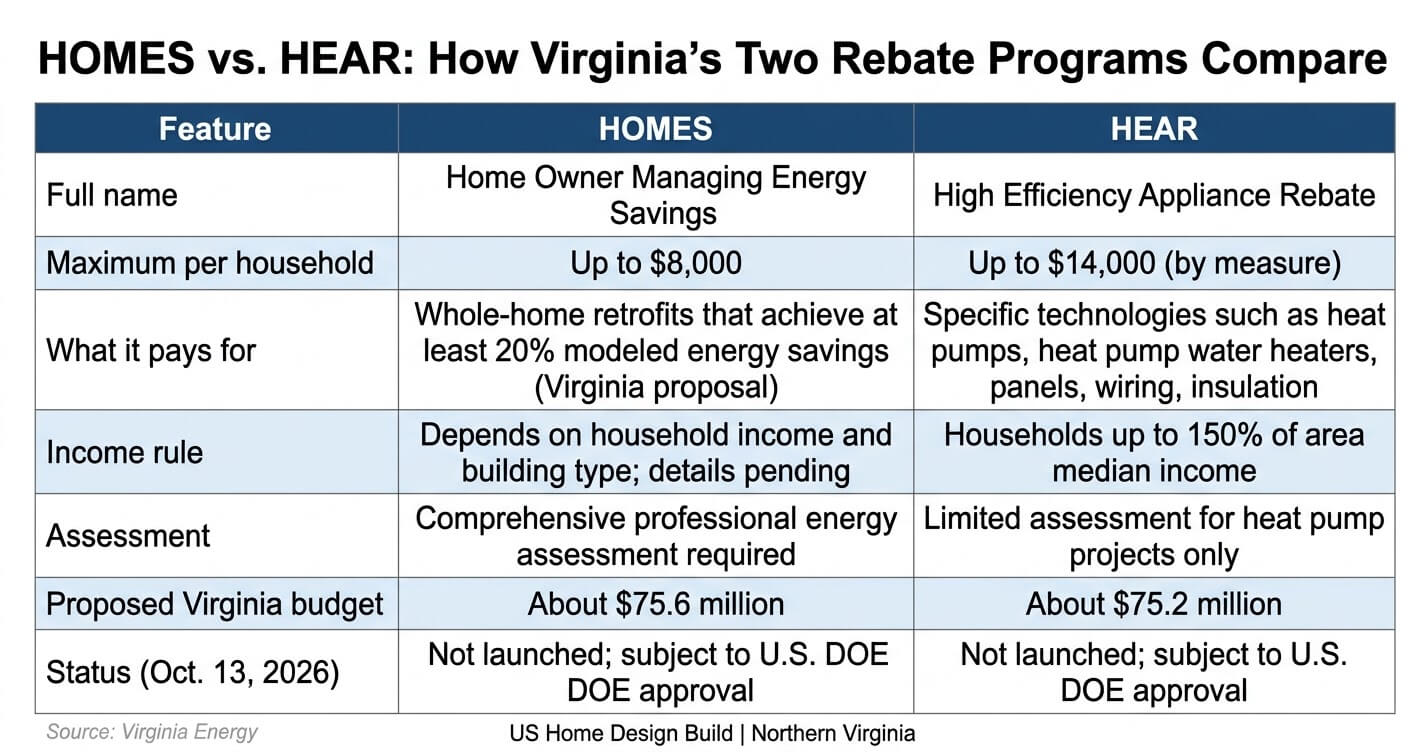
The two programs pay for different things, and they cannot both pay for the same purchase. A household can use HOMES for insulation and HEAR for a heat pump, for example.
Table 3: HOMES vs. HEAR – How Virginia’s Two Rebate Programs Compare
Three rules that matter for Northern Virginia homeowners
- HEAR is income-limited. Federal law restricts HEAR to households earning up to 150% of area median income. Northern Virginia has high area median income figures, so many middle-income households may qualify, but Virginia Energy has not finalized criteria.
- HEAR cannot replace non-electric appliances under current guidance. Virginia Energy states that, under current U.S. DOE guidance, HEAR cannot help pay to replace a non-electric appliance. The program may support heat pump installations that keep existing fossil-fuel heating equipment, which matters for homes heated with natural gas.
- Only Verified Contractors will qualify. DOE requires projects to be completed by a Verified Contractor. Virginia’s list has not been established, and Virginia Energy warns homeowners about contractors who guarantee eligibility before launch.
Which Home Energy Rebates Northern Virginia Homeowners Can Use Today?
Five options are open now: Dominion Energy’s heat pump water heater rebate, Dominion’s audit-based Home Energy Evaluation program, select Washington Gas equipment rebates, Fairfax County’s free Energy Compass advice, and income-qualified weatherization. Eligibility depends on your utility, heating fuel, and household income.
Utility territory shapes which home energy rebates Northern Virginia homeowners can claim. Most of the region is served by Dominion Energy for electricity, Washington Gas supplies natural gas in many areas, and some communities are served by electric cooperatives. Confirm your provider first, then check current terms before you buy anything.
1. Dominion Energy heat pump water heater rebate
Dominion Energy offers $250 for an ENERGY STAR heat pump water heater of 40 to 59 gallons and $400 for 60 gallons or larger. The new unit must replace an electric water heater, and the customer must live in an eligible single-family home. The page we reviewed carried an older update date, so confirm the current amounts before purchasing.
2. Dominion Energy Home Energy Evaluation program
Dominion’s Home Energy Assessment and Home Retrofit programs merged into the Home Energy Evaluation program. It gives access to rebates for heat pump or mini-split upgrades, heat pump water heater replacement, and smaller measures such as heat pump tune-ups. Central heat pump rebates are audit-based, so the amount depends on the evaluation, not a flat figure.
3. Washington Gas equipment rebates
Washington Gas has been reported to offer up to $2,000 on select ENERGY STAR boilers and furnaces and $100 on a smart thermostat. This figure comes from a secondary summary, not the utility’s own page. Verify the current program terms with Washington Gas before you rely on it.
4. Fairfax Energy Compass (Fairfax County)
Fairfax Energy Compass is a free county program where a local Energy Navigator answers technical questions and connects residents to available incentives. It is open to Fairfax County residents who make decisions for a single-family home, whether detached, attached, or a mobile home. County staff note they cannot give legal, financial, or specialized technical advice you should rely on without outside experts.
5. Weatherization Assistance Program (income-qualified)
The Weatherization Assistance Program provides energy improvements for income-eligible households. Virginia Energy confirms that existing programs, including this one and utility efficiency programs, may be available while the new rebates are pending. Households can use this program and the new rebates together, as long as both do not pay for the same item.
Table 4: Energy Programs for Northern Virginia Homeowners – Open Now vs. Pending
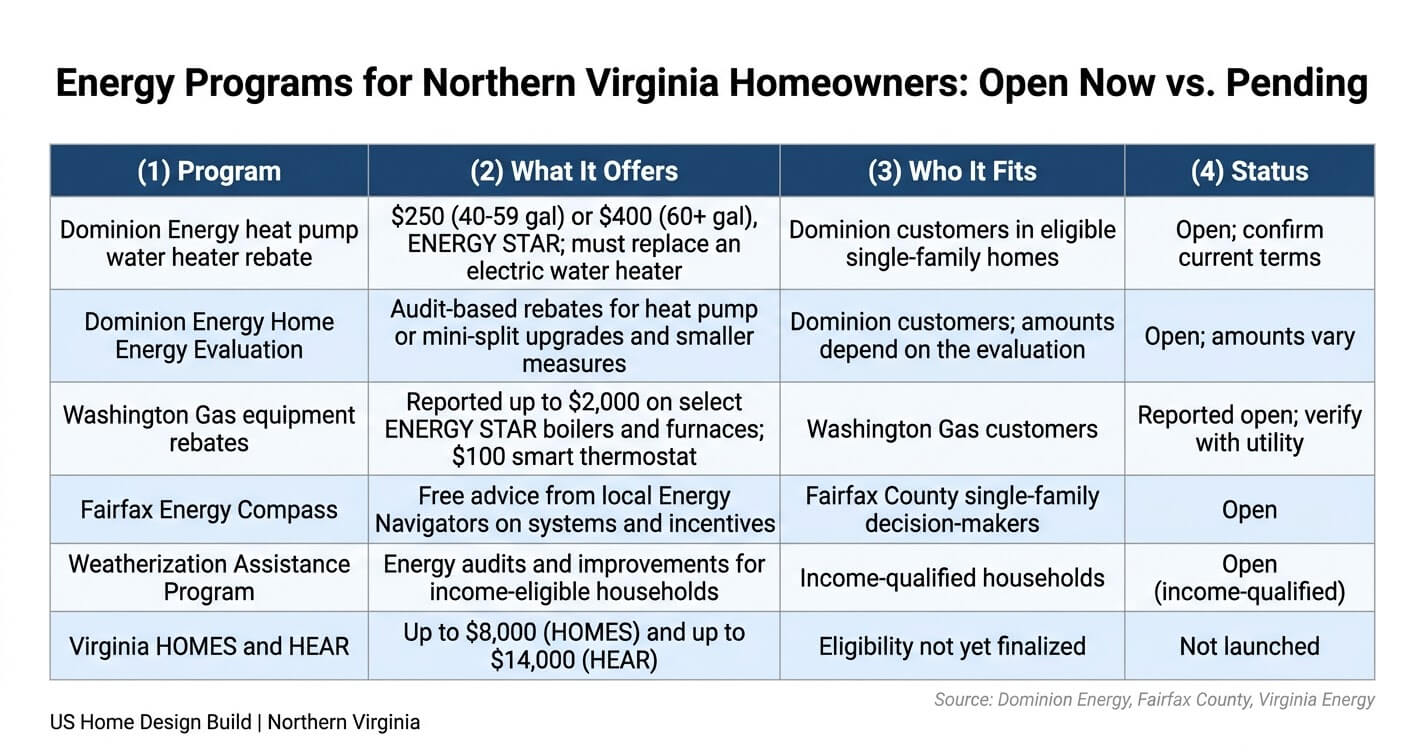
For a central, regularly updated list of incentives, Virginia Energy points residents to Virginia Energy Connect. Use it to confirm that a program is active before you commit.
Which Energy-Efficient Renovation Projects Deliver the Most Savings?
Air sealing and attic insulation usually deliver the best return per dollar. The EPA estimates average savings of 15% on heating and cooling costs, or 11% on total energy costs, from sealing and insulating a home. Equipment upgrades perform best after the envelope is tight.
Many home energy rebates Northern Virginia utilities offer start with an audit, so the assessment comes first. ENERGY STAR, the EPA program, estimates that homeowners save an average of 15% on heating and cooling costs, or 11% on total energy costs, by air sealing and adding insulation in attics, floors over crawl spaces, and accessible basement rim joists. Savings vary by climate zone, as the table shows.
Table 5: Estimated Savings From Air Sealing and Insulation by Climate Zone
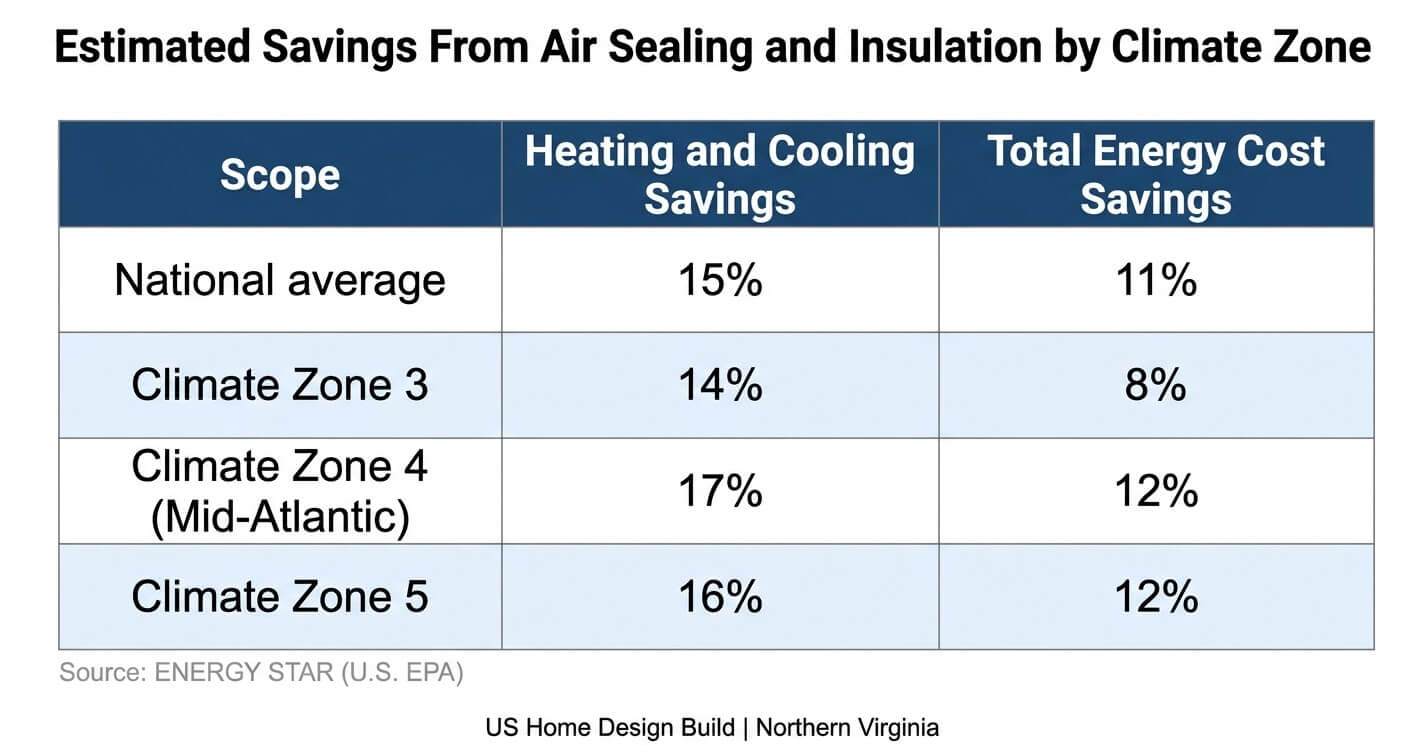
ENERGY STAR’s Climate Zone 4 figures apply to much of the Mid-Atlantic. Confirm your county’s zone on the Department of Energy climate zone map before applying these numbers to your home.
The sequence we recommend
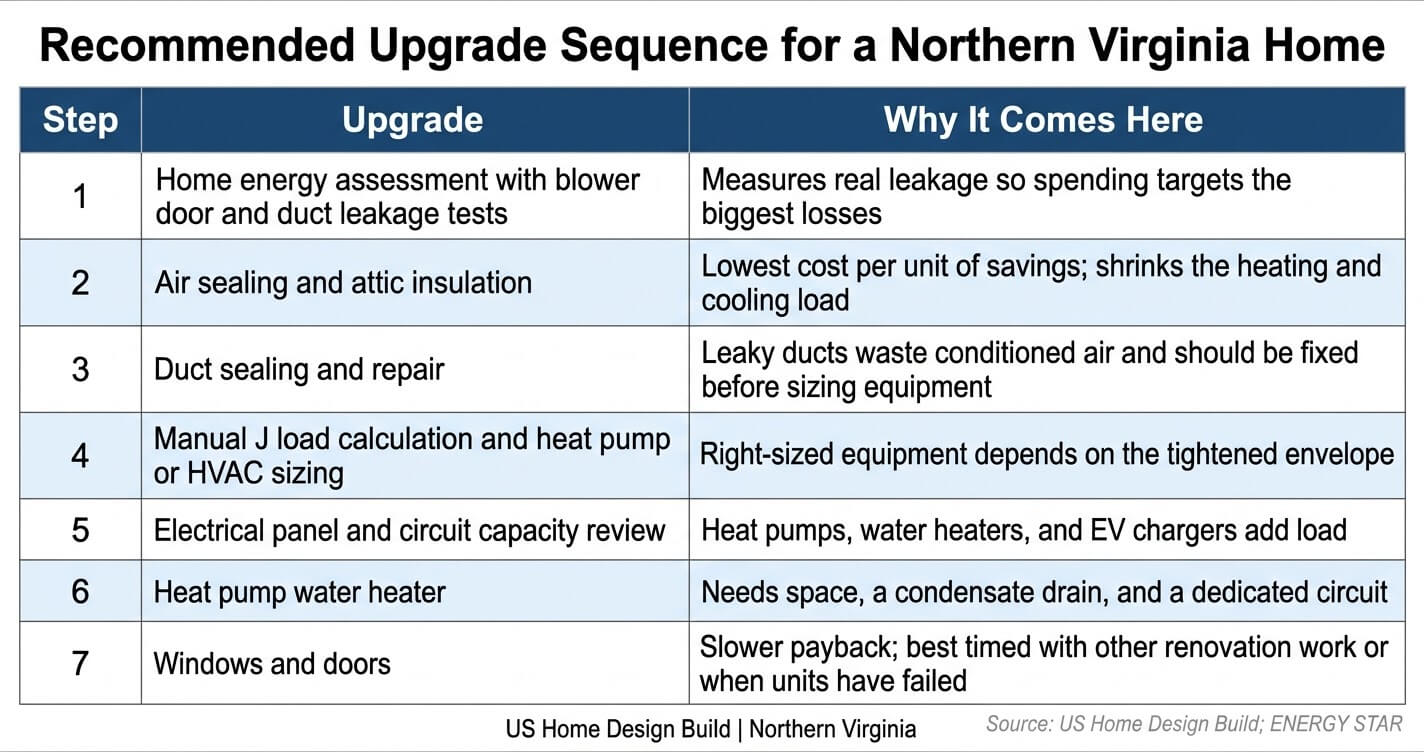
Order matters more than any single product. Sealing and insulating first shrinks the heating and cooling load, which lets a smaller, cheaper heat pump do the same job. The sequence below reflects how our design-build team plans these projects.
Table 6: Recommended Upgrade Sequence for a Northern Virginia Home
Homeowners considering a similar project may benefit from discussing their options with an experienced design-build team before finalizing budgets or timelines.
What Technical Issues Affect Energy Upgrades in Northern Virginia Homes?
Five issues decide whether an upgrade performs: load-based equipment sizing, air leakage, combustion safety, ventilation, and electrical capacity. Skipping any of them can erase the savings, no matter which rebate you collect.
Right-sizing with a load calculation
Heat pump size should come from a Manual J load calculation, not from the size of the old system. Oversized equipment short-cycles, handles humidity poorly, and wears out sooner. Northern Virginia’s mixed-humid climate makes humidity control a real design factor, not a footnote.
Air leakage and ducts
A blower door test measures how leaky the house is, and a duct leakage test shows how much conditioned air escapes. Older homes in Vienna, Falls Church, and McLean often have attic bypasses, unsealed top plates, and ducts in unconditioned space. Fixing these first lets equipment work as designed.
Combustion safety and ventilation
Tightening a home changes how combustion appliances draw air. If a house has a gas furnace or water heater, a combustion safety test should accompany air sealing. Mechanical ventilation may also be needed so a tighter home keeps healthy indoor air.
Electrical capacity
Heat pumps, heat pump water heaters, induction ranges, and EV chargers all add electrical load. A panel and circuit review should happen early, because a late discovery that a 100-amp service cannot support the plan can reset the budget and schedule.
Permits and inspections
Virginia’s building code generally requires permits for mechanical, plumbing, and electrical work, including equipment replacements and panel upgrades. Requirements and fees vary by jurisdiction, so confirm with your local building department before work begins. Permits also protect rebate eligibility and resale, since programs and buyers often ask for proof that work was inspected.
Should You Renovate Now or Wait for Virginia’s Rebates to Launch?
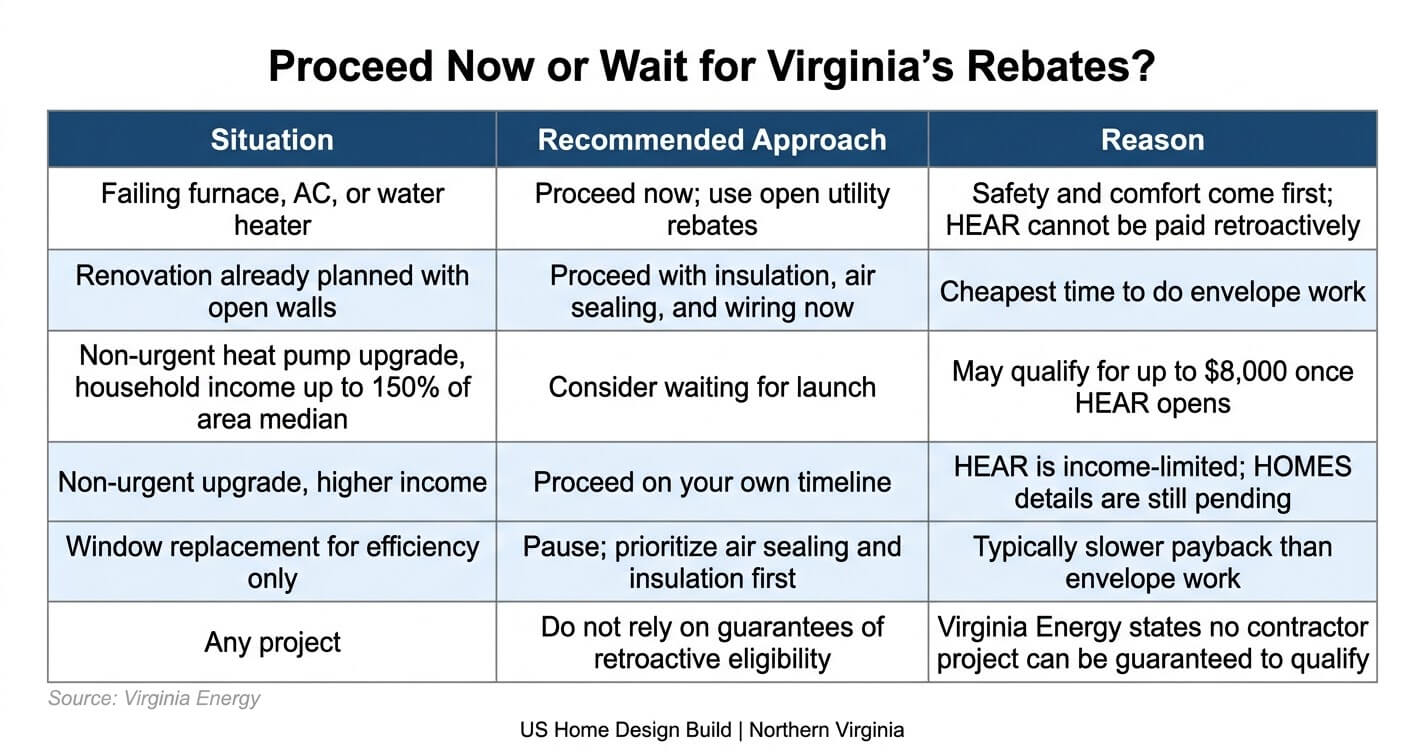
Wait only on projects that are not urgent. If a furnace, water heater, or roof is failing, proceed using the incentives available today. Virginia Energy states that HEAR rebates cannot be paid retroactively, and no contractor can guarantee that an early project will qualify.
Virginia Energy states that the Inflation Reduction Act does not authorize HEAR rebates for purchases made before launch, and that Virginia’s proposed HOMES treatment is still under DOE review. It adds that households starting projects early may assume the full risk of being ineligible.
Timing matters for home energy rebates Northern Virginia homeowners may qualify for later. Virginia Energy also notes that DOE strongly recommends waiting for program launch before beginning a project. That advice fits non-urgent equipment swaps. It does not fit a failed system in January.
Table 7: Proceed Now or Wait for Virginia’s Rebates?
How Do Energy Upgrades Fit Into a Kitchen, Addition, or Whole-Home Renovation?
The cheapest time to add insulation, air sealing, and efficient wiring is while walls and ceilings are already open. Folding energy upgrades into a planned renovation avoids paying for demolition twice and lets one team coordinate the details.
A remodel is the natural moment to improve the envelope. During a kitchen remodeling project, open exterior walls can be insulated and air sealed, and circuits can be sized for induction cooking. A bathroom remodeling is a good time to upgrade exhaust ventilation and run lines for a heat pump water heater.
Additions need extra planning. A new room changes the load on existing heating and cooling, and new construction must meet current energy code. Our home addition services team evaluates whether the existing system can serve the new space before drawings are finalized. Roof replacements are another opening, since attic insulation and ventilation can be corrected while the roof is stripped; see our TPO roofing services.
For larger scopes, the full home renovation services approach lets envelope, mechanical, and electrical work be sequenced in one plan. Homeowners comparing scopes can also read our guide to planning and budgeting a whole house remodel in Northern Virginia and the 30% rule for home renovations in Northern Virginia to keep efficiency spending in proportion to total project cost. Our guide to design-build in Northern Virginia explains why one accountable team helps when trades overlap.
How Do Programs Differ Across Fairfax County, Arlington, and Other Northern Virginia Areas?
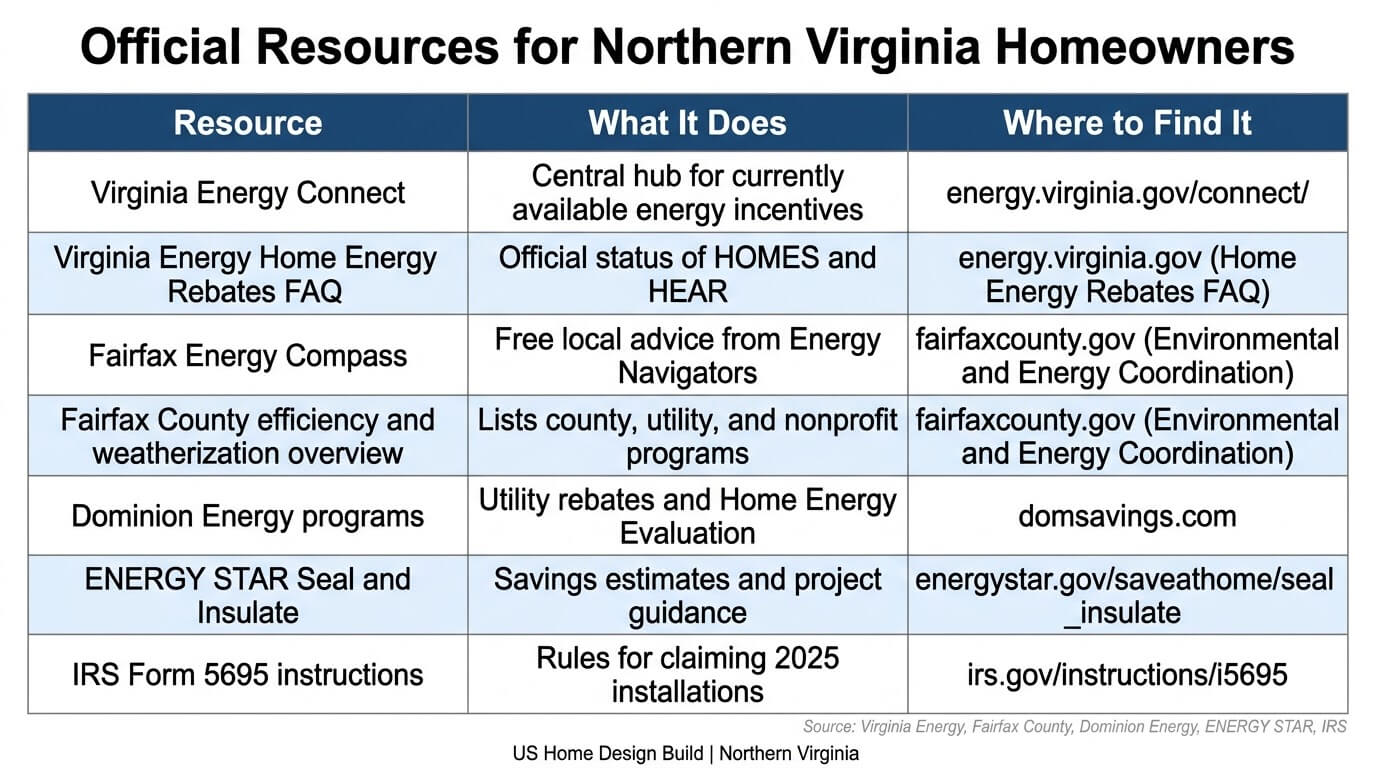
Utility territory matters more than county lines. Dominion Energy, Washington Gas, and local electric cooperatives run separate programs, and Fairfax County adds its own free Energy Compass advisory service for county residents.
As of December 2024, Fairfax County reported that more than 37,000 homes had been retrofitted for energy efficiency, against a goal of 100,000 retrofits by 2030, according to local news coverage of the county’s clean energy push. That figure is dated, so treat it as context rather than a current count.
Fairfax Energy Compass helps residents sort through home energy rebates Northern Virginia utilities and the county offer. Homeowners in Arlington County, Falls Church, Reston, Great Falls, and Burke should start with their electric and gas provider, then check their jurisdiction’s own energy resources. Fairfax County’s Office of Environmental and Energy Coordination overview lists county, utility, and nonprofit weatherization programs in one place.
Table 8: Official Resources for Northern Virginia Homeowners
What Should You Document Now to Be Rebate-Ready?
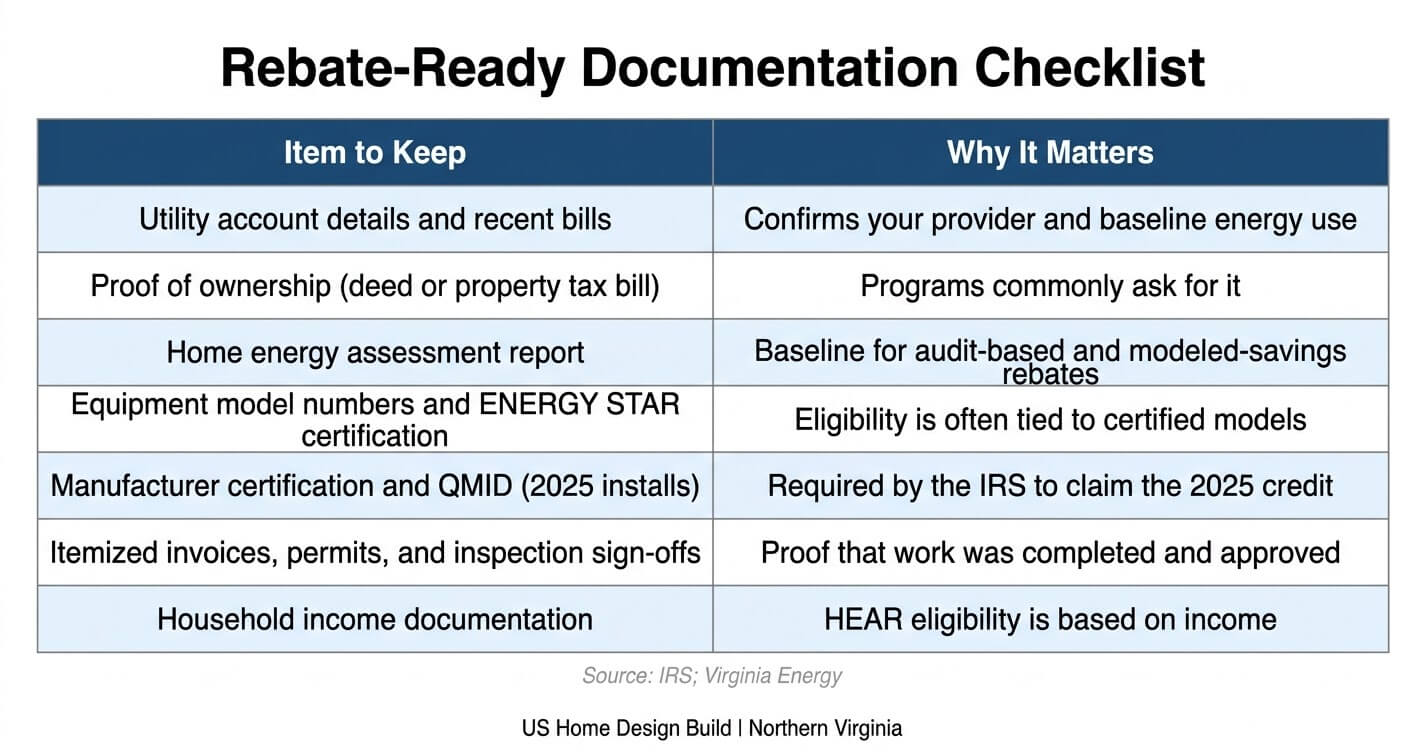
Keep proof of ownership, utility accounts, an energy assessment report, equipment model numbers, itemized invoices, and permit sign-offs. Programs are still being finalized, so complete records protect your options whichever way the rules land.
Table 9: Rebate-Ready Documentation Checklist
What Mistakes Cost Homeowners the Most on Energy Upgrades?
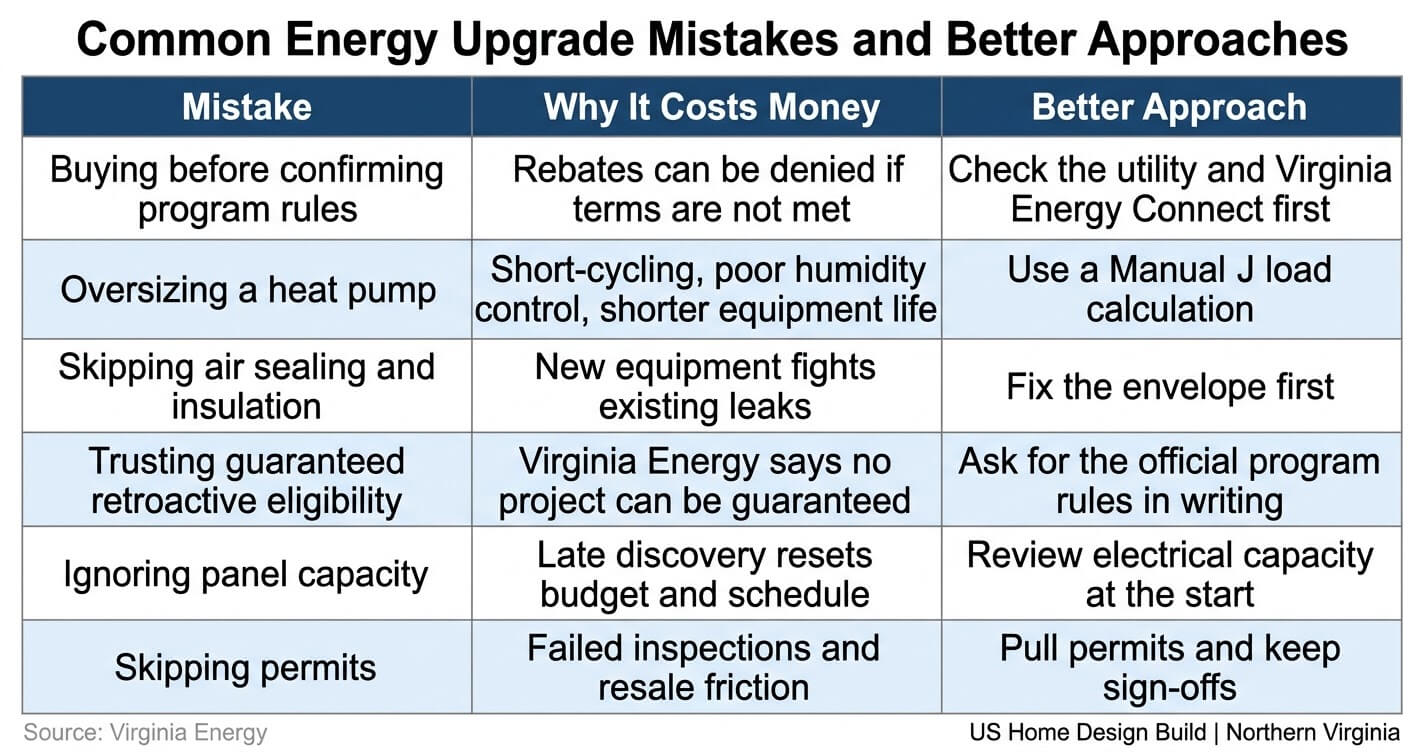
The costliest mistakes are buying before confirming program rules, oversizing equipment, skipping air sealing, and trusting guaranteed eligibility claims. Each one is avoidable with a short planning step before any contract is signed.
Table 10: Common Energy Upgrade Mistakes and Better Approaches
If you are choosing a contractor for this kind of work, our guide on how to choose a home renovation contractor in Northern Virginia lists the questions worth asking, including licensing and permit handling. For budget priorities, our best ROI home improvements in Northern Virginia guide shows how efficiency work compares with other projects.
Frequently Asked Questions
Are there still federal tax credits for energy-efficient home improvements in 2026?
No. The federal Energy Efficient Home Improvement Credit and Residential Clean Energy Credit ended for property placed in service or expenditures made after December 31, 2025. Installations completed in 2025 can still be claimed on a 2025 return using IRS Form 5695, so keep your invoices and manufacturer certification statements.
Has Virginia launched its home energy rebate programs yet?
No. The state portion of home energy rebates Northern Virginia homeowners expect has not opened. As of Virginia Energy’s October 13, 2026 update, neither HOMES nor HEAR is available, and the agency cannot give a launch date. It submitted updated application materials in September 2026, and launch depends on U.S. DOE approval.
How much is the Dominion Energy heat pump water heater rebate?
Dominion Energy lists $250 for a 40 to 59 gallon ENERGY STAR unit and $400 for 60 gallons or larger. The unit must replace an electric water heater, and you must be an eligible Dominion customer. Confirm current terms before buying.
Can I get a rebate if I install a heat pump before Virginia’s program opens?
Not for HEAR. Virginia Energy states that the Inflation Reduction Act does not authorize HEAR rebates for purchases made before launch, and HOMES timing is still under DOE review. No contractor can guarantee a retroactive rebate. If your system has failed, replace it now and use the utility incentives that exist today.
What energy-efficient upgrades should I do first in a Northern Virginia home?
Start with a home energy assessment, then air sealing and attic insulation. The EPA estimates average savings of 15% on heating and cooling costs from sealing and insulating. Next come duct repairs, a load calculation, and then heat pump or water heater upgrades.
Does Fairfax County offer free help with home energy upgrades?
Yes. Fairfax Energy Compass gives Fairfax County residents free advice from local Energy Navigators on home energy systems and available incentives. It serves decision-makers for single-family homes, including attached homes and mobile homes.
Do I need a permit for energy-efficient upgrades in Northern Virginia?
Often yes. Equipment replacements, new circuits, and panel upgrades generally require mechanical, plumbing, or electrical permits under Virginia’s building code. Rules and fees vary by jurisdiction, so check with your local building department before work starts. Your contractor should handle permits and inspections as part of the scope.
Conclusion: Plan Smart Around Home Energy Rebates Northern Virginia
The federal tax credits are gone, Virginia’s HOMES and HEAR rebates are pending, and utility and county programs are the options open today. The smartest plan fixes the envelope first, sizes equipment properly, documents everything, and avoids rebate promises that cannot be verified.
Home energy rebates Northern Virginia homeowners can use today are smaller and more utility-specific than the federal credits they replaced. That makes planning more important, not less. Start with an assessment, use the programs that are open, and keep records in case Virginia launches HOMES and HEAR with favorable timing rules.
Homeowners in Fairfax County, McLean, Vienna, Reston, Great Falls, and Burke can also read more on our blog as program details change. We will update this guide when Virginia Energy announces a launch.
Planning a similar project in Northern Virginia? Contact US Home Design Build to discuss your goals, budget, and timeline with our team.
