
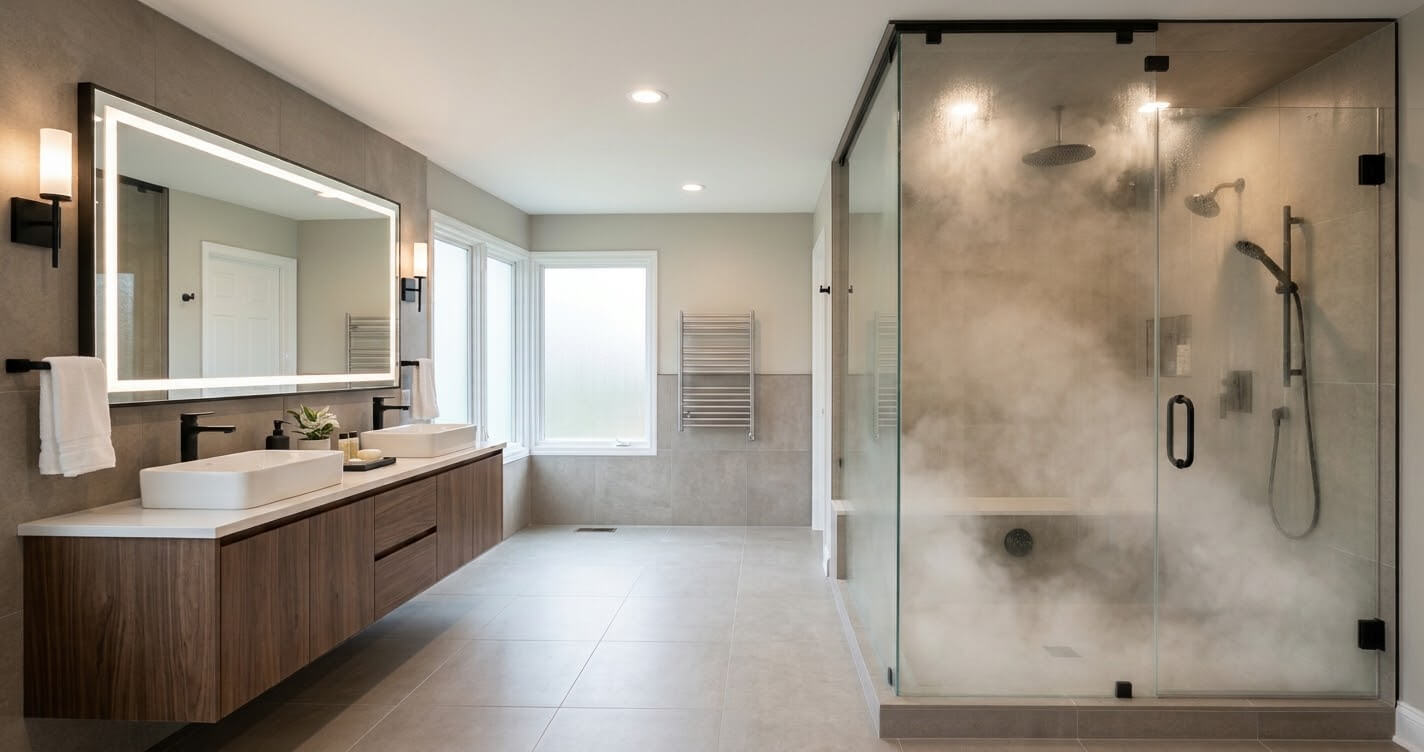
Steam shower installation Northern Virginia homeowners are planning in 2026 comes down to three questions: what it costs, which permits it needs, and whether your existing bathroom can physically support it. Many homeowners fall for the idea first and discover the electrical, waterproofing and ventilation requirements second. This guide answers all three questions in plain language so you can decide before you commit to a budget.
The demand is real. The National Kitchen & Bath Association (NKBA) 2026 Bath Trends Report, based on a survey of nearly 700 industry professionals, found that 55% say a larger shower matters more to clients than a bathtub. That shift leaves room for spa features such as steam, aromatherapy and built-in seating.
At US Home Design Build, our design-build team plans bathroom remodels for Northern Virginia homeowners in Fairfax County, McLean, Vienna, Reston, Great Falls and Burke. We treat a steam shower as a building-system decision, not a fixture upgrade. The shower, the electrical panel, the ceiling, the fan and the permit path all have to work together. For broader inspiration, see our guide to spa bathroom design ideas for Northern Virginia homes or explore our Bathroom Remodeling Services.
Quick answer: Steam shower installation Northern Virginia projects need a fully enclosed shower, a dedicated 240-volt circuit, vapor-rated waterproofing and a sealed ceiling. Expect roughly $9,000 to $20,000 to convert a suitable existing shower and $35,000 to $70,000 for a full bathroom remodel that includes steam. Electrical and plumbing permits are typically required in Fairfax County and Arlington County.
Key takeaways
- A steam shower is a sealed enclosure plus a generator, not just a shower head with a hot setting.
- Three checks decide feasibility: an enclosable shower, a place for the generator and spare panel capacity.
- Vapor-rated waterproofing and a sealed ceiling cause more failures than the generator itself.
- Plan on electrical and plumbing permits, and confirm which office covers your address before you apply.
What Is a Steam Shower and How Does It Work?
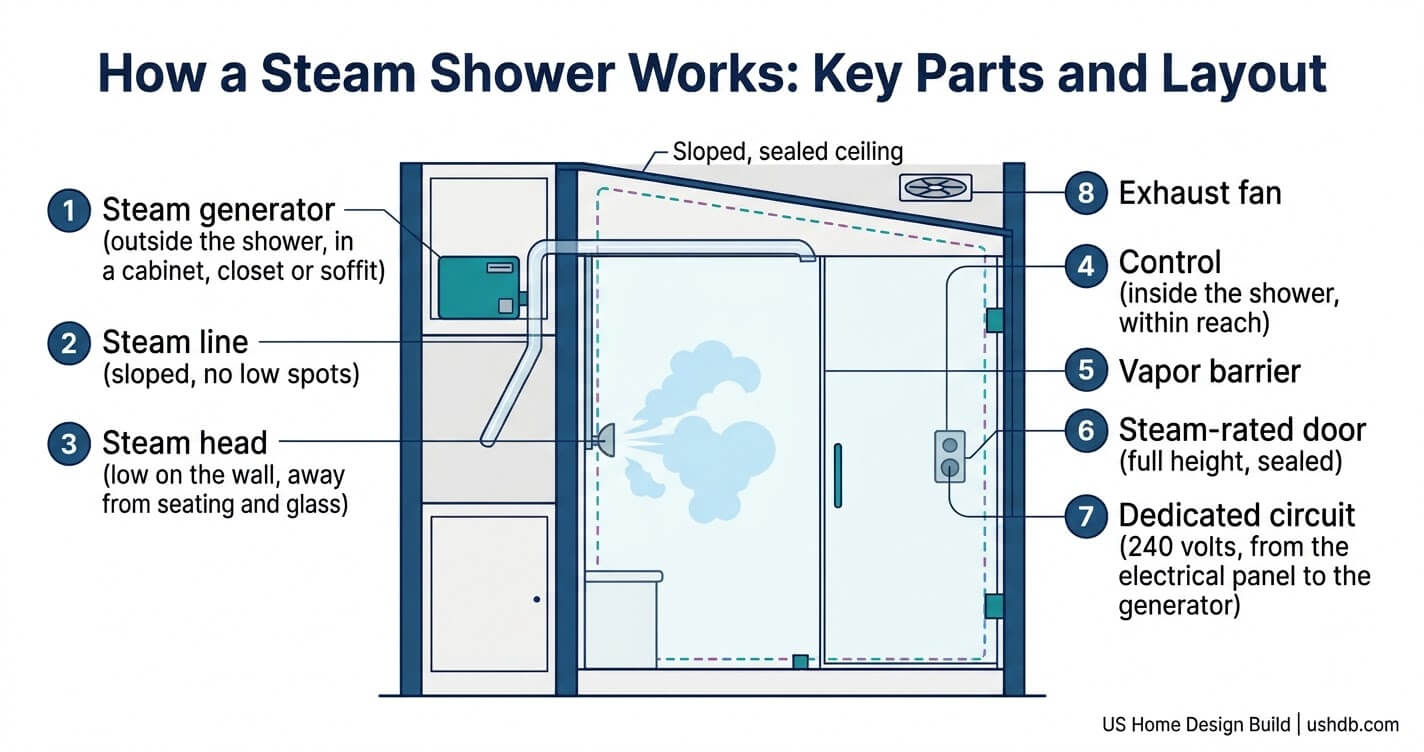
A steam shower is a fully sealed shower enclosure with a steam generator that boils water into vapor and releases it through a steam head. The generator sits outside the shower, usually in a closet, cabinet or soffit. The same enclosure still works as a normal shower when the steam is turned off.
A steam generator is an electric boiler. It draws cold water, heats it with an element and pushes vapor through a copper or approved steam line to a head mounted low on the shower wall. A digital control inside the shower sets the temperature and run time. Because the steam fills the whole enclosure, the room has to hold it in, which is why a steam shower is closer to a small steam room than to a regular shower.
This is also the key difference from a sauna. A steam shower delivers moist heat at lower temperatures, while a traditional sauna uses dry heat. The two have different build requirements, and a steam shower belongs in a wet room that is designed to take sustained moisture.
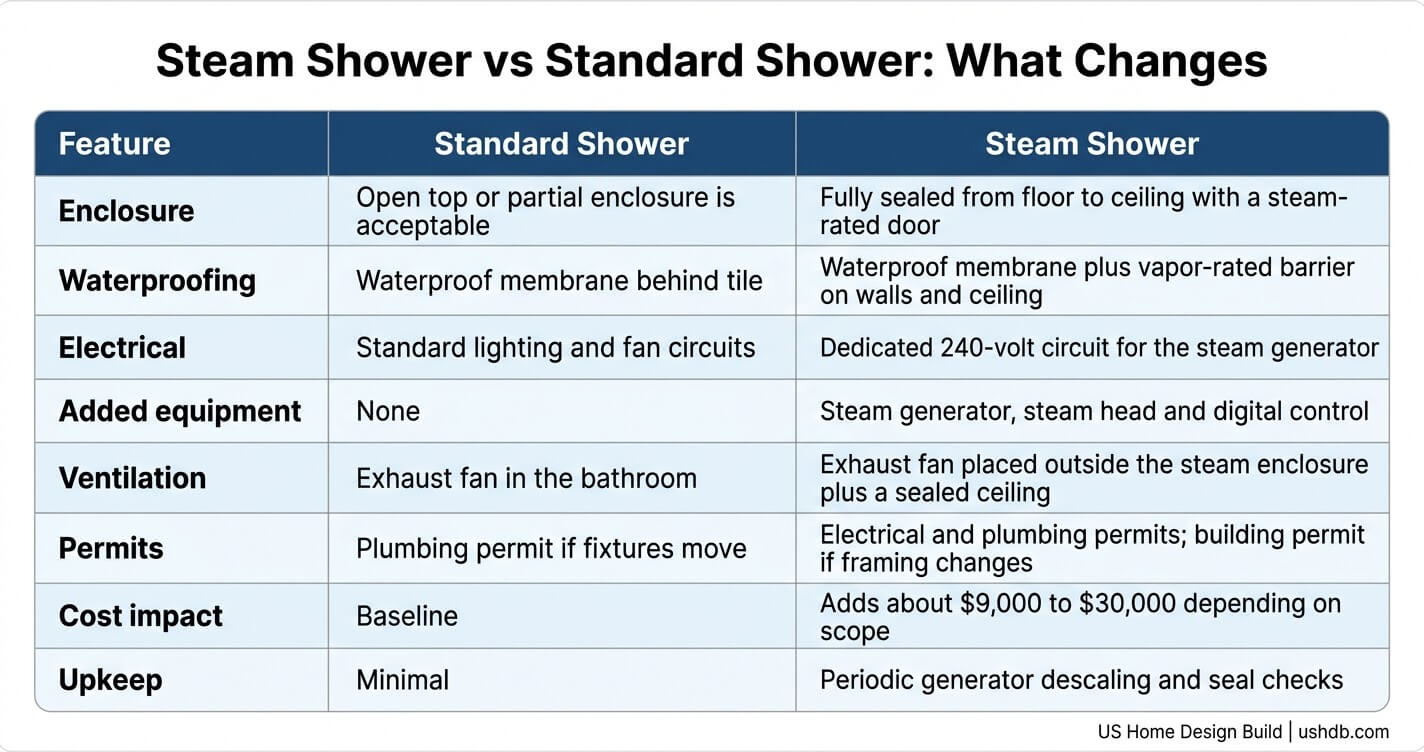
Table 1: Steam Shower vs Standard Shower: What Changes
Core components
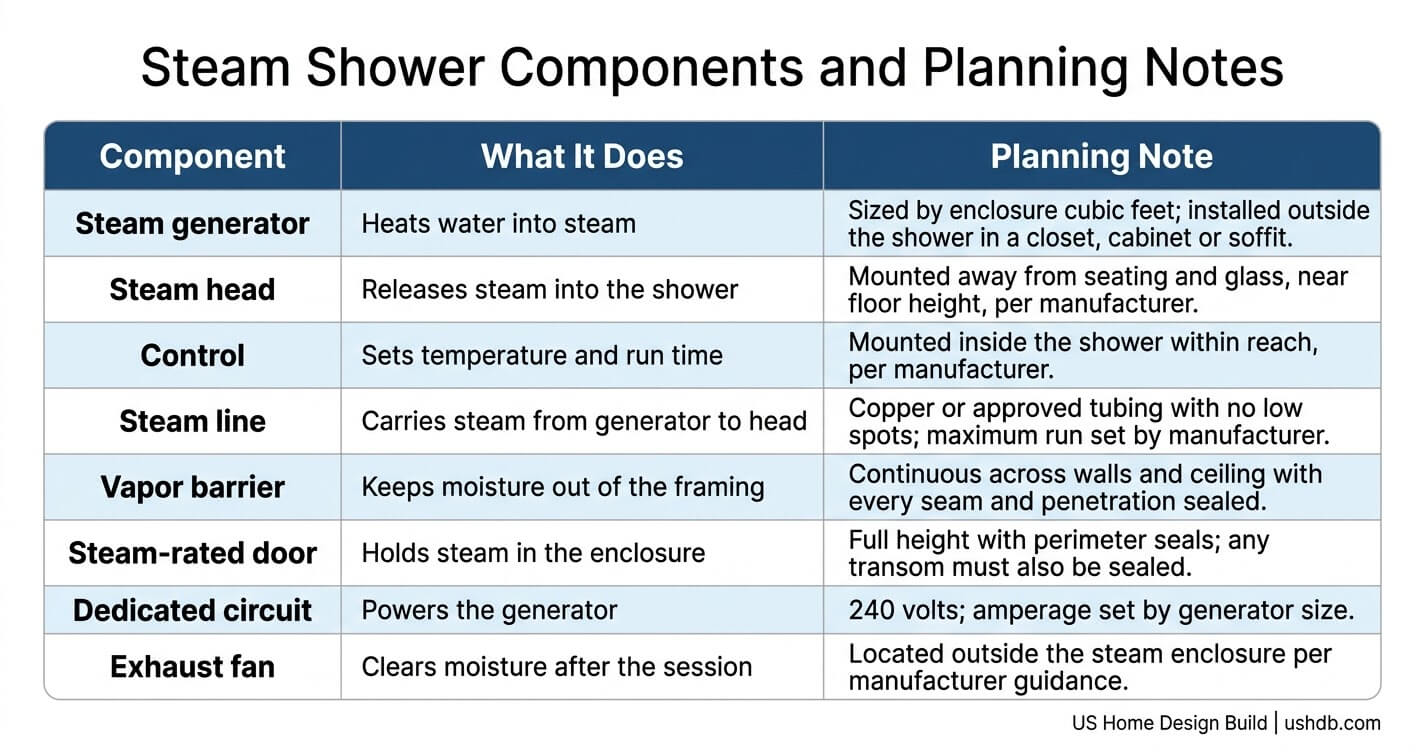
Every steam shower, regardless of brand, relies on the same eight parts. The table below shows what each part does and the planning note your design-build team should confirm before ordering.
Table 2: Steam Shower Components and Planning Notes
Can Your Bathroom Support a Steam Shower? Feasibility Checklist
Your bathroom can usually support steam shower installation Northern Virginia homeowners want if it has a shower that can be fully enclosed, space for a generator within the manufacturer’s steam-line limit and a panel with room for a dedicated 240-volt circuit. If any one of those three fails, the fix is possible but it changes the budget.
Enclosure and ceiling height
Steam rises and spreads, so an open-top or partially open shower will not hold it. The enclosure needs a full-height, steam-rated door with perimeter seals, and any transom has to be sealed as well. Ceiling height matters too. Generator manufacturers size their units for ceilings up to 8 feet and tell installers to move up a generator size for each additional foot, up to 10 feet.
Sizing the generator
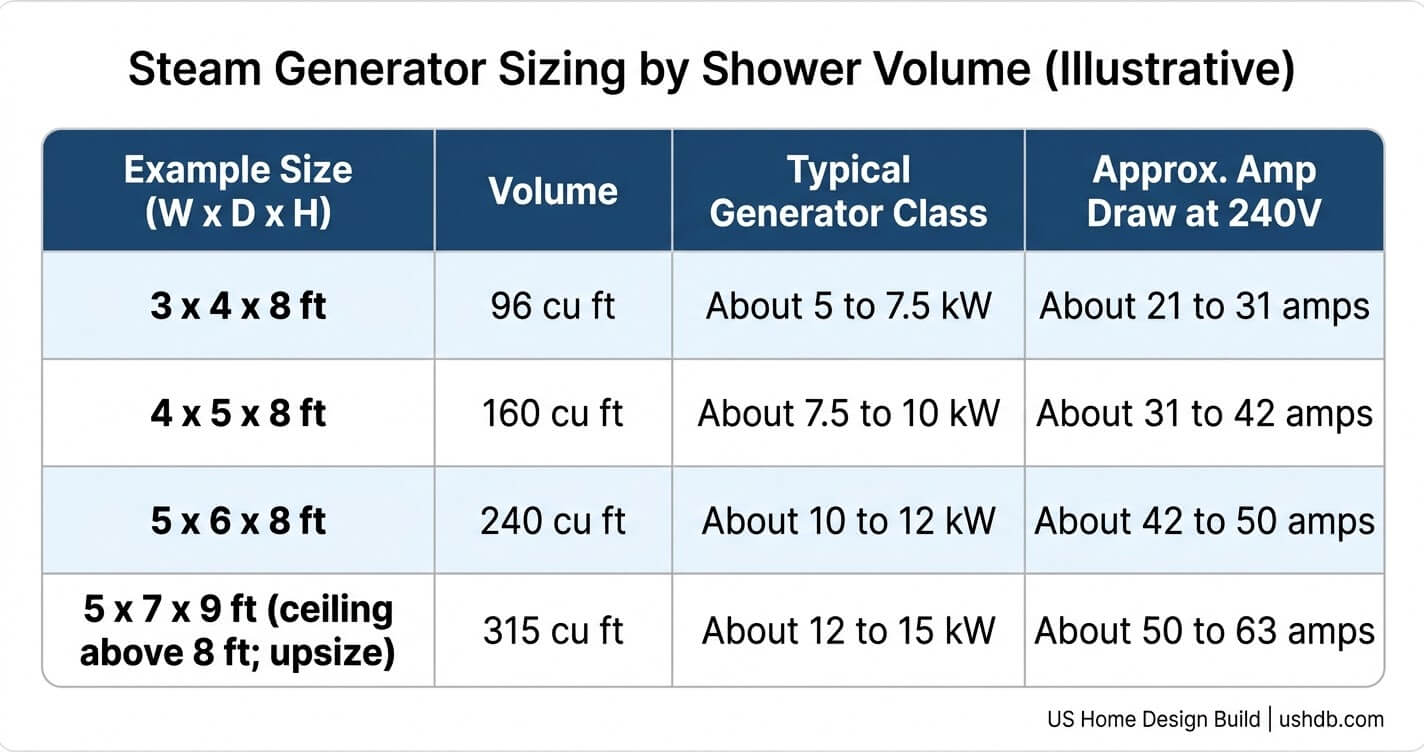
Generator size follows enclosure volume. Multiply length by width by height in feet to get cubic feet, then match that number to the manufacturer’s chart and adjust for dense materials such as stone and glass. The table below shows illustrative classes only. The manufacturer’s volume chart and installation manual always govern the final choice.
Table 3: Steam Generator Sizing by Shower Volume (Illustrative)
Electrical capacity
Every steam generator needs its own dedicated 240-volt circuit. Amperage equals watts divided by 240 volts, so a 7.5 kW generator draws about 31 amps and a 12 kW generator about 50 amps. The manufacturer’s manual sets the breaker and wire size. Large units can need more than one circuit: Kohler’s specification sheet for its 634-cubic-foot generator calls for two dedicated 240-volt, 60-amp circuits.
GFCI protection requirements differ by manufacturer and by inspector interpretation, so your electrician should confirm the rule for your exact unit before rough-in. Many older Northern Virginia homes, including mid-century ramblers in Annandale and Falls Church, still run 100-amp or 150-amp service. A panel load calculation tells you whether a new 240-volt circuit fits or whether a subpanel or service upgrade comes first.
Generator location, water and ventilation
The generator must sit outside the shower in a dry, accessible spot such as a vanity cabinet, closet or soffit, within the maximum steam-line run the manufacturer allows. It also needs a cold water supply and, on many models, a drain connection for automatic flushing. Hard water shortens generator life, so a softener or filter is worth discussing. Finally, the exhaust fan belongs outside the steam enclosure so it clears moisture when the door opens rather than pulling steam out while the session runs.
Condos and HOAs
In Arlington condominiums and many Northern Virginia townhome communities, association rules can decide the project before the building code does. Ask about contractor insurance requirements, approved work hours and whether new electrical circuits or exterior venting need a design-review approval.
Green, yellow and red light summary
Table 4: Can Your Bathroom Support a Steam Shower? Feasibility Checklist
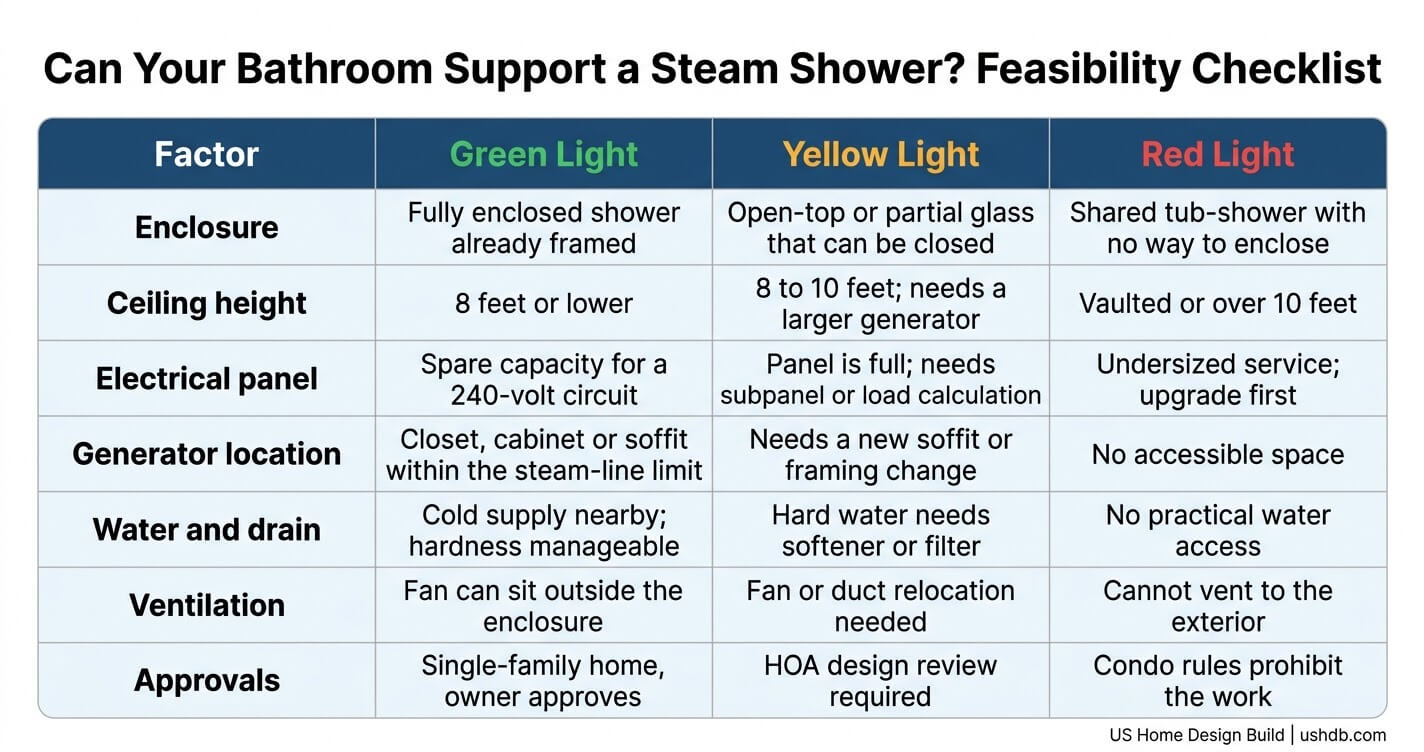
Example scenario (illustrative). Consider a 1990s two-story home in Burke with an enclosed 3-by-5-foot corner shower, an 8-foot ceiling and a 200-amp panel with open slots. That bathroom is close to a green light: the main work is vapor-rated waterproofing, the generator location and one new circuit. Now consider a mid-century Annandale rambler with a tub-shower combination and a full 100-amp panel. That bathroom needs panel work and a rebuilt enclosure before steam is even on the table.
If your bathroom is a red light, you still have options. Compare the tradeoffs in our guide to bathroom addition vs bathroom remodel in Northern Virginia, or look at a larger master suite addition or our bathroom addition contractors service when the existing footprint simply cannot support steam.
Steam Shower Installation Northern Virginia Cost in 2026
Steam shower installation Northern Virginia homeowners should budget for typically costs $9,000 to $20,000 to convert a suitable existing shower. When steam is built into a full remodel, it adds roughly $12,000 to $30,000, and a complete bathroom project often lands between $35,000 and $70,000. Luxury primary suites with custom stone and glass start around $75,000.
Cost depends on one question more than any other: is the existing shower already enclosed, correctly waterproofed and close to a panel with capacity? If yes, you are paying mostly for the generator, a circuit and steam-rated details. If no, you are paying to rebuild the shower first. These figures are planning ranges. Final pricing depends on the design, product selections and the conditions found behind the walls.
Table 5: Steam Shower Installation Cost Tiers in Northern Virginia (2026)
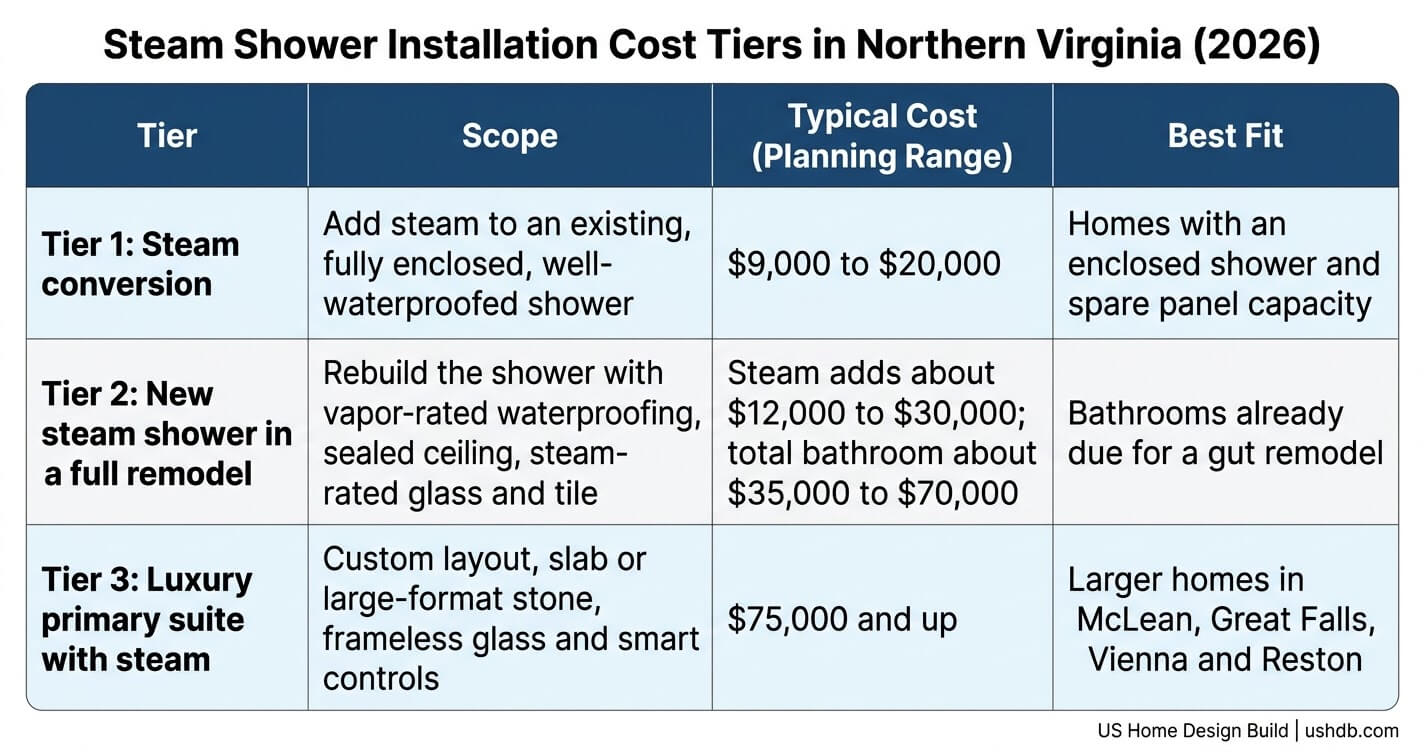
For a baseline on the surrounding remodel, our Bathroom Remodel Cost Fairfax County VA guide shows that a bathroom remodel typically runs from about $12,000 for a simple guest bathroom refresh to $70,000 or more. For the top end of the range, see our luxury bathroom remodel in Great Falls VA guide, which covers estate-level primary suites.
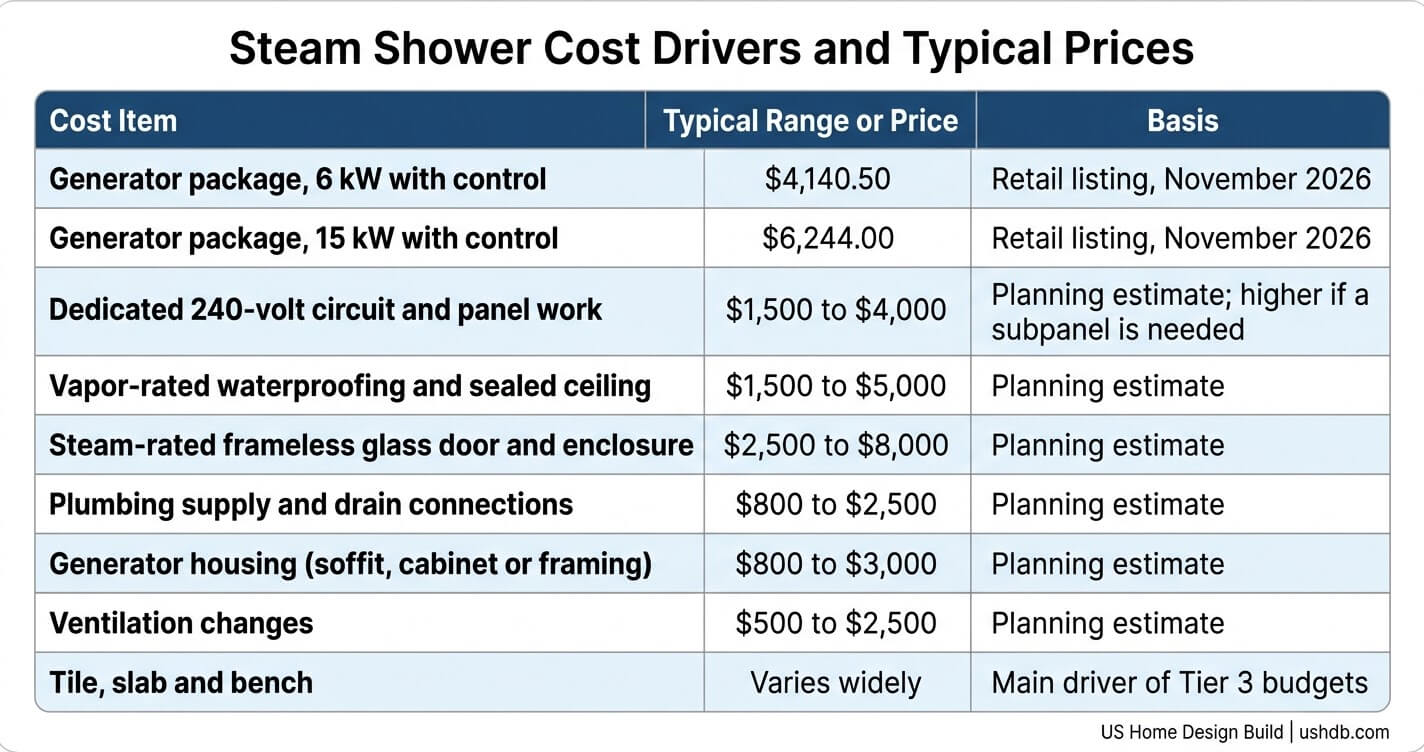
What drives the price
The generator is the most visible cost, and it is easy to verify. In November 2026, a national home improvement retailer listed a Mr. Steam 6 kW generator package with control at $4,140.50 and a 15 kW package at $6,244.00. Retail pricing changes, but it shows that equipment alone can reach several thousand dollars before electrical, waterproofing, glass and labor.
Table 6: Steam Shower Cost Drivers and Typical Prices
Five costs homeowners overlook
- Panel capacity. A full panel can turn a one-circuit job into a subpanel or service upgrade.
- Steam-rated glass. Full-height glass with perimeter seals costs more than a standard shower door.
- Vapor-rated ceiling detailing. The ceiling needs the same protection as the walls, including seams and light fixtures.
- Generator housing and access. A soffit or cabinet has to be framed so the unit can be serviced later.
- Ventilation changes. Relocating a fan or duct to sit outside the enclosure adds labor in finished spaces.
Ways to control cost
- Confirm panel capacity and generator location before choosing a shower layout.
- Reuse the existing shower footprint when it is already enclosed and correctly framed.
- Spend on waterproofing and vapor control first, because those are hard to fix after tile is set.
- Choose a generator size that matches the enclosure instead of buying the largest unit available.
- Finish tile and slab selections before demolition so glass and fixtures can be ordered on time.
Common cost mistakes
- Buying the generator before an electrician reviews the panel.
- Treating the shower as a standard wet area and skipping vapor-rated detailing.
- Leaving glass measurements until after tile, then waiting weeks for fabrication.
- Pricing only the equipment and ignoring permits, inspections and finishes.
Homeowners considering steam shower installation Northern Virginia projects may benefit from discussing panel capacity, generator placement and waterproofing with an experienced design-build team before finalizing budgets or timelines.
Our team can review these items alongside your full scope through our Bathroom Remodeling Services so the steam shower is priced as part of one coordinated plan.
Steam Shower Permits in Fairfax County and Nearby Jurisdictions
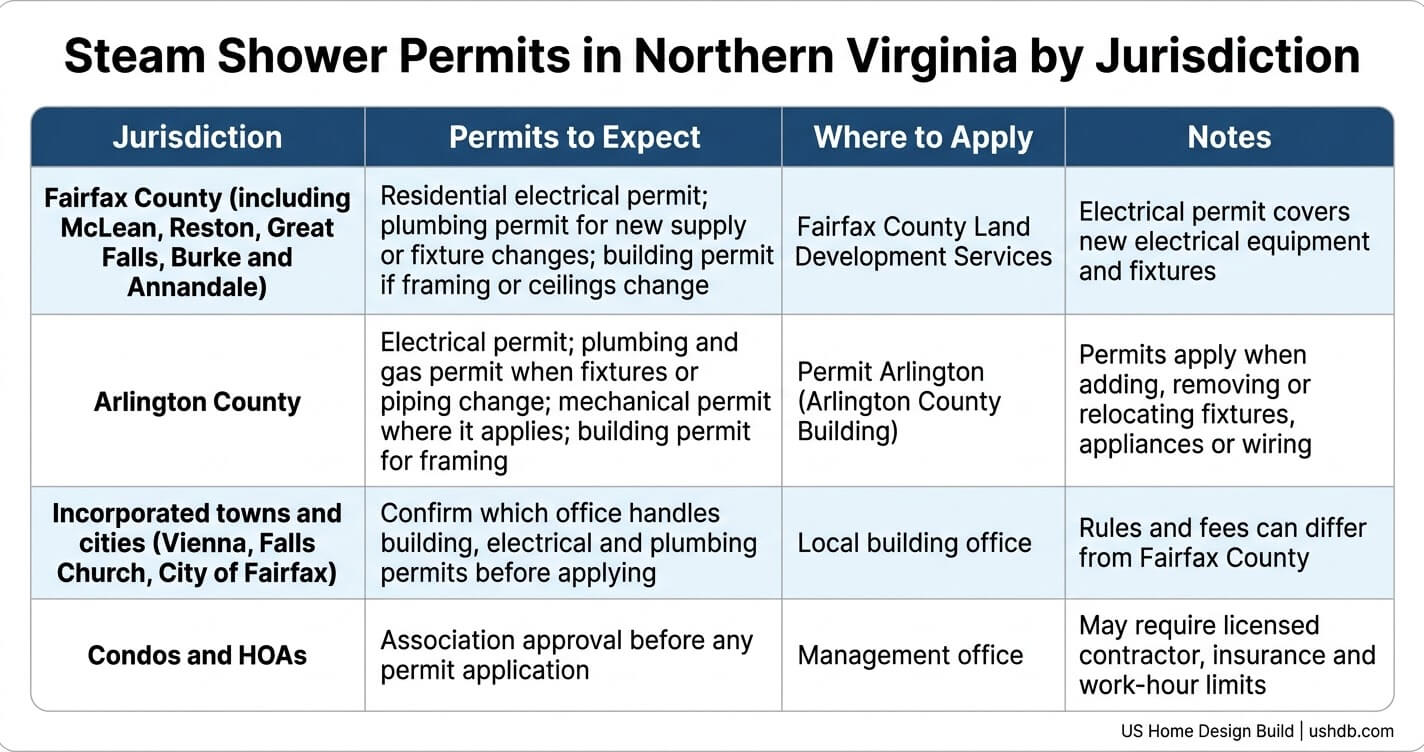
Steam shower installation Northern Virginia projects typically need an electrical permit and a plumbing permit, plus a building permit if walls, ceilings or framing change. Fairfax County and Arlington County issue these permits through separate offices, and incorporated towns and cities may use their own building departments.
Virginia’s building rules come from the Virginia Uniform Statewide Building Code, which is administered by the Virginia Department of Housing and Community Development and enforced by each local building department. Local offices handle applications, plan review and inspections.
Permit requirements by jurisdiction
Fairfax County’s Land Development Services states that a residential electrical permit is required for new residential service, new electrical equipment or fixtures, and the replacement of electrical equipment or fixtures. A steam generator circuit falls squarely under that language.
Arlington County’s Building office states that its electrical permit is required for adding, removing or relocating fixtures, appliances or wiring, and that its plumbing and gas permit applies when fixtures, appliances or piping are added, removed or relocated. Arlington also lists a separate mechanical permit for certain systems.
Table 7: Steam Shower Permits in Northern Virginia by Jurisdiction
The approval process
- Confirm which jurisdiction covers your address. An address with a Vienna, Falls Church or City of Fairfax mailing label may not be in the same permit office as a McLean or Reston address.
- Finalize the generator model so the electrician knows the exact amperage, breaker and wire size.
- Submit electrical and plumbing applications, plus a building application when framing or ceilings change. Your contractor normally files these.
- Respond to any plan review comments quickly, since incomplete specs are the most common cause of delay.
- Schedule rough inspections for electrical and plumbing before walls and ceilings are closed.
- Finish waterproofing and tile, then schedule final inspections.
Common permit mistakes
- Starting demolition before permits are issued.
- Assuming a plug-in or small circuit does not need review.
- Closing walls before rough inspections.
- Applying in the wrong jurisdiction because of a mailing city name.
- Hiring unlicensed trades, which can leave you without clean permit records at resale.
Rules and fees change, so verify current requirements with the local office before you apply. If you plan to sell, keep the permit records, final inspection approvals and manufacturer manuals together. Buyers and their inspectors may ask for them.
How a Steam Shower Is Built: Waterproofing, Ventilation and Layout
A steam shower is built around continuous vapor control, a sealed ceiling, correct steam-head placement and ventilation outside the enclosure. Most steam shower failures come from moisture reaching the framing through gaps, not from the generator. Getting these details right is what separates a steam shower that lasts from one that rots.
Waterproofing and vapor control
A standard shower membrane stops liquid water. A steam shower also has to control vapor that pushes through walls and ceilings. Every seam, corner, niche, valve penetration and ceiling transition needs the manufacturer’s banding and sealant. The Tile Council of North America (TCNA) publishes installation guidance for tile in steam rooms and showers, and installers should follow the current handbook method together with the membrane manufacturer’s steam-rated instructions.
Ceiling treatment
Condensation collects on the ceiling, so ceiling design matters. Saunafin’s steam room installation guidance calls for a ceiling slope of at least 2 inches per foot so that condensation runs to the walls instead of dripping on the bather. Guidance varies by manufacturer, so follow the instructions for your specific unit. Benches and ledges should also slope to shed water.
Steam head and control placement
Place the steam head low on the wall, away from seating and at a safe distance from glass. Do not mount it directly under the shower valve or under the control, because steam is hot enough to burn and can overheat nearby fittings. Keep the steam line free of low spots so condensation cannot trap water and block flow.
Door, glass and fixtures
Use a full-height, steam-rated door with perimeter seals and seal any transom. Specify light fixtures and trim rated for wet and steam locations, and seal the gaps where trim meets a curved or sloped ceiling.
Ventilation
Steam showers run longer than regular showers and can overload a standard fan. Place the exhaust fan outside the steam enclosure to clear moisture when the door opens. Some generator manufacturers advise against a fan inside the enclosure, so follow the manual. Rinsing the shower with cool water at the end of a session helps reduce the cloud that rolls out when the door opens.
Steam Shower vs Other Spa Bathroom Upgrades
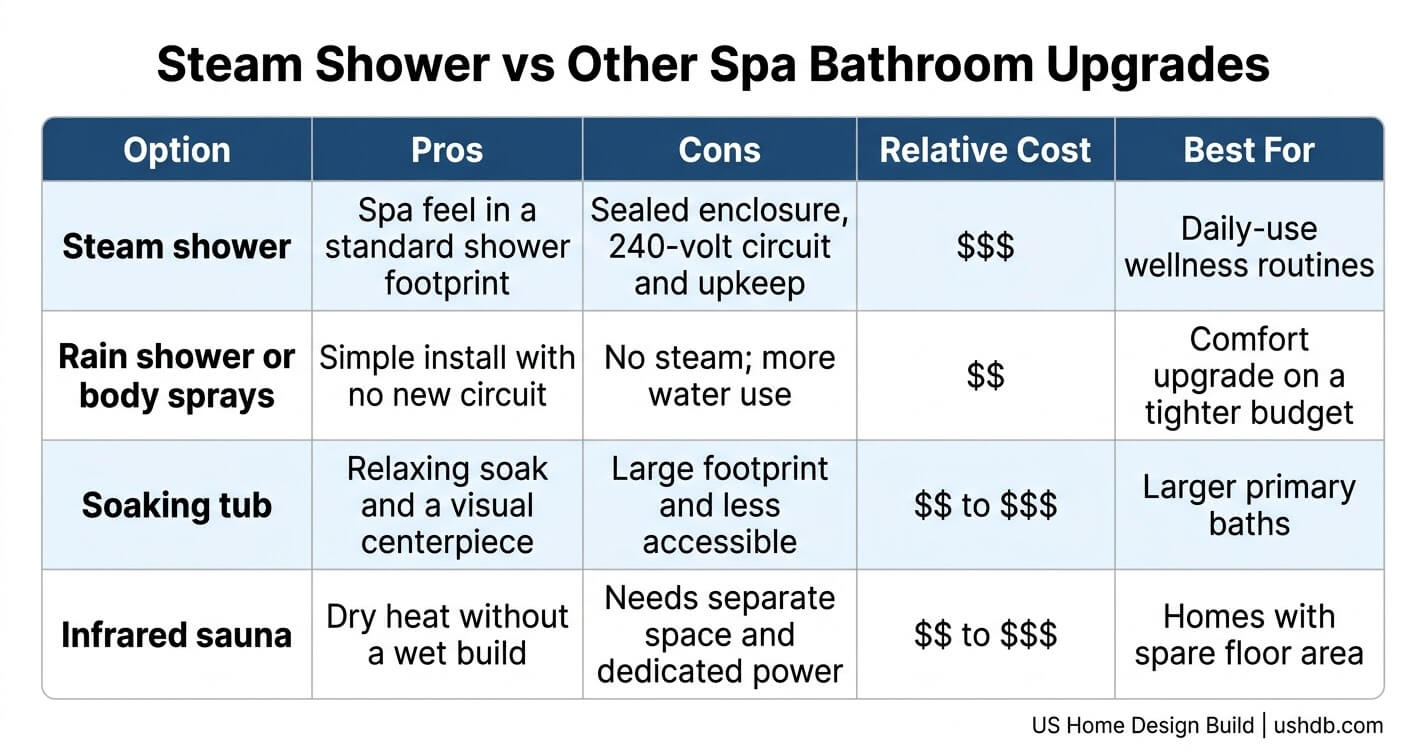
A steam shower is the strongest spa upgrade when you want daily wellness use inside a standard shower footprint. A soaking tub suits larger primary baths, a rain shower is the simplest budget upgrade, and an infrared sauna needs separate floor space. The right choice depends on space, budget and how you will actually use it.
If you are still deciding between a large shower and a tub, our guide to walk-in shower vs soaking tub in Northern Virginia covers the layout and accessibility tradeoffs in detail. For finishes, lighting and layout ideas that pair well with steam, see spa bathroom design ideas for Northern Virginia homes.
Table 8: Steam Shower vs Other Spa Bathroom Upgrades
Steam Shower Installation Timeline: From Design to Final Inspection
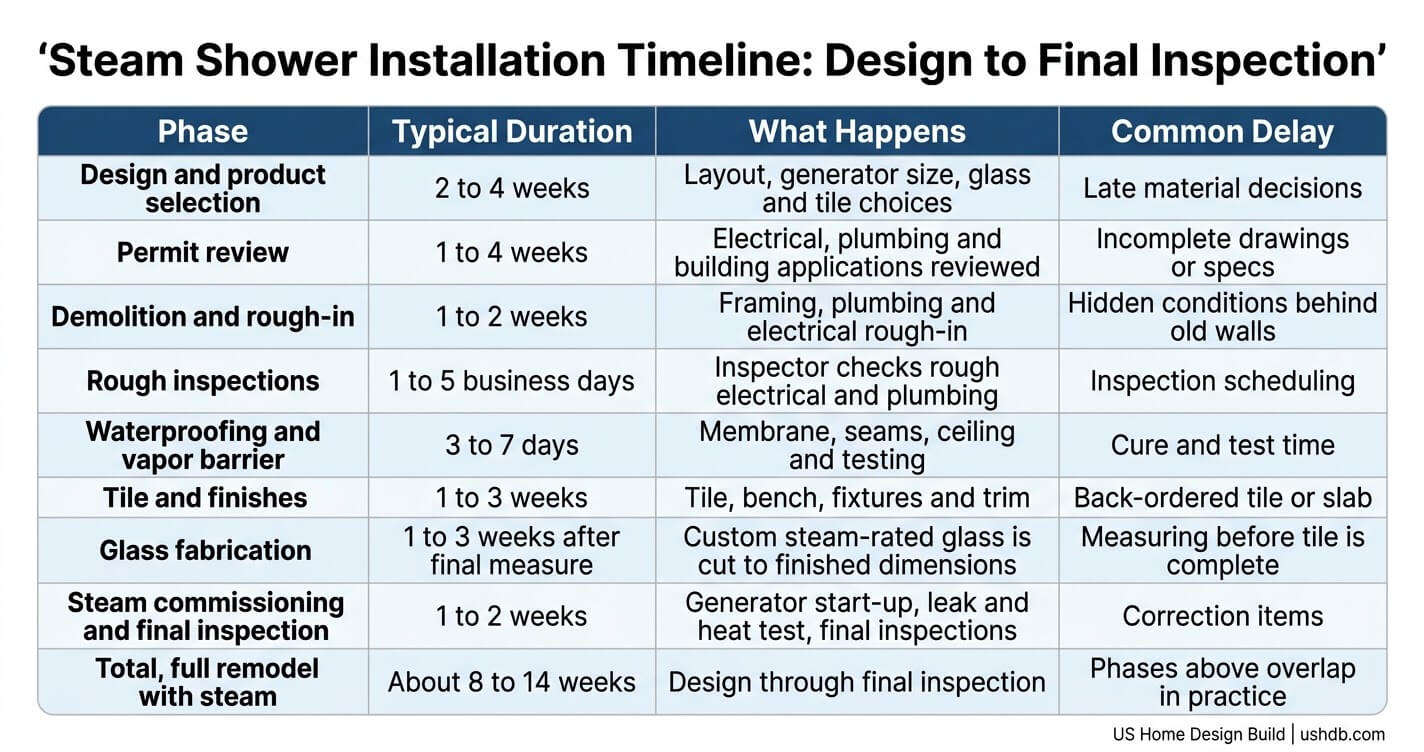
A full bathroom remodel that includes a steam shower typically takes about 8 to 14 weeks from design to final inspection. A simple conversion of an existing enclosed shower can take three to six weeks of construction once permits and materials are in hand. Permit review, generator lead time and custom glass are the most common schedule drivers.
The phases below overlap in practice. For example, glass cannot be measured until tile is finished, so ordering glass late can add weeks at the end of an otherwise smooth project. Ranges are planning estimates, not guarantees, and local permit timing varies by jurisdiction and application completeness.
Table 9: Steam Shower Installation Timeline: Design to Final Inspection
Is a Steam Shower Worth It? Maintenance, Running Costs and Tradeoffs
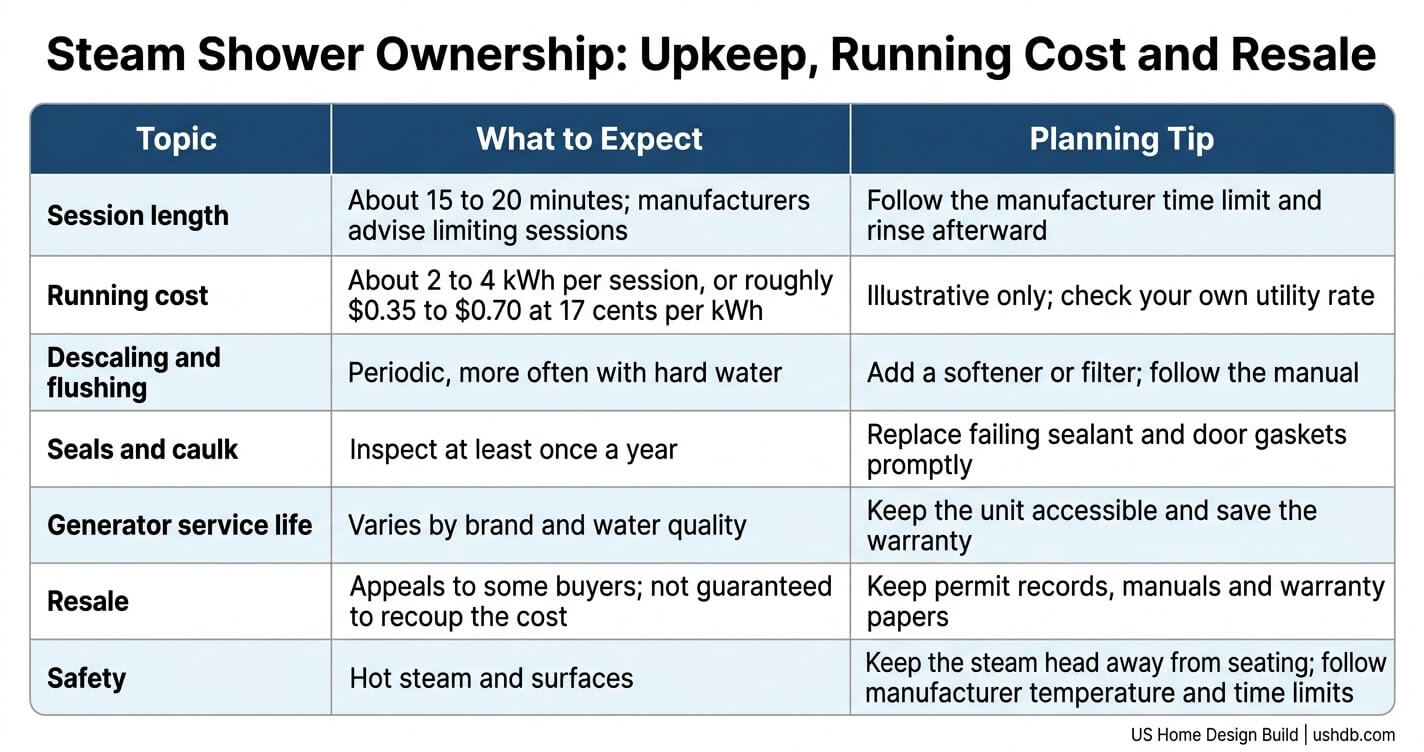
A steam shower is worth it if you will use it regularly and your bathroom can support it without major rebuilding. Running costs are modest, but upkeep is real: descaling, seal checks and generator care. Resale value is not guaranteed, so treat it as a lifestyle upgrade first.
Energy use is small compared with the installation cost. As an illustration, a session of about 15 to 20 minutes might use roughly 2 to 4 kWh depending on generator size and how often it cycles. At about 17 cents per kWh, that is roughly $0.35 to $0.70 per session. This is an illustrative estimate, not a measured figure. The U.S. Energy Information Administration publishes average residential electricity prices by state, and your own utility bill gives your exact rate.
Session length matters for safety. One retail buying guide advises limiting steam sessions to about 15 minutes to help prevent dehydration, avoiding use with a fever and drinking water before and after. Follow your manufacturer’s limits and talk with your doctor if you have health concerns.
Table 10: Steam Shower Ownership: Upkeep, Running Cost and Resale
How to Choose a Contractor for Steam Shower Installation in Northern Virginia
Choose a licensed contractor who can coordinate design, electrical, plumbing, waterproofing and permits as one plan. For steam shower installation Northern Virginia homeowners rely on, ask for proof of license, examples of permitted work and a written scope that names the generator, circuit and vapor-control system.
Verify any contractor’s Virginia license before signing. The Virginia Department of Professional and Occupational Regulation (DPOR) provides a license lookup for contractors and tradespeople.
A design-build firm keeps design, permits and construction under one team, which helps with a project where the electrician, plumber, tile setter and glass fabricator all depend on each other. Ask every contractor these questions:
- Who confirms panel capacity, and will the generator circuit be priced in the proposal?
- Which waterproofing and vapor-control system will be used on walls and ceiling, and who installs it?
- Which generator model and size are included, and how was it sized?
- Who pulls the electrical, plumbing and building permits, and which jurisdiction applies to my address?
- How will the generator be accessed for service, and who handles the warranty?
- When is glass measured, and how does that affect the schedule?
Frequently Asked Questions
How much does steam shower installation cost in Northern Virginia?
Steam shower installation in Northern Virginia typically costs $9,000 to $20,000 to convert a suitable existing shower, and adds about $12,000 to $30,000 when built into a full remodel.
Equipment alone can run several thousand dollars: one national retailer listed a 6 kW generator package at $4,140.50 and a 15 kW package at $6,244.00 in November 2026. Panel work, vapor-rated waterproofing, steam-rated glass and ventilation changes drive the rest.
Do I need a permit to install a steam shower in Fairfax County?
Yes, in most cases you need at least an electrical permit, because a steam generator needs a new dedicated 240-volt circuit. A plumbing permit applies if supply lines or fixtures change, and a building permit applies if framing or ceilings change.
Fairfax County Land Development Services requires a residential electrical permit for new electrical equipment and fixtures. Confirm your exact scope with the county before work begins.
Can I turn my existing shower into a steam shower?
Often yes, but only if the shower is fully enclosed, the ceiling can be sealed and the waterproofing can handle sustained vapor.
Many standard showers use a membrane that stops liquid water but not vapor, so a conversion can turn into a partial rebuild. Use the feasibility checklist in this guide to see whether your shower is a green, yellow or red light.
How much electrical power does a steam shower need?
A steam shower needs a dedicated 240-volt circuit sized to the generator. A 7.5 kW unit draws about 31 amps and a 12 kW unit about 50 amps.
The manufacturer’s manual sets the breaker and wire size, and some large units need two circuits. Kohler’s specification sheet for its 634-cubic-foot generator calls for two 240-volt, 60-amp circuits.
How long does steam shower installation take?
A conversion of an existing enclosed shower typically takes three to six weeks of construction after permits and materials are ready. A full remodel with steam usually takes about 8 to 14 weeks from design to final inspection.
Permit review, generator lead time and custom glass fabrication are the most common causes of delay.
Does a steam shower need special waterproofing?
Yes. A steam shower needs vapor control on walls and ceiling in addition to the usual waterproof membrane, with every seam and penetration sealed.
Follow the current Tile Council of North America handbook methods and the membrane manufacturer’s steam-rated instructions. tcnatile.com
Will a steam shower damage my bathroom if it isn’t built correctly?
Yes. If steam reaches the framing through gaps, it can cause mold, wood rot and failed finishes over time.
Most steam shower problems trace back to missing vapor control, unsealed ceiling transitions or poor ventilation, not the generator. Correct detailing at the start is much cheaper than repairing hidden moisture damage later.
How do I choose a contractor for steam shower installation in Northern Virginia?
Choose a licensed contractor who can show permitted work and manage design, electrical, plumbing, waterproofing and permits as one plan.
Check the license on the Virginia DPOR website, ask who pulls the permits and who sizes the generator.
Final Thoughts
Steam shower installation Northern Virginia homeowners can trust starts with three checks: an enclosure that can be sealed, space and capacity for the generator and circuit, and a clear permit path. If those three line up, steam is a practical upgrade. If not, a larger remodel or addition may be the better route.
Steam shower installation Northern Virginia projects reward planning more than almost any other bathroom upgrade. The cost range is wide, the permit path depends on your address and the waterproofing details decide whether the shower lasts. Use the feasibility checklist, confirm panel capacity early and match the generator to the enclosure. Our design-build team at US Home Design Build plans these projects across Fairfax County, McLean, Vienna, Reston, Great Falls, Burke and Arlington County. Costs, codes and product pricing change, so confirm current figures before you finalize a budget.
Planning steam shower installation in Northern Virginia? Contact US Home Design Build to discuss your goals, budget, and timeline with our team.
