
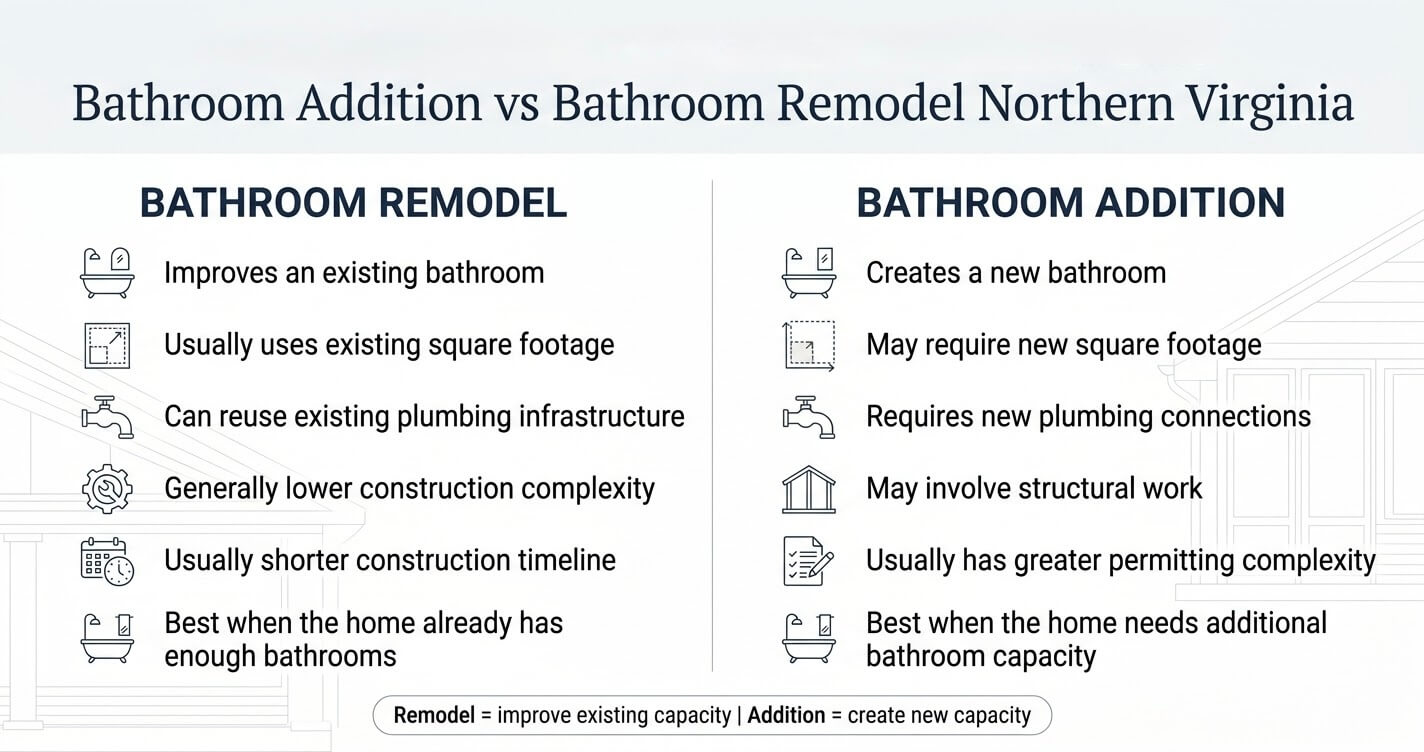
For most Northern Virginia homeowners, a bathroom remodel makes more financial sense when the existing bathroom count is adequate, while a bathroom addition becomes the stronger investment when the home genuinely lacks functional bathroom capacity. The difference comes down to more than construction cost: you also need to consider resale recovery, plumbing and structural complexity, permitting, project duration, and how much additional functionality your home actually needs.
The decision is particularly important in Northern Virginia, where renovation costs can vary significantly based on the home’s age, location, existing layout, labor requirements, and the extent of structural or plumbing work involved. In 2026, national remodeling activity remains substantial: Harvard University’s Joint Center for Housing Studies projects approximately $518 billion in homeowner spending on improvements and maintenance by the end of 2026.
For homeowners comparing a Bathroom Addition vs Bathroom Remodel Northern Virginia, however, national spending trends are only background context. The more useful question is what each project accomplishes inside your specific home.
A bathroom remodel improves an existing room without necessarily increasing the home’s bathroom count. Depending on the scope, it can involve replacing fixtures and finishes, rebuilding the shower, changing the vanity, upgrading lighting and ventilation, or substantially reconfiguring the existing space. US Home Design Build’s bathroom remodeling services in Northern Virginia cover projects ranging from functional upgrades to complete bathroom transformations.
A bathroom addition is fundamentally different. It creates a new bathroom where one did not previously exist, which can require new plumbing and drainage connections, electrical work, HVAC considerations, structural modifications, and potentially additional conditioned square footage. In Fairfax County, for example, the county explicitly identifies new additions to existing homes and interior bathroom renovations as projects that require permits, while certain like-for-like finish replacements can be exempt.
There is also an important financial distinction. The 2025 Zonda Cost vs. Value Report puts the national average cost of a midrange bathroom remodel at $26,138, with $20,915 in resale value recovered, or approximately 80%. A midrange bathroom addition averaged $60,645 and recovered $32,347, or approximately 53%. These are national benchmarks rather than Northern Virginia-specific projections, but they provide a useful starting point for understanding the relative economics of the two project types.
That does not mean adding a bathroom is a poor investment. A home with four bedrooms and only one full bathroom has a fundamentally different functional problem from a home with three bedrooms and two-and-a-half bathrooms. In the first situation, adding bathroom capacity can solve a genuine deficiency that a cosmetic remodel cannot address.
The right decision, therefore, is not simply “Which project has the higher ROI?” It is “Which project solves the homeowner’s actual problem at a cost that makes sense for the property?”
Bathroom Addition vs Bathroom Remodel: Quick Comparison Table
A bathroom remodel generally offers the lower upfront cost, shorter construction path, and stronger percentage of cost recovery, while a bathroom addition provides something a remodel cannot: an entirely new bathroom. The better option depends primarily on whether the home’s existing bathroom capacity is adequate.
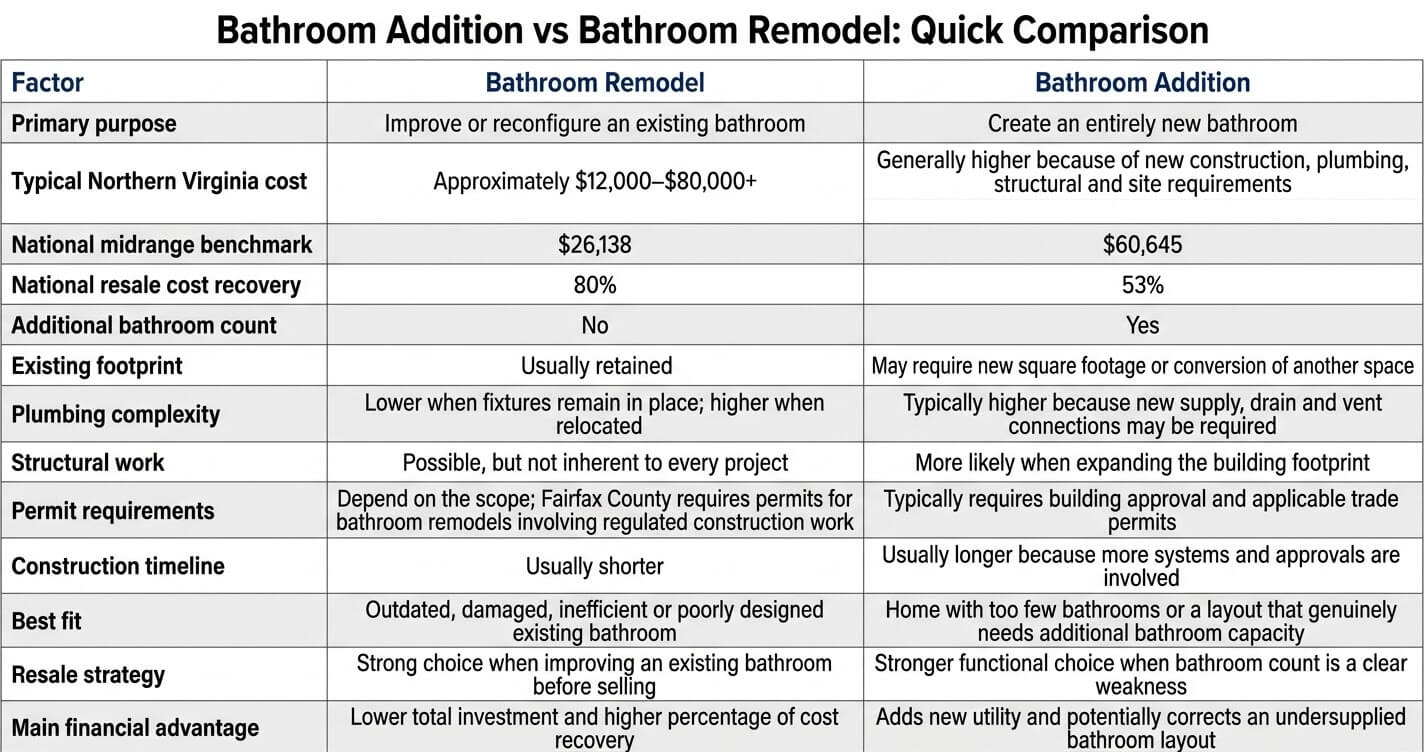
The cost comparison requires an important qualification. US Home Design Build’s current Northern Virginia bathroom cost guide places a typical bathroom remodel at approximately $12,000–$25,000 for a small bathroom, $25,000–$45,000 for a midrange remodel, and $45,000–$80,000+ for a high-end renovation.
For a more detailed understanding of the remodeling side, homeowners can review the Bathroom Remodel Cost in Northern Virginia guide, which breaks costs down by bathroom size, finish level, and project scope.
The addition side is harder to reduce to a single per-bathroom number because the cost depends heavily on where the new bathroom goes and how much new construction is required. A bathroom created inside an existing unfinished space can have a very different cost structure from a bathroom attached to the exterior of a home.
For example, US Home Design Build’s Home Addition Cost Fairfax County VA guide currently places basic-to-midrange ground-floor additions at approximately $150–$350 per square foot, with second-story additions generally running approximately $250–$500+ per square foot in 2026.
That distinction matters when comparing the two projects. A bathroom remodel primarily spends money inside an existing envelope. A true addition may require you to pay for some combination of new foundation, framing, exterior walls, roofing, insulation, windows, HVAC extension, electrical distribution, plumbing, and interior finishes before you even reach the bathroom fixtures.
The ROI numbers need context
The 2025 Zonda Cost vs. Value data is particularly useful because it compares standardized project types rather than arbitrary contractor estimates. Nationally, the midrange bathroom remodel benchmark is $26,138 in cost, $20,915 in recovered resale value, and 80% cost recoupment. The midrange bathroom addition benchmark is $60,645 in cost, $32,347 in recovered resale value, and 53% cost recoupment.
These numbers should not be interpreted as a guarantee that a Northern Virginia homeowner will recover exactly 80% or 53% of a project. Actual resale impact depends on the local housing market, neighborhood norms, property condition, bathroom count, quality of construction, and the specific buyer pool.
In other words, ROI is one decision variable, not the decision itself.
A homeowner with two functional bathrooms may have little reason to spend $60,000 or more creating another one simply because additional square footage sounds valuable. Conversely, a four-bedroom home with one full bathroom may have a genuine functional limitation that a $30,000 remodel of that same bathroom cannot solve.
What’s the Real Difference Between a Bathroom Addition and a Bathroom Remodel?
A bathroom remodel improves an existing bathroom within its current footprint or substantially reworks that existing space, while a bathroom addition creates new bathroom capacity that did not previously exist. The distinction affects plumbing, structural work, permitting, square footage, schedule, and ultimately the project budget.
The simplest way to understand the difference is to ask one question:
Are you improving an existing bathroom, or are you creating another bathroom?
If the answer is the first, you are generally looking at a remodel. If the answer is the second, you are dealing with an addition, even if the new bathroom is relatively small.
What happens during a bathroom remodel?
A bathroom remodel starts with an existing bathroom and changes some or all of its components.
A limited renovation might replace a vanity, countertop, toilet, flooring, lighting, or plumbing fixtures while leaving the underlying layout largely untouched. A full remodel can go much further, including demolition to the framing, new waterproofing, replacement of the shower or tub, new tile, updated electrical circuits, ventilation improvements, cabinetry, and plumbing changes.
The critical technical distinction is that the existing bathroom infrastructure already exists.
The room already has a defined location for the water supply, drain and waste system, electrical service, ventilation path, and finished-floor elevation. Even when those systems are upgraded, the contractor is working within an established building envelope.
That can make the project more predictable, particularly when the new fixtures remain close to their existing locations.
However, “remodel” does not automatically mean “simple.”
Moving a toilet several feet can require new drain routing. Relocating a shower can require changes to supply lines, waste lines and waterproofing. Moving walls can trigger structural considerations, while new lighting or outlets can require electrical modifications.
Fairfax County’s Land Development Services specifically lists bathroom remodels and interior alterations among residential projects requiring permits. The county also identifies new, repaired or relocated plumbing fixtures as permit-triggering work, while direct replacement of certain existing finishes, such as bathroom countertops, vanity, tile and flooring, can fall within listed permit exemptions when the work does not involve regulated alterations.
For homeowners planning a project in Fairfax County, the Fairfax County remodeling permit guide can provide additional project-planning context.
What happens during a bathroom addition?
A bathroom addition starts with a different objective: create a bathroom where there was not one before.
That could mean:
- Building an extension onto the exterior of the house
- Converting part of an unfinished basement
- Converting a large closet or unused room
- Creating a new bathroom within a bedroom suite
- Reconfiguring existing square footage to carve out a new bathroom
- Adding a bathroom as part of a larger home addition
Not every bathroom addition requires a new exterior footprint.
This is an important distinction for Northern Virginia homeowners. If an existing unfinished area already provides adequate floor area, ceiling height, access, and suitable building conditions, creating a bathroom there may be possible without constructing an exterior addition. The project would still require careful evaluation of plumbing, electrical, ventilation, waterproofing, structural conditions and applicable code requirements.
A true footprint expansion is more involved.
Once the bathroom extends beyond the existing exterior walls, the project becomes part of a larger addition construction process. Foundation or footing requirements, exterior wall construction, roof integration, insulation, weatherproofing, windows, HVAC and site considerations can all enter the equation.
Fairfax County’s permit guidance explicitly identifies new additions to existing homes as permit-required residential projects. The county also separates building permits from trade permits covering electrical, mechanical and plumbing work, depending on the project’s scope.
Why plumbing location matters so much
One of the biggest technical differences between an addition and a remodel is the amount of new plumbing infrastructure required.
Bathrooms are unusually infrastructure-intensive rooms. A new toilet requires a properly sized waste connection and venting arrangement. Showers and sinks require hot and cold water supplies and drainage. The bathroom also needs adequate ventilation and electrical service, while the finished floor, waterproofing system and wall assemblies must accommodate those penetrations without creating moisture problems.
When a remodel keeps the toilet, shower and sink relatively close to their existing locations, the project can often reuse portions of the existing infrastructure.
When a new bathroom is placed far from the existing plumbing core, the design team may need to determine:
- Where the new supply lines can be routed.
- Where the new waste and vent connections can connect to the existing system.
- Whether the existing drain configuration can support the new fixtures.
- Whether floor or wall assemblies need to be opened.
- Whether new plumbing penetrations affect structural framing.
- Whether additional mechanical ventilation is required.
- Whether electrical service and circuits need to be extended or modified.
Fairfax County’s residential plumbing guidance states that permits are required for new sewer or water connections, disconnections, and the installation, replacement or repair of plumbing equipment and fixtures.
That is why a bathroom addition should not be priced simply by multiplying bathroom square footage by a generic construction rate.
Existing footprint vs. new square footage
The physical footprint is another major dividing line.
A remodel generally works with the square footage you already have. The challenge is to make that space perform better.
An addition creates or reallocates additional usable space. That means the project can solve a problem that remodeling cannot, for example, a home with four bedrooms and only one full bathroom may need more bathroom capacity, not a more attractive version of its existing bathroom.
This is where homeowners sometimes make the wrong comparison.
If the underlying problem is “Our bathroom is ugly,” remodeling is usually the logical starting point.
If the problem is “Four people are sharing one bathroom every morning,” a remodel may improve the room, but it does not increase capacity.
And if the problem is “Our primary bedroom has no private bathroom,” an addition or conversion may provide substantially more functional value than replacing tile and fixtures in the existing hall bathroom.
The practical decision
The difference between the two projects can therefore be summarized in one sentence:
A remodel changes the quality, functionality or configuration of an existing bathroom; an addition changes the home’s bathroom capacity.
That distinction should come before discussions about tile, countertops, shower systems or fixtures.
For homeowners considering the project from both a construction and financial perspective, the next question is therefore not simply which option costs less. It is how much each option will cost in the specific Northern Virginia market and what that investment actually accomplishes for the property.
That is where local project scope, plumbing conditions, home value, neighborhood expectations and the difference between existing-space renovation and new construction become especially important.
Bathroom Addition Cost vs Bathroom Remodel Cost in Northern Virginia
In Northern Virginia, a bathroom remodel typically costs less than creating a new bathroom because the remodel can reuse the existing room, building envelope, and much of the plumbing infrastructure. A new bathroom becomes substantially more expensive when it requires new square footage, foundation work, structural framing, or long plumbing and mechanical runs.
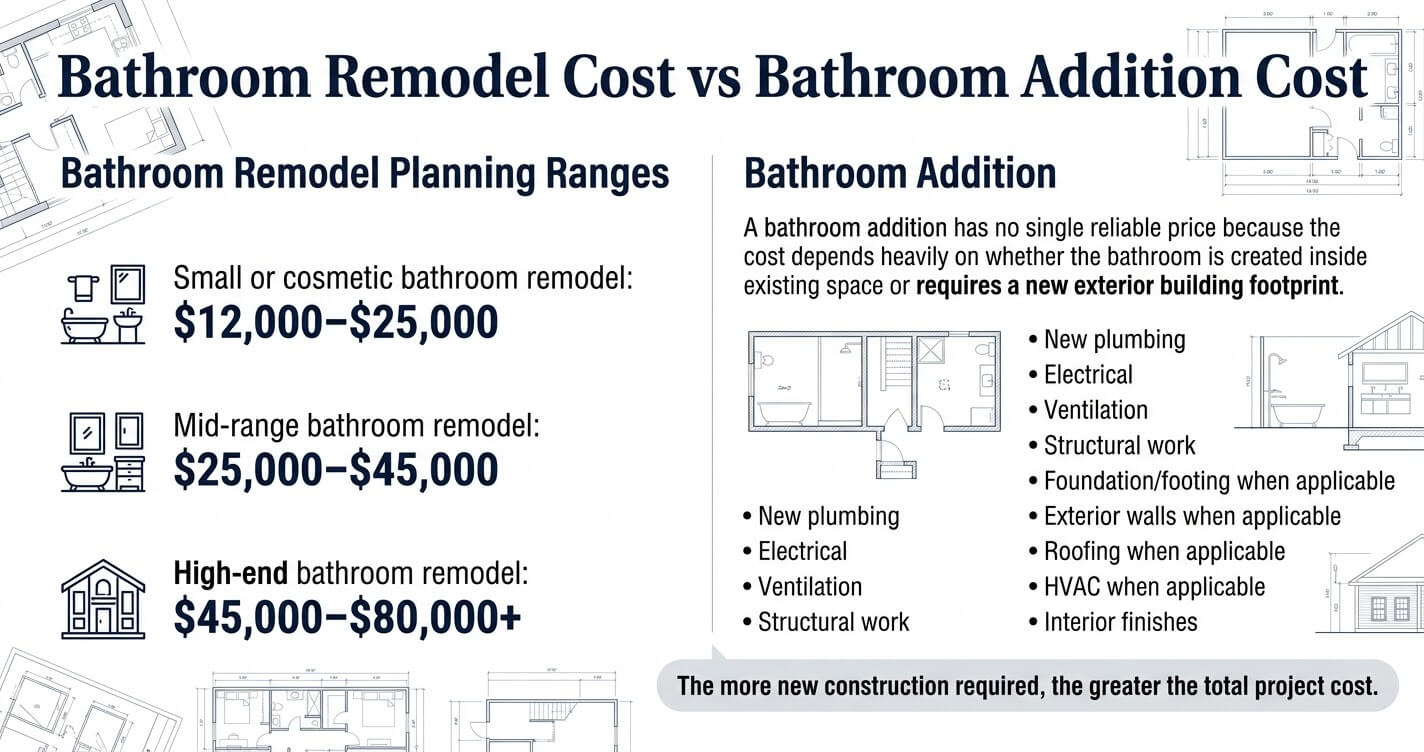
For 2026 planning purposes, US Home Design Build’s Northern Virginia cost guide places a typical bathroom remodel in three broad tiers:
- Small or cosmetic bathroom remodel: approximately $12,000–$25,000
- Mid-range bathroom remodel: approximately $25,000–$45,000
- High-end bathroom remodel: approximately $45,000–$80,000+
These are planning ranges rather than fixed bids. The actual price depends on the bathroom’s size, existing conditions, finish selections, accessibility requirements, and, most importantly, whether the layout and plumbing are being changed.
For the detailed local breakdown, homeowners can review Bathroom Remodel Cost in Northern Virginia, which separates pricing by project scope, bathroom type, and finish level.
Bathroom addition costs are more difficult to standardize
A bathroom addition does not have one reliable “per bathroom” price because the construction method can vary dramatically.
A new bathroom created inside an existing unfinished area is fundamentally different from a bathroom built as part of an exterior addition.
For example, converting an existing portion of a basement or oversized room may require:
- Interior framing
- Plumbing supply and drainage
- Electrical circuits and fixtures
- Mechanical ventilation
- Waterproofing
- Flooring and wall finishes
- New doors or windows where required
- Potential structural modifications
An exterior bathroom addition can require all of those items plus a new foundation or footing system, exterior walls, insulation, siding or masonry, roofing, windows, HVAC extension, and the structural connection between the old and new portions of the house.
That distinction is why homeowners should be cautious when comparing a contractor’s bathroom-remodel quote with a generic “bathroom addition cost” found online.
US Home Design Build’s 2026 Fairfax County addition guide currently places ground-floor home additions at approximately $150–$350 per square foot, while second-story additions generally run approximately $250–$500+ per square foot. The guide notes that plumbing, structural complexity, site conditions, and finish level can move a project toward the upper end of those ranges.
Homeowners considering a footprint expansion can use the Home Addition Cost Fairfax County VA guide as a broader planning reference.
A bathroom addition can be expensive even when the bathroom itself is small
This is one of the most important budgeting concepts in the Bathroom Addition vs Bathroom Remodel Northern Virginia decision.
A 60-square-foot bathroom does not necessarily cost 60 square feet × a bathroom construction rate.
Some project costs are relatively fixed regardless of bathroom size.
The contractor still has to establish a construction area, obtain the necessary approvals, connect plumbing and electrical systems, install ventilation, complete inspections, waterproof the room, and coordinate multiple trades.
If the bathroom is part of a new exterior addition, the homeowner may also be paying for the building shell around that bathroom.
For example, a 100-square-foot bump-out containing a bathroom might require foundation work, framing, roofing, siding, insulation, windows, HVAC and utility connections. Much of that expenditure exists because the building is being expanded, not because the bathroom has expensive tile.
This is why a homeowner should evaluate the cost of the entire construction scope, rather than assuming the bathroom fixture package represents most of the budget.
Local market differences matter
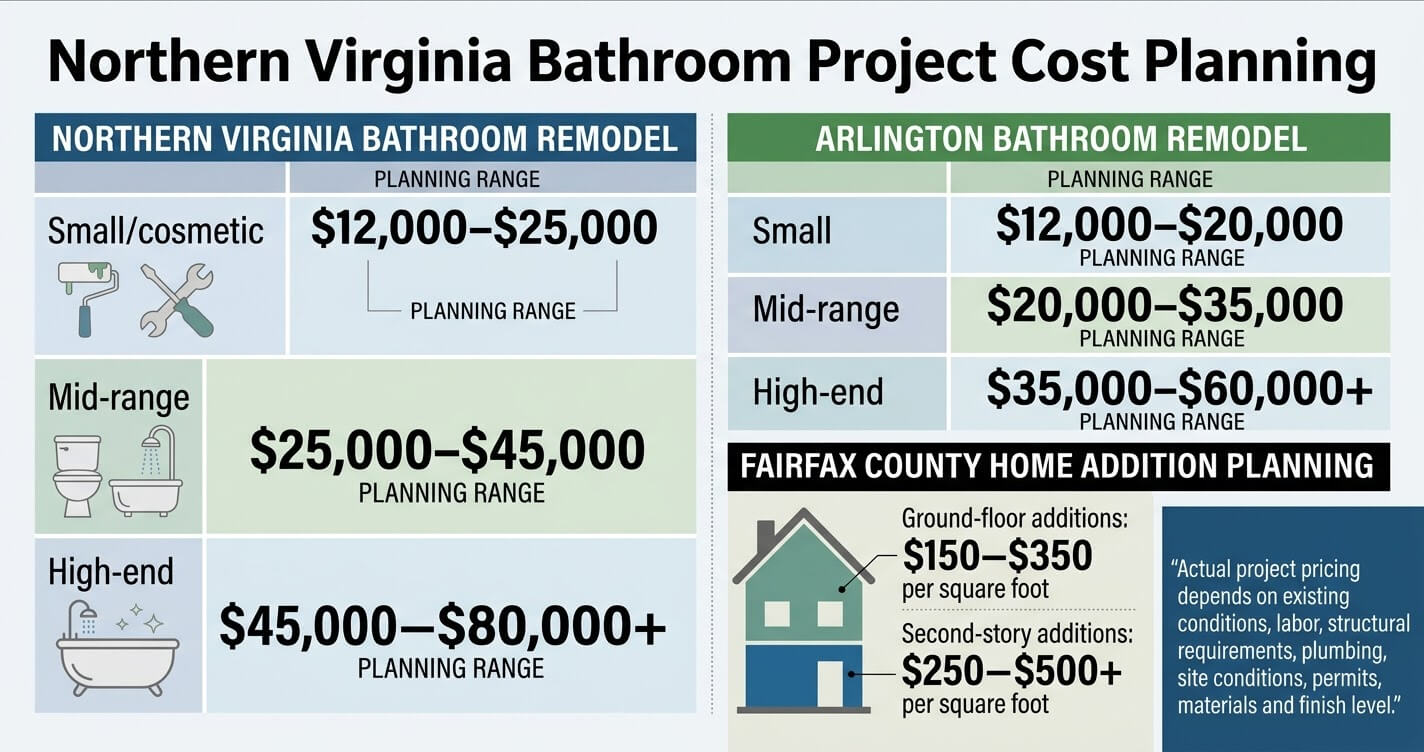
Northern Virginia is not a single construction market.
Labor availability, property type, home age, lot constraints, neighborhood expectations, and material preferences can produce meaningful differences between communities.
For example, US Home Design Build’s Arlington bathroom cost guide currently places most bathroom remodels around $12,000–$20,000 for small projects, $20,000–$35,000 for mid-range work, and $35,000–$60,000+ for high-end projects. Older Arlington homes can require additional plumbing or electrical work when walls are opened.
For homeowners specifically researching that market, Bathroom Remodel Cost in Arlington VA provides the jurisdiction-specific breakdown.
McLean can similarly trend toward higher project budgets when homeowners select larger bathrooms, custom cabinetry, premium stone, high-end plumbing fixtures, or more extensive layout changes.
Burke and other established Fairfax County communities can present a different issue: existing-home conditions. A bathroom that appears straightforward from the finished surface may reveal outdated plumbing, inadequate ventilation, moisture damage, or framing constraints once demolition begins.
The biggest cost drivers
Whether you remodel or add a bathroom, five variables usually have an outsized effect on the final price.
1. Plumbing relocation
Keeping the toilet, shower and sink close to their existing locations generally reduces the amount of new supply and drainage work. Moving a toilet is particularly significant because its waste connection and venting requirements have to be coordinated with the existing drainage system.
2. Structural changes
Removing a non-load-bearing partition is very different from modifying a load-bearing wall or floor system. Once structural framing is involved, engineering, temporary support and additional inspections may become part of the project.
3. Building footprint
A remodel generally avoids the cost of creating new exterior square footage. A footprint-expanding addition does not.
4. Finish level
Tile, natural stone, cabinetry, shower glass, plumbing fixtures, lighting and specialty features can move a project from a mid-range renovation into a luxury build very quickly.
5. Existing conditions
Older homes can contain hidden conditions that cannot be accurately priced until walls and floors are opened. Water damage, deteriorated subflooring, outdated wiring, undersized plumbing or previous unpermitted work can all affect the final scope.
That is why the lowest initial estimate is not necessarily the lowest final project cost.
A practical cost comparison
The difference can be summarized this way:
The financial question is therefore not simply “How much does a bathroom cost?”
It is “How much new construction does this bathroom require?”
That is the number that can fundamentally change the economics of the project.
Which Adds More Resale Value – a Bathroom Addition or a Bathroom Remodel?
On a percentage-of-cost basis, a midrange bathroom remodel currently has the stronger national resale return: about 80% compared with approximately 53% for a midrange bathroom addition. But an addition can create more practical market value when a home has a genuine shortage of bathrooms that a remodel cannot solve.
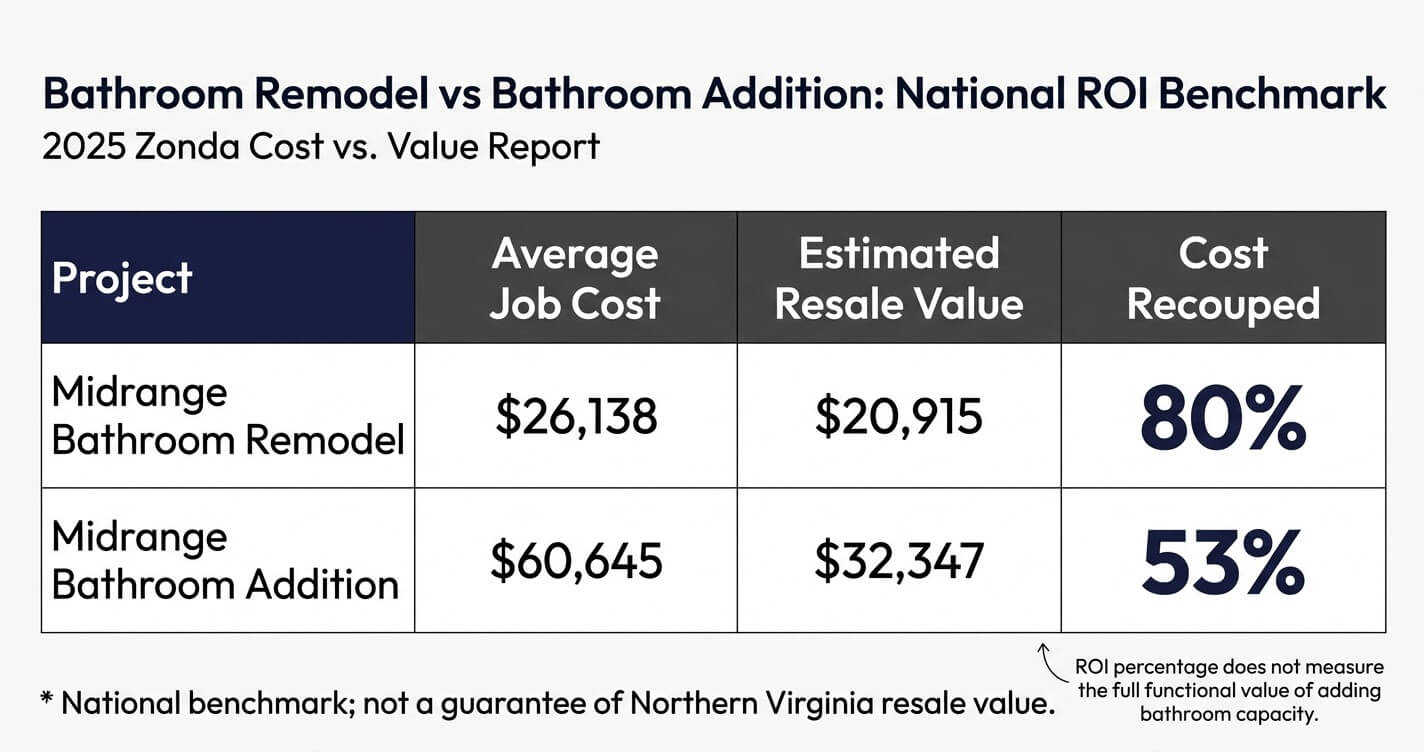
The most current national benchmark comes from the 2025 Zonda Cost vs. Value Report.
For a standardized midrange project, the report lists:
- Bathroom remodel: $26,138 average job cost → $20,915 estimated resale value → 80% cost recouped
- Bathroom addition: $60,645 average job cost → $32,347 estimated resale value → 53% cost recouped
These are national averages, not guaranteed Northern Virginia resale returns. The report itself presents the figures as market-level benchmarks, so homeowners should not treat 80% or 53% as a promised increase in their home’s sale price.
Why does the remodel perform better?
The mathematics are relatively straightforward.
A remodel spends money improving an asset that already exists.
The house already has:
- A bathroom location
- A finished or partially finished room
- Existing water and drainage infrastructure
- Existing electrical distribution
- Existing walls and ceiling
- Existing exterior envelope
Even if several of those systems are replaced, the project does not necessarily have to create a new portion of the house.
An addition has a much larger construction burden.
The homeowner is paying not only for the bathroom but also for the infrastructure required to create the new space.
That is why the percentage return can be lower even though the new bathroom itself may be highly useful.
But ROI percentage is not the same thing as homeowner value
Consider two hypothetical Northern Virginia homes.
Home A: Three bedrooms, two-and-a-half bathrooms, with an outdated primary bathroom.
A $35,000 remodel could modernize the space, correct functional problems, improve waterproofing and make the home more competitive when it eventually goes on the market.
Home B: Four bedrooms, one full bathroom.
A $35,000 remodel could produce a beautiful bathroom, but the house would still have only one full bathroom.
For Home B, adding a second bathroom may solve a much more important deficiency.
This is why the question “Does a bathroom addition or a bathroom remodel add more resale value?” cannot be answered from ROI percentage alone.
The home’s existing bathroom-to-bedroom ratio, floor plan, neighborhood expectations and buyer profile all matter.
Bathroom count can be a threshold issue
Bathroom improvements often produce incremental benefits: better finishes, improved lighting, more storage, a larger shower, better ventilation and improved accessibility.
Bathroom count can work differently.
Moving from one full bathroom to two can materially change how a home functions for a family and how prospective buyers evaluate the property.
Moving from three bathrooms to four, however, may produce a much smaller marginal benefit if the existing bathroom supply already meets the needs of the likely buyer.
That is why a bathroom addition can make financial sense even when its percentage ROI is lower than a remodel.
The addition may be solving a functional deficiency, not merely upgrading an existing room.
Avoid over-improving the bathroom
The 2025 Cost vs. Value data also shows why “more expensive” does not automatically mean “better investment.”
A midrange bathroom remodel recoups approximately 80% nationally, while an upscale bathroom remodel recoups approximately 42%. An upscale bathroom addition recoups approximately 36%.
That does not mean luxury bathrooms are undesirable.
It means that resale value does not necessarily increase in direct proportion to construction expenditure.
A homeowner can spend substantially more on imported stone, custom cabinetry, specialty fixtures and elaborate shower systems without receiving an equivalent increase in appraised or buyer-perceived value.
For resale-focused projects, the goal is generally appropriate quality, not maximum possible spending.
What this means for Northern Virginia homeowners
For a homeowner planning to sell relatively soon, the financial case often favors a well-designed remodel when the existing bathroom count is already appropriate.
For a homeowner planning to stay for many years, the calculation changes.
An addition can deliver years of practical utility:
- Less morning congestion
- Private bathroom access for a primary bedroom
- Better accommodation for children
- Improved guest privacy
- More flexibility for multigenerational households
- Greater functional separation between bedrooms
None of those benefits appear in a simple resale ROI percentage.
The strongest Bathroom Addition vs Bathroom Remodel Northern Virginia decision therefore considers three separate forms of value:
Financial value: What portion of the investment could potentially be recovered at resale?
Functional value: Does the project solve an actual limitation in the home’s layout?
Lifestyle value: How much will the household benefit from the improvement while living there?
A project that scores well across all three is usually easier to justify than one chosen solely because an online ROI percentage looks attractive.
Timeline Comparison: How Long Does Each Project Take?
A straightforward bathroom remodel is generally faster because the project stays within the existing building envelope, while a bathroom addition usually takes longer because design, structural work, new utilities, permitting and inspections add more phases. Complex remodels can still take significantly longer when walls, plumbing or structural systems are changed.
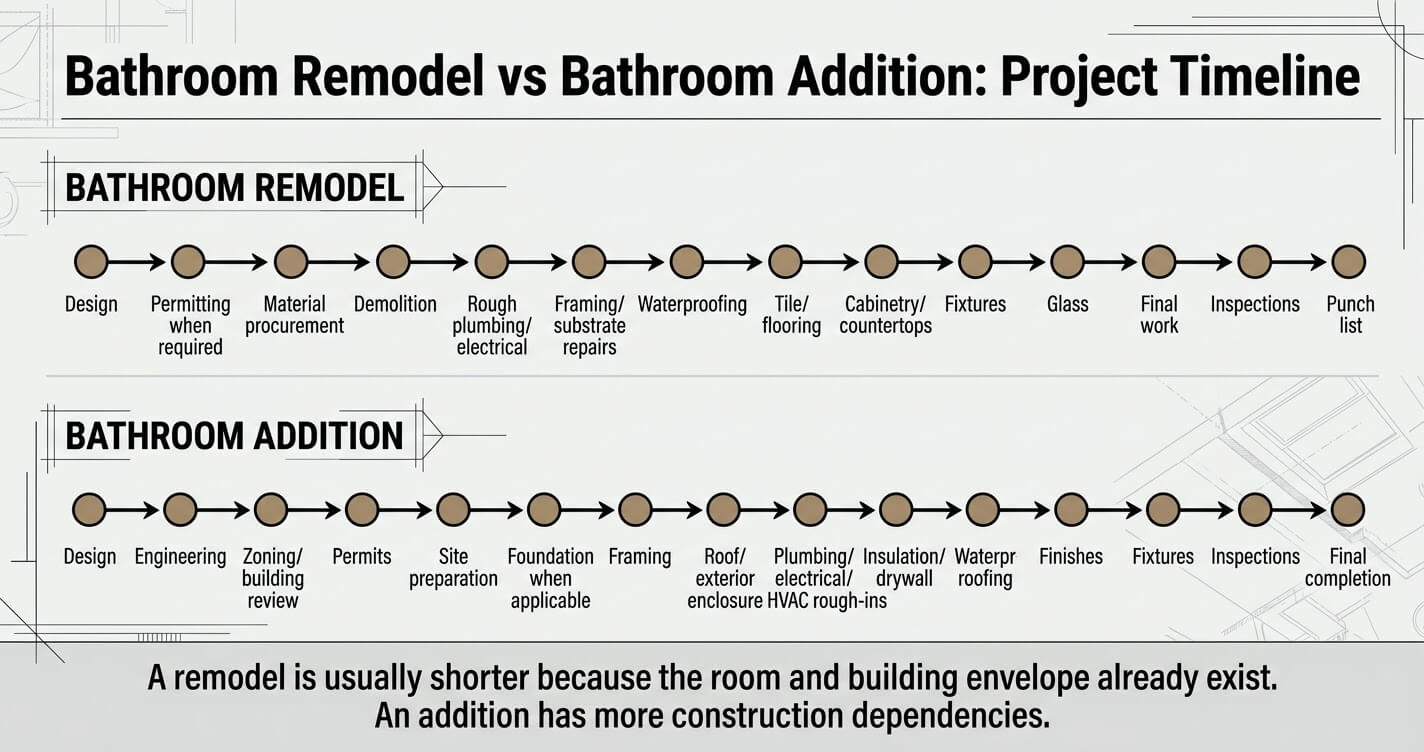
The exact construction schedule varies by project, but the difference in complexity is predictable.
A bathroom remodel may involve:
- Design and selections
- Permitting, when required
- Material procurement
- Demolition
- Rough plumbing and electrical
- Framing or substrate repairs
- Waterproofing
- Tile and flooring
- Cabinetry and countertops
- Fixture installation
- Glass installation
- Final electrical and plumbing work
- Inspections
- Punch-list completion
A bathroom addition can involve all of those steps plus additional construction phases before the bathroom itself can even be finished.
Typical bathroom remodel sequence
A conventional bathroom remodel can move relatively quickly when the layout remains substantially unchanged.
After demolition, the contractor can expose the existing plumbing and electrical systems, make necessary corrections, complete rough inspections, install waterproofing and substrates, and then proceed through finishes and fixtures.
The critical scheduling risk is often not the physical size of the bathroom.
It is coordination between trades and availability of materials.
A custom vanity that arrives late can delay countertop templating. A delayed shower enclosure can prevent final completion. A plumbing problem discovered after demolition can require additional work before walls can be closed.
That is why homeowners should distinguish between construction duration and total project duration.
Construction might take several weeks, while design, material selection, permitting and procurement can extend the overall calendar considerably.
Why bathroom additions take longer
A new bathroom can require a much longer chain of dependencies.
For an exterior addition, the sequence may look more like:
Design → engineering → zoning/building review → permits → site preparation → foundation → framing → roof/exterior enclosure → plumbing/electrical/HVAC rough-ins → insulation/drywall → bathroom waterproofing → finishes → fixtures → inspections → final completion
The bathroom cannot be completed until the surrounding addition is sufficiently built.
That creates a fundamental difference between the projects.
With a remodel, the room already exists.
With an addition, the room has to be created first.
US Home Design Build’s Fairfax County addition research places larger home additions in a much longer overall planning-and-construction window, with permitting and design often becoming significant portions of the schedule.
Permitting can affect the schedule before construction starts
Permit requirements are not merely an administrative issue.
They can affect when construction can begin.
Fairfax County’s residential addition/alteration process can involve a primary building permit plus associated trade permits. The county explains that electrical and plumbing permits can be linked to the main building permit as child permits once the parent permit has been issued.
For a homeowner, this means the project schedule should not be calculated as:
“How many weeks will the contractor need to build the bathroom?”
It should be calculated as:
“How long from design authorization to final inspection?”
That is a much more useful planning metric.
Inspections create additional dependencies
Bathroom construction involves systems that generally cannot simply be covered and forgotten.
Depending on the project, plumbing, electrical, structural and other work may need to be inspected before portions of the work are concealed.
For example, a new bathroom addition may require inspection of rough plumbing and electrical work before insulation and drywall proceed.
This sequencing matters because one missed inspection or failed inspection can prevent the next trade from moving forward.
A good project schedule therefore includes inspection dependencies, not merely labor estimates.
What can cause a bathroom project to run over schedule?
The most common schedule risks include:
- Hidden water damage
- Deteriorated subflooring
- Outdated plumbing
- Electrical deficiencies
- Structural framing problems
- Material backorders
- Custom cabinetry lead times
- Shower-glass fabrication
- Permit review
- Inspection availability
- Client-driven design changes after construction begins
The last one is particularly important.
Changing a tile pattern during installation may sound minor, but changing a plumbing fixture location after rough-in can force multiple trades to redo completed work.
For that reason, homeowners can protect both budget and schedule by finalizing major layout and fixture decisions before demolition begins.
Permit Requirements for Bathroom Additions vs Remodels in Northern Virginia
Bathroom additions generally involve more extensive permitting because they can affect building structure, square footage, plumbing, electrical systems and mechanical systems. A bathroom remodel can also require permits, particularly when plumbing, electrical, structural or other regulated work is altered, so homeowners should not assume that an interior project is automatically permit-exempt.
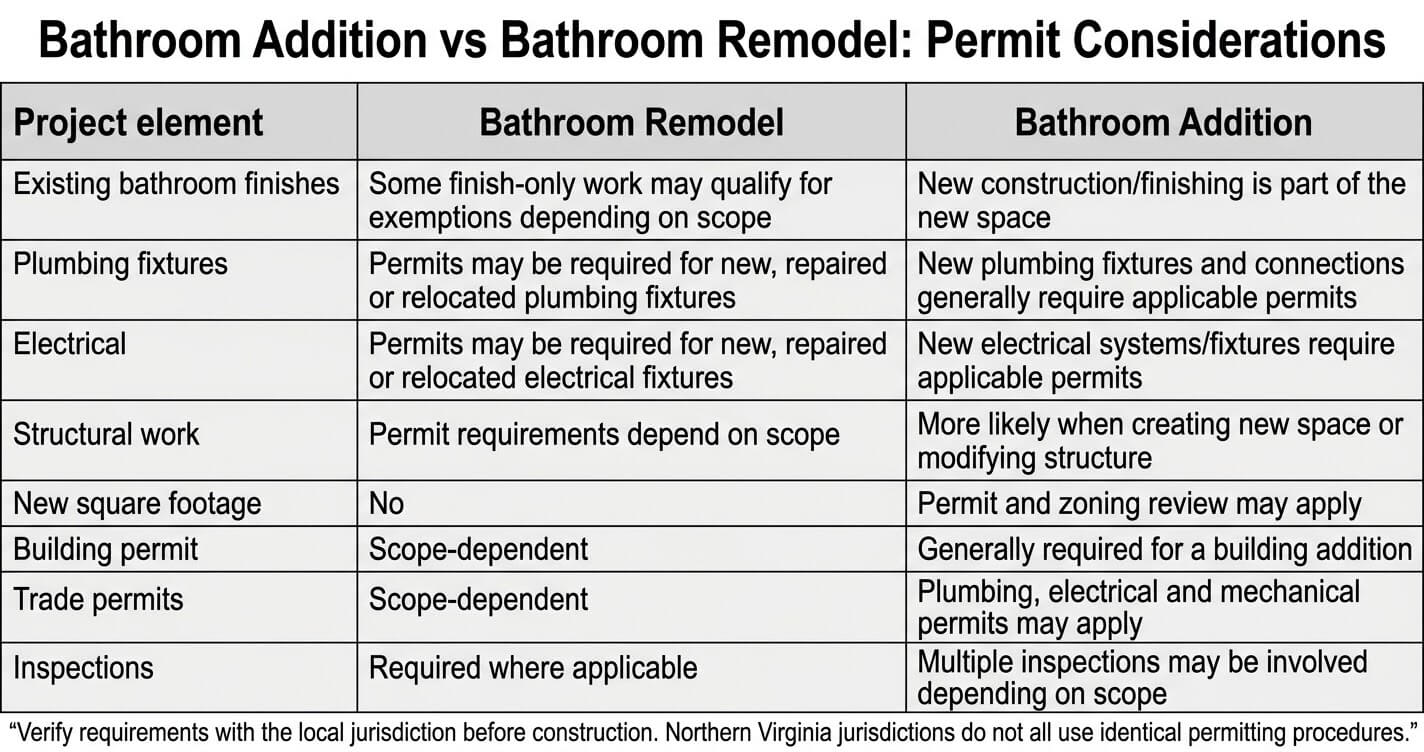
Permit requirements vary by jurisdiction, so Northern Virginia homeowners should verify requirements with the county or city governing their property.
For Fairfax County, Land Development Services provides a particularly useful distinction between work that requires permits and limited work that may qualify for an exemption.
When a Fairfax County bathroom remodel requires a permit
Fairfax County states that permits are required for new, repaired or relocated electrical fixtures, as well as new, repaired or relocated mechanical or gas fixtures. The county also specifically identifies new, repaired or relocated plumbing or gas fixtures, including sinks, tubs, showers and water closets, as permit-required work.
That means a homeowner should not assume that “bathroom remodel” means “no permit.”
A project that involves relocating the toilet, installing a new shower, modifying plumbing connections, adding electrical fixtures, changing mechanical systems or making structural alterations can trigger permitting requirements.
Fairfax County’s residential plumbing permit guidance is even more explicit: a plumbing permit is required for new sewer or water connections, disconnections, installing new plumbing equipment or fixtures, and replacing or repairing plumbing equipment or fixtures.
By contrast, certain direct replacements and finish-only work may fall within specific exemptions.
The county’s permit guidance should therefore be reviewed based on the actual scope of work, not the label attached to the project.
Bathroom additions require a different level of review
A new bathroom addition can involve two categories of work simultaneously:
- Building work: creating or modifying the physical space.
- Trade work: plumbing, electrical and mechanical systems serving the new space.
Fairfax County’s residential addition/alteration process recognizes this relationship. Where electrical, plumbing or mechanical work is part of the project, associated trade permits may be required alongside the main building permit. The county explains that these trade permits can be connected to the primary building permit as related permits.
For a footprint-expanding bathroom addition, the review can therefore extend beyond the bathroom itself.
The jurisdiction may need to evaluate issues such as:
- Building location
- Setbacks
- Structural design
- Foundation
- Lot coverage
- Building height
- Exterior construction
- Plumbing
- Electrical systems
- Mechanical systems
- Applicable zoning requirements
- Site-specific limitations
This is another reason a true addition cannot be budgeted or scheduled in the same way as a cosmetic bathroom renovation.
What about a bathroom created inside existing space?
This is where the distinction becomes especially important.
Suppose a homeowner has an unfinished basement area and wants to build a new bathroom.
There may be no new exterior footprint, but that does not mean the project is permit-free.
The contractor may still be installing new plumbing fixtures, electrical fixtures, ventilation and potentially structural components.
Fairfax County’s plumbing requirements apply to new plumbing equipment and fixtures regardless of whether the bathroom expands the home’s exterior footprint.
In other words:
No new square footage does not necessarily mean no permit.
The permitting question depends on what construction and building systems are actually being modified.
Why permits matter beyond legal compliance
Permits are sometimes treated as a bureaucratic obstacle, but their practical role is broader.
The permit and inspection process creates checkpoints for work that affects critical building systems.
For a bathroom, those systems include:
- Water supply
- Drainage
- Waste and venting
- Electrical distribution
- Moisture control
- Structural framing
- Mechanical ventilation
Proper inspections can help identify installation problems before walls, floors or ceilings are closed.
There is also a resale consideration.
Unpermitted work can create questions during a future sale, appraisal, insurance claim or renovation. A homeowner who adds a bathroom should therefore preserve permit records, approved plans and inspection documentation as part of the property’s long-term records.
Fairfax County vs. the rest of Northern Virginia
Northern Virginia includes multiple local jurisdictions, and their permit processes are not identical.
A homeowner in Fairfax County should not automatically apply Fairfax County’s rules to:
- Arlington County
- City of Alexandria
- City of Falls Church
- Loudoun County
- Prince William County
The same bathroom project can have different application procedures, review requirements, fees and zoning considerations depending on the property’s jurisdiction.
This is particularly important for homeowners searching for Bathroom Addition ROI Fairfax County or comparing bathroom remodel vs addition Arlington. The construction principles may be similar, but the permitting authority is different.
For Fairfax County homeowners, the county’s official Land Development Services permit guidance is the appropriate starting point for determining whether the proposed work requires a permit.
The permit question to ask before getting a quote
Before comparing contractor prices, ask:
“What permits and inspections will this exact scope of work require in my jurisdiction?”
Then ask the contractor to identify whether the proposal includes:
- Building permit
- Plumbing permit
- Electrical permit
- Mechanical permit
- Engineering
- Permit drawings
- Inspection coordination
- Permit fees
This creates a much more useful comparison between bids.
A quote that appears cheaper because it excludes required permitting or inspection-related work is not necessarily the lower-cost option.
For Fairfax County homeowners, US Home Design Build’s Remodeling Permit Fairfax County resource can also be used alongside the county’s official requirements when planning the project.
Ultimately, the safest approach is to determine the permit scope before construction begins, not after demolition has already exposed the need for regulated work.
When a Bathroom Remodel Makes More Sense
A bathroom remodel usually makes more financial and practical sense when the home already has an adequate number of bathrooms, the existing room is poorly designed or outdated, and the homeowner wants to improve functionality without creating new square footage. It is particularly attractive when resale is relatively near-term and the goal is to improve the home’s condition without taking on the cost and complexity of an addition.
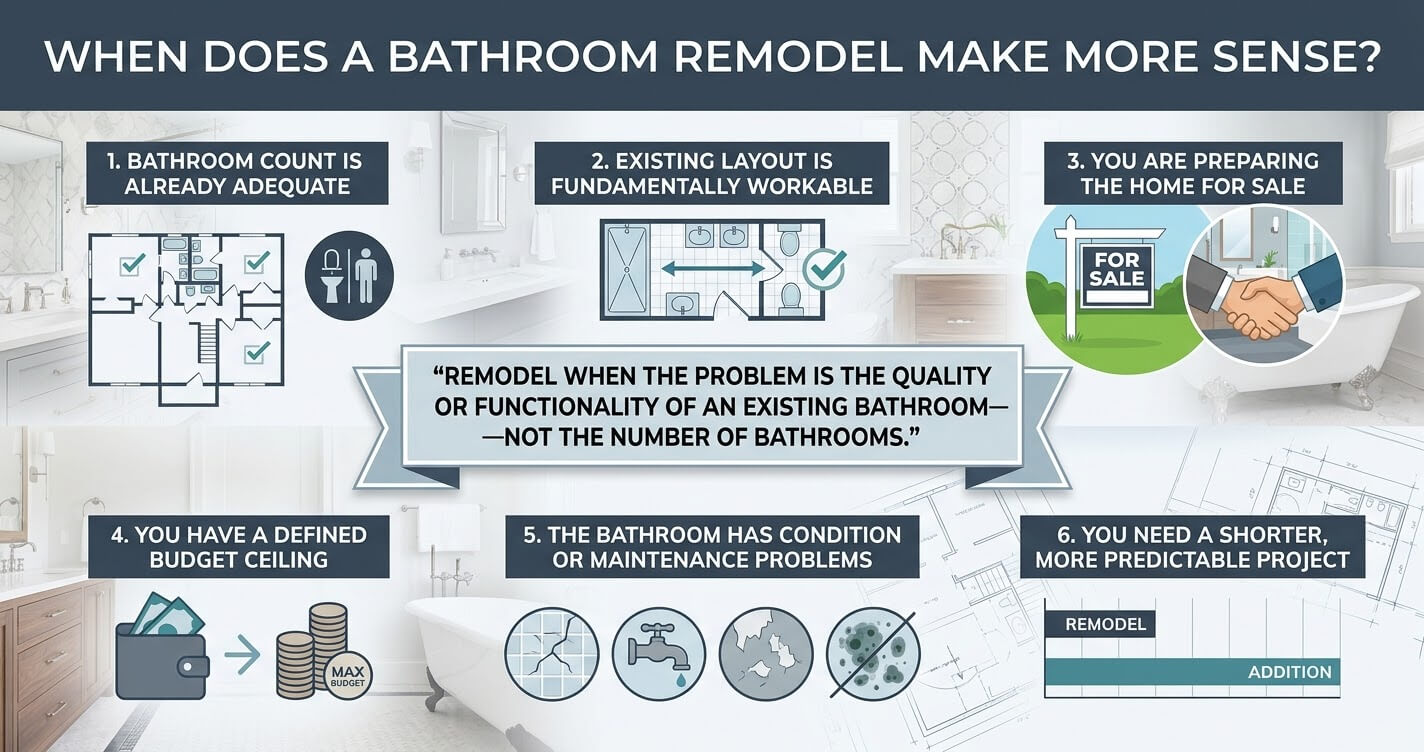
The strongest case for remodeling is usually not simply that the bathroom looks old.
It is that the existing bathroom has enough space and capacity, but the way that space is being used is no longer working well.
A remodel can correct many of those problems without changing the fundamental bathroom count.
1. The home already has enough bathrooms
If a three-bedroom home already has two-and-a-half bathrooms, adding another bathroom may provide relatively limited functional benefit.
In that situation, the existing bathrooms may be better candidates for improvement.
A remodel can address issues such as:
- An undersized or inefficient shower
- Insufficient storage
- Poor lighting
- Outdated fixtures
- Damaged tile or grout
- Inadequate ventilation
- Poor accessibility
- Deteriorated waterproofing
- An inefficient vanity configuration
- An outdated bathtub/shower arrangement
The key is to distinguish between insufficient bathroom capacity and poor bathroom functionality.
A remodel addresses the second problem.
An addition addresses the first.
2. The existing layout is fundamentally workable
Not every bathroom needs to be completely reconfigured.
If the toilet, shower and vanity are already positioned reasonably well, keeping them near their existing locations can eliminate substantial plumbing work.
This does not mean the remodel has to be cosmetic.
A full renovation can still include demolition to the framing, new waterproofing, upgraded electrical work, new tile, cabinetry, plumbing fixtures, ventilation and accessibility improvements.
But retaining the basic plumbing configuration can reduce both construction complexity and the number of variables that need to be coordinated.
This is one reason homeowners should evaluate the layout first and the finishes second.
A $5,000 bathtub may be visually impressive, but moving a toilet several feet can have a greater effect on the construction budget than upgrading the tub itself.
3. You are preparing the home for sale
If resale is the primary objective, a bathroom remodel can be a more controlled investment than creating an entirely new bathroom.
The 2025 Zonda Cost vs. Value Report estimates that a midrange bathroom remodel recovers approximately 80% of its cost nationally, compared with approximately 53% for a midrange bathroom addition. These figures are national averages, not a guarantee for an individual Northern Virginia property.
That makes a remodel worth considering when the property already has an appropriate bathroom count but one or more bathrooms are visibly dated or functionally deficient.
However, the objective should not be to create the most expensive bathroom possible.
A resale-focused renovation should generally emphasize:
- Durable materials
- Neutral design
- Good lighting
- Functional storage
- Quality waterproofing
- Reliable plumbing fixtures
- Proper ventilation
- Consistent finishes
Overly personalized luxury features can increase construction cost without generating equivalent resale value.
4. You have a defined budget ceiling
Remodeling is also easier to control when the homeowner has a firm maximum budget.
A project can be designed around a specific scope:
$20,000 budget → prioritize functionality and essential finishes.
$35,000 budget → allow more substantial layout and finish upgrades.
$50,000+ budget → consider higher-end materials, custom cabinetry, expanded shower systems or more extensive reconfiguration.
These are planning concepts rather than fixed Northern Virginia price tiers. Actual pricing depends on the property and scope.
For local benchmarks, US Home Design Build’s Bathroom Remodel Cost in Northern Virginia guide provides a useful starting point for understanding how project scope and finish level influence cost.
5. The bathroom has condition problems but does not need expansion
Sometimes the most financially rational reason to remodel is maintenance.
A bathroom with failing grout, deteriorated subflooring, recurring moisture problems, outdated plumbing, inadequate ventilation or damaged waterproofing can eventually become a more expensive building problem.
In those cases, remodeling is not simply about aesthetics.
It is about restoring the bathroom’s underlying building systems before a localized problem becomes a larger repair.
This is particularly important in older Northern Virginia homes, where opening walls and floors may reveal conditions that were not visible during a surface-level inspection.
6. You want a shorter and more predictable construction process
A remodel that retains the existing footprint and generally preserves the plumbing layout is usually easier to coordinate than an addition.
There are fewer construction systems involved, less exterior work and no new building envelope to create.
That makes remodeling attractive for homeowners who cannot accommodate a prolonged construction schedule.
When a Bathroom Addition Makes More Sense
A bathroom addition becomes the stronger choice when the home’s existing bathroom count is the actual problem, not merely the condition of the existing bathrooms. It can make particular sense for homes with one full bathroom serving several bedrooms, bedrooms without convenient bathroom access, growing households, or homeowners planning to remain in the property long enough to benefit from the added functionality.
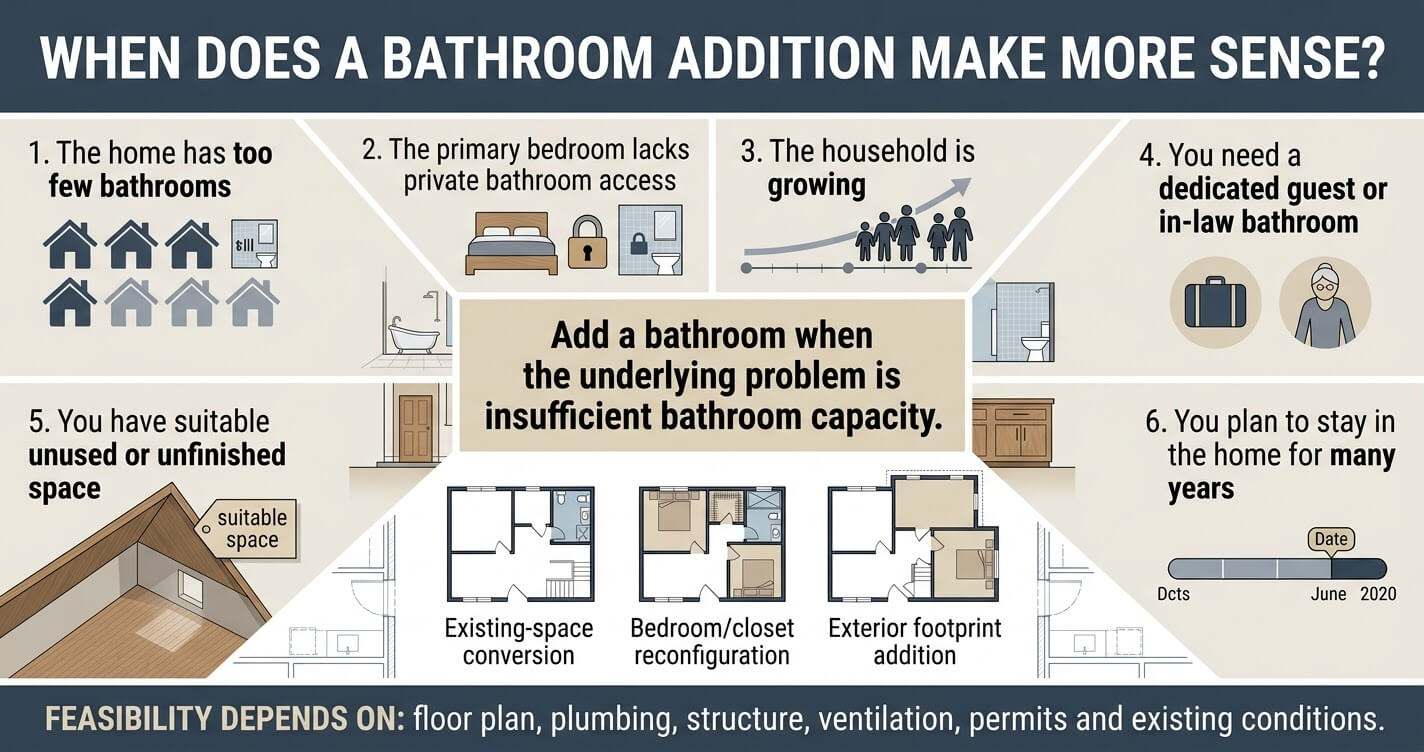
The most important question is:
Can the problem be solved by improving the bathroom you already have?
If the answer is no, an addition deserves serious consideration.
1. The home has too few bathrooms
This is the clearest case.
Imagine a four-bedroom house with one full bathroom.
You can completely renovate that bathroom, but the household will still have one bathroom.
If multiple family members need to get ready simultaneously, the underlying problem remains.
Adding a second bathroom changes the home’s functionality rather than simply improving its finishes.
This distinction is particularly important when evaluating Bathroom Addition ROI Fairfax County. The financial return should be considered alongside the functional deficiency being corrected.
2. The primary bedroom lacks private bathroom access
A primary suite without a private bathroom can be a major layout limitation.
If the home’s existing hall bathroom is the only full bathroom, converting part of the primary bedroom area, or adding a new bathroom adjacent to the bedroom, can fundamentally change how the home functions.
Potential solutions include:
- Converting an oversized closet
- Reconfiguring an adjacent room
- Building into an unfinished area
- Creating a bathroom within an existing addition
- Constructing a new bump-out
The best solution depends on the existing floor plan and the location of the home’s plumbing infrastructure.
3. The household is growing
A bathroom addition can also make sense when the home’s current bathroom capacity was adequate for a smaller household but no longer works.
For example, a home may have been comfortable for two adults with one full bathroom but become significantly less functional after children reach school age.
In this scenario, the homeowner is purchasing years of additional utility, not simply another finished room.
That lifestyle benefit may justify an addition even when the percentage resale ROI is lower than a remodel.
4. You need a dedicated guest or in-law bathroom
Long-term household changes can also make bathroom additions worthwhile.
A homeowner planning for aging parents, frequent guests, adult children or multigenerational living may value an additional bathroom more than a higher percentage resale return.
In these cases, design should also consider:
- Step-free access where feasible
- Wider clearances
- Shower entry
- Grab-bar reinforcement
- Slip-resistant flooring
- Appropriate lighting
- Convenient fixture heights
- Adequate turning and circulation space
Those decisions can be incorporated during construction much more efficiently than retrofitted later.
5. You have suitable unused space
An addition does not necessarily mean building outward.
One of the most cost-effective strategies can be identifying space that already exists but is not performing a useful function.
Potential candidates include:
- Unfinished basement areas
- Oversized closets
- Underused portions of bedrooms
- Large hallways
- Storage areas
- Existing additions with excess floor area
Converting existing square footage can eliminate some of the costs associated with a new exterior building envelope.
However, the space still needs to be evaluated for plumbing access, ventilation, electrical service, structural conditions, ceiling height and applicable building requirements.
6. You plan to stay in the home for many years
Time horizon changes the financial calculation.
If you expect to sell in two years, resale recovery may dominate the decision.
If you expect to stay for 15 years, the household may receive thousands of days of practical use from an additional bathroom before resale becomes relevant.
Zonda’s 2025 Cost vs. Value research specifically notes that interior remodeling projects can make more sense for homeowners planning to remain in their homes longer, while resale-oriented value is not necessarily proportional to the amount spent.
The question becomes:
How much is the additional functionality worth to you during the years you will actually live there?
Real Northern Virginia Examples
The most useful way to compare a bathroom addition with a remodel is to look at the type of problem each project solves: a remodel improves an existing bathroom, while an addition increases bathroom capacity. Northern Virginia projects also demonstrate why local property conditions and construction scope can matter more than a generic national cost-per-square-foot figure.
A useful starting point is US Home Design Build’s Bathroom Remodel Before/After Burke VA case study.
A before-and-after project is valuable because it demonstrates something a generic cost table cannot: how an existing bathroom can be substantially improved without necessarily creating additional square footage.
The same principle applies across Fairfax County, Arlington and other established Northern Virginia communities.
Example 1: Existing bathroom with poor functionality
Consider a Burke home with a bathroom that technically has enough space but suffers from:
- A cramped shower
- Limited storage
- An inefficient vanity
- Outdated finishes
- Poor lighting
- Aging plumbing fixtures
The homeowner does not necessarily need another bathroom.
They need the existing bathroom to work better.
A full remodel can reorganize the interior, improve waterproofing, replace outdated fixtures and make better use of the existing footprint.
That is a classic case where remodeling can provide substantial functional improvement without taking on the cost of an exterior addition.
Example 2: A home with insufficient bathroom capacity
Now consider a Fairfax County home with multiple bedrooms but only one full bathroom.
The homeowner could spend $40,000 renovating that bathroom, but the morning bottleneck would remain.
A second bathroom may require considerably more construction work, especially if the only practical location requires new plumbing or a footprint expansion.
But the project solves a problem that remodeling cannot.
This is where the lower percentage ROI of an addition may still be justified.
Example 3: Existing-space bathroom addition
A third scenario is particularly interesting.
Suppose a homeowner has an unfinished basement with sufficient space near an existing plumbing route.
Creating a bathroom there may avoid the foundation, exterior wall and roof work associated with an exterior addition.
It is still a new bathroom, so plumbing, electrical, ventilation, waterproofing and permitting requirements remain important.
But the construction economics can be fundamentally different from building a new bump-out.
Fairfax County classifies residential addition/alteration work according to the scope, including interior alterations, additional square footage, and projects combining additional square footage with interior alterations.
Example 4: Exterior bathroom addition
The most construction-intensive scenario is when the new bathroom is part of a footprint expansion.
Now the homeowner may be paying for:
- Foundation
- Framing
- Exterior wall assembly
- Insulation
- Roofing
- Siding or masonry
- Windows
- HVAC extension
- Plumbing
- Electrical
- Interior finishes
- Bathroom fixtures
The bathroom itself is only one component of the project.
That is why homeowners researching Home Addition Cost Fairfax County VA should evaluate the entire addition scope rather than treating the bathroom as an isolated room.
Why local examples matter
Northern Virginia’s housing stock contains a wide range of construction eras and home types.
A newer home may have relatively accessible mechanical systems and a bathroom layout that can be modified efficiently.
An older home may have concealed plumbing, unusual framing, previous renovations, or infrastructure that does not align with modern bathroom layouts.
That means two bathrooms with identical dimensions can have dramatically different renovation requirements.
The most reliable cost estimate therefore comes after evaluating:
Existing conditions → proposed layout → plumbing route → structural requirements → permit scope → finish selections.
Not simply:
Bathroom size × average cost per square foot.
How to Decide: A Simple Framework
The best way to choose between a bathroom addition and remodel is to answer three questions in order: Do you actually need another bathroom, how long will you stay in the home, and what is your realistic investment ceiling? The answers usually reveal whether you are solving a capacity problem, a condition/functionality problem, or both.
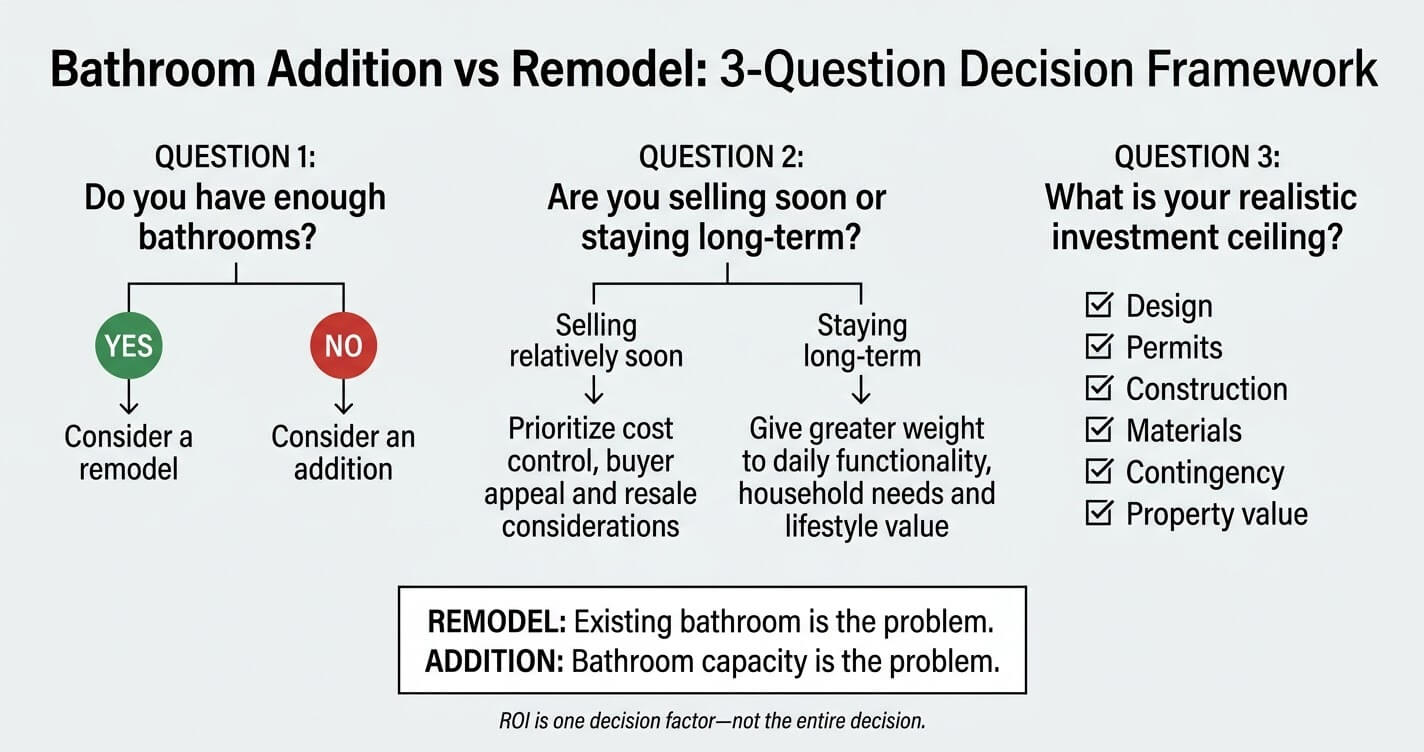
Question 1: Do you have enough bathrooms?
Start with function, not finishes.
Ask:
- How many bedrooms does the home have?
- How many full bathrooms?
- How many people regularly use them?
- Does the primary bedroom have private access?
- Are guests sharing the family’s bathroom?
- Is the existing bathroom simply outdated, or is there genuinely not enough capacity?
If the answer is “we have enough bathrooms, but this one is outdated,” begin with a remodel.
If the answer is “we don’t have enough bathrooms,” investigate an addition.
This is the single most important decision point.
Question 2: Are you selling soon or staying long-term?
Your time horizon changes the definition of “value.”
If you are preparing to sell within a few years, focus more heavily on:
- Cost control
- Broad buyer appeal
- Durable finishes
- Existing bathroom deficiencies
- Neighborhood expectations
- Resale recovery
If you are staying long-term, give greater weight to:
- Daily convenience
- Privacy
- Household capacity
- Accessibility
- Future family needs
- Long-term functionality
This does not mean resale value becomes irrelevant for a long-term homeowner.
It means resale is only one component of the investment decision.
Question 3: What is your maximum comfortable budget?
Do not begin by asking:
“How much can I technically spend?”
Ask:
“How much am I comfortable investing after allowing for design, permitting, construction, selections and reasonable contingency?”
Then compare the project scope to the home’s value.
US Home Design Build’s 30% Rule Home Renovation Northern Virginia guide provides a useful framework for thinking about renovation spending relative to property value.
The 30% concept should be treated as a planning guideline rather than a hard rule. A homeowner should also consider neighborhood standards, remaining mortgage horizon, expected holding period and whether the improvement solves a major functional deficiency.
The final test: solve the actual problem
Before selecting a contractor, finish this sentence:
“We want to renovate our bathroom because ______.”
If the answer is:
“It is outdated, cramped, damaged or poorly designed.”
A remodel is probably the appropriate starting point.
If the answer is:
“We need another bathroom because the current number of bathrooms does not work for our household.”
An addition deserves serious consideration.
That distinction prevents homeowners from spending tens of thousands of dollars solving the wrong problem.
Frequently Asked Questions
Is it cheaper to remodel a bathroom or add a new one in Northern Virginia?
A bathroom remodel is generally less expensive than adding a completely new bathroom because it can reuse existing square footage and infrastructure. A new bathroom becomes substantially more expensive when it requires new plumbing routes, structural modifications or an exterior building addition.
The final cost depends heavily on the scope. US Home Design Build’s Northern Virginia bathroom cost guide places remodels broadly from approximately $12,000 to $80,000+, depending on size, finish level and complexity.
A bathroom addition cannot be assigned one reliable price without knowing whether it will occupy existing unfinished space or require new construction.
Does a bathroom addition or a bathroom remodel add more resale value?
A midrange bathroom remodel currently has the stronger national percentage cost recovery, at approximately 80%, compared with approximately 53% for a midrange bathroom addition in Zonda’s 2025 Cost vs. Value data. However, an addition can provide greater practical value when a home has an insufficient number of bathrooms.
The figures are national benchmarks rather than Northern Virginia-specific guarantees.
The right project depends on the home’s existing bathroom count, neighborhood, buyer expectations, construction cost and the homeowner’s intended holding period.
How long does a bathroom addition take compared to a bathroom remodel?
A straightforward bathroom remodel is generally faster because the room and building envelope already exist. A bathroom addition takes longer because it may involve design, permitting, structural work, new plumbing and electrical systems, inspections and, if the footprint expands, foundation and exterior construction.
A remodel can also become lengthy if major plumbing, structural or moisture problems are discovered after demolition.
For that reason, homeowners should ask for a schedule covering design, permitting, procurement, construction and final inspection, rather than looking only at the number of weeks of onsite labor.
Do I need a permit for a bathroom addition in Fairfax County?
Yes, a bathroom addition will generally involve permitting, and the exact permits depend on whether the project creates new square footage, changes the structure, or installs new plumbing, electrical or mechanical systems. Fairfax County classifies new additions and interior alterations as permit-required residential work.
Fairfax County also states that residential plumbing permits are required for new plumbing equipment or fixtures and for replacing or repairing plumbing equipment or fixtures.
Because requirements can vary by scope and property conditions, homeowners should verify the proposed project with Fairfax County Land Development Services before construction.
When does it make more sense to add a bathroom instead of remodeling an existing one?
Adding a bathroom makes more sense when the home’s bathroom count is the underlying problem. This is especially true for homes with several bedrooms but only one full bathroom, primary suites without private bathrooms, or households that need additional capacity for family, guests or multigenerational living.
If the home already has enough bathrooms and the problem is outdated finishes, poor storage, damaged surfaces or inefficient layout, remodeling is usually the more targeted solution.
Can I add a bathroom without expanding my home’s footprint?
Yes. A new bathroom can sometimes be created within existing unfinished or underused space, such as a basement, oversized closet or portion of another room. However, avoiding an exterior addition does not eliminate the need to evaluate plumbing, electrical, ventilation, structural conditions and applicable permits.
Fairfax County’s residential permit framework distinguishes between interior alterations and projects involving additional square footage, which demonstrates why the construction method matters when planning a new bathroom.
The feasibility of an interior bathroom addition ultimately depends on the existing floor plan and the location of the home’s utility systems.
How much does a bathroom addition cost vs. a bathroom remodel in Northern Virginia?
A Northern Virginia bathroom remodel can range from roughly $12,000 to $80,000+, while a bathroom addition has a much wider cost range because it may involve new plumbing, structural work and additional building square footage. The most important cost distinction is whether the new bathroom fits inside existing space or requires an exterior addition.
For current remodel planning ranges, see US Home Design Build’s Bathroom Remodel Cost in Northern Virginia.
For a project involving additional square footage, the Home Addition Cost Fairfax County VA guide provides broader Northern Virginia/Fairfax planning context.
Final Thoughts
When comparing a Bathroom Addition vs Bathroom Remodel Northern Virginia, a remodel usually provides the stronger financial return when the home’s bathroom count is already adequate, while an addition makes more sense when the household genuinely needs additional bathroom capacity. The right choice depends on the property’s existing layout, construction requirements, budget, resale horizon and how the space will be used.
The financial data supports that distinction.
Zonda’s 2025 Cost vs. Value Report estimates approximately 80% national cost recovery for a midrange bathroom remodel versus 53% for a midrange bathroom addition. But those percentages should be viewed as benchmarks rather than promises, particularly in a market as diverse as Northern Virginia.
A remodel is usually the more efficient solution when the existing bathroom is fundamentally adequate but needs better layout, finishes, storage, waterproofing, lighting or functionality.
An addition becomes more compelling when the home simply does not have enough bathrooms.
The most important financial question is therefore not:
“Which project has the higher ROI?”
It is:
“Which project solves the biggest problem in my home without spending substantially more than the property and household needs justify?”
For homeowners still weighing the two options, the next step should be a project-specific assessment of the existing floor plan, plumbing access, structural conditions, permitting requirements and budget.
If you’re deciding between a bathroom addition and a bathroom remodel in Northern Virginia, contact US Home Design Build to discuss your existing space, construction goals and the most practical direction for your home.
