
Homeowners planning a renovation, addition, or custom home project often spend significant time comparing finishes, layouts, and budgets. However, one of the most important decisions is made long before construction begins: choosing the project delivery method. The choice between a design build vs general contractor (Northern Virginia) can influence project cost, schedule, communication quality, accountability, and overall homeowner experience.
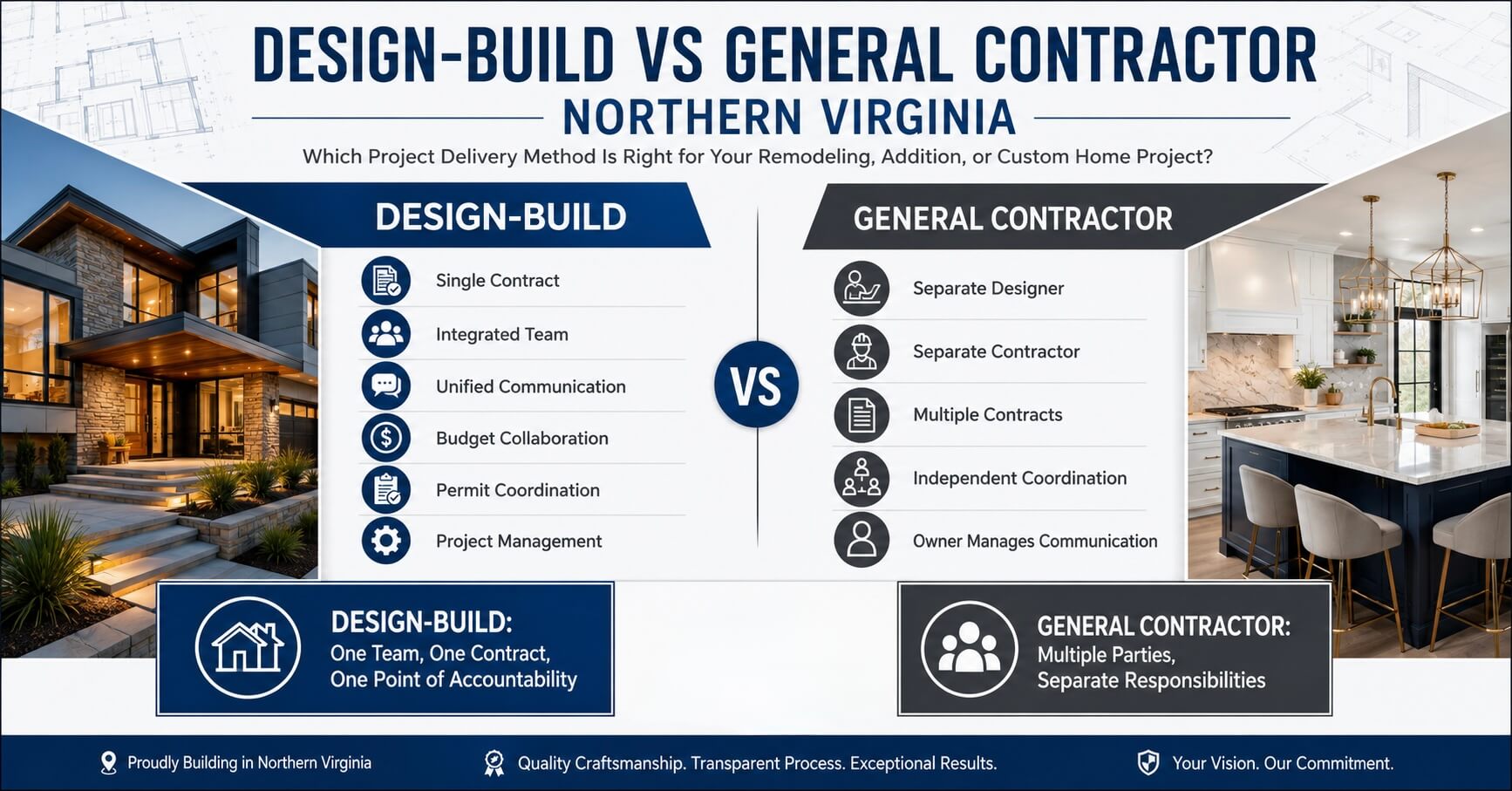
In Northern Virginia, remodeling and construction projects frequently involve complex factors such as permit approvals, structural modifications, zoning considerations, utility coordination, and code compliance. Whether the project is a kitchen remodel in Arlington, a home addition in McLean, or a whole-house renovation in Fairfax, the way the project team is organized can significantly impact outcomes.
The construction industry has increasingly embraced integrated project delivery models. According to the Design-Build Institute of America (DBIA), design-build is projected to represent more than 47% of U.S. construction spending by 2028, reflecting growing demand for streamlined communication and unified accountability. [Source: Design-Build Institute of America (DBIA)]
Many homeowners researching the Top Remodeling Trends in Northern Virginia are discovering that project organization can be just as important as project design. A beautiful plan alone does not guarantee success. Effective budgeting, permitting, scheduling, project management, and communication often determine whether a renovation remains on schedule and within budget.
Ultimately, understanding the differences between project delivery methods before signing a contract can help homeowners avoid costly delays, unexpected change orders, and coordination challenges later in the process.
WHAT IS A GENERAL CONTRACTOR?
A general contractor is a construction professional responsible for managing the physical construction phase of a project. In a traditional project delivery model, the homeowner typically hires an architect or designer first to create plans and specifications. Once the design is completed, the homeowner solicits bids from one or more contractors and selects a builder to execute the work.
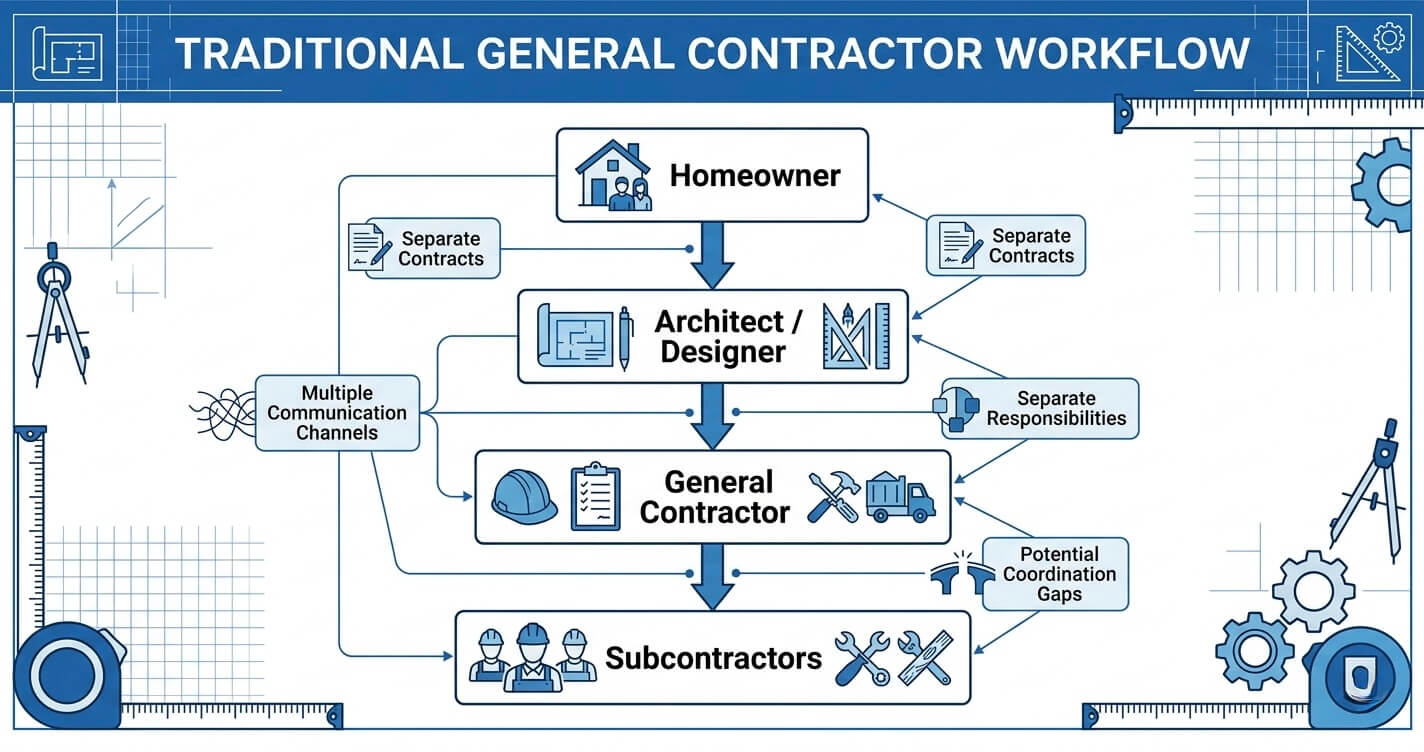
The traditional workflow generally follows this structure:
Homeowner → Architect/Designer → General Contractor → Subcontractors
Under this model, the homeowner often maintains separate contractual relationships with both the design professional and the contractor. While this approach can provide greater control over design decisions and may allow competitive bidding among contractors, it also introduces additional coordination responsibilities.
The general contractor is responsible for managing subcontractors, scheduling work, coordinating inspections, overseeing construction quality, and implementing the approved plans. However, design-related questions frequently require communication between multiple parties, which can slow decision-making and create opportunities for misunderstandings.
One of the primary advantages of the traditional model is design independence. Homeowners who already have completed architectural plans may find competitive bidding useful for comparing construction pricing. However, multiple contracts can create fragmented accountability. If unforeseen conditions arise or construction conflicts occur, disputes may develop regarding whether responsibility lies with the architect, engineer, contractor, or homeowner.
In Virginia, contractors performing residential construction work must maintain the appropriate license classification through the Virginia Department of Professional and Occupational Regulation (DPOR). [Source: Virginia Department of Professional and Occupational Regulation (DPOR)]
For straightforward projects, a traditional general contractor may be an effective solution. For larger renovations, additions, and custom homes, however, homeowners often seek a more integrated approach that reduces communication gaps and centralizes accountability.
WHAT IS A DESIGN-BUILD COMPANY?
A design-build company combines architectural design, planning, estimating, permitting, project management, and construction services under a single organization and a single contract. Rather than hiring separate designers and contractors, the homeowner works with one integrated team from project conception through final completion.
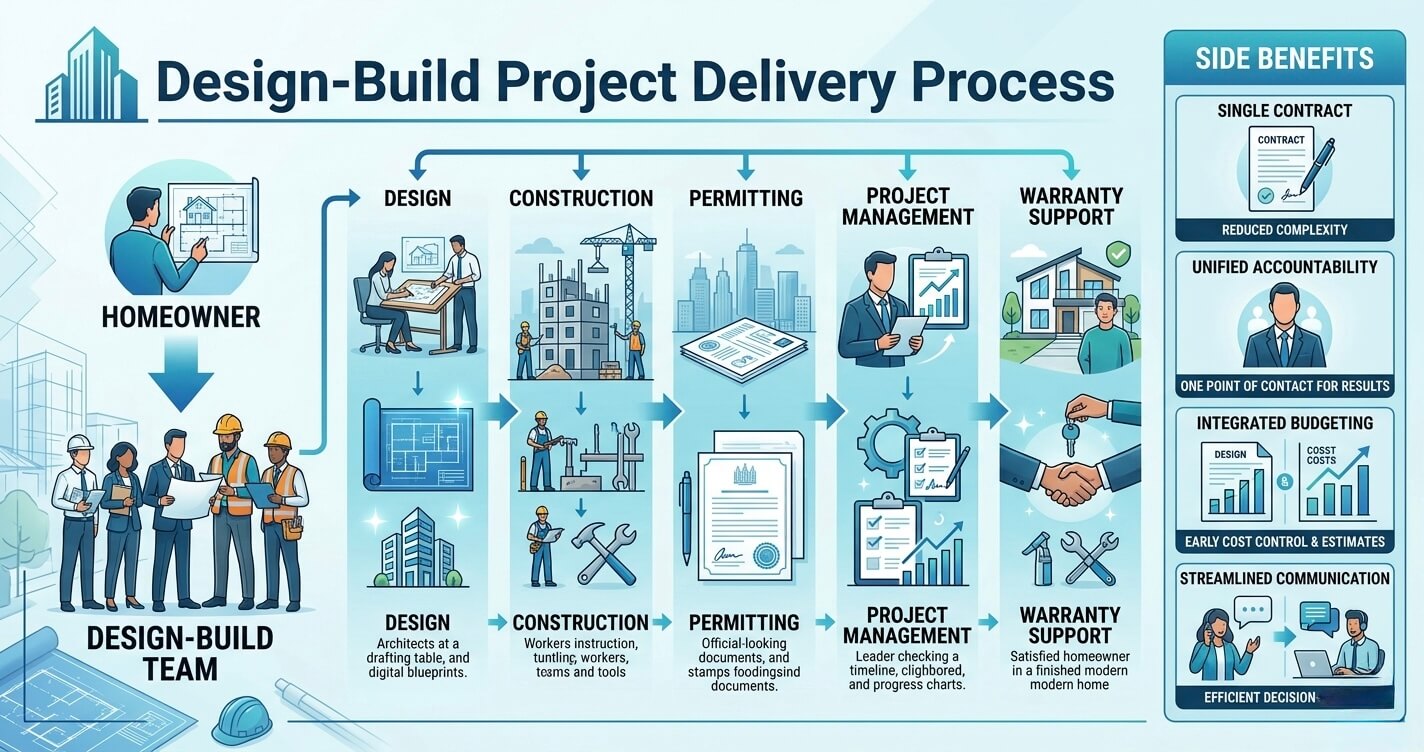
The design-build workflow generally follows this structure:
Homeowner → Design-Build Team → Design + Construction + Project Management
The defining characteristic of the design-build model is unified responsibility. According to the Design-Build Institute of America (DBIA), the single contract for both design and construction is the fundamental distinction between design-build and traditional project delivery methods. [Source: Design-Build Institute of America (DBIA)]
Because designers, estimators, project managers, and construction professionals collaborate from the earliest stages of planning, budget considerations can be incorporated into design decisions before construction begins. This often helps identify potential cost issues earlier and reduces the likelihood of extensive redesigns later in the project.
For Northern Virginia homeowners, design-build delivery can be particularly beneficial for projects involving home additions, whole-house renovations, structural modifications, second-story additions, and custom homes. These projects frequently require extensive permitting, engineering coordination, and phased scheduling, making communication and accountability especially important.
Another advantage is centralized project management. Instead of navigating multiple consultants and contractors, homeowners communicate with a single team that coordinates design development, permit submissions, budgeting, procurement, inspections, and construction sequencing.
At firms such as US Home Design Build, the design-build process typically follows a structured workflow:
Consultation → Design → Budget Development → Permitting → Construction → Final Inspections → Warranty Support
This integrated approach often results in clearer communication, more predictable budgeting, faster decision-making, and fewer coordination conflicts throughout the life of the project. For homeowners comparing design build vs general contractor Northern Virginia options, understanding this difference is often the first step toward selecting the delivery method best suited to their goals, budget, and project complexity.
DESIGN-BUILD VS GENERAL CONTRACTOR: SIDE-BY-SIDE COMPARISON
For homeowners evaluating design build vs. general contractor Northern Virginia options, the most important differences are not necessarily construction quality or craftsmanship. Both delivery methods can produce excellent results when managed properly. The primary distinction lies in project organization, communication structure, accountability, and how decisions are made throughout the process.
In a traditional contractor model, design and construction are typically separated into different contracts and responsibilities. The homeowner often acts as the coordinator between architects, engineers, contractors, and consultants. In contrast, a design-build firm consolidates those responsibilities under one team, creating a more integrated planning and construction process.
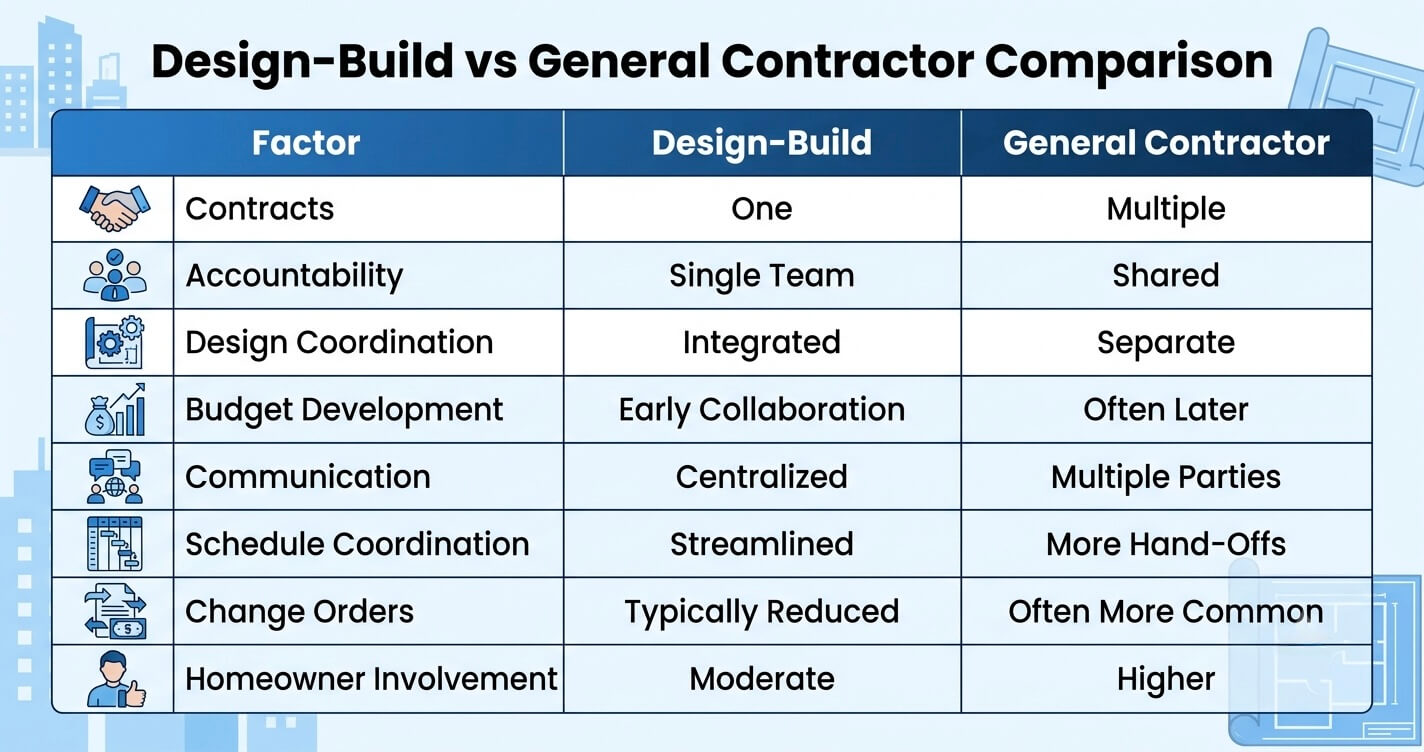
One of the most significant advantages of design-build delivery is unified accountability. When design, estimating, permitting, and construction teams work together from the beginning, project decisions can be evaluated through both design and construction perspectives simultaneously.
According to the Design-Build Institute of America (DBIA), the defining characteristic of design-build delivery is the single contract and integrated responsibility for both design and construction services. [Source: Design-Build Institute of America (DBIA)]
For larger projects such as home additions, whole-house renovations, custom homes, and structural remodeling projects in Fairfax, McLean, Arlington, Vienna, and Falls Church, many homeowners prefer centralized communication because it reduces confusion regarding project ownership and decision-making responsibilities.
While some homeowners value the flexibility of separately hiring designers and contractors, others prioritize efficiency, predictability, and simplified coordination. Understanding these differences is essential when selecting the delivery method that best aligns with project goals, budget expectations, and desired level of homeowner involvement.
COST DIFFERENCES: WHICH APPROACH COSTS MORE?
A common misconception is that design-build projects automatically cost more than projects completed through a traditional general contractor model. In reality, the final project cost often depends less on the delivery method itself and more on how effectively scope, budgeting, and decision-making are managed throughout the project.
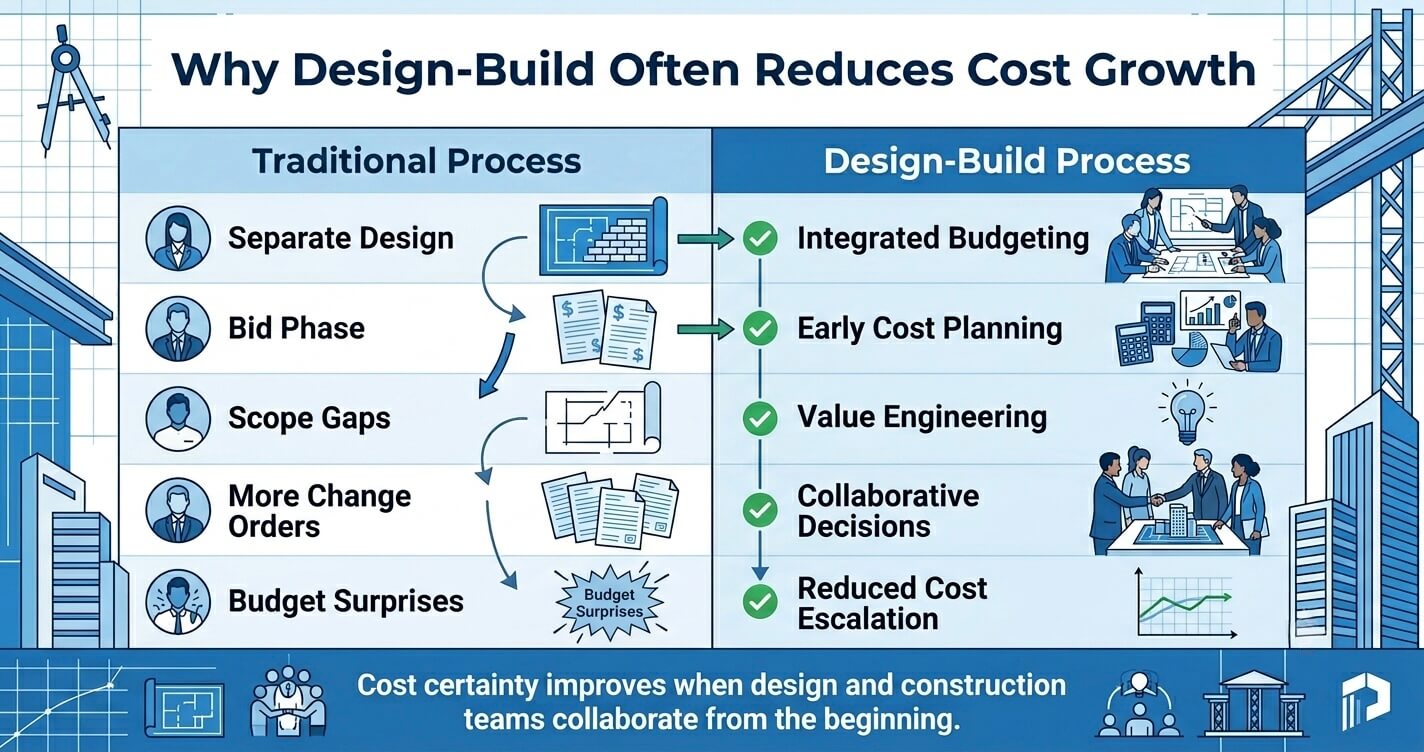
Traditional project delivery frequently separates design development from construction pricing. As a result, homeowners may invest significant time and money into architectural plans before receiving accurate construction estimates. If construction bids exceed expectations, redesigns and scope adjustments may be necessary, creating additional expenses and delays.
Design-build delivery approaches budgeting differently. Because estimators, designers, and construction professionals collaborate during the design phase, project costs can be evaluated continuously as plans evolve. This allows homeowners to make informed decisions before plans are finalized, helping maintain budget alignment throughout the process.
Another major cost factor involves change orders. When design and construction teams operate independently, discrepancies between plans, site conditions, and homeowner expectations can create additional revisions during construction. These changes frequently contribute to project cost growth.
Research from the Design-Build Institute of America (DBIA) and FMI Consulting has consistently found that integrated project delivery methods often achieve better cost performance because collaboration begins earlier in the planning process. [Source: Design-Build Institute of America (DBIA)]
For homeowners evaluating renovation budgets, understanding realistic pricing remains critical regardless of delivery method. Projects involving additions, structural renovations, and major remodels should always be evaluated alongside local market conditions and construction costs. Additional guidance can be found in Home Addition Cost in Northern Virginia.
Ultimately, neither approach is inherently cheaper. However, projects with well-defined scope, proactive budgeting, and strong communication often experience fewer unexpected costs throughout construction.
TIMELINE DIFFERENCES
Project timelines are often one of the most noticeable differences between design-build delivery and traditional contractor delivery. While both methods require design, permitting, procurement, and construction, the sequencing of these activities can significantly affect overall project duration.
Traditional project delivery generally follows a sequential workflow. Architectural design is completed first, followed by contractor bidding, contract negotiations, permit submissions, and construction. Because each phase depends on completion of the previous phase, project timelines can extend as coordination requirements increase.
Design-build delivery often allows certain activities to overlap. Budgeting can occur alongside design development, permit preparation can begin earlier, and material procurement planning can be integrated before final construction documents are completed.
Timeline Comparison
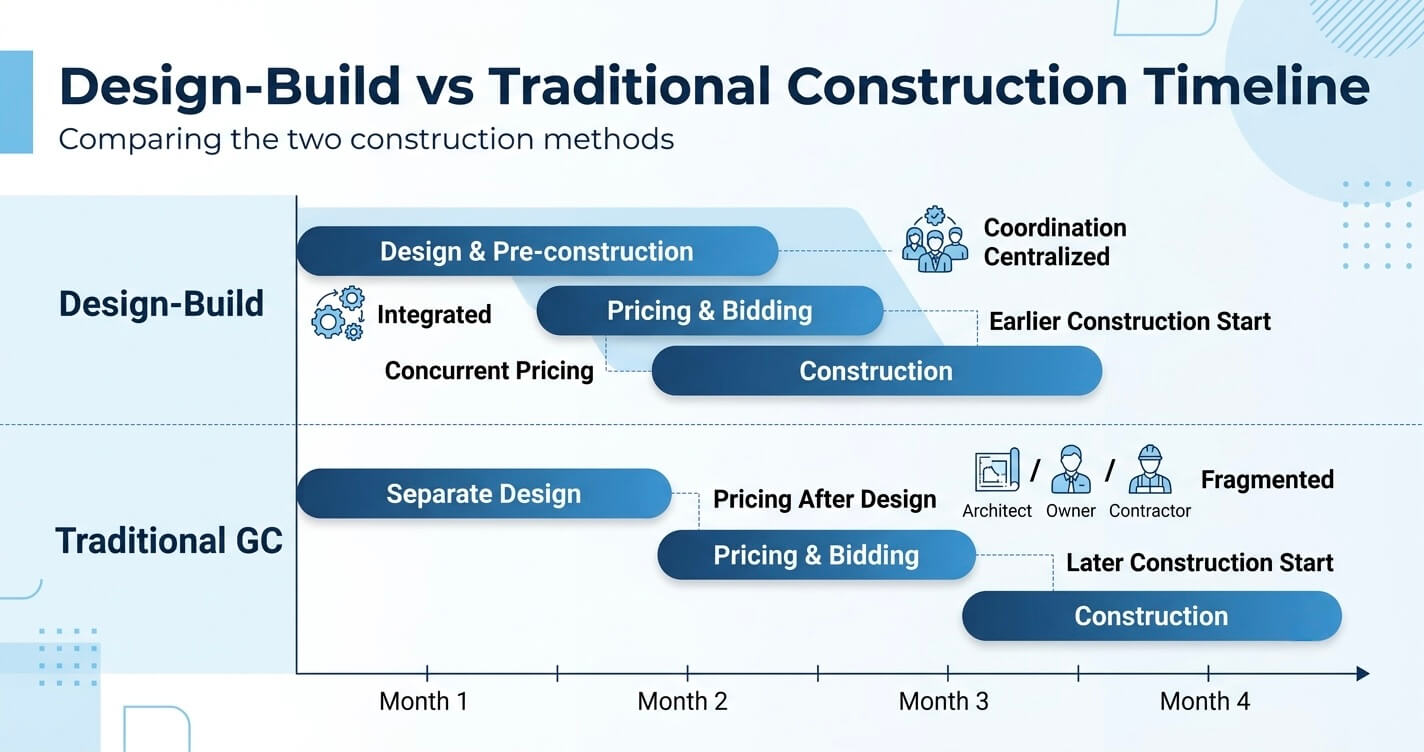
According to research published by the Design-Build Institute of America (DBIA), design-build projects have consistently demonstrated faster project delivery compared with traditional design-bid-build methods because of overlapping workflows and integrated coordination. [Source: Design-Build Institute of America (DBIA)]
In Northern Virginia, permit review timelines can also influence project schedules. Projects requiring structural modifications, additions, major mechanical work, or extensive site reviews may involve substantial coordination with local jurisdictions such as Fairfax County Land Development Services. [Source: Fairfax County Land Development Services]
Because permit submissions, consultant coordination, subcontractor scheduling, and material procurement are managed by one team, design-build firms can often reduce administrative delays and streamline communication throughout the project lifecycle. For homeowners seeking schedule predictability and fewer hand-offs, this integrated approach is often one of the strongest advantages of the design-build model.
WHO IS RESPONSIBLE WHEN PROBLEMS OCCUR?
One of the most overlooked differences between project delivery methods becomes apparent when problems arise. Construction projects inevitably involve decisions, revisions, site conditions, and unforeseen challenges. The question is not whether issues will occur; it is who is responsible for resolving them.
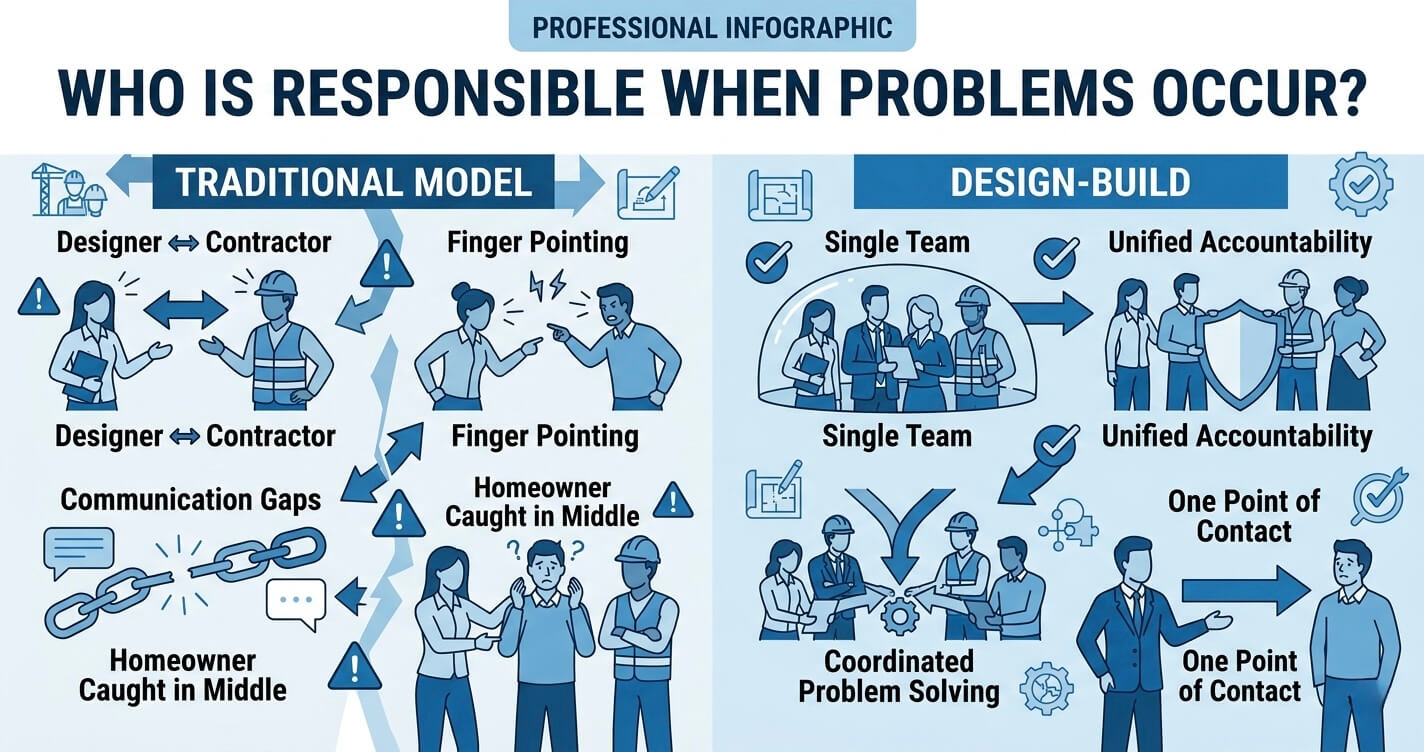
In a traditional project structure, accountability is often divided among multiple parties. Architects create plans, engineers develop technical documents, and contractors execute construction. When a conflict emerges, responsibility can become difficult to determine.
A common example is the “finger-pointing problem.” If a structural detail cannot be built as designed, the contractor may argue that the plans were incomplete. The designer may respond that the contractor misunderstood the documents. Meanwhile, the homeowner is left attempting to coordinate communication, evaluate conflicting recommendations, and determine how additional costs should be handled.
Design changes can create similar challenges. A homeowner request made during construction may require revisions from designers, pricing updates from contractors, permit modifications, and schedule adjustments. When multiple parties are involved, these changes often require extensive coordination.
The design-build model approaches accountability differently. Because design, estimating, project management, permitting, and construction are managed by a single organization, responsibility remains centralized. Rather than determining which party is responsible, the integrated team focuses on identifying solutions and maintaining project momentum.
According to the Design-Build Institute of America (DBIA), the defining feature of design-build delivery is single-source responsibility for both design and construction services. [Source: Design-Build Institute of America (DBIA)]
For homeowners in Northern Virginia planning major renovations, additions, or custom homes, unified accountability can significantly reduce confusion, streamline decision-making, and improve overall project management throughout construction.
WHICH PROJECTS BENEFIT MOST FROM DESIGN-BUILD?
Not every construction project requires the same level of coordination. While a small repair project may only require a contractor, larger and more complex projects often benefit from integrated planning, budgeting, permitting, and construction management.
Design-build delivery tends to provide the greatest advantages when multiple disciplines must work together. Projects involving architectural design, engineering, permitting, structural modifications, and extensive scheduling coordination are particularly well-suited for this approach.
Recommended Delivery Method by Project Type
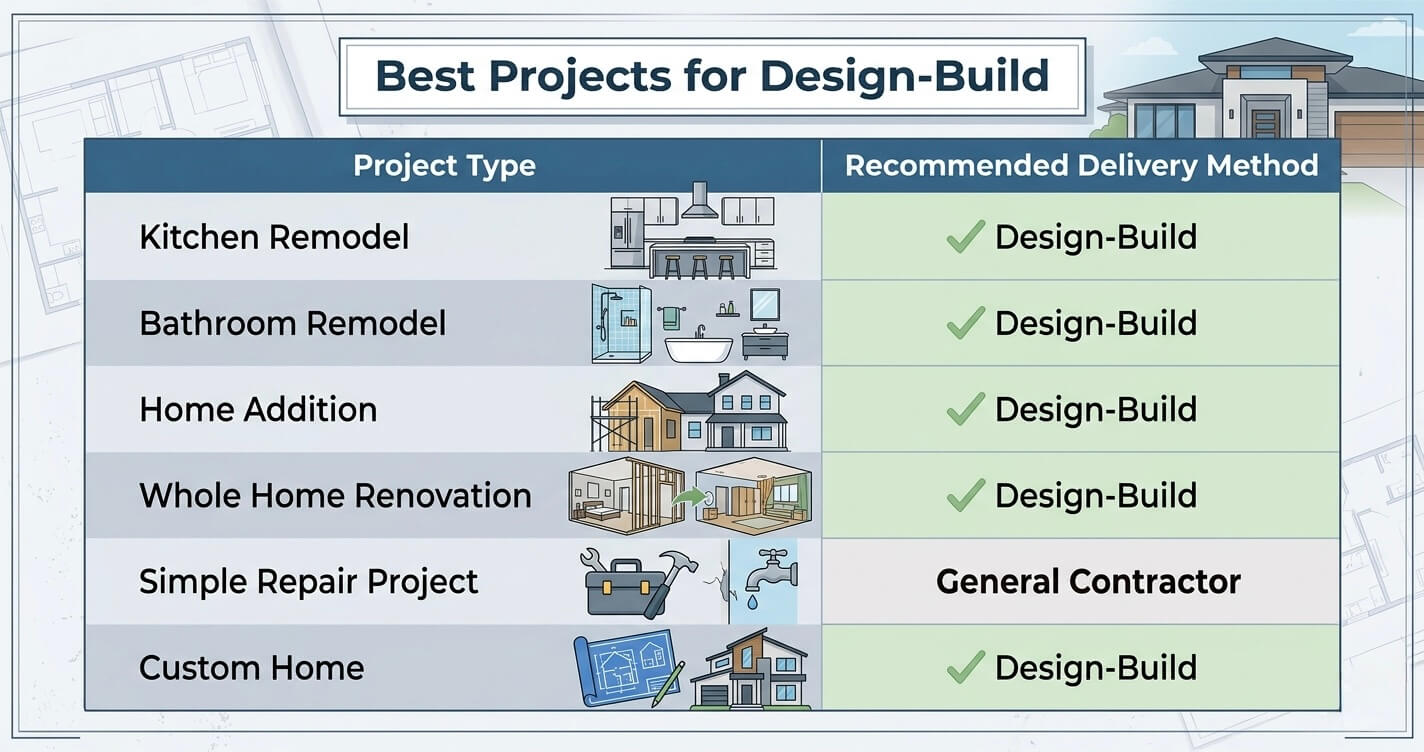
Kitchen and bathroom renovations often involve plumbing, electrical, mechanical, and finish selections that benefit from early collaboration between designers and construction professionals. Whole-home renovations frequently require phased construction planning, permitting, and coordination among multiple trades.
Home additions are another category where integrated project delivery can provide significant advantages. Structural engineering, zoning compliance, budgeting, and permit approvals frequently influence design decisions. Early collaboration helps prevent costly redesigns and scheduling conflicts later in the project.
Projects such as a Second Story Addition in Northern Virginia illustrate why design-build delivery is often preferred. Structural analysis, foundation evaluation, permitting requirements, architectural planning, and construction sequencing must be coordinated simultaneously.
Custom homes also benefit from integrated project delivery because budgeting, site development, permitting, utility planning, and design decisions evolve together throughout the planning process.
For homeowners seeking streamlined communication and centralized accountability, design-build delivery is often most effective for projects where complexity, customization, and coordination requirements are highest.
PERMITS, CODE COMPLIANCE & PROJECT MANAGEMENT
Permit coordination and code compliance represent some of the most complex aspects of residential construction in Northern Virginia. Whether a homeowner is planning a kitchen renovation, home addition, structural modification, or custom home, local jurisdictions require compliance with building codes, zoning regulations, and inspection requirements.
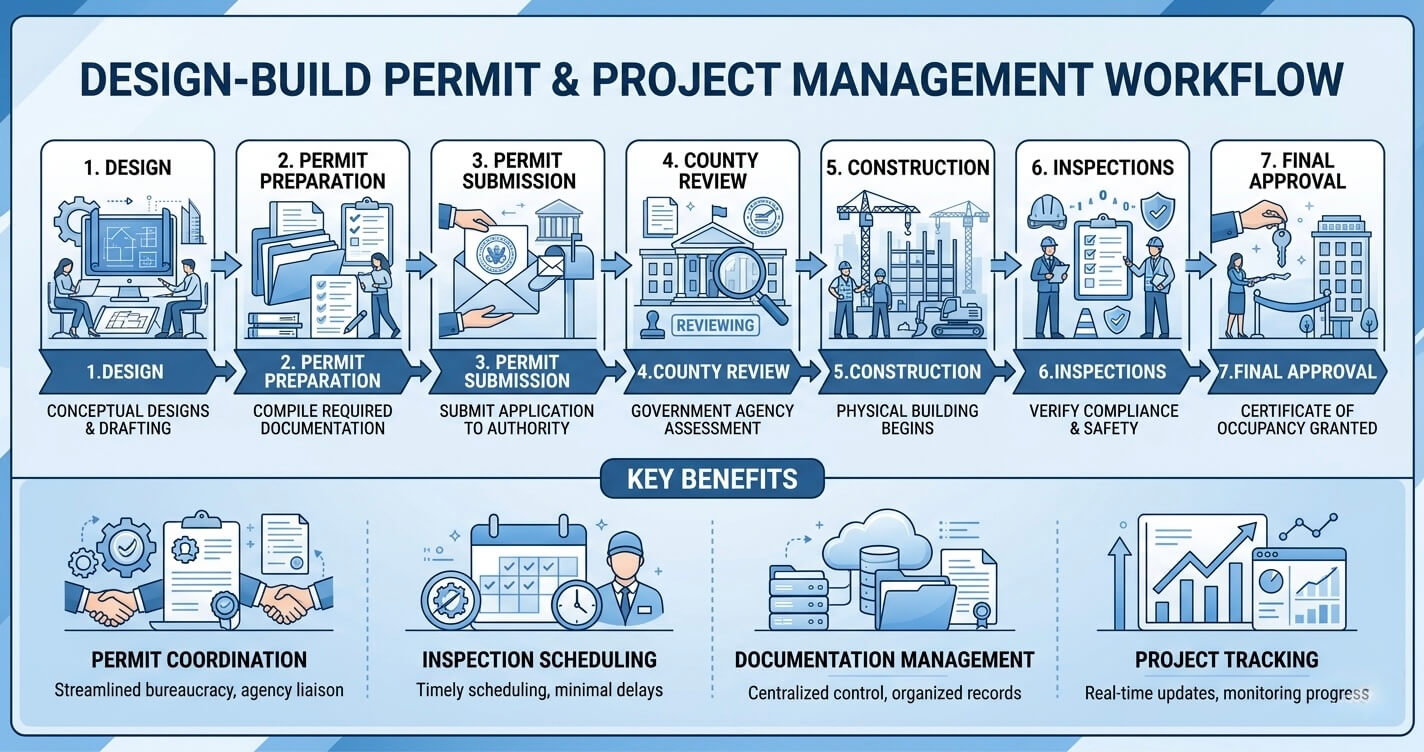
In a traditional project structure, permit responsibilities can sometimes be divided among architects, engineers, expediters, and contractors. Without clear communication, delays may occur if documentation is incomplete or revisions are required during the review process.
The Fairfax County approval process typically involves plan preparation, permit submission, plan review, permit issuance, inspections, and final approval. Construction activities often cannot proceed until the appropriate permits have been approved. [Source: Fairfax County Land Development Services]
Design-build firms typically coordinate permit preparation, application management, county communication, inspection scheduling, and documentation as part of a unified project management process. Because the design and construction teams operate under one organization, permit requirements can be incorporated into project planning earlier in the process.
Homeowners seeking additional guidance on local approval requirements can review Remodeling Permit Fairfax County.
Beyond permitting, project management includes procurement scheduling, subcontractor coordination, budget tracking, quality control, inspection management, and client communication. When these responsibilities are centralized, project teams can often identify potential issues earlier and maintain better schedule predictability.
For major remodeling and construction projects, effective project management is frequently the difference between a smooth construction experience and one characterized by delays, confusion, and repeated revisions.
HOW TO CHOOSE THE RIGHT DELIVERY METHOD FOR YOUR PROJECT
The best project delivery method depends on project complexity, homeowner preferences, budget objectives, and desired level of involvement throughout the construction process. Neither approach is universally better; each serves different project types and homeowner priorities.
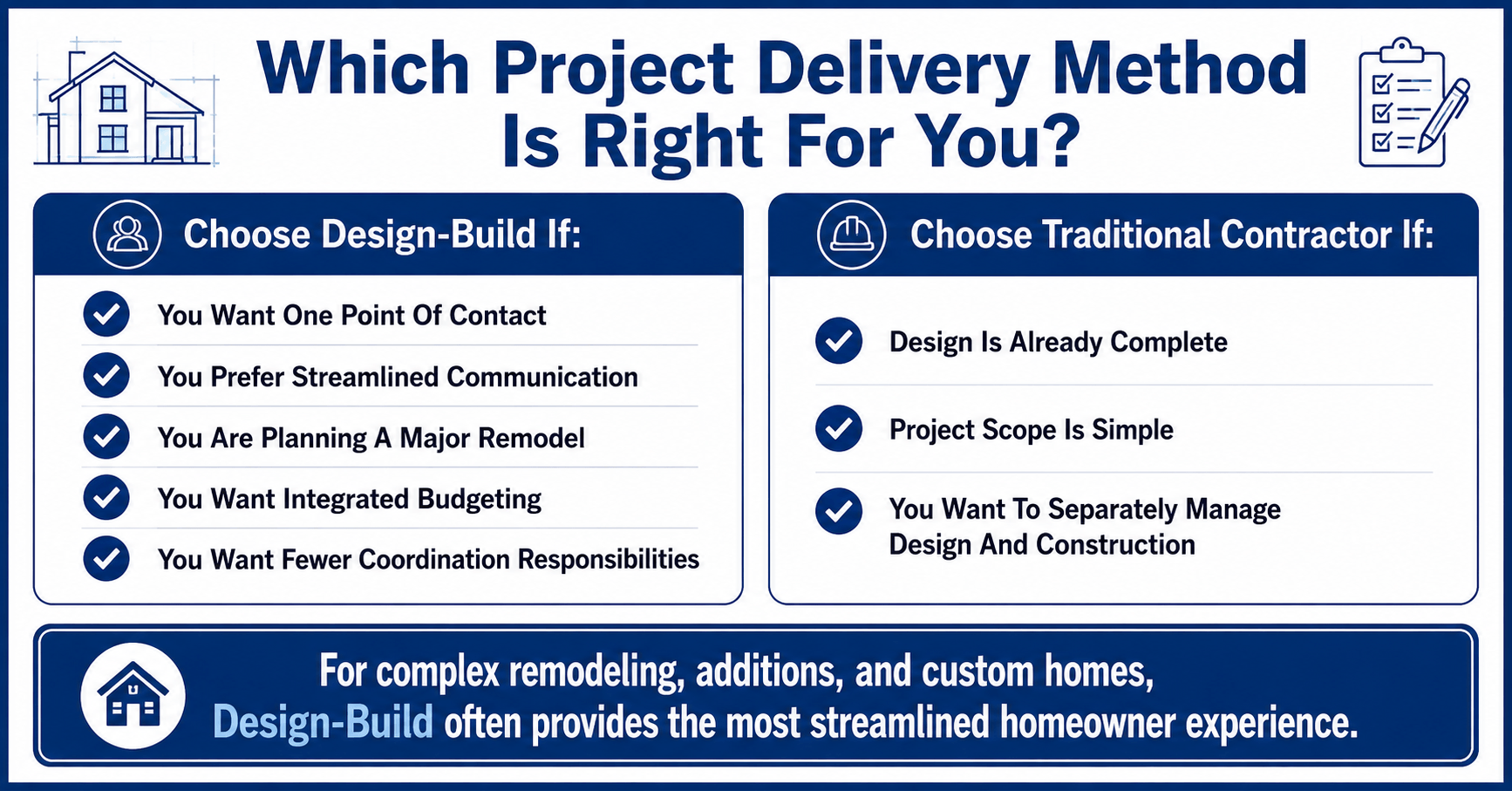
Choose Design-Build If:
- You want one point of contact throughout the project
- You prefer streamlined communication
- You are planning a major remodel or addition
- You want integrated budgeting during design
- You want fewer coordination responsibilities
- Your project requires permitting, engineering, and design collaboration
- You value centralized accountability
Choose a Traditional Contractor If:
- Design plans are already complete
- The project scope is relatively simple
- You want to separately manage design and construction
- Competitive bidding is a primary objective
- You have established relationships with independent architects or designers
For many Northern Virginia homeowners, project complexity becomes the deciding factor. Small repairs and straightforward upgrades may be handled effectively through a traditional contractor relationship. However, larger projects involving structural modifications, additions, custom homes, or whole-house renovations often benefit from integrated planning and execution.
According to the Design-Build Institute of America (DBIA), design-build delivery continues to grow because many owners value improved collaboration, streamlined communication, and single-source responsibility. [Source: Design-Build Institute of America (DBIA)]
Ultimately, homeowners should evaluate not only construction costs, but also communication structure, accountability, permit coordination, project management capabilities, and long-term project goals before selecting a delivery method.
FREQUENTLY ASKED QUESTIONS [FAQs]
What is the difference between design-build and a general contractor?
A design-build company provides both design and construction services under a single contract, while a traditional general contractor typically builds a project designed by a separate architect or designer.
Is design-build more expensive?
Not necessarily. While pricing varies by project, design-build delivery often helps control costs through early budgeting, collaborative planning, and reduced change-order exposure.
Is design-build faster?
In many cases, yes. Design-build projects can overlap design, budgeting, permitting, and procurement activities, which may reduce overall project timelines.
Does design-build reduce change orders?
Design-build delivery frequently reduces change orders because designers, estimators, and construction professionals collaborate earlier in the planning process.
Which delivery method is better for home additions?
Home additions generally benefit from design-build delivery because they involve structural design, permitting, engineering, budgeting, and construction coordination.
Which is better for kitchen remodeling?
Kitchen remodels often benefit from design-build delivery due to the coordination required between cabinetry, plumbing, electrical systems, finishes, and permitting.
Who handles permits in a design-build project?
Most design-build firms coordinate permit preparation, submissions, revisions, inspections, and county communication as part of their project management services.
How do I choose the right contractor in Northern Virginia?
Homeowners should verify licensing, insurance, local experience, project management systems, references, and communication processes before selecting a contractor.
FINAL THOUGHTS
The best delivery method depends on project complexity, homeowner preferences, and the level of coordination required for success. For many remodeling, addition, and custom home projects throughout Northern Virginia, design-build delivery offers meaningful advantages through unified accountability, integrated planning, and streamlined communication.
When comparing design build vs general contractor Northern Virginia options, homeowners should evaluate more than construction pricing alone. Project organization, communication structure, permit management, budgeting processes, and accountability often have a greater impact on project outcomes than most homeowners initially realize.
Key takeaways include:
- One contract versus multiple contracts
- Centralized accountability reduces coordination challenges
- Communication directly impacts project success
- Early collaboration improves budget predictability
- Design-build delivery often minimizes project risk
The best projects happen when design, budgeting, permitting, and construction work together from the very beginning.
US Home Design Build serves homeowners throughout McLean, Vienna, Fairfax, Arlington, Falls Church, Alexandria, and Northern Virginia with design-build remodeling, additions, custom homes, and full-home renovations.
From concept development and budgeting through permits, construction, inspections, and warranty support, their integrated design-build team manages every phase under one roof.
703-202-3520 | https://ushdb.com | 8200 Greensboro Dr Suite 900, McLean, VA 22102
