
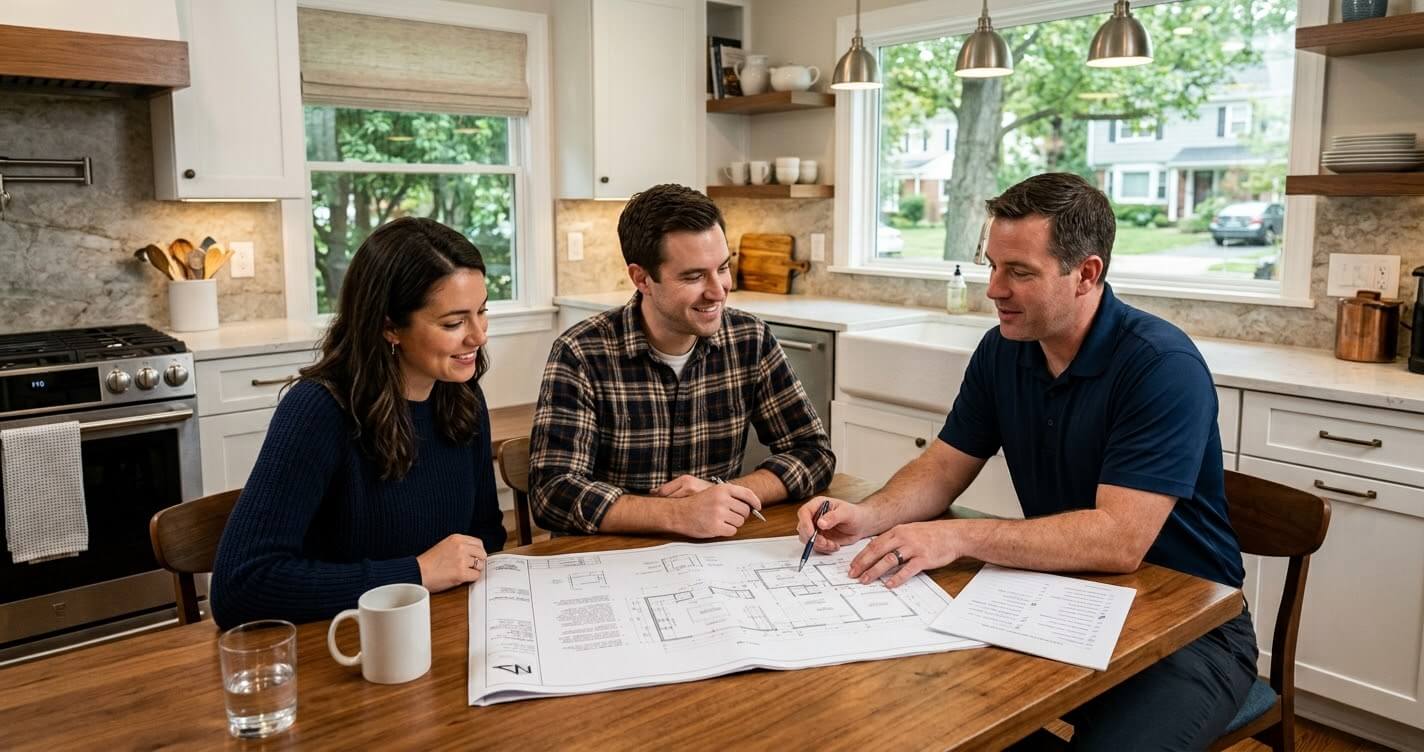
Hiring a kitchen remodeling contractor Northern Virginia homeowners can trust takes more than checking star ratings. If you’ve already read our guide on how to choose a home renovation contractor in Northern Virginia, this article picks up exactly where that one leaves off, narrowing in on the plumbing, electrical, gas, cabinetry, and structural questions that are unique to kitchens and that a general renovation checklist won’t cover.
A kitchen remodel layers more trades into one footprint than almost any other room in the house: water supply and drain lines, a dedicated electrical circuit plan, sometimes a gas line, custom cabinetry, stone fabrication, and, in many Northern Virginia Colonials and split-levels, a load-bearing wall. US Home Design Build has managed design-build kitchen remodeling projects across Fairfax County, McLean, Vienna, and Arlington, and the ten questions below are drawn directly from where those projects typically go right, or wrong. Ask them before you sign a contract.
Why Kitchen Remodels Need Different Vetting Than Other Renovations
Kitchens combine plumbing, electrical, gas, and, in many older Northern Virginia homes, structural work into a single continuous scope, which means a contractor who handles bathrooms or basements competently may still lack the specific cabinetry, countertop, and code-compliance relationships a kitchen demands. That trade overlap is also why kitchen remodels are consistently among the highest-value, highest-complexity projects a homeowner will ever hire for.
Kitchens remain one of the most frequently requested remodeling project types nationally, with the Remodeling Market Index holding at elevated readings for multiple consecutive quarters, and overall remodeling spending is projected to stay near record levels through 2026.
Part of the reason kitchens are more complex to vet is the age of the housing stock they sit inside. The median U.S. home is now roughly 41 years old, up from 31 in 2006, which means a growing share of kitchen remodels in Fairfax County, McLean, and Vienna involve outdated wiring, undersized electrical panels, and galvanized or polybutylene plumbing that a purely cosmetic contractor isn’t equipped to evaluate.
Question 1: Are You Licensed for the Full Scope of a Kitchen Remodel?
A kitchen remodeling contractor’s license class has to cover plumbing and electrical relocation, not just cabinetry and carpentry, a distinction that matters far more here than on a cosmetic-only kitchen update. Virginia ties license class directly to project value, so the wrong class isn’t a paperwork technicality; it’s a sign the contractor may be operating outside their legal scope on your project.
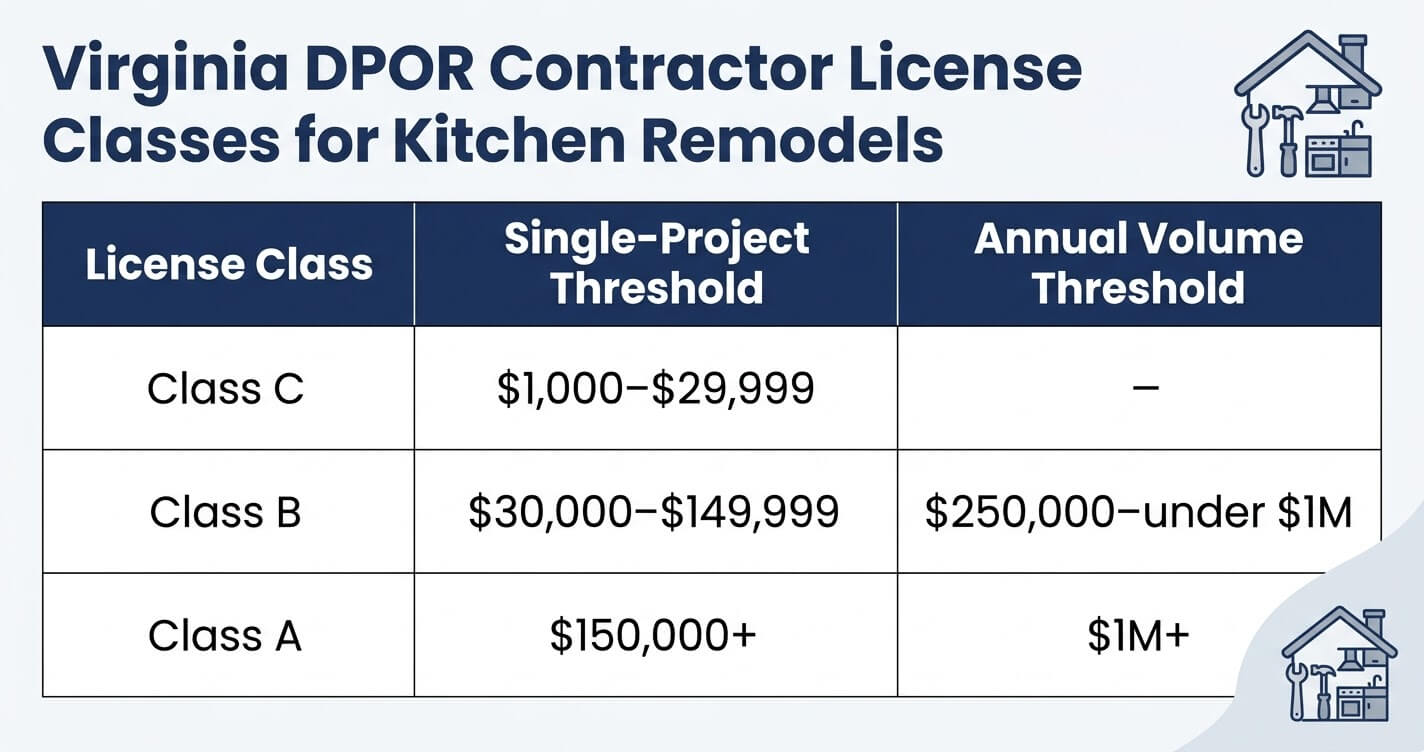
Virginia’s Department of Professional and Occupational Regulation (DPOR) licenses contractors under a three-tier system. A Class A license is required once a single project reaches $150,000 or the contractor’s 12-month volume passes $1 million; Class B covers single contracts between roughly $30,000 and $150,000; Class C covers smaller single contracts above $1,000. A full kitchen remodel in Northern Virginia routinely clears the Class B threshold and often the Class A threshold once cabinetry, countertops, appliances, and labor are totaled.
- Ask whether the license class on file with DPOR actually covers your project’s total contract value, not just the trade the contractor is best known for.
- Ask whether plumbing and electrical work is performed in-house or subcontracted, and if subcontracted, whether those subs hold their own current DPOR licenses.
- Verify the license number yourself on the DPOR license lookup tool before signing anything.
Question 2: Who Pulls the Kitchen Remodel Permit – and For What?
Most Northern Virginia kitchen remodels require separate plumbing, electrical, and, when a wall comes down, structural permits, not one blanket permit for the whole project. Any contractor who suggests skipping a permit to save time or money on a full kitchen remodel is a immediate red flag, not a convenience.
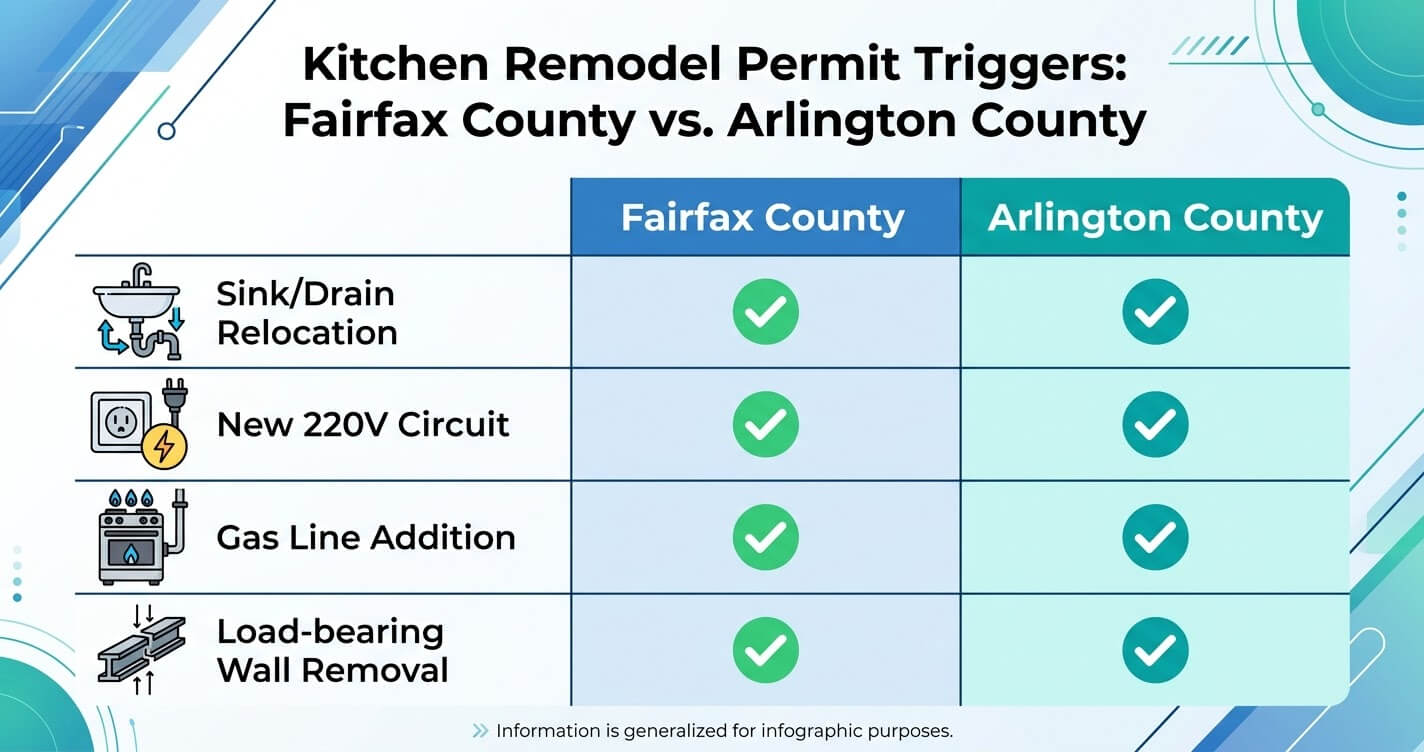
In Fairfax County and Arlington County, permit triggers for a kitchen include moving a sink or drain line, relocating or adding a 220V circuit for a range or oven, adding a gas line, and removing or altering a load-bearing wall. A contractor who pulls permits under their own license, rather than asking the homeowner to pull an owner-builder permit, is also taking on the liability and inspection accountability for the work.
Question 3: How Do You Handle Structural Wall Removal for Open-Concept Kitchens?
Opening a kitchen into an adjoining family or dining room in an older Northern Virginia Colonial or split-level almost always means removing a load-bearing wall, so ask specifically how the contractor engineers and inspects that step rather than assuming it’s routine carpentry.
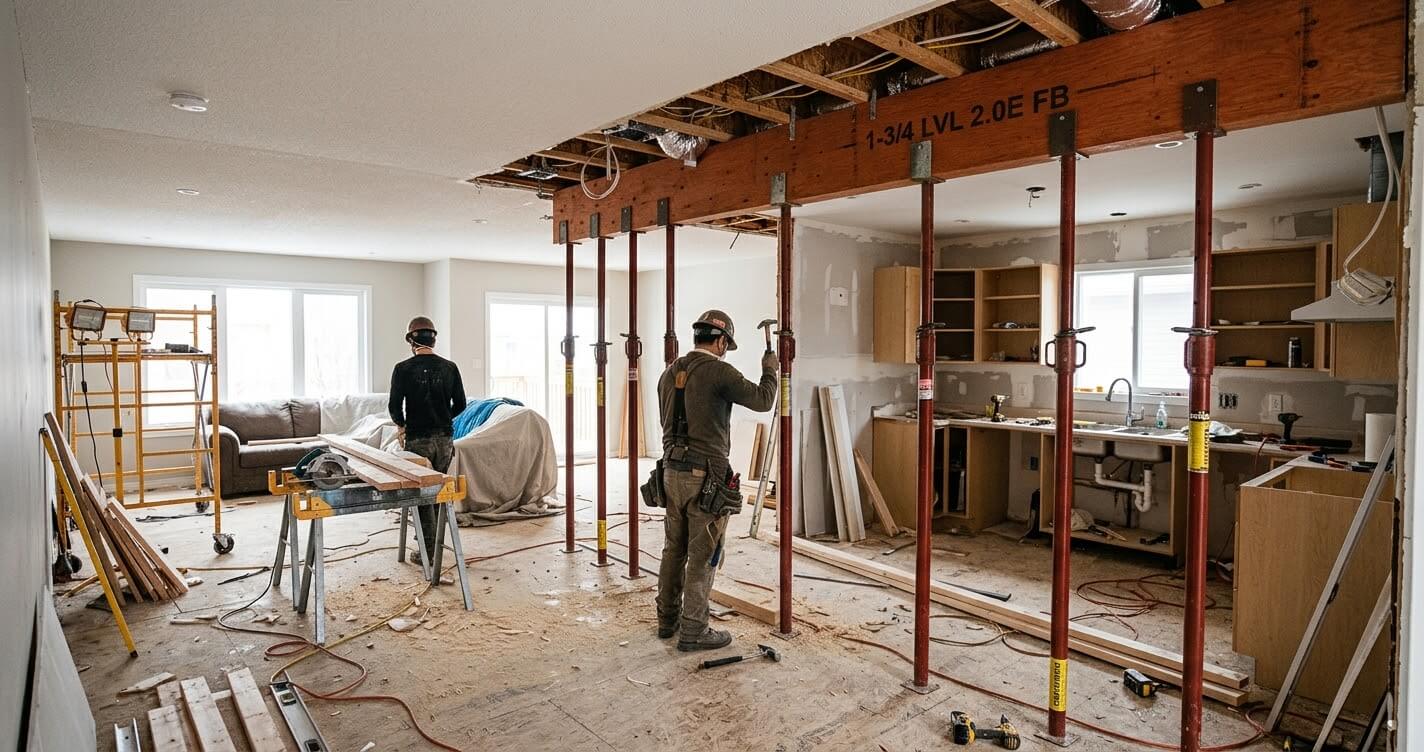
- Ask whether a structural engineer sizes the replacement LVL (laminated veneer lumber) beam and issues a stamped structural letter for the permit file.
- Ask how temporary shoring is handled during the wall opening, and who schedules the framing inspection before drywall closes the beam in.
- If the goal is closer to added square footage than an open floor plan, a kitchen addition may be the more accurate scope to price out.
This exact issue, a load-bearing wall standing between a closed-off kitchen and an open floor plan, comes up constantly in older Vienna and Fairfax County homes; our Kitchen Remodeling Vienna VA: Complete 2026 Homeowner Guide walks through how that specific structural sequence plays out from demo to inspection.
Question 4: Has Your Team Handled Lead Paint Rules for Older Kitchens?
Homes built before 1978 trigger the EPA’s Lead-Based Paint Renovation, Repair and Painting (RRP) Rule whenever a kitchen remodel disturbs painted surfaces, so ask directly whether the crew doing your demolition is RRP-certified — not just whether the company is licensed.
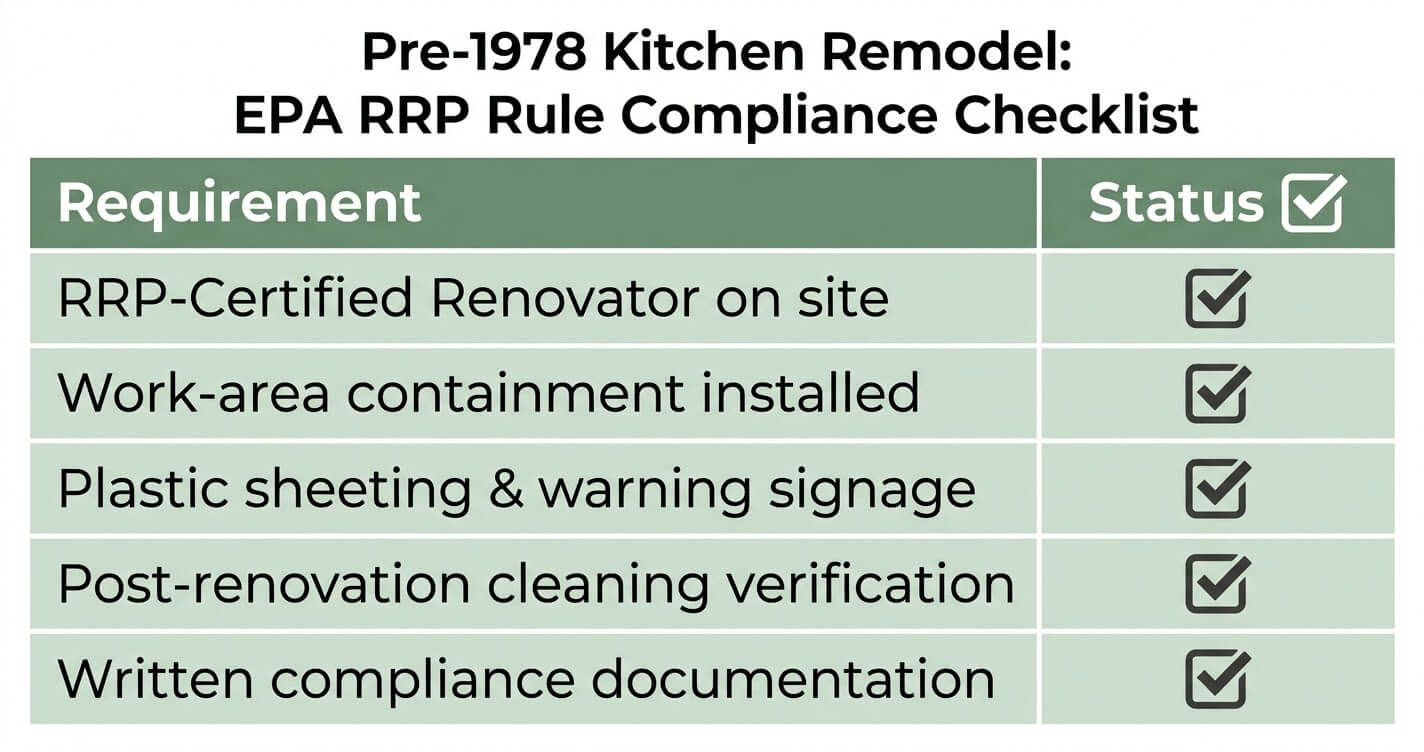
Renovations that disturb painted surfaces in pre-1978 housing must follow EPA-mandated lead-safe work practices, including containment, specific cleaning verification, and certified renovator supervision on site. Given how much of Northern Virginia’s housing stock, particularly in older Arlington, Falls Church, and inner Fairfax County neighborhoods, predates 1978, this isn’t a rare edge case; it’s a routine compliance step that an under-qualified crew will either skip or price incorrectly.
Question 5: Who Are Your Cabinetry and Countertop Subcontractors?
Cabinetry and countertop fabrication are almost always subcontracted, even by full-service kitchen remodeling contractors, so ask by name who fabricates and installs them and who owns the schedule if either one runs late.
- Custom and semi-custom cabinetry commonly runs 8–14 weeks from order to delivery, ask whether that lead time is already built into the published project timeline or added on afterward.
- Countertop template-and-fabrication turnaround varies by material: quartz is typically fastest, granite and quartzite can add extra time for slab selection and fabrication.
- Ask to see current allowance pricing for cabinetry and countertops before comparing quotes, see our Kitchen Countertop Cost Northern Virginia breakdown for current 2026 ranges by material.
Question 6: How Do You Sequence Plumbing, Electrical, and Appliance Delivery?
Sequencing mistakes, appliances arriving before rough-in plumbing and electrical are complete, or cabinets installed before countertop templating, are one of the most common causes of kitchen remodel delays, so ask to see a sample project schedule rather than a verbal promise.
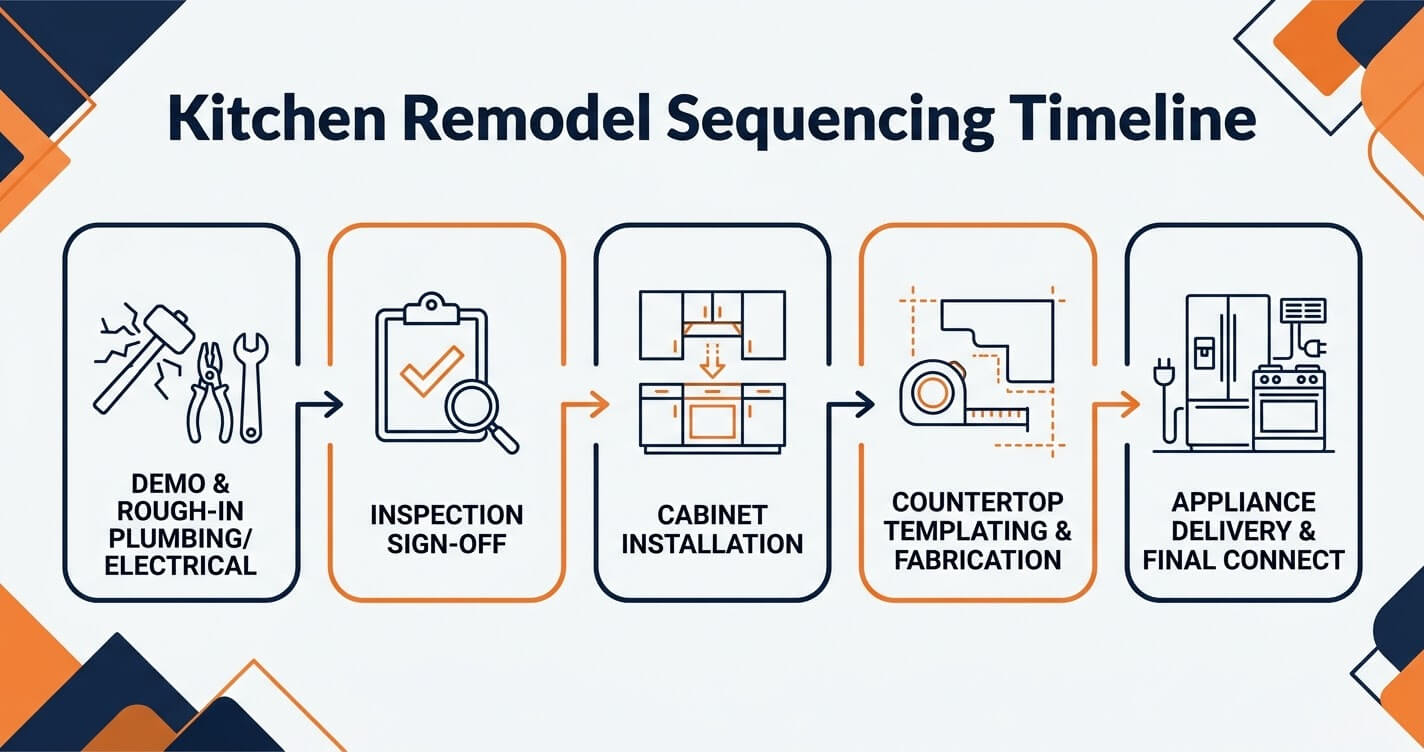
A kitchen-specific schedule should show rough-in plumbing and electrical inspections completed before cabinet installation begins, countertop templating scheduled only after cabinets are set and leveled, and appliance delivery timed to arrive after both. A contractor who can’t produce this sequence in writing is more likely to improvise it on your job.
Question 7: What Happens If We Only Have One Kitchen? (Living-Without-a-Kitchen Plan)
Ask for a written temporary-kitchen plan, where the sink, refrigerator, and a cooking appliance will be relocated, and for how many weeks, since going without a functioning kitchen is a concern unique to this remodel type and rarely comes up on a bathroom or basement project.
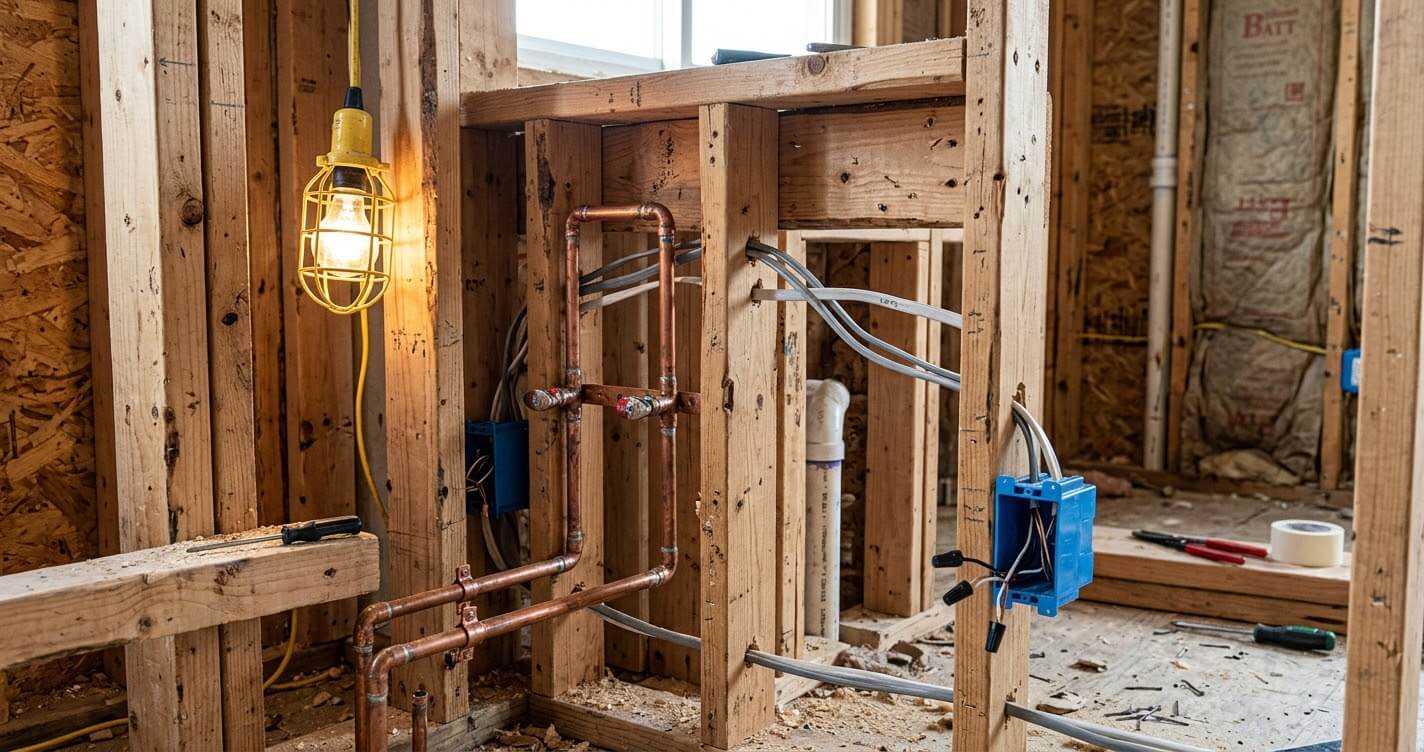
A contractor who has done this before should be able to describe a temporary utility relocation (often to a garage, mudroom, or basement) and give a realistic window for water and appliance downtime, tied to the same schedule discussed in Question 6.
Question 8: Can I See a Kitchen Remodel Specifically – Not Just Any Project?
Ask for two to three kitchen-specific references and completed projects in Northern Virginia, not a general renovation portfolio, because kitchen execution quality, cabinet reveal and alignment, seam placement on countertops, outlet and switch placement, is trade-specific and won’t show up in photos of a finished basement.
Our recent Kitchen Remodel in McLean VA (Before & After 2026) project is one example worth reviewing for exactly this kind of detail; cabinet alignment, seam placement, and electrical layout in a completed, occupied kitchen.
Question 9: Is This a Design-Build Kitchen Remodel or Separate Design + Construction?
Design-build kitchen remodeling keeps design and construction accountable to a single contract and a single point of contact, while a separate design-then-bid approach hands the project between two firms, ask which model the contractor uses and, specifically, how change orders are priced under it.
Under a design-build model, the same team that draws the layout is contractually responsible for pricing and building it, which tends to reduce the finger-pointing that happens when a mid-project change (a moved outlet, a swapped appliance) crosses between a separate designer and a separate contractor. Our Design-Build Northern Virginia: 2026 Complete Guide covers how that contract structure works in more detail.
Before comparing final numbers, it also helps to have a realistic cost baseline in hand, see Kitchen Remodel Cost in Fairfax VA for current 2026 ranges, since the next question is where allowance-based pricing most often creates confusion between quotes.
Question 10: What’s Included vs. Allowance-Based in the Contract?
Cabinetry, countertops, and appliances are frequently listed in a kitchen remodeling contract as dollar allowances rather than fixed line-item prices, so ask for the exact allowance amount for each category in writing before you sign, not just a total contract price.
Two quotes with the same bottom-line number can carry very different cabinet and countertop allowances; the lower-looking quote sometimes has the thinner allowance, which shows up later as a change order once you select materials.
Red Flags When Hiring a Kitchen Remodeling Contractor
The clearest warning signs surface before a shovel ever touches the kitchen, in how a contractor talks about licensing, permits, and pricing during the estimate itself.
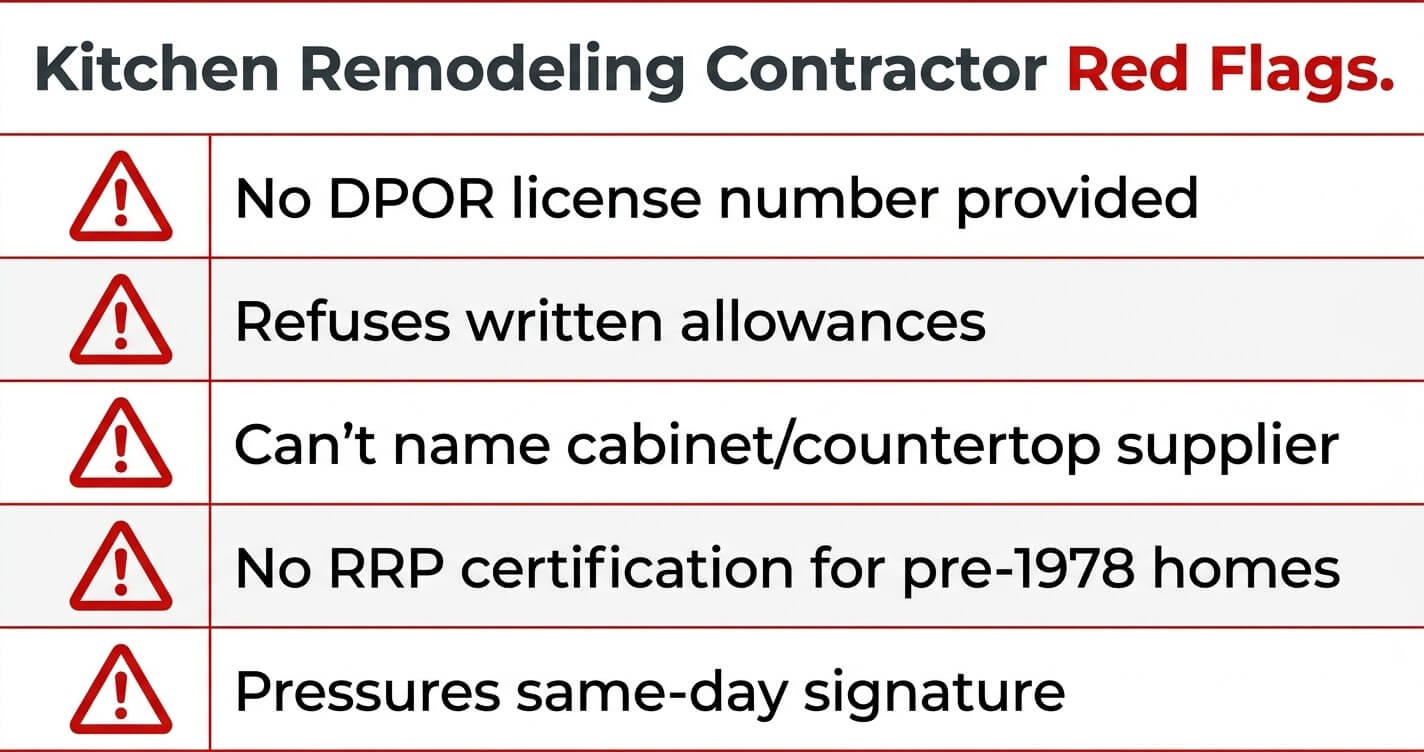
- No DPOR license number provided, or a license number that doesn’t match the business name on the contract.
- Refuses to put cabinetry, countertop, or appliance allowances in writing.
- Can’t name their cabinet or countertop supplier when asked directly.
- No RRP certification on file for a pre-1978 home (see Question 4).
- Pressures a same-day signature or discounts tied to signing before you’ve compared a second quote.
Frequently Asked Questions

How much does it cost to hire a kitchen remodeling contractor in Northern Virginia?
Kitchen remodel costs in Northern Virginia vary widely by scope, a cosmetic refresh runs far lower than a full gut remodel with structural changes, so the most useful starting point is a current cost breakdown by project tier rather than a single average number.
See Kitchen Remodel Cost in Fairfax VA for current 2026 ranges by scope and finish level.
Do I need a permit for a kitchen remodel in Fairfax County?
Yes, most Fairfax County kitchen remodels require plumbing and/or electrical permits at minimum, and a structural permit if a wall is removed, as covered in Question 2 above.
How long does it take to hire and start with a kitchen remodeling contractor?
Expect roughly two to six weeks from initial quote to signed contract, followed by additional lead time for permitting and cabinetry ordering before demolition starts, which is why the sequencing question in Question 6 matters as much as the hiring timeline itself.
What license does a kitchen remodeling contractor need in Virginia?
A Virginia contractor needs a DPOR license class that matches the total contract value of the kitchen remodel, Class B or Class A for most full kitchen projects, as detailed in Question 1 above.
Should I hire a design-build company or a separate designer and contractor for my kitchen?
A design-build kitchen remodeling contractor keeps design and construction under one contract and one point of accountability, which tends to simplify change orders compared to coordinating a separate designer and builder, see Question 9 for the full comparison.
What’s a red flag when interviewing a kitchen remodeling contractor?
The clearest red flags are a missing or mismatched DPOR license number and a refusal to put cabinetry and countertop allowances in writing, see the full Red Flags checklist above for the complete list.
Can my kitchen remodeling contractor also handle a small addition or layout expansion?
Many Northern Virginia design-build contractors handle both, but a layout expansion is a different scope and cost than a kitchen remodel alone, confirm it’s priced and permitted as its own line item rather than folded into the kitchen allowance.
See our kitchen addition page for that scope specifically, and for combining projects, Kitchen and Bathroom Remodel Together: Arlington VA covers how that sequencing and budgeting works when two rooms are remodeled at once.
Crux of the Matter
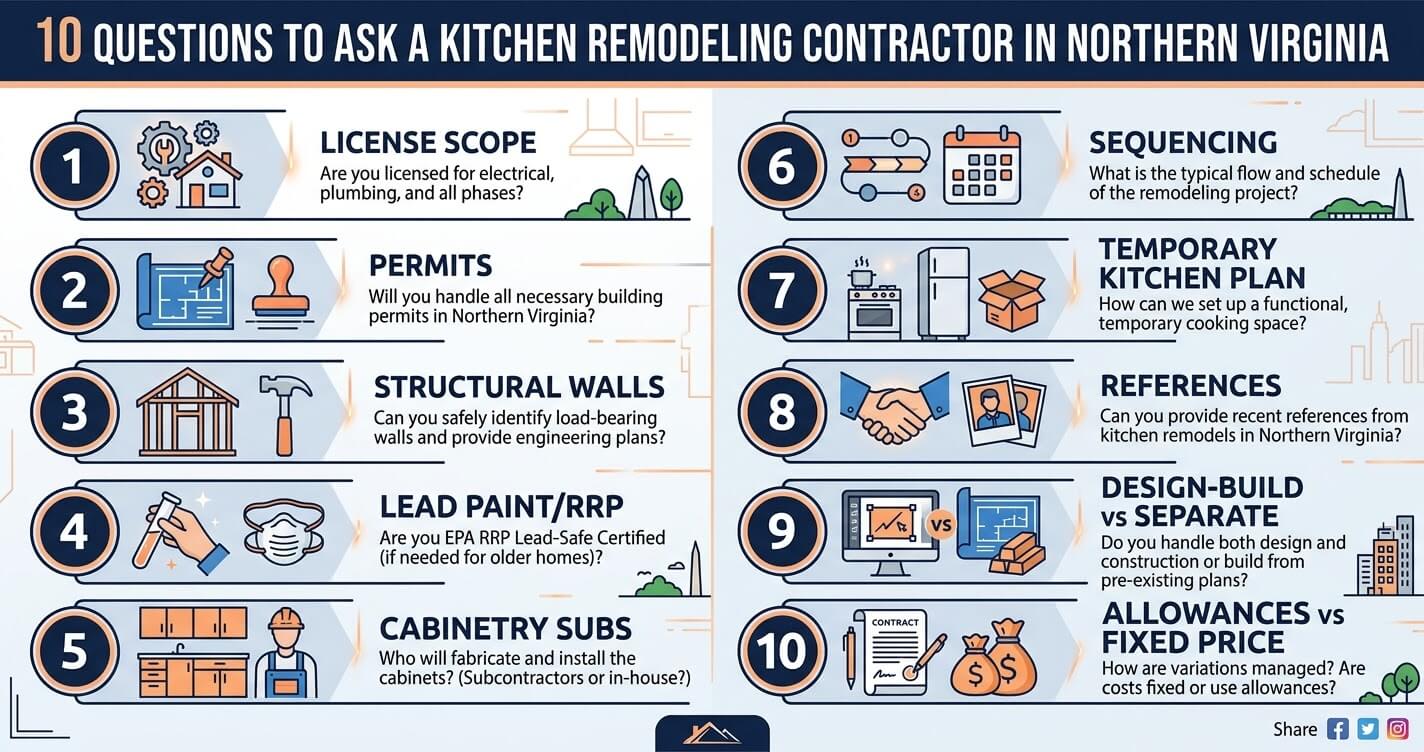
Vetting a kitchen remodeling contractor Northern Virginia homeowners can rely on comes down to three things a general renovation checklist won’t catch: a license class that actually covers plumbing and electrical relocation, a written cabinetry and countertop allowance, and a realistic sequencing plan for the one kitchen you’ll be living without. Work through the ten questions above with every contractor you interview, and use the red flags checklist to rule out the ones who won’t answer them in writing.
Planning a kitchen remodel in Northern Virginia? Contact US Home Design Build to discuss your layout, budget, and timeline with our design-build kitchen remodeling team.
