
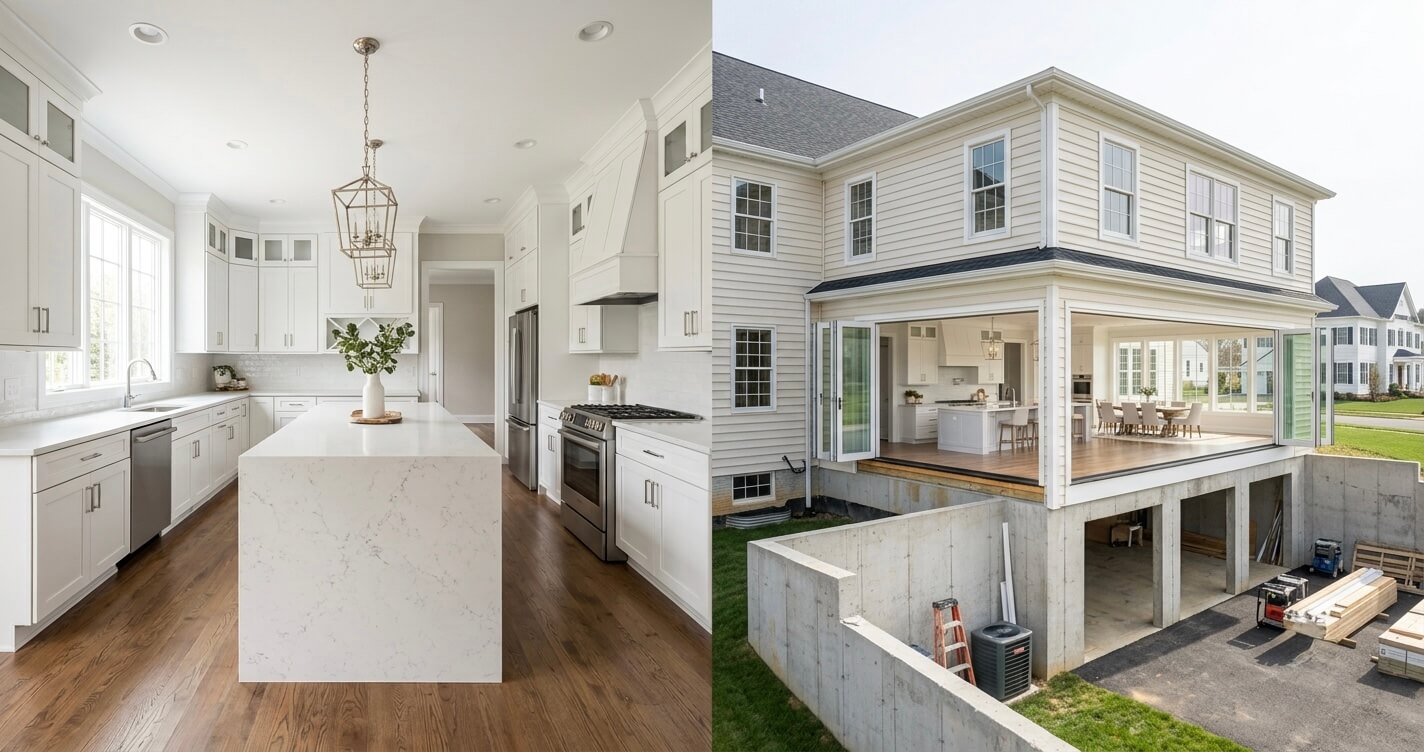
For many homeowners across Fairfax, McLean, Arlington, Vienna, and the surrounding communities, the kitchen eventually becomes the one room that no longer fits the way the family lives. Storage feels inadequate, traffic flow becomes frustrating during gatherings, and preparing meals in a cramped layout turns into a daily inconvenience.
At that point, homeowners often face one of the biggest renovation decisions they will ever make: should you invest in a kitchen remodel or build a kitchen addition?
When comparing a kitchen remodel vs kitchen addition Northern Virginia, there isn’t a universal answer. While both projects can significantly improve functionality and increase property value, they solve fundamentally different problems. A remodel transforms the kitchen you already have by improving its layout, finishes, storage, and efficiency without increasing the home’s footprint. A kitchen addition, on the other hand, physically expands the home to create more usable living space, a solution that’s often necessary when the existing kitchen is simply too small to meet modern lifestyle needs.
That distinction is especially important in Northern Virginia, where home values remain among the highest in the Mid-Atlantic. According to the U.S. Census Bureau and the Fairfax County Department of Tax Administration, Fairfax County’s median home value exceeds $729,000, making renovation decisions particularly impactful because even modest improvements can influence buyer perception and long-term equity.
At the same time, homeowners continue investing heavily in remodeling despite higher construction costs. The Harvard Joint Center for Housing Studies reports that 54% of homeowners completed a remodeling project, with median renovation spending reaching $20,000, demonstrating that strategic home improvements remain a priority nationwide.
At US Home Design Build (USHDB), we’ve completed both kitchen remodels and kitchen additions throughout Fairfax, McLean, Arlington, Vienna, Reston, Burke, and nearby Northern Virginia communities. We’ve learned that the best investment isn’t determined by which project costs less, it’s determined by your home’s existing layout, your property’s zoning constraints, your long-term plans, and your renovation goals.
In this guide, we’ll compare kitchen remodels and kitchen additions across the factors that matter most to Northern Virginia homeowners, including project costs, return on investment (ROI), permitting requirements, construction timelines, and the situations where one option delivers greater long-term value than the other.
What’s the Difference? Defining Each Project
Although the terms are often used interchangeably, a kitchen remodel and a kitchen addition are two very different construction projects. Understanding that difference is essential before evaluating costs, timelines, or expected returns.
What Is a Kitchen Remodel?
A kitchen remodel upgrades or reconfigures the existing kitchen without expanding the home’s footprint. The project remains within the current walls of the house while improving functionality, aesthetics, and efficiency.
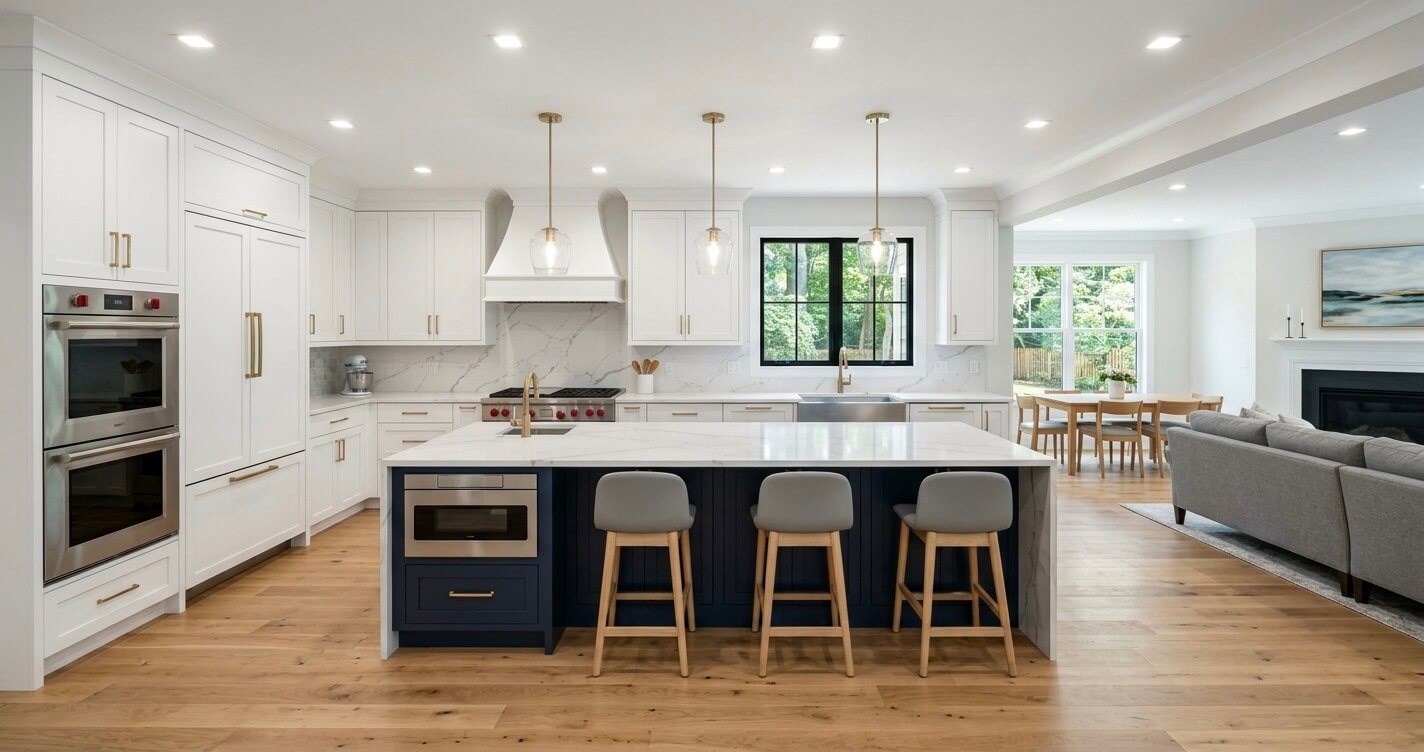
A remodel may include:
- Replacing or refacing cabinets
- Installing quartz, granite, or natural stone countertops
- Upgrading appliances
- Installing new flooring and lighting
- Modernizing plumbing fixtures
- Reconfiguring cabinetry for improved workflow
- Removing a non-load-bearing or structural wall to create an open-concept layout
- Relocating plumbing or electrical systems where necessary
Depending on the scope, a kitchen remodel may involve structural engineering, electrical upgrades, plumbing modifications, HVAC adjustments, and building permits. However, the defining characteristic remains the same; the home’s exterior footprint does not change.
For homeowners considering whether expanding the kitchen is the better solution, our detailed guide to Kitchen Addition Contractors Northern Virginia explains how additions differ from remodeling projects and what construction requirements to expect.
What Is a Kitchen Addition?
A kitchen addition physically enlarges the home by constructing new livable square footage specifically for the kitchen or adjoining dining space.
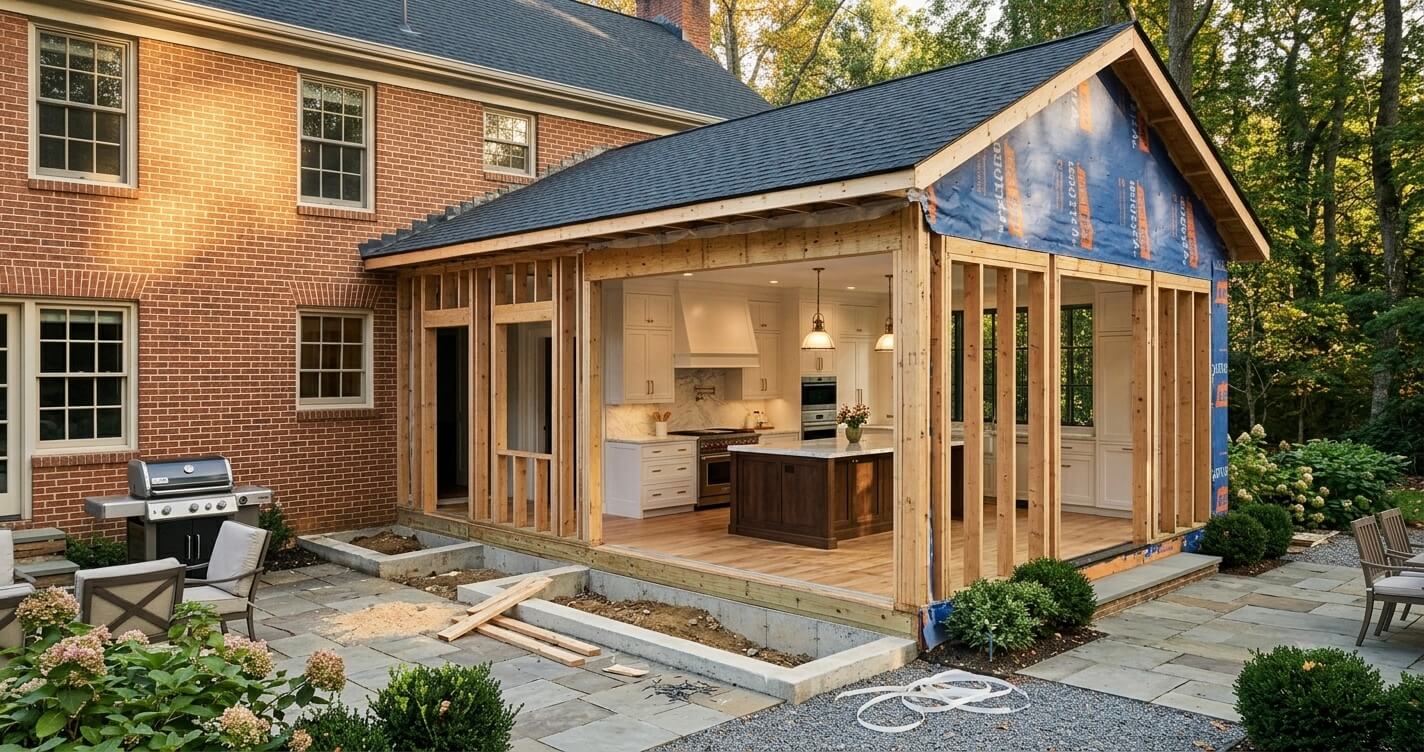
Unlike remodeling, an addition requires major structural construction, including:
- New foundation work
- Exterior wall removal
- Roof extension
- Framing and structural engineering
- New insulation
- Exterior finishes
- Window and door installation
- Plumbing, HVAC, and electrical extensions
- Full building permits and inspections
Because new square footage is being added, kitchen additions also increase the home’s assessed living area, which can influence both appraised value and long-term resale potential.
Many Northern Virginia homeowners choose a hybrid approach, expanding the kitchen first and then completely remodeling the original kitchen space, creating a seamless, modern layout while maximizing functionality and resale appeal.
Cost Comparison: Kitchen Remodel vs Kitchen Addition in Northern Virginia
Cost is often the deciding factor for homeowners evaluating whether to remodel an existing kitchen or expand the home altogether. While every project is unique, understanding the typical investment ranges helps establish realistic expectations before design begins.
Kitchen Remodel Costs in Northern Virginia (2026)
Kitchen remodeling costs vary based on the home’s age, structural complexity, material selections, and whether plumbing or electrical systems are relocated.
Most Northern Virginia kitchen remodels fall between $35,000 and $150,000, with many homeowners investing approximately $75,000–$95,000 for a high-quality mid-range renovation involving new cabinetry, quartz countertops, upgraded appliances, lighting, flooring, and moderate layout improvements.
Compared with national averages, remodeling costs across Northern Virginia typically run 15–25% higher due to elevated labor rates, stricter permitting requirements, premium material expectations, and the complexity of renovating older homes throughout Fairfax County, Arlington, and surrounding jurisdictions.
If you’re planning a remodel specifically in Fairfax County, our complete Kitchen Remodel Cost in Fairfax VA guide provides a detailed breakdown of pricing factors, finish levels, and budgeting considerations.
Kitchen Addition Costs in Northern Virginia (2026)
Kitchen additions require considerably more construction than remodels because the project creates entirely new living space.
Typical costs include:
- Ground-floor additions: $150–$350 per square foot
- Typical 200–400 square foot kitchen additions: $60,000–$140,000+
- Combined addition plus full remodel: $120,000–$250,000+
Beyond the base construction cost, homeowners should also budget for:
- Foundation excavation
- Structural engineering
- Roofline integration
- HVAC extensions
- Plumbing relocation
- Electrical service upgrades
- Exterior siding and roofing
- Permit fees
- Architectural design
These additional components commonly add $25,000–$50,000 depending on project complexity.
Across Northern Virginia, total addition costs frequently average $230–$500 per square foot once all construction, engineering, permitting, and finish work are included. Larger additions often provide better overall value because fixed costs, such as design, permitting, and foundation work, are distributed across more square footage.
Kitchen Remodel vs Kitchen Addition Cost Comparison
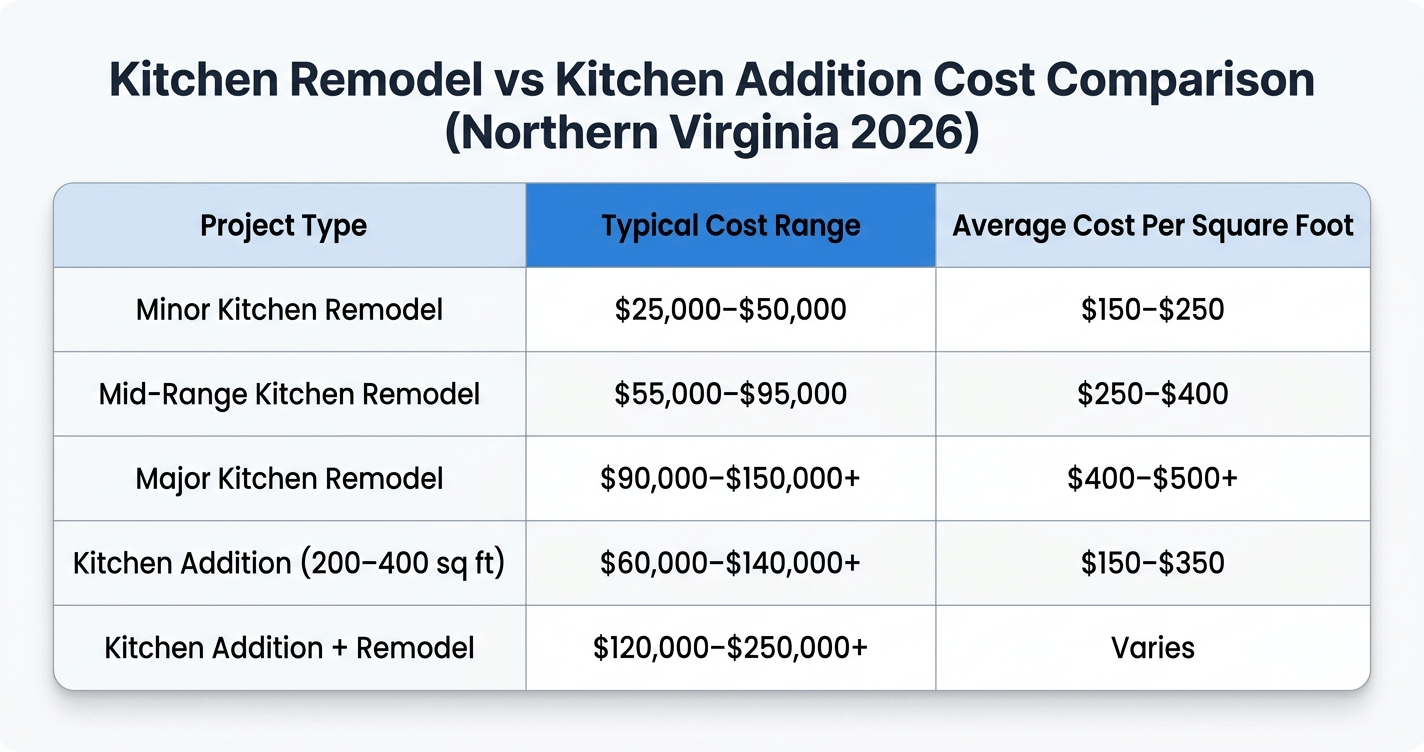
Although a kitchen addition generally requires a larger investment, comparing total project cost alone doesn’t tell the full story. The better choice depends on whether you’re trying to improve an outdated kitchen or solve a genuine lack of square footage. In the next section, we’ll compare how each option performs from a return-on-investment and long-term home value perspective.
Which Adds More Home Value? ROI of Kitchen Remodel vs Kitchen Addition in Northern Virginia
For most homeowners, the decision isn’t based solely on construction cost; it’s based on long-term value. Whether you’re planning to sell within a few years or remain in your home for the next decade, understanding the return on investment (ROI) of each project is essential.
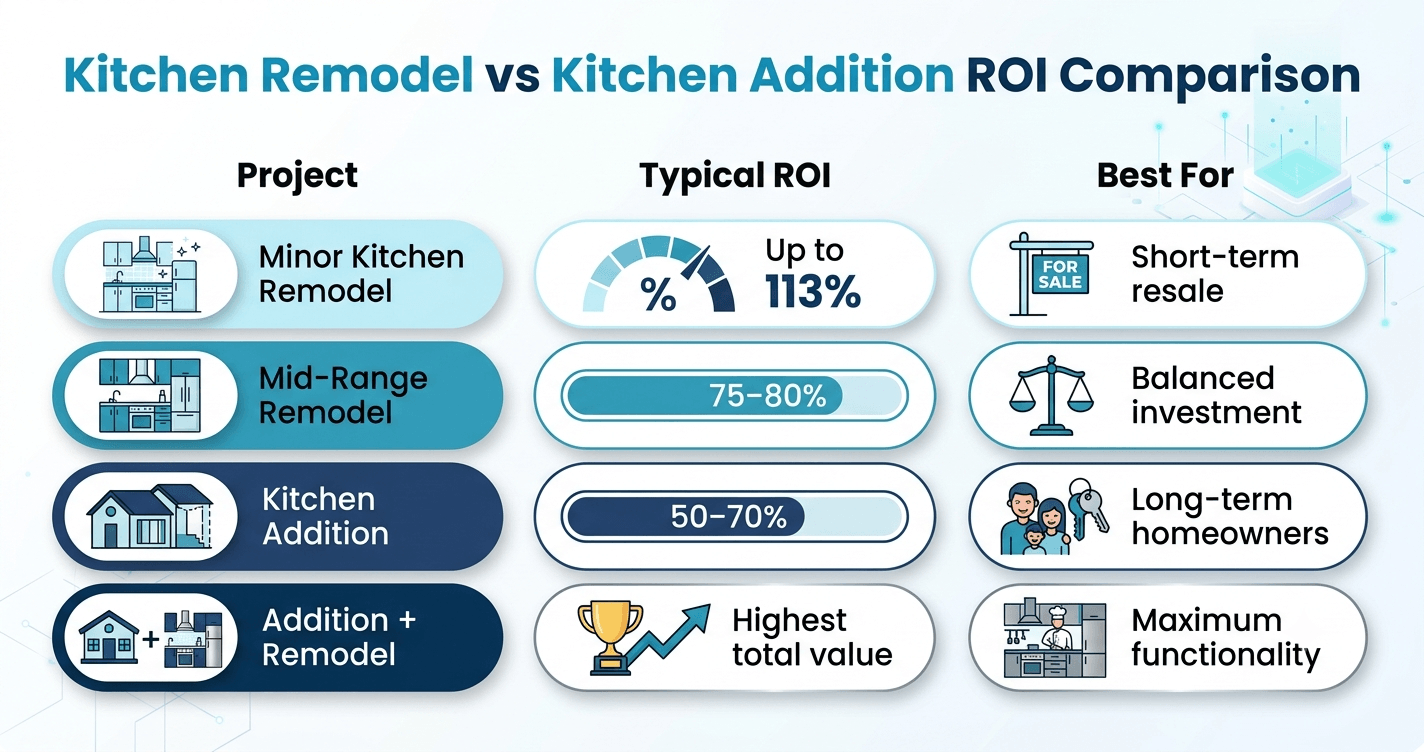
The answer, however, isn’t as straightforward as asking which project produces the highest percentage return. A kitchen remodel and a kitchen addition create value in different ways. Remodels typically generate stronger percentage-based resale returns because they modernize one of the home’s most influential spaces without the high structural costs associated with new construction. Additions, meanwhile, increase usable square footage and overall livability, often producing larger absolute dollar gains despite lower percentage ROI.
ROI of a Kitchen Remodel in Northern Virginia
Kitchen remodeling consistently ranks among the highest-return interior renovations in the United States. According to the 2025 Remodeling Cost vs. Value Report, a minor kitchen remodel continues to deliver one of the strongest resale returns of any interior improvement, while mid-range kitchen renovations in the Washington, D.C. metropolitan region regularly outperform national averages.
For Northern Virginia homeowners, that trend is amplified by local buyer expectations. In communities such as McLean, Vienna, Great Falls, and Arlington, updated kitchens are no longer considered luxury upgrades; they’re expected features in competitive listings. Buyers shopping in homes valued between $800,000 and $2 million often expect:
- Quartz or natural stone countertops
- Semi-custom or custom cabinetry
- High-efficiency appliances
- Layered LED lighting
- Functional islands
- Open-concept layouts
- Modern storage solutions
A home with an outdated kitchen may remain structurally sound, but it can still experience longer time on market and downward pricing pressure simply because buyers anticipate the cost and disruption of future renovations.
According to the 2025 Remodeling Cost vs. Value Report, minor kitchen remodels remain among the strongest-performing interior projects nationally, with returns approaching 113% in many markets.
Likewise, regional data for the Washington D.C. metropolitan area shows that mid-range kitchen remodels typically recover approximately 75–80% of their investment, outperforming many other interior renovation categories.
For homeowners evaluating broader renovation priorities, our guide to Best ROI Home Improvements Northern Virginia 2026 explains how kitchen remodeling compares with bathrooms, additions, roofing, and other major investments.
ROI of a Kitchen Addition in Northern Virginia
Kitchen additions generate value differently because they increase both functionality and total living area.
Instead of simply modernizing existing space, an addition creates entirely new square footage that becomes part of the home’s assessed value. Appraisers evaluate finished living area as one of the primary components of residential property valuation, making additions particularly valuable when the existing kitchen is significantly smaller than comparable homes in the surrounding neighborhood.
Nationally, kitchen additions generally recover 50–70% of their construction cost at resale, although returns in Northern Virginia frequently exceed national averages due to higher home values and stronger buyer demand for spacious, open kitchens.
According to the National Association of Realtors Remodeling Impact Report, room additions that improve functionality and increase livable space consistently rank among the remodeling projects that homeowners report as adding substantial resale value and owner satisfaction.
A kitchen addition generally provides the greatest financial return when:
- The existing kitchen is noticeably undersized compared to neighboring homes.
- The homeowner intends to remain in the property for seven years or longer.
- The addition improves circulation, natural light, and family gathering space.
- The project brings the home’s overall layout in line with neighborhood expectations rather than exceeding them.
The Northern Virginia Nuance
One of the biggest mistakes homeowners make is assuming that larger automatically means more valuable.
Northern Virginia neighborhoods each have an established pricing ceiling influenced by lot size, school district, architectural style, and comparable sales. Adding an oversized luxury kitchen to a modest colonial in Arlington or Falls Church may not generate proportional resale value if surrounding homes offer significantly smaller footprints.
Likewise, many neighborhoods throughout Fairfax County, McLean, and Vienna have zoning restrictions that limit lot coverage and building setbacks. These regulations can make additions significantly more expensive, or, in some cases, impossible without obtaining zoning variances.
For homeowners whose kitchens are already appropriately sized, a thoughtfully designed remodel often produces stronger percentage ROI because it modernizes buyer expectations without over-improving the property.
Should You Remodel or Add?
From a financial perspective:
- Choose a remodel when the existing kitchen footprint is adequate but outdated.
- Choose an addition when inadequate square footage limits functionality.
Combine both projects when long-term ownership and neighborhood values justify the larger investment.
Thinking about both options?
Homeowners throughout Fairfax County, McLean, Arlington, and surrounding Northern Virginia communities often benefit from a professional site evaluation before committing to either path. Your lot dimensions, zoning limitations, structural conditions, and long-term plans ultimately determine which investment produces the greatest value.
Permits and Timelines: What to Expect in Northern Virginia
Construction costs receive most of the attention, but permitting requirements and project timelines frequently influence homeowners just as much. Northern Virginia maintains some of the most comprehensive residential building regulations in Virginia, particularly for projects involving structural work, plumbing, gas lines, and electrical systems.

Understanding those requirements early helps avoid unexpected delays and budgeting surprises.
Kitchen Remodel Permit Requirements
Not every kitchen remodel requires a building permit. Cosmetic improvements such as painting cabinets, replacing countertops, installing flooring over existing subfloors, or changing cabinet hardware can usually proceed without formal permitting.
However, permits become necessary whenever the project involves:
- Structural modifications
- Load-bearing wall removal
- Electrical circuit additions
- Plumbing relocation
- Gas appliance installation
- HVAC modifications
- Window or exterior door changes
Across Fairfax County, Arlington County, Loudoun County, and Prince William County, permit fees vary depending on project scope and inspection requirements.
For most kitchen remodels, homeowners should anticipate permit costs ranging from $500 to $2,500, depending on structural complexity and the number of required inspections.
Typical construction timelines include:
- Cosmetic remodel: 4–6 weeks
- Mid-range remodel: 8–12 weeks
- Major structural remodel: 12–20 weeks
Projects involving custom cabinetry or specialty finishes may require additional lead time because of manufacturing schedules.
Kitchen Addition Permit Requirements
Kitchen additions require substantially more regulatory review because they alter the home’s structural envelope.
Typical requirements include:
- Building permit
- Site plan review
- Structural engineering
- Foundation inspection
- Framing inspection
- Electrical inspection
- Plumbing inspection
- Mechanical inspection
- Final occupancy approval
Before construction begins, homeowners must also verify:
- Property setbacks
- Lot coverage limitations
- Easements
- HOA architectural approval (when applicable)
Within Fairfax County, permit review alone may require two to four months, depending on project complexity and revision requests.
Once construction begins, a typical ground-floor kitchen addition often requires four to six months from demolition through final inspection. More complex additions involving second-story support, retaining walls, or significant structural modifications may extend overall project duration to eight to twelve months.
Homeowners interested in understanding the broader cost implications of residential additions can read our complete guide to Northern Virginia Home Addition Cost Explained.
Zoning Considerations Specific to Northern Virginia
Many homeowners assume sufficient backyard space automatically allows for an addition. In reality, local zoning ordinances often determine whether expansion is legally possible.
Common restrictions include:
- Minimum rear-yard setbacks
- Side-yard setbacks
- Maximum lot coverage ratios
- Easement limitations
- Stormwater management requirements
- Tree preservation regulations
Neighborhoods throughout McLean, Vienna, and Great Falls frequently present additional challenges because mature lots, conservation easements, and urban forest protection requirements can influence foundation placement.
Evaluating these constraints before architectural design begins helps homeowners avoid redesign costs later in the permitting process.
Kitchen Remodel vs Kitchen Addition in Northern Virginia: Which Is Right for Your Situation?
Every successful renovation begins by correctly identifying the problem you’re trying to solve.
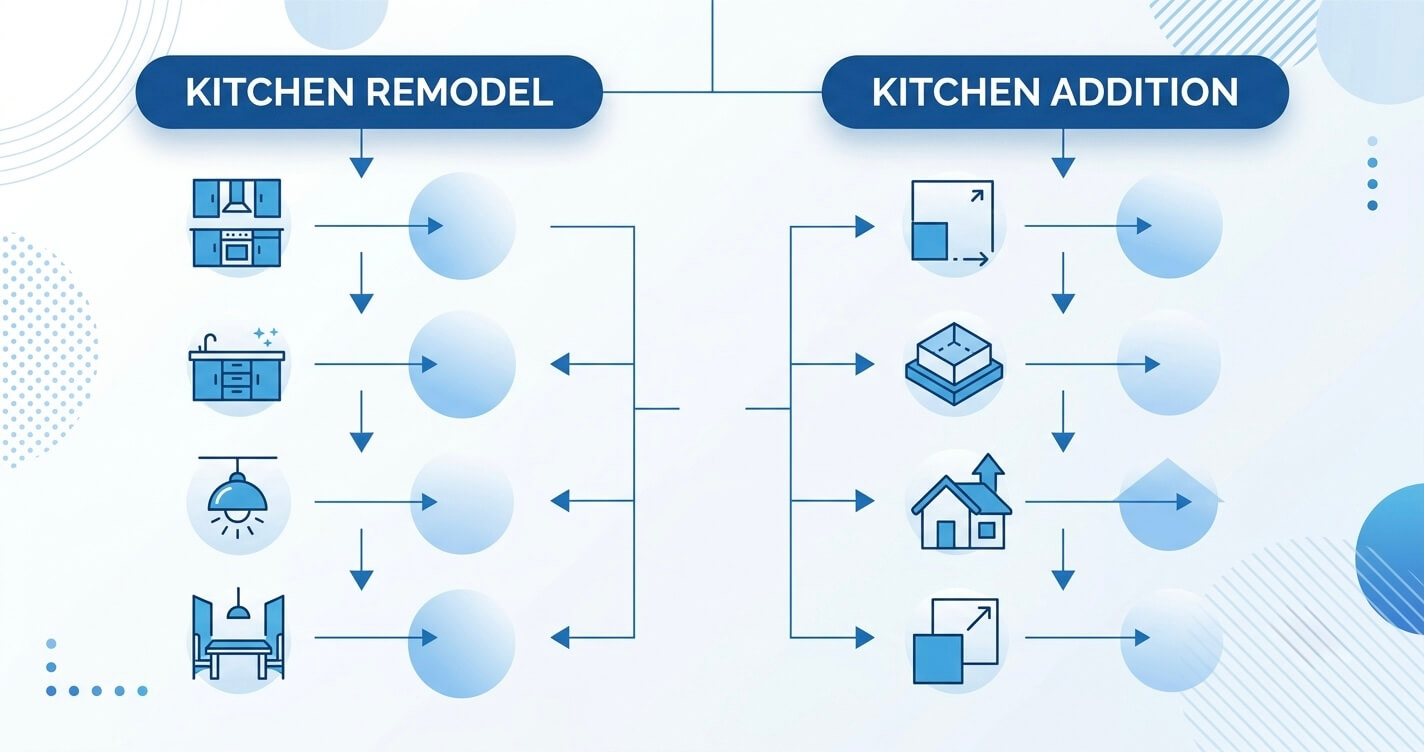
If the issue is outdated finishes, poor workflow, or insufficient storage, remodeling often delivers the best return. If the existing kitchen simply lacks enough square footage to function comfortably, expanding the home may become the more practical long-term investment.
Choose a Kitchen Remodel When…
A remodel is typically the better choice if:
- Your kitchen already has adequate square footage.
- The layout can be improved without expanding the home.
- You want an open-concept floor plan.
- Your renovation budget remains below approximately $100,000.
- You expect to sell within the next three to five years.
- Local zoning restrictions make additions difficult.
Our comprehensive Kitchen Remodeling Northern Virginia service page explains how design-build remodeling projects improve both functionality and resale value.
Choose a Kitchen Addition When…
A kitchen addition becomes the stronger investment when:
- The kitchen is significantly smaller than comparable homes.
- Storage and circulation problems cannot be solved within the existing footprint.
- You intend to remain in your home for at least seven to ten years.
- Your property allows additional construction.
- Increasing total living area aligns with neighborhood values.
Homeowners considering expansion can also learn more through our Home Additions Northern Virginia resource.
The Hybrid Approach: Addition + Remodel
Many higher-end Northern Virginia projects combine both strategies.
Rather than simply building additional square footage, homeowners expand the footprint while completely redesigning the original kitchen. This integrated approach creates the most cohesive floor plan, modernizes finishes throughout the space, and maximizes overall functionality.
Although combined projects typically range between $120,000 and $250,000+, they often produce the most dramatic improvements in both daily living and long-term property value, particularly within McLean, Great Falls, and Vienna’s luxury housing markets.
How Northern Virginia’s Housing Market Shapes This Decision
Location plays a significant role in determining whether a remodel or addition makes better financial sense.
According to the Fairfax County Department of Tax Administration and the U.S. Census Bureau, Fairfax County’s median home value exceeds $729,000, placing Northern Virginia among the country’s most valuable residential markets.
That pricing environment changes renovation economics.
In McLean, Great Falls, and Vienna, buyers often expect expansive kitchens with premium finishes as a baseline feature rather than an upgrade. Conversely, Arlington and Falls Church contain many townhomes and infill properties where lot constraints frequently make additions impractical, increasing the value proposition of well-executed remodels.
Meanwhile, neighborhoods such as Burke, Reston, and Annandale often include larger suburban lots that provide greater flexibility for bump-outs and full kitchen additions.
Northern Virginia’s construction market also remains more expensive than much of the country. Continued commercial development, including large-scale data center construction throughout Loudoun County, has intensified demand for skilled trades, contributing to remodeling costs that frequently exceed national averages.
USHDB has completed kitchen remodeling and home addition projects throughout Fairfax, McLean, Arlington, Vienna, Great Falls, Reston, Burke, and neighboring Northern Virginia communities, giving homeowners local experience that’s essential when evaluating zoning constraints, neighborhood expectations, and long-term resale potential.
For an example of a completed luxury renovation, explore our Recent Kitchen Remodel in McLean VA project.
If you’re also deciding whether improving your current home makes more sense than moving, our guide Renovate vs. Sell Northern Virginia 2026 provides a broader financial comparison.
Frequently Asked Questions
Is a kitchen addition worth it in Northern Virginia?
A kitchen addition can be an excellent long-term investment when the existing kitchen is genuinely undersized and cannot be improved within the current footprint. Homes in higher-value Northern Virginia communities, including McLean, Great Falls, Vienna, and portions of Fairfax County, often command premium resale values when they offer spacious, functional kitchens that meet modern buyer expectations.
However, value depends heavily on context. If your kitchen already provides adequate square footage, investing in a well-planned remodel often delivers a stronger percentage return while avoiding the additional structural, permitting, and engineering costs associated with new construction.
Generally, homeowners planning to remain in their property for seven to ten years or longer are better positioned to realize the full lifestyle and financial benefits of a kitchen addition.
How much does a kitchen addition cost in Northern Virginia in 2026?
For most homeowners, a ground-floor kitchen addition costs between $60,000 and $140,000+ for approximately 200–400 square feet of new living space.
Construction costs typically range between $150 and $350 per square foot for the addition itself. Once foundation work, structural engineering, roofing, plumbing, HVAC modifications, electrical upgrades, architectural design, permits, and interior finishes are included, complete project costs frequently exceed those base figures.
When homeowners combine a kitchen addition with a full remodel of the original kitchen, total project investments commonly range between $120,000 and $250,000+, depending on structural complexity and finish selections.
For a detailed breakdown of addition pricing, permitting costs, and budgeting considerations, see our guide Northern Virginia Home Addition Cost Explained.
Do I need permits for a kitchen remodel in Fairfax County?
In most cases, yes, if the project involves electrical work, plumbing modifications, gas appliance installation, HVAC alterations, or structural changes.
Purely cosmetic work, such as cabinet painting, countertop replacement, flooring installation over existing subfloors, or replacing cabinet hardware, generally does not require a building permit. However, removing load-bearing walls, relocating sinks or appliances, upgrading electrical circuits, or modifying gas lines requires permits and inspections.
Fairfax County updated portions of its building permit fee schedule in July 2025, making it even more important for homeowners to understand permitting requirements before finalizing renovation budgets.
Official Fairfax County Building Development Services: Click Here
Which adds more resale value: a kitchen remodel or a kitchen addition in Northern Virginia?
Neither project is universally better because each creates value differently.
A kitchen remodel generally delivers the strongest percentage return on investment, particularly when updating finishes, cabinetry, countertops, appliances, lighting, and layout within an already functional footprint.
A kitchen addition, however, increases finished living area, making it more likely to produce larger absolute dollar gains in appraised value, especially in neighborhoods where comparable homes already feature larger kitchens.
According to the National Association of Realtors Remodeling Impact Report, projects that improve functionality and livable space consistently rank among the remodeling investments homeowners perceive as adding meaningful value.
Similarly, the 2025 Remodeling Cost vs. Value Report continues to identify kitchen remodeling as one of the highest-performing interior renovation categories nationwide.
How long does a kitchen addition take in Northern Virginia?
Project duration depends on permitting, engineering complexity, weather conditions, and material lead times.
For most homeowners, a realistic schedule includes:
– Design and architectural planning: 4–8 weeks
– Permit review and approvals: 2–4 months
– Construction: 3–6 months
Overall, homeowners should expect approximately four to eight months from initial planning through final inspection for a typical ground-floor kitchen addition.
Projects involving second-story structural support, retaining walls, significant grading, or extensive custom construction may require eight to twelve months.
Can I build a kitchen bump-out instead of a full addition?
Yes. A kitchen bump-out expands only a portion of the existing exterior wall, typically extending the kitchen two to four feet without creating a completely new room.
For many Northern Virginia homes, bump-outs provide enough additional space to:
– Enlarge an island
– Add pantry storage
– Improve appliance spacing
– Create a breakfast seating area
– Increase circulation around work zones
Depending on structural requirements, bump-outs often cost between $15,000 and $50,000, making them considerably less expensive than full additions while still delivering meaningful improvements in functionality.
Whether a bump-out requires a new foundation depends on engineering requirements, soil conditions, and the amount of cantilevering that is structurally feasible.
What is the best kitchen upgrade for resale in McLean or Great Falls?
Luxury buyers throughout McLean, Great Falls, and similar Northern Virginia communities generally expect kitchens that combine premium finishes with highly functional layouts.
Among the upgrades that consistently improve marketability are:
– Quartz or natural stone countertops
– Semi-custom or custom cabinetry
– Professional-grade appliances
– Large multifunction islands
– Walk-in pantry storage
– Layered LED lighting
– Wide-plank hardwood flooring
– Open-concept layouts with improved traffic flow
For homes where the kitchen is already appropriately sized, these remodeling improvements often generate stronger resale returns than expanding the home’s footprint.
Conversely, if the kitchen is noticeably smaller than comparable homes in the neighborhood, increasing square footage through an addition may create greater long-term value.
For an example of how a premium remodel transformed a luxury home, explore our completed project Recent Kitchen Remodel in McLean VA.
Choosing Between a Kitchen Remodel and Kitchen Addition in Northern Virginia
Choosing between a kitchen remodel vs kitchen addition in Northern Virginia ultimately comes down to identifying the problem you’re trying to solve, not simply comparing price tags.
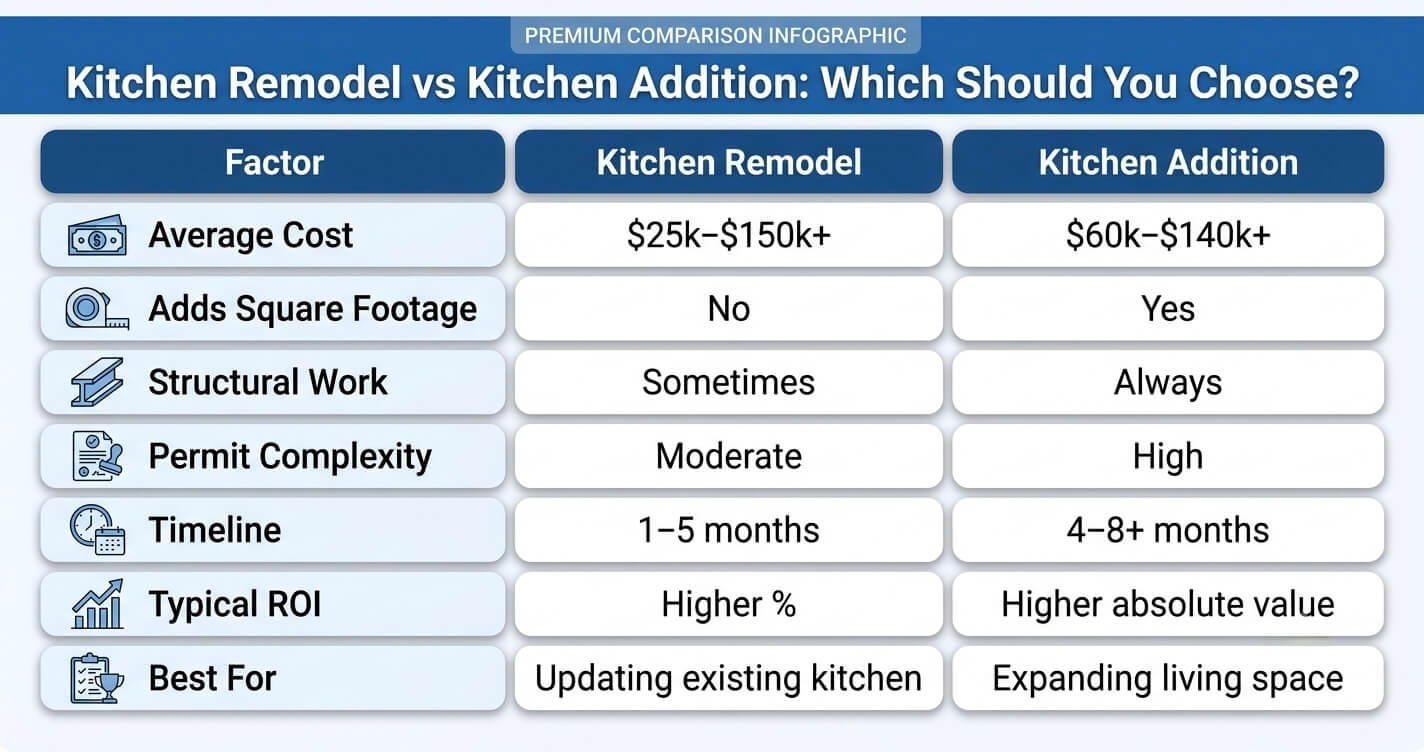
If your kitchen already offers sufficient square footage but suffers from outdated finishes, inefficient storage, poor lighting, or an impractical layout, a professionally planned remodel will usually provide the strongest balance of cost, functionality, and resale value. Modern cabinetry, premium countertops, upgraded appliances, improved lighting, and thoughtful space planning can dramatically transform everyday living without altering your home’s footprint.
If, however, the kitchen is fundamentally too small for your family’s needs, no amount of cosmetic improvement will create the functionality that additional square footage provides. In those situations, a kitchen addition becomes a long-term investment that improves livability while increasing the home’s overall usable space and market appeal.
For homeowners facing both challenges, limited space and outdated finishes, a combined addition and remodel often delivers the most comprehensive solution. Although this approach requires greater planning, a larger budget, and a longer construction timeline, it frequently produces the most significant improvement in both daily living and long-term property value.
Because Northern Virginia combines high home values with strict zoning regulations, detailed permitting requirements, and demanding buyer expectations, working with an experienced design-build contractor is essential. Every property presents unique structural, zoning, and financial considerations that should be evaluated before finalizing a renovation strategy.
Whether you’re planning a kitchen remodel, considering a kitchen addition, or deciding between the two, US Home Design Build can help you evaluate your home’s existing layout, lot constraints, investment goals, and long-term plans before construction begins.
Planning a kitchen remodel or kitchen addition in Northern Virginia?
Contact US Home Design Build to schedule a consultation with our experienced design-build team. We proudly serve homeowners throughout Fairfax, McLean, Arlington, Vienna, Great Falls, Reston, Burke, Falls Church, Annandale, and surrounding Northern Virginia communities, helping them design kitchens that enhance everyday living while maximizing long-term property value.