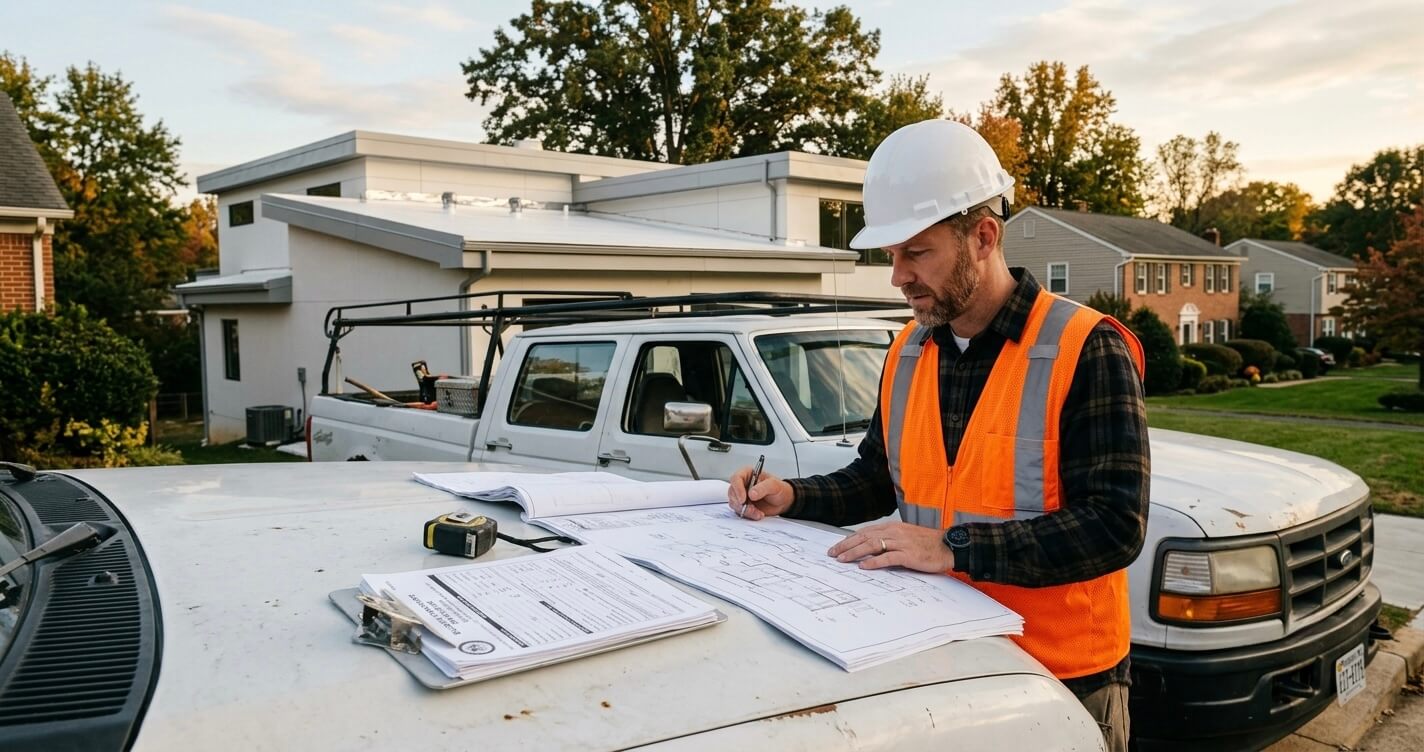
The materials have been delivered, the crew is scheduled, and a flat-roof addition in McLean is ready for installation. Then the homeowner asks a simple question that can determine whether the project moves forward on schedule or comes to a halt: “Has the permit been approved?”
For contractors and property owners alike, understanding TPO roofing permit Northern Virginia requirements is one of the most important steps before work begins. Unlike many routine roofing replacements, TPO membrane systems are frequently installed on low-slope additions, accessory dwelling units (ADUs), commercial-style residential designs, and projects involving insulation or structural upgrades. These situations often trigger permit reviews under the Virginia Uniform Statewide Building Code (USBC) and local building department requirements.
Another challenge is that permitting is not standardized across Northern Virginia. Fairfax County, Arlington County, the City of Fairfax, and the City of Falls Church each administer their own permit systems, application procedures, review timelines, and inspection requirements. A project that qualifies for an expedited process in one jurisdiction may require a more detailed plan review in another.
This guide explains when a permit is typically required for TPO roofing work, what documents contractors should prepare before submitting an application, how permit reviews differ across major Northern Virginia jurisdictions, and the filing mistakes that most commonly delay projects. Whether you’re replacing an existing low-slope roof or installing TPO as part of a larger renovation, understanding the permitting process can help avoid costly scheduling setbacks and compliance issues.
If you’re looking for a broader overview of TPO roofing systems, including installation methods, costs, energy performance, and whether TPO is the right roofing material for your property, read our complete guide, TPO Roofing Northern Virginia: Ultimate Guide 2026.
Why Permits Matter More on TPO Projects Than Most Contractors Expect
Many homeowners assume that every roofing project follows the same permitting process. In practice, TPO roofing permit Northern Virginia requirements are often more extensive than those for conventional asphalt shingle replacements because flat-roof assemblies are commonly associated with structural modifications, energy-code upgrades, and new construction.
TPO roofing is widely specified for modern residential additions, rooftop decks, garage conversions, mixed-use buildings, and low-slope home designs. Many of these projects involve framing alterations, new roof assemblies, or changes to insulation thickness, all of which are reviewed for compliance with the Virginia Uniform Statewide Building Code before construction begins.
This is particularly common for home additions Northern Virginia, where roofing work forms part of a larger permitted construction package rather than a standalone roofing project.
Flat roofs also receive closer technical review because they perform differently than steep-slope roofing systems. During plan review, building officials may evaluate several factors, including:
- Roof drainage design to prevent standing water
- Structural loading capacity for the proposed roof assembly
- Compliance with current insulation and energy efficiency requirements
- Fire classification of the complete roofing assembly
- Manufacturer-approved installation details for the selected membrane system
Another situation that frequently triggers permit review is changing roofing materials. Replacing an aging modified bitumen roof with a modern TPO system is more than a cosmetic upgrade; it introduces a different roofing assembly with its own attachment methods, insulation requirements, and manufacturer specifications. Building departments may therefore require documentation demonstrating that the proposed system complies with current code requirements rather than those that existed when the original roof was installed.
Experienced Northern Virginia roofing contractors typically address permit requirements during the estimating phase instead of after contracts are signed. Discussing jurisdiction-specific requirements early allows project schedules, inspections, and material deliveries to be coordinated before construction begins, reducing the likelihood of unexpected delays once work is underway.
Does Your TPO Project Require a Permit? The Trigger Checklist
Before purchasing materials or scheduling installation, contractors should determine whether the proposed work requires approval from the local building department. Although each jurisdiction has its own administrative procedures, permit decisions throughout Virginia are generally made within the framework of the 2021 Virginia Uniform Statewide Building Code (USBC), which governs new construction, alterations, repairs, and additions statewide.
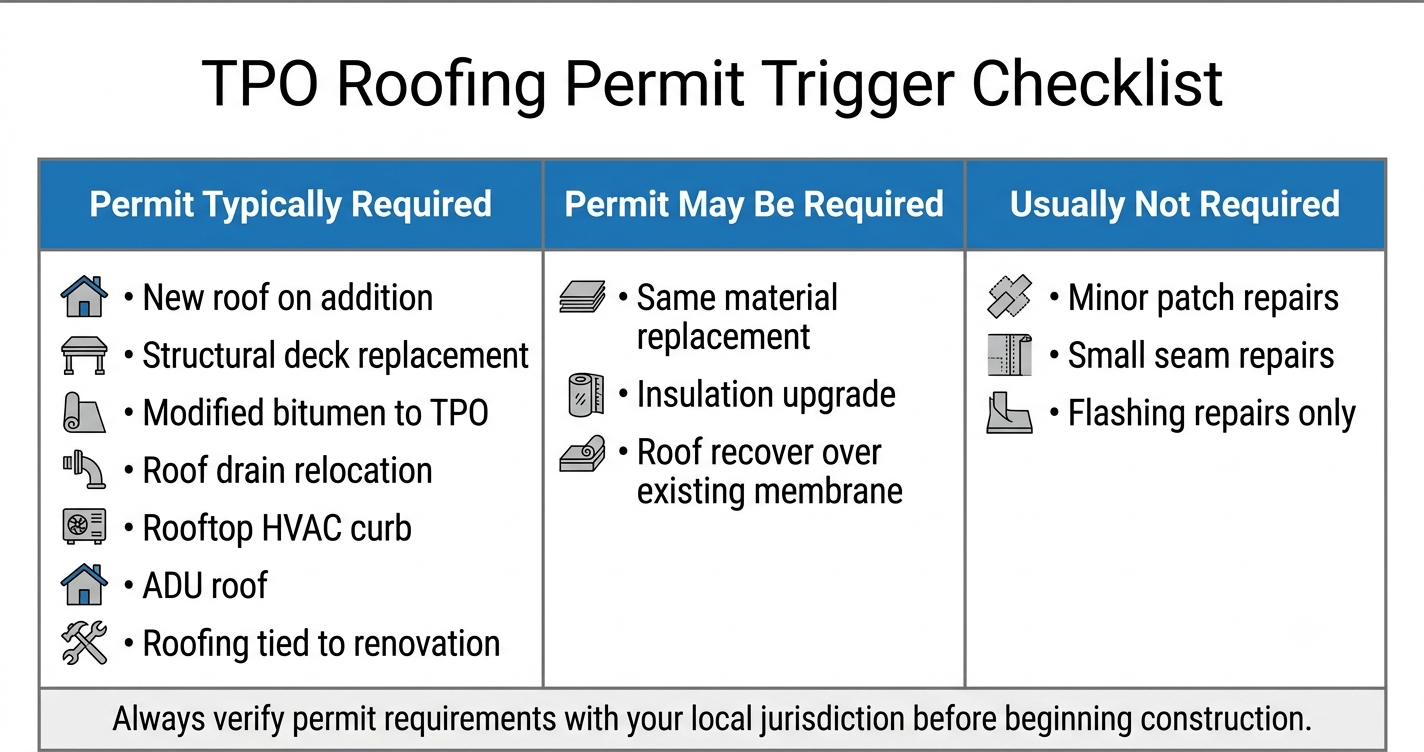
The following checklist covers the situations most commonly encountered on residential TPO roofing projects throughout Northern Virginia.
A permit is typically required when:
- Constructing a new low-slope roof on a home addition.
- Replacing structural roof decking or sheathing as part of the project.
- Changing from one roofing system to another, such as modified bitumen to TPO.
- Installing or relocating roof drains, scuppers, or other drainage components.
- Adding rooftop HVAC curbs, mechanical equipment, skylights, or other roof penetrations.
- Installing TPO roofing on an accessory dwelling unit (ADU), detached structure, or newly constructed building.
- Performing roofing work as part of a larger permitted renovation or addition project.
Projects involving ADU Builder Northern Virginia services frequently fall into this category because roofing is incorporated into the overall building permit rather than submitted separately.
A permit may be required depending on project scope:
- Full tear-off and replacement using the same roofing material.
- Installing additional insulation to satisfy current energy code requirements.
- Recovering an existing roofing membrane with a new TPO system where local regulations permit roof recover installations.
When comparing roofing materials, it’s also important to understand that permitting requirements for low-slope membrane systems can differ from those associated with asphalt shingle roofing Northern Virginia, particularly when structural changes or energy-code upgrades are involved.
A permit is often not required for routine maintenance such as:
- Localized membrane patching.
- Minor seam repairs.
- Replacing isolated flashing components.
- Preventive maintenance that does not alter the roofing assembly or structural elements.
However, contractors should never assume that maintenance exemptions apply universally. Local amendments, administrative policies, and project-specific conditions can influence whether a permit is required. Before beginning work, always verify the applicable requirements with the building department having jurisdiction over the property.
Taking a few minutes to confirm permit obligations before mobilization is significantly less expensive than correcting an unpermitted installation after construction has already begun. It also protects both the contractor and the property owner by ensuring inspections, warranty documentation, and code compliance remain properly documented throughout the project.
TPO Roofing Permit Northern Virginia: Jurisdiction-by-Jurisdiction Requirements
One of the biggest misconceptions contractors make is assuming that roofing permits are administered the same way throughout Northern Virginia. While every locality follows the Virginia Uniform Statewide Building Code (USBC), each jurisdiction has its own permitting office, online application system, review procedures, inspection scheduling, and administrative requirements.
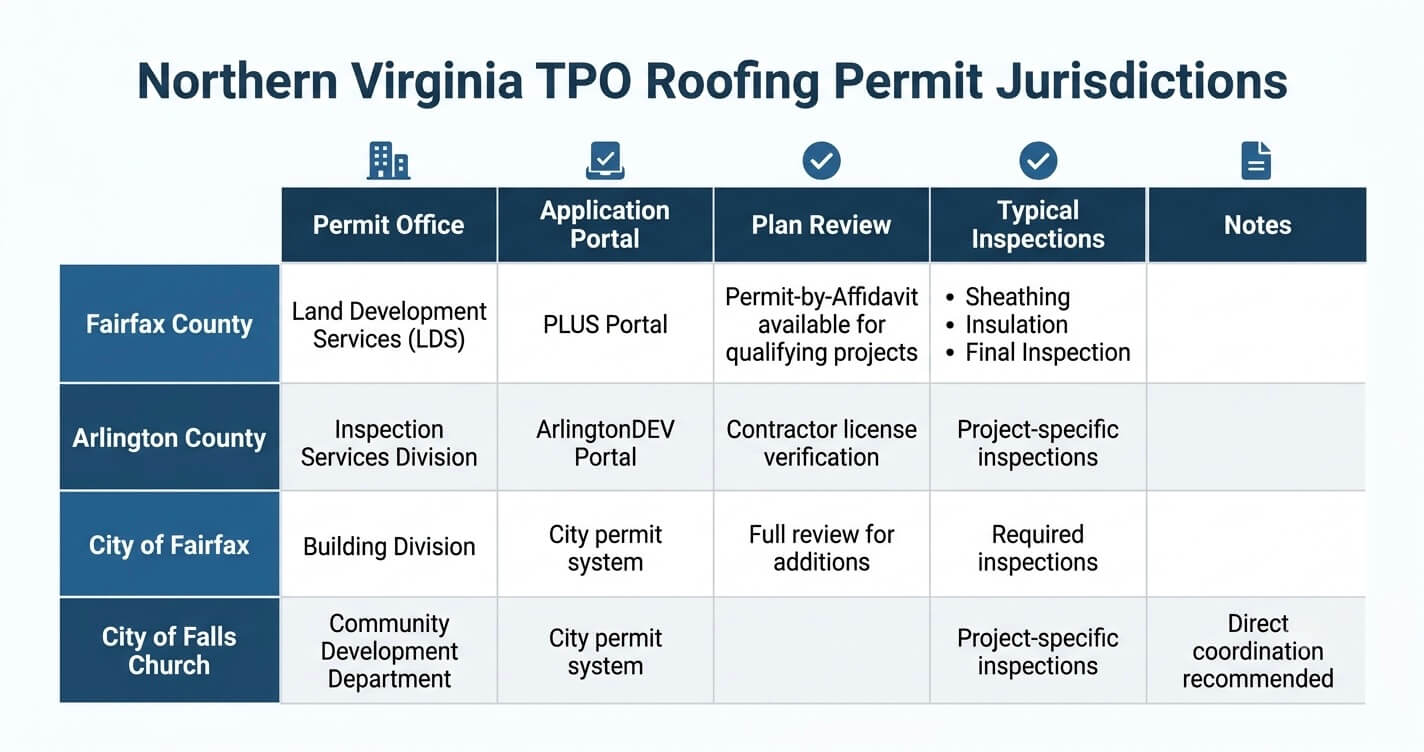
Understanding these local differences can prevent unnecessary delays, rejected applications, and missed project milestones.
Fairfax County
Fairfax County, USHDB’s primary service area, administers roofing permits through the Land Development Services (LDS) department. Contractors submit applications electronically using the PLUS (Planning and Land Use System) portal, which centralizes permit applications, plan reviews, payments, inspection scheduling, and project tracking.
For qualifying residential roofing projects, Fairfax County may allow contractors to use its Permit-by-Affidavit process when specific eligibility requirements are met. More complex TPO roofing projects involving structural modifications, additions, insulation upgrades, or engineered roof assemblies typically undergo a standard plan review before permit issuance.
Depending on project scope, inspections commonly include:
- Roof sheathing or framing inspection when structural decking is replaced
- Inspections required for insulation or other concealed work, where applicable
- Final roofing inspection before permit close-out
Official Resources:
Fairfax County Land Development Services: Click Here
PLUS Portal: Click Here
Arlington County
Arlington County operates independently from Fairfax County and uses its own online permitting platform known as ArlingtonDEV. Although the overall code requirements remain consistent with Virginia’s statewide building code, contractors should expect different application workflows, permit review procedures, and administrative documentation requirements.
Roofing projects involving structural work, material changes, or new construction generally require contractor license verification and supporting project documentation before permits are approved.
Official Resource:
Arlington County Building Permits: Click Here
City of Falls Church
Although geographically surrounded by Fairfax County, the City of Falls Church manages its own permitting and inspection process through its Community Development Department.
Because of the city’s smaller jurisdiction and project volume, contractors are often encouraged to communicate directly with permit reviewers when proposing specialized roofing systems such as TPO assemblies associated with additions or low-slope construction. Confirming documentation requirements before submission can significantly reduce review time.
Official Resource:
City of Falls Church Community Development: Click Here
City of Fairfax
The City of Fairfax should not be confused with Fairfax County. It maintains a separate Building Division with its own permitting staff, review timelines, and inspection scheduling procedures.
For TPO roofing installed as part of residential additions, structural renovations, or other building improvements, contractors should generally expect a full building permit review rather than treating the roofing work as an isolated project.
Official Resource:
City of Fairfax Building Division: Click Here
McLean, Vienna, Burke, Reston, and Great Falls
Communities including McLean, Vienna, Burke, Reston, and Great Falls are all unincorporated areas within Fairfax County. Contractors working in these locations use the same Fairfax County LDS procedures and submit applications through the PLUS portal.
This distinction is particularly important for contractors who regularly work across multiple Northern Virginia jurisdictions. A permit package prepared for Arlington County cannot simply be reused for Fairfax County without verifying local administrative requirements, application forms, and inspection procedures.
For homeowners, this highlights one of the advantages of hiring experienced TPO Roofing Contractors Northern Virginia who routinely work across local jurisdictions and understand each permitting system before construction begins.
What Documents Contractors Must Submit
Preparing a complete permit application before submission is one of the most effective ways to keep a TPO roofing project on schedule. While documentation requirements vary based on project complexity and local jurisdiction, most TPO roofing permit Northern Virginia applications require substantially more than a simple roofing estimate.
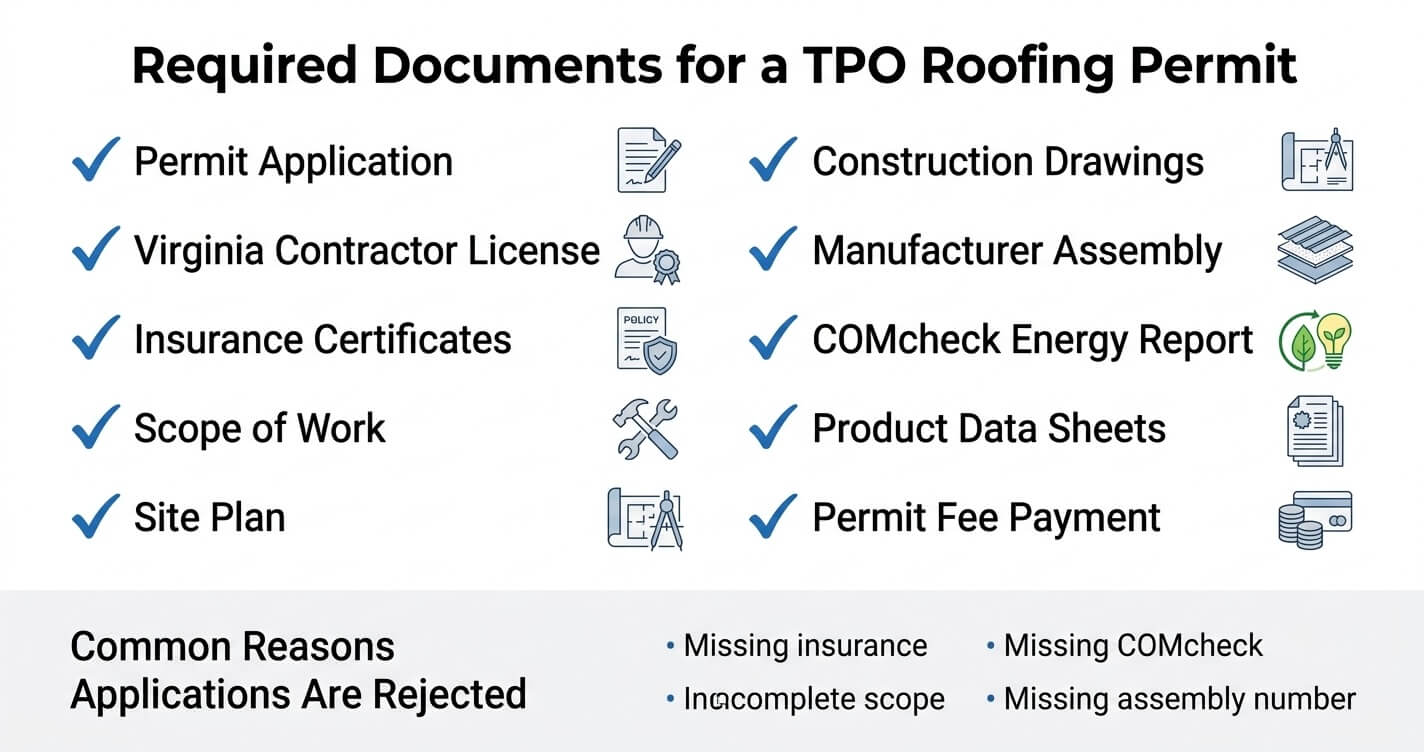
Professional contractors typically assemble a standardized permit package that demonstrates code compliance before the plans examiner begins reviewing the application.
A complete submission commonly includes:
Completed Permit Application
Every jurisdiction requires an official permit application identifying the project location, property owner, contractor information, project valuation, and proposed scope of work. In Fairfax County, this application is submitted electronically through the PLUS portal.
Virginia Contractor License Information
Applicants must provide the appropriate Virginia contractor license number issued through the Virginia Department of Professional and Occupational Regulation (DPOR). Licensing classifications should match the scope and value of the proposed work.
License verification: Click Here
Proof of Insurance
Most jurisdictions require documentation confirming current general liability insurance and, where applicable, workers’ compensation coverage before permits are issued.
Detailed Scope of Work
One of the most common reasons applications are returned for correction is an overly generic project description.
Instead of simply stating:
“Replace existing roof.”
A professional scope should clearly describe the work being performed, including membrane type, insulation modifications, attachment method, flashing details, drainage improvements, and whether structural components are being replaced.
The more complete the narrative, the fewer clarification requests the reviewer typically needs to issue.
Site Plan or Property Survey
When TPO roofing is part of a home addition, ADU, or structural expansion, jurisdictions frequently require an updated site plan or property survey showing the proposed improvements relative to property setbacks and existing structures.
Construction Drawings or Manufacturer Assembly Details
Projects requiring plan review generally include architectural drawings or manufacturer-approved roofing assemblies demonstrating compliance with applicable structural, wind uplift, fire classification, and weather-resistance requirements.
Providing manufacturer assembly numbers early in the review process often prevents additional requests for information later.
Energy Compliance Documentation
If insulation levels are being upgraded, contractors may also need to submit supporting energy compliance documentation, such as COMcheck, demonstrating conformity with the applicable energy provisions adopted by Virginia.
Manufacturer Product Data
Most plan reviewers expect product literature for the proposed TPO membrane, insulation system, adhesives or attachment methods, cover boards, and related roofing components so they can verify compatibility with the approved roofing assembly.
Permit Fees
Applications are generally not processed until all required permit fees have been paid according to the jurisdiction’s published fee schedule.
Common Reasons Permit Applications Are Delayed
Even experienced contractors occasionally encounter review comments. However, most delays stem from incomplete documentation rather than technical deficiencies.
Common issues include:
- Missing insurance certificates
- Incomplete or vague scope-of-work descriptions
- Failure to include energy compliance documentation when insulation is upgraded
- Missing manufacturer assembly numbers
- Inconsistent project information across submitted documents
- Incomplete contractor licensing information
Experienced contractors often maintain a standardized TPO permit package template that includes current manufacturer specifications, insurance certificates, licensing information, and commonly required forms. Updating this package as building code requirements evolve helps reduce administrative delays and creates a more predictable permitting process across multiple Northern Virginia jurisdictions.
Planning a Project?
Homeowners planning a flat-roof addition, ADU, or low-slope roofing project in Northern Virginia can often simplify the process by working with a design-build contractor that manages permit preparation, submission, and inspections as part of the overall project, not as a separate administrative task.
The Permit Review and Inspection Process
Submitting a permit application is only the beginning of the approval process. Before a TPO roofing project can move forward, the local building department reviews the proposed work to verify compliance with the Virginia Uniform Statewide Building Code (USBC) and any applicable local administrative requirements. The complexity of the review largely depends on whether the project is a straightforward roof replacement or part of a larger structural renovation.
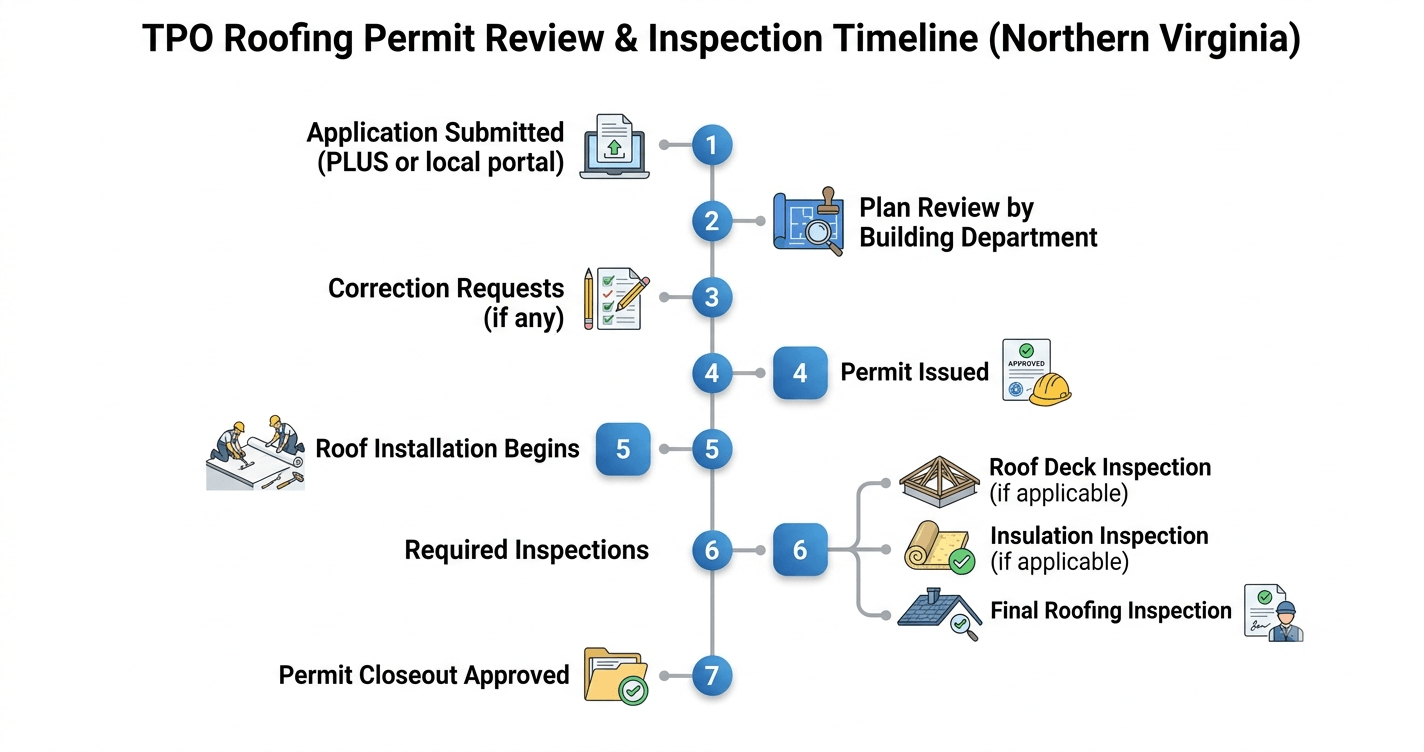
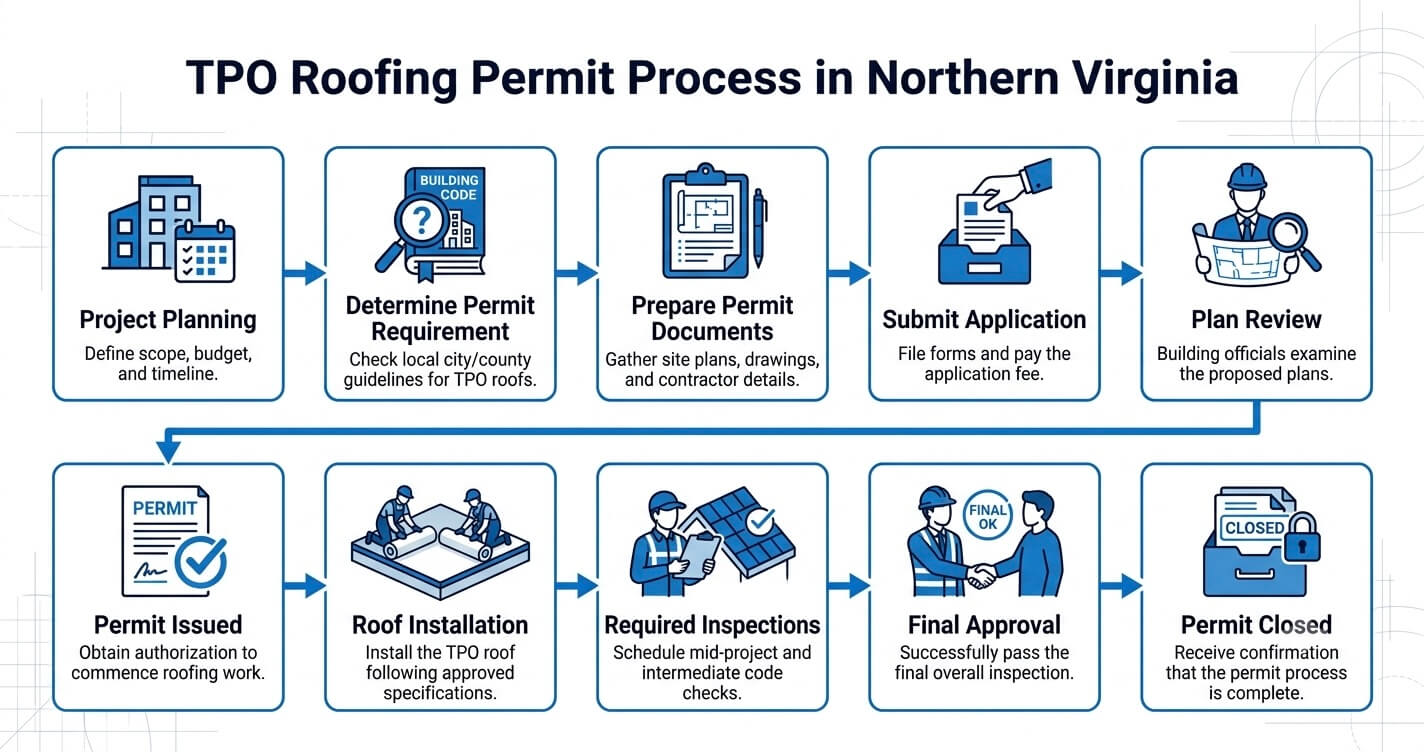
For most residential TPO roofing projects in Northern Virginia, the permit process generally follows these steps:
1. Permit Application Submission
Contractors submit the completed application through the jurisdiction’s online permitting portal, such as Fairfax County’s PLUS system or Arlington County’s ArlingtonDEV portal, along with all required supporting documents.
2. Plan Review
A plans examiner evaluates the submission for code compliance. Depending on the project, the review may include:
- Structural roof modifications
- Drainage design
- Insulation and energy code compliance
- Fire-resistance classification of the roofing assembly
- Manufacturer-approved installation specifications
- Contractor licensing and insurance verification
If additional information is needed, the reviewer issues comments that must be addressed before approval.
3. Permit Issuance
Once all review comments have been resolved and applicable fees have been paid, the building department issues the permit authorizing construction to begin.
The permit should remain accessible at the job site throughout construction, whether physically posted or available electronically, depending on local jurisdictional requirements.
4. Required Inspections
Inspection requirements vary according to project scope, but commonly include:
- Roof deck or framing inspection when structural sheathing has been replaced
- Insulation inspection where required before concealment
- Final roofing inspection verifying completion of the approved work
Projects involving additions or major renovations may require additional inspections coordinated under the primary building permit.
5. Permit Close-Out
After the final inspection is approved, the building department closes the permit, creating an official record that the roofing work was completed in accordance with the approved plans and applicable building codes.
For straightforward residential roofing projects, permit approval may be issued within one to three business days when no plan review is required. More complex projects involving structural changes, additions, or engineered roofing assemblies often require additional review time before permits are issued.
According to the Virginia Department of Housing and Community Development, roofing assemblies must comply with applicable fire-resistance and energy code provisions adopted under the Virginia Uniform Statewide Building Code.
Common Permit Mistakes That Delay TPO Roofing Permit Northern Virginia Applications
Even experienced contractors occasionally encounter permit review comments. However, the majority of delays are avoidable and result from administrative oversights rather than technical code violations.
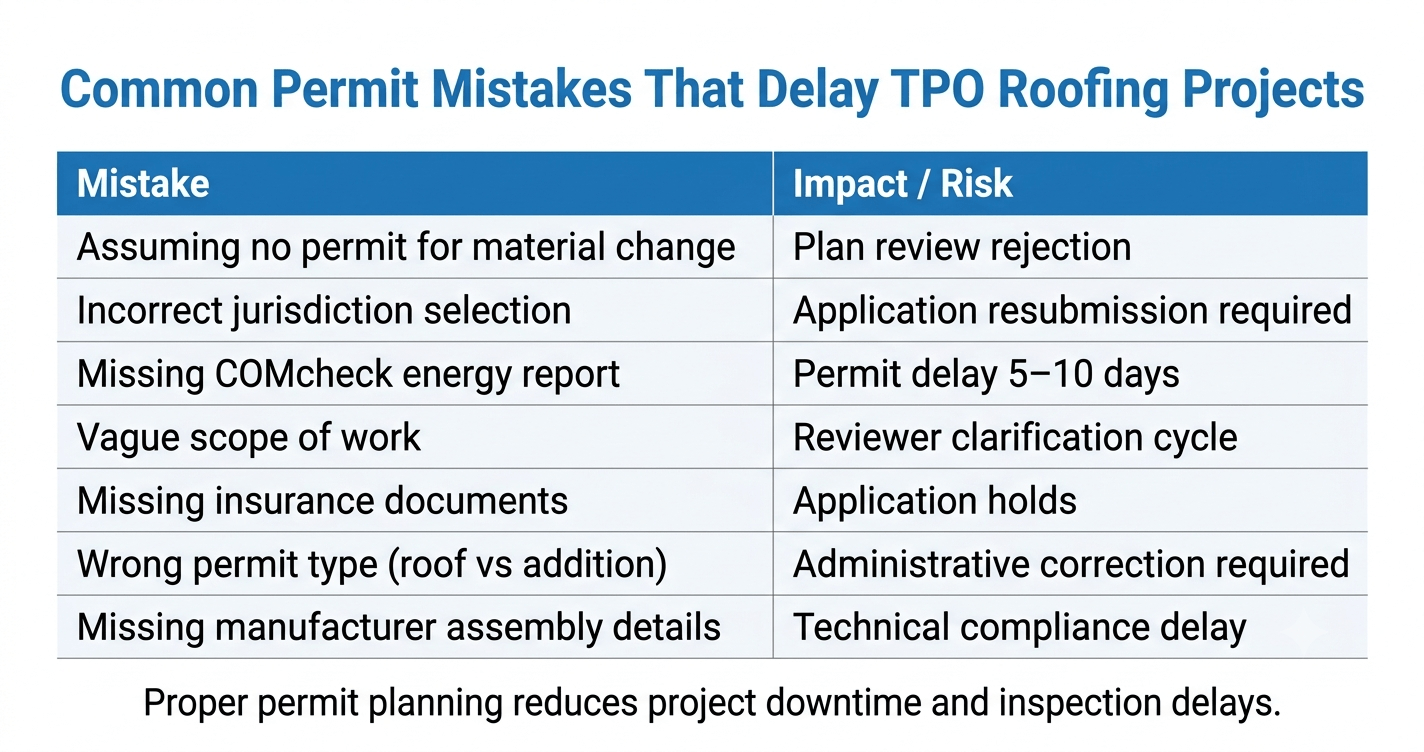
Before reviewing these common mistakes, homeowners interested in learning more about TPO roofing systems, installation methods, and performance characteristics can read our TPO Roofing Northern Virginia: Ultimate Guide 2026.
Understanding the following issues can help contractors avoid unnecessary review cycles and keep projects moving according to schedule.
Assuming a Material Change Doesn’t Require a Permit
One of the most common misconceptions is treating a roofing replacement as “like-for-like” simply because the roof’s footprint remains unchanged.
Replacing a modified bitumen roof with a TPO membrane introduces an entirely different roofing assembly. Depending on the jurisdiction, this change may require review of insulation levels, attachment methods, fire classification, and manufacturer-approved assembly details.
Filing Under the Wrong Applicant
Some jurisdictions permit homeowners to apply for certain residential permits, while others require licensed contractors to assume responsibility for specific scopes of work.
Submitting an application under the wrong party can delay permit processing until contractor licensing information has been verified.
Omitting Energy Compliance Documentation
Modern TPO roofing projects frequently include insulation upgrades to improve thermal performance.
Whenever insulation thickness changes or current energy code requirements apply, supporting documentation, such as COMcheck or equivalent compliance calculations, may be required as part of the permit package.
Missing this documentation is one of the most common reasons reviewers request additional information.
Delaying Required Inspections
Scheduling inspections at the appropriate construction stage is just as important as obtaining the permit itself.
Covering roof assemblies before required inspections have been completed may require portions of the work to be reopened for verification, resulting in additional labor, scheduling delays, and potential reinspection fees.
Separating Roofing from the Overall Building Permit
When TPO roofing is installed as part of a home addition, second-story expansion, or major renovation, the roofing work is often incorporated into the primary building permit rather than submitted separately.
Attempting to obtain an independent roofing permit for work already covered under a larger construction project can create unnecessary administrative complications.
Confusing Local Jurisdictions
Northern Virginia contains several independent jurisdictions with separate permitting authorities.
For example, McLean falls under Fairfax County Land Development Services, while the City of Falls Church maintains its own Community Development Department.
Assuming both locations follow identical procedures frequently results in incorrect applications, missing forms, or submission through the wrong online portal.
Experienced contractors verify the governing jurisdiction before beginning permit preparation rather than relying solely on mailing addresses or ZIP codes.
How Permits Protect Both Contractors and Homeowners
Although permits are often viewed as an administrative hurdle, they serve an important purpose beyond regulatory compliance. A properly permitted roofing project creates documented evidence that construction was reviewed, inspected, and completed in accordance with applicable building codes.
For contractors, permits establish a clear record of the approved project scope. If questions arise later regarding workmanship, design decisions, or alleged code violations, inspection records and approved plans provide valuable documentation demonstrating that the work was performed under the oversight of the local building department.
For homeowners, permit records can become equally valuable long after construction is complete. During future property sales, refinancing transactions, insurance claims, or home inspections, documentation showing that roofing work received the required approvals can help reduce questions regarding the property’s construction history.
Proper permitting also contributes to preserving long-term property value. Buyers and lenders are generally more confident when significant improvements, including roofing, additions, and structural renovations, have been completed through the appropriate permitting process rather than undocumented construction.
For homeowners considering additional investments that improve resale value, our guide to Best ROI Home Improvements Northern Virginia explores renovation projects that deliver strong long-term returns while maintaining compliance with local building requirements.
Ultimately, a contractor who consistently incorporates permitting into every qualifying project demonstrates a commitment to professional project management, regulatory compliance, and long-term quality assurance. These practices not only reduce construction risks but also help protect the interests of everyone involved throughout the life of the property.
Virginia Contractor Licensing Requirements for TPO Roofing Work
Before applying for a TPO roofing permit Northern Virginia, contractors should verify that they meet Virginia’s licensing requirements for the proposed scope of work. While local building departments administer permits, contractor licensing is regulated at the state level through the Virginia Department of Professional and Occupational Regulation (DPOR).
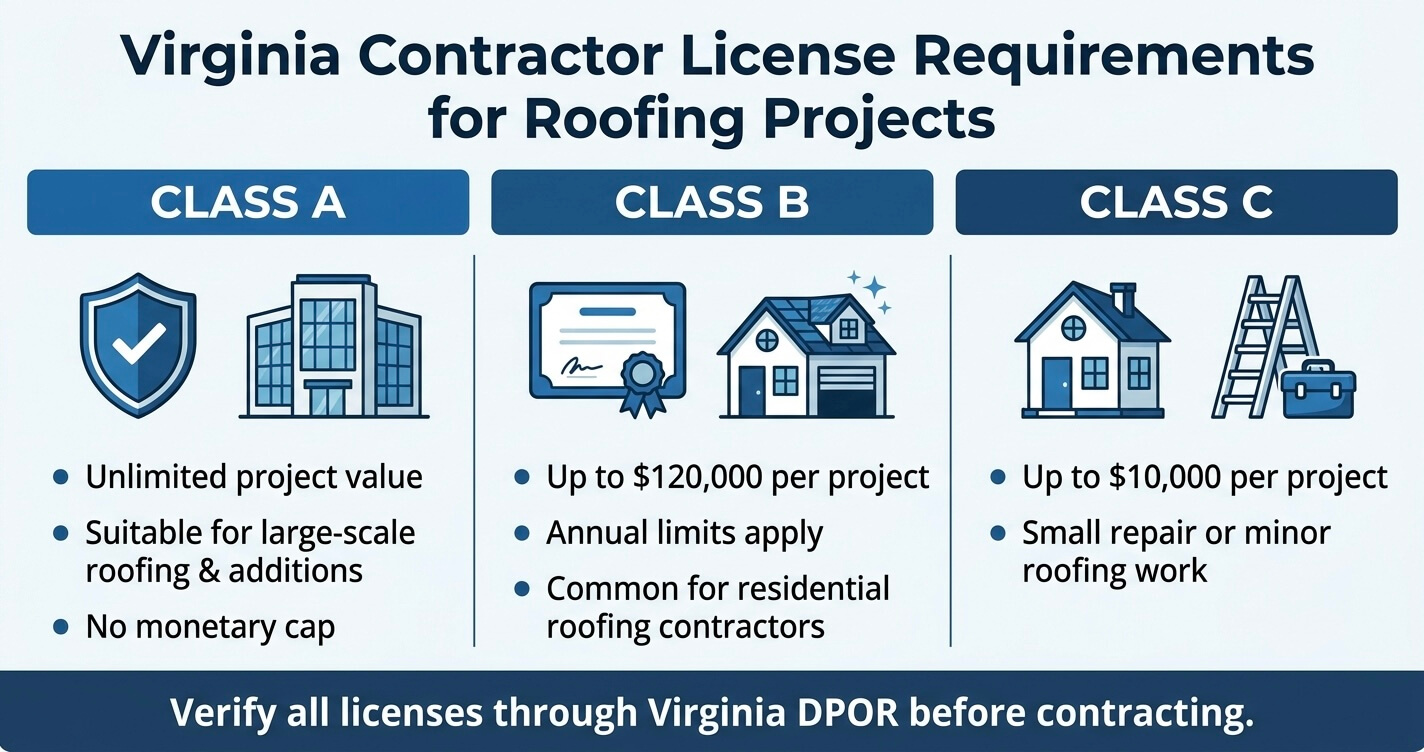
According to the U.S. Small Business Administration (SBA), building permits are required for most construction projects because they help ensure work complies with applicable health, safety, and building regulations.
For residential roofing projects, Virginia generally requires:
- Class A Contractor License – No monetary limitation.
- Class B Contractor License – Projects up to $120,000, with an annual project limit established by DPOR.
- Class C Contractor License – Individual projects up to $10,000 and subject to annual revenue limitations.
The appropriate license classification depends on the total value of the contract rather than the roofing material being installed. Contractors performing TPO roofing as part of larger additions, structural renovations, or design-build projects should ensure their license classification aligns with the overall project value.
Homeowners should also verify that any contractor bidding on a roofing project holds an active Virginia license before signing a contract. License verification is available through the Virginia DPOR online lookup system.
Virginia DPOR Contractor License Lookup: Click Here
Beyond state licensing, many TPO roofing manufacturers, including Carlisle, Firestone Building Products, and GAF, offer certification programs for approved installers. While manufacturer certification does not replace licensing requirements, it may qualify property owners for enhanced warranty options and demonstrates that the contractor has received product-specific installation training.
How to Work with Fairfax County’s PLUS Portal – A Quick Contractor Reference
Because Fairfax County represents one of the largest residential construction markets in Northern Virginia, contractors regularly use the county’s Planning and Land Use System (PLUS) to submit permit applications, upload documents, schedule inspections, and monitor project status.
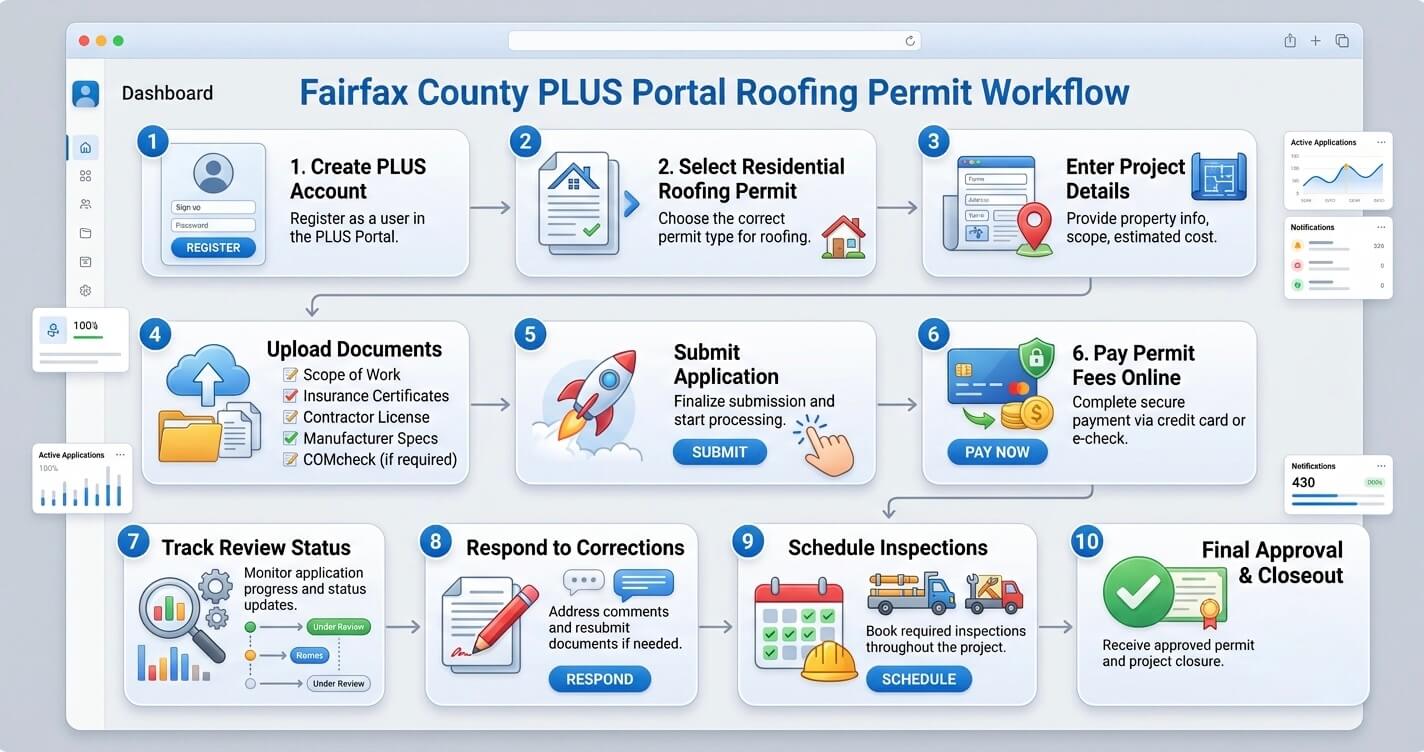
Understanding how the system works before beginning the application process can significantly reduce administrative delays.
The standard workflow typically follows these steps:
Step 1: Create or Access Your PLUS Account
Visit the Fairfax County PLUS Portal and create a contractor account or log in using your existing credentials.
PLUS Portal: Click Here
Step 2: Select the Appropriate Permit Type
Choose the residential roofing permit category or the applicable permit associated with the overall construction project.
If the TPO roofing work is part of a home addition or second-story expansion, it will generally be submitted under the primary building permit rather than as an independent roofing permit.
For projects involving vertical additions, see our guide on Second Story Addition Northern Virginia.
Step 3: Complete the Application
Provide:
- Property address
- Contractor licensing information
- Project valuation
- Scope of work
- Property owner information
Carefully reviewing the application before submission helps avoid unnecessary correction requests.
Step 4: Upload Supporting Documentation
Depending on project scope, uploads may include:
- Construction drawings
- Manufacturer roofing assemblies
- Product data sheets
- Site plans
- COMcheck reports
- Insurance documentation
Organizing files before beginning the online application often speeds up submission.
Step 5: Pay Applicable Permit Fees
Permit fees are paid electronically through the portal before the application enters formal review.
Step 6: Monitor Review Status
Contractors can track reviewer comments, upload revised documents, and monitor approval progress directly within the PLUS dashboard.
Step 7: Schedule Inspections
Once construction begins, inspections can also be requested through the same online portal, simplifying project management throughout the construction process.
For contractors managing multiple roofing or addition projects simultaneously, familiarity with the PLUS platform can reduce administrative overhead and improve scheduling efficiency.
Frequently Asked Questions
Do I need a permit for TPO roofing in Fairfax County, Virginia?
In many cases, yes. New roof construction, structural deck replacement, material changes, additions, ADUs, and roofing work associated with larger renovation projects commonly require permits. Requirements vary depending on project scope, so contractors should confirm permit obligations directly with Fairfax County Land Development Services before beginning work.
What documents do contractors typically submit for a TPO roofing permit?
A complete application commonly includes:
– Permit application
– Virginia contractor license information
– Proof of insurance
– Scope of work narrative
– Construction drawings (when required)
– Site plan (for additions)
– Manufacturer product data sheets
– COMcheck or other energy compliance documentation when insulation upgrades are included
– Applicable permit fees
How long does a roofing permit take in Fairfax County?
Straightforward residential roofing permits may be approved within one to three business days when no plan review is required. Projects involving structural modifications, additions, or engineered roofing assemblies generally require additional review time depending on project complexity and department workload.
Current permitting information: Click Here
Does changing from modified bitumen to TPO require a permit?
It often does. Because the roofing assembly changes, local jurisdictions may review the proposed installation for compliance with current structural, fire-resistance, weather-resistance, and energy-code requirements. Contractors should verify permit requirements before beginning work.
How can I verify a roofing contractor’s Virginia license?
Virginia contractor licenses can be verified using the online lookup system maintained by the Department of Professional and Occupational Regulation (DPOR).
License Lookup: Click Here
Is a TPO roofing permit required in Arlington County?
Material changes, structural roofing work, and roofing associated with additions or major renovations commonly require permits. Arlington County administers permits independently from Fairfax County through its own permitting system.
Official Information: Click Here
What happens if TPO roofing work is completed without a permit?
Unpermitted roofing work can create complications during property sales, refinancing, insurance claims, and future renovations. In some situations, local jurisdictions may require concealed work to be exposed for inspection or require corrective work before the project can be approved. Obtaining the proper permit before construction begins is generally the most efficient and cost-effective approach for both contractors and homeowners.
To Sum Up
Successfully navigating TPO roofing permit Northern Virginia requirements requires more than simply completing a permit application. Contractors must understand how Virginia’s building code interacts with local administrative procedures, prepare complete documentation, coordinate inspections, and account for the unique requirements of each jurisdiction they serve.
Although Fairfax County, Arlington County, the City of Fairfax, and the City of Falls Church all operate under the Virginia Uniform Statewide Building Code, each locality maintains its own permitting systems, online portals, review procedures, and inspection processes. Understanding these differences before construction begins helps minimize delays and keeps projects moving according to schedule.
For homeowners, the takeaway is straightforward: choose a contractor who incorporates permitting into the project planning process, not as an afterthought after construction has already been scheduled. Proper permit preparation protects project timelines, supports code compliance, and creates a documented record that benefits both contractors and property owners long after the work is complete.
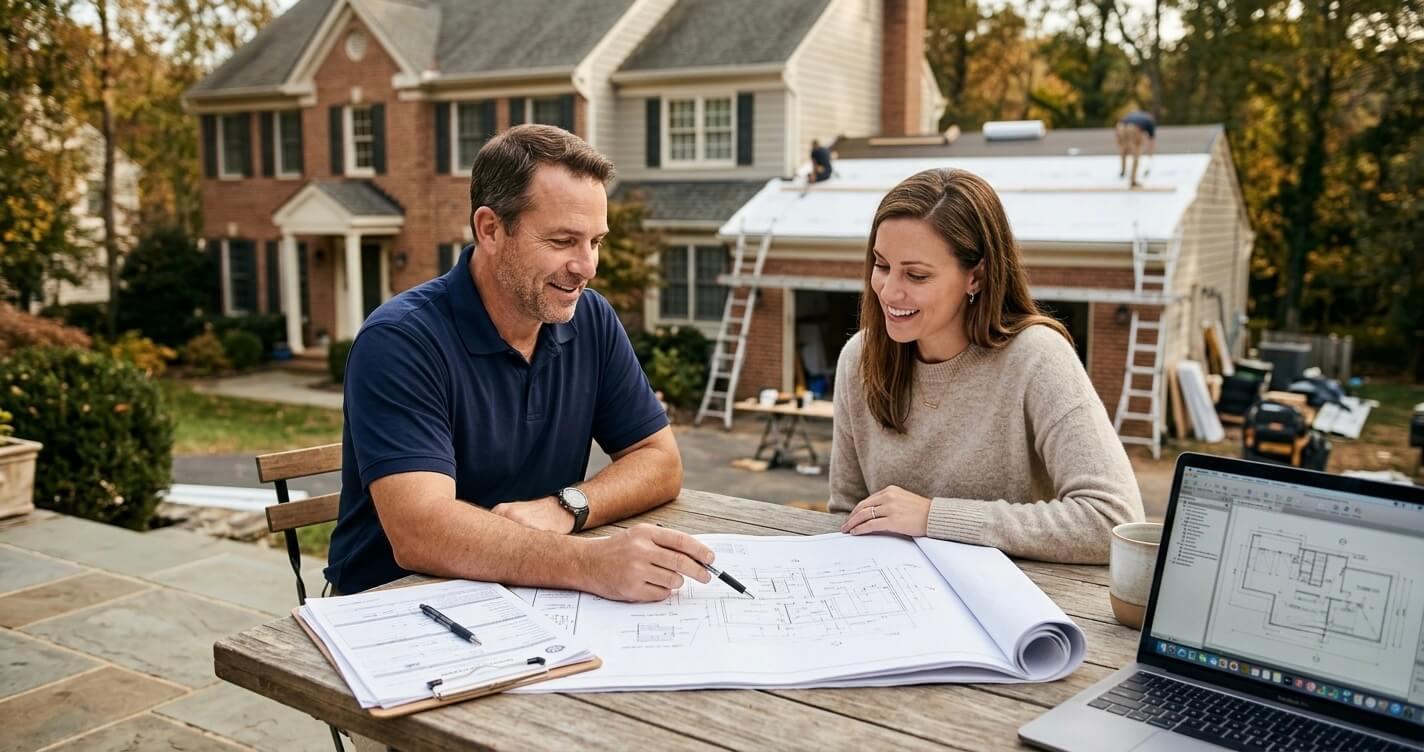
If you’re planning a flat-roof addition, low-slope renovation, or TPO roofing project anywhere in Northern Virginia, US Home Design Build can help guide you through both the construction process and the permitting requirements from start to finish.