
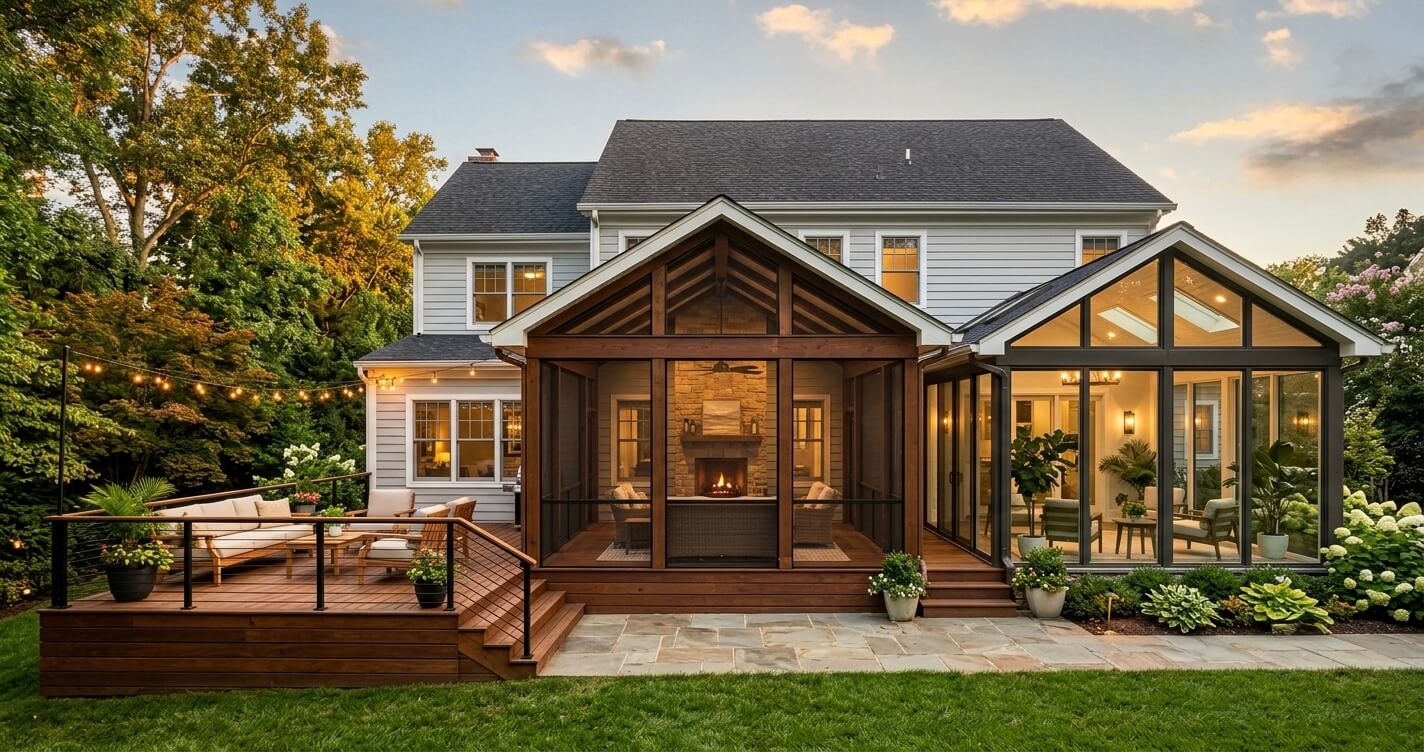
Homeowners comparing a screen porch vs sunroom vs deck Northern Virginia project are usually weighing the same three questions: how much can I spend, how many months a year will I actually use the space, and how much value will it add when I sell. Each of these three additions solves a different problem. A deck is the fastest, most affordable way to gain outdoor square footage. A screen porch adds shade and bug-free comfort for roughly three seasons. A sunroom is a fully conditioned room that functions year-round, even through a Northern Virginia winter.
This guide breaks down real cost ranges, permit requirements, resale considerations, and a decision framework built from projects across Fairfax County, McLean, Vienna, Reston, Great Falls, and Burke. US Home Design Build has built all three structure types for Northern Virginia homeowners, and the comparison below reflects what actually differentiates them on a real property, not just brochure descriptions.
Screen Porch vs Sunroom vs Deck Northern Virginia: Quick Comparison
A deck costs the least and builds fastest but offers no shade or climate control. A screen porch costs more but adds shade, bug protection, and roughly three-season comfort. A sunroom costs the most because it becomes a fully conditioned, code-classified living space usable in every month of the year.
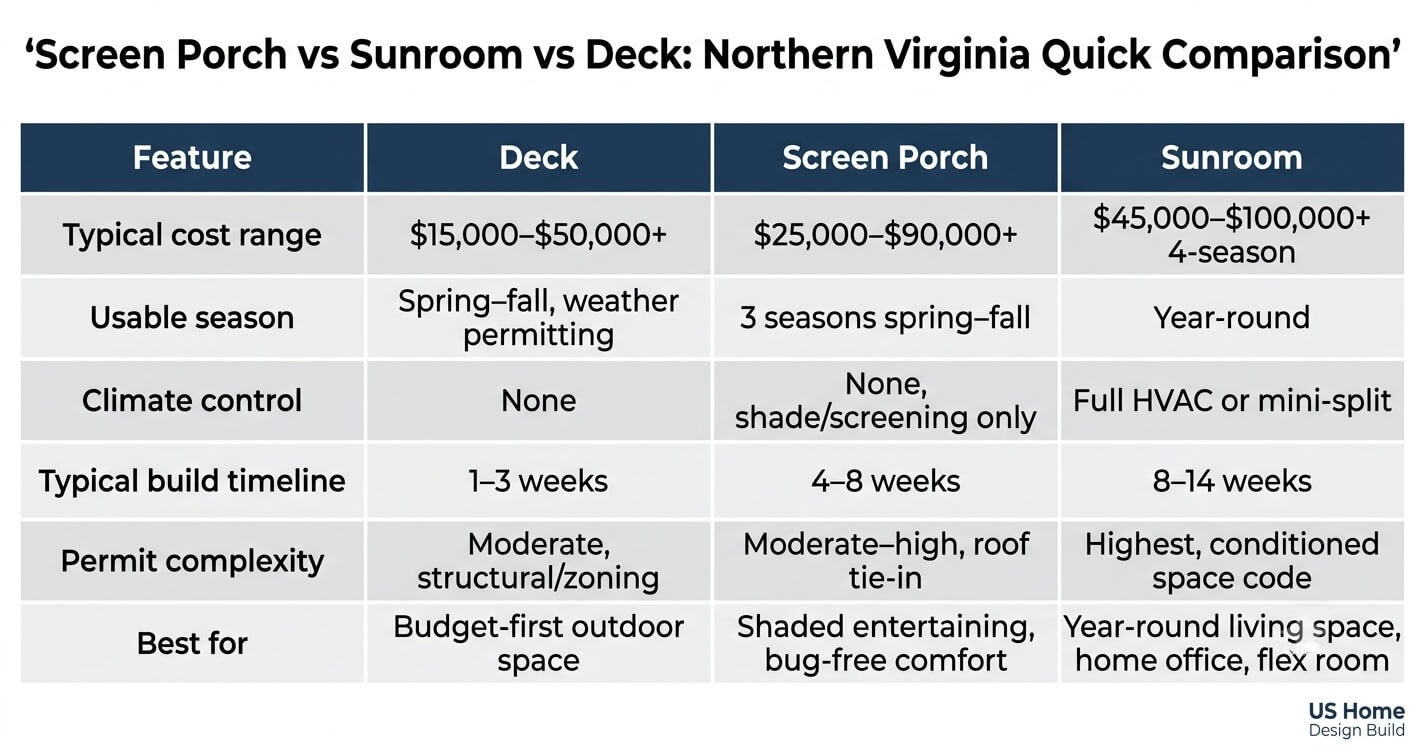
The right choice depends less on budget alone and more on how many months per year the space needs to function, and whether the homeowner wants it to count as true conditioned living area.
Deck: Cost, Pros, and Cons in Northern Virginia
A deck addition in Northern Virginia typically runs $15,000 to $50,000 or more, depending on size, decking material, and railing. It is the fastest and least expensive of the three options, but it offers no shade, screening, or climate control.
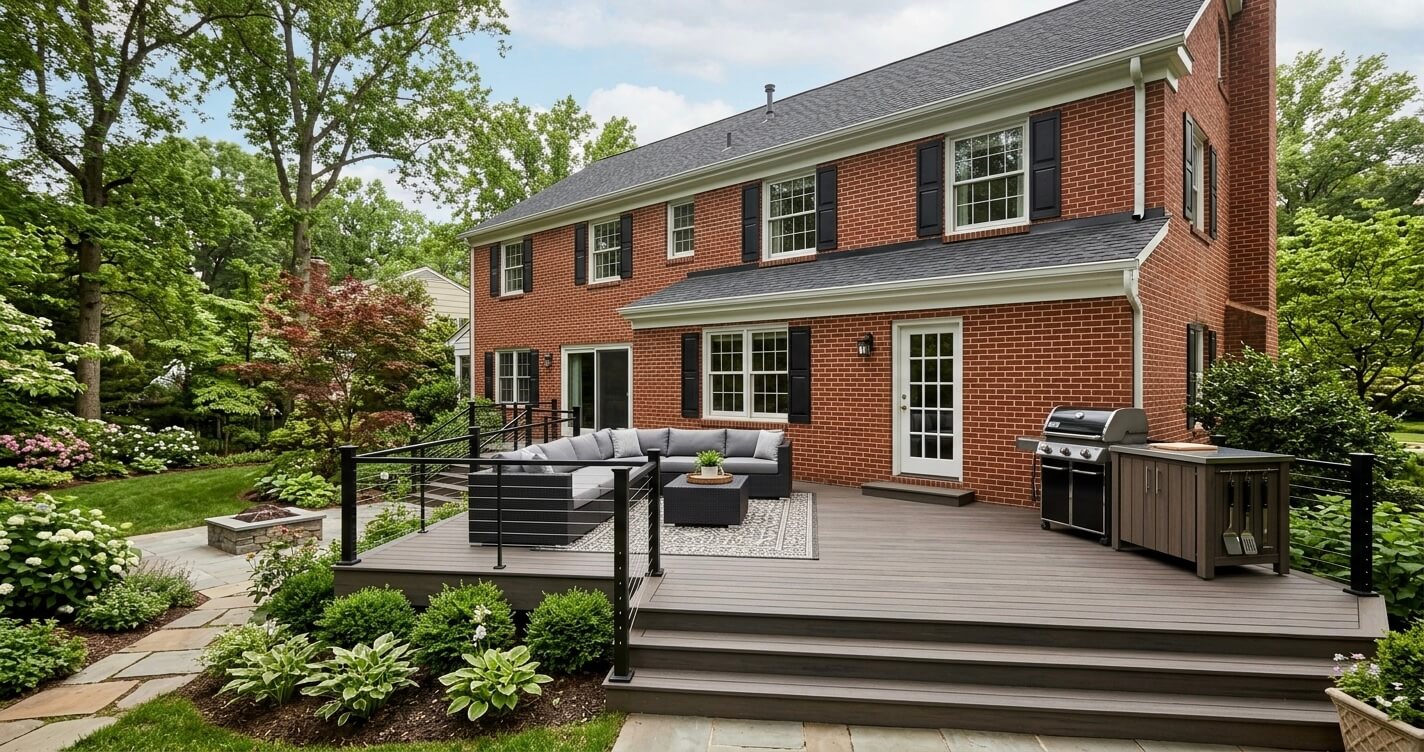
Decks remain the default first addition for many Fairfax County, Vienna, and Burke homeowners because the construction is straightforward relative to an enclosed structure: no roof tie-in, no window or glazing systems, and generally a shorter permitting review. Composite decking has become the preferred material for homeowners who want to avoid annual staining and sealing, while pressure-treated wood remains the lowest entry cost.
For a deeper breakdown of layout options, railing materials, and cost drivers by size, see US Home Design Build’s Deck Design Ideas Falls Church VA guide.
The tradeoff is exposure. A deck offers zero protection from Northern Virginia’s humid summers, sudden thunderstorms, or pollen season, which limits realistic usable days per year compared to a screened or conditioned structure. Homeowners planning to entertain frequently in spring and fall, but who are comfortable treating the space as seasonal, tend to be the strongest fit for a deck.
Homeowners weighing a deck against a more enclosed option may benefit from talking through year-round usability with an experienced design-build team before finalizing a budget. US Home Design Build offers a free consultation to walk through the tradeoffs for your specific lot and orientation.
Screen Porch: Cost, Pros, and Cons in Northern Virginia
A screen porch addition in Northern Virginia typically costs $25,000 to $90,000 or more, depending on roof structure, flooring, and whether the porch ties into the existing roofline. It extends usable outdoor time to roughly three seasons by adding shade and insect screening without full climate control.
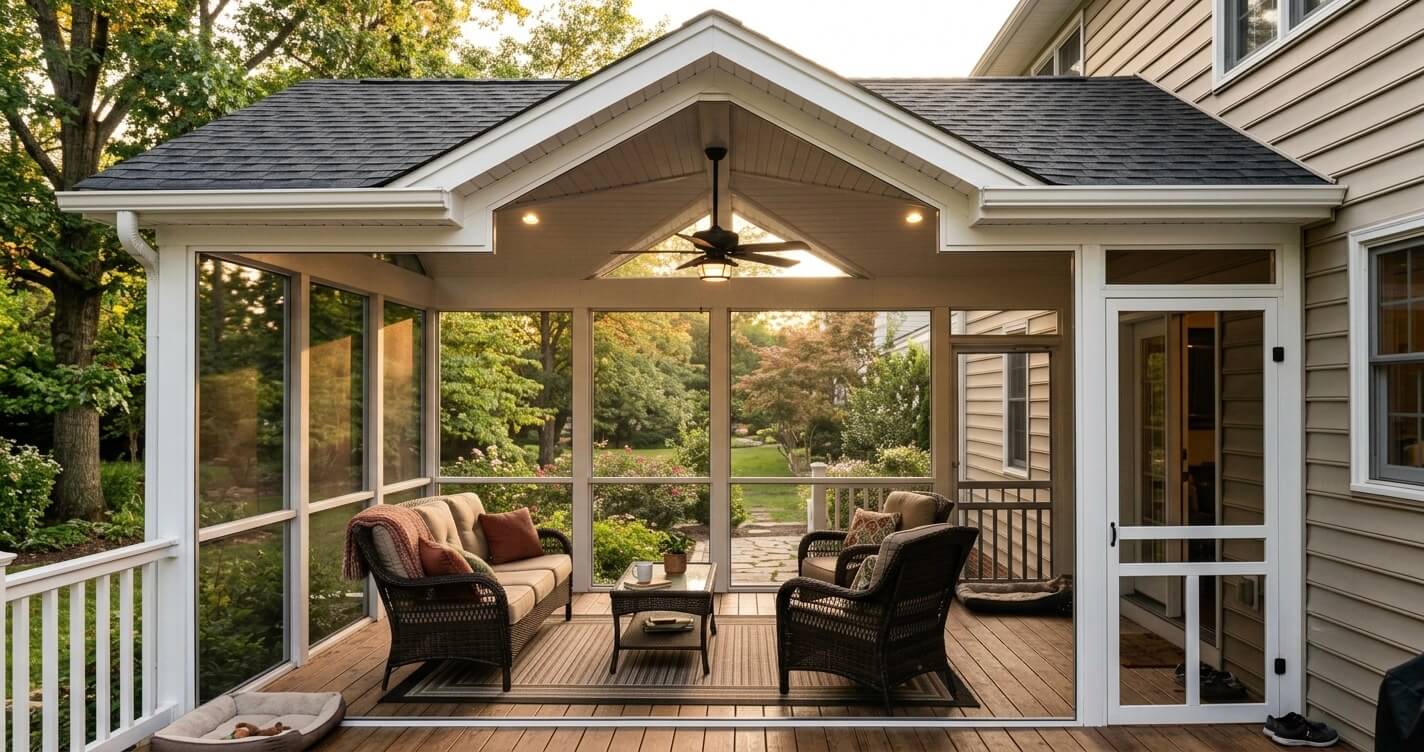
A screened porch sits functionally between a deck and a sunroom. It requires a roof structure, which adds structural and permitting complexity beyond a simple deck, but it does not require the insulated glazing, HVAC integration, or energy code compliance that a four-season sunroom needs. For homeowners in Fairfax County dealing with Virginia’s mosquito and pollen seasons, screening alone dramatically increases how often the space actually gets used between April and October.
Detailed cost breakdowns by size and roof style are covered in US Home Design Build’s Screen Porch Addition Cost Northern Virginia guide.
The main limitation is winter usability. Without insulation and conditioning, a screen porch is not usable during Northern Virginia’s colder months, which is the primary reason some homeowners choose to build a screen porch with future sunroom conversion in mind, using a foundation and roof structure engineered to support glazing and insulation later.
Sunroom: Cost, Pros, and Cons in Northern Virginia
A four-season sunroom addition in Northern Virginia typically costs $45,000 to $100,000 or more, reflecting insulated glazing, foundation work, and HVAC or mini-split integration. It is the only one of the three options usable in every month of the year, including winter.
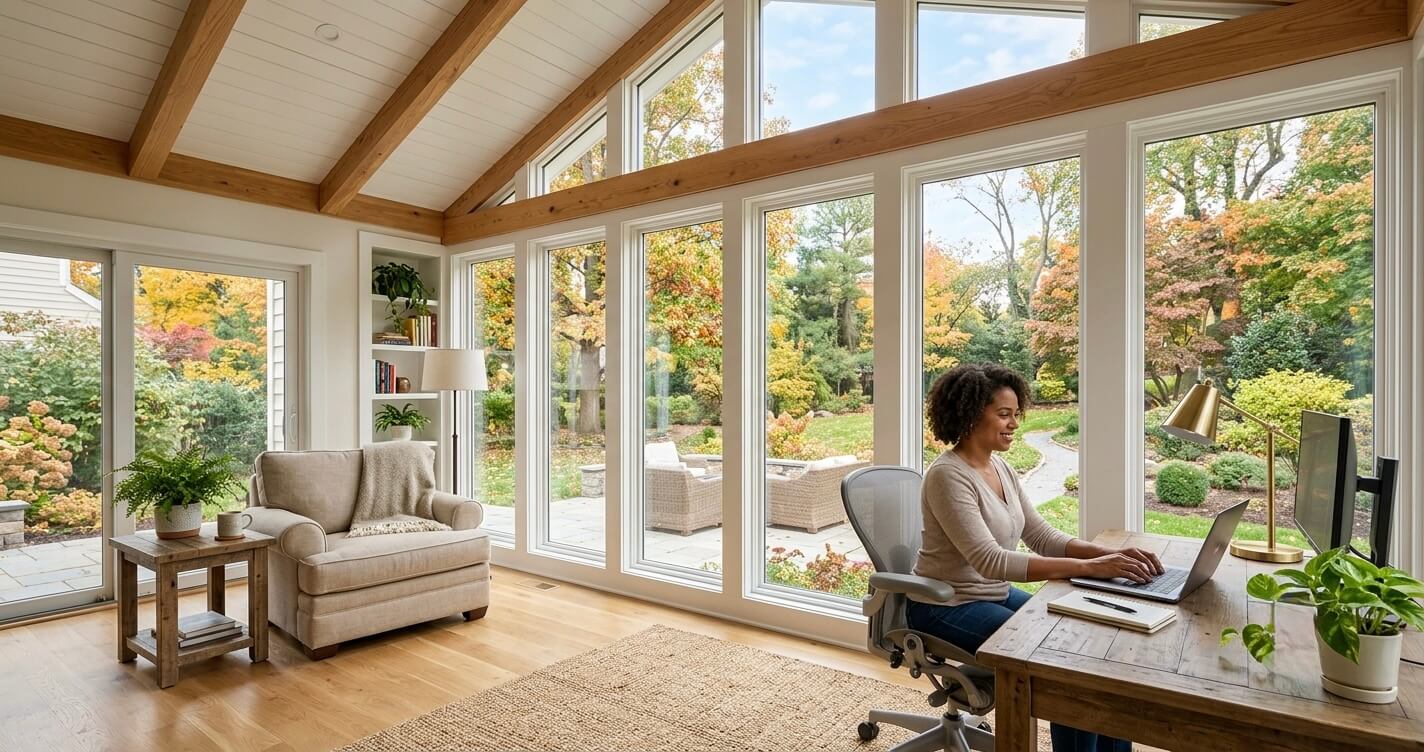
A sunroom is classified as conditioned living space once it is insulated and tied into heating and cooling, which is what allows it to function as a home office, playroom, or family room rather than a seasonal add-on. This reclassification is also what drives the higher cost and more involved permitting process compared to a deck or screen porch, since the structure must meet the same energy code standards as the rest of the home.
For layout and glazing inspiration specific to Northern Virginia’s older housing stock, see US Home Design Build’s Sunroom Addition Ideas Burke VA guide.
Homeowner demand for this type of flexible, year-round space has grown consistently in recent years. Design professionals surveyed nationally identified covered outdoor rooms, patios, and decks as the three most requested outdoor living features, with covered and enclosed rooms ranking highest among multifunctional space requests. This shift toward flexible, weather-independent living space is one of the strongest arguments for a sunroom over a purely seasonal structure.
Cost Comparison Table: Screen Porch vs Sunroom vs Deck
Deck additions run roughly $15,000 to $50,000, screen porches run roughly $25,000 to $90,000, and four-season sunrooms run roughly $45,000 to $100,000 or more. Cost per square foot rises with each step because of added structural, glazing, and mechanical complexity.
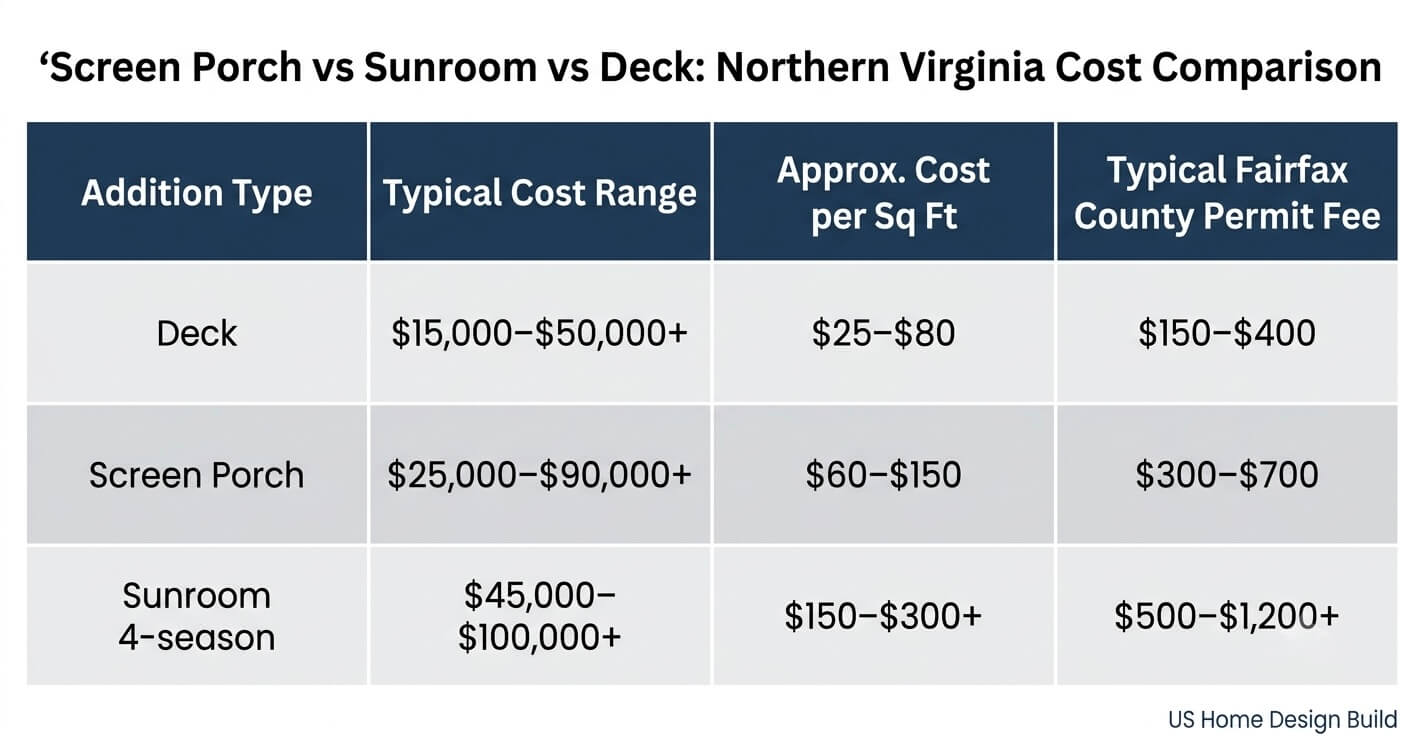
Permit fees vary by jurisdiction and project scope; figures above are general planning ranges, not quotes. Confirm exact fees with Fairfax County Land Development Services before budgeting a final number.
Which Adds More Home Value in Northern Virginia?
Outdoor and landscape-related upgrades recover close to their full cost at resale on average, according to realtor-reported data, while the specific return for a deck, screen porch, or sunroom depends heavily on neighborhood expectations and how many months of the year the space is usable.
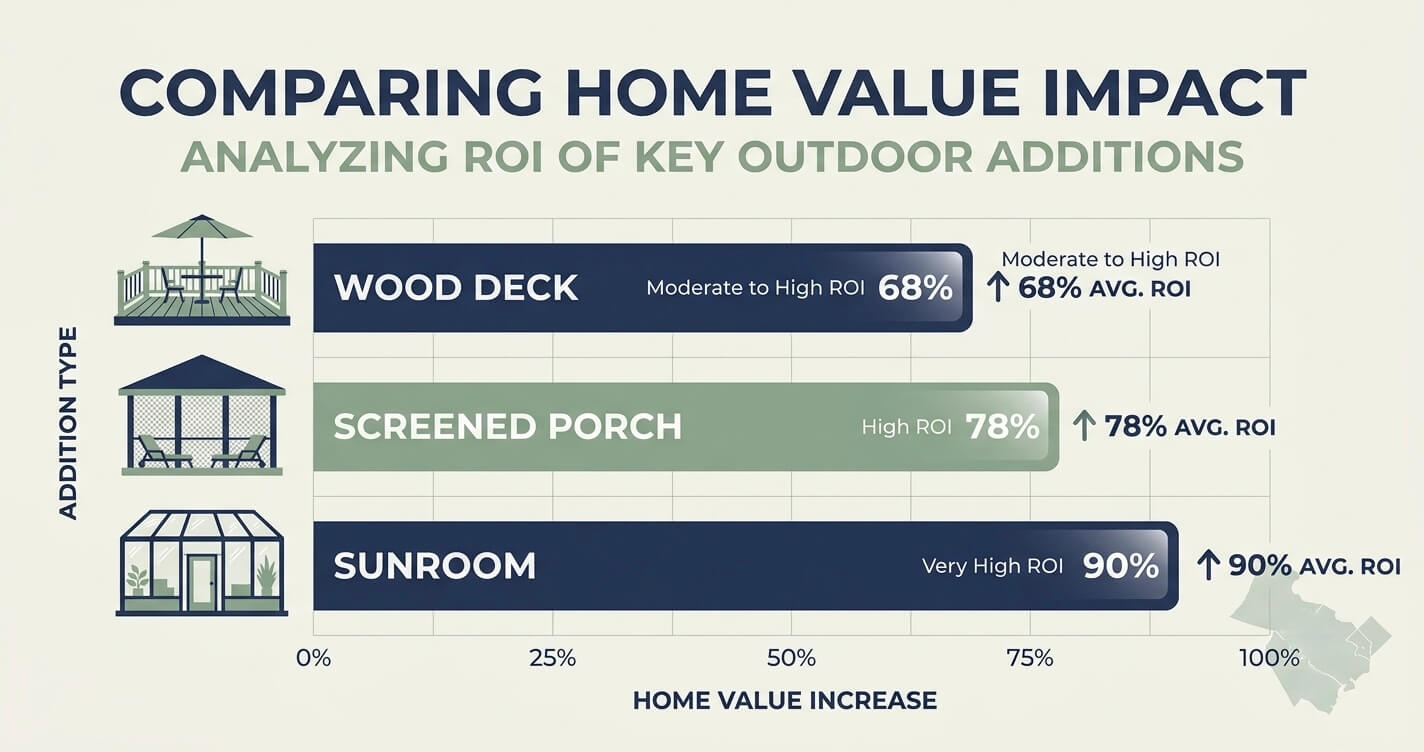
Realtor-reported data shows that a general outdoor or landscape upgrade recovers close to 100 percent of its cost at resale on average, reflecting how strongly buyers now weigh usable outdoor space in their purchase decisions.
In practice, the return on a Northern Virginia project depends on the buyer pool in that specific neighborhood. In McLean and Great Falls, where homes routinely sell in the $1.5 million-plus range, a well-designed sunroom or four-season room tends to read as genuine conditioned square footage and is valued accordingly by appraisers and buyers. In more starter-home-oriented markets like Burke, a well-built deck or screen porch often delivers a stronger dollar-for-dollar return because it matches buyer expectations for the price point without pushing the home into an unusual price-per-square-foot bracket for the block.
National demand for outdoor living space has also increased by roughly 50 percent since 2020, a shift that has held steady rather than reversing post-pandemic.
Comparing resale value across these three options can be tricky without local comparable data. US Home Design Build can walk through what similar projects have returned for homeowners in your specific Northern Virginia neighborhood before you commit to a direction.
Permits and Timeline: What Fairfax County Homeowners Should Expect
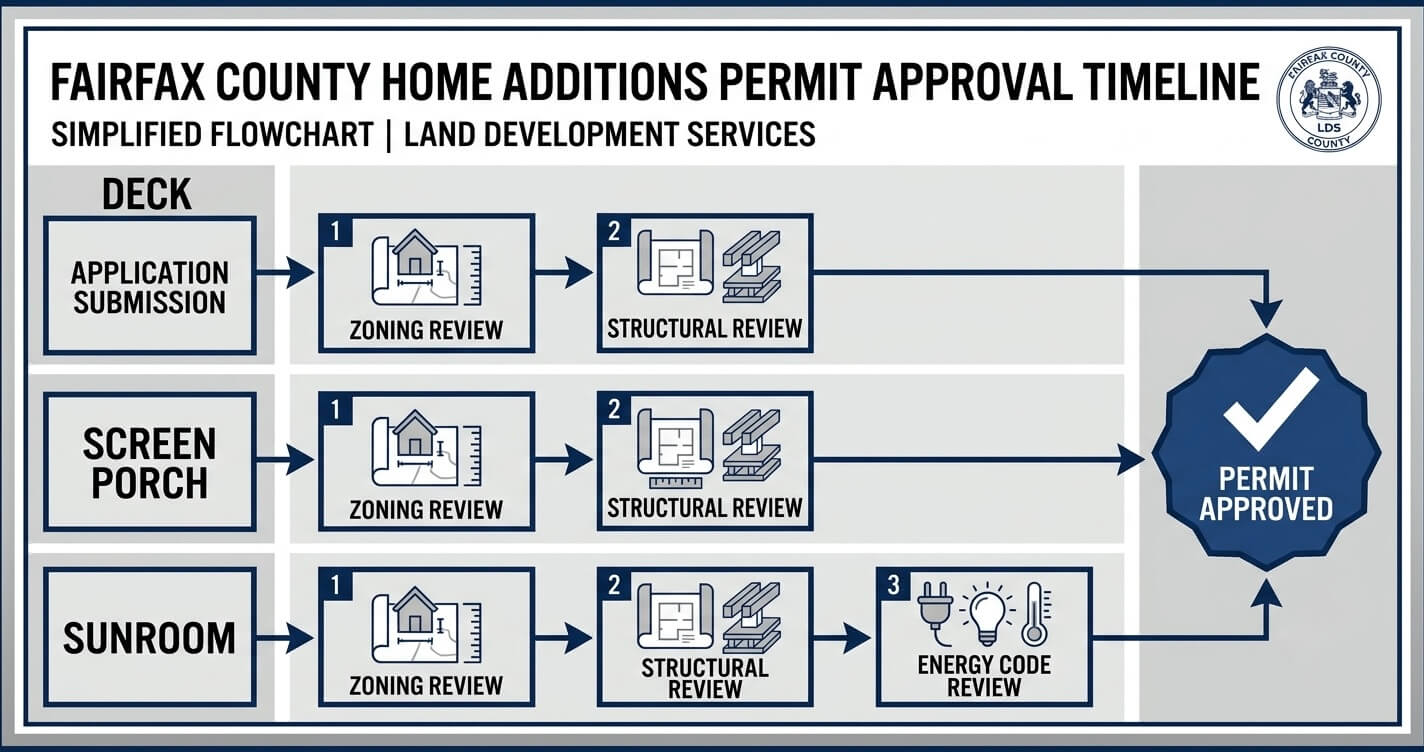
A sunroom requires the most involved permitting of the three options because it is classified as conditioned living space and must meet full energy code review. Screen porches require a structural and roof permit but skip the energy code review. Decks require the simplest permit, though most attached or elevated decks in Fairfax County still require one.
Under Virginia’s statewide building code, freestanding decks that do not exceed 30 inches above grade may not require a permit, but the majority of residential decks in Northern Virginia are attached to the home or elevated above that threshold, which triggers a standard building permit. Source: Virginia Uniform Statewide Building Code (VUSBC), as referenced in US Home Design Build’s Porch & Patio Permit Alexandria VA guide.
Fairfax County Land Development Services specifically notes that most decks, particularly those attached to the home or elevated, require permits and must meet structural and safety code review before construction begins. Source: Fairfax County Land Development Services (LDS), as cited in US Home Design Build’s Deck Design Ideas Falls Church VA guide.
Screen porches typically require both a building permit for the roof and structural framing and a zoning review for setback compliance, since the roofline changes the structure’s footprint relative to the home. Sunrooms require the same structural and zoning review as a screen porch, plus mechanical, electrical, and energy code review once the space is classified as conditioned living area. This is also why sunroom timelines run longer, typically eight to fourteen weeks from permit approval to completion, compared to one to three weeks for a straightforward deck.
Homeowners who have made permit mistakes on similar projects in the past should review US Home Design Build’s Home Renovation Mistakes Northern Virginia guide before finalizing a design.
How to Choose Between a Screen Porch, Sunroom, and Deck
Choose a deck if budget and speed matter most and the space will mainly be used spring through fall. Choose a screen porch if shade and bug-free comfort across three seasons matter more than winter usability. Choose a sunroom if the goal is a true year-round room, such as a home office or family room.
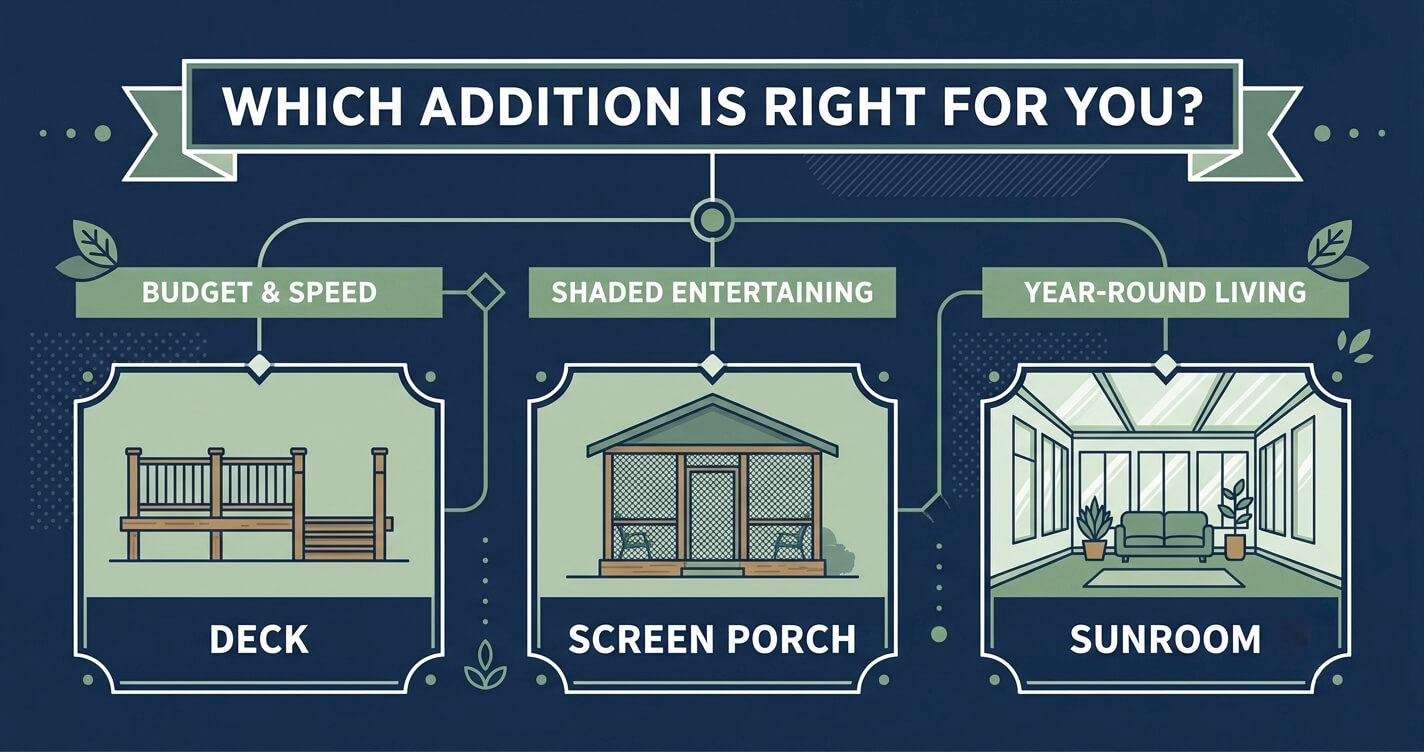
A few common Northern Virginia homeowner scenarios illustrate how this plays out in practice:
- A Vienna homeowner who works from home and wants a quiet, naturally lit office usable in January as well as July is a strong fit for a four-season sunroom, since a deck or screen porch cannot support daily winter use.
- A McLean homeowner focused primarily on outdoor entertaining space for spring and summer gatherings, without the higher cost of full conditioning, is typically better served by a screen porch.
- A Great Falls or Burke homeowner working with a tighter renovation budget who mainly wants additional outdoor square footage for grilling and casual seating is usually best matched to a deck, with the option to add screening or a roof structure later.
Homeowners who are unsure which category their goals fall into often benefit from starting with the lowest-commitment option and designing the structure so it can be upgraded later, for example building a screen porch on a foundation and roofline engineered to support future glazing and insulation for a sunroom conversion.
Frequently Asked Questions
What is the difference between a screen porch, a sunroom, and a deck?
A deck is an uncovered outdoor platform with no shade or climate control, a screen porch is a roofed and screened structure usable roughly three seasons, and a sunroom is a fully insulated and conditioned room usable year-round. The core difference is how many months of the year each space can realistically be used.
How much does a screen porch cost in Northern Virginia?
A screen porch addition in Northern Virginia typically costs $25,000 to $90,000 or more, depending on roof structure, flooring, and size. See US Home Design Build’s Screen Porch Addition Cost Northern Virginia guide for a full cost breakdown.
Is a sunroom worth it compared to a deck?
A sunroom costs significantly more than a deck but delivers year-round usability, which a deck cannot offer. Homeowners who want the space to function as a genuine living area in every season typically find the added cost worthwhile, while homeowners focused on warm-weather entertaining alone often get a stronger dollar-for-dollar return from a deck or screen porch.
Do I need a permit to build a deck, screen porch, or sunroom in Fairfax County?
In most cases, yes. Fairfax County Land Development Services requires permits for the majority of attached or elevated decks, and screen porches and sunrooms require additional structural, zoning, and, for sunrooms, energy code review. Freestanding decks under 30 inches above grade are the main exception that may not require a permit under Virginia’s statewide code.
Which adds more resale value: a sunroom or a screened porch?
It depends on the neighborhood’s buyer pool. In higher-value markets like McLean and Great Falls, a well-built sunroom often reads as genuine conditioned square footage and is valued accordingly. In more moderately priced neighborhoods, a screen porch can deliver a stronger dollar-for-dollar return relative to its lower cost.
Can a screen porch be converted into a sunroom later?
Yes, if the foundation and roof structure are engineered upfront to support future glazing, insulation, and mechanical equipment. This is a common strategy for homeowners who want the lower initial cost of a screen porch while preserving the option to convert to a four-season sunroom later.
How long does it take to build each type of addition?
A deck typically takes one to three weeks to build. A screen porch typically takes four to eight weeks. A four-season sunroom typically takes eight to fourteen weeks, reflecting its more involved permitting, foundation, and mechanical requirements.
Which option works best for year-round use in Northern Virginia’s climate?
Only a fully conditioned, four-season sunroom is realistically usable year-round in Northern Virginia’s climate. A screen porch extends usable time to roughly three seasons, and a deck is generally limited to warm-weather months.
Final Thoughts on Screen Porch vs Sunroom vs Deck Northern Virginia
There is no universally correct answer to the screen porch vs sunroom vs deck Northern Virginia question; the right choice depends on budget, how many months of the year the space needs to function, and whether the homeowner wants the addition to count as true conditioned living area. A deck offers the fastest, most affordable path to outdoor square footage. A screen porch adds shade and bug-free comfort across three seasons. A sunroom delivers year-round usability at the highest cost and permitting complexity.
Still deciding between a screen porch, sunroom, or deck for your Northern Virginia home? Contact US Home Design Build to discuss your goals, budget, and timeline with our design-build team.
