
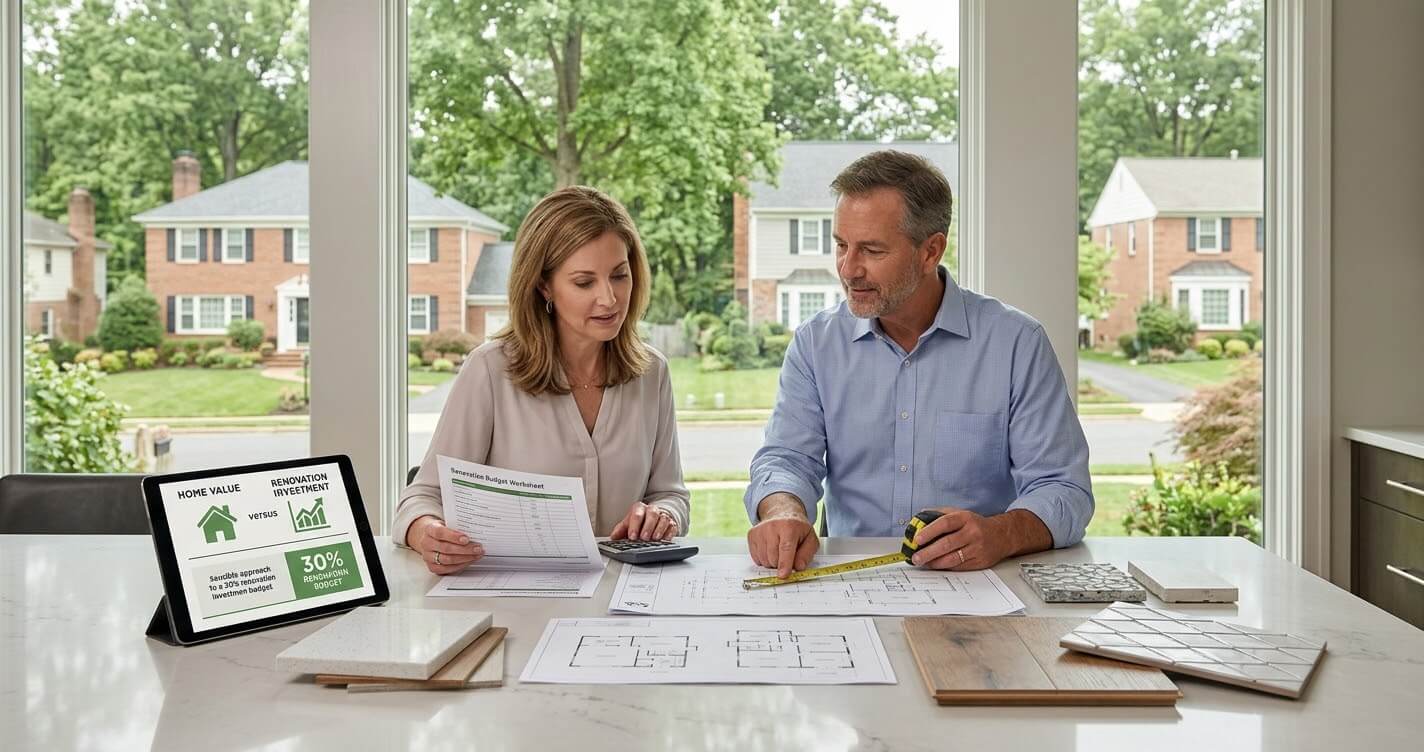
The 30% rule for home renovation in Northern Virginia is a budgeting guideline that suggests keeping major renovation spending to roughly 30% of your home’s current market value. It is not a legal limit or appraisal requirement; instead, it is a practical warning line for avoiding over-improvement relative to your home’s neighborhood and likely resale value.
That distinction matters in Northern Virginia because renovation budgets can vary dramatically between neighborhoods. A $150,000 renovation may be a reasonable investment for a high-value home in McLean or Great Falls but could represent a much larger financial exposure for a lower-valued property elsewhere in the region. The right question is therefore not simply, “How much can I afford to renovate?” It is, “How much can this property and its surrounding market reasonably support?”
That question has become increasingly relevant as homeowners continue investing in existing properties rather than moving. The Harvard Joint Center for Housing Studies projects that annual homeowner spending on improvements and maintenance will reach approximately $518 billion by the end of 2026. Harvard’s 2026 housing research also found that owner improvement spending increased 153% over the previous decade, substantially faster than spending growth on new multifamily and single-family construction.
The aging U.S. housing stock is another reason renovation demand remains strong. According to the National Association of Home Builders, the typical age of a U.S. home increased from 31 years in 2006 to 41 years in 2023, while nearly half of owner-occupied homes were built before 1980.
For Northern Virginia homeowners, the practical takeaway is simple: the 30% rule can be a useful first-pass budget check, but it should never replace local comparable sales, current market value, project scope, or long-term ownership plans. In the sections below, we will explain exactly how the rule works, calculate example renovation ceilings, and then apply the concept to different Northern Virginia markets.
If you are already planning a substantial project, it can also help to review the region’s Home Renovation Services before deciding how much scope to include in your initial budget.
What Is the 30% Rule for Home Renovations?
The 30% rule says that a homeowner can use approximately 30% of the property’s current market value as a preliminary ceiling for major renovation spending. The basic calculation is: current home value × 0.30 = preliminary renovation ceiling.
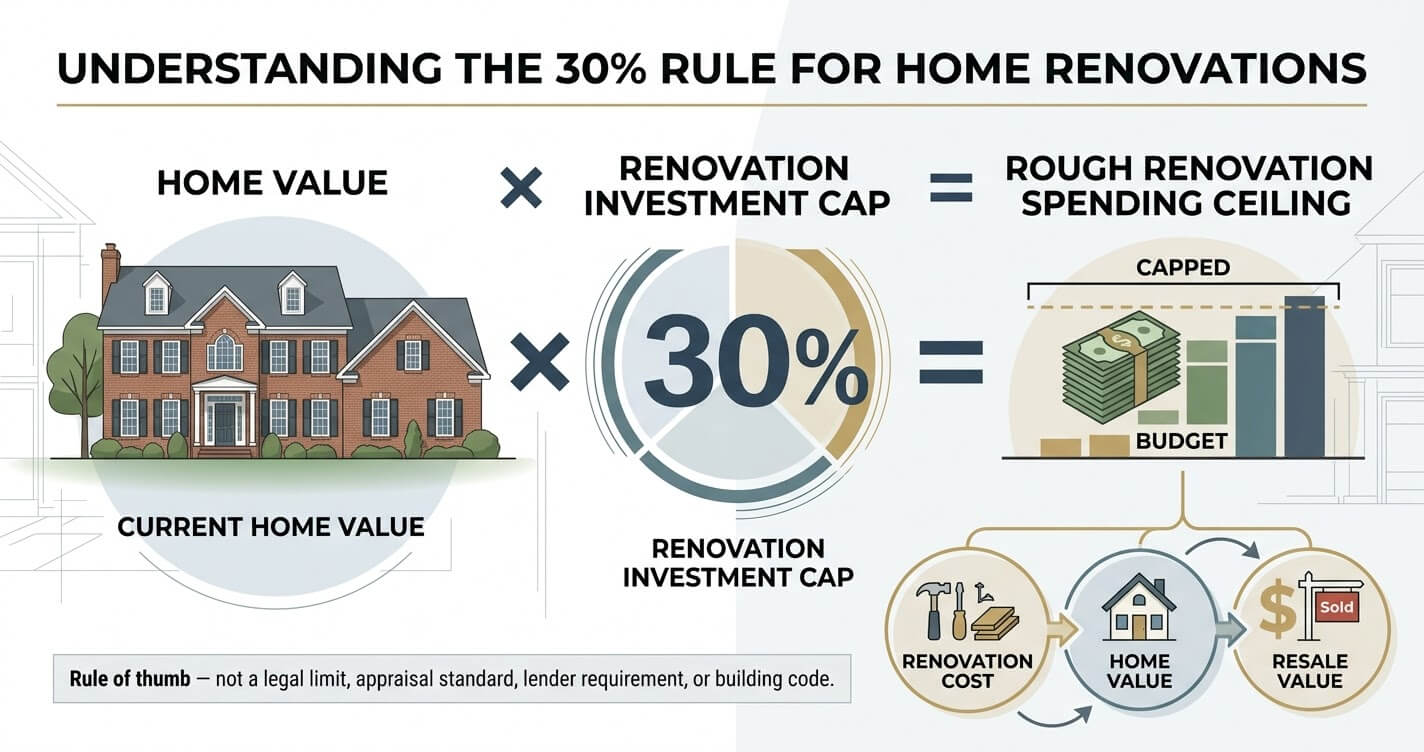
For example, if your Northern Virginia home is currently worth $900,000, the basic calculation would be:
$900,000 × 0.30 = $270,000
That does not mean you should automatically spend $270,000. It means that $270,000 is a useful point at which to stop and evaluate whether the proposed scope is still financially and locally proportionate.
The 30% rule is a guideline, not a hard cap
One of the most important things to understand about the 30% rule is what it is not.
It is not a Virginia building regulation. It is not a requirement imposed by a lender. It is not an appraisal formula that an appraiser mechanically applies to every renovation. And it does not mean that spending 31% of your home’s value automatically makes a project financially unsound.
Rather, the rule is a budgeting and over-improvement heuristic. Real-estate guidance commonly uses the 30% figure as a rough way to keep renovation spending proportional to the property and its market.
The underlying concept is more important than the percentage itself: a renovation should make sense in relation to the value ceiling supported by comparable properties in the same market.
That is particularly important when the finished property becomes substantially more expensive than the homes buyers typically encounter nearby.
Why does the 30% rule exist?
The primary concern is over-improving for your neighborhood.
Suppose two otherwise similar homes are located on the same street. One sells for $850,000 and another homeowner spends $300,000 transforming a similar property into a highly customized luxury home. The renovated property may be dramatically better from a design and lifestyle perspective, but that does not automatically mean buyers will pay $1.15 million for it.
The market determines value through factors such as location, lot characteristics, size, condition, layout, quality, and comparable sales. Renovation cost is only one input—and it is not a guarantee of equivalent value creation.
This is why renovation spending and added market value should never be treated as the same number.
A $200,000 renovation does not automatically add $200,000 to a home’s resale value.
The rule is really about proportionality
A more useful way to interpret the 30% rule is:
The larger the renovation becomes relative to the property’s existing value, the more carefully you should evaluate whether the neighborhood can support the finished product.
That is where the concept of renovation budget vs. home value becomes more useful than the percentage alone.
Consider three homeowners:
- Home A is worth $600,000 and has a proposed $100,000 renovation.
- Home B is worth $1 million and has a proposed $150,000 renovation.
- Home C is worth $1.5 million and has a proposed $400,000 renovation.
Their percentages are approximately 16.7%, 15%, and 26.7%, respectively. All three are below 30%, but the third project still deserves a much more detailed analysis because its absolute cost and scope may materially change the property’s position within its local market.
The percentage is therefore a screening tool, not a substitute for project-level analysis.
Why the rule matters more in Northern Virginia
Northern Virginia is not a single housing market. Home values, lot sizes, housing stock, buyer expectations, and renovation standards can change substantially from one jurisdiction or neighborhood to another.
A budget that is proportionate for a higher-value property in McLean may be excessive for a substantially lower-value property in another Fairfax County neighborhood. Conversely, a major renovation may be easier to justify in a premium market where buyers already expect larger homes, higher-end finishes, and extensive modernization.
This is why a Northern Virginia homeowner should calculate the 30% figure from the actual current value of the property, then compare that number with recent local comparable sales, not simply apply a regional average.
The Census Bureau’s latest QuickFacts data, for example, puts the median value of owner-occupied homes at $732,800 in Fairfax County and $895,000 in Arlington County for 2020–2024.
Using those figures only as broad jurisdiction-level reference points, the 30% calculations would be approximately:
- Fairfax County: $732,800 × 0.30 = $219,840
- Arlington County: $895,000 × 0.30 = $268,500
These are not recommended renovation budgets for every home in either county. They simply demonstrate why the same renovation price can represent a very different proportion of property value depending on location.
For an actual project, neighborhood-level comparable sales and the home’s specific characteristics should take precedence over a countywide median.
The 30% rule should not be treated as a per-room allowance
Another common mistake is interpreting the guideline as 30% for the kitchen, another 30% for the bathrooms, and another 30% for an addition.
That approach defeats the purpose of the rule.
If a homeowner has a $900,000 property and treats 30% as a separate allowance for each major project, the theoretical renovation budget could quickly become $500,000 or more. At that point, the homeowner is no longer using the percentage as a safeguard against over-improvement.
Instead, think of the 30% figure as a total preliminary spending ceiling for the overall renovation plan, unless a more detailed market and project analysis supports a different number.
For homeowners specifically evaluating a kitchen project, a more targeted resource is Kitchen Remodeling Northern Virginia, where the budget needs to be evaluated against the home’s value, desired finish level, layout changes, and local market expectations.
What the 30% rule can, and cannot, tell you
The rule can help answer:
- Is my preliminary renovation budget proportionate to my home’s current value?
- Should I investigate the neighborhood’s comparable sales before expanding the scope?
- Am I approaching a spending level where over-improvement deserves serious consideration?
- Should I prioritize certain projects instead of renovating everything at once?
It cannot, by itself, answer:
- How much additional value a specific renovation will create.
- Whether an addition will appraise for its construction cost.
- Whether a luxury kitchen is appropriate for a particular street.
- Whether a homeowner should renovate or sell.
- Whether exceeding 30% is financially justified for a long-term owner.
Those questions require a broader analysis of the property, neighborhood, project scope, and homeowner’s objectives.
How to Calculate Your 30% Ceiling
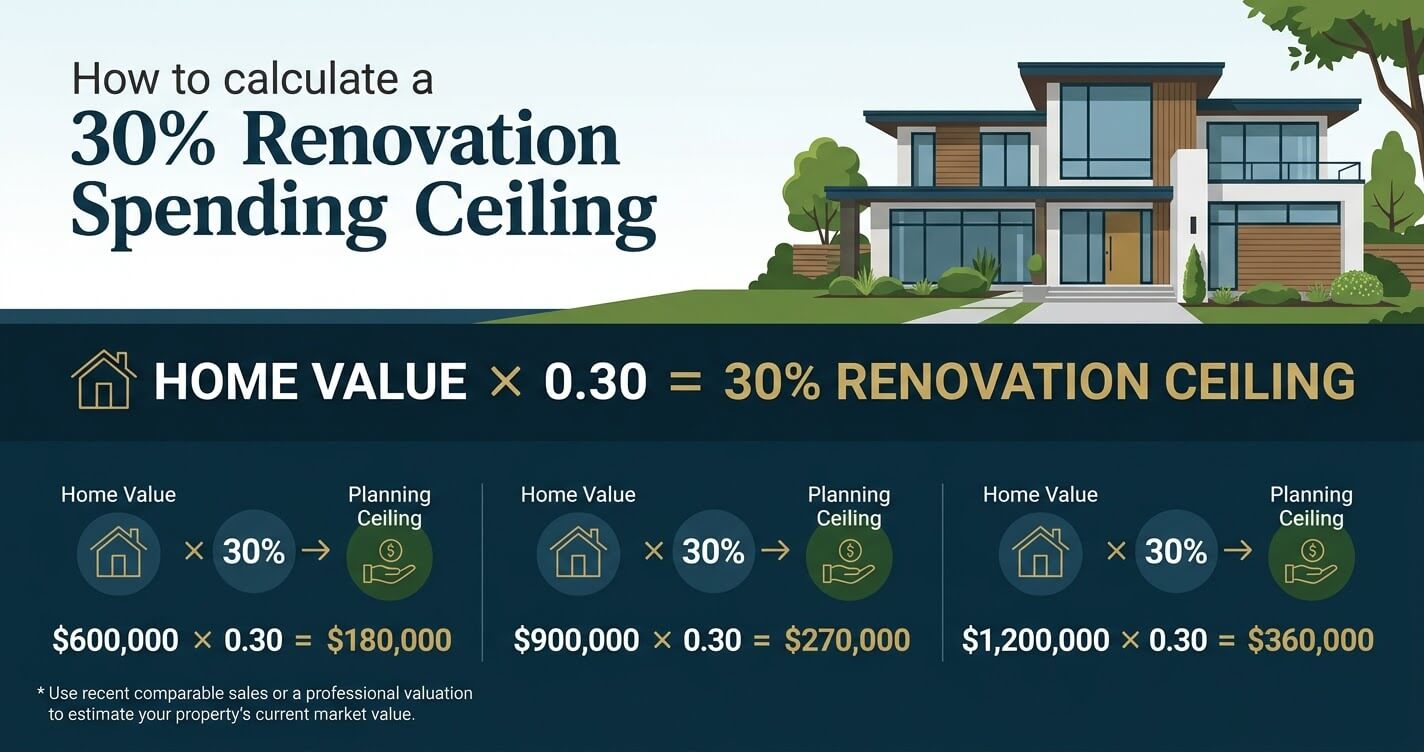
To calculate the basic 30% renovation ceiling, multiply your home’s current market value by 0.30. For example, a $900,000 home produces a preliminary ceiling of $270,000, but that number should then be tested against local comparable sales, project scope, and your expected ownership period.
The basic formula
The calculation is straightforward:
Current Market Value × 30% = Preliminary Renovation Spending Ceiling
Or:
Current Market Value × 0.30 = Renovation Ceiling
Here is what that looks like across several hypothetical Northern Virginia home values:
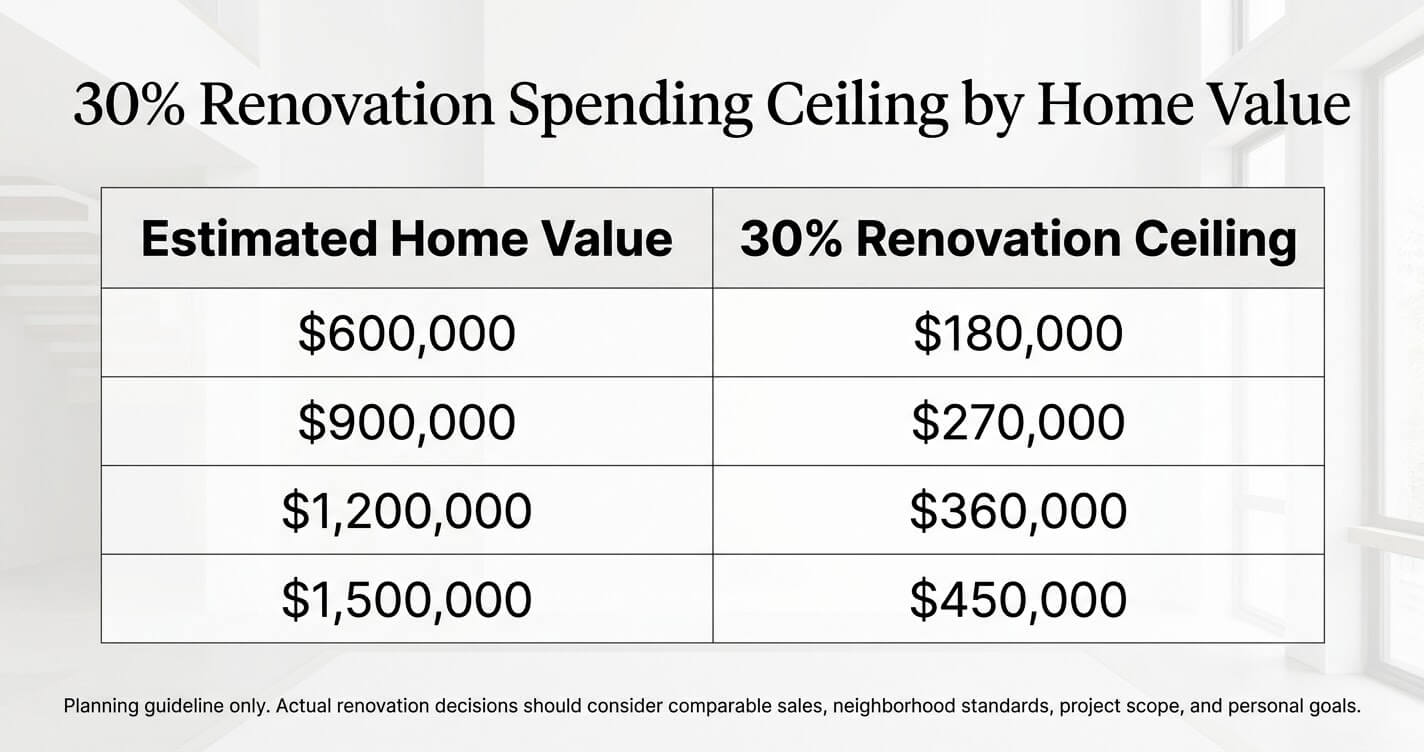
These figures are mathematical examples rather than recommended project budgets. A homeowner should not interpret the $450,000 figure for a $1.5 million property as an automatic green light for a $450,000 remodel.
The calculation simply establishes the first financial boundary.
Step 1: Determine your home’s current market value
This is the most important part of the calculation.
Do not automatically use the home’s original purchase price. If you purchased the property years ago, its current market value may be substantially different from what you paid.
Likewise, an online home-value estimate should not be treated as definitive for a major renovation decision. Automated valuation models can provide a starting point, but they do not replace a market analysis or professional appraisal when an accurate valuation is important.
A stronger approach is to consider three sources:
1. Recent comparable sales
Look for recently sold homes that are genuinely comparable to yours in location, size, lot, age, condition, bedroom/bathroom count, and overall quality. Sold properties are generally more informative for market-value analysis than asking prices because they show what buyers actually paid.
2. A local real-estate comparative market analysis
A knowledgeable Northern Virginia real-estate professional can help identify relevant comparable properties and adjust for meaningful differences between your home and the sales.
3. A professional appraisal
For a major renovation, especially when substantial financing or a future sale is involved, a professional appraisal can provide a more formal opinion of current market value.
The goal is not to find the highest possible number. It is to establish a defensible estimate of what the property could reasonably command before renovation.
Step 2: Multiply the value by 0.30
Once you have a reasonable current-value estimate, the calculation takes seconds.
For example, assume your home is worth $900,000:
$900,000 × 0.30 = $270,000
Your preliminary 30% ceiling is therefore $270,000.
But this is where good renovation planning begins, not where it ends.
If your proposed project is $275,000, that does not automatically mean you should cut $5,000 from the plan. Instead, it tells you that the project is close enough to the guideline’s threshold that you should examine the property’s comparable sales, neighborhood ceiling, project scope, and long-term ownership plans more carefully.
Step 3: Compare the ceiling with the actual renovation scope
Your renovation budget should include more than the most visible construction items.
Depending on the project, the overall budget may include:
- Architectural and design fees
- Engineering
- Permits and related approvals
- Demolition
- Structural work
- Plumbing and electrical changes
- HVAC modifications
- Cabinets and millwork
- Flooring
- Windows and doors
- Appliances
- Fixtures and finishes
- General construction labor
- Site work
- Temporary living arrangements, where applicable
- Contingency for unforeseen conditions
This is particularly important with older Northern Virginia homes, where opening walls or modifying existing systems can reveal conditions that were not apparent during initial planning.
The NAHB notes that the aging housing stock is one of the structural factors supporting continued remodeling demand. Its research shows that the typical U.S. home reached 41 years of age in 2023, compared with 31 years in 2006.
In other words, the renovation budget should be based on the complete project scope, not simply the contractor’s initial construction number.
Step 4: Compare your project with neighborhood comparables
This is where the 30% rule becomes more useful than a simple calculator.
Imagine your home is worth $1 million and your proposed renovation is $250,000. The project represents 25% of the home’s value, so it falls below the basic 30% guideline.
That sounds comfortable, but you still need to ask:
What are renovated homes similar to mine actually selling for?
If comparable homes in the neighborhood sell for $1.2 million to $1.3 million, the project may have a reasonable market context.
But if comparable homes rarely exceed $1.05 million, spending $250,000 could create a significant appraisal gap or resale-value problem, even though the project technically falls below 30%.
This is the central limitation of percentage-based budgeting:
A property can be below the 30% threshold and still be over-improved.
The reverse can also be true. A renovation can exceed 30% in a premium market or for a long-term owner and still make practical sense because the homeowner is buying substantial additional functionality, livability, or usable space.
Step 5: Separate financial return from personal value
Not every renovation is undertaken to maximize resale proceeds.
A homeowner may spend more because they need:
- A larger kitchen for a growing family
- A first-floor bedroom or accessible bathroom
- A home office
- Better energy performance
- Additional living space
- A redesigned floor plan
- Modernized electrical or plumbing systems
- Improved accessibility
- A more functional primary suite
Those improvements can have significant personal value even when the eventual resale value does not fully reimburse the construction cost.
That is why the 30% ceiling should be viewed as a financial risk-management tool, not a command to eliminate every feature that does not produce a measurable resale return.
A practical way to use the 30% ceiling
For a Northern Virginia homeowner, a useful sequence is:
1. Establish current market value → 2. Calculate 30% → 3. Build the complete project budget → 4. Review local comparable sales → 5. Identify where the finished property would sit within the neighborhood → 6. Decide whether the proposed scope is financially and personally justified.
This process is much more reliable than starting with a desired renovation number and then trying to make the property value fit around it.
Example: A $900,000 Northern Virginia home
Suppose a homeowner estimates the current market value of the property at $900,000.
The calculation is:
$900,000 × 0.30 = $270,000
The homeowner then receives a preliminary renovation estimate of $240,000.
At first glance, the project appears to fit comfortably below the 30% guideline.
But further analysis shows that similarly sized renovated homes nearby are selling around $1.05 million to $1.15 million.
That changes the conversation.
The homeowner now needs to determine whether the proposed renovation is likely to position the property appropriately within that range, or whether the project is introducing expensive features that the neighborhood’s buyers are unlikely to reward.
If the project includes a kitchen overhaul, the homeowner might prioritize the layout, cabinetry, appliances, and structural improvements that solve the property’s biggest deficiencies rather than automatically selecting the most expensive available finishes.
For homeowners considering a substantially larger whole-house scope, Custom Home Builder Northern Virginia may also be a relevant service resource when the project begins to approach a point where the existing home’s configuration and the proposed investment need to be evaluated together.
Why the current value, not the future value, matters
One of the easiest ways to misuse the 30% rule is to calculate the ceiling using the home’s expected post-renovation value.
For example, if a homeowner believes a $1 million property could be worth $1.4 million after renovation, using $1.4 million to calculate the budget would produce a $420,000 ceiling.
That is backwards.
The purpose of the guideline is to establish whether the proposed investment is proportionate to the property before the investment is made. The calculation should therefore begin with a defensible estimate of the property’s current value.
The expected post-renovation value can then be analyzed separately using comparable properties and market evidence.
The 30% number is a checkpoint, not a target
Perhaps the most important takeaway is that homeowners should not try to spend exactly 30%.
If your home is worth $900,000 and you can complete the necessary renovation for $140,000, there is no financial reason to expand the scope simply because the guideline allows up to $270,000.
The strongest renovation budget is the one that solves the property’s important problems, fits the homeowner’s financial position, aligns with the neighborhood, and produces a finished home that makes sense for its intended market.
The 30% calculation simply helps identify when that conversation deserves closer attention.
The 30% Rule by Northern Virginia County and City
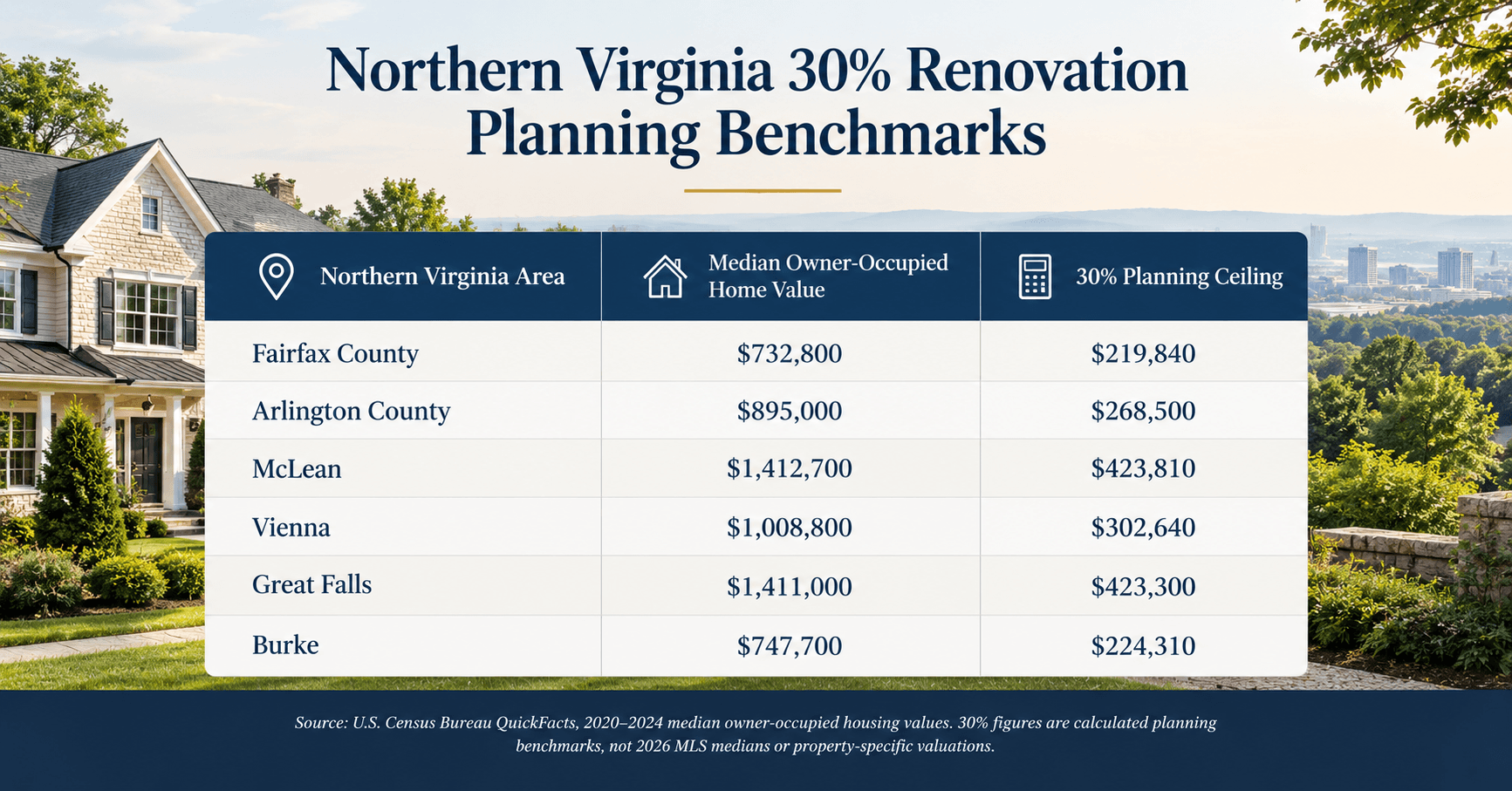
The 30% rule home renovation Northern Virginia calculation changes significantly by location because property values vary across Fairfax County, Arlington County, McLean, Vienna, Great Falls, and Burke. Using current Census housing-value data as a broad benchmark, the theoretical 30% ceiling ranges from about $219,840 in Fairfax County to more than $423,000 in McLean and Great Falls.
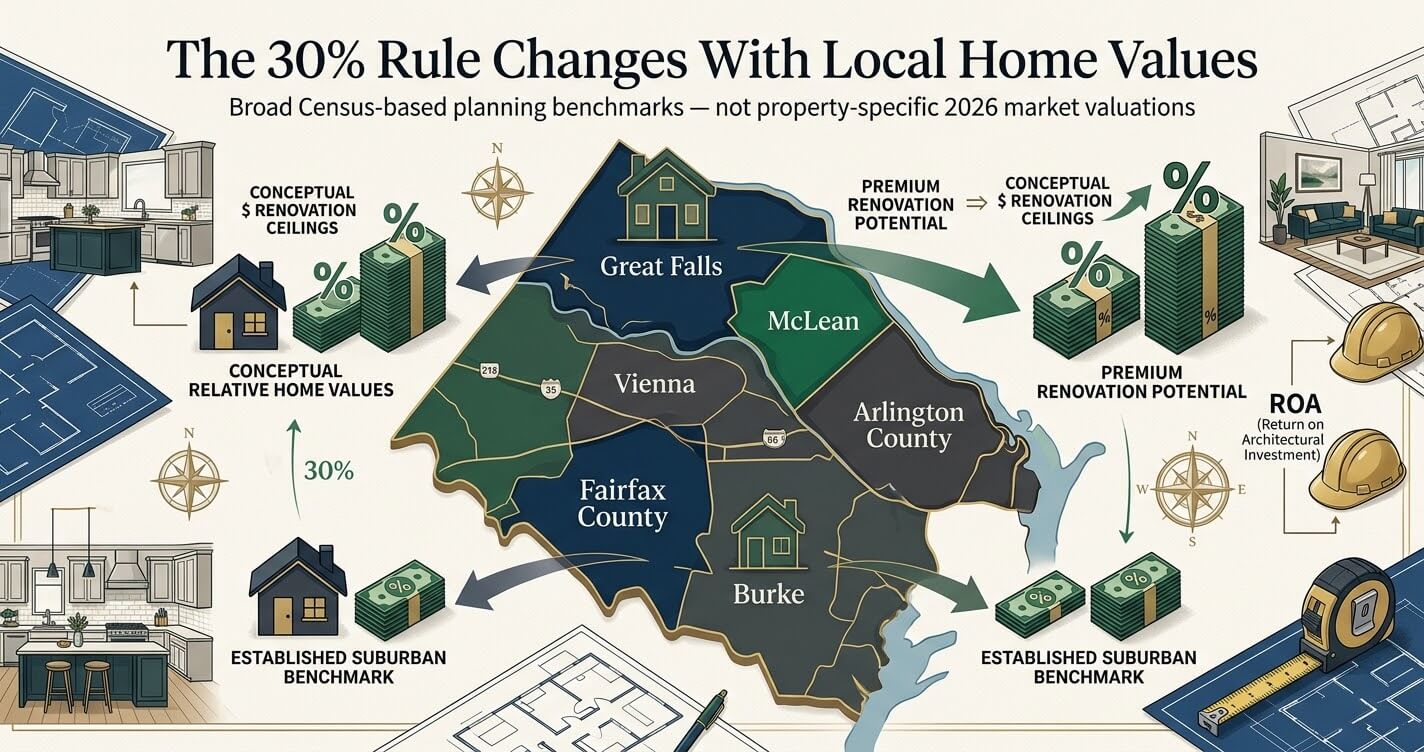
These figures demonstrate why there is no single dollar amount that represents a sensible renovation ceiling for every Northern Virginia homeowner.
The same $250,000 renovation can represent approximately one-third of a $750,000 property but less than one-fifth of a $1.4 million property. More importantly, even those percentages do not tell the entire story. A home’s immediate competitive market can be substantially different from the countywide or Census-area median.
For that reason, the numbers below should be treated as screening benchmarks, not recommended budgets for individual properties.
Fairfax County
Fairfax County’s 2020–2024 median value of owner-occupied homes is $732,800, producing a basic 30% renovation ceiling of approximately $219,840. Individual neighborhoods can support substantially higher or lower renovation investments depending on home values, lot characteristics, condition, and comparable sales.
The U.S. Census Bureau reports a $732,800 median value for owner-occupied housing units in Fairfax County for 2020–2024. Applying the 30% formula gives:
$732,800 × 0.30 = $219,840
That $219,840 figure should not be interpreted as a countywide maximum. Fairfax County contains a wide range of housing types and submarkets, from older starter-home neighborhoods to significantly higher-value properties.
For example, a homeowner whose property is currently worth $600,000 would have a preliminary 30% ceiling of only $180,000, while a $1.2 million property would produce a $360,000 preliminary ceiling.
This is why property-specific value should take precedence over the county median when determining a renovation budget.
The more important question is where the renovated property will sit relative to comparable homes after the work is complete. If similar renovated properties in the immediate market routinely sell for substantially more than the subject property, a larger investment may have a stronger market rationale. If the neighborhood’s price ceiling is considerably lower, the same investment deserves more scrutiny.
Arlington County
Arlington County’s 2020–2024 median owner-occupied home value is $895,000, producing a basic 30% calculation of $268,500. However, Arlington’s varied housing stock means a property-specific comparable-sales analysis is more meaningful than applying the countywide figure to every renovation.
The Census Bureau reports a $895,000 median value of owner-occupied housing units in Arlington County for 2020–2024. The corresponding calculation is:
$895,000 × 0.30 = $268,500
Arlington’s housing market also illustrates why geography needs to be interpreted carefully. A countywide median does not establish the value ceiling for an individual neighborhood, street, or property type.
A renovation that is proportionate for a high-value detached home may be inappropriate for a substantially lower-value property, even when both properties are located within Arlington County.
The practical application is therefore:
Use the county figure to understand the scale of the market, then replace it with the property’s actual current market value when calculating the renovation ceiling.
McLean
McLean’s 2020–2024 median value of owner-occupied housing units is approximately $1,412,700, which produces a preliminary 30% ceiling of about $423,810. That higher mathematical ceiling reflects McLean’s much higher property values, but it does not mean every $423,810 renovation is financially justified.
The Census Bureau reports a $1,412,700 median owner-occupied home value for McLean CDP for 2020–2024.
The calculation is:
$1,412,700 × 0.30 = $423,810
This is a useful illustration of why applying the same dollar ceiling across Northern Virginia can be misleading.
A $300,000 renovation would exceed the basic 30% ceiling on a $900,000 home, but represent only about 21.2% of the McLean median value.
That does not automatically make the McLean project a better investment. The renovation still needs to be appropriate for the specific property, its location, lot, existing improvements, and competitive set.
In higher-value markets, homeowners may also encounter a different standard of buyer expectation. A renovation with high-quality materials, sophisticated millwork, expanded living space, or a substantially reconfigured floor plan may be more compatible with the surrounding housing stock than it would be in a lower-priced neighborhood.
Vienna
Vienna’s 2020–2024 median owner-occupied home value is $1,008,800, producing a basic 30% renovation ceiling of approximately $302,640. For an individual Vienna property, however, the appropriate ceiling depends on nearby comparable homes rather than the townwide median alone.
The U.S. Census Bureau reports a $1,008,800 median value of owner-occupied housing units in the Town of Vienna for 2020–2024.
The calculation is:
$1,008,800 × 0.30 = $302,640
Vienna is particularly useful as an example because a townwide median can conceal meaningful differences among individual properties.
Lot size, proximity to commercial areas, street characteristics, home age, existing square footage, school assignments, condition, and architectural style can all influence the competitive set.
For homeowners considering a kitchen-focused renovation, the property’s current position within that local market matters more than simply comparing the project price with the $302,640 benchmark. A useful next resource is Kitchen Remodeling Vienna VA: Complete 2026 Homeowner Guide, which provides more project-specific context for homeowners evaluating kitchen improvements in this market.
Great Falls
Great Falls has one of the highest median owner-occupied home values among the Northern Virginia locations considered here: $1,411,000 for 2020–2024. Applying the 30% guideline produces a preliminary ceiling of approximately $423,300, although property-specific comparable sales remain the stronger valuation reference.
The Census Bureau reports a $1,411,000 median value of owner-occupied housing units in Great Falls CDP for 2020–2024.
The calculation is:
$1,411,000 × 0.30 = $423,300
The relatively high figure demonstrates an important principle: the 30% calculation scales with property value.
A $400,000 renovation may therefore warrant a completely different analysis in Great Falls than it would in a neighborhood where the typical property is worth $700,000.
However, high-value markets can also contain highly customized properties, large lots, distinctive architecture, and substantial variation between individual homes. Those characteristics make generic percentage rules less precise.
Burke
Burke’s 2020–2024 median owner-occupied home value is $747,700, producing a preliminary 30% ceiling of approximately $224,310. As with Fairfax County overall, homeowners should compare their property with nearby renovated homes rather than treating the Burke median as a fixed spending limit.
The Census Bureau reports a $747,700 median owner-occupied home value for Burke CDP for 2020–2024.
The calculation is:
$747,700 × 0.30 = $224,310
A homeowner with a $750,000 property therefore lands almost exactly on the Burke-area benchmark, while a homeowner with a $1 million property would have a substantially higher property-specific calculation of $300,000.
That difference is why the 30% rule should always begin with the individual home’s current market value, with local median values used only as context.
Northern Virginia 30% ceiling comparison
Why neighborhood-level data matters more than the county median
The 30% rule becomes much more useful when the homeowner moves from regional averages to competitive-market analysis.
Fannie Mae’s appraisal guidance explains that comparable sales should reflect properties with similar physical and legal characteristics, including factors such as site, room count, finished area, style, and condition. It also defines the relevant market area around the properties that compete for the same buyers.
That means a homeowner should ideally compare the property against homes that buyers would genuinely consider as alternatives, not simply homes located somewhere within the same county.
This distinction can materially change the answer to the question, “How much should I spend on a renovation?”
Warning Signs You’re Over-Improving for Your Neighborhood
You may be over-improving for your neighborhood when the finished property would materially exceed the quality, size, price, or feature level of competing homes without sufficient market evidence to support the higher value. The strongest warning signs include an unusually high post-renovation price, highly customized features with limited buyer demand, and spending that significantly exceeds local comparable properties.
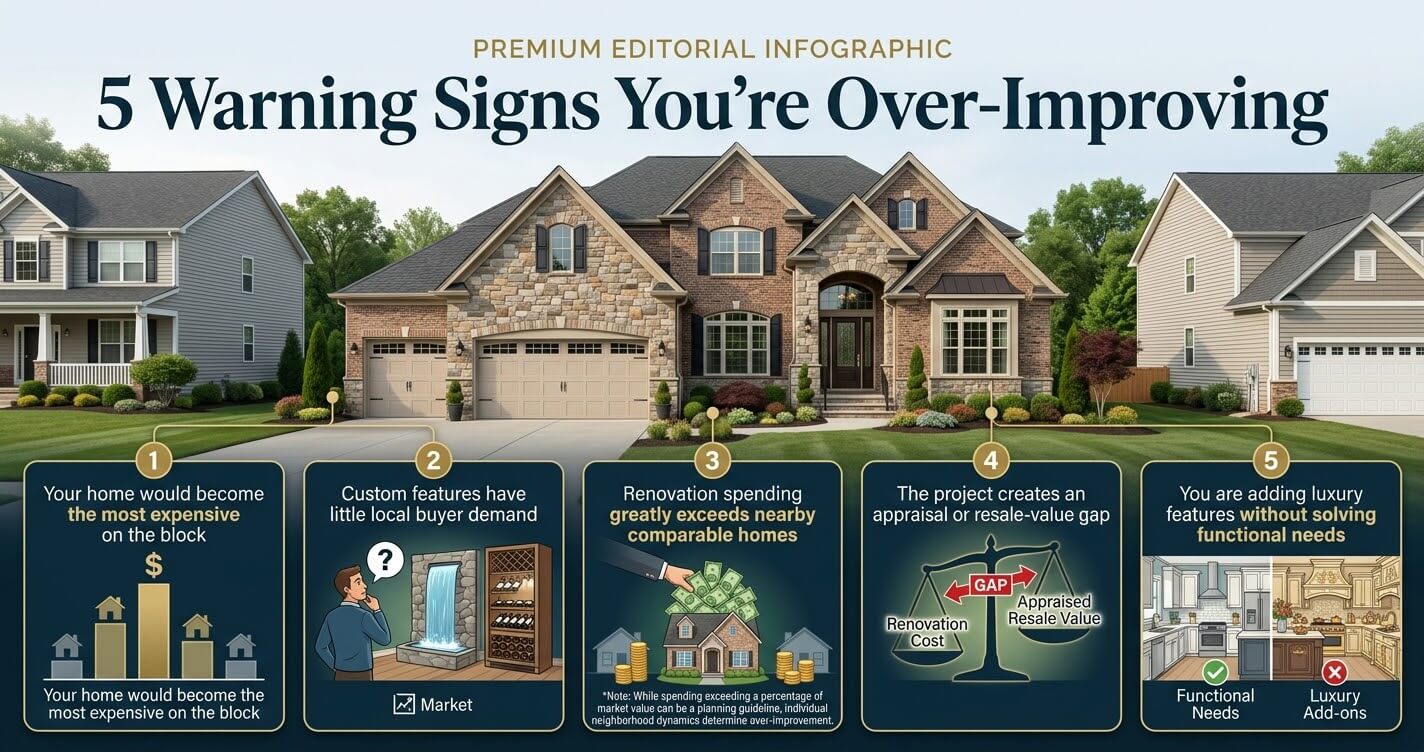
The 30% threshold is useful because it identifies when you should investigate further. But the warning signs below are often more informative than the percentage itself.
1. Your projected finished value would make the home an outlier
One of the clearest warning signs is when your projected post-renovation value would place the property substantially above the prices of otherwise comparable homes.
For example, imagine that most renovated homes similar to yours sell between $1.0 million and $1.1 million. You own a similar property currently worth $800,000 and are considering a $350,000 renovation.
The project would cost 43.75% of the current value.
More importantly, you would be attempting to spend your way toward a finished property that may sit outside the established competitive range.
That is a stronger warning than the 30% figure alone.
Fannie Mae’s appraisal guidance specifically emphasizes the importance of comparable properties that are competitive with the subject property and the need for market-supported adjustments when properties differ.
2. Your house would become the most expensive home on the block
Being the nicest house in a neighborhood is not automatically a problem.
Being dramatically more expensive than the surrounding competitive properties can be.
Suppose nearly all comparable homes around you trade between $850,000 and $1 million. If your renovation would push the property toward $1.4 million, you should identify actual sales supporting that level before committing to the additional scope.
This is especially important when the additional spending goes toward features that are difficult to value objectively, such as highly customized finishes, specialized rooms, imported materials, or elaborate architectural details.
The issue is not that these features have no value.
The issue is whether the marginal buyer in that market is willing to pay for them.
3. Your renovation is highly customized but not broadly marketable
Customization becomes riskier as the intended buyer pool becomes smaller.
Examples could include:
- A highly specialized home theater
- A commercial-style kitchen far beyond neighborhood norms
- An unusually large wine cellar
- A room designed for a very specific hobby
- Extremely personalized built-ins
- Unconventional floor plans
- Luxury finishes with little precedent in comparable homes
Fannie Mae’s guidance recognizes that unusual layouts can have limited market appeal and that unique properties require sufficient market evidence to establish reliable value.
That does not mean homeowners should avoid customization.
It means the financial analysis should distinguish between personal enjoyment value and market-supported value.
If you intend to remain in the property for many years, that distinction may be perfectly acceptable. If you expect to sell soon, it deserves considerably more attention.
4. Your renovation cost is rising faster than your property’s competitive value
Construction cost and market value are two different variables.
A contractor may reasonably quote $250,000 for a technically complex renovation. That does not establish that the completed property will increase in value by $250,000.
This distinction is critical when structural changes, high-end finishes, or extensive mechanical upgrades are involved.
The question should therefore be:
“What does this improvement cost?”
followed by:
“How does the local market value the finished condition?”
Those are separate questions.
5. You’re using the 30% rule as permission to spend more
This is one of the easiest ways to misuse the guideline.
If your home is worth $800,000, the calculation produces $240,000. That does not mean you have found a reason to spend $240,000.
If your essential project can be completed for $150,000, adding another $90,000 of discretionary work simply because it falls below the 30% threshold defeats the purpose of the guideline.
The 30% figure is a warning line, not a spending target.
6. Your project has no genuinely comparable finished properties
A lack of comparable renovated properties does not automatically make a project unwise, but it increases valuation uncertainty.
Fannie Mae’s guidance allows appraisers to use the best available market evidence when truly comparable sales do not exist, but the appraiser must still establish market-supported adjustments and demonstrate that the property has market acceptance.
In practical terms, the fewer comparable properties available, the more carefully the homeowner should evaluate the proposed scope.
This is particularly relevant for highly customized whole-house renovations and unusual additions.
7. The renovation solves a personal problem but adds little competitive advantage
Some improvements are enormously valuable to the current homeowner without substantially changing the property’s market position.
For example, a homeowner may spend heavily to create a specialized hobby space that is essential to their lifestyle. That can be a completely rational decision.
But it should not be justified solely by saying, “The renovation will add the same amount to resale value.”
Instead, classify the expenditure honestly:
- Market-driven improvement: primarily intended to improve competitiveness and value.
- Lifestyle improvement: primarily intended to improve personal enjoyment.
- Deferred-maintenance improvement: primarily intended to correct aging or failing systems.
- Hybrid improvement: provides meaningful personal and market benefits.
That classification makes the renovation budget much easier to evaluate.
When It’s Safe to Exceed the 30% Rule
Exceeding the 30% rule can make sense when the property has a strong long-term ownership case, the local market supports the finished product, the renovation materially improves functionality or usable space, or the project changes the home’s competitive set. The key is having a defensible reason for exceeding the guideline rather than treating 30% as either a mandatory limit or an automatic allowance.
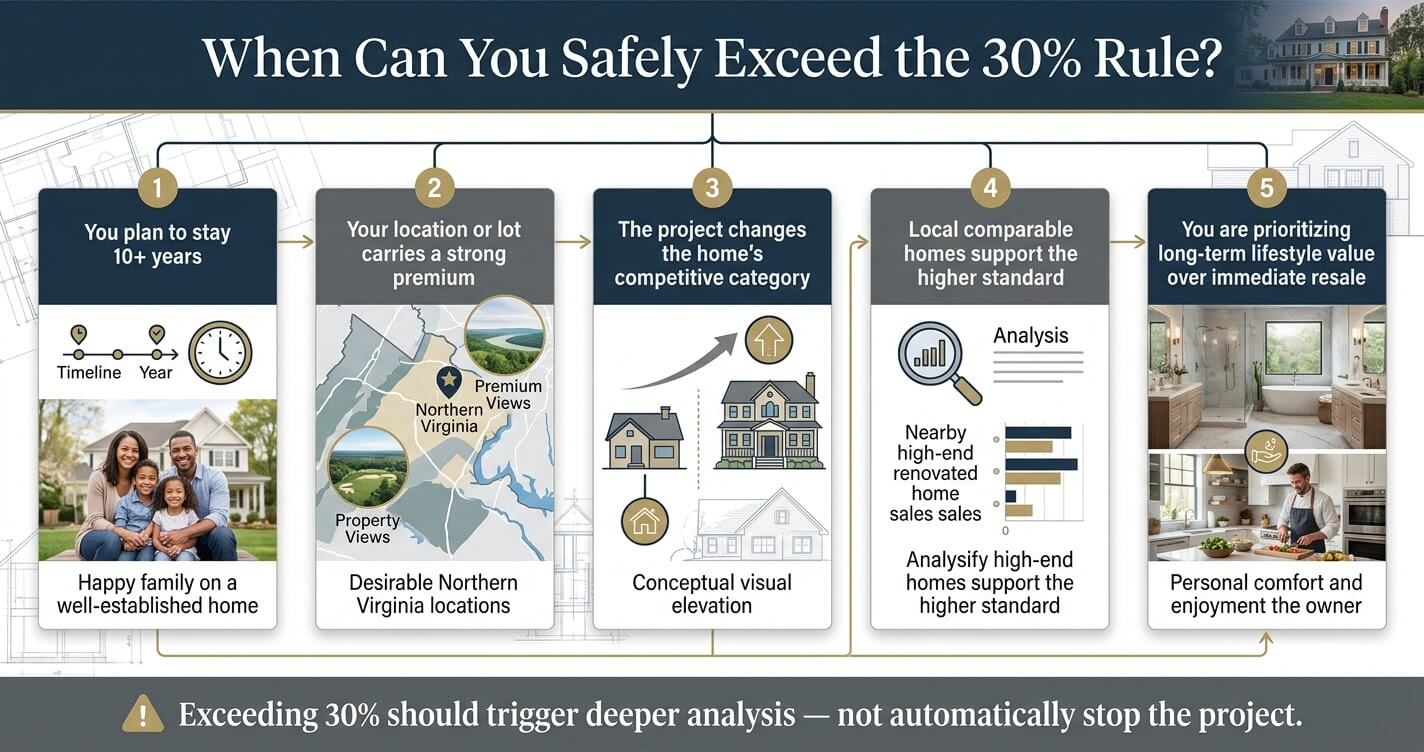
There are several situations where a homeowner may rationally decide that the 30% threshold is too conservative.
1. You plan to remain in the home for 10 years or longer
A short-term resale calculation is less important when the homeowner expects to remain in the property for a decade or more.
A long-term owner may reasonably place greater weight on:
- Daily functionality
- Family needs
- Accessibility
- Energy efficiency
- Structural improvements
- Maintenance reduction
- Additional living space
- Quality of life
Suppose a $1 million home requires a $350,000 whole-house renovation. That represents 35% of current value and therefore exceeds the basic 30% guideline.
If the homeowner intends to remain there for 15 years, however, the decision is not simply a question of immediate resale ROI. The homeowner will receive the functional benefit of the renovation throughout the ownership period.
That does not eliminate financial risk, but it changes the decision framework.
2. The project adds meaningful usable space
A major addition can change the analysis because it is not simply replacing one finish with another.
Adding conditioned living area, a bedroom, a bathroom, or a properly designed family space can materially change the property’s utility and competitive characteristics.
However, homeowners should still avoid assuming that construction cost equals added market value.
The finished property’s market position needs to be supported by comparable properties with similar size, configuration, and quality.
Fannie Mae’s appraisal guidance requires appraisers to consider relevant physical characteristics and market-supported adjustments when analyzing comparable properties.
3. The existing home is materially under-improved
Sometimes a property is substantially below the quality level of its surrounding competitive market.
For example, imagine a neighborhood where most comparable homes have already undergone major modernization while one property remains largely original.
A renovation that brings the property up to the neighborhood standard could exceed 30% of the home’s current value while still being strategically sensible.
The important distinction is between catching up to the market and leapfrogging far beyond it.
If the renovation brings an outdated home into the same competitive category as nearby properties, the risk of over-improvement may be lower than the raw percentage suggests.
4. The property has a location or lot advantage
Not all homes with the same square footage are economically equivalent.
A property may have:
- An unusually large lot
- Exceptional privacy
- A premium street
- A desirable view
- Proximity to major employment centers
- Strong school-market appeal
- Walkability
- A distinctive architectural setting
These factors can create a higher value ceiling than a broad neighborhood median suggests.
The 30% rule should therefore be evaluated against the property’s actual competitive position, not simply against an area-wide average.
5. The renovation changes the property’s competitive set
This is one of the strongest reasons a project may legitimately exceed the guideline.
Suppose a 2,000-square-foot home is substantially reconfigured and expanded to 3,000 square feet with a new layout, additional bedrooms, and improved functionality.
The homeowner is no longer comparing the finished property solely with the original 2,000-square-foot homes.
The relevant competitive set may now include larger homes with similar finished area and quality.
That does not guarantee the renovation will recover its cost. It does mean the analysis should be based on the new competitive position rather than treating the project as a cosmetic upgrade.
For homeowners whose project is approaching this scale, the Custom Home Builder Northern Virginia service page is a natural resource to review because the project may be moving beyond a conventional renovation into a more comprehensive design-and-build exercise.
6. You’re correcting significant functional or structural deficiencies
Some of the most important renovation expenditures are not discretionary luxury upgrades.
They can include:
- Structural repairs
- Electrical modernization
- Plumbing replacement
- Roof-related work
- Drainage improvements
- HVAC replacement
- Water-management improvements
- Code-related corrections
- Major insulation or envelope improvements
These projects may not produce a dollar-for-dollar resale increase, but they can protect the home’s functionality, marketability, and condition.
In these situations, asking whether the project stays below 30% can be less important than determining whether the work is necessary and whether the overall scope is proportionate to the property’s long-term use.
7. You’re making a long-term “stay-put” decision
Northern Virginia homeowners may also face a substantial opportunity cost when moving.
A homeowner who already has a favorable mortgage, a desirable location, established community ties, or a property that meets most needs may decide that improving the existing home is preferable to purchasing another property.
That is a different decision from a short-term resale-focused renovation.
In that situation, the homeowner can reasonably place more weight on replacement cost, transaction costs, lifestyle value, and long-term functionality.
For readers specifically evaluating whether a major investment makes more sense than moving, the site’s Renovate vs. Sell Northern Virginia guide provides a useful next step.
How Over-Improving Affects Appraisal and Resale
Over-improving can create an appraisal or resale problem when the finished property’s value is not adequately supported by comparable sales, even if the homeowner spent substantially more on the renovation. Appraisers do not simply add renovation invoices to a property’s previous value; they analyze market evidence and how buyers respond to differences between properties.
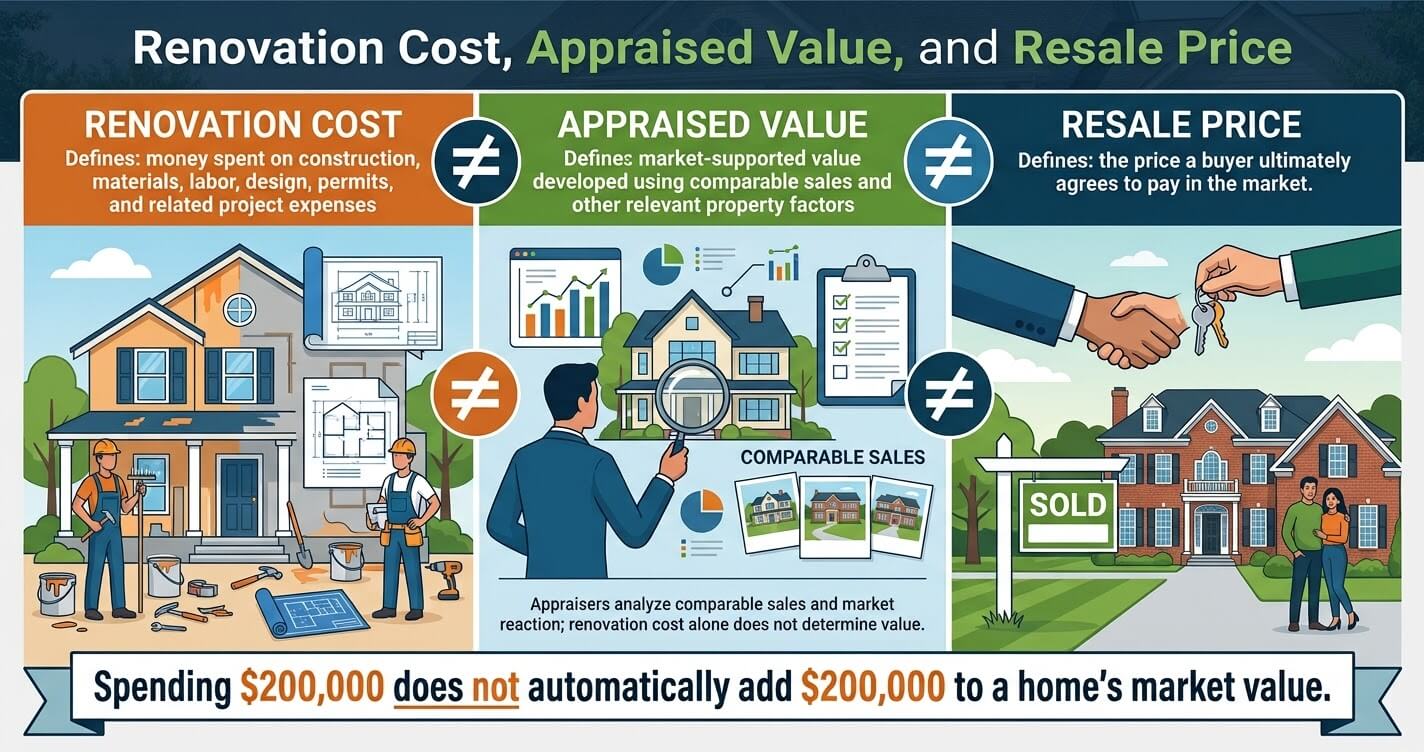
This is where the distinction between renovation cost, appraised value, and resale price becomes critical.
They are related, but they are not interchangeable.
Appraisers do not simply reimburse renovation costs
A common misconception is:
“If I spend $300,000 renovating my home, the appraisal should increase by $300,000.”
That is not how the sales comparison process works.
Fannie Mae’s appraisal guidance states that the sales comparison approach analyzes comparable sales, contract sales, and listings that are most comparable to the subject property. The appraiser considers differences that affect value and makes market-supported adjustments rather than relying on arbitrary rules of thumb.
This means the market’s reaction to an improvement matters more than the homeowner’s construction invoice.
Why renovation cost and value can diverge
Imagine a homeowner spends:
- $100,000 on a kitchen
- $80,000 on bathrooms
- $75,000 on custom millwork
- $95,000 on structural and mechanical work
Total investment:
$350,000
The fact that the renovation cost $350,000 does not establish that the market value increased by $350,000.
Some of the investment may have been necessary simply to bring an aging property up to current standards. Some may improve marketability but produce less than a dollar-for-dollar increase in value. Other improvements may generate stronger market recognition.
The appraiser’s task is not to reimburse the homeowner for the invoice. It is to develop an opinion of market value based on available evidence.
The appraisal gap becomes important
An appraisal gap occurs when the appraised value is below the price a buyer and seller have agreed upon.
For a heavily renovated home, this can become particularly important if the seller expects the renovation investment to justify a much higher asking price than comparable sales support.
For example:
- Renovated home asking price: $1,350,000
- Accepted offer: $1,330,000
- Appraised value: $1,250,000
The buyer and lender now have a $80,000 difference to resolve.
Depending on the financing structure and transaction, the buyer may need to contribute additional cash, the seller may need to reduce the price, or the parties may negotiate another solution.
The lesson for homeowners is straightforward:
A large renovation budget does not eliminate the need for comparable-sale support at resale.
Comparable sales are the critical evidence
Fannie Mae’s current guidance says comparable sales should have similar physical and legal characteristics, including site, room count, finished area, style, and condition. It also states that the appraiser should select properties that are competitive with the subject and appeal to the same market participants.
That makes the quality of the comparable set especially important after a major renovation.
A newly remodeled home should ideally be compared with other homes that buyers would consider substitutes, not simply the closest properties geographically.
If your renovation creates a property that is larger, newer, more sophisticated, or materially different from nearby homes, the appraiser may need to expand the search for appropriate comparables.
Unique renovations can increase valuation uncertainty
The more unusual the property becomes, the more difficult it can be to establish market-supported value.
Fannie Mae specifically addresses unique or nontraditional properties and notes that when truly similar comparable sales are unavailable, an appraiser may use the best available market evidence and make supported adjustments. However, there must still be enough evidence to develop a reliable opinion of market value and demonstrate market acceptance.
This is one reason highly customized renovations should be approached carefully.
A homeowner may love a particular feature, but if there are few comparable homes demonstrating buyer demand for that feature, its resale contribution may be uncertain.
The neighborhood ceiling matters
The concept of a neighborhood ceiling is not a formal appraisal formula.
It is a practical way of asking:
“What level of finished value does the local market actually support?”
If comparable properties consistently cluster around $1 million to $1.1 million, a $1.5 million renovation outcome requires stronger evidence than a finished value of $1.05 million.
Fannie Mae’s guidance also recognizes that extensive comparable-sale adjustments can raise questions about whether a property conforms to its neighborhood and whether the resulting value conclusion is adequately supported.
That is the technical reason over-improvement matters.
Buyer psychology also affects resale
Appraisal is only one part of the resale equation.
Even if an appraiser can support a particular value, buyers still decide whether the property is worth the asking price.
A highly renovated home can have strong buyer appeal when the improvements solve problems buyers commonly encounter:
- Poor layout
- Outdated kitchen
- Insufficient storage
- Inadequate bathrooms
- Lack of functional living space
- Aging mechanical systems
- Poor indoor-outdoor connection
Conversely, a renovation can become harder to monetize when a large portion of the budget is concentrated in features that only a small segment of buyers values.
This is why marketability should be considered alongside cost and appraisal.
A better way to think about the appraisal risk
Instead of asking:
“Will my $300,000 renovation add $300,000 to the home’s value?”
ask:
“Will the finished property have enough comparable market support to justify the value I need when I eventually sell?”
That question is much closer to the way professional valuation works.
It also explains why a homeowner can rationally exceed the 30% rule while still making a sound personal decision, but should not assume that every dollar spent will automatically be recovered at resale.
The bottom line for Northern Virginia homeowners
The 30% rule is most useful as an early warning system.
If your renovation is comfortably below 30%, that does not automatically make it a good investment.
If your renovation exceeds 30%, that does not automatically make it a bad one.
The stronger analysis considers:
- Current property value
- Total renovation cost
- Neighborhood and submarket
- Comparable renovated properties
- Expected post-renovation competitive position
- Length of ownership
- Lifestyle and functional benefits
- Potential appraisal and resale constraints
When those factors point in the same direction, the 30% rule becomes a useful planning tool rather than an arbitrary spending limit.
How to Stay Within (or Strategically Exceed) Your Renovation Budget
The best way to manage a renovation budget is to establish the property’s value ceiling first, then prioritize scope according to neighborhood comparables, functional needs, and long-term ownership plans. If the project exceeds the 30% guideline, phase discretionary work or verify that the larger investment has a defensible market and lifestyle rationale.
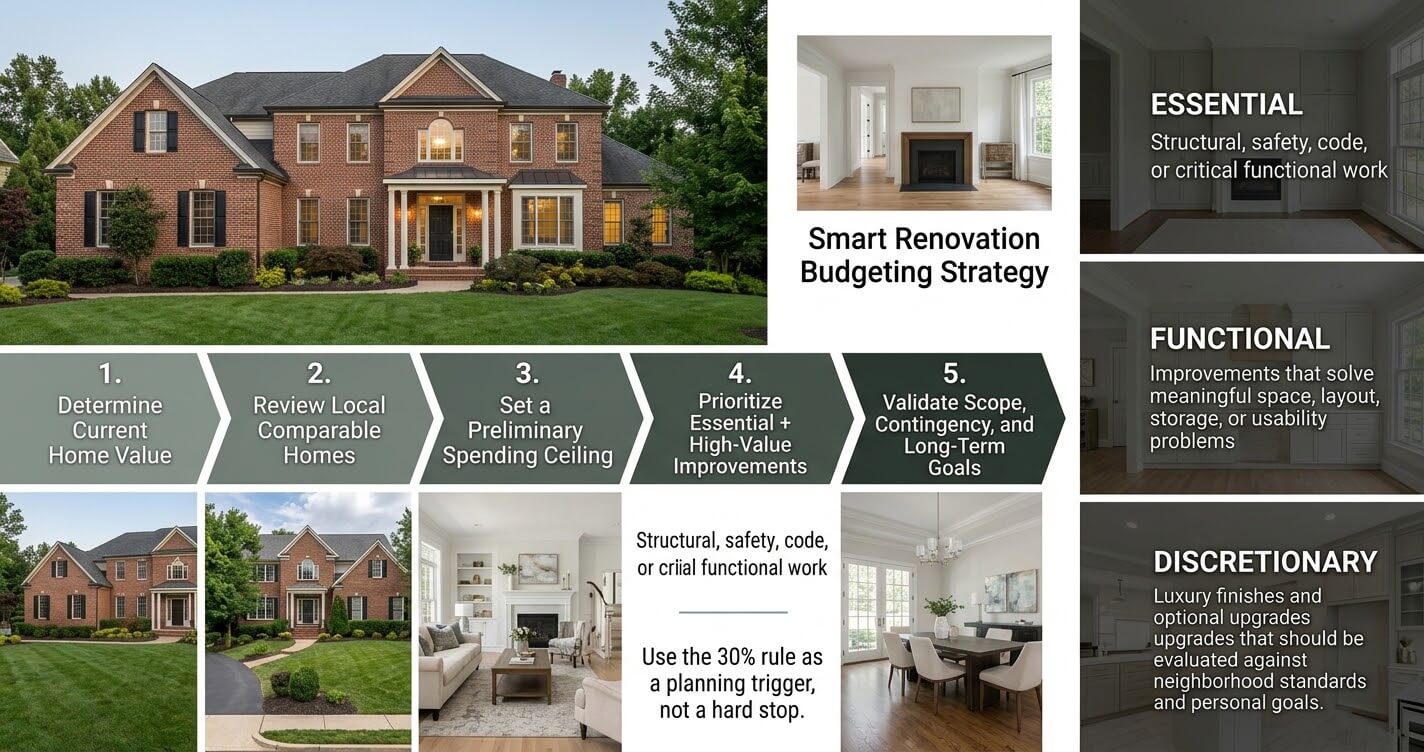
A renovation budget should not be built by starting with a wish list and then asking how to pay for it.
A stronger process works in the opposite direction:
Property value → preliminary spending ceiling → project priorities → complete construction budget → comparable-sales check → final scope.
This becomes especially important as renovation projects become larger. NAHB’s Remodeling Market Index remained firmly positive in Q2 2026, recording a reading of 61, while its current-conditions index for large remodeling projects of $50,000 or more remained at 64.
At the same time, Harvard’s Leading Indicator of Remodeling Activity projects homeowner improvement and maintenance spending to reach approximately $518 billion by the end of 2026.
In other words, homeowners continue to invest heavily in existing properties. The objective is not necessarily to spend less. It is to make sure the money being spent is allocated intelligently.
1. Separate essential work from discretionary upgrades
Start by dividing the proposed renovation into three categories:
Essential: Work required for safety, structural integrity, code compliance, weather protection, or failing systems.
Functional: Improvements that materially improve how the household uses the property.
Discretionary: Luxury finishes, highly customized features, or upgrades primarily motivated by personal preference.
This classification prevents a common budgeting mistake: treating every item in a renovation wish list as equally important.
For example, replacing an obsolete electrical system and upgrading to premium decorative lighting are both technically part of the renovation, but they have very different implications for risk, function, and resale.
If the total project approaches the 30% threshold, discretionary items should usually receive the greatest scrutiny first.
2. Prioritize improvements that solve multiple problems
The strongest renovation scope often combines several benefits in one intervention.
A kitchen reconfiguration, for example, may simultaneously improve:
- Circulation
- Storage
- Natural light
- Appliance placement
- Dining functionality
- Sightlines to adjacent rooms
- Overall architectural flow
That can be more strategically useful than spending the same amount exclusively on premium finishes.
The objective is to maximize functional improvement per renovation dollar, not simply the visible cost of materials.
Homeowners evaluating a kitchen-specific project can also review Kitchen Remodeling Northern Virginia for more detailed planning considerations.
3. Phase the renovation when the complete scope is too large
Phasing can be one of the most effective ways to control an oversized renovation without abandoning the overall plan.
For example, a homeowner with a $1 million property might initially develop a $350,000 whole-house scope.
Instead of immediately committing to every component, the project could be divided into:
Phase 1: Structural, mechanical, layout, and high-priority functional work.
Phase 2: Kitchen and primary living spaces.
Phase 3: Secondary bathrooms, finishes, or discretionary upgrades.
The advantage is not simply cash-flow management.
Phasing also allows homeowners to reassess the property after the first stage. If the completed work already solves the major deficiencies, some discretionary elements may no longer be necessary.
4. Protect the budget for unknown conditions
Older homes can contain conditions that cannot be fully evaluated until demolition begins.
Potential discoveries include:
- Outdated wiring
- Deteriorated plumbing
- Hidden water damage
- Structural deficiencies
- Inadequate insulation
- Previous unpermitted modifications
- Ductwork limitations
- Framing conditions
- Drainage problems
That is why the construction budget should include an appropriate contingency rather than allocating every available dollar to finishes.
A $250,000 renovation with no financial reserve can be riskier than a $230,000 renovation that leaves room for legitimate unforeseen conditions.
5. Use local comparable properties to prioritize the final scope
Once the preliminary budget is established, compare the proposed finished property with nearby homes that compete for the same buyers.
Fannie Mae’s appraisal guidance states that comparable sales should reflect properties with similar physical and legal characteristics and should generally appeal to the same market participants as the subject property.
That principle can be applied before construction, not just when the property is being appraised.
Ask:
- What features do renovated competitors have?
- What features are noticeably absent from the subject property?
- Which upgrades appear consistently in higher-value comparable homes?
- Which features are rare or highly personalized?
- Where does the proposed finished property fall within the local price range?
This approach helps identify the difference between bringing a property up to market standard and overbuilding beyond market demand.
6. Compare the renovation budget with the home’s value, not just the contractor estimate
A contractor’s estimate tells you what the project may cost.
It does not tell you whether that cost is proportionate to the property.
For example:
Current home value: $900,000
Preliminary 30% ceiling: $270,000
Construction estimate: $260,000
At first glance, the project appears to fit.
But if comparable renovated properties rarely exceed $1 million, the homeowner should investigate further before approving the complete scope.
Conversely, if the property is significantly under-improved compared with comparable homes selling at $1.15 million to $1.25 million, the same $260,000 investment may have a stronger strategic rationale.
7. Evaluate whether the project is a renovation or effectively a reinvention
At some point, the scale of work can become so extensive that homeowners should stop thinking about the project as a collection of individual improvements.
A whole-house renovation involving major structural modifications, extensive additions, new mechanical systems, and a complete reconfiguration may effectively create a substantially different property.
At that stage, the relevant question becomes:
What will this property compete against when the work is finished?
That is where a larger investment may be justified, but it also makes the comparable-sales analysis more important.
Homeowners considering this scale of project can review the Whole House Remodel Northern Virginia: 2026 Guide before finalizing the scope.
8. Use the 30% rule as a trigger for analysis, not a trigger for cancellation
If your renovation reaches 28%, 30%, or even 35% of the property’s current value, do not automatically stop the project.
Instead, increase the level of due diligence.
The goal is not to make every renovation fit neatly inside 30%.
The goal is to make every dollar of renovation spending defensible in relation to the property, market, and homeowner’s objectives.
9. Know when to seek professional scope validation
If a project is approaching or exceeding the 30% threshold, homeowners can benefit from reviewing the scope with an experienced design-build team before finalizing the budget.
A professional team can help identify where structural requirements, design decisions, construction sequencing, material selections, and project priorities interact.
That does not replace an appraisal or independent market analysis.
It simply ensures that the construction scope itself is being developed realistically before the homeowner commits to the full investment.
Frequently Asked Questions
What is the 30% rule for home renovations?
The 30% rule is a general budgeting guideline suggesting that major renovation spending should remain around 30% of a home’s current market value. It is not a legal requirement, lender rule, or formal appraisal formula.
For example, a $900,000 home would produce a preliminary 30% ceiling of:
$900,000 × 0.30 = $270,000
The number should then be tested against comparable properties, neighborhood value levels, project scope, and the homeowner’s intended ownership period.
The rule is most useful as an early warning against over-improving for your neighborhood, rather than as a strict spending prohibition.
How do I calculate my home’s 30% renovation ceiling?
Multiply your home’s current market value by 0.30. The resulting figure is a preliminary renovation ceiling, not a guaranteed budget or estimate of how much value the renovation will add.
For example:
$1,200,000 × 0.30 = $360,000
Use the property’s current market value, not its expected post-renovation value, to perform the initial calculation.
Afterward, compare the proposed project with recent comparable sales and the finished property’s expected position within the local market.
Is the 30% rule different in Fairfax County vs. Arlington?
The mathematical rule is the same, but the resulting dollar ceiling can differ because property values differ between Northern Virginia markets. More importantly, the appropriate ceiling for an individual home depends on its own market value and comparable properties rather than the county median.
For broad context, the Census Bureau’s 2020–2024 median owner-occupied home values were approximately $732,800 in Fairfax County and $895,000 in Arlington County.
Applying 30% produces:
Fairfax County: approximately $219,840
Arlington County: approximately $268,500
Those figures are jurisdiction-level benchmarks, not recommended renovation budgets.
A $1.2 million Fairfax County home, for example, would have a property-specific 30% calculation of $360,000 regardless of the countywide median.
Can I exceed the 30% rule if I’m not planning to sell?
Yes. A long-term homeowner can reasonably exceed the 30% guideline when the renovation provides substantial personal, functional, accessibility, or long-term maintenance benefits. The financial decision should then consider years of use and lifestyle value in addition to potential resale value.
For example, a homeowner planning to remain in a property for 15 years may reasonably invest more in a redesigned floor plan, accessible first-floor living, improved mechanical systems, or additional space than a homeowner planning to sell within two years.
The important distinction is between:
“This renovation will definitely pay for itself at resale”
and:
“This renovation provides enough long-term value to justify the investment even if resale does not recover every dollar.”
The second is often the more realistic framework for a long-term owner.
Mortgage-rate lock-in can also influence this decision. NAHB notes that homeowners with below-market mortgage rates have continued to face incentives to stay in their existing homes and remodel rather than move, although that lock-in effect has been gradually easing.
How do appraisers handle over-improved homes in Northern Virginia?
Appraisers do not apply a fixed 30% penalty to an over-improved home. Instead, they analyze comparable sales and other market evidence to determine how the property’s features, condition, size, quality, and location affect market value.
Fannie Mae’s current appraisal guidance states that the sales comparison approach relies on comparable sales, contract sales, and listings and requires analysis of factors that affect value.
Comparable-sale adjustments are also expected to reflect market reaction, rather than arbitrary rules of thumb.
If a property is highly unique and truly comparable sales are limited, the appraiser can use the best available market evidence and competing-market sales where appropriate, but there must still be sufficient evidence to support a reliable opinion of value.
That is why an expensive renovation can create appraisal uncertainty even when the construction itself is excellent.
The issue is not necessarily the quality of the work.
The issue is whether the market provides enough evidence to support the value the homeowner expects.
Final Thoughts
The 30% rule home renovation Northern Virginia homeowners use should be treated as a starting point for financial and market analysis, not a mandatory spending cap. Calculate 30% of your home’s current value, compare the result with local comparable properties, and then adjust your renovation scope according to market support, functionality, and your ownership horizon.
Northern Virginia’s housing markets vary too widely for a single renovation ceiling to work everywhere. A property in Fairfax County, Arlington, McLean, Vienna, Great Falls, or Burke can have a very different value ceiling based on its specific location, lot, size, condition, and competitive set.
The most important question is therefore not simply whether your project falls below 30%.
It is whether the finished property will make sense for its market and for the way you intend to use it.
A renovation that stays below 30% can still be an over-improvement if the finished home dramatically exceeds local buyer expectations. Conversely, a project that exceeds 30% can be reasonable when it adds meaningful space, corrects significant deficiencies, improves long-term livability, or brings an under-improved property into line with its competitive market.
The strongest renovation decisions combine three perspectives:
Construction reality + market evidence + homeowner goals.
That approach is particularly important as remodeling remains a major component of residential investment. NAHB reported that the remodeling market remained in positive territory in Q2 2026, with an RMI reading of 61, while Harvard JCHS expects homeowner improvement and maintenance spending to reach about $518 billion by the end of 2026.
For homeowners, the lesson is simple: do not use the 30% rule to decide how much you can spend. Use it to identify when you need to investigate how much you should spend.
Planning a Northern Virginia Renovation?
Planning a renovation in Northern Virginia and want to know if your budget fits your neighborhood? Contact US Home Design Build to discuss your goals, budget, project scope, and timeline with an experienced design-build team.
A professional scope review can help you determine which improvements should be prioritized, where the project may require additional planning, and whether the proposed scope is proportionate to the property and your long-term goals.
If you are still evaluating which type of renovation makes the most sense, you can also explore Best ROI Home Improvements Northern Virginia 2026 for project-level considerations after establishing your overall renovation ceiling.
