
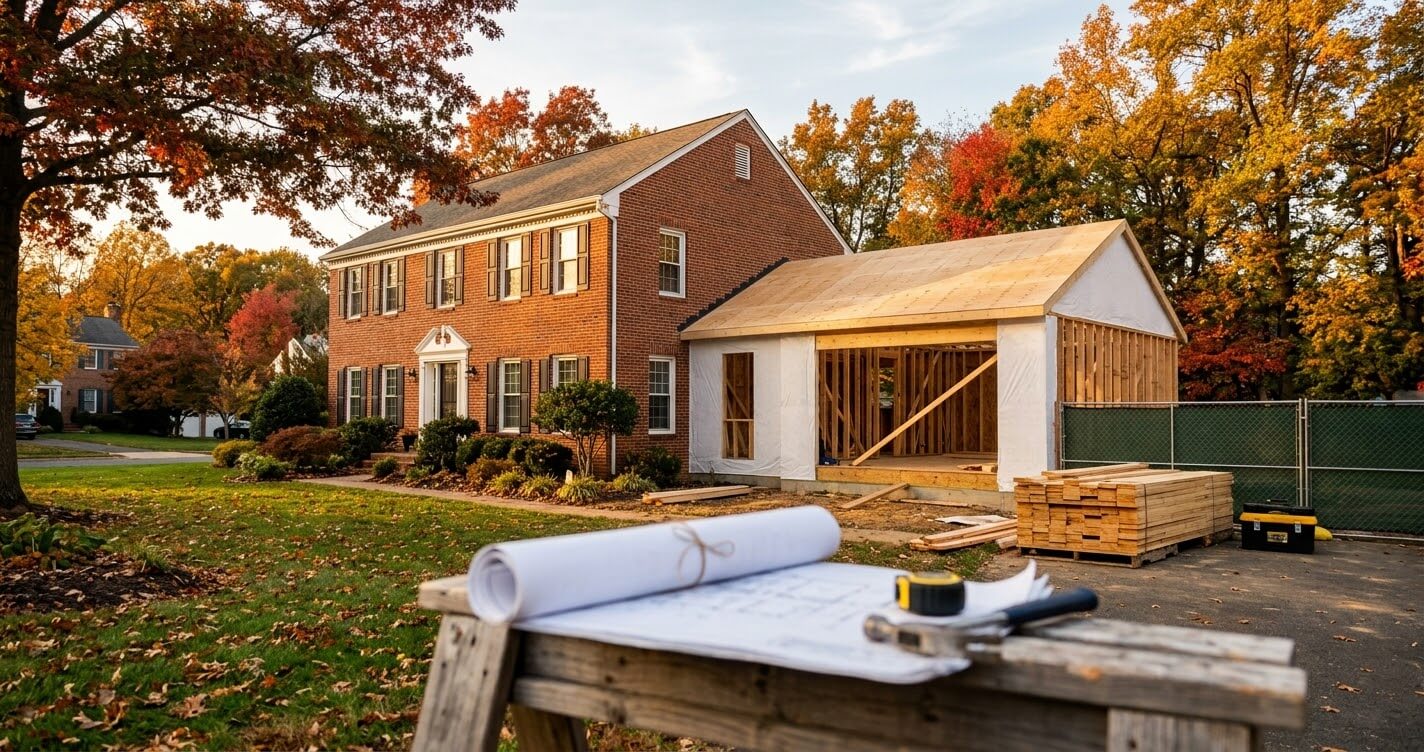
A home addition permit Fairfax County VA homeowners need is rarely a single approval. It is a bundle of reviews that can include building, zoning, site and trade permits.
Fairfax County’s NewsCenter reported that permit applications for popular projects such as decks, screened porches and pools increase every spring, and that higher application volumes increase processing wait times. The county urged residents to file early instead of joining the spring rush. That guidance dates to January 2022, but it remains the county’s own explanation of why timing matters.
Fall is not a magic month. Fairfax County now offers Fast Track review for simple projects, and eligible plans can clear review in as little as one business day. The fall advantage is strongest for larger additions that need design work, a plat and review by several county teams.
Our design-build team at US Home Design Build works from McLean and plans additions for homeowners across Fairfax County, Vienna, Reston, Great Falls, Burke and Clifton. This guide explains what the permit involves, what the county publishes about review times, and how to build a fall-to-spring schedule that protects your start date. For the full scope of what we build, see our home addition services in Northern Virginia.
At a glance
- Most additions need a residential building permit. Electrical, plumbing and mechanical work usually need separate trade permits.
- One-story additions of 500 square feet or less may qualify for Fast Track review in as little as one business day.
- Projects in the Town of Vienna or Town of Clifton need separate town approval.
- Fairfax County is reviewing how residential building height is measured. No public hearings were scheduled as of October 15, 2026.
- Arlington County lists 10 business days for standard addition review and 2 for Express.
Do You Need a Home Addition Permit in Fairfax County VA?
Yes. Almost every home addition in Fairfax County needs a residential building permit from Land Development Services. Electrical, plumbing and mechanical work usually need separate trade permits, and zoning staff review setbacks and height during the process.
Fairfax County treats a project as residential when the building is a detached one- or two-family home or a townhouse of no more than three stories above ground. Apartment buildings and condominiums fall under commercial permits. Most homeowners reading this guide are in the residential group.
In the county’s online system, PLUS, you choose a type of work. Options include one-story additions on a slab, crawl space or basement, second-story additions over an existing structure, sunrooms, screened porches, attached garages, and combined additions with interior alterations.
Permits and approvals for a Fairfax County home addition
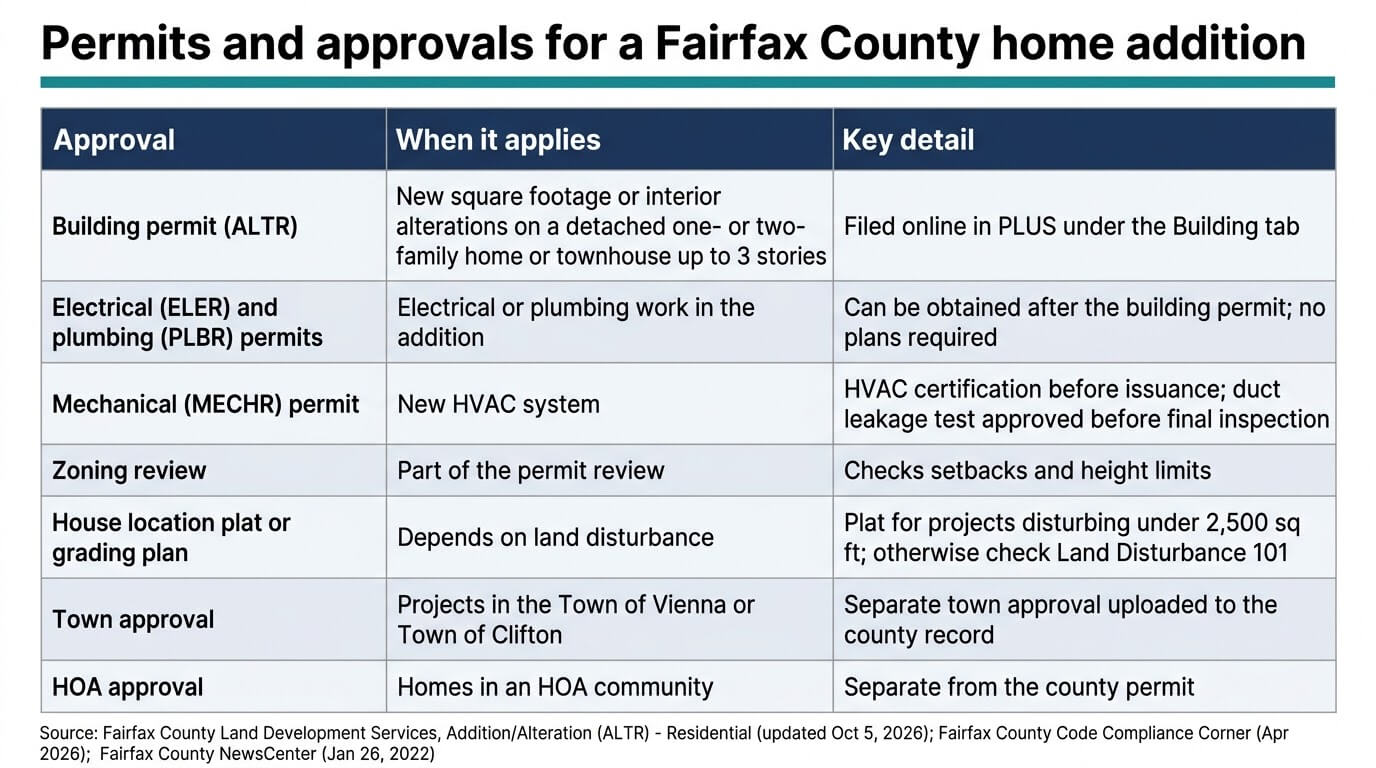
Trade permits follow the main permit. The county says electrical and plumbing permits can be obtained after the building permit is issued, and plans are not required for them. A new HVAC system needs a mechanical permit, a Residential HVAC Certification before issuance, and an approved duct leakage test form before final inspection.
Zoning review is built into the process. Fairfax County explains that the permit process lets it review setbacks, height limits and other Zoning Ordinance provisions. A design that ignores those limits will not clear review.
Two local layers catch homeowners off guard. First, projects in the Town of Vienna or Town of Clifton need separate approval from the town, uploaded to the county record. Second, HOA review is separate from the county permit. Our guide to home addition HOA approval in Reston VA explains how an architectural review board works alongside county approval.
If your addition is a bedroom, our bedroom addition permit in Fairfax County VA guide covers the bedroom-specific details, including trade permits.
What Documents Does a Fairfax County Home Addition Permit Require?
A complete home addition permit Fairfax County VA package starts with a county coversheet, architectural and structural drawings, and a house location plat or grading plan record number. Extra forms apply when the applicant is not the owner or no licensed contractor is listed.
Fairfax County Land Development Services lists the first-submission items for residential additions. Which ones apply depends on the scope of your project.
Documents for a Fairfax County residential addition permit
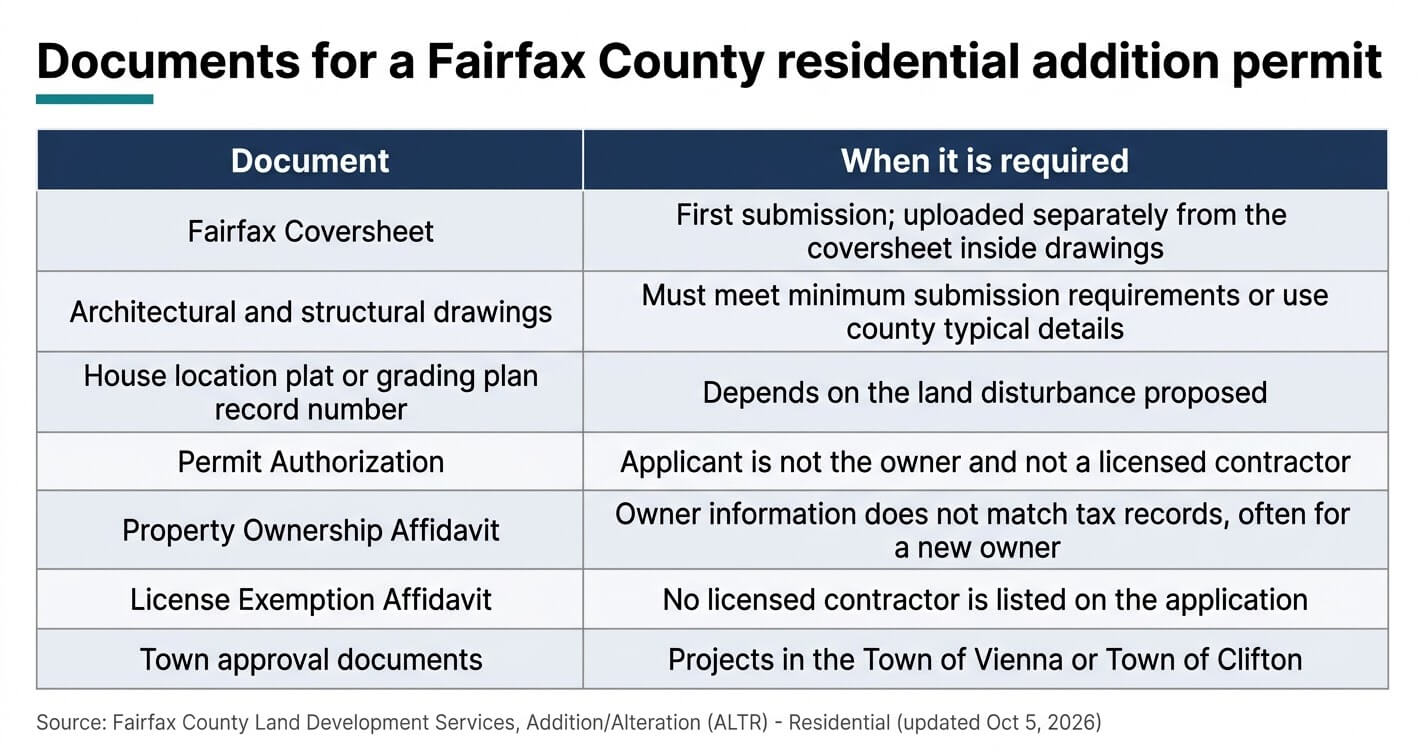
The county also tells applicants to check site factors before submitting. Those include zoning, design codes, whether a registered design professional is needed, floodplains, Resource Protection Areas, grading, parking tabulation and soils. Drawings should meet the county’s minimum submission requirements or use county typical details.
The plat is the item homeowners most often underestimate. Fairfax County asks for a house location plat during the building permit process for projects that disturb less than 2,500 square feet of land. The county also publishes guidance on submitting plats correctly. If your project may disturb more land, read Land Disturbance 101 guidance before you design.
Expect corrections. Reviewers post comments as “Issues,” and the applicant must respond to each open issue and pay any resubmission fees before resubmitting. The county publishes common residential plan comments so you can fix typical problems before you file.
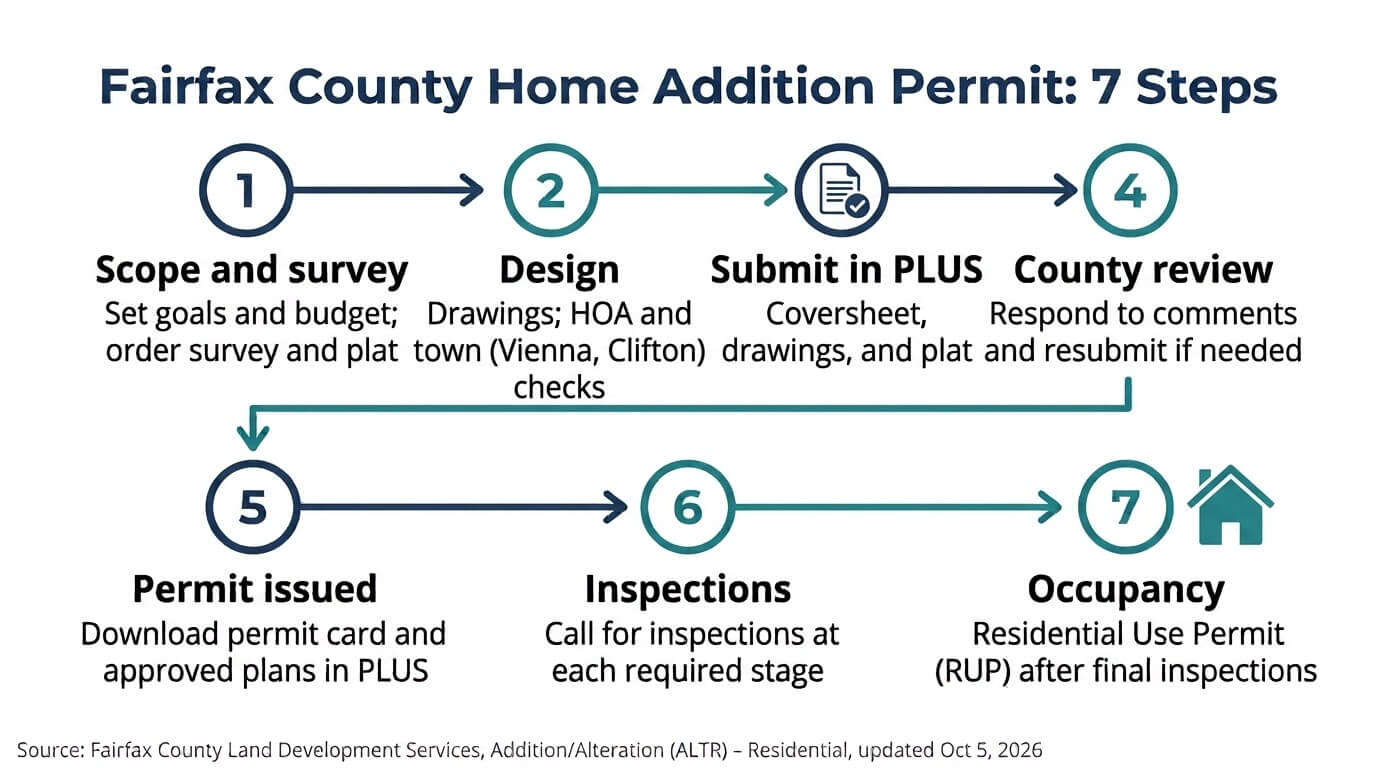
Our practical advice: order the survey early. The plat and accurate site data drive setbacks, lot coverage and drainage choices. A late survey delays every step that follows.
How Long Does a Home Addition Permit Take in Fairfax County?
Review time depends on the project. Eligible simple additions can clear Fast Track review in as little as one business day, while larger additions go through standard review by several county teams. Check Fairfax County’s live queue times before you set a start date.
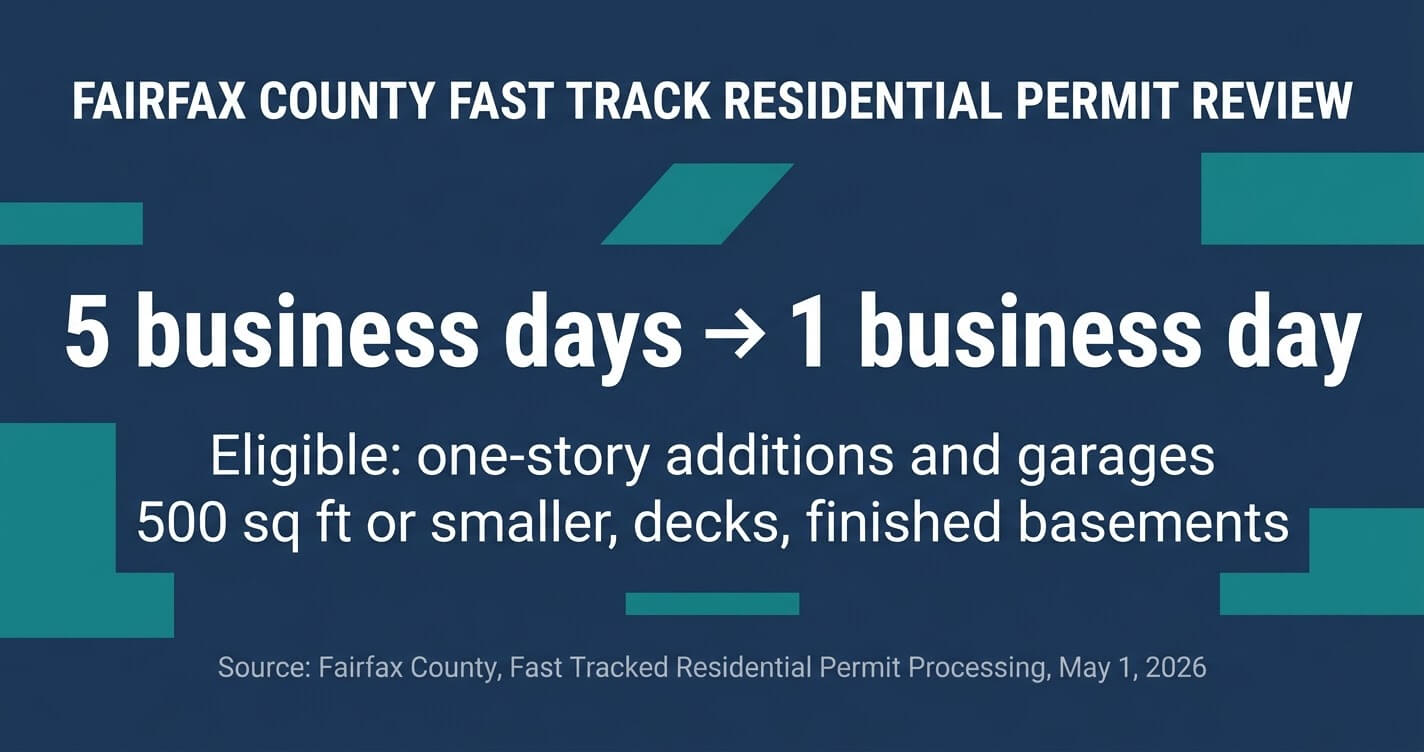
Fairfax County cut residential Fast Track plan review from five business days to one, according to its May 1, 2026 announcement. The program serves construction-ready plans that are not overly complex, and the county reviews submissions in the order received.
Fairfax County Fast Track eligibility (review in as little as 1 business day, down from 5)
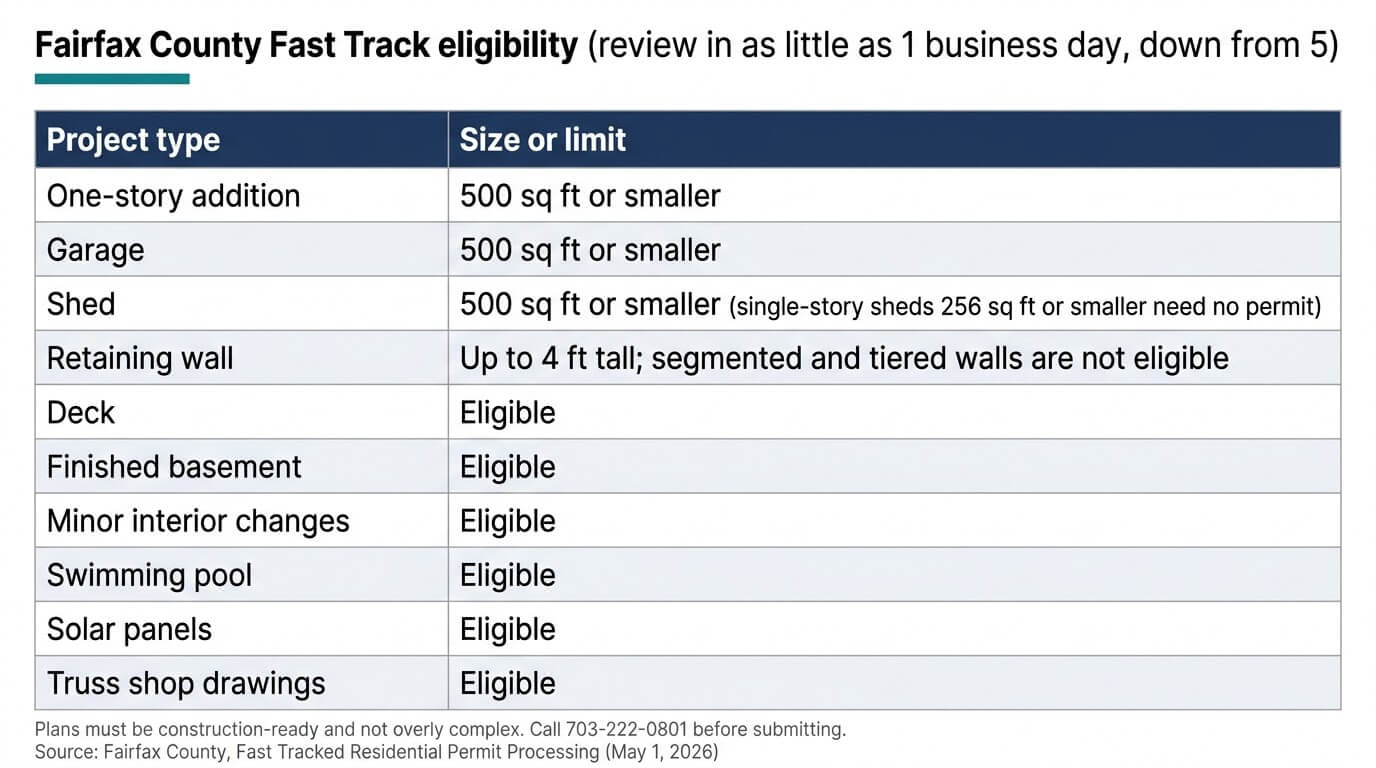
The county advises residents to call 703-222-0801 or email LDSBuildingPermits@fairfaxcounty.gov before submitting to confirm that a project qualifies.
Larger additions follow standard review. The county says staff from the Permit Application Center, Building Plan Review, Site Technician Review, Fire Marshal’s Office, Wastewater and Zoning may review a package, plus the Health Department if the home uses well or septic.
Fairfax County teams that may review a home addition permit
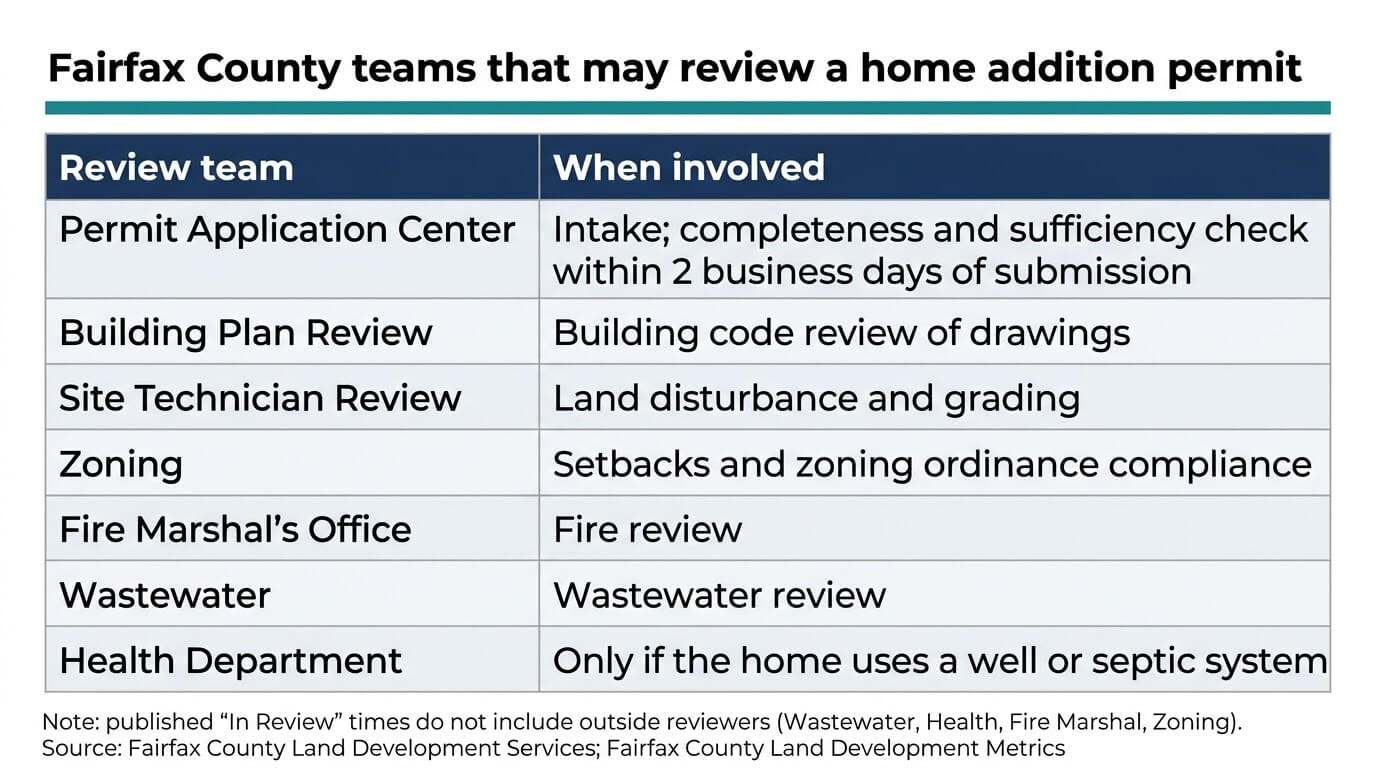
Fairfax County publishes queue times. One detail matters. The county notes that its “In Review” figures show only how long building reviewers take. They do not include outside reviewers such as Wastewater, Health, Fire Marshal and Zoning. Each application also gets a completeness and sufficiency check within two business days of submission.
Read the published numbers as a best case, not a promise. Build a buffer for comments and resubmission.
Why Is Fall a Smart Time to Start Your Home Addition Permit?
Fall is a smart time to start because Fairfax County says permit applications rise every spring and longer waits follow. Starting between October and December gives larger additions time for design, survey, plat and approval steps before the spring rush.
Fairfax County has said that permit applications increase every spring and that higher volumes lengthen processing waits. A home addition permit Fairfax County VA applicants file in fall avoids that busiest stretch.
Fall also gives larger projects room to prepare. Survey work, plat preparation, drawings, HOA review and any town approval can take weeks. Starting in October lets you submit in December and be ready when spring construction calendars tend to fill.
Fast Track changes the math for small projects. A one-story addition of 500 square feet or less may qualify for review in as little as one business day. If your project is that simple, fall is still a good time to plan, but the urgency is lower.
Do not file too early. A permit that sits unused may lapse or need an extension. Ask Fairfax County Land Development Services how long an issued permit stays valid before you file for a project that will not start for months. The office is reachable at 703-222-0801.
Winter does not stop permitting. Applications and reviews run online in PLUS, so design and approvals continue through the cold months, and construction can start when site conditions allow.
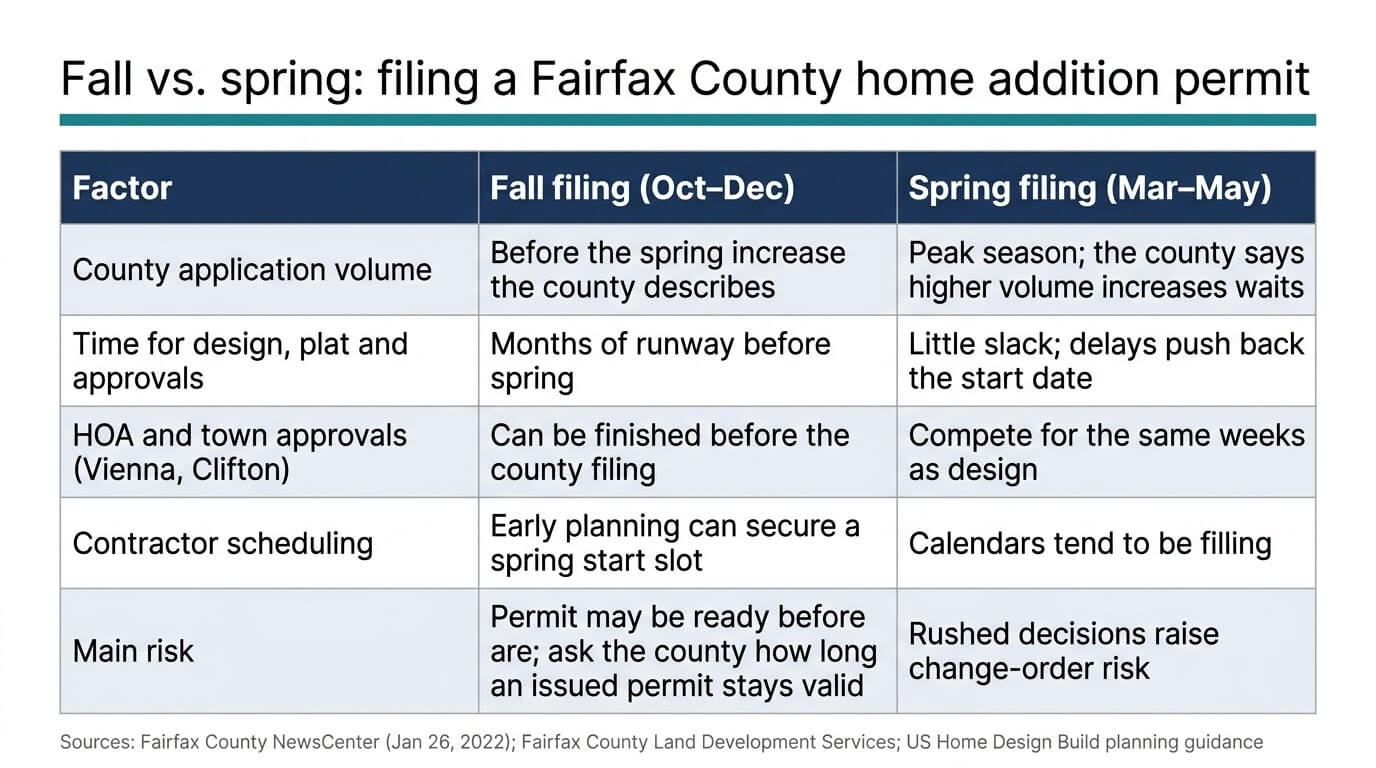
Fall vs. spring: filing a Fairfax County home addition permit
Homeowners considering a larger addition may benefit from discussing their options with an experienced design-build team before finalizing budgets or timelines.
What Fairfax County Rule Changes Could Affect Taller Additions?
Fairfax County is reviewing how building height is measured for detached homes, and the change is still only proposed. As of the county page’s October 15, 2026 update, no public hearings were scheduled.
Fairfax County’s Department of Planning and Development lists a proposed Zoning Ordinance amendment that revises the definition of building height and related provisions for detached residential dwellings. Upcoming committee meetings are listed for November 24 and December 3, 2026.
The county’s March 10, 2026 white paper discusses the existing 35-foot residential height limit and potential changes for consideration.
Local coverage in late 2025 showed why the topic is active. NBC Washington reported that a three-story addition drew neighbor complaints, that supervisors sponsored a resolution asking planners to re-examine height rules, and that the county cited a side-yard setback violation and ordered construction to stop.
Fairfax County residential building height amendment tracker
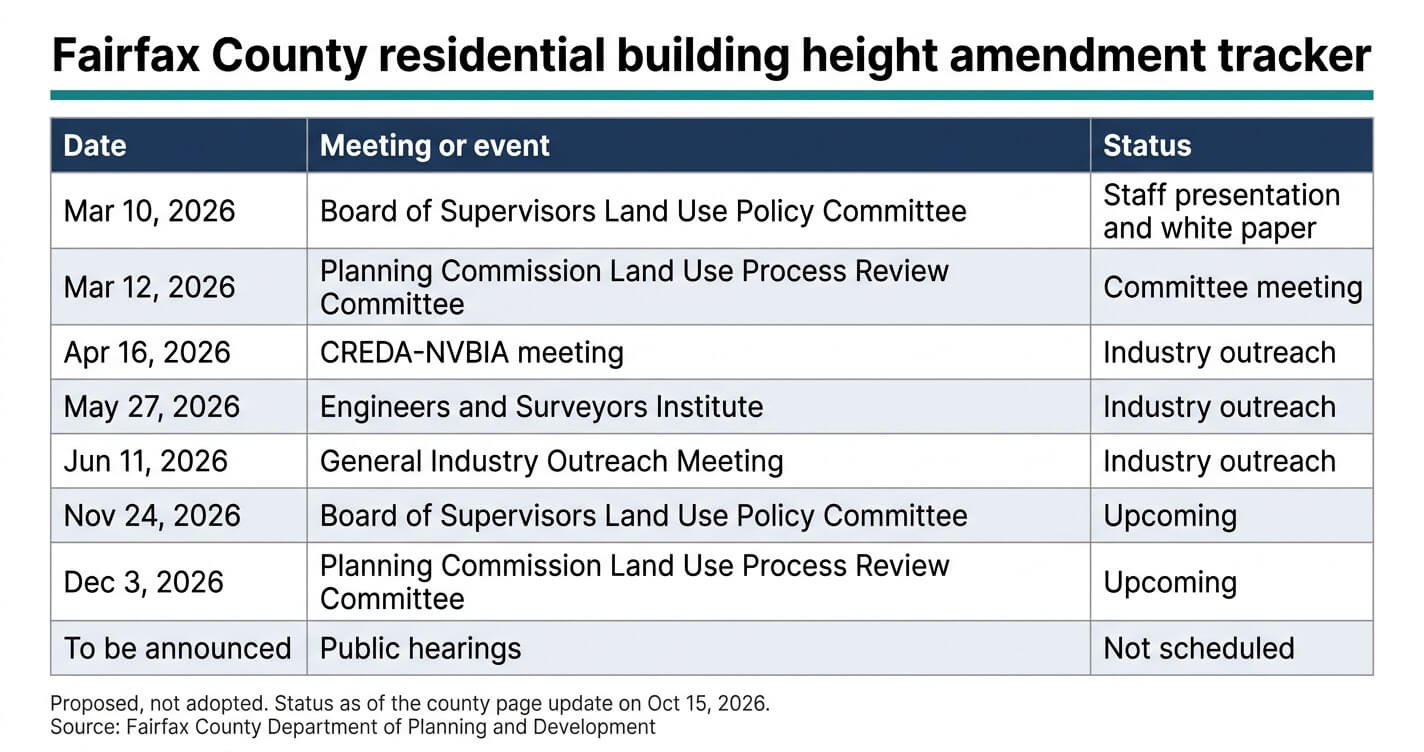
No change has been adopted. Do not design around rumors. Ask the county how any adopted amendment would apply to an application already filed, and design with margin under current limits. If you are planning a taller project, review our second story addition contractors in Northern Virginia page for how we approach structure, rooflines and permits on upper-level additions.
How Do Fairfax County Permits Compare With Arlington County?
Arlington County lists about 10 business days for a standard addition review and 2 business days for Express addition review. Fairfax County uses a different system, so confirm which jurisdiction your lot is in before you plan.
Arlington County lists approximate review times of 10 business days for Residential Addition Route Through and 2 business days for Residential Addition Express. Alterations run 5 business days on Route Through and 2 on Express. Review times begin after a permit is processed and fees are paid.
Fairfax County vs. Arlington County: residential permit paths
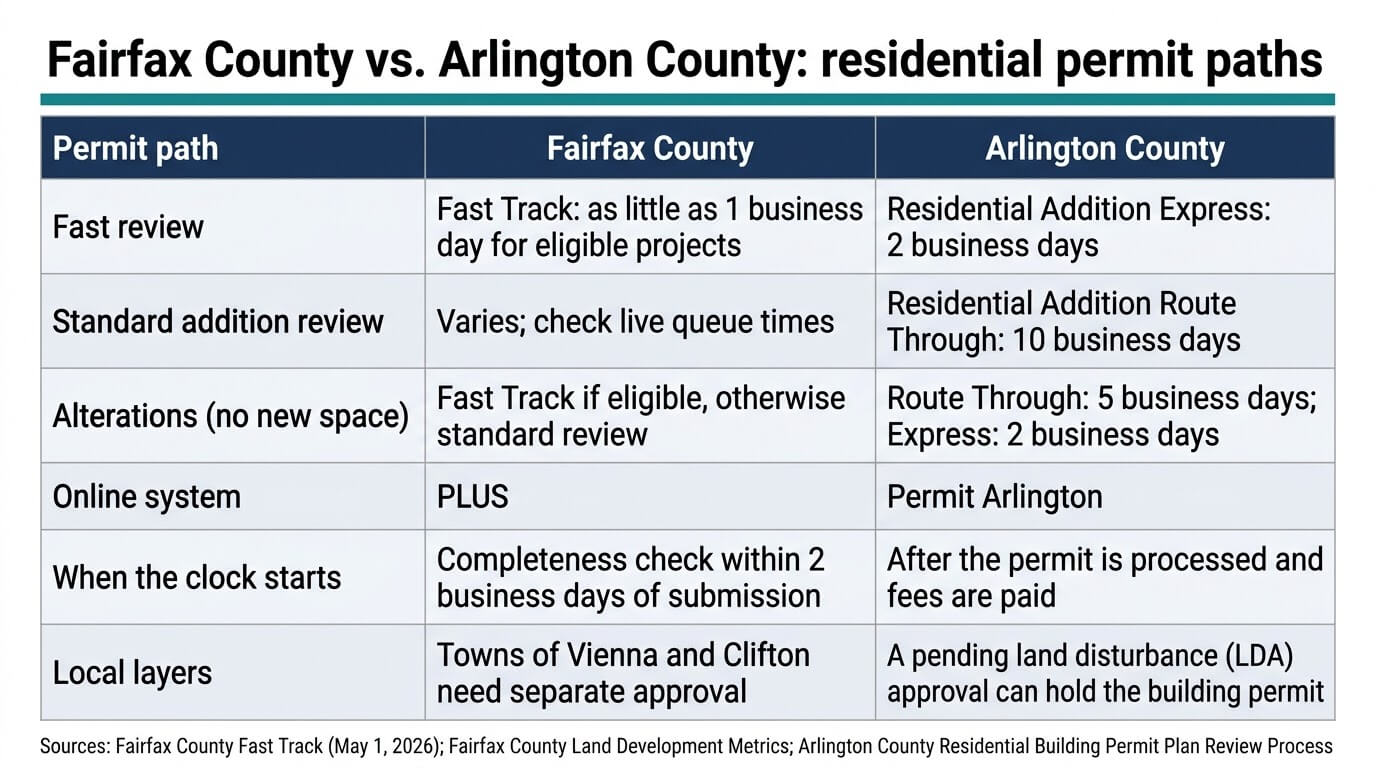
Fairfax County and Arlington County are separate permitting jurisdictions. The City of Fairfax and Falls Church are independent cities with their own offices, so a Fairfax mailing address does not guarantee Fairfax County jurisdiction. Check your jurisdiction first.
Arlington also lists a land disturbing activity (LDA) approval that can hold a building permit until it clears. Fairfax County has its own site layers, covered in Land Disturbance 101.
What Does a Fall-to-Spring Home Addition Timeline Look Like?
A fall-to-spring home addition timeline usually runs from scoping in October to permit issuance in late winter and construction in spring. Actual durations vary with design complexity, survey needs, HOA review and county comments.
For a home addition permit Fairfax County VA applicants should plan backward from the construction start date. The table shows an illustrative sequence based on the county process described above.
Fall-to-spring home addition planning timeline (illustrative)
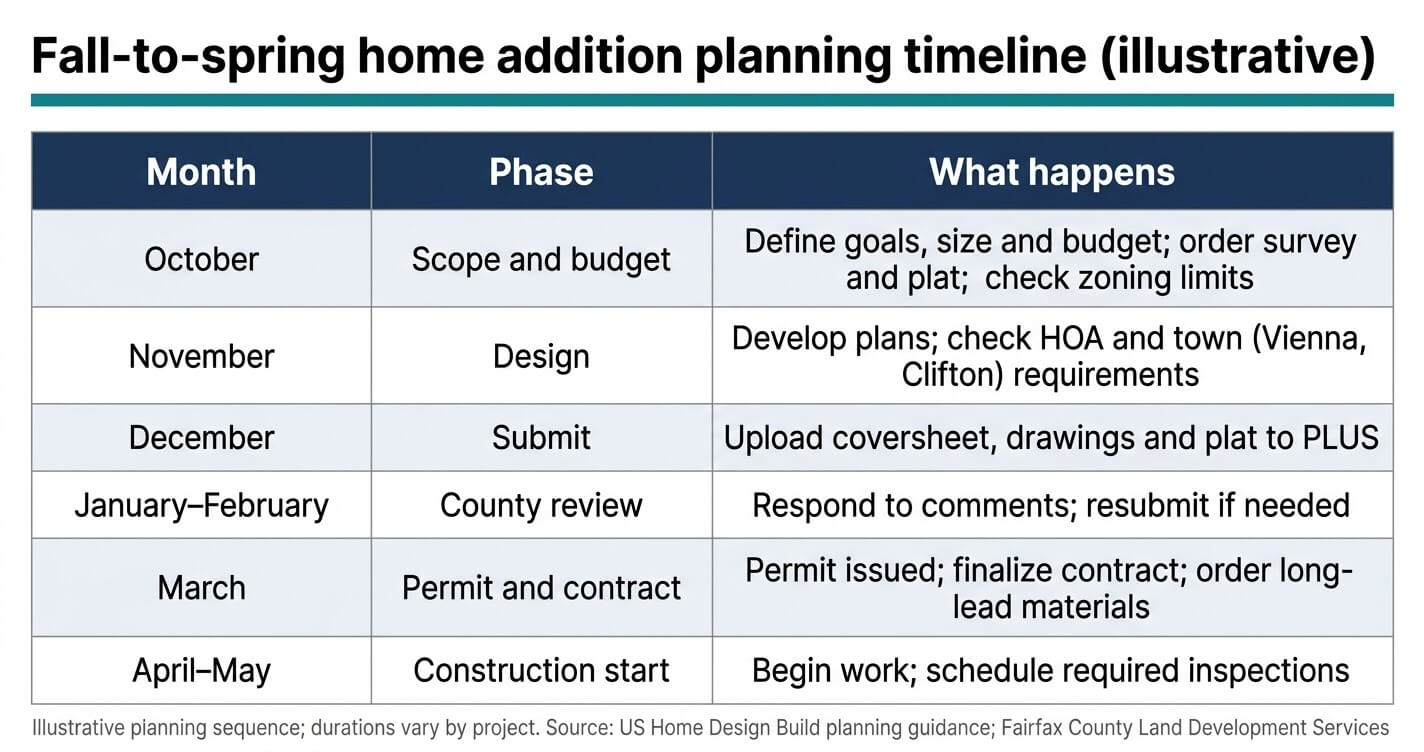
October is for decisions: size, budget and survey. November is for design and approvals outside the county. December is for a complete first submission. January and February are for review and corrections. March is for contract and material orders.
Our home remodel timeline in Northern Virginia guide explains how long projects run once construction begins. If your addition is a primary suite, see our master suite additions page.
How Much Should You Budget Around Your Home Addition Permit?
Permit planning affects budget because redesigns, resubmission fees and delayed starts add cost. Use $150 to $350 per square foot as a starting range for a ground-floor addition in Fairfax County, and expect second-story work to run higher.
Fairfax County reported that the mean assessment for all homes in 2026 is $829,895, and that residential assessments rose 3.99% on average countywide. At that value, an addition is a practical alternative to moving. It also raises the cost of planning errors.
The Harvard Joint Center for Housing Studies projects that U.S. homeowner spending on improvements and maintenance will reach about $518 billion by the end of 2026, with growth slowing through the year.
Budget ranges to plan around a Fairfax County home addition permit
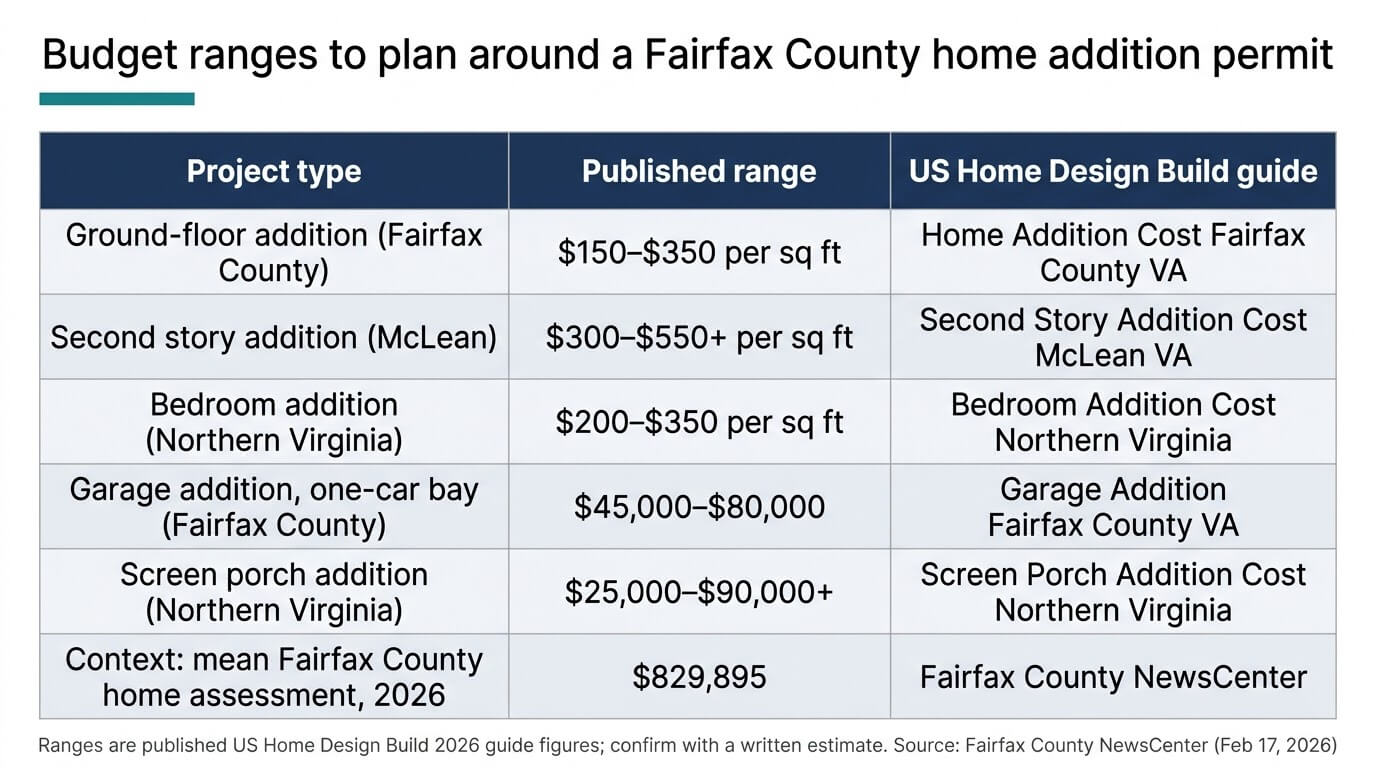
Permit fees are set by the county. Check the published schedule for your project here. Resubmission fees apply when corrections are required. Set aside a contingency for design changes after review comments.
Our guide to home addition cost in Fairfax County VA breaks down the factors behind these ranges. Treat every range as a starting point and request a written estimate.
What Permit Mistakes Delay Home Additions in Northern Virginia?
The most common home addition permit Fairfax County VA delays come from incomplete plats, missed town or HOA approvals, and design that ignores setbacks or height. Each mistake is avoidable with early zoning checks and a complete first submission.
Home addition permit mistakes and how to avoid them
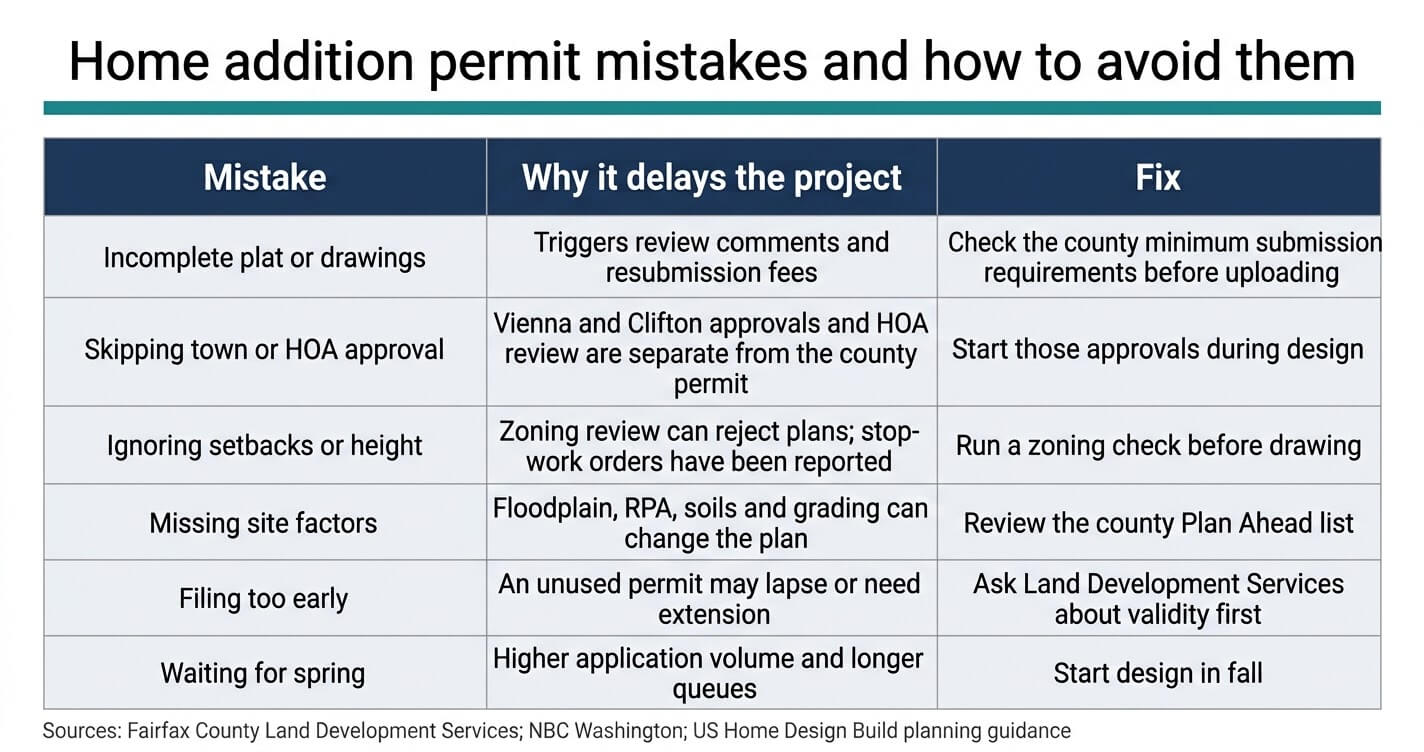
Incomplete submissions cause the most avoidable delay. Review the county’s common residential plan comments before you upload.
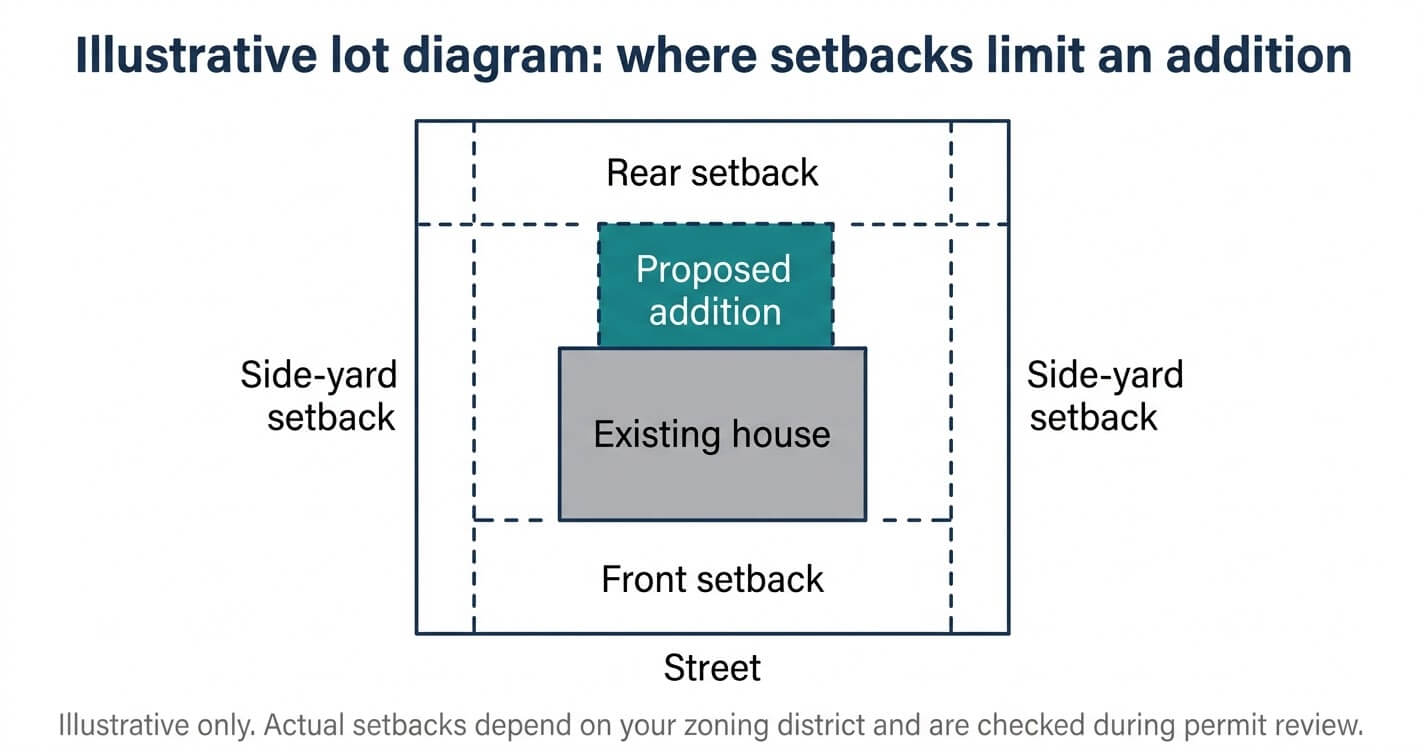
Setback errors can stop work. The NBC Washington report described a county stop-work order tied to a side-yard setback violation on a large addition. Verify setbacks before you finalize drawings.
Local approvals are easy to miss. Vienna and Clifton projects need town approval, and HOA communities need their own review.
How Does a Design-Build Team Manage the Permit Process?
A design-build team reduces permit risk by keeping design, engineering and construction under one contract. The plans that go to Fairfax County are drawn with buildability, setbacks and inspection stages in mind.
At US Home Design Build, the permit package is part of the design process, not an afterthought. Our design-build team coordinates the survey and plat, prepares drawings that meet county submission requirements, files in PLUS, answers review comments and schedules inspections.
Fairfax County allows owners to obtain permits in their own name. It strongly recommends that a properly licensed contractor pull the permit so the county can better assist in gaining compliance for defective work. You can verify a license with the Virginia Department of Professional and Occupational Regulation, and the county offers tips for hiring a contractor.
To see how this works in a real project, read our home addition before and after case study in McLean VA, which covers a 960-square-foot, two-level family room and primary suite addition.
Design-build is not required for every homeowner. It suits projects where design choices, permits and construction need one point of accountability. If you prefer to hire separately, ask each professional who will own the permit package.
Frequently Asked Questions
Do I need a permit for a home addition in Fairfax County?
Yes. Almost every home addition in Fairfax County needs a residential building permit, plus separate trade permits for electrical, plumbing or mechanical work. Zoning limits are reviewed during the process. The county’s permit-required page lists what does and does not need a permit. Single-story sheds of 256 square feet or smaller do not need one.
How long does it take to get a home addition permit in Fairfax County?
It depends on the project. Eligible simple additions can clear Fast Track review in as little as one business day, while larger additions go through standard review and take longer. Check current queue times here. Each application gets a completeness check within two business days. Build in time for comments and resubmission.
How much does a home addition permit cost in Fairfax County?
Is fall a good time to apply for a home addition permit in Fairfax County?
Yes. A home addition permit Fairfax County VA applicants file in fall avoids the spring surge the county describes, and it gives larger projects time for design, plat and approvals. The county says applications rise every spring and longer waits follow. Simple projects may qualify for Fast Track review, so the benefit is smaller for them.
What documents do I need to apply for a home addition permit in Fairfax County?
You typically need a county coversheet, architectural and structural drawings, and a house location plat or grading plan record number. Depending on your situation, you may also need a Permit Authorization, Property Ownership Affidavit, License Exemption Affidavit or town approval documents.
Can a homeowner pull their own home addition permit in Fairfax County?
Yes. Property owners may obtain permits in their own name, but Fairfax County strongly recommends that a properly licensed contractor pull the permit. The county says this helps it assist in gaining compliance for defective work. Verify any contractor’s license through Virginia DPOR License Lookup.
Do Vienna and Clifton homeowners need a separate approval for a home addition?
Yes. Projects in the Town of Vienna or Town of Clifton need separate approval from the town, in addition to the county process. The county asks applicants to upload the town approval documentation to the permit record.
Are Fairfax County rules for taller home additions changing in 2026?
Possibly, but nothing has been adopted. Fairfax County is reviewing a proposed amendment on how building height is measured for detached homes, and public hearings had not been scheduled as of October 15, 2026. Ask the county how any change would apply to pending applications.
Start Your Home Addition Permit Planning This Fall
A home addition permit Fairfax County VA homeowners file in fall can avoid the spring surge, and it gives your design, plat and approvals time to come together. Confirm whether your project qualifies for Fast Track, check Vienna, Clifton and HOA requirements, and ask the county about permit validity before you file. Then build a schedule that works backward from your construction start date.
Planning a home addition in Fairfax County? Contact US Home Design Build to discuss your goals, budget, and timeline with our team. Call (703) 202-3520 or visit our office at 8200 Greensboro Dr Suite 900, McLean, VA 22102.
