
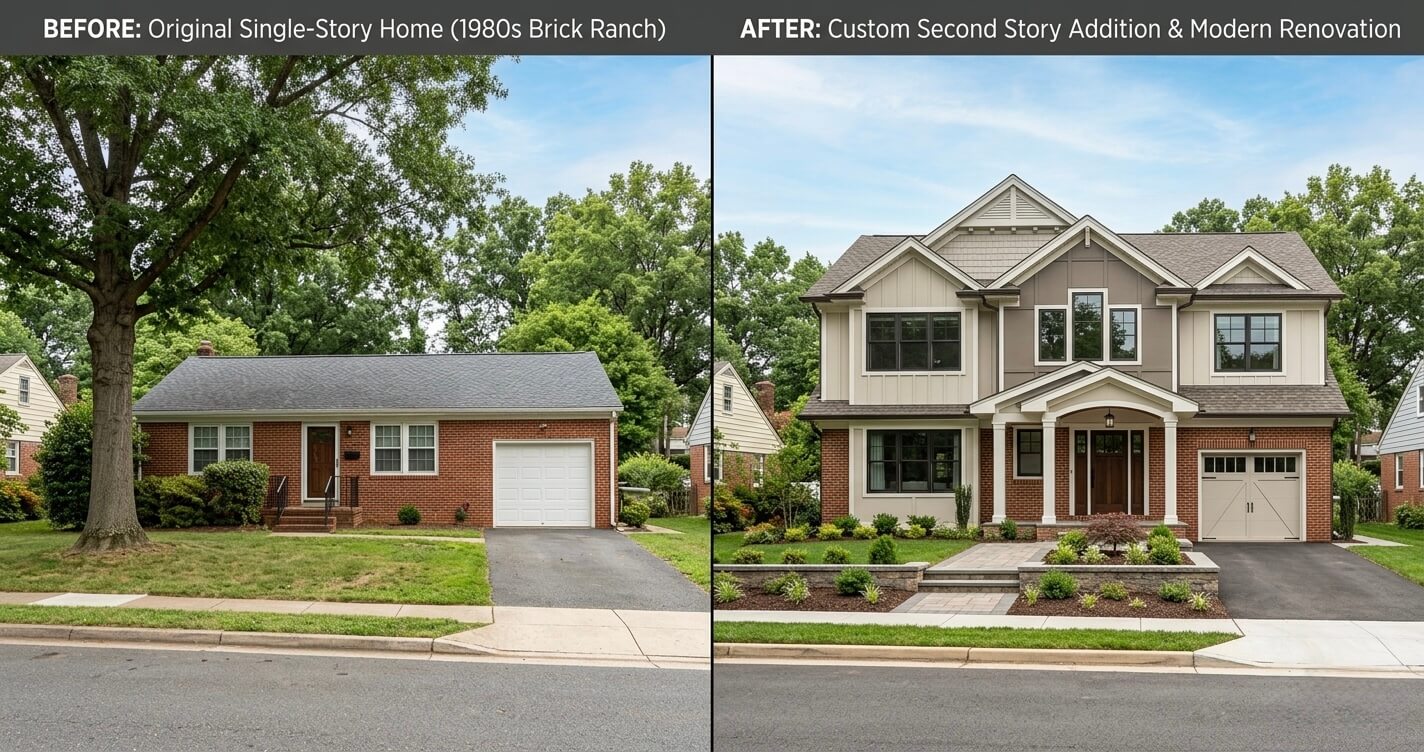
A second story addition mistakes Northern Virginia homeowners make often begin long before construction starts, at the planning stage, where assumptions about cost, structure, and permitting can quietly compound into major risks. A second story addition in this market is one of the most effective ways to expand livable space without sacrificing valuable lot area, but it is also one of the most structurally complex residential projects a homeowner can undertake.
Northern Virginia’s housing conditions reinforce this trend. Limited inventory, escalating land values, and the premium attached to established neighborhoods are pushing homeowners to build upward rather than relocate. In high-demand areas like Fairfax County, this strategy is supported by strong property values.
“In Fairfax County, the median home value exceeds $650,000, with many Northern Virginia submarkets significantly higher.” [Source: U.S. Census Bureau — QuickFacts]
The critical distinction is this: a second story addition is not a cosmetic remodel; it is a structural reconstruction that involves load calculations, zoning compliance, and coordinated multi-trade permitting. This guide breaks down the seven most common mistakes and how to avoid them when planning a second story addition in Northern Virginia.
WHY SECOND STORY ADDITIONS ARE INCREASING IN NORTHERN VIRGINIA
Second story additions are becoming increasingly common across Northern Virginia due to a combination of financial pressure and spatial constraints. Rising home values have elevated the cost of replacement housing, while limited inventory in established neighborhoods makes relocation both competitive and disruptive. As a result, many homeowners are choosing to reinvest in their existing properties rather than enter the current housing market.
This shift is further reinforced by interest rate dynamics.
“With higher mortgage rates compared to historic lows, many homeowners are choosing to renovate rather than relocate due to the cost of replacing an existing low-rate mortgage.” [Source: Freddie Mac — Mortgage Market Insights]
From a planning standpoint, building upward offers several strategic advantages. It preserves existing lot coverage, an important constraint in jurisdictions with strict zoning controls, and allows homeowners to remain within preferred school districts and neighborhoods. In contrast, horizontal additions are often limited by setback requirements and lot coverage ratios, particularly in mature suburban communities.
Structurally, a second story addition transforms the entire home envelope, enabling full reconfiguration of upper-level layouts while maintaining the footprint below. For a deeper breakdown of structural considerations, costs, and planning strategy, see our guide on Second Story Addition in Northern Virginia.
MISTAKE #1: UNDERSTIMATING STRUCTURAL REQUIREMENTS
The most consequential mistake in any second story addition is assuming the existing structure can support the added load without significant reinforcement. In Northern Virginia, many homes built between the 1960s and 1990s were designed for single-story or limited-load configurations, meaning their foundations, load-bearing walls, and framing systems were not engineered for vertical expansion.
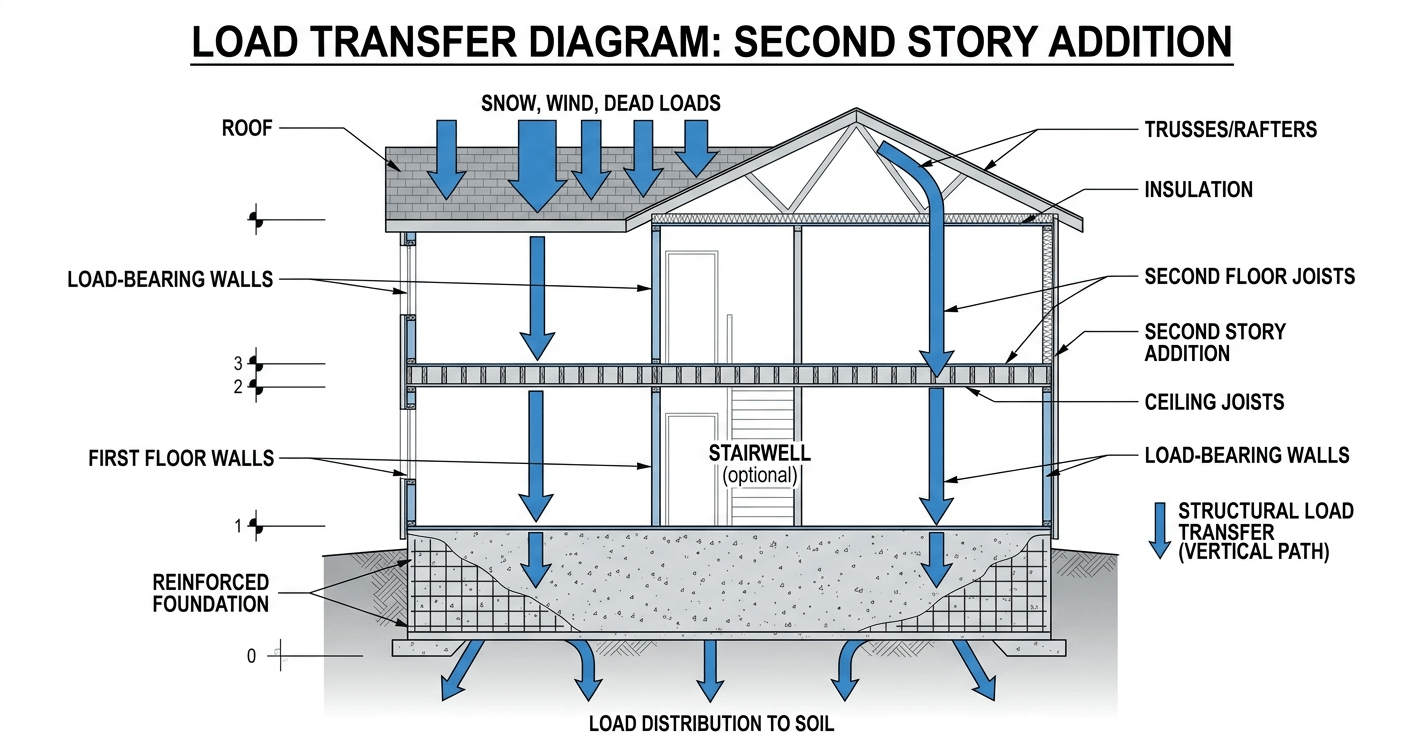
From an engineering perspective, a second story addition introduces new dead loads (materials) and live loads (occupancy) that must be transferred safely through the structure to the foundation. This often requires foundation underpinning, installation of new load-bearing beams, reinforcement of joists, and in some cases, partial structural rebuilds of the first floor.
Regulatory compliance reinforces this requirement.
“Virginia requires structural systems to comply with the Uniform Statewide Building Code (USBC), including load-bearing capacity and structural integrity.” [Source: Virginia Department of Housing and Community Development]
Failing to properly assess structural capacity before construction begins can result in serious consequences: foundation settlement, structural deflection, failed inspections, and expensive mid-project redesigns. In practice, a structural engineer’s evaluation is not optional; it is the baseline requirement that determines whether the project is feasible at all.
MISTAKE #2: IGNORING ZONING & HEIGHT RESTRICTIONS
One of the most common, and preventable, errors in a second story addition project is beginning design work before confirming zoning compliance. In Northern Virginia, zoning is not a formality; it is the framework that defines what can legally be built on a property. Every second story addition must conform to a combination of height limits, floor-area ratio (FAR), and setback requirements that vary by jurisdiction and neighborhood.
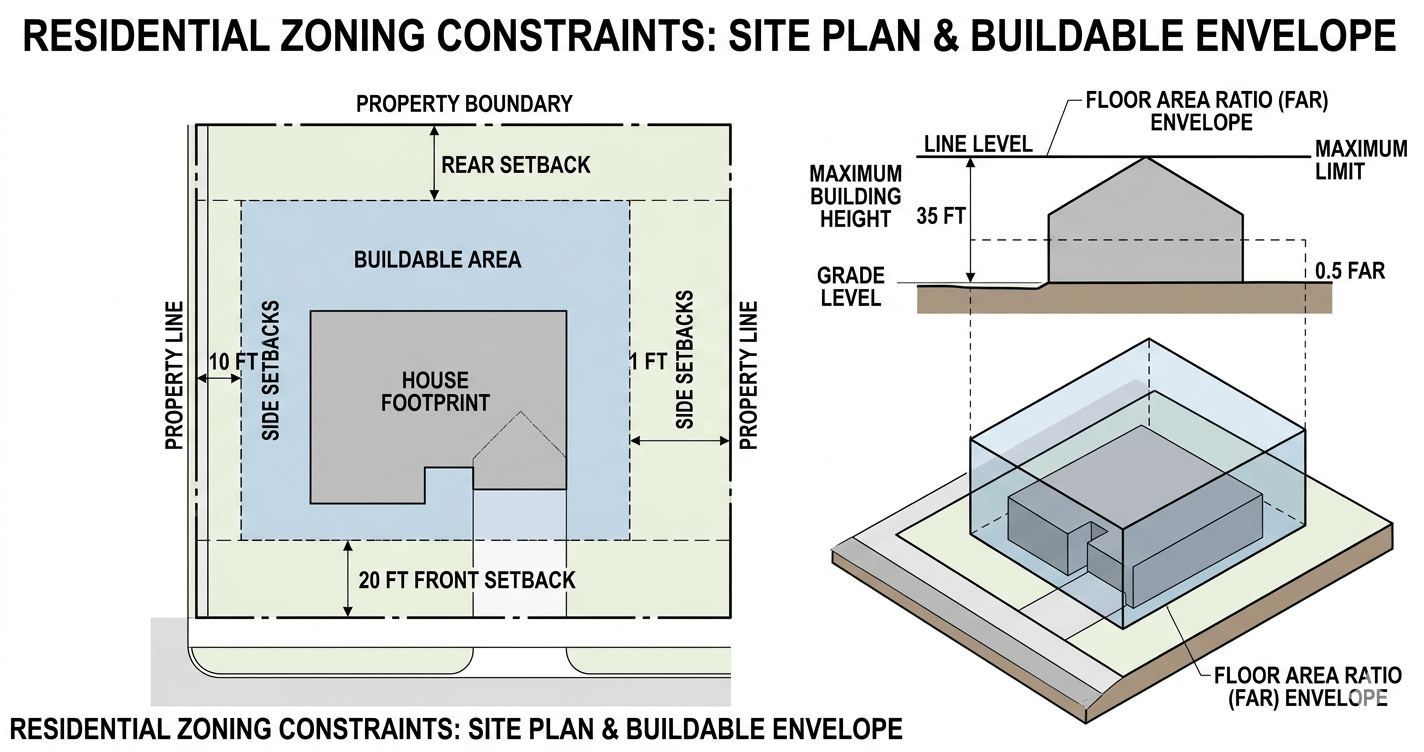
Height restrictions directly determine whether a second level can be added without exceeding maximum building elevation. FAR limits control the total allowable square footage relative to lot size, often restricting how much additional space can be built even when vertical expansion is structurally feasible. Setbacks further constrain where expansions can occur, particularly for homes on narrower or irregular lots.
These limitations are explicitly enforced at the county level.
“Zoning regulations in Northern Virginia jurisdictions strictly control building height, setbacks, and lot coverage, all of which apply to second story additions.” [Source: Fairfax County Zoning Ordinance]
Failing to validate these constraints before design can trigger a cascade of issues: rejected permit applications, costly redesigns, and extended project timelines. In practice, zoning verification should be the first step in feasibility, not an afterthought once drawings are complete.
MISTAKE #3: POOR PERMIT PLANNING
Treating permits as a procedural checkbox rather than a defined project phase is a critical mistake that can derail a second story addition before construction even begins. In Northern Virginia, permitting is a multi-layered process that directly affects timeline, sequencing, and compliance across all trades.
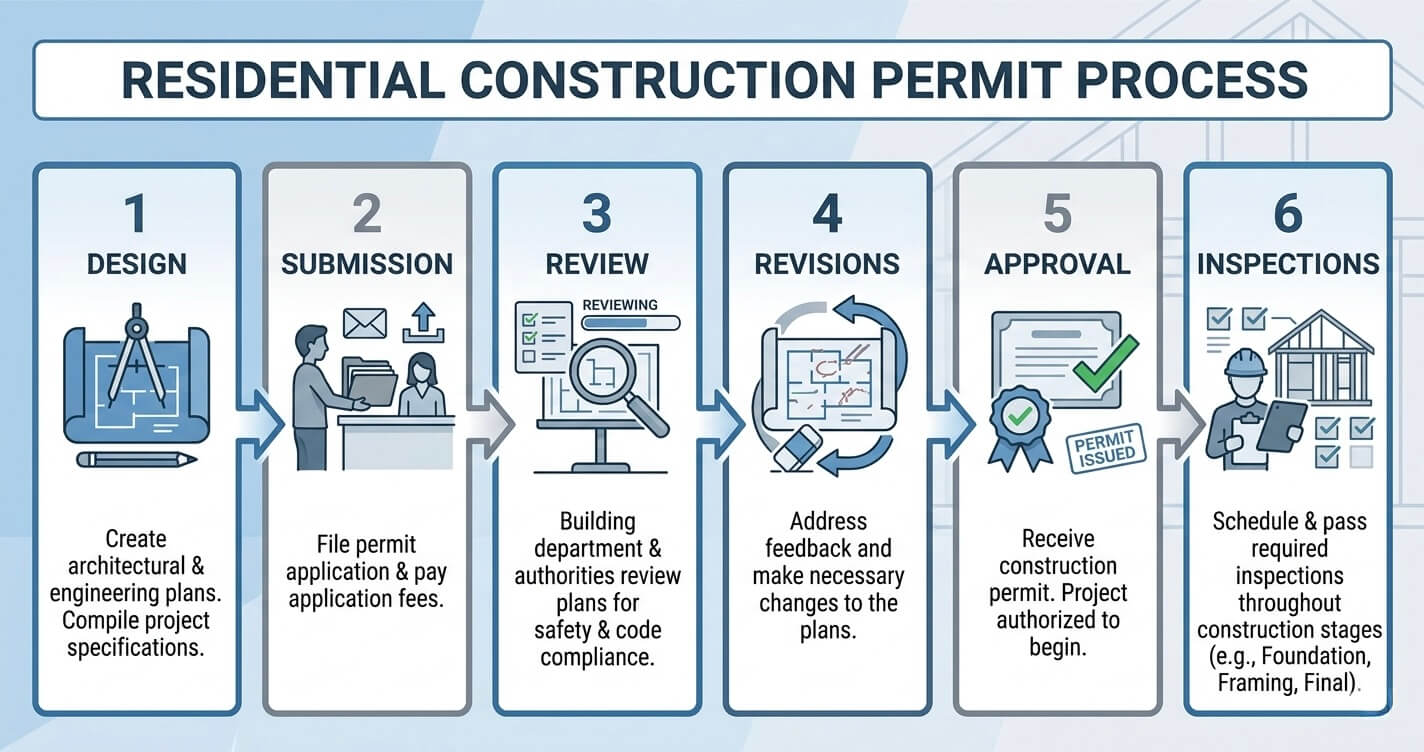
A second story addition typically requires a coordinated set of approvals, including a building permit for structural work, as well as separate electrical, plumbing, and mechanical permits for system modifications. Each permit involves plan review, inspections, and compliance with the Virginia Uniform Statewide Building Code (USBC). These are not parallel processes that can be improvised; they must be planned, sequenced, and submitted correctly from the outset.
The regulatory requirement is explicit.
“Fairfax County requires permits for all residential alterations, including structural additions and interior modifications.” [Source: Fairfax County Land Development Services]
When permit planning is neglected, the consequences are immediate and enforceable: stop-work orders issued by inspectors, financial penalties, and in severe cases, mandatory removal of unpermitted construction. Beyond compliance risk, poor permit coordination also creates scheduling inefficiencies, delaying inspections and extending overall project duration.
For a complete breakdown of permit requirements and submission strategy, see our guide on Remodeling Permit Fairfax County.
MISTAKE #4: UNDERBUDGETING THE PROJECT
Underestimating the true cost of a second story addition is one of the most consistent drivers of project stress, delays, and scope reduction. Many homeowners begin with partial estimates, often based on outdated pricing or incomplete scope definitions, without accounting for the full structural and systems impact of building upward.
Industry data confirms how common this issue is.
“The 2024 U.S. Houzz & Home Study found that 39% of homeowners exceeded their renovation budgets.” [Source: Houzz & Home Study]
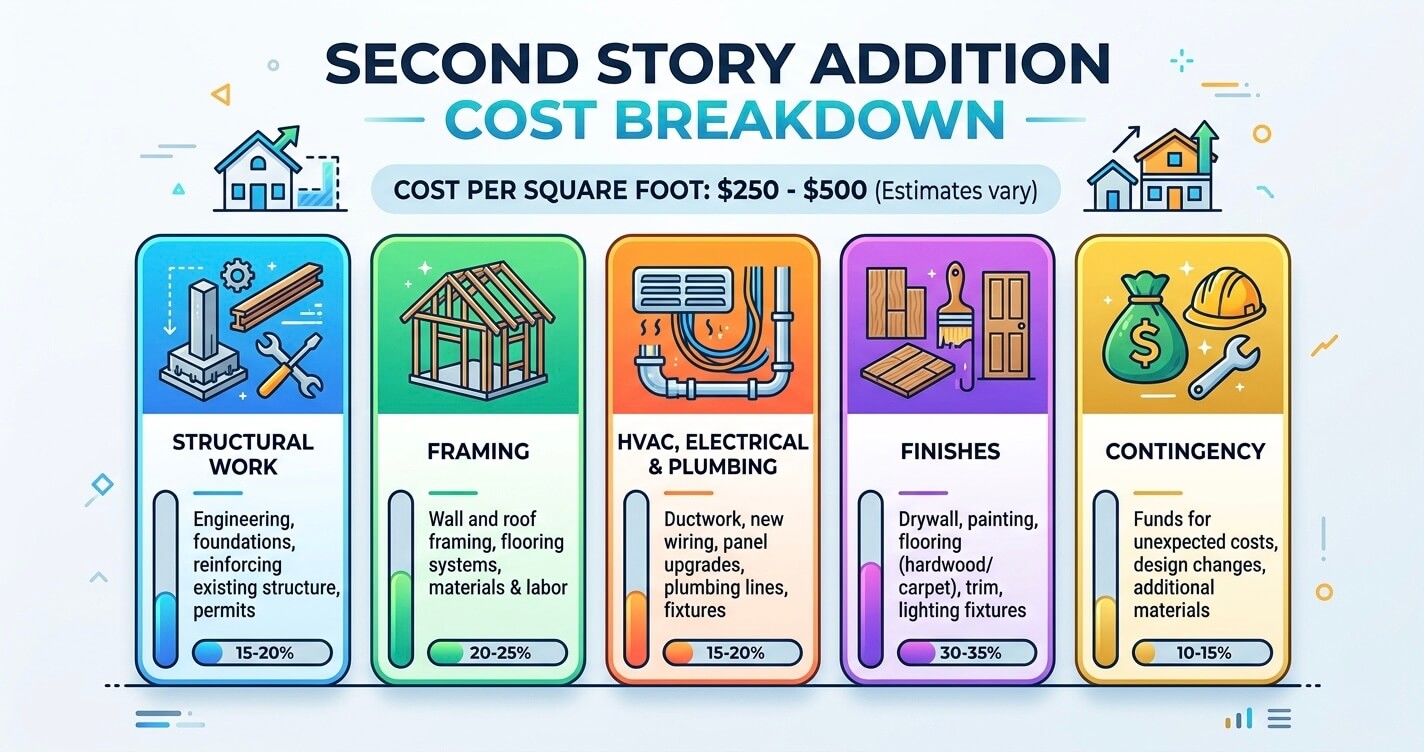
In Northern Virginia, second story additions typically fall within a range of $250 to $500 per square foot, depending on structural complexity, finish level, and system upgrades. However, this base range rarely captures the full financial picture. Structural reinforcement of the existing home, temporary relocation costs during construction, and full-system upgrades, particularly HVAC and electrical, can significantly expand the budget.
A critical oversight is failing to include contingency. Older homes, especially those built between the 1960s and 1990s, often conceal outdated materials, framing inconsistencies, or code deficiencies that only become visible during demolition. The industry standard is to allocate an additional 15–20% contingency to absorb these unknowns.
Without this buffer, even a well-planned project can quickly become financially unstable mid-construction.
MISTAKE #5: NOT UPGRADING HOME SYSTEMS
A second story addition increases not only square footage but also the functional demand placed on a home’s core systems. One of the most critical mistakes homeowners make is expanding the structure without proportionally upgrading HVAC, electrical, and plumbing systems to support the added load.
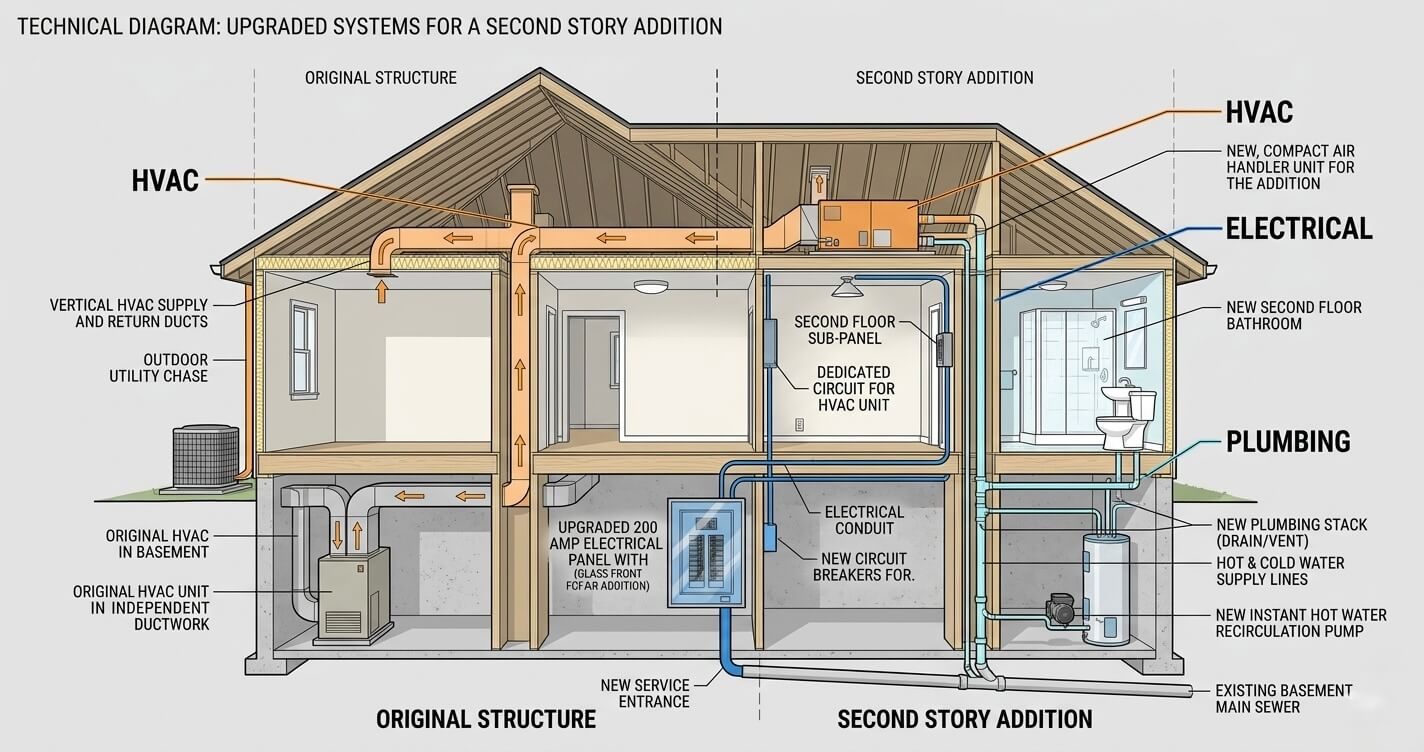
From a technical standpoint, these systems are designed based on capacity thresholds. Electrical panels, for example, are rated to handle a defined amperage load. Adding new bedrooms, bathrooms, lighting circuits, and potentially high-demand appliances can exceed that capacity quickly. Similarly, HVAC systems sized for a single-story home may be unable to efficiently condition a larger, multi-level structure.
This limitation is widely recognized at the federal level.
“Older homes often require electrical panel upgrades to safely support modern energy demands.” [Source: U.S. Department of Energy — Energy Saver]
Ignoring these upgrades introduces multiple risks. System overload can lead to breaker failures, inconsistent heating and cooling, and in extreme cases, fire hazards. From a compliance standpoint, inadequate systems may also fail inspection under current building codes.
In practice, a second story addition should be treated as a full systems recalibration. Upgrading infrastructure during construction is significantly more efficient, and far less expensive, than retrofitting after the addition is complete.
MISTAKE #6: HIRING THE WRONG CONTRACTOR
Selecting a contractor based primarily on price is one of the highest-risk decisions in a second story addition project. Unlike standard remodeling work, these projects require coordinated execution across structural engineering, permitting, and multi-phase construction sequencing, capabilities that not all contractors possess.
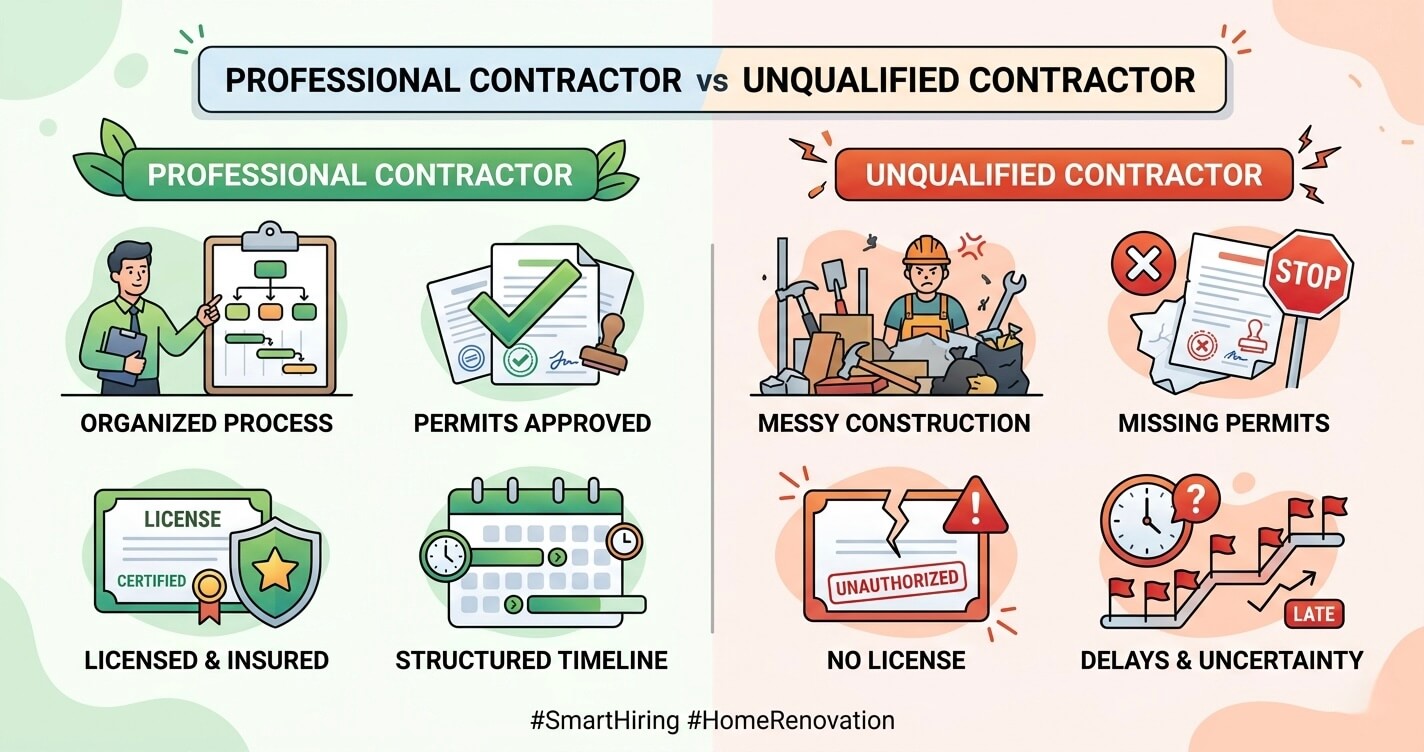
At a minimum, homeowners should verify that the contractor holds a valid Virginia Class A license, carries current general liability and workers’ compensation insurance, and has demonstrable experience with second story additions in Northern Virginia. Local experience is particularly critical, as familiarity with Fairfax County permitting processes and inspection requirements directly affects project efficiency.
The complexity of these projects extends beyond construction itself. A qualified contractor must coordinate structural engineers, manage phased inspections, align trade scheduling, and ensure all work complies with the Virginia Uniform Statewide Building Code. Inadequate experience in any of these areas can result in delays, failed inspections, or costly rework.
Equally important is evaluating past performance. Reviewing completed projects of similar scope and speaking directly with prior clients provides insight that pricing alone cannot reveal.
For a detailed framework on vetting contractors, including required documents, interview questions, and evaluation criteria, see our guide on How to Choose the Right Contractor in Northern Virginia.
MISTAKE #7: IGNORING DESIGN INTEGRATION
A second story addition that fails to integrate visually and architecturally with the existing home can undermine both its aesthetic value and its resale potential. This mistake typically occurs when the addition is designed as a standalone structure rather than as a continuation of the original architectural language.
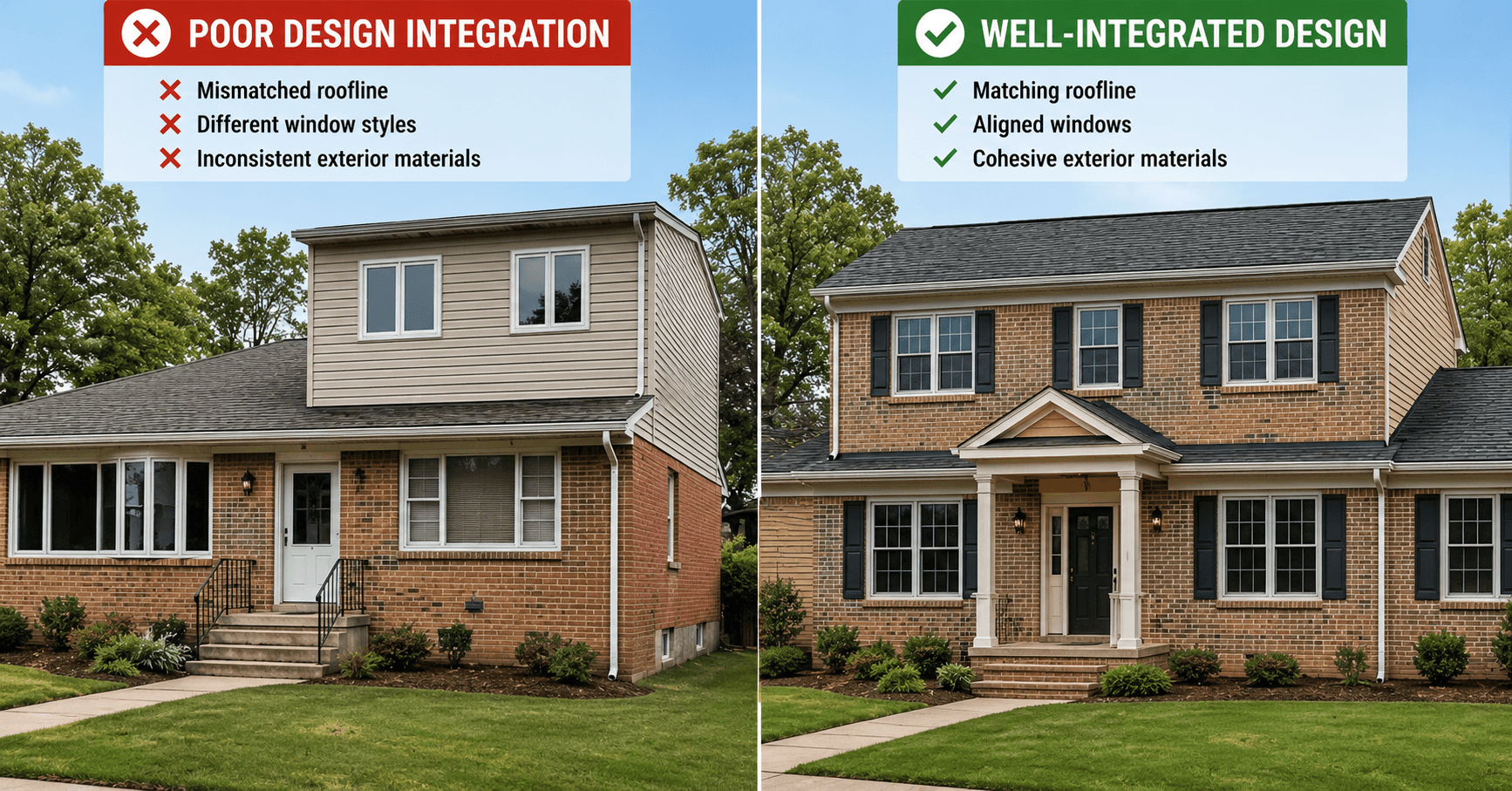
The impact is immediate and measurable. Misaligned rooflines, inconsistent window proportions, and mismatched exterior materials create a visual disconnect that reduces curb appeal and signals poor design execution to prospective buyers. In high-value markets like Northern Virginia, where buyer expectations are elevated, this can directly affect resale value.
Effective design integration requires precise alignment across multiple elements. Roof geometry must transition seamlessly between old and new structures, often requiring full roof reconfiguration rather than partial extension. Window placement should follow existing vertical and horizontal rhythms to maintain façade symmetry. Exterior materials, siding, brick, trim profiles, must either match or be intentionally upgraded across the entire elevation to avoid a “patched-on” appearance.
This principle extends to interior continuity as well, where floor heights, stair transitions, and finish selections must feel cohesive across both levels.
For a real-world example of how thoughtful design integration transforms a space from functional to cohesive, see our Kitchen Remodel Before After Fairfax VA case study, which demonstrates how aligned design decisions elevate both usability and long-term value.
TIMELINE: WHAT TO EXPECT FOR A SECOND STORY ADDITION
A second story addition in Northern Virginia is a multi-phase project that requires coordinated planning across design, permitting, and construction. Setting realistic timeline expectations is essential, as each phase is dependent on approvals, material availability, and inspection scheduling.
The process typically begins with design and engineering, which takes approximately 6 to 10 weeks. This phase includes architectural drawings, structural calculations, and material selections necessary for permit submission. Once completed, the project moves into permitting, which generally requires 4 to 8 weeks depending on project complexity and seasonal workload within Fairfax County.
“Permit processing timelines vary but typically take several weeks depending on project complexity.” [Source: Fairfax County Land Development Service]
Construction represents the longest phase, typically ranging from 6 to 10 months. This includes demolition (if required), structural reinforcement, framing of the new level, system installations, insulation, drywall, and final finishes. Inspections are conducted at multiple stages, requiring precise scheduling to avoid delays.
In total, homeowners should plan for an 8 to 12 month timeline from initial design to final inspection. Projects initiated during peak spring and summer permitting cycles may experience extended approval durations.
FREQUENTLY ASKED QUESTIONS [FAQs]
Q1: How much does a second story addition cost in Northern Virginia?
A second story addition typically costs between $250 and $500 per square foot, depending on structural complexity, system upgrades, and finish level. Projects involving significant reinforcement or premium materials will fall toward the upper end of this range.
Q2: Do I need permits for a second story addition?
Yes, multiple permits are required, including building, electrical, plumbing, and mechanical permits. All structural and system modifications must comply with local building codes.
Q3: How long does a second story addition take?
Most projects take between 8 and 12 months from design through final inspection. This includes design (6–10 weeks), permitting (4–8 weeks), and construction (6–10 months).
Q4: Is a second story addition worth it?
In high-value markets like Northern Virginia, a well-executed second story addition can significantly increase both usable space and property value, while allowing homeowners to remain in established neighborhoods.
CRUX OF THE MATTER
Second story additions are among the most complex residential construction projects, but also among the most strategically valuable when executed correctly. They require structural precision, zoning compliance, disciplined budgeting, and coordinated execution across every phase.
Avoiding the seven mistakes outlined in this guide ensures more than just a successful build; it ensures structural safety, financial control, and long-term property value in one of the most competitive housing markets in the country.
The defining factor is not the square footage added, but how seamlessly that space integrates with the existing home, both structurally and architecturally.
The success of a second story addition is not defined by the space you add, but by how well it integrates with the home you already have.
US Home Design Build works with homeowners across Northern Virginia to plan and execute second story additions that are structurally sound, properly permitted, and built for long-term value. If you’re considering expanding your home upward, start with a consultation before design begins.
703-202-3520 | www.ushdb.com | 8200 Greensboro Dr #900, McLean VA 22102