
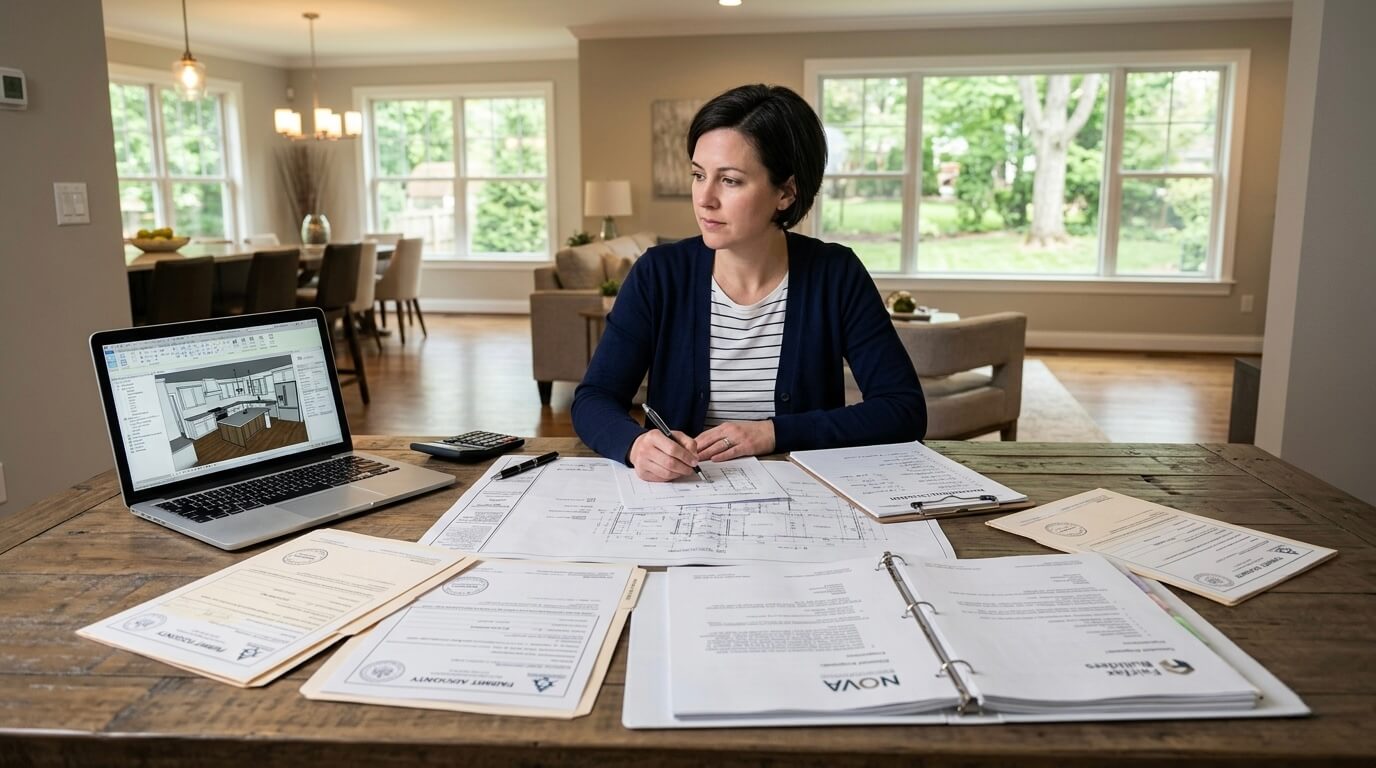
When homeowners research remodeling contractor red flags Northern Virginia, they are often focused on avoiding delays, cost overruns, or poor workmanship. What many discover too late is that contractor selection affects far more than the finished appearance of a project. It influences permitting compliance, inspection outcomes, scheduling accuracy, budget control, warranty protection, and even future resale value.
In Northern Virginia communities such as Fairfax, McLean, Arlington, Vienna, Falls Church, Alexandria, and Tysons, remodeling projects frequently involve structural modifications, electrical upgrades, plumbing relocations, building permits, and compliance with the Virginia Uniform Statewide Building Code. Mistakes made during construction can remain hidden for years before emerging as costly repairs or issues during a future home sale.
The financial stakes are substantial. Major kitchen remodels, home additions, basement renovations, and second-story additions routinely represent investments ranging from tens of thousands to several hundred thousand dollars. A poorly managed project can create change orders, permit violations, failed inspections, or unfinished work that significantly increases overall costs.
Consumer protection agencies continue to warn homeowners about contractor-related fraud and home improvement scams. The Federal Trade Commission reports that consumers lose billions of dollars annually to fraud across multiple industries, including home improvement and repair-related scams. [Source: Federal Trade Commission (FTC) Consumer Advice]
The reality is that successful remodeling projects depend on much more than construction skills. Proper planning, permitting, project management, scheduling, communication, and documentation are often the factors that separate a smooth renovation from an expensive and frustrating experience. This is one reason many Northern Virginia homeowners are increasingly seeking contractors with established design-build systems rather than relying solely on the lowest bidder.
For homeowners researching current renovation demand and market preferences, our guide to Top Remodeling Trends in Northern Virginia provides additional insight into how local remodeling priorities continue to evolve.
RED FLAG #1: THE CONTRACTOR CANNOT VERIFY A VIRGINIA LICENSE
One of the most important warning signs when hiring a remodeling contractor is an inability, or unwillingness, to verify a valid Virginia contractor license.
Virginia requires contractors performing regulated construction work to hold the appropriate license classification through the Virginia Department of Professional and Occupational Regulation (DPOR). Licensing exists to establish minimum standards for experience, financial responsibility, business practices, and regulatory compliance. [Source: Virginia Department of Professional and Occupational Regulation (DPOR)]
If a contractor cannot immediately provide a license number, homeowners should consider that a significant red flag. Even more concerning are situations where a contractor claims to be licensed but cannot verify their status through DPOR’s public license lookup system.
Licensing matters because it provides accountability. An active contractor license demonstrates that the business operates within Virginia’s regulatory framework. An expired, suspended, or revoked license may indicate unresolved compliance issues, disciplinary actions, or administrative failures that could expose homeowners to unnecessary risk.
Homeowners should never assume a license is valid simply because it appears on a business card, website, vehicle, or proposal. Verification should always be performed independently.
Virginia Contractor Verification Checklist
- Verify the contractor’s license number
- Verify the license classification matches the project scope
- Verify the license status is active and in good standing
- Confirm the business name matches the licensed entity
- Review any disciplinary actions listed through DPOR
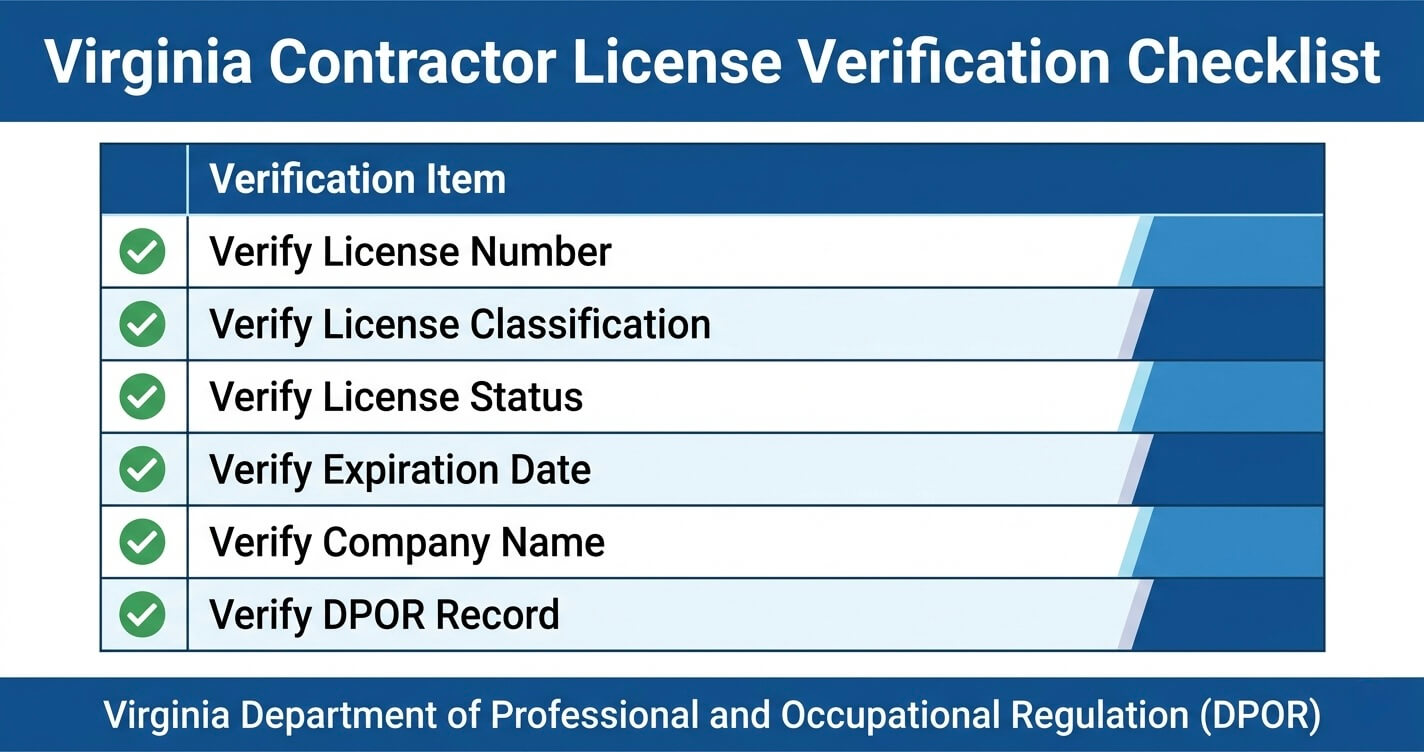
A reputable contractor should welcome these questions. In fact, professional contractors often encourage homeowners to verify their credentials because transparency builds trust. If a contractor becomes defensive when asked about licensing, that response itself may be a warning sign.
For major remodeling projects throughout Northern Virginia, contractor verification should always be one of the first steps completed before discussing budgets, timelines, or construction schedules.
RED FLAG #2: THEY WANT TO START WITHOUT PERMITS
Few warning signs are more dangerous than hearing a contractor say:
“You don’t need a permit.”
While some minor cosmetic work may not require permitting, structural modifications, electrical upgrades, plumbing work, additions, and many major remodeling projects generally require permits and inspections under local building regulations. [Source: Fairfax County Land Development Services]
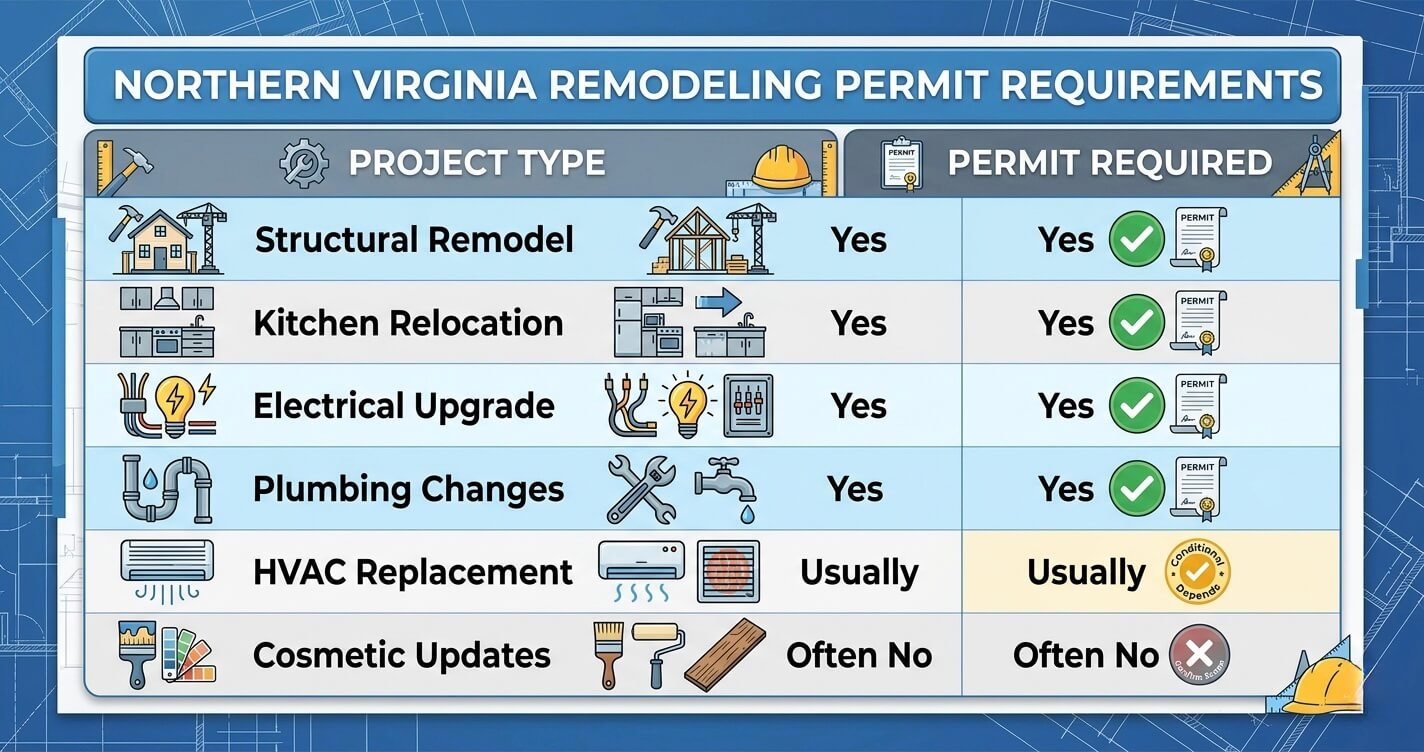
Permit requirements exist to protect homeowners by ensuring construction work complies with safety standards, structural requirements, and applicable building codes. Skipping permits may save time initially, but it often creates significant legal, financial, and resale risks later.
In Northern Virginia jurisdictions such as Fairfax County and Arlington County, permit reviewers and inspectors evaluate work involving framing, foundations, electrical systems, plumbing systems, HVAC equipment, structural modifications, and life-safety requirements.
A contractor who encourages permit avoidance may be attempting to:
- Reduce project oversight
- Avoid inspections
- Conceal code deficiencies
- Accelerate construction without proper review
- Submit artificially low project pricing
The liability ultimately falls on the homeowner, not the contractor. Unpermitted work can create problems during property sales, insurance claims, refinancing transactions, and future renovations. Buyers and inspectors frequently identify permit discrepancies during due diligence, potentially delaying or jeopardizing a transaction.
For example, homeowners adding bathrooms, relocating kitchens, building additions, converting basements, or undertaking major structural renovations in Fairfax County should expect permit requirements to be part of the normal construction process.
For a detailed breakdown of permit requirements, inspections, and common project types that require approval, see our guide to Remodeling Permit Fairfax County.
A trustworthy contractor explains permits clearly, includes permit costs transparently in proposals, and coordinates inspections as part of a documented project management process. A contractor who wants to bypass permits is often signaling a much larger problem than simply paperwork.
RED FLAG #3: THE PRICE IS SIGNIFICANTLY LOWER THAN EVERY OTHER BID
Every homeowner wants to save money on a remodeling project. However, one of the most common, and expensive, mistakes is selecting a contractor solely because they submitted the lowest proposal.
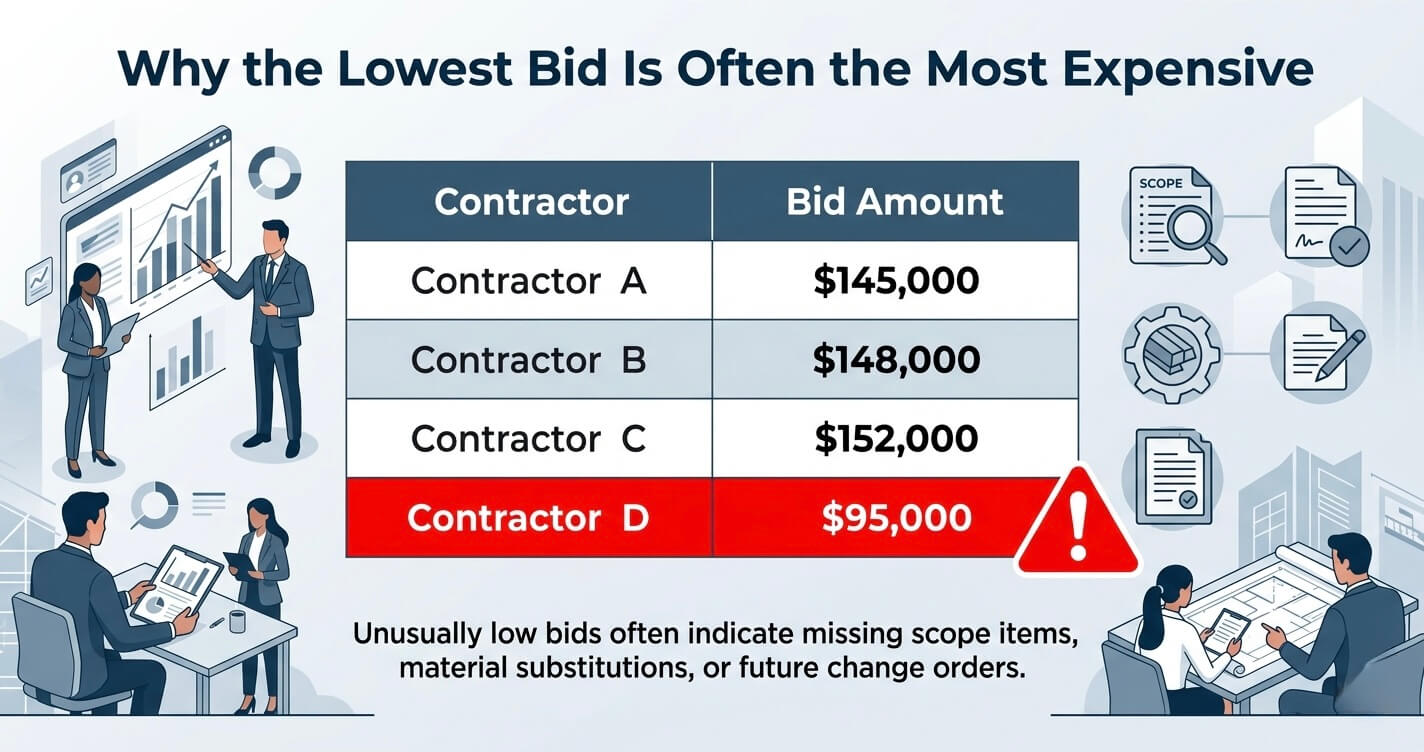
If three contractors submit bids of $145,000, $152,000, and $148,000, while a fourth submits a proposal for $95,000, the difference is rarely the result of superior efficiency. More often, it indicates missing scope items, underestimated labor costs, material substitutions, inadequate project management, or a strategy designed to generate future change orders.
Construction costs are heavily influenced by labor availability, material pricing, transportation costs, subcontractor rates, and regional market conditions. Because most legitimate contractors operate within the same economic environment, accurate bids for the same project tend to cluster within a relatively narrow range. [Source: U.S. Bureau of Labor Statistics]
A dramatically lower bid often signals one or more of the following:
- Missing permit costs
- Incomplete labor estimates
- Low-quality material allowances
- Excluded demolition or disposal costs
- Unqualified subcontractors
- Aggressive change-order strategies after construction begins
Many homeowners discover the true cost only after work has started and the contractor begins requesting additional payments for items that should have been included from the beginning.
Price should always be evaluated alongside scope, licensing, insurance, experience, project management systems, and warranty coverage. The goal is not to find the cheapest contractor; it is to identify the contractor offering the best value for the required scope of work.
For homeowners comparing remodeling budgets, our guide to Home Addition Cost in Northern Virginia provides additional context on realistic construction pricing throughout the region.
RED FLAG #4: THERE IS NO DETAILED WRITTEN SCOPE OF WORK
One of the strongest predictors of future project disputes is a vague or incomplete scope of work.
Many homeowners focus heavily on the final price while paying little attention to what is actually included in the proposal. Unfortunately, every remodeling contract is ultimately defined by its scope, not its price.
A poorly written proposal might simply state:
Kitchen Remodel — $48,000
At first glance, this appears straightforward. In reality, it leaves dozens of critical questions unanswered. Does the price include permits? Are appliances included? What type of cabinets are specified? Who is responsible for electrical upgrades, painting, debris removal, inspections, or final cleanup?
By contrast, a professional scope document clearly identifies materials, responsibilities, timelines, and project deliverables.
Good Scope vs. Bad Scope
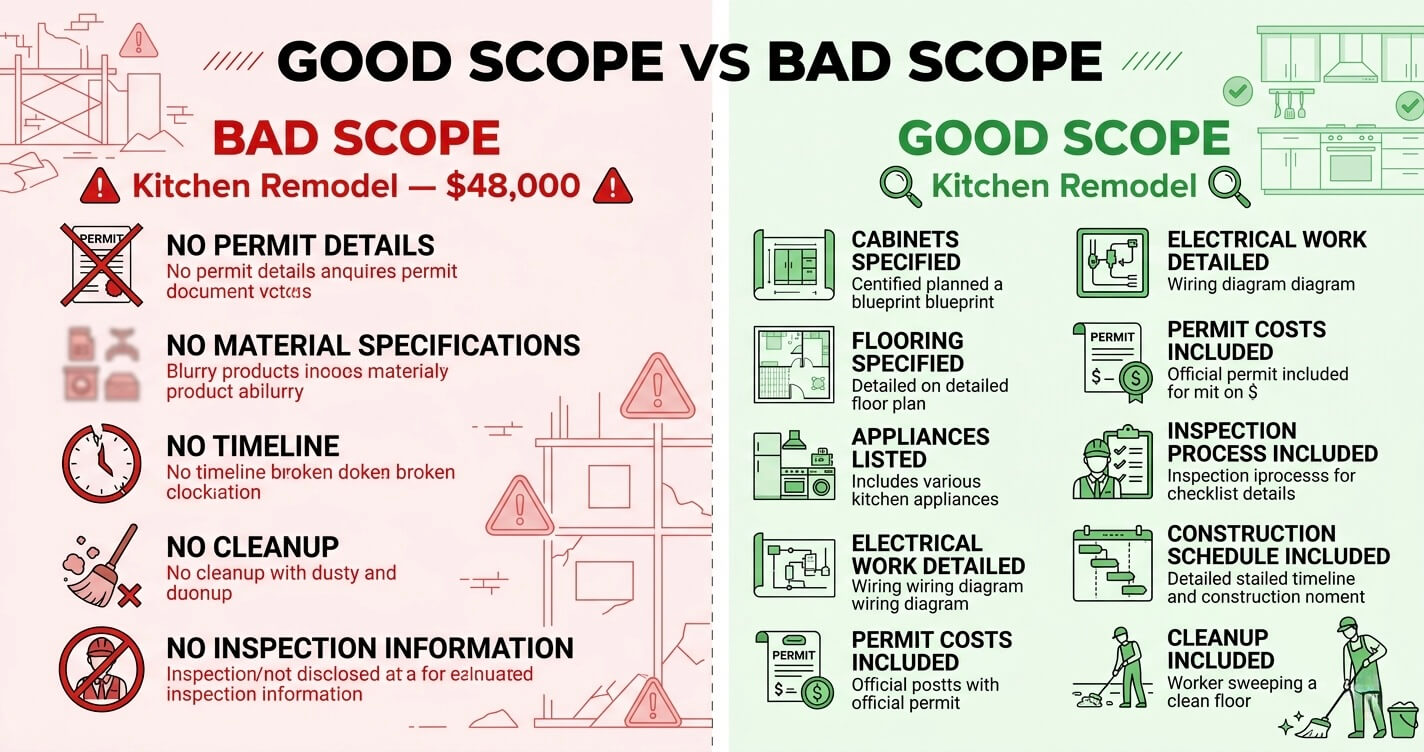
The more detailed the scope, the fewer assumptions exist. Assumptions are where misunderstandings, delays, change orders, and budget disputes originate.
A comprehensive remodeling proposal should identify:
- Materials and product specifications
- Permit responsibilities
- Construction schedule
- Payment milestones
- Inspection requirements
- Cleanup responsibilities
- Warranty coverage
Simply put, every construction dispute begins where the written scope ends.
RED FLAG #5: NO INSURANCE OR INADEQUATE COVERAGE
A contractor may have impressive photos, strong marketing, and a competitive price, but none of those protect a homeowner if something goes wrong on the job site.
Proper insurance coverage is one of the most important safeguards in residential construction. Contractors performing remodeling work in Northern Virginia should maintain appropriate insurance policies to protect both their business and their clients.
At a minimum, homeowners should verify:
- General liability insurance
- Workers’ compensation coverage (when applicable)
- Commercial vehicle coverage
- Umbrella or excess liability coverage for larger projects
Workers’ compensation coverage is particularly important because it helps protect both workers and property owners when job-site injuries occur. [Source: Virginia Workers’ Compensation Commission]
Without adequate coverage, homeowners may face significant financial exposure if a worker is injured, property is damaged, or a third party files a claim related to the project.
Insurance Verification Checklist
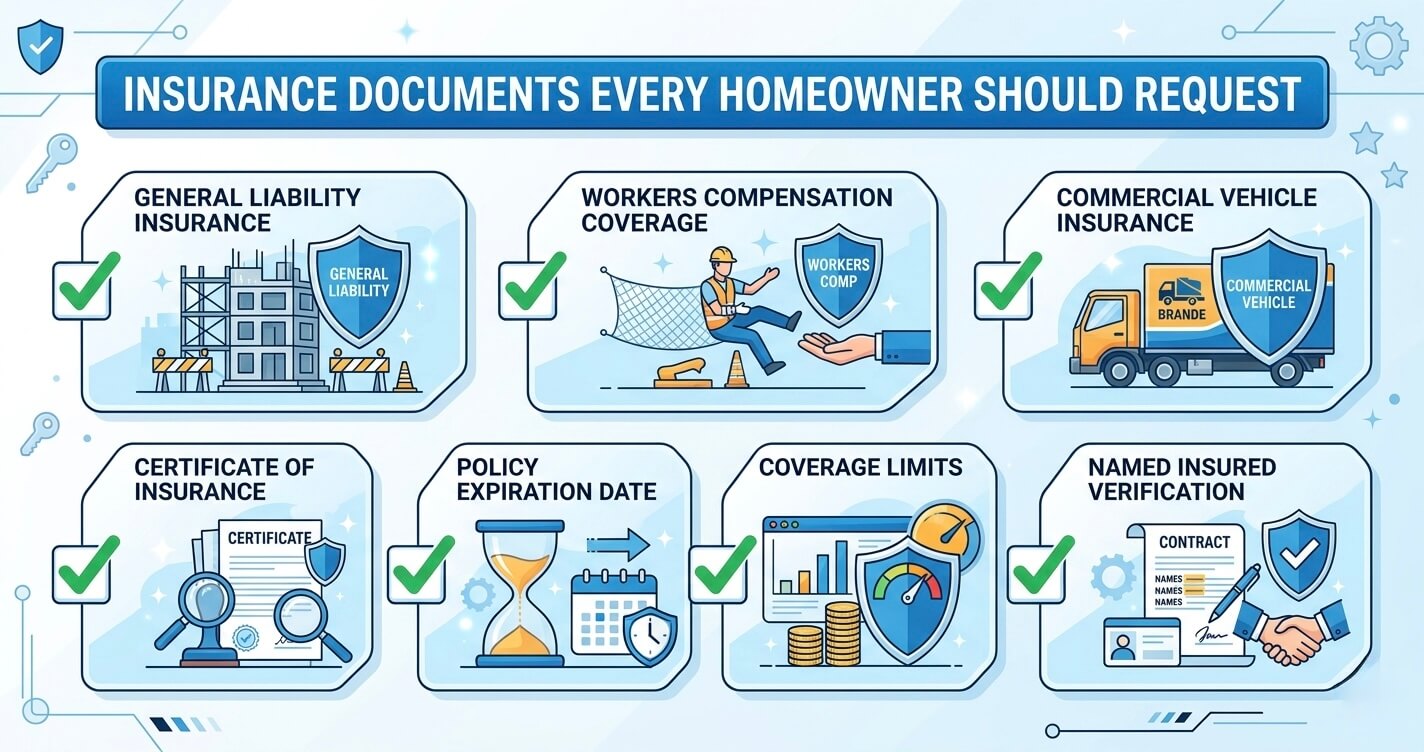
Before signing a remodeling contract, request:
- Current Certificate of Insurance (COI)
- General liability policy documentation
- Workers’ compensation verification
- Insurance carrier contact information
- Policy expiration dates
- Confirmation that coverage limits are appropriate for the project size
Professional contractors expect these questions and provide documentation without hesitation. Contractors who avoid insurance discussions, refuse to provide certificates, or claim coverage is unnecessary should be viewed as a significant risk.
When evaluating a remodeling contractor, insurance verification should be treated with the same importance as licensing, permitting, and project experience.
RED FLAG #6: THEY HAVE NO LOCAL PROJECT HISTORY
Experience matters in remodeling, but local experience matters even more.
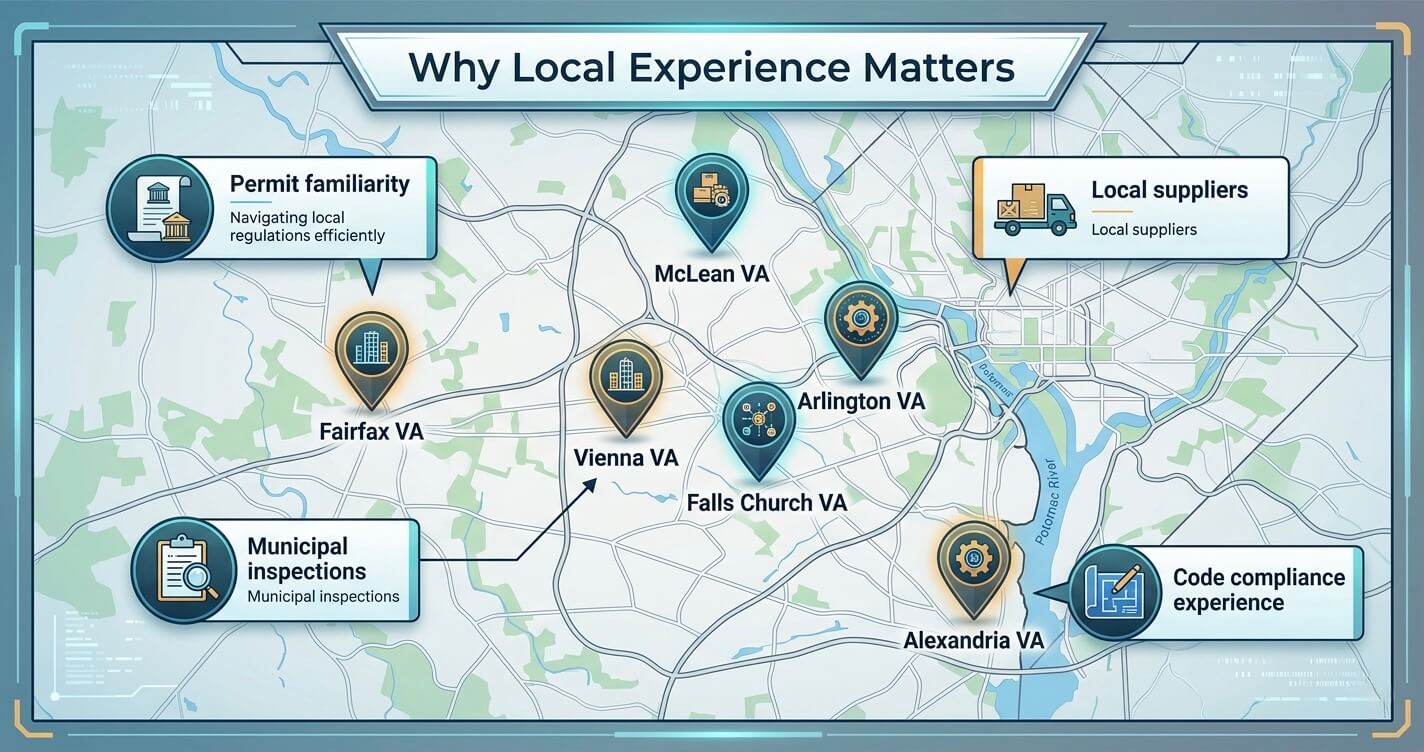
A contractor may have completed hundreds of projects elsewhere, yet still struggle when navigating the permitting requirements, inspection procedures, neighborhood restrictions, and construction challenges unique to Northern Virginia. Communities such as Fairfax VA, McLean VA, Arlington VA, Vienna VA, and Falls Church VA each have distinct permitting processes, zoning considerations, architectural expectations, and inspection protocols that can directly impact project timelines and costs.
Contractors with an established local presence typically have stronger relationships with suppliers, subcontractors, permit offices, inspectors, and specialty trades. These relationships often translate into smoother scheduling, faster problem resolution, and better project coordination.
When evaluating a remodeling contractor, homeowners should ask:
- Can I see projects you have completed nearby?
- Can I speak with recent local clients?
- How many projects have you completed in Fairfax County?
- Have you worked in Arlington County before?
- Can you provide examples of projects similar to mine?
A contractor should be able to provide verifiable references and examples relevant to the type of work being proposed.
Local project history is especially important for additions, structural renovations, historic properties, second-story additions, and projects requiring significant permitting coordination. Contractors unfamiliar with local requirements often underestimate approval timelines, overlook jurisdiction-specific requirements, or encounter avoidable delays during construction.
The strongest contractors can demonstrate not only technical expertise, but also a proven record of successfully completing projects within the communities they serve.
RED FLAG #7: COMMUNICATION IS ALREADY POOR BEFORE THE PROJECT STARTS
One of the most reliable predictors of future project problems is poor communication during the proposal phase.
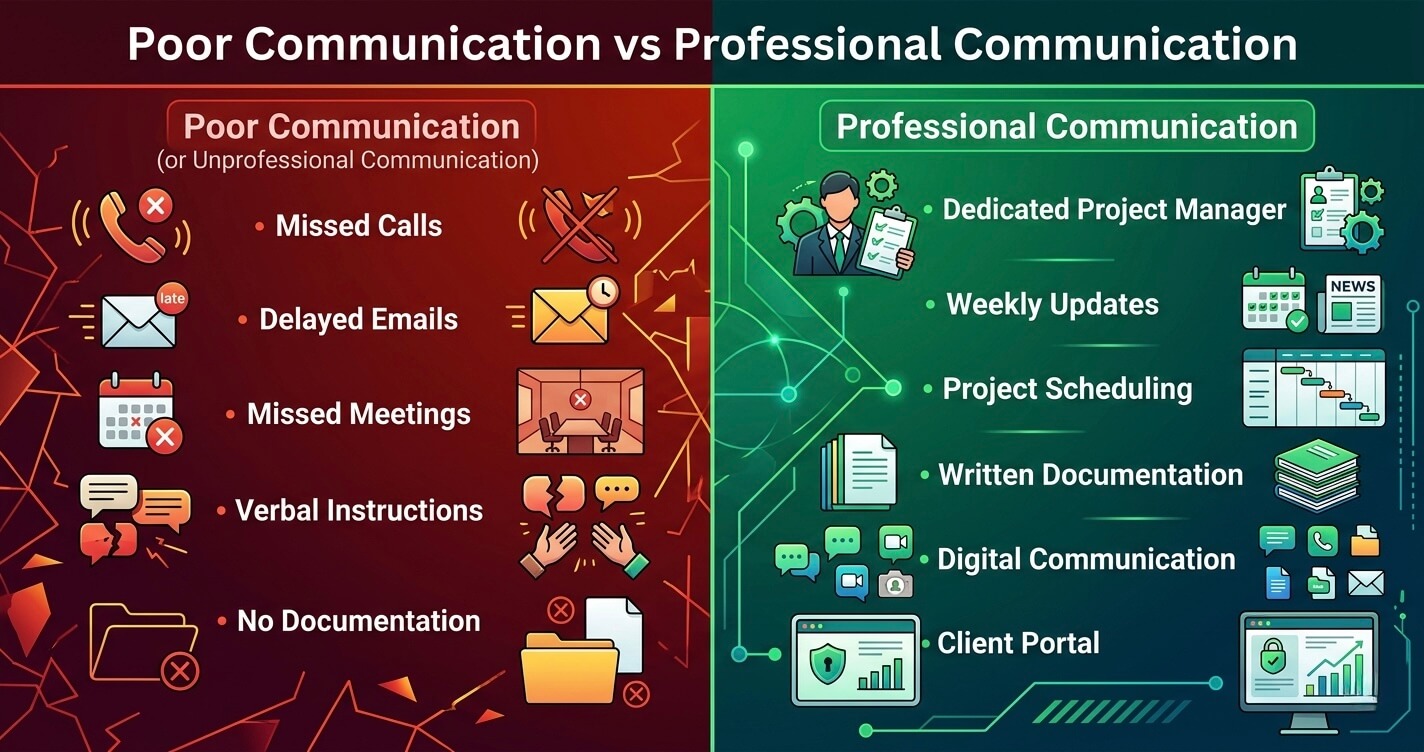
Many homeowners focus on pricing, design ideas, and construction schedules while overlooking how a contractor communicates before a contract is signed. In reality, pre-construction communication often reflects how the project will be managed once construction begins.
Warning signs include:
- Delayed responses to emails or calls
- Missed appointments
- Incomplete proposals
- Unclear answers to questions
- Lack of written documentation
- Inconsistent scheduling information
If communication is disorganized before the contractor has secured the project, it rarely improves after construction begins.
Professional remodeling firms typically rely on structured project management systems that provide consistency throughout the project lifecycle. Strong communication systems often include:
- Written meeting summaries
- Scheduled progress updates
- Centralized project documentation
- Dedicated points of contact
- Change-order tracking procedures
- Digital scheduling platforms
Homeowners should know who is responsible for communication, how updates will be delivered, and how questions will be addressed during construction.
One advantage of the design-build approach is communication centralization. Rather than coordinating separately with architects, designers, engineers, subcontractors, and construction crews, homeowners work through a unified system that keeps project information organized and accessible.
The reality is simple: communication problems rarely begin during construction. They almost always begin before construction starts.
RED FLAG #8: THERE IS NO PROJECT MANAGEMENT PROCESS
Construction expertise alone is not enough to successfully manage a remodeling project.
Many remodeling failures occur not because the contractor lacks technical skill, but because there is no structured process for managing schedules, budgets, permits, inspections, procurement, and client communication.
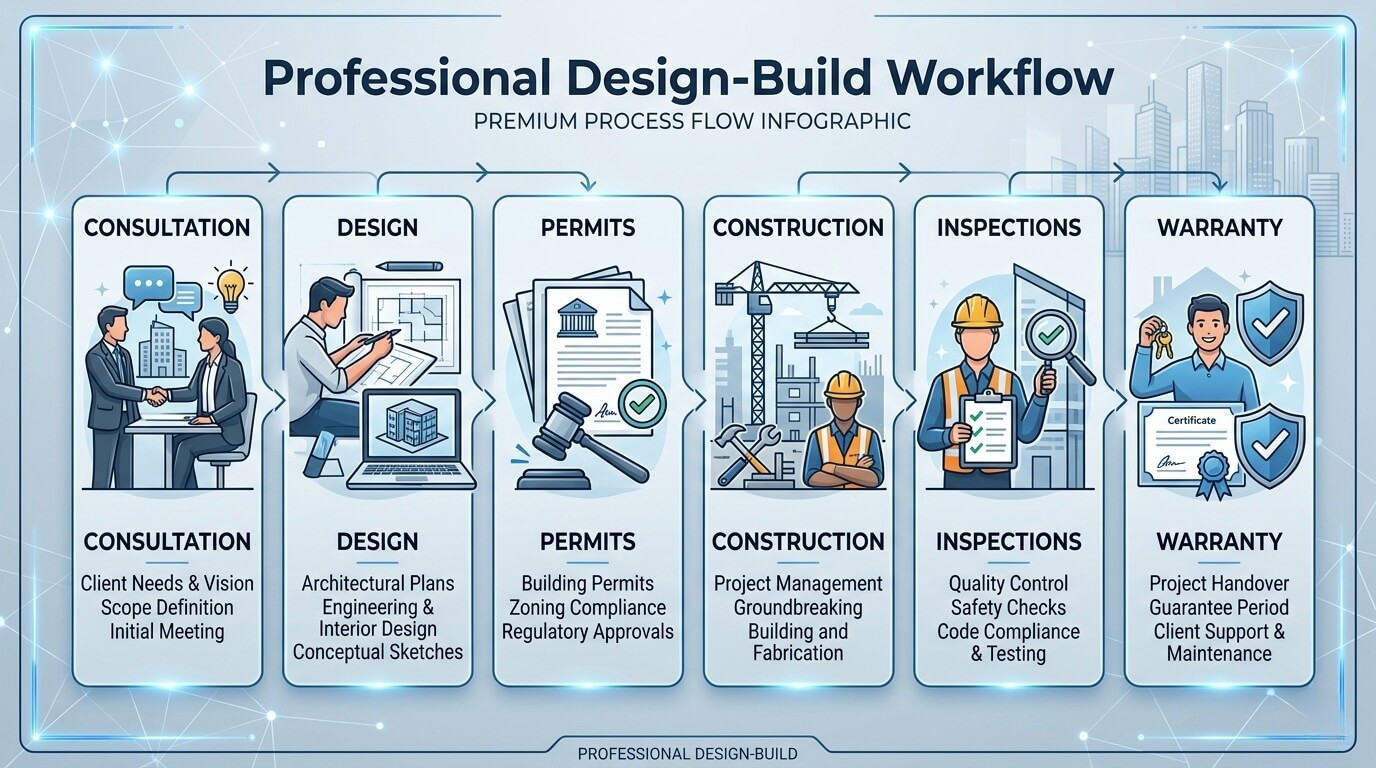
Professional remodeling projects involve dozens, or even hundreds, of moving parts. Materials must be ordered and tracked. Permits must be coordinated. Inspections must be scheduled. Subcontractors must be sequenced correctly. Budgets must be monitored continuously.
Without a project management system, delays and cost overruns become significantly more likely.
Key components of professional project management include:
- Construction scheduling
- Procurement planning
- Budget tracking
- Permit coordination
- Inspection scheduling
- Change-order management
- Client communication systems
- Quality control procedures
Projects involving significant structural modifications, such as a Second Story Addition in Northern Virginia, demonstrate how important coordination becomes when multiple trades, inspections, and engineering requirements overlap:
Design-build firms often have an advantage because they operate under a unified workflow:
Consultation → Design → Permits → Construction → Warranty
This integrated structure creates a single source of accountability rather than dividing responsibility among multiple independent parties.
When homeowners ask a contractor how projects are managed, the answer should involve documented systems, dedicated personnel, and clearly defined procedures, not simply “we’ll figure it out as we go.”
The difference between an organized project and a chaotic project is usually the strength of the management process behind it.
CONTRACTOR SCREENING CHECKLIST FOR NORTHERN VIRGINIA HOMEOWNERS
Before signing any remodeling contract, homeowners should complete a thorough contractor screening process. The following checklist can help identify qualified professionals and avoid many of the risks discussed throughout this guide.
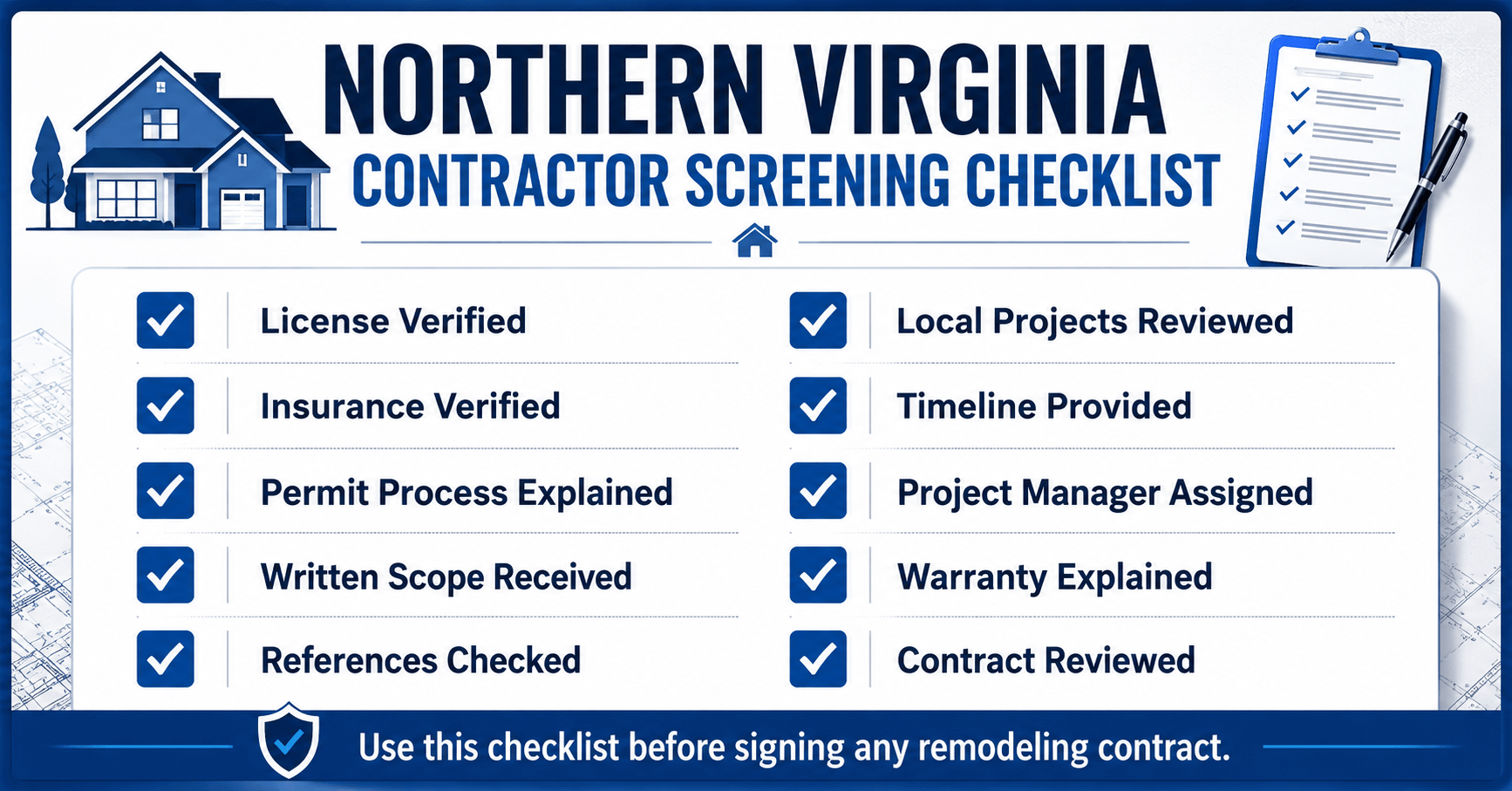
Northern Virginia Contractor Screening Checklist
- Virginia contractor license verified through DPOR
- Insurance certificates reviewed and confirmed
- Permit process explained clearly
- Detailed written scope of work received
- Recent client references contacted
- Local projects reviewed
- Construction timeline provided
- Dedicated project manager assigned
- Warranty terms explained in writing
- Payment schedule documented
- Change-order procedures documented
- Contract reviewed before signing
- Permit responsibilities clearly assigned
- Material specifications identified
- Communication process established
A qualified remodeling contractor should welcome these questions rather than avoid them. Transparency is typically a sign of professionalism, while resistance often signals additional concerns worth investigating.
Homeowners investing tens or hundreds of thousands of dollars into a remodeling project should approach contractor selection with the same diligence they would apply to hiring any professional responsible for a major financial decision.
FREQUENTLY ASKED QUESTIONS [FAQs]
How do I verify a contractor license in Virginia?
You can verify a contractor’s license through the Virginia Department of Professional and Occupational Regulation (DPOR). Search by company name or license number to confirm license status, classification, and disciplinary history.
What permits are required for remodeling in Northern Virginia?
Permit requirements vary by project and jurisdiction. Structural work, electrical upgrades, plumbing modifications, HVAC installations, additions, and many major renovations typically require permits and inspections.
Should I hire the cheapest remodeling contractor?
Not necessarily. Extremely low bids often indicate missing scope items, material substitutions, underqualified labor, or future change-order strategies. Compare scope and qualifications—not just price.
What insurance should a contractor carry?
At minimum, contractors should maintain general liability insurance and workers’ compensation coverage when applicable. Additional coverage may be appropriate depending on project size and complexity.
How many bids should I get before hiring a contractor?
Most homeowners benefit from obtaining three qualified bids. Multiple proposals help establish realistic pricing and reveal major differences in scope and project approach.
How do I know if a remodeling estimate is realistic?
Legitimate estimates typically include detailed scopes, material specifications, permit costs, timelines, and payment schedules. If one bid is dramatically lower than the others, additional scrutiny is warranted.
What is a design-build contractor?
A design-build contractor manages both design and construction under a single contract, providing one point of accountability throughout planning, permitting, and construction.
How do I avoid contractor scams in Virginia?
Verify licensing, confirm insurance, require written contracts, avoid large upfront payments, review references, and ensure all required permits are obtained before work begins.
IN SUMMARY
The most expensive remodeling mistake is rarely choosing the wrong flooring, countertop, or paint color. More often, it is choosing the wrong contractor.
Throughout Northern Virginia, successful remodeling projects are built on a foundation of contractor verification, permit compliance, detailed scopes of work, strong communication systems, and professional project management. Homeowners who verify licensing, confirm insurance coverage, require permits, review local project history, and evaluate communication processes significantly reduce the risks associated with major renovations.
The right contractor makes remodeling feel organized. The wrong contractor makes it feel unpredictable.
US Home Design Build works with homeowners throughout Northern Virginia, including Fairfax VA, McLean VA, Arlington VA, Vienna VA, Falls Church VA, and Alexandria VA.
Their design-build process manages planning, design, permits, construction, inspections, and warranty support under one roof, providing homeowners with a single point of accountability from start to finish.
703-202-3520 | https://ushdb.com | 8200 Greensboro Dr Suite 900, McLean, VA 22102
