
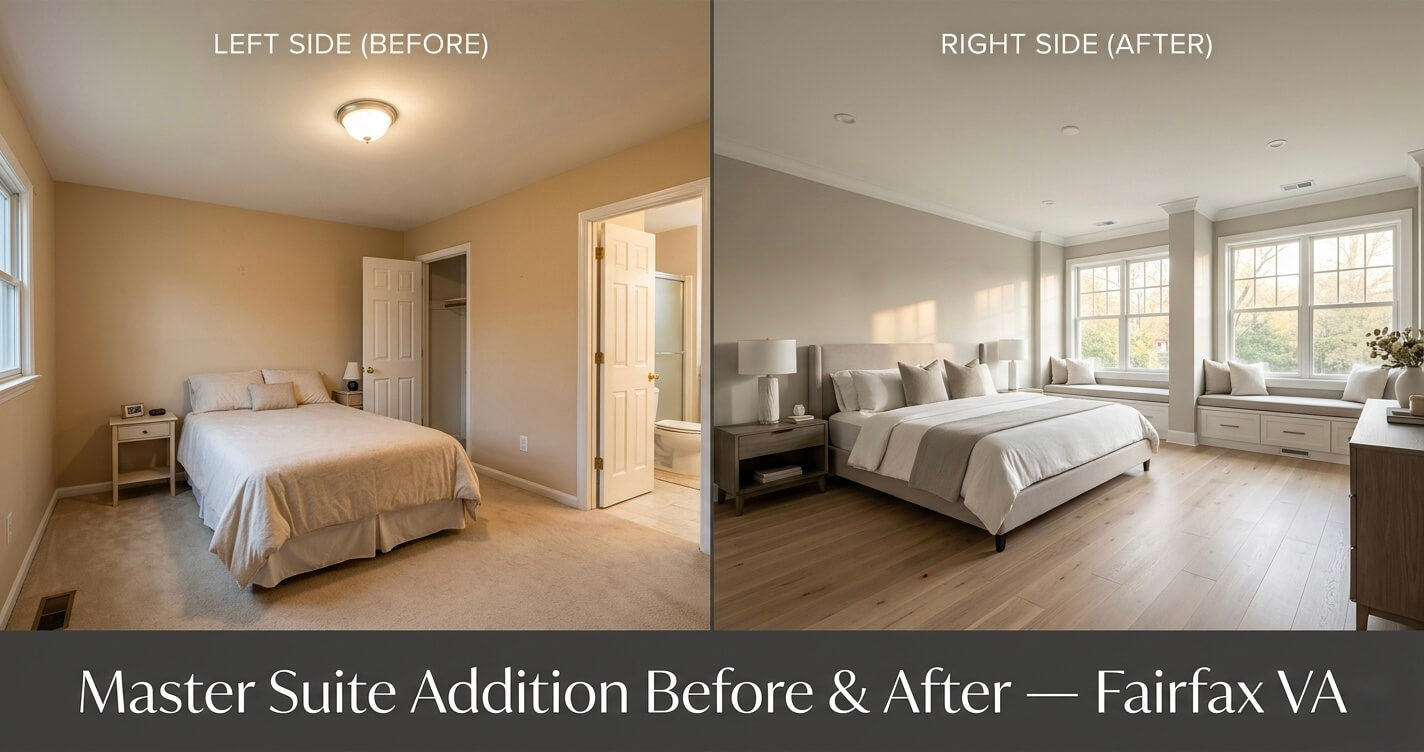
This master suite addition before after Fairfax VA case study shows what happens when a 1984 Colonial finally gets the primary suite it was always missing, and why more homeowners across Fairfax County are choosing to build rather than move in 2026.
The Martins purchased their 4-bedroom Colonial-style home in Fairfax VA in 2008. By 2025, the house still worked structurally, but the original primary bedroom no longer matched the way they lived. The 12×14-foot bedroom lacked a private bathroom, offered only a small reach-in closet, and provided little privacy or functional storage for two adults entering their empty-nester years. Rather than competing in Northern Virginia’s expensive housing market, the couple decided to reinvest in the home and neighborhood they already loved.
Their decision was heavily influenced by mortgage economics. Having secured a 3.2% mortgage rate in 2021, moving into a comparable updated home in Fairfax County would have significantly increased their monthly housing costs. At the same time, the existing lot offered enough rear-yard depth to accommodate a code-compliant addition without requiring zoning variances or major site complications.
Nationally, a primary suite addition returns approximately 48% of its cost at resale, but in competitive Northern Virginia markets, the long-term lifestyle value and mortgage-rate lock-in advantage often make expanding an existing home financially preferable to relocating. [Source: AmeriSave — Essential Cost Insights for 2026 Home Remodeling Projects]
US Home Design Build, a Fairfax County-based design-build contractor specializing in additions and whole-home remodeling throughout Northern Virginia, managed the project from initial consultation through final county inspection. Many homeowners considering a master suite addition also evaluate broader remodeling strategies such as Full Home Renovation McLean VA before deciding whether to expand or fully reconfigure an existing property.
Here is the complete story; the original conditions, every major design decision, Fairfax County permit considerations, construction costs, and how the finished master suite functions today.
THE BEFORE: WHAT THE SPACE ACTUALLY LOOKED LIKE
Before construction began, the Martins’ home reflected a layout common in many Northern Virginia suburban houses built during the 1980s. The structure itself remained solid, but the primary bedroom suite lacked the functionality expected in modern Fairfax County homes.
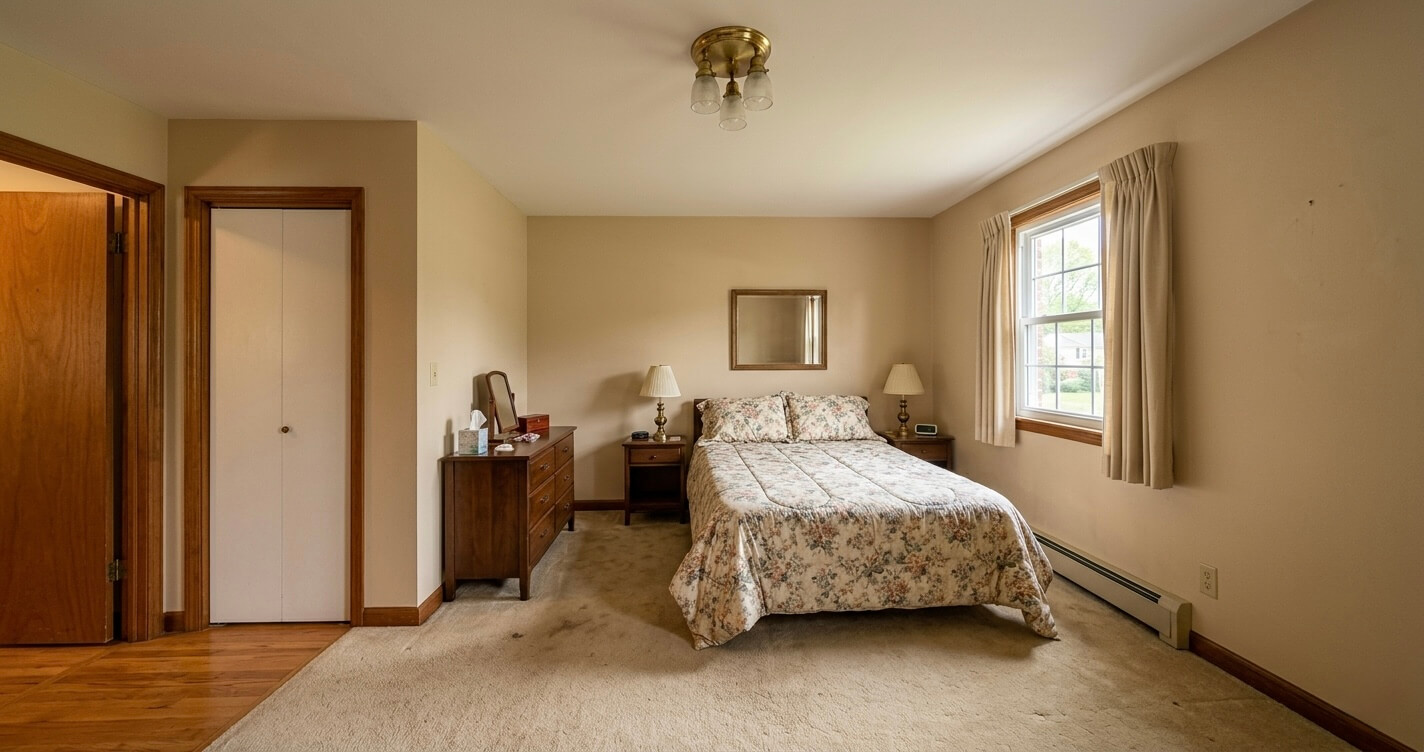
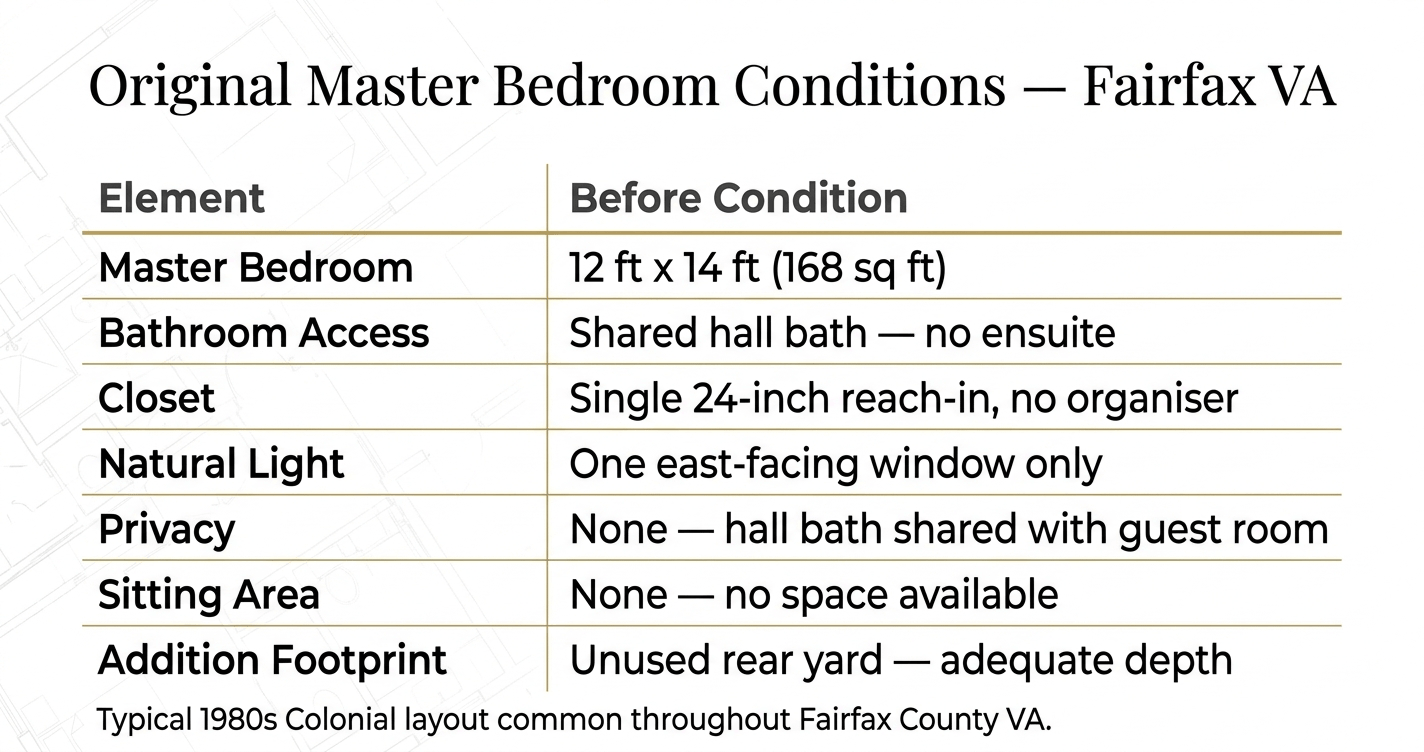
The original master bedroom measured only 12 feet by 14 feet, approximately 168 square feet. A queen bed, two nightstands, and a single dresser occupied nearly all usable floor area. Storage was limited to a narrow 24-inch reach-in closet tucked behind the entry door. The room had only one east-facing window, resulting in limited natural light and a noticeably enclosed feel during much of the day.
The adjacent 10×10 guest bedroom ultimately became a critical part of the redesign strategy. By removing the shared wall between the two rooms and extending the footprint into the rear yard, the design team could create a much larger integrated primary suite without requiring a second-story addition.
More significantly, the homeowners did not have a dedicated ensuite bathroom. Instead, they shared a standard hall bathroom with the adjacent guest bedroom. The bathroom retained many original 1984 finishes, including a fiberglass tub/shower combination, vinyl flooring, builder-grade vanity cabinetry, and limited task lighting. Privacy and circulation became increasingly frustrating as the homeowners spent more time at home after transitioning into empty-nester life.
The rear yard itself provided one of the project’s biggest advantages: a relatively flat, unobstructed addition zone with sufficient setback clearance and no major easement conflicts. That site condition significantly simplified zoning compliance and reduced site-development costs compared to more constrained Fairfax County lots.
BEFORE SPECIFICATIONS TABLE
Many Colonial and split-level homes built in Northern Virginia between 1975 and 1995 were originally designed without large primary suites or dedicated spa-style bathrooms. Those layouts reflected the design priorities of the era but often create functional limitations for modern households seeking privacy, storage, and long-term accessibility. [Source: U.S. Census Bureau — American Housing Survey]
Importantly, the “before” condition was not a failure of the original home design. The house had served the family well for decades. But by 2025, the homeowners’ priorities had shifted toward comfort, functionality, privacy, and long-term aging-in-place usability, goals the original layout could no longer support effectively.
THE DESIGN PLAN: WHAT WAS DECIDED BEFORE DEMO DAY
The success of this Fairfax VA master suite addition depended almost entirely on careful planning completed before demolition began. Rather than treating the project as a simple bedroom expansion, the design-build team approached it as a full lifestyle reconfiguration centered around privacy, comfort, and long-term functionality.
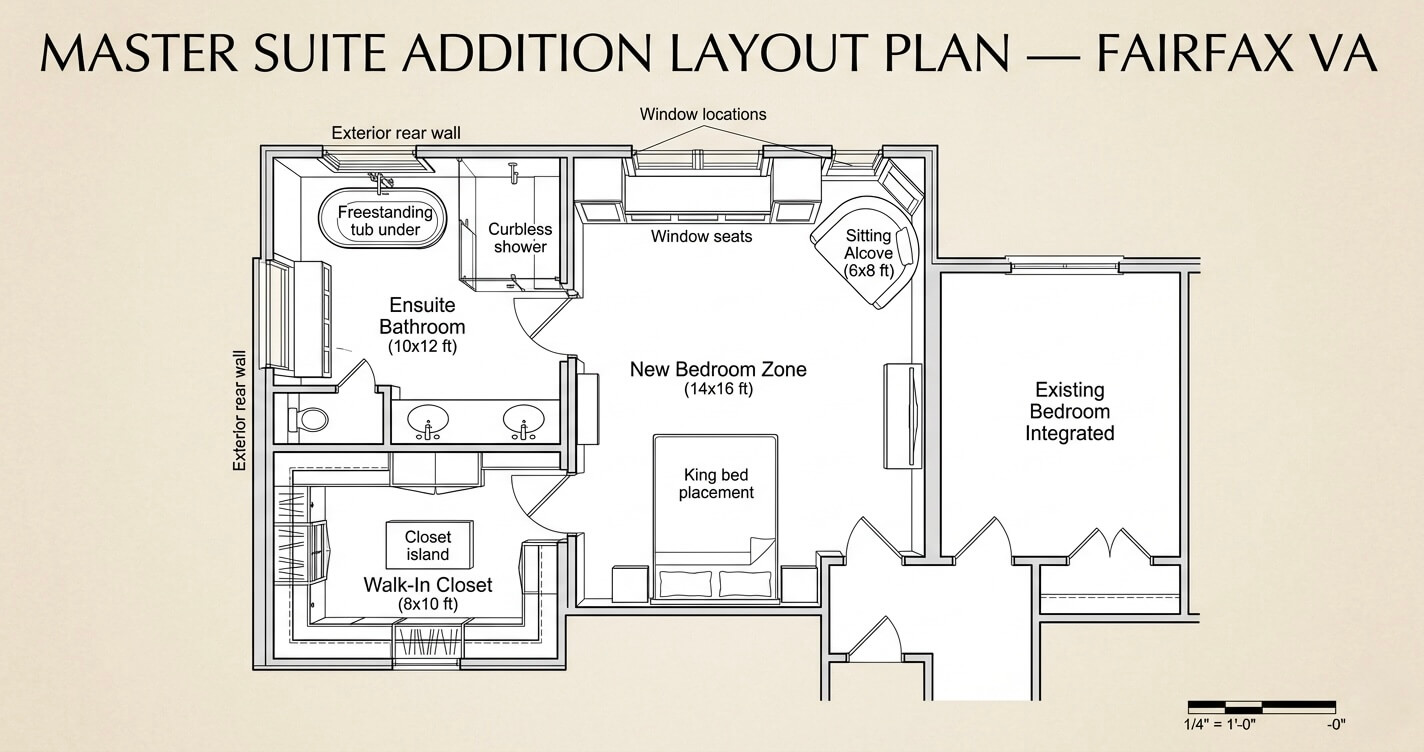
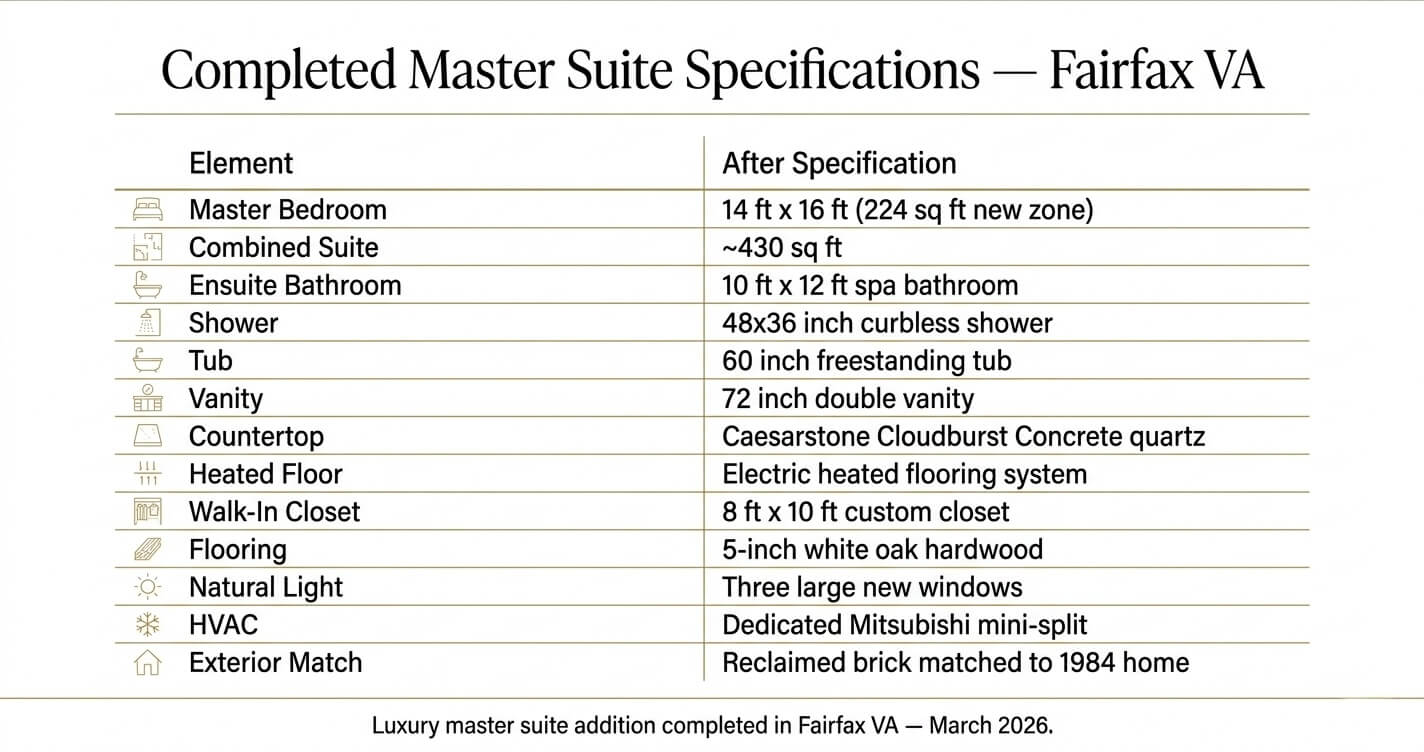
The core structural decision involved building a new 16-foot by 20-foot rear addition connected directly to the existing primary bedroom. This 320-square-foot extension combined with the adjacent 10×10 guest room to create an integrated primary suite totaling approximately 430 square feet of reconfigured living space.
The redesigned suite included:
- A new 14×16 primary bedroom sized for a king bed and seating area
- A 10×12 spa-style ensuite bathroom
- An 8×10 custom walk-in closet
- A dedicated sitting alcove positioned beside new rear-facing windows
This layout solved multiple problems simultaneously: circulation improved, storage increased dramatically, privacy was restored, and natural light penetration improved throughout the suite.
Primary suite additions have become increasingly common across Northern Virginia as empty nesters repurpose underused bedrooms into larger owner-focused living spaces. Many homeowners now prioritize hotel-style comfort and long-term livability over maintaining surplus guest rooms. [Source: National Association of Realtors — 2025 Remodeling Impact Report]
A major architectural priority involved ensuring the addition looked original to the house rather than visibly attached later. The exterior design carefully matched the home’s 1984 Colonial architecture using reclaimed brick selected to closely mirror the existing façade, matching roof pitches, identical trim profiles, and proportionally aligned windows. This integration philosophy reflects a common approach in higher-end Fairfax County additions where architectural continuity directly influences long-term resale value.
Master Bathroom Design
The new ensuite bathroom became the centerpiece of the project. The homeowners wanted a calm, spa-inspired environment emphasizing natural light, warm neutral materials, and low-maintenance durability.
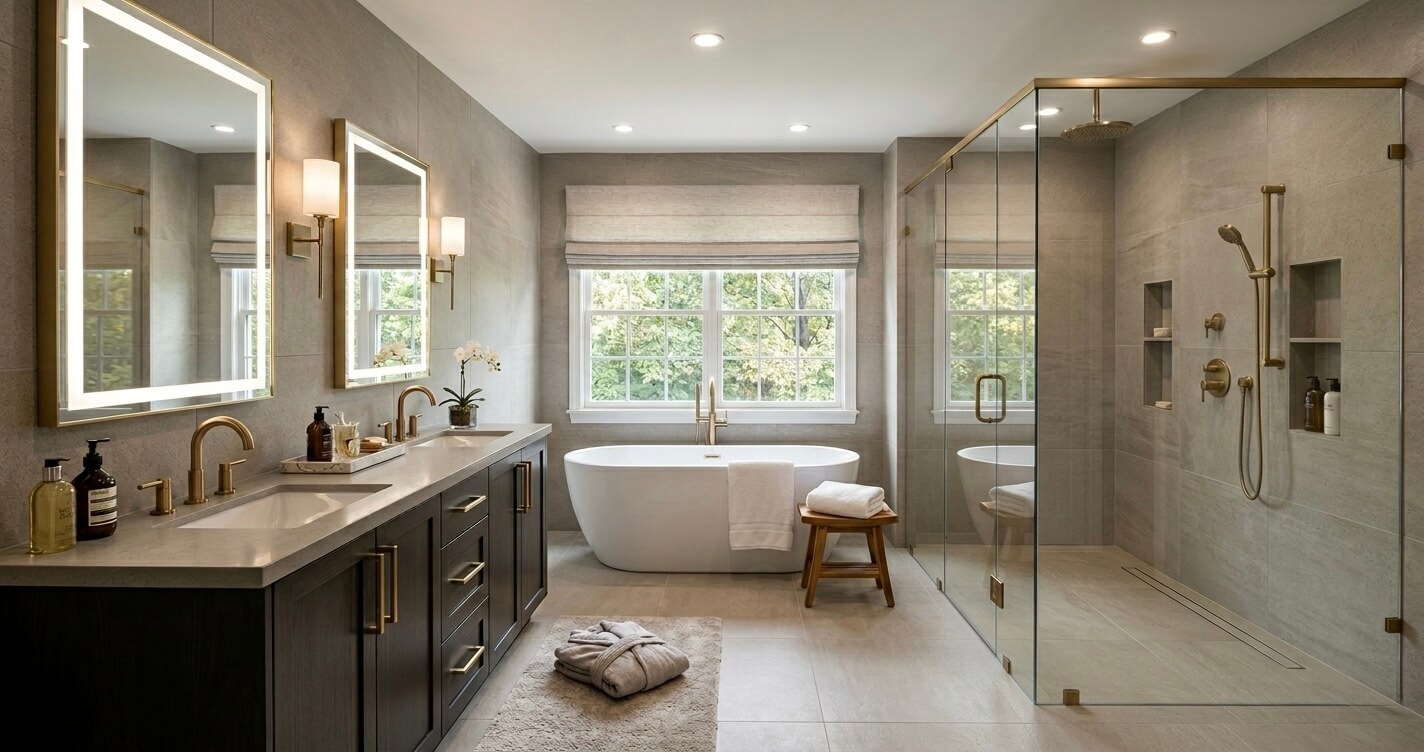
Key features included:
- 48×36-inch curbless walk-in shower
- Floor-to-ceiling 24×48 matte porcelain tile
- Frameless tempered-glass enclosure with brushed gold hardware
- 60-inch freestanding soaking tub beneath a rear-facing fixed window
- 72-inch semi-custom shaker vanity in Benjamin Moore “Kendall Charcoal”
- Caesarstone “Cloudburst Concrete” quartz countertops
- Heated porcelain tile flooring
- Backlit LED mirrors with layered recessed lighting
- Panasonic WhisperFit 110CFM exhaust fan vented externally for moisture control
Luxury bathroom trends increasingly prioritize spa-style functionality, larger-format tile, organic finishes, integrated lighting, and wellness-oriented design features such as heated flooring and curbless showers. [Source: National Kitchen & Bath Association (NKBA) — 2025 Design Trends Report]
Walk-In Closet Design
The new closet system dramatically improved storage efficiency. Features included:
- Double-hanging storage zones
- Full-height hanging sections
- Sixteen integrated drawers
- Open shelving and shoe storage
- Motion-activated LED strip lighting
- Central island cabinetry for folded items and accessories
The cabinetry used painted MDF finished in Benjamin Moore “Simply White” to visually connect with the trim package throughout the addition.
Bedroom & HVAC Decisions
The homeowners initially considered a vaulted ceiling but ultimately maintained a standard 9-foot ceiling height. This decision simplified structural framing, reduced HVAC complications, and improved long-term thermal efficiency.
Natural light increased substantially through the addition of two large rear casement windows and a fixed side window. Built-in window seating with storage drawers further improved functionality without increasing footprint requirements.
Rather than overloading the existing HVAC system, the project incorporated a dedicated Mitsubishi M-Series mini-split system for the suite. This allowed independent climate control while avoiding expensive ductwork modifications throughout the original home.
PROJECT COST BREAKDOWN
One of the biggest questions homeowners ask before starting a luxury addition project is how much a realistic master suite addition in Fairfax VA actually costs in 2026. For the Martins’ project, the final investment totaled $187,400, reflecting both the structural addition itself and the high-end bathroom and closet finishes integrated into the new suite.
“Home additions in Northern Virginia cost between $230 and $500 per square foot, a range that reflects the significant premium of DC-area labor rates, Fairfax County permitting requirements, and the premium material expectations of buyers in this market. Northern Virginia costs run 25–40% above national averages.” [Source: Home Addition Cost Calculator — Virginia 2026]
Additional regional pricing context also supports those elevated costs:
“Home addition costs in Northern Virginia range from $150 to $350 per square foot on average, with large-scale or high-finish projects such as master suite additions reaching and exceeding the upper end of that range.” [Source: USHDB — Northern Virginia Home Addition Cost]
Detailed Project Cost Breakdown
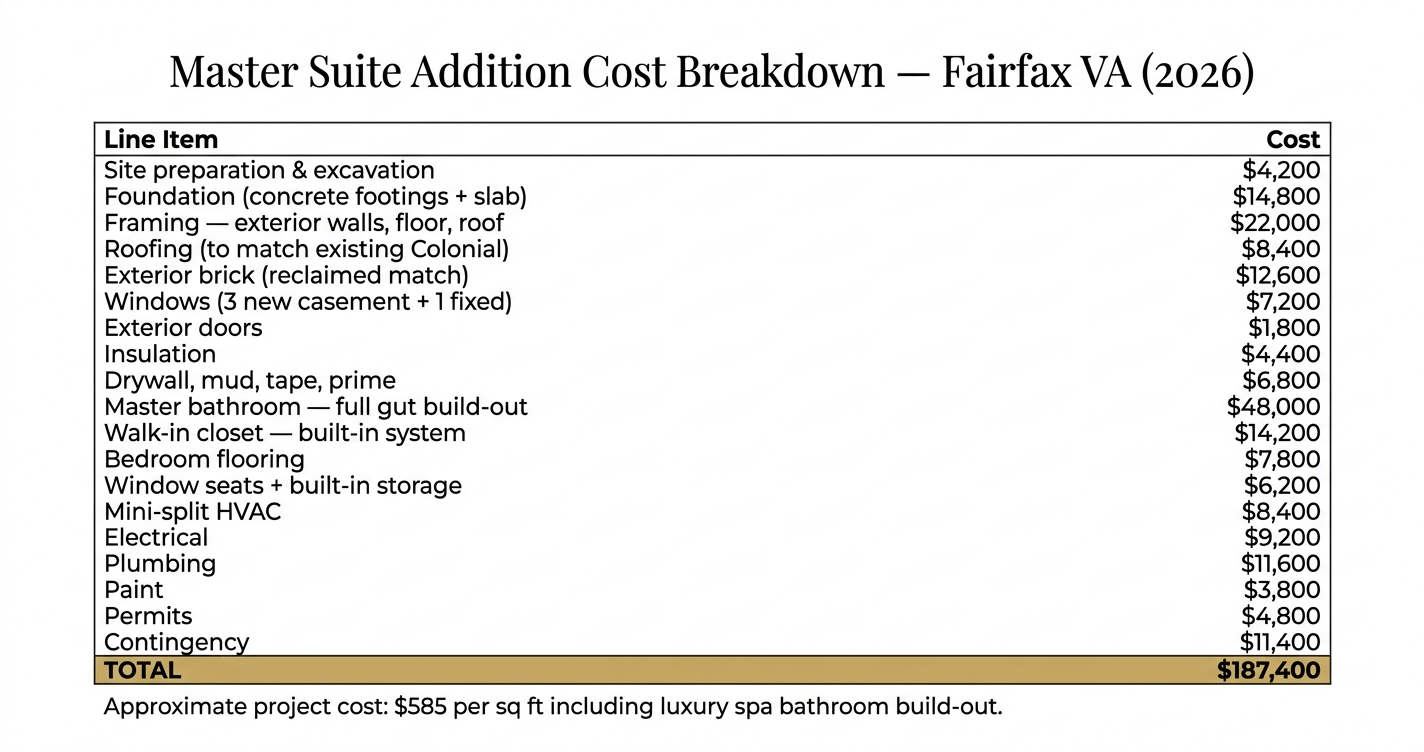
The addition footprint itself measured 320 square feet, placing the total project cost at roughly $585 per square foot. However, that figure is heavily influenced by the spa-style bathroom build-out, which alone represented $48,000 of the budget. Excluding the bathroom scope, the structural addition portion of the project aligned much more closely with typical Northern Virginia addition costs at approximately $295 per square foot.
The contingency allowance ultimately proved necessary for two unexpected issues discovered during construction. First, the reclaimed brick required to precisely match the 1984 Colonial exterior had to be sourced from a specialty supplier in Richmond, adding approximately three weeks and $4,200 to the project. Second, the existing master bedroom floor sat nearly 0.75 inches lower than the new addition floor, requiring a tapered framing correction to create a seamless transition between the original structure and the new suite.
To understand how a master suite addition cost compares to other home addition types in this market, our comprehensive guide to Home Addition Cost in Northern Virginia covers the full cost spectrum by project type and Fairfax County location.
PERMITS: WHAT THIS PROJECT REQUIRED IN FAIRFAX COUNTY VA
Like nearly all structural residential additions in Northern Virginia, this master suite addition required multiple permits and reviews through Fairfax County Land Development Services (LDS). Fairfax County’s permitting environment has become increasingly technical in recent years, especially after the county fully transitioned to updated statewide building standards.
“Beginning January 18, 2025, all permit applications and plans in Fairfax County must exclusively comply with the 2021 Virginia Uniform Statewide Building Code (USBC) requirements — the transitional period allowing the 2018 code has permanently expired.” [Source: Fairfax County LDS — Codes and Standards]
Fairfax County also makes clear that additions require formal approval:
“A building permit is required for all new residential construction in Fairfax County, including additions that expand the footprint of an existing home, interior alterations including changes to load-bearing and non-load-bearing walls, and all associated trade work including electrical, plumbing, and mechanical.” [Source: Fairfax County Code Compliance — Unpermitted Construction]
For the Martin project, the following permits were obtained:
- Building permit (residential addition):
Covered the new 320 sq ft addition, structural tie-in to the existing home, and removal of the adjacent guest-room wall. Filed through the Fairfax County PLUS portal under “Addition/Alteration Residential.” [Source: Fairfax County LDS — Addition/Alteration Residential Permit Library]
- Electrical permit:
Included new bathroom circuits, heated floor power supply, upgraded lighting, dedicated mini-split electrical service, and panel-capacity improvements.
- Plumbing permit:
Covered the new dual vanity drains, freestanding tub, curbless shower system, venting, and supply-line installation.
- Mechanical permit:
Required for installation of the Mitsubishi M-Series mini-split HVAC system. Fairfax County requires HVAC certification documentation prior to permit issuance. [Source: Fairfax County LDS — Permit Library]
- Zoning review:
Verified rear setback compliance, lot coverage limits, and compatibility with Fairfax County’s R-3 residential zoning district regulations.
Fairfax County also advises homeowners that licensed contractors should typically manage the permit process:
“Property owners may obtain permits in their own name, however, it is strongly recommended a properly licensed contractor pull the permits as the responsible party so the county can better assist in gaining compliance for defective work.” [Source: Fairfax County LDS — Addition/Alteration Residential Permit Library]
US Home Design Build handled all permit filings for this project through the Fairfax County PLUS portal at https://plus.fairfaxcounty.gov. Total permit approval time was approximately 4.5 weeks from the first submission, with all permits and trade reviews approved without major revision cycles. Combined permit costs totaled approximately $4,800.
For a complete guide to Fairfax County permit requirements across all project types, our article on Remodeling Permit Fairfax County covers the full process including how to use the PLUS portal.
CONSTRUCTION TIMELINE
Master suite additions in Fairfax County rarely move quickly, particularly when structural expansion, luxury finishes, and exterior integration are involved. The Martins’ project ultimately required approximately six months from initial design work through final county inspections and homeowner walkthrough.
“Home additions in Northern Virginia take 4 to 8 months for construction alone. Add 1 to 3 months for design and permitting, and realistic planning horizons run 5 to 11 months total. Second stories and complex master suite additions sit at the longer end of that range.” [Source: Home Addition Cost Calculator — Virginia 2026]
Project Timeline
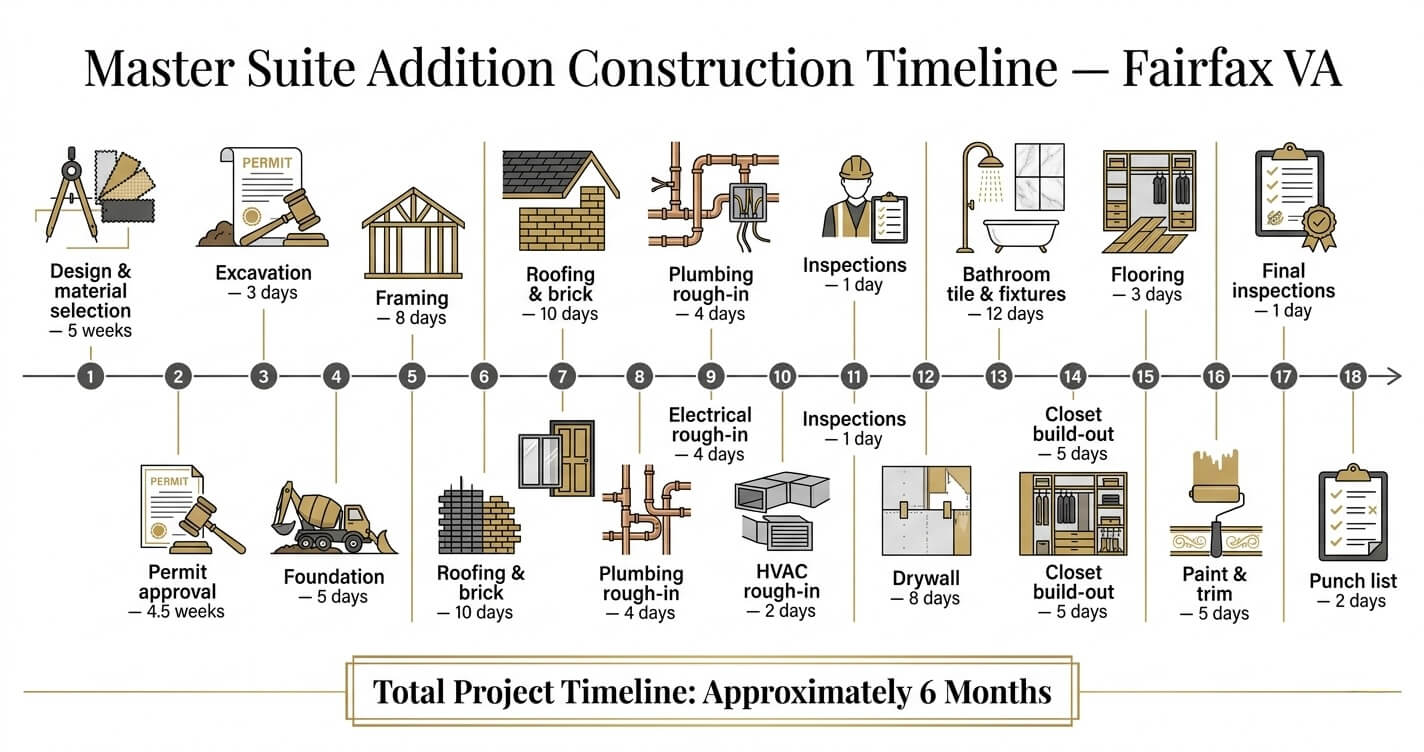
The reclaimed brick sourcing proved to be the single largest schedule extension during the project. Matching 1980s Colonial brick with modern additions is often far more difficult than homeowners initially expect, particularly when exact color variation and mortar compatibility matter visually. In this case, sourcing reclaimed brick from Richmond added approximately three weeks to the timeline but preserved the architectural continuity that ultimately made the addition appear original to the home rather than visibly appended later.
THE AFTER: THE MASTER SUITE REVEALED
The finished result of this master suite addition before after Fairfax VA project feels dramatically different from the original 1984 layout, not because the addition is oversized, but because every square foot now serves a clear purpose. The original primary bedroom had functioned for years as a sleeping space only. After the renovation, the Martins gained a fully integrated private suite designed around comfort, privacy, storage, and long-term usability.
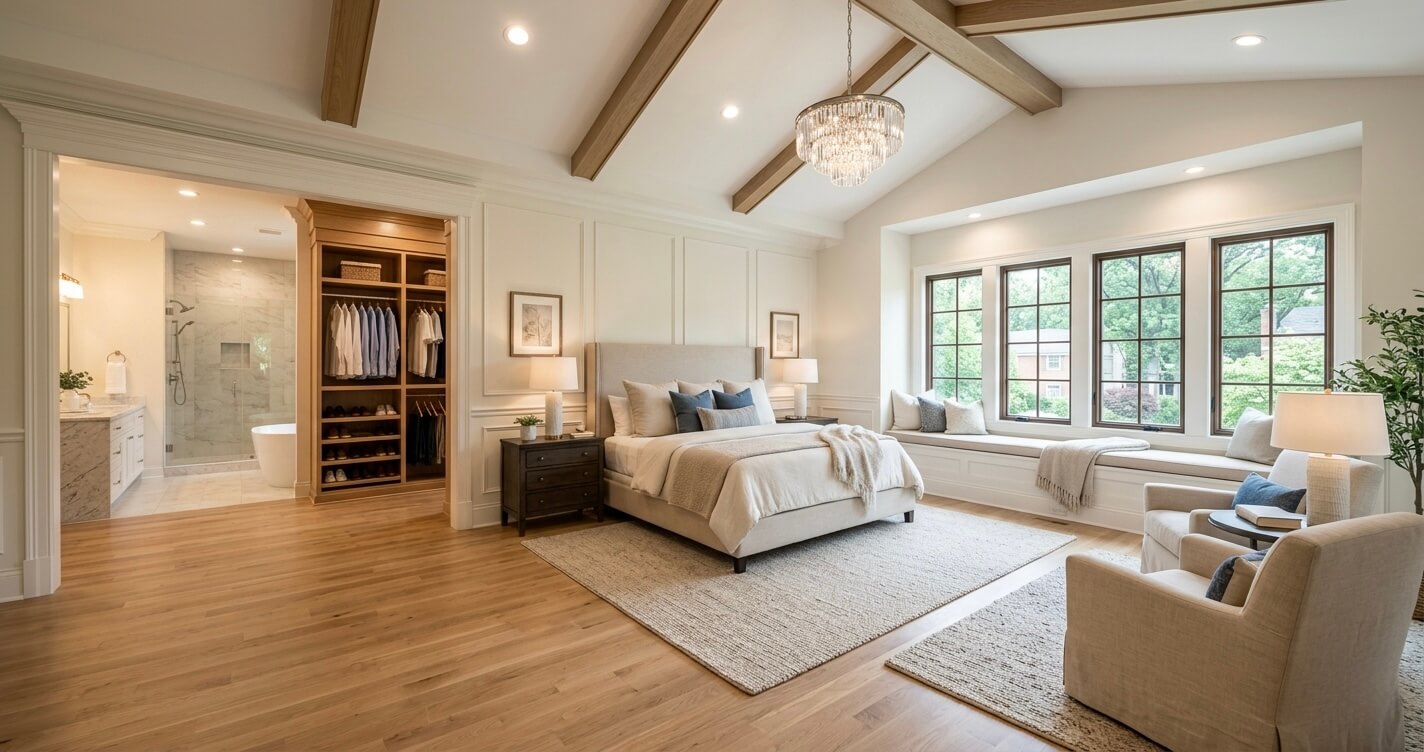
The transformation begins immediately at the bedroom entry. The original 12×14 room now flows seamlessly into the new rear addition, creating a balanced and proportional primary suite rather than an obviously “added-on” space. White oak flooring extends continuously throughout the entire bedroom zone, visually connecting the original structure to the new construction. Two large rear casement windows dramatically increase natural light compared to the single original east-facing window, while the built-in window seats create functional storage and a dedicated sitting area overlooking the backyard.
The walk-in closet became one of the homeowners’ favorite features. At 8×10 feet, the closet alone offers more usable storage than the original bedroom ever provided. Motion-activated LED lighting, integrated drawer towers, full-length hanging sections, and open shelving transformed what had previously been daily clutter into organized, accessible storage.
The spa-style bathroom functions as the centerpiece of the addition. The 120-square-foot layout accommodates a freestanding soaking tub beneath the rear window, a curbless walk-in shower with floor-to-ceiling porcelain tile, heated flooring, and a 72-inch double vanity finished in Benjamin Moore Kendall Charcoal with Caesarstone Cloudburst Concrete quartz countertops. The large-format tile and frameless glass enclosure visually enlarge the room while simplifying maintenance and moisture management.
AFTER SPECIFICATIONS TABLE
The master bathroom design choices in this project closely mirror the approach documented in the Bathroom Remodel before after Burke VA case study, where the same prioritisation of the walk-in shower over an unused tub delivered a similarly dramatic transformation.
Two weeks after moving back into the completed suite, Mrs. Martin described the emotional impact clearly: they had spent nearly two decades sharing a hall bathroom with guests, and now the bathroom itself felt larger and more functional than the original bedroom ever had. The closet alone completely changed their morning routine.
Perhaps the most important success of the project, however, is what is not immediately noticeable. The reclaimed brick exterior, roofline alignment, and window proportions integrate so naturally into the original Colonial architecture that the addition appears original to the home. That level of architectural continuity required both design discipline and construction precision from the very beginning of the project.
WHY THE DESIGN-BUILD APPROACH WORKED FOR THIS PROJECT
A project like this sits in a unique category between a luxury interior renovation and a structural home addition. It combines foundation work, framing, exterior architectural integration, structural engineering, waterproofing, HVAC planning, high-end finish installation, and Fairfax County permit coordination under one scope of work. Separating design and construction responsibilities on projects of this complexity often creates communication gaps between the architect, engineer, and contractor that later become field conflicts.
For the Martins’ project, using a single design-build firm simplified coordination significantly. Structural engineering, permit filing through Fairfax County’s PLUS system, finish selections, scheduling, inspections, and subcontractor management all operated through one central workflow instead of multiple disconnected teams. That continuity helped the project maintain schedule predictability even after the reclaimed brick sourcing delay.
Industry data also supports this integrated approach. Research cited by AmeriSave notes that combining renovation phases under one design-build structure can reduce overall project costs by approximately 15% compared to managing separate designers and contractors independently. [Source: AmeriSave — Essential Cost Insights 2026]
US Home Design Build follows a four-stage process – Consultation, Design, Build, and Maintain – which carried this project from the initial site evaluation through the final county inspection and post-completion warranty period. For a structurally complex master suite addition, that continuity proved valuable at every phase.
Homeowners across Fairfax VA, McLean VA, Arlington VA, Vienna, Burke, and throughout Northern Virginia planning a similar project benefit significantly from consulting a design-build contractor before architectural planning begins.
LESSONS LEARNED: WHAT THE MARTINS WOULD DO THE SAME – AND DIFFERENTLY
Looking back on the completed project, the Martins identified several decisions they would absolutely repeat. Submitting permits during late fall turned out to be especially beneficial because Fairfax County’s winter review cycle moved faster than peak spring permitting periods. Their 4.5-week approval timeline allowed construction to begin in January before contractor schedules became heavily booked.
They also considered the dedicated Mitsubishi mini-split HVAC system one of the best investments in the project. Rather than extending undersized ductwork from the existing HVAC system, the independent climate zone now allows the suite to maintain its own temperature year-round without affecting the rest of the home.
The reclaimed brick decision, despite adding cost and three weeks of lead time, was also viewed as worthwhile because it preserved the visual integrity of the Colonial exterior. Similarly, the heated bathroom floor added relatively little cost during construction but would have been extremely expensive to retrofit later.
The homeowners also strongly supported allowing the licensed contractor to manage all Fairfax County permits and inspections directly. Every inspection passed on the first attempt, and the permitting process remained predictable throughout construction.
There were, however, a few things they would change. In hindsight, they wish they had added a direct exterior door from the suite to the backyard patio during framing. They also would have prewired for an integrated audio system before drywall installation and requested additional electrical outlets inside the walk-in closet.
The contractor selection process that helped this project remain organized from permitting through final inspection is discussed further in the guide How to Choose the Right Contractor in Northern Virginia, including what homeowners should verify before signing a remodeling contract in this market.
FREQUENTLY ASKED QUESTIONS [FAQs]
Q1: How much does a master suite addition cost in Fairfax VA in 2026?
A full master suite addition in Fairfax VA typically costs between $150,000 and $250,000 in 2026 depending on the addition size, bathroom complexity, structural integration requirements, and finish level. The Martin project shown in this case study totaled $187,400 for a 320-square-foot rear addition with a luxury spa bathroom and walk-in closet. [Source: Home Addition Cost Calculator — Virginia]
Q2: Do I need a permit for a master suite addition in Fairfax County VA?
Yes. Fairfax County requires a residential building permit for structural additions plus separate electrical, plumbing, and mechanical permits for associated trade work. Permit applications are submitted through the Fairfax County PLUS portal and must comply with the 2021 Virginia Uniform Statewide Building Code. [Source: Fairfax County LDS — When a Permit Is Required]
Q3: How long does a master suite addition take in Northern Virginia?
Most master suite additions in Northern Virginia require approximately 5 to 7 months from design through final inspection. Construction alone commonly takes 14 to 20 weeks depending on bathroom scope, exterior integration complexity, and permit review timelines. [Source: Home Addition Cost Calculator — Virginia]
Q4: What is the ROI on a master suite addition in Fairfax VA?
Nationally, primary suite additions return approximately 48% of their cost at resale according to recent Cost vs. Value studies. In Northern Virginia, however, the lifestyle value and ability to retain a low existing mortgage rate often make building financially preferable to purchasing a replacement home. [Source: AmeriSave (citing Remodeling Magazine data)]
Q5: Can a master suite addition increase home value in Fairfax VA?
Yes. In Fairfax VA’s competitive housing market, homes without dedicated primary ensuites often underperform compared to similarly sized homes with modern suite layouts. A professionally designed master suite addition can improve resale competitiveness, appraised square footage, and buyer appeal substantially. [Source: Opendoor — Which Home Improvements Increase Value Most?]
THE BOTTOM LINE
This master suite addition before after Fairfax VA case study demonstrates what this type of project truly involves beyond the finished photographs, structural planning, zoning review, permit coordination, material sourcing, budget management, and months of detailed construction sequencing.
The Martins’ project illustrates several realities of building in Northern Virginia in 2026. A properly integrated master suite addition commonly costs between $150,000 and $250,000, requires multiple Fairfax County permits, and depends heavily on careful architectural integration with the original home. Bathroom complexity remains the single largest cost driver, while exterior matching details often determine whether the addition feels authentic or visually disconnected.
Most importantly, the project shows why many Fairfax County homeowners are choosing to build rather than move. For households with favorable mortgage rates and established neighborhoods, transforming the existing home often creates stronger long-term lifestyle value than entering today’s housing market.
The before photographs showed a bedroom the Martins slept in. The after photographs show a suite they truly live in.
US Home Design Build specializes in home additions, including master suite additions, across Fairfax VA, McLean VA, Arlington VA, Vienna, Burke, Annandale, Great Falls, and throughout Northern Virginia. Their four-step design-build process is structured to guide projects from the initial on-site consultation through permitting, construction, and long-term workmanship support.
703-202-3520 | US Home Design Build | 8200 Greensboro Dr Suite 900, McLean, VA 22102
