
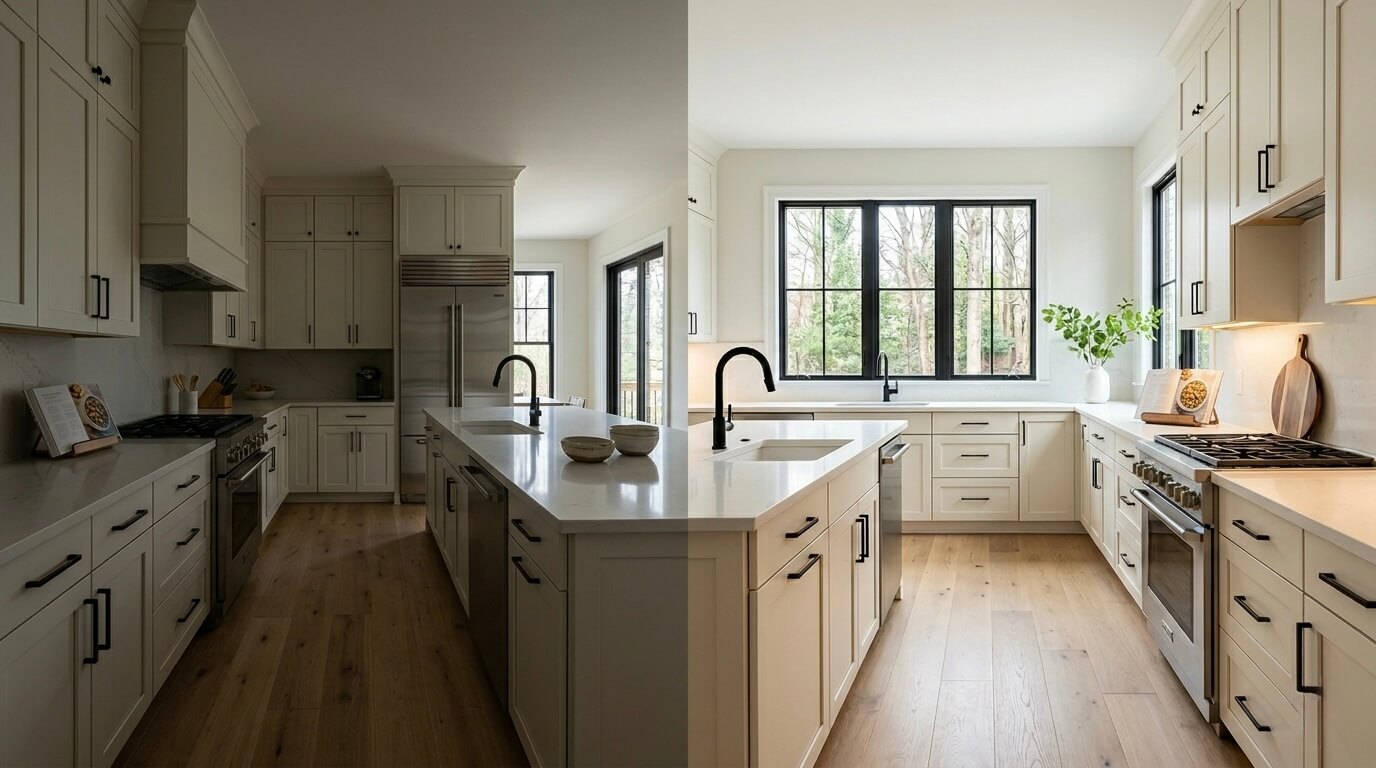
A large percentage of expensive kitchen remodel mistakes Vienna VA homeowners encounter are not caused by poor craftsmanship during construction, they begin much earlier during planning, budgeting, and design coordination. In a market like Vienna VA, where much of the housing inventory was built between the 1960s and 1990s, kitchen renovation projects frequently uncover infrastructure conditions that were never designed for modern cooking, lighting, ventilation, and appliance demands.
Many older homes across Vienna VA, Fairfax VA, and nearby Northern Virginia neighborhoods still contain kitchens built around compact appliance footprints, closed-off floor plans, limited countertop circulation, and outdated electrical systems. Once demolition begins, contractors commonly discover undersized electrical panels, aluminum branch wiring, aging drain lines, inadequate HVAC supply and return capacity, and load-bearing walls that complicate open-concept redesigns.
At the same time, Vienna’s real estate market continues to support aggressive remodeling investment. Redfin reports that Vienna VA home values remain substantially above national averages, reinforcing strong renovation activity throughout Fairfax County and surrounding Northern Virginia markets. [Source: Redfin]
The problem is not remodeling itself, it is entering a kitchen renovation Vienna VA project without understanding the structural, permitting, and budgeting realities specific to this market. Poor planning often leads to permit delays, inspection failures, change orders, inefficient layouts, and long-term resale limitations.
A properly planned remodel, however, improves far more than aesthetics. The best Northern Virginia kitchen remodel projects increase workflow efficiency, storage capacity, lighting quality, energy performance, and overall resale competitiveness in one of Fairfax County’s most valuable residential markets.
MISTAKE #1: STARTING WITHOUT A REALISTIC BUDGET
One of the most common kitchen remodel mistakes Vienna VA homeowners make is establishing a renovation budget before defining the actual project scope. In Northern Virginia, where labor demand, permit requirements, and finish expectations are significantly above national averages, unrealistic budgeting is the fastest route to mid-project financial stress.
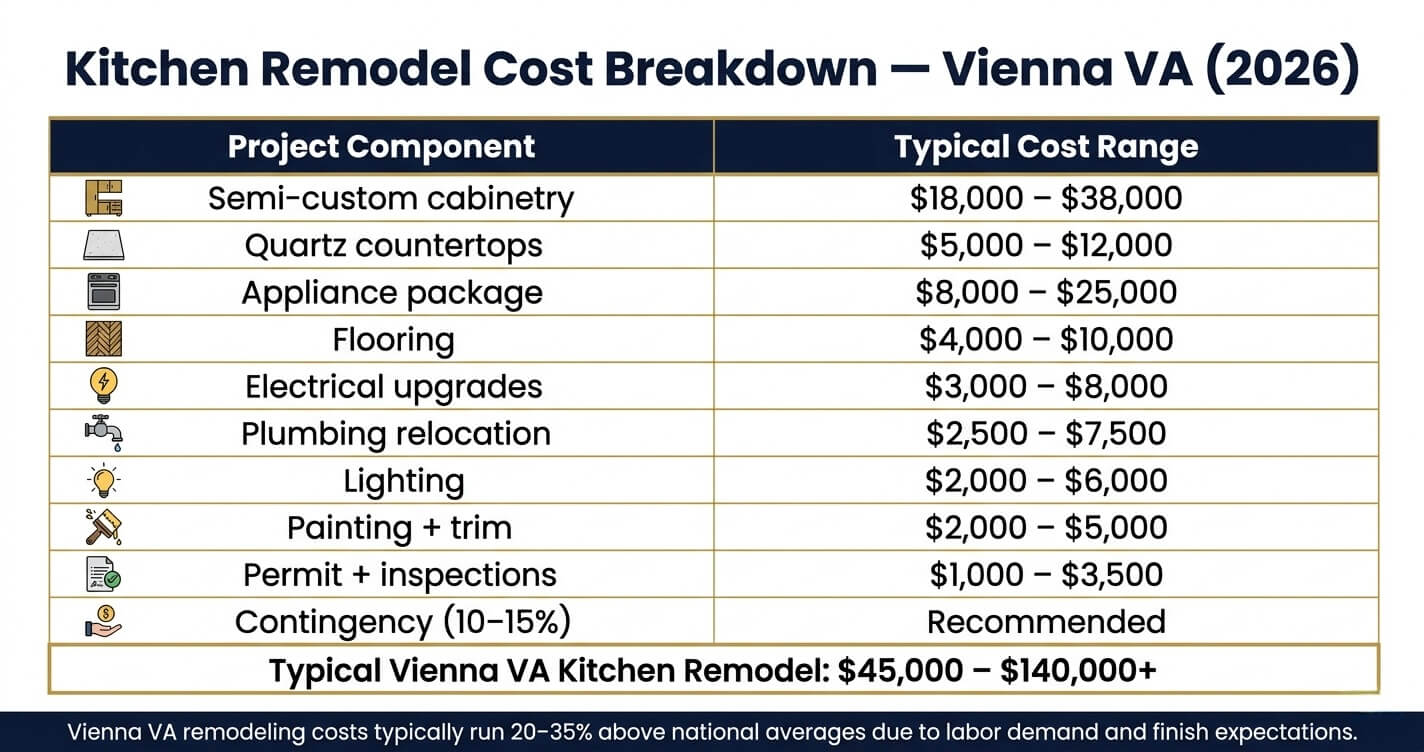
According to the 2025 Houzz U.S. Kitchen Trends Study, major kitchen remodels involving cabinetry replacement, layout changes, plumbing relocation, and premium appliances consistently cost substantially more than cosmetic refresh projects. [Source: Houzz — U.S. Kitchen Trends Study]
In Vienna VA, kitchen remodeling costs are commonly 20–35% above national averages due to Fairfax County labor rates, permit compliance requirements, skilled-trade demand, and the prevalence of high-end finish selections in this market. Homeowners frequently budget for visible materials — cabinets, countertops, tile, and appliances, while underestimating the hidden infrastructure costs that actually drive project overruns.
The most common budgeting blind spots include:
- Electrical panel upgrades for modern appliance loads
- Structural beam installation after wall removal
- Plumbing relocation for island sinks or wet zones
- HVAC rerouting for open-concept layouts
- Temporary kitchen setup costs during construction
- Permit revisions and inspection-related delays
- Long-lead custom cabinetry and appliance storage fees
Appliance allowances are another major issue. Many homeowners initially budget using entry-level appliance pricing, only to later select professional-grade packages that increase electrical, ventilation, and cabinetry requirements simultaneously.
A properly structured budget for a kitchen remodeling Vienna VA project should separate fixed construction costs from finish allowances and include a realistic contingency reserve of at least 10–15% for older Vienna homes.
Pro Tip
An experienced design-build contractor should establish the project scope, material allowances, contingency assumptions, permit requirements, and infrastructure evaluation before demolition begins. This pre-construction process is what prevents most change-order disputes and schedule overruns in Fairfax County remodeling projects.
MISTAKE #2: IGNORING KITCHEN WORKFLOW AND LAYOUT
Many homeowners believe the success of a kitchen remodel depends primarily on finishes, countertops, cabinet colors, tile selections, or appliance brands. In reality, the majority of long-term renovation regrets come from workflow and layout failures. Function always outlasts aesthetics.
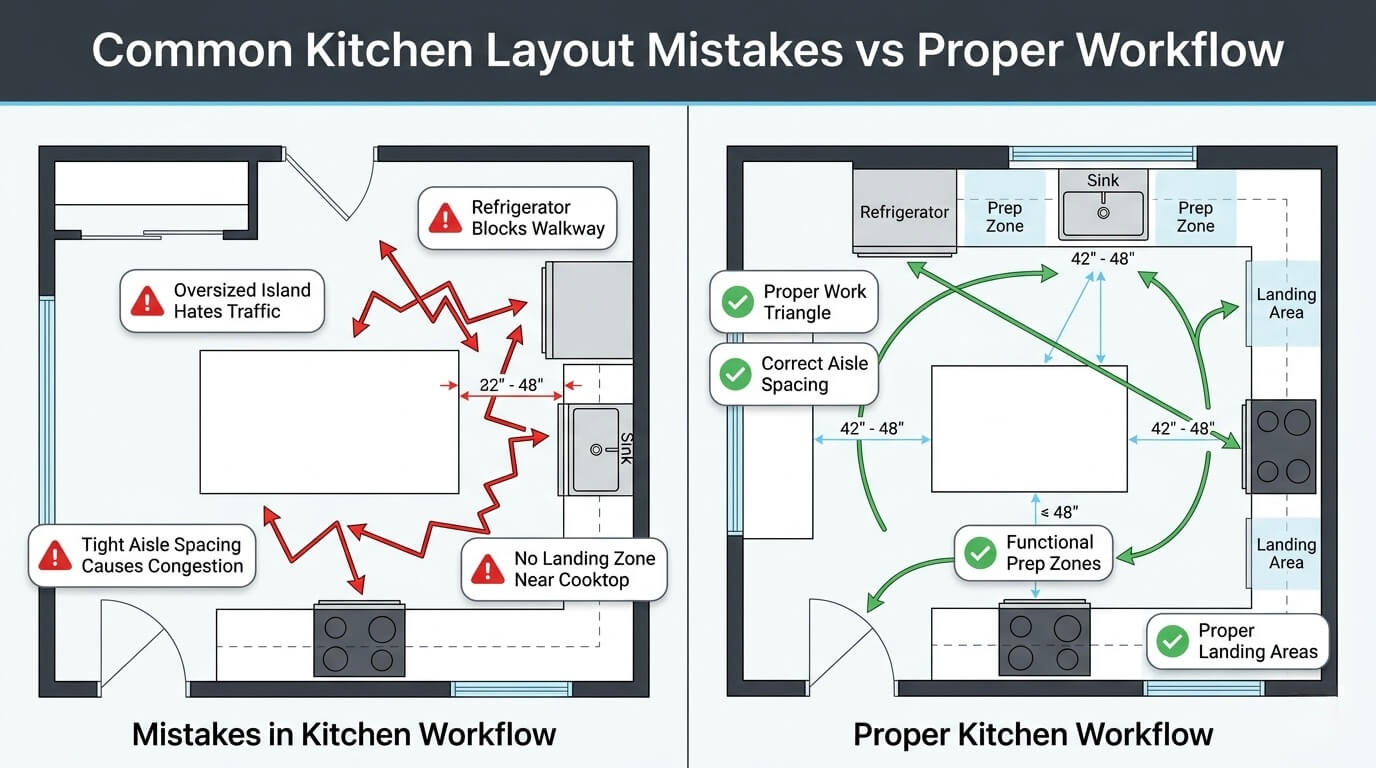
Poor kitchen circulation creates daily frustration even in visually impressive kitchens. Common kitchen design mistakes include oversized islands that restrict movement, appliance doors that collide during use, insufficient landing space beside ranges and refrigerators, narrow aisle spacing, and inefficient work-triangle relationships between the sink, refrigerator, and cooktop.
The National Kitchen & Bath Association (NKBA) establishes professional planning guidelines for kitchen circulation, landing zones, walkway clearances, and workflow efficiency. These standards recommend specific aisle widths and spacing requirements to improve functionality and safety in active kitchens. [Source: National Kitchen & Bath Association]
In Vienna VA, layout problems are especially common because many older homes were originally designed with compartmentalized kitchens separated from dining and living areas. Creating the open-concept layouts now preferred across Northern Virginia frequently requires major structural modifications, including:
- Load-bearing wall removal
- LVL or steel beam installation
- HVAC duct relocation
- Plumbing rerouting
- Electrical rewiring
- Lighting redesign
These structural changes significantly affect kitchen remodel cost Vienna VA projects and must be evaluated before finalizing any design direction.
Another frequent mistake is prioritizing island size over circulation quality. Oversized islands may look impressive in renderings but often create cramped pathways that reduce functionality during real-world use.
For homeowners evaluating budgeting expectations in nearby luxury markets, our guide on Kitchen Remodel Cost in McLean VA explains how layout complexity, structural modifications, and finish level dramatically influence total renovation pricing across Northern Virginia.
MISTAKE #3: CHOOSING CABINETS BASED ONLY ON APPEARANCE
One of the most expensive kitchen remodel mistakes Vienna VA homeowners make is selecting cabinetry based primarily on showroom appearance while overlooking construction quality, installation precision, and long-term durability. In most Northern Virginia kitchen remodels, cabinetry is not just a finish material; it is the backbone of storage efficiency, workflow, and daily functionality.
According to the National Association of Home Builders (NAHB), cabinetry consistently represents the single largest component of a kitchen remodeling budget. [Source: NAHB]
The difference between MDF cabinet boxes and plywood construction becomes especially important in Vienna VA homes where humidity fluctuations, older framing conditions, and heavy daily use place additional stress on cabinetry systems. Lower-grade MDF components are more vulnerable to moisture swelling and hinge loosening over time, while plywood cabinet boxes generally provide superior structural rigidity and screw retention.
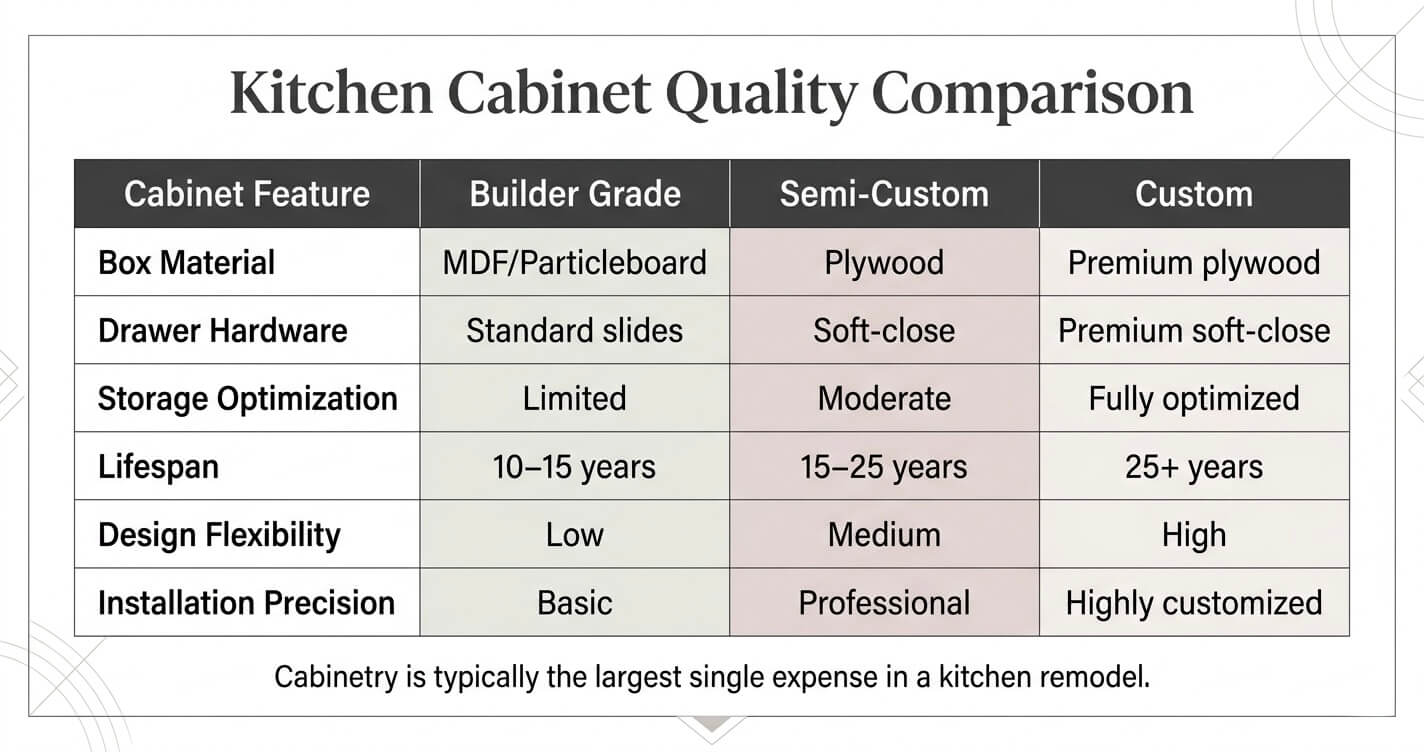
Hardware quality matters equally. Soft-close undermount drawer systems, full-extension glides, and commercial-grade hinges significantly extend cabinet lifespan and improve usability. Homeowners also frequently misunderstand the difference between full-overlay and inset cabinetry. Inset cabinets deliver a premium architectural appearance but require extremely precise installation tolerances, particularly in older Vienna VA homes where walls and floors are rarely perfectly level.
Custom and semi-custom cabinetry decisions should also reflect storage strategy, not just aesthetics. Deep drawers, appliance garages, pull-out organizers, tray dividers, and integrated waste systems typically add more long-term functional value than decorative door profiles alone.
The reality is that even premium cabinets perform poorly when installation tolerances are inaccurate. Proper shimming, leveling, scribing, and fastening are what determine whether a kitchen still functions correctly 15 years later, not simply how the cabinets looked under showroom lighting on day one.
MISTAKE #4: UNDERESTIMATING PERMITS AND FAIRFAX COUNTY CODE REQUIREMENTS
One of the most common causes of kitchen remodeling delays in Vienna VA is assuming the project is “cosmetic only” when the actual scope triggers multiple Fairfax County permit requirements. In Northern Virginia, kitchen remodels frequently involve structural modifications, electrical upgrades, plumbing relocation, or ventilation changes, all of which fall under regulated construction activity.
As of January 18, 2025, Fairfax County requires all permit applications to comply with the 2021 Virginia Uniform Statewide Building Code (USBC), with no transitional grace period. [Source: Fairfax County Land Development Services]
In Vienna VA, permits are commonly required for:
- Removing or modifying load-bearing walls
- Relocating plumbing supply or drain lines
- Installing new gas lines for ranges or cooktops
- Electrical panel upgrades or new dedicated circuits
- Range hood ventilation modifications
- Window enlargements or exterior wall alterations
All permit submissions in Fairfax County are processed through the PLUS portal. [Source: Fairfax County PLUS Portal]
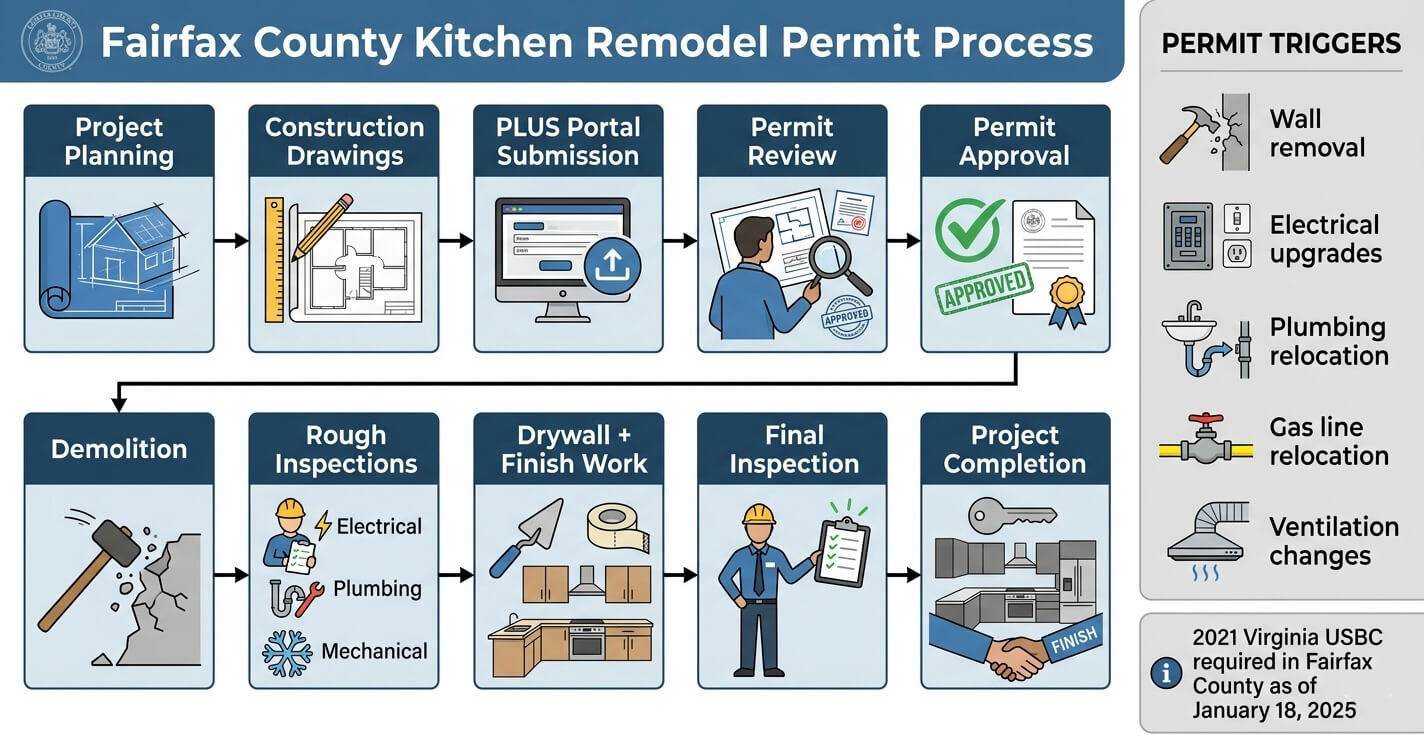
Structural kitchen remodels often require multiple inspections, including framing, electrical rough-in, plumbing rough-in, insulation, and final inspections before permit closure. Homeowners who skip permits or rely on incorrect DIY assumptions frequently encounter failed inspections, stop-work orders, delayed resale transactions, and insurance complications following future claims.
This becomes especially important in older Vienna VA homes from the 1960s–1980s, where opening walls regularly exposes outdated wiring, undersized electrical service, or non-compliant prior renovations.
For a detailed breakdown of permit triggers, inspection stages, and the Fairfax County submission process, see our guide on Remodeling Permit Fairfax County.
A qualified kitchen remodeling contractor in Northern Virginia should identify permit requirements during the planning phase, before demolition begins, not after inspectors are already involved.
MISTAKE #5: PRIORITIZING TRENDS OVER RESALE VALUE
Another major kitchen remodel mistake Vienna VA homeowners make is designing exclusively around short-term trends instead of long-term usability and resale positioning. Trend-driven kitchens often photograph well initially but can age rapidly in Northern Virginia’s highly competitive real estate market.

Highly saturated cabinet colors, ultra-modern slab designs in traditional neighborhoods, oversized decorative fixtures, and heavily personalized layouts frequently reduce broad buyer appeal within only a few years. This is particularly relevant in Vienna VA, where buyers consistently favor transitional kitchen design, combining classic architectural character with modern functionality.
In practice, the highest-performing kitchen remodels in Vienna VA and nearby McLean VA typically prioritize:
- Neutral or warm natural color palettes
- Quartz countertops with low-maintenance durability
- Functional storage systems
- Layered lighting design
- Open-concept layouts with clear circulation paths
- Timeless cabinet profiles over trend-heavy detailing
According to the 2025 Cost vs. Value Report by Zonda, kitchen remodels continue to rank among the strongest ROI-producing residential renovation projects nationally. [Source: Zonda]
The strongest long-term design strategy is usually moderation, incorporating current trends through lighting, paint, hardware, or decorative accents while keeping permanent architectural components timeless.
This is especially important in Northern Virginia luxury markets, where buyers expect kitchens to feel updated without appearing overly customized to a previous owner’s taste.
For a broader breakdown of design directions shaping upscale remodels across the region, see our article on Top Remodeling Trends in Northern Virginia.
MISTAKE #6: HIRING THE WRONG CONTRACTOR
One of the most expensive kitchen remodel mistakes Vienna VA homeowners make is selecting a contractor based primarily on price rather than process, licensing, and local permit experience. In Northern Virginia, kitchen remodeling is not simply finish installation — it is a coordinated construction project involving electrical systems, plumbing, ventilation, inspections, scheduling, and code compliance. The contractor selection process ultimately determines whether the remodel stays on schedule, passes inspections efficiently, and remains financially controlled.
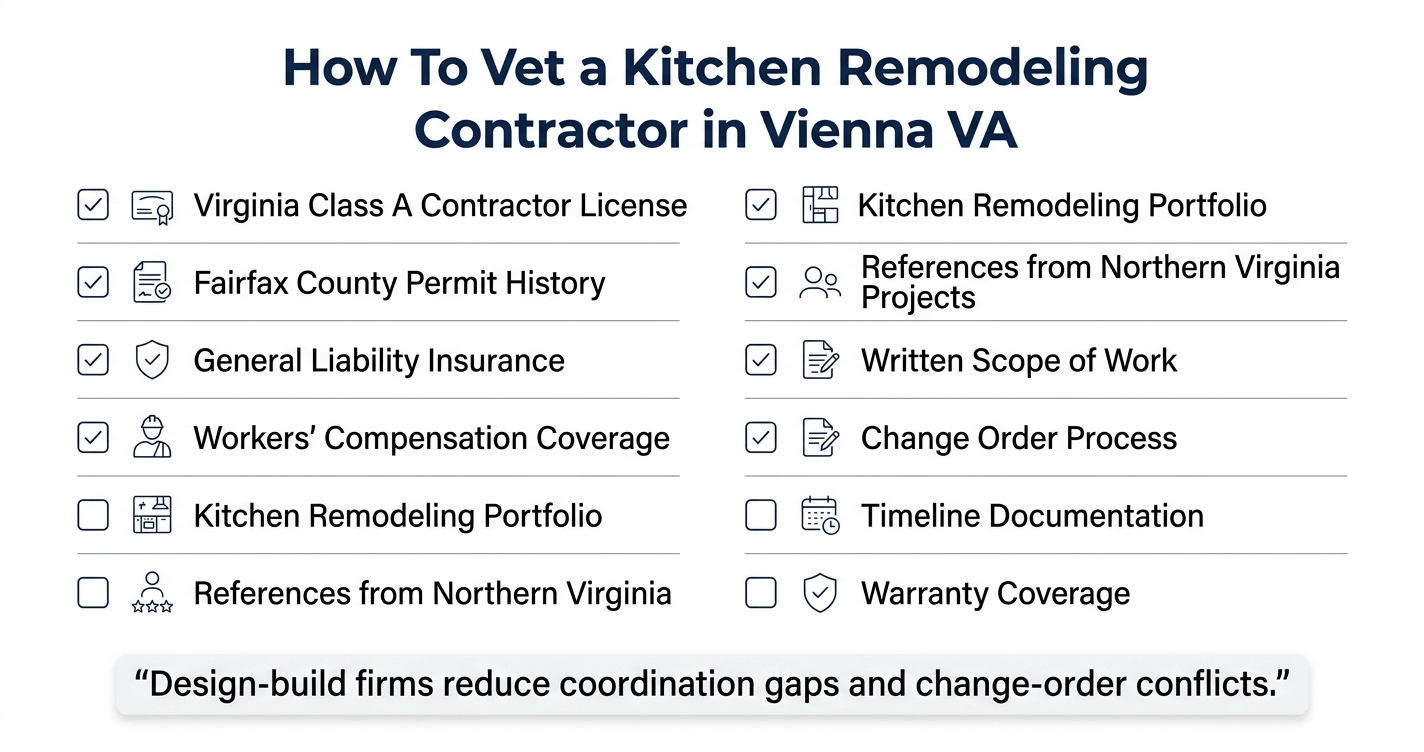
Before signing any contract, homeowners should independently verify the contractor’s Virginia Class A license through the Virginia Department of Professional and Occupational Regulation (DPOR). [Source: Virginia DPOR License Lookup]
In addition to licensing, homeowners in Vienna VA should request:
- current general liability and workers’ compensation certificates
- a recent Fairfax County permit history
- a kitchen-specific remodeling portfolio
- references from projects completed in Northern Virginia
- a written explanation of how subcontractors are coordinated during construction
This last point matters more than many homeowners realize. Kitchen remodeling involves electricians, plumbers, cabinet installers, countertop fabricators, flooring crews, drywall teams, and inspectors working in sequence. Poor coordination between trades is one of the primary causes of delays and change orders.
For this reason, the design-build model has become increasingly common in high-value Northern Virginia kitchen remodeling projects. Instead of separate designers and contractors operating independently, a design-build structure places the entire project under one accountability system: Consultation → Design → Build → Maintain. This reduces communication gaps, scheduling conflicts, and scope inconsistencies before demolition begins.
US Home Design Build applies this integrated process across Vienna VA and surrounding Fairfax County communities, managing kitchen remodeling projects from design planning and permit submission through final inspection and post-project support. Clients consistently note that projects stay organized and schedule disruptions remain limited when scope decisions are finalized early and managed by a single coordinated team.
For a deeper contractor vetting framework specific to this market, see our guide on How to Choose the Right Contractor in Northern Virginia.
MISTAKE #7: IGNORING LIGHTING AND VENTILATION
Lighting and ventilation failures are among the most overlooked kitchen design mistakes in Northern Virginia remodels. Many Vienna VA homeowners focus heavily on cabinetry and countertops while underestimating how lighting layout and air movement affect the kitchen’s daily usability.
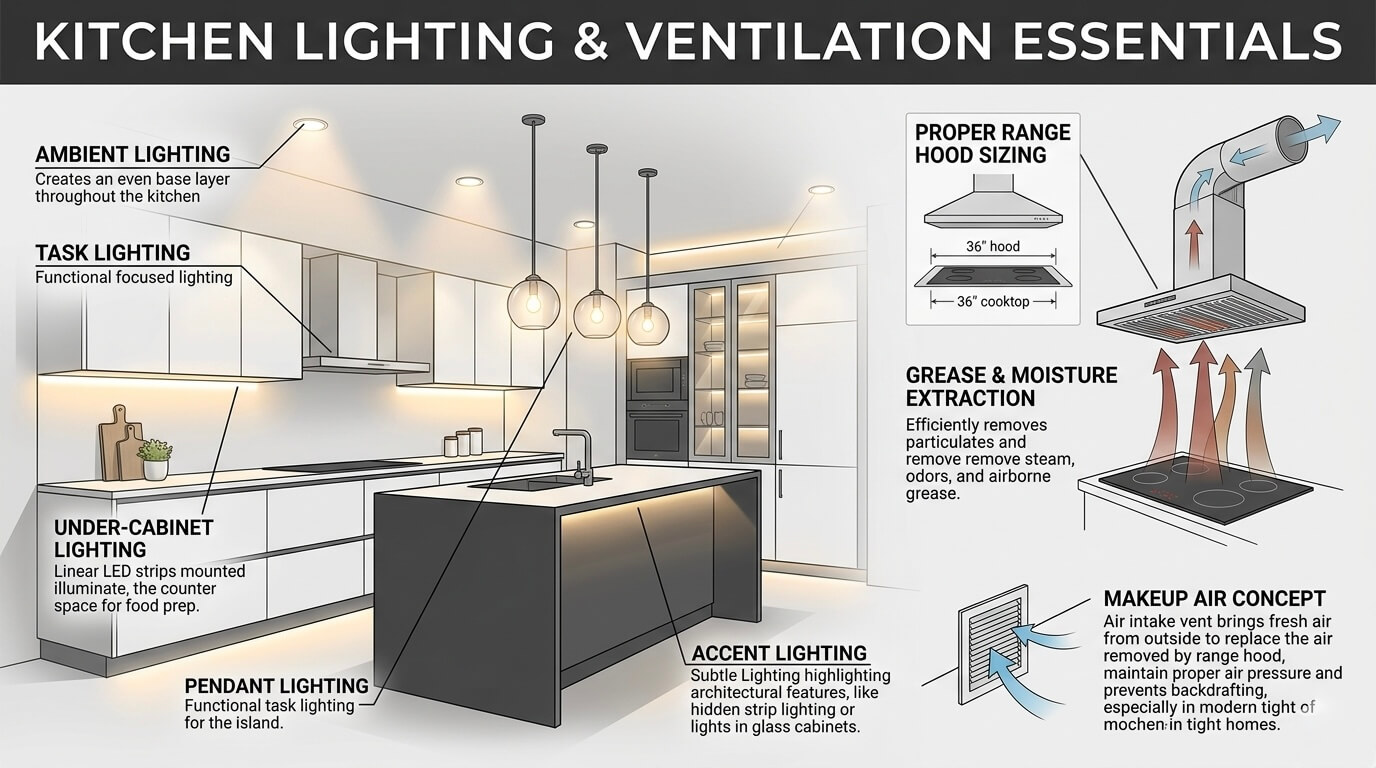
An effective kitchen lighting plan should combine three separate layers:
- ambient lighting for overall illumination
- task lighting for work surfaces
- accent lighting for depth and visual balance
In practical terms, this means recessed ceiling lights spaced correctly across circulation zones, under-cabinet lighting at preparation surfaces, and dedicated lighting over islands or dining areas. Poor recessed-light spacing often creates shadow lines directly over countertops, one of the most common layout complaints after remodel completion.
Ventilation is equally important. Undersized range hoods allow grease particles, humidity, and cooking contaminants to circulate throughout the home. Over time, this contributes to cabinet deterioration, indoor air quality issues, and moisture accumulation around ceilings and walls.
ENERGY STAR recommends properly ducted kitchen ventilation systems that effectively exhaust cooking pollutants outdoors rather than recirculating them internally. [Source: ENERGY STAR]
In larger Vienna VA kitchen remodels involving high-BTU gas ranges, makeup air requirements may also apply under current residential mechanical code standards. This becomes especially relevant in newer airtight homes or major open-concept renovations where ventilation loads increase substantially.
A technically correct kitchen remodel is not only about appearance, it is about airflow, visibility, comfort, and long-term performance.
MISTAKE #8: MAKING CHANGES AFTER CONSTRUCTION STARTS
One of the fastest ways to destabilize a kitchen remodeling project in Vienna VA is making major design or material changes after construction begins. Homeowners often assume mid-project adjustments are minor administrative revisions, but in practice, change orders create cascading impacts across scheduling, labor coordination, inspections, and material lead times.
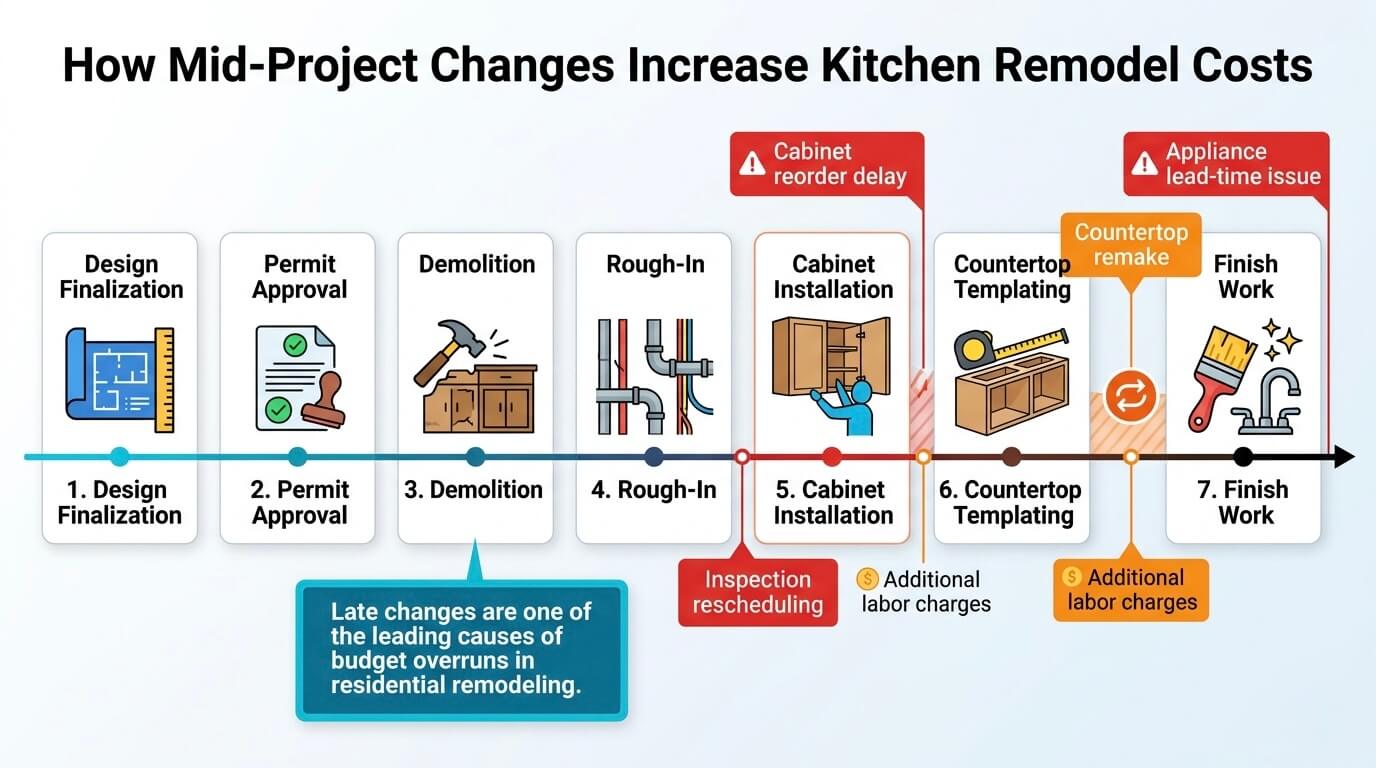
Kitchen remodeling operates in a strict sequence. Cabinet dimensions determine countertop templating. Appliance specifications affect electrical and plumbing rough-ins. Lighting selections impact switch placement and ceiling layouts. When one selection changes after demolition or framing has begun, multiple downstream trades are forced to stop, revise, or reorder materials.
Cabinetry is especially vulnerable to change-order disruption. Custom and semi-custom cabinets commonly carry lead times of 6–14 weeks depending on manufacturer availability. A single dimensional modification after ordering can trigger complete cabinet remanufacturing, delaying flooring, countertops, backsplash installation, and final inspections.
This issue becomes even more significant in Fairfax County permit-controlled remodels. Changes affecting plumbing, electrical, structural framing, or ventilation may require permit revisions or additional inspections before work can continue.
Experienced design-build firms reduce these disruptions by finalizing selections before:
- framing begins
- rough-in inspections occur
- cabinet orders are submitted
- countertop templating is scheduled
US Home Design Build’s planning process emphasizes early material coordination and scope verification specifically to minimize costly mid-project revisions. In practice, the projects that stay closest to budget are usually the projects where design decisions are completed before demolition starts, not during construction.
FREQUENTLY ASKED QUESTIONS [FAQs]
How much does a kitchen remodel cost in Vienna VA?
Kitchen remodel costs in Vienna VA vary substantially based on scope, structural work, and finish level. Cosmetic remodels typically begin around $35,000–$60,000, while full-scale kitchen remodeling projects with layout changes, custom cabinetry, premium appliances, and structural modifications frequently exceed $100,000 in Northern Virginia’s high-cost labor market.
Do kitchen remodels require permits in Fairfax County?
Yes. Fairfax County requires permits for most kitchen remodeling projects involving electrical work, plumbing relocation, ventilation modifications, wall removal, or structural changes. Permit applications must comply with the 2021 Virginia Uniform Statewide Building Code effective January 18, 2025.
How long does a kitchen remodel take in Vienna VA?
A cosmetic kitchen remodel may take 4–8 weeks, while a full structural renovation with permit approvals, custom cabinetry, inspections, and utility relocation commonly takes 10–16 weeks or longer depending on material lead times and Fairfax County inspection scheduling.
Is removing a wall in a kitchen expensive?
Removing a non-load-bearing wall is relatively straightforward. However, removing a load-bearing wall often requires structural engineering, beam installation, permit approval, and inspection sequencing. Costs increase significantly when HVAC, plumbing, or electrical systems run through the wall cavity.
What adds the most value in a kitchen remodel?
Functional layout improvements, high-quality cabinetry, quartz countertops, efficient lighting, upgraded appliances, and improved storage generally provide the strongest resale positioning in Vienna VA and broader Northern Virginia markets.
IN SUMMARY
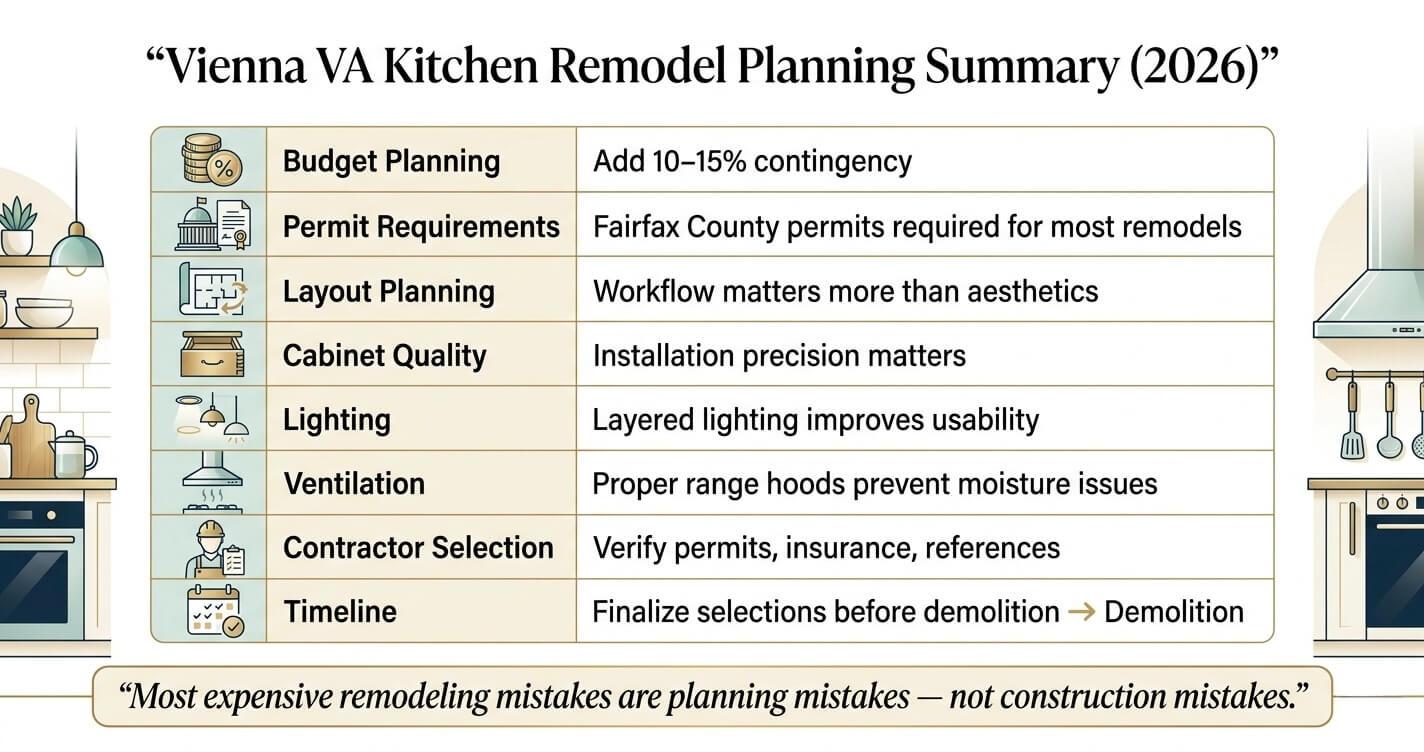
The most expensive kitchen remodel mistakes Vienna VA homeowners make are almost always planning mistakes, not construction mistakes. Unrealistic budgets, poor layout decisions, permit misunderstandings, trend-driven selections, and contractor coordination failures create the majority of delays and cost overruns seen in Northern Virginia kitchen remodeling projects.
The strongest remodel outcomes typically come from homeowners who:
- establish realistic budgets early
- finalize layouts before demolition
- understand Fairfax County permit requirements
- prioritize long-term functionality over short-term trends
- work with experienced contractors who understand local inspections, structural conditions, and sequencing
US Home Design Build works with homeowners across Vienna VA, McLean VA, Fairfax VA, and throughout Northern Virginia on kitchen remodeling and full home renovation projects. Their design-build approach integrates planning, permitting, construction, and project coordination under one accountable process designed to reduce delays and change orders.
703-202-3520 | US Home Design Build | 8200 Greensboro Dr Suite 900, McLean, VA 22102