
A growing number of homeowners are facing the same question: home renovation vs moving Northern Virginia, which option makes more financial sense in 2026?
Consider a typical McLean family living in a four-bedroom colonial. The neighborhood is ideal. The schools are excellent. The commute works. But the house no longer fits their lifestyle. Children need additional bedrooms, remote work requires dedicated office space, and the home’s layout feels increasingly constrained. At that point, homeowners generally face two choices: invest in a renovation that adapts the existing home to their needs or sell and purchase a larger property elsewhere.
In Northern Virginia, that decision carries unusually high financial stakes. Fairfax County home values now routinely range from approximately $725,000 to more than $950,000 depending on location and property type, making every transaction cost significantly more expensive than in many other U.S. markets.
The timing is also notable. National remodeling expenditures are projected to reach approximately $522 billion by the end of 2026, demonstrating that many homeowners across the country are choosing to improve their existing properties rather than relocate. [Source: Harvard Joint Center for Housing Studies (LIRA)]
This article provides a detailed side-by-side comparison of both paths. You’ll learn the true cost of moving, realistic renovation budgets in Northern Virginia, the impact of today’s mortgage rates, hidden expenses homeowners often overlook, and a practical framework for deciding which option delivers the strongest financial outcome.
Why the Renovation vs Moving Decision Hits Differently in Northern Virginia
For homeowners in many parts of the country, the decision to renovate or move is often driven primarily by lifestyle preferences. In Northern Virginia, however, the equation is far more complex because housing costs, mortgage rates, inventory constraints, and transaction expenses all combine to amplify the financial consequences of either choice.
The regional housing market has entered a more balanced phase compared to the extreme conditions seen during the pandemic years, but affordability pressures remain significant.
According to the Northern Virginia Association of Realtors (NVAR) and George Mason University Center for Regional Analysis, the median sold price across the NVAR region reached approximately $720,500, while Fairfax County single-family homes approached $956,000 in early 2026. [Source: NVAR & George Mason University 2026 Housing Forecast]
Another major factor is what economists call the mortgage rate lock-in effect. Thousands of Northern Virginia homeowners refinanced during 2020 and 2021 when 30-year mortgage rates fell below 3.5%. Today, replacing that mortgage means accepting financing costs nearly double those levels.
For example, a homeowner with a remaining mortgage balance of $600,000 at 3.0% may face monthly payments more than $1,000 higher if they move and finance a replacement property at current market rates. That payment increase continues long after the moving truck leaves.
Inventory conditions also remain challenging. Although active listings increased across many Northern Virginia jurisdictions during 2026, housing supply generally remains below two months, still well under the level considered balanced by most housing economists. Buyers therefore continue competing for limited inventory, especially in high-demand communities such as McLean, Vienna, Great Falls, Arlington, and Burke.
These market conditions help explain why more homeowners are evaluating renovation options before listing their homes. And if the decision is to stay, understanding which improvements create the greatest financial return becomes equally important. Homeowners considering renovation should review best ROI home improvements Northern Virginia before finalizing project priorities.
What Moving Actually Costs in Northern Virginia in 2026
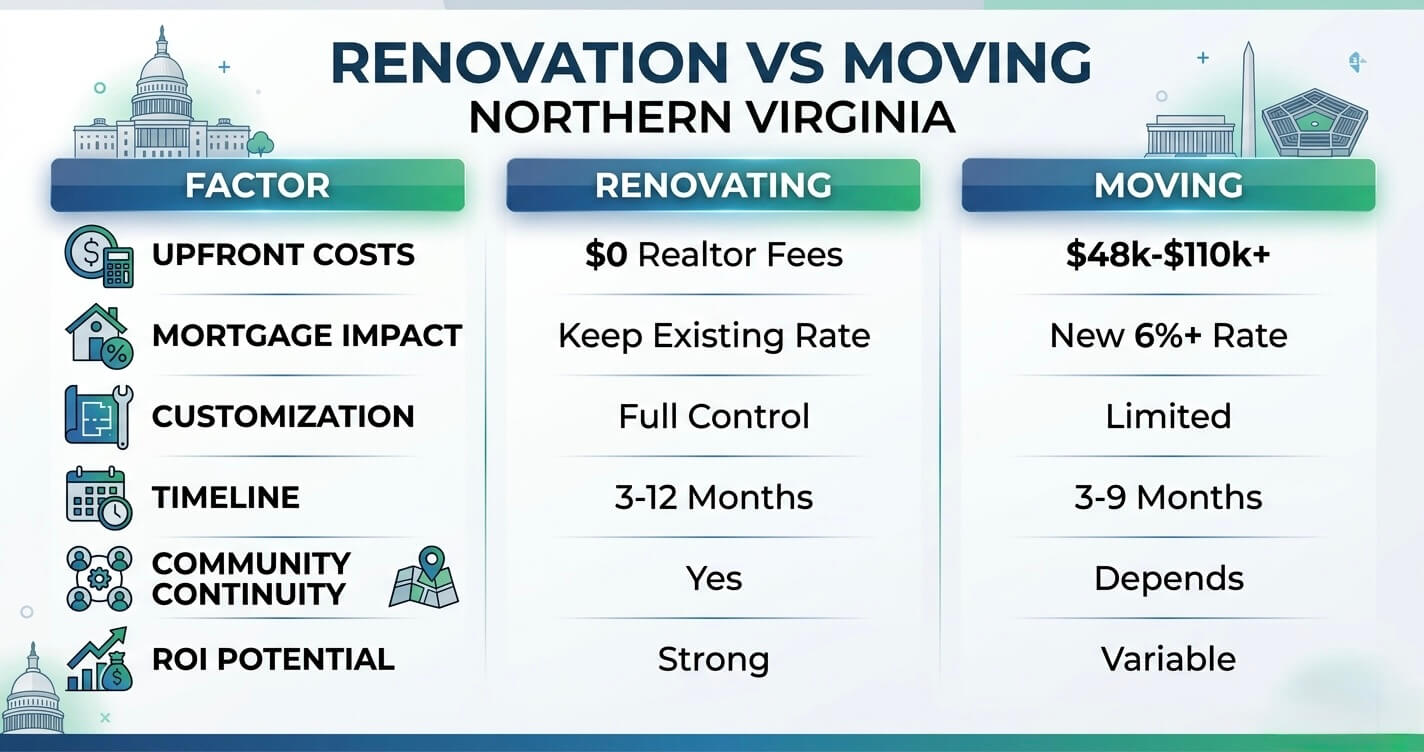
When evaluating home renovation vs moving Northern Virginia homeowners often underestimate the true cost of selling one property and purchasing another. The purchase price difference between homes is only part of the equation. Transaction expenses, financing changes, moving costs, and post-purchase improvements can collectively add six figures to the total cost of relocating.
Selling Your Current Home
Consider a homeowner selling a $750,000 property in Fairfax County.
The largest expense is typically the real estate commission. While rates vary by brokerage and negotiation, Virginia homeowners commonly pay approximately 5%–6% of the sale price in combined listing and buyer-agent commissions.
Additional expenses include:
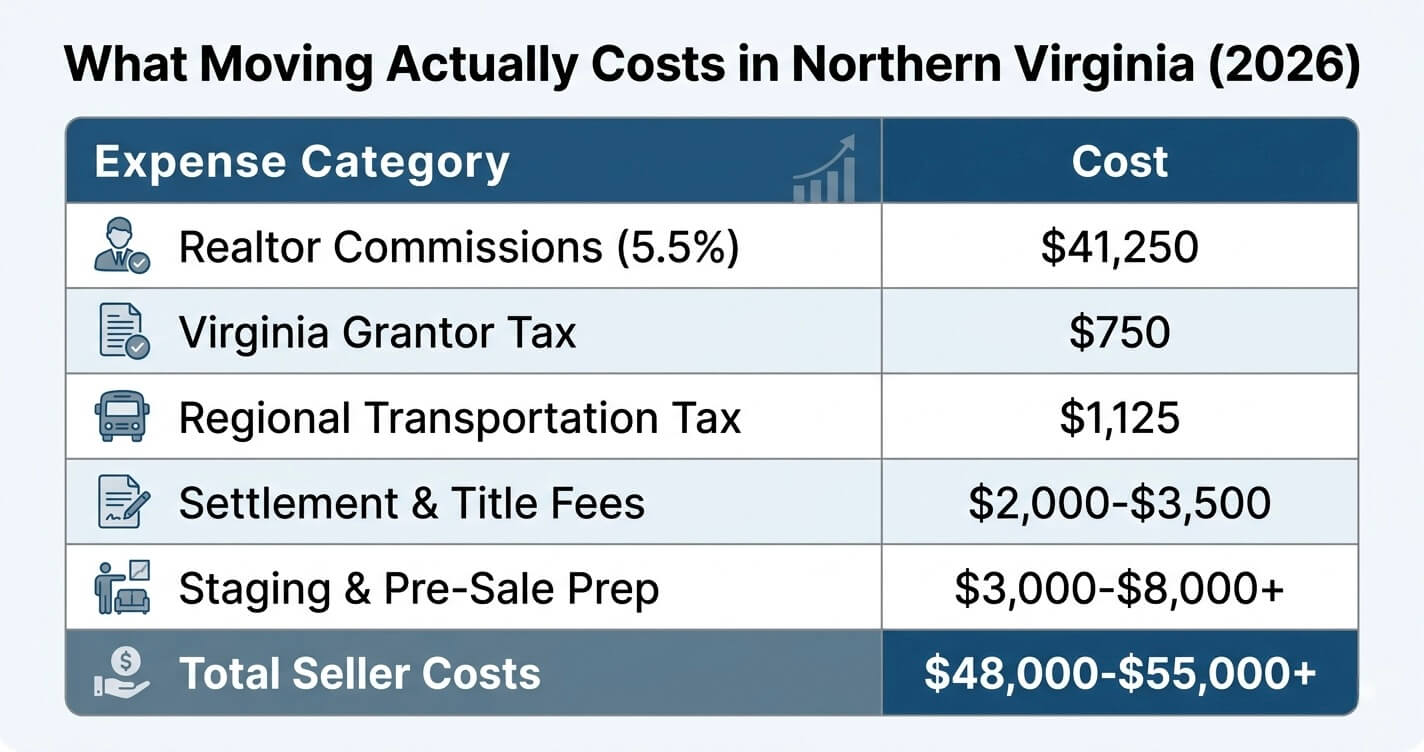
- Realtor commissions (approximately 5.5%): ~$41,250
- Virginia grantor’s tax (0.1%): ~$750
- Northern Virginia regional transportation transfer tax (0.15%): ~$1,125
- Settlement and title fees: $2,000–$3,500
- Pre-sale repairs, staging, photography, and preparation: $3,000–$8,000+
Total estimated seller costs can easily reach $48,000–$55,000+ before the homeowner receives proceeds from the sale. [Source: Virginia Seller Closing Cost Analysis]
Buying a Replacement Home
The expenses continue on the purchase side.
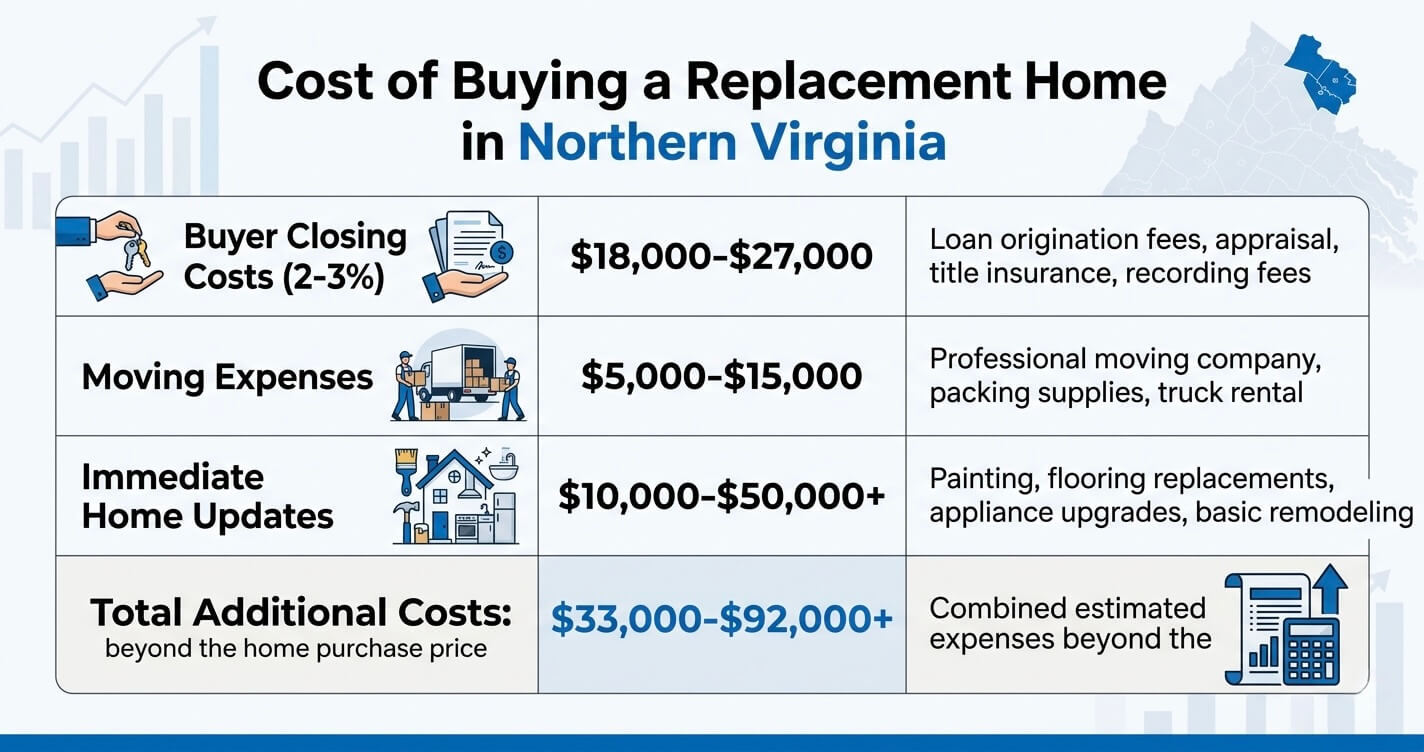
For a replacement home priced at $900,000, buyers should expect:
- Buyer closing costs: 2–3% of purchase price ($18,000–$27,000)
- Moving expenses: $5,000–$15,000
- Temporary storage or short-term housing if timelines do not align
- Immediate updates and personalization costs that many buyers incur after closing: $10,000–$50,000+
Even homes marketed as “move-in ready” frequently require painting, flooring upgrades, kitchen updates, bathroom improvements, or energy-efficiency improvements shortly after purchase.
Total Cost-to-Move Estimate
For a Northern Virginia homeowner selling a $750,000 home and purchasing a $900,000 replacement property, total transaction-related costs often fall between $75,000–$110,000+.
And that figure excludes future mortgage-rate impacts, furnishing expenses, and long-term carrying costs.
On a $750,000 Northern Virginia home, total selling costs alone can reach $56,000 or more, and that’s before accounting for the cost of purchasing and settling into a replacement property.
For many households, those transaction costs exceed the investment required for a strategic expansion project. In fact, many homeowners discover that professionally planned home additions Northern Virginia cost less than the combined expense of selling, buying, and moving.
What Home Renovation Actually Costs in Northern Virginia in 2026
Understanding the home renovation vs moving Northern Virginia cost equation requires an honest assessment of renovation pricing in today’s construction environment.
Northern Virginia consistently ranks among the most expensive remodeling markets in the Mid-Atlantic region. Construction costs are elevated due to strong demand for skilled labor, competition from major commercial development projects, extensive permitting requirements, and homeowner expectations for high-end finishes and architectural consistency.
Renovation Cost Ranges by Project Type
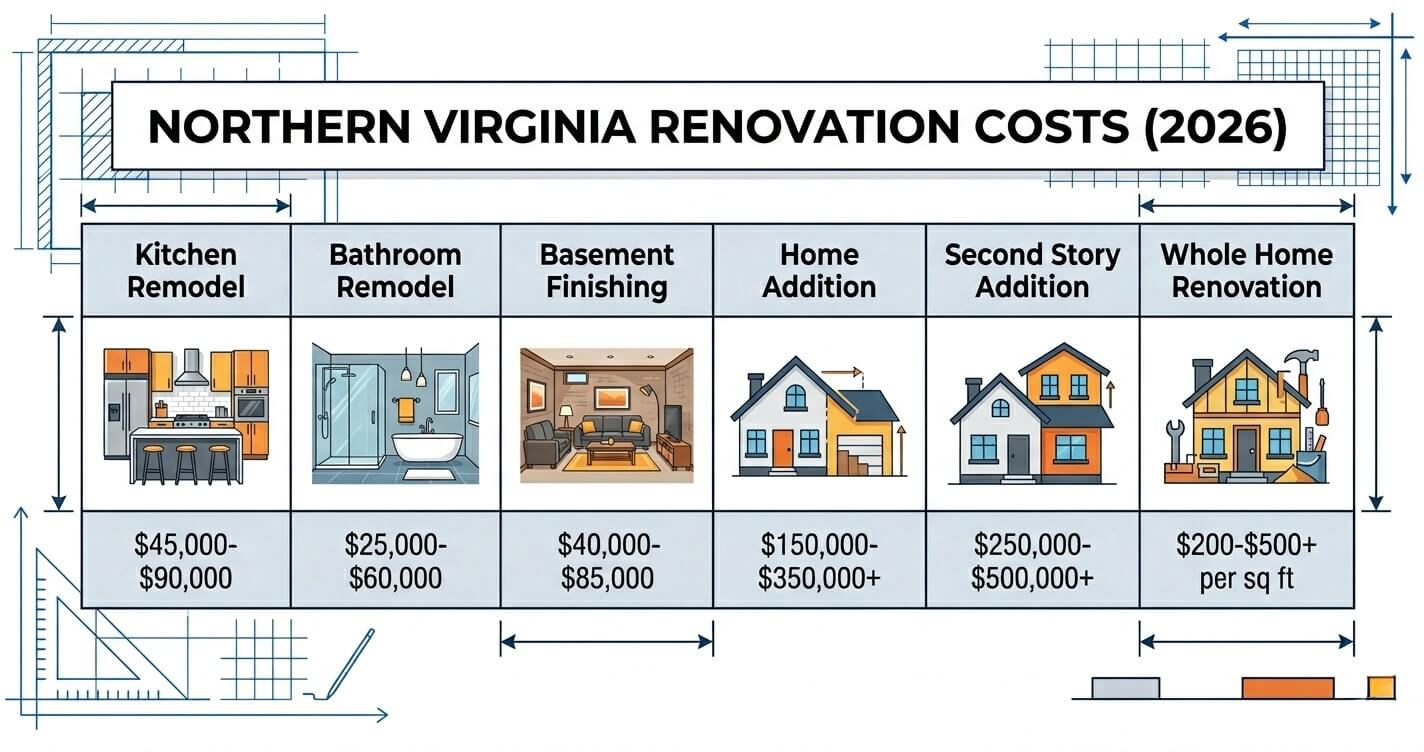
The following ranges reflect common 2026 pricing for professionally managed renovation projects in Northern Virginia:
For homeowners seeking substantial additional living space, a carefully designed addition often compares favorably against the combined transaction costs and mortgage impacts associated with moving.
Hidden Renovation Costs Homeowners Often Miss
One of the most common budgeting mistakes is focusing exclusively on the contractor’s base proposal while overlooking project-related expenses that frequently arise during construction.
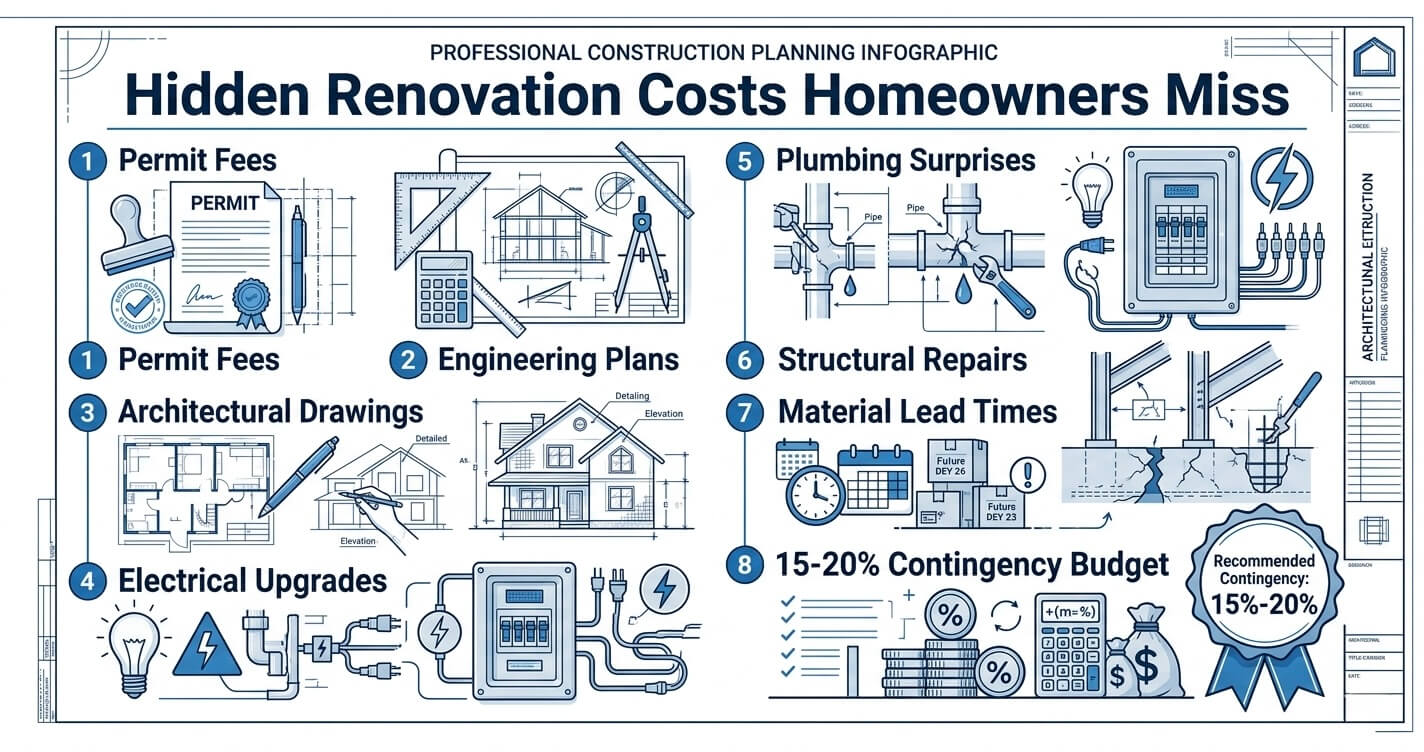
These may include:
- Permit Fees and Approvals
Fairfax County building permit fees increased approximately 12.5% in 2026, with bathroom renovation permits commonly ranging from $800–$1,500+ depending on scope. [Source: Monarch Custom Homes Remodeling Guide]
- Engineering and Architectural Services
Structural modifications, additions, and major layout changes often require engineered drawings, site documentation, and permit-ready plans before construction can begin.
- Existing Condition Discoveries
Older homes in Fairfax County, Falls Church, and Vienna frequently reveal hidden conditions after demolition, including:
- Outdated electrical systems
- Galvanized plumbing
- Inadequate insulation
- Structural modifications from previous renovations
- Material Lead Times
Custom cabinetry, specialty windows, and premium finish materials can require lead times of eight to twelve weeks or longer, impacting both project schedules and budgeting.
- Contingency Planning
Experienced design-build professionals generally recommend maintaining a contingency reserve of 15–20% above the initial construction budget, particularly when renovating older homes.
Working with experienced home renovation contractors Northern Virginia who understand local permitting requirements, inspection processes, and supply-chain realities can significantly reduce the risk of budget overruns and scheduling delays.
Considering Renovation? Start With Accurate Numbers
Homeowners considering a major renovation in Northern Virginia may benefit from discussing their specific scope and budget with an experienced design-build team before committing to either path. A realistic assessment often changes the numbers significantly.
The Hidden Cost of Moving: Your Mortgage Rate in 2026
One of the most important variables in the renovation-versus-moving equation never appears on a contractor estimate or real estate listing. It appears on a homeowner’s mortgage statement.
For many Northern Virginia homeowners, the single largest financial advantage of staying put is preserving a mortgage rate secured during the historically low-interest-rate environment of 2020 and 2021. Thousands of homeowners refinanced during that period at rates below 3.5%. Replacing that mortgage today often means accepting a rate that is nearly double.
According to Freddie Mac reporting referenced in regional housing market updates, the average 30-year fixed mortgage rate remained approximately 6.38% during spring 2026. [Source: Freddie Mac / Northern Virginia Housing Market Update]
The financial impact is substantial.
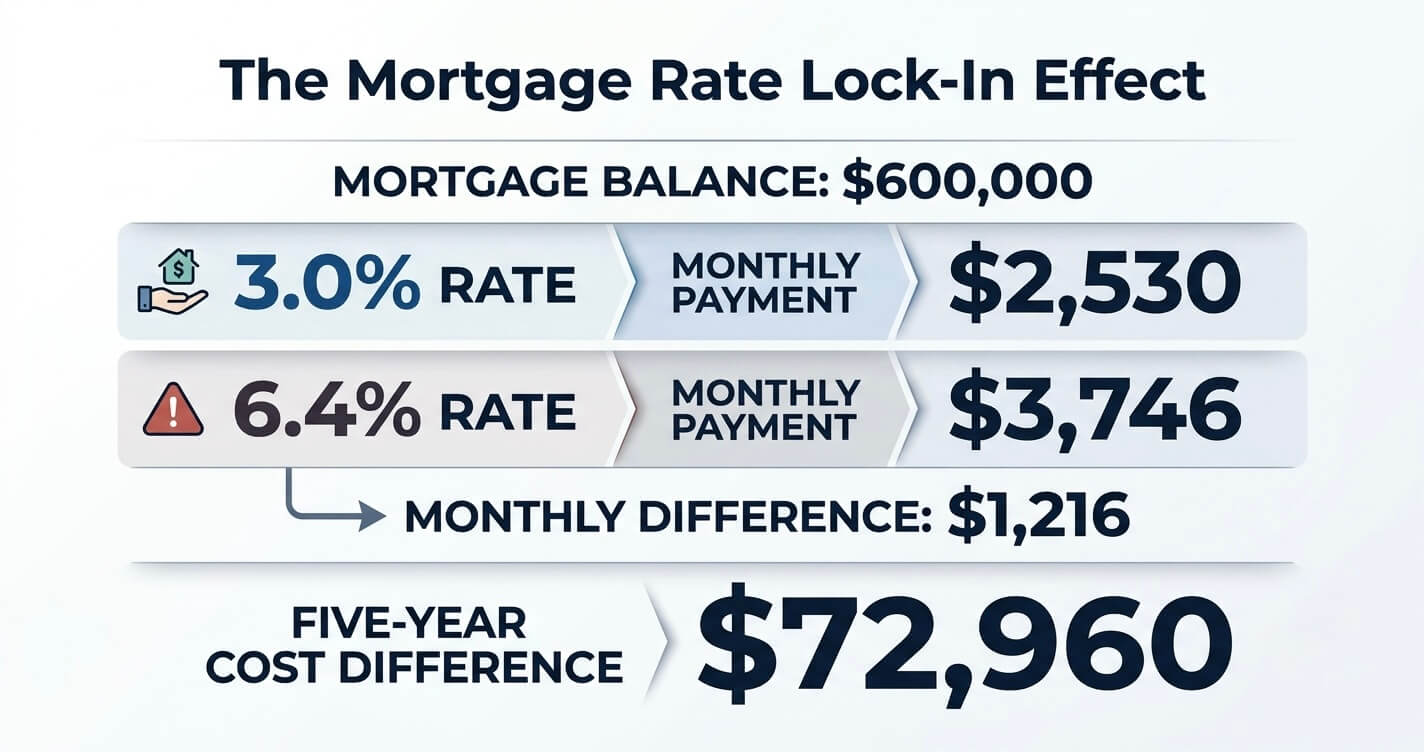
Consider a homeowner with a remaining mortgage balance of $600,000:
Difference: ~$1,216 per month
That translates to:
- Approximately $14,592 annually
- Approximately $72,960 over five years
Importantly, those additional costs provide no added square footage, no upgraded kitchen, no new bathroom, and no increase in functional living space. The homeowner is simply paying more to finance the same amount of debt.
This dynamic has become one of the strongest financial arguments in favor of renovation throughout Northern Virginia. Even homeowners who require significant additional space often discover that preserving their existing mortgage can offset a meaningful portion of a renovation investment over time.
The NVAR and George Mason University housing forecast suggests mortgage rates are likely to remain around current levels throughout much of 2026, meaning homeowners should not necessarily expect a near-term return to pandemic-era financing conditions. [Source: NVAR / George Mason University 2026 Forecast]
For homeowners who need substantially more square footage, a second story addition Northern Virginia often provides the space they need while allowing them to retain the favorable mortgage terms they’ve spent years protecting.
Rather than evaluating renovation costs in isolation, homeowners should compare them against the long-term cost of surrendering a low-interest mortgage. In many cases, the difference is large enough to fundamentally change the financial outcome of the decision.
When Moving Is the Better Choice in Northern Virginia
A credible renovation-versus-moving analysis must acknowledge an important reality: renovation is not always the best answer.
Although staying and improving an existing home frequently produces a stronger financial outcome in today’s Northern Virginia market, certain circumstances make moving the more practical and cost-effective solution.
The first is when the property has physical limitations that renovation cannot reasonably solve. Lot setbacks, zoning restrictions, easements, HOA regulations, or environmental constraints may prevent meaningful expansion. A homeowner who requires significantly more living space may simply not have enough buildable area available on the property.
Location can also outweigh financial considerations.
A homeowner may love their house but need a shorter commute, different schools, greater walkability, proximity to aging parents, or access to services unavailable in their current neighborhood. Renovation can improve the structure, but it cannot change the location.
Moving may also make sense for homeowners entering a downsizing phase. If children have moved out and a household no longer needs 3,500 square feet of living space, investing heavily in renovation may not align with long-term goals.
Another consideration is deferred maintenance. Some older homes require major investments in roofing, foundations, electrical systems, plumbing infrastructure, HVAC equipment, and structural repairs before cosmetic improvements can even begin. When these costs accumulate alongside a desired renovation scope, the economics can become difficult to justify.
Finally, market opportunities occasionally create situations where moving simply produces a better outcome. A highly desirable replacement property may become available at a price point that remains attractive even after accounting for transaction costs, financing changes, and relocation expenses.
The key takeaway is that moving is not inherently wrong. The objective is not to force renovation into every scenario. The objective is to evaluate both paths using complete financial data and realistic assumptions rather than relying on intuition alone.
Homeowners who perform a comprehensive analysis often discover that the right answer depends less on renovation costs and more on how effectively either option solves their underlying lifestyle and financial goals.
When Home Renovation Is the Smarter Financial Move in Northern Virginia
The home renovation vs moving Northern Virginia decision often favors staying put when several financial and lifestyle factors align.
The most common indicator is a low existing mortgage rate. Homeowners locked into financing below 4% possess a financial asset that is difficult to replicate in today’s lending environment. Preserving that rate can generate tens of thousands of dollars in savings over the coming years.
Renovation also tends to outperform moving when homeowners genuinely like where they live. Neighborhood relationships, school districts, commuting patterns, community amenities, and proximity to family all carry value that cannot be replicated through construction or captured in a financial spreadsheet.
In many cases, the problem homeowners are trying to solve is relatively specific:
- They need an additional bedroom.
- They need a dedicated home office.
- They want a larger kitchen.
- They require multigenerational living space.
- They need a primary suite addition.
When the challenge is clearly defined and technically solvable through renovation, investing in the existing property often becomes the more efficient option.
Equity also plays an important role. Homeowners who have owned their properties for several years typically possess substantial equity that can help fund strategic improvements while avoiding many of the transaction costs associated with moving.
Northern Virginia’s pricing structure further strengthens the case for renovation. In many communities, purchasing a comparable home with additional space may require spending $150,000 to $300,000 more than the value of the existing property. Once realtor commissions, transfer taxes, closing costs, moving expenses, and higher mortgage payments are included, the gap often widens further.
This is particularly true for multigenerational households. Homeowners evaluating the in-law suite addition cost Northern Virginia frequently discover that adding dedicated living space is considerably more cost-effective than relocating to a substantially larger home elsewhere in Fairfax County.
Ultimately, renovation tends to deliver the strongest value when homeowners like their location, have favorable financing, possess sufficient equity, and can solve their space challenges without fundamentally altering the character of the property.
Does Renovation Actually Add Value in the Northern Virginia Market?
One of the most common concerns homeowners express before beginning a major project is whether the investment will translate into measurable property value. While no renovation guarantees a dollar-for-dollar return, the Northern Virginia market has historically rewarded well-executed improvements more consistently than many regions of the country.
That trend is expected to continue.
According to the Northern Virginia Association of Realtors and George Mason University housing forecast, Fairfax County single-family home values are projected to increase approximately 1.9% during 2026, while overall housing activity is expected to remain relatively healthy. [Source: NVAR / George Mason University Housing Forecast]
Within the broader home renovation vs moving Northern Virginia financial analysis, this matters because homeowners are not investing in stagnant assets. They are improving properties located within one of the country’s most resilient housing markets.
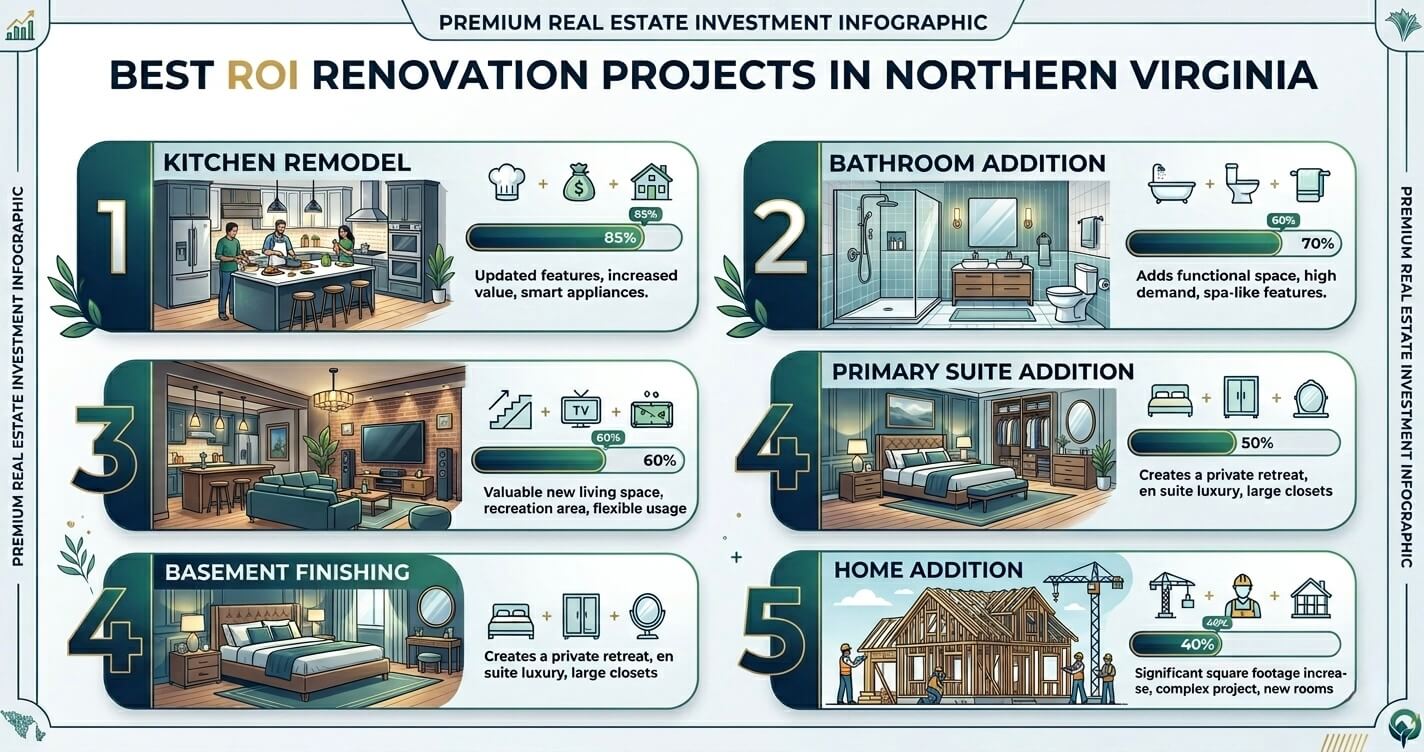
Historically, projects that tend to generate the strongest returns in Northern Virginia include:
- Kitchen remodels
- Bathroom additions and renovations
- Basement finishing projects
- Primary suite expansions
- Thoughtfully designed home additions
The common characteristic among high-performing projects is functionality. Buyers consistently pay premiums for homes that offer improved layouts, updated finishes, additional usable living space, and modern systems.
Quality execution also matters significantly in upper-tier Northern Virginia submarkets such as McLean, Vienna, Great Falls, and Arlington.
Poorly integrated additions, mismatched architectural details, and low-quality workmanship can reduce buyer appeal despite substantial investment. Conversely, professionally designed renovations that maintain architectural consistency often command stronger resale premiums because they feel original to the home rather than appended to it.
This is one reason design-build projects frequently outperform fragmented renovation approaches. Coordinated planning allows structural, aesthetic, and functional decisions to support long-term value creation rather than focusing solely on short-term cost reduction.
Homeowners primarily focused on maximizing resale performance should also review best ROI home improvements Northern Virginia 2026 before finalizing a renovation scope.
The important distinction is that renovation should not be viewed exclusively as an investment vehicle. Most projects deliver value through a combination of improved daily living, increased functionality, preserved location advantages, and enhanced marketability. In a strong housing market such as Northern Virginia, those benefits often combine to produce returns that compare favorably against the cost and disruption of moving.
How to Decide: A Practical Framework for Northern Virginia Homeowners
The home renovation vs moving Northern Virginia decision ultimately comes down to four variables: financing, location, functionality, and total cost.
Many homeowners begin the process by comparing renovation estimates against listing prices on real estate websites. While understandable, that approach often overlooks the broader financial picture. A more effective framework evaluates both options through the lens of long-term value rather than short-term expense.
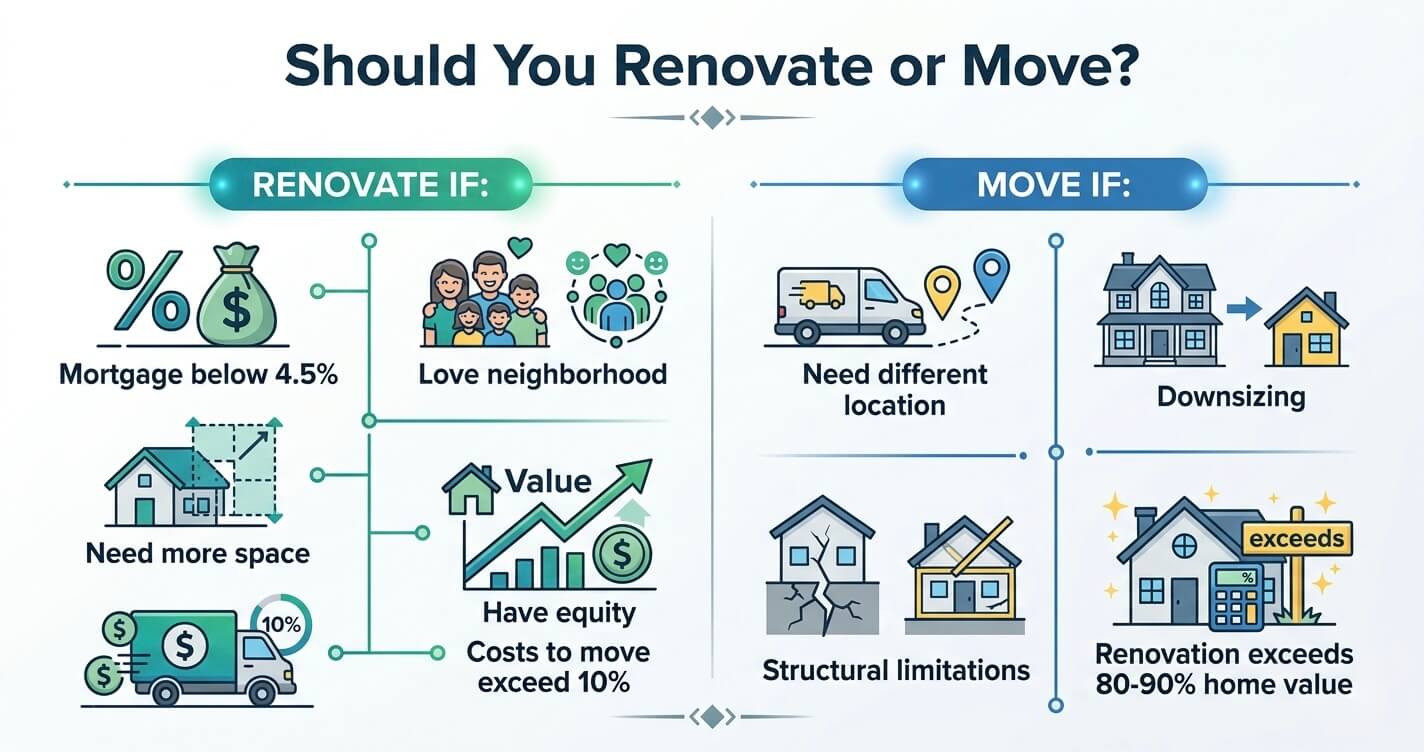
Renovate If:
Your Mortgage Rate Is Below 4.5%
A low-interest mortgage represents a significant financial advantage in today’s market. Preserving that rate may save tens of thousands of dollars over the next five years compared to financing a replacement home.
You Love Your Neighborhood
Location remains one of the few factors that renovation cannot change. If your current home offers access to preferred schools, a convenient commute, established community relationships, or proximity to family, renovation allows you to preserve those benefits.
The Renovation Solves a Specific Problem
Projects tend to generate the strongest value when they address a clearly defined challenge such as insufficient living space, lack of a home office, outdated functionality, or the need for multigenerational accommodations.
Moving Costs Exceed 10% of Your Home’s Value
In many Northern Virginia transactions, selling costs, closing costs, moving expenses, and financing changes can collectively exceed ten percent of a home’s market value. When transaction costs alone approach six figures, renovation often becomes the more efficient use of capital.
You Have Adequate Equity
Homeowners with substantial equity generally have more flexibility when financing improvement projects and are often able to leverage that equity while retaining favorable mortgage terms.
Move If:
The Property Has Fundamental Limitations
Lot constraints, zoning restrictions, HOA regulations, floodplain issues, or structural challenges may limit the effectiveness of renovation.
Your Location No Longer Fits Your Lifestyle
If your priorities have shifted significantly and require a different school district, commute pattern, neighborhood environment, or housing type, moving may provide a more comprehensive solution.
Renovation Costs Approach Replacement Value
When renovation costs exceed roughly 80–90% of the home’s current market value, homeowners should carefully evaluate whether they are approaching over-improvement territory.
A Superior Replacement Property Exists
Occasionally, a replacement home becomes available that solves multiple problems simultaneously while remaining financially reasonable after transaction costs are considered.
The Most Important Step: Run the Full Numbers
The most successful homeowners do not compare a renovation estimate against a Zillow valuation. They compare the complete cost stack on both sides.
That means evaluating:
- Selling expenses
- Closing costs
- Mortgage-rate changes
- Moving costs
- Immediate improvements to a replacement property
- Renovation costs
- Permit fees
- Financing costs
- Long-term ownership goals
Only after all of those variables are considered does the true financial picture emerge.
Working with a Design-Build Team to Evaluate Your Options
For homeowners considering a major renovation, one of the most valuable exercises is obtaining an accurate understanding of project scope, feasibility, timeline, and cost before making any commitment.
This is where the design-build process provides a significant advantage.
Unlike traditional construction delivery methods that separate design and construction into independent phases, a design-build approach integrates planning, budgeting, permitting, and construction management from the beginning. This allows homeowners to evaluate renovation feasibility using real project data rather than assumptions.
At US Home Design Build, the process begins with understanding the homeowner’s goals, challenges, and budget parameters. Whether the objective is a home addition, whole-home renovation, second-story expansion, basement transformation, or multigenerational living solution, the goal is to establish realistic expectations before major financial decisions are made.
This evaluation becomes particularly valuable when homeowners are also considering moving. Understanding what a renovation would actually cost allows for a meaningful comparison against the total cost of selling and purchasing another property.
USHDB serves homeowners throughout:
- McLean
- Vienna
- Great Falls
- Fairfax
- Burke
- Arlington
- Reston
- Falls Church
- Surrounding Northern Virginia communities
The firm’s design-build process includes coordination of design development, permitting, construction management, scheduling, and project execution, helping homeowners navigate the complexities of Northern Virginia’s regulatory and construction environment.
Homeowners beginning this process may also benefit from reviewing how to choose a home remodeling contractor in Northern Virginia.
Ultimately, the goal is not to convince every homeowner to renovate. The goal is to ensure they understand the true costs, opportunities, and tradeoffs associated with both options before making a major financial commitment.
Frequently Asked Questions
Is it cheaper to renovate or move in Northern Virginia in 2026?
For many homeowners, the home renovation vs moving Northern Virginia cost comparison reveals that moving carries substantial expenses beyond the purchase price of a replacement home. Realtor commissions, transfer taxes, settlement costs, moving expenses, and mortgage-rate increases can easily total $75,000–$110,000 or more before any improvements are made to the new property. Whether renovation is cheaper depends on project scope, but transaction costs alone often make renovation the more financially attractive option.
What are the average transaction costs when selling a home in Northern Virginia?
Northern Virginia homeowners typically spend approximately 7–10% of the sale price on selling-related expenses.
These costs commonly include:
– Realtor commissions
– Virginia grantor’s tax
– Regional transfer taxes
– Settlement and title fees
– Staging and photography
– Pre-sale repairs
On a $750,000 home, total selling expenses can exceed $50,000 before accounting for the purchase of a replacement property. [Source: Virginia Seller Closing Costs Guide]
How much does home renovation cost in Northern Virginia?
Costs vary significantly based on scope, complexity, and property conditions.
Typical 2026 ranges include:
– Kitchen remodel: $45,000–$90,000
– Bathroom remodel: $25,000–$60,000
– Basement finishing: $40,000–$85,000
– Home addition: $150,000–$350,000+
– Second-story addition: $250,000–$500,000+
– Whole-home renovation: $200–$500+ per square foot
Within the home renovation vs moving Northern Virginia analysis, the appropriate comparison is not simply renovation cost versus purchase price, but renovation cost versus total moving-related expenses.
How does the mortgage rate lock-in affect the renovation versus moving decision in 2026?
Many Northern Virginia homeowners refinanced during 2020–2021 when mortgage rates were below 3.5%.
Today, average mortgage rates remain near 6.4%.
A homeowner carrying a $600,000 mortgage balance may see monthly payments increase by more than $1,200 if they replace their existing loan with current financing. Over five years, that difference can exceed $72,000.
Do I need permits to renovate my home in Northern Virginia?
Yes. Most renovation projects involving structural work, plumbing, electrical systems, mechanical systems, additions, or significant layout changes require permits.
Permit requirements vary by jurisdiction, but Fairfax County, Arlington County, Falls Church, and other Northern Virginia localities generally require formal review and inspections for qualifying work.
Experienced design-build firms typically manage permit applications, inspections, and code compliance on behalf of homeowners.
What renovation projects have the best ROI in Northern Virginia?
Projects that consistently generate strong returns include:
– Kitchen remodels
– Bathroom additions
– Basement finishing
– Primary suite additions
– Thoughtfully designed home additions
The highest-performing projects improve functionality, maintain architectural consistency, and align with buyer expectations within the local market.
How long does a typical home renovation take in Northern Virginia?
Project timelines vary based on scope and permitting requirements.
General ranges include:
– Kitchen remodel: 6–12 weeks
– Bathroom remodel: 4–10 weeks
– Basement finishing: 8–16 weeks
– Home addition: 4–8 months
– Second-story addition: 6–12 months
Northern Virginia permitting timelines can add several additional weeks to project schedules, particularly for structural additions and major renovations. Early planning and thorough design development are often the best ways to minimize delays and maintain schedule predictability.
In Conclusion
The home renovation vs moving Northern Virginia decision has become increasingly complex as home values, mortgage rates, transaction costs, and construction costs continue evolving throughout the region.
For many homeowners, the analysis reveals an important reality: moving often costs substantially more than expected. Realtor commissions, transfer taxes, settlement fees, moving expenses, replacement-home upgrades, and higher mortgage payments can easily add tens of thousands of dollars to the total cost of relocation.
At the same time, renovation is not automatically the correct answer. Successful projects require realistic budgeting, thoughtful planning, professional execution, and a clear understanding of the home’s limitations.
The strongest candidates for renovation are typically homeowners who:
- Have a favorable existing mortgage rate
- Love their current location
- Possess substantial equity
- Need additional space or improved functionality
- Can solve their challenges through a well-defined renovation scope
Meanwhile, homeowners whose needs are driven primarily by location, downsizing goals, or structural constraints may find that moving remains the better long-term solution.
The key is making the decision using complete financial data rather than assumptions.
When transaction costs, financing changes, renovation expenses, and long-term ownership goals are evaluated together, homeowners can move forward with confidence knowing they have selected the option that best supports both their lifestyle and financial future.
Planning to Evaluate Your Renovation Options in Northern Virginia?
Contact US Home Design Build to discuss your goals, budget, and timeline with our team. We serve Fairfax County, McLean, Vienna, Great Falls, Arlington, Burke, Reston, and surrounding communities and will provide an honest assessment of what your project would involve.