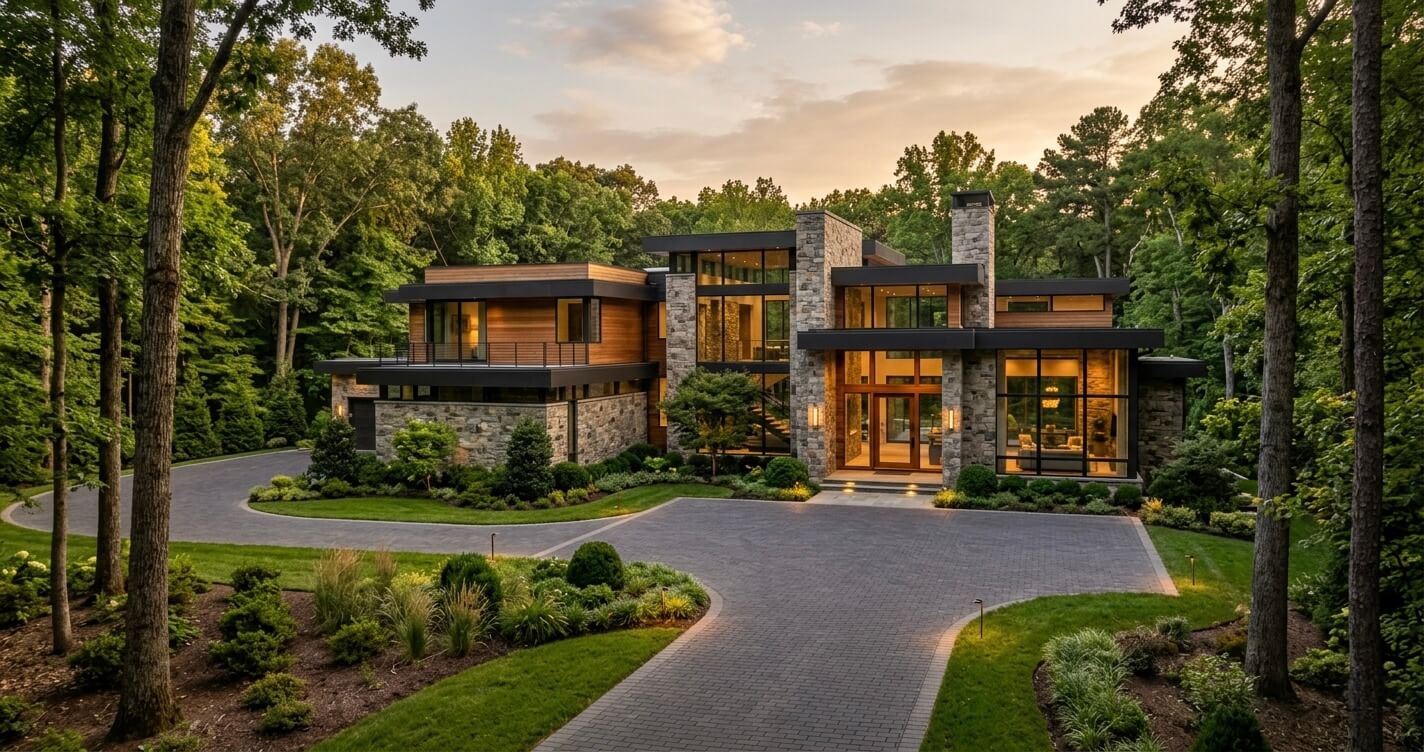
Great Falls, VA continues to rank among the most exclusive residential enclaves in Northern Virginia, where estate-scale properties, wooded landscapes, and architectural freedom define the local housing identity. As demand for high-end residential living increases, more homeowners are shifting away from purchasing outdated luxury homes and instead investing in fully tailored residences designed around modern lifestyle needs.
This shift is strongly influenced by two factors: rising renovation costs and limited inventory of move-in-ready luxury estates. In many cases, tear-down rebuilds and fully custom developments have become the more strategic long-term investment compared to renovating older structures.
Within Great Falls, custom homes typically sit on expansive lots featuring private wooded surroundings, elevation changes, and high-end architectural potential. These conditions create both opportunity and complexity in pricing.
The custom home cost Great Falls VA is not fixed—it varies significantly based on lot preparation, architectural design, square footage, material selections, permitting requirements, and infrastructure demands.
According to the U.S. Census Bureau, median housing values in Fairfax County remain significantly above national averages, reinforcing continued demand for luxury residential investment. [Source: U.S. Census Bureau]
At the same time, rising labor and material costs continue to impact construction nationwide, as highlighted by the National Association of Home Builders. Source: https://www.nahb.org/
Many Great Falls homeowners compare the cost of major luxury renovations against fully custom home construction before making long-term investment decisions, often evaluating options such as “Full Home Renovation McLean VA” before committing to rebuild strategies.
This guide breaks down real-world pricing, cost drivers, and construction insights for building in Great Falls and surrounding Northern Virginia markets.
WHAT FACTORS AFFECT CUSTOM HOME COST IN GREAT FALLS VA?
Understanding the custom home cost Great Falls VA requires evaluating multiple layers of construction complexity. Unlike production homes, luxury custom homes in Northern Virginia are highly sensitive to site-specific conditions and design decisions.
1. Lot Conditions
Lot preparation is one of the most influential cost drivers. In Great Falls, properties often include wooded terrain, slopes, and uneven grading. These conditions increase costs related to:
- land grading and excavation
- tree clearing and environmental preservation
- drainage and stormwater systems
- septic or well requirements (in select areas)
- utility access and trenching
2. Home Size & Layout
Square footage directly impacts structural, mechanical, and material costs. Larger homes require:
- expanded foundation systems
- more complex framing structures
- multi-zone HVAC systems
- higher roofing material volumes
3. Architectural Complexity
High-end architectural design significantly increases construction difficulty. Features such as:
- modern minimalist estates
- custom roof geometries
- floor-to-ceiling glass systems
- steel beam structural supports
increase engineering and labor costs substantially.
4. Material Selections
Luxury material upgrades have a major cost impact:
- imported stone countertops
- custom cabinetry and millwork
- wide-plank hardwood flooring
- premium window systems
- integrated smart-home technologies
5. Site Infrastructure
Infrastructure work often represents a major portion of total project cost, especially on large estate lots:
- driveway construction
- retaining walls
- stormwater management systems
- utility trenching and connections
In many cases, site development costs can significantly exceed expectations before vertical construction begins, particularly in wooded or sloped parcels.
According to the National Association of Home Builders, site preparation and infrastructure can represent a substantial portion of total construction budgets. [Source: NAHB]
CUSTOM HOME COST BREAKDOWN IN GREAT FALLS VA (2026)
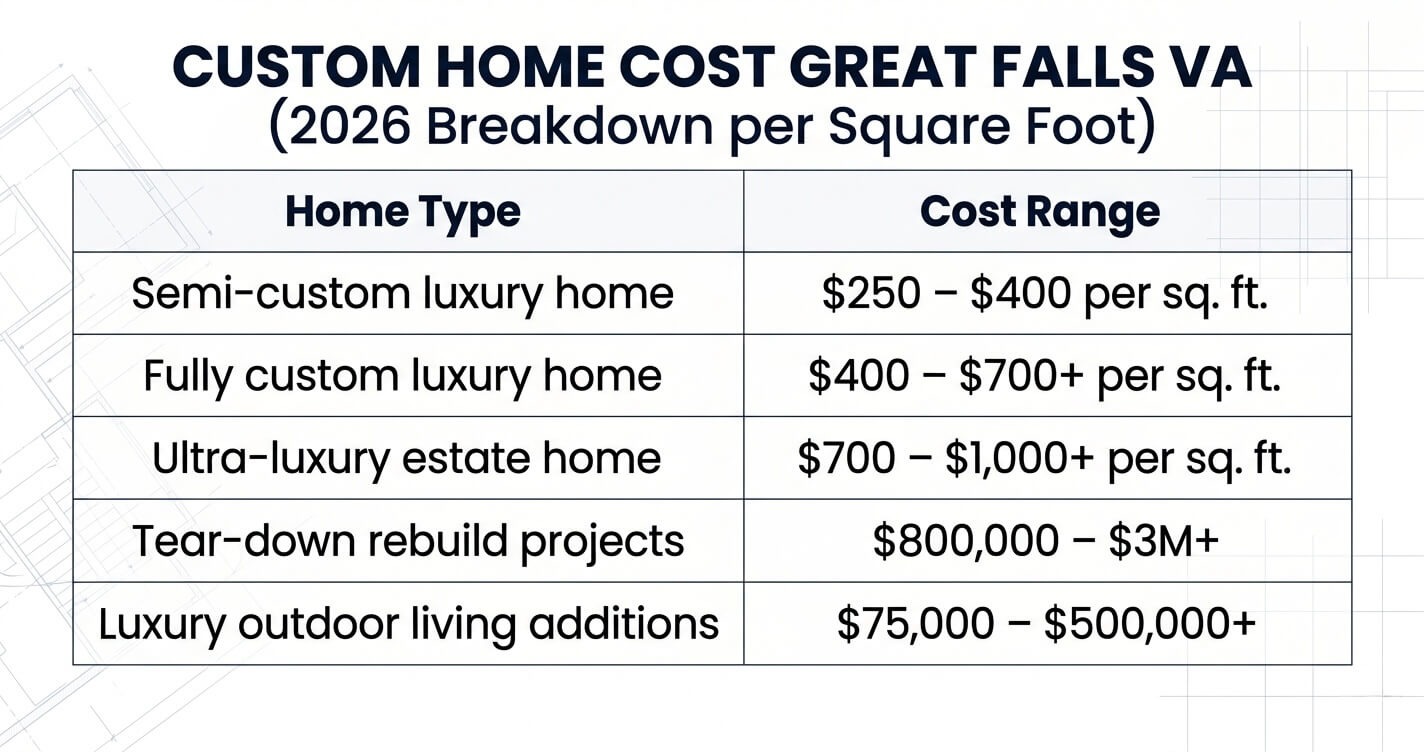
The custom home cost Great Falls VA in 2026 varies widely depending on design tier, site conditions, and material quality. Below is a realistic pricing breakdown based on current Northern Virginia construction trends.
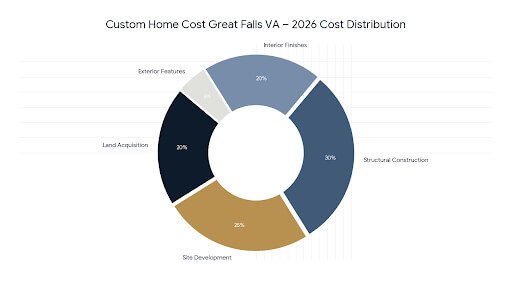
1. Land Acquisition
Great Falls land is among the most valuable in Fairfax County. Costs vary based on:
- lot size and privacy level
- proximity to McLean and Tysons
- teardown feasibility for older homes
2. Site Development
Before vertical construction begins, significant investment is required for:
- excavation and grading
- drainage and stormwater systems
- retaining walls on sloped lots
- utility installation (electric, water, sewer/septic)
3. Structural Construction
Core building systems include:
- foundation engineering (often reinforced concrete)
- framing systems for large-span luxury layouts
- roofing systems with architectural complexity
- energy-efficient building envelope systems
4. Interior Finishes
Luxury homes in Great Falls frequently include:
- chef-grade custom kitchens
- spa-inspired bathrooms
- home theaters and entertainment spaces
- wine cellars and climate-controlled storage
- full smart-home automation systems
5. Exterior Features
Outdoor living is a major investment category:
- resort-style pools
- outdoor kitchens and fireplaces
- covered terraces and patios
- detached garages and guest suites
- professional landscaping and lighting design
Regional Cost Context
Construction costs in the Washington DC metropolitan area remain above national averages due to land values, labor demand, and permitting complexity. [Source: Harvard Joint Center for Housing Studies]
Technical Analysis
Luxury homes in Great Falls often require:
- advanced structural engineering
- large-scale HVAC zoning systems
- high-performance insulation assemblies
- stormwater compliance design
Structural complexity in custom builds can exceed what is typically required even in major residential expansion projects such as a “Second Story Addition in Northern Virginia.”
LAND, SITE DEVELOPMENT & INFRASTRUCTURE COSTS
In Great Falls, VA, land and site development costs often represent one of the most underestimated components of the custom home cost Great Falls VA. Unlike traditional suburban construction, estate lots in this region frequently require extensive pre-construction engineering before any vertical building begins.
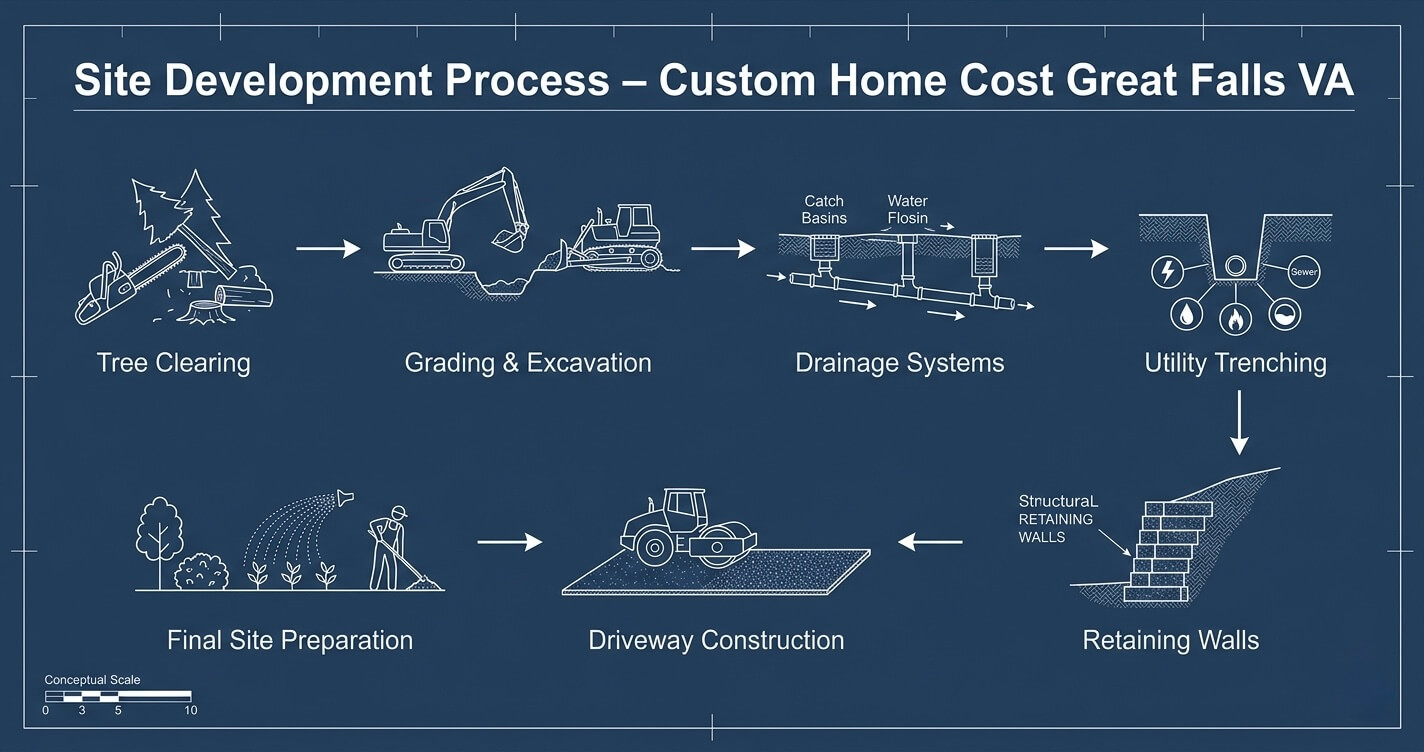
Key site development expenses typically include:
- tree clearing and selective preservation
- grading and excavation for structural stability
- engineered drainage systems and stormwater controls
- retaining walls for sloped terrain
- driveway construction with load-bearing base layers
- utility trenching for water, sewer, gas, and electric
- septic system installation (where municipal access is limited)
- private well drilling and water system integration
- stormwater compliance infrastructure
Great Falls properties present unique construction challenges due to:
- heavily wooded landscapes requiring environmental clearing permits
- uneven or sloped topography increasing excavation complexity
- large estate-sized parcels requiring extended utility runs
- strict stormwater and erosion control regulations
From a technical standpoint, Fairfax County stormwater requirements significantly influence site design, particularly grading strategy, drainage engineering, and impervious surface calculations. These requirements directly affect both design feasibility and construction cost structure.
Fairfax County Land Development Services strictly regulates land disturbance, erosion control, and runoff management. [Source: Fairfax County Land Development]
Because these requirements are enforced prior to vertical construction, many homeowners significantly underestimate early-stage costs. Site preparation often accounts for a substantial portion of the total budget before framing even begins.
This is why early feasibility planning is essential, particularly when applying for a “Remodeling Permit Fairfax County” before committing to full-scale redevelopment or teardown construction.
LUXURY FEATURES THAT INCREASE CUSTOM HOME COSTS
Luxury custom homes in Great Falls are defined not only by size, but by the depth of customization and integrated high-end systems. These premium features significantly influence the final custom home cost Great Falls VA, especially when architectural and mechanical complexity increases.
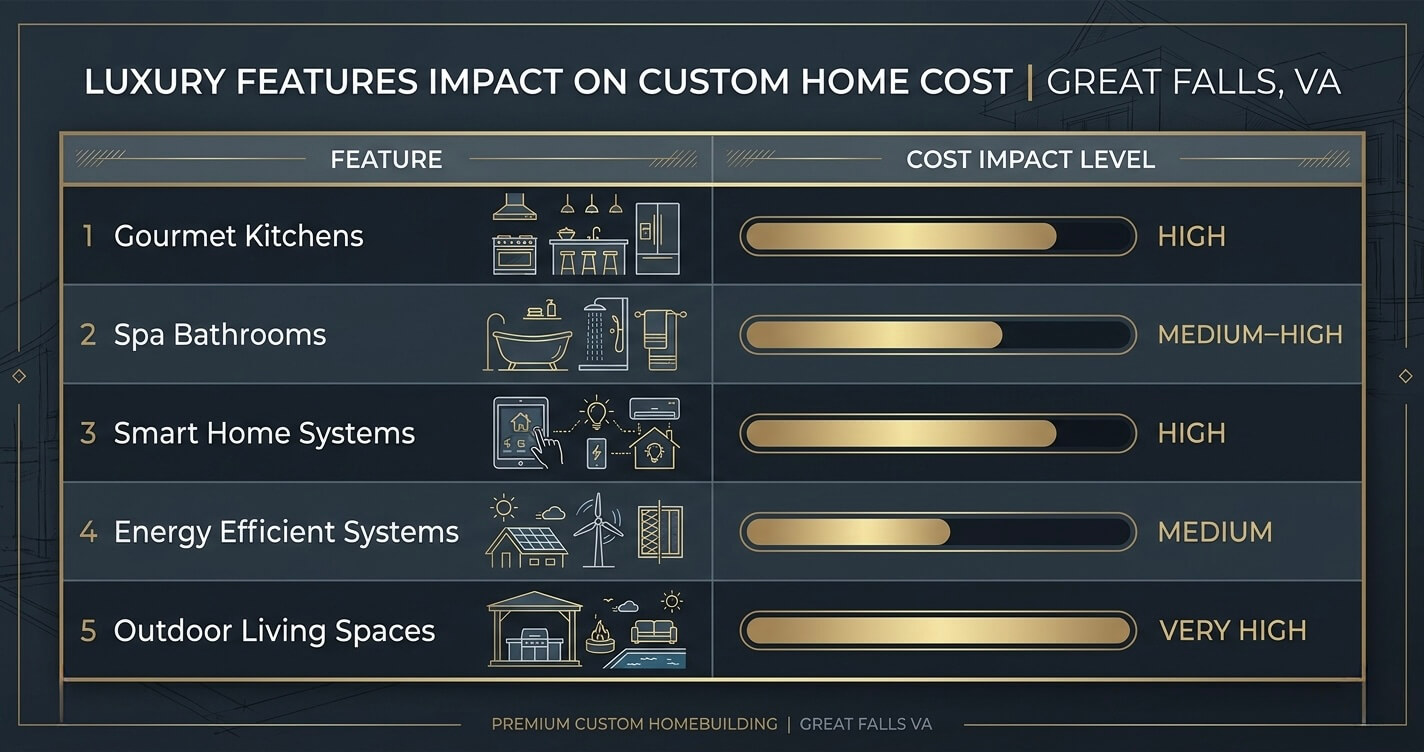
Gourmet Kitchens
High-end kitchens are one of the most cost-intensive interior spaces, often featuring:
- full-height custom cabinetry systems
- oversized waterfall islands
- professional-grade appliance packages (Sub-Zero, Wolf, etc.)
- concealed prep kitchens or sculleries for service separation
- Spa-Inspired Bathrooms
Luxury bathrooms elevate both comfort and resale value:
- radiant heated flooring systems
- steam showers with digital controls
- freestanding sculptural tubs
- smart mirrors with integrated lighting and display features
Many homeowners evaluate upgrades in relation to broader regional renovation benchmarks such as “Bathroom Remodel Cost Northern Virginia” when planning interior luxury scopes.
Smart Home Technology
Modern estates increasingly integrate:
- whole-home automation platforms
- advanced security systems with remote access
- motorized shades and lighting scenes
- distributed audio-video systems
- Energy-Efficient Systems
High-performance homes now prioritize:
- upgraded insulation assemblies
- multi-zone HVAC systems
- energy-efficient glazing systems
- solar-ready electrical infrastructure
- Outdoor Living Features
Exterior luxury significantly increases total investment:
- resort-style swimming pools
- outdoor kitchens and fire features
- covered entertainment patios
- architectural landscape lighting systems
According to the National Association of Home Builders, demand for energy efficiency and wellness-focused home features continues to grow among luxury buyers. [Source: NAHB]
Technical Findings
Luxury construction increasingly balances aesthetics with:
- indoor air quality optimization
- thermal performance
- acoustic insulation design
- envelope efficiency engineering
PERMITS, ZONING & BUILDING REQUIREMENTS IN GREAT FALLS VA
Custom home development in Great Falls is heavily regulated by Fairfax County authorities to ensure compliance with zoning, safety, and environmental standards. The governing body responsible is Fairfax County Land Development Services (LDS).
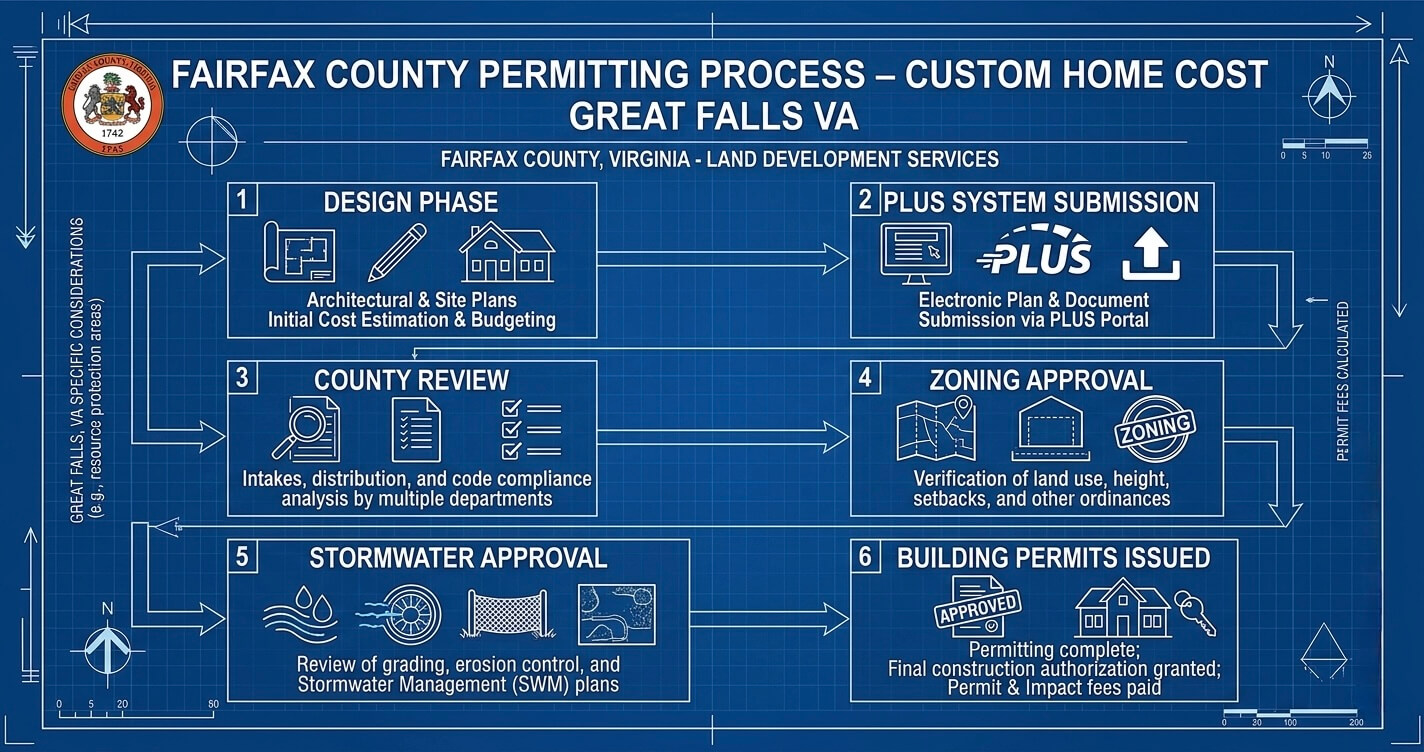
All permit applications and approvals are processed through the county’s digital platform, the PLUS system (Planning and Land Use System), which manages submissions for residential development projects. [PLUS System: https://plus.fairfaxcounty.gov]
Permits Typically Required
Luxury custom home projects may require multiple permit categories, including:
- building permits
- electrical permits
- plumbing permits
- mechanical (HVAC) permits
- grading permits
- land disturbance permits
Key Zoning Review Areas
Before approval, properties are evaluated for:
- setback compliance
- allowable lot coverage
- building height restrictions
- stormwater management compliance
- tree preservation requirements
- driveway access regulations
Regulatory Framework
All residential construction in Virginia must comply with the Uniform Statewide Building Code (USBC), which sets minimum standards for safety and structural performance. [Source: Virginia DHCD]
Technical Evaluation
Luxury custom homes often require advanced engineering and multi-layer approvals, including:
- structural engineering review
- energy-code compliance verification
- stormwater engineering approval
- zoning board review (in select cases)
It is critical to understand that HOA approval does not replace county permits or zoning clearance.
Homeowners are strongly advised to work with experienced professionals who understand regulatory sequencing, including experts in “How to Choose the Right Contractor in Northern Virginia”, to avoid delays in approval cycles.
COMMON CUSTOM HOME BUILDING MISTAKES TO AVOID
Even in high-end markets like Great Falls, costly mistakes during planning and construction can significantly impact the final custom home cost Great Falls VA, often leading to delays and budget overruns.
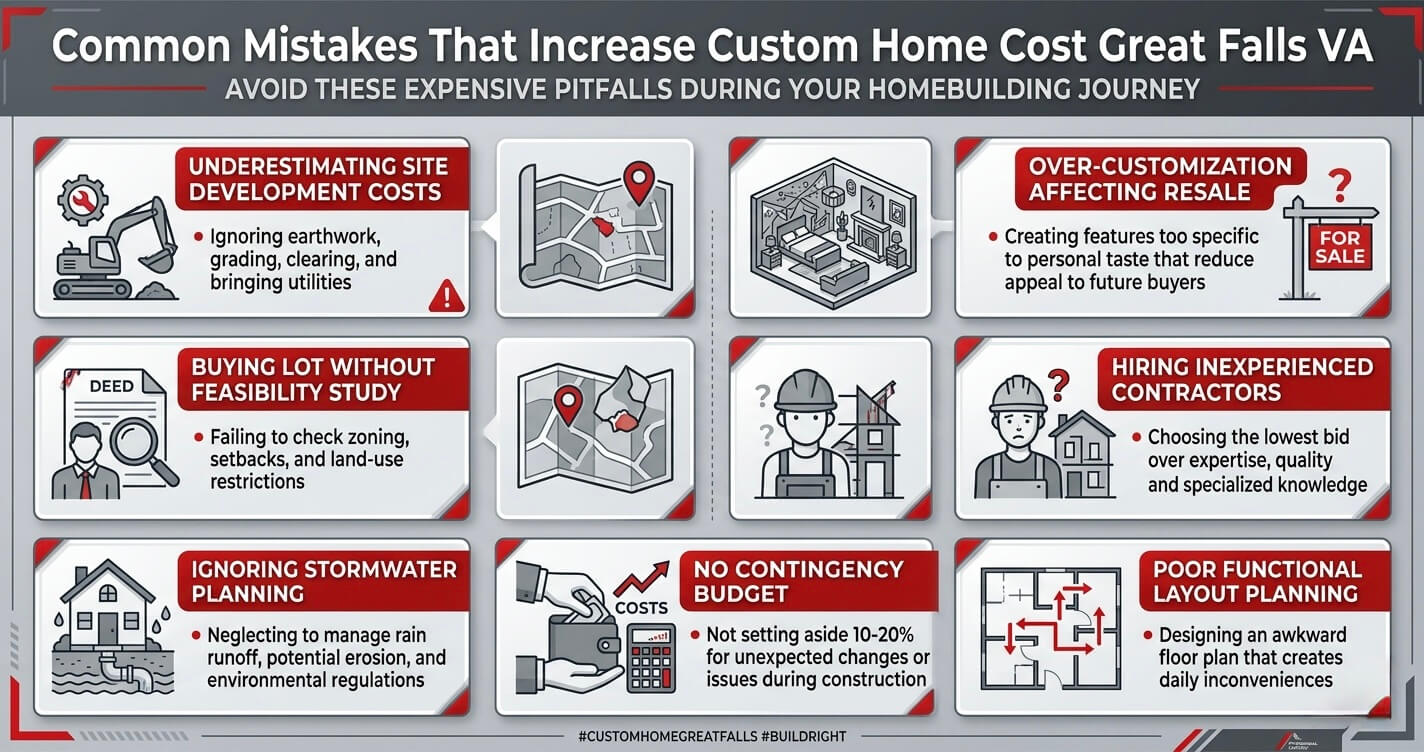
Mistake 1: Underestimating Site Development Costs
Many homeowners focus on architectural design while overlooking grading, drainage, and utility infrastructure costs that occur before construction begins.
Mistake 2: Buying Land Without Feasibility Analysis
Purchasing a lot without evaluating slope, drainage, and zoning constraints often leads to expensive redesigns.
Mistake 3: Ignoring Stormwater Management
In Fairfax County, improper drainage planning can halt permitting or require costly redesigns mid-project.
Mistake 4: Over-Customization
Excessive personalization may reduce long-term resale appeal in luxury neighborhoods.
Mistake 5: Hiring Inexperienced Contractors
Luxury construction requires specialized expertise in structural engineering, sequencing, and county compliance.
Mistake 6: Poor Functional Planning
Aesthetic-driven layouts without functional flow often result in inefficient living spaces.
Mistake 7: Weak Contingency Planning
Many projects exceed budget due to unforeseen:
- subsurface conditions
- engineering changes
- material price fluctuations
- design modifications during construction
According to the National Association of Home Builders, construction timelines and budgets are heavily influenced by permitting, labor availability, and material volatility. [Source: NAHB]
Technical Insight
Most budget overruns in luxury custom homes stem from hidden site conditions and mid-project design changes rather than initial architectural estimates.
Experienced Northern Virginia builders are typically well-versed in:
- Fairfax County permitting workflows
- zoning compliance strategies
- luxury sequencing and scheduling
- subcontractor coordination systems
- high-performance building envelope standards
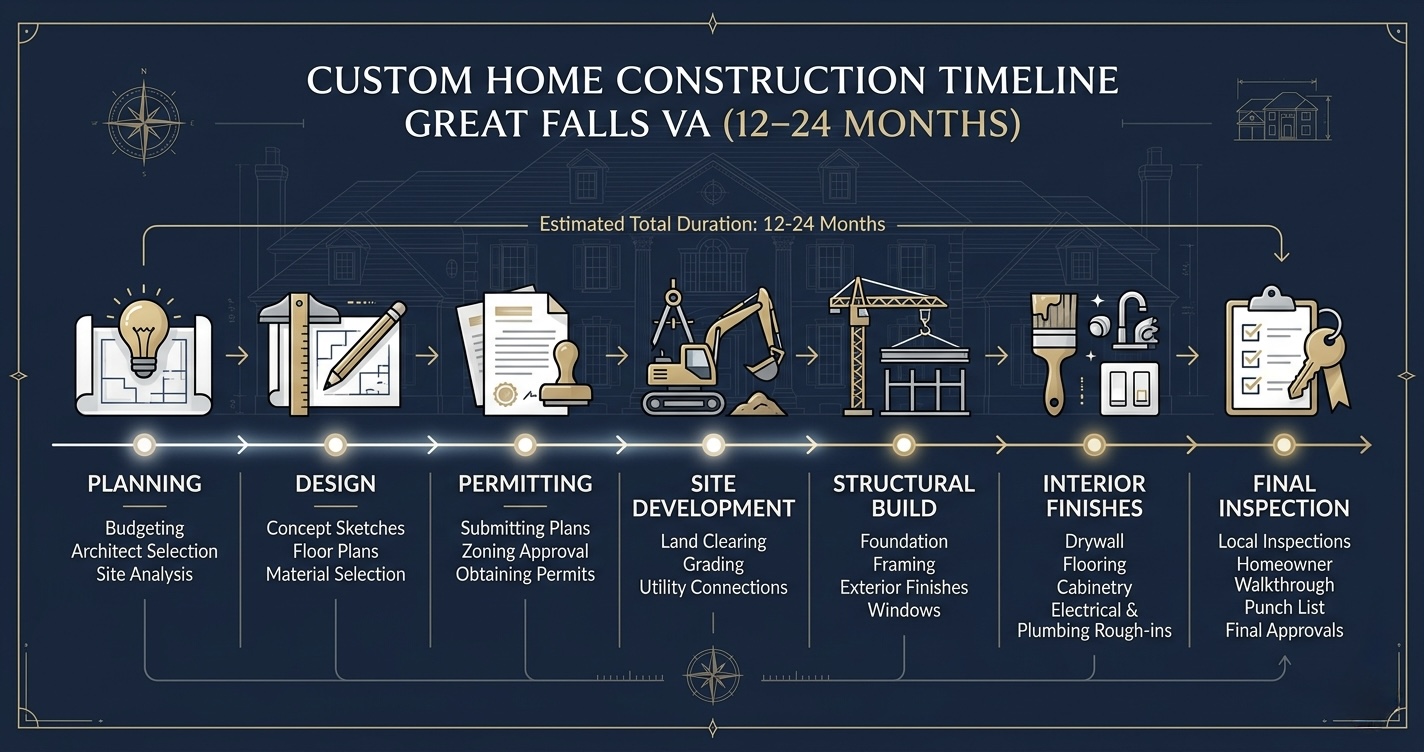
HOW TO PLAN A CUSTOM HOME PROJECT CORRECTLY
A successful luxury build in Northern Virginia begins long before construction starts. In Great Falls, where the custom home cost Great Falls VA is heavily influenced by site complexity and design decisions, structured planning is essential to avoid costly revisions later in the process.
Step 1 – Define Lifestyle Goals
Start by clearly defining how the home will function long-term:
- multi-generational living needs
- entertainment and hosting priorities
- workspace or remote office requirements
- future adaptability for aging in place
Step 2 – Evaluate the Lot Carefully
Before design begins, analyze:
- grading and slope conditions
- drainage patterns and stormwater flow
- utility access points
- zoning and setback constraints
Step 3 – Establish a Realistic Budget
A complete budget should include:
- core construction costs
- architectural and engineering fees
- permitting and approvals
- contingency reserves (critical in luxury builds)
- landscaping and exterior development
Step 4 – Build the Design Team Early
High-end projects require coordinated expertise from:
- architect
- custom home builder
- structural engineer
- interior designer
Step 5 – Finalize Major Selections Early
Delays often occur due to late decisions on:
- windows and glazing systems
- cabinetry and millwork
- appliance packages
- custom finish materials
Technical Assessment
Luxury custom homes require synchronized coordination across architecture, structural engineering, mechanical systems, energy performance, and site development planning to ensure buildability and code compliance.
The same principle applies across all major remodeling and construction projects: planning decisions made early often determine long-term project success, especially in high-value renovations such as “Kitchen Remodel Before After Fairfax VA.”
FREQUENTLY ASKED QUESTIONS [FAQs]
Q1: How much does a custom home cost in Great Falls VA?
Most fully custom luxury homes in Great Falls range from $400 to $700+ per square foot, depending on architectural complexity, material selections, and site conditions.
Q2: What increases custom home construction costs the most?
The biggest cost drivers include:
- site development and grading
- structural engineering complexity
- luxury interior finishes
- stormwater management systems
- custom architectural features
- high-performance mechanical systems
Q3: Do custom homes require permits in Fairfax County?
Yes. Custom homes require multiple approvals and permits, including:
- building permits
- grading permits
- electrical, plumbing, and mechanical permits
- zoning review
- stormwater management approval
[Source: Fairfax County Land Development Services]
Q4: How long does it take to build a custom home in Great Falls VA?
Most luxury custom homes take approximately 12–24 months, depending on:
- permitting timelines
- design complexity
- weather conditions
- material lead times
- site preparation requirements
Q5: Is building a custom home more expensive than remodeling?
In many cases, yes. However, large-scale renovations or tear-down rebuilds can reach similar cost levels depending on structural scope, especially in luxury markets where site and engineering requirements are significant.
FINAL THOUGHTS
The true custom home cost Great Falls VA extends far beyond square footage calculations. In high-value markets like Northern Virginia, successful luxury construction depends on the precise coordination of architecture, engineering, zoning compliance, site development, and material selection.
When executed correctly, custom homes deliver long-term advantages including:
- stronger resale positioning
- improved energy efficiency and performance
- enhanced lifestyle functionality
- greater long-term property value stability
However, these outcomes are only achieved when planning and execution are aligned from the earliest stages of development.
Ultimately, the best custom homes are not defined only by size or luxury finishes, they are defined by how intelligently they are planned, engineered, and built to perform for decades.
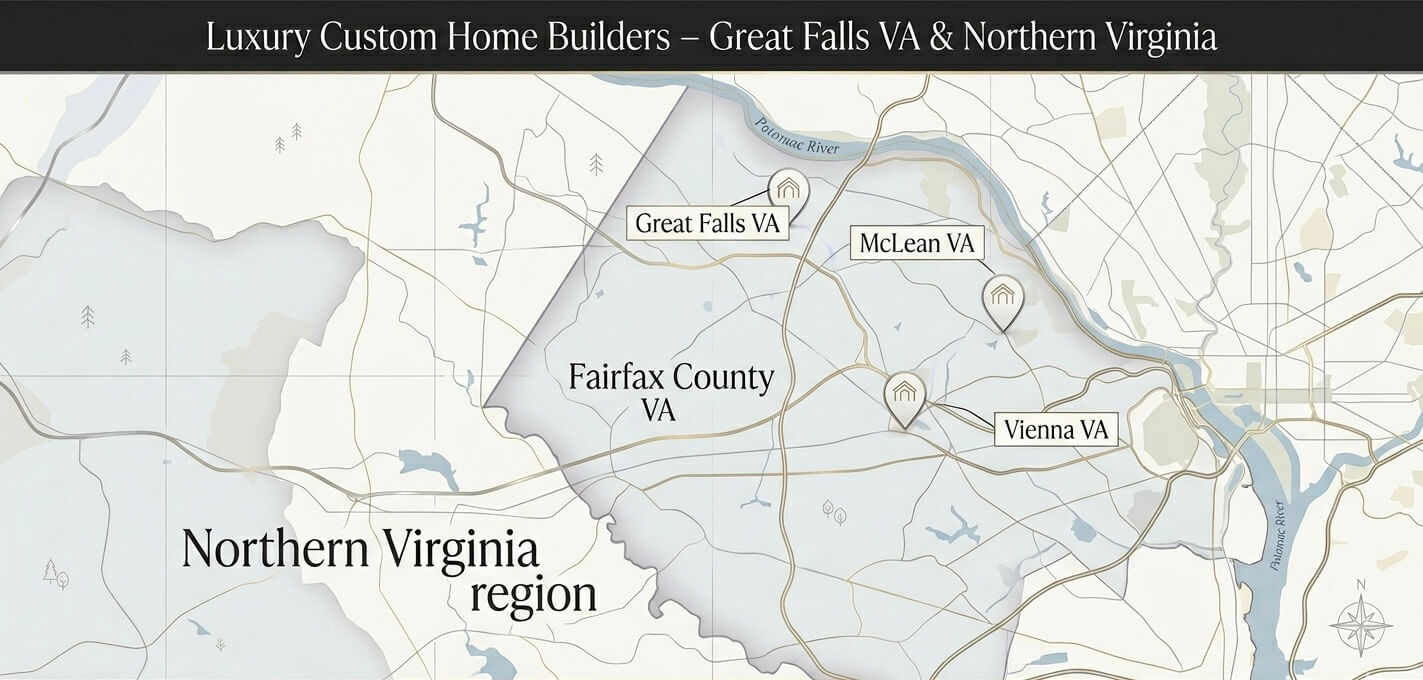
US Home Design Build works with homeowners across Great Falls VA, McLean, Vienna, Fairfax County, and Northern Virginia to plan and build custom homes that balance luxury design, structural performance, code compliance, and long-term value.
703-202-3520 | https://ushdb.com | 8200 Greensboro Dr #900, McLean VA 22102