
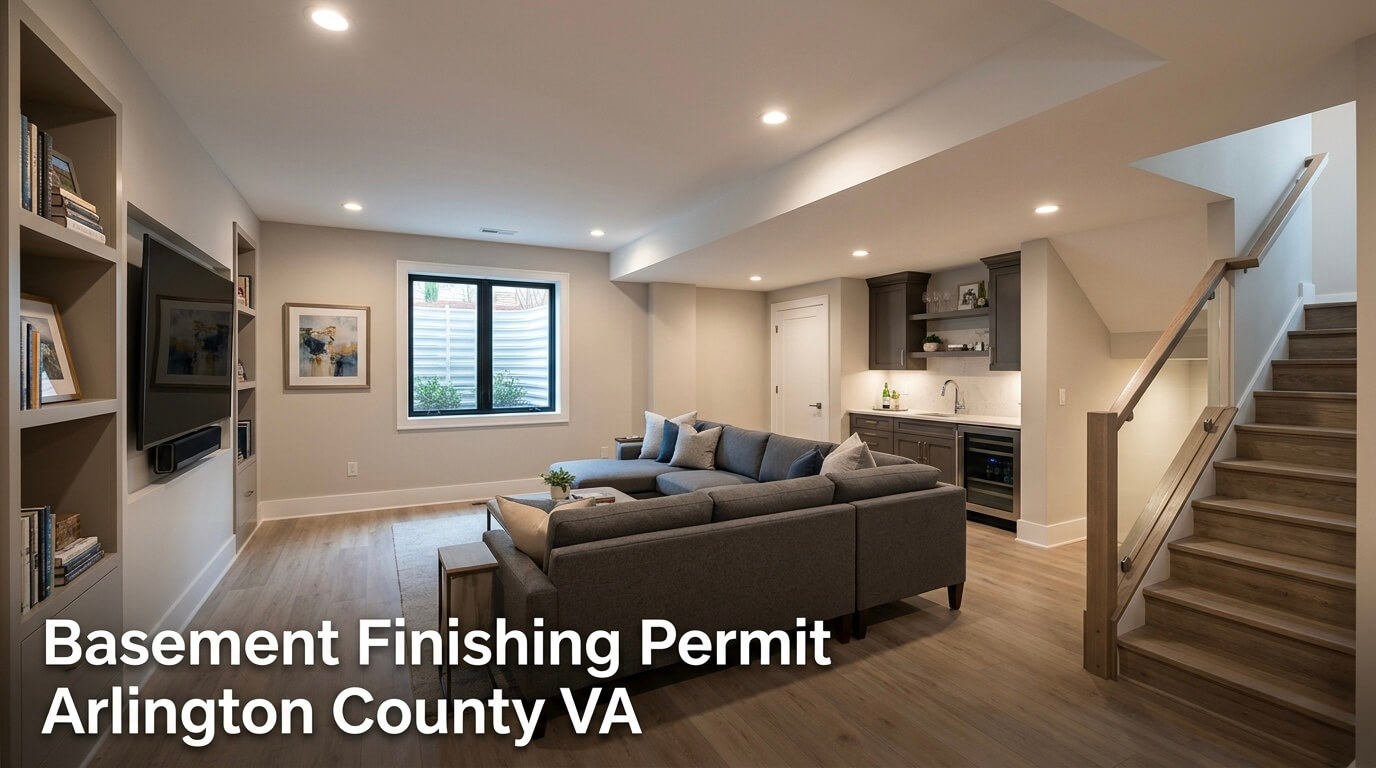
Understanding the requirements for a basement finishing permit Arlington County VA homeowners must follow is one of the most important parts of planning a legal and code-compliant basement remodel in 2026. Across Arlington County, rising home values and limited expansion opportunities are driving homeowners to convert unfinished basements into functional living spaces, home offices, guest suites, recreation rooms, and multi-generational living areas rather than pursuing costly relocations.
Arlington’s housing inventory, heavily composed of Colonials, ramblers, Cape Cods, and post-war homes built between the 1940s and 1980s, creates unique remodeling challenges. Many basements contain older electrical systems, limited ceiling heights, aging drainage infrastructure, and foundation layouts that were never designed for modern finished living space standards.
“The average Arlington VA home value remains among the highest in Virginia, reflecting continued demand for renovated and expanded housing inventory.” [Source: Zillow Home Values]
In Arlington County, permit compliance is significantly more important than many homeowners initially realize. Unpermitted basement work can create failed inspections, appraisal complications, insurance disputes, resale disclosure problems, and expensive corrective reconstruction after the fact.
This guide explains what basement work requires permits in Arlington County VA, how inspections work, when egress windows become mandatory, what the 2021 Virginia Uniform Statewide Building Code requires, and how homeowners can avoid the most common compliance mistakes before construction begins.
WHAT BASEMENT WORK REQUIRES A PERMIT IN ARLINGTON COUNTY?
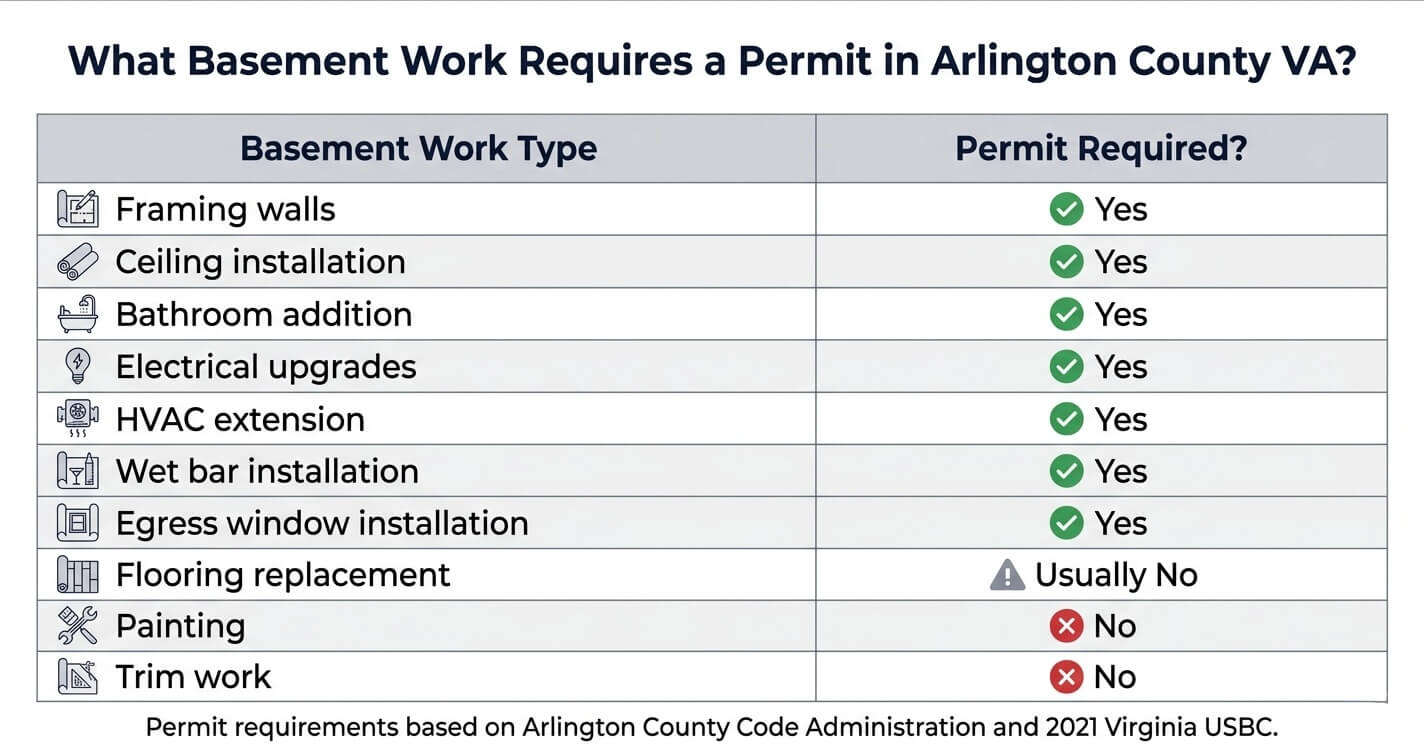
In Arlington County, most basement finishing projects require permits once the work extends beyond purely cosmetic improvements. Homeowners frequently assume that finishing a basement is treated similarly to painting or replacing flooring, but code requirements become mandatory as soon as systems, structural elements, or occupancy conditions are modified.
Permit applications in Arlington County are processed through the Permit Arlington portal:
https://permitarlington.arlingtonva.us
Under Arlington County Code Administration requirements and the 2021 Virginia Uniform Statewide Building Code (USBC), permits are generally required for:
- Framing new walls or partitions
- Installing drywall ceilings
- Creating bedrooms
- Bathroom additions
- Wet bars or kitchenettes
- Electrical circuit additions
- Panel upgrades
- HVAC extensions or duct modifications
- Plumbing relocations
- Egress window installation
- Structural beam modifications
- Foundation opening alterations
“As of January 18, 2025, Arlington County construction projects must comply with the 2021 Virginia Uniform Statewide Building Code (USBC).” [Source: Arlington County Code Administration]
By contrast, cosmetic-only work that usually does not require permits includes:
- Painting
- Flooring replacement
- Trim installation
- Cabinet replacement without plumbing/electrical relocation
- Finish material updates
The distinction becomes critical because many Arlington basement remodels involve hidden infrastructure upgrades once demolition begins. Electrical deficiencies, undersized service panels, improper ventilation, and outdated plumbing are commonly discovered in older Arlington homes.
A permit also triggers mandatory inspections, which verify that framing, wiring, insulation, plumbing, smoke detectors, and life-safety systems comply with current Virginia code standards. Attempting to bypass permits may initially appear less expensive, but failed resale disclosures and corrective reconstruction costs are often substantially higher than completing the project correctly from the beginning.
BASEMENT BEDROOMS AND EGRESS REQUIREMENTS
One of the most misunderstood areas of basement remodeling in Arlington County involves bedroom legality and emergency egress requirements. Homeowners frequently assume that adding a closet automatically qualifies a basement room as a legal bedroom, but Virginia code requires compliant emergency escape and rescue openings before a basement sleeping area can legally function as a bedroom.
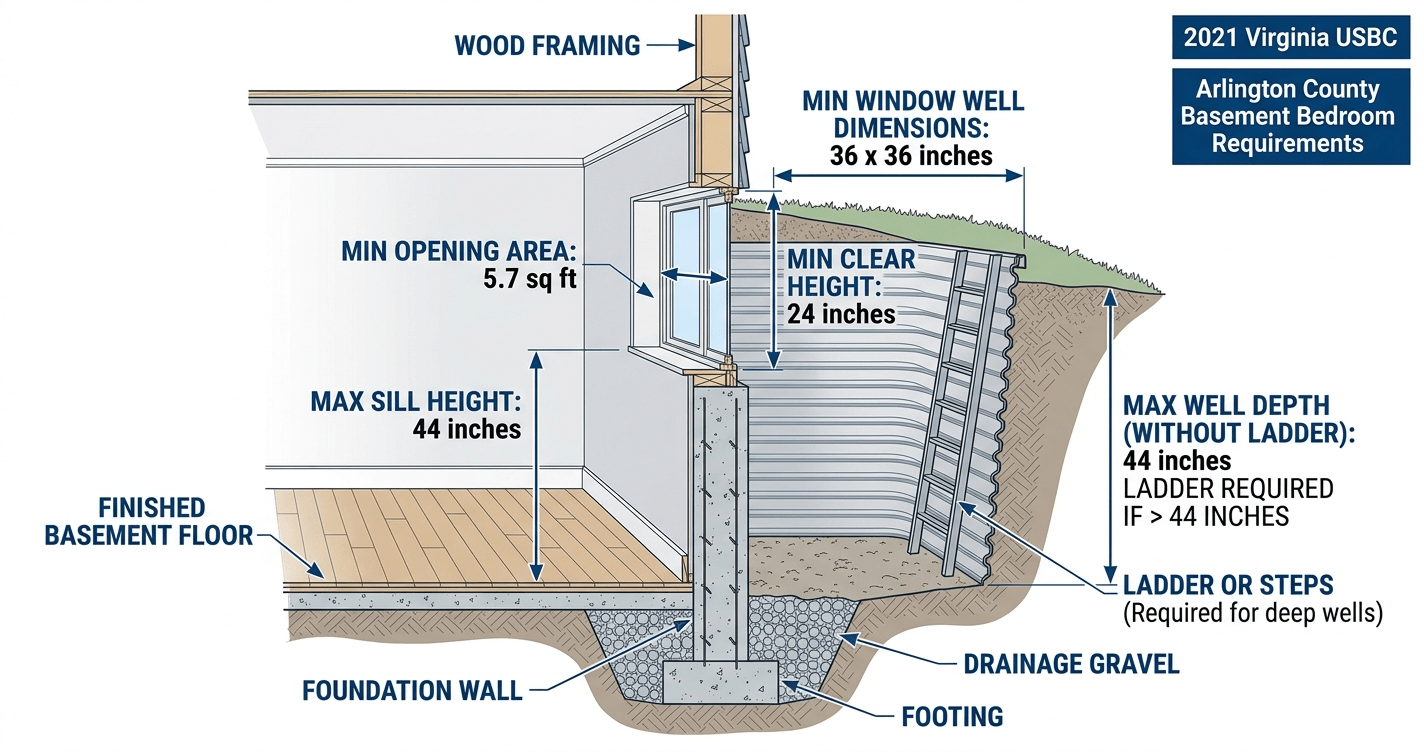
Under the 2021 Virginia Uniform Statewide Building Code (USBC), basement bedrooms must include an emergency egress window or exterior door that allows occupants to exit safely during a fire or emergency event. [Official Source: Arlington County Code Administration]
Typical IRC/USBC egress requirements include:
- Minimum opening width: 20 inches
- Minimum opening height: 24 inches
- Minimum net clear opening: 5.7 square feet
- Maximum sill height: 44 inches above finished floor
- Window wells typically requiring at least 36-inch clearance dimensions
These requirements become particularly challenging in Arlington County because many older homes contain:
- deep below-grade foundations
- narrow side-yard setbacks
- mature landscaping constraints
- older drainage systems
- limited excavation access
As a result, installing a compliant egress system often requires:
- foundation wall cutting
- excavation
- drainage modification
- retaining wall adjustments
- window well construction
- waterproofing integration
Typical basement egress installation costs in Arlington County range from approximately $3,000–$8,000+, depending on excavation complexity, soil conditions, access limitations, drainage requirements, and structural engineering considerations.
Homeowners should also understand that non-compliant basement bedrooms may create appraisal issues and cannot legally be marketed as official bedrooms during resale. This is particularly important in Arlington’s high-value housing market, where bedroom count materially affects comparable property valuations and buyer expectations.
STRUCTURAL AND CEILING HEIGHT REQUIREMENTS
Structural compliance is one of the most important, and most underestimated, aspects of obtaining a basement finishing permit in Arlington County VA. Many Arlington homes constructed before 1985 were not originally designed for modern finished basement layouts, particularly those involving open-concept recreation spaces, bedrooms, or bathrooms.
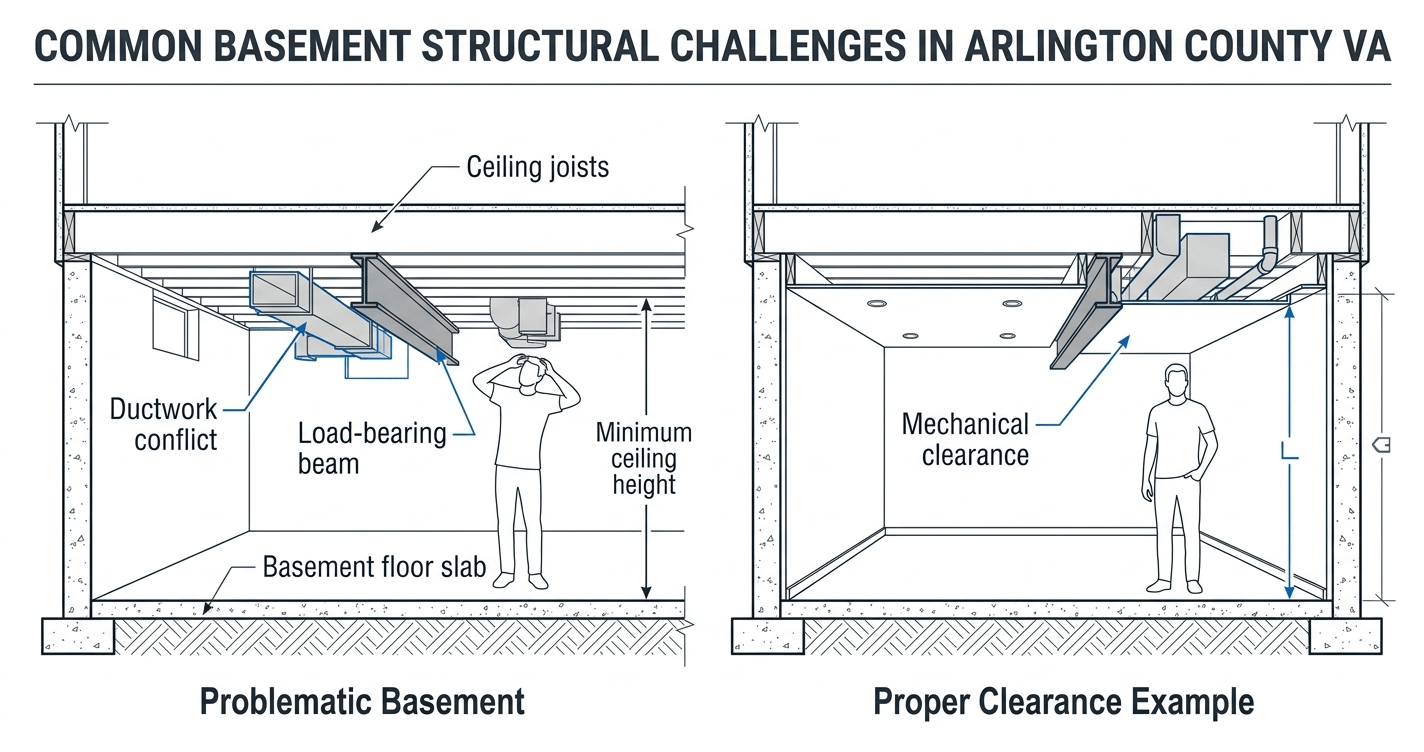
Under the 2021 Virginia Uniform Statewide Building Code (USBC), habitable basement spaces generally require minimum finished ceiling heights of at least 7 feet, although beams, ducts, and other obstructions may have limited exceptions depending on location and clearance dimensions. [Official Source: Arlington County Code Administration]
In older Arlington homes, common structural complications include:
- low basement ceiling heights
- oversized bulkheads
- outdated beam layouts
- undersized joist spacing
- limited mechanical clearances
- aging support columns
- irregular foundation wall conditions
Ductwork conflicts are particularly common when homeowners attempt to maximize ceiling height without considering HVAC routing requirements. Relocating trunk lines, plumbing stacks, or structural beams often requires engineering review and revised permit drawings before approval can proceed.
Load-bearing wall removal is another major trigger for structural review. Once a wall supports floor or roof loads above, Arlington County typically requires engineered beam specifications and load transfer calculations before permits can be issued.
Foundation penetrations for egress windows, new exterior doors, or utility routing also require careful review because improper cutting can compromise structural stability and waterproofing performance.
For this reason, Arlington County frequently requires detailed construction drawings and structural documentation before approving basement remodeling permits involving layout changes or significant mechanical modifications.
ELECTRICAL, HVAC, AND PLUMBING CODE REQUIREMENTS
Mechanical, electrical, and plumbing systems are among the most heavily regulated portions of any basement finishing project in Arlington County. Even relatively straightforward remodels often trigger multiple trade permits once new circuits, bathrooms, or conditioned living spaces are added.
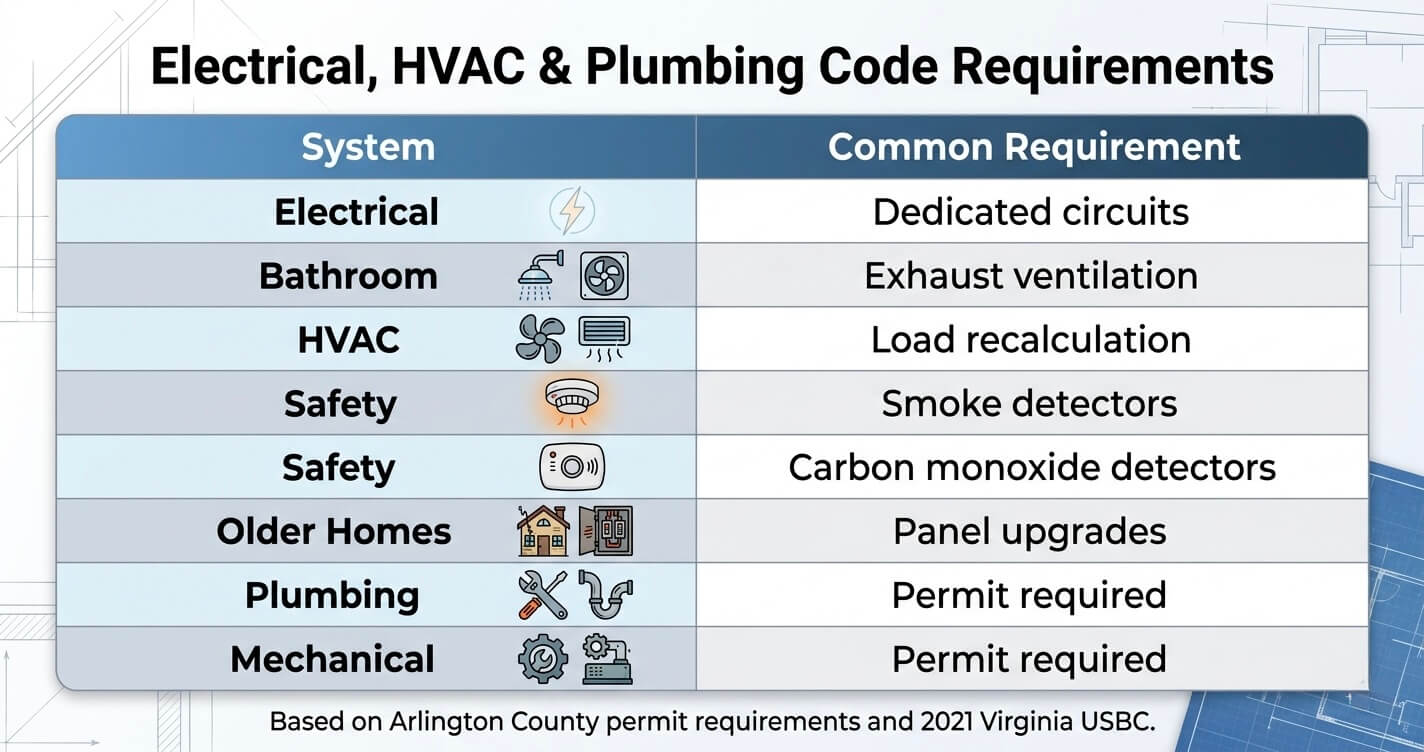
Under Arlington County requirements and the 2021 Virginia Uniform Statewide Building Code (USBC), homeowners typically need:
- Electrical permits for:
- new circuits
- recessed lighting
- panel upgrades
- outlet additions
- dedicated appliance circuits
- Plumbing permits for:
- bathrooms
- wet bars
- sewage ejector systems
- drain relocations
- water supply extensions
- Mechanical permits for:
- HVAC duct extensions
- mini-split installations
- exhaust systems
- combustion appliance modifications
[Official Source: Arlington County Code Administration]
Older Arlington homes frequently require significant infrastructure corrections before basement permits can receive final approval. Common deficiencies include:
- outdated 100-amp electrical service
- improper grounding
- overloaded panels
- insufficient return-air systems
- undersized HVAC equipment
- non-compliant wiring methods
Modern finished basements also require interconnected smoke detectors and carbon monoxide detectors in accordance with Virginia residential code requirements, particularly when bedrooms are added or fuel-burning appliances exist within the home.
Bathroom additions must include properly vented exhaust fans to control humidity and moisture accumulation. Improper ventilation remains one of the leading contributors to mold development and long-term basement air quality problems.
HVAC load recalculations are also common in Arlington basement remodels because original systems were often not designed to condition an additional 800–1,500 square feet of living space. In many cases, mini-split systems or zoning modifications become necessary to maintain proper comfort and airflow performance throughout the home.
HOW THE ARLINGTON COUNTY PERMIT PROCESS WORKS
The basement finishing permit process in Arlington County VA involves multiple review stages designed to verify code compliance, life-safety protection, and structural integrity before construction begins. Homeowners who understand the sequence early typically avoid the majority of costly delays and inspection failures later in the project.
Permit applications are processed digitally through the Permit Arlington portal:
Official Source: Permit Arlington Portal
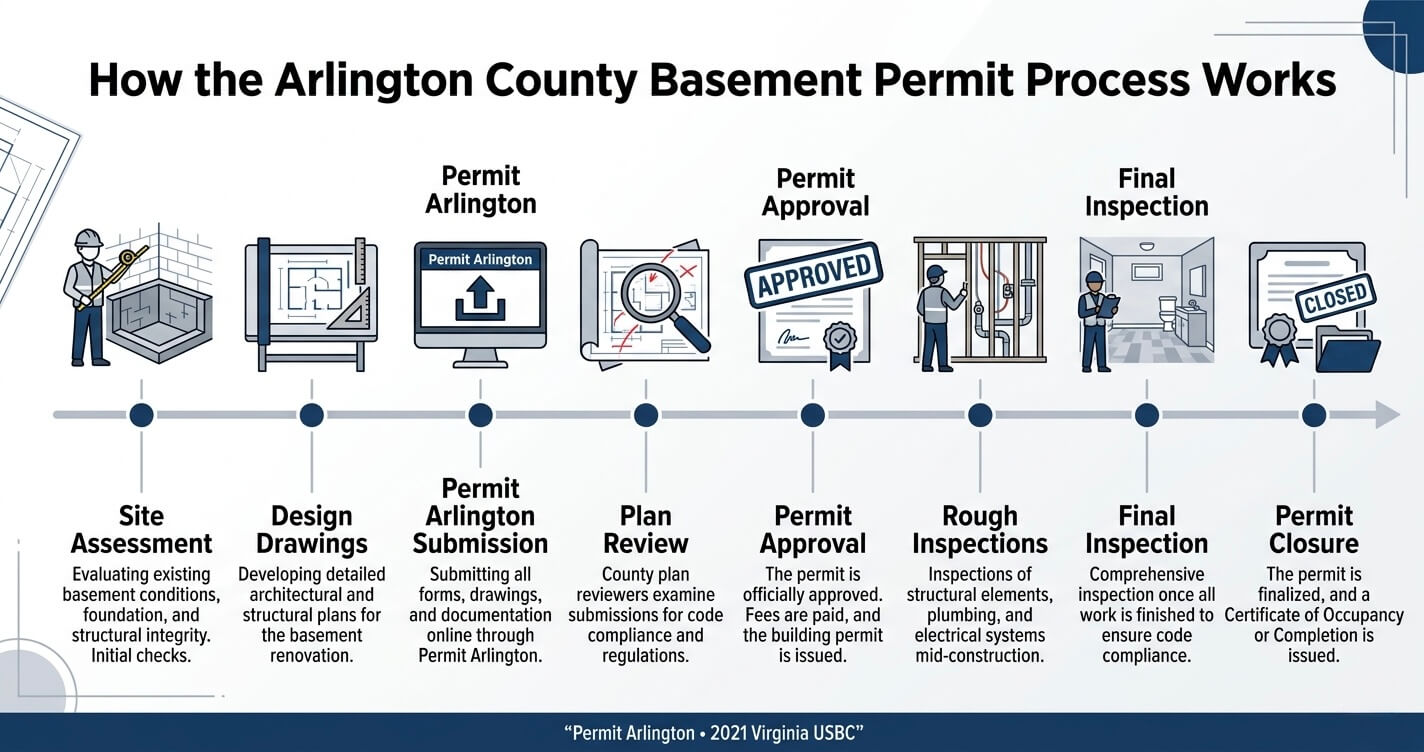
A typical Arlington County basement permit process includes the following stages:
1. Initial Site Assessment
The process usually begins with a contractor or design-build team evaluating:
- ceiling height
- moisture conditions
- electrical capacity
- HVAC compatibility
- structural layout
- egress feasibility
This step identifies code issues before drawings are prepared.
2. Design Drawings and Scope Preparation
Construction drawings are developed showing:
- floor plans
- framing details
- electrical layouts
- plumbing locations
- mechanical systems
- egress compliance
- smoke detector placement
Structural engineering may be required if beams, load-bearing walls, or foundation penetrations are involved.
3. Permit Arlington Submission
Applications, drawings, supporting documentation, and trade scopes are submitted digitally through Permit Arlington for plan review.
4. Plan Review and Corrections
County reviewers evaluate compliance with the 2021 Virginia Uniform Statewide Building Code. Corrections or additional documentation requests are common, especially for structural modifications and bedroom additions.
5. Permit Issuance and Construction
Once approved, permits are issued and construction can begin.
6. Rough Inspections
Arlington County typically conducts separate inspections for:
- framing
- electrical
- plumbing
- HVAC systems
- insulation
7. Final Inspection and Approval
Final inspections verify:
- life-safety compliance
- detector placement
- egress conditions
- finish completion
- code conformity
Typical permit review timelines vary depending on project complexity, revision requests, and seasonal submission volume. Delays commonly occur because of incomplete drawings, missing engineering documentation, or improperly coordinated trade scopes.
For homeowners comparing regional procedures, Arlington County’s digital submission and review structure differs significantly from Fairfax County’s workflow and inspection coordination process. For comparison purposes, see our guide on Remodeling Permit Fairfax County.
COMMON BASEMENT PERMIT MISTAKES HOMEOWNERS MAKE
One of the biggest reasons basement remodeling projects fail inspections or exceed budgets in Arlington County is not poor workmanship, it is poor permit planning. Homeowners frequently underestimate how aggressively code compliance is enforced once structural, electrical, plumbing, or bedroom modifications are involved.
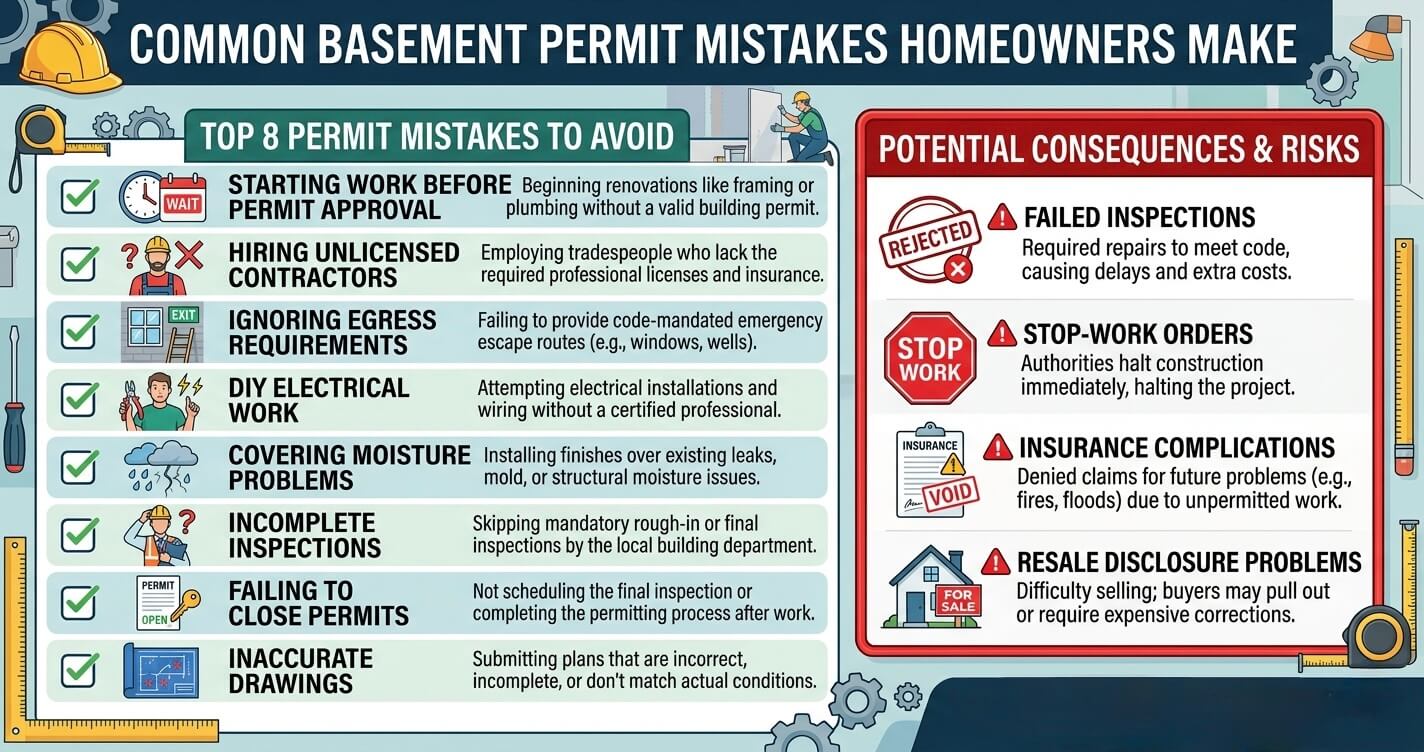
Common basement permit mistakes include:
- starting demolition before permit approval
- hiring unlicensed contractors
- ignoring egress requirements
- covering existing moisture problems
- submitting inaccurate construction drawings
- performing DIY electrical work
- skipping required inspections
- failing to close permits after completion
These issues create serious downstream consequences. Arlington County can issue stop-work orders when unpermitted construction is discovered, particularly for framing, electrical, plumbing, or structural modifications. Failed inspections often require expensive demolition and rework before approvals can continue.
Unclosed permits also create long-term transaction problems. During resale, buyers increasingly request permit records, inspection approvals, and documentation confirming that finished basement space was legally constructed. Missing permits can complicate appraisals, delay closings, and trigger disclosure concerns.
Insurance complications are another major risk. If a fire, water loss, or structural issue occurs in an unpermitted finished basement, insurance carriers may dispute portions of the claim tied to non-compliant work.
Budget overruns are also common during poorly planned remodels. According to the Houzz & Home Study, 39% of homeowners exceeded their original renovation budgets during remodeling projects. [Source: Houzz & Home Study]
The most successful Arlington basement projects resolve permit, moisture, and infrastructure issues before construction begins, not during demolition.
ARLINGTON COUNTY VS FAIRFAX COUNTY: WHAT IS DIFFERENT?
Although Arlington County and Fairfax County both operate under the 2021 Virginia Uniform Statewide Building Code (USBC), their basement permit processes differ in several important ways that directly affect remodeling timelines and project planning.
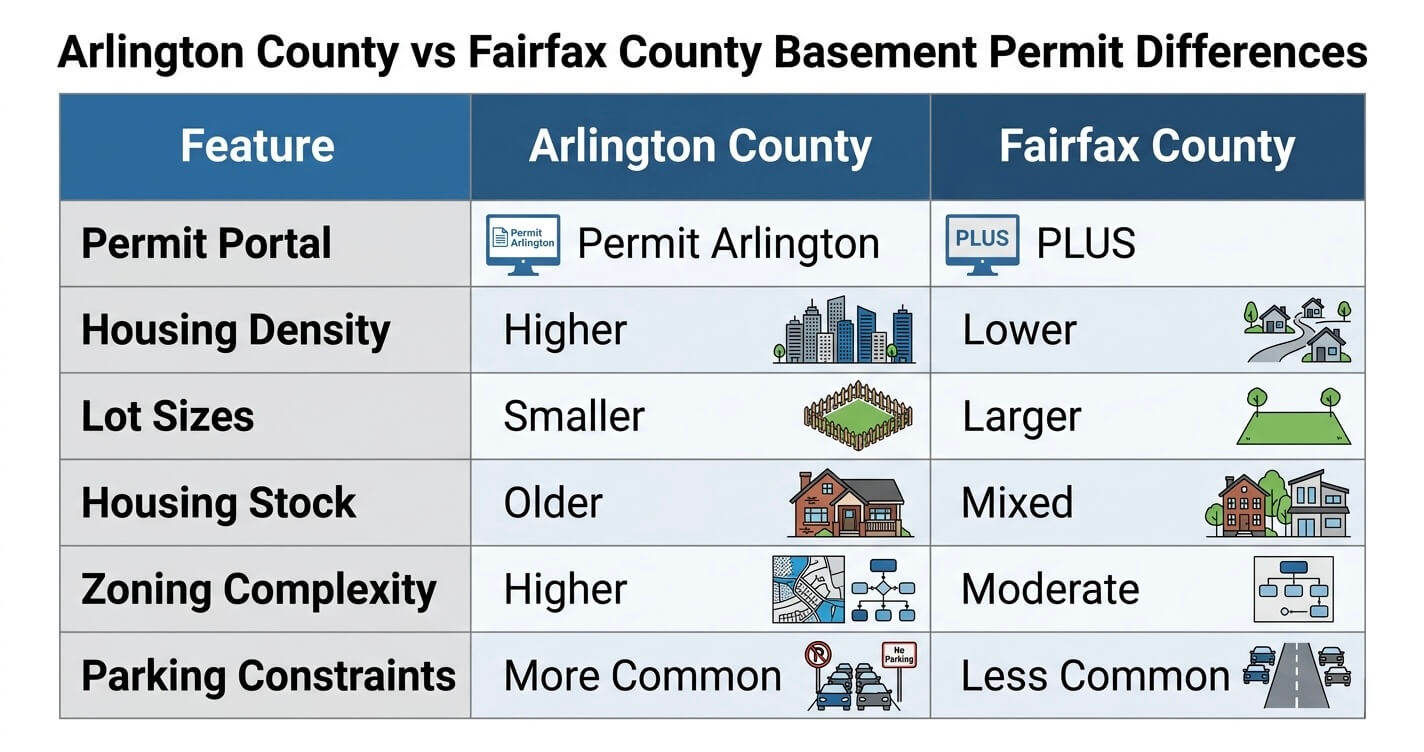
Arlington County generally operates with:
- tighter zoning scrutiny
- denser neighborhood conditions
- narrower setbacks
- more constrained construction access
- older housing inventory
- stricter logistical limitations during construction
Compared to Fairfax County, Arlington basement projects often involve smaller lots, limited driveway access, restricted street parking, and homes built decades earlier with tighter structural clearances. These conditions frequently complicate excavation, egress installation, debris removal, and inspection scheduling.
Permit review timelines may also differ because Arlington projects commonly require additional review for:
- structural modifications
- drainage impacts
- foundation penetrations
- lot-line proximity
- historic neighborhood considerations
The counties also use different digital systems and administrative workflows. Arlington projects are processed through the Permit Arlington portal, while Fairfax County uses the PLUS system for permit submissions and inspection coordination.
Inspection scheduling procedures can vary as well, particularly for multi-trade inspections involving electrical, plumbing, framing, and mechanical work.
For homeowners comparing regional permitting procedures, our guide on Basement Finishing Permit Fairfax County VA explains how Fairfax County’s review structure differs from Arlington’s approach to basement remodeling approvals.
DOES A PERMITTED BASEMENT ADD VALUE?
A properly permitted finished basement generally adds significantly more long-term value than unpermitted basement space in Arlington County VA. Buyers, appraisers, lenders, and insurers increasingly expect documentation proving that basement renovations complied with building code requirements and passed final inspections.
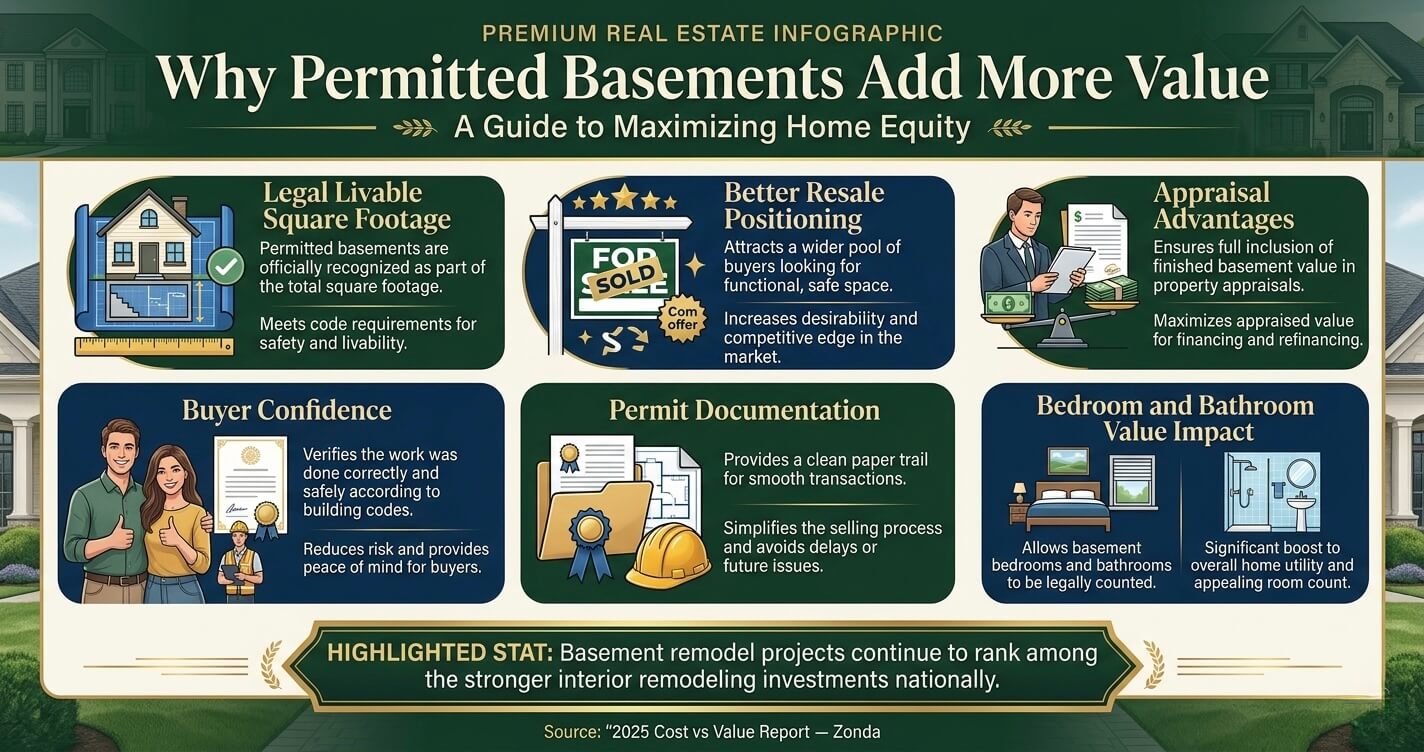
Legally permitted basement space improves:
- resale positioning
- buyer confidence
- appraisal support
- financing eligibility
- inspection transparency
The financial impact becomes even stronger when the basement includes a legally compliant bedroom, bathroom, or flexible living area supported by proper egress and permit approvals.
According to the 2025 Cost vs. Value Report, basement remodels continue to rank among the stronger interior remodeling investments nationally. [Source: 2025 Cost vs. Value Report]
Permitted projects also reduce transaction friction during resale. Buyers increasingly request:
- permit documentation
- final inspection approvals
- contractor records
- proof of code-compliant bedroom additions
In Arlington County’s competitive housing market, undocumented basement renovations can create appraisal concerns because unpermitted square footage may not receive full valuation consideration.
Appraisers and lenders place greater confidence in finished basements that include verified permit histories and legally approved living areas.
For homeowners evaluating remodeling investments more broadly, our guide on Home Addition Cost Northern Virginia explains how finished basements compare with larger additions from both cost and resale perspectives.
CHOOSING A BASEMENT CONTRACTOR IN ARLINGTON COUNTY
Selecting the right basement contractor in Arlington County is as much a permit and structural decision as it is a construction decision. Basement remodeling projects routinely involve coordination between framing, electrical, plumbing, HVAC, waterproofing, inspections, and code compliance, making contractor experience critical to avoiding delays and costly corrections.
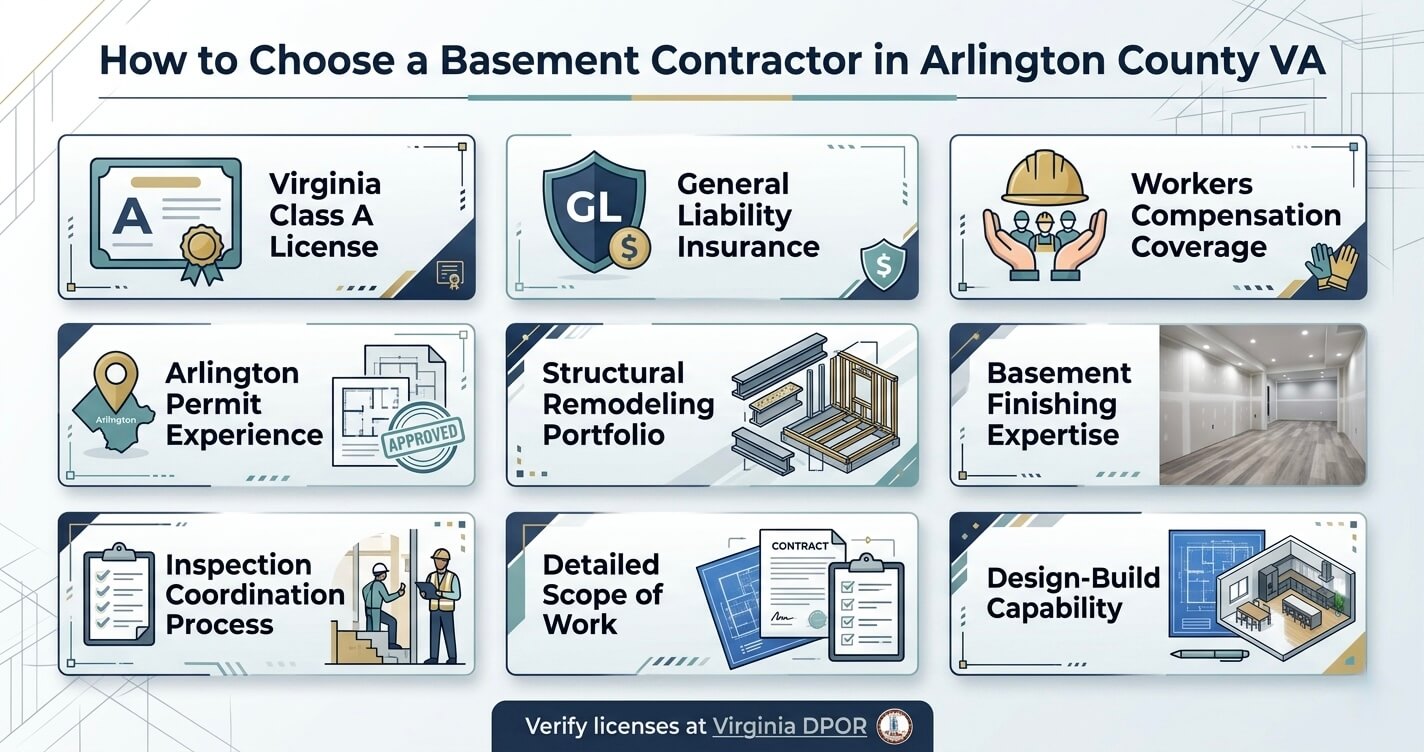
Before hiring any basement contractor, homeowners should verify:
- Virginia Class A contractor license
- active general liability insurance
- workers’ compensation coverage
- Arlington County permit experience
- structural renovation experience
- finished basement portfolio
- inspection coordination procedures
[Official License Verification Source: Virginia DPOR]
Arlington County’s older housing stock frequently introduces hidden structural and mechanical complications that inexperienced contractors fail to identify during initial walkthroughs. Common examples include:
- low ceiling clearances
- undersized electrical service
- moisture intrusion
- aging plumbing
- non-compliant framing
- complex egress excavation conditions
Contractors without substantial Arlington permitting experience may underestimate the documentation and inspection coordination required for basement approvals.
This is where design-build delivery becomes particularly valuable. A design-build structure creates:
- one accountability system
- integrated planning
- coordinated permit management
- fewer communication gaps
- reduced change-order risk
US Home Design Build approaches basement remodeling through a Consultation → Design → Build → Maintain process that aligns engineering, permitting, construction sequencing, and final inspections under one coordinated workflow.
This structure helps reduce the mid-project scope conflicts that commonly occur when homeowners separately hire designers, engineers, and contractors without centralized oversight.
For a broader contractor evaluation framework, see our article on How to Choose the Right Contractor in Northern Virginia.
FREQUENTLY ASKED QUESTIONS [FAQs]
Do I need a permit to finish a basement in Arlington County VA?
Yes. Arlington County requires permits for most basement finishing work involving framing, electrical systems, plumbing, HVAC modifications, bedrooms, bathrooms, egress windows, or structural changes.
How much does a basement finishing permit cost in Arlington County?
Permit costs vary depending on project scope, valuation, trade permits, and structural complexity. Most basement finishing projects include separate fees for building, electrical, plumbing, and mechanical permits in addition to possible engineering review costs.
Official Permit Portal: https://permitarlington.arlingtonva.us/
Does adding a basement bedroom require an egress window?
Yes. A basement bedroom must include a compliant emergency escape and rescue opening that meets minimum egress dimensions established under the Virginia Residential Code. Non-compliant rooms cannot legally be classified or marketed as bedrooms.
How long does basement permit approval take in Arlington County?
Approval timelines vary based on project complexity, revision requests, and workload volume. Projects involving structural modifications, foundation penetrations, or egress work generally require longer review periods than simple open-space finishes.
Can I finish my basement without a contractor?
Homeowners may perform certain work themselves, but basement remodeling projects involving electrical, plumbing, structural changes, or code-regulated systems typically require licensed trade work and inspections. DIY permit mistakes often result in failed inspections and expensive corrections.
What inspections are required for basement remodeling?
Most Arlington County basement projects require multiple inspections including framing, electrical, plumbing, HVAC, insulation, and final inspections before permit closure and occupancy approval.
TO SUM UP
The most expensive basement remodeling mistakes in Arlington County are almost never paint colors or flooring selections, they are permit, planning, and code-compliance mistakes that surface after construction begins.
Successful basement projects start with understanding:
- permit triggers
- egress requirements
- structural limitations
- inspection sequencing
- electrical and HVAC capacity
- moisture conditions
In Arlington’s older housing stock, addressing these issues early prevents the majority of stop-work orders, failed inspections, and mid-project budget overruns.
US Home Design Build works with homeowners across Arlington VA, McLean VA, Fairfax VA, Vienna VA, Burke VA, and throughout Northern Virginia on:
- basement finishing
- structural remodeling
- permit coordination
- egress installation
- full home renovation projects
Their design-build process combines Consultation → Design → Build → Maintain under one coordinated system backed by local permitting experience and a two-year workmanship warranty.
703-202-3520 | US Home Design Build | 8200 Greensboro Dr Suite 900, McLean, VA 22102
