
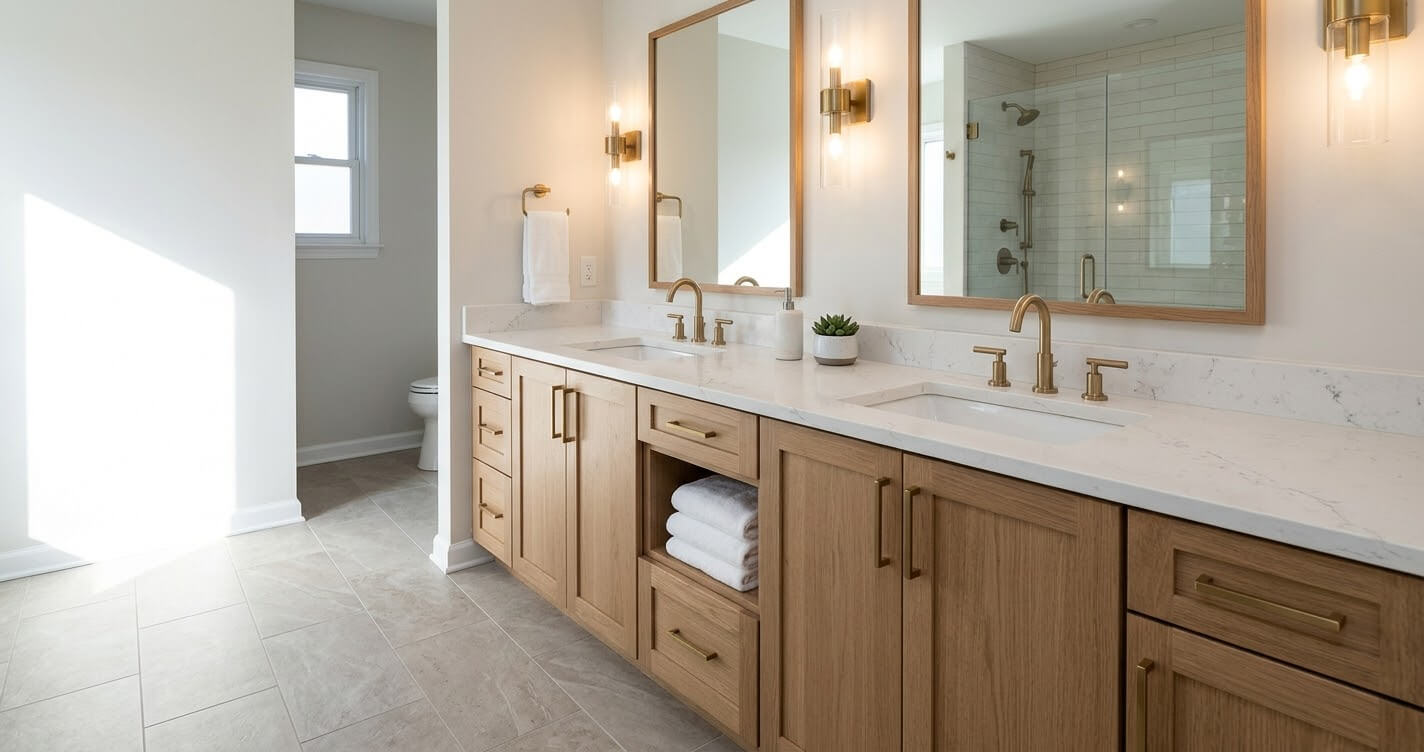
Bathroom vanity prices Fairfax County VA homeowners encounter in 2026 are generally higher than pre-tariff pricing, particularly for imported cabinetry, but the full 25% tariff does not automatically translate into a 25% increase at the retail level. Current federal policy keeps a 25% duty on imported kitchen cabinets and bathroom vanities, while the planned increase to 50% has been delayed until January 1, 2027.
For a Fairfax County homeowner, the practical question is not simply whether vanities are more expensive. It is how much the vanity will add to the remodeling budget, whether its country of origin exposes it to additional import costs, and whether choosing stock, semi-custom, or fully custom cabinetry changes the financial impact.
As a 2026 planning benchmark, a standard stock bathroom vanity may run roughly $500–$1,500 for a single vanity and $900–$2,500 for a double vanity, while semi-custom and custom options can move well beyond those figures depending on dimensions, wood species, finish, countertop, hardware, storage configuration, and installation requirements. These are planning ranges rather than government-published Fairfax County price averages; actual project pricing depends heavily on the selected manufacturer and specification.
The broader Fairfax County remodeling market also has a relatively high cost floor compared with a simple national bathroom-refresh estimate. US Home Design Build’s Northern Virginia cost guide currently places complete bathroom remodels at approximately $12,000–$25,000 for smaller updates, $25,000–$45,000 for mid-range projects, and $45,000–$80,000+ for high-end renovations. A vanity is therefore only one component of the total project budget.
For homeowners planning a broader renovation, it is useful to review the company’s bathroom remodeling services alongside individual material costs. A design-build approach can help coordinate cabinetry, countertops, plumbing, electrical work, tile, demolition, and installation rather than treating the vanity as an isolated purchase.
At US Home Design Build, bathroom design and remodeling decisions are evaluated within the actual scope of the home, existing conditions, material selections, and installation requirements. That distinction matters in Fairfax County because the price shown on a vanity retailer’s website is not necessarily the final installed cost.
What Is Driving Up Bathroom Vanity Prices in Fairfax County in 2026?
The biggest tariff-related factor is the federal 25% duty on imported kitchen cabinets and bathroom vanities that took effect for covered goods entered for consumption on or after October 14, 2025.
The originally scheduled increase to 50% on January 1, 2026 was subsequently delayed, so the 25% rate remains the key tariff figure for 2026 planning.
The 25% tariff applies to covered imported vanities and parts
The tariff issue is more technical than simply saying “foreign vanities now cost 25% more.”
The September 2025 presidential proclamation established a 25% ad valorem duty on completed kitchen cabinets and vanities, as well as specified parts imported for use in kitchen cabinets and vanities. The duty applies to covered goods entered for consumption, or withdrawn from a warehouse for consumption, on or after October 14, 2025.
An ad valorem duty means the tariff is calculated as a percentage of the applicable customs value rather than as a fixed dollar charge. Therefore, a vanity with a higher customs value can carry a larger absolute tariff liability than a lower-cost model.
However, homeowners should not assume that a vanity listed at $2,000 will automatically become $2,500 at the showroom or online checkout. The tariff is initially an import cost. How much of that cost ultimately reaches the homeowner depends on the manufacturer’s pricing structure, distributor margins, inventory timing, exchange rates, freight, domestic production costs, and how much of the imported content is incorporated into the finished product.
That distinction is important when comparing bathroom vanity cost 2026 estimates.
Why the planned 50% increase matters even though it was delayed
The original proclamation scheduled the cabinet and vanity duty to increase from 25% to 50% on January 1, 2026. That increase did not take effect because the administration later delayed it for another year while negotiations concerning wood-product imports continued. The 25% rate therefore remains in effect through the current 2026 period, with the delayed increase scheduled for January 1, 2027 unless policy changes again.
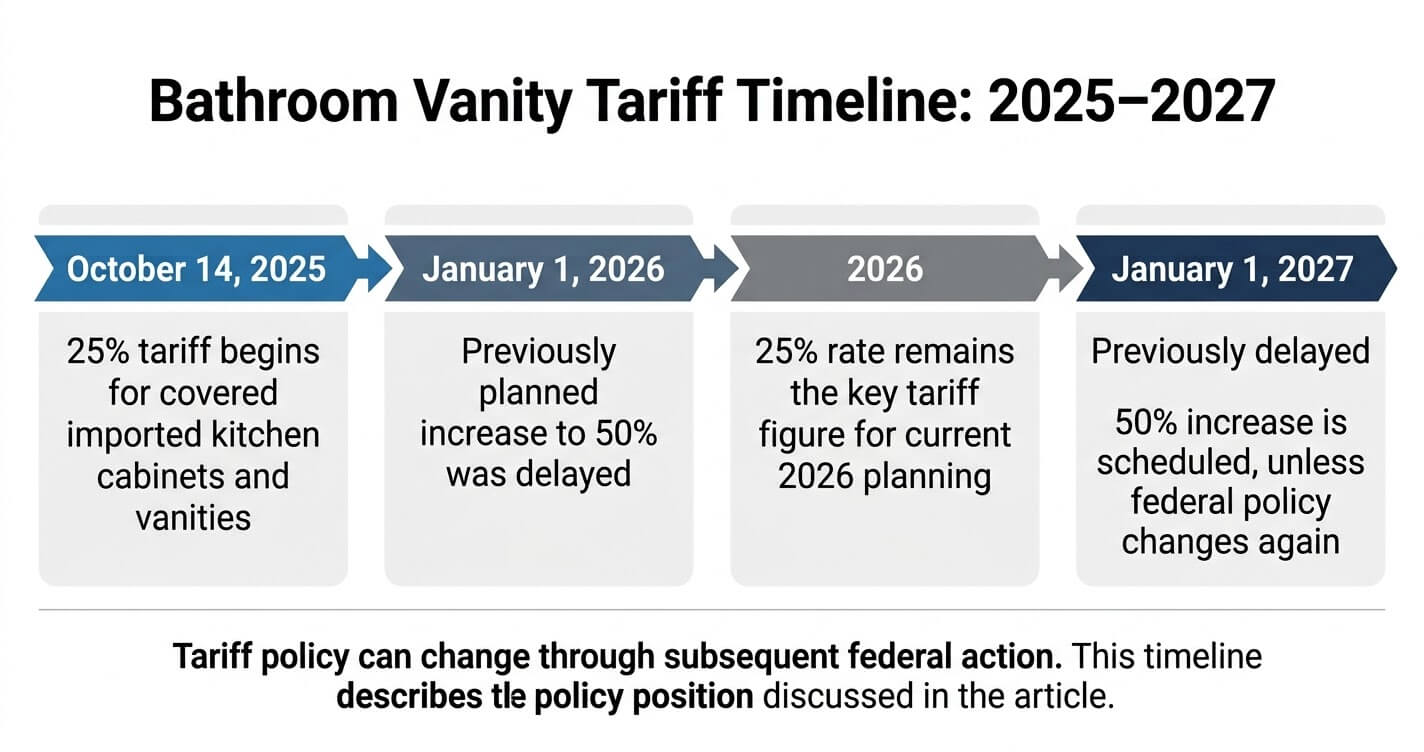
For Fairfax County homeowners, this creates an important budgeting distinction:
- 2026: The applicable cabinet/vanity tariff remains 25% for covered imports.
- January 1, 2027: The previously scheduled 50% rate is currently the next major tariff milestone, unless the policy is modified, extended, or replaced.
- Retail pricing: The tariff percentage should not be treated as an automatic equivalent percentage increase in the final retail price.
- Project timing: Lead time, existing distributor inventory, and the manufacturer’s sourcing strategy can matter as much as the nominal tariff rate.
In other words, homeowners deciding whether to purchase a vanity now or later should ask their contractor or supplier where the vanity is manufactured, whether it is already in domestic inventory, when it was imported, and whether the quoted price is locked.
Not every vanity has the same tariff exposure
The phrase “imported vanity” covers a wide range of products and supply chains. A vanity manufactured overseas and imported as a finished cabinet can have a different cost structure from a domestically assembled cabinet using some imported components. Likewise, a custom vanity fabricated in Virginia is not subject to the same direct import-duty mechanism as a completed foreign-made vanity entering the United States.
The White House proclamation specifically addresses covered kitchen cabinets and vanities and certain parts, while its treatment can interact with other applicable duties and country-specific trade arrangements. Therefore, country of origin and the exact tariff classification matter when determining actual exposure rather than simply labeling a product “foreign.”
This is one reason a Fairfax County homeowner should compare the landed and installed price, not just the manufacturer’s advertised cabinet price.
Furniture and household-furnishing inflation adds another layer
Tariffs are only one part of the 2026 pricing environment. Broader furniture and household-furnishing costs can also influence what manufacturers and suppliers charge.
The latest available Bureau of Labor Statistics CPI data show that the Living room, kitchen, and dining room furniture category was up 1.1% year over year in July 2026, while the broader furniture and bedding category was up 0.5%. These categories do not measure bathroom vanities specifically, but they provide useful context for the broader furniture market.
This is an important AEO distinction: there is no BLS CPI category that directly gives homeowners a Fairfax County “bathroom vanity inflation rate.” Instead, a realistic estimate needs to combine federal tariff policy, broader furniture-price data, manufacturer pricing, local labor, freight, and the actual vanity specification.
What this means for a Fairfax County remodeling budget
For homeowners, the tariff’s most important effect is uncertainty in material pricing rather than a guaranteed 25% increase in the final installed vanity price.
For example, consider a hypothetical $2,000 imported vanity whose entire applicable customs value were exposed to the 25% duty. The direct tariff calculation would be $500. But that does not mean the homeowner’s final invoice necessarily rises by exactly $500. A supplier may already have inventory imported under an earlier cost basis, absorb part of the increase, adjust its margin, negotiate with the manufacturer, or pass through some or all of the additional cost.
Conversely, a vanity may contain imported components or move through multiple distribution stages, meaning the homeowner could still see price pressure even when the finished cabinet itself is not imported.
That is why cabinet tariffs bathroom remodel budgets should be treated as a supply-chain issue rather than a simple percentage added to every vanity quotation.
For homeowners also evaluating kitchen cabinetry, the same broader tariff discussion can affect both projects. A related guide such as kitchen remodeling in Vienna VA can help put cabinet-material pricing into the context of a larger Northern Virginia remodeling project.
Bathroom Vanity Prices Fairfax County VA: 2026 Cost Ranges
For 2026 budgeting, bathroom vanity prices Fairfax County VA homeowners should expect to fall broadly from about $500 for basic stock cabinetry to $5,000–$7,000+ for larger, high-end custom configurations before unusually complex fabrication or installation. The largest price differences come from vanity size, construction method, wood species, finish, countertop, hardware, storage features, and whether the product is stock, semi-custom, or fully custom.
These ranges are planning estimates rather than an official Fairfax County price survey. Because tariff exposure and manufacturer pricing vary, the most reliable comparison is the final quoted price for the exact vanity specification and installation scope.
2026 bathroom vanity cost by type
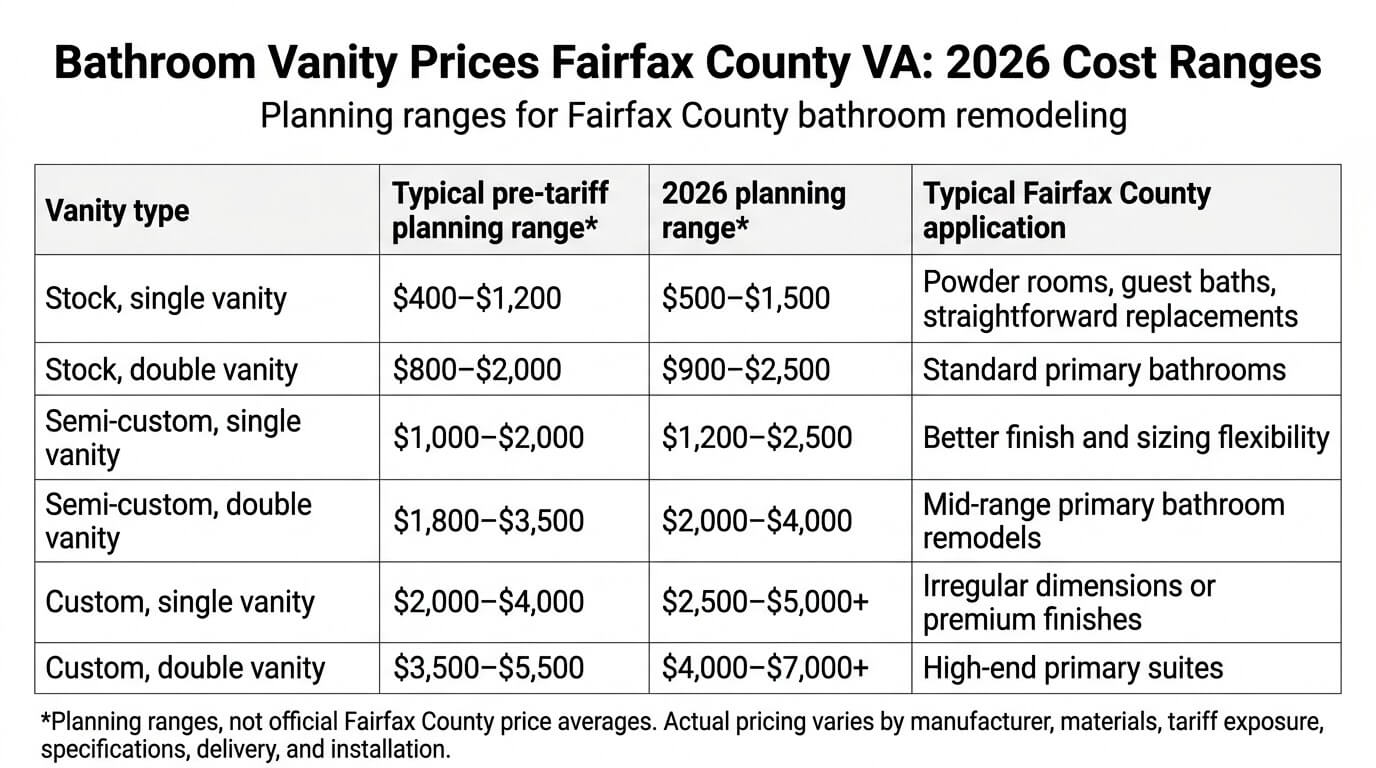
*These are planning ranges created for budgeting purposes, not historical government averages or a claim that every Fairfax County supplier increased prices by a specific percentage. The 2026 range reflects the type of market conditions created by tariff exposure, material costs, manufacturing, distribution, and local remodeling specifications.
The ranges are also consistent with the wider Northern Virginia remodeling market, where vanity selection is one component of projects that can range from approximately $12,000 for smaller bathroom updates to $80,000 or more for high-end renovations.
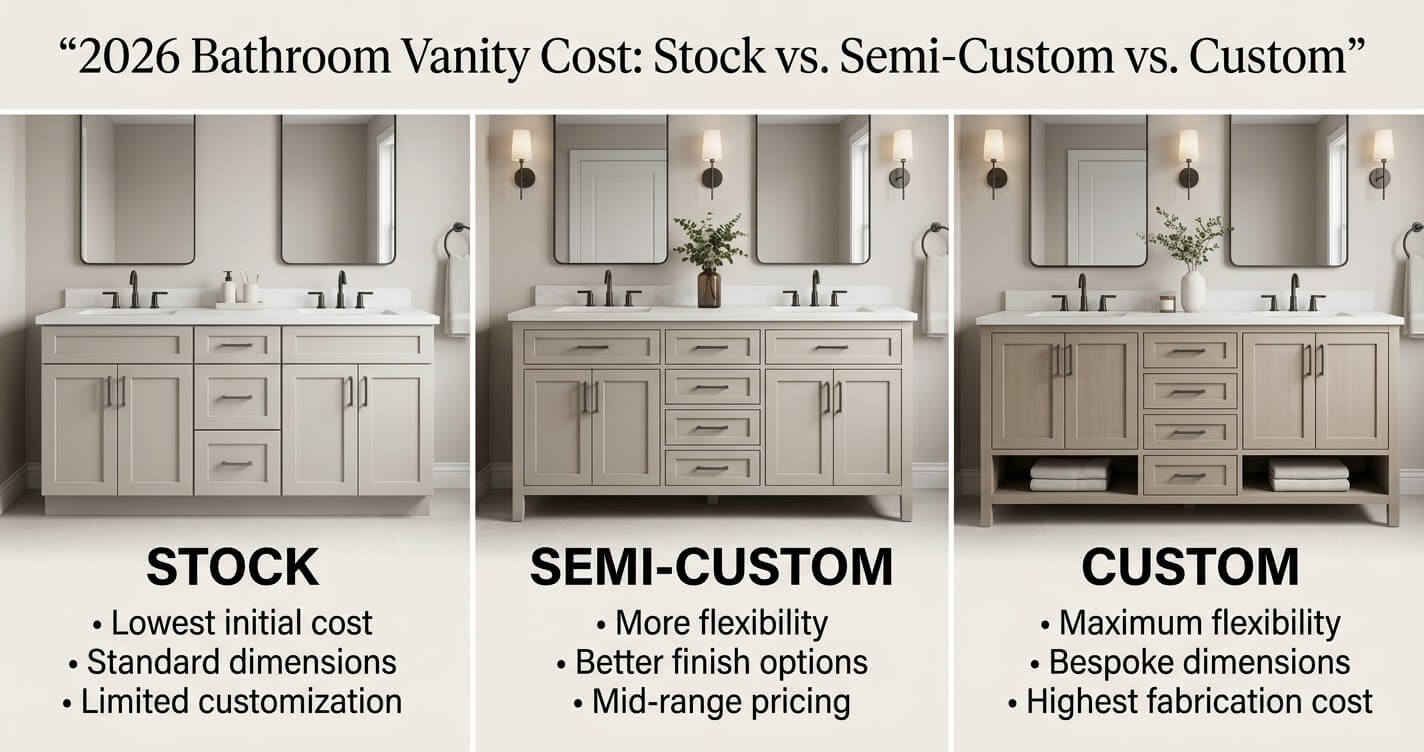
Stock vanities: lowest initial price, least customization
Stock vanities are mass-produced in standardized dimensions and are generally the easiest option to price and source. They are commonly available in widths such as 24, 30, 36, 48, 60, and 72 inches, although exact dimensions vary by manufacturer.
For a Fairfax County homeowner completing a straightforward bathroom update, a stock vanity can make sense when:
- The existing plumbing locations already work.
- The bathroom accommodates a standard cabinet width.
- Storage requirements are relatively simple.
- The homeowner does not need a specific wood species or custom finish.
- Schedule certainty is more important than extensive customization.
The key advantage is not simply the lower cabinet price. Stock cabinetry can also reduce design and fabrication complexity, which can help keep the project schedule predictable.
However, stock pricing requires careful comparison. Two vanities with similar dimensions may differ substantially in drawer construction, hardware, countertop material, sink configuration, finish quality, and warranty coverage.
Semi-custom vanities: a useful middle ground
Semi-custom cabinetry generally provides more control over dimensions, finishes, hardware, drawer configurations, and storage than a stock product without requiring every component to be fabricated from scratch.
For many Northern Virginia bathroom remodels, this category can offer a practical balance between appearance, durability, customization, and budget.
A homeowner might use semi-custom cabinetry to accommodate:
- A slightly unusual wall width.
- Additional drawers instead of doors.
- A specific paint or stain.
- Integrated electrical storage.
- A particular countertop configuration.
- Matching linen storage.
- Double-sink layouts with improved drawer organization.
This is also where imported vanity prices Virginia homeowners see online can become difficult to compare directly. A $1,500 advertised cabinet and a $2,500 semi-custom cabinet may not represent equivalent products. One may include a countertop and sink while the other may be cabinet-only. One may be delivered fully assembled while the other requires additional fabrication or installation.
Custom vanities: highest flexibility and greater cost exposure
Custom vanities are built around the actual dimensions and requirements of the bathroom. They can be particularly valuable when a room has an irregular wall, unusual plumbing locations, architectural constraints, or a homeowner wants cabinetry that matches other millwork in the house.
Custom work can also provide better control over details such as:
- Exact cabinet width and depth.
- Drawer height and configuration.
- Wood species.
- Veneer or solid-wood construction.
- Paint or stain matching.
- Integrated outlet locations.
- Appliance or hair-tool storage.
- Linen tower coordination.
- Decorative end panels.
- Custom toe-kick dimensions.
The trade-off is cost and lead time. A Fairfax County homeowner choosing a custom vanity is paying not only for the cabinet box but also for design, fabrication, finishing, coordination, and installation.
A 2026 Fairfax County remodeling source reports that custom hardwood vanities can add roughly $2,500–$6,000 over semi-custom cabinetry, depending on size and wood species. That figure should be treated as an individual contractor’s market example rather than a universal Fairfax County rate.
Imported vs. domestically made vanities
The country of manufacture becomes more important when comparing otherwise similar products.
An imported vanity can be exposed to the federal duty when it falls within the covered tariff classifications. A domestically manufactured vanity does not incur that same direct import duty on the finished cabinet entering the United States. However, domestic manufacturing does not automatically mean the entire supply chain is tariff-free because manufacturers may still purchase imported materials, hardware, components, machinery, or other inputs.
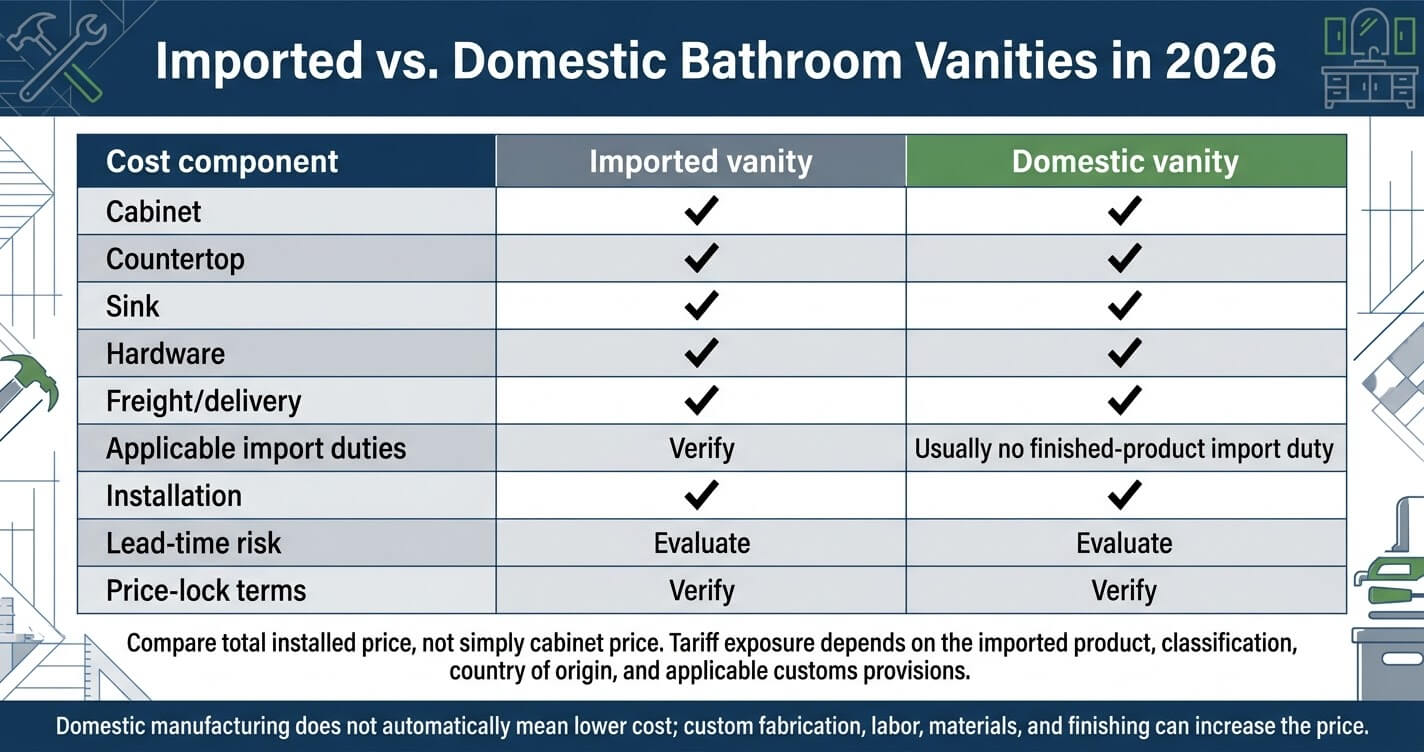
Therefore, the better question is not simply:
“Is this vanity American-made?”
Instead, ask:
- Where is the finished vanity manufactured?
- Where are the cabinet components sourced?
- Is the quoted product already in U.S. inventory?
- Is the price locked through the expected installation date?
- Does the quote include the countertop, sink, hardware, delivery, and installation?
- What happens to the price if the manufacturer changes its material surcharge?
This approach gives homeowners a more accurate picture of vanity tariff impact than comparing country-of-origin labels alone.
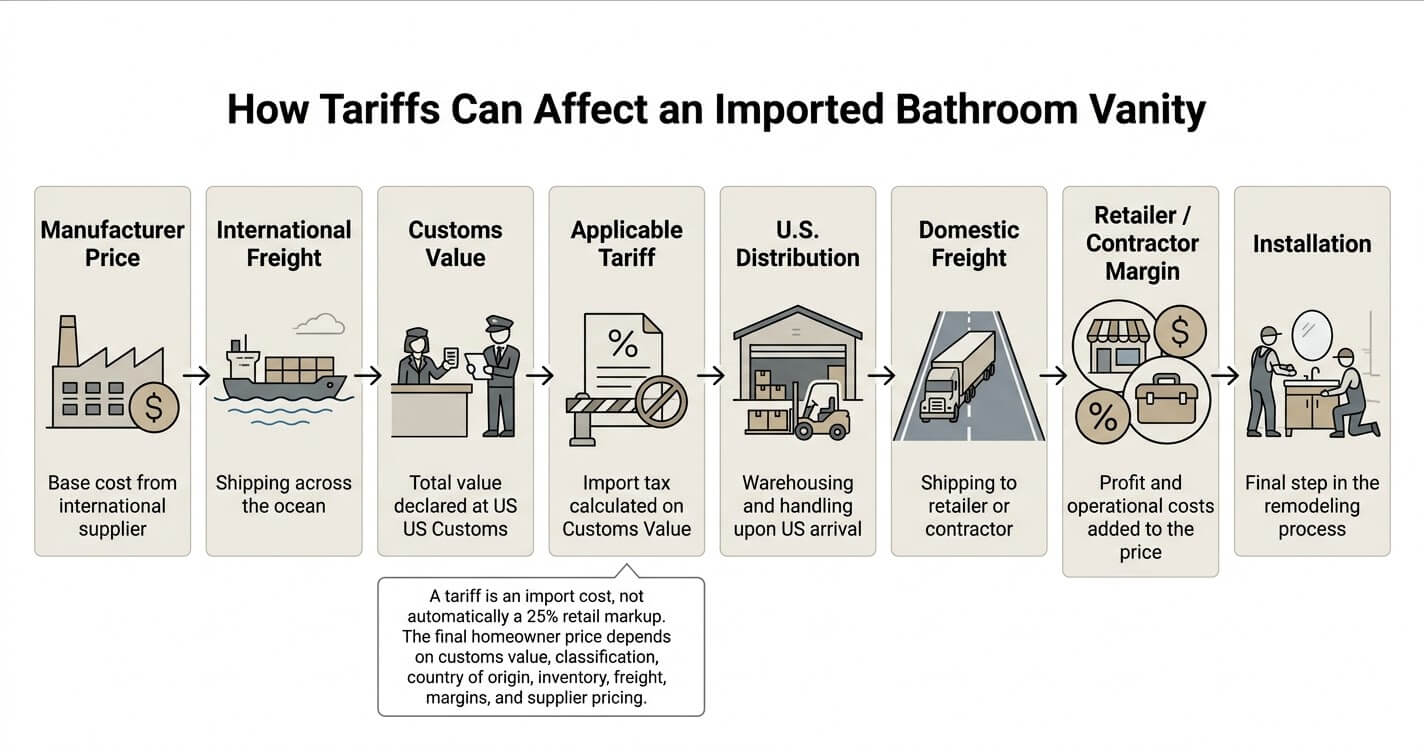
Why the tariff does not equal a 25% retail markup
Suppose two comparable vanities each have a pre-tariff manufacturer/import value of $2,000. A 25% duty applied to a $2,000 customs value would equal $500.
That mathematical example is straightforward:
$2,000 × 25% = $500
But the retail chain is more complicated.
The importer may pay the duty, then sell to a distributor. The distributor may apply its own margin, freight cost, warehousing cost, and pricing adjustment. The retailer or remodeling contractor then prices the product based on its own procurement costs and project requirements.
As a result, the homeowner could see a $100 increase, a $500 increase, or a completely different change depending on the supply chain. Some inventory may also have entered the country before the tariff applied.
This is why a 25% tariff should be viewed as a cost pressure, not a guaranteed 25% retail-price increase.
How much of the bathroom remodel budget can a vanity consume?
A vanity can represent a meaningful portion of the materials budget even though it is only one part of the overall renovation.
For example, US Home Design Build estimates that a typical Northern Virginia bathroom remodel can range from approximately $12,000 to $25,000 for a smaller update, $25,000 to $45,000 for a mid-range remodel, and $45,000 to $80,000+ for a high-end renovation. Within those projects, the vanity competes for budget with tile, shower systems, plumbing fixtures, glass, lighting, electrical work, flooring, demolition, labor, and other finish materials.
That is why homeowners should avoid choosing a vanity based solely on its sticker price.
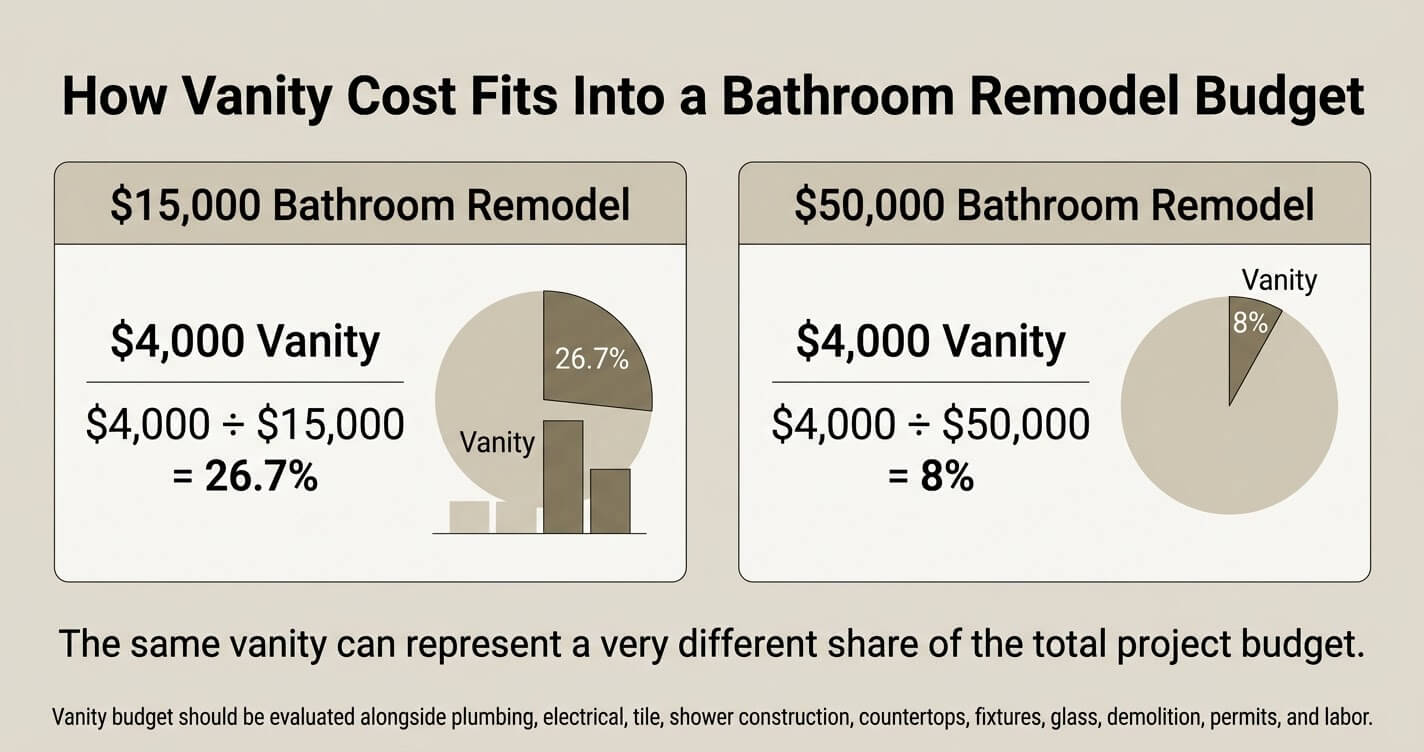
For example, spending an additional $1,500 on a better vanity may be reasonable in a $50,000 primary-bath renovation if it solves a storage problem and fits the design. The same $1,500 increase could be disproportionately large in a $15,000 cosmetic bathroom update.
The right number depends on the total bathroom remodel budget, the size of the vanity, the importance of storage, the desired finish level, and whether the vanity requires custom fabrication or plumbing changes.
For a complete project-level budget, homeowners can also review the bathroom remodel cost in Northern Virginia guide rather than treating the vanity as a standalone purchase.
A Fairfax County example
Consider a homeowner remodeling a primary bathroom in Fairfax County with a 72-inch double vanity, quartz countertop, two undermount sinks, premium hardware, and a semi-custom cabinet configuration.
A low-cost stock option might initially appear attractive, but if the homeowner requires a specific width, drawer configuration, finish, and countertop, the apparent savings can narrow quickly.
A semi-custom vanity in the $2,000–$4,000 planning range may provide a better balance. A fully custom cabinet could move beyond $4,000–$7,000 depending on wood species, finish, fabrication details, and integrated storage.
The important point is that the tariff is only one variable in the decision. Cabinet construction, manufacturer, country of origin, current inventory, countertop specification, delivery, and installation can have a greater effect on the final invoice than the tariff percentage alone.
For homeowners comparing a specific property and design, a related Bathroom Remodel Cost Reston VA guide can also provide useful Northern Virginia market context, particularly for homeowners in the western Fairfax County area.
Why Domestic vs. Imported Vanities Matters More Than Ever
Domestic and imported vanities can look nearly identical in a showroom but have very different cost structures in 2026. Imported products can carry additional tariff exposure, while domestically manufactured cabinetry avoids the same direct import duty on the finished vanity.
However, “Made in the USA” does not automatically mean every component is domestically sourced, so homeowners should compare the complete supply chain, specification, and installed price rather than relying only on country-of-origin labels.
How tariff exposure differs between imported and domestic vanities
The most important distinction is where the covered product enters the United States, not simply where a retailer or contractor is located.
The federal tariff imposed in 2025 established an additional 25% ad valorem duty on covered imported kitchen cabinets and vanities, with the rate applying to qualifying goods entered for consumption or withdrawn from warehouse for consumption beginning October 14, 2025. The administration subsequently delayed the planned increase to 50% until January 1, 2027.
An imported vanity therefore can have a cost structure that looks roughly like this:
Manufacturer price → international freight → customs value → applicable tariff → U.S. distribution → domestic freight → retailer/contractor margin → installation
A domestically manufactured vanity generally removes the finished-product import tariff from that chain:
Domestic manufacturing → domestic distribution → freight → retailer/contractor margin → installation
That does not mean the domestic option is automatically cheaper. A U.S.-made custom vanity can cost substantially more because of domestic labor, smaller production runs, premium materials, customization, finishing, and fabrication.
The practical issue for Fairfax County homeowners is therefore tariff exposure rather than simply foreign versus American manufacturing.
What materials and products are actually exposed?
The federal action covers specified kitchen cabinets and vanities and certain parts. The tariff framework is administered through the Harmonized Tariff Schedule of the United States (HTSUS), meaning classification, product characteristics, country of origin, and applicable Chapter 99 provisions can affect the duty treatment of an individual import.
This is important because a bathroom vanity is not necessarily one uniform commodity.
A typical vanity may contain:
- Wood or engineered-wood cabinet components
- Hardwood or veneer
- Metal hinges and drawer slides
- Aluminum or steel hardware
- Quartz, porcelain, stone, or other countertop materials
- Ceramic or porcelain sinks
- Plumbing components
- Decorative pulls and handles
- Mirrors or integrated lighting
Not every component necessarily receives the same tariff treatment.
For example, the federal cabinet and vanity tariff should not be interpreted as a blanket 25% surcharge on every item installed around a bathroom sink. The applicable treatment depends on the imported article and its classification.
This distinction becomes particularly important when a contractor provides a single installed price for a vanity package. The cabinet, countertop, sink, hardware, delivery, and labor may all have different cost structures.
Country of origin can be more important than the retailer’s location
A common mistake is to assume that purchasing from a U.S.-based bathroom showroom means the vanity is domestically manufactured.
It does not.
A Fairfax County homeowner could purchase an imported vanity from a U.S. retailer, while another homeowner could purchase a domestically manufactured vanity through the same retailer.
The retailer’s location is therefore not enough to determine tariff exposure.
Before approving a vanity, homeowners should ask:
- Where was the finished vanity manufactured?
- What is the country of origin?
- Is the product already physically in U.S. inventory?
- Has the supplier already paid the applicable import duties?
- Is the quoted price guaranteed through installation?
- Are countertop and sink costs included?
- How long is the expected lead time?
These questions are particularly useful when comparing imported vanity prices Virginia homeowners see online with locally sourced or domestically manufactured alternatives.
“Already in the United States” does not necessarily mean tariff-free
Another important distinction is between when a vanity was manufactured and when it entered the United States for consumption.
The federal proclamation ties the cabinet and vanity duty to qualifying goods entered for consumption or withdrawn from warehouse for consumption after the specified effective date.
That means a supplier should be able to explain the product’s import status rather than simply saying that it was manufactured several months ago.
For a homeowner, however, the more useful question is usually simpler:
Is this exact product already in domestic inventory, and is my quoted price locked?
If a distributor already owns inventory and has incorporated its acquisition costs into its current selling price, the homeowner may not experience the same immediate pricing movement as someone ordering a new production run from an overseas manufacturer.
This is one reason inventory availability can matter when planning a 2026 bathroom renovation.
Lead times can affect the real cost of an imported vanity
Tariffs are only one supply-chain issue.
An imported vanity can involve manufacturing, quality control, ocean transportation, customs processing, warehousing, domestic transportation, and final delivery before it reaches a Fairfax County project.
That longer chain creates more opportunities for delays.
A vanity that is inexpensive on paper may become more expensive to the overall project if it arrives after the scheduled installation date. For example, a delayed cabinet could force a contractor to reschedule countertop templating, plumbing connections, mirror installation, or final bathroom completion.
The resulting cost may not appear as a “tariff charge,” but it still affects the project’s economics.
For a remodeling contractor, material availability is part of cost control.
A slightly more expensive vanity that can be delivered on the required date can sometimes be financially preferable to a cheaper product with an uncertain international lead time.
What about “goods on the water”?
Homeowners should also be cautious about assuming that a vanity already moving through international transportation is automatically exempt from the tariff.
The applicable tariff treatment is tied to customs entry and the legal provisions governing the imported product. A shipment’s physical location alone does not establish whether the tariff applies.
For that reason, a contractor or supplier should verify the actual customs and inventory status rather than promising that a shipment is “grandfathered in” simply because it was ordered before a tariff change.
For homeowners, the safest approach is to treat the quoted and contracted price as the relevant budgeting number and ask the supplier whether any tariff-related surcharge can be added later.
Domestic does not automatically mean cheaper
A domestic vanity may avoid the direct import duty on the finished cabinet, but that does not guarantee a lower final price.
A U.S.-manufactured custom cabinet can include:
- Higher domestic labor costs
- More expensive finishing processes
- Custom fabrication
- Smaller production quantities
- Premium hardwoods
- Higher-grade hardware
- More detailed joinery
- Local design and fabrication labor
Consequently, a $3,500 domestic custom vanity could still cost more than a $2,000 imported semi-custom vanity even after accounting for the tariff.
The correct comparison is therefore:
Imported installed price vs. domestic installed price
—not:
Imported cabinet price vs. domestic cabinet price.
This distinction can prevent homeowners from making a decision based on a misleading headline price.
A practical Fairfax County comparison
Imagine two 60-inch double vanities for the same primary-bathroom remodel.
Option A: Imported semi-custom vanity
- Cabinet price: $2,500
- Possible tariff exposure: depends on classification, country of origin, and import circumstances
- International/domestic freight: additional
- Lead time: supplier-dependent
- Installation: additional
Option B: Domestic custom vanity
- Cabinet price: $4,000
- Direct import duty on finished cabinet: not applicable in the same manner
- Domestic delivery: additional
- Lead time: local fabricator-dependent
- Installation: additional
At first glance, Option A is clearly cheaper.
But if the imported vanity’s availability, freight, tariff treatment, countertop compatibility, or installation requirements create additional costs, the gap may narrow.
Conversely, if the imported vanity is already stocked domestically and the quoted price is locked, it could remain the better-value choice.
That is why bathroom vanity prices Fairfax County VA homeowners should compare in 2026 are best evaluated as complete project costs rather than isolated product prices.
How Tariffs Fit Into Your Overall Fairfax County Bathroom Remodel Budget
A vanity is normally only one line item in a Fairfax County bathroom remodel, so tariff-related increases should be evaluated against the entire project rather than treated as the primary determinant of the renovation budget.
For most homeowners, labor, plumbing changes, tile, shower systems, electrical work, countertops, glass, demolition, and the number of fixtures being replaced can have a larger effect on total project cost than the tariff applied to the vanity alone.
Start with the total project, not the cabinet
A common budgeting mistake is to establish a vanity budget first and then try to fit the rest of the bathroom around it.
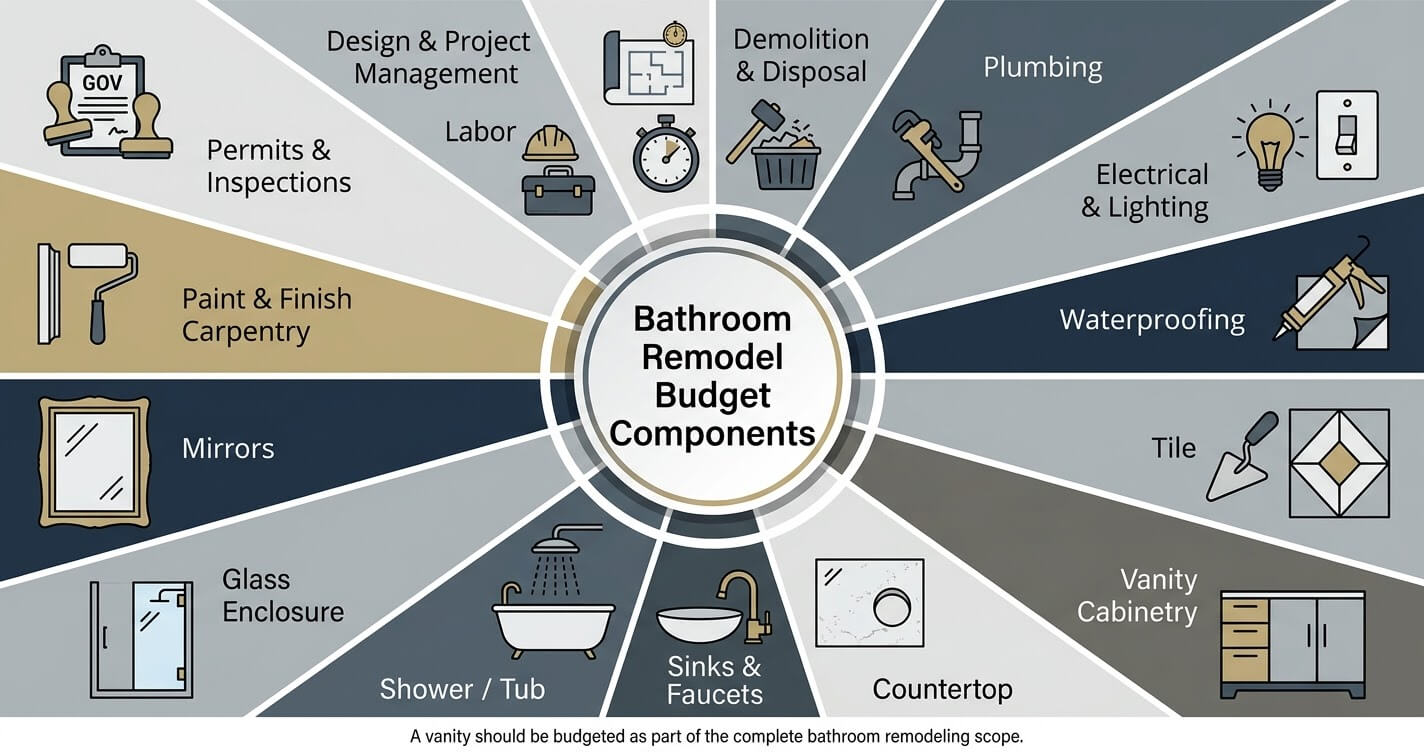
A better approach is to establish the total project scope and then allocate money across the major components.
For example, a bathroom renovation may include:
- Design and project management
- Demolition and disposal
- Framing or structural modifications
- Plumbing
- Electrical
- Lighting
- Ventilation
- Shower or tub
- Waterproofing
- Wall and floor tile
- Vanity cabinetry
- Countertop
- Sinks and faucets
- Toilet
- Shower fixtures
- Glass enclosure
- Mirrors
- Paint
- Finish carpentry
- Permits and inspections
- Labor
The vanity is therefore an important component, but it is not the entire remodeling budget.
US Home Design Build’s Northern Virginia bathroom remodeling cost guidance currently places projects broadly in the range of $12,000–$25,000 for smaller updates, $25,000–$45,000 for mid-range renovations, and $45,000–$80,000+ for high-end remodels.
For project-specific planning, homeowners can review the company’s bathroom remodel cost in Northern Virginia guide.
Where the vanity fits into a remodeling budget
There is no universal percentage that every Fairfax County bathroom should allocate to its vanity.
A reasonable planning framework is to think in terms of vanity cost relative to the overall scope and finish level.
For a $15,000 bathroom update, a $4,000 custom vanity represents approximately:
$4,000 ÷ $15,000 = 26.7%
For a $45,000 renovation, the same $4,000 vanity represents:
$4,000 ÷ $45,000 = 8.9%
The vanity has not changed, but its impact on the total project has.
This is why a homeowner should not ask only, “How much does a vanity cost?”
The more useful question is:
How much of my total remodeling budget should I dedicate to cabinetry while still funding the construction and finish elements that determine the bathroom’s performance?
Tariffs affect the material portion, not the entire remodeling invoice
Suppose a project includes a $3,000 vanity and a $30,000 total remodeling budget.
Even if the entire $3,000 vanity value were hypothetically exposed to a 25% tariff, the simple tariff calculation would be:
$3,000 × 25% = $750
That $750 is approximately 2.5% of the $30,000 project budget.
And even this example should not be interpreted as a prediction of the homeowner’s final invoice. The tariff applies according to the applicable customs rules and import value, not automatically to the retail or installed price.
The example illustrates an important budgeting principle:
A material-level tariff can have a much smaller proportional effect on the complete remodeling project.
That does not make $750 insignificant. It means the homeowner should evaluate it alongside much larger project variables such as plumbing relocation, shower reconstruction, tile selection, and labor.
Plumbing changes can outweigh vanity-price differences
Vanity selection becomes particularly important when the cabinet configuration requires plumbing changes.
A simple replacement may keep:
- Existing drain locations
- Existing supply lines
- Existing sink positions
- Existing wall conditions
A more extensive remodel may move the vanity, change from a single to double sink, relocate plumbing, or alter wall framing.
In that situation, the cabinet price may be only part of the additional cost.
For example, upgrading from a $2,000 stock vanity to a $3,500 custom vanity adds $1,500 in cabinetry cost.
But moving plumbing, modifying walls, adding electrical outlets, changing lighting, and repairing surrounding finishes can create a much larger project-cost difference.
That is why the correct bathroom remodel budget Northern Virginia should be developed from the entire scope of work.
Countertops and sinks should be separated from cabinet pricing
Another common source of inaccurate vanity comparisons is failing to determine what the advertised price includes.
One manufacturer may quote:
Cabinet only
while another may quote:
Cabinet + countertop + integrated sink
A contractor may instead provide:
Cabinet + countertop + sink + delivery + installation
Those are three different cost packages.
Quartz, natural stone, porcelain, solid-surface materials, undermount sinks, integrated sinks, backsplash pieces, edge profiles, and cutouts can all change the final price.
When comparing custom vanity cost Fairfax County homeowners should therefore request an itemized specification rather than relying on the cabinet’s headline price.
Permits can also affect the overall budget
A vanity replacement itself may be relatively straightforward, but the surrounding bathroom renovation can involve plumbing, electrical, structural, or other work that requires permits or inspections depending on the scope and applicable Fairfax County requirements.
Homeowners planning a larger renovation should review the project’s permit requirements early rather than adding permit costs after the material budget has already been finalized.
For projects in Fairfax County, the Remodeling Permit Fairfax County resource provides additional guidance on the permitting side of renovation planning.
Build a contingency instead of spending every dollar on finishes
A strong remodeling budget should not allocate 100% of available funds to visible finishes.
Existing bathrooms can reveal unexpected conditions after demolition, including:
- Water damage
- Deteriorated subflooring
- Outdated wiring
- Plumbing deficiencies
- Mold or moisture damage
- Framing problems
- Previous unpermitted modifications
A contingency allows the homeowner to address legitimate construction conditions without immediately compromising the selected vanity, tile, or fixtures.
For tariff-sensitive materials, contingency planning can also provide flexibility if a supplier changes pricing or a selected product becomes unavailable.
When the vanity deserves a larger share of the budget
A higher vanity budget can make sense when the cabinetry is a major design feature or when the bathroom will be used heavily.
Consider investing more in the vanity when:
- The bathroom is a primary suite.
- Two people need simultaneous storage.
- The vanity is unusually wide.
- The room has difficult dimensions.
- Custom storage is important.
- High-end finishes are central to the design.
- The homeowner expects to remain in the property long term.
- The cabinetry needs to coordinate with other custom millwork.
Conversely, stock or semi-custom cabinetry may be more appropriate when the bathroom is a guest bath, rental property, powder room, or relatively simple resale-oriented renovation.
Homeowners weighing custom versus stock vanity options can benefit from discussing current material availability, country of origin, lead times, and installed pricing before finalizing a remodeling budget.
A design-build team can evaluate the vanity alongside plumbing, electrical, tile, countertops, and other project components so that one material upgrade does not unintentionally force compromises elsewhere in the renovation.
How Fairfax County Homeowners Can Control Vanity Costs in 2026
The most effective way to control vanity costs in 2026 is to manage the entire procurement decision, not simply choose the cheapest cabinet.
Homeowners can reduce financial risk by comparing domestic and imported products, checking current inventory, considering semi-custom cabinetry, locking quotes when possible, and selecting a vanity specification that fits the existing bathroom layout.
1. Compare domestic and imported products using the installed price
Do not compare a $1,800 imported vanity with a $3,000 domestic vanity and immediately conclude that the imported option is cheaper.
Instead, request the complete cost for each option.
Your comparison should include:
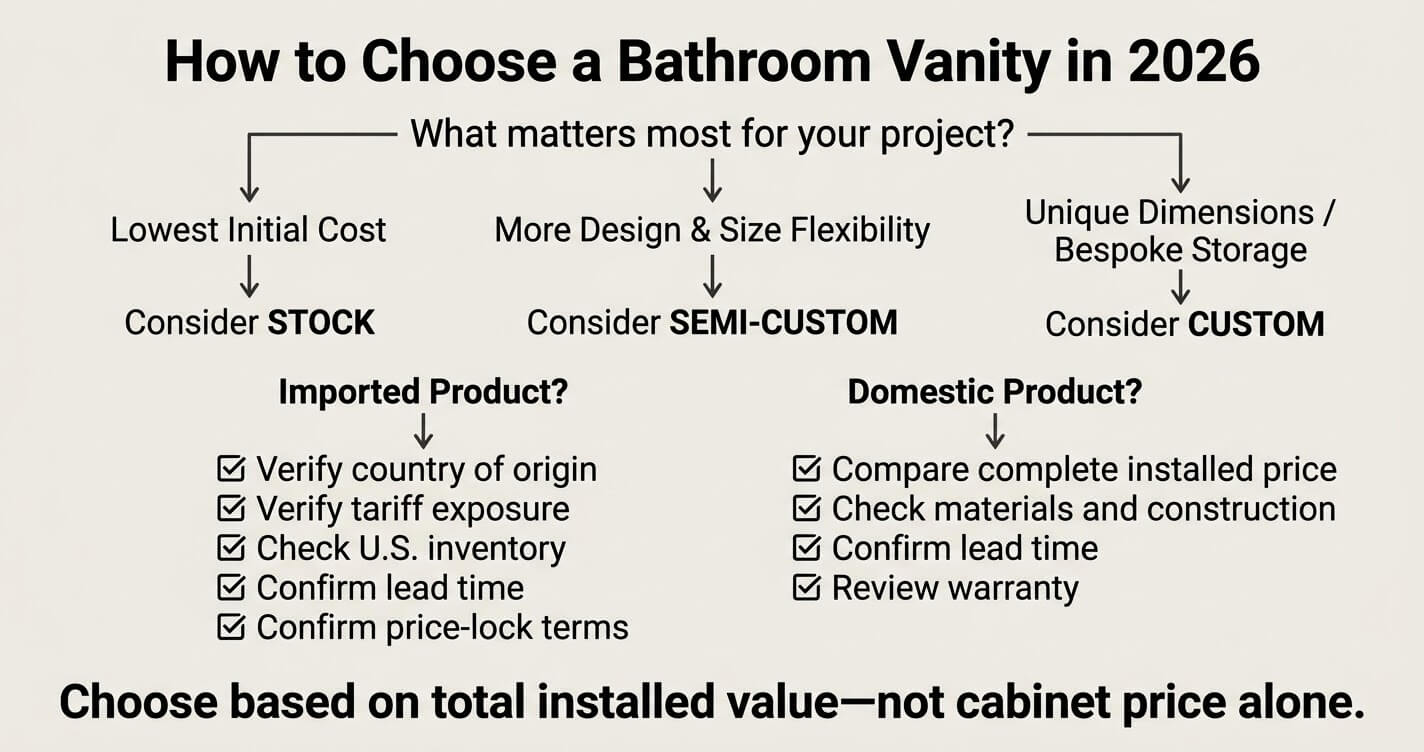
The objective is to determine total installed cost, not simply the cabinet’s advertised price.
2. Ask whether the vanity is already in U.S. inventory
Inventory can be valuable during a period of changing trade policy.
If a supplier already has the exact vanity in a domestic warehouse, the homeowner should ask whether the quoted price reflects the supplier’s existing acquisition cost and whether that price is locked.
This does not mean domestic inventory is automatically tariff-free. It means the product’s current procurement status can be materially different from a new overseas production order.
For a renovation with a firm construction schedule, available inventory can also reduce the risk of delaying other trades.
3. Consider semi-custom instead of full custom
One of the most effective ways to control custom vanity cost Fairfax County homeowners face is to determine whether every custom feature is actually necessary.
A semi-custom cabinet may allow you to customize:
- Width
- Finish
- Hardware
- Drawer configuration
- Sink configuration
- Storage accessories
without requiring an entirely bespoke cabinet.
If the bathroom has standard dimensions, semi-custom cabinetry may provide most of the desired appearance and functionality at a lower cost than a fully custom build.
4. Keep the vanity in the existing plumbing footprint when practical
Moving a vanity can trigger additional construction work.
If the existing layout works well, keeping the vanity in approximately the same location may reduce:
- Plumbing modifications
- Wall repairs
- Flooring repairs
- Tile replacement
- Electrical relocation
- Construction time
This strategy does not mean homeowners should never relocate a vanity. A poor layout should not be preserved simply to save money.
Instead, evaluate the cost of moving the vanity against the functional benefit.
If a $2,000 layout change creates substantially better storage and circulation, it may be worthwhile. If the move provides little practical improvement, preserving the existing plumbing footprint can be a sensible cost-control decision.
5. Lock the material price before construction begins
A remodeling estimate is much more useful when homeowners understand how long material prices remain valid.
Ask the contractor or supplier:
- Is the vanity price locked?
- How long is the quote valid?
- Can manufacturer surcharges be passed through?
- What happens if the selected model is discontinued?
- Is the product reserved once the deposit is paid?
- When will the vanity be ordered?
- What happens if delivery is delayed?
This is particularly important when tariff policy can change.
The current federal framework keeps the 25% cabinet/vanity duty in place while delaying the previously scheduled increase to 50% until January 1, 2027. Because the policy can be amended again through future federal action, homeowners should avoid assuming that today’s tariff schedule will remain unchanged indefinitely.
6. Choose materials based on performance, not just appearance
A bathroom vanity operates in a high-moisture environment.
The cheapest cabinet is not necessarily the lowest-cost option over the life of the bathroom.
Consider:
- Moisture resistance
- Cabinet-box construction
- Edge sealing
- Finish durability
- Drawer hardware
- Hinge quality
- Ease of cleaning
- Replacement-part availability
- Warranty
- Countertop durability
A vanity that costs $500 less but has poor moisture resistance or lower-quality hardware may not represent a genuine saving if it requires earlier replacement.
7. Avoid changing the specification repeatedly
Design changes can create unnecessary costs.
Changing from a 60-inch vanity to a 72-inch model after plumbing and countertop planning has begun can affect:
- Cabinet procurement
- Countertop dimensions
- Sink locations
- Plumbing
- Mirrors
- Lighting
- Wall finishes
- Electrical locations
Once the design has been finalized, homeowners should minimize unnecessary specification changes.
This is especially important for custom products because fabrication may begin well before installation.
8. Coordinate the vanity with the rest of the bathroom
A vanity should be selected as part of the bathroom’s complete material palette.
For example, choosing an expensive custom vanity and then discovering that the countertop, mirrors, lighting, and hardware exceed the remaining budget can create unnecessary compromises.
A better approach is to establish the entire finish package first:
Vanity + countertop + sink + faucet + mirror + lighting + hardware
Then determine where premium spending will have the greatest design and functional impact.
9. Use real project constraints to make the decision
A practical example illustrates why the “cheapest vanity” is not always the best option.
Imagine a Fairfax County primary bathroom with a 72-inch opening and a planned completion date six weeks away.
An imported custom vanity costs $2,800 but has an uncertain eight-to-ten-week lead time.
A domestic semi-custom vanity costs $3,400 and can be delivered within four weeks.
The second option costs $600 more, but it may prevent a project delay that affects countertop fabrication, plumbing completion, mirror installation, and final inspection.
In this scenario, the $600 premium could be economically rational.
On the other hand, if the imported vanity is already stocked domestically and can be delivered in two weeks with a firm price, the lower-cost option may be preferable.
The correct decision depends on price, tariff exposure, availability, lead time, specification, and project schedule together.
For homeowners interested in seeing how material selection and project execution come together in an actual Northern Virginia renovation, the site’s bathroom remodel before and after in Burke VA example can provide useful project context.
10. Consider buying before the next scheduled tariff milestone, but do not panic-buy
The current policy provides an important planning window.
The 25% tariff on covered imported kitchen cabinets and vanities remains in effect during 2026, while the previously scheduled increase to 50% has been delayed to January 1, 2027.
That does not mean every homeowner should immediately purchase a vanity.
Buying too early can create its own problems:
- The bathroom design may change.
- The product could be damaged during storage.
- The manufacturer could discontinue the model.
- Warranty periods may begin before installation.
- Dimensions may change after demolition.
- The selected vanity may not fit actual site conditions.
The better strategy is to finalize the bathroom design, verify dimensions, confirm product availability, and understand the supplier’s price-lock policy before ordering.
11. Work with a design-build team when multiple trades are involved
Vanity procurement becomes more complicated when it is part of a larger bathroom renovation.
A design-build contractor can coordinate the relationship between:
Cabinet → countertop → plumbing → electrical → tile → mirrors → lighting → final installation
This reduces the risk of choosing a cabinet that looks good independently but creates problems elsewhere in the project.
For Fairfax County homeowners planning a complete renovation, professional bathroom remodeling services can help integrate material selection with the construction schedule and overall budget.
A simple 2026 vanity-cost control checklist
Before approving a vanity, confirm:
- Country of origin: Where was the finished cabinet manufactured?
- Inventory: Is it already in the United States?
- Tariff exposure: Does the supplier know the applicable import treatment?
- Price: Is the quoted price locked?
- Scope: Does it include the countertop, sink, hardware, delivery, and installation?
- Dimensions: Has the actual bathroom been field-measured?
- Plumbing: Will existing plumbing locations work?
- Lead time: Does delivery fit the construction schedule?
- Warranty: What happens if a component arrives damaged or defective?
- 2027 exposure: Could a future tariff change affect a later order?
Taking these steps can make bathroom vanity prices Fairfax County VA homeowners budget in 2026 considerably more predictable.
The objective is not necessarily to find the lowest-priced vanity. It is to find the right vanity at a predictable installed cost, with an acceptable lead time and a specification that fits the entire remodeling project.
Frequently Asked Questions
How much does a bathroom vanity cost in Fairfax County VA in 2026?
A bathroom vanity in Fairfax County can cost approximately $500–$1,500 for a basic stock single vanity, $900–$2,500 for a stock double vanity, and roughly $1,200–$7,000+ for semi-custom or custom configurations. The final installed price depends on dimensions, cabinetry construction, finish, countertop, sink, hardware, delivery, installation, and the project’s existing plumbing conditions.
These figures should be treated as 2026 planning ranges rather than official Fairfax County averages because there is no government database that publishes a standardized retail price for bathroom vanities in Fairfax County. A custom 72-inch double vanity with premium cabinetry and quartz can cost several times more than a basic 30-inch stock vanity.
The broader bathroom remodeling budget is also important. US Home Design Build’s Northern Virginia cost guide places complete bathroom remodeling projects broadly across approximately $12,000–$25,000 for smaller updates, $25,000–$45,000 for mid-range projects, and $45,000–$80,000+ for high-end renovations.
Are all bathroom vanities affected by tariffs?
No. The 25% federal tariff does not mean every bathroom vanity sold in Fairfax County automatically receives a 25% price increase. The tariff applies to covered imported kitchen cabinets and vanities under the applicable federal tariff provisions, while domestically manufactured finished vanities do not face the same direct import duty.
The tariff framework is based on factors such as the imported product, tariff classification, country of origin, and applicable customs provisions. The White House confirmed in December 2025 that the existing 25% tariff on certain kitchen cabinets and vanities would remain in effect, while the previously scheduled increase was delayed for another year.
A U.S.-based retailer can therefore sell an imported vanity that remains subject to tariff-related supply-chain costs, while a domestically manufactured vanity sold through the same retailer may have a different cost structure.
Homeowners should ask the supplier where the finished vanity was manufactured, whether it is already in U.S. inventory, and whether the quoted price includes any applicable material or tariff surcharge.
Will vanity prices go up again in 2027?
There is currently a scheduled tariff milestone for January 1, 2027, when the previously delayed increase for covered kitchen cabinets and vanities is set to take effect unless federal policy changes again. The current 25% rate remains the applicable figure during the 2026 period covered by the latest federal announcement.
The National Association of Home Builders reports that the planned increase from 25% to 50% was delayed until January 1, 2027. The White House similarly stated that the existing 25% tariff would remain in effect after the planned January 1, 2026 increase was postponed.
However, homeowners should not treat the 50% figure as a guaranteed future retail-price increase. A tariff rate is not the same thing as a retail markup. Manufacturers, importers, distributors, and retailers can absorb, distribute, or partially pass through changes in their costs.
For someone planning a bathroom remodel in late 2026 or early 2027, the more useful question is whether the specific vanity has already been ordered, where it is manufactured, whether it is in domestic inventory, and whether the supplier has locked the quoted price.
Is it cheaper to buy a domestically made vanity right now?
A domestically made vanity can reduce direct exposure to the import tariff on the finished cabinet, but it is not automatically cheaper than an imported alternative. Domestic cabinetry can have higher fabrication, labor, finishing, and customization costs, so the correct comparison is the complete installed price rather than the country-of-origin label.
For example, a domestically manufactured custom vanity may cost more than an imported semi-custom vanity even after tariff costs are considered. Conversely, an imported vanity ordered under a new production run may become less competitive if tariff and freight costs are passed through.
Domestic manufacturing can also provide advantages beyond price, including potentially shorter transportation distances, easier communication with the manufacturer, and more predictable replacement or service arrangements.
The best approach is to compare the exact specifications of both products, including cabinet construction, dimensions, finish, countertop, sink, hardware, delivery, installation, warranty, and lead time.
Does a custom vanity cost more because of tariffs?
A custom vanity can cost more because of its materials and fabrication requirements, but its higher price cannot automatically be attributed to tariffs. If the custom vanity is manufactured domestically, the finished cabinet does not incur the same direct import duty as a covered imported vanity; however, imported components or upstream material costs can still influence the manufacturer’s pricing.
Custom cabinetry already carries additional costs because each unit requires more design, fabrication, finishing, and coordination than mass-produced stock cabinetry.
A custom vanity may also use premium hardwoods, specialty veneers, higher-grade hardware, custom paint or stain, integrated storage, unusual dimensions, or specialized construction methods.
Therefore, when evaluating custom vanity cost Fairfax County homeowners should ask for an itemized quotation that separates cabinetry, countertop, sink, hardware, delivery, and installation. This makes it easier to identify whether a higher price is primarily coming from customization or from material and supply-chain conditions.
How much of my bathroom remodel budget should I expect vanities to take up?
There is no fixed percentage that applies to every Fairfax County bathroom remodel because vanity cost depends heavily on the project’s overall scope and finish level. A $4,000 vanity represents a very different budget commitment in a $15,000 bathroom renovation than it does in a $50,000 primary-bathroom remodel.
For example, a $4,000 vanity represents approximately 26.7% of a $15,000 project but only 8% of a $50,000 project.
That does not mean homeowners should target a specific vanity percentage. Instead, cabinetry should be evaluated alongside the other major project costs, including plumbing, electrical, waterproofing, tile, shower construction, countertops, glass, fixtures, lighting, demolition, permits, and labor.
For a larger Northern Virginia bathroom project, the complete bathroom remodel cost in Northern Virginia guide provides a broader framework for understanding how individual material decisions fit into the total budget.
Should I buy my vanity before starting my remodel?
In most cases, the vanity should be selected and ordered early enough to protect the construction schedule, but homeowners should not necessarily purchase it before the bathroom design and field measurements are finalized. The ideal timing is to confirm the final dimensions, plumbing layout, countertop requirements, and product availability before placing the order.
This is particularly important for custom and semi-custom cabinetry because manufacturing and delivery can take substantially longer than purchasing a standard stock vanity.
A real Northern Virginia project documented by US Home Design Build provides a useful example: the company’s Burke bathroom remodel had a six-week vanity order lead time, making material coordination an important part of the project’s overall schedule.
Ordering too late can delay countertop templating, plumbing connections, mirrors, lighting, and final completion. Ordering too early, however, can create problems if field measurements change after demolition or if the design is modified.
The safest approach is to finalize the bathroom design, verify dimensions, confirm the vanity’s availability and lead time, and understand the supplier’s price-lock and cancellation policies before ordering.
In Summary
Bathroom vanity prices Fairfax County VA homeowners face in 2026 are being influenced by both traditional remodeling cost factors and changing federal trade policy. The current 25% tariff on covered imported kitchen cabinets and vanities remains an important consideration, but it should be evaluated alongside product origin, inventory, material specifications, lead time, labor, and the complete installed cost.
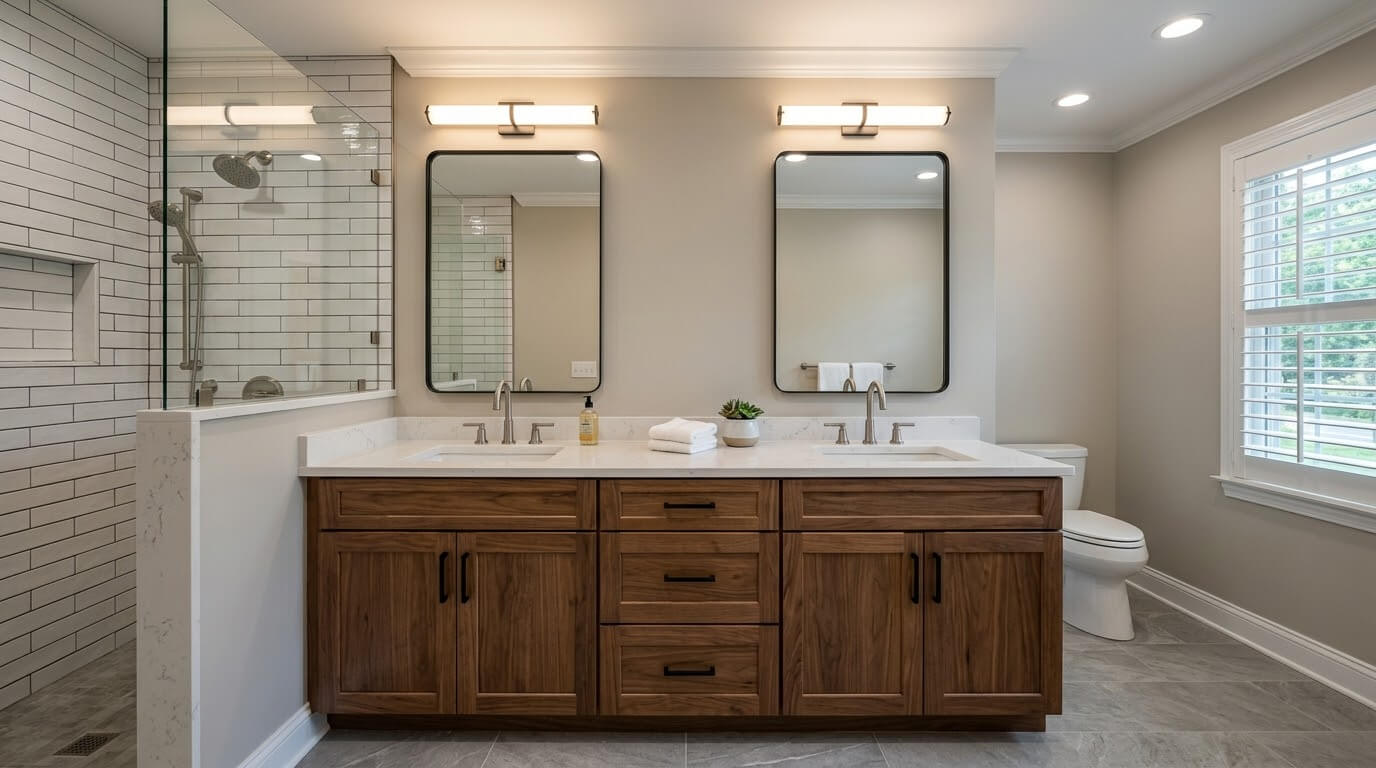
The most important takeaway is that a tariff percentage should never be treated as a direct retail-price calculator.
A 25% import duty does not necessarily mean a vanity’s retail price will rise by exactly 25%. The ultimate effect depends on the customs value, product classification, country of origin, manufacturer pricing, importer and distributor margins, freight, existing inventory, and how much of the additional cost is passed through the supply chain. The current federal policy keeps the 25% rate in place while delaying the previously planned 50% increase until January 1, 2027.
For Fairfax County homeowners, the smartest approach is therefore to evaluate value and timing together.
A stock vanity may make the most financial sense for a straightforward bathroom update. Semi-custom cabinetry can provide a useful middle ground when homeowners need better dimensions, storage, or finish options without the full expense of bespoke fabrication. Custom cabinetry can justify its higher price when the room has unusual dimensions, premium design requirements, or long-term storage needs.
The same principle applies to imported versus domestic products. Instead of asking only whether a vanity is imported, homeowners should determine the country of origin, current inventory status, applicable tariff exposure, lead time, warranty, and complete installed price.
The broader remodeling budget matters just as much. A vanity is only one component of a bathroom renovation that may also involve plumbing, electrical work, waterproofing, tile, countertops, shower construction, glass, fixtures, permits, demolition, and skilled labor. For that reason, a vanity that costs an additional $1,000 or $2,000 may be perfectly reasonable within a larger renovation if it provides substantially better durability, storage, or design value.
If you are planning a bathroom renovation, US Home Design Build’s bathroom remodeling services can help evaluate vanity selection within the broader design, construction, material, and scheduling requirements of your project.
For homeowners considering a larger change to their home’s footprint rather than a conventional remodel, bathroom addition contractors in Northern Virginia can also help evaluate whether expanding the bathroom makes more sense than reconfiguring the existing space.
Ultimately, the best time to select a vanity is before construction begins but after the bathroom design and measurements have been finalized. Confirming the product’s origin, availability, lead time, and price before demolition can reduce the risk of material-related delays and unexpected cost changes.
Planning a bathroom remodel in Fairfax County? Contact US Home Design Build for current, project-specific vanity and material pricing before finalizing your remodeling budget.
