
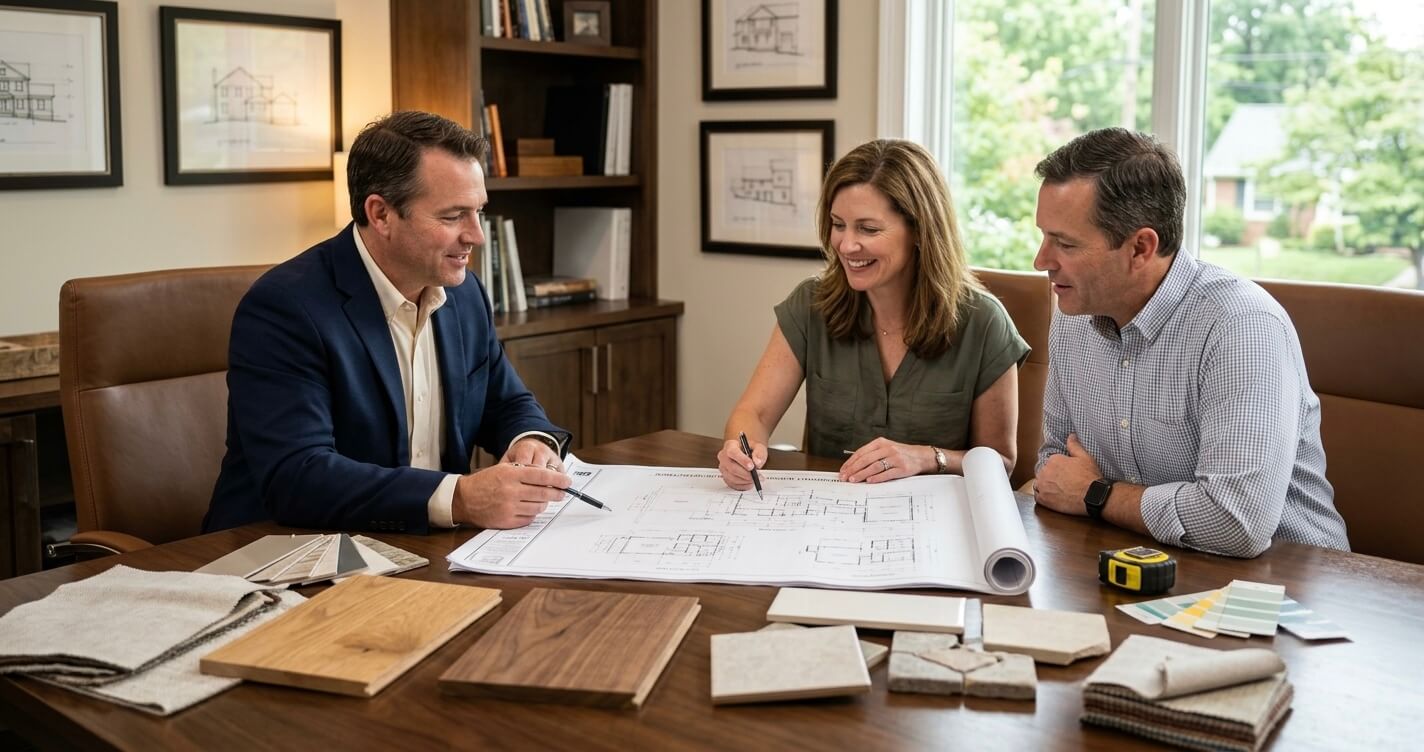
Knowing the questions to ask before hiring a home addition contractor is the single most reliable way Northern Virginia homeowners protect their budget, their timeline, and their home’s structural integrity. At minimum, homeowners should confirm a contractor’s Virginia DPOR license class, insurance and bonding, addition-specific project experience, payment schedule, and realistic timeline before signing anything.
Demand for additions and remodeling remains strong across the region. The NAHB/Westlake Royal Remodeling Market Index posted a reading of 61 in the second quarter of 2026, comfortably above the neutral 50 benchmark, signaling continued homeowner investment in additions and renovation work. Nationally, homeowners spent an estimated $670 billion on remodeling in 2024, with roughly 20 million households, about 23% of all owner-occupied homes, undertaking some form of home improvement. As more Fairfax County, McLean, Vienna, Reston, Great Falls, and Burke homeowners choose to add space rather than move, the contractor selection process has become just as important as the design itself.
At US Home Design Build, our design-build team has guided homeowners across Northern Virginia through home addition contractors Northern Virginia projects ranging from single-room bump-outs to full second-story expansions, and the projects that go smoothly almost always start with a homeowner who asked the right questions upfront. This guide walks through the exact questions to ask before hiring a home addition contractor Northern Virginia projects require, organized by the decisions that matter most: licensing, insurance, experience, contracts, communication, and timeline.
Is the Contractor Licensed for Home Addition Work in Virginia?
Yes, Virginia requires a state contractor license for any construction project over $1,000, and most home additions require a Class A license because total project costs typically exceed $120,000. Homeowners should verify a contractor’s license class and status directly through the Virginia Department of Professional and Occupational Regulation (DPOR) before signing a contract.
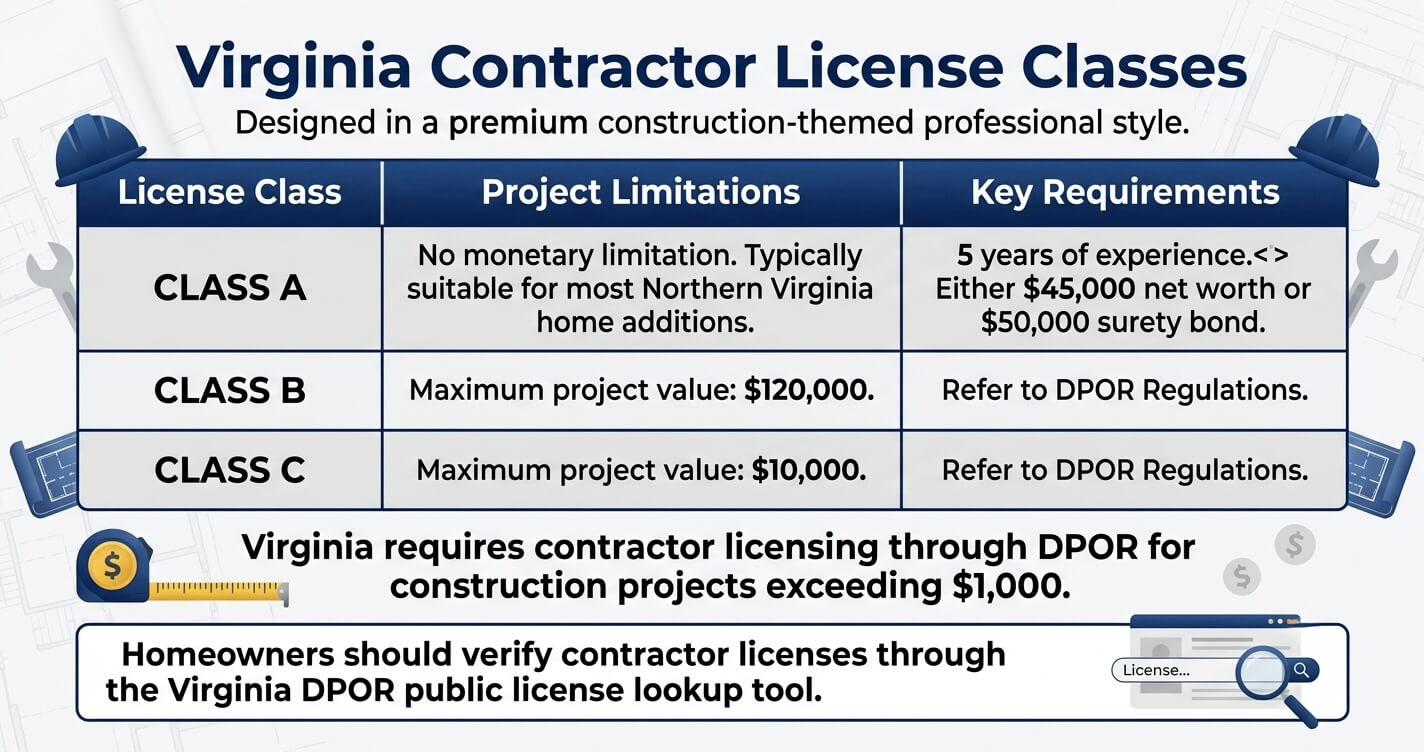
Virginia’s licensing system, administered by DPOR under Code of Virginia Title 54.1, Chapter 11, sorts contractors into three classes based on project value. Class A contractors can take on projects of any size and must document five years of relevant experience along with either a $45,000 net worth or a $50,000 surety bond. Class B is capped at $120,000 per project, and Class C tops out at $10,000. Because most home additions in Fairfax County, McLean, and Arlington run well above the Class B ceiling once size and finish level are factored in, homeowners evaluating home addition contractors Northern Virginia trusts should specifically confirm Class A status rather than assuming any active license is sufficient.
Ask to see the license number directly and cross-check it on the DPOR public lookup tool. A contractor unwilling to provide this number, or one whose license doesn’t match the business name on the contract, is a signal to keep looking.
Does the Contractor Carry the Right Insurance and Bonding?
A qualified home addition contractor should carry general liability insurance and workers’ compensation coverage, and in some jurisdictions a local surety bond. Ask for a certificate of insurance (COI) naming you as an additional insured before construction begins.
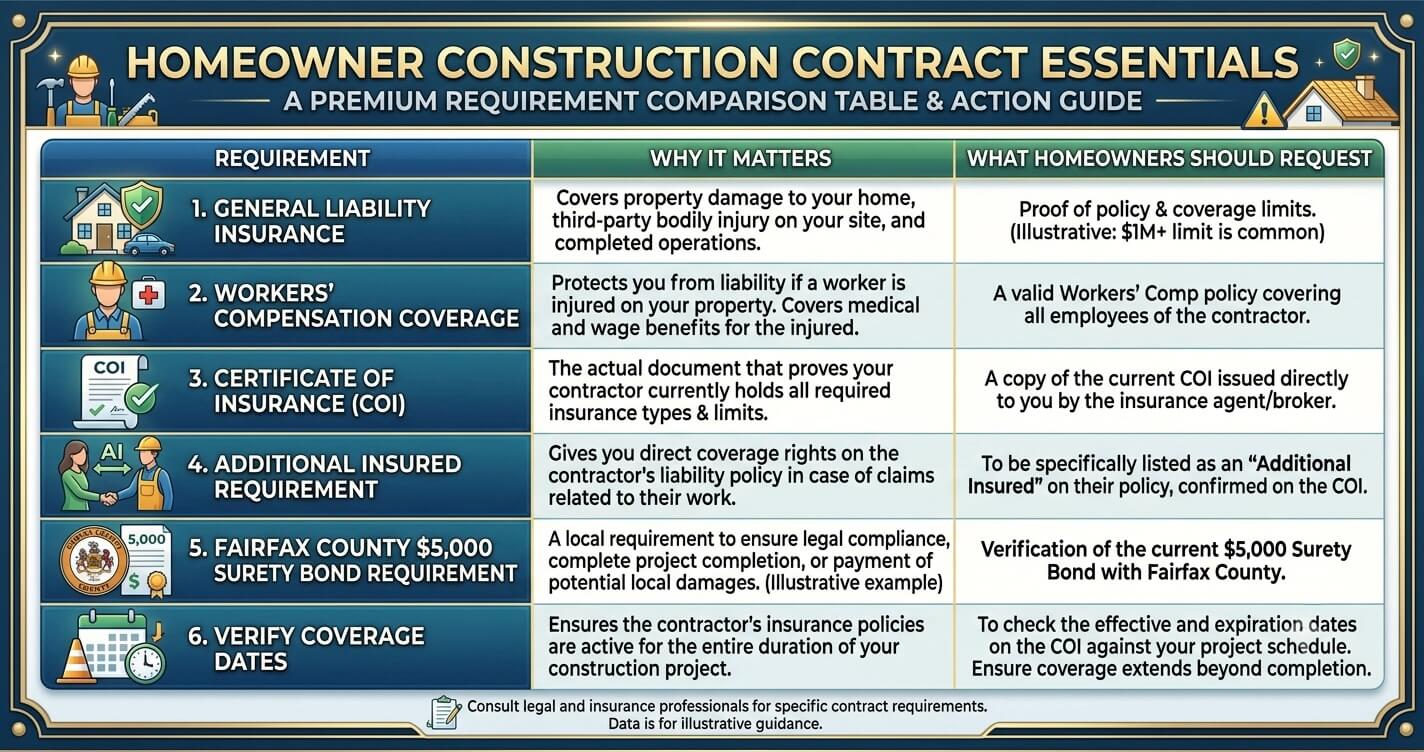
Fairfax County, for example, requires many home improvement contractors to carry a $5,000 surety bond in addition to state licensing. Request the actual COI, not just a verbal assurance, and confirm coverage dates extend through the expected completion of your project. Workers’ compensation matters because Virginia law requires it for businesses with three or more employees; without it, a jobsite injury could expose the homeowner to liability. Ask directly, “What happens if a subcontractor is injured on my property?” and listen for a confident, specific answer rather than a shrug.
Does the Contractor Have Experience With Additions Like Yours?
Ask for three to five completed projects similar in scope to yours, ideally in the same jurisdiction, since Fairfax County, Arlington, and Falls Church each run separate permitting processes. Broad remodeling experience does not automatically qualify a contractor for structural addition work.
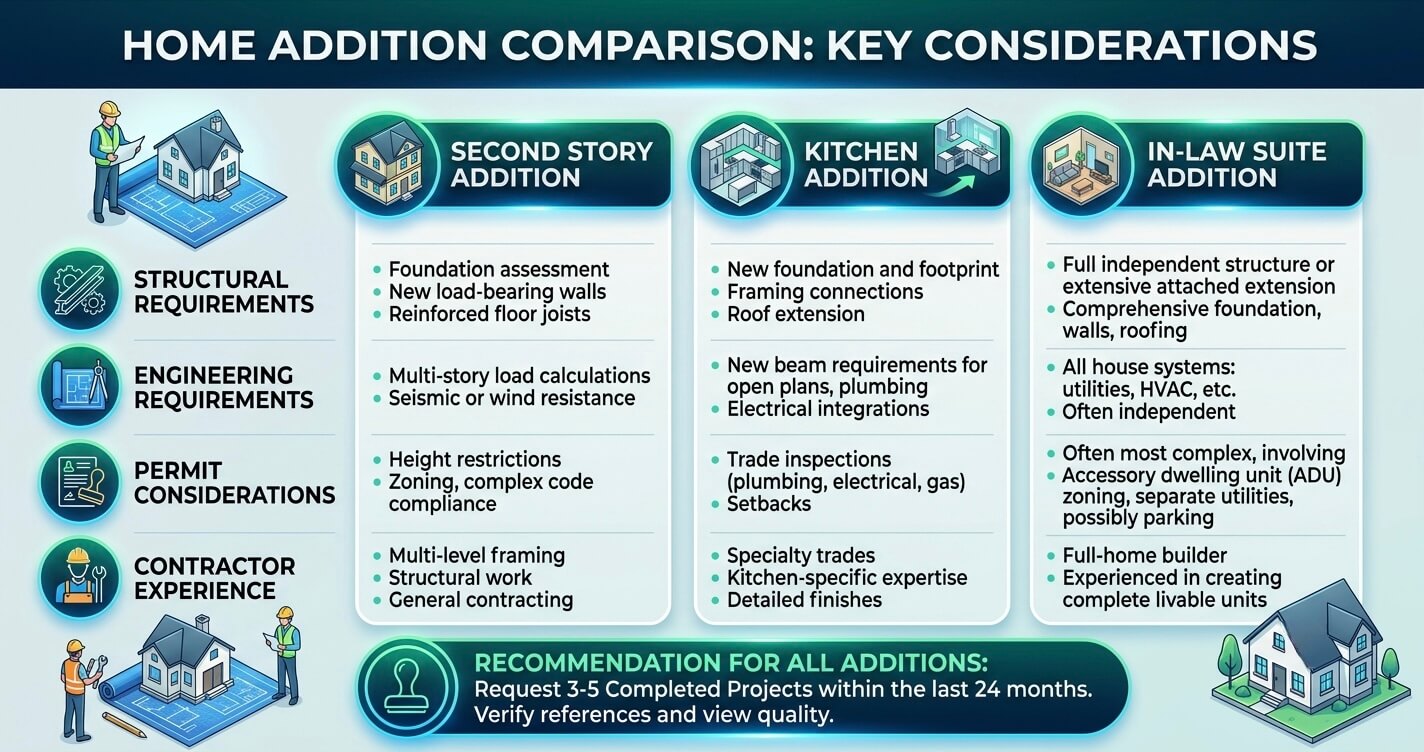
Additions carry different technical demands depending on type. A second story addition adds structural load to an existing foundation and requires engineering review; an in-law suite addition often involves separate egress and accessibility considerations; a kitchen extension typically triggers plumbing and electrical relocation. Ask specifically how many projects of your addition type the contractor has completed in the past 24 months, and request to see photos or, ideally, visit a completed project in person.
Who Handles Design, Permitting, and Structural Engineering?
Confirm whether one company is contractually responsible for both design and construction, or whether you will be coordinating a separate architect and contractor yourself. Single-team accountability generally reduces the risk of costly miscommunication between separate parties.
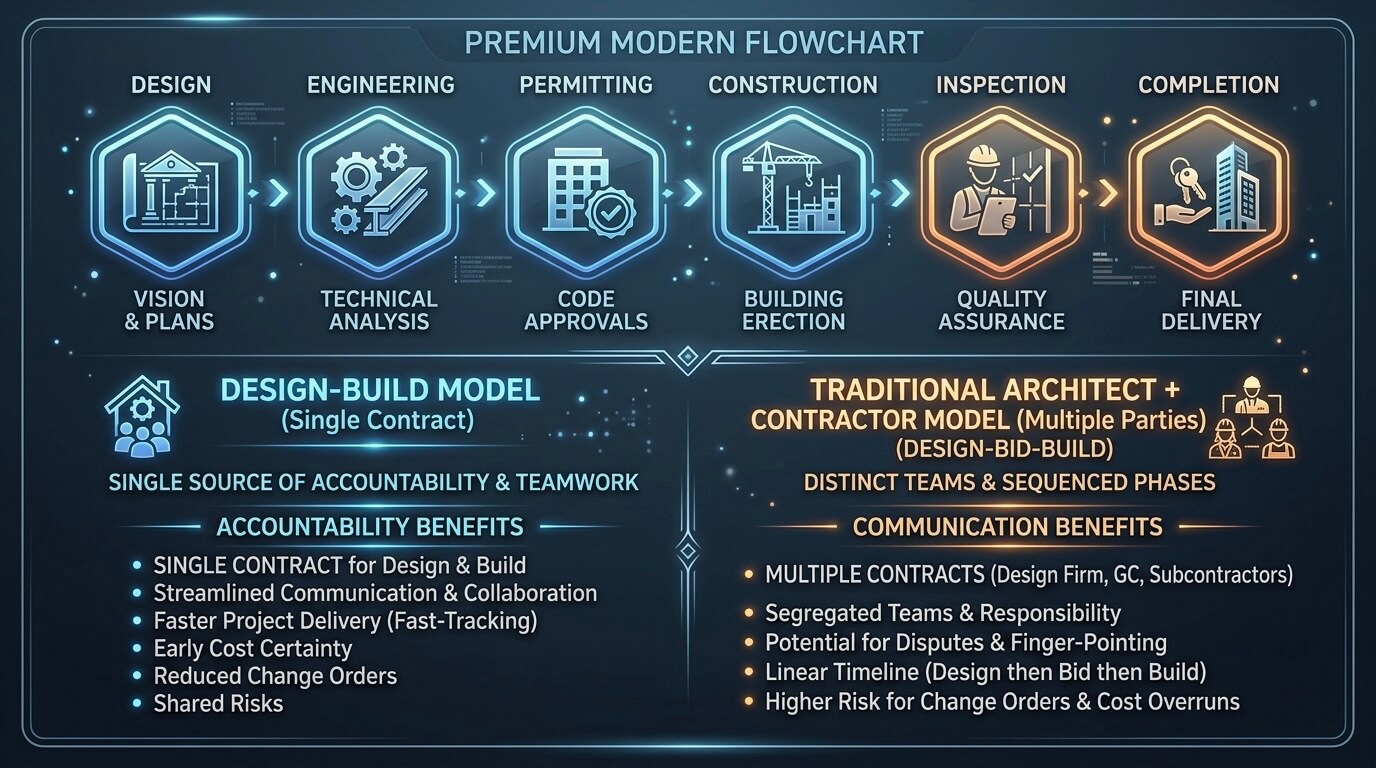
Under a Design-Build Northern Virginia arrangement, the same firm produces the drawings, manages permitting, and builds the project under one contract, which keeps a single team accountable from first sketch through final inspection. Under the traditional design-bid-build model, a homeowner hires an architect first, then separately solicits bids from contractors, and the two parties are not on the same team or contract. Ask prospective contractors: “If a design detail turns out to be more expensive to build than expected, who resolves it, and how?” A single-team answer is generally stronger than “we would have to check with the architect.”
What Does the Payment Schedule and Contract Actually Say?
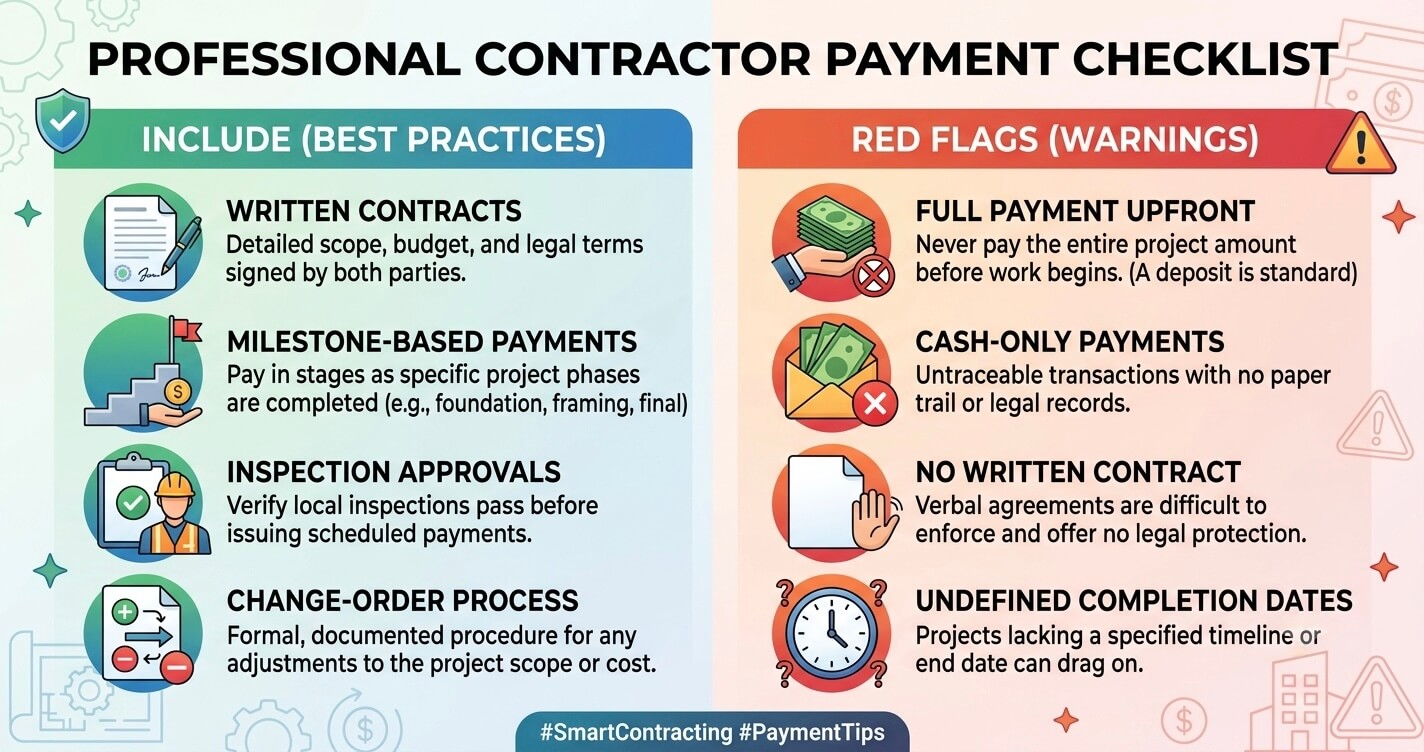
A trustworthy home addition contractor ties payments to completed milestones, verified by inspection, rather than requesting a large deposit upfront. Read the scope of work, change-order language, and start/completion dates closely before signing.
Payment structure disputes are one of the most common sources of homeowner-contractor conflict. According to a 2025 survey covering 41 consumer protection agencies across 31 states, home-repair and remodeling complaints remained among the top categories reported to state agencies in 2024, frequently involving unclear payment terms and incomplete work.
- Before signing, watch for these red flags in a contract or payment request:
- A request for full or majority payment before work begins
- Cash-only payment with no receipts
- No written contract, or a contract with a blank scope-of-work section
- No defined start date, completion date, or change-order process
How Will the Contractor Communicate During Construction?
Ask for a single named point of contact and an expected response time, such as within 24 hours, for questions that come up during construction. Also ask how change orders and delays will be communicated, in writing rather than verbally.
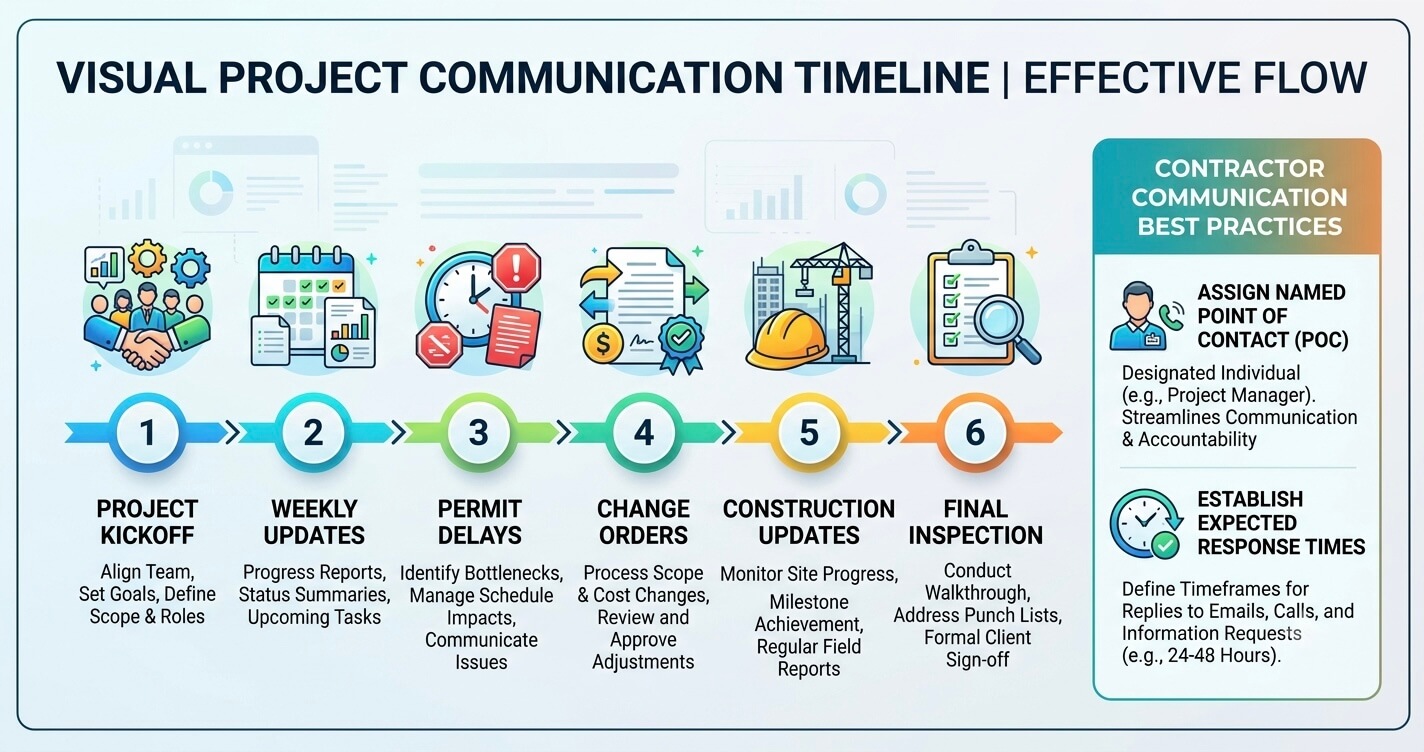
Many Northern Virginia homes, particularly older Colonials in Fairfax County and Falls Church, reveal hidden structural or systems issues once walls are opened. Weather delays and permit-review timelines can also shift a schedule. Homeowners are better protected when the contractor has already explained, before construction starts, how these situations will be communicated and documented, rather than discovering the process reactively mid-project.
Can the Contractor Provide References and Past Project Walkthroughs?
Ask for at least two references from projects completed within the last 12 to 18 months, and when possible, ask to see a similar completed addition in person rather than relying only on photos.
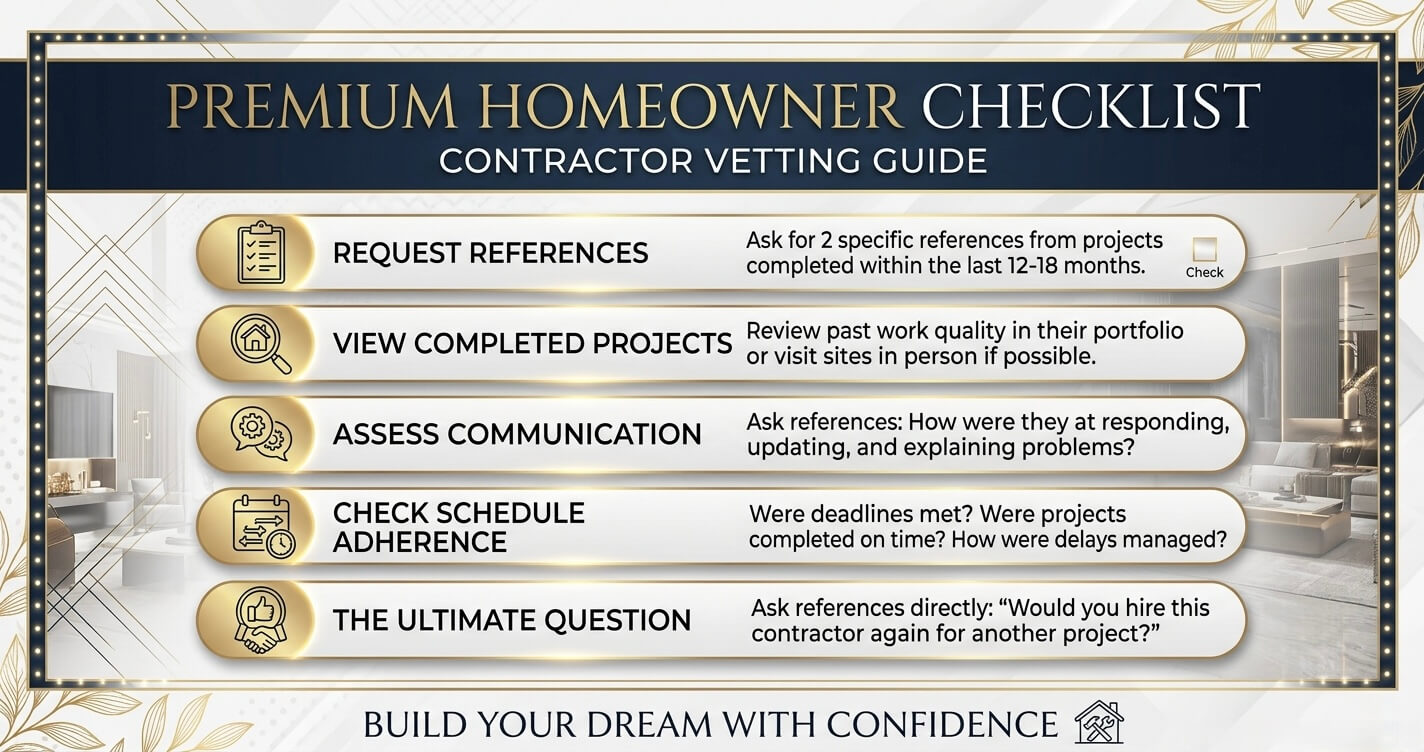
Useful questions to ask references include:
- Was the project completed close to the original schedule?
- How effectively did the contractor communicate during construction?
- Were unexpected issues handled professionally?
- Would you hire this contractor again?
Consistent positive feedback across multiple references, especially regarding schedule adherence and communication, is a stronger indicator of reliability than a polished portfolio alone.
What Is the Realistic Timeline From Contract to Completion?
Most Northern Virginia home additions take five to eleven months total from initial design through final inspection: roughly one to three months for design and permitting, and four to eight months for construction. Second-story and structurally complex additions sit at the longer end of that range.
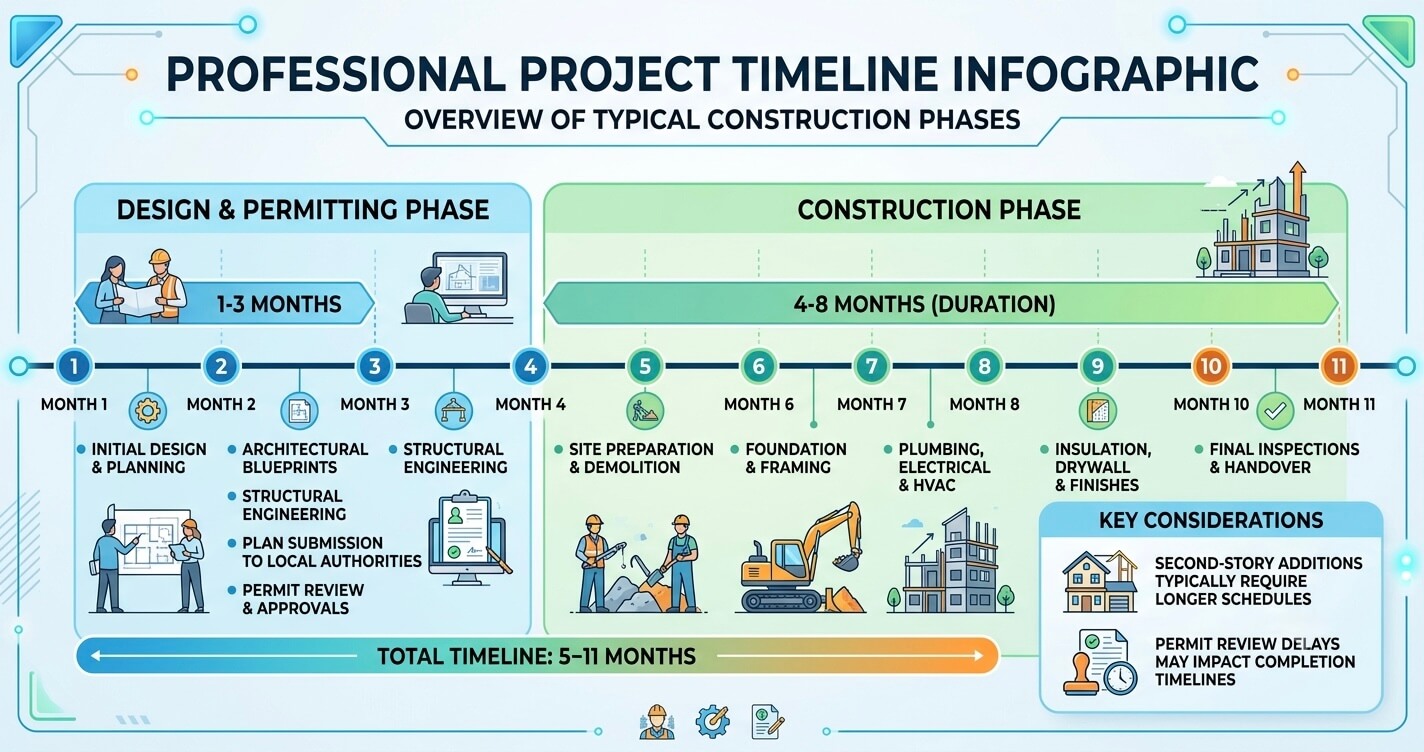
Cost and timeline are closely linked; homeowners can review typical project ranges in our Northern Virginia home addition cost guide and, for suite-specific projects, the In-Law Suite Addition Cost Northern Virginia breakdown. Ask the contractor for a phase-by-phase timeline rather than a single number, and ask directly what happens to the schedule if county permit review takes longer than expected, since permitting delays, not construction itself, are a common source of missed timelines.
Common Red Flags to Watch For When Hiring a Home Addition Contractor
The clearest warning signs include an unwillingness to produce a DPOR license number, pressure to sign a contract the same day, unsolicited door-to-door offers, and requests for full payment upfront. Any one of these should pause the hiring process.
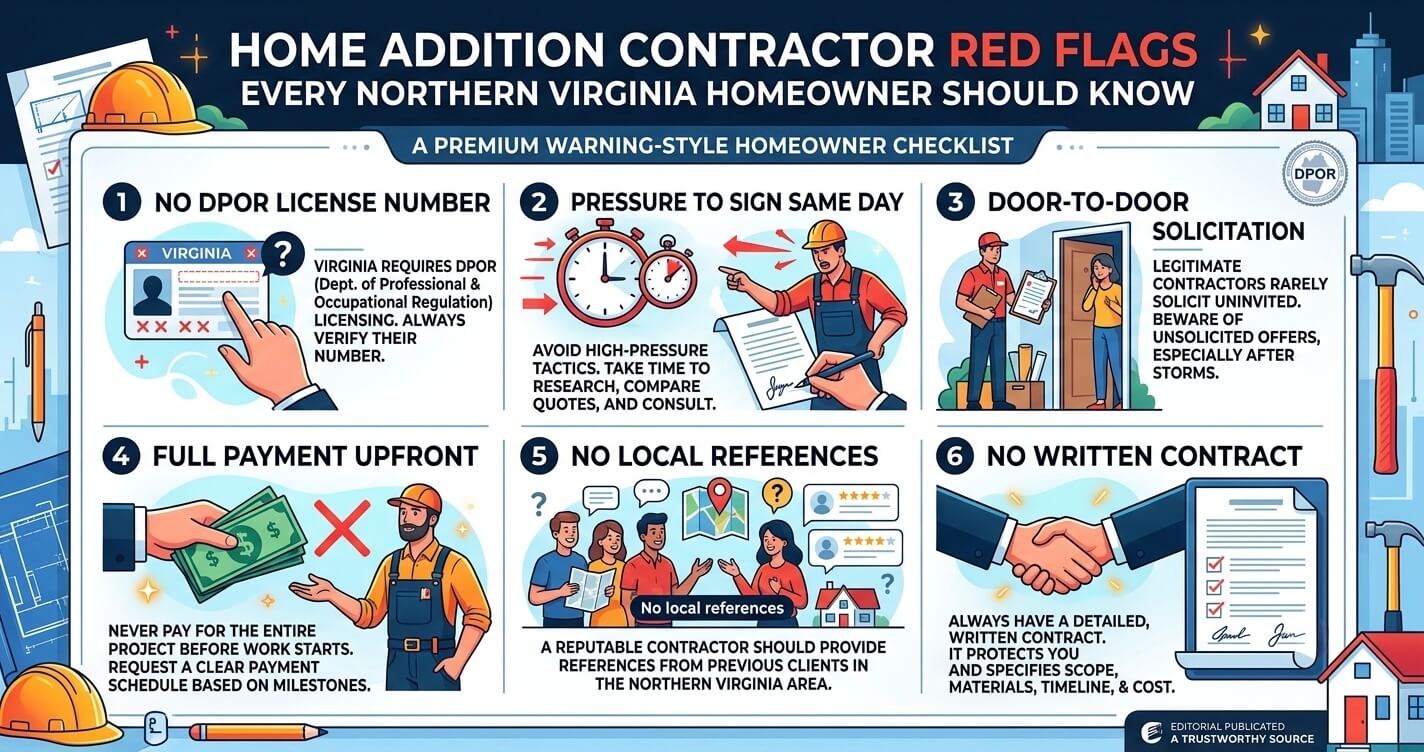
- Cannot or will not provide a DPOR license number
- Pressures you to sign a contract same-day, often with a “price good today only” pitch
- Solicits door-to-door, especially following storm damage in the area
- Requests full or majority payment before work begins
- Has no local references or completed projects in Northern Virginia
- Provides no written contract or a vague scope of work
Homeowners weighing these questions may benefit from discussing their specific addition plans with an experienced design-build team before requesting formal proposals.
Frequently Asked Questions
What questions should I ask before hiring a home addition contractor in Northern Virginia?
At minimum, ask about DPOR license class, insurance and bonding, addition-specific experience, who manages design and permitting, the payment schedule, and the realistic timeline. Each of these is covered in detail above and directly affects cost, quality, and schedule risk.
How do I verify a contractor’s license in Virginia?
Search the contractor’s license number directly on the Virginia DPOR public license lookup tool. The lookup confirms license class, status, and any disciplinary history.
How much should a home addition contractor ask for as a deposit?
A reasonable deposit is a modest percentage of total project cost, with the remaining balance tied to completed milestones verified by inspection. A request for full or majority payment upfront is a common red flag discussed in the payment schedule section above.
Should I hire a design-build firm or a separate architect and contractor?
Design-build keeps one company accountable for both design and construction under a single contract, which typically reduces miscommunication compared to coordinating an architect and contractor separately. Our Design-Build Northern Virginia guide compares both models in detail.
What insurance should a home addition contractor carry?
A qualified contractor should carry general liability insurance and workers’ compensation coverage, and provide a certificate of insurance naming the homeowner as an additional insured. Some jurisdictions, including Fairfax County, also require a local surety bond.
How long does it take to build a home addition in Northern Virginia?
Most Northern Virginia home additions take five to eleven months total, including one to three months for design and permitting and four to eight months for construction. Second-story and structurally complex additions run toward the longer end of that range.
What are red flags when hiring a home addition contractor?
Key red flags include an unwillingness to provide a DPOR license number, pressure to sign the same day, door-to-door solicitation, and requests for full payment before work begins. Any of these warrants pausing the hiring decision and reviewing another contractor.
Crux of the Matter
The questions to ask before hiring a home addition contractor ultimately come down to a short, verifiable checklist: confirm the DPOR license class, request proof of insurance and bonding, ask for addition-specific project experience, clarify who is accountable for design and permitting, review the payment schedule and contract terms, set communication expectations, check references, and get a realistic phase-by-phase timeline. Homeowners who work through this checklist before signing a contract are considerably better positioned to avoid the change-order surprises and delays that most often follow from hiring a contractor without asking the right questions.
Homeowners still weighing budget and financing options may also find our Finance a Home Addition in Northern Virginia guide useful, and those still deciding between adding on and moving can review Renovate vs. Sell Northern Virginia.
Planning a home addition in Northern Virginia? Contact US Home Design Build to talk through your project, timeline, and how our team handles licensing, permitting, and design under one contract.
