
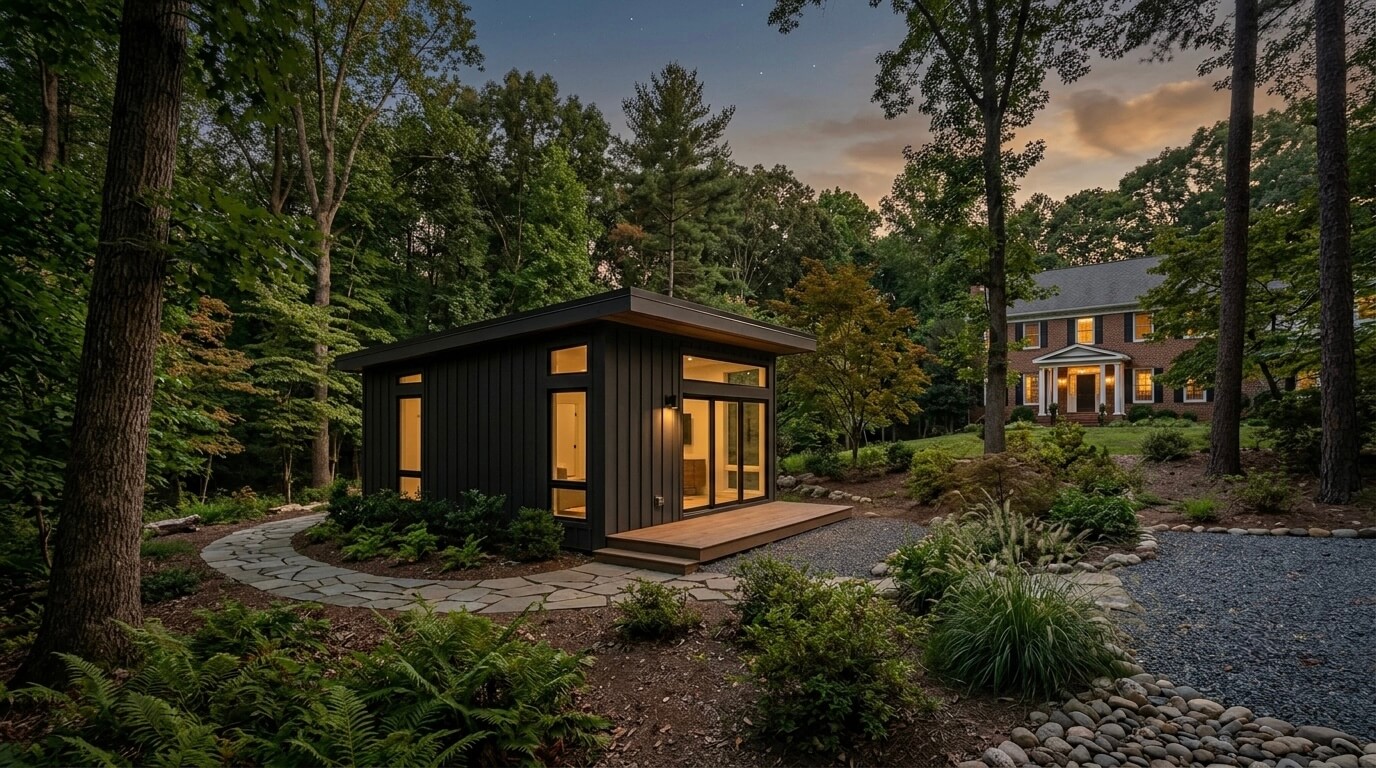
An ADU permit Fairfax County VA process requires two separate approvals: a zoning permit (administrative or special) confirming the accessory unit meets Fairfax County’s use standards, and a building permit covering the actual construction. Interior accessory units are typically reviewed at the staff level, while detached units require a special permit and a public hearing before the Board of Zoning Appeals.
Homeowners across Fairfax County are increasingly asking the same question before adding a private guest suite, a space for aging parents, or a rental unit: what does it actually take to get an ADU permit Fairfax County VA approval? The county’s own terminology adds a layer of confusion here. Fairfax County does not officially use the term “ADU.” Instead, it regulates these secondary living spaces as Accessory Living Units, or ALUs, a naming choice the county made specifically to avoid confusion with a separate program called Affordable Dwelling Units. Nationally, “ADU” remains the more commonly searched and understood term, so this guide uses both interchangeably while making the distinction clear.
This guide walks through zoning eligibility, size limits, setback rules, the difference between an administrative permit and a special permit, a realistic approval timeline, and the mistakes that most often derail an ADU project before it starts. US Home Design Build has guided homeowners throughout McLean, Vienna, Reston, Great Falls, Burke, and the wider Northern Virginia region through the zoning and permitting process for in-law suite additions, and this guide reflects the standards our design-build team works against on every accessory living unit project.
Do You Need a Permit to Build an ADU in Fairfax County VA?
Yes. Every accessory living unit in Fairfax County requires zoning approval, either an administrative permit or a special permit, in addition to a standard building permit for the construction itself. There is no scenario in which an ADU can legally be built or occupied without both approvals in place.
The zoning approval confirms that the unit meets Fairfax County’s use-specific standards for accessory living units under the county’s Zoning Ordinance: how it connects to the main home, how large it can be, who can occupy it, and how many off-street parking spaces the property must provide. The building permit is a separate process that confirms the actual construction, framing, electrical, plumbing, mechanical systems, meets the Virginia Uniform Statewide Building Code.
Homeowners frequently assume that once a building permit is issued, zoning compliance is automatically covered. It isn’t. The zoning determination has to be resolved first, because it determines whether the space can legally function as a second dwelling unit at all, according to Fairfax County’s Accessory Living Unit (Administrative Permit) page.
Interior vs. Detached ADU: Which Type Can You Build?
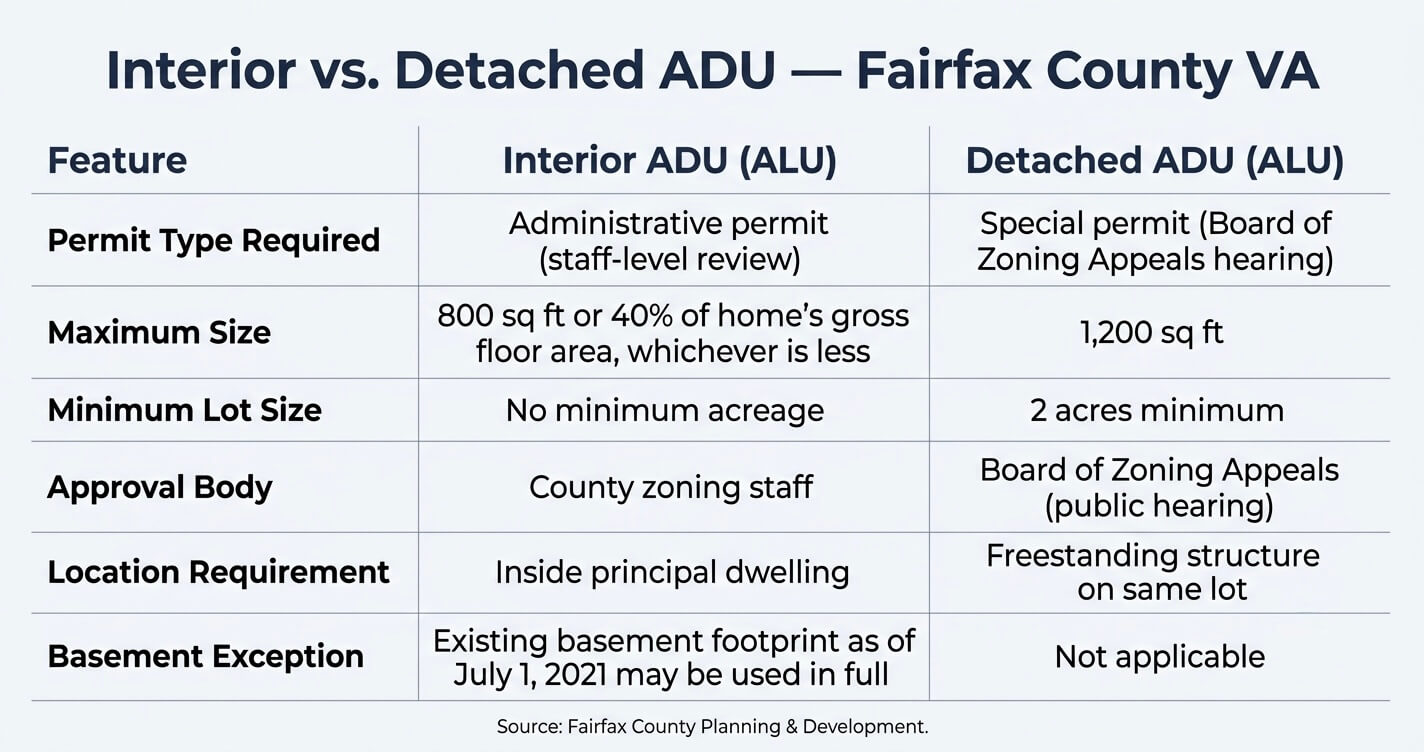
An interior ADU, built within the existing home or an addition to it, is allowed on any single-family detached lot in Fairfax County. A detached ADU, built as a separate structure, is only allowed on lots of at least two acres and requires a special permit with a public hearing before the Board of Zoning Appeals.
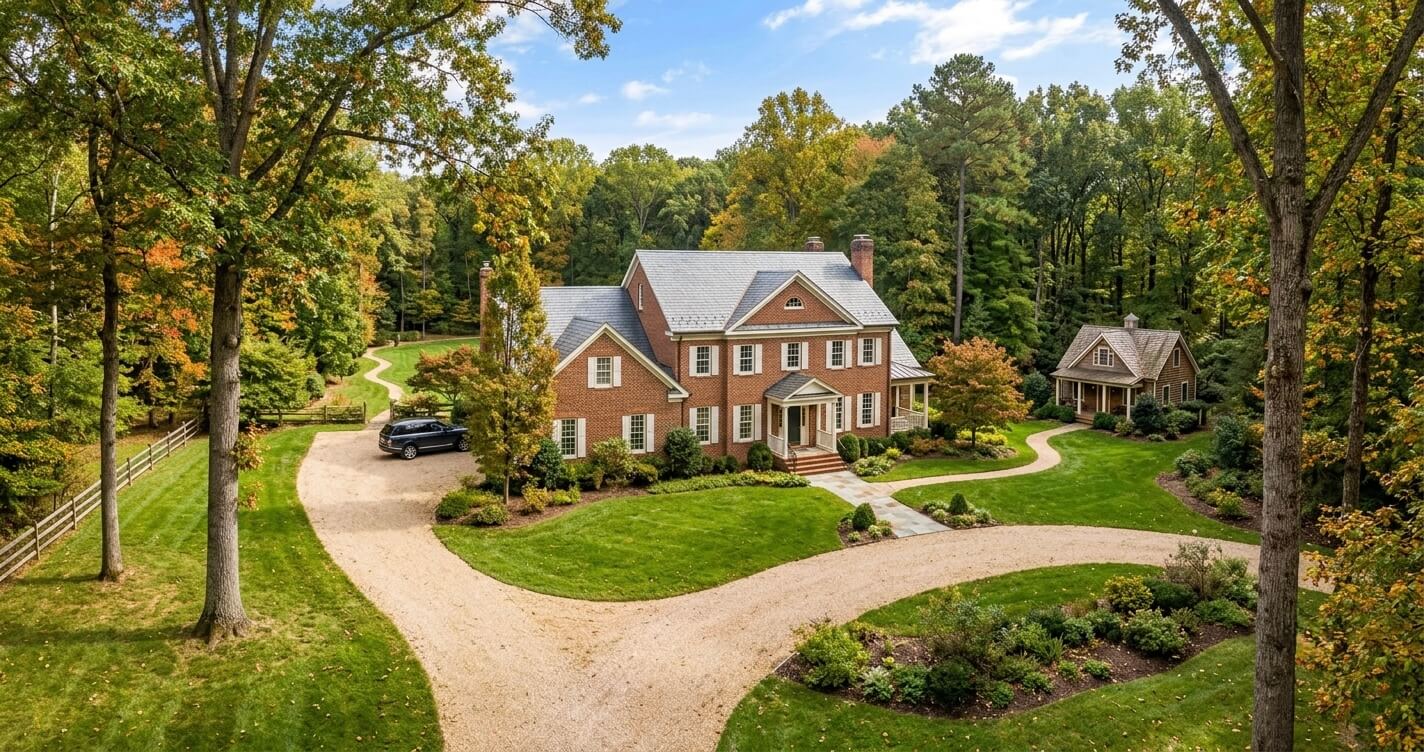
This distinction is the single biggest factor in how complicated your ADU project will be. Interior units qualify for the county’s streamlined, staff-level administrative permit process in most cases. Detached units, think a converted garage, a backyard cottage, or a purpose-built accessory structure, face a much higher bar.
Interior ADU standards
- Must be wholly contained within the principal single-family dwelling.
- Must connect to the main home through an interior space that is finished, temperature-controlled, and fully enclosed.
- Any new exterior entrance created for the unit must be located on the side or rear of the home, not the front facade.
Detached ADU standards
- Only permitted on lots of two acres or more.
- Requires a special permit approved by the Board of Zoning Appeals following a public hearing, not a staff-level review.
- Subject to the same general setback expectations as the principal dwelling, though exact figures depend on the property’s zoning district.
Interior vs. Detached ADU Comparison (Fairfax County VA)
Many homeowners exploring a detached ADU are actually better served by a garage conversion or garage addition instead, which follows a different permit path. Our Garage Addition Permit Fairfax County VA guide covers when a garage-based ADU or ALU form applies and how that process differs from a standalone detached unit.
ADU Size Limits in Fairfax County
Interior ADUs in Fairfax County are capped at 800 square feet or 40% of the principal dwelling’s gross floor area, whichever is smaller. Detached ADUs are capped at 1,200 square feet under current standards. Every accessory living unit is also limited to two occupants and two bedrooms, regardless of size.
These figures come directly from Fairfax County’s zoning standards under Ordinance subsection 4102.7.B, as summarized in the county’s Proposed zMOD Changes – Accessory Living Units FAQ. The size cap exists to keep the accessory unit clearly subordinate to the main home rather than functioning as a second, independent house.
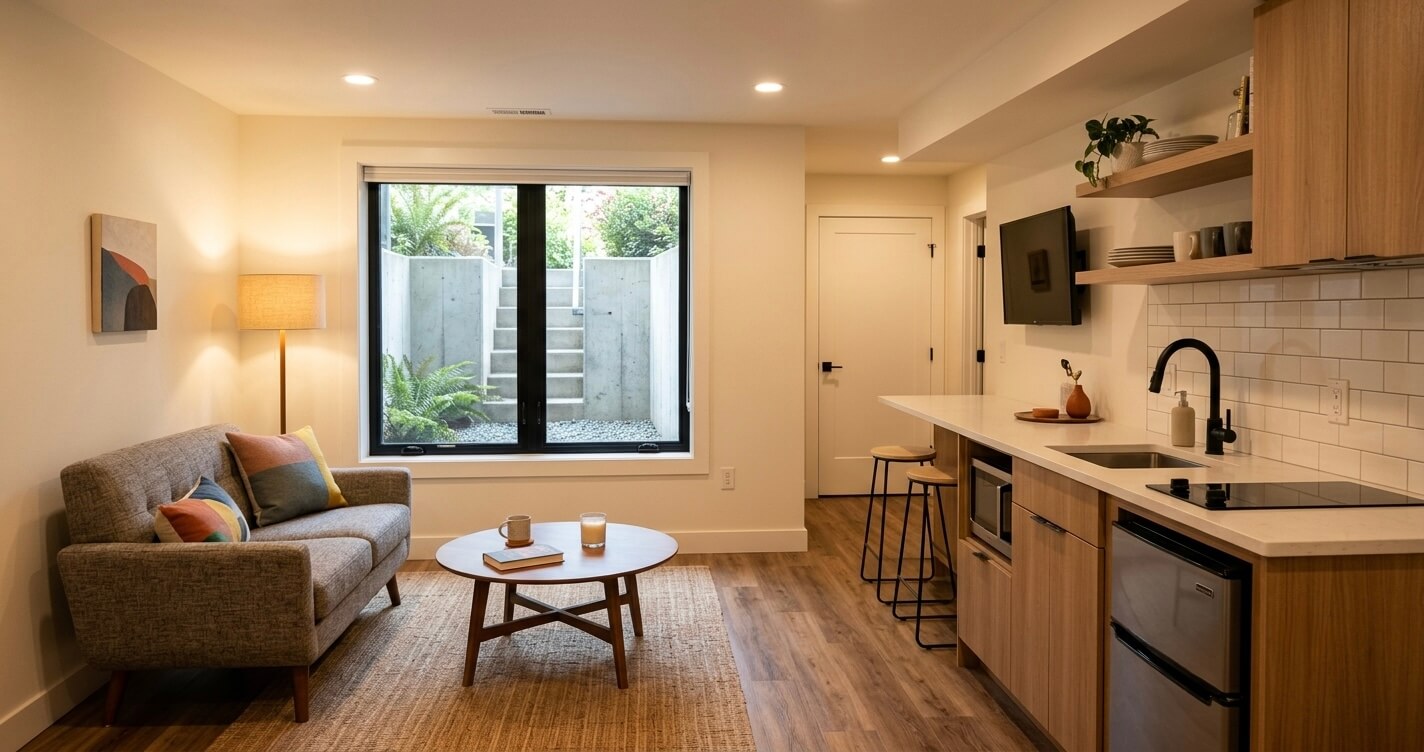
There is one notable exception worth understanding if your home already has a finished or partially finished basement. Fairfax County allows the full existing basement footprint to be used for an interior ADU, even if it exceeds the standard 800-square-foot cap, as long as that footprint existed as of July 1, 2021, the effective date of the county’s zoning ordinance modernization (zMOD). This makes basement conversions one of the most efficient paths to a compliant, larger interior ADU.
ADU Setback and Zoning Requirements
Detached ADUs in Fairfax County generally follow the same setback requirements that apply to the principal dwelling on the property, but the exact distance depends on the lot’s zoning district. Homeowners must also meet an owner-occupancy requirement and provide at least one additional off-street parking space for the accessory unit.
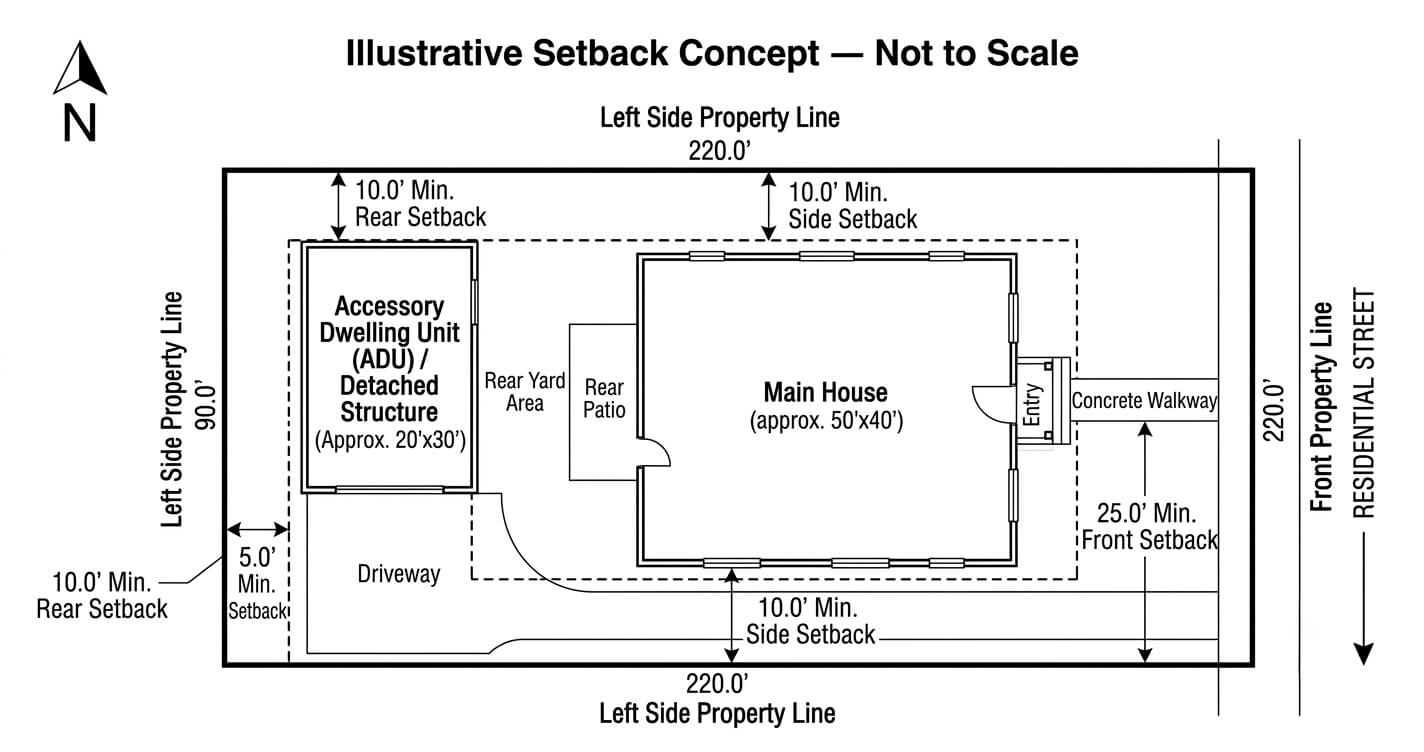
Fairfax County does not publish a single flat setback number for ADUs because setbacks are determined by zoning district, R-1, R-2, R-3, R-4, R-5, and others, and can be further affected by proffers, development conditions, easements, or an approved development plan specific to the property. This is why a zoning district lookup has to be the first step in any ADU project, not an afterthought after floor plans are already drawn.
Owner-occupancy and rental rules
Either the principal dwelling or the accessory living unit must be occupied by the property owner. Only one of the two units, the main home or the ADU, may be rented out at any given time. A property with an ADU cannot also be used for short-term lodging; Fairfax County’s standards specify long-term occupancy only.
Parking requirements
A home with an ADU must provide the standard parking required for the principal dwelling, plus at least one additional off-street space for the accessory unit. Homeowners on smaller or more constrained lots should confirm parking feasibility early, since it can affect where a detached unit or a new entrance can realistically be placed.
If your project might take the form of a larger addition rather than a standalone ADU, our home addition services page outlines how room additions, second-story expansions, and in-law suite additions compare in cost and scope.
Administrative Permit vs. Special Permit: What’s the Difference?
An interior ADU that meets all of Fairfax County’s standard requirements can be approved through a staff-level administrative permit, with no public hearing required. An interior ADU that doesn’t meet every standard, and every detached ADU, must go through a special permit process that includes a public hearing before the Board of Zoning Appeals.
Before Fairfax County’s 2021 zoning ordinance modernization (zMOD) took effect, every accessory living unit required a special permit and a public hearing, regardless of type. That changed on July 1, 2021, when the county adopted updated standards allowing qualifying interior units to be approved administratively, according to the Fairfax County Zoning Ordinance Modernization Project summary. The same update also removed a prior requirement that one occupant of the ADU be age 55 or older, or have a disability.
What happens after approval
- An administrative or special permit is initially issued for a two-year period from the date of approval.
- The permit can be extended by the Zoning Administrator for successive periods of up to five years, based on the property’s compliance record.
- Before the ADU can legally be occupied, the owner must record a copy of the permit in Fairfax County’s land records, indexed under the property owner’s name.
- The county may inspect the property during reasonable hours to confirm the unit continues to meet the approved standards.
ADU Permit Approval Timeline in Fairfax County VA
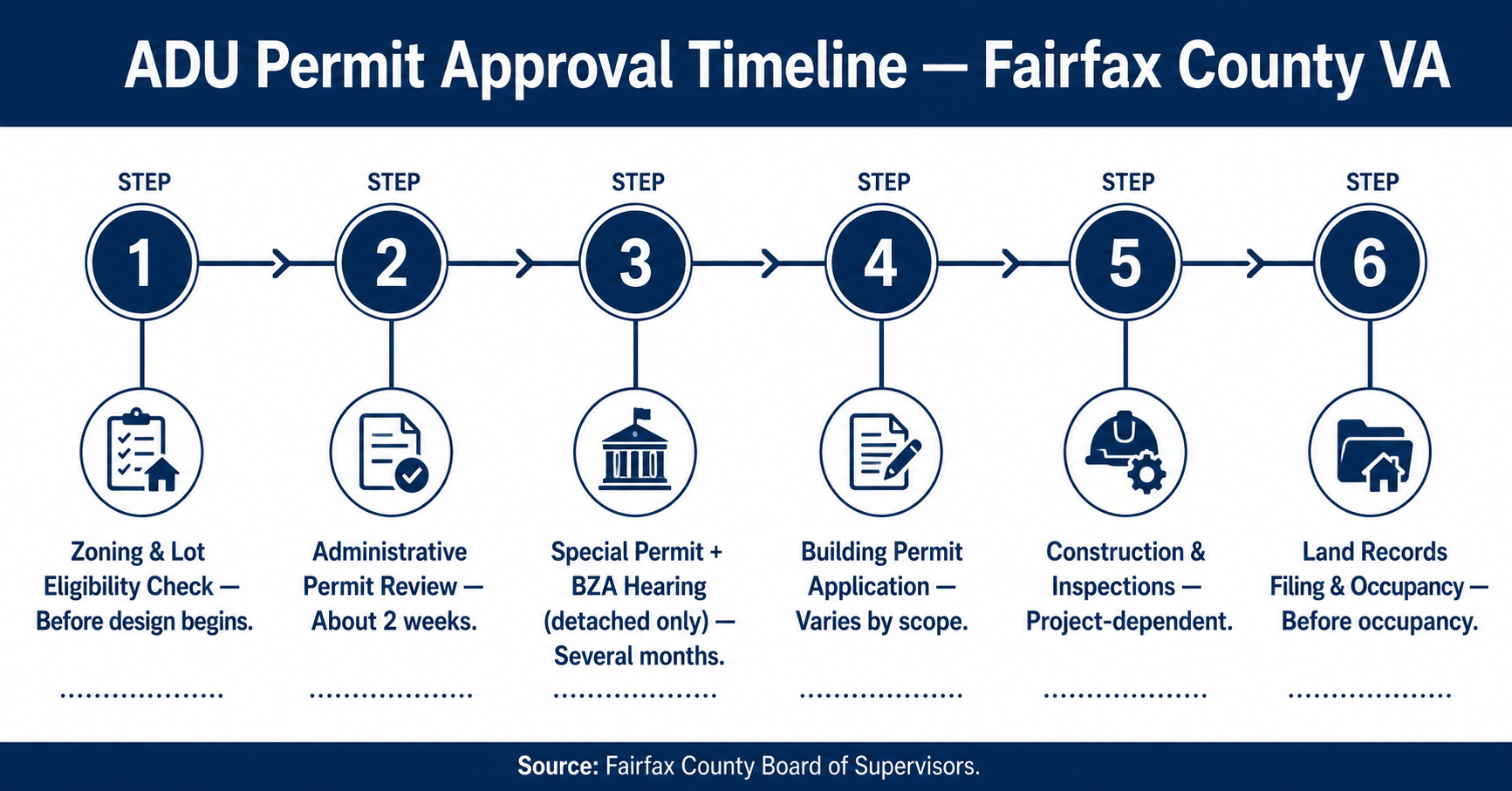
Most complete administrative permit applications for an interior ADU are approved within about two weeks by Fairfax County staff. The full project timeline, including zoning review, a building permit, inspections, and land-records filing, typically runs several months longer once design and construction are factored in.
According to Fairfax County’s own ALU program data, a majority of administrative permit applications are approved within two weeks, though the county notes that more complex applications can require multiple exchanges of information between the applicant and staff. Special permit applications for detached ADUs take considerably longer, since they depend on the Board of Zoning Appeals public hearing calendar rather than a staff-level review alone.
ADU Permit Approval Timeline – Fairfax County VA
2026 Proposed Changes to Fairfax County’s ADU Rules
Fairfax County is actively reconsidering several ADU standards in 2026, including the 1,200-square-foot detached size cap and a proposal to fold ADU zoning approval directly into the standard building permit process instead of requiring a separate permit. Homeowners planning a future ADU should confirm current requirements before finalizing design, since these standards may shift.
As of a December 2025 white paper presented to the county’s Land Use Policy Committee, Fairfax County staff are evaluating changes that could reshape the ADU process, according to the Fairfax County Board of Supervisors ALU White Paper. Under consideration: revising the 1,200-square-foot maximum size for detached units, increasing the renewal period, and integrating zoning approval into the general building permit workflow.
There are currently approximately 158 approved ALUs in Fairfax County, roughly 0.08% of single-family detached homes in the county, according to the Fairfax County ALU Zoning Ordinance Amendment Survey. That low adoption rate is part of why the county is revisiting the rules: officials have said publicly they want ALUs to serve as a more usable tool in the local housing toolkit, but the current standards haven’t produced the uptake the 2021 zMOD update anticipated.
Because these standards are actively under review, working with a local design-build team that tracks Fairfax County zoning changes in real time is one of the most reliable ways to avoid designing around rules that shift mid-project.
Common ADU Permit Mistakes Homeowners Make in Fairfax County
The most common and most expensive mistake is designing a detached ADU before confirming the lot actually meets the two-acre minimum. Beyond that, homeowners frequently overlook the land-records filing requirement, misunderstand owner-occupancy rules, or assume ADU standards allow short-term rental use.
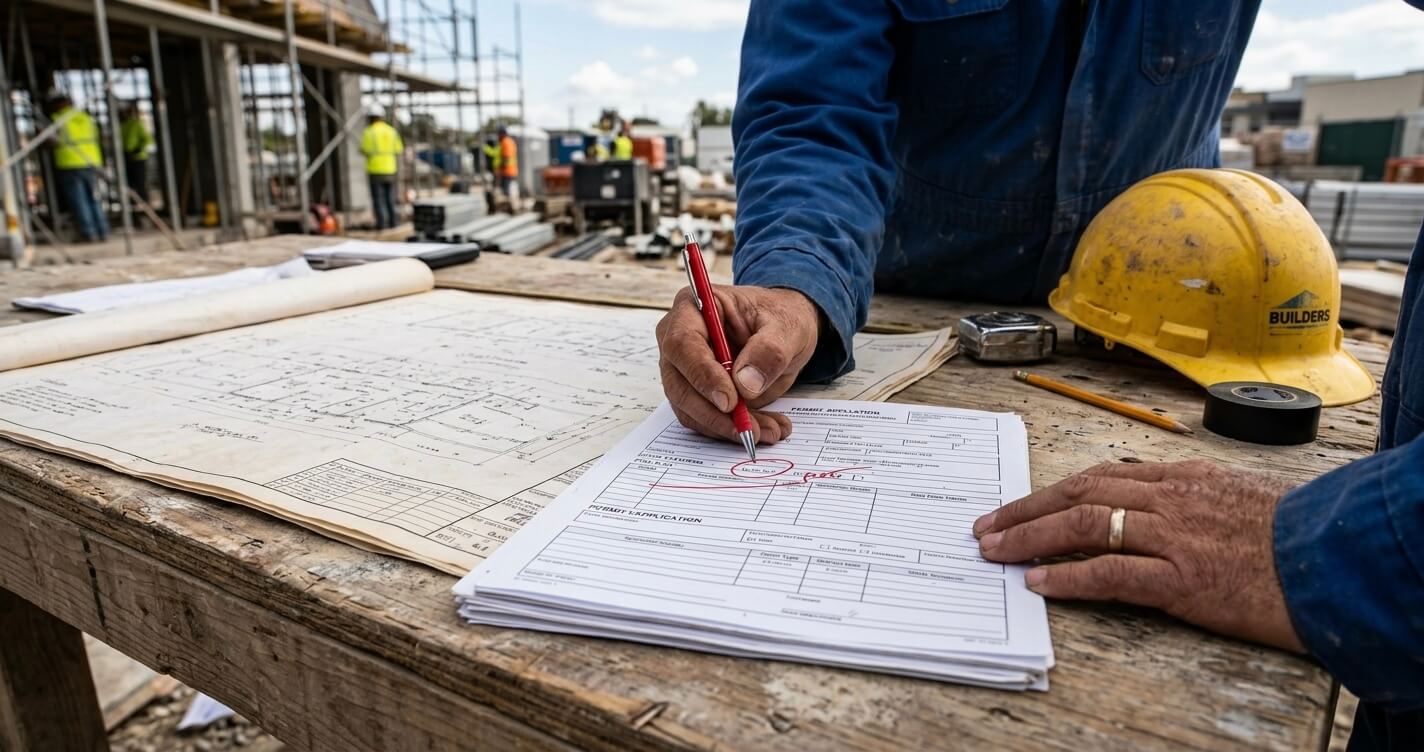
Mistake 1: Assuming any lot qualifies for a detached ADU
A detached ADU is only legal on a lot of at least two acres. Homeowners on standard suburban lots throughout McLean, Vienna, and Burke frequently discover this only after design work is already underway, at which point an interior ADU or a different addition type becomes the realistic path forward.
Mistake 2: Skipping the land-records filing step
Even after permit approval, the ADU cannot legally be occupied until the owner records a copy of the permit in Fairfax County’s land records. This step is easy to overlook because it happens after construction is functionally complete, when homeowners are focused on moving in rather than paperwork.
Mistake 3: Misunderstanding owner-occupancy compliance
Either the main home or the ADU must be owner-occupied, and only one of the two units can be rented. Homeowners planning to rent out both the ADU and the main home; for example, while living elsewhere, will not meet Fairfax County’s current standards.
Mistake 4: Confusing ADU rules with short-term rental rules
A property with an ADU cannot also be used for short-term lodging under Fairfax County’s standards. Homeowners considering an ADU partly as a short-term rental income strategy should understand this restriction before finalizing plans.
Homeowners evaluating whether their property qualifies for an ADU may benefit from a zoning feasibility review with an experienced design-build team before finalizing floor plans or budgets.
Frequently Asked Questions
Do you need a permit to build an ADU in Fairfax County VA?
Yes, every ADU in Fairfax County requires zoning approval through either an administrative permit or a special permit, in addition to a standard building permit for construction.
What is the size limit for an ADU in Fairfax County?
Interior ADUs are capped at 800 square feet or 40% of the home’s gross floor area, whichever is smaller, while detached ADUs are capped at 1,200 square feet under current standards.
Can I build a detached ADU on any lot in Fairfax County?
No, detached ADUs are only allowed on lots of at least two acres and require special permit approval from the Board of Zoning Appeals, which includes a public hearing.
How long does it take to get an ADU permit approved in Fairfax County?
Most administrative permit applications are approved within about two weeks of a complete submission, though the full project timeline, including building permits, inspections, and construction, typically runs several months.
Does someone have to live in the ADU or the main house?
Yes, Fairfax County requires that either the principal dwelling or the accessory unit be owner-occupied, and only one of the two units may be rented out at a time.
Is an ADU in Fairfax County the same as an ALU?
Yes, Fairfax County officially calls these units Accessory Living Units (ALUs) to avoid confusion with affordable dwelling units, but they function the same way as what is commonly called an ADU elsewhere.
Can I use an ADU as a short-term rental in Fairfax County?
No, Fairfax County’s zoning standards specify that a property with an ALU cannot also be used for short-term lodging; ALUs are intended for long-term occupancy only.
Are Fairfax County’s ADU rules changing in 2026?
Possibly, as of early 2026, the county is reviewing potential changes to the detached ADU size cap and considering folding zoning approval into the standard building permit process, so requirements could shift for future applicants.
Final Thoughts
Getting an ADU permit Fairfax County VA approved comes down to a few decision points made early: whether the unit will be interior or detached, whether the lot meets the two-acre threshold for a detached structure, and whether the household can meet the owner-occupancy requirement. Interior ADUs built within an existing home, especially in an eligible basement footprint, remain the most straightforward path through Fairfax County’s zoning process for most homeowners.
US Home Design Build has worked with homeowners throughout Fairfax County, McLean, Vienna, Reston, Great Falls, and Burke to plan and build in-law suite additions and accessory living units that are designed around the county’s zoning standards from the very first floor plan, not retrofitted to meet them after the fact.
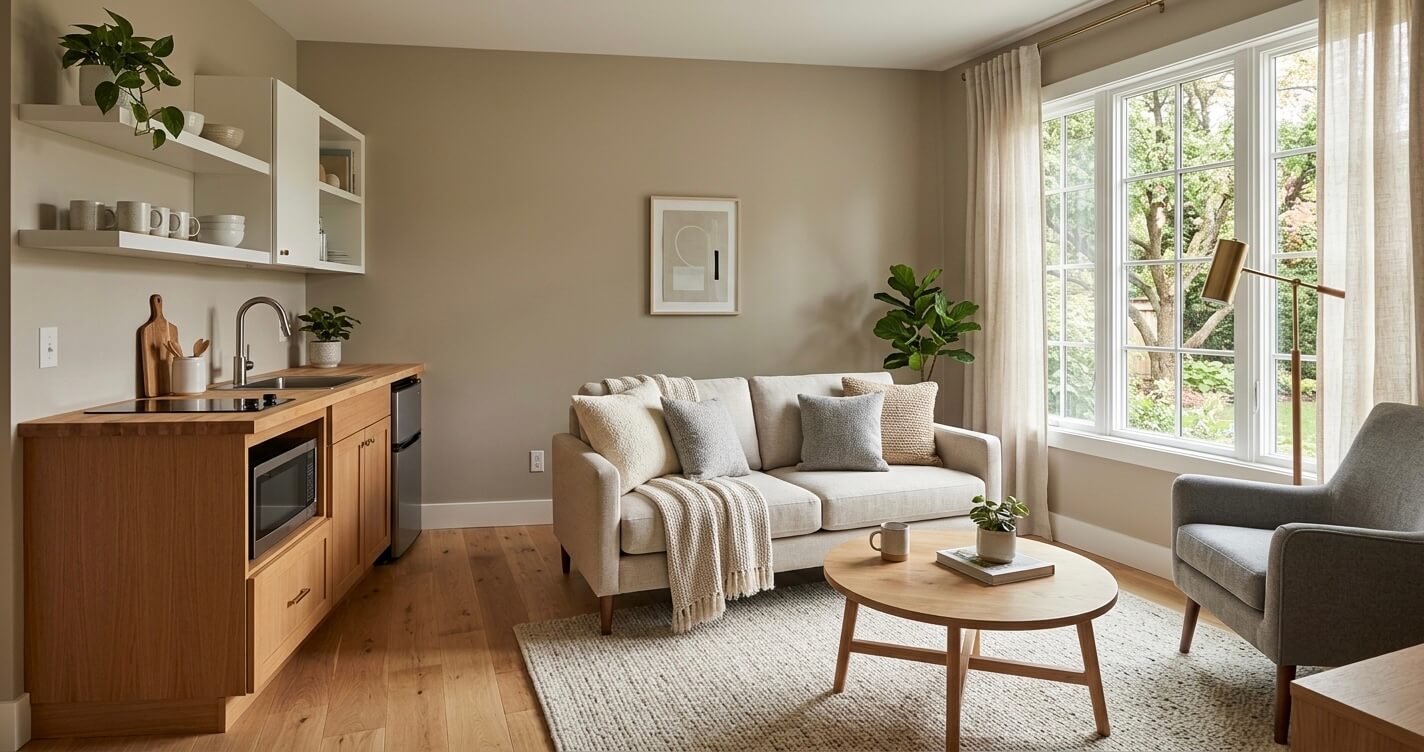
Considering an ADU or in-law suite in Fairfax County, McLean, Vienna, or elsewhere in Northern Virginia? Contact US Home Design Build to discuss zoning eligibility, permitting, and design options with our home addition contractors in Northern Virginia team.