
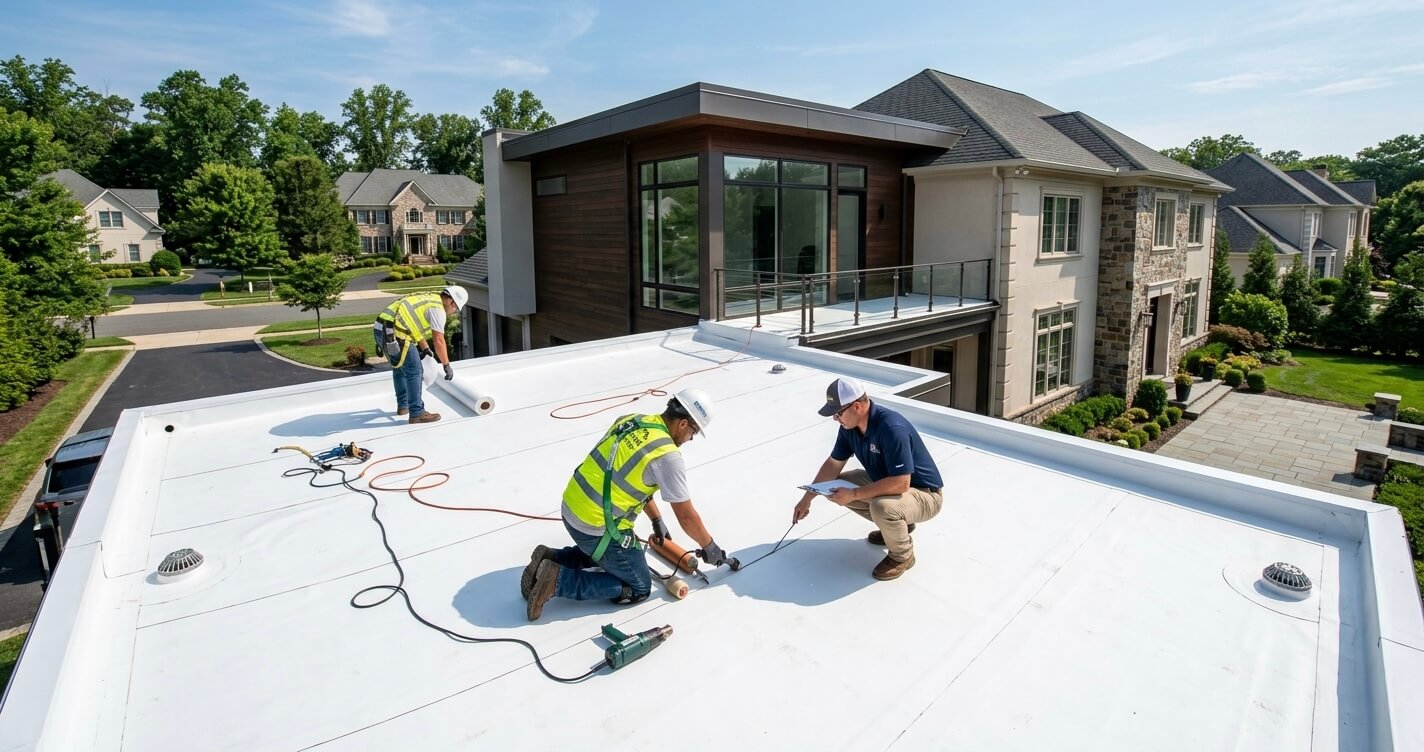
If you’re a homeowner in Fairfax, McLean, Arlington, or elsewhere in Northern Virginia, chances are your home has at least one area where traditional roofing materials are not ideal. Flat-roof additions, garage roofs, sunrooms, covered porches, modern home extensions, and low-slope roof sections all require a different approach than a conventional asphalt shingle roof.
This is one reason TPO roofing Northern Virginia projects have become increasingly common in recent years. Homeowners researching flat-roof solutions often begin by comparing local TPO roofing contractors Northern Virginia before deciding which system best fits their project scope and budget.
Unlike traditional roofing materials designed to shed water on steep slopes, TPO roofing is engineered specifically for flat and low-slope roof assemblies. It creates a continuous waterproof membrane, offers excellent resistance to UV exposure, and reflects a significant portion of solar radiation away from the building.
For Northern Virginia homeowners, that matters. The region falls within Climate Zone 4A, a mixed-humid climate characterized by hot, humid summers and cold winters. Roofing materials must perform across a wide range of temperatures while resisting moisture intrusion, thermal expansion, freeze-thaw cycles, and seasonal weather extremes.
According to the U.S. Department of Energy, cool roofs are designed to reflect more sunlight and absorb less solar energy than conventional roofing systems, helping reduce roof temperatures and cooling demand. White roofing products can reflect approximately 60%–90% of incoming sunlight, making reflective membrane systems particularly attractive for low-slope residential roofs. [Source: The Department of Energy’s Energy.gov]
For homeowners with flat or low-slope roof sections, choosing the wrong roofing system can lead to premature leaks, ponding water issues, increased cooling costs, and expensive repairs long before the roof reaches its expected service life.
This guide explains everything homeowners need to know about TPO roofing Northern Virginia, including how the material works, where it should be used, expected costs in 2026, local permitting requirements, installation expectations, and how to choose the right contractor for the project.
What Is TPO Roofing? A Plain-Language Explanation for Homeowners
TPO stands for Thermoplastic Polyolefin, a single-ply roofing membrane commonly used on flat and low-slope roofs throughout North America.
In simple terms, TPO is a flexible roofing sheet manufactured from a blend of polypropylene and ethylene-propylene rubber compounds. Most residential-grade TPO membranes are reinforced with a polyester fabric scrim that improves tear resistance, dimensional stability, and overall durability.
Unlike shingles, which rely on overlapping layers to shed water, TPO functions as a continuous waterproof membrane. Large sheets are rolled across the roof surface and welded together to create a nearly seamless protective barrier.
TPO is specifically designed for roof slopes below approximately 2:12, making it an ideal solution for:
- Flat-roof additions
- Garage roofs
- Sunroom roofs
- ADU rooftops
- Covered porches
- Modern flat-roof home sections
- Low-slope transition roofs
Residential TPO membranes are generally available in three thicknesses.
The membrane is most commonly manufactured in white or light-reflective colors. This highly reflective surface is one of the primary reasons homeowners choose TPO, particularly in climates that experience significant summer cooling loads.
An additional benefit is sustainability. Most TPO membranes are recyclable at the end of their service life and do not contain chlorine-based compounds commonly associated with some alternative roofing systems.
How TPO Differs From Other Flat Roof Systems
Homeowners often compare TPO against EPDM, PVC, and modified bitumen roofing systems. While each has strengths, TPO typically provides one of the best balances between cost, performance, durability, and energy efficiency.
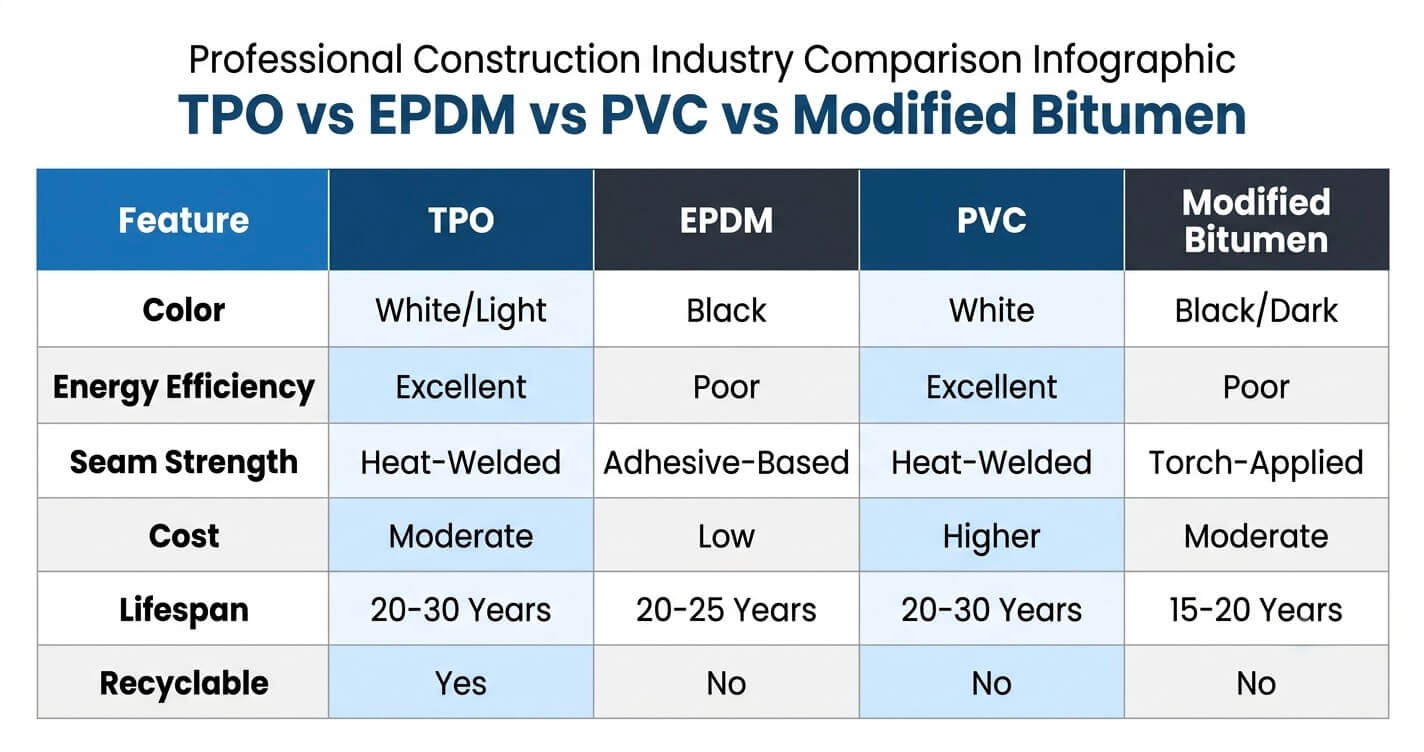
One of the most important differences involves seam construction.
TPO seams are fused together using hot-air welding equipment. Instead of relying on adhesives or tapes, adjacent sheets become physically bonded into a single membrane system.
For homeowners in Northern Virginia, this is particularly valuable because freeze-thaw cycling can place substantial stress on roofing seams. Heat-welded connections generally provide superior long-term resistance to moisture infiltration compared with adhesive-based seam systems when installed correctly.
Is Your Northern Virginia Home a Candidate for TPO Roofing?
Not every roof should use TPO.
The material was engineered specifically for flat and low-slope roof systems and performs best when installed in applications where conventional shingles are not appropriate.
When TPO Makes Sense
Many Northern Virginia homeowners first encounter TPO when planning a renovation or addition project.
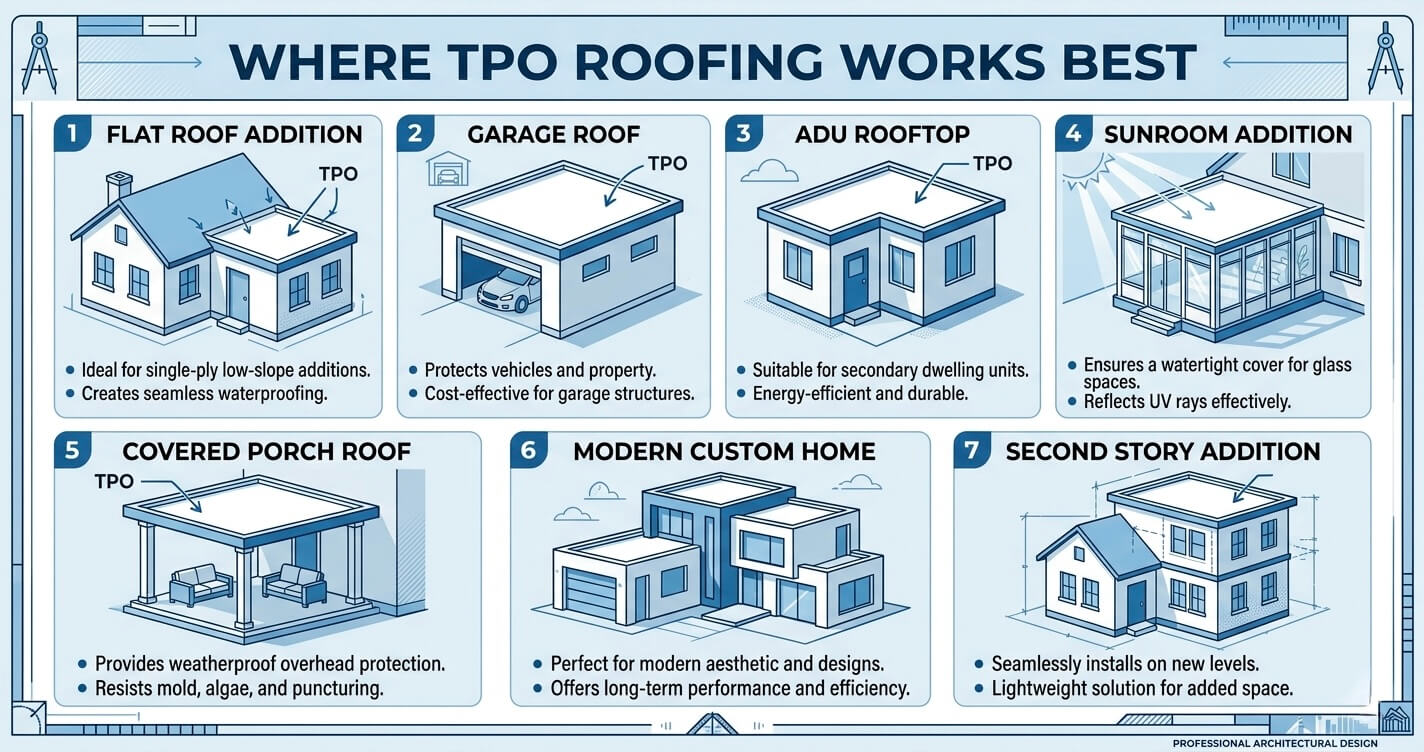
Homeowners planning home additions Northern Virginia discover that new flat-roof sections often require a membrane roofing system rather than traditional shingles.
A growing number of sunroom addition Northern Virginia projects incorporate TPO roofing because the roof pitch is frequently too low for asphalt shingles to perform properly.
Homeowners working with an experienced ADU builder Northern Virginia often choose TPO membranes because accessory dwelling units commonly feature modern low-slope roof designs.
A lot of homeowners partnering with a custom home builder Northern Virginia select TPO roofing for contemporary architectural designs that include flat-roof sections and rooftop terraces.
Certain second story addition Northern Virginia projects create roof transitions that are ideally suited for TPO membrane systems.
Other residential applications include:
- Bedroom additions
- Garage rooftops
- Covered porch roofs
- Deck roof structures
A key rule of thumb is roof pitch.
When a roof section falls below approximately 2:12 pitch, traditional asphalt shingles are generally no longer considered the appropriate roofing solution. In these situations, a membrane roofing system such as TPO becomes the preferred option because it is specifically engineered to resist standing water and low-slope drainage conditions.
When TPO Is Not the Right Choice
While TPO is highly effective in low-slope applications, it is not universally appropriate.
Steep-sloped roofs remain better suited for asphalt shingles, metal roofing, slate, or other materials specifically designed for higher-pitch installations.
TPO may also be a poor fit when:
- The roof will experience frequent foot traffic
- Historic district requirements restrict material selection
- The project prioritizes the absolute lowest upfront cost over long-term performance
- Installation quality cannot be verified
Because TPO relies heavily on heat-welded seams and flashing details, installation quality plays a larger role in long-term success than many homeowners realize. A poorly installed TPO roof can fail years before the membrane itself reaches the end of its service life.
Homeowner Consideration
Homeowners planning a flat-roof addition, garage roof replacement, or low-slope renovation project should evaluate roofing options early in the design process. Roofing decisions often affect insulation requirements, drainage design, energy performance, and overall project costs.
TPO Roofing Northern Virginia: Why This Material Suits Our Local Climate
One of the biggest reasons TPO performs well locally is that it aligns closely with Northern Virginia’s climate conditions.
The region falls within IECC Climate Zone 4A, commonly described as a mixed-humid climate. Homeowners experience hot, humid summers alongside cold winters that regularly create freeze-thaw cycles.
Those conditions place unique demands on roofing systems.
During summer, roofs absorb substantial solar radiation and can become one of the largest contributors to heat gain inside the home. During winter, repeated temperature fluctuations can stress seams, flashings, penetrations, and expansion joints.
TPO addresses both challenges.
The membrane’s reflective surface reduces solar heat absorption during warmer months, while its flexibility helps accommodate seasonal thermal movement without becoming brittle.
The U.S. Department of Energy notes that white roofing products can reflect approximately 60%–90% of incoming sunlight, substantially reducing roof-surface temperatures compared with darker roofing materials. Reflective roofs may remain more than 50°F cooler under sunny conditions than conventional dark roofing surfaces. [Source: The Department of Energy’s Energy.gov]
For homeowners, the practical benefits can include:
- Lower cooling demand during summer
- Reduced HVAC workload
- Improved indoor comfort
- Lower rooftop temperatures
- Reduced thermal stress on roofing materials
Energy Savings Homeowners Can Expect
Although actual savings vary by home design, insulation levels, HVAC efficiency, and occupancy patterns, reflective roofing systems are widely recognized as an effective strategy for reducing cooling loads.
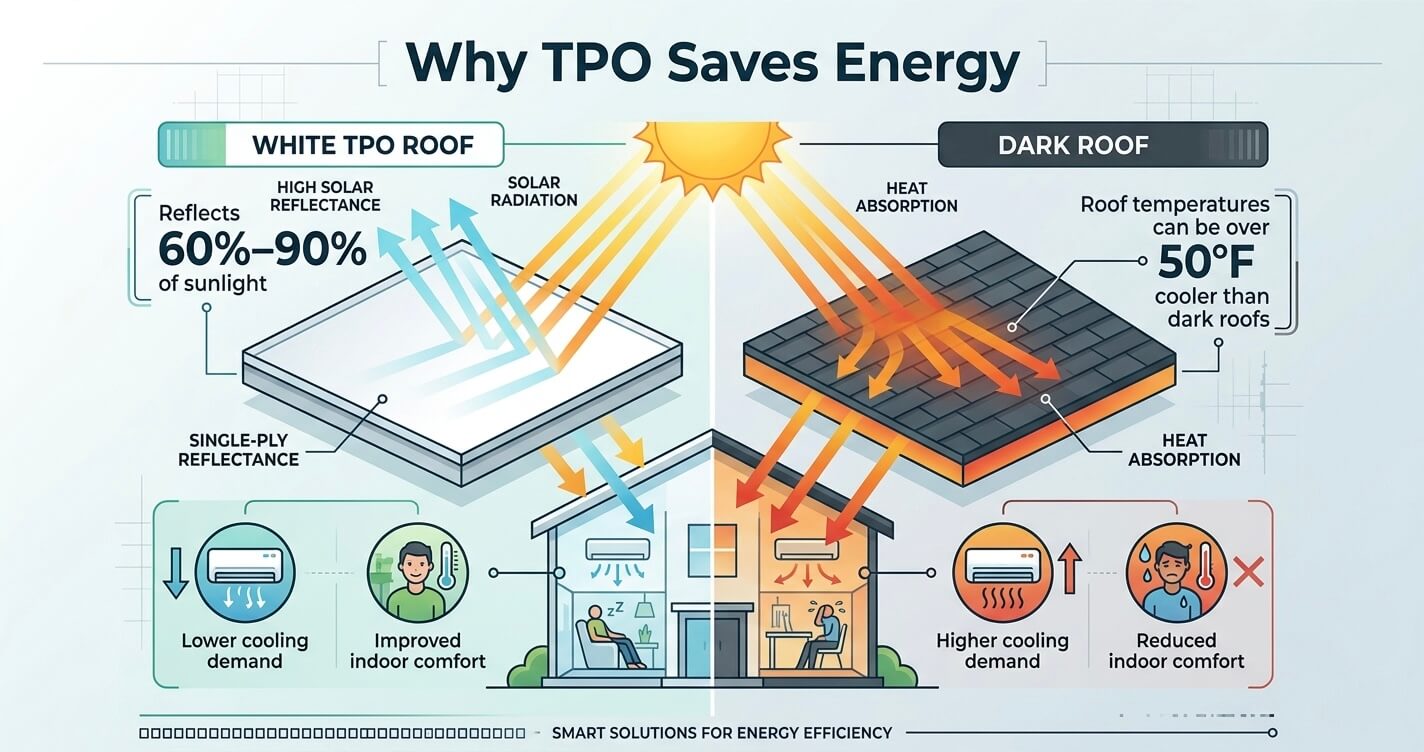
According to the U.S. Environmental Protection Agency, cool roofs reduce heat transfer into buildings and can lower indoor temperatures while decreasing air-conditioning demand. [Source: US EPA]
Many modern white TPO membranes achieve solar reflectance values high enough to qualify for ENERGY STAR cool-roof standards when properly installed.
Energy performance improves further when TPO is paired with high-quality polyisocyanurate (polyiso) insulation installed above the roof deck. In many residential roofing assemblies, insulation contributes as much to long-term energy performance as the membrane itself.
How Northern Virginia Winters Affect TPO
While homeowners often focus on summer energy savings, winter performance matters just as much.
Northern Virginia’s freeze-thaw cycles can expose weaknesses in roofing systems over time. Water enters small openings, freezes, expands, and gradually enlarges vulnerabilities.
TPO’s heat-welded seams help mitigate this risk because they create a fused connection rather than relying solely on adhesives.
Even so, no roofing system is maintenance-free.
Homeowners should schedule annual inspections to evaluate:
- Seam integrity
- Flashing performance
- Drainage conditions
- Ponding water
- Roof penetrations
- Debris accumulation
Regular inspections after severe winter weather can identify minor issues before they develop into expensive repairs.
For many homeowners, the combination of reflective energy performance, strong seam technology, and compatibility with low-slope residential designs makes TPO one of the most practical roofing solutions available for Northern Virginia’s climate.
How Much Does TPO Roofing Cost in Northern Virginia in 2026?
One of the first questions homeowners ask is straightforward: How much will a TPO roof cost?
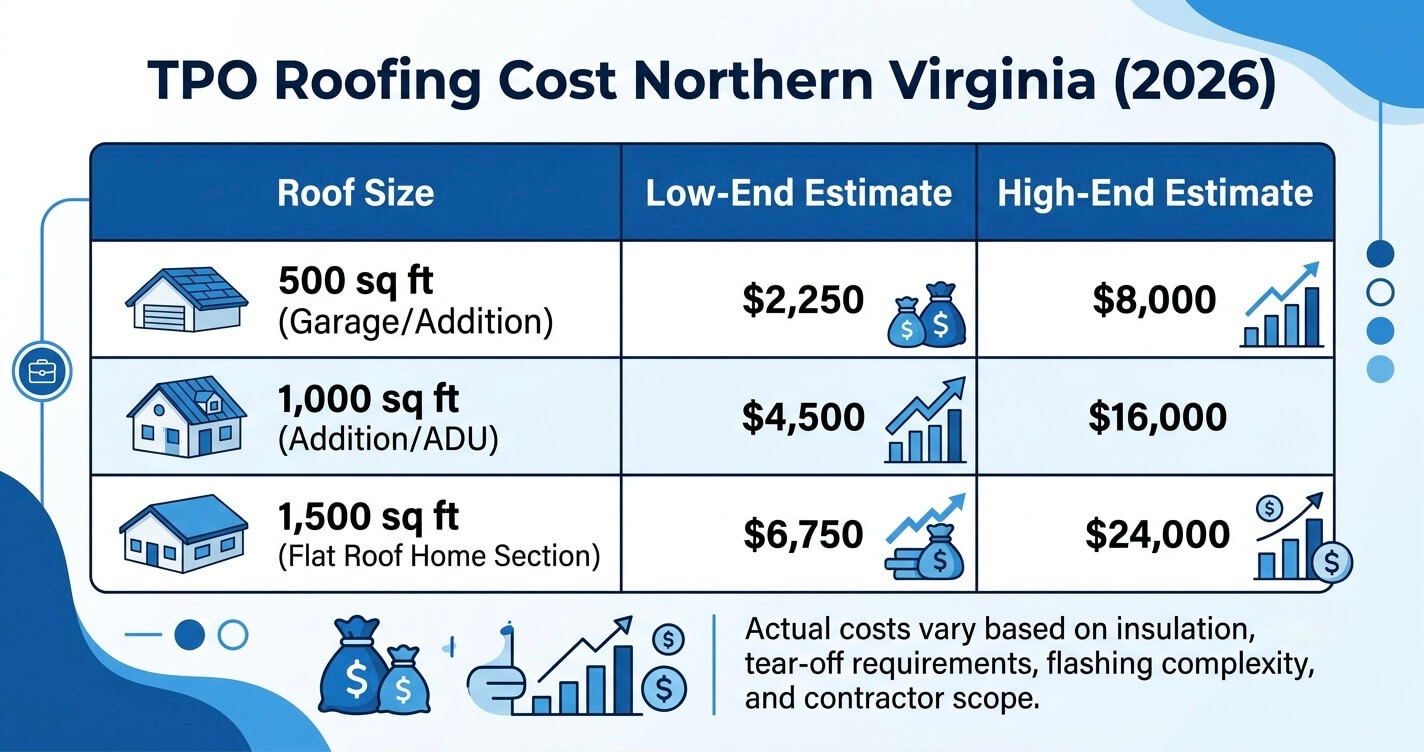
The answer depends on several variables, including roof size, membrane thickness, insulation requirements, attachment method, flashing complexity, and the condition of the existing roof assembly. While national pricing benchmarks provide a useful starting point, homeowners in Fairfax County, Arlington, McLean, Great Falls, and surrounding Northern Virginia communities should expect costs to trend higher than national averages because of labor rates, permitting requirements, and regional construction demand.
National Cost Benchmarks vs. Northern Virginia Reality
According to Angi’s 2026 roofing cost data, TPO roofing installations generally range from approximately $4.50 to $16 per square foot installed, with a national average project cost around $10,700 for a typical residential flat-roof project. [Source: Angi]
However, homeowners should understand that national averages often underrepresent costs in high-cost construction markets such as Northern Virginia.
Projects in Fairfax County, McLean, Arlington, and Great Falls frequently require higher labor expenditures, stricter permitting oversight, and more extensive flashing details than comparable projects in lower-cost regions.
For planning purposes, many homeowners can expect the following ranges:
These figures are planning estimates only. Actual project costs vary significantly based on existing conditions, insulation requirements, drainage corrections, permit requirements, and contractor scope.
A useful way to think about pricing is that homeowners are not simply purchasing a membrane. They are purchasing an integrated roofing assembly designed to manage water, air, vapor, thermal performance, and structural movement for decades.
What Drives Cost Up or Down?
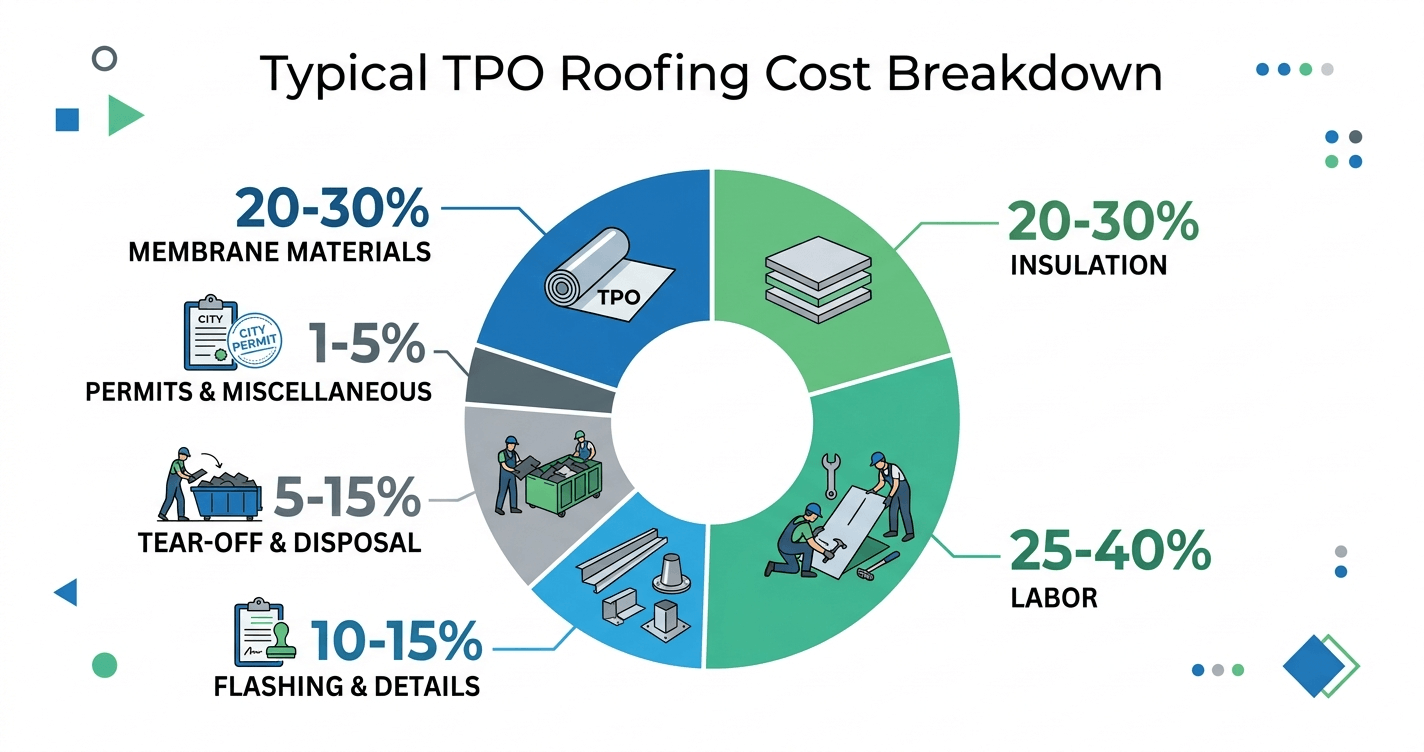
Several factors influence the final price of a TPO roofing project.
Membrane Thickness
The membrane itself is available in multiple thicknesses.
For most Northern Virginia residential projects, 60-mil TPO offers the strongest balance between durability, puncture resistance, and cost efficiency.
Attachment Method
The installation method affects both labor costs and long-term performance.
Fully Adhered Systems
- Highest installation cost
- Excellent wind resistance
- Smooth finished appearance
- Preferred for many residential applications
Mechanically Fastened Systems
- Moderate cost
- Faster installation
- Common on larger roof areas
Ballasted Systems
- Lowest material cost
- Rarely used on modern residential projects
- Additional structural load considerations
Insulation Requirements
Insulation often surprises homeowners because it can represent a substantial portion of the project budget.
Polyisocyanurate (Polyiso) insulation remains the most commonly specified insulation beneath TPO membranes due to its high R-value per inch and compatibility with modern roofing assemblies.
Depending on thickness requirements, insulation frequently represents approximately 20–30% of total project cost.
Tear-Off and Disposal
If existing roofing materials must be removed, disposal costs increase project budgets considerably.
Typical tear-off costs range from approximately:
- $1–$2 per square foot for membrane removal
- Higher costs if multiple roof layers are present
- Additional charges if damaged decking requires replacement
Roof Complexity
The most expensive square foot of a roofing project is rarely the open field membrane.
Instead, costs often arise at:
- Skylights
- Chimneys
- HVAC curbs
- Roof drains
- Parapet walls
- Pipe penetrations
- Roof-to-wall transitions
Each penetration introduces additional flashing work, welding, and quality-control requirements.
How to Control Your TPO Roofing Budget
Homeowners can often save money without sacrificing performance by focusing on scope clarity rather than chasing the lowest bid.
Before signing any contract:
- Obtain at least three detailed proposals.
- Confirm membrane manufacturer and thickness.
- Verify insulation type and R-value.
- Request a breakdown of tear-off costs.
- Confirm flashing replacement is included.
- Review warranty coverage carefully.
- Verify permit fees are included.
The cheapest proposal is often not the best value. In TPO roofing, seam quality, flashing quality, and installer experience have a greater influence on long-term performance than small differences in membrane pricing.
TPO Roofing Permits in Northern Virginia: What Fairfax County and Other Jurisdictions Require
Many homeowners are surprised to learn that roofing projects frequently trigger permit requirements.
Whether a permit is necessary depends on project scope, structural modifications, material changes, and local jurisdiction requirements.
Because permit regulations can change, homeowners should always verify requirements directly with the appropriate building department before construction begins.
When Is a Permit Required for TPO Roofing?
In many Northern Virginia jurisdictions, permits become necessary when roofing work goes beyond routine maintenance.
Common triggers include:
- Structural roof repairs
- Roof deck replacement
- Material changes
- Significant sheathing replacement
- New roof penetrations
- Changes affecting building code compliance
For Fairfax County homeowners, permit requirements are administered through Fairfax County Land Development Services (LDS).
Official Fairfax County Code Information: Click Here
Because permit exemptions can vary based on project specifics, homeowners should verify requirements directly with county staff before starting work.
Key Code Considerations for TPO Roofing
Modern roofing projects must satisfy multiple code objectives simultaneously:
· Weather Protection
The roof assembly must provide a continuous weather-resistant barrier capable of resisting water intrusion.
· Energy Efficiency
Virginia currently enforces the 2021 Virginia Uniform Statewide Building Code (USBC), which incorporates updated energy-efficiency requirements for many roofing assemblies. [Source: DHCD]
Depending on project scope, insulation upgrades may be required to meet current code standards.
· Fire Classification
Roof assemblies must comply with applicable fire-resistance classifications specified by building code requirements and manufacturer-approved assembly designs.
· Wind Resistance
Northern Virginia roofing systems must be designed to resist local wind loads and attachment requirements established by code and manufacturer specifications.
The Permit Process in Fairfax County
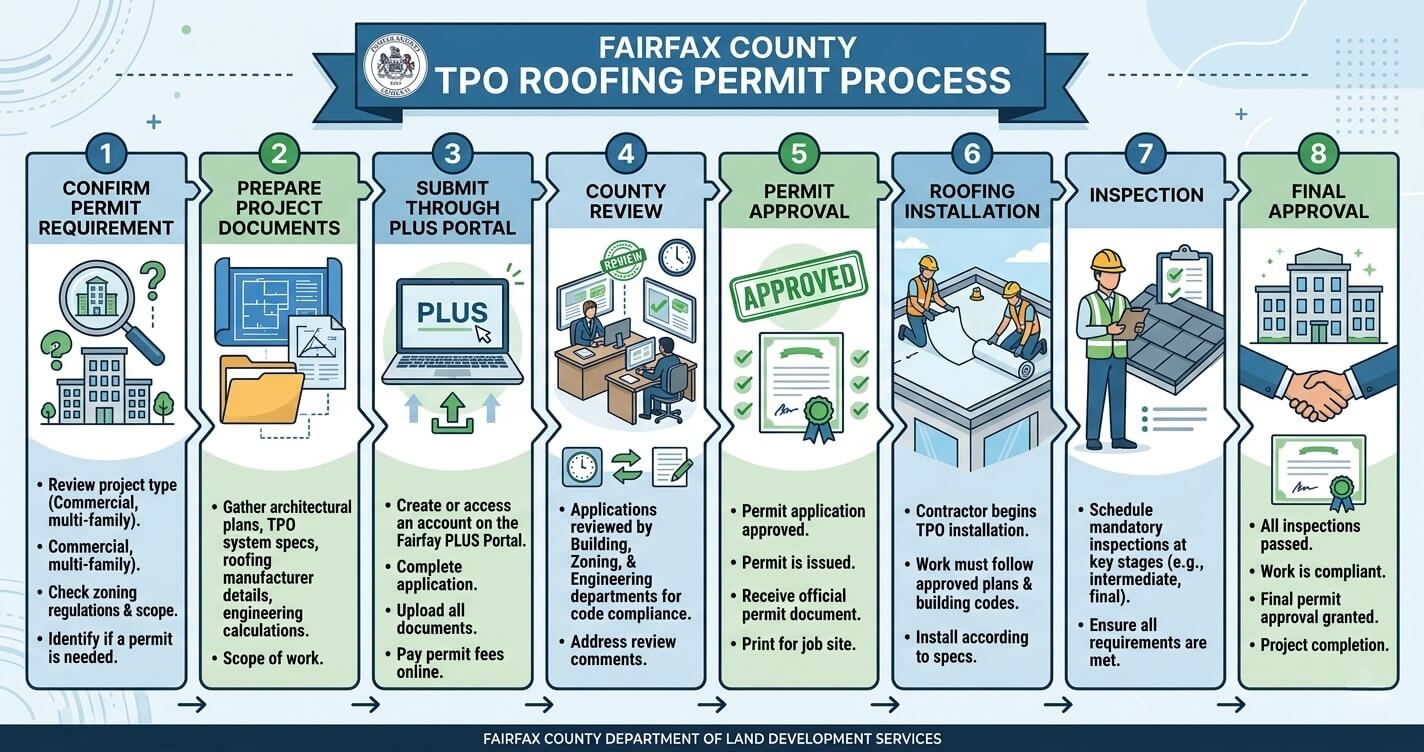
Although specific requirements vary by project, the process generally follows these steps:
- Determine permit applicability.
- Prepare project specifications.
- Submit application through Fairfax County PLUS.
- County review and approval.
- Construction begins.
- Required inspections occur.
- Final approval and permit closeout.
Official Fairfax County PLUS Portal: Click Here
For homeowners, one of the simplest ways to avoid permitting problems is to hire a contractor who routinely works within Northern Virginia jurisdictions and handles permit administration as part of their service.
What to Expect During a TPO Roofing Installation in Northern Virginia
Understanding the installation process helps homeowners evaluate contractor proposals and recognize the difference between a professional roofing system and a basic membrane replacement.
Pre-Installation: Inspection and Preparation
Before any membrane is installed, experienced contractors conduct a comprehensive evaluation of the existing roof assembly.
This assessment typically includes:
- Roof deck condition
- Existing insulation condition
- Moisture intrusion assessment
- Structural concerns
- Drainage performance
- Penetration locations
- Flashing conditions
Moisture trapped beneath an existing roofing system is one of the most common discoveries during tear-off projects.
Wet insulation loses thermal performance and can accelerate deterioration within the roofing assembly. If moisture is present, replacement is usually recommended before new materials are installed.
The Installation Sequence
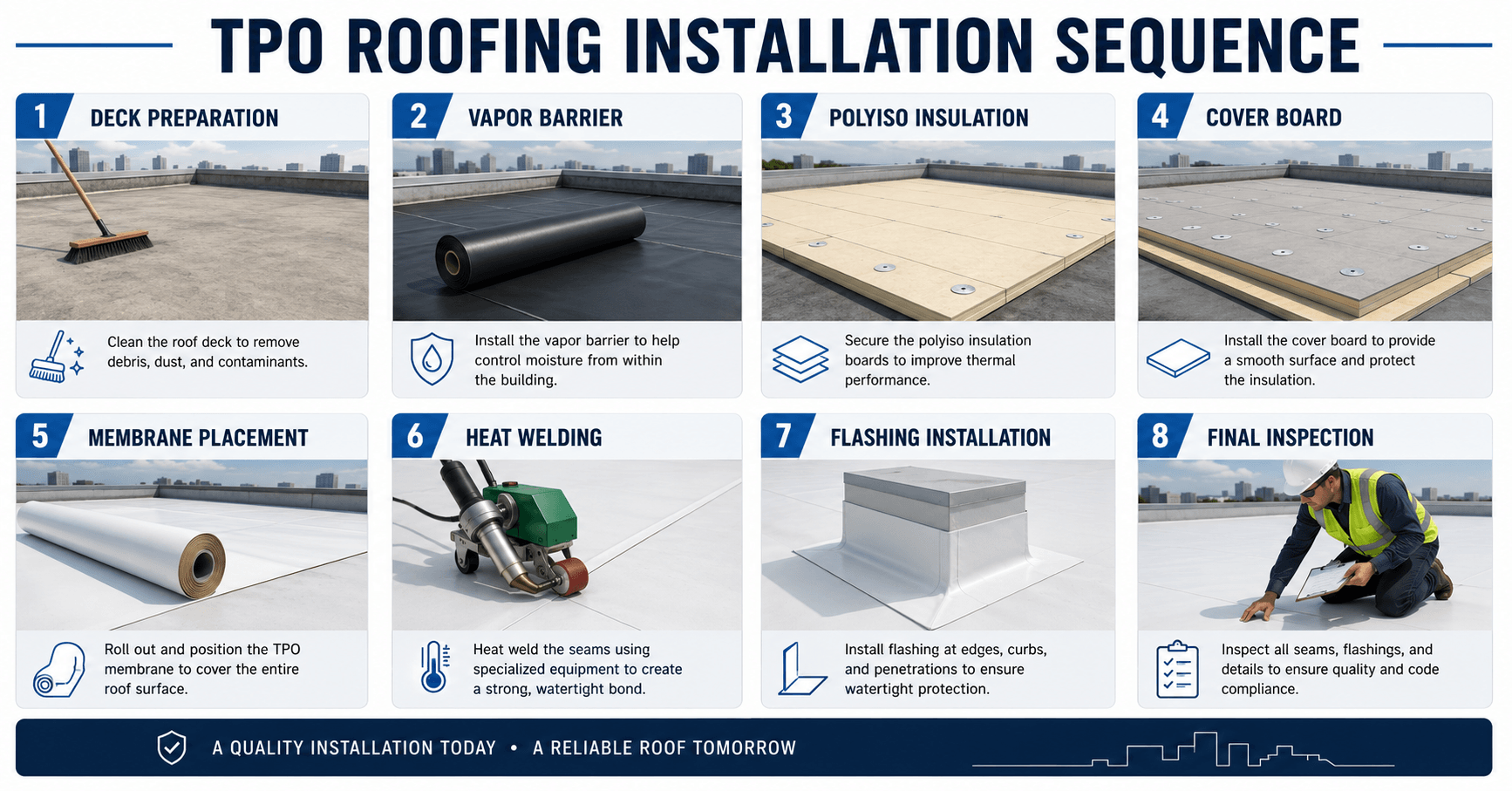
A professionally installed TPO system generally follows the following sequence:
Step 1: Deck Preparation
Damaged decking is repaired or replaced.
The roof surface must be smooth, stable, and structurally sound before installation begins.
Step 2: Vapor Barrier Installation
Where required by assembly design, a vapor retarder is installed to help manage moisture migration.
Step 3: Insulation Installation
Polyiso insulation boards are mechanically attached or adhered to the roof deck.
Multiple layers may be used to improve thermal performance and stagger joints.
Step 4: Cover Board Installation
Many premium systems include a cover board.
Cover boards improve impact resistance, provide a smooth substrate, and increase overall system durability.
Step 5: Membrane Placement
Large rolls of TPO membrane are positioned across the roof.
Sheets are aligned carefully to maintain proper overlap dimensions.
Step 6: Heat Welding
This is the most critical phase of installation.
Specialized hot-air welding equipment fuses adjacent sheets into a continuous membrane.
Proper welding temperature, speed, and pressure are essential for seam integrity.
Step 7: Flashing Installation
Penetrations, walls, drains, and transitions receive custom flashing details.
Many roofing failures originate at flashing locations rather than in the field membrane itself.
Step 8: Quality Control Testing
Professional installers perform seam inspections and probe testing to verify weld consistency before project completion.
Timeline Expectations
Most residential projects are completed relatively quickly once permits are approved.
Typical installation durations include:
When permitting, material procurement, inspections, and scheduling are included, the overall project timeline commonly ranges from four to eight weeks.
TPO vs. Other Roofing Options: Which Is Right for Your Northern Virginia Home?
Choosing the right roofing system begins with understanding that different roofing materials are designed for different applications.
There is no universal “best” roof.
The best roof is the one designed for your specific roof geometry, performance requirements, budget, and long-term goals.
TPO vs. Asphalt Shingles
While asphalt shingle roofing Northern Virginia remains the preferred choice for steep-slope roof systems, shingles are not designed for flat or low-slope applications where TPO membranes excel.
For roof sections below approximately 2:12 pitch, water drains too slowly for shingles to perform reliably. Under those conditions, membrane roofing systems become the appropriate solution.
This means many homes actually require both roofing types.
For example:
- Main roof = asphalt shingles
- Flat-roof addition = TPO
- Garage roof = TPO
- Porch roof = TPO
TPO vs. EPDM (Rubber Roofing)
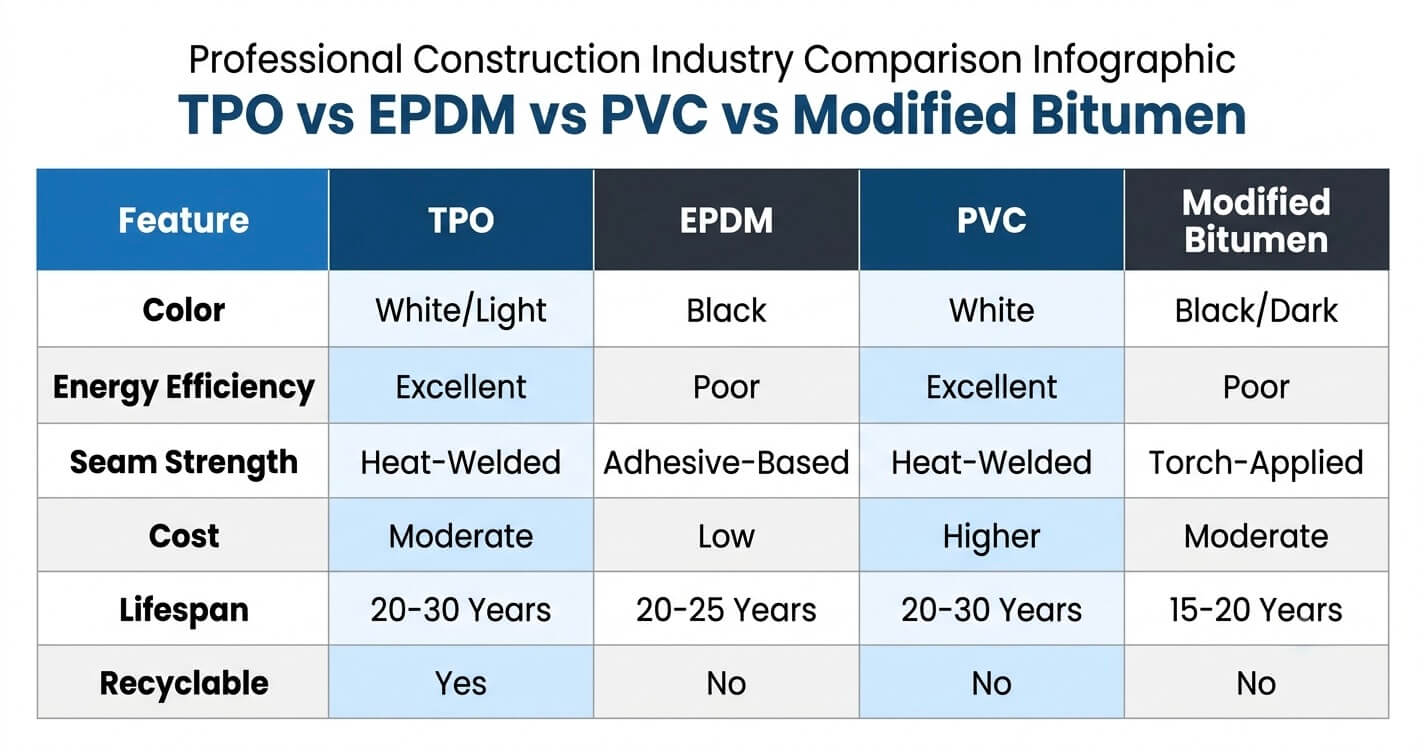
EPDM has been widely used for decades and remains a respected roofing material.
However, there are important differences.
For Northern Virginia’s hot summers, TPO’s reflective surface provides a meaningful advantage in reducing rooftop heat gain.
TPO vs. PVC Roofing
TPO and PVC share many characteristics.
Both are thermoplastic membranes.
Both use heat-welded seams.
Both provide excellent waterproofing performance.
The primary difference is cost.
PVC generally costs more because of its chemical-resistance capabilities and specialized formulations.
For most residential applications, homeowners rarely need PVC’s enhanced chemical resistance.
As a result, TPO often provides the better value proposition.
TPO vs. Modified Bitumen
Modified bitumen has historically been common on low-slope roofs throughout the Mid-Atlantic region.
While still used today, many homeowners and builders have shifted toward TPO because of:
- Better solar reflectance
- Lower rooftop temperatures
- Cleaner installation methods
- Reduced maintenance requirements
- Strong seam performance
For most residential additions, garages, and modern low-slope roof sections in Northern Virginia, TPO has become one of the most commonly specified roofing systems because it balances cost, durability, energy efficiency, and installation flexibility better than many traditional alternatives.
6 TPO Roofing Mistakes Northern Virginia Homeowners Should Avoid
Even the highest-quality roofing membrane can fail prematurely if the roof is poorly designed, improperly installed, or inadequately maintained.
Most major roofing problems are not caused by defective materials. They are caused by avoidable mistakes made before, during, or after installation.
Understanding these common pitfalls can help homeowners protect their investment and maximize the lifespan of their roofing system.
Mistake #1: Choosing the Cheapest Bid Without Reviewing the Scope
Many homeowners compare roofing proposals based on the final number at the bottom of the estimate.
Unfortunately, roofing proposals are rarely equal.
One contractor may include:
- 60-mil membrane
- New flashing
- Insulation upgrades
- Permit administration
- Manufacturer warranty registration
Another contractor may exclude several of those items while presenting a much lower price.
The result is an apples-to-oranges comparison.
The most important question is not “Which bid is cheapest?”
The better question is:
“Which bid provides the most complete roofing system?”
Homeowners should always request detailed written scopes identifying:
- Membrane manufacturer
- Membrane thickness
- Attachment method
- Insulation specifications
- Flashing details
- Warranty coverage
- Permit responsibilities
Mistake #2: Skipping the Permit Process
Some homeowners assume roofing permits are unnecessary because the work occurs outside the home.
In reality, many roofing projects trigger permit requirements depending on scope, structural modifications, and material changes.
Unpermitted work can create complications during:
- Property sales
- Refinancing
- Insurance claims
- Future renovation projects
Additionally, if code violations are discovered, corrective work may become necessary before the issue can be resolved.
Fairfax County permit information: Click Here
The safest approach is to verify permit requirements before work begins and ensure the contractor assumes responsibility for obtaining all required approvals.
Mistake #3: Ignoring Drainage Design
Water management is the single most important function of any roofing system.
A common misconception is that TPO roofs are completely unaffected by standing water.
While TPO generally performs better than many traditional roofing materials in low-slope applications, prolonged ponding water can still accelerate wear, increase dirt accumulation, stress seams, and reduce long-term performance.
Professional roof design should evaluate:
- Roof slope
- Drain placement
- Overflow drainage
- Tapered insulation requirements
- Scupper locations
- Existing drainage deficiencies
A roofing membrane should never be viewed as a substitute for proper drainage design.
Mistake #4: Hiring an Unlicensed or Unqualified Contractor
Not all roofing contractors possess the same qualifications.
Before signing a contract, homeowners should verify:
- Virginia contractor licensing
- Insurance coverage
- Local references
- Manufacturer certifications
- Roofing specialization experience
Virginia Department of Professional and Occupational Regulation (DPOR): Click Here
Manufacturer-certified contractors often provide access to enhanced warranty options that may not be available through uncertified installers.
Most importantly, experienced installers understand the technical details that determine long-term roof performance, including seam welding, flashing fabrication, drainage integration, and substrate preparation.
Mistake #5: Selecting Membrane Thickness Based Solely on Price
TPO membranes are available in multiple thicknesses, but thicker membranes generally provide greater puncture resistance and durability.
For many Northern Virginia residential projects, 60-mil membranes have become the industry standard because they offer a strong balance between:
- Cost
- Longevity
- Warranty eligibility
- Impact resistance
- Weather resistance
A lower-cost 45-mil membrane may be appropriate for certain applications, but homeowners should understand the performance trade-offs before making a decision.
The goal should be long-term value, not simply minimizing upfront expense.
Mistake #6: Neglecting Annual Roof Maintenance
One of the biggest myths in roofing is that new roofs require no maintenance.
In reality, every roofing system benefits from periodic inspections.
Annual maintenance should include:
- Drain cleaning
- Debris removal
- Seam inspection
- Flashing evaluation
- Penetration inspection
- Drainage verification
Minor issues identified early are typically inexpensive to address.
The same issues left unnoticed for years can result in interior water damage, insulation replacement, and costly repairs.
For Northern Virginia homeowners, spring inspections following winter freeze-thaw cycles are particularly valuable.
How to Choose a TPO Roofing Contractor in Northern Virginia
A TPO roofing system is only as good as the contractor installing it.
Even premium materials can underperform when installation quality is poor.
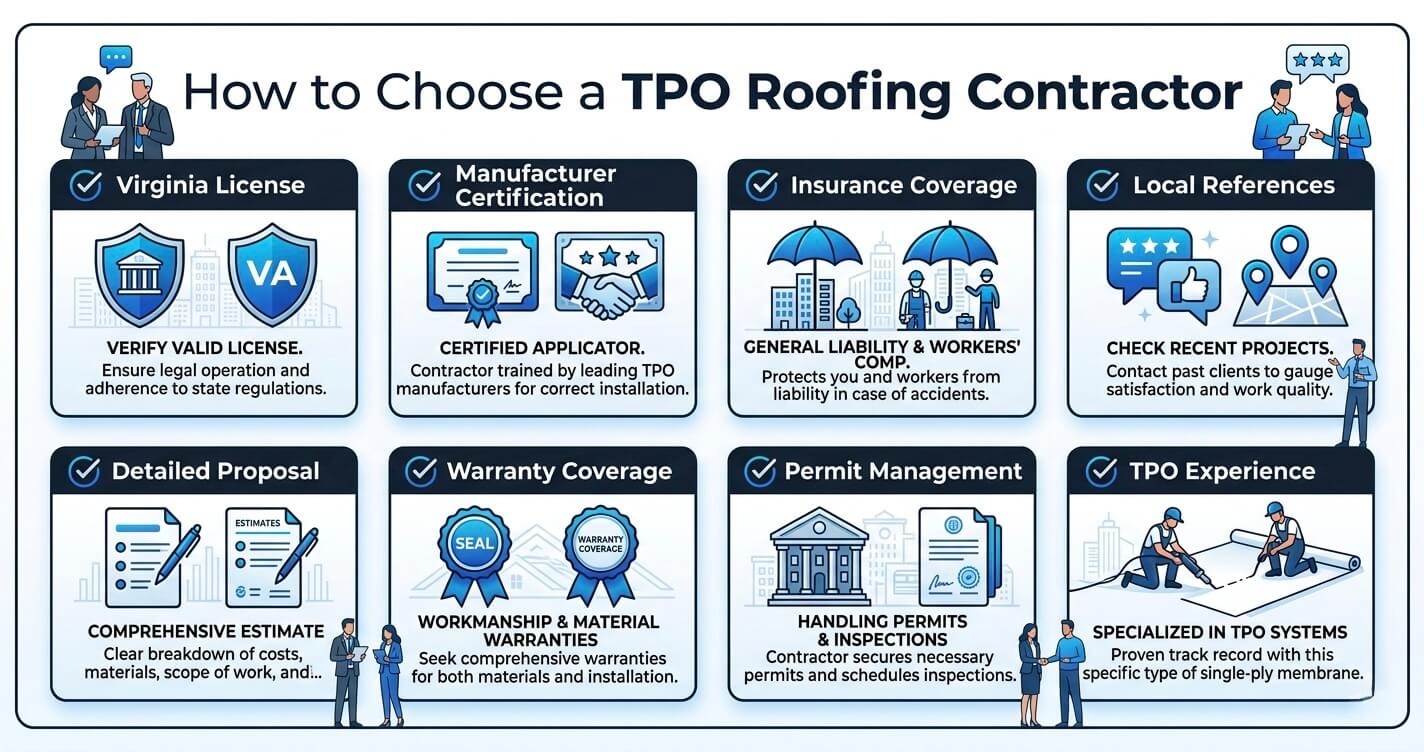
Because roofing work becomes difficult to inspect once completed, contractor selection is one of the most important decisions homeowners will make.
Verify Virginia Licensing
Any contractor performing significant roofing work should hold the appropriate Virginia contractor licensing required for the scope of work.
Homeowners can verify credentials through:
Virginia DPOR License Lookup: Click Here
Licensing alone does not guarantee quality, but it helps establish minimum legal qualifications and accountability.
Confirm Manufacturer Certification
Many major roofing manufacturers maintain certified installer programs.
Certification demonstrates that installers have completed manufacturer training and understand approved installation methods.
Benefits often include:
- Enhanced warranty eligibility
- Access to manufacturer technical support
- Compliance with warranty requirements
- Improved quality assurance
Ask prospective contractors which membrane manufacturers they are certified to install.
Request Local References
Northern Virginia presents unique roofing challenges, including:
- Freeze-thaw cycling
- High summer humidity
- Intense UV exposure
- Complex permitting environments
Contractors with extensive local experience are often better equipped to address these conditions than companies operating primarily outside the region.
Ask for examples of completed projects involving:
- Flat-roof additions
- Garage roofs
- ADUs
- Modern homes
- Low-slope residential roofs
Review the Proposal Carefully
A professional roofing proposal should clearly identify:
- Scope of work
- Materials
- Membrane thickness
- Insulation specifications
- Warranty terms
- Permit responsibilities
- Estimated timeline
Avoid contractors who provide vague lump-sum pricing without supporting details.
The proposal should answer questions before they become problems.
Verify Insurance Coverage
Homeowners should request proof of:
- General liability insurance
- Workers’ compensation insurance
This protects both the homeowner and contractor if an accident occurs during construction.
Evaluate Warranty Coverage
Roof warranties generally fall into two categories:
Manufacturer Warranty
Covers approved roofing materials against manufacturing defects.
Workmanship Warranty
Covers installation-related defects performed by the contractor.
The strongest roofing projects typically include both forms of protection.
According to HomeGuide cost and lifespan data, TPO roofing systems generally last between 15 and 30 years depending on material quality, membrane thickness, climate conditions, and installation quality. [Source: HomeGuide]
This is one reason contractor selection often matters more than small differences in material pricing.
Planning a TPO Roofing Project?
Homeowners considering a flat-roof addition, garage roof replacement, ADU project, or low-slope roofing upgrade should evaluate roofing options early in the planning process.
A qualified design-build team can help assess roof geometry, drainage requirements, insulation performance, permitting considerations, and long-term budget expectations before construction begins.
US Home Design Build serves homeowners throughout Fairfax County, McLean, Great Falls, Arlington, Reston, and surrounding Northern Virginia communities.
Frequently Asked Questions
How much does TPO roofing cost in Northern Virginia in 2026?
Most homeowners should expect installed costs ranging from approximately $4.50 to $16 per square foot depending on roof size, membrane thickness, insulation requirements, roof complexity, and labor conditions. Small residential projects may cost several thousand dollars, while larger low-slope roof systems can exceed $20,000. Obtaining multiple itemized proposals remains the most accurate way to establish project-specific pricing. [Source: Angi]
Do I need a permit for TPO roofing in Fairfax County?
Permit requirements depend on project scope. Structural modifications, material changes, significant deck replacement, and certain roof alterations frequently require permits. Homeowners should confirm requirements directly with Fairfax County Land Development Services before beginning work. [Source: Fairfax County Land and Development]
How long does a TPO roof last in Northern Virginia?
When properly installed and maintained, many TPO roofing systems provide approximately 20–30 years of service life. Longevity depends on membrane thickness, installation quality, weather exposure, drainage design, and maintenance practices.
What is the difference between TPO and EPDM roofing?
TPO is a reflective thermoplastic membrane that uses heat-welded seams, while EPDM is a synthetic rubber membrane that typically relies on adhesive-based seams. TPO generally offers stronger solar reflectance and lower rooftop temperatures, making it particularly attractive in mixed-humid climates such as Northern Virginia.
Is TPO roofing right for a home addition in Northern Virginia?
In many cases, yes. TPO is specifically designed for flat and low-slope roof applications commonly found on additions, garages, sunrooms, ADUs, and modern residential roof sections. Proper drainage and professional installation remain essential for long-term performance.
Can TPO roofing help lower energy bills?
Potentially. Reflective TPO membranes reduce solar heat absorption compared with dark roofing materials. According to the U.S. Department of Energy, cool roofs are designed to reflect more sunlight and absorb less heat, helping reduce cooling demand in many buildings. [Source: US Department of Energy]
What membrane thickness should I choose?
For most residential projects, 60-mil TPO is generally considered the preferred balance between durability, puncture resistance, cost, and warranty eligibility. Specific recommendations should be based on roof design, exposure conditions, and budget considerations.
What warranties should I expect?
Most projects include both a manufacturer material warranty and a contractor workmanship warranty. Coverage periods vary by manufacturer, membrane thickness, installer certification level, and project specifications. Homeowners should request warranty documentation before signing a contract.
Making the Right TPO Roofing Decision for Your Northern Virginia Home
For homeowners with flat or low-slope roof sections, TPO roofing Northern Virginia projects continue to offer one of the strongest combinations of durability, energy performance, affordability, and long-term value available in today’s residential roofing market.
Whether the project involves a garage roof, sunroom, home addition, ADU, covered porch, or modern custom home, TPO provides a proven waterproofing solution specifically engineered for low-slope applications where traditional roofing materials are not appropriate.
However, material selection is only one part of the equation.
Long-term success depends on three critical factors:
- Selecting the appropriate membrane thickness.
- Ensuring proper installation and flashing details.
- Working with a qualified contractor who understands local codes, permitting requirements, and Northern Virginia climate conditions.
Northern Virginia’s mixed-humid Climate Zone 4A environment places significant demands on roofing systems throughout the year. Reflective TPO membranes help reduce rooftop heat gain during summer while maintaining flexibility through winter freeze-thaw cycles, making them particularly well-suited for the region.
When installed correctly, paired with quality insulation, and maintained through routine inspections, a residential TPO roofing system can provide decades of reliable protection and energy-efficient performance.
Ready to Explore Your Options?
Planning a flat-roof addition, garage roof replacement, ADU project, or low-slope roofing upgrade?
Contact US Home Design Build to discuss your goals, evaluate your roof conditions, and determine whether a TPO roofing system is the right solution for your Northern Virginia home.
