
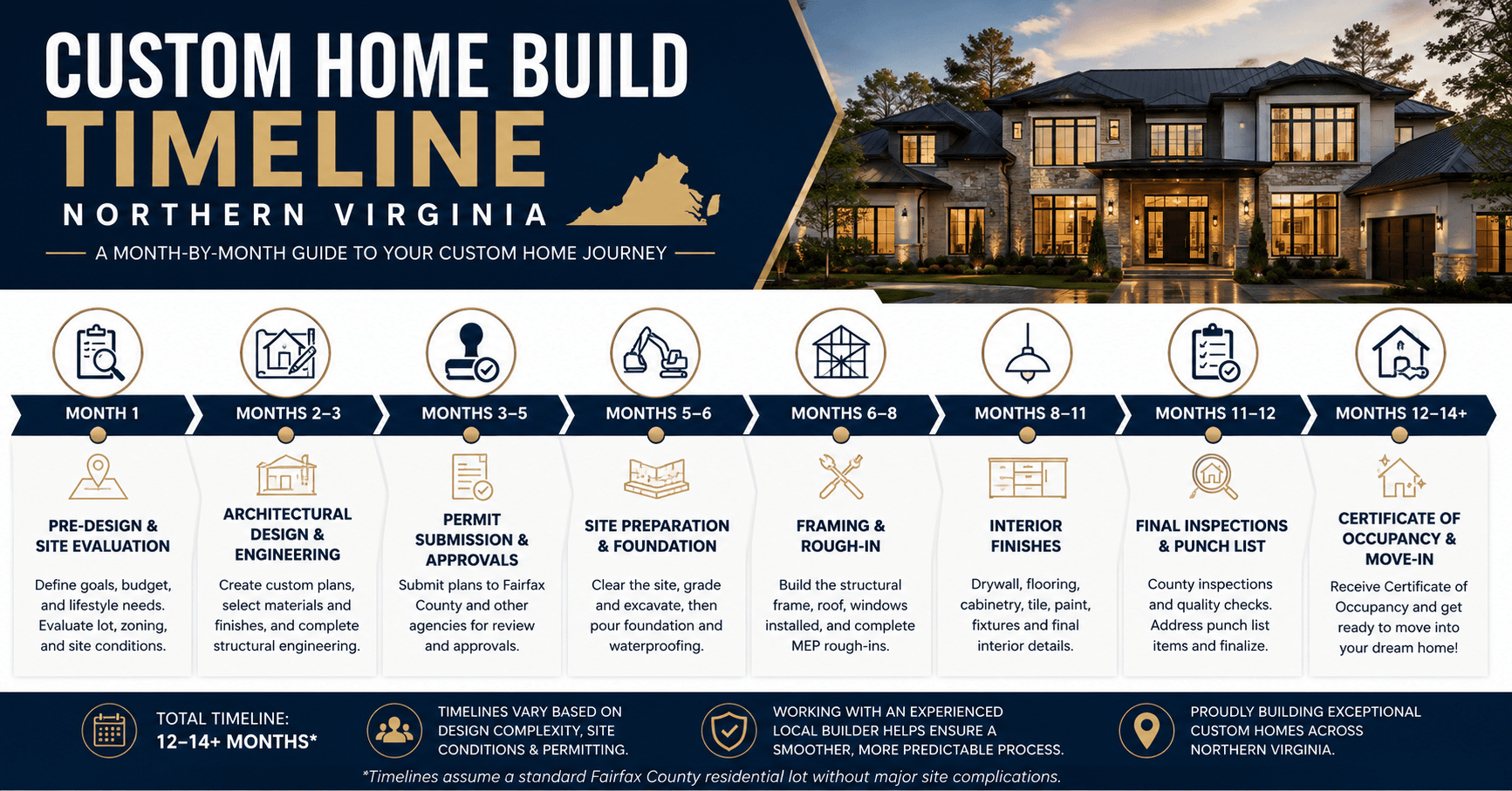
If you’ve recently purchased a lot in McLean, Vienna, Great Falls, or elsewhere in Northern Virginia, one of the first questions you’ll likely ask is: What is a realistic custom home build timeline Northern Virginia?
The answer is often longer than homeowners expect. Many people estimate the timeline based solely on construction activity, assuming the process begins when excavation equipment arrives on-site. In reality, a significant portion of the project occurs long before foundation work begins. Design development, engineering, permitting, site evaluations, and municipal reviews all play critical roles in determining the overall schedule.
Understanding your full custom home build timeline in Northern Virginia requires looking beyond the construction phase alone. From the initial consultation through final occupancy approval, most custom homes in the region require approximately 12–18 months to complete, with construction itself often beginning three to five months into the process.
This guide provides a realistic month-by-month breakdown of every major stage, including design, permitting, site preparation, construction, inspections, and move-in. Whether you’re planning a luxury custom residence in Great Falls or a teardown-and-rebuild project in McLean, understanding the timeline upfront helps you make better decisions, establish realistic expectations, and avoid preventable delays.
Homeowners evaluating a Custom Home Builder Northern Virginia can also benefit from understanding how builder selection, project delivery methods, and local permitting requirements affect schedules from day one.
According to the National Association of Home Builders, custom single-family housing starts reached approximately 186,000 homes in 2025, representing a 3% increase from the previous year and highlighting continued demand among homeowners seeking personalized living spaces rather than production-built homes.
What Makes the Northern Virginia Timeline Unique
Not all custom home markets operate under the same conditions. While many areas of Virginia follow similar construction processes, Northern Virginia introduces additional regulatory, environmental, and permitting complexities that can significantly influence project timelines.
The region is one of the most heavily regulated residential construction markets in the Mid-Atlantic. Jurisdictions such as Fairfax County, Arlington County, Loudoun County, and Prince William County each administer local review processes on top of Virginia’s statewide building requirements. As a result, custom home projects often move through multiple layers of review before construction approval is granted.
One of the most significant recent regulatory changes involves the adoption of the 2021 Virginia Uniform Statewide Building Code (USBC). Effective January 18, 2025, all new permit applications must comply with this updated code cycle. Builders, architects, engineers, and permitting professionals must ensure that plans satisfy the latest structural, energy efficiency, safety, and construction requirements before permits can be approved. [Source: Virginia Department of Housing and Community Development (DHCD)]
Fairfax County, where many Northern Virginia custom homes are built, processes applications through its Planning and Land Use System (PLUS) platform. Unlike smaller jurisdictions that may require only basic plan reviews, Fairfax County’s review process frequently involves multiple departments and technical disciplines. Depending on the lot and project scope, submissions may require evaluation by:
- Zoning Review
- Land Development Services (LDS)
- Stormwater Management
- Urban Forestry
- Site Development and Inspections Division (SDID)
- Virginia Department of Transportation (VDOT) for applicable properties
- Utility coordination departments
Permit packages commonly include:
- Architectural drawings
- Site plans
- Boundary surveys
- Grading plans
- Utility connection documentation
- Tree preservation plans
- Erosion and sediment control measures
Source: Fairfax County PLUS System
In addition to municipal requirements, many Northern Virginia communities maintain homeowner association (HOA) architectural review processes. Neighborhoods throughout Reston, Vienna, Burke, and portions of McLean often require separate architectural approval before construction can begin. Even when local permits are approved, HOA review requirements can add several weeks to the overall schedule.
Site conditions also play a larger role in Northern Virginia than many homeowners anticipate. Custom home lots in areas such as McLean and Great Falls frequently contain mature tree canopies, steep topography, stream buffers, drainage easements, or environmentally sensitive areas. These characteristics often trigger additional engineering studies, grading reviews, or environmental assessments before permits are issued.
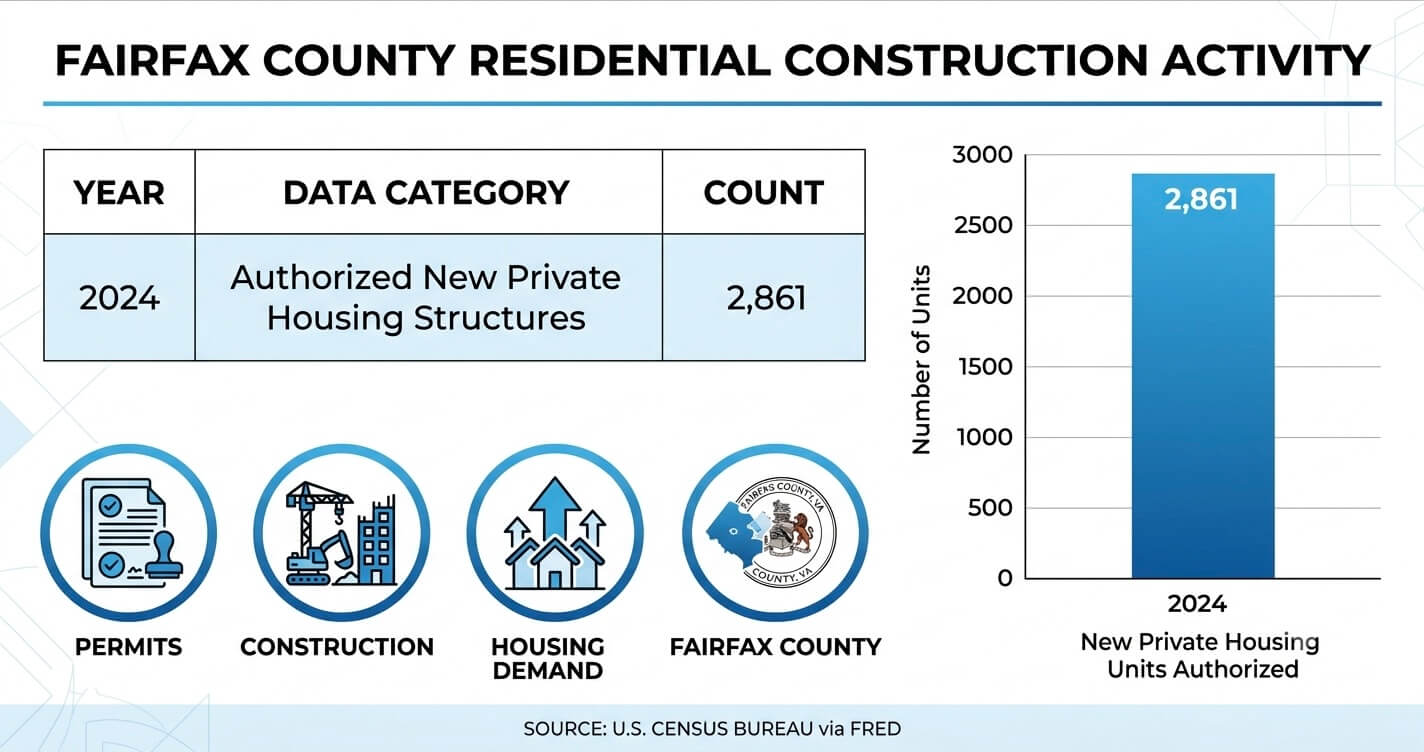
The volume of ongoing residential construction further contributes to permitting and inspection demand. According to data from the U.S. Census Bureau, Fairfax County authorized approximately 2,861 new private housing structures in 2024, illustrating the significant level of development activity occurring throughout the county. [Source: Federal Reserve Bank of St. Louis (FRED) – U.S. Census Bureau Data]
For homeowners asking, “How long does it take to build a custom home in Virginia?”, the answer depends heavily on these local regulatory and site-specific factors. Understanding them early is essential for developing realistic expectations and avoiding frustration later in the process.
The Full Custom Home Build Timeline Northern Virginia: Phase-by-Phase Overview
Before diving into the month-by-month details, it helps to understand the overall structure of a typical custom home project. While every build is unique, most follow the same major sequence of planning, permitting, construction, inspections, and occupancy.
The timeline below reflects a typical custom home built on a standard residential lot within Fairfax County under normal market conditions.
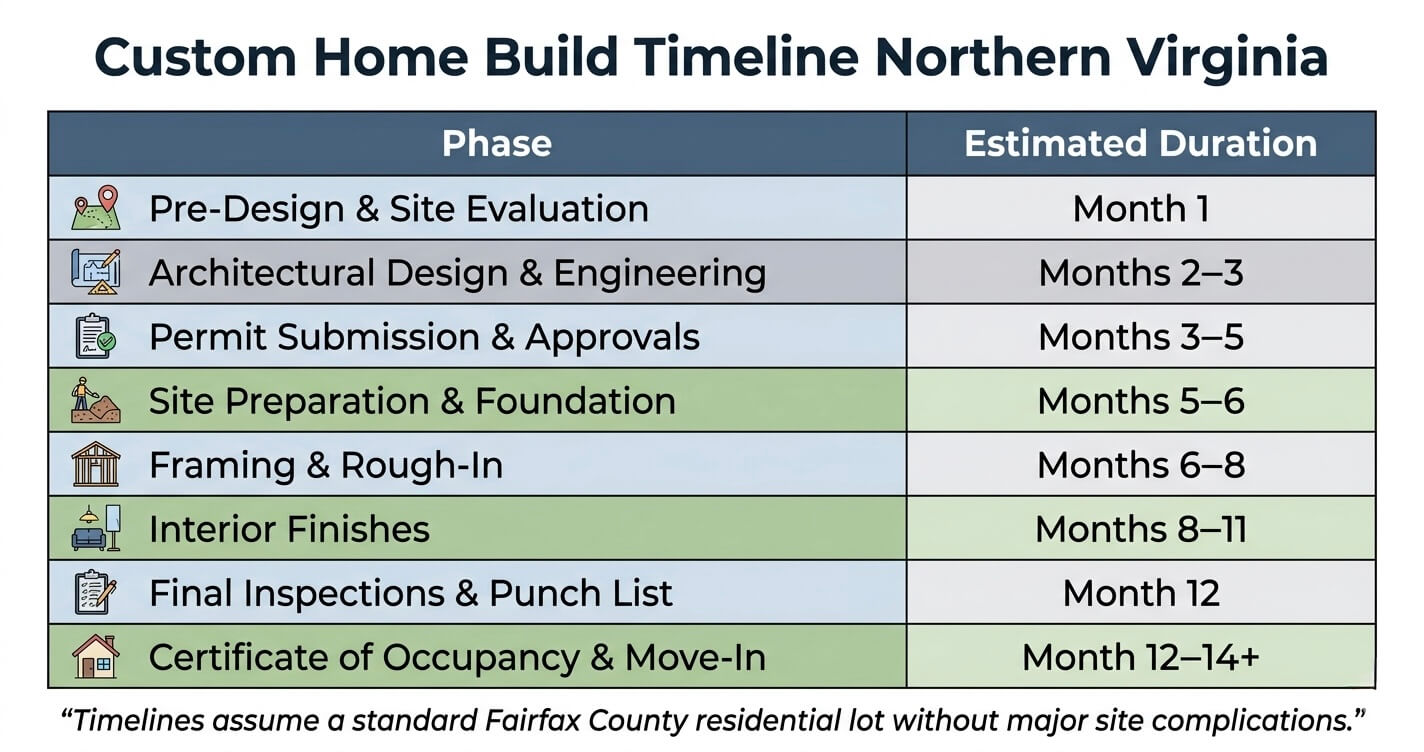
Note: These timelines assume a relatively straightforward residential lot in Fairfax County without major zoning complications, environmental constraints, or extensive homeowner-requested design revisions. Projects involving HOA approvals, grading challenges, stream buffers, variances, or complex architectural features can extend individual phases significantly.
From a project management perspective, the most important takeaway is that nearly half of the overall timeline occurs before major vertical construction begins. Homeowners often focus on framing, roofing, and interior finishes because those phases are visible. However, site evaluation, architectural design, engineering coordination, and permitting typically account for three to five months of the schedule before excavation equipment ever arrives on-site.
This reality is why experienced design-build firms place substantial emphasis on pre-construction planning. Every decision finalized during the design and permitting stages helps reduce delays later during construction.
For homeowners considering a custom home construction phases Northern Virginia project, the following month-by-month breakdown provides a realistic look at what happens during each stage, why it matters, and what actions can help keep the project moving efficiently.
Month 1: Pre-Design, Site Evaluation, and Budget Planning
The first month of any successful custom home project is focused on due diligence. While homeowners are often eager to begin designing floor plans and selecting finishes, experienced builders understand that every major decision should be grounded in a clear understanding of the property itself.
This phase establishes the foundation for the entire project. Decisions made during the first few weeks directly influence design feasibility, permitting requirements, construction costs, and ultimately the overall schedule.
What Happens During Month 1?
The process typically begins with an initial consultation between the homeowner and the design-build team. During this meeting, discussions focus on lifestyle requirements, architectural preferences, budget expectations, lot characteristics, and project goals.
Once project objectives are established, the builder begins a detailed site evaluation. This analysis commonly includes:
- Zoning classification review
- Setback requirement verification
- Lot coverage limitations
- Building restriction assessments
- Existing utility availability
- Topographic analysis
- Soil and drainage considerations
- Tree preservation requirements
- HOA restrictions and architectural guidelines
In Northern Virginia, particularly in communities such as McLean, Great Falls, and Vienna, site conditions often have a greater impact on cost and scheduling than homeowners initially realize. Mature tree canopies, steep grades, stormwater management requirements, and environmental constraints frequently influence both design options and permitting timelines.
Simultaneously, project budgeting begins to take shape.
Contrary to popular belief, budget planning is not simply about determining what homeowners are willing to spend. It is a process of aligning project expectations with construction realities. Square footage, finish levels, structural complexity, site conditions, and municipal requirements all influence the final investment level.
Construction financing is also addressed during this phase. Most lenders require preliminary project information and financial qualification before issuing construction loan approvals. Securing financing early prevents delays during the design and permitting stages.
What Homeowners Should Accomplish During This Phase
To keep the project moving efficiently, homeowners should focus on several key tasks:
- Secure construction loan pre-approval
- Gather surveys, plats, and property records
- Establish realistic budget parameters
- Define must-have features versus optional upgrades
- Create a preliminary design inspiration portfolio
- Identify long-term lifestyle requirements
The more clarity homeowners provide during this stage, the smoother the design process becomes in later months.
Industry Cost Reality
Budget planning has become increasingly important as construction costs continue to rise nationwide.
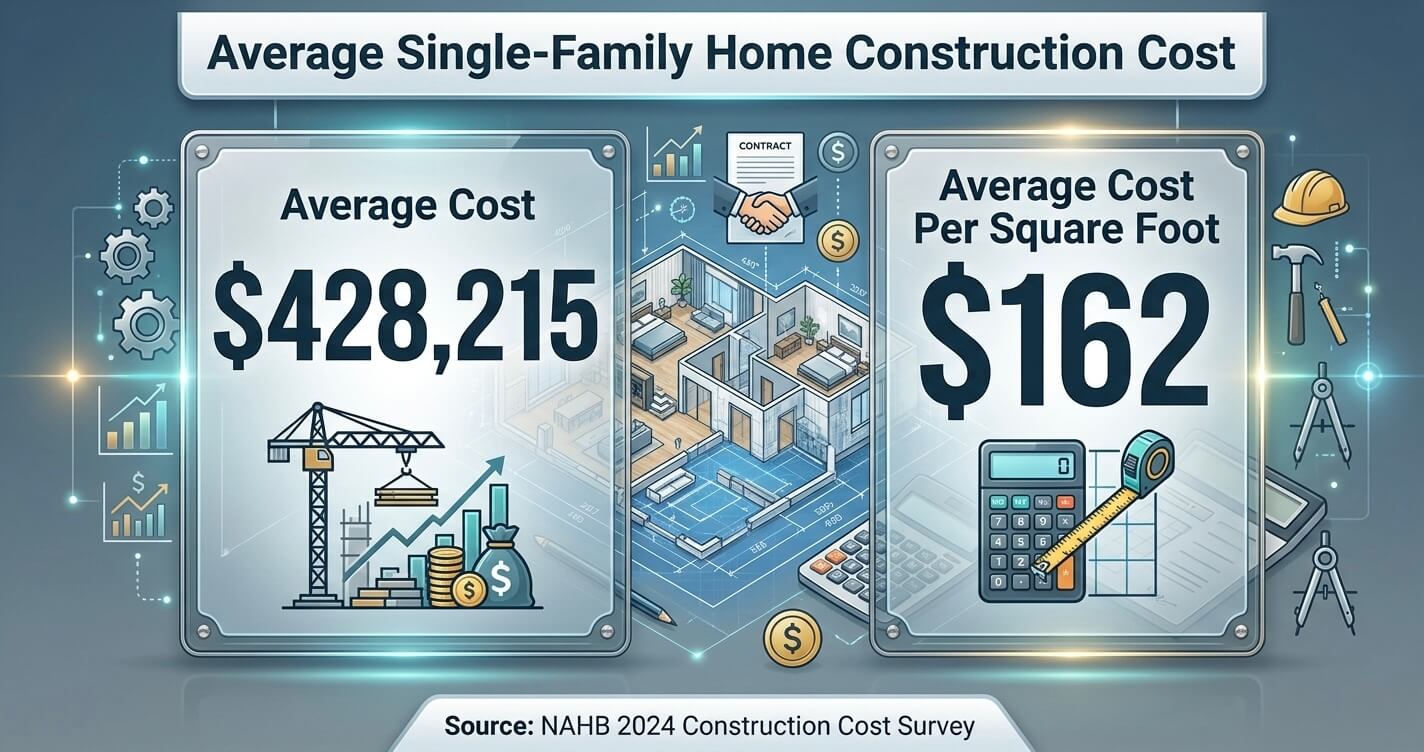
According to the National Association of Home Builders’ 2024 Construction Cost Survey, the average construction cost of a single-family home reached approximately $428,215, or roughly $162 per square foot, representing the highest figure recorded in the survey’s history. [Source: NAHB 2024 Construction Cost Survey]
Professional Insight
One of the most common mistakes homeowners make is beginning architectural design before thoroughly evaluating the lot. Experienced Northern Virginia builders know that a parcel appearing straightforward on paper may contain hidden costs related to grading, tree preservation, utility connections, drainage improvements, or environmental compliance.
Identifying those factors early allows the design team to create plans that align with both the site and the budget from the beginning rather than requiring expensive redesigns later.
Months 2–3: Architectural Design and Engineering
With site analysis complete and budget parameters established, the project moves into architectural design and engineering. This is the phase where ideas become buildable plans.
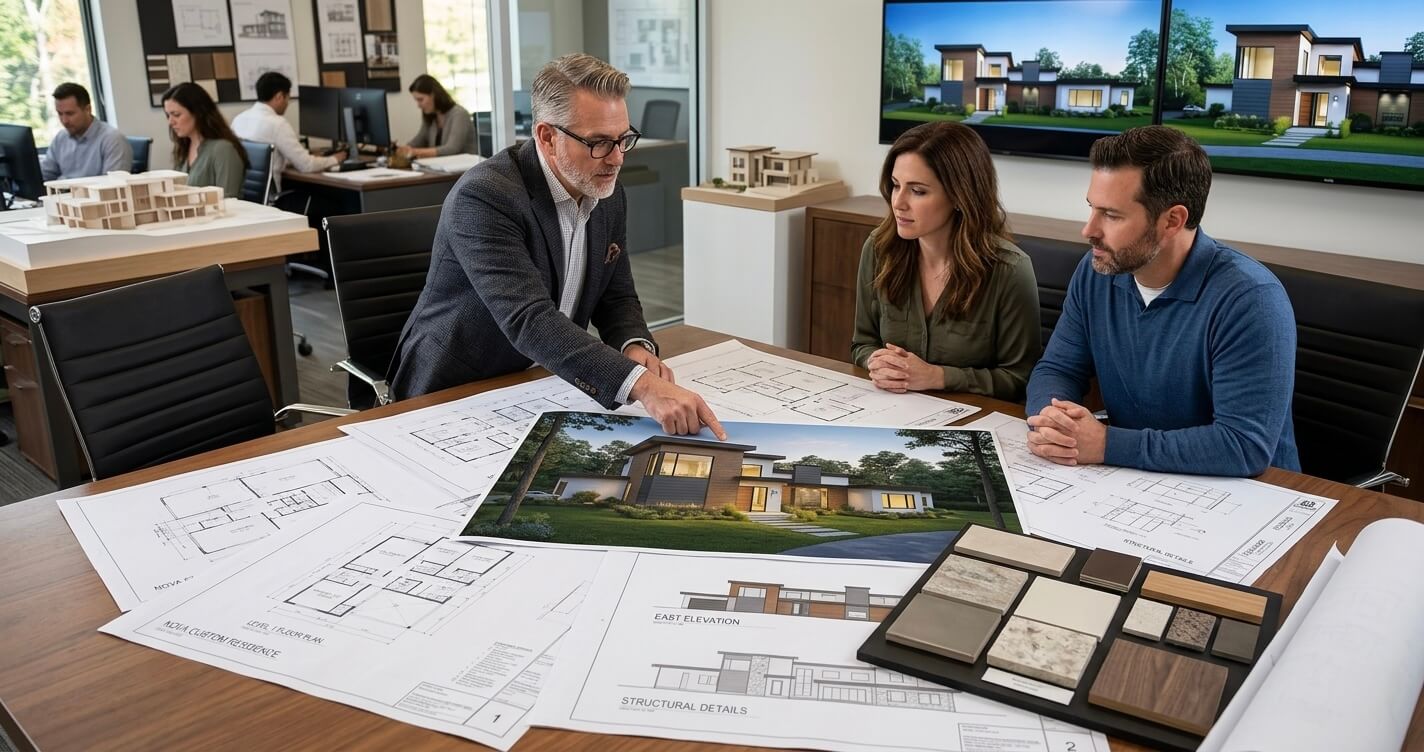
For many homeowners, this is also the most exciting stage of the process. Floor plans take shape, elevations are developed, and the future home begins to transition from concept to reality.
Schematic Design
The first step typically involves schematic design.
Architects and designers work with homeowners to establish:
- Overall home size
- Room relationships
- Floor plan layouts
- Architectural style
- Building orientation
- Initial exterior appearance
Rather than focusing on finishes or decorative details, schematic design concentrates on functionality and spatial planning.
Homeowners exploring contemporary architectural styles may also begin evaluating whether working with a modern home builder Northern Virginia aligns with their vision. Contemporary custom homes often require additional design coordination, larger window systems, open-concept layouts, and specialized structural engineering considerations that should be addressed early during the design development process.
Design Development
Once the general layout is approved, plans move into design development.
During this phase, the project team refines:
- Exterior materials
- Structural systems
- Window configurations
- Roof designs
- Interior layouts
- Mechanical space allocations
- Energy-efficiency strategies
The objective is to transform conceptual drawings into a coordinated set of plans that can move into engineering and permitting.
Engineering Coordination
Custom homes require input from multiple engineering disciplines.
Depending on project complexity, consultants may prepare:
- Structural engineering plans
- Mechanical system layouts
- Electrical plans
- Plumbing plans
- Stormwater calculations
- Grading and drainage plans
Coordination between these disciplines is essential. Conflicts discovered later in the permitting process can result in redesigns and significant delays.
HOA and Compliance Reviews
For homeowners building within HOA-governed communities, architectural review packages are often prepared during this phase.
Neighborhood associations may review:
- Exterior elevations
- Material selections
- Roof designs
- Building placement
- Landscaping concepts
At the same time, the project team verifies compliance with Fairfax County zoning requirements regarding:
- Building setbacks
- Height limitations
- Lot coverage restrictions
- Impervious surface calculations
Common Delay Triggers
Several issues routinely extend this phase:
- Multiple design revision rounds
- Delayed homeowner decisions
- HOA design modifications
- Engineering coordination conflicts
- Significant scope changes after approval
Simple customizations of existing plans may move through this stage in four to six weeks. Fully custom luxury homes often require eight to twelve weeks or longer depending on complexity.
Why Design-Build Teams Often Move Faster
Homeowners planning a custom home in McLean, Vienna, or the broader Northern Virginia area often benefit from working with a design-build team that manages both design and permitting under one roof. Because architects, engineers, and construction professionals collaborate from the beginning, communication gaps that commonly delay projects are significantly reduced.
For homeowners evaluating a Custom Home Builder Northern Virginia, integrated design-build delivery frequently creates a smoother transition between design completion and permit submission.
Months 3–5: Permit Submission and the Fairfax County Approval Process
For many homeowners, permitting is the least visible stage of the project. It is also one of the most important.
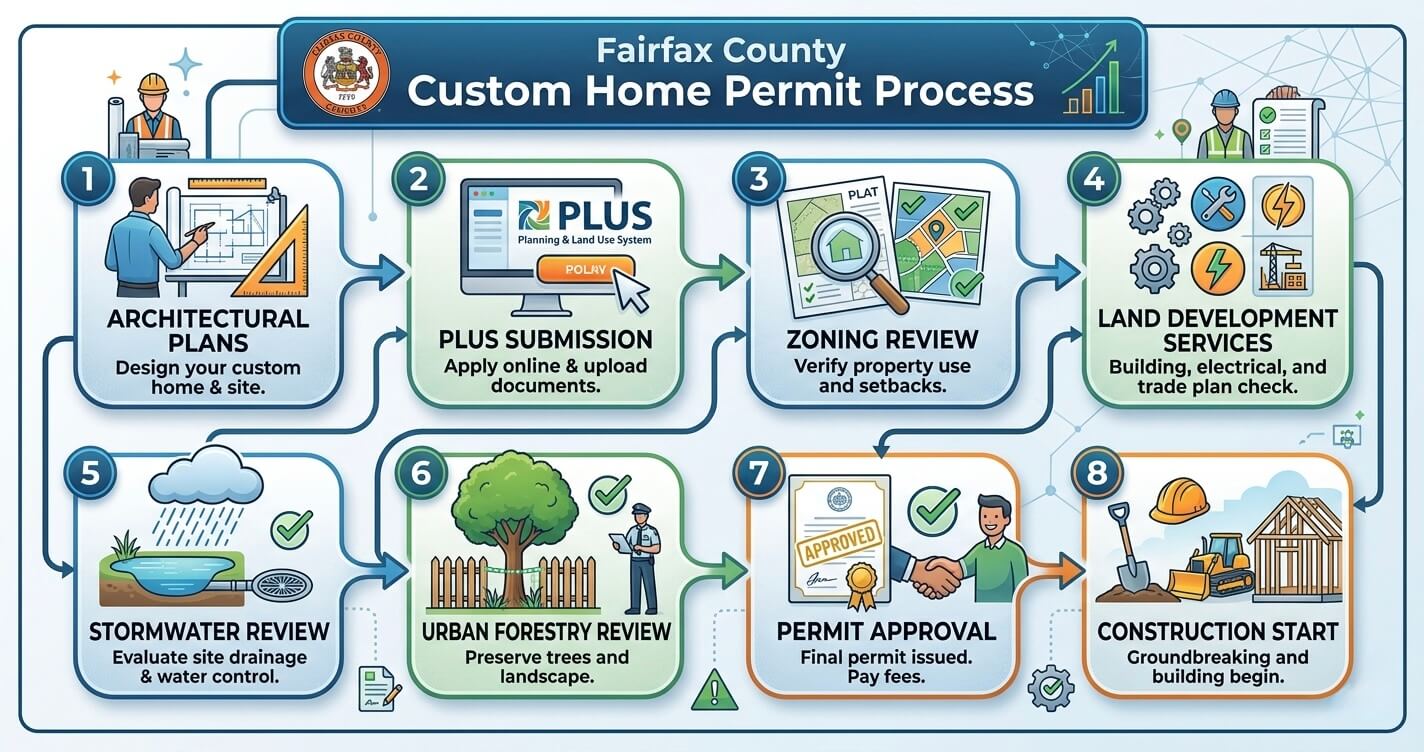
While no construction activity may be occurring on-site, a significant amount of technical review is happening behind the scenes. In fact, permitting delays represent one of the most common causes of schedule extensions in Northern Virginia custom home projects.
Preparing the Permit Package
Before submission, the project team assembles a comprehensive permit package that typically includes:
- Architectural construction drawings
- Structural engineering plans
- Site plans
- Grading plans
- Utility connection documentation
- Stormwater management requirements
- Erosion and sediment control information
- Energy compliance documentation
Permit reviewers evaluate whether the proposed home complies with applicable zoning, environmental, engineering, and building code requirements.
Fairfax County’s PLUS System
Fairfax County processes permit applications through its Planning and Land Use System (PLUS). [Source: Fairfax County PLUS]
The platform allows electronic submission, review, revisions, and tracking throughout the approval process.
However, electronic submission should not be confused with instant approval.
Depending on project complexity, plans may be reviewed by multiple agencies simultaneously, including:
- Land Development Services (LDS)
- Zoning Administration
- Urban Forestry
- Stormwater Management
- Site Development and Inspections Division
- Virginia Department of Transportation (VDOT)
- Utility review agencies
Each review group may issue comments requiring revisions before approval can proceed.
Building Code Requirements
As of January 18, 2025, all new permit applications must comply with the 2021 Virginia Uniform Statewide Building Code. [Source: Virginia DHCD]
This affects:
- Structural requirements
- Energy efficiency standards
- Fire safety provisions
- Mechanical systems
- Electrical systems
- Accessibility requirements where applicable
Failure to address code requirements early frequently results in additional review cycles.
Realistic Permit Timelines
Although every project is unique, most custom home permits fall within the following ranges:
- Straightforward residential projects: 6–8 weeks
- Lots requiring environmental review: 10–16 weeks
- Variances or special exceptions: 4–6 months or longer
Projects involving demolition permits, stream buffers, steep slopes, protected trees, or complex grading plans often require additional review periods.
How Experienced Builders Keep Projects Moving
While waiting on approvals, experienced design-build teams keep your custom home build timeline in Northern Virginia on track by ordering long-lead materials, coordinating subcontractors, refining construction schedules, and preparing procurement strategies before permits are officially issued.
This proactive planning approach often saves several weeks later in the construction process because materials and labor resources are already positioned when approvals arrive.
Homeowner Actions That Reduce Permit Delays
Homeowners can help accelerate approvals by:
- Finalizing design decisions before submission
- Responding quickly to information requests
- Avoiding major plan revisions during review
- Providing complete documentation from the outset
- Working with builders familiar with Fairfax County review procedures
Incomplete permit submissions remain one of the most common and avoidable causes of permitting delays throughout Northern Virginia.
Month 5–6: Site Preparation and Foundation
Once permits are approved, the project transitions from planning to physical construction. For many homeowners, this is the moment when the custom home finally begins to feel real. However, before framing can start, the site must first be prepared to safely support the structure for decades to come.
What Happens During Site Preparation?
The first step is mobilization. Construction equipment, temporary utilities, erosion-control measures, and site protection systems are brought to the property.
Site preparation activities commonly include:
- Lot clearing and vegetation removal
- Tree protection installation
- Erosion and sediment control measures
- Temporary construction access creation
- Utility marking and verification
- Rough grading and earthwork
Before excavation begins, contractors verify that all approved plans match existing site conditions. Any discrepancies discovered at this stage can require engineering review before work proceeds.
Excavation and Foundation Construction
Once grading is complete, excavation crews begin preparing for foundation installation.
Depending on the home design and lot characteristics, the foundation may be:
- Slab-on-grade
- Crawlspace foundation
- Full basement foundation
In Northern Virginia, full basements are common due to lot topography and homeowner preferences for additional living space.
Excavation activities include:
- Footing excavation
- Foundation trench preparation
- Drainage installation
- Waterproofing preparation
- Utility stub placement
Following excavation, concrete footings are poured and inspected before foundation walls are constructed.
Northern Virginia-Specific Site Challenges
Local site conditions frequently influence schedules during this phase.
Common challenges include:
- Heavy clay soils
- Unexpected rock formations
- High groundwater conditions
- Existing utility conflicts
- Stream buffer restrictions
- Stormwater compliance requirements
Properties in Great Falls, McLean, and portions of Fairfax County often require additional grading and drainage solutions due to elevation changes and environmental constraints.
Weather can also significantly affect production schedules. Spring rainfall, winter freeze-thaw cycles, and extended wet conditions can delay excavation and concrete work.
Required Inspections
Before framing can begin, local inspectors verify:
- Footing installation
- Foundation wall construction
- Waterproofing systems
- Drainage systems
- Structural compliance
Only after approvals are granted can the project advance to vertical construction.
Realistic Timeline Expectations
For a typical residential lot, site preparation and foundation work generally require three to six weeks.
However, unexpected conditions such as buried debris, unsuitable soils, groundwater issues, or extensive rock excavation can add several additional weeks to the schedule.
Experienced builders account for these possibilities during pre-construction planning, but some subsurface conditions cannot be fully identified until excavation begins.
Months 6–8: Framing and Rough-In
For most homeowners, this is the most exciting phase of the project. After months of planning, permitting, and site work, the home rapidly becomes recognizable as walls, floors, and roof systems take shape.
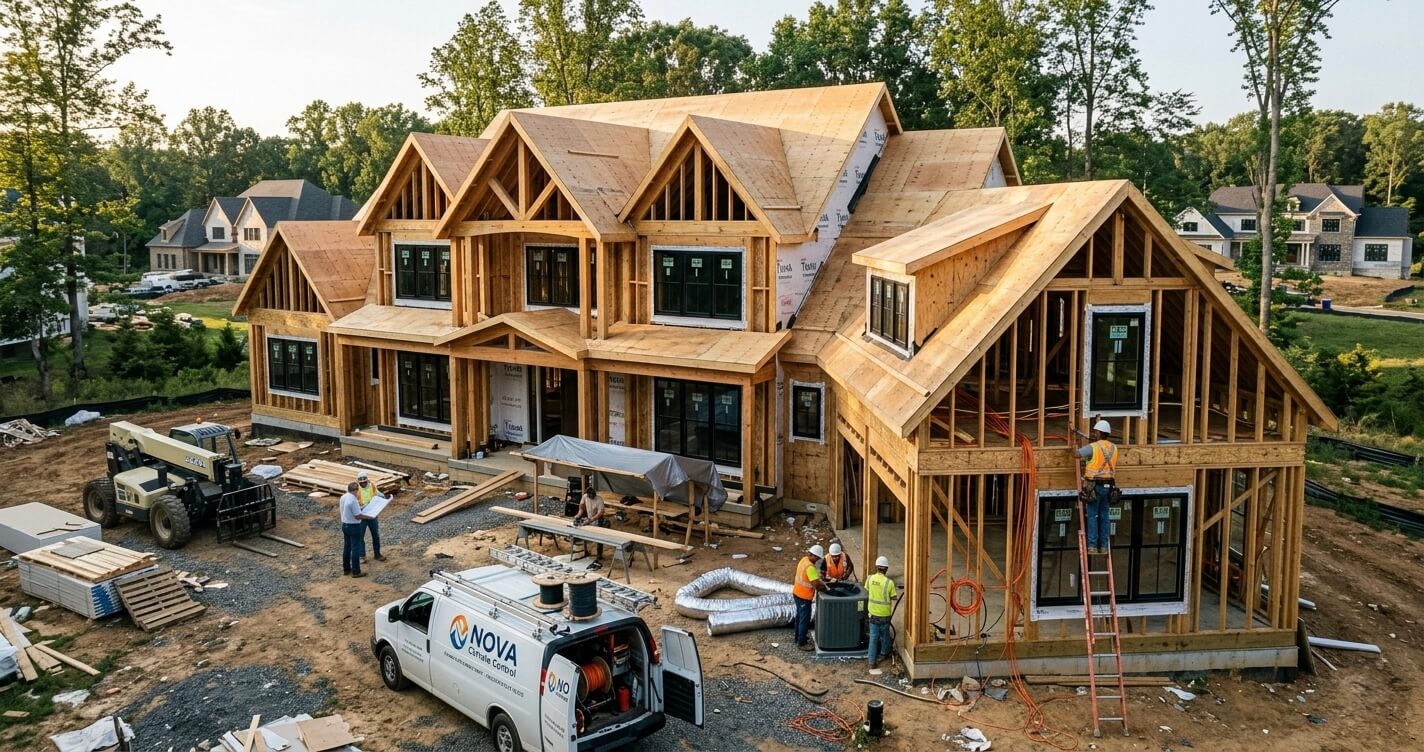
This is also the phase where the project progresses most visibly.
Structural Framing
The framing process creates the home’s structural skeleton.
Crews install:
- Floor systems
- Exterior wall framing
- Interior partitions
- Roof trusses or roof framing systems
- Structural beams and headers
- Stair framing
As framing progresses, homeowners can finally walk through rooms and experience the scale and layout established during design.
Once framing is substantially complete, exterior sheathing is installed to strengthen the structure and prepare it for weather protection systems.
Dry-In Stage
After framing inspections are approved, contractors install:
- Housewrap and weather barriers
- Roofing underlayment
- Roofing materials
- Windows
- Exterior doors
At this point, the structure becomes “dried in,” meaning it is largely protected from weather intrusion.
Achieving dry-in status is a major milestone because interior work can begin regardless of many external weather conditions.
Rough-In Installation
With the building enclosed, specialized trade contractors begin installing major systems.
Electrical Rough-In:
- Service panels
- Wiring systems
- Outlet locations
- Lighting circuits
- Low-voltage infrastructure
Plumbing Rough-In:
- Water supply lines
- Drain and waste systems
- Venting systems
- Gas piping where applicable
Mechanical Rough-In:
- HVAC ductwork
- Air handlers
- Ventilation systems
- Equipment platforms
Inspections Drive the Schedule
Each trade requires separate inspections before walls can be closed.
Inspectors typically review:
- Electrical systems
- Plumbing systems
- Mechanical systems
- Structural framing components
Inspection scheduling often becomes one of the most overlooked variables in project timelines.
This phase is the most visually dramatic part of the custom home build timeline in Northern Virginia. Homeowners often visit the site frequently as the structure takes shape and begins resembling the finished home envisioned during the design phase.
Common Delay Factors
Several issues can impact progress during framing and rough-in:
- Inspector scheduling backlogs
- Weather interruptions
- Material shortages
- Window delivery delays
- Structural revisions
- Trade coordination conflicts
While framing itself often progresses quickly, maintaining proper sequencing among subcontractors is critical to avoiding costly downtime.
Months 8–11: Interior Finishes
Interior finishing is typically the longest individual construction phase because it involves the greatest number of trades, materials, inspections, and homeowner selections.
Unlike framing, where large portions of work can be completed rapidly, finish work involves hundreds of detailed installation tasks that build upon one another.
Insulation and Drywall
After rough-in inspections are approved, insulation is installed throughout the structure.
Following insulation approval, drywall crews begin:
- Hanging drywall panels
- Taping joints
- Applying multiple finish coats
- Sanding surfaces
- Surface preparation
Because each coat must properly cure before the next application, drywall work often requires more time than homeowners expect.
Interior Finishing Sequence
Once drywall is complete, the project progresses through a carefully coordinated sequence.
Typical order includes:
- Primer and paint
- Hardwood flooring preparation
- Cabinet installation
- Trim carpentry
- Tile installation
- Countertop fabrication
- Fixture installation
- Appliance installation
- Final paint touchups
Each trade depends on the completion of previous work, making scheduling critical.
Cabinetry and Millwork Lead Times
Custom cabinetry is one of the most common sources of schedule delays.
High-end custom homes in McLean, Vienna, and Great Falls frequently feature:
- Custom kitchens
- Built-in storage systems
- Specialty millwork
- Luxury bath cabinetry
Lead times from domestic manufacturers often range from 10–14 weeks or longer.
For this reason, experienced builders typically place cabinet orders during the permitting phase rather than waiting until framing begins.
Cost Concentration During Interior Finishes
Interior finishing also represents the largest concentration of construction spending.
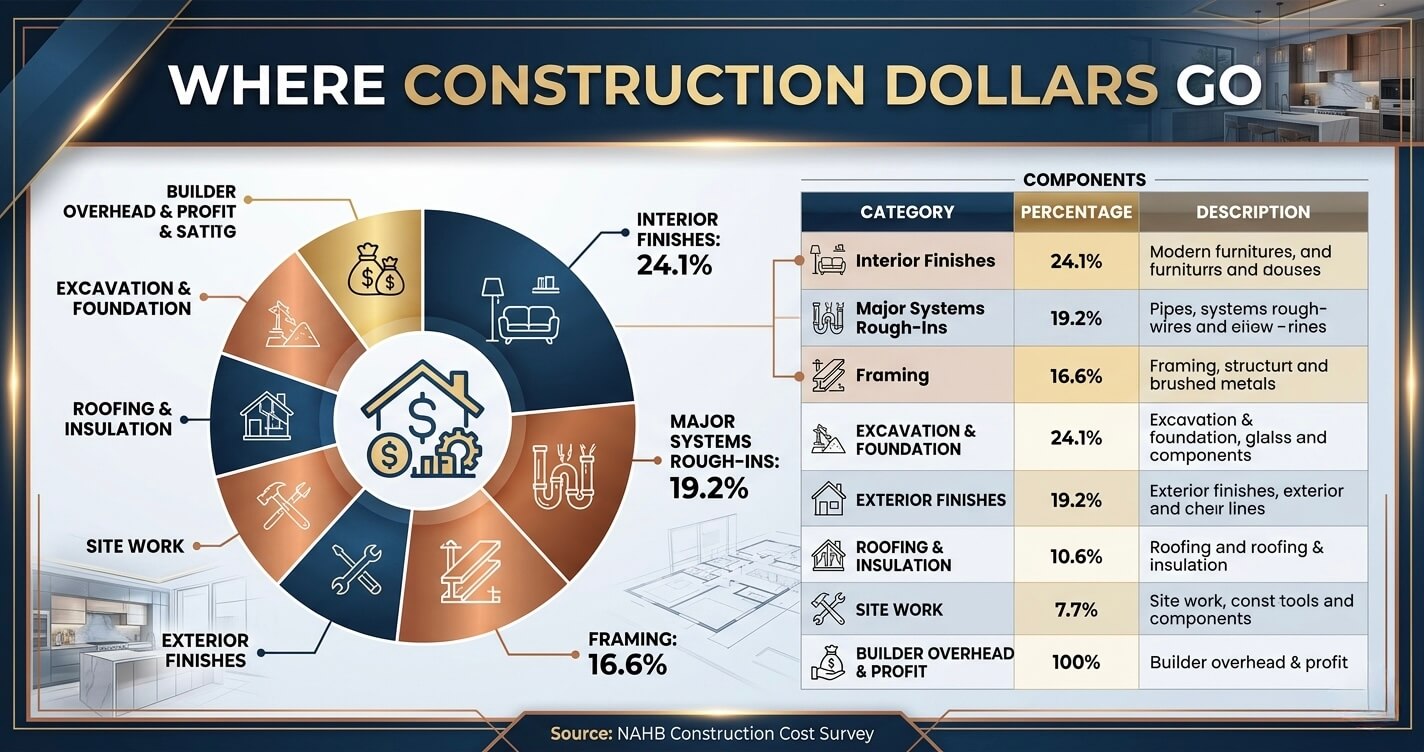
According to the NAHB Construction Cost Survey, interior finishes account for approximately 24.1% of total construction costs, making them the single largest cost category in residential construction. [Source: NAHB Construction Cost Survey]
The same survey found major system rough-ins account for approximately 19.2% of costs, while framing represents approximately 16.6%.
Professional Insight
Most budget overruns occur during this phase rather than during structural construction.
Homeowners who finalize flooring, cabinetry, plumbing fixtures, appliances, hardware, lighting, and tile selections before construction begins consistently experience smoother schedules, fewer change orders, and better cost control.
Month 11–12: Final Inspections, Punch List, and Certificate of Occupancy
As construction nears completion, the focus shifts from installation to verification, quality control, and regulatory approval.
Final Inspections
Before occupancy can occur, local authorities conduct a series of final inspections.
These typically include:
- Building inspection
- Electrical inspection
- Mechanical inspection
- Plumbing inspection
- Site and grading verification
Inspectors confirm that all work complies with approved plans and applicable code requirements.
Any deficiencies identified must be corrected before final approval is granted.
Punch List Process
Simultaneously, the builder conducts a detailed walkthrough with the homeowner.
This review generates a punch list, which documents:
- Cosmetic touchups
- Hardware adjustments
- Paint corrections
- Fixture alignment issues
- Minor completion items
The punch list phase serves as the final quality assurance review before turnover.
Certificate of Occupancy
Once inspections are passed and all required conditions are satisfied, Fairfax County issues a Certificate of Occupancy (CO).
The CO confirms that:
- Construction complies with applicable regulations
- Life-safety requirements have been met
- The residence is legally approved for occupancy
Homeowners should never move into a newly constructed residence before the Certificate of Occupancy has been issued.
Realistic Expectations
Final inspections and punch list completion typically require three to six weeks.
Luxury custom homes featuring extensive automation systems, specialty finishes, or complex mechanical systems may require additional review and adjustment periods.
What Factors Can Extend Your Custom Home Build Timeline in Northern Virginia?
Even well-managed projects encounter challenges. Understanding what extends your custom home build timeline in Northern Virginia helps homeowners establish realistic expectations and plan more effectively.
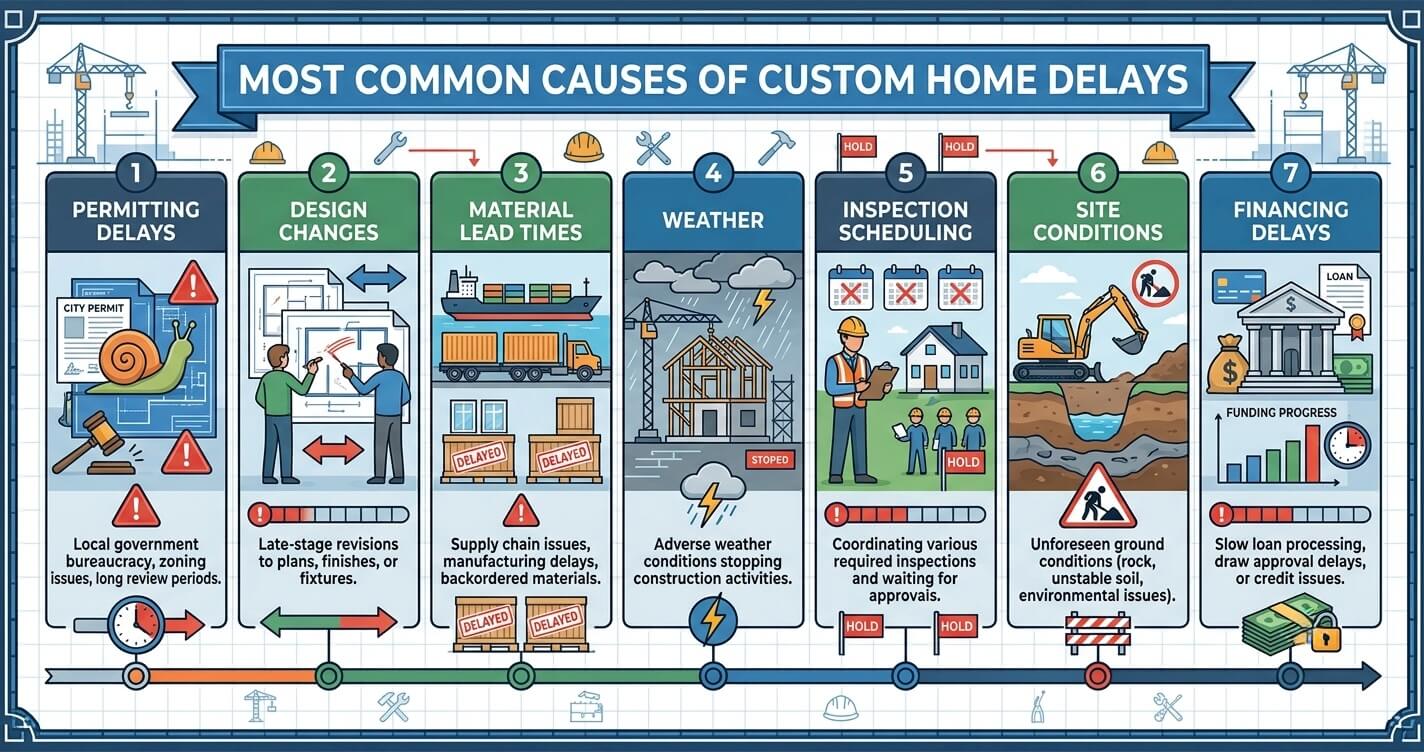
Permitting Delays
Incomplete submissions, plan revisions, zoning questions, and multi-agency reviews remain the most common causes of pre-construction schedule extensions.
Mid-Construction Design Changes
Change orders introduced after construction begins often create cascading delays.
Modifications may require:
- Engineering revisions
- Material reordering
- Inspection updates
- Trade rescheduling
Material Lead Times
Specialty windows, imported finishes, custom cabinetry, and luxury appliances frequently require months of advance planning.
Weather Conditions
Virginia weather can significantly impact:
- Excavation
- Concrete placement
- Roofing installation
- Exterior finishing work
Most experienced builders include weather contingencies in their schedules.
Inspection Scheduling
County inspection demand fluctuates throughout the year. High construction activity can occasionally create approval bottlenecks.
Site Conditions
Rock excavation, drainage problems, buried utilities, and poor soils remain among the most unpredictable construction variables.
Financing Delays
Construction draws must align with project milestones. Delays in lender approvals can temporarily affect project cash flow and subcontractor scheduling.
Industry-Wide Reality
Construction delays are not unique to Northern Virginia.
A 2024 analysis of U.S. Census Bureau data found that approximately 13% of new single-family homes required more than 13 months to complete, compared to roughly 9% in 2019. [Source: Construction Coverage]
For planning purposes, many experienced builders recommend adding a 15–20% schedule buffer beyond the projected completion date.
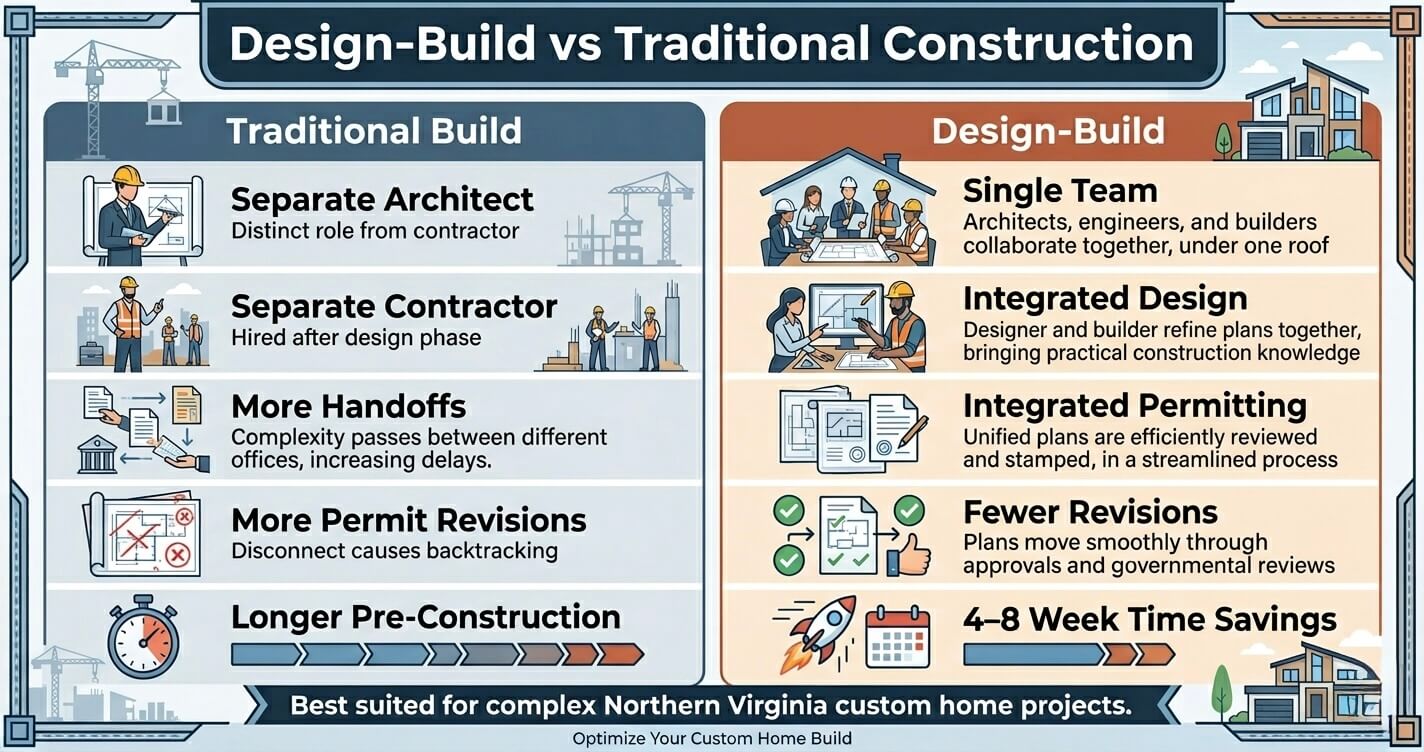
Design-Build vs. Traditional Build: How Your Delivery Method Affects the Timeline
One of the most overlooked factors affecting project schedules is the delivery method itself.
Traditional Delivery
Under a traditional model, homeowners separately hire:
- An architect
- Engineers
- A general contractor
Although this approach can work successfully, it often introduces communication gaps during design, estimating, permitting, and construction.
Plans must be transferred between teams, and interpretation differences frequently result in revisions.
Design-Build Delivery
A design-build firm manages:
- Design
- Engineering coordination
- Permitting
- Construction
Under a single contract structure.
This integrated process often reduces duplication, improves accountability, and minimizes communication delays.
For complex projects in Northern Virginia’s highly regulated permitting environment, design-build delivery frequently shortens pre-construction schedules by several weeks.
Homeowners researching a Custom Home Builder Northern Virginia often find that integrated project management creates a smoother experience from design through occupancy.
Similarly, homeowners exploring a home renovation Northern Virginia project often experience many of the same coordination advantages when design and construction are managed under one team.
How to Choose the Right Builder for Your Northern Virginia Custom Home Timeline
Selecting the right builder is often the single most important scheduling decision a homeowner will make.
Look for a builder who:
- Has extensive Fairfax County permitting experience
- Maintains established relationships with local review agencies
- Uses formal project scheduling systems
- Provides milestone tracking and regular updates
- Holds Virginia Class A contractor licensing
- Maintains proper insurance coverage
- Has documented schedule performance references
Homeowners should also understand how change orders are managed. A clearly documented process reduces confusion, protects budgets, and helps maintain project momentum.
Planning a custom home in Northern Virginia? Contact US Home Design Build to discuss your goals, timeline, and lot with our team, and get a realistic picture of what your project will require from day one.
Frequently Asked Questions
How long does the full custom home build timeline in Northern Virginia typically take?
Most projects require approximately 12–18 months from initial consultation through move-in. Construction generally begins three to five months into the process after design, engineering, and permitting activities are completed.
How long does it take to get a building permit in Fairfax County for a custom home?
Straightforward residential projects typically require six to ten weeks. More complex properties involving zoning review, environmental approvals, or multi-agency coordination may require three to six months.
What is the fastest phase of a custom home build in Northern Virginia?
Site preparation and foundation construction often move relatively quickly when conditions are favorable, typically requiring three to six weeks.
What causes the most delays in a Northern Virginia custom home build?
Permitting issues, design changes, long-lead materials, inspection scheduling, and weather interruptions are the most common causes of schedule extensions.
Do I need a Certificate of Occupancy before moving in?
Yes. Fairfax County requires a Certificate of Occupancy before a newly constructed residence can legally be occupied.
When should I order cabinets, fixtures, and finishes?
Most long-lead materials should be ordered during the permitting phase, often three to five months before installation.
Can I remain in my current home while my custom home is being built?
Yes. Many homeowners do exactly that. However, it is wise to maintain flexibility because construction schedules can shift due to permitting, weather, inspections, or material availability.
Does the design-build model save time compared to hiring separate professionals?
In many cases, yes. Integrated project delivery often reduces coordination delays between architects, engineers, and contractors. This advantage can be particularly valuable on complex projects such as a second story addition Northern Virginia where design and construction decisions must remain tightly coordinated.
Final Thoughts
The custom home build timeline in Northern Virginia rewards preparation above everything else. While most projects require approximately 12–18 months from initial consultation to move-in, the exact schedule depends heavily on permitting complexity, site conditions, homeowner decision-making, and project management quality.
As this month-by-month breakdown demonstrates, nearly half of the timeline occurs before construction even begins. Design development, engineering coordination, permitting reviews, and site preparation create the foundation for everything that follows.
Homeowners who enter the process with realistic expectations, finalized selections, and an experienced design-build team consistently experience smoother projects, fewer delays, and better overall outcomes.
Planning a custom home in Northern Virginia? Contact US Home Design Build to discuss your lot, your goals, and your timeline, and get an honest picture of what your project will require from day one.