
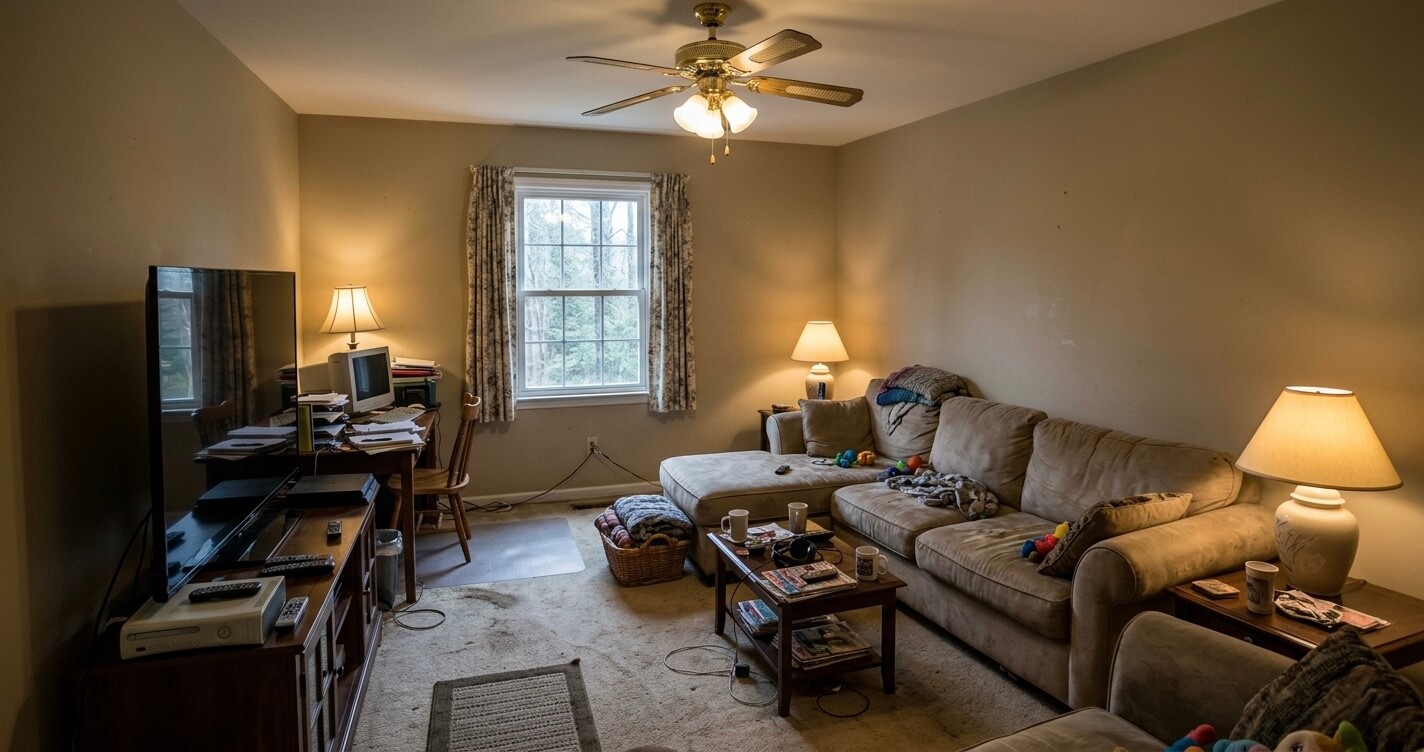
A family room addition Clifton VA homeowners can learn from often starts with a simple question: should you move, or should you invest in the home and neighborhood you already love? For the Castellano family, the answer became clear in early 2025 when their existing Colonial-style home no longer supported the way they lived.
Located in the 20124 ZIP code of Clifton VA, the property is a four-bedroom Colonial built in 1986 on approximately 0.65 wooded acres. The homeowners, both in their early 50s with two teenagers still at home, had lived there since 2010. What once felt spacious had become increasingly constrained as homework sessions, gaming, movie nights, and everyday family activities competed for the same small den.
The decision to stay was supported by both lifestyle and financial realities. Clifton’s rural atmosphere, larger residential lots, and access to Robinson Secondary School made relocating undesirable. At the same time, replacing a low-interest mortgage with a new purchase in today’s market would have significantly increased monthly housing costs.
The economics of improving the existing property were equally compelling. The typical home value in Clifton VA reached approximately $1,024,982 in 2026, representing a 4.1% year-over-year increase, reinforcing the long-term value of strategic home improvements. [Source: Zillow]
The generous rear yard also provided ample room for expansion without creating setback challenges.
This is the complete story of the project, from the original conditions and design decisions to Clifton’s unique dual-permit process, construction costs, and the finished family room that now serves as the heart of the home.
THE BEFORE: WHAT THE FAMILY ACTUALLY LIVED WITH
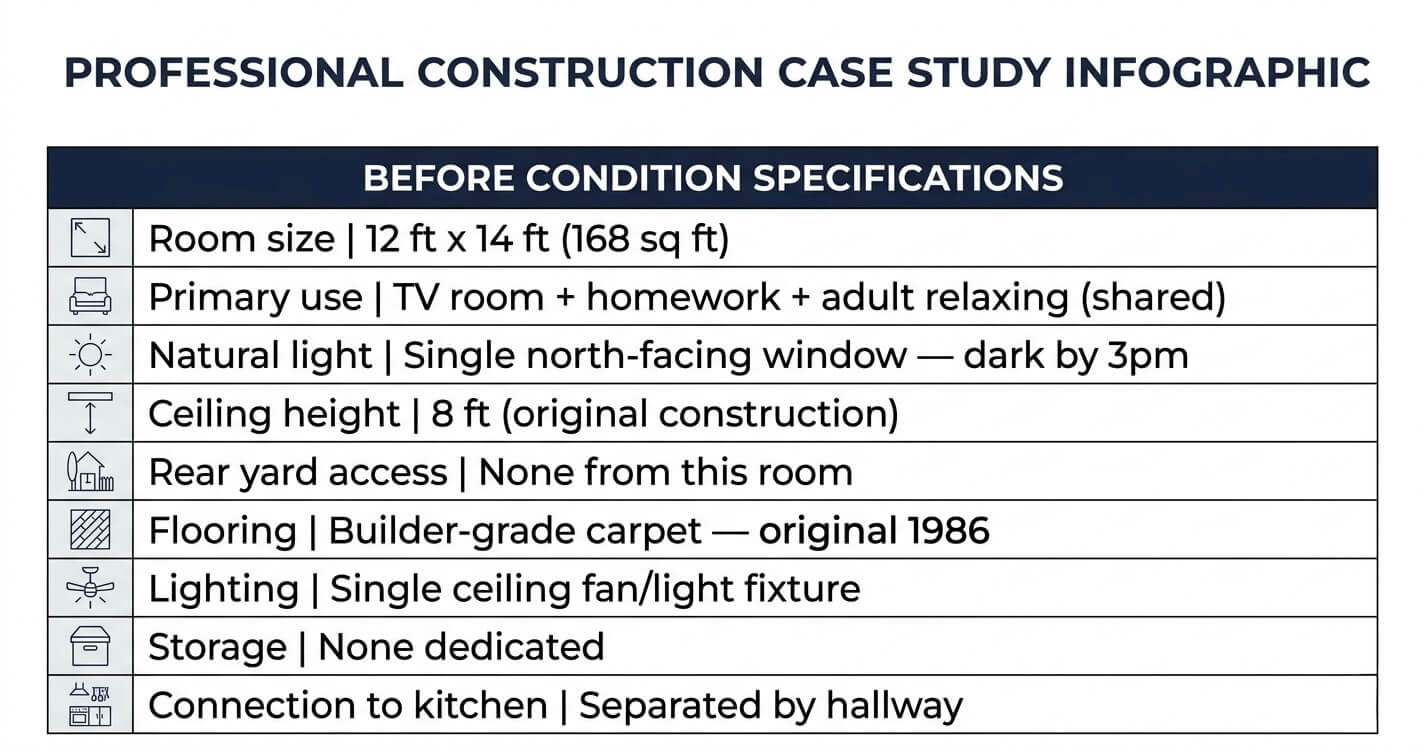
Before the family room addition Clifton VA project began, the Castellanos relied on a modest 12-foot by 14-foot den that served nearly every casual function in the house. At only 168 square feet, the room was expected to accommodate television viewing, homework sessions, gaming, reading, and adult relaxation simultaneously.
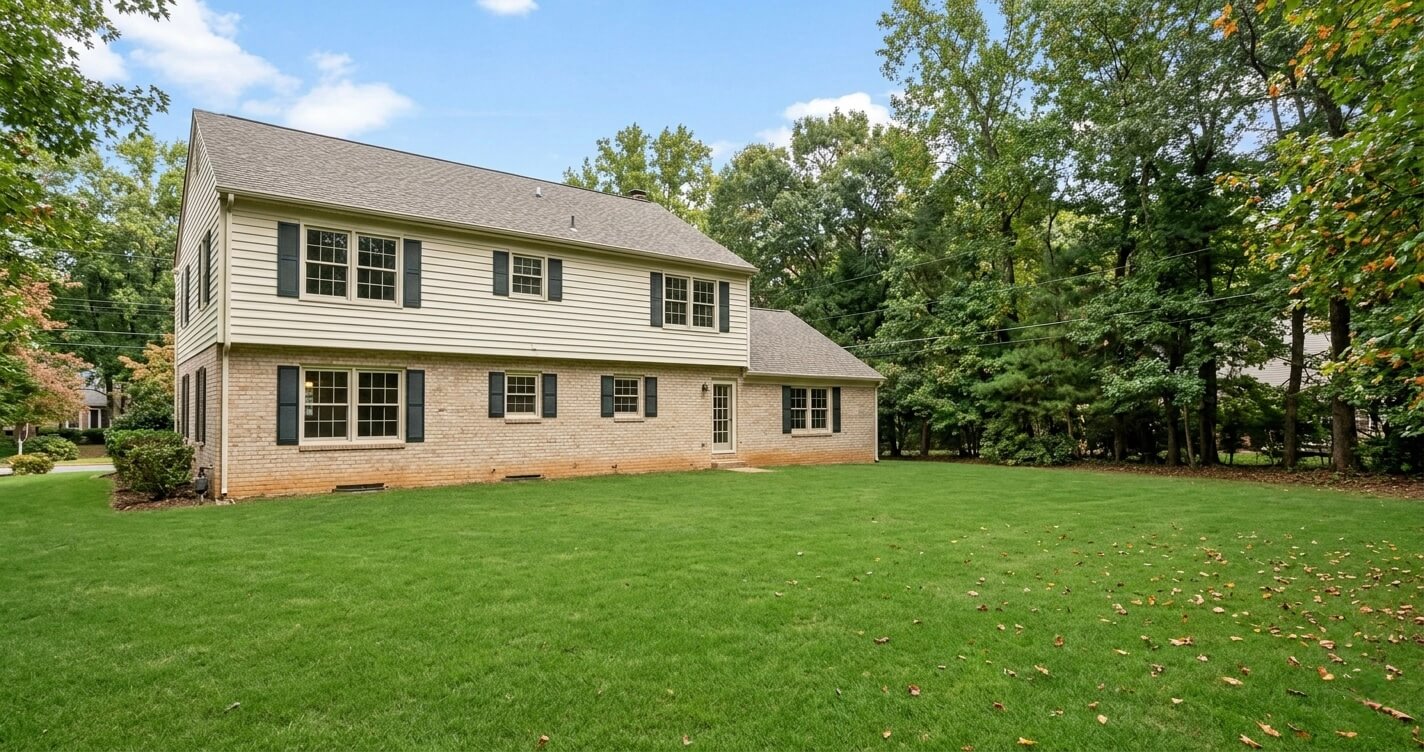
Viewed from the hallway doorway, the room felt crowded despite careful furniture placement. A sectional sofa occupied two walls, while a 65-inch television consumed the third. A small desk squeezed into the remaining corner functioned as the family’s primary homework station. Three separate table lamps had been added over the years because the original ceiling fixture failed to provide sufficient illumination.
The home’s relationship with the backyard was equally limiting. Although the property backed to a beautiful wooded lot, there was no direct connection from the den to the exterior. Family members accessed the rear yard through a garage-side door, making outdoor entertaining feel disconnected from the home’s primary living areas.
Natural light presented another challenge. The room contained only one north-facing window, causing interior brightness to drop noticeably by mid-afternoon. Combined with the original 8-foot ceiling height and builder-grade finishes, the space often felt smaller than its actual dimensions.
Before Conditions Summary
The Castellanos’ experience reflects a broader trend among homeowners living in houses constructed during the 1980s and early 1990s. Many Northern Virginia homes from this era were designed around formal living rooms and compartmentalized spaces rather than today’s preference for flexible, multi-purpose gathering areas. [Source: U.S. Census Bureau]
As daily routines evolved, the limitations of the existing layout became increasingly apparent, setting the stage for a more substantial transformation.
THE DESIGN PLAN: DECISIONS MADE BEFORE GROUND WAS BROKEN
Designing a successful family room addition Clifton VA homeowners would use every day required more than simply adding square footage. The objective was to create a space that felt architecturally integrated with the original 1986 Colonial while dramatically improving functionality, natural light, and connection to the surrounding landscape.
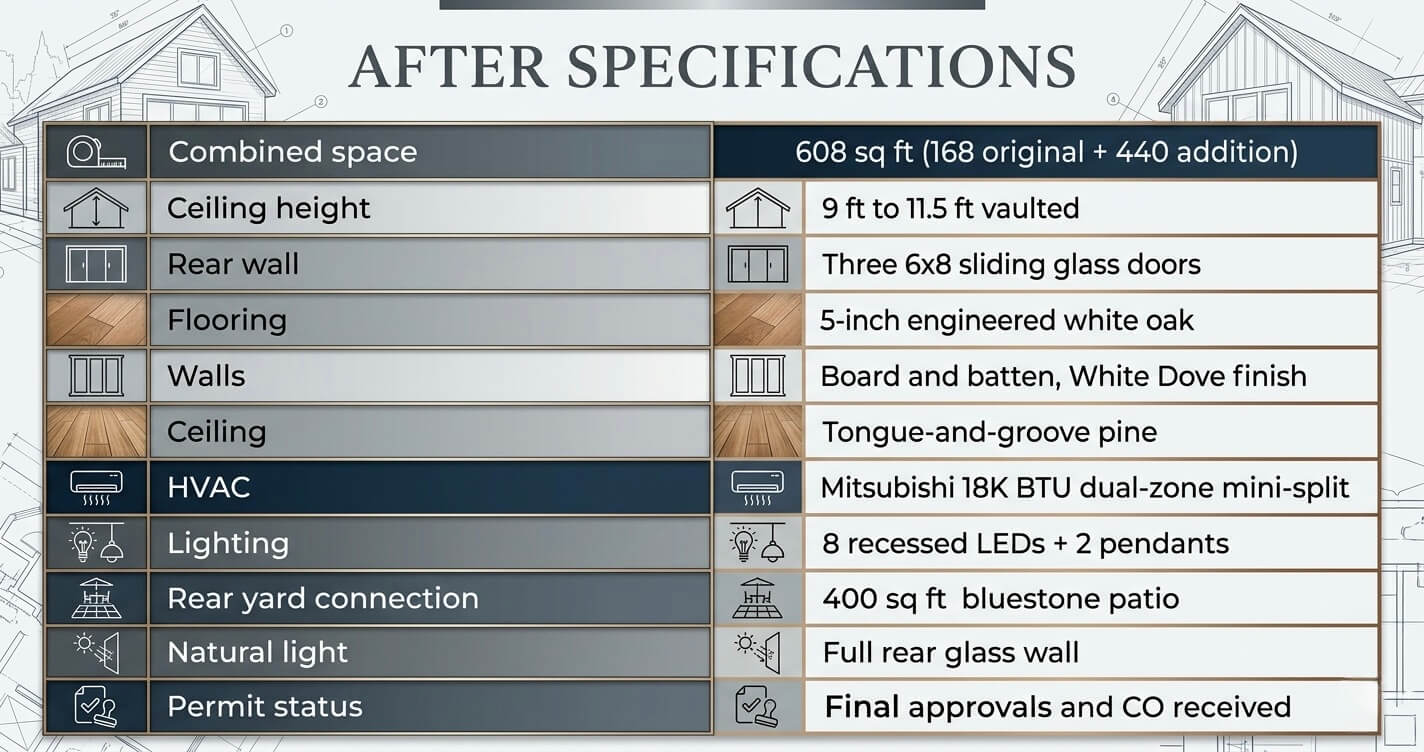
The core design decision was a 20-foot by 22-foot single-story rear addition totaling 440 square feet. Rather than treating the addition as a separate room, the design team removed the wall between the existing den and the new structure after confirming it was non-load-bearing. This transformed two disconnected spaces into a single casual living environment totaling approximately 608 square feet.
The addition extended 14 feet beyond the original rear wall, creating uninterrupted sightlines from the former den through the new family room and out to the wooded backyard. This visual depth dramatically changed how the home felt without altering its overall footprint excessively.
Architectural Strategy
Planning the addition required balancing traditional exterior architecture with contemporary interior living. The exterior was intentionally designed to appear original to the house, while the interior embraced open space, natural light, and flexible family use.
Structural Design Decisions
The rear elevation became the project’s defining feature.
- Three separate sliding glass door systems, each approximately 6 feet wide by 8 feet tall, span much of the rear wall.
- A 400-square-foot bluestone patio was added immediately outside the new family room.
- A shed roof with a 4:12 pitch was selected instead of a gable roof.
- Interior ceiling heights rise from approximately 9 feet near the original house to 11.5 feet at the rear glass wall.
This gradual increase in ceiling height directs attention toward the wooded landscape beyond the home while avoiding zoning complications that a taller roof configuration could have created.
The addition was constructed over a crawl-space foundation matching the existing house. This approach simplified structural integration and reduced construction costs compared with extending a full basement.
Interior Design Decisions
To maintain continuity with the original home, the flooring specification included 5-inch engineered white oak hardwood, matching adjacent living areas.
Wall treatments combined painted drywall with board-and-batten detailing to introduce texture without competing with the outdoor views. Benjamin Moore’s “White Dove” was selected throughout the space to maximize light reflectance.
The lighting plan included:
- Eight recessed LED wafer fixtures on dimmers
- Two decorative reading pendants
- Exterior wall-mounted fixtures flanking the center door system
HVAC Strategy
One of the most important technical decisions involved climate control.
Rather than extending existing ductwork from the main HVAC system—which would have created air balancing issues, a dedicated Mitsubishi M-Series 18K BTU dual-zone mini-split system was installed. This solution provides independent temperature control for a room with extensive glass exposure while improving year-round comfort.
The design reflects a broader shift in homeowner priorities. Casual rear-facing family rooms connected to outdoor living spaces have become one of the most requested residential additions throughout Northern Virginia as families seek flexible environments that support work, entertainment, and everyday living simultaneously. [Source: National Association of Realtors]
The result was a design that addressed the family’s current needs while remaining compatible with the architectural character that makes Clifton homes distinctive.
THE CLIFTON VA SITE CHALLENGE: WHAT MADE THIS ADDITION MORE COMPLEX
While the finished family room feels effortless, the site conditions behind this Clifton VA project required significantly more planning than a typical Northern Virginia addition. Clifton’s larger residential lots often create the impression that expansion is straightforward, but several property-specific constraints had to be addressed before final design approval.
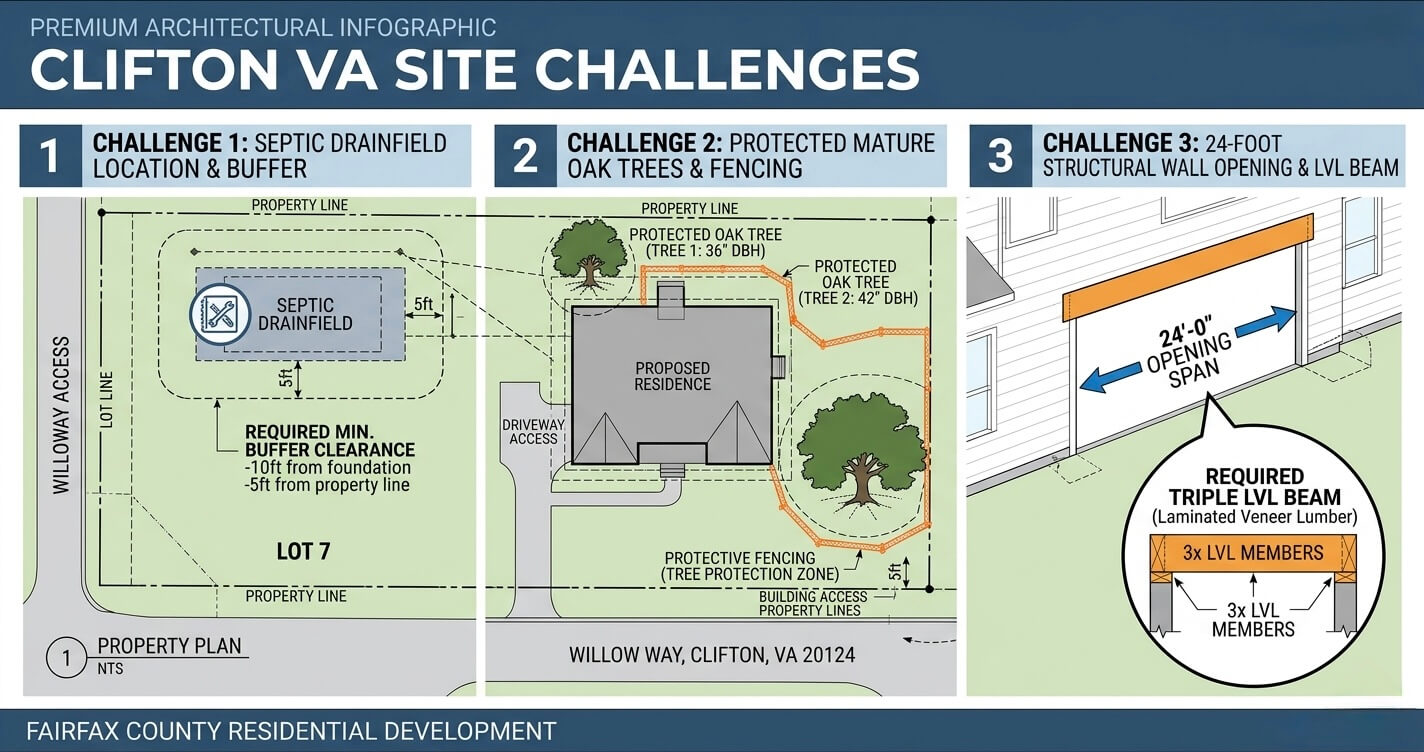
Challenge #1: Septic System Proximity
Unlike many suburban neighborhoods in Fairfax VA, a substantial number of Clifton properties still operate on private well and septic systems. For the Castellano residence, the rear-yard buildable area was influenced not only by Fairfax County setback requirements but also by mandatory separation distances from the existing septic drainfield.
Before the addition footprint was finalized, US Home Design Build coordinated a septic survey and site verification to ensure the proposed foundation remained outside all required drainfield protection areas. The final 14-foot rear extension preserved compliance while maximizing usable interior square footage.
Challenge #2: Tree Canopy Protection
Clifton’s heavily wooded character is one of the town’s defining features. However, mature trees often create construction limitations that do not exist on more typical suburban lots.
Several established oak trees were located near the proposed grading area. Prior to excavation, Fairfax County urban forestry requirements were reviewed and protective measures were implemented. Temporary fencing was installed around root protection zones, allowing construction to proceed without damaging the long-term health of the trees that contribute to the property’s privacy and value.
Challenge #3: 1986 Structural Tie-In
The most significant structural challenge involved connecting the new family room to the existing 1986 Colonial. Removing nearly 24 feet of interior wall to create a seamless transition required engineering analysis before demolition began.
A structural engineer determined that the opening required a triple laminated veneer lumber (LVL) beam capable of carrying roof and ceiling loads across the expanded span. By identifying this requirement during design rather than during construction, the project team avoided costly delays and change orders later in the build process.
PERMITS: THE DUAL APPROVAL PROCESS IN CLIFTON VA
One of the most overlooked aspects of planning a family room addition Clifton VA homeowners should understand is that Clifton follows a dual approval process that differs from most Fairfax County communities. This requirement surprises many homeowners because Clifton is both an incorporated town and part of Fairfax County, creating two separate approval tracks that must be coordinated simultaneously.
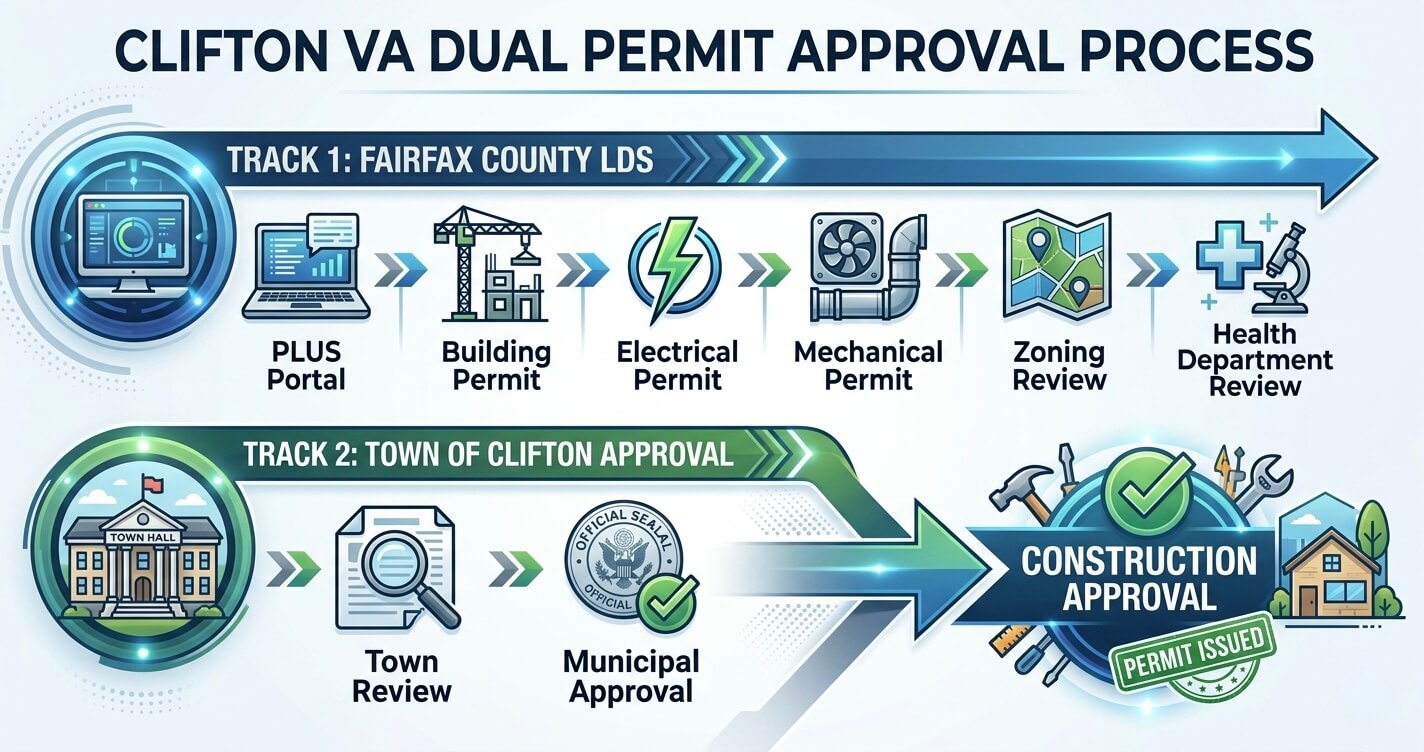
According to Fairfax County Land Development Services, “Vienna and Clifton residents require additional approval from their respective towns.” [Source: Fairfax County LDS]
Similarly, Northern Virginia addition planning guidance notes that Clifton homeowners must secure town-level approval in addition to county permits. [Source: Ideal Construction]
Track 1: Fairfax County LDS Review
The county review process included:
- Residential addition building permit
- Electrical permit for new circuits and lighting
- Mechanical permit for the Mitsubishi mini-split system
- Zoning compliance review
- Health Department review due to the property’s septic system
Track 2: Town of Clifton Approval
Simultaneously, project plans were submitted to the Town of Clifton for review of community compatibility and town-specific requirements.
Town of Clifton Information: https://www.cliftonva.gov/
Building Code Compliance
As of January 18, 2025, Fairfax County requires all permit applications to comply with the 2021 Virginia Uniform Statewide Building Code (USBC). [Source: Fairfax County LDS]
Inspection Process
The project proceeded through footing, framing, electrical, mechanical, insulation, and final inspections before receiving its Certificate of Occupancy. [Source: Ideal Construction]
Actual Permit Timeline
Pro Tip
An experienced Clifton contractor understands that Fairfax County approval alone is not sufficient. US Home Design Build submitted both permit tracks simultaneously, allowing reviews to occur in parallel rather than sequentially. This approach prevented weeks of avoidable delay and kept the project aligned with its original construction schedule.
For a real-world example of budgeting and planning for additions in this area, see our guide on Room Addition Cost Clifton VA.
PROJECT COST BREAKDOWN
The final investment for this Clifton VA family room expansion was $168,200, including permitting, site preparation, structural modifications, custom finishes, and the connected outdoor living space.
Home addition costs throughout Northern Virginia vary substantially depending on structural complexity, foundation requirements, utility modifications, and finish quality.
According to current regional data, home additions in Northern Virginia typically range between $230 and $500 per square foot, with permitting timelines often extending two to four months for larger projects. [Source: Renewal Homes DMV]
Additional remodeling cost research places many home additions between $80 and $250 per square foot, with premium structural additions regularly exceeding that range. [Source: AmeriSave]
Detailed Project Cost Breakdown
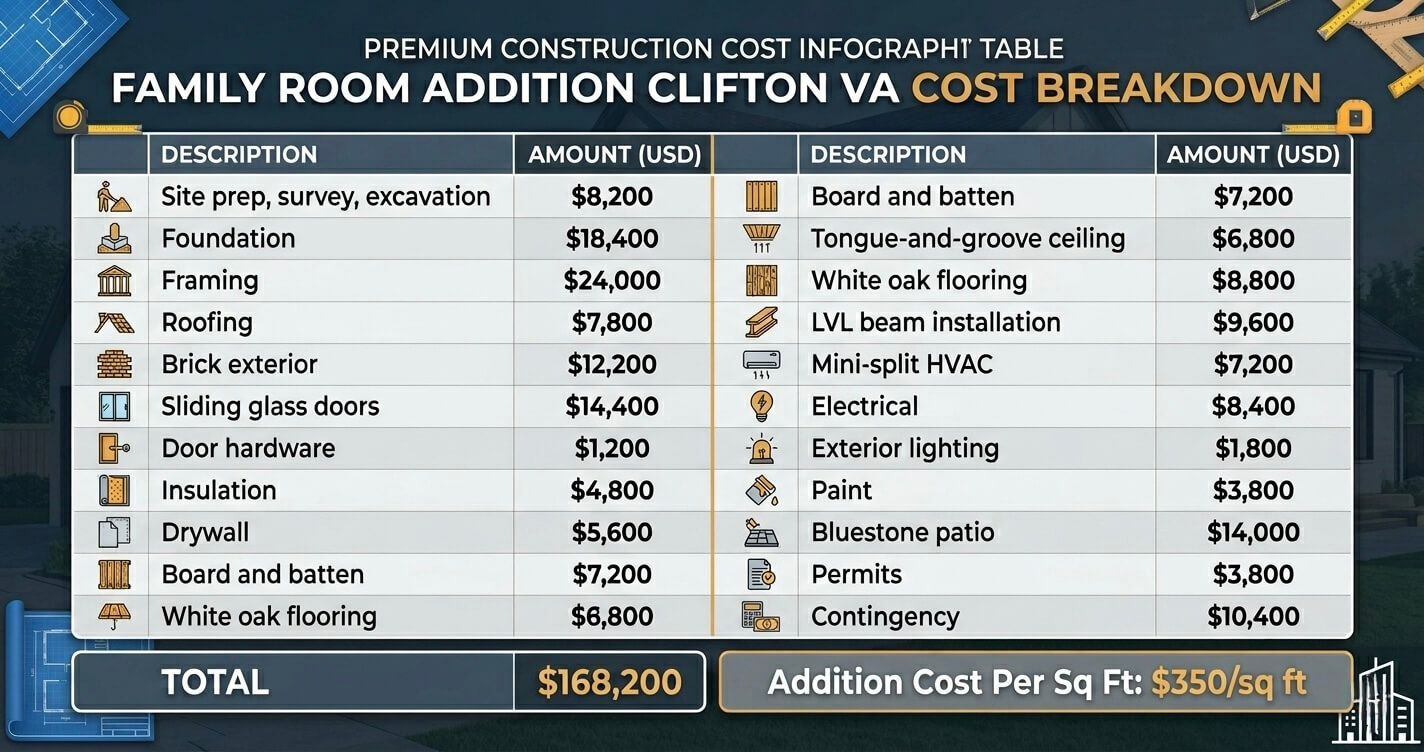
Cost Per Square Foot Analysis
Excluding the separate patio scope, the addition itself totaled $154,200.
$154,200 ÷ 440 square feet = $350 per square foot
That figure places the project comfortably within the documented range for premium Fairfax County additions involving structural wall removal, custom exterior matching, extensive glazing, and specialized HVAC systems.
For broader pricing benchmarks, see our detailed guide on Room Addition Cost Clifton VA.
For regional comparison data across Fairfax County, McLean VA, Burke VA, Fairfax Station VA, and surrounding communities, see Home Addition Cost in Northern Virginia.
The key takeaway is that this project was not priced like a basic room expansion. The large structural opening, custom glass wall system, septic-related planning requirements, and premium finish package pushed the investment into the upper-middle tier of Northern Virginia addition projects, while delivering a transformation that fundamentally changed how the family uses the home every day.
THE CONSTRUCTION TIMELINE
One of the most common questions homeowners ask before starting an addition project is how long the process actually takes. In Northern Virginia, the answer is often longer than expected because permitting, inspections, engineering, and material procurement all affect the schedule.
According to regional construction data, home additions typically require 4–8 months of construction, plus 1–3 months for design and permitting, creating a realistic planning horizon of 5–11 months from concept to completion. Fairfax County permit reviews for major additions frequently add another 2–4 months depending on project complexity. [Source: Renewal Homes DMV]
For the Castellano project, the dual approval process required by Clifton VA and Fairfax County became the single longest phase of the timeline. Fortunately, both permit tracks were submitted simultaneously, preventing additional delays.
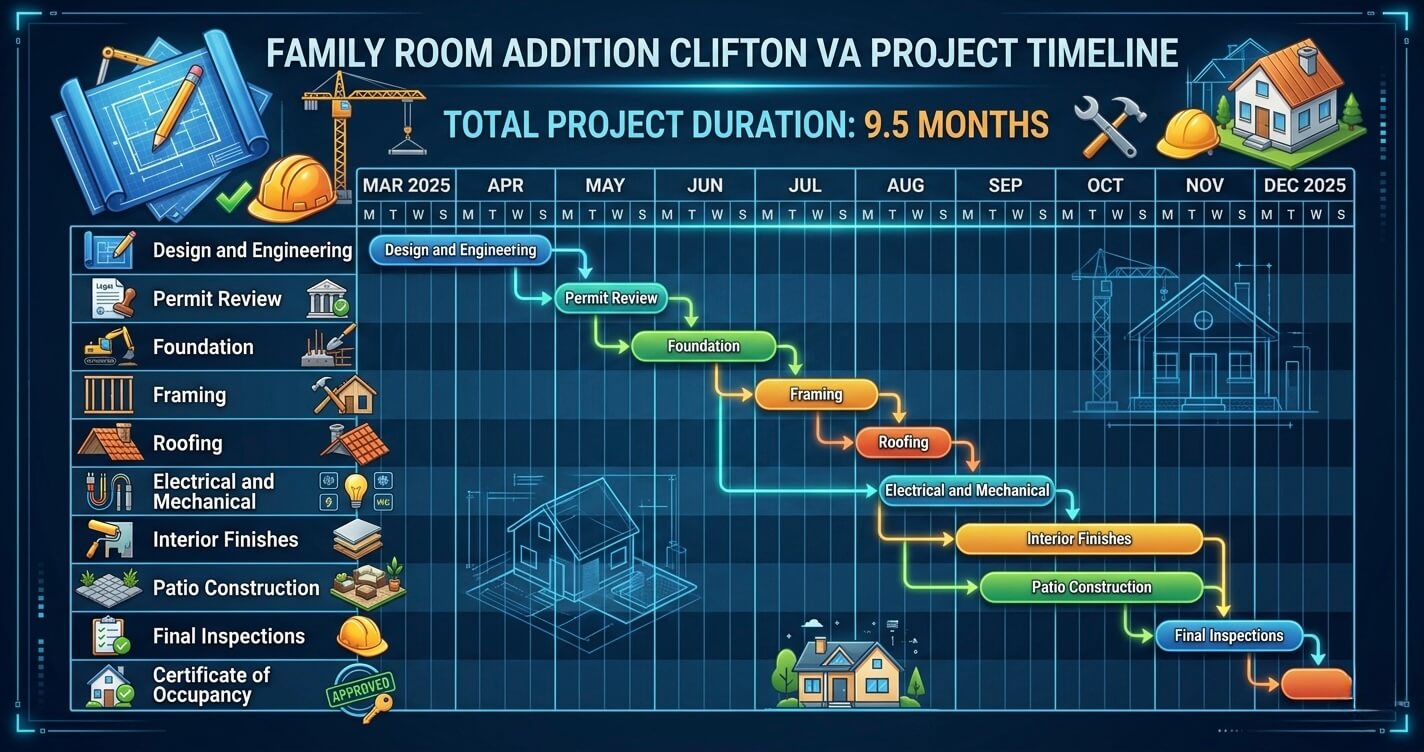
While construction itself moved efficiently, the project reinforces an important reality: in Clifton VA, proper planning and permit coordination are just as important as the actual building work.
THE AFTER: THE FAMILY ROOM REVEALED
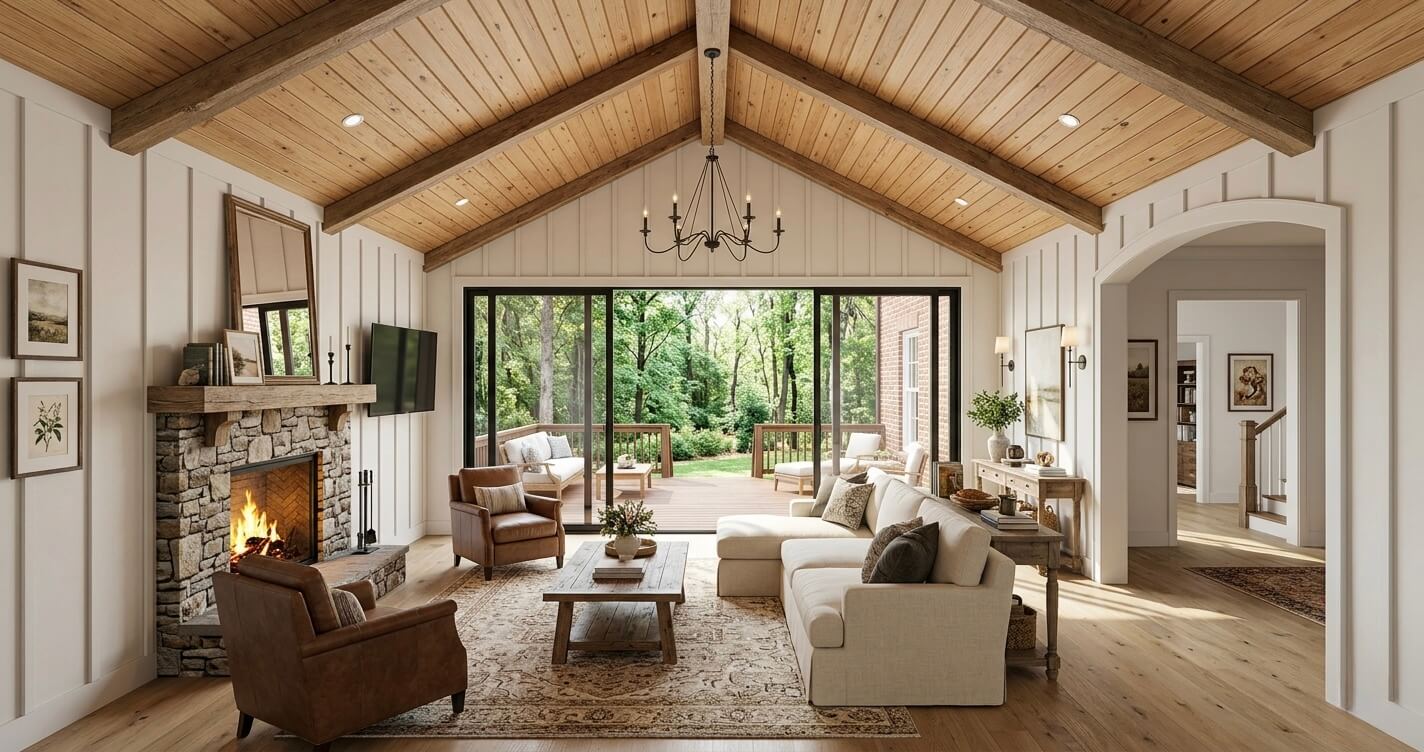
The completed family room addition Clifton VA project transformed far more than square footage. What was once a cramped 168-square-foot den became the visual and functional center of the home, connecting interior living space directly to the property’s wooded rear landscape.
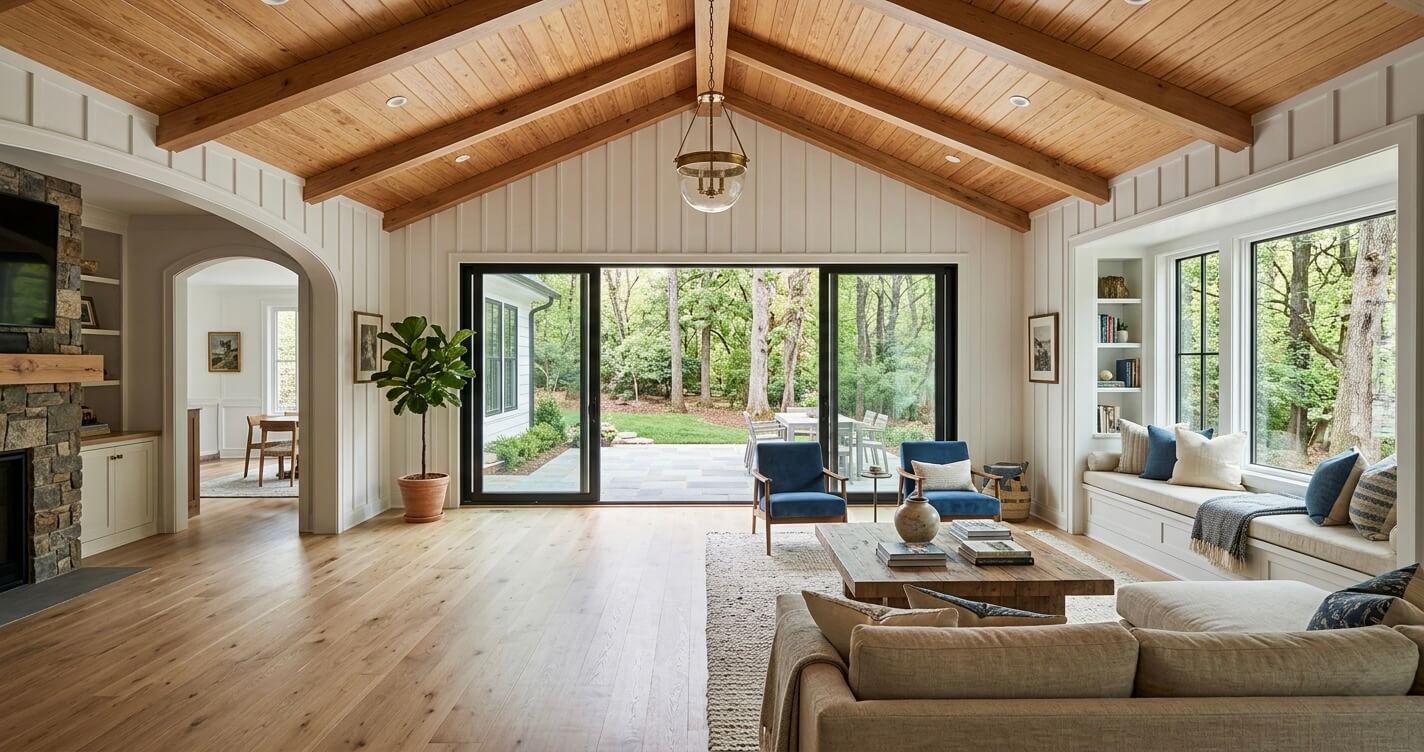
Standing in the original den doorway today reveals an entirely different experience. The dividing wall has disappeared, creating a continuous 608-square-foot living environment stretching from the original house to the new glass rear elevation. The eye now travels uninterrupted across white oak flooring, through the vaulted ceiling volume, and toward the mature tree canopy beyond the sliding glass doors.
Natural light was perhaps the most dramatic change. The original room relied on a single north-facing window and multiple lamps throughout the day. The addition’s three 6-foot-by-8-foot sliding door systems now flood the space with daylight from sunrise through sunset while maintaining direct visual access to the 0.65-acre lot.
The board-and-batten accent walls, natural tongue-and-groove pine ceiling, and integrated reading bench provide architectural character without competing with the outdoor views. Meanwhile, the dedicated Mitsubishi mini-split system ensures the room remains comfortable throughout Northern Virginia’s hot summers and cold winters.
After Specifications
Mrs. Castellano summarized the transformation best:
“We have lived in this house for 15 years and treated the back yard as a separate thing. Now it is part of the house. The kids do homework in the same room I work in — but somehow it does not feel crowded anymore. We did not add a room. We changed how the whole house functions.”
From a financial perspective, the project also performs well. Home additions typically return 48–80% of project cost at resale, depending on location and scope. [Source: Opendoor]
Applied conservatively to this project:
- Total investment: $168,200
- Estimated ROI: 60%
- Estimated value added: $100,920
- Effective net ownership cost: $67,280
For homeowners interested in another Fairfax County transformation project, see our Master Suite Addition before after Fairfax VA case study.
LESSONS LEARNED: WHAT THE CASTELLANOS WOULD DO THE SAME – AND DIFFERENTLY
Every successful addition project produces lessons that can help future homeowners make better decisions. Looking back on the completed project, the Castellanos identified several decisions they would absolutely repeat.
What They Would Do the Same
The first was submitting both permit applications simultaneously. Coordinating Fairfax County and Town of Clifton approvals from day one prevented weeks of avoidable delay and kept the overall review period to approximately 11 weeks.
The second was commissioning the septic survey before finalizing the design. Knowing the exact drainfield location early avoided potentially expensive redesigns later in the process.
They also remain convinced that the tongue-and-groove pine ceiling was worth every dollar. Although it increased construction complexity, it became the room’s defining architectural feature and consistently receives compliments from visitors.
Finally, they would again choose the dedicated mini-split HVAC system. Independent climate control has proven especially valuable in a glass-heavy space exposed to changing seasonal conditions.
What They Would Change
The family would begin reclaimed brick sourcing much earlier in the project. Matching a nearly forty-year-old exterior required additional lead time that could have been absorbed during permit review.
They would also include a ceiling fan rough-in during construction. The vaulted ceiling performs well, but additional air circulation would improve summer comfort.
A second exterior power outlet on the patio would also make outdoor entertaining easier.
For homeowners planning a similar project, our guide on how to choose the right contractor in Northern Virginia provides a detailed framework for evaluating contractors, reviewing proposals, and avoiding common mistakes.
Pro Tip
US Home Design Build’s design-build approach allowed one team to coordinate structural engineering, septic review, Fairfax County permitting, Town of Clifton approval, construction management, and final inspections under a single process. In Clifton, where the dual permit requirement creates additional complexity, centralized project management is often the difference between a predictable timeline and a frustrating one.
FREQUENTLY ASKED QUESTIONS [FAQs]
Does a family room addition in Clifton VA require permits from both Fairfax County and the Town of Clifton?
Yes. A family room addition Clifton VA project requires approval from both Fairfax County and the Town of Clifton. Because Clifton is an incorporated town within Fairfax County, homeowners must complete two separate approval processes. Submitting both applications simultaneously is the most efficient approach.
How much does a family room addition cost in Clifton VA in 2026?
A premium 400–500 square foot family room addition generally ranges from $130,000 to $180,000, depending on structural complexity, finishes, site conditions, and permitting requirements. The project documented in this case study totaled $168,200.
How long does permitting take in Clifton VA?
Most homeowners should plan for 11–14 weeks of permit review. Fairfax County reviews typically require 8–12 weeks, while Town of Clifton review occurs concurrently when submitted properly.
What ROI can homeowners expect from a family room addition?
Nationally, home additions return approximately 48–80% of their cost depending on market conditions and project quality. Premium markets such as Clifton VA often perform above national averages because buyers place significant value on additional living space.
How long does construction take?
A family room addition of this size generally requires 14–20 weeks of construction, with total project timelines ranging from 8–11 months when design, permitting, inspections, and final approvals are included.
FINAL THOUGHTS
This family room addition Clifton VA case study demonstrates what becomes possible when homeowners choose to invest in the home they already love rather than enter a competitive Northern Virginia housing market searching for additional space.
The project highlights several realities specific to Clifton homeowners:
- Dual approvals from Fairfax County and the Town of Clifton are required.
- Septic system considerations must be evaluated before design is finalized.
- Premium additions commonly range from $300–$400+ per square foot.
- Expanding an existing home is often significantly more cost-effective than purchasing a larger property in Clifton’s million-dollar housing market.
Most importantly, the project shows that a successful addition is not simply about adding square footage. It is about improving how a home functions every day.
The Castellanos did not add a room. They changed how their house lives. That is what the right family room addition in Clifton VA actually delivers.
US Home Design Build serves homeowners throughout Clifton VA, Fairfax VA, McLean VA, Burke VA, Fairfax Station VA, and Northern Virginia, managing everything from design and engineering through Fairfax County PLUS permitting and Town of Clifton approvals.
If you are considering a family room addition or home expansion, schedule a free consultation before design decisions or permit applications begin.
703-202-3520 | https://ushdb.com/ | 8200 Greensboro Dr Suite 900, McLean, VA 22102
