
If you are researching how to choose a home remodeling contractor in Northern Virginia, you are already making one of the most important decisions in the entire renovation process. While homeowners often spend weeks comparing flooring materials, countertop options, paint colors, and fixture selections, the reality is that contractor selection has a far greater impact on the final outcome than any individual finish choice.
Major remodeling projects in Northern Virginia frequently involve substantial financial commitments. Kitchen renovations, home additions, whole-home remodels, and structural renovations can represent investments reaching well into six figures. The contractor you choose will directly influence project quality, schedule performance, permit compliance, communication efficiency, budget control, and long-term property value.
This is especially important in communities such as McLean, Fairfax, Arlington, Vienna, Falls Church, Alexandria, and Great Falls, where renovation projects often require engineering reviews, permit approvals, inspections, and coordination among multiple trades. Even a well-designed project can experience delays, cost overruns, or quality issues when managed by an inexperienced or poorly organized contractor.
The Federal Trade Commission (FTC) continues to advise consumers to carefully research contractors before signing agreements because home improvement scams remain among the most common forms of consumer fraud reported nationwide. [Source: FTC Consumer Advice]
Hiring the wrong contractor can create problems that persist for years, including construction defects, failed inspections, warranty disputes, and resale complications. In many cases, choosing the right contractor is more important than choosing the right countertop.
Homeowners exploring the latest renovation opportunities should also review Top Remodeling Trends in Northern Virginia.
UNDERSTANDING THE DIFFERENT TYPES OF REMODELING CONTRACTORS
One of the most overlooked aspects for how to choose a home remodeling contractor in Northern Virginia is understanding that not all contractors operate under the same business model. Choosing the wrong contractor type for your project can create unnecessary complexity, communication challenges, and budget uncertainty.
General Contractors
A general contractor primarily manages construction activities after plans have already been developed. Homeowners typically hire architects or designers separately and then bring a general contractor into the project during the bidding or construction phase. This traditional model often involves multiple contracts and multiple decision-makers.
Design-Build Firms
A design-build contractor combines design, budgeting, permitting, project management, and construction under a single contract and unified team. This approach integrates planning and construction from the beginning, reducing coordination challenges and creating a more streamlined experience for homeowners.
Specialty Contractors
Specialty contractors focus on a specific trade, such as roofing, HVAC, plumbing, electrical work, flooring installation, or painting. These firms are often best suited for isolated projects rather than comprehensive renovations.
Custom Builders
Custom builders primarily focus on new construction projects and luxury custom homes. While some also perform major renovations, their expertise is generally concentrated on ground-up residential construction.
Home Improvement Companies
These firms often specialize in limited-scope improvements such as windows, doors, siding, roofing, or exterior upgrades rather than comprehensive remodeling projects.
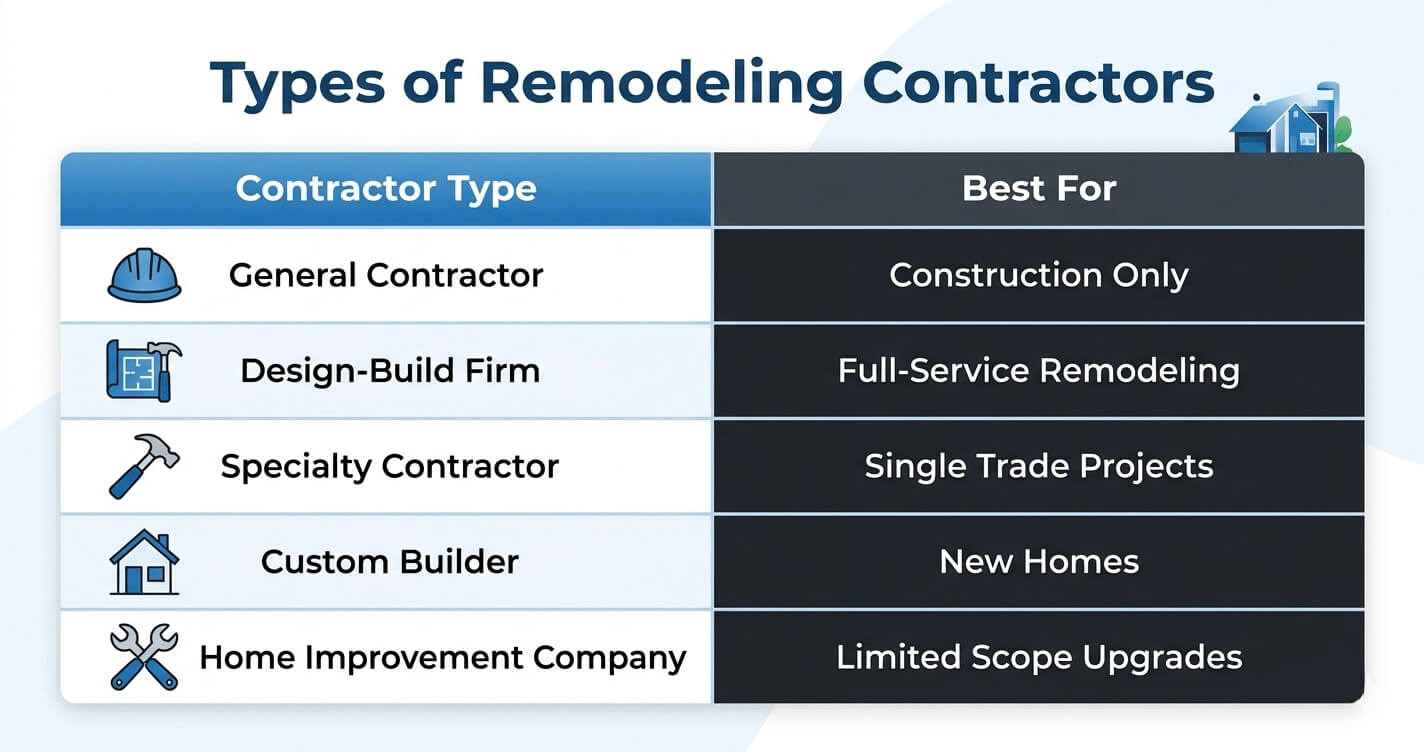
For homeowners planning additions, whole-home renovations, kitchens, bathrooms, or structural modifications, understanding the differences between delivery methods can significantly impact project success.
VERIFY LICENSING FIRST: THE NON-NEGOTIABLE STEP
Before reviewing portfolios, requesting estimates, or discussing design concepts, homeowners should verify that any contractor they are considering holds an active Virginia contractor license.
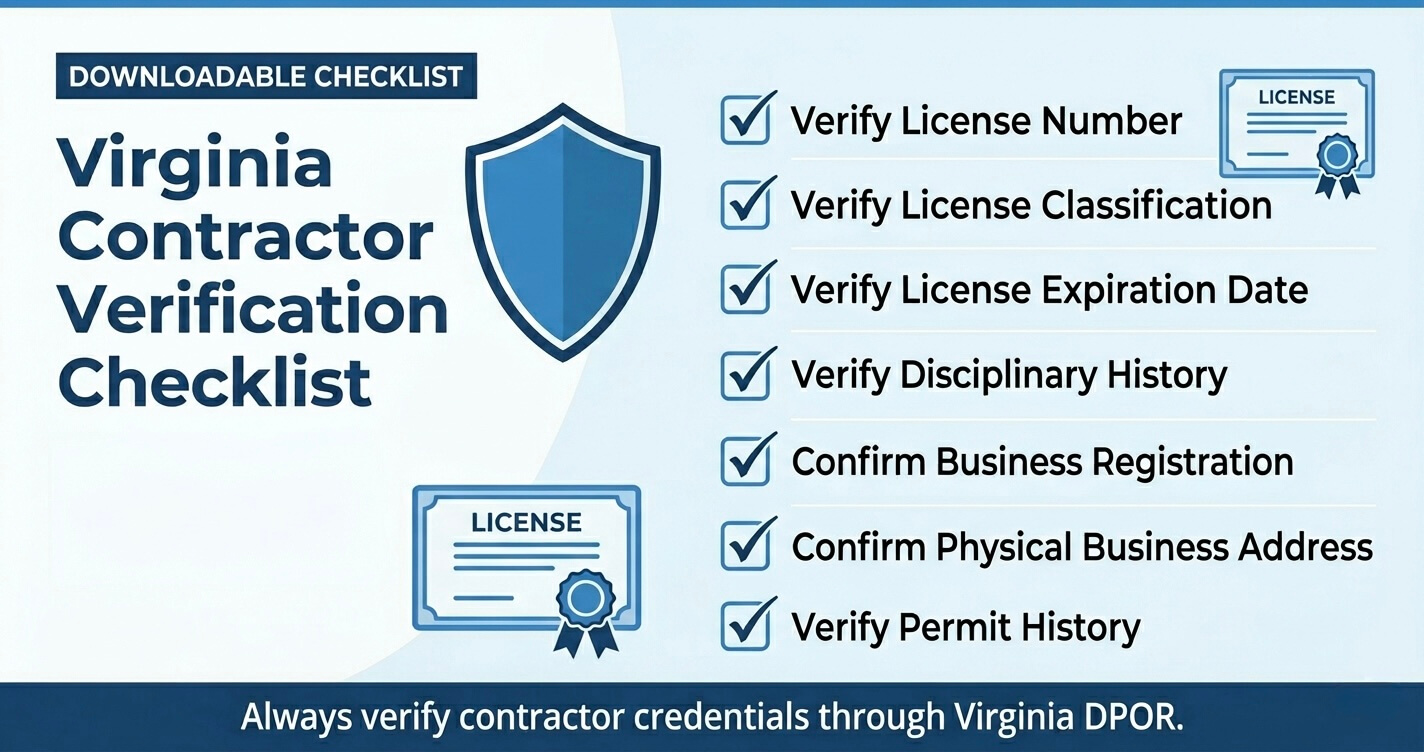
The Virginia Department of Professional and Occupational Regulation (DPOR) oversees contractor licensing throughout the Commonwealth and maintains a public license verification database. Contractors must maintain the appropriate license classification and comply with state regulatory requirements. [Source: Virginia DPOR]
License verification is one of the simplest yet most important forms of contractor due diligence. An active license demonstrates that a contractor has met state requirements regarding experience, business operations, and regulatory compliance.
Homeowners should never rely solely on information displayed on a contractor’s website or marketing materials. Instead, verification should be performed directly through the official DPOR License Lookup tool:
Virginia License Lookup: https://www.dpor.virginia.gov/LicenseLookup
When conducting contractor verification, homeowners should confirm:
- License number
- License classification
- License status (active)
- Expiration date
- Disciplinary history
It is important to understand that licensing alone does not guarantee superior workmanship or project management. However, hiring an unlicensed contractor significantly increases risk and may create legal, financial, and insurance complications.
For major remodeling projects involving permits, structural modifications, additions, or extensive renovations, licensing should be considered a non-negotiable requirement rather than an optional qualification.
Strategically, this step is one of the most important parts of how to choose a home remodeling contractor in Northern Virginia because it immediately eliminates unqualified candidates from consideration.
INSURANCE REQUIREMENTS EVERY HOMEOWNER SHOULD VERIFY
Licensing confirms legal authorization to perform work, but insurance provides financial protection when unexpected events occur. Every homeowner should verify insurance coverage before signing a construction agreement or allowing work to begin on their property.
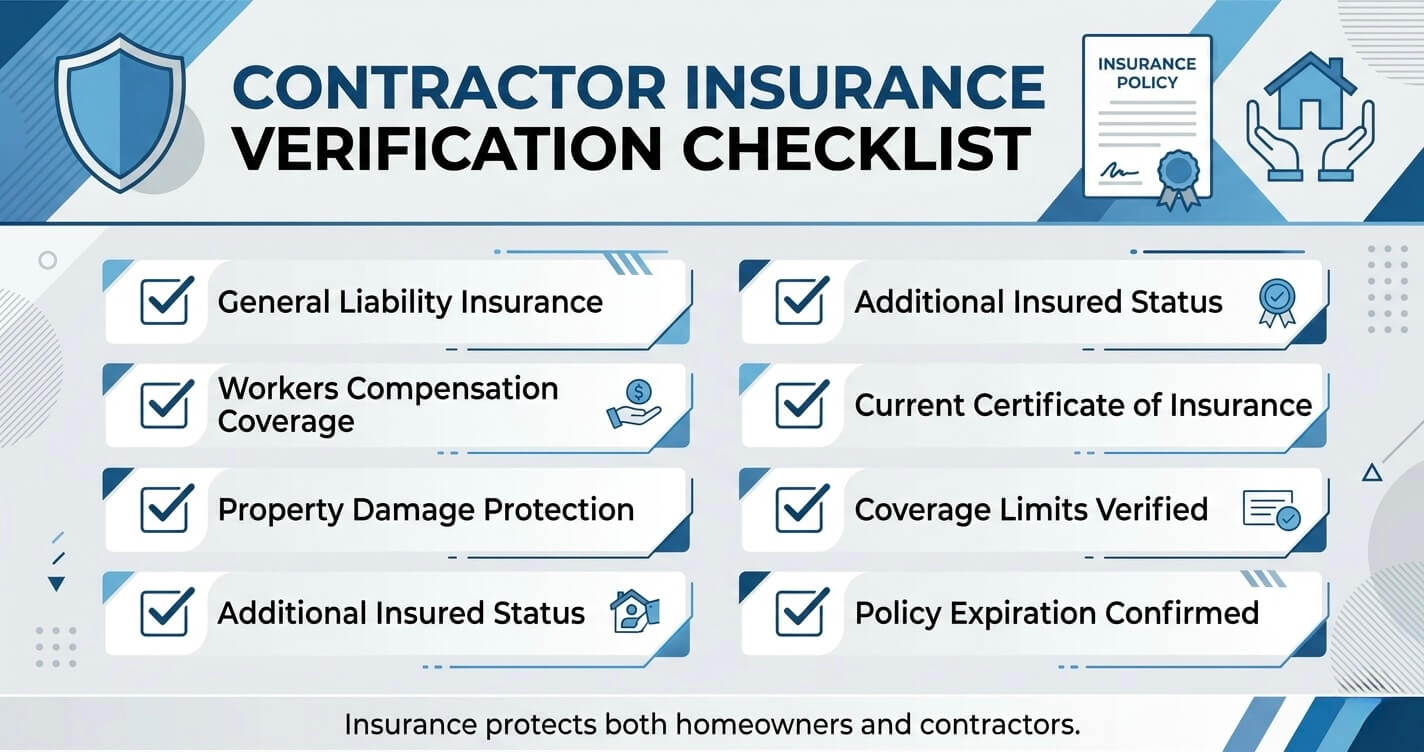
At a minimum, professional remodeling contractors should carry general liability insurance and, where required, workers’ compensation coverage.
General Liability Insurance
General liability insurance helps protect homeowners against property damage claims that may arise during construction activities. Coverage can apply to accidental damage affecting portions of the home, neighboring properties, or other third-party claims associated with the project.
Workers’ Compensation Insurance
Workers’ compensation coverage protects employees who may be injured while working on a job site. Without appropriate coverage, homeowners could potentially face increased exposure to claims arising from workplace injuries.
Virginia Workers’ Compensation Commission: https://workcomp.virginia.gov
Property Damage Protection
Homeowners should request a current Certificate of Insurance (COI) directly from the contractor and confirm coverage limits. Large-scale renovations often justify higher liability limits due to the value of the property and scope of work.
Additional Insured Status
For substantial remodeling projects, some homeowners request additional insured status, providing an additional layer of protection during construction.
Certificate Verification Checklist
- Request current Certificate of Insurance
- Verify policy expiration dates
- Confirm general liability coverage
- Confirm workers’ compensation coverage
- Review coverage limits
- Verify carrier information
Insurance verification protects both parties. A contractor unwilling to provide proof of insurance should be viewed as a significant warning sign. Professional contractors expect these questions and typically provide documentation promptly because insurance verification is a standard component of responsible project planning.
REVIEW THEIR LOCAL EXPERIENCE IN NORTHERN VIRGINIA
When evaluating how to choose a home remodeling contractor in Northern Virginia, homeowners should prioritize local experience just as highly as licensing and insurance. Remodeling requirements can vary significantly between jurisdictions, and contractors with extensive experience in Northern Virginia often have a stronger understanding of permitting procedures, inspection requirements, subcontractor availability, supplier relationships, and local construction standards.
A contractor who regularly works in Fairfax, McLean, Arlington, Vienna, Falls Church, Alexandria, and Great Falls is more likely to understand county-specific processes, zoning considerations, architectural review requirements, and scheduling expectations. This knowledge can reduce delays and help projects move more efficiently through design, permitting, construction, and final inspections.
Local experience also provides practical advantages through established relationships with suppliers, trade partners, engineers, architects, and specialty subcontractors. These professional networks can improve project coordination, material procurement, and overall schedule management.
For projects involving structural modifications, additions, kitchens, bathrooms, or whole-home renovations, familiarity with local permit requirements becomes especially valuable. Fairfax County Land Development Services oversees many permitting and inspection activities affecting remodeling projects throughout Northern Virginia. [Source: Fairfax County Land Development Services]
Before hiring a contractor, homeowners should ask:
- How many projects have you completed in Northern Virginia?
- Can I see recent projects in Fairfax, McLean, Arlington, Vienna, Falls Church, Alexandria, or Great Falls?
- How familiar are you with Fairfax County permitting requirements?
- Can I speak with recent local clients?
- Do you regularly work with local inspectors and permit offices?
- How long has your company been serving Northern Virginia homeowners?
Local Experience Evaluation Table
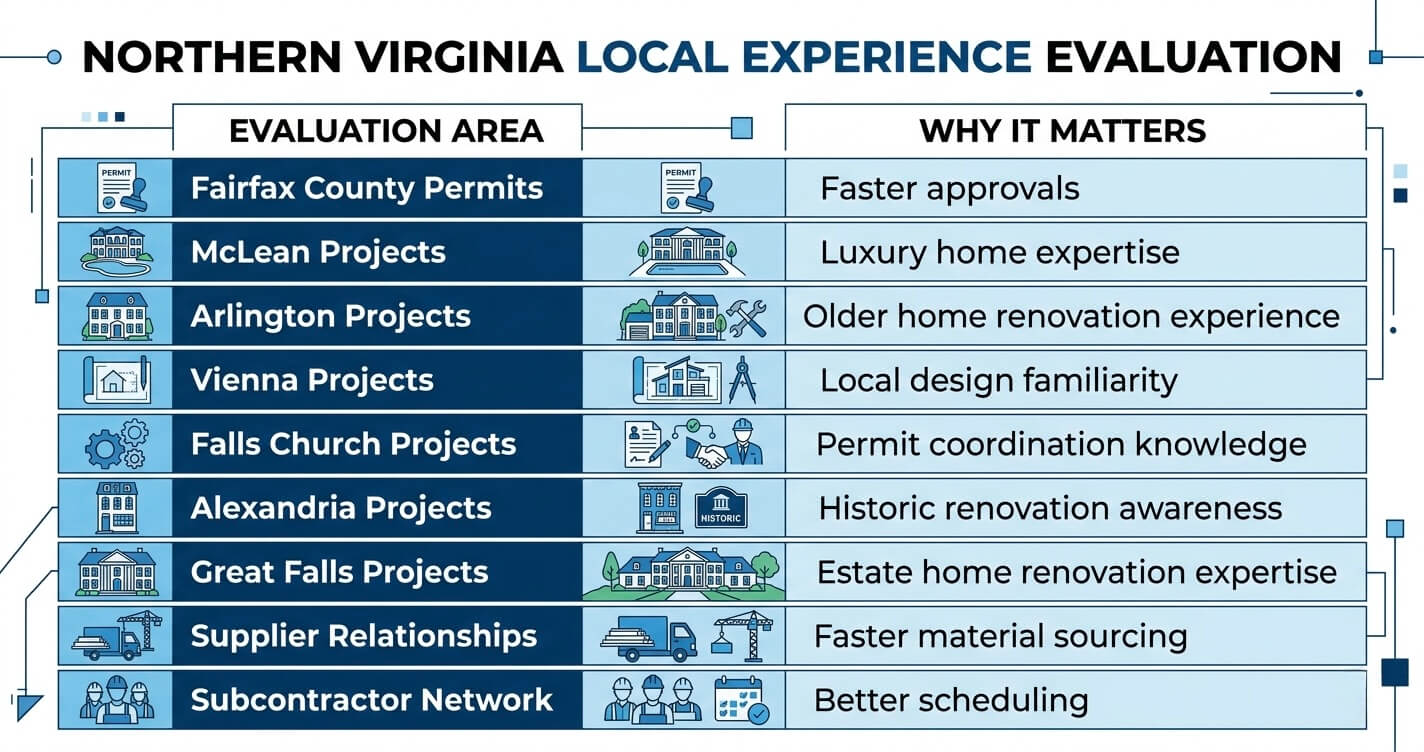
Contractors with proven local experience typically provide greater predictability, smoother permitting, and better project execution.
HOW TO EVALUATE CONTRACTOR REVIEWS, REFERENCES & PORTFOLIOS
Reviews, references, and project portfolios provide valuable insight into how a contractor performs after the contract is signed. While marketing materials often showcase best-case scenarios, customer feedback can reveal important details about communication, scheduling, workmanship, and overall client satisfaction.
Review Multiple Sources
Google Reviews can help identify trends across many customer experiences. Look beyond overall ratings and evaluate patterns involving responsiveness, project management, scheduling, and problem resolution.
The Better Business Bureau (BBB) can provide additional information regarding complaint history, accreditation status, and customer dispute resolution. [Source: Better Business Bureau]
Evaluate Project Portfolios Carefully
A strong portfolio should demonstrate experience with projects similar to yours. If you are planning a kitchen remodel, home addition, whole-home renovation, or luxury remodel, ask to see multiple examples of comparable work.
Pay attention to:
- Project complexity
- Design quality
- Consistency
- Finish details
- Before-and-after transformations
- Project scale
Conduct Reference Calls
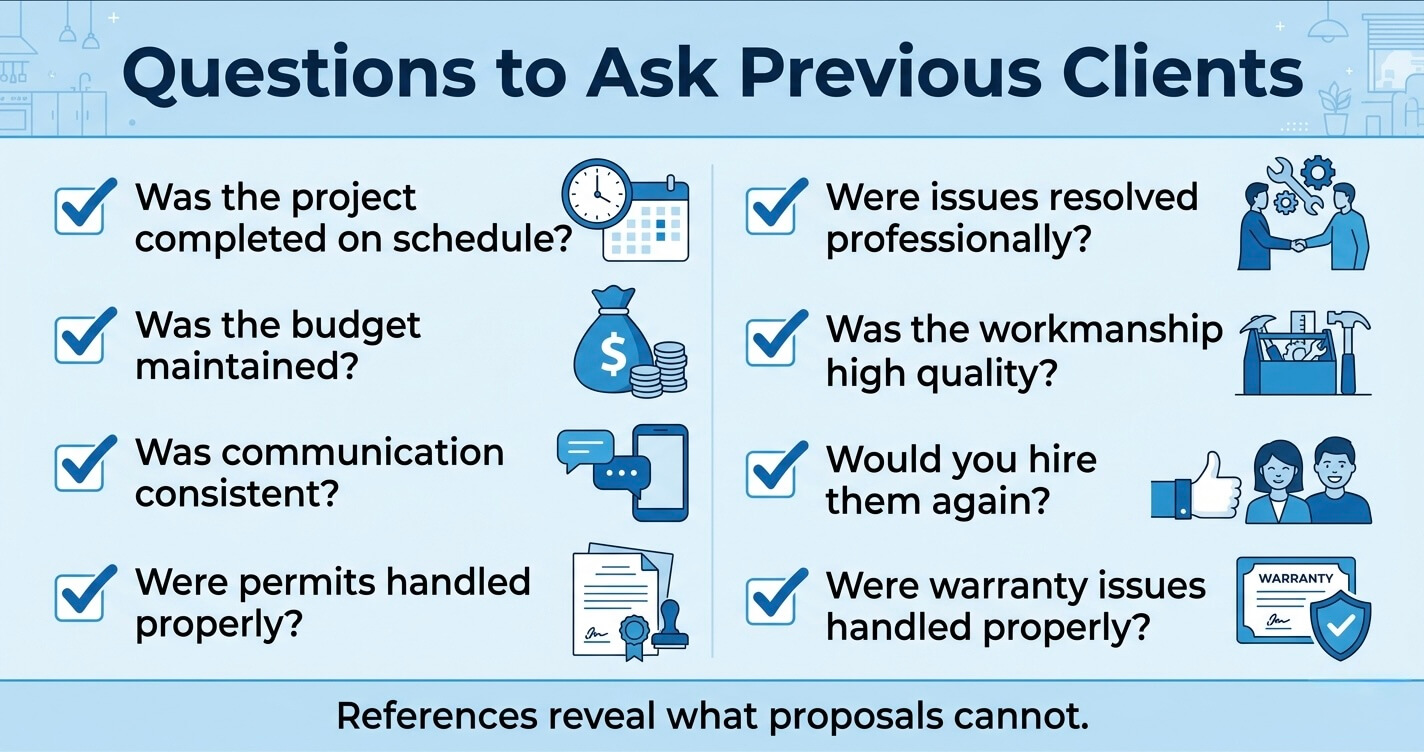
Reference conversations often reveal information that online reviews cannot. Strong references typically discuss professionalism, communication, organization, problem-solving ability, and overall satisfaction.
Positive references frequently sound like:
- “The team communicated throughout the project.”
- “They handled permits and inspections professionally.”
- “Issues were resolved quickly.”
- “The final cost aligned with expectations.”
- “We would hire them again.”
Review Red Flags
Potential warning signs include:
- Numerous complaints about communication
- Missed deadlines
- Frequent cost overruns
- Unresolved warranty issues
- Poor responsiveness after project completion
Reference Interview Checklist
- Did the project finish close to schedule?
- Did costs remain reasonably aligned with estimates?
- Was communication consistent?
- Were permits and inspections handled properly?
- How were unexpected issues managed?
- Was the job site maintained professionally?
- Would you hire the contractor again?
Reviewing feedback from multiple sources helps homeowners make more informed contractor selection decisions.
QUESTIONS EVERY HOMEOWNER SHOULD ASK BEFORE HIRING
One of the most effective ways to determine whether a contractor is a good fit is through a structured interview process. Asking the right questions allows homeowners to evaluate experience, project management systems, communication practices, and overall professionalism before making a commitment.
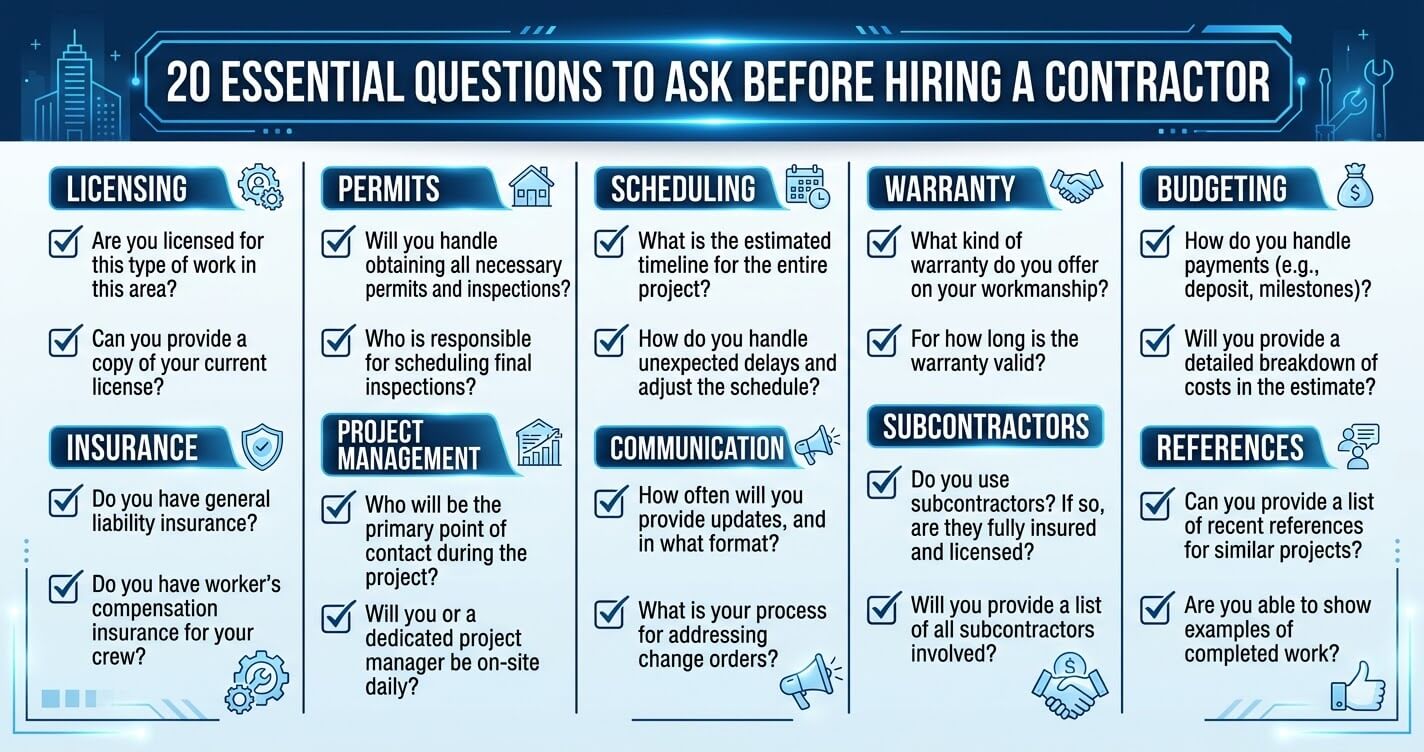
Below are 20 essential questions every homeowner should ask:
Licensing & Qualifications
- Are you licensed through Virginia DPOR?
- What license classification do you hold?
- Can you provide your license number?
Insurance
- Do you carry general liability insurance?
- Do you carry workers’ compensation coverage?
- Can you provide certificates of insurance?
Experience
- How many similar projects have you completed?
- Can I see local examples of your work?
- Can I speak with recent clients?
Permits & Compliance
- Who handles permit applications?
- Who schedules inspections?
- How do you ensure code compliance?
Project Management
- Who will manage my project day-to-day?
- How often will I receive updates?
- What project management system do you use?
Scheduling
- What is your estimated timeline?
- How do you handle delays?
Subcontractors
- Do you use employees or subcontractors?
- How are subcontractors selected and supervised?
Warranty
- What workmanship warranty do you provide?
Contractor Interview Checklist
- License Verified
- Insurance Verified
- References Checked
- Portfolio Reviewed
- Permit Process Explained
- Timeline Discussed
- Project Manager Identified
- Communication Process Explained
- Warranty Reviewed
- Contract Questions Answered
The quality of answers often reveals as much as the answers themselves. Professional contractors typically welcome detailed questions because informed homeowners contribute to smoother projects.
UNDERSTANDING PROPOSALS, ESTIMATES & BIDS
A contractor’s proposal is more than a price quote; it is a roadmap for how the project will be executed. One of the most common homeowner mistakes is comparing bids based solely on total cost rather than evaluating the scope and quality of what is actually included.
A professional proposal should clearly define:
- Scope of work
- Materials
- Labor
- Permit responsibilities
- Project assumptions
- Payment schedules
- Allowances
- Warranty information
- Change order procedures
Understanding Allowances
Allowances are budget placeholders used when final selections have not yet been made. Common examples include cabinetry, flooring, tile, appliances, lighting, and plumbing fixtures.
Homeowners should understand:
- What allowance amounts are included
- Whether allowances reflect realistic market pricing
- How adjustments will be handled
Change Orders
Change orders are formal modifications to the original scope of work. While some changes are unavoidable, excessive change orders can indicate poor planning or incomplete scope development.
Payment Schedules
Avoid contractors requesting unusually large upfront payments. Payment schedules should generally correspond with project milestones and completed work.
Material Specifications Matter
A quality proposal identifies specific materials whenever possible rather than relying on vague descriptions.
For budgeting guidance, homeowners should also review Home Addition Cost in Northern Virginia.
Good Estimate vs Bad Estimate Comparison Table
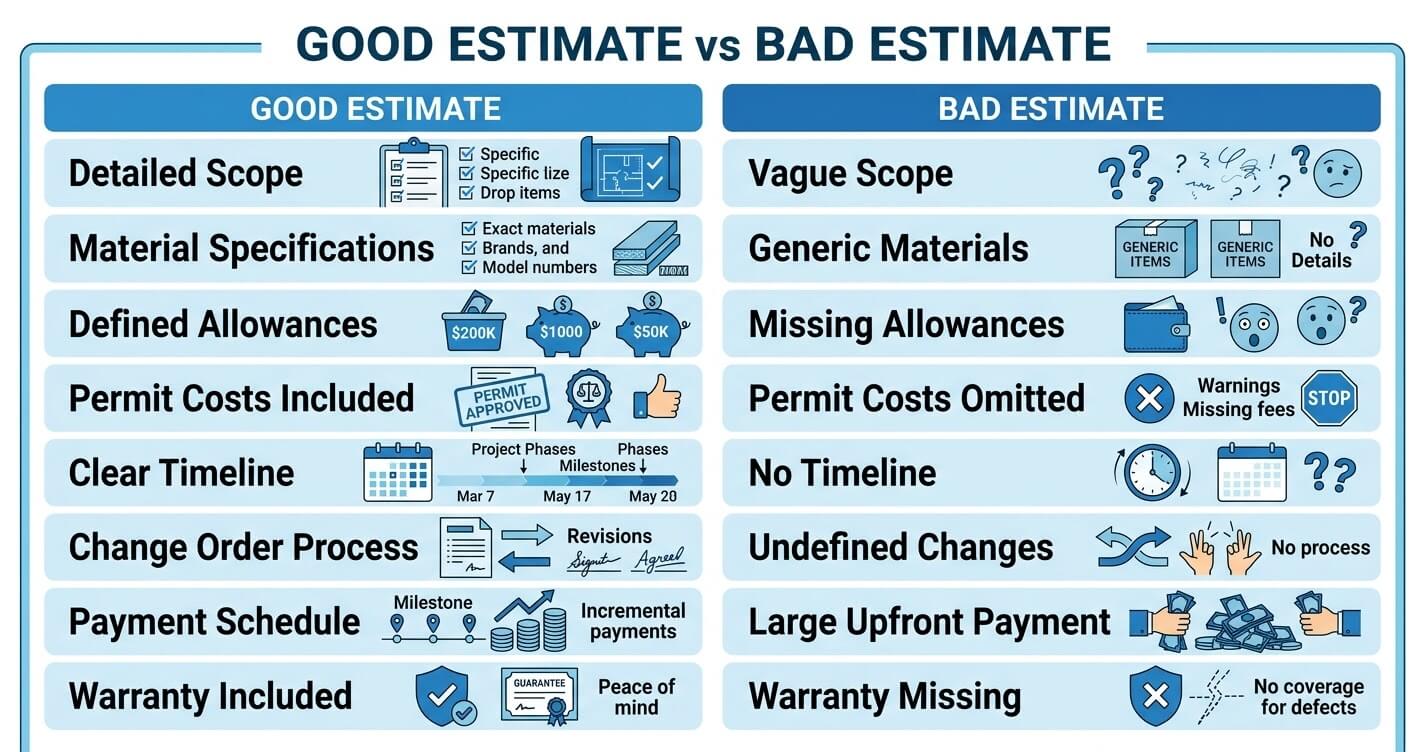
The best proposals create clarity before construction begins. In contrast, vague estimates often lead to misunderstandings, disputes, and unexpected costs later in the project.
RED FLAGS THAT SHOULD IMMEDIATELY CONCERN YOU
Choosing the wrong contractor can create problems that extend far beyond construction delays. In many cases, the warning signs appear long before a contract is signed. Homeowners who understand these red flags can significantly reduce the risk of financial loss, poor workmanship, permit violations, and unfinished projects.
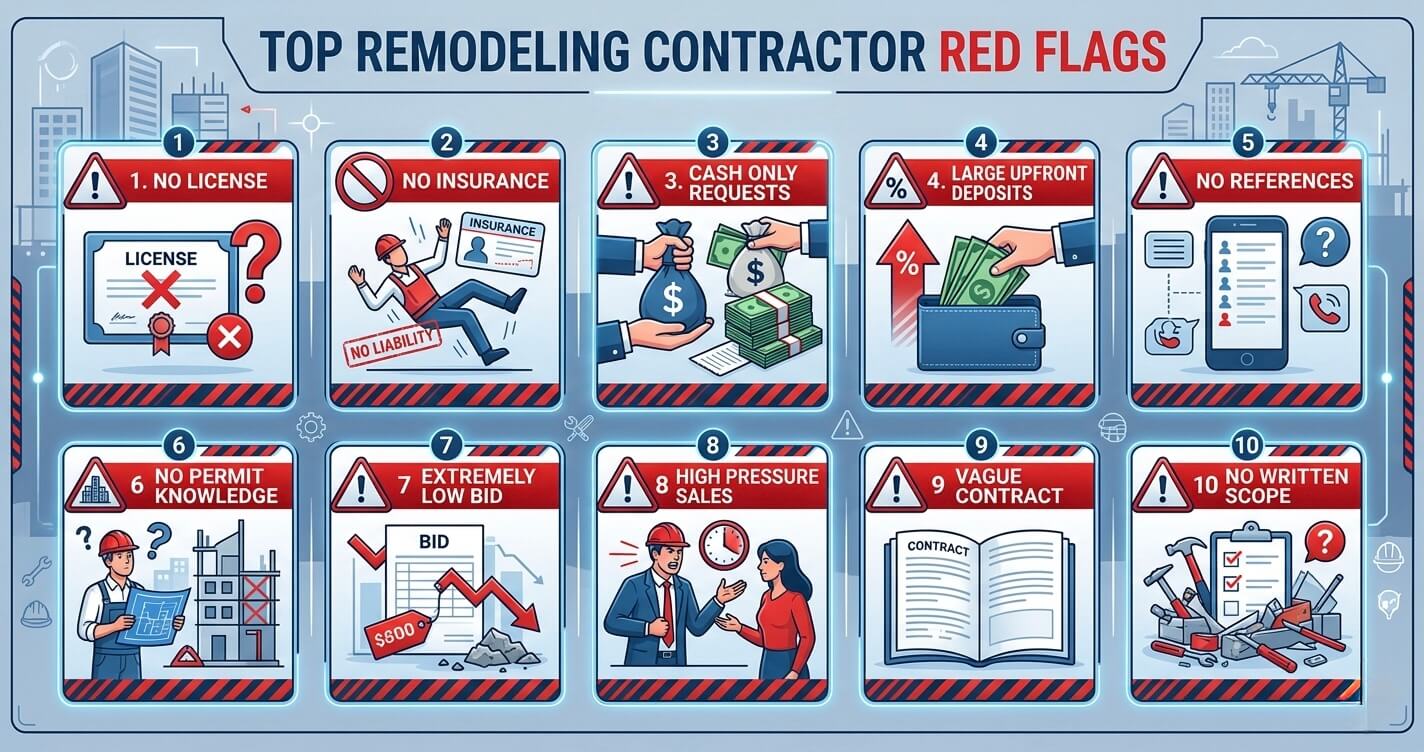
One of the most serious warning signs is the inability or unwillingness to provide proof of licensing. Virginia contractors performing regulated work must maintain the appropriate license classification through the Virginia Department of Professional and Occupational Regulation (DPOR). A contractor operating without proper licensing may expose homeowners to legal, financial, and insurance risks. [Source: Virginia DPOR]
Insurance is equally important. Contractors who cannot provide proof of general liability coverage or workers’ compensation insurance should be removed from consideration immediately.
Additional red flags include:
- Requests for cash-only payments
- Large upfront deposits before work begins
- Refusal to obtain permits
- Vague or incomplete contracts
- No recent references
- Unusually low bids that seem unrealistic
- High-pressure sales tactics demanding immediate commitment
- Unwillingness to provide detailed proposals
The Federal Trade Commission (FTC) warns consumers about home improvement scams that often involve advance payment schemes, misleading promises, and incomplete work. [Source: Federal Trade Commission]
A contractor who pressures homeowners into making quick decisions often prioritizes closing sales over proper project planning. Similarly, extremely low bids may indicate missing scope items, inadequate insurance, unqualified labor, or future change orders designed to recover lost profit.
Major Remodeling Contractor Red Flags
- No License
- No Insurance
- No References
- No Permit Knowledge
- Cash-Only Requests
- Large Upfront Deposits
- Vague Contracts
- Unrealistically Low Pricing
- High-Pressure Sales Tactics
- Poor Communication
Professional contractors welcome questions, provide documentation, and encourage informed decision-making rather than rushing homeowners into contracts.
DESIGN-BUILD VS GENERAL CONTRACTOR: WHICH MODEL IS BETTER?
One of the most important decisions homeowners make is selecting the project delivery method. While both design-build firms and traditional general contractors can complete remodeling projects, the experience and level of accountability differ significantly.
Under the traditional model, homeowners typically hire a designer or architect separately before selecting a general contractor. Multiple contracts, separate responsibilities, and divided communication channels often increase coordination requirements.
By contrast, a design-build firm combines design, budgeting, permitting, project management, and construction within a single integrated team. According to the Design-Build Institute of America (DBIA), the defining characteristic of design-build delivery is a single contract and unified responsibility for both design and construction. [Source: DBIA]
Advantages of design-build delivery often include:
- Single point of accountability
- Integrated design and budgeting
- Earlier cost visibility
- Streamlined communication
- Faster decision-making
- Better schedule coordination
- Reduced change-order exposure
Traditional contractor models can still work effectively, particularly when homeowners already have completed plans and prefer to manage multiple parties themselves.
For a deeper comparison, homeowners can review Design-Build vs. General Contractor Northern Virginia.
Design-Build vs General Contractor Comparison
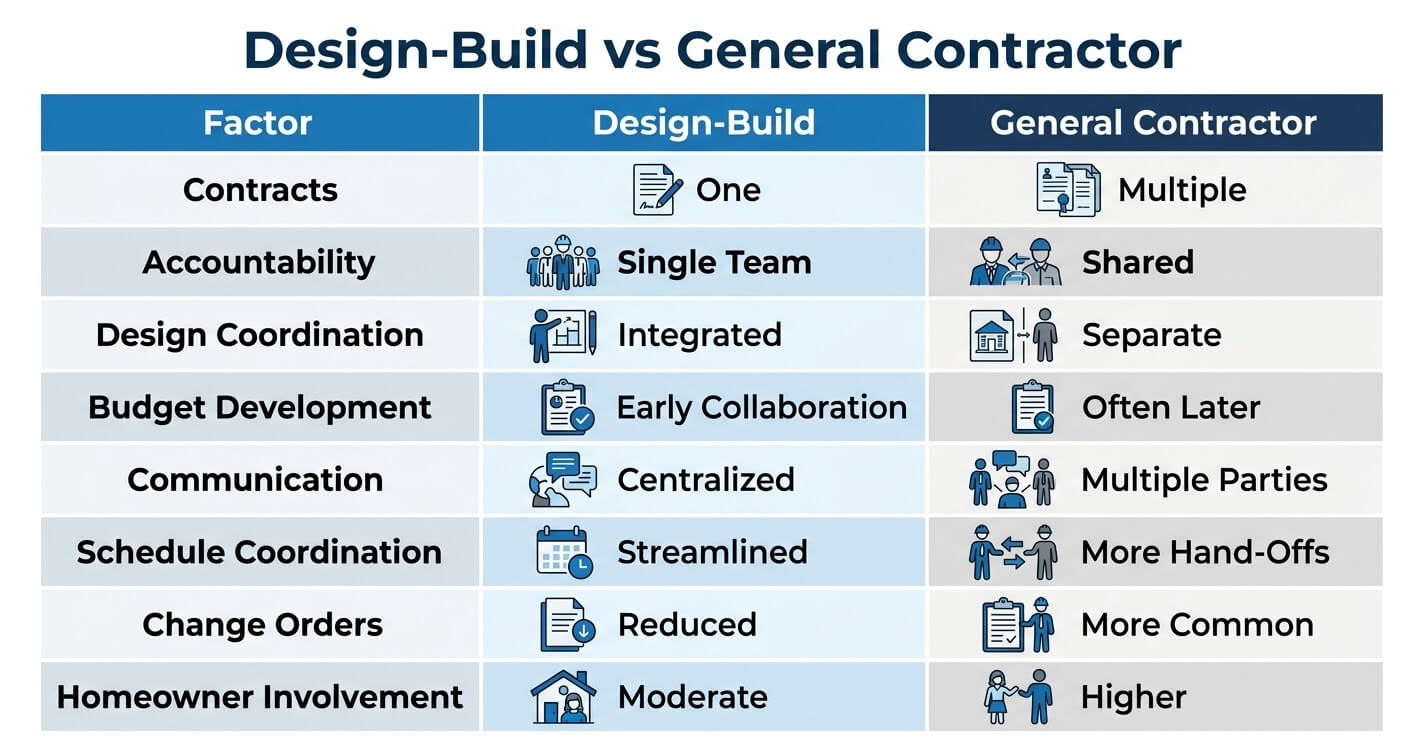
For complex renovations, additions, and whole-home remodels, many Northern Virginia homeowners find design-build delivery offers greater clarity and coordination throughout the project lifecycle.
UNDERSTANDING PERMITS & CODE COMPLIANCE
Permits and code compliance are often overlooked during contractor selection, yet they play a critical role in protecting homeowners, ensuring safety, and maintaining property value.
Many remodeling projects throughout Northern Virginia require permits and inspections. Common examples include:
- Structural modifications
- Electrical upgrades
- Plumbing changes
- HVAC installations
- Additions
- Basement renovations
- Major kitchen remodels
- Significant bathroom remodels
Fairfax County Land Development Services oversees permit administration, inspections, and code enforcement for many projects affecting homeowners throughout the region. [Source: Fairfax County Land Development Services]
A qualified contractor should clearly explain:
- Which permits are required
- Who is responsible for obtaining permits
- Inspection schedules
- Documentation requirements
- Code compliance procedures
Homeowners should never assume permits are unnecessary simply because a contractor says so. Unpermitted work can create problems during refinancing, insurance claims, future renovations, and property sales.
For detailed guidance, homeowners can review Remodeling Permit Fairfax County.
Permit Responsibility Flow
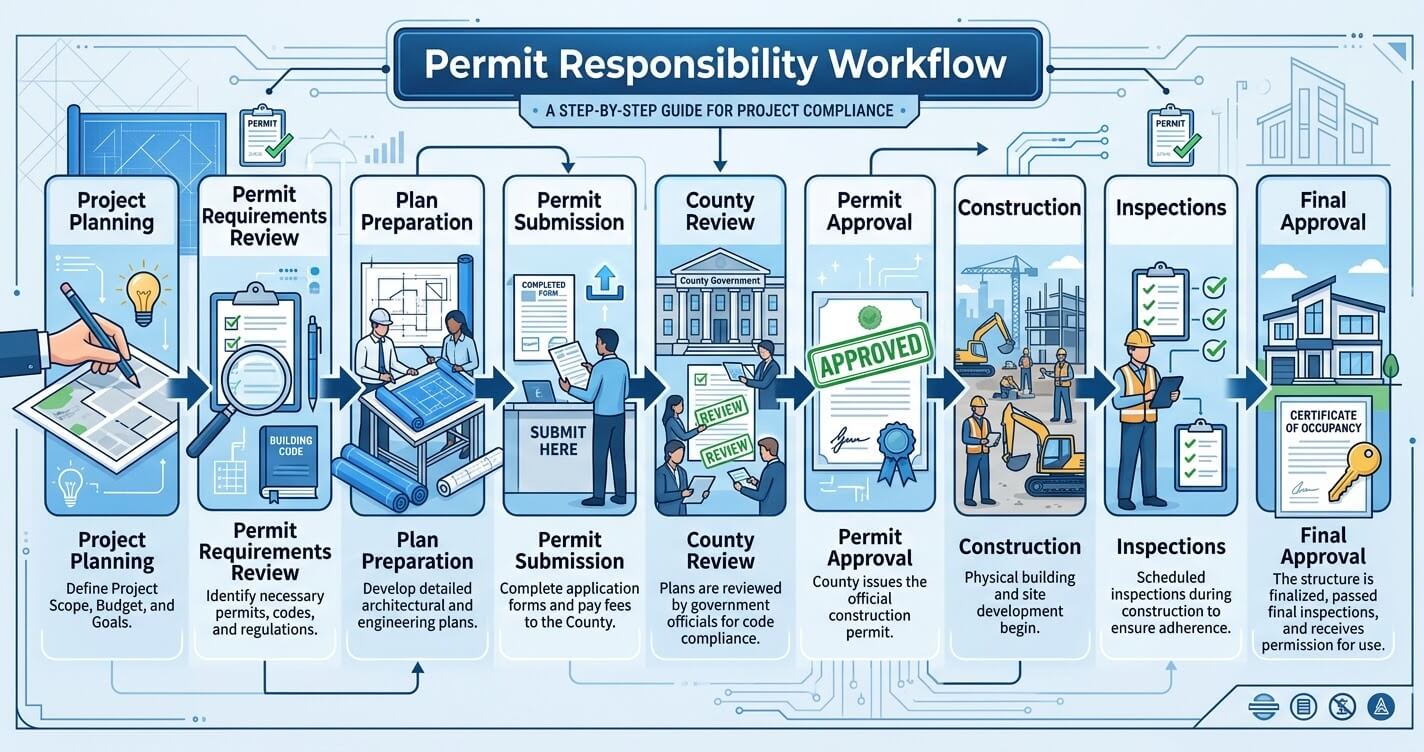
Project Planning
↓
Permit Evaluation
↓
Plan Preparation
↓
Permit Submission
↓
County Review
↓
Permit Approval
↓
Construction
↓
Inspections
↓
Final Approval
Contractors who proactively manage permitting and inspection processes often provide a smoother remodeling experience and reduce compliance-related risks.
CONTRACTOR SELECTION SCORECARD
Selecting a contractor becomes much easier when homeowners evaluate candidates using objective criteria instead of relying solely on price or sales presentations.
The following scorecard can help compare contractors consistently during the screening process. Assign a score from 1–10 for each category and compare total results across multiple companies.
Homeowner Contractor Selection Scorecard
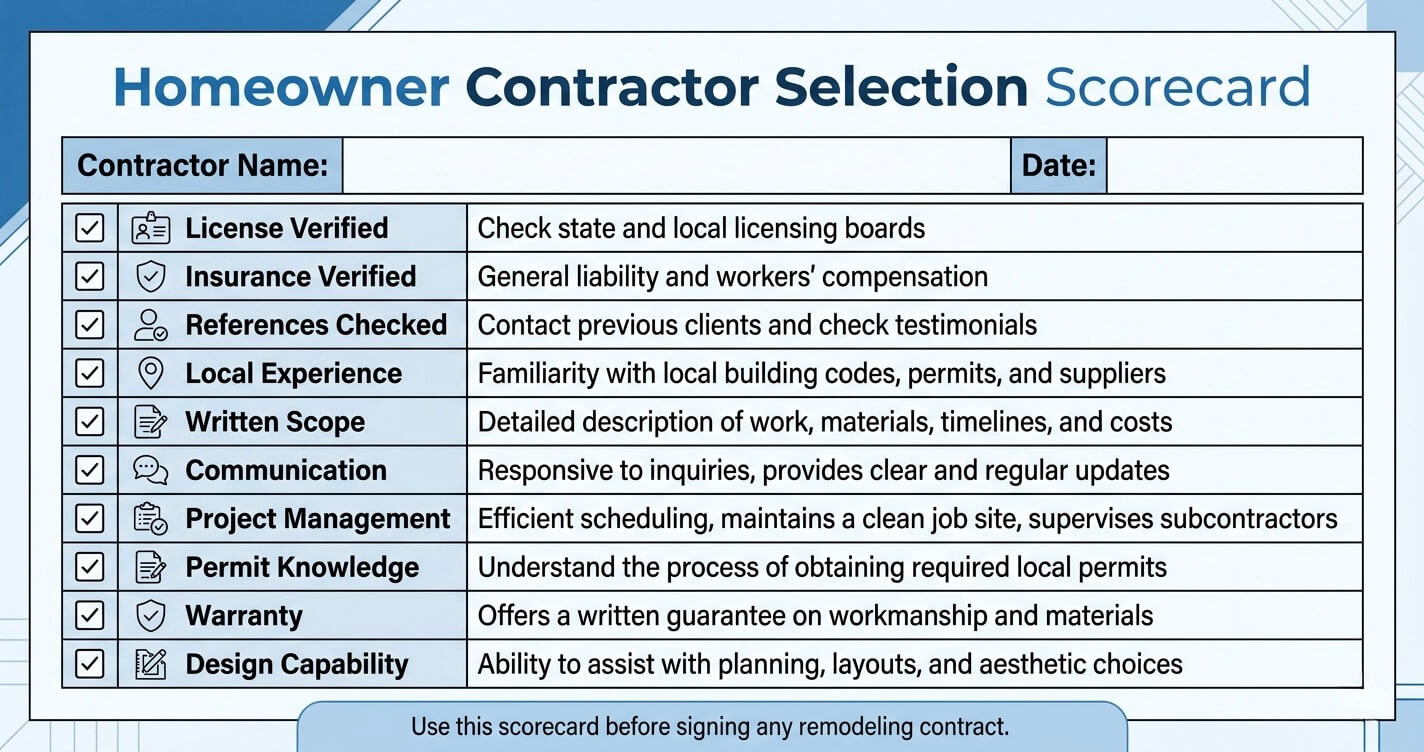
Contractor Screening Checklist
- License Verified
- Insurance Verified
- References Checked
- Local Experience Reviewed
- Detailed Scope Received
- Communication Evaluated
- Project Management Process Explained
- Permit Experience Confirmed
- Warranty Reviewed
- Design Capabilities Assessed
A contractor may excel in one category while falling short in another. The goal is to identify the company that demonstrates consistent strength across all critical areas rather than focusing exclusively on cost.
The highest-scoring contractor is not always the cheapest, but often provides the greatest long-term value and lowest project risk.
FREQUENTLY ASKED QUESTIONS [FAQs]
How do I verify a remodeling contractor license in Virginia?
Virginia contractor licenses can be verified through the Virginia Department of Professional and Occupational Regulation (DPOR) License Lookup system:
https://www.dpor.virginia.gov/LicenseLookup
How many contractor bids should I get?
Most experts recommend obtaining three detailed proposals from qualified contractors to compare scope, pricing, communication, and project approach.
Should I hire the cheapest contractor?
Not necessarily. Extremely low bids may indicate missing scope items, inadequate insurance, lower-quality materials, or future change orders.
What insurance should a remodeling contractor carry?
At minimum, contractors should carry general liability insurance and workers’ compensation coverage when applicable.
What are the biggest contractor red flags?
Lack of licensing, lack of insurance, no references, cash-only requests, vague contracts, large upfront deposits, and refusal to obtain permits.
What permits are required for remodeling in Northern Virginia?
Permit requirements vary by project scope. Structural, plumbing, electrical, and HVAC work frequently require permits and inspections.
What is a design-build contractor?
A design-build contractor provides integrated design, budgeting, permitting, project management, and construction services under one contract.
How do I compare remodeling proposals?
Compare scope, material specifications, allowances, payment schedules, permit responsibilities, warranties, and change-order procedures.
How much should I pay upfront?
Reasonable deposits vary, but homeowners should be cautious of unusually large upfront payment requests before work begins.
How do I avoid contractor scams?
Verify licensing, confirm insurance, review references, check complaint history, require written contracts, and never rush into decisions.
THE FINAL VERDICT
Understanding how to choose a home remodeling contractor in Northern Virginia is one of the most important decisions homeowners make during any renovation project. The success of a remodel depends far less on individual materials and far more on the experience, systems, communication, and accountability of the team responsible for delivering the work.
Before signing any contract, homeowners should verify licensing, confirm insurance coverage, review references, evaluate local experience, compare proposals carefully, and understand permit responsibilities. Strong communication systems, transparent project management, and detailed documentation are often the characteristics that separate exceptional contractors from average ones.
Design-build delivery can provide additional advantages through integrated planning, centralized communication, and single-source accountability.
The best remodeling projects begin long before construction starts; they begin with choosing the right team.
US Home Design Build serves homeowners throughout McLean VA, Fairfax VA, Arlington VA, Falls Church VA, Vienna VA, Alexandria VA, Great Falls VA, and Northern Virginia.
Their integrated design-build process manages consultation, planning, design, budgeting, permits, construction, inspections, and warranty support under one roof, providing homeowners with a single point of accountability from start to finish.
703-202-3520 | https://ushdb.com | 8200 Greensboro Dr Suite 900, McLean, VA 22102
