
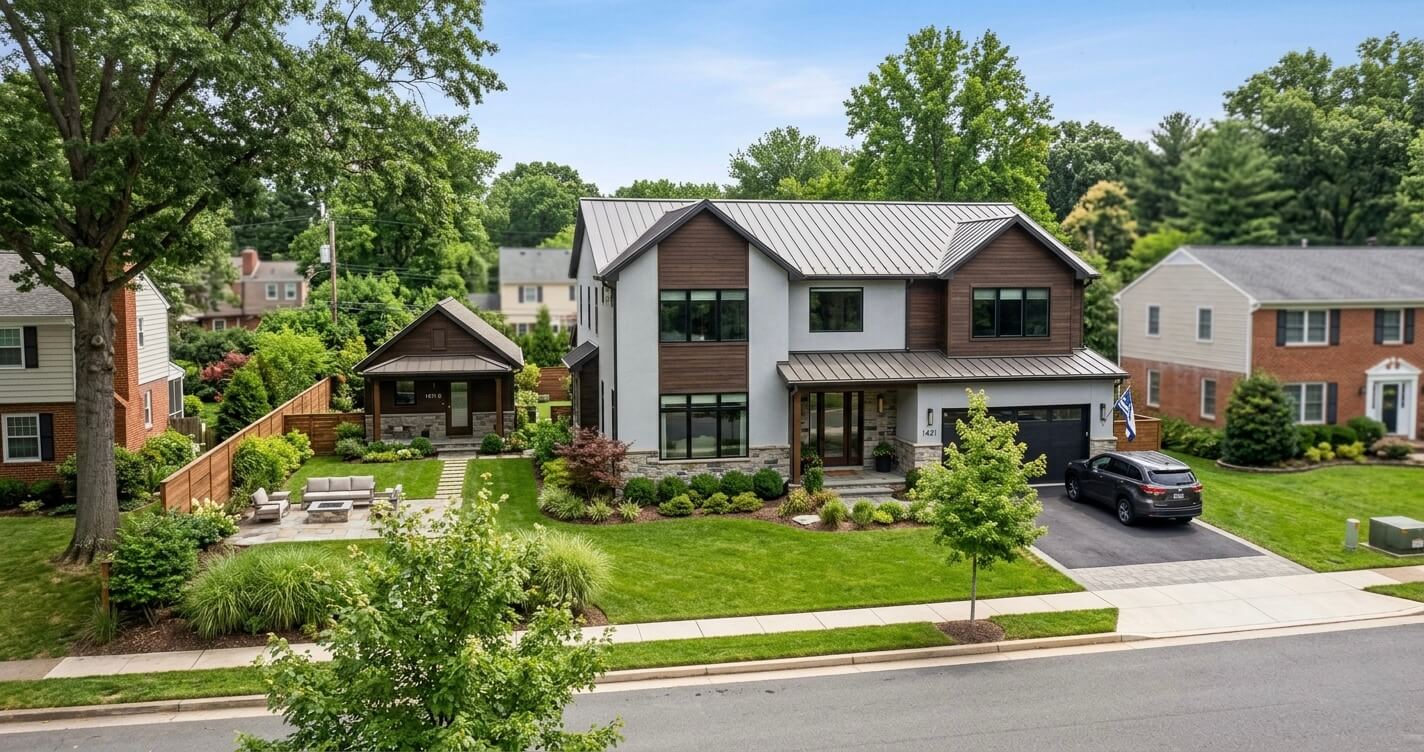
An accessory living unit Fairfax County VA is a self-contained secondary residence located within or on the same lot as a primary home. Often referred to as in-law suites or basement apartments, these units are increasingly popular among homeowners across Northern Virginia due to rising housing costs and multigenerational living needs.
However, building an ALU in Fairfax County VA involves strict zoning regulations and permit requirements. Understanding these rules is essential before starting any project, especially for homeowners in areas like Fairfax VA, McLean VA, Arlington VA, and Vienna VA, where compliance is closely monitored.
What Is an Accessory Living Unit (ALU) in Fairfax County VA?
An Accessory Living Unit (ALU) in Fairfax County VA is a secondary dwelling unit that exists within a single-family detached home. It is designed to provide independent living facilities while remaining clearly subordinate to the primary residence.
These units are commonly known as:
- In-law suites
- Basement apartments
- Secondary living spaces
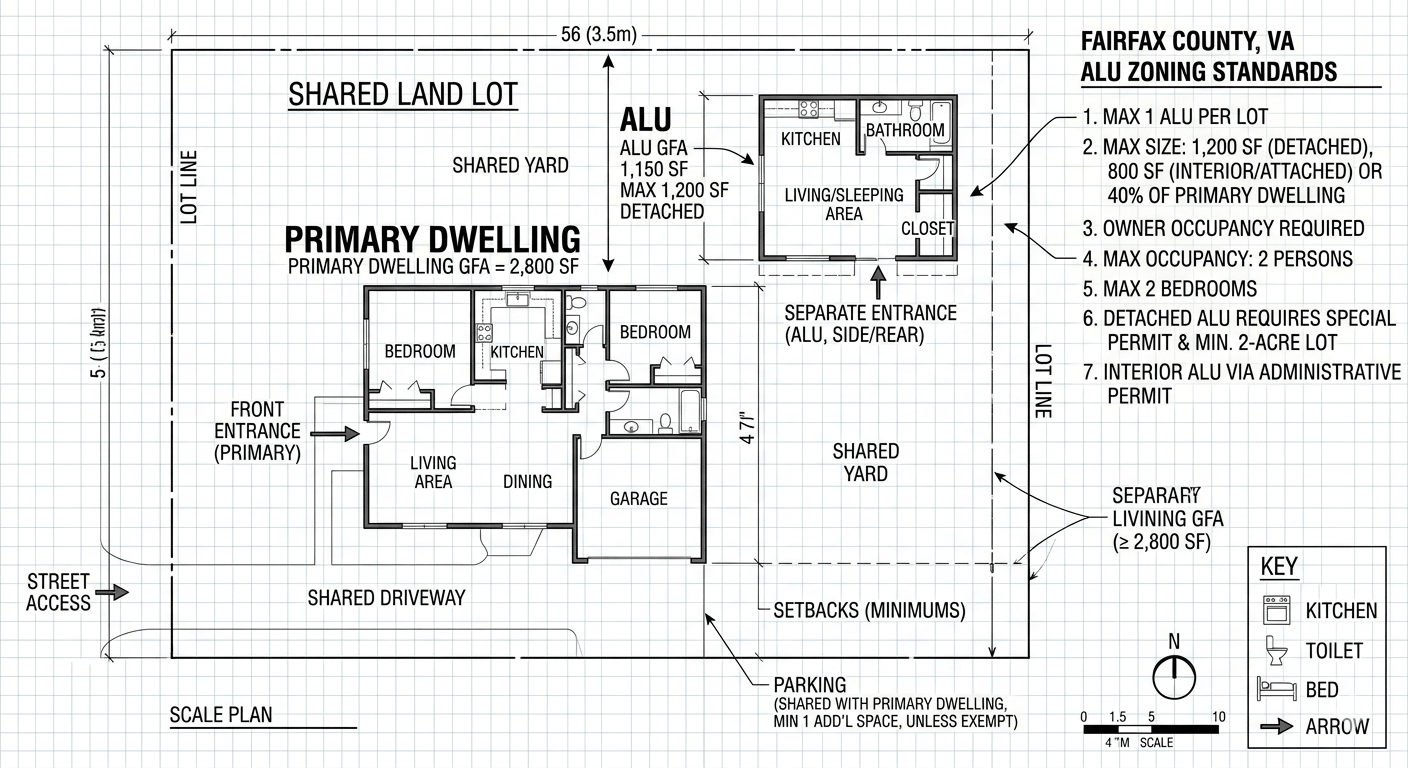
According to Fairfax County zoning regulations, ALUs are only permitted in single-family detached homes and must not alter the primary residential character of the property. This means the main dwelling must remain dominant in both size and appearance.
Additionally, the ALU must:
- Be integrated into the existing structure or an approved addition
- Share utilities or infrastructure with the primary home in many cases
- Comply with strict zoning and occupancy standards
For homeowners in Northern Virginia, especially in high-demand areas like McLean VA and Vienna VA, ALUs offer a practical solution for housing family members without purchasing additional property but only when done within legal limits.
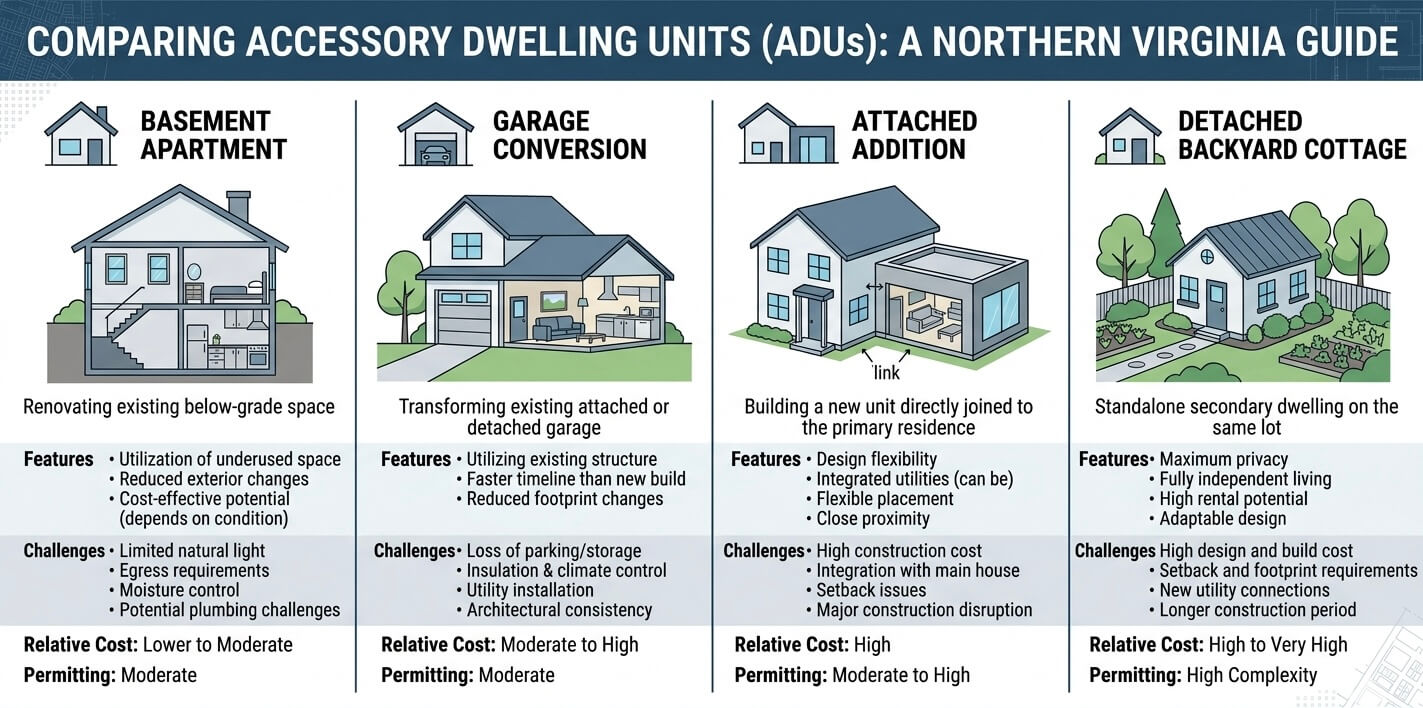
Types of Accessory Living Units Allowed in Fairfax County
Understanding the different types of ALUs is critical before starting your project in Fairfax County VA, as each type comes with specific design and permitting considerations.
Interior Accessory Living Units
Interior ALUs are the most common and generally easier to approve because they are part of the existing structure.
These include:
- Basement ALUs
A finished basement converted into a livable unit with a bedroom, bathroom, and kitchenette. These are especially popular in Fairfax VA due to existing home layouts.
- Attached Additions
Expanding the home to create a separate living space while still being physically connected to the main house.
- Garage Conversions
Transforming an attached garage into a functional living unit. However, zoning and parking requirements must still be met.
Interior ALUs are often preferred across Northern Virginia because they typically face fewer zoning challenges compared to detached units.
Detached Accessory Living Units
Detached ALUs are separate structures located on the same property but physically independent from the main house.
Examples include:
- Backyard cottages
- Guest houses
- Standalone secondary dwellings
While these offer greater privacy and flexibility, they are significantly more complex to approve in Fairfax County VA. Lot size, setbacks, and neighborhood zoning restrictions often limit their feasibility, especially in established communities like Arlington VA and McLean VA.
In many cases, detached ALUs require more scrutiny and may not be permitted in certain zoning districts, making professional planning essential.
Permit Requirements for Accessory Living Units in Fairfax County VA
Obtaining the correct permit is one of the most critical steps when building an accessory living unit Fairfax County VA. The county uses two primary approval pathways depending on the scope and specifics of the project.
1. Administrative Permit
An Administrative Permit is the most common route for ALUs in Fairfax County VA.
This applies when:
- The ALU meets all zoning requirements
- The unit is clearly subordinate to the main dwelling
- No major zoning exceptions are required
This process is handled internally by the county and is generally faster, making it ideal for interior ALUs such as basement apartments or garage conversions.
2. Special Permit (Board of Zoning Appeals)
A Special Permit is required when the proposed ALU does not fully comply with standard zoning regulations.
This may apply if:
- The property has unique constraints
- The homeowner is requesting exceptions (e.g., size or layout deviations)
- The structure is detached or significantly alters the property
This process involves review by the Board of Zoning Appeals (BZA) and can be time-consuming, often requiring:
- Public hearings
- Detailed site plans
- Community input
For homeowners in Northern Virginia, particularly in high-value areas like Vienna VA or Arlington VA, this step can introduce delays and added complexity, making professional guidance highly recommended.
Occupancy Rules for ALUs in Fairfax County
Fairfax County enforces strict occupancy regulations to ensure that ALUs remain secondary living spaces and do not function as independent rental properties.
Key rules include:
- Maximum of 2 occupants allowed in the ALU
- Maximum of 2 bedrooms permitted
- The unit must remain clearly subordinate to the primary dwelling
- The property must maintain its single-family residential classification
These rules are particularly important for homeowners in Fairfax VA and surrounding areas, where zoning enforcement is strict. Violating occupancy limits or using the ALU as a separate rental unit can lead to penalties or permit revocation.
Size Limits for Accessory Living Units
When planning an accessory living unit Fairfax County VA, understanding size restrictions is critical to avoid permit delays or rejections. Fairfax County zoning regulations clearly define how large an ALU can be to ensure it remains secondary to the primary residence.
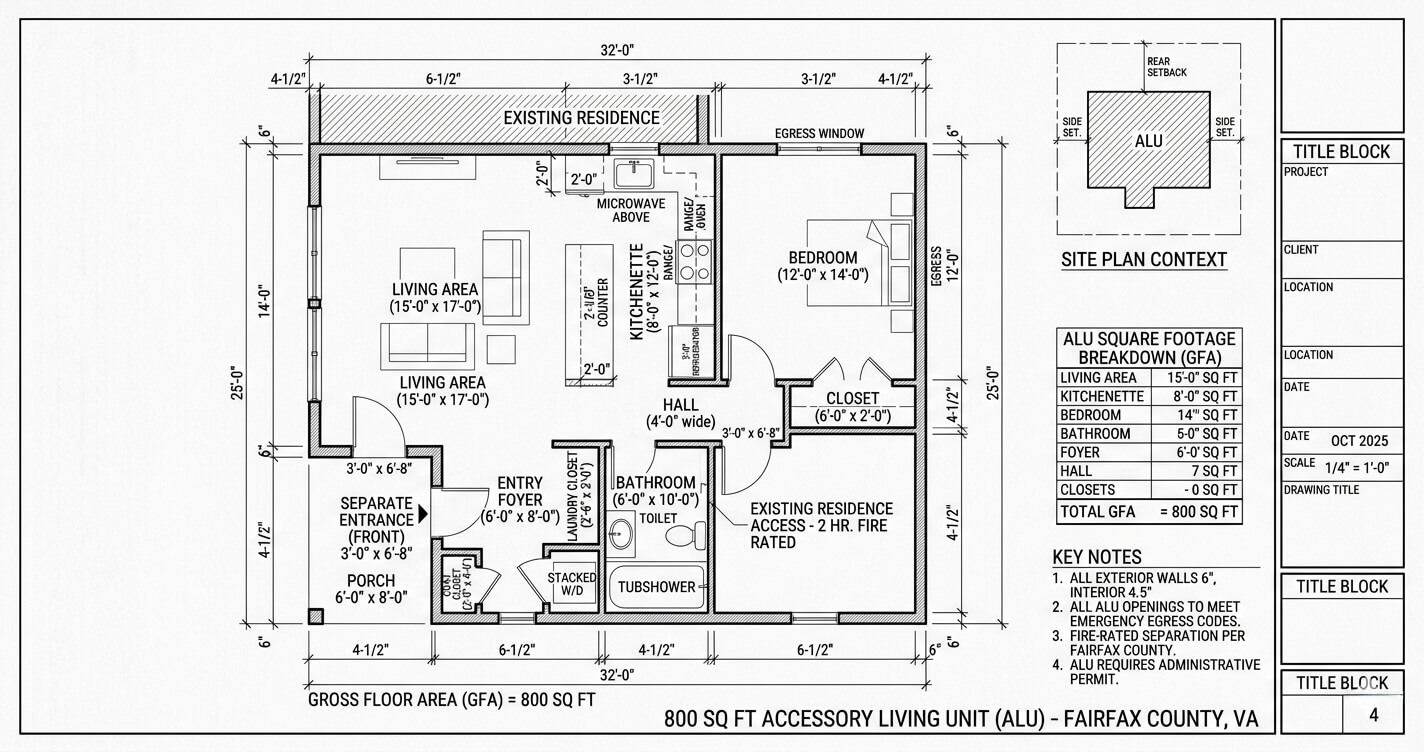
In most cases, the ALU must not exceed:
- 800 square feet, OR
- 40% of the total floor area of the main dwelling
Whichever is less will apply.
This limitation ensures that the accessory unit does not overpower the primary home in scale or function. For example, in larger homes across McLean VA or Vienna VA, the 800 sq ft cap is often the controlling factor, even if 40% of the home would allow more space.
For detached ALUs, size restrictions become even more nuanced. In addition to the 800 sq ft / 40% rule, the structure must comply with:
- Setback requirements
- Height restrictions
- Lot coverage limits
These additional constraints often make detached units more challenging to design, particularly in established neighborhoods across Fairfax VA and Arlington VA, where zoning is tightly enforced.
Because of these layered requirements, many homeowners in Northern Virginia choose to work with professionals to ensure their design aligns with county regulations from the start.
Lot Size Requirements for Detached ALUs
Detached accessory living units in Fairfax County VA are subject to stricter lot size requirements compared to interior units.
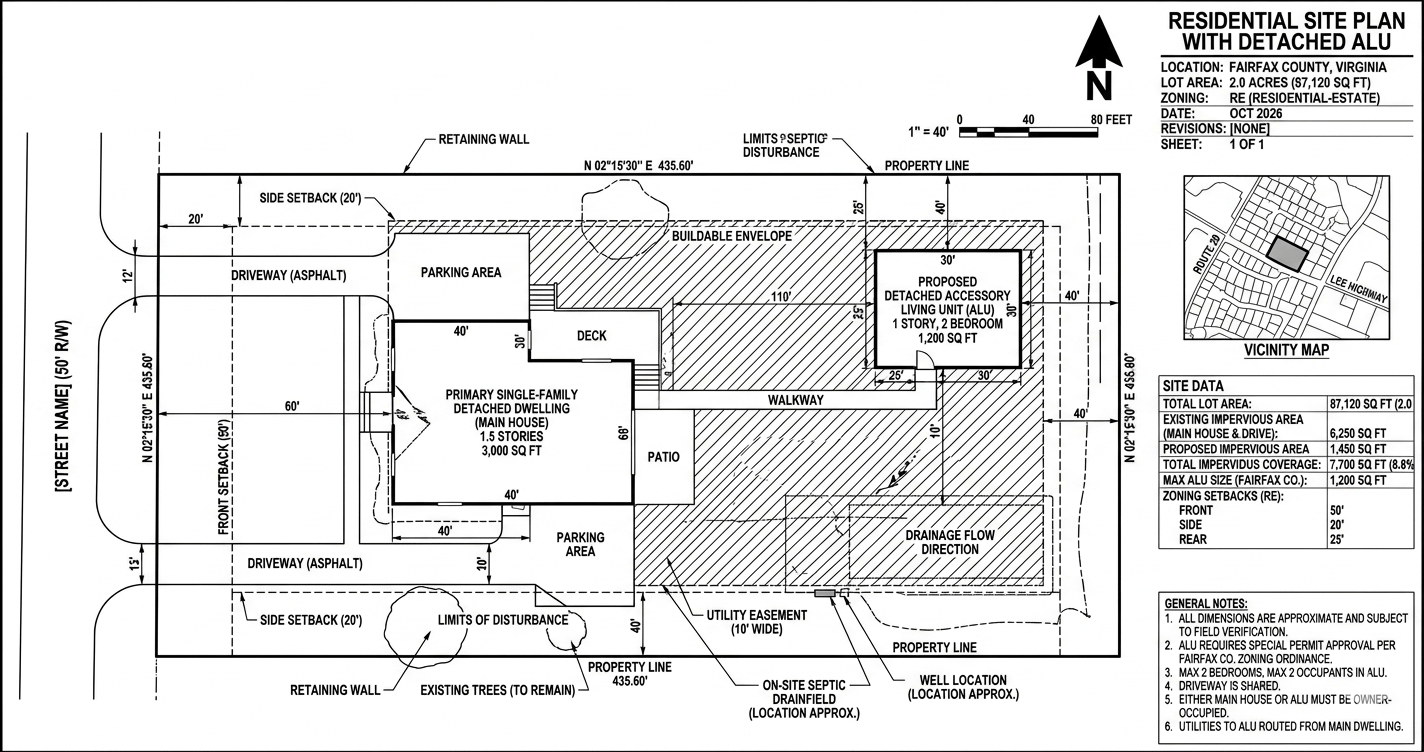
In most cases, a minimum lot size of 2 acres is required to qualify for a detached ALU. This rule is designed to:
- Maintain neighborhood density standards
- Preserve residential character
- Prevent overcrowding in suburban communities
Zoning classifications play a major role here. Properties located in lower-density zoning districts are more likely to meet the requirements, while homes in compact areas like Arlington VA or parts of Fairfax VA may not qualify at all.
Additionally, neighborhood-specific restrictions, such as HOA rules or overlay districts, can further limit eligibility, especially in upscale communities like McLean VA.
For homeowners across Northern Virginia, this means that even if your property seems suitable, zoning verification is a non-negotiable first step before planning a detached ALU.
Owner Occupancy Requirement
One of the most important compliance rules for an accessory living unit Fairfax County VA is the owner occupancy requirement.
Fairfax County mandates that:
- The property owner must live either in the main dwelling or in the ALU
- The property cannot be used as a fully independent multi-family rental setup
This rule ensures that ALUs are used for their intended purpose, supporting family members or providing limited additional living space, rather than functioning as investment rental properties.
For homeowners in Fairfax VA, Vienna VA, and surrounding areas, this has direct implications:
- You cannot rent out both the main house and the ALU simultaneously
- Short-term rentals or fully separate leasing arrangements may violate zoning laws
Failure to comply with the owner occupancy rule can result in:
- Permit revocation
- Fines or legal action
- Difficulty renewing approvals
Given the strict enforcement across Northern Virginia, maintaining compliance is essential not just during approval, but throughout the life of the ALU.
Permit Duration and Renewal Rules
Permits for ALUs in Fairfax County VA are not indefinite; they require periodic renewal to ensure continued compliance with zoning regulations.
Here’s how it works:
- Initial Approval Duration:
Once granted, an ALU permit is valid for 2 years.
- Renewal Period:
After the initial term, permits can be renewed in 5-year increments, provided all conditions are still being met.
- Inspection Requirements:
Before renewal, the county may require inspections to verify:
- Continued owner occupancy
- Compliance with size and layout approvals
- Adherence to safety and building codes
For homeowners in McLean VA and Arlington VA, where enforcement standards are particularly strict, failing to renew on time can lead to permit expiration and potential legal complications.
This ongoing oversight highlights an important reality: building an ALU is not a one-time approval; it requires long-term compliance and proper documentation.
Recording Requirements in Fairfax County
After receiving approval for an ALU, Fairfax County requires homeowners to formally record the permit in land records. This step is often overlooked but is essential for legal compliance.
The recording process ensures that:
- The existence of the ALU is officially documented
- Future property buyers are aware of the unit and its restrictions
- The county can enforce zoning and occupancy rules over time
Typically, homeowners must file the permit with the Fairfax County Circuit Court Land Records Division, creating a permanent record tied to the property.
Failure to record the permit can result in:
- Non-compliance issues
- Delays during property sale or transfer
- Potential penalties from the county
For property owners in Northern Virginia, especially in high-value markets like Vienna VA and Fairfax VA, proper recording is not just a legal formality; it protects your investment and ensures smooth transactions in the future.
Step-by-Step: How to Apply for an Accessory Living Unit Permit
Applying for an accessory living unit Fairfax County VA permit involves multiple steps, and missing even one requirement can delay your project. Here’s a clear, practical breakdown for homeowners across Northern Virginia:
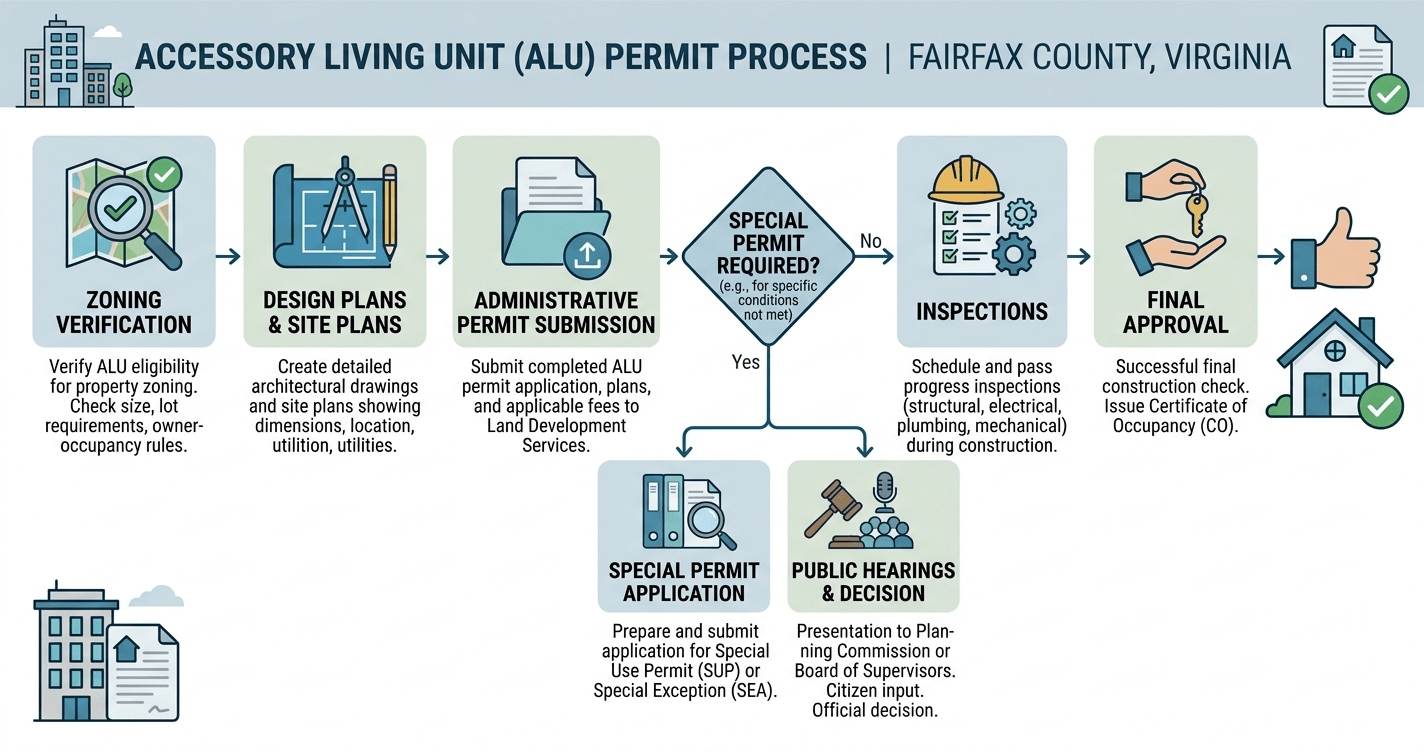
1. Confirm Zoning Eligibility
Start by verifying that your property qualifies for an ALU under Fairfax County VA zoning regulations. This includes checking:
- Property type (must be single-family detached)
- Lot size and district classification
- Whether detached units are permitted
This step is critical, especially in areas like Arlington VA, where zoning is more restrictive.
2. Prepare Layout Plans
Next, develop detailed architectural plans showing:
- Floor layout and square footage
- Entry points and utility connections
- Compliance with the 800 sq ft / 40% rule
For homeowners in McLean VA and Vienna VA, professional drawings often make approval smoother and faster.
3. Submit an Administrative Permit Application
If your design meets all standard requirements, you can apply for an Administrative Permit through Fairfax County. This is the most common and efficient approval route for interior ALUs.
4. Apply for a Special Permit (If Required)
If your project involves exceptions, such as a detached unit or zoning deviation, you’ll need to go through the Board of Zoning Appeals (BZA). This process includes public hearings and extended review timelines.
5. Schedule Required Inspections
Once construction begins, inspections ensure compliance with:
- Building codes
- Safety regulations
- Approved plans
Skipping inspections can lead to permit violations.
6. Obtain Final Approval
After passing all inspections and meeting zoning requirements, the county issues final approval. At this stage, your ALU becomes legally recognized—but ongoing compliance is still required.
Because the process can quickly become technical, many homeowners in Fairfax VA choose experienced local professionals to handle permitting and avoid costly mistakes.
Proposed 2026 Changes for Accessory Living Units in Fairfax County
Fairfax County is actively evaluating updates that could significantly reshape how homeowners build an accessory living unit Fairfax County VA. These proposed changes aim to address housing demand across Northern Virginia while simplifying the approval process.
Here are the key updates being considered for 2026:
Easier Approval Process
The county is exploring ways to streamline permitting, reducing delays and making ALUs more accessible for homeowners.
Detached ALUs via Administrative Permits
One of the most impactful proposals is allowing certain detached ALUs to be approved through administrative permits instead of requiring a Special Permit. This could remove a major barrier for homeowners in areas like Fairfax VA and Vienna VA.
Size Limit Adjustments
There is discussion around increasing or modifying the current 800 sq ft cap, especially for larger properties. This would provide more flexibility in design and usability.
Lot Size Flexibility
The current 2-acre requirement for detached ALUs may be relaxed, opening opportunities for properties in McLean VA and even parts of Arlington VA, where lot sizes are typically smaller.
For homeowners across Northern Virginia, these updates could make ALUs far more attainable, but until officially adopted, all current zoning rules still apply. Staying informed is essential before planning your project.
Benefits of Adding an Accessory Living Unit
Adding an ALU is not just a design upgrade, it’s a strategic investment for homeowners in Fairfax County VA and throughout Northern Virginia.
Multigenerational Living
ALUs are ideal for accommodating aging parents, adult children, or extended family while maintaining privacy. This trend is growing rapidly across the U.S.
According to the U.S. Census Bureau, accessory dwelling units are increasingly used to support multigenerational housing needs, reflecting a shift in how families live and share space.
Rental Income Potential
While regulations limit full rental flexibility, ALUs can still provide controlled income opportunities when used within county guidelines.
Increased Property Value
Homes with legally approved ALUs often see higher resale value, particularly in competitive markets like McLean VA and Vienna VA.
Flexible Living Space
From home offices to guest suites, ALUs offer adaptable space that evolves with your needs—something highly valued by homeowners in Fairfax VA and Arlington VA.
Common Mistakes Homeowners Make When Planning an ALU
Despite the benefits, many ALU projects in Fairfax County VA face delays or rejections due to avoidable mistakes.
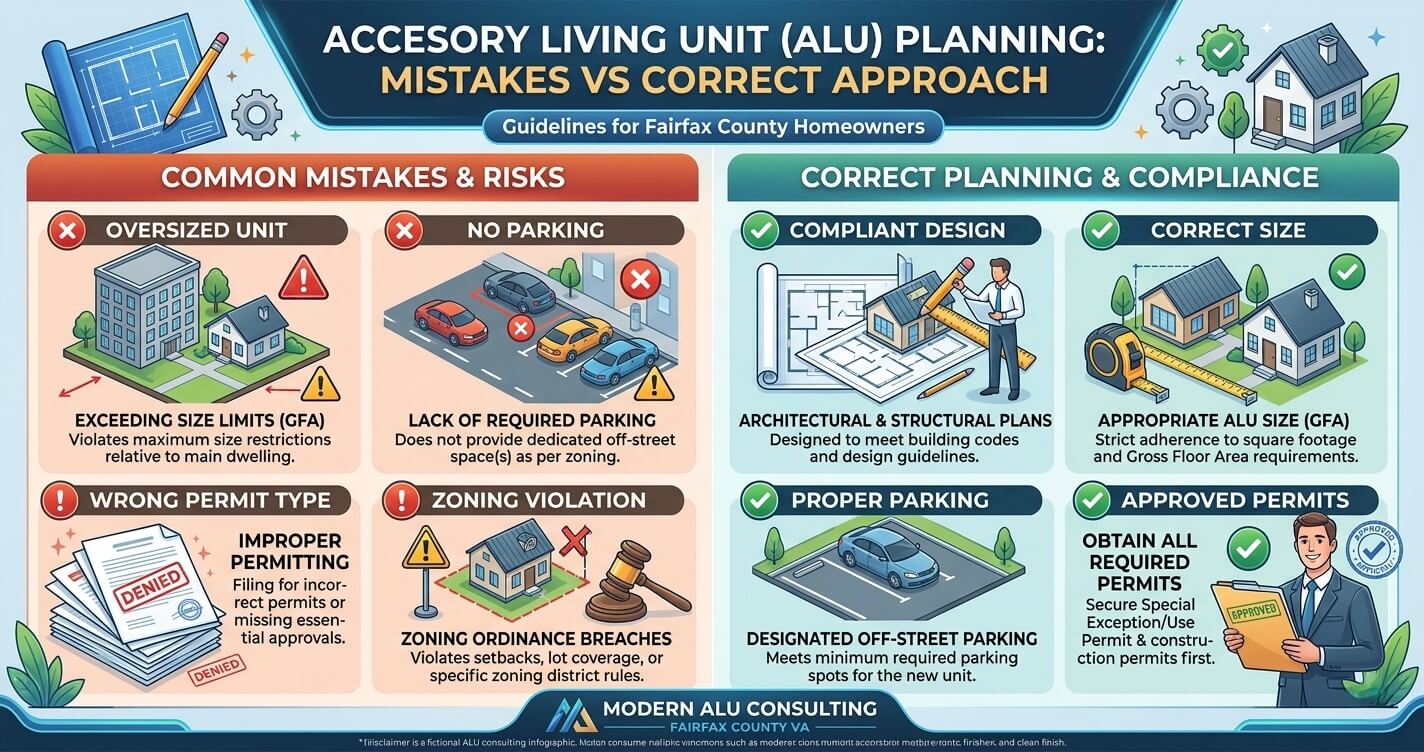
Ignoring Zoning Rules
One of the biggest issues is assuming all properties qualify. Zoning restrictions vary widely across Northern Virginia, and skipping this step can halt your project before it starts.
Designing Oversized Layouts
Exceeding the 800 sq ft or 40% limit is a common reason for permit denial. Many homeowners underestimate how strictly these rules are enforced.
Lack of Parking Planning
Parking requirements still apply, especially in denser areas like Arlington VA. Not accounting for this can complicate approvals.
Not Identifying the Correct Permit Type
Choosing between an Administrative Permit and a Special Permit is critical. Applying under the wrong category can lead to delays and additional costs.
Hiring Non-Local Contractors
Contractors unfamiliar with Fairfax County VA regulations often overlook key zoning and compliance details. This is particularly risky in regulated areas like McLean VA and Vienna VA.
Avoiding these mistakes can save months of delays and significant redesign costs.
Accessory Living Unit Regulations in Northern Virginia
While this guide focuses on Fairfax County VA, ALU regulations vary across Northern Virginia, and understanding local differences is essential for homeowners.
Fairfax VA
Fairfax County has some of the most structured and clearly defined ALU regulations, including strict size, occupancy, and permit requirements. Compliance is closely monitored.
McLean VA
As part of Fairfax County, McLean follows the same zoning rules, but larger lot sizes often make detached ALUs more feasible; provided all requirements are met.
Arlington VA
Arlington has its own zoning framework, often with tighter restrictions due to higher density. Approval processes can differ significantly from Fairfax County.
Vienna VA
Vienna properties typically fall under Fairfax County zoning, but neighborhood characteristics, such as lot size and HOA guidelines, can influence feasibility.
Across Northern Virginia, the key takeaway is this:
Even small zoning differences can have a major impact on whether your ALU is approved.
That’s why homeowners planning an accessory living unit Fairfax County VA or nearby areas should approach the process with careful planning, local expertise, and a clear understanding of regulations.
When to Hire a Professional for Your Accessory Living Unit?
Planning an accessory living unit Fairfax County VA may seem straightforward at first, but the reality is that zoning regulations, permits, and design constraints can quickly become overwhelming, especially for homeowners in Northern Virginia.
Here’s when hiring a professional becomes essential:
Permit Complexity
Navigating between Administrative Permits and Special Permits requires a clear understanding of county processes. A small mistake in documentation or application type can lead to significant delays.
Zoning Interpretation
Zoning codes in Fairfax County VA are detailed and often require expert interpretation. This is particularly important for properties in Arlington VA or Vienna VA, where additional restrictions or overlays may apply.
Design Compliance
Your layout must meet strict requirements, including size limits, occupancy rules, and structural guidelines. Professionals ensure your design aligns with these standards from the beginning—avoiding costly revisions later.
Inspections and Approvals
From initial inspections to final approval, each phase requires coordination with county officials. Missing a required inspection or failing compliance checks can halt your project.
For many homeowners in McLean VA and Fairfax VA, working with a knowledgeable local team is not just helpful; it’s the difference between a smooth approval process and months of setbacks.
Accessory Living Unit Design & Construction Services in Northern Virginia
Designing and building an ALU is not just about adding space, it’s about creating a fully compliant, functional living unit that meets Fairfax County VA regulations while enhancing your property’s value.
In Northern Virginia, successful ALU projects require a coordinated approach that includes:
- Zoning analysis and feasibility studies
- Custom architectural design
- Permit application management
- Code-compliant construction
- Final inspections and approvals
Homeowners in areas like McLean VA, Vienna VA, and Fairfax VA often face unique challenges related to lot size, neighborhood restrictions, and permit pathways. Without proper planning, these factors can delay or even prevent project approval.
This is where professional design-build services become invaluable, ensuring that every step, from concept to completion, is handled with precision and local expertise.
Get Help with Accessory Living Units in Fairfax County VA
Homeowners planning an accessory living unit Fairfax County VA often benefit from working with an experienced design-build team familiar with local zoning rules and permit requirements in Northern Virginia.
US Home Design Build helps homeowners design and construct compliant accessory living units while managing permits, approvals, and inspections. With a deep understanding of Fairfax County VA regulations and local building requirements, their team ensures your project is handled efficiently and correctly from start to finish.
Whether you’re considering a basement apartment in Fairfax VA, an addition in Vienna VA, or exploring options for a detached unit in McLean VA, having the right team on your side can simplify the entire process.
Contact US Home Design Build
Address: 8200 Greensboro Dr #900, McLean VA 22102
Phone: 703 202 3520
Website: www.ushdb.com
Contact US Home Design Build today to discuss your accessory living unit project and get expert guidance on permits, design, and construction.
Final Thoughts
Planning an accessory living unit Fairfax County VA requires a clear understanding of zoning regulations, size limits, occupancy rules, and permit requirements. From determining eligibility to securing approvals and completing inspections, every step must align with Fairfax County VA guidelines to ensure long-term compliance.
For homeowners across Northern Virginia, especially in Fairfax VA, McLean VA, Arlington VA, and Vienna VA, the process can be complex but also highly rewarding when done correctly. An ALU not only adds functional living space but also increases property value and supports evolving family needs.
Because of the technical nature of permits and zoning laws, working with experienced professionals can help you avoid costly mistakes and streamline the entire process.
If you’re considering building an accessory living unit Fairfax County VA, now is the time to plan carefully, follow local regulations, and seek expert guidance to bring your project to life successfully.
