
In most cases, the answer to whether you can Airbnb ADU Northern Virginia is no, at least not in Fairfax County, where the zoning ordinance explicitly bars short-term lodging in any accessory dwelling unit. Arlington County takes a narrower but still restrictive approach through its Accessory Homestay ordinance. For homeowners in Fairfax County, McLean, Vienna, Great Falls, Reston, Burke, and Arlington who are budgeting an ADU partly around nightly-rental income, understanding these rules before finalizing floor plans can prevent a costly permitting mistake.
This guide walks through exactly what each jurisdiction allows, what it doesn’t, and what the realistic income path looks like when short-term rental isn’t an option. With years of experience navigating Northern Virginia’s ADU permitting process, our design-build team at US Home Design Build has seen firsthand how often this restriction catches homeowners off guard mid-project.
Can You Airbnb an ADU in Fairfax County, VA?
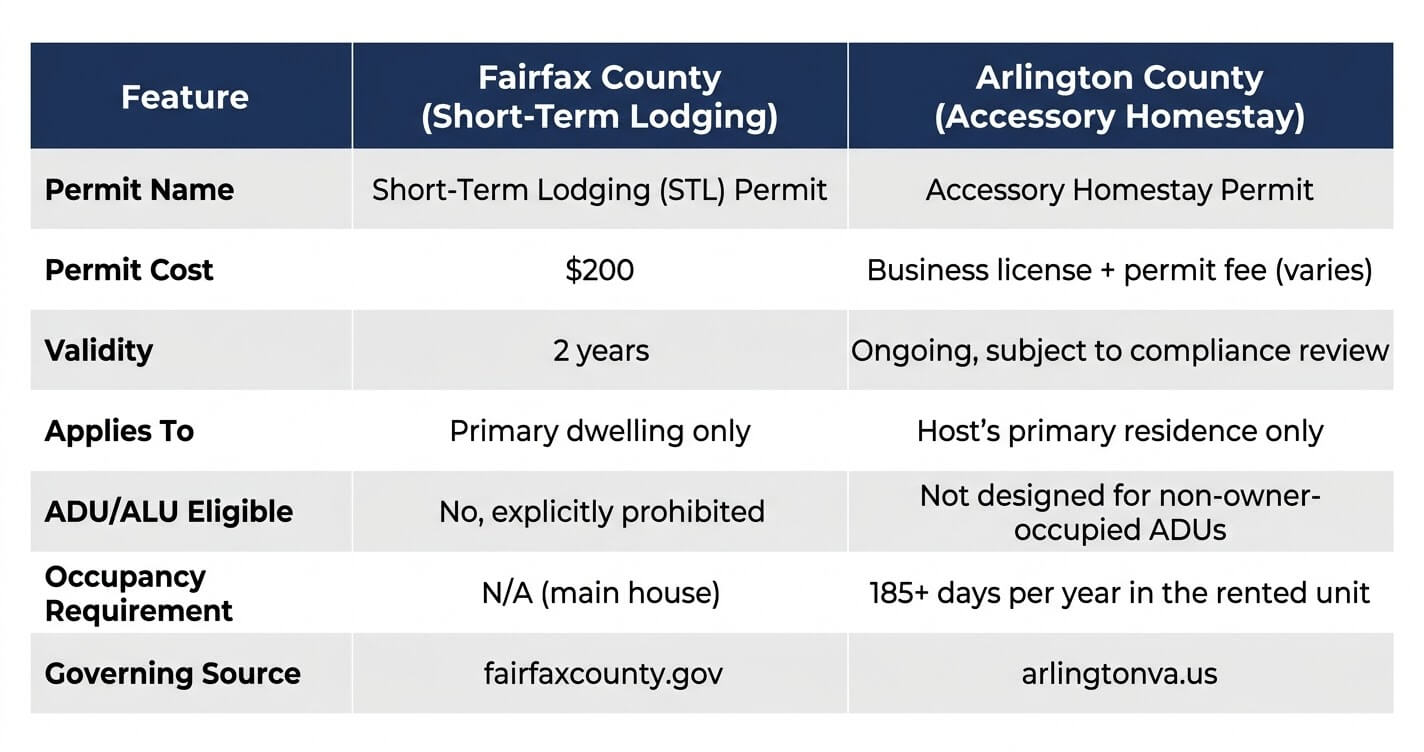
No. Fairfax County’s Zoning Ordinance explicitly prohibits short-term lodging in an accessory living unit (ALU), detached accessory structure, or affordable/workforce dwelling unit. Short-term rental in Fairfax County is only permitted in the primary dwelling itself, and only with a separate Short-Term Lodging permit.
Fairfax County officially calls ADUs “Accessory Living Units” (ALUs), and its zoning code treats short-term lodging as an entirely separate use category from ALU occupancy. Since October 1, 2018, Fairfax County has permitted Short-Term Lodging (STL) as an accessory use in any zoning district that allows residential use, but only inside the main dwelling. Homeowners must secure a zoning permit before advertising or beginning short-term lodging; the permit costs $200 and remains valid for two years.
Critically, the same ordinance draws a hard line around accessory structures. Fairfax County’s zoning standards state that short-term lodging is prohibited in a detached accessory structure, accessory living unit, temporary family health care structure, affordable dwelling unit, or workforce dwelling unit.
This means a homeowner in McLean, Vienna, or Burke who builds a detached backyard ALU or converts a basement into an ALU cannot legally list that unit on Airbnb, VRBO, or any similar platform, regardless of whether the main house is separately permitted for short-term lodging. For a full breakdown of ALU zoning eligibility, size limits, and the permit process, see our ADU Permit Fairfax County VA guide, which covers this restriction in the context of the full ALU approval timeline.
Can You Airbnb an ADU in Arlington County, VA?
Only under narrow conditions, and generally not for a standalone backyard ADU rented independently. Arlington regulates short-term rentals through a separate “Accessory Homestay” permit that requires the unit being rented to function as the host’s primary residence, a structurally different framework from Arlington’s Accessory Dwelling (AD) permit.
Arlington County classifies short-term rentals under a home-occupation category called “Accessory Homestay,” created when the County Board adopted new Zoning Ordinance regulations covering this use.
Under this framework, an Accessory Homestay permit only authorizes short-term rental of a unit that functions as the host’s (owner’s or renter’s) primary residence, it was not designed around detached, non-owner-occupied accessory dwellings. Industry compliance research places the owner-occupancy threshold at a minimum of 185 days per year in the unit being rented, with occupancy caps of six guests or two guests per bedroom, whichever is greater. Homeowners should confirm current thresholds directly with Arlington’s Zoning Division before applying, since these specific figures come from third-party compliance research rather than the county’s own published ordinance text.
This creates a practical conflict for ADU owners: Arlington’s separate Accessory Dwelling (AD) permit process is built around a detached or interior unit that is not the primary residence of the main homeowner, that’s the entire premise of building one. See our ADU Permit Arlington VA guide for full eligibility and size requirements. Because Accessory Homestay requires primary-residence occupancy of the rented unit, a homeowner who lives in the main house and wants to Airbnb a separate backyard AD, rather than live in it themselves, does not fit the ordinance’s core requirement. Homeowners considering this route should request a written determination from Arlington’s Zoning Administrator (zoningadmin@arlingtonva.us) before finalizing ADU construction plans around short-term rental income.
Fairfax County vs. Arlington: Side-by-Side Short-Term Rental Comparison
Fairfax County flatly bars short-term lodging in any ADU; Arlington doesn’t name ADUs directly, but its Accessory Homestay primary-residence requirement makes a standalone rental-only ADU functionally non-compliant in most cases. Neither jurisdiction currently offers a clear, ADU-specific path to nightly rental income.
What Homeowners Get Wrong About ADUs and Airbnb
The most common mistake is designing and budgeting an ADU around projected nightly-rental income before confirming zoning eligibility, a decision that can undercut the entire financial case for the project. Three misconceptions come up repeatedly during Northern Virginia ADU consultations.

Misconception 1: “If my ADU has its own kitchen and bathroom, I can rent it however I want.”
Not automatically. In Fairfax County, a legal ALU only qualifies the space for long-term residential use — the same zoning approval does not extend to short-term lodging use.
Misconception 2: “Arlington’s newer ADU rules include Airbnb rights.”
Arlington’s Accessory Dwelling permit governs construction and long-term occupancy; it does not confer Accessory Homestay rights, which require a completely separate application and a primary-residence test. See our Design-Build Northern Virginia: 2026 Complete Guide for how permit complexity across Fairfax County and Arlington affects overall project timelines.
Misconception 3: “The county won’t find out.”
Both counties require advertisements to display the applicable permit number, and Virginia law requires hosting platforms like Airbnb to collect Transient Occupancy Tax on the county’s behalf, meaning the transaction is already visible to local tax authorities before enforcement even gets involved.
Homeowners weighing an ADU partly for short-term rental income may benefit from a zoning feasibility review with an experienced design-build team before finalizing floor plans or budgets.
If Short-Term Rental Isn’t Allowed, What’s the Real ADU Income Path?
Long-term rental remains the legal and financially proven income path for a Northern Virginia ADU. In Arlington, one-bedroom ADUs commonly command $1,700 to $2,200 per month in long-term rent, generating measurable payback and resale value even without short-term rental income.
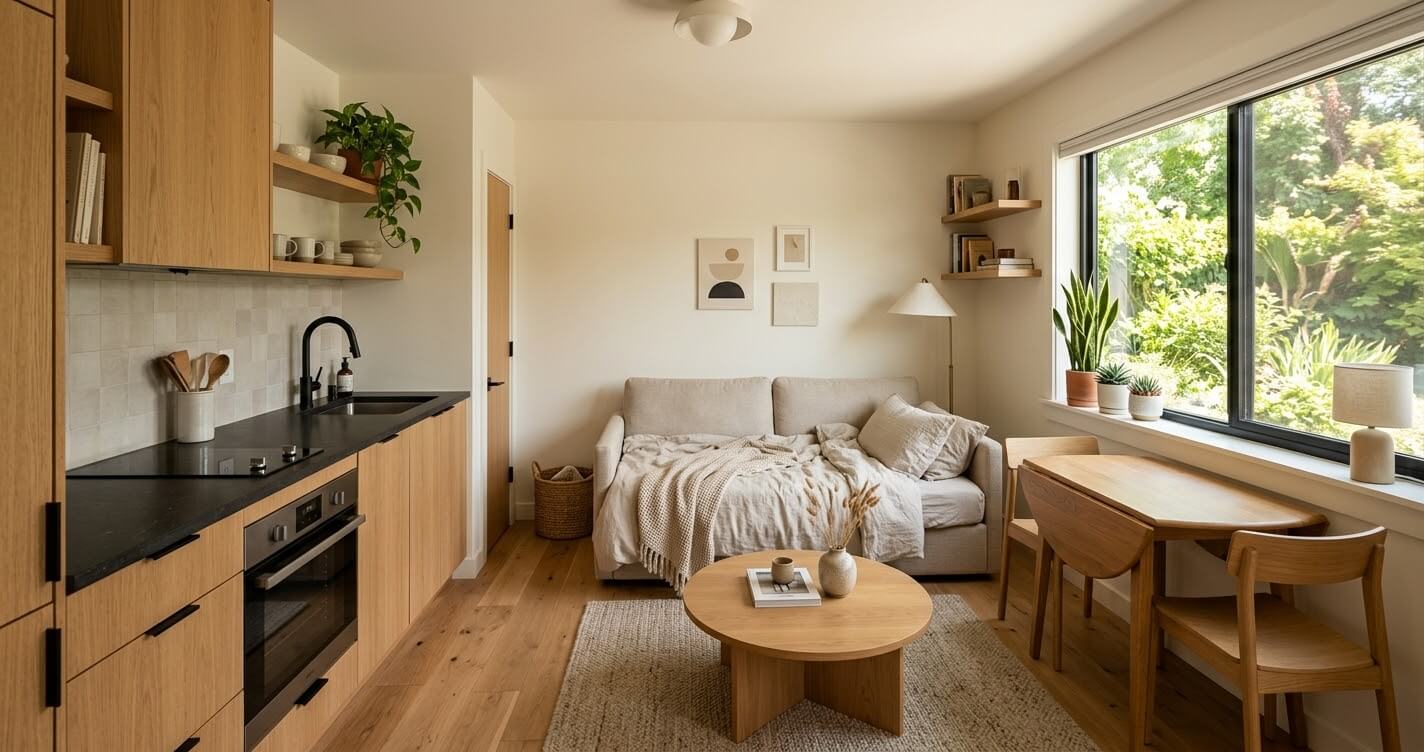
A properly designed and permitted ADU can generate monthly rental income while simultaneously increasing overall property value. In Arlington VA, one-bedroom ADUs commonly command rents between $1,700 and $2,200 per month.
Using a long-term rental model instead of short-term nightly rates removes STL/Accessory Homestay licensing risk entirely while still producing meaningful returns: a garage-conversion ADU costing approximately $127,400 can reach simple payback in roughly 5.7 years at a $1,850 monthly rent, and continue generating income indefinitely afterward.
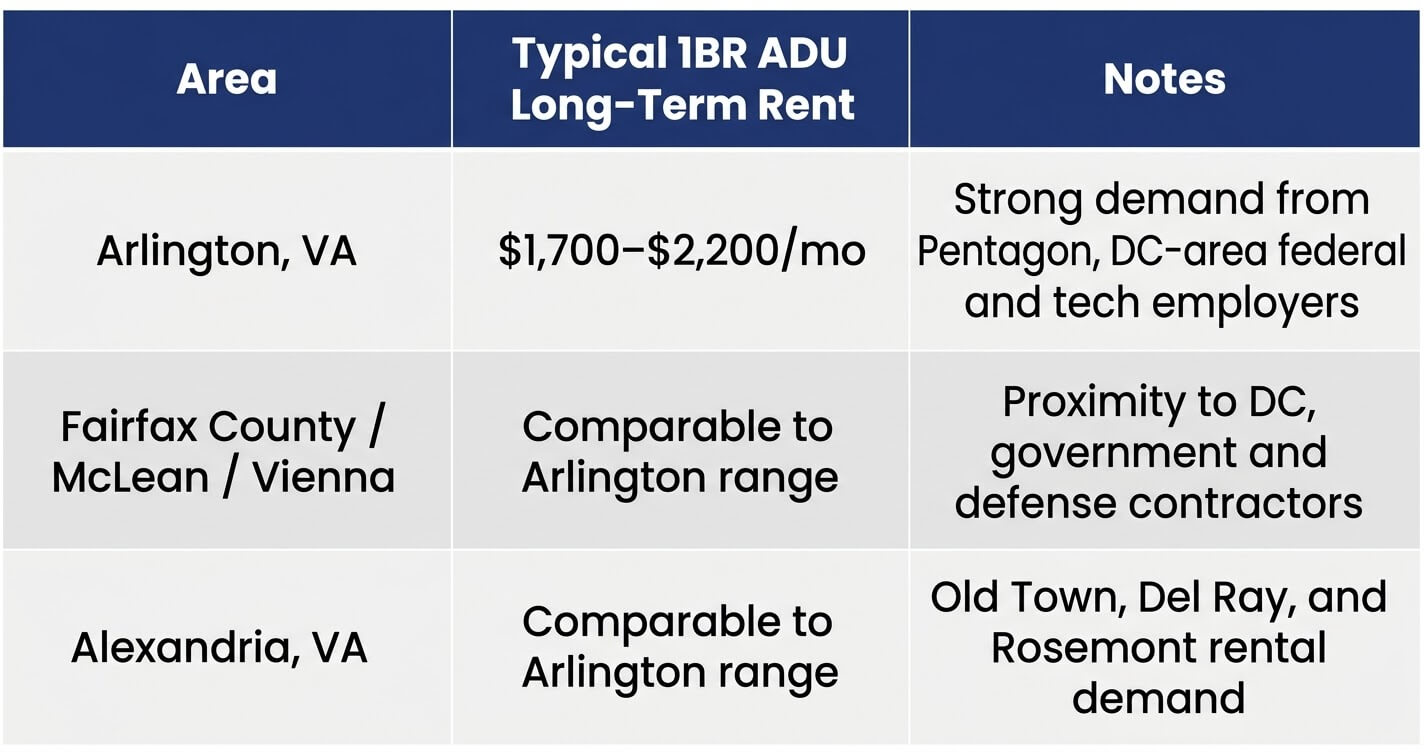
For typology-specific ADU construction guidance, see our ADU Builder in Alexandria, VA service page or our ADU Mistakes Fairfax County VA guide to avoid the most common and costly planning errors before construction begins.
Permit Enforcement and Risks of Non-Compliance
Operating an unpermitted short-term rental in an ADU carries real financial exposure: Virginia law requires platforms to collect occupancy tax on every booking, both counties require visible permit numbers in listings, and violations can trigger zoning enforcement, fines, and in Fairfax County’s case, ALU permit revocation.

Beyond the immediate risk of a zoning complaint, Fairfax County ties ALU legality to continued compliance with its permit terms. Using the space in a way that violates those terms, including for short-term lodging, can jeopardize the ALU’s legal status entirely, not just the rental activity.
Additionally, Fairfax County requires accommodation intermediaries and hosting platforms to collect and remit Transient Occupancy Tax on every short-term booking, and a Business Professional and Occupational License (BPOL) is required once gross receipts exceed $10,000 per calendar year, obligations that apply independently of whether the underlying zoning use is even legal.
Frequently Asked Questions

Can you Airbnb an ADU in Fairfax County, VA?
No. Fairfax County’s zoning ordinance explicitly prohibits short-term lodging in any accessory living unit, detached accessory structure, or affordable/workforce dwelling unit. Only the primary dwelling qualifies for a Short-Term Lodging permit.
What is Fairfax County’s Short-Term Lodging permit?
It is a zoning permit required before advertising or operating any short-term rental (stays under 30 days) in Fairfax County. It costs $200 and is valid for two years.
Does Arlington County allow Airbnb in an accessory dwelling unit?
Generally not for a standalone rental-only unit. Arlington’s Accessory Homestay permit requires the rented unit to be the host’s primary residence, which conflicts with how most Accessory Dwellings are used.
What’s the difference between Arlington’s Accessory Homestay and Accessory Dwelling permits?
Accessory Homestay authorizes short-term rental of a primary residence. Accessory Dwelling authorizes construction of a separate, long-term living unit. They serve different purposes, and holding one does not grant rights under the other.
Can you rent a Northern Virginia ADU long-term instead of short-term?
Yes. Long-term rental (30 days or more) is the legal and common income path for ADUs in both Fairfax County and Arlington, with one-bedroom units commonly renting for $1,700 to $2,200 per month in Arlington.
What happens if you Airbnb an ADU without the correct permit?
You risk zoning enforcement action and fines, and in Fairfax County, potential revocation of the ALU’s legal permit status, in addition to unpaid Transient Occupancy Tax exposure under Virginia law.
Final Thoughts
For homeowners across Fairfax County, Arlington, McLean, Vienna, and the rest of Northern Virginia, the short answer to whether you can Airbnb an ADU in Northern Virginia is almost always no, at least under current zoning frameworks in both jurisdictions. Fairfax County draws the clearest line by explicitly banning short-term lodging in any ALU. Arlington’s Accessory Homestay ordinance doesn’t name ADUs directly, but its primary-residence requirement makes a standalone rental-only ADU difficult to operate legally.
The financially sound and fully legal path remains long-term rental, which continues to deliver strong returns across Northern Virginia’s rental market. With years of hands-on experience navigating ALU and AD permitting in both Fairfax County and Arlington, our design-build team can help homeowners plan an ADU around a realistic, compliant income strategy from day one.

Planning an ADU in Fairfax County or Arlington? Contact US Home Design Build to review your zoning options, rental strategy, and realistic income path before you build.
