
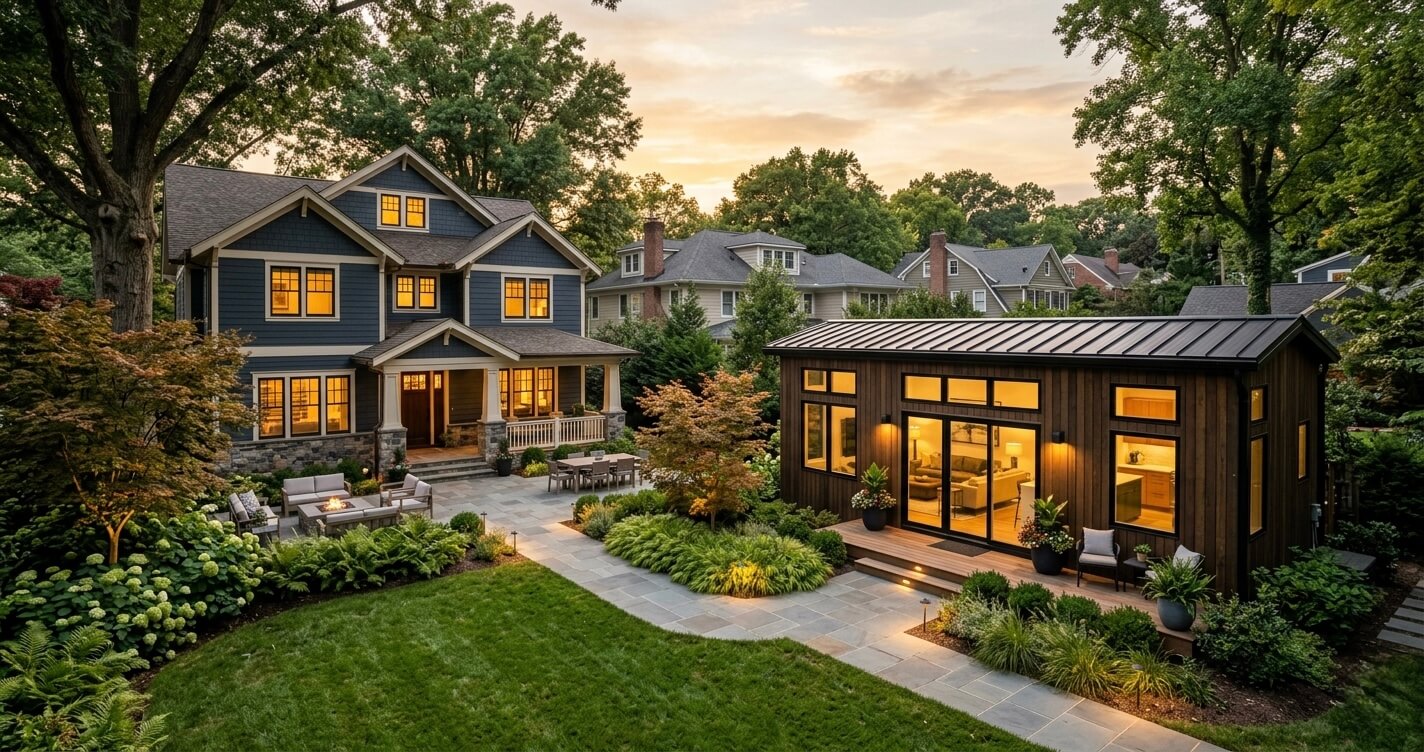
The decision to build an accessory dwelling unit under current ADU regulations Arlington VA homeowners must follow is no longer limited to investors or large-lot properties. Across Arlington County, homeowners are increasingly exploring detached backyard cottages, garage conversion apartments, and internal ADUs as a way to create flexible living space without leaving high-value neighborhoods.
The economic logic is straightforward. Arlington County’s median home value now exceeds $900,000, making every additional square foot of legally permitted living space significantly more valuable than in many surrounding housing markets.
At the same time, homeowners across Northern Virginia are facing converging lifestyle pressures: multigenerational living, aging parents moving closer to family, rising mortgage rates, and a shortage of flexible housing inventory. Accessory dwelling units address all of these issues simultaneously while preserving long-term property ownership in established neighborhoods.
National housing organizations have identified ADUs as one of the most practical solutions for aging-in-place and housing flexibility. [Source: AARP ADU Guide]
What makes Arlington unique, however, is that its ADU ordinance is highly regulated. Lot coverage calculations, setback requirements, height restrictions, parking rules, and zoning district limitations all determine whether an ADU is legally buildable before construction drawings even begin.
This guide explains the zoning rules, permit requirements, lot restrictions, setbacks, parking considerations, and practical planning issues Arlington VA homeowners must understand before building an ADU.
WHAT COUNTS AS AN ADU IN ARLINGTON VA?
Under current ADU regulations Arlington VA enforces, not every finished basement, detached shed, or garage conversion automatically qualifies as a legal accessory dwelling unit. Arlington County applies specific legal definitions, zoning standards, and occupancy requirements that determine whether a secondary living space is considered a lawful ADU.
Arlington County defines accessory dwellings as:
“Smaller independent residential dwelling units located on the same lot as a single-family home.” [Source: Arlington County Housing Arlington]
A legal accessory dwelling unit Arlington VA homeowners build must function as a self-contained residential space with independent living facilities, typically including:
- sleeping area
- bathroom
- kitchen or kitchenette
- independent access
- code-compliant utilities and egress
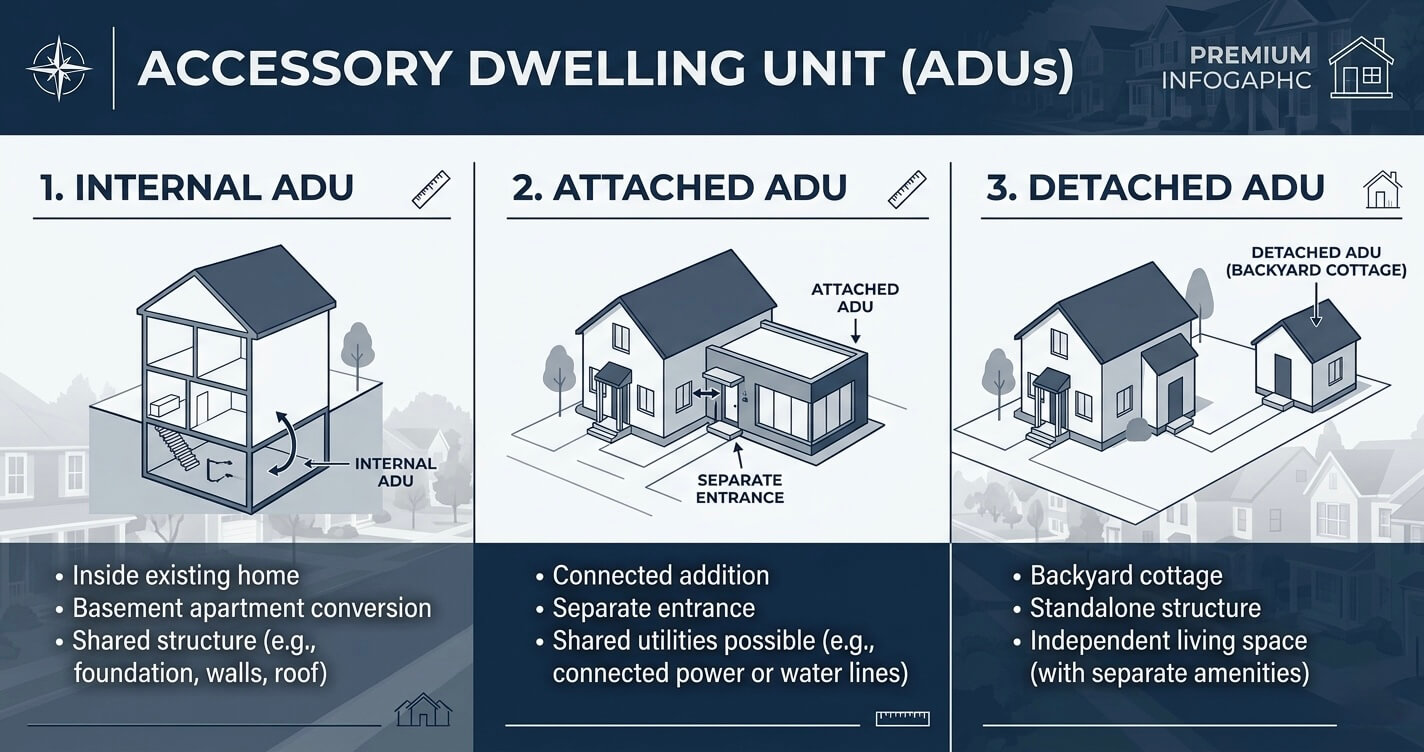
Internal ADUs
Internal ADUs are constructed within the existing primary residence, most commonly as basement apartments or converted lower levels. These units are often the most cost-effective option because they use the home’s existing structural envelope and utility systems.
Attached ADUs
Attached ADUs involve an addition connected directly to the primary residence but designed with a separate entrance and partially independent living layout.
Detached ADUs
Detached ADUs, often called backyard cottages Arlington VA homeowners research, are standalone residential structures located separately from the main home.
Garage Conversion ADUs
Garage conversion ADU Arlington VA projects convert attached or detached garages into livable residential space. However, structural upgrades, insulation, ceiling height compliance, emergency egress, and utility separation often make these conversions more technically complex than homeowners initially expect.
Importantly, Arlington permits ADUs only within specific zoning districts and subject to strict size, setback, occupancy, and lot coverage requirements. Not every basement renovation or detached structure qualifies legally.
ARLINGTON VA ZONING RULES FOR ADUS
Zoning compliance is the single most important factor determining whether an accessory dwelling unit can legally be built under current ADU regulations Arlington VA homeowners must follow. Most failed ADU projects in Arlington do not fail because of construction issues, they fail during zoning review because the lot cannot legally accommodate the proposed structure.
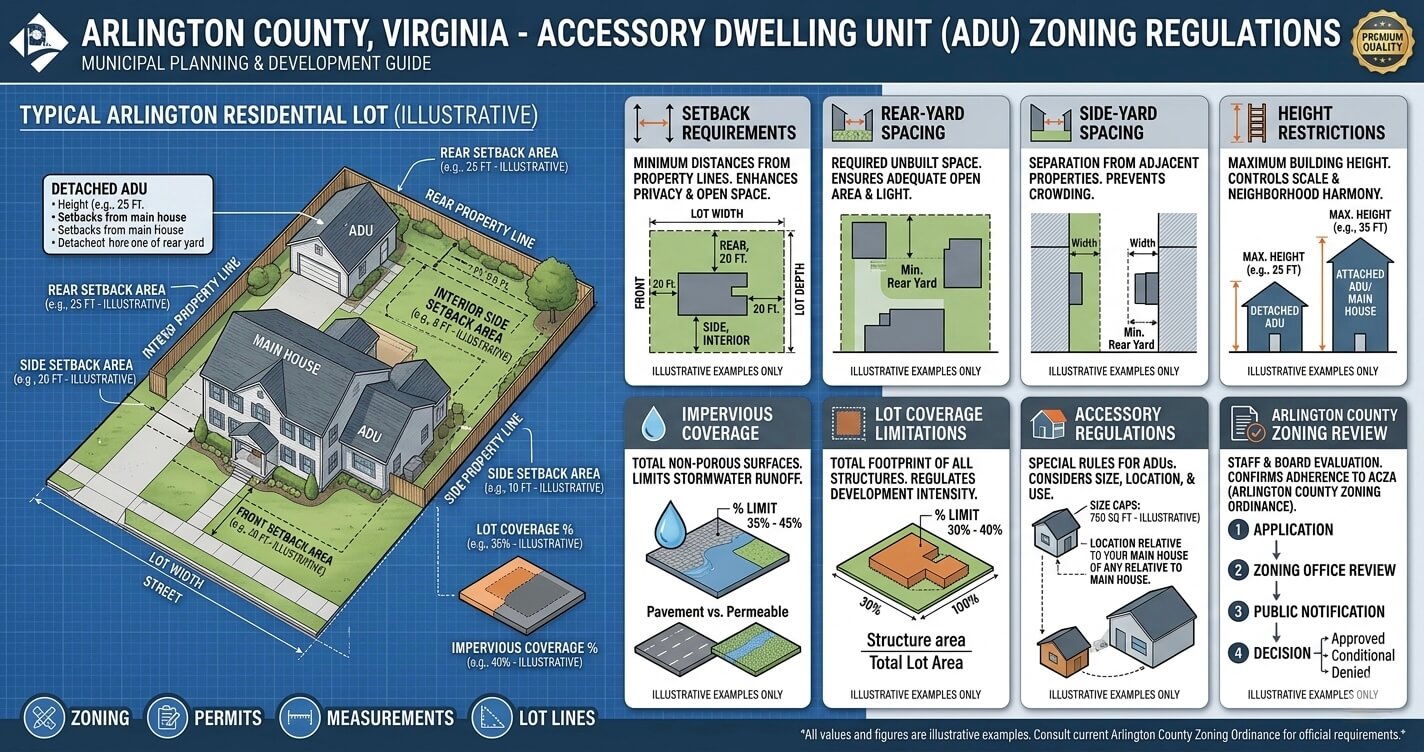
All Arlington County ADUs are governed under the Arlington County Zoning Ordinance. [Source: Arlington County Zoning Ordinance]
ZONING DISTRICTS
ADUs are permitted only within specific residential zoning classifications established by Arlington County. Before any design work begins, homeowners must verify that their parcel is located within an eligible zoning district.
ADU SIZE LIMITS
Arlington requires accessory dwelling units to remain subordinate to the primary residence in both scale and appearance. Floor area limitations are generally proportional to the size of the principal dwelling, preventing oversized detached units that visually dominate the lot.
HEIGHT RESTRICTIONS
Detached ADUs and backyard cottages Arlington VA homeowners build must comply with accessory structure height limitations established by county zoning regulations. Taller detached structures, lofted garages, or second-story ADUs may trigger additional review requirements or design restrictions.
SETBACK REQUIREMENTS
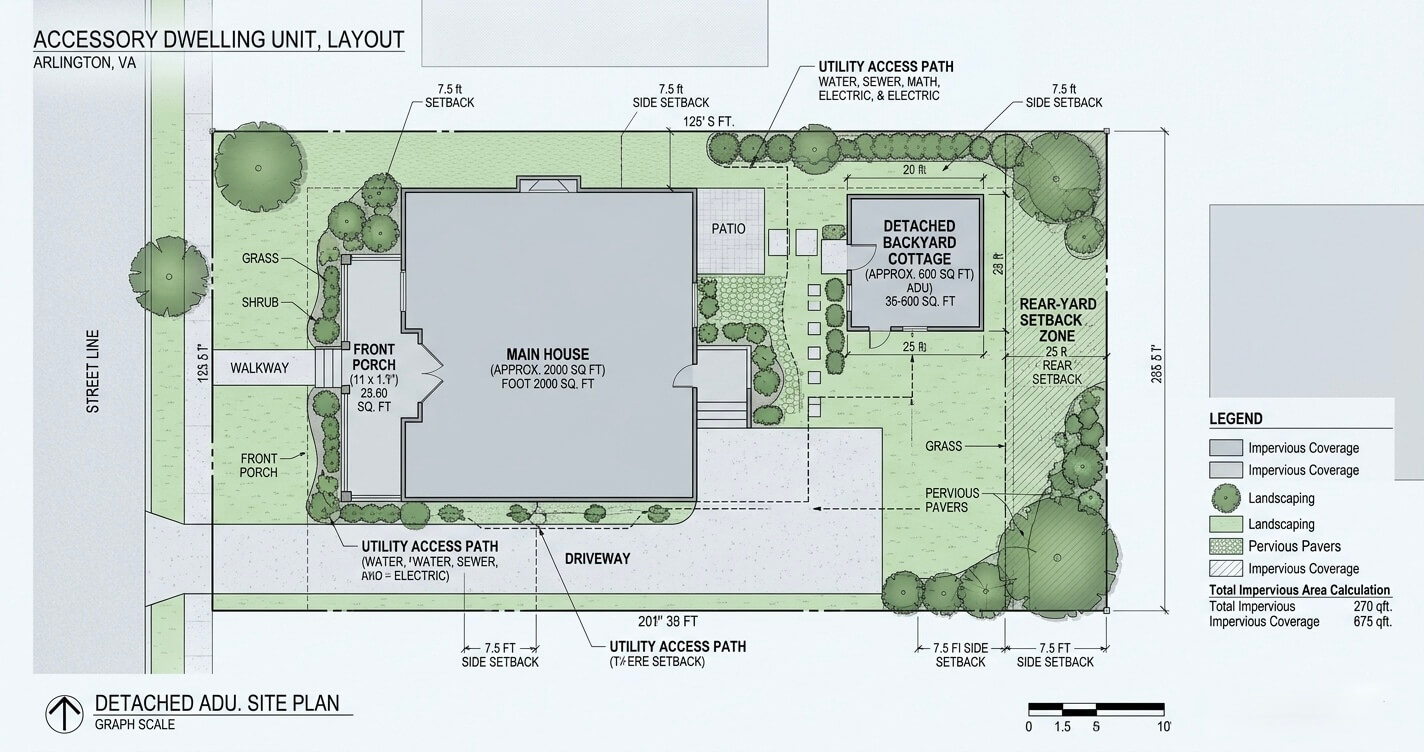
Rear-yard and side-yard setbacks significantly affect detached ADU feasibility. Required setbacks are measured from property lines and reduce the actual buildable footprint available on the lot.
This becomes particularly challenging in Arlington neighborhoods with narrower parcels and older subdivision patterns where side-yard clearance is already limited.
PARKING REQUIREMENTS
Parking rules vary depending on zoning classification, proximity to transit corridors, and project type. Some Arlington ADU projects may require additional off-street parking accommodations during review.
LOT COVERAGE & IMPERVIOUS SURFACE LIMITS
Detached ADUs contribute toward both lot coverage and impervious surface calculations. Many Arlington properties appear visually large enough for an ADU but fail zoning calculations once driveways, patios, walkways, and existing accessory structures are included.
Because Arlington zoning review occurs before permit approval, a professional feasibility analysis is critical at the earliest planning stage.
A qualified design-build contractor evaluates:
- zoning district compliance
- existing lot coverage
- utility routing feasibility
- setback conflicts
- stormwater implications
before architectural drawings are finalized.
For homeowners comparing ADU investments with broader expansion projects, our guide on Home Addition Cost in Northern Virginia provides additional cost-planning context for the regional market.
PERMIT REQUIREMENTS FOR ADUS IN ARLINGTON VA
Building an accessory dwelling unit under current ADU regulations Arlington VA homeowners must follow requires substantially more than a basic building permit. ADUs are treated as legally habitable residential structures, meaning Arlington County reviews them through multiple technical and zoning disciplines before approval is granted.
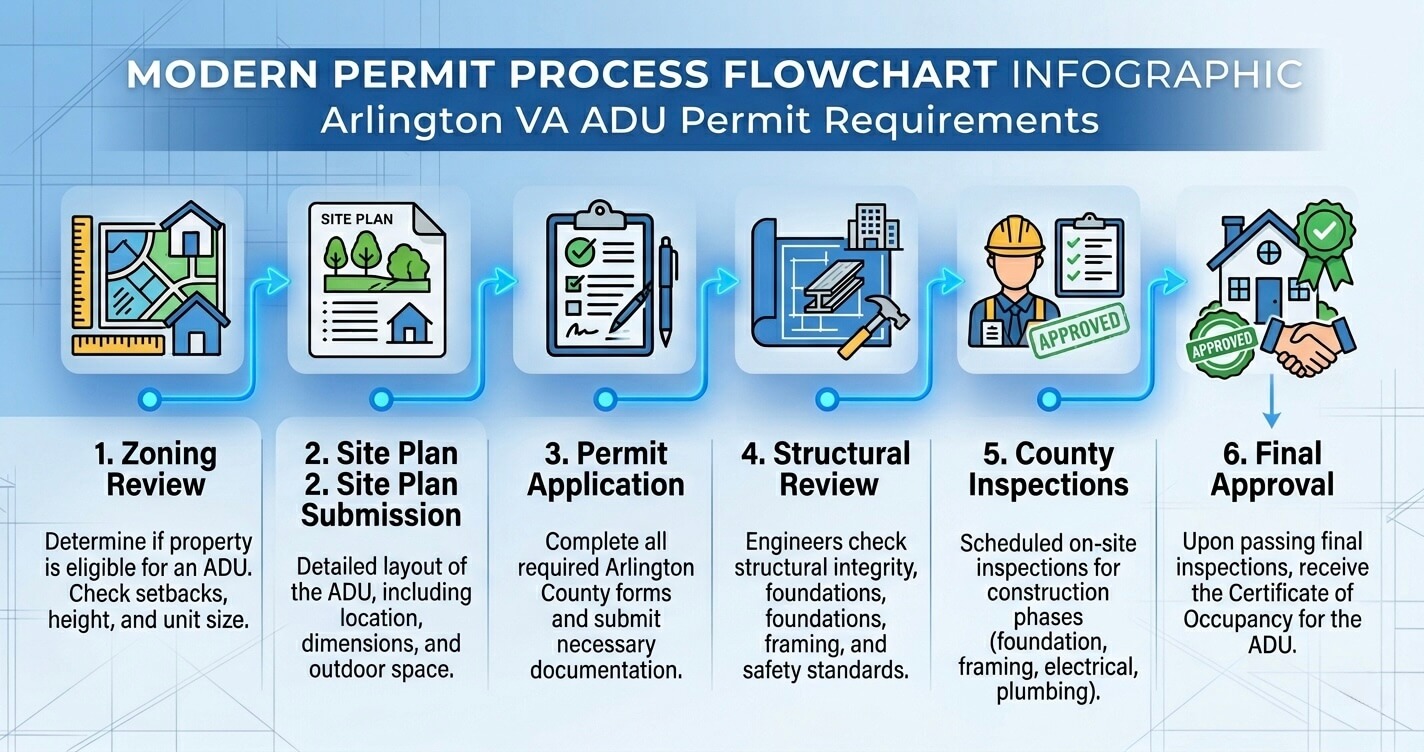
All permits are administered through Arlington County’s permitting system. [Source: Arlington County Permits]
In addition, all Arlington ADU construction must comply with Virginia’s statewide building code requirements.
“As of January 18, 2025, Virginia jurisdictions enforce the 2021 Virginia Uniform Statewide Building Code.” [Source: Virginia DHCD — USBC]
PERMITS REQUIRED FOR MOST ARLINGTON ADUS
Depending on the project type, Arlington VA ADU permit requirements commonly include:
- building permit
- electrical permit
- plumbing permit
- mechanical/HVAC permit
- zoning approval
- stormwater review (where applicable)
Detached backyard cottage Arlington VA projects often trigger the most extensive review because they involve new foundations, separate utility routing, grading work, and accessory structure compliance.
REQUIRED SUBMISSIONS
Arlington County typically requires:
- detailed site plan
- floor plans
- exterior elevations
- structural engineering drawings
- utility connection plans
- energy code compliance documentation
Incomplete submission packages are one of the biggest causes of permit delays.
INSPECTION STAGES
Most accessory dwelling unit Arlington VA projects require multiple inspections throughout construction, including:
- footing inspection
- framing inspection
- electrical inspection
- insulation inspection
- final building inspection
ARLINGTON-SPECIFIC CHALLENGES
Tree preservation review and stormwater compliance regularly extend detached ADU approval timelines in Arlington neighborhoods with mature lots and limited permeable area. Even projects that satisfy setbacks may require revised grading or drainage plans before permits are approved.
Importantly, Arlington County and Fairfax County operate under different permit systems and review workflows. Homeowners researching regional requirements should understand that Arlington does not use the same administrative process covered in our guide on Remodeling Permit Fairfax County.
THE MOST COMMON ADU PLANNING MISTAKES IN ARLINGTON VA
Most failed ADU projects in Arlington do not fail because homeowners lack interest or financing, they fail because critical zoning and site constraints are discovered too late in the planning process. Under current ADU regulations Arlington VA enforces, early feasibility analysis is often more important than the architectural concept itself.
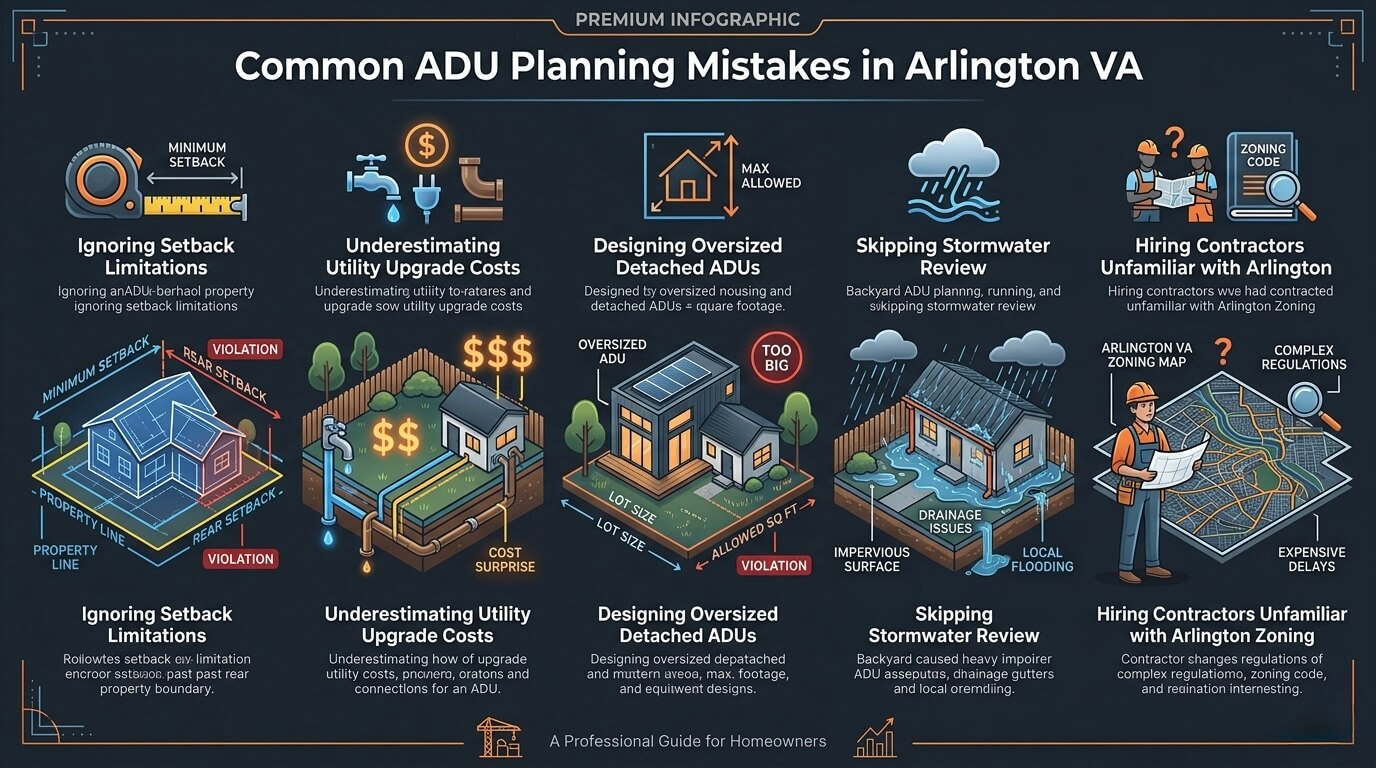
Mistake #1 — Ignoring Setback Limitations
Detached ADU Arlington VA projects frequently encounter side-yard and rear-yard setback conflicts. Arlington’s older neighborhoods contain many narrow lots where the theoretical backyard space appears sufficient visually but fails required setback calculations during zoning review.
Mistake #2 — Underestimating Utility Upgrade Costs
Many homeowners budget for framing and finishes while overlooking:
- sewer tie-in costs
- electrical service upgrades
- water line extensions
- HVAC zoning modifications
Garage conversion ADU Arlington VA projects are especially vulnerable because older garages often lack insulated slabs, adequate electrical capacity, and code-compliant ceiling heights.
Mistake #3 — Designing an Oversized Detached ADU
One of the most common design failures is attempting to maximize square footage beyond what the lot legally supports. Oversized backyard cottages often violate:
- lot coverage limitations
- accessory structure size restrictions
- height limitations
- impervious surface caps
Mistake #4 — Skipping Stormwater and Grading Review
Older Arlington properties frequently contain drainage constraints, mature tree systems, and elevation transitions that complicate detached ADU construction. Stormwater compliance can significantly alter project costs and timelines.
Mistake #5 — Hiring Contractors Unfamiliar With Arlington Zoning
A contractor experienced elsewhere in Northern Virginia may still lack familiarity with Arlington County ADU rules, zoning review procedures, and neighborhood-specific development patterns.
Older Arlington lots commonly contain:
- easement conflicts
- mature tree preservation restrictions
- utility access constraints
At a national level, renovation projects routinely exceed budget because of unforeseen site and structural conditions discovered after construction begins.
A professional design-build process substantially reduces these risks because zoning review, permit coordination, engineering analysis, and construction planning occur under one integrated workflow instead of through disconnected parties making independent assumptions.
HOW MUCH DOES AN ADU COST IN ARLINGTON VA?
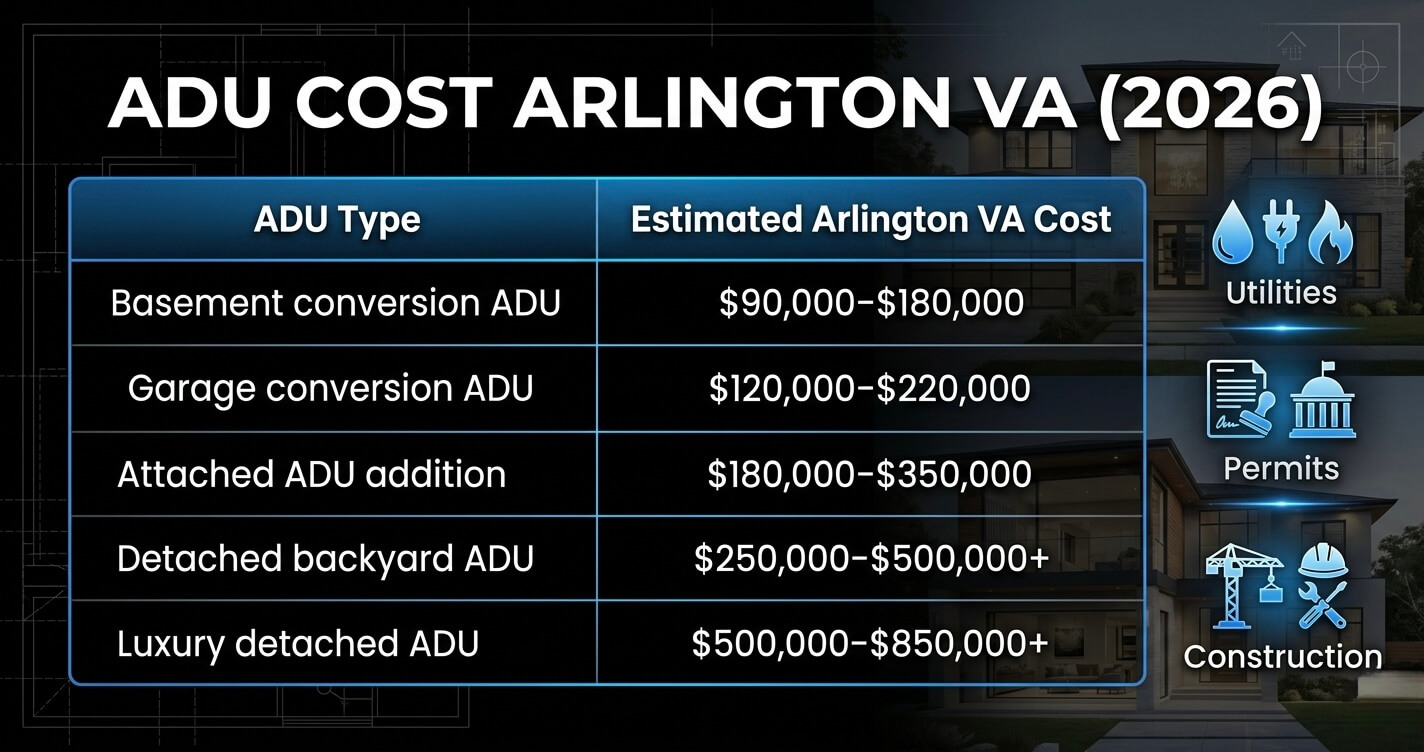
ADU cost Arlington VA homeowners should realistically budget for is substantially higher than national averages due to Arlington’s elevated labor market, permitting complexity, zoning limitations, and premium finish expectations.
Nationally, accessory dwelling unit construction costs vary significantly depending on structure type and infrastructure requirements.
“ADU construction costs vary widely based on structure type, utility connections, and finish level.” [Source: Freddie Mac ADU Guide]
ESTIMATED ADU COSTS IN ARLINGTON VA (2026)
STRUCTURAL COST DRIVERS
Detached accessory dwelling unit Arlington VA projects typically carry the highest structural costs because they require:
- excavation
- foundation construction
- retaining walls
- grading adjustments
- stormwater management systems
Arlington’s sloped lots and mature neighborhoods often increase excavation and drainage complexity beyond what homeowners initially anticipate.
UTILITY & INFRASTRUCTURE COSTS
Utility-related expenses are another major pricing factor, including:
- sewer tie-ins
- upgraded electrical service
- HVAC zoning systems
- water line extensions
- internet/data infrastructure
In older Arlington homes, electrical panel upgrades are frequently required before a legal ADU can be connected safely.
THE ARLINGTON PREMIUM
Construction pricing in Arlington VA sits well above national averages because of:
- high labor demand
- stricter permitting review
- limited site access
- premium architectural expectations
- tree preservation compliance costs
Detached backyard cottage Arlington VA projects may also require arborist reports, stormwater engineering, and permeable surface mitigation, all of which add cost before construction even begins.
For homeowners evaluating larger structural expansion options beyond detached ADUs, our guide on Second Story Additions explains how vertical additions compare from both a cost and zoning perspective in Northern Virginia.
ROI: DO ADUS ADD VALUE IN ARLINGTON VA?
From both a financial and functional perspective, accessory dwelling units built under current ADU regulations Arlington VA homeowners must follow can significantly strengthen long-term property value when designed and permitted correctly.
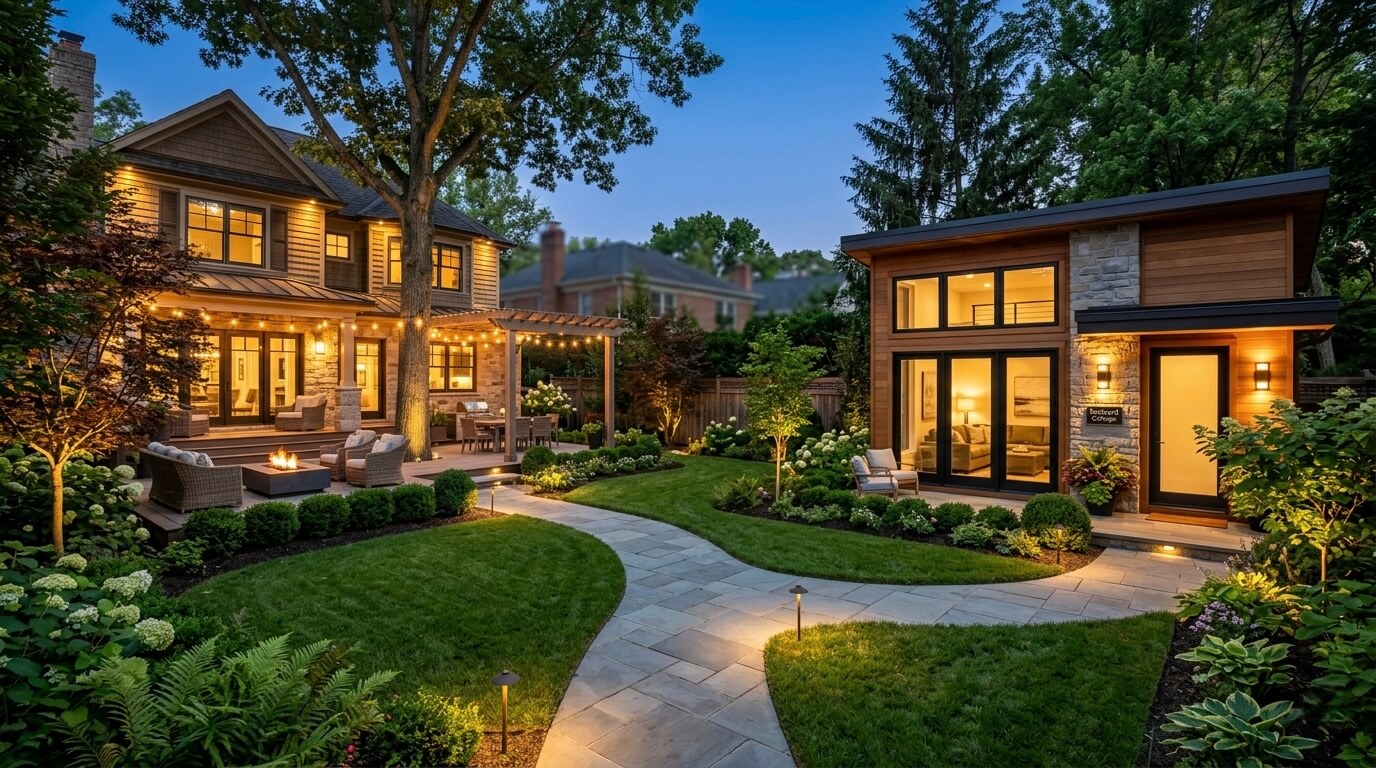
The strongest value driver is flexibility. A legal accessory dwelling unit Arlington VA property owners add can function as:
- multigenerational housing
- aging-in-place accommodation
- rental income space
- guest housing
- home office or caregiver suite
This adaptability is increasingly attractive in Arlington’s high-cost housing market, where buyers prioritize properties that can evolve with changing family and financial needs.
Freddie Mac notes that:
“Homes with ADUs often command increased buyer interest because they provide flexible housing and income potential.” [Source: Freddie Mac]
In Arlington VA specifically, legal detached ADUs and garage conversion apartments are becoming premium features because buildable land is limited and housing costs remain elevated. Buyers increasingly value properties that offer independent living space without sacrificing location within established neighborhoods close to transit, schools, and employment centers.
A properly integrated backyard cottage Arlington VA homeowners build can also improve resale positioning by differentiating the property from competing listings with less functional space.
However, not every ADU improves value equally. Poorly planned projects can reduce buyer appeal if:
- parking access is compromised
- the detached structure clashes architecturally with the main residence
- privacy between structures is poorly designed
- zoning compliance is questionable or undocumented
The highest-return ADUs are those that look architecturally intentional, not like an afterthought added solely for short-term rental potential.
HOW TO CHOOSE THE RIGHT ADU CONTRACTOR IN ARLINGTON VA
Selecting the right contractor is one of the most important decisions homeowners make under current ADU regulations Arlington VA projects require. ADUs combine zoning compliance, structural engineering, utility coordination, and residential construction into a single highly regulated process. A contractor unfamiliar with Arlington County’s review procedures can create expensive delays long before construction begins.
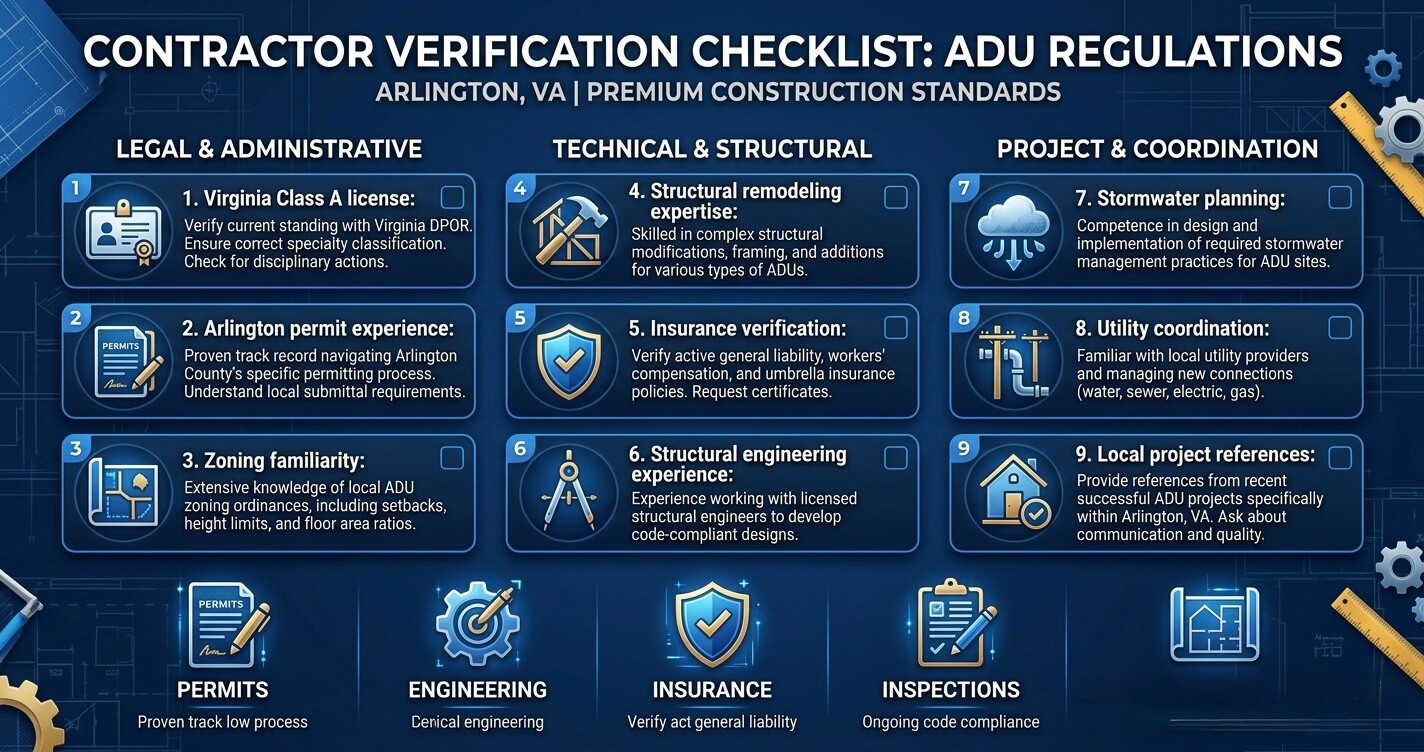
Before signing any agreement, homeowners should verify the following:
- Virginia Class A contractor license
- Arlington County permit experience
- familiarity with Arlington zoning regulations
- structural remodeling expertise
- active liability and workers’ compensation insurance
- references from completed Northern Virginia ADU projects
Detached accessory dwelling unit Arlington VA projects are especially technical because they require coordination between:
- grading and drainage planning
- stormwater compliance
- utility trenching
- foundation engineering
- electrical service upgrades
- zoning setback verification
These are not cosmetic remodels. They are small-scale residential construction projects subject to the same structural and code requirements as primary residences.
US Home Design Build operates from 8200 Greensboro Dr Suite 900, McLean VA, immediately adjacent to Arlington, and works with homeowners throughout Northern Virginia on zoning-sensitive residential additions and ADU projects.
Their design-build workflow integrates:
- consultation
- zoning review
- architectural planning
- permit coordination
- construction management
- post-construction warranty support
under one process instead of separating design and construction into disconnected phases.
This integrated approach substantially reduces mid-project redesigns, permit conflicts, and communication breakdowns that commonly affect Arlington VA ADU permit requirements.
For additional contractor evaluation guidance, see our article on How to Choose the Right Contractor in Northern Virginia.
FREQUENTLY ASKED QUESTIONS [FAQs]
Q1. Are ADUs legal in Arlington VA?
Yes. Arlington County permits accessory dwelling units in specific residential zoning districts subject to zoning, setback, size, height, occupancy, and permit requirements. [Source: Arlington County Housing Arlington]
Q2. How much does a detached ADU cost in Arlington VA?
A detached ADU Arlington VA homeowners build typically costs between $250,000 and $500,000+, while luxury backyard cottages with premium finishes can exceed $850,000 depending on structure size, grading complexity, utility work, and architectural detailing.
Q3. Do I need a permit for an ADU in Arlington?
Yes. Arlington VA ADU permit requirements generally include building, electrical, plumbing, and mechanical permits, along with zoning review and inspections. Detached ADUs may also require stormwater and tree preservation review. [Source: Arlington County Permits]
Q4. Can I build an ADU above my garage?
Possibly. Garage conversion ADU Arlington VA projects and over-garage ADUs may be permitted depending on zoning district, height limits, lot coverage, parking requirements, and structural feasibility. Engineering review is commonly required.
Q5. Do Arlington ADUs increase property value?
In many cases, yes. Flexible living space, rental potential, and multigenerational housing capability improve buyer appeal in Arlington’s high-cost housing market. Freddie Mac notes that homes with ADUs often attract stronger buyer interest because of their versatility and income potential.
CRUX OF THE MATTER
Accessory dwelling units are one of the most flexible and financially strategic residential additions available under current ADU regulations Arlington VA homeowners must navigate, but only when planned correctly from the beginning.
Arlington’s zoning rules are highly specific, and setbacks, lot coverage, utility routing, stormwater compliance, and permit approvals all affect whether an ADU is legally buildable long before construction starts.
The most successful projects begin with:
- accurate zoning verification
- realistic cost planning
- early utility analysis
- experienced permit coordination
- contractors familiar with Arlington County review processes
“In Arlington’s high-value housing market, a well-designed ADU is no longer viewed as excess space, it is increasingly viewed as intelligent space.”
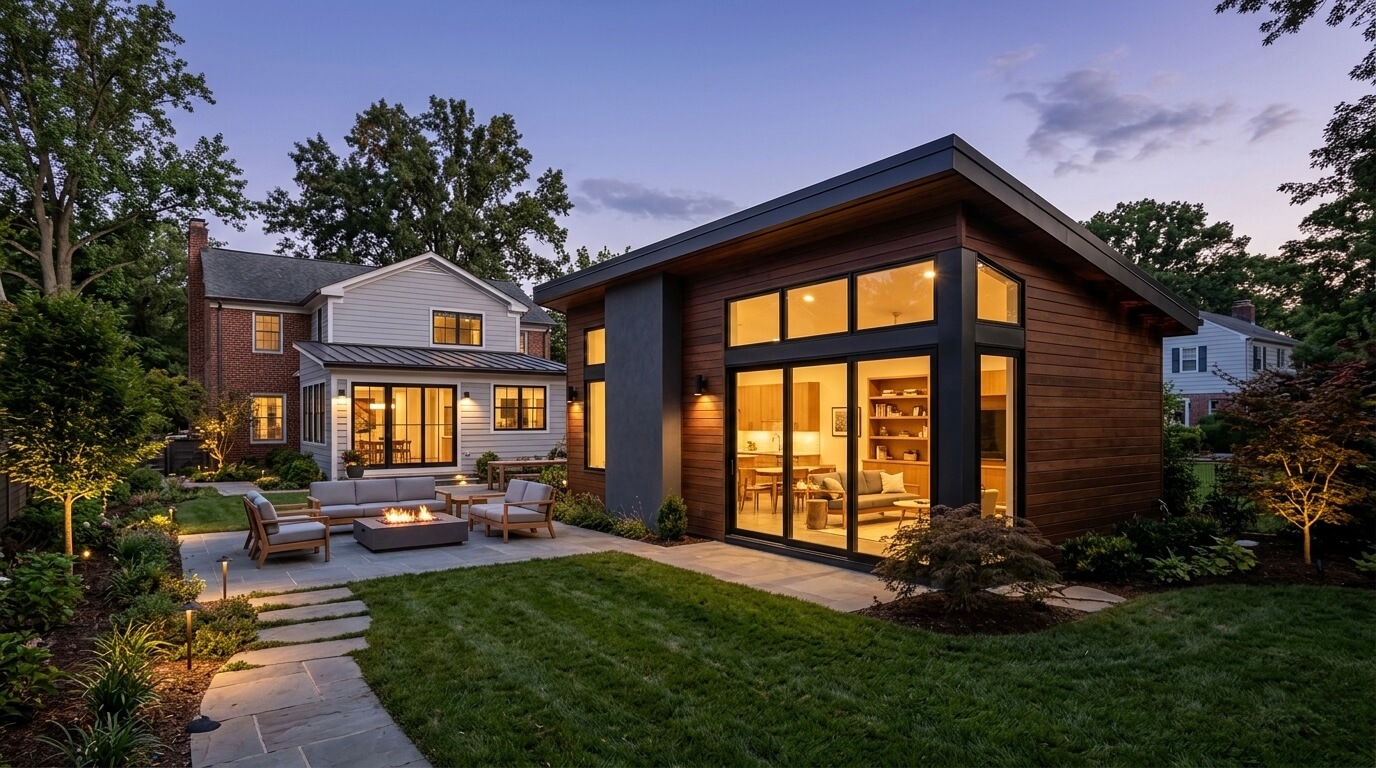
US Home Design Build works with homeowners across Arlington VA, McLean VA, Fairfax VA, Vienna VA, and throughout Northern Virginia on accessory dwelling units, garage conversions, detached backyard cottages, and zoning-sensitive home additions.
Their design-build process, consultation → design → build → maintain, integrates zoning review, permit coordination, craftsmanship, and a two-year workmanship warranty into a single streamlined workflow.
703-202-3520 | https://ushdb.com | 8200 Greensboro Dr Suite 900, McLean, VA 22102
