
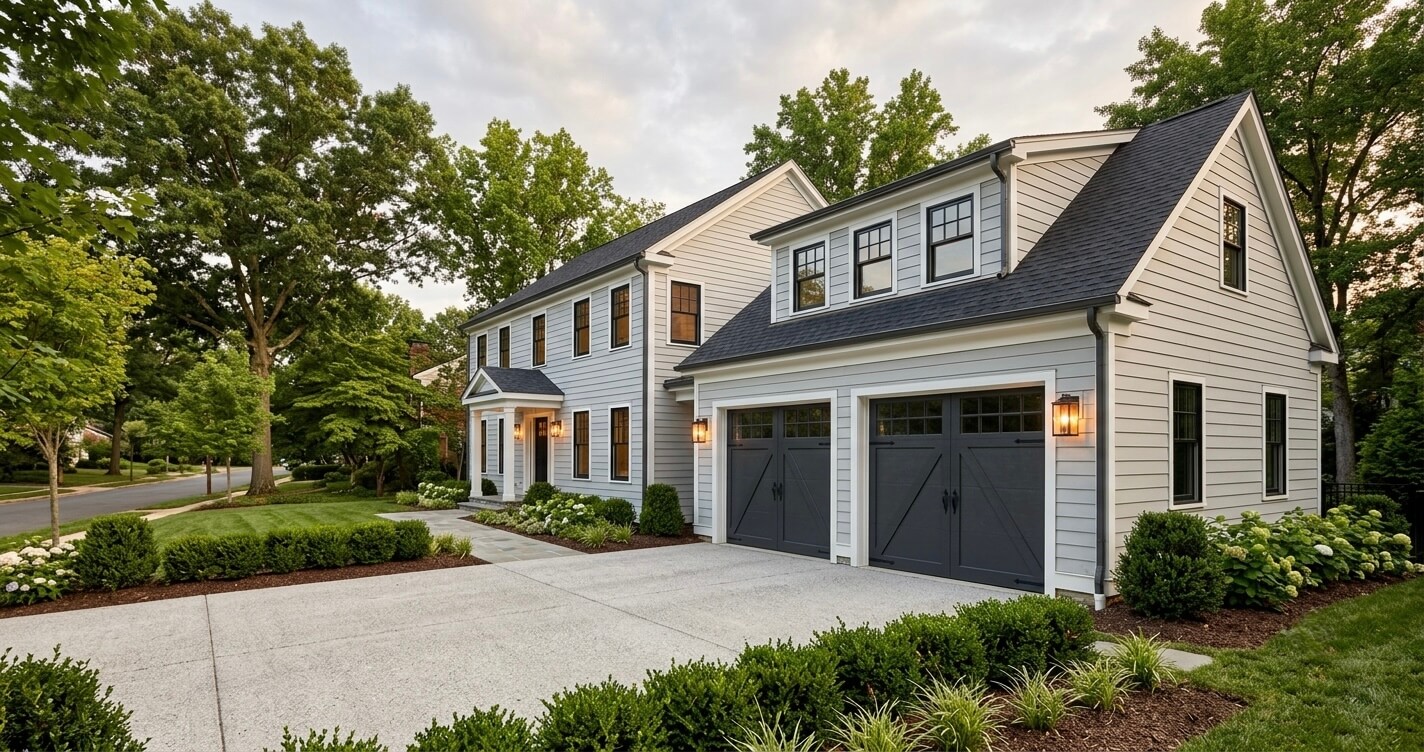
Understanding the garage addition mistakes Falls Church VA homeowners make before construction begins is critical in a market where zoning restrictions, permit requirements, and lot constraints can dramatically affect both project cost and approval timelines. In Falls Church VA, garage additions are not simply about adding parking or storage, they are long-term property investments that directly influence resale value, curb appeal, and functional living space.
A garage addition is one of the strongest ROI-producing exterior improvements available to Northern Virginia homeowners, typically returning 60%–85% of project cost depending on location, construction quality, and functionality. Even smaller exterior improvements remain highly valuable in this market: a new garage door alone delivers an average 268% return nationally in the 2025 Cost vs. Value Report. [Source: HomeLight]
What makes Falls Church unique is that it operates as an independent city with its own zoning ordinance, permit process, and Building Division, entirely separate from Fairfax County. Homeowners who mistakenly apply Fairfax County rules to a Falls Church project often discover problems only after design work or permit submission has already begun.
This guide breaks down the seven most expensive and most common garage addition planning mistakes Falls Church VA homeowners make, and how to avoid them before they affect your budget, timeline, or approval process.
MISTAKE #1: CHOOSING ATTACHED VS. DETACHED WITHOUT UNDERSTANDING THE COST, ZONING, AND LIFESTYLE TRADEOFFS
One of the most common garage addition mistakes Falls Church VA homeowners make is deciding between an attached or detached garage based on assumptions rather than site realities. Many homeowners begin with a preference driven by convenience, appearance, or resale assumptions without understanding how lot dimensions, zoning restrictions, setbacks, driveway geometry, and future use plans affect the viability of each option.
Attached garages are typically 10%–20% less expensive than detached structures of comparable size because they share an existing structural wall and can often connect more efficiently to existing electrical and HVAC systems. [Source: List With Clever]
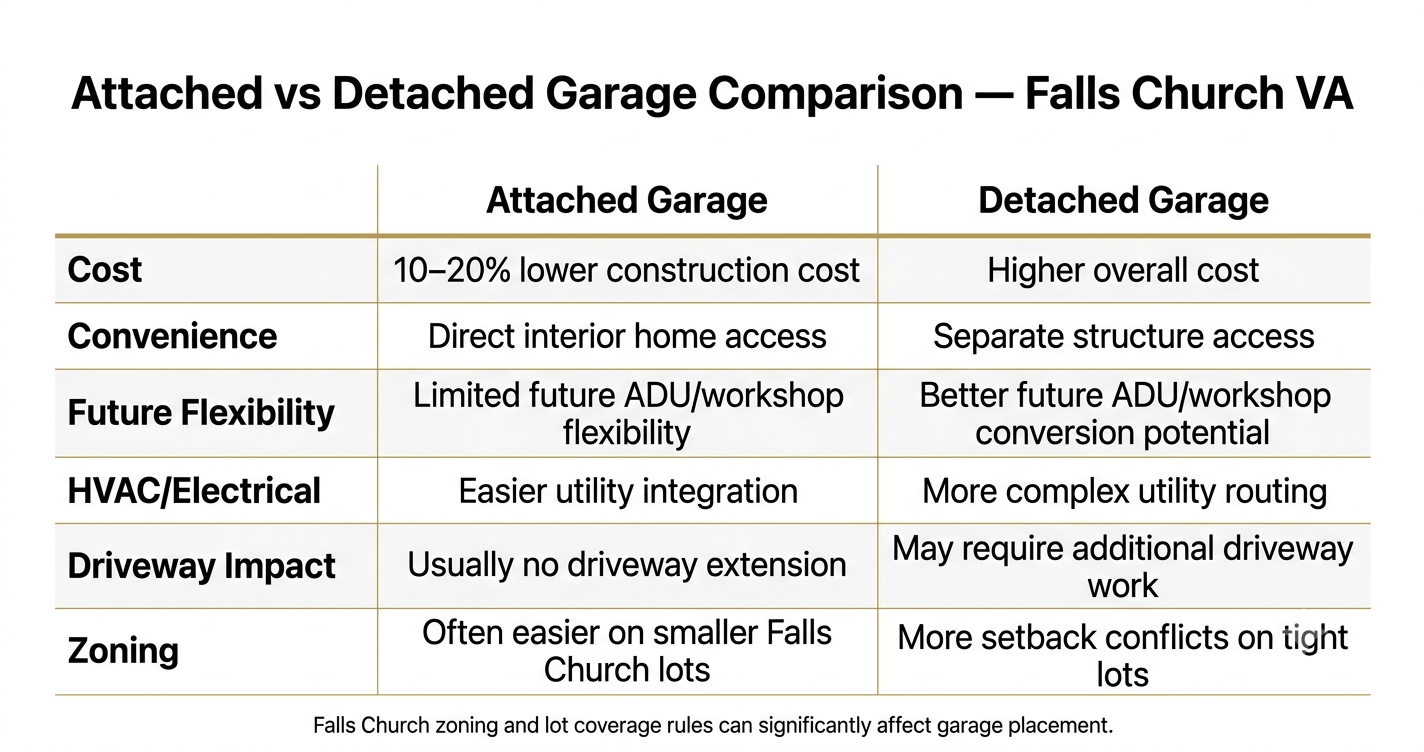
They also provide direct interior access, a major quality-of-life advantage during Northern Virginia winters and summer storms, and usually avoid the cost of a secondary driveway extension.
Detached garages, however, offer greater long-term flexibility. They are easier to convert into workshops, studios, gyms, or future ADUs without affecting the main home’s structural systems or HVAC zoning.
The challenge in Falls Church is lot size. Many properties are significantly smaller than lots in nearby Fairfax County communities such as McLean or Great Falls. That limitation matters because Falls Church zoning caps both building and impervious coverage.
“Single-family and two-family residential properties in Falls Church are limited to a maximum building coverage of 25% and impervious coverage of 35%.” [Source: City of Falls Church – Zoning FAQs]
That means a detached rear-yard garage can quickly create setback or coverage conflicts on already-developed lots.
The correct decision is usually determined by the property itself, not by initial homeowner preference.
For a detailed comparison of design flexibility, zoning implications, and cost differences, see the article on Attached vs. Detached Garage Vienna VA.
Insider Tip:
A professional design-build contractor evaluates the lot survey, setback conditions, driveway geometry, utility routing, and zoning limitations before recommending attached or detached construction. Contractors, who recommend one option immediately, without reviewing the property, are skipping the analysis stage that prevents expensive redesigns later in the permitting process.
MISTAKE #2: ASSUMING FALLS CHURCH FOLLOWS FAIRFAX COUNTY PERMIT RULES
One of the most expensive planning mistakes homeowners make is assuming Falls Church follows Fairfax County permitting rules. It does not.
Falls Church is an independent city with its own Building Division, zoning administration, fee schedules, and approval procedures. Homeowners who search for “garage addition permits Northern Virginia” frequently encounter Fairfax County Land Development Services (LDS) guidance and mistakenly apply those requirements to a Falls Church project.
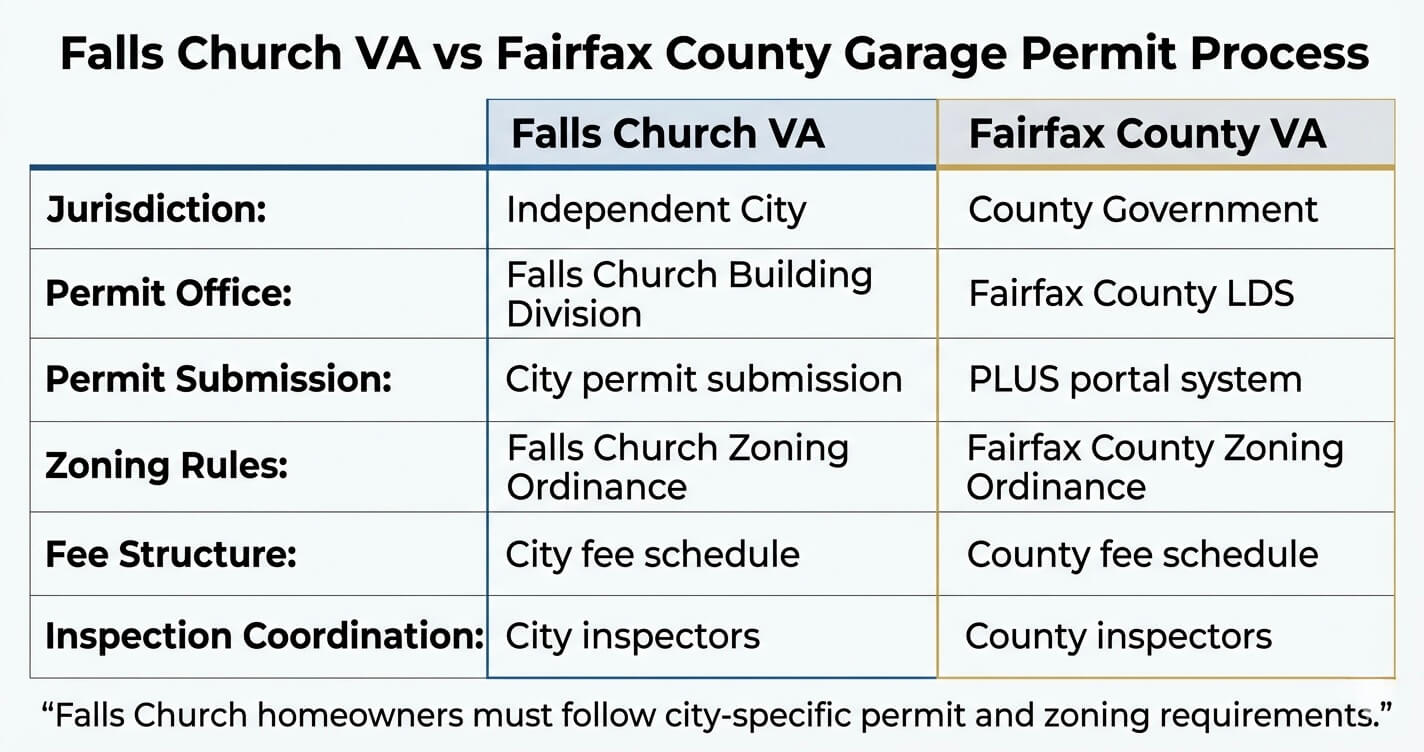
That confusion creates real consequences: incorrect submissions, zoning violations, rejected applications, inaccurate setback assumptions, and delays that can push projects back weeks or even months.
Falls Church maintains its own permitting and zoning structure:
- Building permits for garage additions and residential alterations are issued through the City of Falls Church Building Division [Source: City of Falls Church — Licenses & Permits]
- Zoning setbacks, lot coverage limits, and height restrictions are governed by Falls Church city ordinance, not Fairfax County zoning code [Source: City of Falls Church — Zoning Division]
- Residential garage addition requirements are addressed through the city’s zoning guidance and FAQs [Source: City of Falls Church — Zoning FAQs]
The underlying building code is still statewide:
“Falls Church, like all Virginia jurisdictions, enforces the 2021 Virginia Uniform Statewide Building Code (USBC), which incorporates the 2021 International Residential Code (IRC).” [Source: Virginia Department of Housing and Community Development]
The practical takeaway is simple: a Falls Church garage addition permit must be processed through the City of Falls Church Building Division, not Fairfax County’s PLUS portal.
The confusion is understandable because nearby communities such as McLean, Vienna, Burke, and Annandale are all within Fairfax County and do use the Fairfax County LDS process. But for Falls Church homeowners, using the wrong jurisdictional framework from the beginning can derail an otherwise well-planned project.
If your property is located in Fairfax County rather than Falls Church city limits, the permitting process is entirely different. Our guide on Garage Addition Permit Fairfax County VA explains that system in detail.
MISTAKE #3: IGNORING FALLS CHURCH’S SPECIFIC SETBACK AND HEIGHT LIMITS
Another expensive garage addition mistake Falls Church VA homeowners make is designing the structure before verifying what is actually permitted on the lot. In many cases, homeowners, and even contractors unfamiliar with Falls Church city regulations, decide on the garage size, placement, or loft concept first, only to discover during zoning review that the proposed structure violates coverage limits, setback requirements, or auxiliary structure height restrictions.
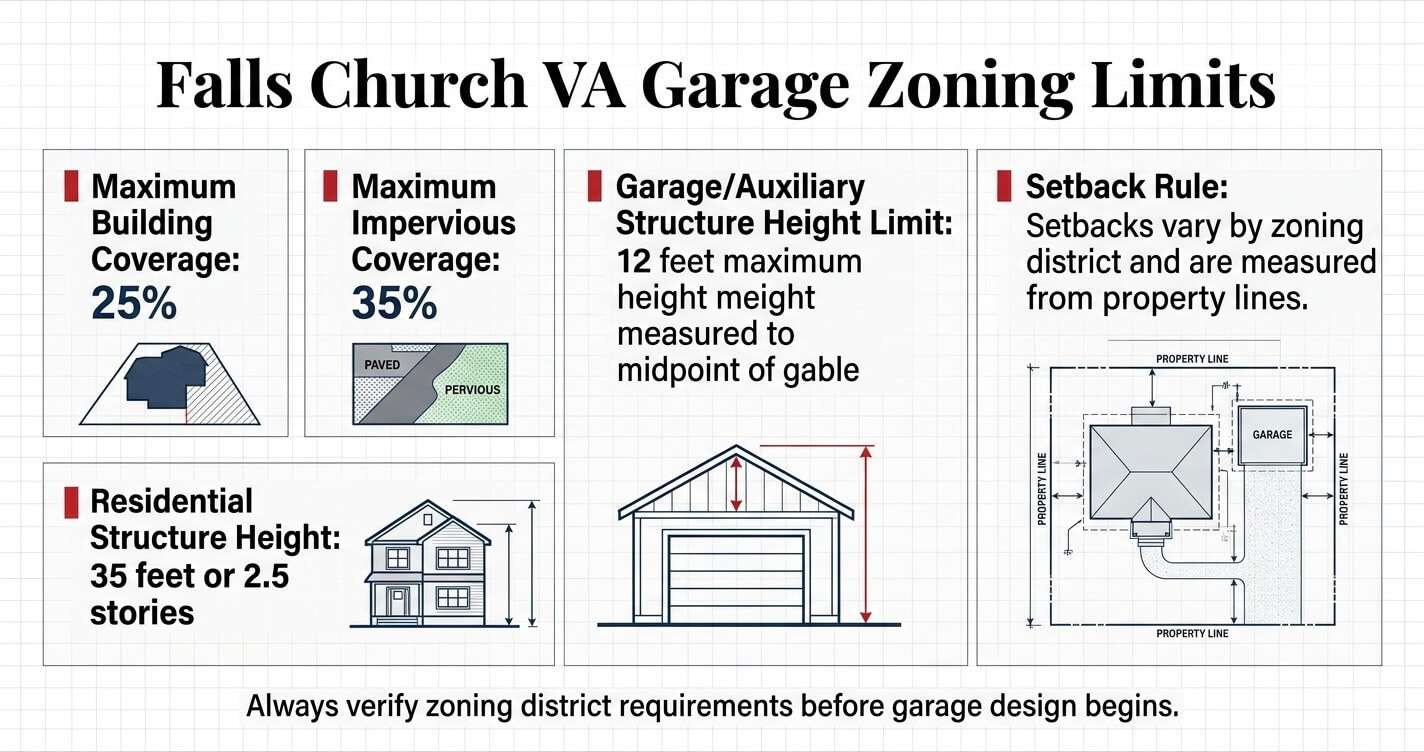
The first major restriction is lot coverage.
“Single-family and 2-family residential properties are limited to a maximum building coverage of 25% and impervious coverage of 35% in the City of Falls Church.” [Source: City of Falls Church — Zoning FAQs]
A garage addition counts toward building coverage. Because many Falls Church lots are smaller and more densely developed than surrounding Fairfax County properties, homeowners frequently discover that existing driveways, patios, and the primary residence have already consumed most of the allowable coverage percentage.
Height restrictions are equally important.
“Residential structures in the City of Falls Church are limited to 35 feet or 2.5 stories. Garages and auxiliary structures are limited to 12 feet in height measured to the midpoint of the gable for non-historic properties.” [Source: City of Falls Church — Zoning FAQs]
That 12-foot auxiliary structure limit is particularly consequential. Many homeowners envision a garage loft, second-story storage area, or future studio space without realizing the design may exceed the city’s allowable height envelope.
Falls Church also regulates setbacks by zoning district.
“Residential setbacks, coverage, and heights are regulated by Zoning District in Falls Church. Required yards, also referred to as setbacks, are measured from the property line and are defined as open space that is unoccupied and unobstructed by buildings from the ground upward.” [Source: City of Falls Church — Residential Information]
Even a one- or two-foot setback violation can require a redesign or formal variance application.
“The Board of Zoning Appeals has the authority to modify certain zoning requirements pertaining to setbacks, building height, etc. due to special characteristics of an individual property.” [Source: City of Falls Church — Variances and Special Use Permits]
Variance requests add weeks to a project timeline and introduce uncertainty that many homeowners mistakenly assume can be solved automatically.
The correct approach is to verify zoning district requirements, current lot coverage, setbacks, and allowable structure height before any design work begins.
Helpful Hint:
US Home Design Build conducts a full site evaluation and zoning review before beginning any garage addition design work. In independent jurisdictions like Falls Church, where zoning rules differ significantly from surrounding Fairfax County communities, this upfront analysis prevents homeowners from investing in plans that cannot ultimately be approved.
MISTAKE #4: UNDERESTIMATING THE REAL COST – AND SKIPPING THE CONTINGENCY
One of the most financially damaging garage addition mistakes Falls Church VA homeowners make is budgeting from outdated national averages or informal neighborhood comparisons instead of current Northern Virginia construction realities. Garage additions in Falls Church operate within one of the most expensive labor and permitting markets in the Mid-Atlantic region, and projects routinely exceed expectations when homeowners fail to account for contingency costs.
Nationally, garage additions vary dramatically depending on size, attachment type, and finishes.
“The national average cost to build a garage addition ranges from $30,000 to $60,000 in 2025. Basic 1-car garages can start as low as $10,000, while high-end detached units with living space can exceed $150,000.” [Source: Garage Addition Cost Calculator (2026)]
Labor alone remains a major cost driver.
“On average, working with a professional contractor costs about $50 per square foot for labor and materials. Prices often start at $30 per square foot for simple attached garages.” [Source: HomeLight]
Northern Virginia costs run even higher.
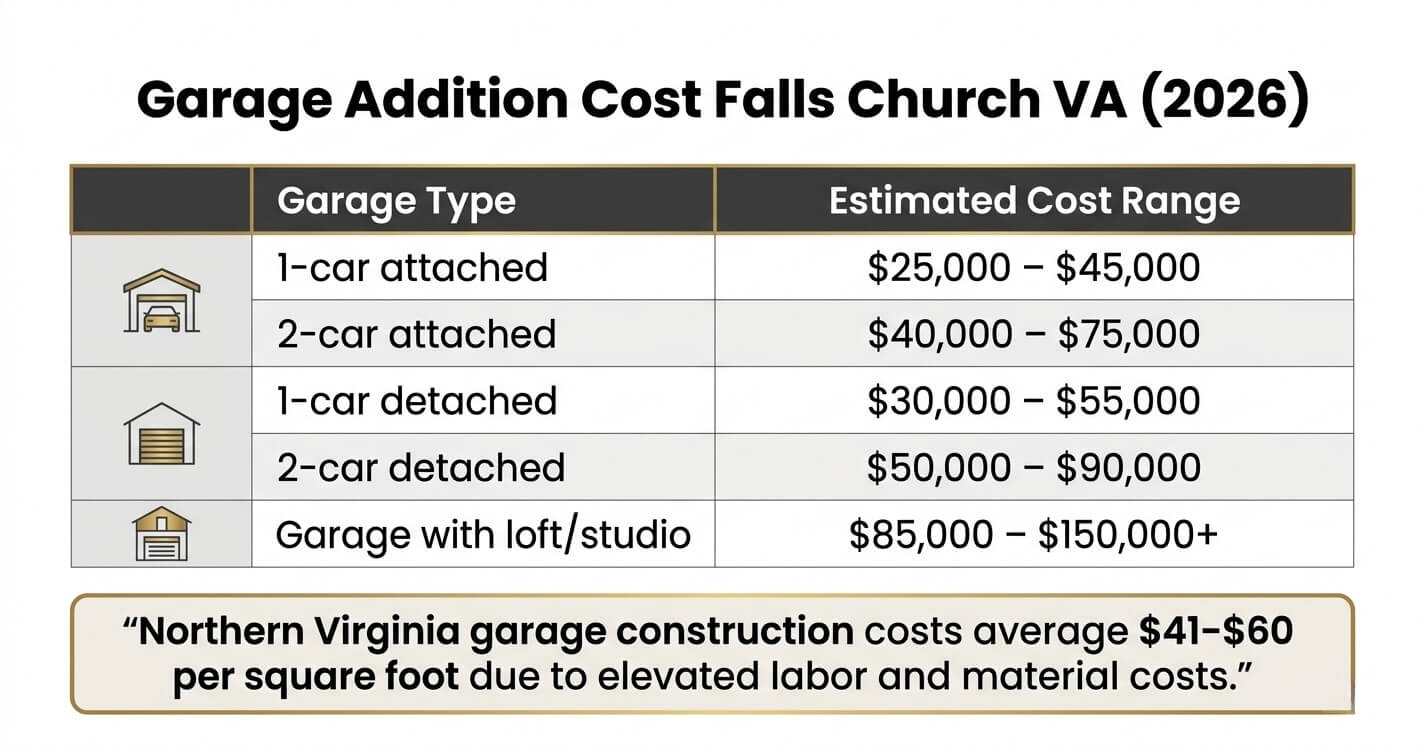
“The cost to build a garage in Northern Virginia ranges from $41 to $60 per square foot depending on the finishes installed.” [Source: HomeBlue]
Typical Falls Church VA Garage Addition Costs (2026)
Older Falls Church homes frequently introduce hidden expenses including electrical panel upgrades, grading complications, drainage work, or structural roofline integration with existing Cape Cod and Colonial architecture.
The most important budgeting rule is contingency planning.
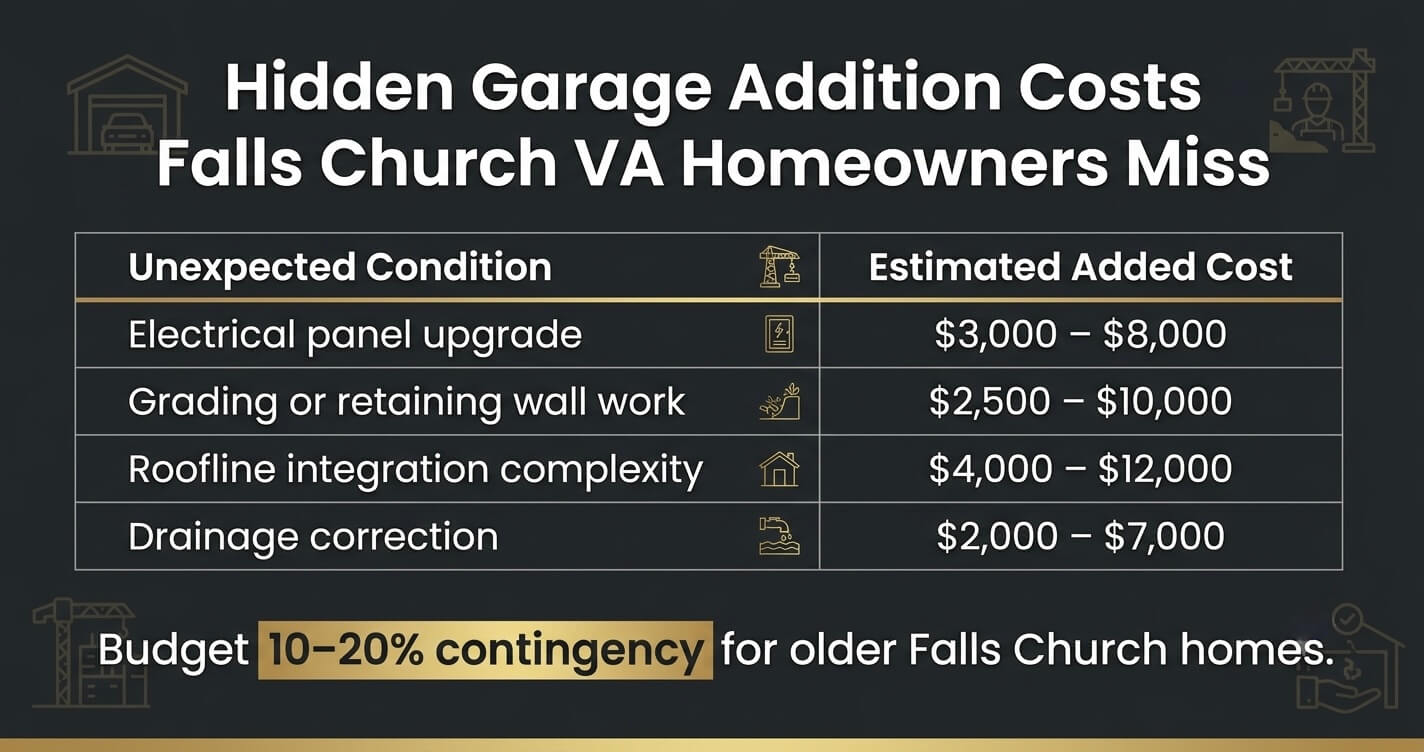
“Budget an additional 10–20% beyond quoted estimates for unexpected conditions. The 2024 Houzz & Home Study found 39% of homeowners exceeded their renovation budget.” [Source: AmeriSave]
For broader context on how garage addition costs compare with larger residential additions in the region, see Home Addition Cost in Northern Virginia.
Practical Tip:
One of the clearest signs of an experienced Northern Virginia contractor is disciplined cost management. Professional design-build firms keep overages limited to genuinely unforeseeable site conditions, not vague change orders caused by incomplete planning or unrealistic initial estimates.
MISTAKE #5: SKIPPING THE PERMIT OR LETTING THE CONTRACTOR SKIP IT
Some homeowners attempt to avoid the permit process to reduce upfront cost or accelerate construction timelines. Others hire contractors who suggest permits are “optional” for smaller garage additions. In Falls Church VA, this is a serious mistake with legal, financial, and resale consequences.
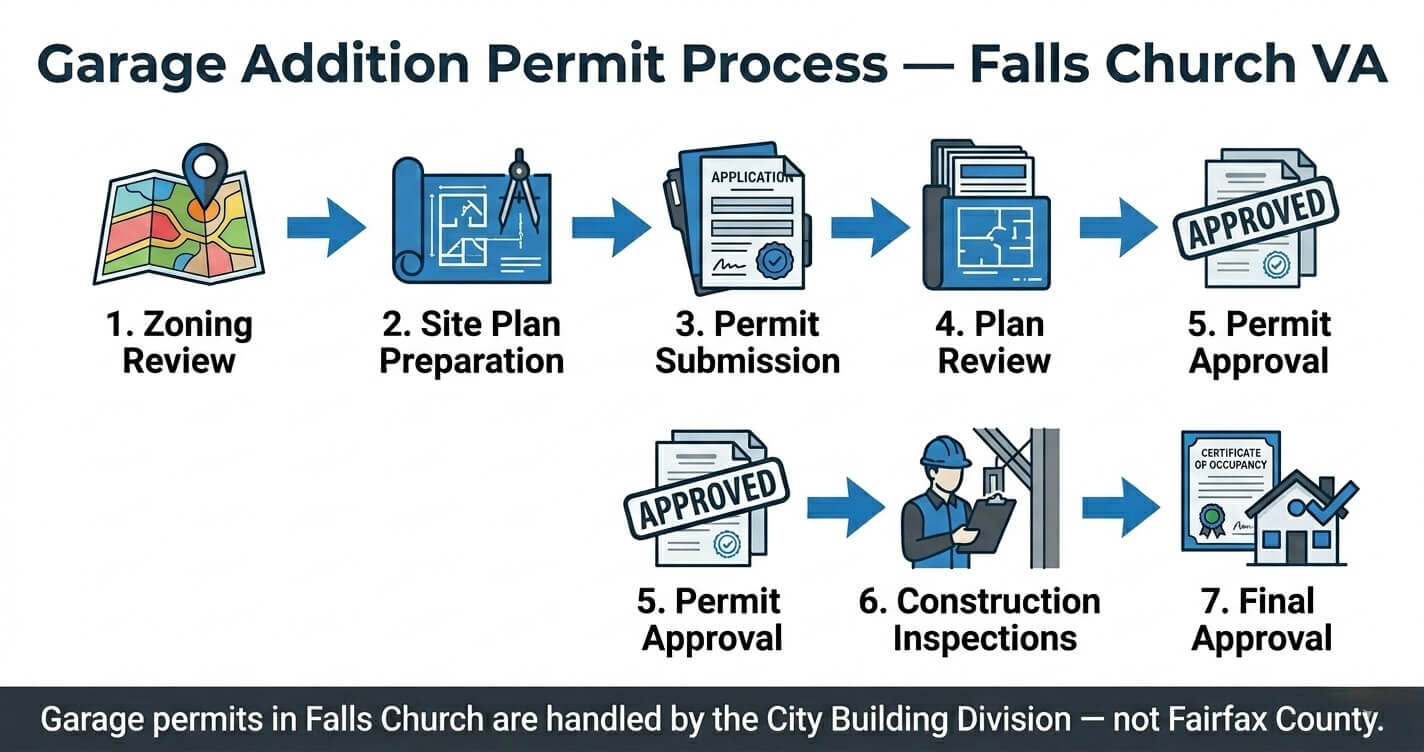
Garage additions require permits because they directly affect structural safety, electrical systems, energy compliance, setbacks, and zoning enforcement.
“A building permit is mandatory for most home addition projects in Falls Church. This permit ensures that construction plans meet the Virginia Uniform Statewide Building Code, which sets standards for structural integrity, safety, and energy efficiency.” [Source: City of Falls Church — Licenses & Permits]
Virginia code requirements are broader than many homeowners realize.
“Any garage over 256 square feet, or one that includes electrical, plumbing, or HVAC systems, requires a building permit under Virginia Uniform Statewide Building Code.” [Source: Sheds Unlimited]
The risks of unpermitted construction are substantial.
“If the local building department discovers that you have been building your garage without a permit, they will halt the work until you obtain one, issue a fine, and may require you to demolish the structure and start from scratch.” [Source: Sheds Unlimited — Garage Permits in VA]
Beyond code enforcement, unpermitted work creates major resale problems. In Northern Virginia’s competitive housing market, buyers’ agents and inspectors routinely identify unpermitted additions during due diligence. An unpermitted garage in Falls Church can quickly become a negotiation issue, insurance concern, or failed transaction.
The safest approach is straightforward: work only with a licensed contractor who pulls all permits as the responsible party through the City of Falls Church Building Division. Any contractor referencing Fairfax County’s PLUS portal for a Falls Church project does not understand the jurisdiction they are working in.
MISTAKE #6: DESIGNING FOR THE WRONG PURPOSE – OR NO SPECIFIC PURPOSE AT ALL
One of the most common garage addition mistakes Falls Church VA homeowners make is designing the garage around a vague idea instead of a clearly defined long-term use case. A garage that is intended only for “parking and storage” often becomes inefficient the moment the homeowner buys a larger vehicle, installs an EV charger, adds workshop equipment, or needs additional overhead storage.
Several garage design decisions become extremely expensive to change once framing and roofing are complete:
Garage door width:
A standard 9-foot garage door works for most sedans and compact SUVs. Upgrading to a 10-foot-wide door typically adds approximately $500–$1,200 during construction but dramatically improves usability for trucks, larger SUVs, and wider vehicle turning radiuses. Reframing later requires structural modification and finish replacement.
Ceiling height:
Standard 8-foot ceilings accommodate normal residential use. However, 9- or 10-foot ceiling heights support vehicle lifts, suspended storage racks, and oversized vehicles. In Falls Church, this must be planned carefully because garage and auxiliary structures are limited to 12 feet in height measured to the midpoint of the gable. [Source: City of Falls Church — Zoning FAQs]
Electrical infrastructure:
Installing a 240V EV charging circuit during rough-in generally costs $600–$1,200. Retrofitting after drywall completion can cost $2,500–$4,500 once wall finishes must be reopened.
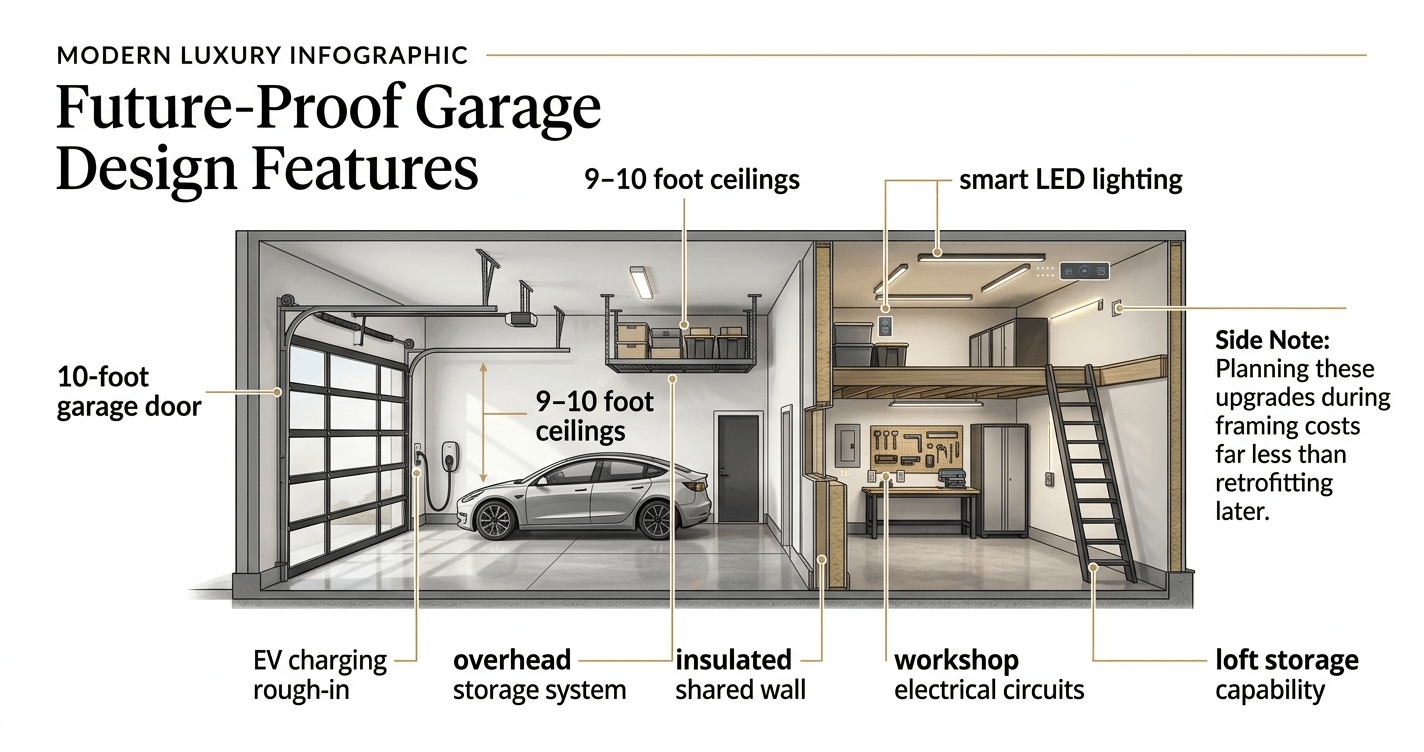
Insulation and thermal separation:
Proper insulation in attached garages prevents significant heat transfer into the living space. Retrofitting insulation after completion requires wall demolition and reconstruction.
A garage addition is already among the strongest ROI projects available, typically returning 60–85% at resale when properly integrated with the home’s architecture. [Source: HomeLight]
For context on how a garage addition fits within the broader range of home addition costs in this market, our guide on Home Addition Cost in Northern Virginia covers the full spectrum.
MISTAKE #7: HIRING THE WRONG CONTRACTOR FOR A FALLS CHURCH PROJECT
Another major garage addition mistakes Falls Church VA homeowners make is assuming that any contractor experienced in Northern Virginia automatically understands the regulatory environment inside Falls Church city limits. Falls Church operates independently from Fairfax County, with its own permitting workflows, zoning administration, and inspection coordination processes.
That distinction matters far more than most homeowners realise.
A contractor who primarily works in Fairfax County may be familiar with county-level permitting systems but still lack direct experience with Falls Church Building Division requirements, zoning interpretations, and submission expectations. When that happens, the homeowner absorbs the consequences through rejected submissions, delayed approvals, redesign costs, and extended construction timelines.
Garage additions also carry significant resale implications.
“Adding a new garage has an ROI of 60–85% at resale. The garage should look like it belongs to the house — a garage whose door style clashes with the home’s architecture, or a structure that is clearly an afterthought, reduces curb appeal for buyers.” [Source: HomeLight]
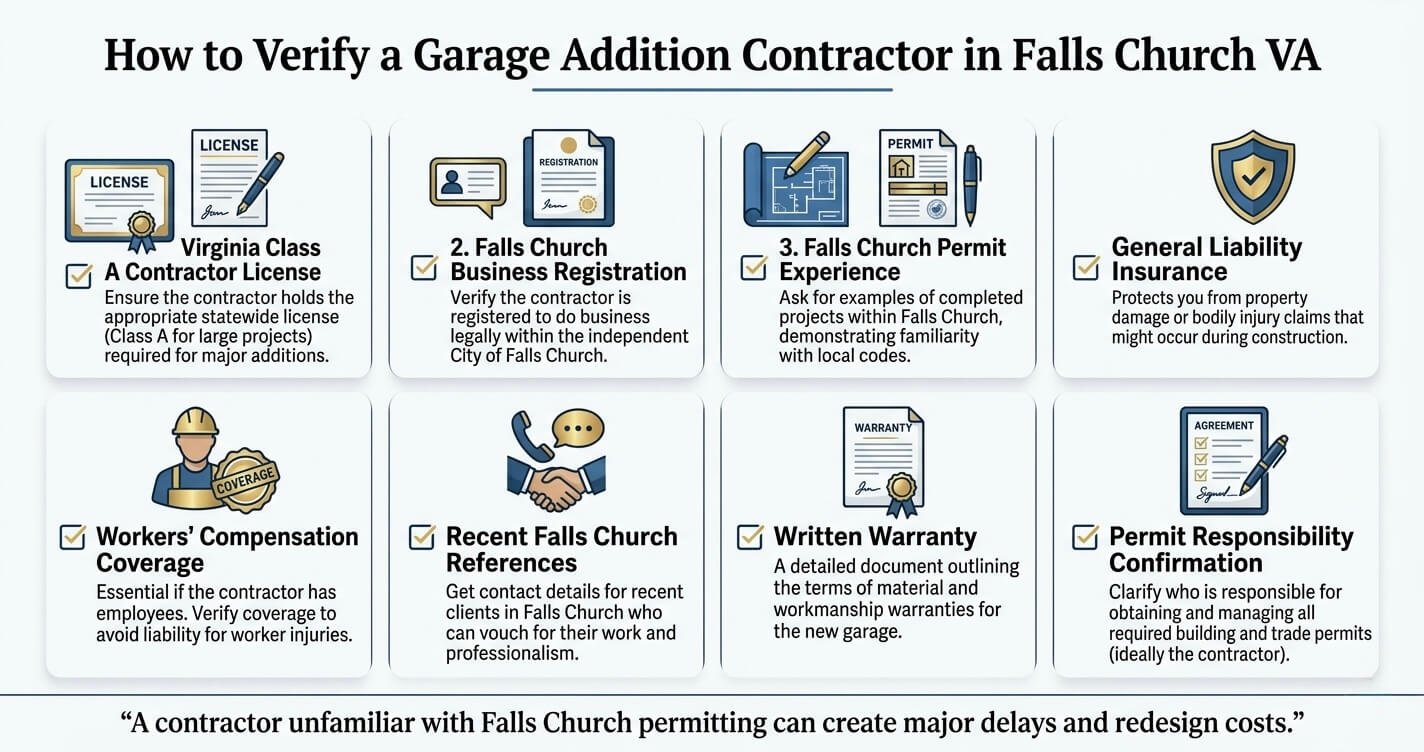
Before signing any agreement, homeowners in Falls Church should verify:
- Virginia Class A contractor licence through the Virginia DPOR [URL: https://www.dpor.virginia.gov]
- Falls Church city business registration
- Direct experience with Falls Church Building Division permits
- Active workers’ compensation and minimum $1M general liability coverage
- References from recent Falls Church garage addition projects specifically
US Home Design Build, based in McLean VA immediately adjacent to Falls Church, works with homeowners throughout Falls Church, Arlington, McLean, Fairfax VA, and Vienna on garage additions requiring detailed zoning review and permit coordination. Their four-step design-build process, consultation, design, build, and post-project warranty support, integrates zoning review, permit filing, and inspection management into a single accountable workflow.
For a comprehensive guide to vetting contractors in this market, including the documents to request and the specific red flags that signal inadequate local knowledge, see our article on How to Choose the Right Contractor in Northern Virginia.
BONUS: THE MISTAKE OF OVER-IMPROVING FOR THE STREET IN FALLS CHURCH
A less obvious but financially important mistake is overbuilding the garage relative to the surrounding neighbourhood standard. Some Falls Church homeowners invest $120,000+ into oversized detached garages with finished lofts, premium architectural detailing, and studio-level finishes on streets where most homes have modest one-car attached garages.
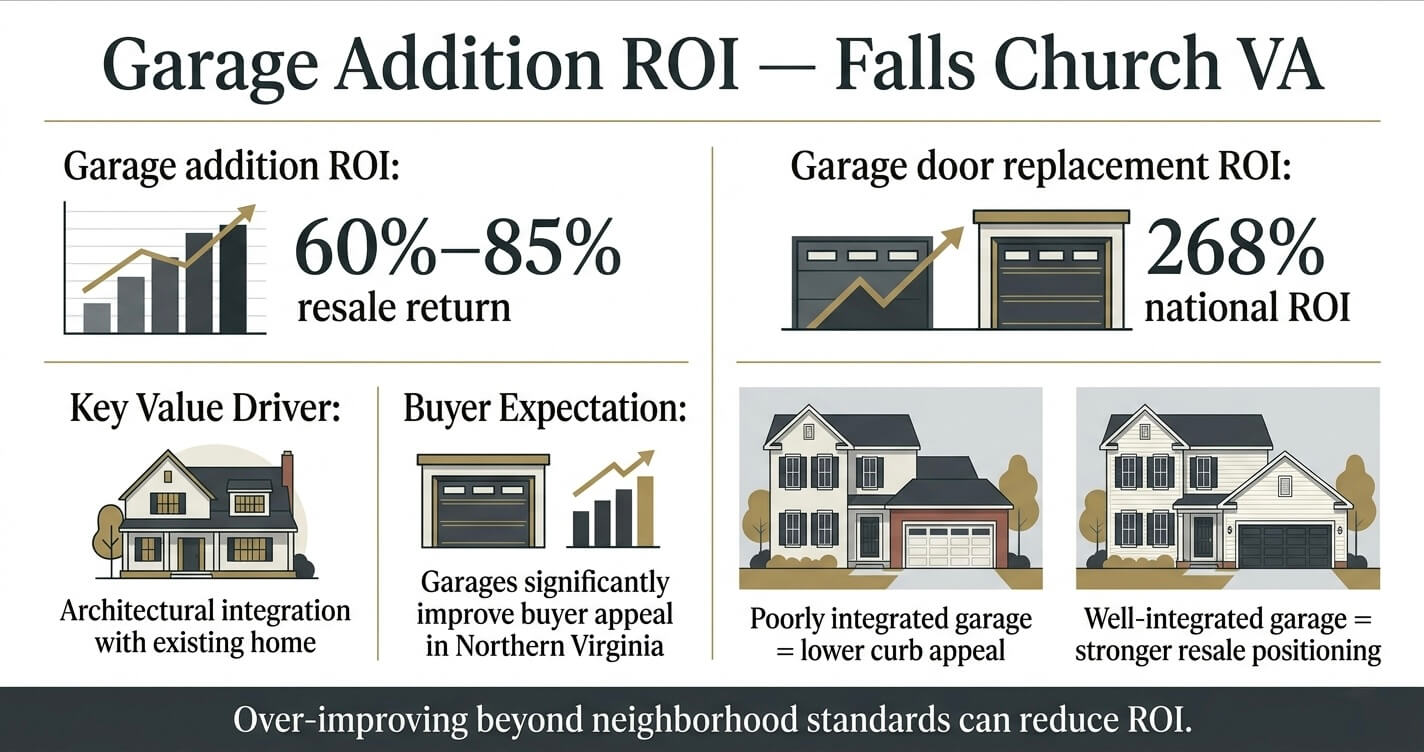
The issue is not construction quality, it is appraisal alignment.
“A garage should be consistent with the amenities of surrounding homes to maximise ROI. If all homes in the neighbourhood have a garage and yours doesn’t, that hurts your value. But a garage that significantly exceeds neighbourhood standards returns less of its cost at resale.” [Source: List With Clever]
In practice, this means the highest return in Falls Church usually comes from a garage that looks architecturally original to the home and aligns with nearby property expectations, not necessarily the most expensive possible structure.
Before finalising the scope, homeowners should evaluate what garage type is standard for comparable homes on the same street and design to meet that benchmark rather than dramatically exceed it.
FREQUENTLY ASKED QUESTIONS [FAQs]
Q1: Do I need a permit for a garage addition in Falls Church VA?
Yes. Falls Church VA is an independent city with its own Building Division separate from Fairfax County. A building permit is required for garage additions, along with electrical and any other applicable trade permits. Permit applications must be submitted to the City of Falls Church Building Division rather than Fairfax County’s PLUS portal. [Source: City of Falls Church — Licenses & Permits]
Q2: How much does a garage addition cost in Falls Church VA in 2026?
A 1-car attached garage generally costs $25,000–$45,000, while a 2-car attached garage ranges from $40,000–$75,000. Detached two-car garages typically cost $50,000–$90,000 depending on finishes and lot conditions. Northern Virginia garage construction averages approximately $41–$60 per square foot.
Q3: What is the height limit for a garage in Falls Church VA?
Falls Church limits garages and auxiliary residential structures to 12 feet in height measured to the midpoint of the gable for non-historic properties. Overall residential structures are limited to 35 feet or 2.5 stories. [Source: City of Falls Church — Zoning FAQs]
Q4: What is the ROI on a garage addition in Northern Virginia?
Garage additions generally return 60–85% of their cost at resale depending on location, architectural integration, and functionality. Garage door replacements alone return 268% nationally according to the 2025 Cost vs. Value Report.
Q5: What lot coverage limits apply to garage additions in Falls Church VA?
Single-family residential properties in Falls Church are limited to 25% building coverage and 35% impervious coverage. Garage additions count toward these limits, which is why lot coverage calculations should be completed before any design work begins.
TO SUM UP
Every major garage addition mistakes Falls Church VA homeowners make can be prevented through proper zoning review, realistic budgeting, permit compliance, and working with a contractor who understands the unique regulatory structure of this independent city.
The most important takeaways are straightforward:
- Falls Church has its own permit and zoning process separate from Fairfax County
- The 25% building coverage cap and setback requirements determine what is legally buildable before design begins
- Two-car garages in Northern Virginia typically cost $40,000–$90,000 depending on structure type and finishes
- Older Falls Church homes require realistic contingency planning because hidden electrical, grading, and structural conditions are common
- Skipping permits creates serious resale and insurance liabilities
“A well-planned garage addition in Falls Church VA is one of the most valuable improvements you can make to your property. A poorly planned one is one of the most expensive.”
US Home Design Build works with homeowners across Falls Church VA, McLean VA, Arlington VA, Fairfax VA, Vienna, and throughout Northern Virginia on garage additions designed around local zoning compliance, long-term functionality, and architectural integration. Their design-build process, from zoning review and permit filing through construction and a two-year workmanship warranty, addresses the exact planning risks outlined in this guide before construction begins.
703-202-3520 | US Home Design Build | 8200 Greensboro Dr Suite 900, McLean, VA 22102
