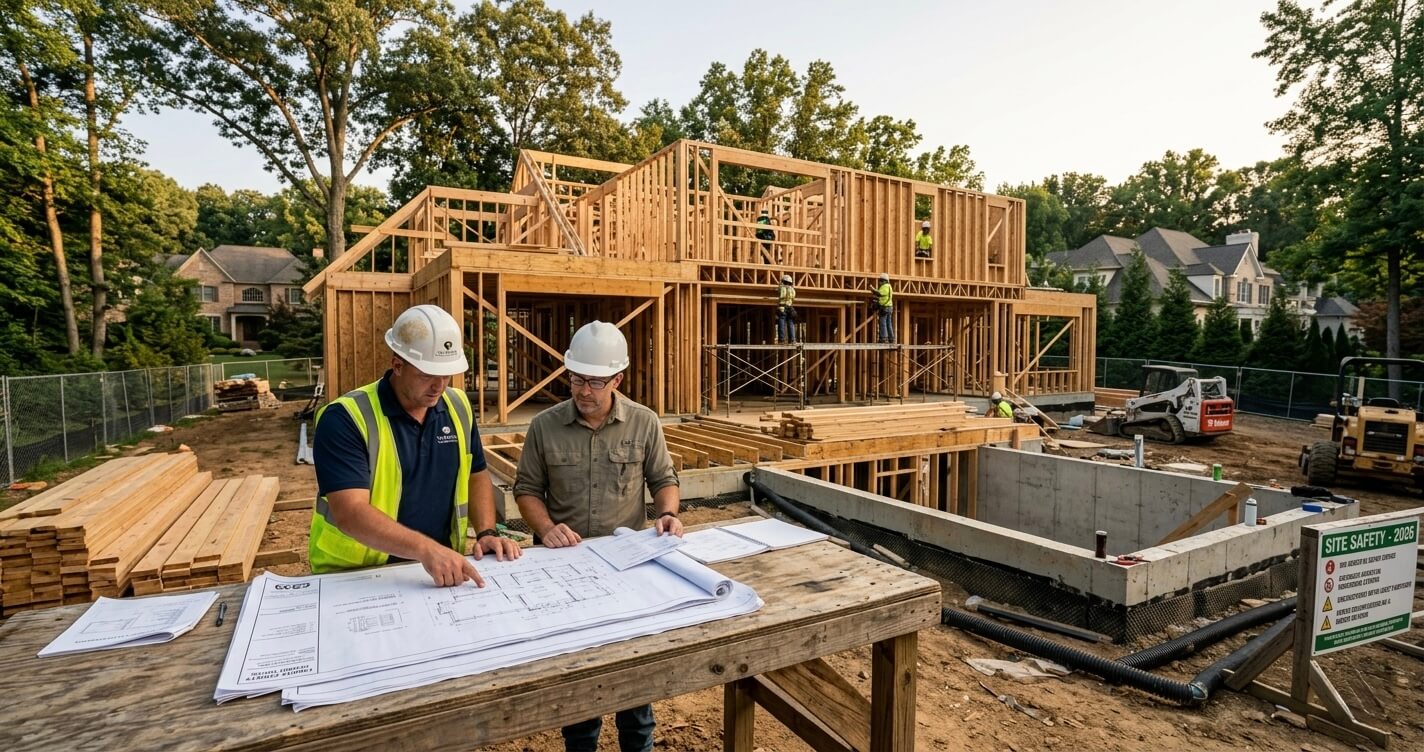
Building a custom home in Fairfax County VA involves far more than architectural design and construction alone. In high-demand residential markets such as McLean, Great Falls, Vienna, and surrounding Northern Virginia communities, the permitting process has become one of the most important early-stage components of successful custom home development.
Luxury residential construction projects in Fairfax County often require extensive coordination between zoning officials, engineers, architects, site planners, environmental reviewers, and construction teams before any vertical construction begins. Custom home permit Fairfax County VA approvals frequently involve multiple layers of review related to:
- zoning compliance
- stormwater management
- grading and drainage
- erosion control
- utility coordination
- environmental restrictions
- structural engineering
- energy code compliance
Because of this complexity, permitting directly affects project timelines, construction sequencing, budgeting, and even overall build feasibility.
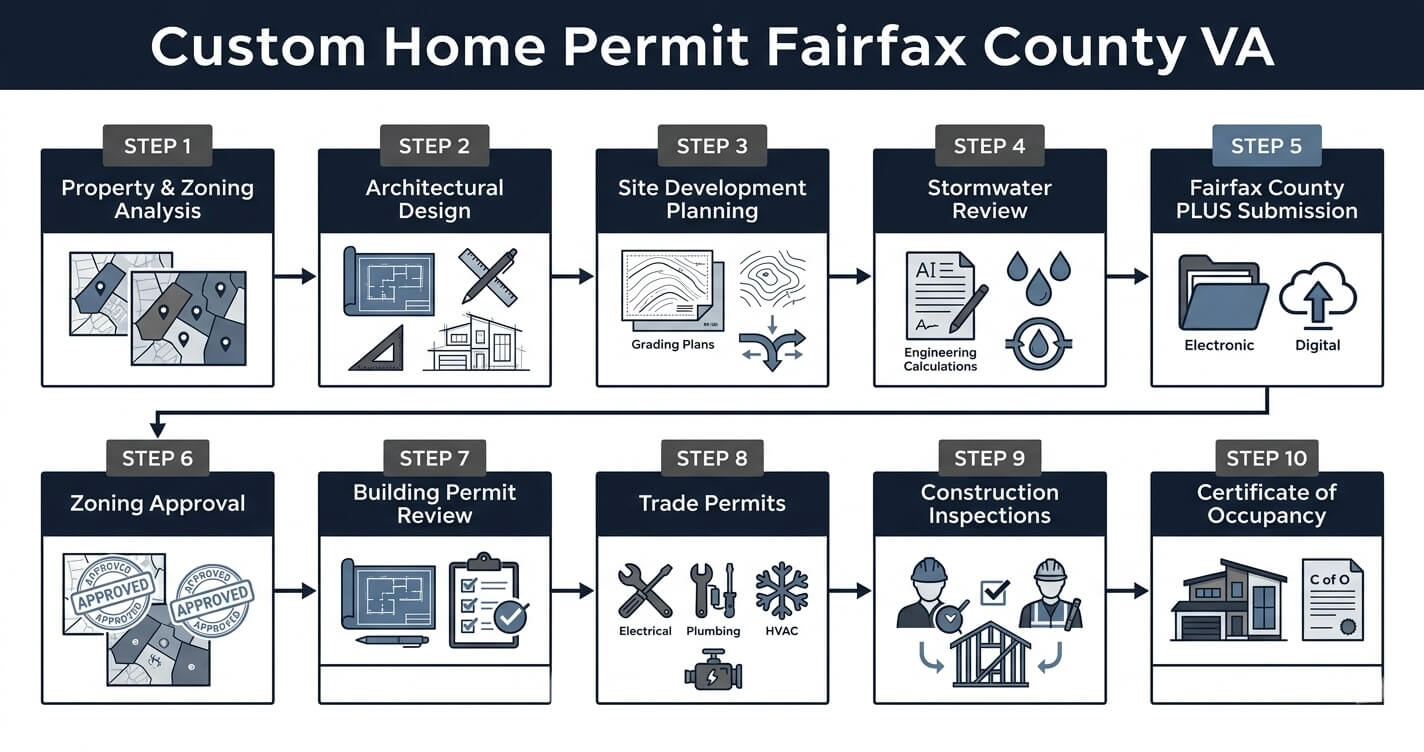
According to Fairfax County Land Development Services (LDS), residential construction projects are reviewed through coordinated processes involving zoning, land development, building plan review, and code enforcement to ensure compliance with county regulations and Virginia building standards. [Source: Fairfax County Land Development Services]
Modern custom homes in Fairfax County also require careful coordination between:
- architectural planning
- structural engineering
- stormwater calculations
- grading plans
- environmental review
- energy-performance standards
Many homeowners evaluating new construction also compare the permitting complexity of luxury remodels versus entirely new builds, especially during projects like Full Home Renovation McLean VA.
This guide explains the complete custom home permit process in Fairfax County VA, including zoning approvals, PLUS system submissions, inspections, common delays, permit sequencing, and contractor coordination strategies that homeowners should understand before construction begins.
WHICH PERMITS ARE REQUIRED FOR A CUSTOM HOME IN FAIRFAX COUNTY?
Custom home construction in Fairfax County typically requires multiple permit categories and regulatory approvals before site work or structural construction can begin. The exact permit requirements vary depending on lot conditions, utility availability, watershed restrictions, demolition scope, and zoning overlays associated with the property.
1. Building Permit
The primary residential building permit authorizes construction of the custom home itself and verifies compliance with the Virginia Uniform Statewide Building Code (USBC). This review typically evaluates:
- structural engineering
- life-safety compliance
- framing systems
- energy-code requirements
- fire separation standards
- foundation design
Without approved building permits, construction cannot legally proceed.
2. Zoning Approval
Zoning review determines whether the proposed home complies with Fairfax County land-use regulations. Officials evaluate:
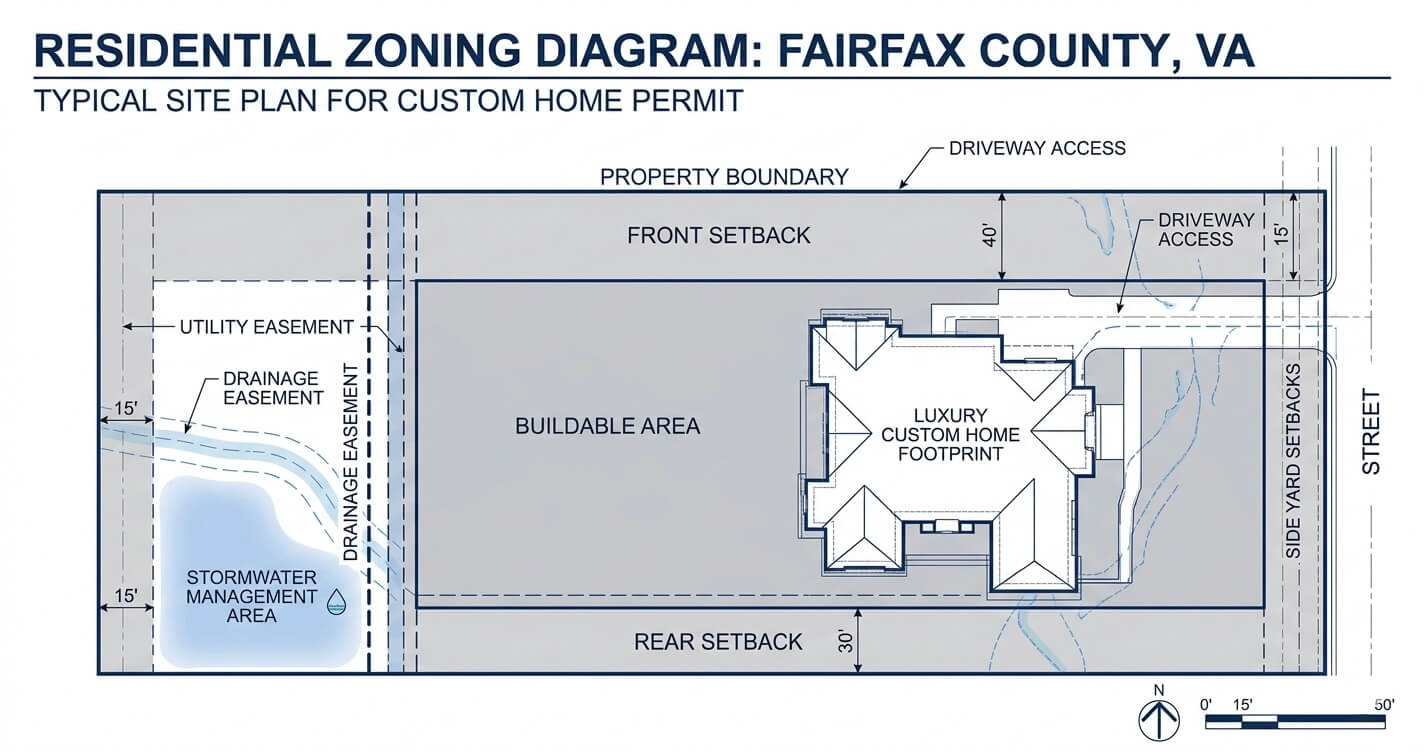
- front, side, and rear setbacks
- maximum building height
- lot coverage limitations
- accessory structure placement
- easements and buildable-area restrictions
Zoning analysis should occur before final architectural drawings are completed to avoid redesign costs later in the process.
3. Site-Related Approvals
Many luxury home sites in Fairfax County require separate reviews for:
- grading plans
- drainage systems
- stormwater management
- erosion and sediment control
- driveway access
- tree preservation
Large or sloped properties often trigger additional engineering coordination.
4. Trade Permits
Custom homes also require individual permits for:
- electrical systems
- plumbing systems
- HVAC/mechanical systems
- gas piping
These permits are typically coordinated alongside the main building permit.
5. Environmental & Utility Reviews
Depending on site conditions, projects may also involve:
- Chesapeake Bay compliance reviews
- septic approvals
- well permits
- utility coordination
- environmental impact reviews
Fairfax County processes residential construction permits through PLUS (Planning and Land Use System) and Fairfax County Land Development Services (LDS).
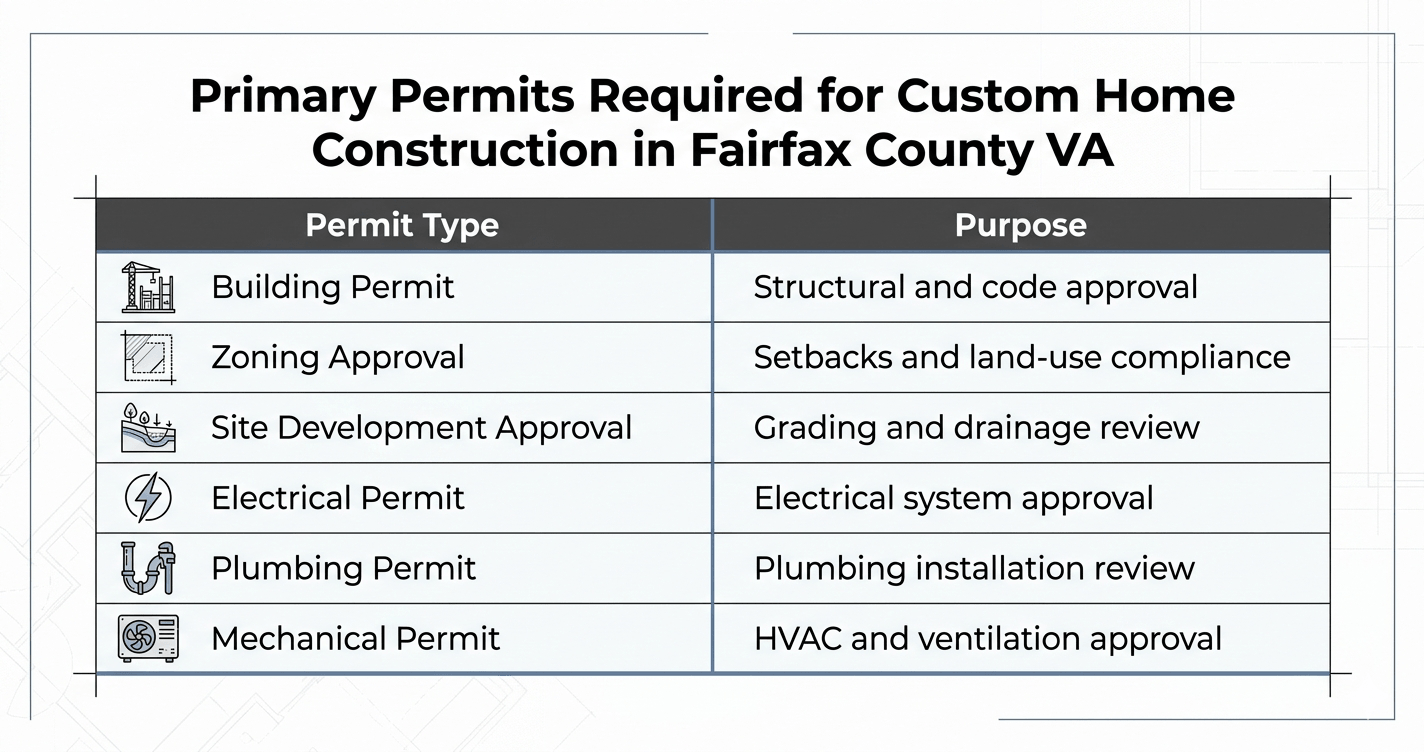
Permit requirements can vary substantially based on watershed conditions, demolition requirements, utility access, and lot-specific development constraints.
[Source: Fairfax County PLUS System]
UNDERSTANDING FAIRFAX COUNTY ZONING BEFORE BUILDING
One of the most important, and frequently underestimated, steps in custom home construction is confirming zoning compliance before architectural design begins. In Fairfax County VA, zoning regulations directly control where and how a home can be built on a property, and many permit delays originate from incomplete early-stage zoning analysis.
Setbacks
Fairfax County zoning regulations establish minimum distances between structures and property lines. These include:
- front setbacks
- rear setbacks
- side-yard setbacks
Setback requirements vary depending on zoning district, lot dimensions, and neighborhood regulations. Oversized custom homes often encounter buildable-area limitations once setbacks are applied to the site.
Lot Coverage Limits
Zoning regulations also restrict:
- impervious surface coverage
- total building footprint
- accessory structure size
- driveway coverage
This becomes especially important for estate homes with pools, detached garages, outdoor living spaces, or large hardscape installations.
Height Restrictions
Custom homes in Fairfax County must comply with maximum height limitations, which may involve:
- roof ridge calculations
- grade elevation measurements
- finished-floor elevation coordination
- roofline design restrictions
Architectural complexity can significantly affect zoning review outcomes.
Easements & Property Constraints
Many properties contain hidden development limitations involving:
- utility easements
- drainage easements
- conservation areas
- floodplain restrictions
- stormwater infrastructure
These constraints can reduce the actual buildable area available for construction.
HOA & Community Restrictions
Homeowners associations may impose additional architectural controls, but HOA approval does not replace county zoning approval or building permits.
According to the Fairfax County Zoning Ordinance, residential zoning regulations govern land use, setbacks, building placement, lot coverage, and development standards throughout Fairfax County.
Many project delays occur because architectural plans are completed before confirming:
- zoning compliance
- grading feasibility
- easement conflicts
- stormwater limitations
- buildable-area restrictions
Like Second Story Addition in Northern Virginia projects, custom homes require detailed site-planning coordination long before construction drawings are finalized.
[Source: Fairfax County Zoning Ordinance]
HOW THE FAIRFAX COUNTY PLUS SYSTEM WORKS
Fairfax County manages most residential construction approvals through the PLUS (Planning and Land Use System), a centralized online platform used for permit applications, document uploads, review coordination, and inspection scheduling. For homeowners planning a custom home project, understanding how the system functions is critical because nearly every stage of the permitting process flows through this digital portal. [Source: Fairfax County PLUS]
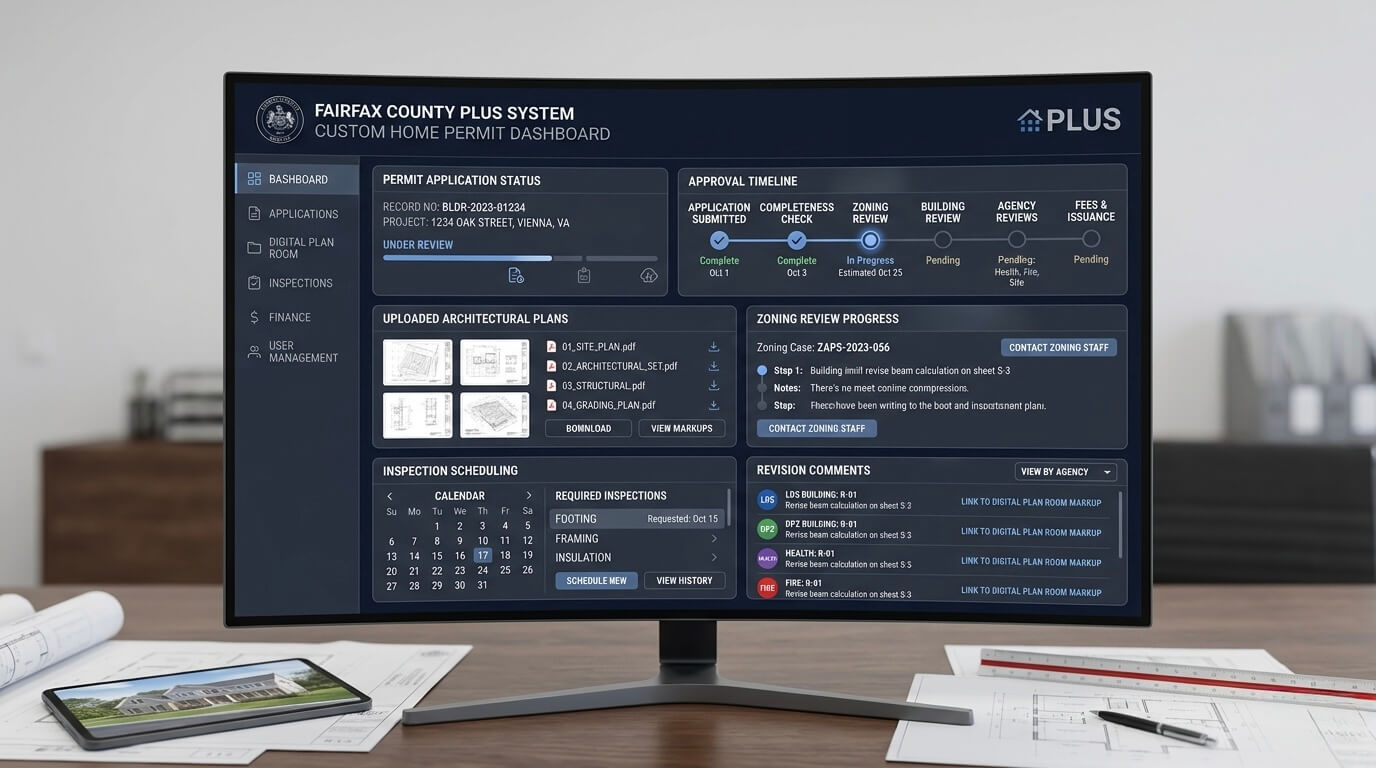
PLUS allows applicants, architects, engineers, and builders to submit and manage:
- building permits
- zoning applications
- site-development plans
- grading submissions
- trade permits
- inspection requests
- permit revisions and resubmittals
For custom homes in Fairfax County, submissions commonly include:
- architectural construction drawings
- structural engineering plans
- boundary and topographic surveys
- grading and drainage plans
- erosion and sediment control documentation
- stormwater management calculations
- energy code compliance documentation
- site-development and utility coordination plans
Once uploaded, the application is routed through multiple county review departments. Depending on project scope and lot conditions, reviews may involve:
- zoning review
- building review
- site and subdivision review
- stormwater management review
- environmental review
- health department coordination
- utility and infrastructure approvals
One of the most important realities homeowners should understand is that the Fairfax County permit process is highly iterative. County reviewers frequently issue comments requiring revisions, clarifications, or additional engineering documentation before approvals are granted. Each correction cycle can add additional review time if drawings are incomplete or poorly coordinated.
Technical challenges:
Incomplete submissions remain one of the leading causes of permit delays for custom home projects in Fairfax County. Missing grading data, inconsistent architectural details, or unresolved zoning conflicts can significantly slow review timelines and create cascading construction delays later in the project.
Experienced Northern Virginia custom home builders often help streamline the process by coordinating architects, engineers, surveyors, and site-development consultants early in the planning phase. This type of permit coordination is especially important for luxury homes in McLean, Great Falls, and Vienna, where complex site-development conditions frequently require extensive county review before construction approval can proceed.
TYPICAL CUSTOM HOME PERMIT TIMELINE IN FAIRFAX COUNTY
Custom home permitting timelines in Fairfax County vary substantially depending on project complexity, lot conditions, zoning constraints, and the quality of the submitted plans. Unlike smaller residential remodeling projects, luxury custom homes often require multiple layers of review before construction can begin.
Typical Fairfax County Permit Timeline
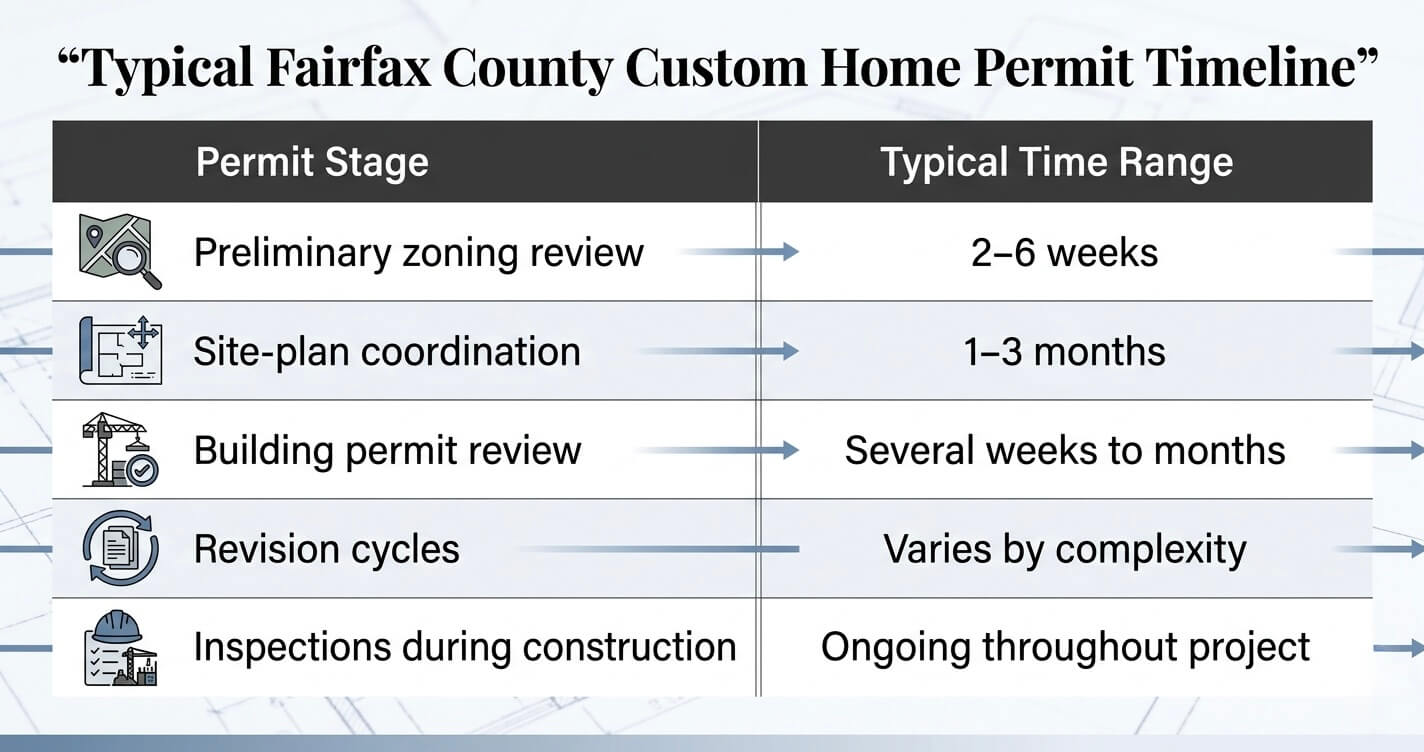
[Source: Fairfax County Land Development Services (LDS)]
Several factors can significantly affect approval speed, including:
- steep or heavily wooded lots
- stormwater management requirements
- retaining wall engineering
- environmental constraints
- incomplete submission packages
- utility coordination delays
- grading and drainage conflicts
- repeated county revision requests
Northern Virginia’s permitting environment is generally more complex than many suburban U.S. construction markets because of stricter development oversight, aging infrastructure coordination, and higher-value residential construction standards. In communities such as Great Falls and McLean, estate-style homes often require extensive engineering review before permits can be finalized.
Technical Insight:
Luxury custom homes frequently involve advanced site-development conditions that extend review timelines well beyond standard residential permitting schedules. Projects with extensive grading, long driveways, stormwater facilities, or large retaining walls commonly require additional engineering coordination before approvals are issued.
Many delays also occur when homeowners underestimate the importance of early consultant coordination. Architects, civil engineers, structural engineers, and surveyors must often work simultaneously to resolve zoning, grading, drainage, and structural conflicts before permits can move efficiently through county review.
This is one reason experienced builders familiar with Fairfax County processes are particularly valuable during pre-construction planning. Articles such as How to Choose the Right Contractor in Northern Virginia can help homeowners better understand the importance of selecting contractors with local permitting and site-development experience.
COMMON CUSTOM HOME PERMIT MISTAKES TO AVOID
Custom home permitting in Fairfax County involves far more than simply submitting architectural drawings for approval. Many permit delays, redesign costs, and construction complications originate from avoidable planning mistakes made during the earliest stages of project development.
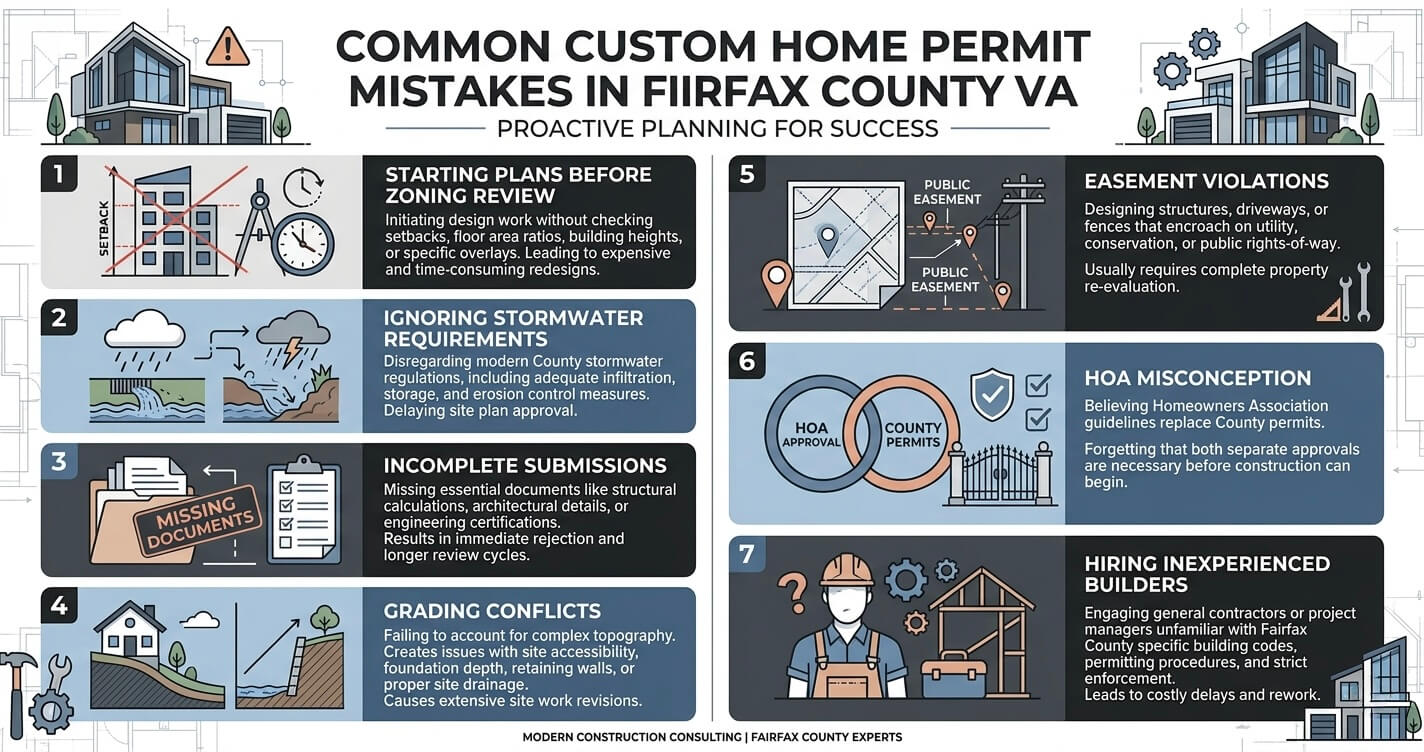
One of the most common issues is starting architectural design work before completing a full zoning analysis. Setback restrictions, easements, lot coverage limits, and grading constraints can dramatically affect what is legally buildable on a property. When zoning conflicts are discovered after design completion, costly revisions often become necessary.
Another major mistake is underestimating stormwater management requirements. Fairfax County places significant emphasis on drainage control, erosion prevention, and runoff management, particularly for larger estate properties in Great Falls and McLean. Projects involving steep slopes, wooded lots, or extensive impervious surfaces frequently require substantial engineering coordination.
Incomplete permit submissions are another leading source of delays. Missing structural calculations, grading details, energy documentation, or site-development information can trigger multiple county revision cycles and extend approval timelines considerably.
Homeowners also commonly underestimate the complexity of grading and drainage coordination. Retaining walls, driveway elevations, utility trenching, and foundation drainage systems often require integrated engineering review before permits can move forward.
Another critical mistake is assuming HOA approval replaces county permitting. Even if a homeowners association approves the design, Fairfax County approvals and code compliance reviews are still required.
Technical Overview:
Many custom home permit delays originate from site-development conflicts rather than the vertical home design itself. Stormwater compliance, grading feasibility, easement restrictions, and drainage engineering frequently create more permitting complications than architectural aesthetics.
Modern custom homes increasingly require advanced coordination between:
- structural engineering
- energy code compliance
- building-envelope detailing
- drainage engineering
- stormwater management
- environmental review systems
Industry Guidance:
The U.S. Department of Energy’s Building America Program emphasizes that early project planning and integrated design coordination improve construction efficiency and reduce costly mid-project revisions. [Source: U.S. Department of Energy — Building America Program]
For this reason, many homeowners choose to work with experienced Northern Virginia builders familiar with Fairfax County LDS procedures, zoning coordination, luxury residential permitting workflows, and local site-development requirements before finalizing construction plans.
INSPECTIONS REQUIRED DURING CUSTOM HOME CONSTRUCTION
After permit approval and construction commencement, Fairfax County requires multiple inspections throughout the building process to verify compliance with approved plans, structural requirements, and Virginia building codes. These inspections are critical because construction cannot legally proceed to certain phases until prior inspections are approved.
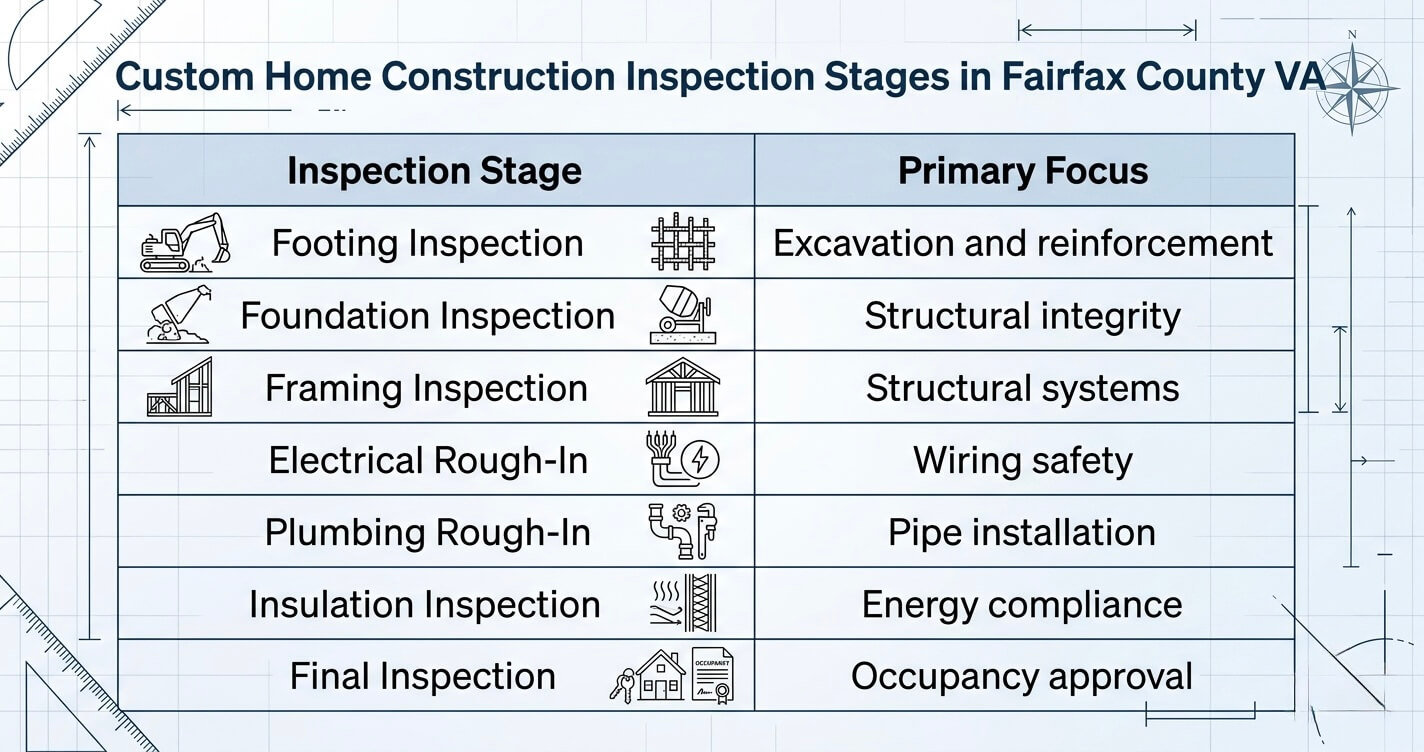
Typical inspection stages during custom home construction include:
- footing inspection
- foundation inspection
- framing inspection
- electrical rough-in inspection
- plumbing rough-in inspection
- mechanical/HVAC inspection
- insulation inspection
- drywall inspection
- final occupancy inspection
Each inspection serves a specific technical purpose. Footing and foundation inspections verify excavation depth, reinforcement placement, waterproofing systems, and foundation construction before concrete placement proceeds. Framing inspections evaluate structural integrity, load paths, engineered framing components, and overall compliance with approved construction drawings.
Rough-in inspections for electrical, plumbing, and HVAC systems occur before wall and ceiling assemblies are closed. These reviews confirm that life-safety systems, utility installations, and mechanical systems meet applicable code standards and approved design requirements.
Technical Focus:
Construction inspections verify:
- structural safety
- code compliance
- energy-performance standards
- fire and life-safety systems
- approved-plan adherence
- mechanical system integration
Virginia residential construction projects operate under the Virginia Uniform Statewide Building Code (USBC), which establishes minimum safety, energy, and construction requirements for residential buildings. [Source: Virginia Department of Housing & Community Development (DHCD)]
One of the most common construction management problems involves improper inspection sequencing. If insulation is installed before rough-in approvals or drywall is installed before required framing inspections, contractors may be forced to remove completed work to allow county access for inspection. These sequencing mistakes can create substantial delays, increase labor costs, and disrupt construction schedules.
Technical perspective:
Inspection coordination becomes increasingly important in luxury custom homes where advanced systems such as smart-home integration, high-efficiency HVAC zoning, specialty structural engineering, and complex mechanical assemblies require additional verification during multiple stages of construction.
FREQUENTLY ASKED QUESTIONS [FAQs]
Q1: Do I need a permit to build a custom home in Fairfax County VA?
Yes. Custom home construction in Fairfax County requires building permits, zoning approvals, and multiple trade permits coordinated through Fairfax County Land Development Services (LDS). Depending on the property, additional site-development and environmental approvals may also be required. [Source: Fairfax County Land Development Services]
Q2: What is the Fairfax County PLUS system?
PLUS (Planning and Land Use System) is Fairfax County’s online permitting and development-review portal. It allows applicants to submit permit applications, upload plans, schedule inspections, manage revisions, and coordinate development approvals digitally. [Source: Fairfax County PLUS System]
Q3: How long does a custom home permit take in Fairfax County?
Permit timelines vary significantly depending on zoning complexity, grading conditions, stormwater management requirements, revision cycles, and overall project scope. Large estate homes in areas such as Great Falls and McLean often require multiple review phases before final approval.
Q4: Does HOA approval replace county permits?
No. HOA approvals and Fairfax County permits are separate requirements. Even if a homeowners association approves a project, county zoning reviews, building permits, inspections, and code approvals are still required before construction may legally proceed.
Q5: What causes most permit delays?
The most common permit delays include incomplete plan submissions, zoning conflicts, unresolved grading issues, stormwater-management deficiencies, utility coordination problems, and revision requests issued during county review. Early coordination between architects, engineers, and builders can significantly reduce approval delays.
CRUX OF THE MATTER
The custom home permit process in Fairfax County VA involves far more than obtaining a basic construction approval. Successful luxury residential projects require careful coordination between zoning analysis, engineering review, site development, stormwater planning, building-code compliance, and construction inspections.
Permit planning directly influences:
- construction timelines
- overall project feasibility
- site-development costs
- construction sequencing
- long-term structural performance
Because Northern Virginia custom homes often involve complex grading conditions, environmental reviews, and advanced engineering systems, early planning and professional coordination remain essential to avoiding costly delays and redesigns later in the project.
The most successful custom home projects begin with strategic planning long before construction equipment arrives on site.
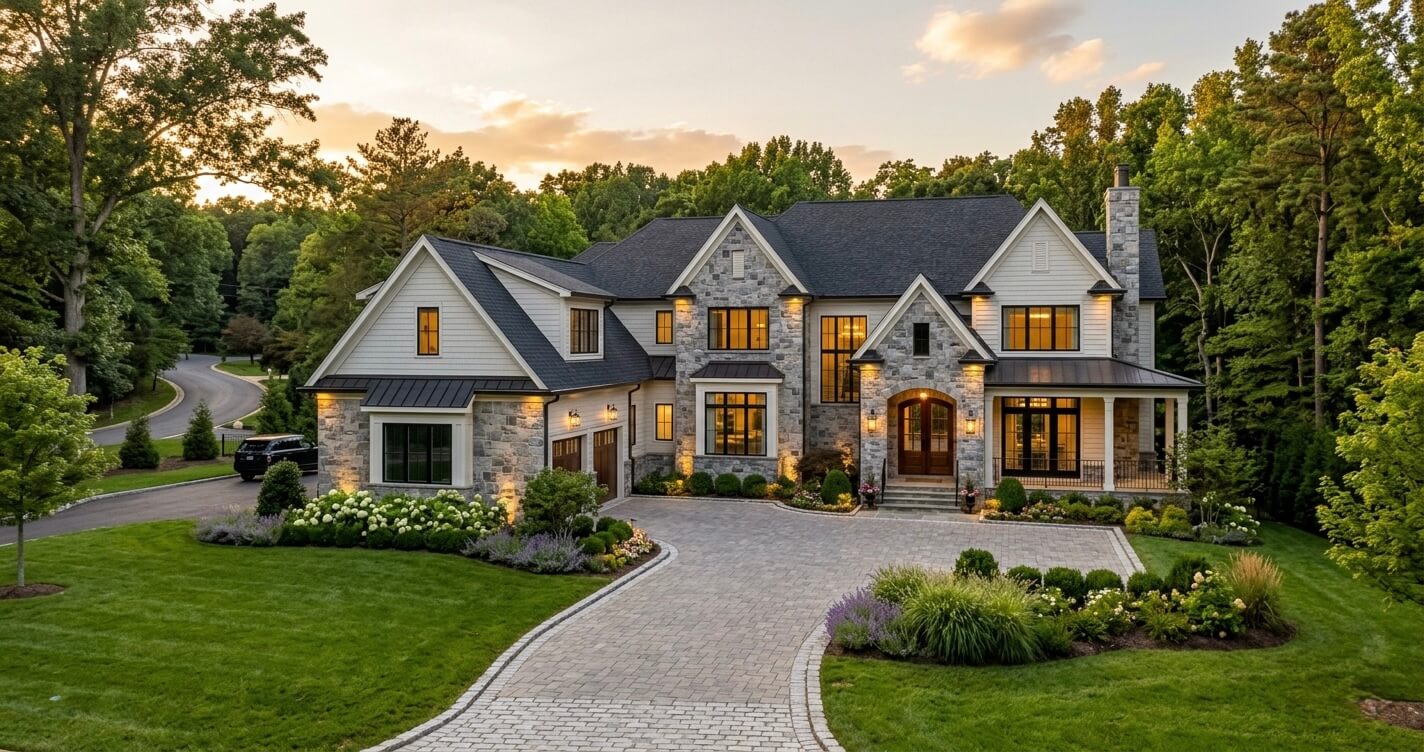
US Home Design Build works with homeowners across Fairfax County, McLean, Great Falls, Vienna, Arlington, and Northern Virginia to navigate custom home permitting, zoning coordination, and luxury residential construction planning with a focus on code compliance, project efficiency, and long-term quality.
703-202-3520 | US Home Design Build | 8200 Greensboro Dr #900, McLean VA 22102