
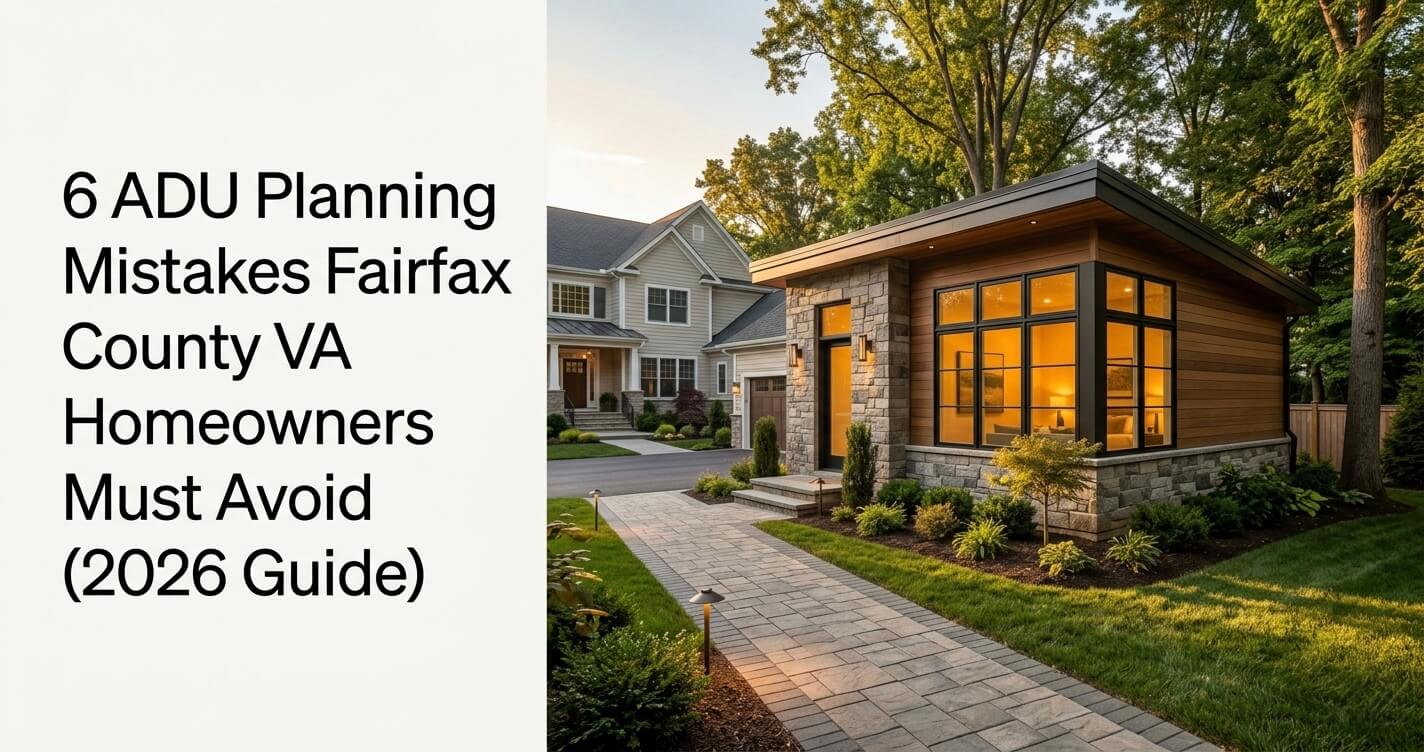
Across Fairfax County VA and the broader Northern Virginia region, accessory dwelling units (ADUs) are becoming one of the fastest-growing residential construction trends among homeowners seeking long-term housing flexibility. Rising property values, elevated housing demand, multigenerational living arrangements, remote work shifts, and aging-in-place planning have all accelerated interest in secondary residential spaces throughout communities such as McLean, Vienna, Arlington, and Alexandria.
An accessory dwelling unit may include a detached backyard cottage, basement apartment, attached in-law suite, or garage conversion apartment designed as an independent living space. However, many homeowners underestimate how technically complex these projects become once local zoning, permitting, and infrastructure requirements enter the process.
In Fairfax County, ADU construction typically involves zoning review, building permits, utility coordination, stormwater considerations, life-safety compliance, and site planning evaluations. Detached ADUs in particular often require detailed analysis of setbacks, lot coverage, parking layouts, and utility access before construction approval is granted.
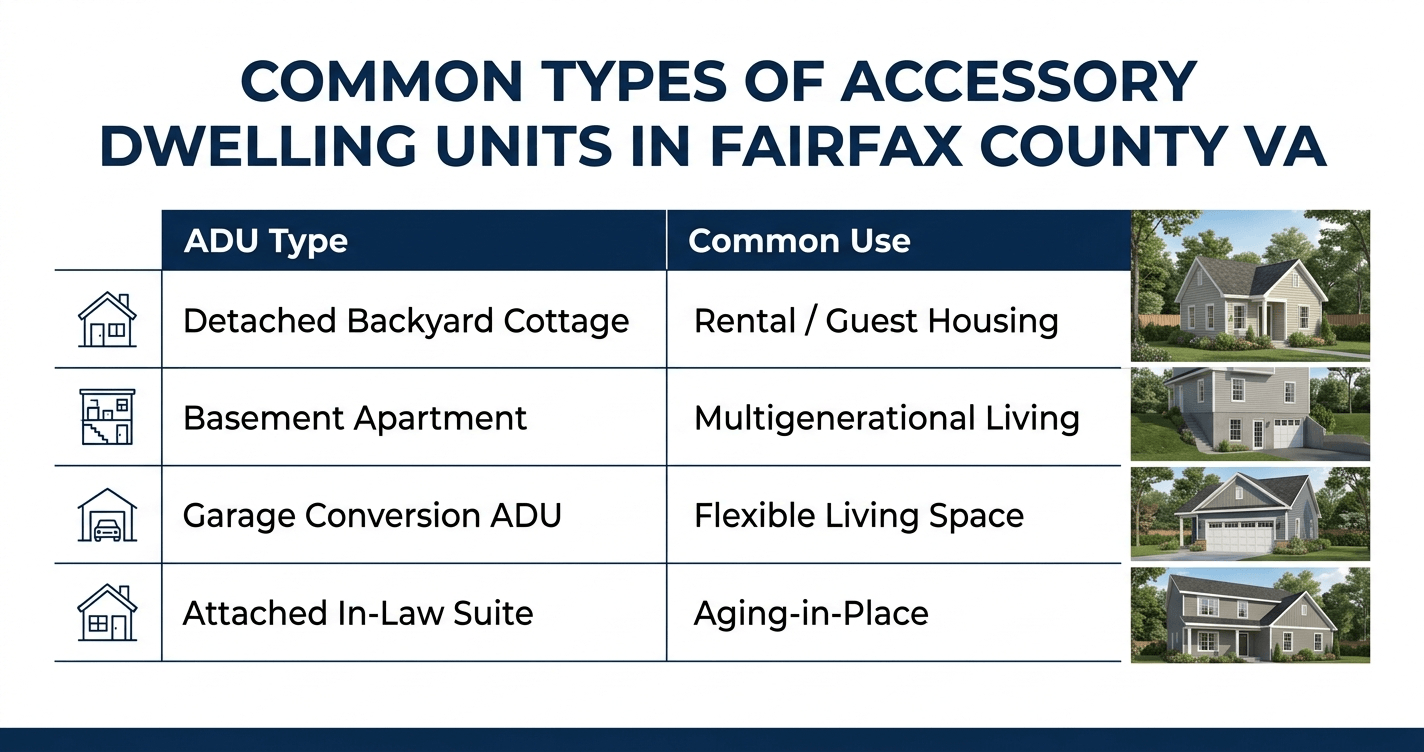
Fairfax County continues to experience strong housing demand and elevated home values, increasing homeowner interest in flexible residential solutions and alternative housing configurations. [Source: U.S. Census Bureau — QuickFacts Fairfax County]
Nationally, accessory dwelling units are increasingly recognized as flexible housing solutions that support multigenerational living and housing supply expansion. [Source: AARP]
Many homeowners first begin exploring ADU construction while evaluating broader remodeling strategies such as full home renovation McLean VA projects that improve both property functionality and long-term resale value.
This guide explains the most common ADU mistakes Fairfax County VA homeowners make before construction begins, including zoning conflicts, permitting delays, infrastructure budgeting errors, contractor selection problems, and long-term design oversights that can significantly increase project cost and approval timelines.
MISTAKE #1: IGNORING FAIRFAX COUNTY ZONING RULES
One of the most expensive ADU planning mistakes Fairfax County VA homeowners make is assuming that a property can automatically accommodate an accessory dwelling unit without detailed zoning verification. In reality, ADUs are heavily regulated through Fairfax County zoning ordinances, land-use controls, setback requirements, and accessory structure limitations that vary based on lot conditions and residential zoning classifications.
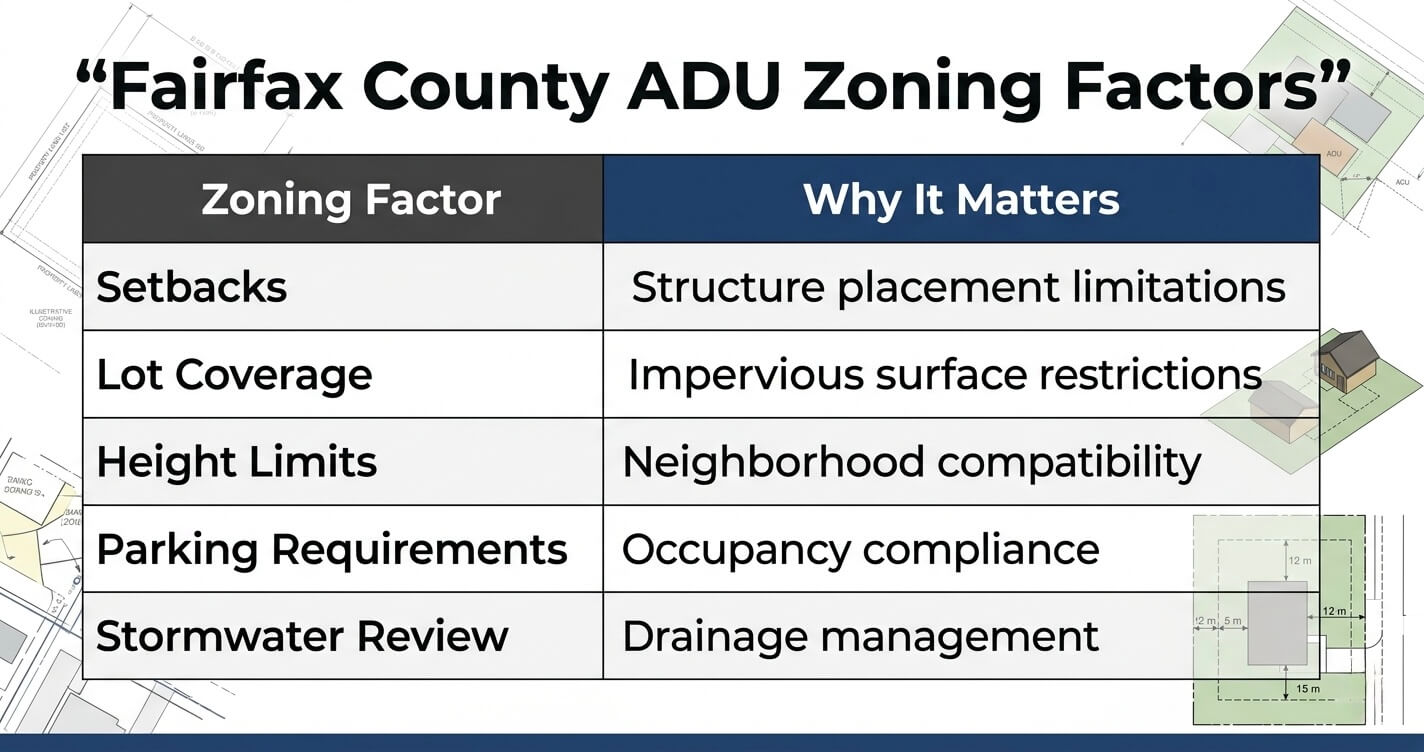
Fairfax County regulates accessory dwelling units through zoning ordinances that govern land use, structure placement, lot utilization, and residential occupancy requirements. [Source: Fairfax County Zoning Ordinance]
The zoning complexity increases significantly depending on the type of ADU being proposed. Attached ADUs, detached backyard cottages, garage conversion apartments, and basement apartments each face different review considerations involving building configuration, egress compliance, parking access, and occupancy limitations.
Detached ADUs are often the most restrictive because accessory structures directly affect rear-yard setbacks, impervious surface calculations, stormwater management thresholds, tree preservation requirements, and neighboring property impacts. In many Fairfax County neighborhoods, homeowners discover too late that their proposed detached ADU exceeds allowable lot coverage or violates minimum setback distances.
Garage conversion ADUs and basement apartments may appear simpler initially, but they still require zoning compliance reviews involving parking requirements, ceiling height standards, emergency egress, fire separation, and utility integration.
Another common issue involves homeowner associations. Many property owners incorrectly assume that HOA approval automatically authorizes construction. However, HOA approval and county zoning approval are entirely separate processes. A project may receive HOA authorization while still violating Fairfax County zoning regulations or building code requirements.
Early zoning analysis is critical because unresolved compliance issues can delay permits, trigger redesign expenses, or halt construction entirely after planning has already begun. Before pursuing an accessory dwelling unit Fairfax VA project, homeowners should verify setback limitations, lot restrictions, parking obligations, and permitting pathways through a proper Remodeling Permit Fairfax County review process.
MISTAKE #2: UNDERestimating ADU INFRASTRUCTURE & UTILITY COSTS
Many homeowners initially budget for visible construction elements such as framing, finishes, cabinetry, and flooring while significantly underestimating the infrastructure and utility costs required to support a legally compliant ADU. In Fairfax County VA, infrastructure upgrades frequently become one of the largest hidden cost categories within accessory dwelling unit construction projects.
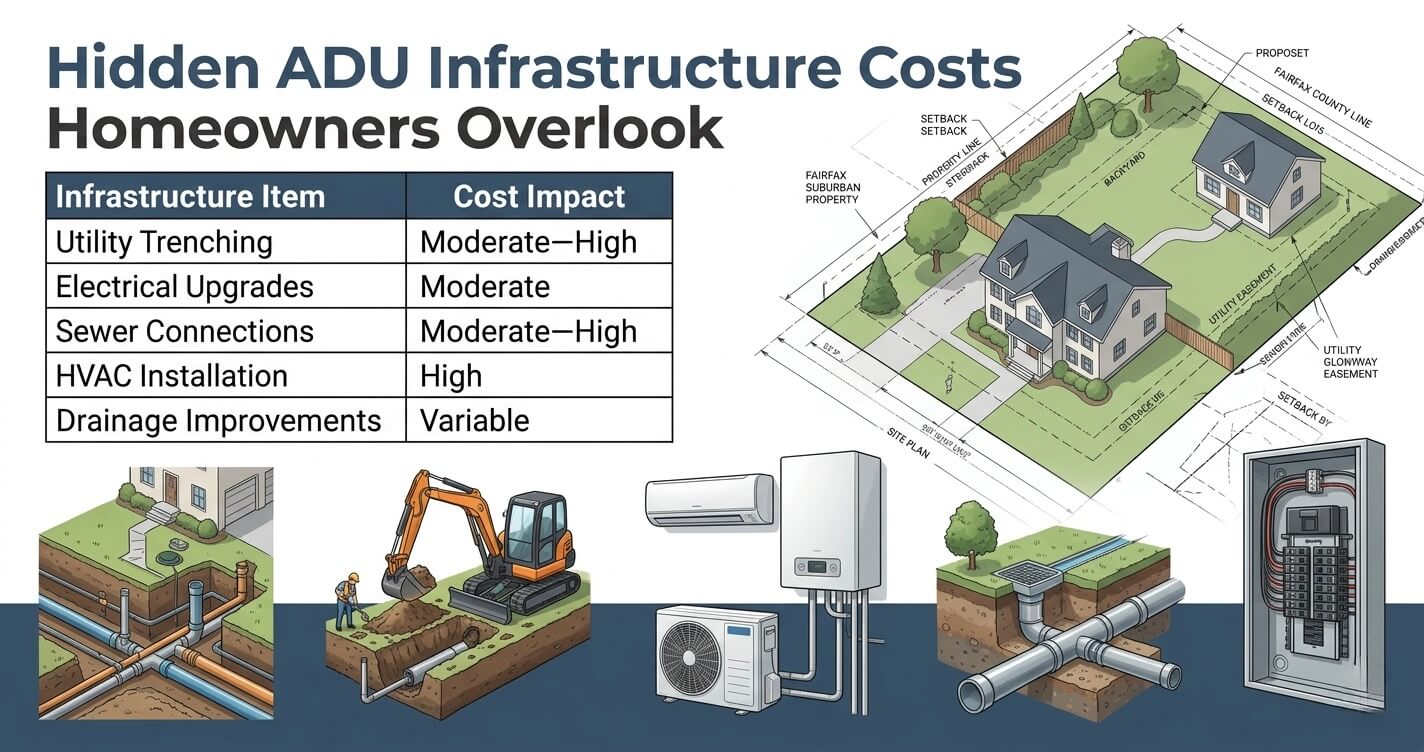
Detached ADUs commonly require extensive site utility work, including underground trenching for electrical service, water supply connections, sewer tie-ins, gas line extensions, internet/data wiring, and exterior drainage systems. Depending on the existing property configuration, homeowners may also need electrical panel upgrades, independent HVAC systems, supplemental water capacity, or additional stormwater management improvements before construction can proceed.
Site development costs can escalate quickly when grading challenges, retaining walls, tree removal, driveway modifications, walkway access, or exterior lighting installations are required to satisfy code compliance and functional access standards. In sloped or heavily landscaped Northern Virginia lots, these costs often emerge well before vertical construction even begins.
According to the National Association of Home Builders (NAHB), infrastructure installation and site development expenses can significantly affect total residential construction budgets, particularly in projects involving utility expansion and land preparation. [Source: National Association of Home Builders (NAHB) — Construction Cost Survey]
Stormwater management is another commonly overlooked factor in Fairfax County ADU development. Additional impervious coverage from detached ADUs, patios, walkways, or driveway expansions may trigger drainage mitigation requirements that increase engineering and site construction costs.
In many garage conversion ADU Northern Virginia projects, homeowners also underestimate the complexity of integrating new plumbing, insulation systems, mechanical ventilation, and fire-rated separations into older existing structures.
One of the most effective ways to control unexpected expenses is by establishing a detailed pre-construction planning framework that evaluates utilities, drainage, access, permitting, and site logistics before design finalization.
MISTAKE #3: FAILING TO PLAN FOR PERMITS & CODE COMPLIANCE
One of the most common ADU mistakes Fairfax County VA homeowners make is underestimating how extensive the permitting and code compliance process becomes once an accessory dwelling unit is designed as an independent living space. Unlike basic remodeling projects, ADUs trigger multiple layers of review involving zoning, life-safety systems, utilities, occupancy standards, and structural compliance.
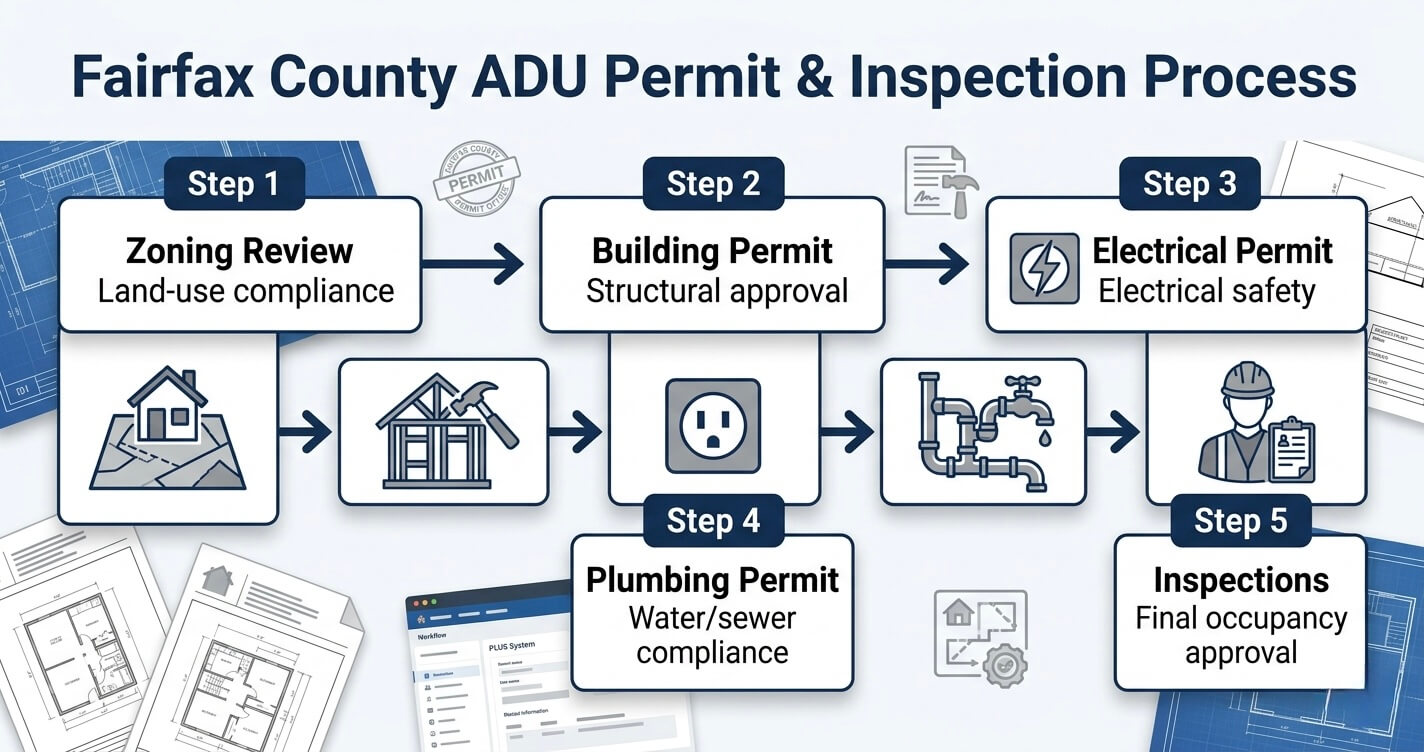
In Fairfax County, permit coordination is managed through Fairfax County Land Development Services (LDS), which oversees residential permitting, inspections, code enforcement, and development review processes. [Source: Fairfax County LDS]
All permit applications and development submissions are processed through Fairfax County’s PLUS (Planning and Land Use System) platform. [URL: https://plus.fairfaxcounty.gov]
Depending on the project scope, homeowners may require building permits, electrical permits, plumbing permits, mechanical permits, zoning approvals, and multiple phased inspections throughout construction. ADU projects frequently involve more review complexity because they contain kitchens, bathrooms, sleeping areas, HVAC systems, and independent living functionality that must comply with residential code standards.
Virginia enforces residential construction standards through the Uniform Statewide Building Code (USBC), which governs structural safety, fire protection, mechanical systems, and habitability requirements. [Source: Virginia DHCD — USBC]
Code compliance for ADUs commonly includes emergency egress requirements, minimum ceiling heights, fire separation assemblies, smoke and carbon monoxide detectors, insulation standards, ventilation systems, stair geometry regulations, and accessibility considerations depending on occupancy configuration.
A major homeowner mistake occurs when demolition, excavation, or site work begins before zoning and permit approvals are fully confirmed. This can trigger stop-work orders, redesign costs, failed inspections, or permit delays that substantially increase total project timelines.
Technically, ADUs undergo more complex review than standard remodeling because they introduce occupancy separation, independent utility coordination, life-safety systems, and habitable residential functions within either a new structure or an altered existing space. Early permit planning is therefore critical to avoiding expensive compliance issues later in construction.
MISTAKE #4: DESIGNING AN ADU WITHOUT LONG-TERM FLEXIBILITY
Many homeowners focus heavily on immediate project goals while overlooking how an ADU may need to function over the next 10 to 20 years. In practice, one of the most valuable aspects of an accessory dwelling unit Fairfax VA project is its long-term adaptability across changing family, lifestyle, and housing needs.
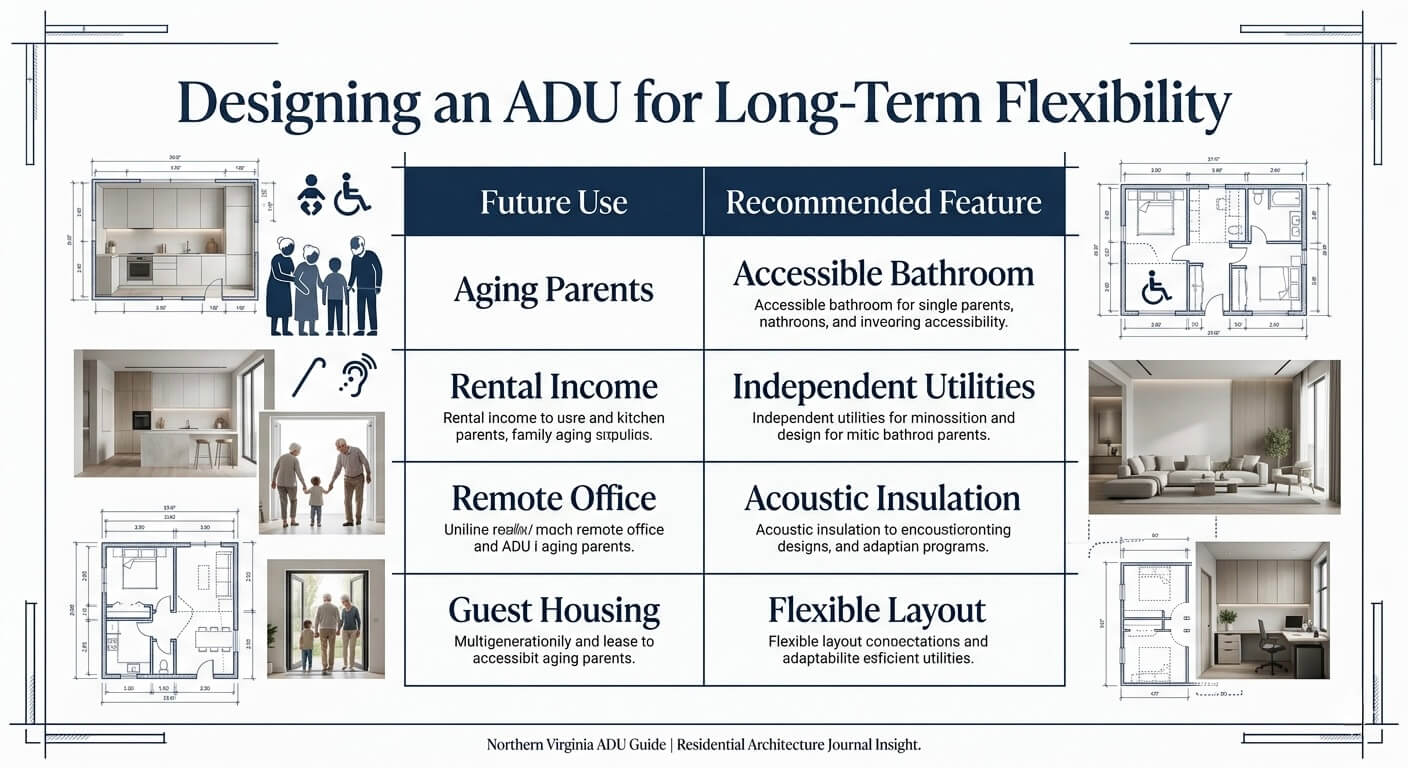
Today’s ADUs frequently serve multiple purposes over their lifespan, including multigenerational living arrangements, aging-in-place housing for parents, independent space for adult children, caregiver accommodations, guest suites, remote work offices, and future rental income opportunities. Poorly planned layouts often become functionally restrictive because they fail to anticipate how household needs evolve over time.
AARP continues to identify aging-in-place and multigenerational housing demand as major drivers behind increasing ADU adoption nationwide. [Source: AARP Livable Communities]
Long-term ADU functionality often depends on incorporating flexible design principles during the earliest planning stages. These may include wider doorways, accessible bathroom layouts, first-floor sleeping areas, improved sound insulation, privacy separation between occupants, efficient storage planning, and independent utility controls that allow the unit to operate more comfortably as a semi-autonomous living space.
In many backyard cottage Fairfax VA projects, homeowners initially prioritize aesthetics while overlooking practical usability issues such as limited storage, poor circulation space, inadequate acoustic separation, or inaccessible bathroom configurations. These oversights can significantly reduce long-term functionality and resale appeal.
Like major home additions, ADU projects require long-term planning that balances immediate lifestyle needs with future adaptability. Many homeowners evaluating accessory dwelling unit construction also explore broader expansion projects such as Second Story Addition in Northern Virginia solutions to improve long-term property flexibility and multigenerational living capacity.
Well-designed ADUs typically maintain higher long-term utility because they can evolve alongside changing family structures, housing demands, and accessibility needs without requiring major reconstruction later.
MISTAKE #5: HIRING CONTRACTORS WITHOUT ADU EXPERIENCE
Accessory dwelling units are among the most technically demanding residential remodeling projects because they combine structural construction, zoning review, infrastructure coordination, permitting compliance, utility planning, and life-safety requirements within a relatively compact footprint. As a result, hiring contractors without direct ADU experience can create substantial project risks for Fairfax County homeowners.
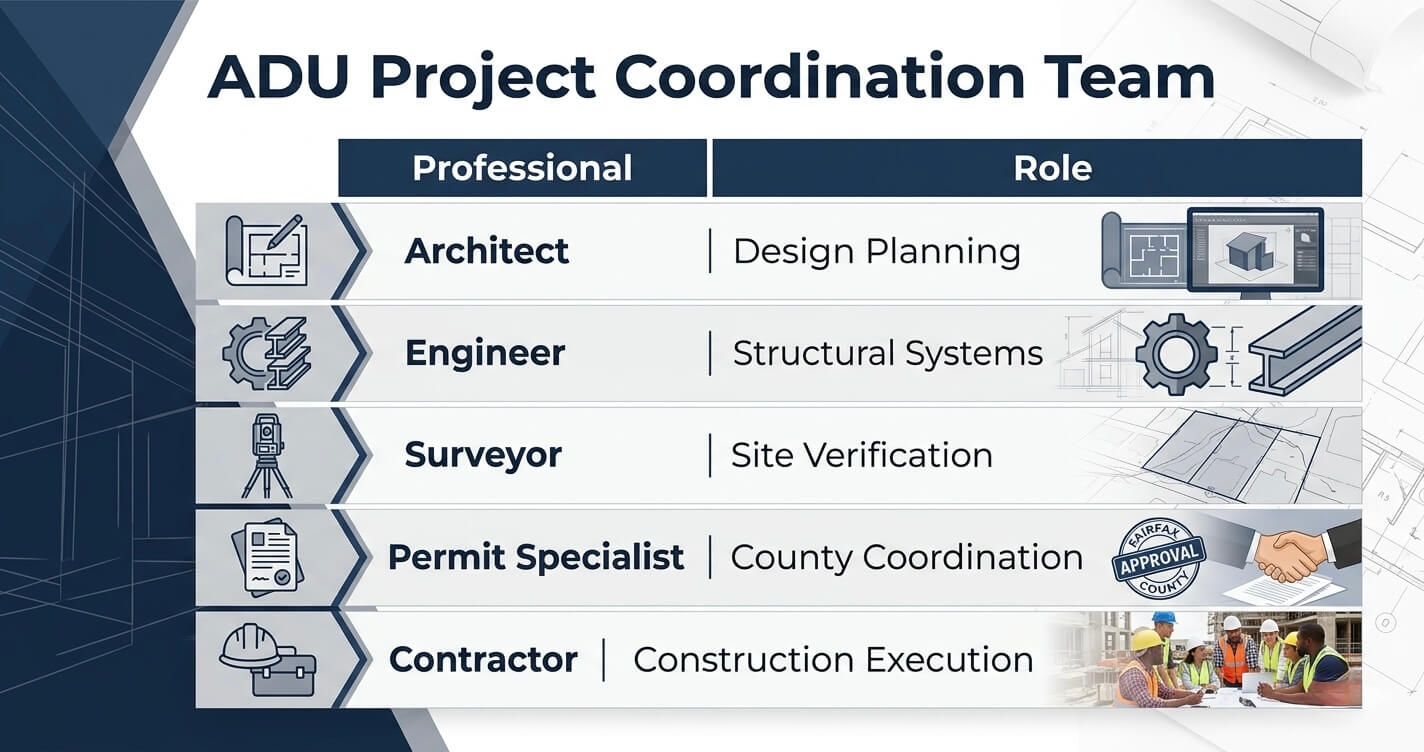
Unlike conventional remodeling projects, detached ADUs function similarly to small independent homes. They require coordinated planning between architects, engineers, surveyors, utility contractors, permit specialists, and inspectors to ensure compliance throughout both design and construction phases.
Inexperienced contractors often underestimate critical ADU-specific issues such as setback restrictions, stormwater review triggers, fire separation requirements, utility capacity limitations, inspection sequencing, and zoning compliance procedures. These oversights frequently lead to redesign costs, permit delays, failed inspections, or expensive corrective work during construction.
Garage conversion ADU Northern Virginia projects can become particularly problematic when contractors lack experience integrating modern code requirements into older existing structures. Improper ventilation design, inadequate fire-rated assemblies, insufficient egress planning, or undersized electrical systems can create serious compliance complications during inspection review.
Before selecting an ADU builder Northern Virginia homeowners should verify several key qualifications, including:
- Virginia Class A contractor licensing
- Active insurance coverage
- Familiarity with Fairfax County permitting procedures
- ADU-specific construction experience
- Design-build coordination capabilities
- Experience managing zoning and infrastructure reviews
Strong ADU contractors also understand broader building-envelope performance, moisture management systems, utility integration, and residential addition sequencing that directly affect long-term durability and code compliance.
Because ADU construction intersects multiple regulatory and technical disciplines, homeowners benefit significantly from working with remodeling professionals experienced in Northern Virginia permitting, zoning coordination, and complex residential additions. Many homeowners begin contractor evaluation research through resources discussing How to Choose the Right Contractor in Northern Virginia before finalizing project planning decisions.
MISTAKE #6: UNDERBUDGETING THE TOTAL ADU PROJECT
One of the largest financial mistakes homeowners make during ADU planning is assuming that smaller square footage automatically translates into inexpensive construction. In reality, accessory dwelling units often involve disproportionately high infrastructure, permitting, and systems-related costs compared to standard interior remodeling projects.
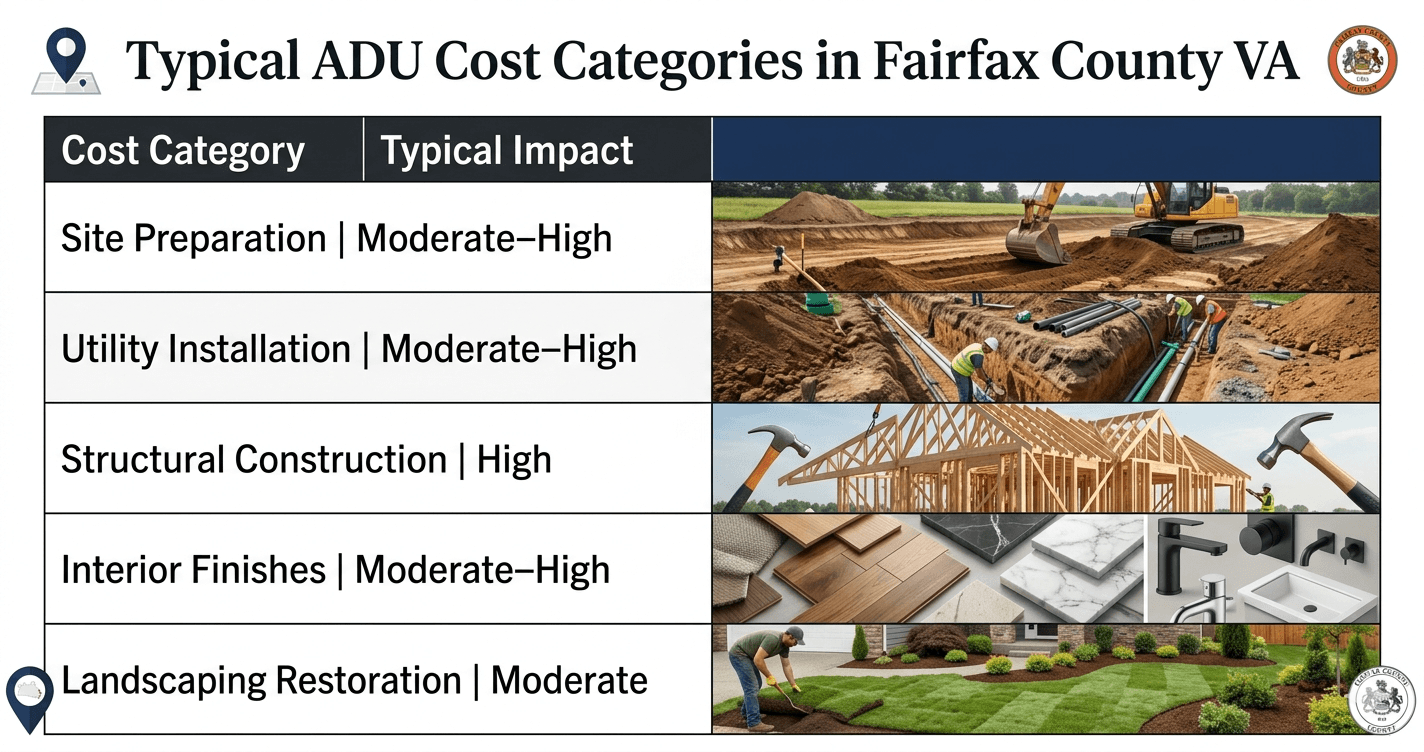
Even compact ADUs still require kitchens, bathrooms, plumbing systems, electrical infrastructure, HVAC equipment, insulation assemblies, ventilation systems, and code-compliant life-safety components. In Fairfax County, these requirements are frequently compounded by zoning reviews, utility coordination, stormwater compliance, and site development costs that homeowners do not initially anticipate.
Typical ADU budget categories often include:
Detached ADU Fairfax County projects commonly experience cost escalation related to grading complications, retaining walls, drainage improvements, utility trenching, driveway modifications, or tree preservation requirements. Hidden site conditions such as poor soil quality, aging utility infrastructure, or insufficient electrical capacity can also significantly increase total project costs after construction begins.
Homeowners should also account for material escalation, permit delays, inspection revisions, and contingency budgeting. Industry professionals commonly recommend maintaining contingency reserves of approximately 10–20% to accommodate unforeseen construction conditions and regulatory adjustments.
According to the Harvard Joint Center for Housing Studies, construction costs throughout the Washington DC metropolitan region continue to remain above national averages due to labor demand, infrastructure complexity, and regional development pressures. [Source: Harvard Joint Center for Housing Studies — Improving America’s Housing Report]
A critical budgeting misconception is that ADUs behave like simplified additions. In reality, independent living functionality dramatically increases technical complexity because every unit still requires fully integrated mechanical, electrical, plumbing, and life-safety systems regardless of overall square footage.
In many ADU zoning Fairfax County VA projects, infrastructure and permitting complexity ultimately affect total cost more heavily than homeowners initially expect during early conceptual planning.
FREQUENTLY ASKED QUESTIONS [FAQs]
Q1: What is the biggest ADU planning mistake in Fairfax County VA?
The biggest ADU mistakes Fairfax County VA homeowners make typically involve skipping early zoning and permit research. Many homeowners begin designing detached ADUs or garage conversion apartments before verifying setbacks, lot coverage limitations, utility requirements, or stormwater regulations. This often leads to redesign costs, permit delays, or failed approvals later in the project.
Q2: Do ADUs require permits in Fairfax County?
Yes. Most accessory dwelling unit Fairfax VA projects require multiple approvals, including zoning review, building permits, electrical permits, plumbing permits, mechanical permits, and inspections through Fairfax County Land Development Services (LDS). Permit applications are processed through the county’s PLUS system. [Source: Fairfax County LDS]
PLUS System: https://plus.fairfaxcounty.gov
Q3: How much does it cost to build an ADU in Northern Virginia?
ADU costs in Northern Virginia vary significantly depending on size, infrastructure requirements, site conditions, utility upgrades, and permitting complexity. Detached ADUs generally cost more than basement conversions because they often require new foundations, utility trenching, stormwater management, and independent HVAC systems.
Q4: Can I build a detached ADU in Fairfax County?
In many cases, yes, but detached ADUs must comply with Fairfax County zoning regulations involving setbacks, lot size, height restrictions, parking requirements, and accessory structure limitations. Some properties may face additional HOA restrictions or stormwater review requirements.
Q5: Does HOA approval replace county zoning approval?
No. HOA approval and Fairfax County zoning approval are entirely separate processes. Even if an HOA approves a project, the ADU must still comply with county zoning ordinances, building codes, and permit requirements.
Q6: Why do ADU projects become more expensive than expected?
Many homeowners underestimate infrastructure and regulatory costs. Utility installation, grading, drainage improvements, permit fees, engineering reviews, inspection revisions, and hidden site conditions frequently increase total ADU construction costs beyond the original budget.
IN SUMMARY
The most expensive ADU mistakes Fairfax County VA homeowners make usually occur long before construction begins. In many cases, project delays, redesign expenses, and budget overruns stem from inadequate zoning research, incomplete permit planning, unrealistic budgeting assumptions, or poor infrastructure coordination during the early planning stages.
Successful accessory dwelling unit projects require a comprehensive approach that combines zoning compliance, permit strategy, utility planning, stormwater evaluation, long-term design flexibility, and experienced construction management. Whether developing a detached backyard cottage, basement apartment, or garage conversion ADU Northern Virginia homeowners benefit most from treating these projects as fully integrated residential living environments rather than simple additions.
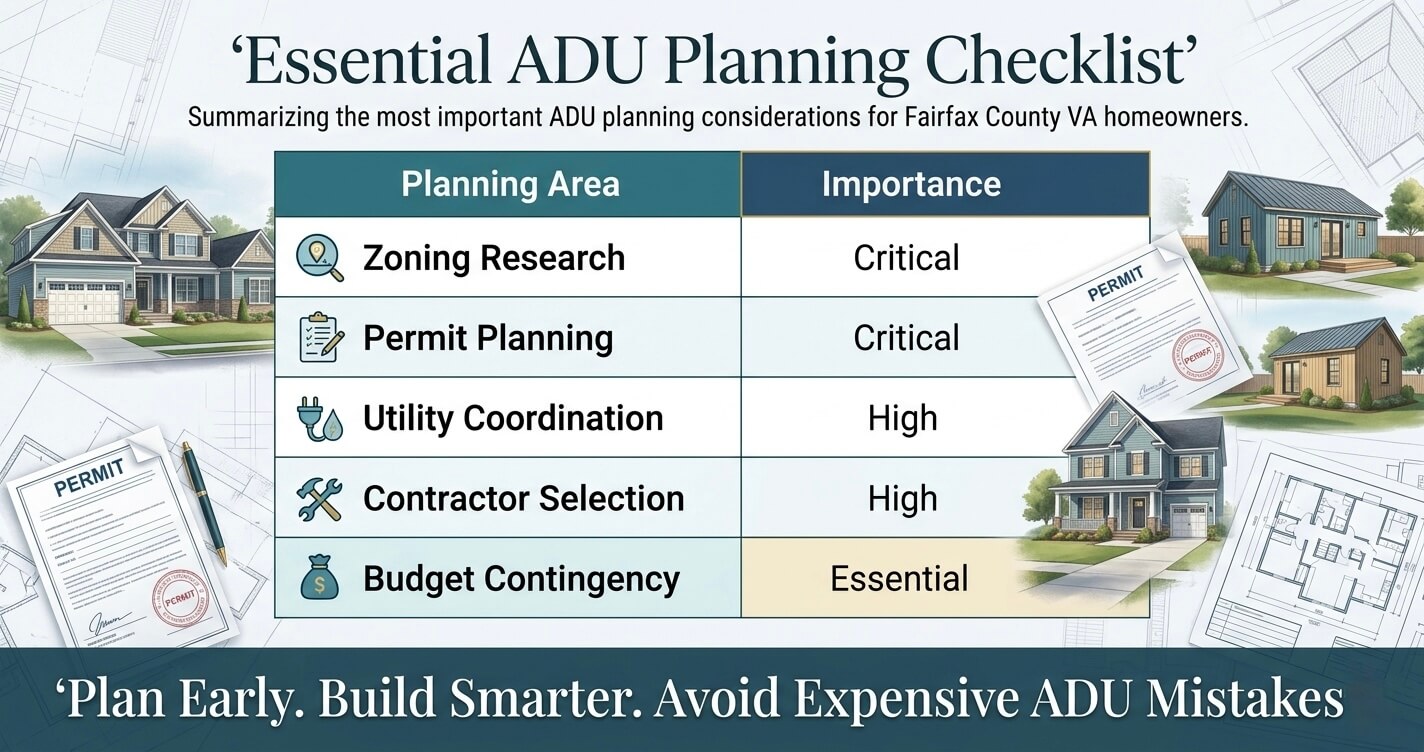
The best ADUs are carefully planned spaces designed for functionality, durability, code compliance, and long-term property value across changing household needs.
US Home Design Build works with homeowners across Fairfax County, McLean, Vienna, Arlington, Alexandria, and Northern Virginia to design and build ADUs that balance modern living flexibility, structural performance, and regulatory compliance.
703-202-3520 | https://ushdb.com/ | 8200 Greensboro Dr #900, McLean VA