
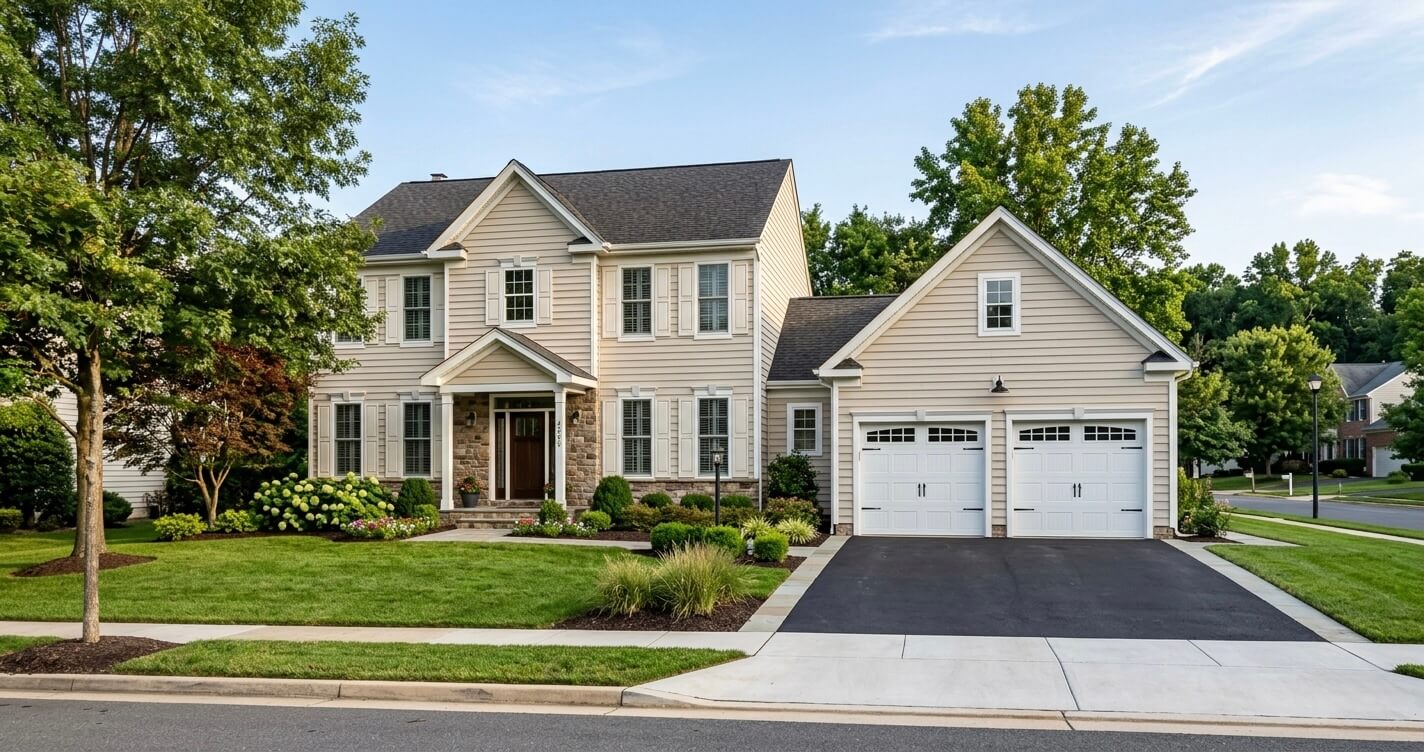
A garage addition permit Fairfax County VA is one of the first and most important steps homeowners need to get right when planning a garage project. A garage addition is one of the most valuable investments a Northern Virginia homeowner can make, but in Fairfax County VA, getting the permit process right from the start is what separates a smooth project from an expensive, stressful one.
From a financial perspective, the impact is significant. A garage addition can increase a home’s resale value with an average ROI ranging from 60% to 85%, depending on location, design, and materials used.
However, Fairfax County has a structured and strictly enforced permitting system. The county operates under the 2021 Virginia Uniform Statewide Building Code, uses the PLUS online portal for submissions, and applies detailed zoning rules that affect everything from placement to height, regardless of garage size or type.
This guide provides a complete, current checklist covering when a permit is required, what documents you need, how to submit through the PLUS system, what inspections to expect, and the real risks of skipping the process. It applies to homeowners across Fairfax County, including McLean VA, Fairfax VA, Burke, Vienna, Annandale, Oakton, and surrounding Northern Virginia communities.
Does Your Garage Addition Actually Require a Permit in Fairfax County?
This is the first question most homeowners ask and in Fairfax County VA, the answer is clear: in almost all cases, yes, a permit is required.
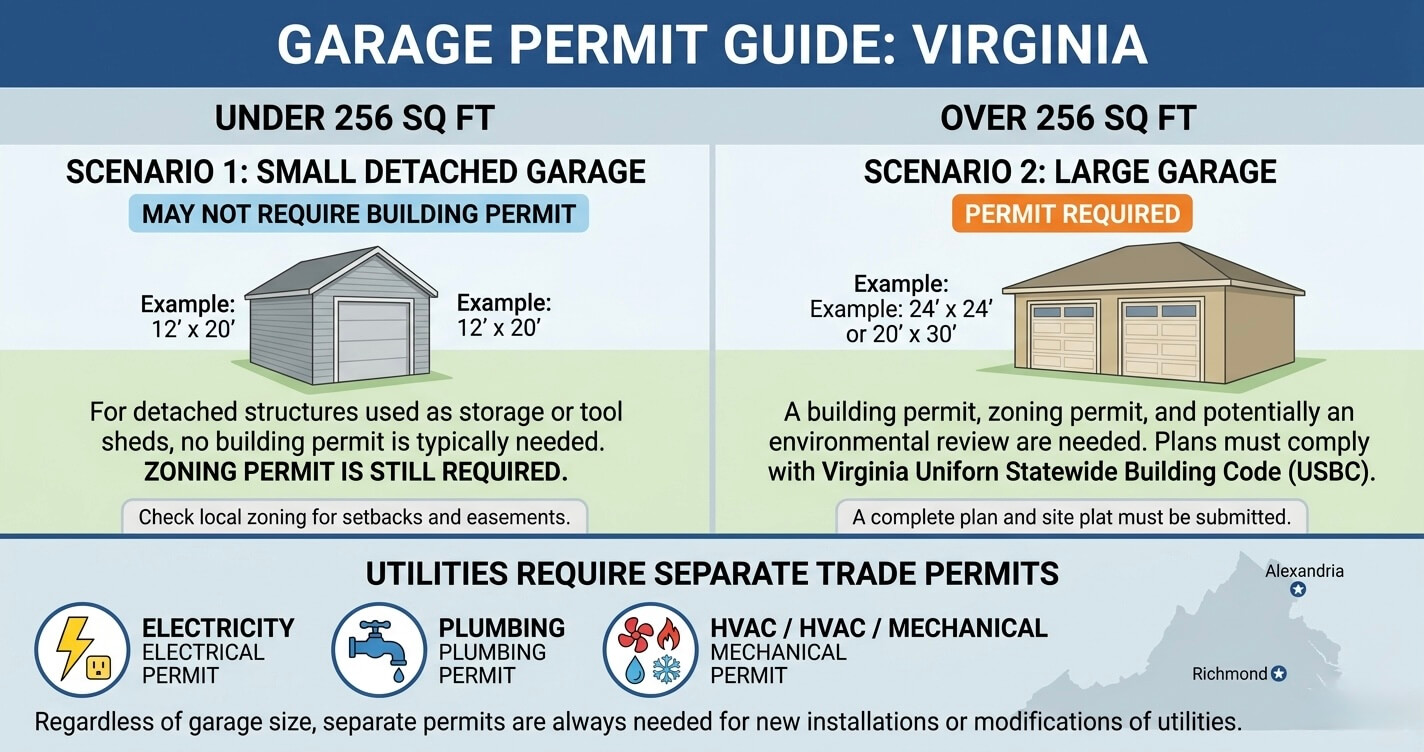
The governing authority is the 2021 Virginia Uniform Statewide Building Code, which became effective January 18, 2025 and applies across Fairfax County.
Under this code, any garage over 256 square feet, or any structure that includes electrical, plumbing, or HVAC systems, requires a building permit. This applies whether you are constructing a new garage, expanding an existing one, or installing a prefab structure.
Even smaller garages are not fully exempt. If your structure is under 256 square feet and does not include utilities, you may not need a full building permit, but you still need zoning approval. Fairfax County enforces strict setback, lot coverage, and placement requirements for all accessory structures.
Homeowners must understand that there are two separate approval tracks:
- Building Permit → Required for structural construction (over 256 sq ft or with utilities)
- Zoning Review → Required for all garage additions to confirm compliance with setbacks and lot regulations
There are also location-specific exceptions. If you live in Vienna or Clifton, you may need additional approvals from the town government in addition to Fairfax County requirements.
Another key distinction is attached vs. detached garages. Both require permits, but they are categorized differently in the county’s PLUS system. Attached garages are typically processed as residential additions or alterations, while detached garages are reviewed as accessory structures.
For homeowners planning broader projects, it’s also helpful to understand how permitting overlaps with other improvements like Home Addition Cost in Northern Virginia and regulatory guidance covered in Remodeling Permit Fairfax VA: Do You Need One, as similar approval pathways often apply.
Zoning Requirements: Setbacks, Lot Coverage & Height Limits
Before finalizing your garage design, zoning review should be your first step, not the last. One of the most common and costly mistakes homeowners in Northern Virginia make is designing a garage that later fails setback or lot coverage requirements, forcing redesigns or delays.
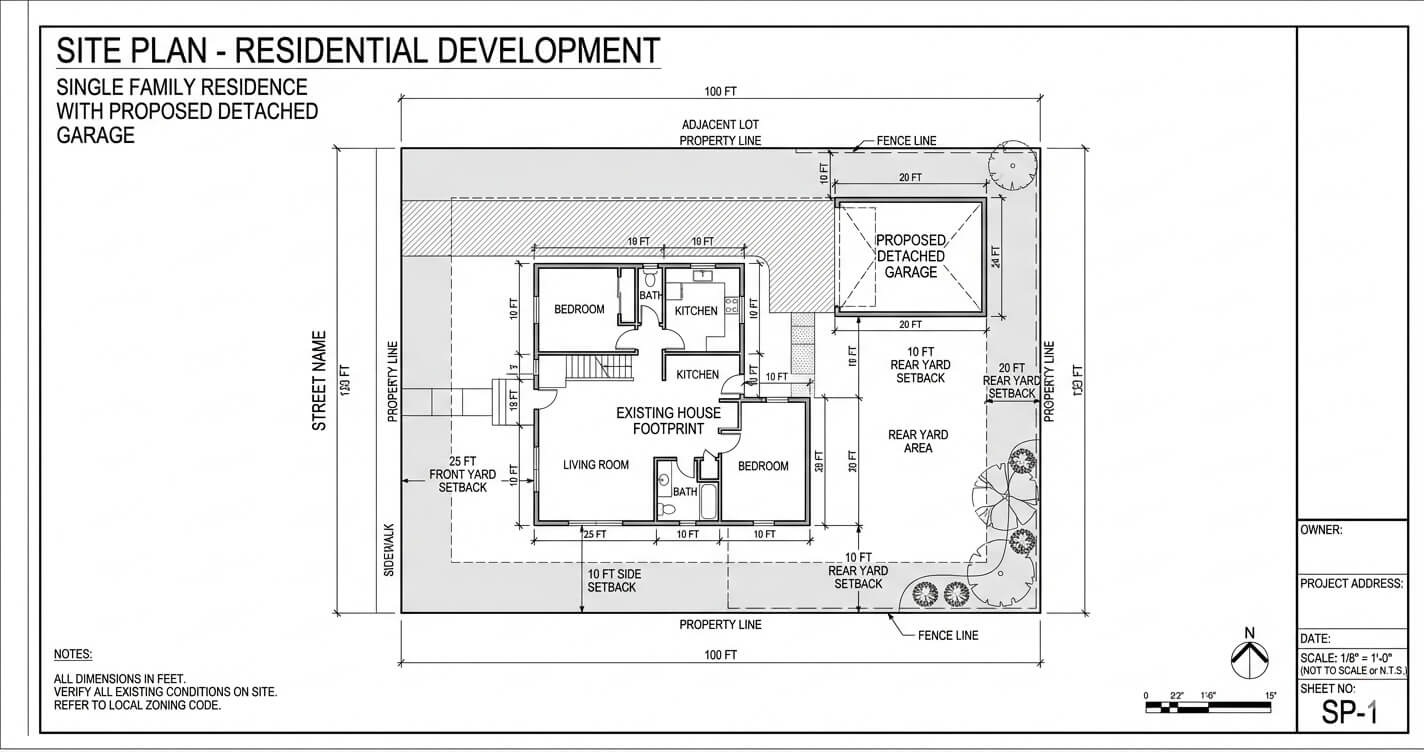
Setbacks define how close a structure can be to property lines. For example, a 10-foot side setback means your garage must be placed at least 10 feet away from the side boundary of your lot. These distances vary based on zoning district and are defined in Article 2 of the Fairfax County Zoning Ordinance.
Here are the key zoning factors you must verify:
Front Yard Setback
Attached garages that face the street must comply with front setback requirements specific to the zoning district (R-1, R-2, R-3, R-4, R-5). These can vary significantly and directly affect garage placement.
Side Yard Setback
Typically ranges between 10–15 feet depending on the zoning district. This is one of the most frequent causes of permit delays in Fairfax County.
Rear Yard Setback
Detached garages located in rear yards must still maintain minimum rear setback distances. Many homeowners assume rear placement is flexible—but it is still regulated.
Lot Coverage Limits
Fairfax County limits how much of your property can be covered by structures and impervious surfaces. A garage addition contributes to this total and may trigger additional review if limits are approached or exceeded.
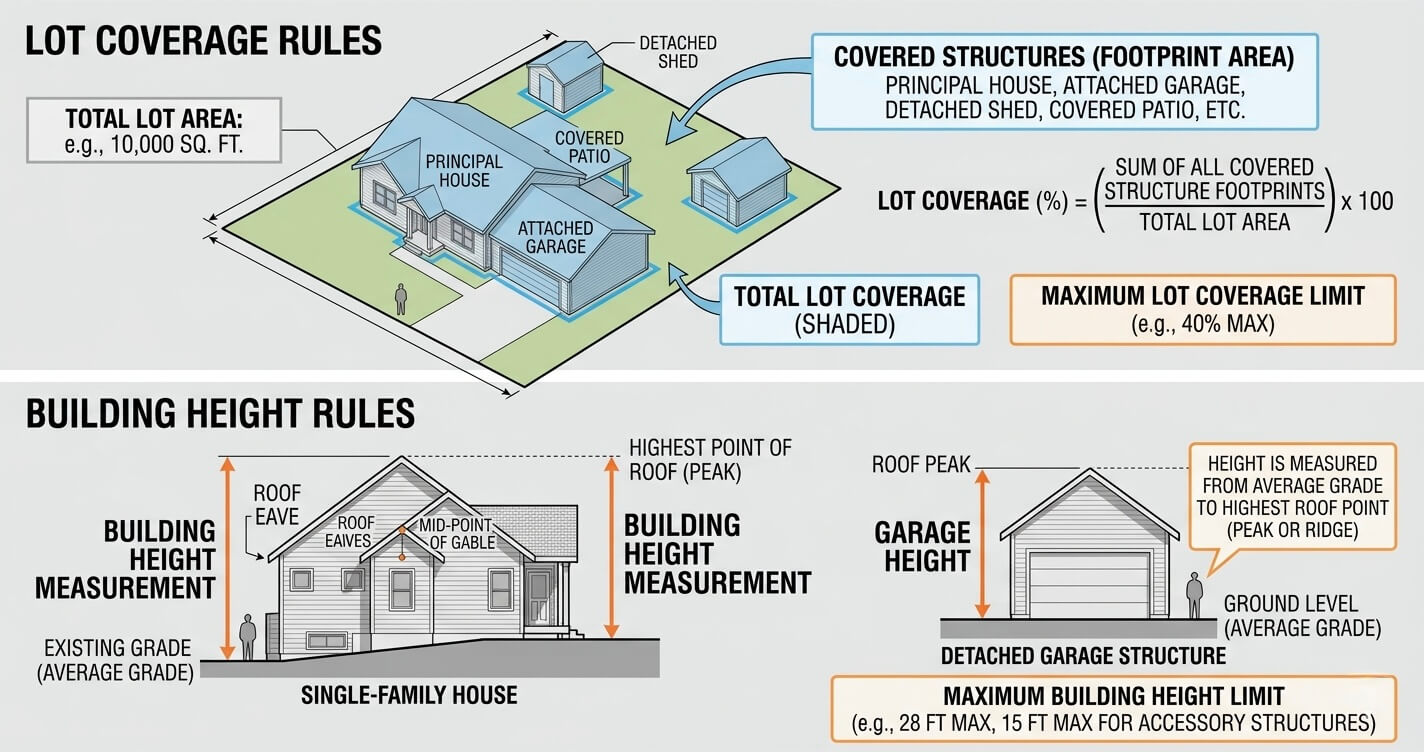
Height Restrictions
Garage height is also regulated. The county measures height from the lowest ground level adjacent to the structure to the highest point of the building.
HOA Requirements (Critical Layer)
For many homeowners in McLean VA, Burke, Vienna, Annandale, and across Fairfax County, zoning approval is only part of the process. Homeowners’ Associations (HOAs) often enforce additional design and placement rules.
These may include:
- Exterior materials
- Roof style
- Garage orientation
- Visual impact on neighboring properties
Importantly, Fairfax County does not enforce HOA rules, but it may require proof of HOA approval before processing certain permits.
How to Verify Your Zoning Requirements
Before submitting your permit:
- Call Zoning: 703-222-1082 (TTY 711)
- Email: DPDZoningPermits@fairfaxcounty.gov
- Use the Fairfax County Zoning Property File tool online
Taking this step early can prevent major delays and ensure your garage addition aligns with both county regulations and local community requirements.
The Complete Garage Addition Permit Checklist for Fairfax County VA
To avoid delays, rejections, or costly redesigns, homeowners should approach the garage addition permit Fairfax County VA process with a structured plan.
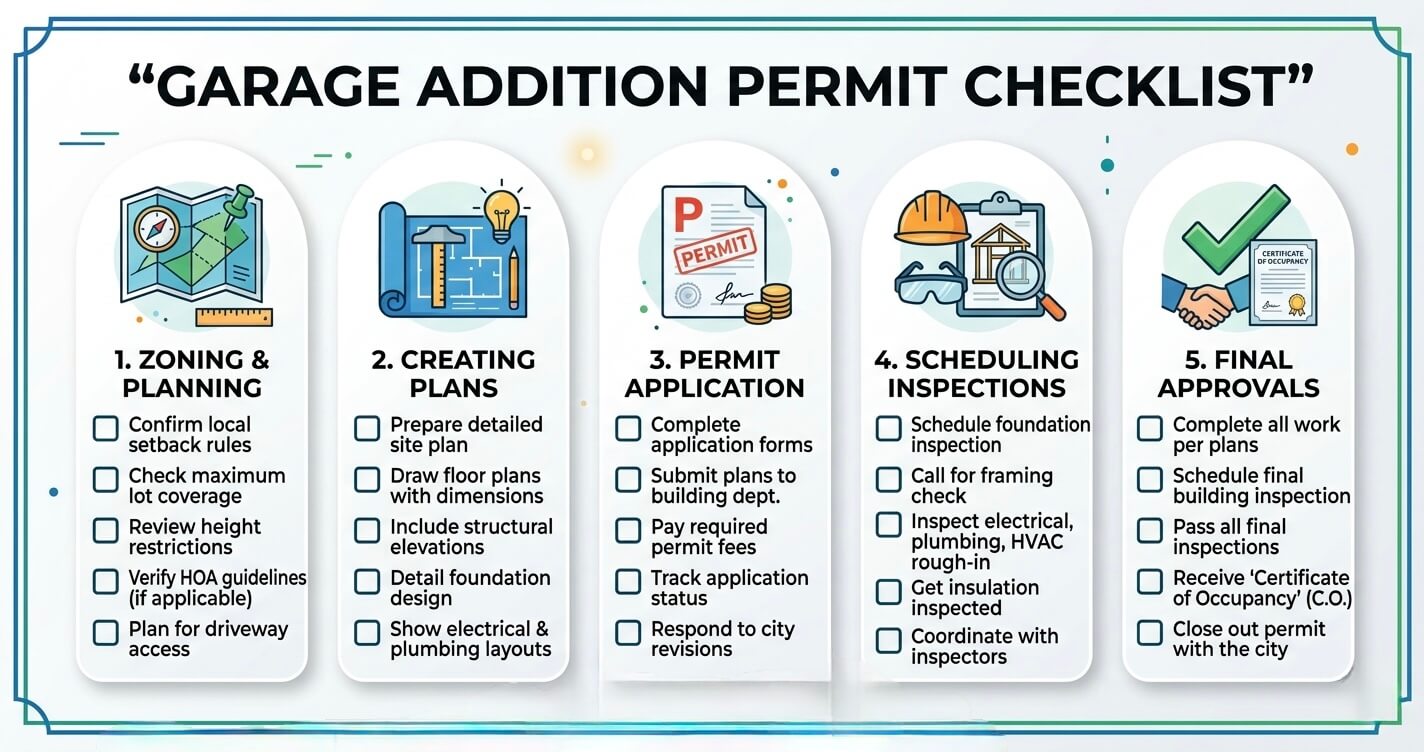
Below is a complete, step-by-step checklist tailored specifically to Fairfax County—organized into three critical stages: Pre-Application, Application & Plan Submission, and Required Permits by Scope.
Stage 1: Pre-Application Checklist
Before opening the PLUS portal, confirm each of the following:
- Determine your zoning district and verify setback, height, and lot coverage requirements for your parcel
- Confirm whether your property is located in Vienna or Clifton—if yes, obtain town-level approval before applying to the county
- Review HOA covenants and secure written approval if required
- Check whether your property falls within a floodplain, Resource Protection Area (RPA), or near a VDOT right-of-way
Separate approvals may be required in these cases.
- Call Miss Utility (811) before any excavation—this is a legal requirement in Virginia
Before you begin excavating for your project, you must first call Miss Utility at 811.
- Decide whether you or your contractor will pull the permits, this impacts responsibility for compliance, inspections, and corrections
This early-stage preparation is often overlooked, but it directly impacts how smoothly your project moves forward. Many of the issues discussed in Remodeling Permit Fairfax VA: Do You Need One also apply here, especially around zoning and approval sequencing.
Stage 2: Required Documents for Plan Submission
Your application must include a complete and code-compliant plan set. Fairfax County has strict documentation standards:
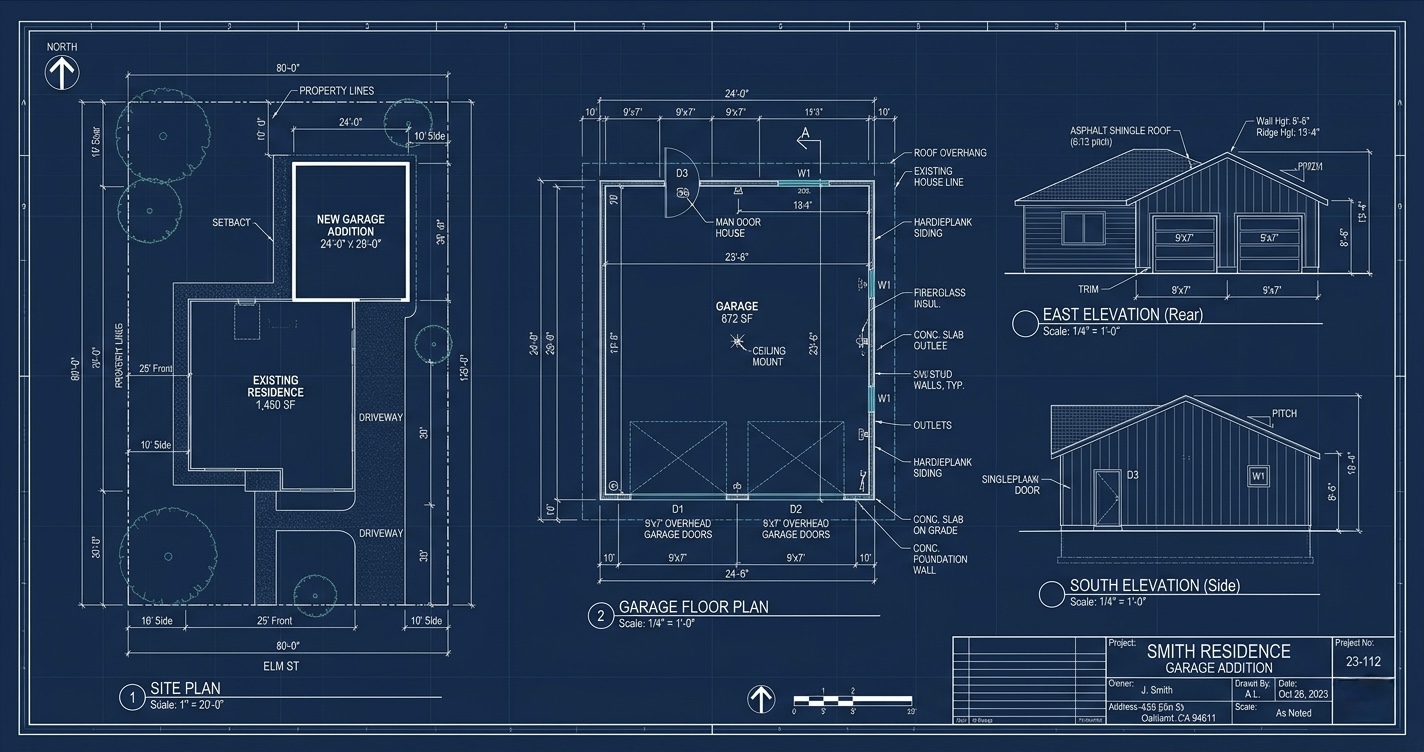
Plans must be drawn at a minimum scale of ¼ inch = 1 foot, fully dimensioned, and include designer information and code references. — Fairfax County LDS
Your submission package should include:
- Site plan — showing property lines, existing structures, proposed garage location, and setback dimensions
- Foundation plan — footing details, depth, and specifications
- Floor plan — dimensions, door/window placement, and utility rough-ins
- Roof framing plan — rafter/truss layout, pitch, and spans
- Exterior elevations — all four sides with height and material details
- Structural details — beams, headers, posts, and connections
- Energy compliance documentation — required for conditioned garages (heated/cooled)
- Manufacturer’s evaluation report — required for prefab garages (ICC-ES report)
- Designer seal and signature — if prepared by a licensed professional
- HOA approval letter — if applicable
Submitting incomplete or unclear plans is one of the most common reasons for delays. This is particularly important for larger projects, similar to what homeowners encounter when planning “Home Addition Cost in Northern Virginia”.
Stage 3: Required Permits by Scope of Work
Garage additions often involve multiple permits depending on scope:
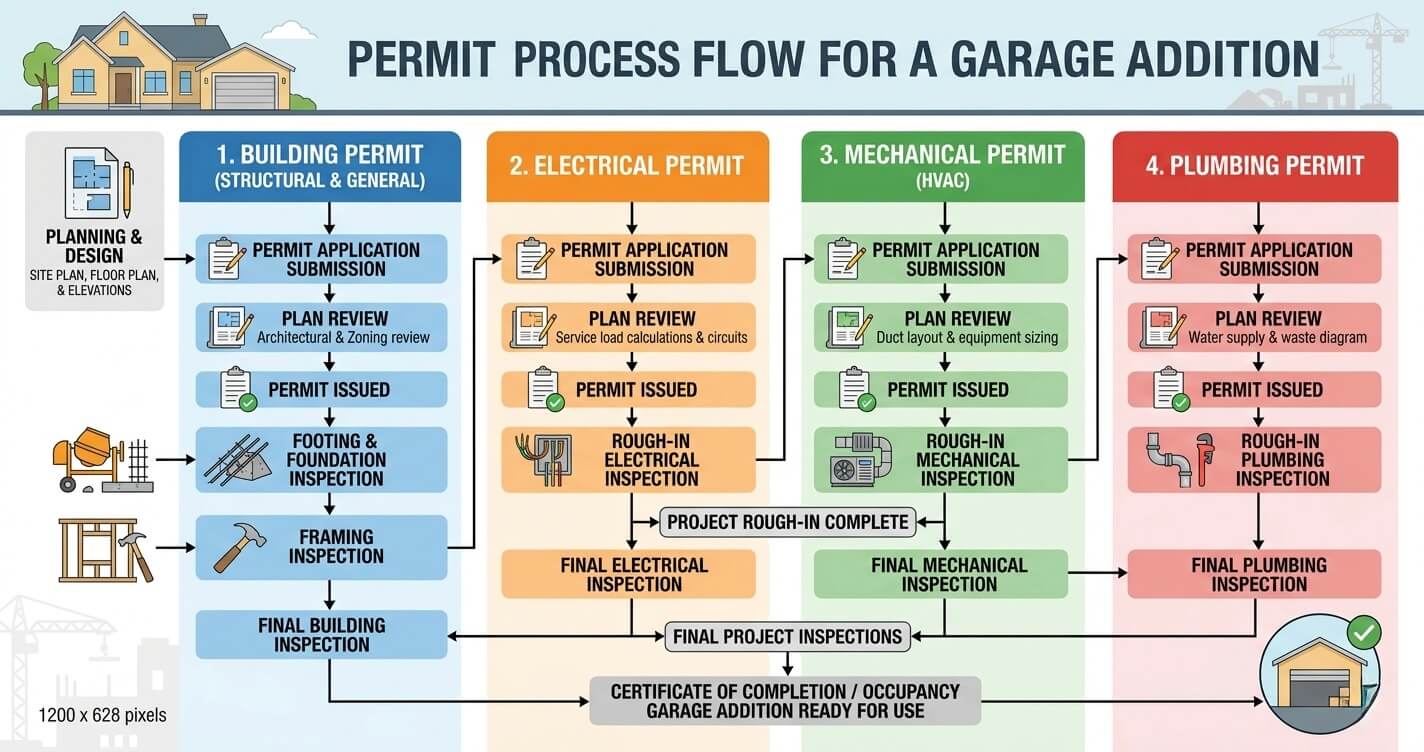
For garage additions, Fairfax County typically requires building, electrical, mechanical, and plumbing permits. — Fairfax County LDS
- Residential addition building permit — primary permit for all attached garages and detached garages over 256 sq ft
- Electrical permit — required for lighting, outlets, EV chargers, or panel work
- Mechanical permit — required for HVAC systems, ductwork, or gas appliances
- Plumbing permit — required if installing sinks, hose bibs, or other fixtures
- Zoning review — required for all garage additions regardless of size
- ADU / ALU form — required if the garage is intended to function as an accessory dwelling unit
If your project overlaps with residential conversion or future use planning, it may also relate to guidelines discussed in Accessory Living Units (ALUs) in Fairfax County VA.
How to Submit Your Application through the Fairfax County PLUS Portal
All permit applications in Fairfax County must be submitted through the PLUS (Planning and Land Use System)—there are no paper or walk-in submissions.
PLUS is the central platform for submitting applications, paying fees, and tracking permit status.
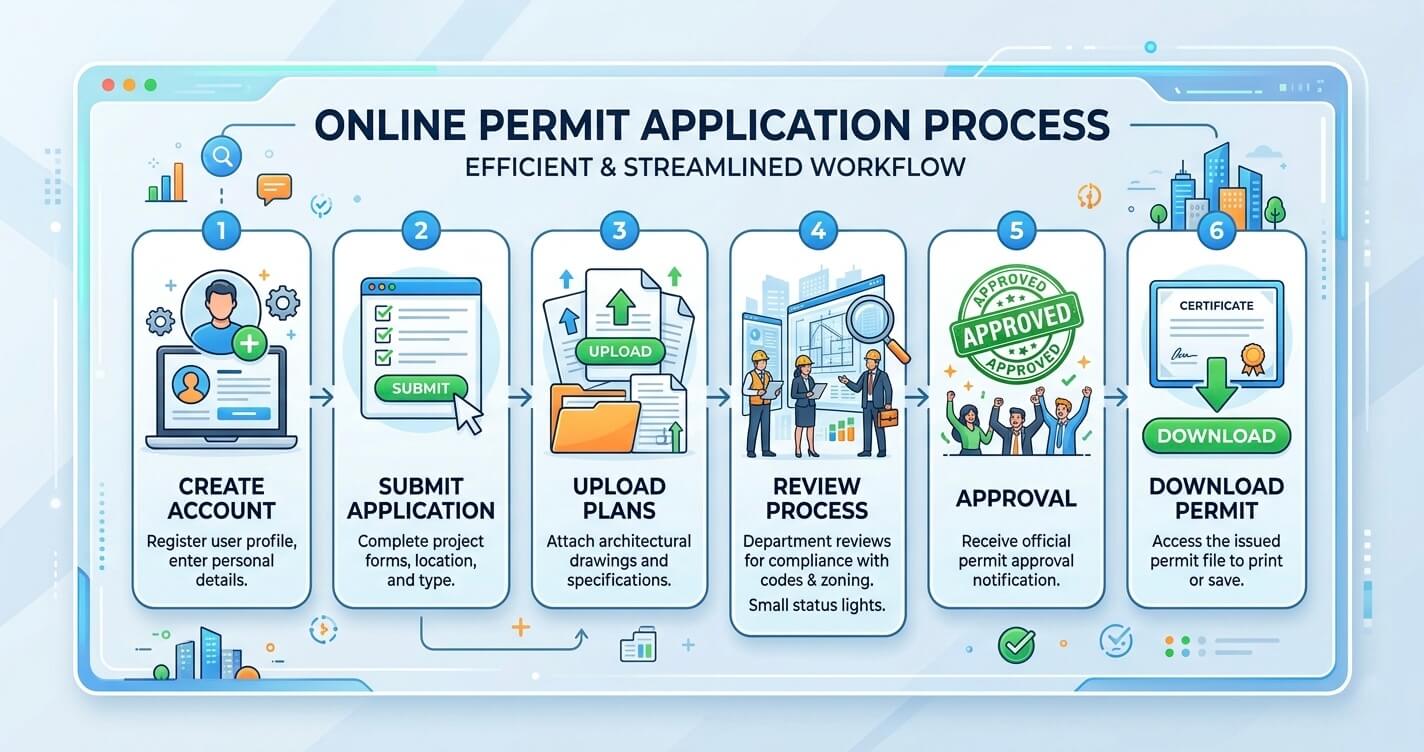
Step-by-Step Submission Process
Step 1: Create or log into your account at https://plus.fairfaxcounty.gov.
Step 2: Select the correct record type
For attached garages:
- Choose Residential Addition/Alteration
- Select Attached Garage under “Type of Addition”
Fairfax County provides multiple addition categories within the PLUS system. — Fairfax County LDS
Step 3: Complete application details
Include all required fields and reference any associated trade permits as “parent permits”
Step 4: Upload plan documents
You will receive an email to upload plans after submission
Step 5: County review begins
Multiple departments review your application for compliance
Reviews may involve Building Plan Review, Zoning, Health Department, Fire Marshal, and more. — Fairfax County LDS
Step 6: Respond to comments
Address deficiencies and resubmit if required
Step 7: Pay fees and download permit
Once approved, download your permit card and stamped plans
Permit Fees
The base building permit fee starts at approximately $108, with total costs depending on project scope.
- Use Fairfax County’s fee estimator to calculate your expected total before submission.
Permit Processing Timeline: What to Realistically Expect
One of the biggest mistakes homeowners make is underestimating how long the permitting process takes in Fairfax County. Planning ahead is essential.
Residential addition permits average approximately 10.44 weeks for approval—significantly longer than smaller alteration permits.
Typical Timeline Breakdown
- Plan preparation: 2–4 weeks
- Application review (initial): 1–2 weeks
- Building + zoning review: 4–8 weeks
- Resubmissions (if required): +2–4 weeks
- Final permit issuance: Around 1 week
Total Timeline
Expect 8–14 weeks before construction can begin.
Seasonal Consideration
Permit volumes peak between March and June, which can extend timelines. For summer construction, submit applications by February or early March.
Inspection Scheduling
Inspections can be requested by 11:59 p.m. for next-business-day service, with a 2-hour arrival window provided.
Required Construction Inspections: Stage-by-Stage
Obtaining your garage addition permit Fairfax County VA is only one part of the process. Fairfax County remains actively involved throughout construction by requiring inspections at specific stages. These inspections must be scheduled through the PLUS system and approved before moving to the next phase.
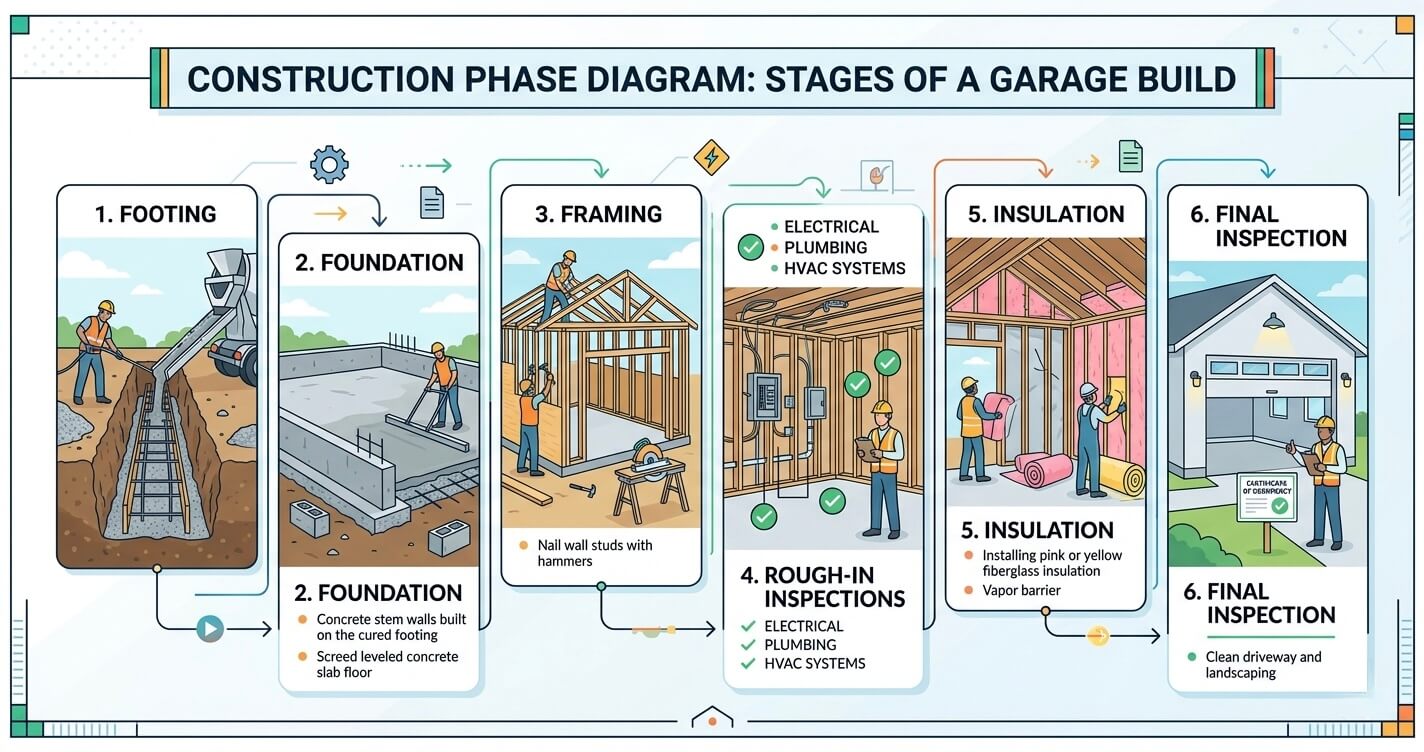
Residential additions are inspected under the Virginia Residential Code 2021, and not every project requires every inspection—it depends on the scope of work.
Typical Inspection Sequence
- Pre-construction / site inspection — required if grading or land disturbance is involved
- Footing inspection — before pouring concrete; verifies excavation depth and reinforcement
- Foundation / slab inspection — ensures proper base and structural integrity before slab pour
- Rough framing inspection — after framing is complete, before walls are closed
- Rough electrical inspection — if wiring is installed; must be approved before drywall
- Rough mechanical inspection — for HVAC or gas systems before enclosure
- Rough plumbing inspection — required if plumbing is included
- Insulation inspection — for conditioned garages before drywall installation
- Final building inspection — confirms all work complies with approved plans and code
Once all inspections are approved, Fairfax County issues a Residential Use Permit (RUP)—the final authorization required before the space can be legally used.
A Residential Use Permit (RUP) is issued after all inspections are completed and conditions are met. — Fairfax County LDS
Should You Pull Your Own Permit or Have Your Contractor Do It?
This is a common question for homeowners planning a garage addition. While homeowners are legally allowed to pull permits in Fairfax County, doing so is not always the best choice.
Fairfax County’s official guidance is clear:
Property owners may obtain permits in their own name, however, it is strongly recommended that a properly licensed contractor pull the permits as the responsible party. — Fairfax County LDS
Why Contractor-Pulled Permits Are Safer
- Accountability: A licensed contractor is responsible for code compliance and workmanship
- Experience: Contractors familiar with Fairfax County understand submission standards and can handle plan review comments efficiently
- Faster Approvals: Experienced professionals reduce delays caused by incomplete or incorrect submissions
If a contractor insists that you pull your own permit, it’s important to ask why.
Homeowners should question contractors who cannot obtain permits themselves. — Fairfax County Department of Code Compliance
Before hiring, always verify licensing through Virginia DPOR at https://www.dpor.virginia.gov.
This applies across McLean VA, Arlington VA, Fairfax VA, and all Northern Virginia communities.
What Happens If You Build a Garage Without a Permit in Fairfax County?
Skipping the permit process may seem like a shortcut, but in Fairfax County, it carries serious legal and financial risks.
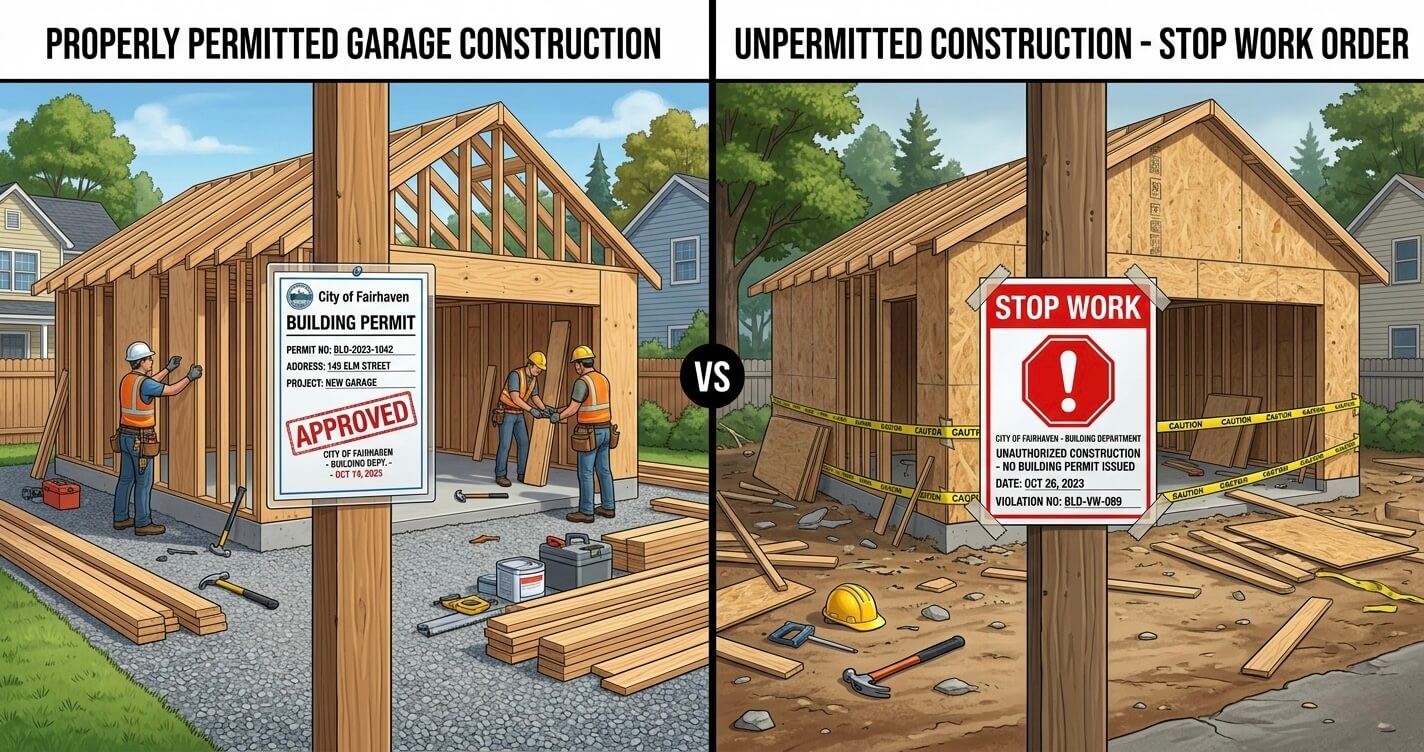
Unpermitted construction includes any work completed without required permits or inspections, and it is a violation of Virginia law under the Virginia Construction Code. — Fairfax County Department of Code Compliance
What Can Happen
- Notice of Violation (NOV) — triggers formal enforcement action
- Stop-work order — construction must immediately halt
- Fines and penalties — vary based on scope and duration of violation
- Mandatory demolition — non-compliant structures may need to be removed and rebuilt
If discovered, the county may require you to stop work, obtain permits, pay fines, or even demolish the structure and rebuild from scratch.
Real Impact on Homeowners
In Northern Virginia markets like McLean VA, Fairfax VA, and Arlington VA, unpermitted work is frequently identified during home inspections. This can lead to:
- Delayed or canceled home sales
- Price reductions
- Costly retroactive permitting
Fixing unpermitted work often requires opening finished walls and correcting structural issues, making it far more expensive than doing it correctly from the start.
Conclusion: Plan It Right, Permit It Right
Getting a garage addition permit Fairfax County VA right the first time is not just about meeting legal requirements, it’s the most effective way to protect your investment, avoid costly delays, and ensure your project delivers long-term value.
A properly permitted and well-executed garage addition can deliver an ROI of 60% to 85%, and homes with a standard-sized garage have been shown to sell for approximately 13% more than those without one.
For homeowners across Fairfax County, McLean VA, Burke, Vienna, Annandale, Oakton, and Great Falls, taking a structured, compliant approach makes all the difference.
US Home Design Build works with homeowners throughout Northern Virginia to plan, permit, and build garage additions that are designed correctly, approved efficiently, and built to last. If you’re planning a project and want to avoid common permit issues, it’s worth starting with the right guidance.
703-202-3520 | www.ushdb.com | 8200 Greensboro Dr #900, McLean VA 22102