
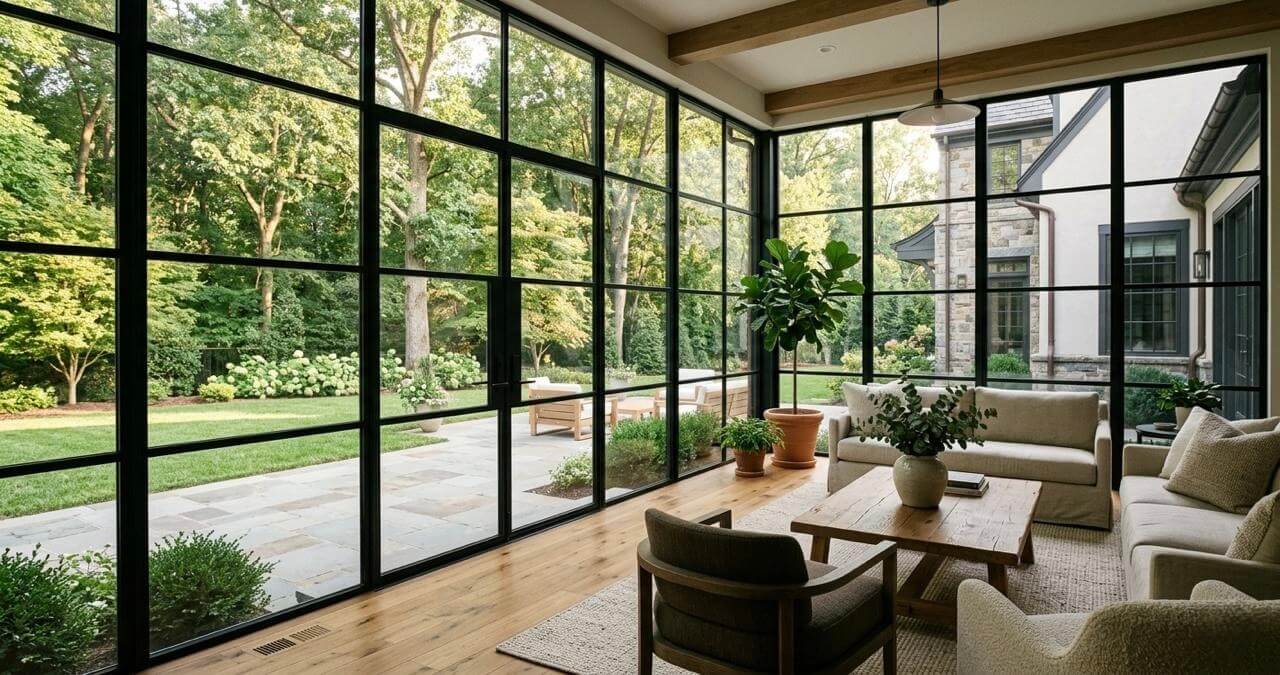
If you own a home in Great Falls, VA, you already know what makes this area special. The wooded lots, the quiet streets, the generous setbacks, this is one of the most naturally beautiful residential communities in all of Northern Virginia. And yet, for many homeowners here, that beauty stays on the wrong side of the glass for most of the year.
A sunroom addition changes that entirely.
The best sunroom addition ideas Great Falls VA homes aren’t just about aesthetics, they’re about creating a space that works with your property, your climate, and your lifestyle. A well-designed sunroom gives you the views and the light without the heat, the bugs, or the January wind chill. It becomes, without exaggeration, the room you use most.
This guide covers the sunroom design styles best suited to Great Falls properties, the materials and features that matter most, what these projects realistically cost, and what you need to know about permitting before construction begins.
Why Great Falls VA Is the Ideal Setting for a Sunroom Addition
Not every neighborhood is equally well-suited for a sunroom addition. Great Falls happens to check nearly every box.
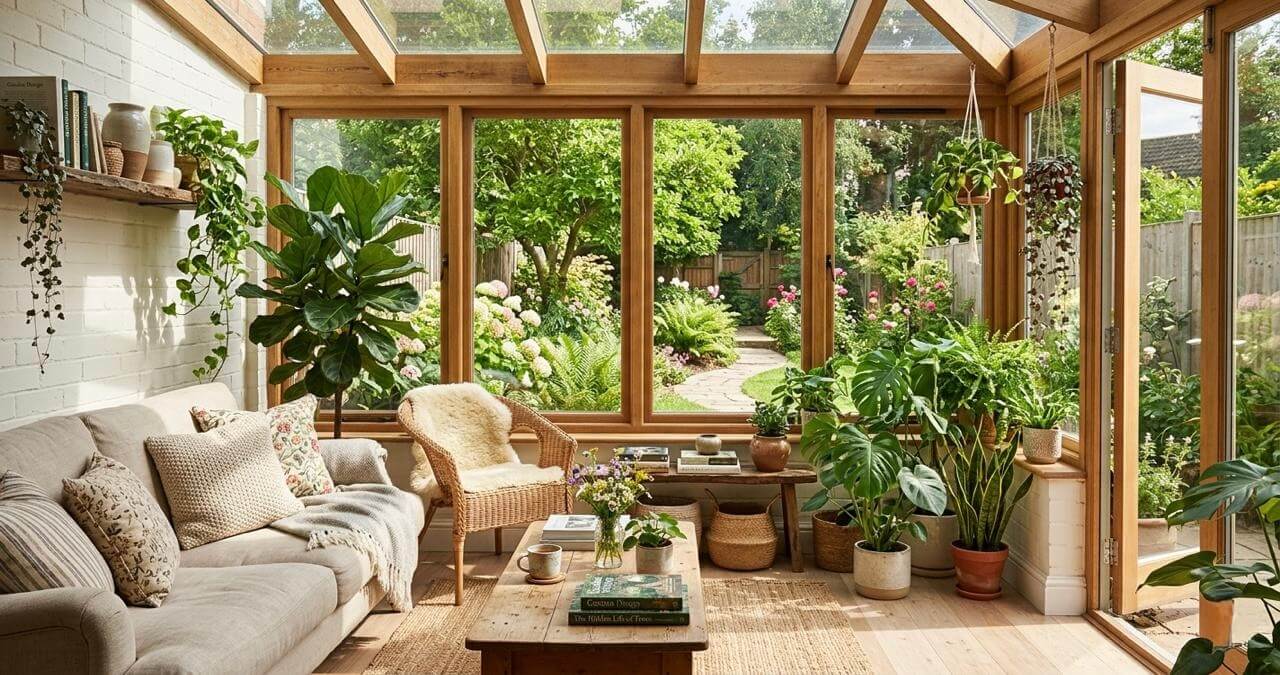
The lots are large. Unlike the denser residential patterns you find in Arlington VA or parts of Alexandria VA, Great Falls properties typically offer generous rear yard depth and meaningful separation from neighboring structures. That gives homeowners real flexibility in terms of sunroom size, orientation, and design without immediately running into setback restrictions or lot coverage limits.
The natural setting demands it. Great Falls sits at the edge of the Potomac River corridor, surrounded by mature hardwoods, rolling terrain, and some of the most dramatic natural scenery in Northern Virginia. A sunroom addition on a property like this isn’t a luxury; it’s a logical extension of what the land already offers.
The climate rewards a smart approach. Northern Virginia’s four-season climate means you get genuine use out of every type of sunroom, but it also means design decisions carry real consequences. Summers here are humid and hot. Winters are cold enough to make an uninsulated three-season room uncomfortable from November through March. The most successful Great Falls sunroom projects are the ones where homeowners think carefully about year-round usability from the very beginning, rather than treating insulation and climate control as afterthoughts.
It’s also worth noting that homeowners across Northern Virginia, in McLean VA, Fairfax VA, Vienna, and Burke, are increasingly adding sunrooms as part of broader renovation plans rather than standalone projects. When a sunroom is planned alongside a kitchen remodel, a deck addition, or a home addition, the design integration is stronger and the overall project tends to deliver better results. If you’re already thinking about expanding your home’s footprint, understanding home addition cost in Northern Virginia is a useful starting point for putting sunroom investment in the right context.
The 5 Most Popular Sunroom Design Styles for Great Falls VA Homes
This is where planning gets interesting. There’s no single “right” sunroom — the best design for your home depends on how you intend to use the space, how your property is oriented, what architectural style your home already has, and what level of investment makes sense for your situation.
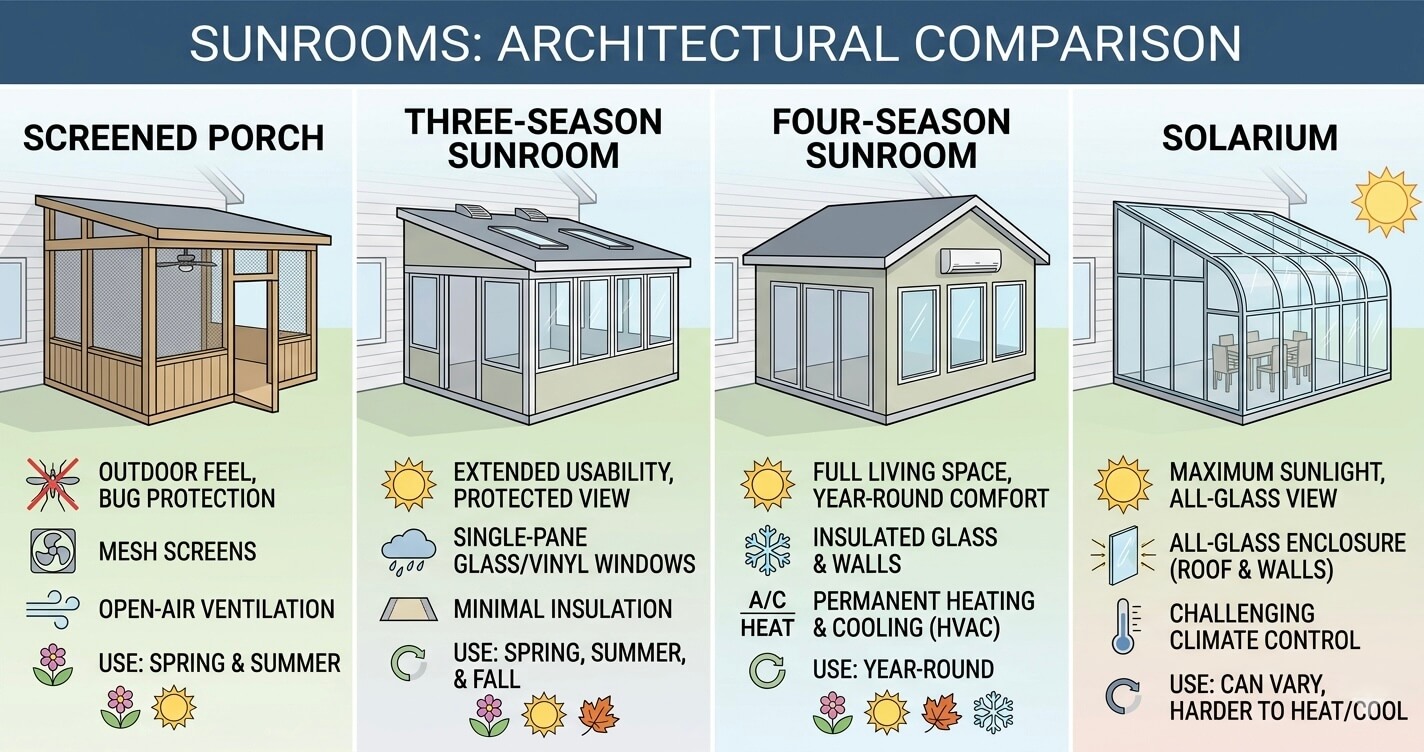
Here are the five design styles that work best for Great Falls VA properties, based on what Northern Virginia homeowners are actually building in 2026.
1. The Four-Season Glass Retreat
This is the gold standard for Great Falls homeowners who want a sunroom that functions as a true living space twelve months a year. A four-season sunroom is fully insulated, climate-controlled with its own HVAC connection or mini-split system, and built with the same structural standards as the rest of your home. It can be legally classified as conditioned living space, which means it counts toward your home’s finished square footage, a direct driver of appraisal value.
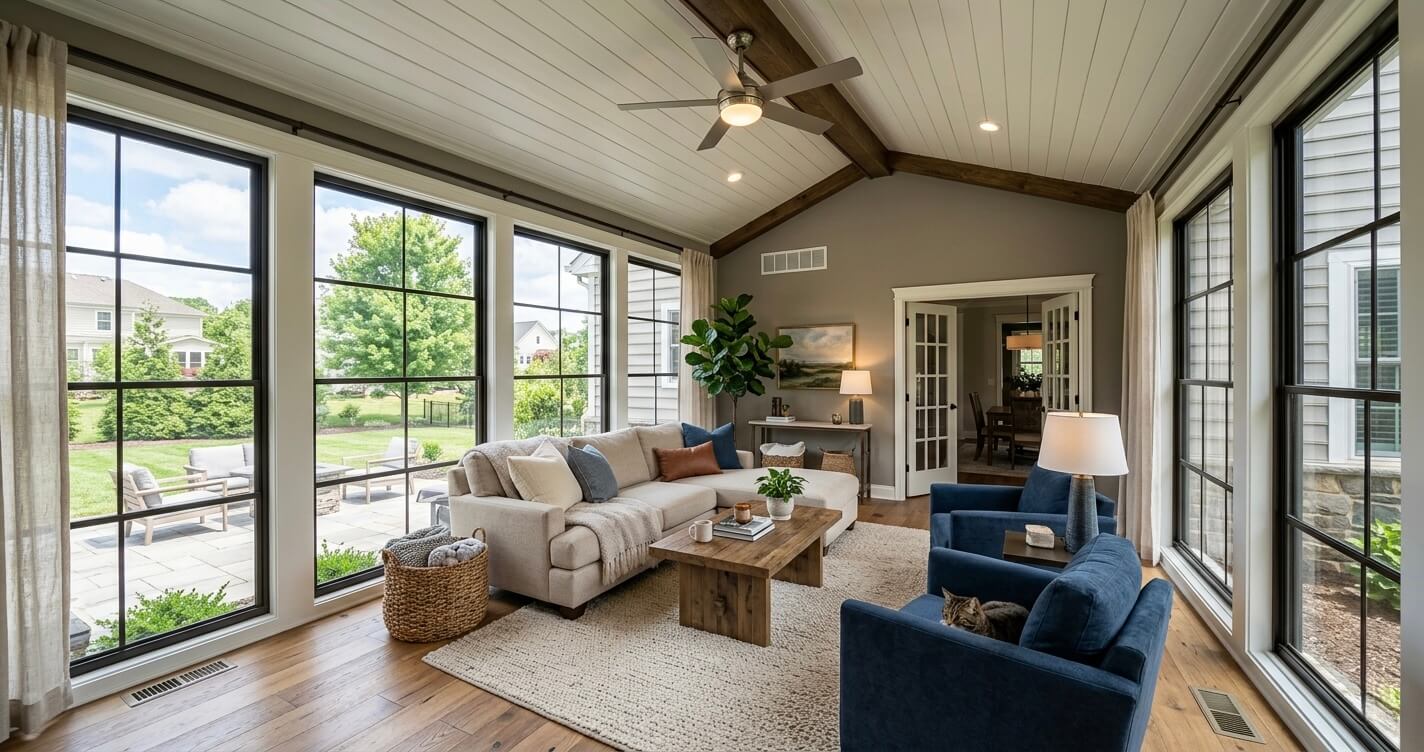
For properties that back to wooded lots, open green space, or any meaningful natural view, the four-season design is unmatched. Floor-to-ceiling glass panels, a well-designed roofline that ties cleanly into the existing structure, and a south or east-facing orientation combine to create a room that feels genuinely connected to the outdoors while staying comfortable regardless of what the weather is doing outside.
Design considerations specific to Great Falls: the mature tree canopy on many lots here creates natural shade in summer, which works in your favor for solar heat management. However, it also means that north-facing or heavily shaded sunroom locations will need careful artificial lighting design to avoid feeling dark. Work with your contractor to map the sun angles across your specific lot before finalizing placement.
On materials: double-pane Low-E (low-emissivity) glass is the baseline for any conditioned sunroom in Northern Virginia and is required under Virginia energy codes. For Great Falls homes with high-end finishes throughout, many homeowners step up to triple-pane glass for better thermal performance and noise reduction, a meaningful quality-of-life upgrade on larger, more open lots.
A four-season sunroom typically costs between $20,000 and $80,000 and runs approximately $200 to $400 per square foot installed. In the Great Falls market, with premium materials and a fully custom design, expect your project to sit comfortably in the upper half of that range.
2. The Three-Season Nature Room
Not every homeowner wants or needs a year-round room, and for those who primarily use their outdoor spaces from spring through fall, a three-season sunroom is a smart, cost-effective choice that still delivers substantial value.
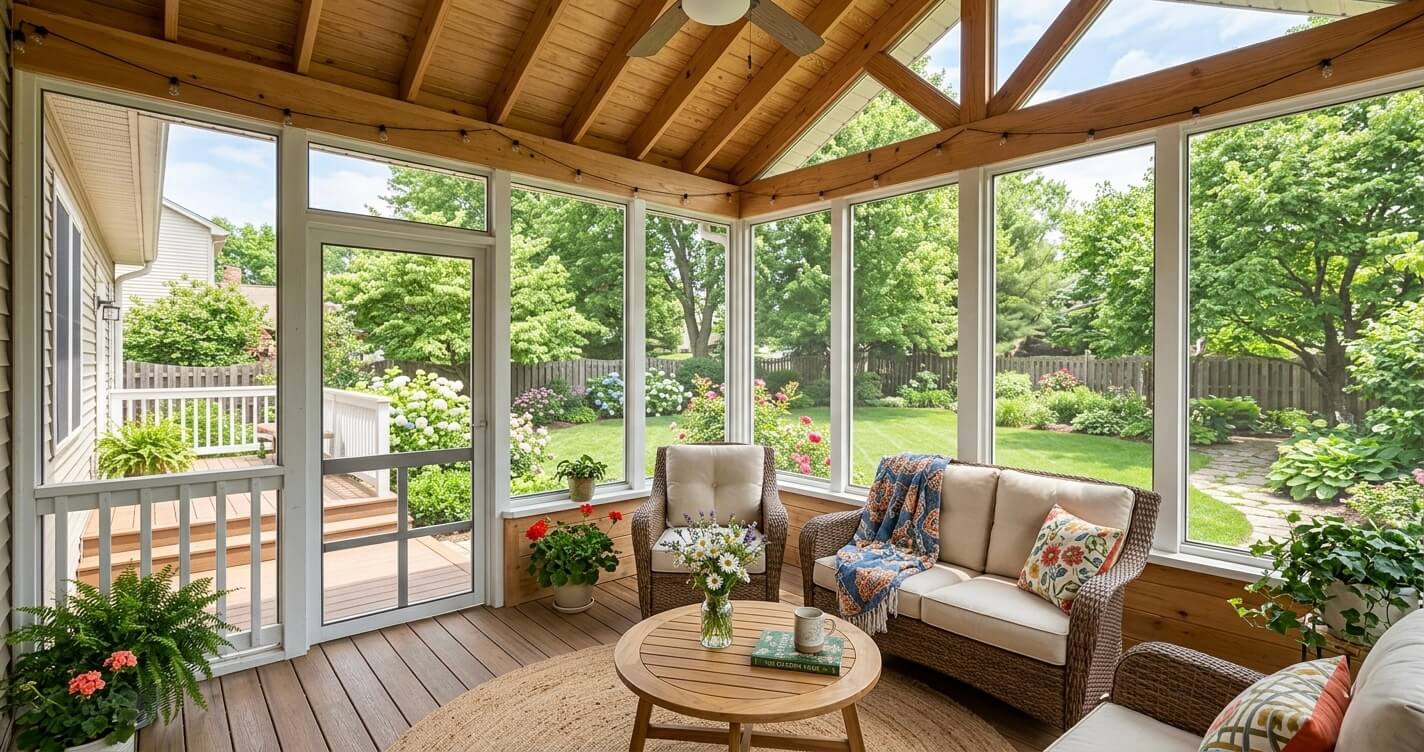
Three-season rooms are enclosed with glass but are not fully insulated for extreme temperatures and typically don’t connect to your home’s central HVAC system. What they sacrifice in winter usability, they make up for in affordability, lighter construction, and an airier feel that many homeowners actually prefer for warm-weather use. With ceiling fans, operable windows, and good cross-ventilation, a three-season room in Great Falls can be genuinely pleasant well into October and again from late March onward, that’s a long usable season in Northern Virginia.
The best use cases for this design in Great Falls: a dedicated reading room or library that opens off a quiet wing of the house, a breakfast nook that captures morning light from the east, or a casual entertaining space off the rear of the home. These rooms work especially well when they connect directly to a deck or patio, creating a layered outdoor living sequence from inside the home outward.
On framing: aluminum or vinyl profiles are the most common choices for three-season construction and keep costs manageable. For Great Falls homes with more traditional architectural character; Colonials, Federals, Craftsman-style builds, wood or wood-clad frames are worth considering for the visual warmth they bring, even though they require more ongoing maintenance.
A three-season sunroom addition typically costs between $8,000 and $50,000 depending on size, finish level, and foundation requirements. For most Great Falls homeowners, a well-executed three-season room in the 200–300 square foot range will land somewhere between $25,000 and $45,000 with quality materials and proper permitting.
3. The Garden Solarium
The garden solarium is the most visually dramatic of all the sunroom options, and on the right Great Falls property, it’s genuinely stunning. Where a standard sunroom has a solid or partially glazed roof, a solarium uses glass or high-performance polycarbonate panels overhead as well, creating an unobstructed view of the sky alongside the landscape views through the walls.
This design is the top choice for homeowners who want a dedicated space for indoor plants, a year-round herb garden, or simply a room that feels immersed in natural light from every angle. Architecturally, solariums have a distinct presence, they read as a purposeful design statement rather than a simple addition, which is well-suited to the scale and quality expectations of Great Falls properties.
The practical realities: glass roof systems require careful specification in Northern Virginia’s climate. Solar heat gain in summer can be significant without UV-protective or thermally broken glass panels, so material selection here is critical, not optional. Retractable interior shades or automated blinds are a common and worthwhile addition. For flooring, porcelain tile or natural stone is the near-universal recommendation, both materials absorb heat during the day and release it gradually, moderating the room’s temperature naturally while handling the moisture demands of an indoor garden environment.
Positioning matters enormously for a solarium. East-facing gets beautiful morning light without the intense afternoon heat load of a west-facing orientation. South-facing maximizes passive solar in winter but needs strong solar management in summer. Work with your contractor to model the heat and light conditions across all four seasons before committing to placement.
A glass solarium addition generally costs between $30,000 and $150,000, with pricing driven largely by the specialized glass roof system and the structural requirements it creates. For Great Falls homeowners, custom solariums with high-end glazing systems and premium interior finishes will typically sit in the $80,000–$130,000 range.
4. The Screened Porch Conversion
Sometimes the best sunroom addition isn’t a new build from the ground up, it’s a smart conversion of an existing outdoor structure. If your Great Falls home already has a deck, patio, or open porch with a roof, a screened porch conversion can deliver a beautifully functional outdoor living space at a fraction of the cost of a full sunroom addition.
Screened porches are particularly well-suited to Great Falls properties given the wooded character of the area. Anyone who has tried to enjoy an evening on a rear deck near the Potomac corridor in July knows that insects are a real and persistent issue. A screened enclosure solves that problem completely, extending comfortable outdoor use from late spring through early fall without requiring climate control infrastructure.
Importantly, screened porches are not classified as conditioned living space. This has two practical implications worth understanding. First, the structural and permitting requirements are lighter than a full four-season sunroom. Second, screened rooms typically do not trigger a property tax reassessment the way a conditioned addition would, which is a consideration some homeowners factor into their decision. The ROI on a screened room runs around 20%, compared to 50% for a fully conditioned three or four season sunroom, so if long-term resale value is the primary driver, a full sunroom delivers more financial return. But if the goal is maximizing outdoor enjoyment at a reasonable cost, a screened porch conversion is hard to beat.
Design details that matter here: match your framing material to the existing exterior of your home; cedar, composite, or aluminum, are all good choices depending on what’s already there. Outdoor-rated lighting and a ceiling fan are near-essentials. And if you want the option to upgrade to a full sunroom in the future, discuss that with your contractor during design so the foundation and structural elements can be specified to support that eventual conversion.
5. The Transitional Indoor-Outdoor Sunroom
The fastest-growing sunroom design trend across Northern Virginia right now, and arguably the most exciting, is the transitional sunroom: a fully conditioned addition that uses folding, sliding, or pocket glass wall systems to blur the boundary between indoors and out completely.
Where a traditional sunroom separates the home from the exterior through fixed glass, a transitional design opens the sunroom directly to the rear yard, deck, or patio when weather allows. Systems like NanaWall or comparable multi-panel folding glass doors can open a 16- to 20-foot wall section entirely, effectively doubling your usable entertaining space on a good day in April or October. When the panels are closed, the room functions as a normal, fully conditioned sunroom. The flexibility is the point.
For Great Falls homeowners undertaking a broader renovation, perhaps updating a kitchen that opens toward the rear of the home, or replacing an aging deck with a more intentional outdoor living sequence, the transitional sunroom creates the most seamless result. The key to making it work is level-to-level continuity: the sunroom floor must be flush with the interior floor, and both should transition smoothly to the exterior patio or deck without steps or level changes. This requires planning at the foundation and framing stage and is considerably harder to retrofit than it is to design from the start.
Architectural style note: while transitional sunrooms have a distinctly contemporary feel, they can be executed successfully on traditional Great Falls homes when the exterior cladding, roofline details, and glazing profiles are specified to complement the existing architecture rather than contrast with it. This is exactly the kind of nuance where working with an experienced design-build contractor in Northern Virginia, one who knows how these homes are built and what reads as coherent versus out-of-place, makes a substantial difference.
If you’re considering a transitional sunroom as part of a larger project, it’s worth reviewing common mistakes to avoid when planning a sunroom addition in Arlington County VA, many of those planning and contractor-selection lessons translate directly to Great Falls projects and can save you significant time and money before construction begins.
Key Design Elements That Make or Break a Great Falls Sunroom
Choosing a sunroom style is the exciting part. But the design decisions that actually determine whether your sunroom is a joy to live in, or a source of ongoing frustration, happen at a level of detail that most homeowners don’t think about until it’s too late to change course without spending more money.
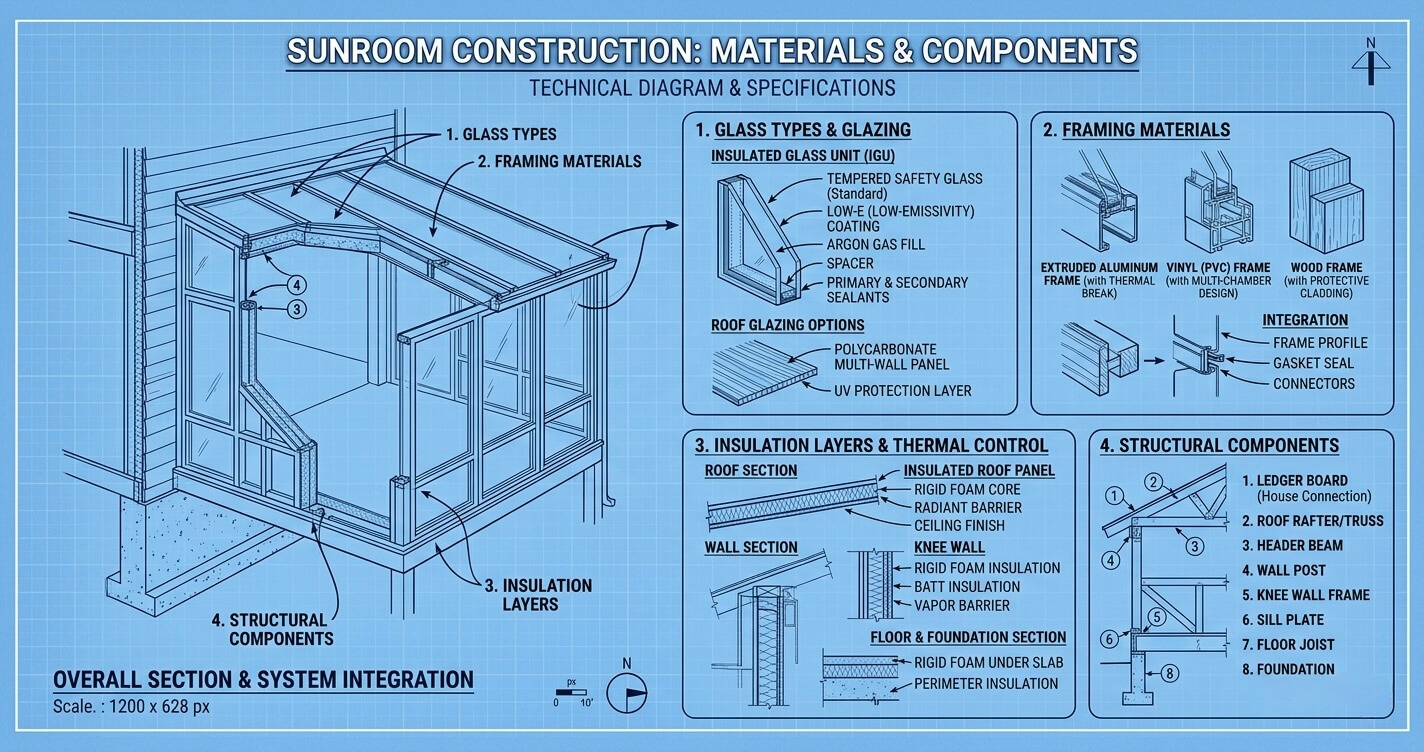
These are the elements that matter most for Great Falls VA properties specifically, given the climate, the architectural character of homes in this area, and the quality expectations that come with the Northern Virginia market.
Framing Material
The frame is the structural backbone of your sunroom, and it shapes both the visual character and the long-term maintenance demands of the space. In Northern Virginia, three materials dominate the market, each with a distinct set of tradeoffs.
Vinyl framing is the most widely used option across Northern Virginia, from Fairfax VA and Burke all the way through the Northern Virginia suburbs. It’s affordable, requires virtually no maintenance, doesn’t rust or rot, and holds insulation values reasonably well. The limitation is aesthetic, vinyl profiles tend to be bulkier than aluminum, which can make a sunroom feel slightly heavier visually. For homeowners whose primary concern is performance and value, vinyl is a solid, proven choice.
Aluminum framing has become increasingly popular in McLean VA and Arlington VA new builds and renovation projects where a cleaner, more contemporary look is the goal. Aluminum allows for thinner sight lines, which means more glass and more view per square foot of wall. The tradeoff is thermal performance, aluminum conducts heat and cold more readily than vinyl, so thermally broken aluminum (where the inner and outer frame sections are separated by an insulating material) is strongly recommended for any conditioned sunroom in Northern Virginia’s four-season climate.
Wood and wood-clad framing is the premium choice for Great Falls homeowners whose homes have traditional architectural character, Colonials, Federals, and Craftsman-style builds that are common in this part of Fairfax County. Wood framing brings a warmth and visual richness that vinyl and aluminum simply can’t match, and it integrates more naturally with existing millwork and trim details inside the home. The honest tradeoff: wood requires periodic painting or staining, is more vulnerable to moisture if not properly maintained, and carries a higher upfront cost. Wood-clad options, aluminum on the outside, wood on the inside, give you the best of both worlds and are worth pricing out before ruling them out on cost alone.
Glass Selection
Glass is where a surprising amount of a sunroom’s comfort, and its energy bill, is determined. Getting this decision right is especially important in Northern Virginia, where summer humidity and solar intensity are significant, and winter temperatures are cold enough to make thermal performance a real factor.
Here’s what Great Falls homeowners need to understand about glass options:
- Single-pane glass is not suitable for any conditioned sunroom in Northern Virginia. Full stop. It provides essentially no thermal resistance and will make your sunroom uncomfortable in both summer and winter.
- Double-pane Low-E glass is the standard minimum for conditioned sunrooms under Virginia Residential Code and the right baseline for any four-season room. The Low-E coating reflects radiant heat while allowing visible light through, keeping the room cooler in summer and warmer in winter without sacrificing light quality.
- Triple-pane glass is the premium upgrade worth serious consideration for Great Falls homeowners. It delivers meaningfully better thermal performance, significantly reduces condensation on the glass in cold weather, and provides noticeably better noise reduction — a real quality-of-life benefit if your property has wind noise from the tree canopy or any traffic sound.
- Argon or krypton gas fills between glass panes improve insulating performance further. Most quality double and triple-pane units include argon as standard; krypton is the higher-performance option used in thinner triple-pane profiles.
- UV-protective coatings are a strong recommendation for solariums or any sunroom with significant overhead glazing, where direct sun exposure on furnishings and flooring can cause fading and deterioration over time.
Fairfax County’s energy conservation requirements specify that windows, doors, and skylights in conditioned sunrooms must have a maximum solar heat gain coefficient (SHGC) of 0.40; this is a code requirement, not a suggestion, and your contractor’s glass specifications must meet it.
Flooring
Flooring choices in a sunroom are driven by three practical realities: moisture exposure, temperature swings, and the transition between the sunroom and the adjoining interior space.
Here’s how the main options stack up for Great Falls homes:
- Porcelain tile is the most popular choice in Northern Virginia sunrooms for good reason. It handles moisture and humidity without warping or buckling, is extremely durable underfoot, and comes in a wide enough range of looks, from wood-look plank formats to large-format stone patterns, to suit virtually any design direction. It’s also thermally stable, which matters in a space that may see significant temperature variation between seasons.
- Luxury vinyl plank (LVP) has become a strong competitor to tile in the sunroom category. It’s warmer underfoot than porcelain, handles moisture well, installs at a lower cost, and today’s best products are difficult to distinguish visually from real hardwood. For Great Falls homeowners who want the warmth of a wood look without the maintenance risk, quality LVP is a practical and attractive solution.
- Natural stone, travertine, slate, bluestone, is the premium choice that works particularly well in solariums and garden-style rooms where the design intent is earthy and organic. Stone absorbs heat during the day and releases it gradually, which actually helps moderate room temperature in a passive solar design. It’s heavier than tile and requires a properly reinforced floor structure, so discuss this early in the planning process.
- Polished or stained concrete is gaining traction in transitional and contemporary sunroom designs, particularly where the room connects to an outdoor patio. A seamless concrete floor that runs from inside the sunroom out to the patio creates a powerful visual continuity that works beautifully in modern Great Falls homes.
- Hardwood flooring, while visually appealing, is generally not recommended for sunrooms in Northern Virginia due to the humidity swings between seasons. Even with climate control, the moisture and UV exposure in a sunroom environment can cause hardwood to cup, crack, and fade over time.
Roof Style
The roof is arguably the most architecturally significant decision in a sunroom addition because it determines how well the new structure visually integrates with the existing home. A sunroom that reads as a natural extension of the house adds real value; one that looks like a greenhouse bolted to the back of a Colonial subtracts from it.
- Shed roof (single slope): The simplest and most affordable roofline, sloping away from the house at a gentle pitch. It works well for lower-profile three-season rooms and screened porches, and is the easiest to tie cleanly into an existing wall or soffit. On Great Falls homes with more modest rear elevations, a well-executed shed roof sunroom can look very clean and intentional.
- Gable roof: Two slopes meeting at a central ridge, creating a more prominent architectural presence. Gable roofs offer better interior headroom, a stronger visual statement, and more flexibility for window placement in the end walls. For Great Falls Colonial and Craftsman-style homes, a gable roof sunroom tends to feel the most architecturally coherent.
- Hip roof: Four slopes meeting at a central point, creating the most complex and expensive roofline option. Hip roofs weather Northern Virginia’s wind and snow loads better than gable roofs and integrate most naturally with homes that already have hipped rooflines. If your Great Falls home has a hip roof, matching it on the sunroom addition is worth the additional cost for the visual continuity it creates.
- Cathedral or vaulted ceiling with exposed rafters: Not a roof style per se, but an interior treatment that works beautifully inside four-season and transitional sunrooms. Exposed structural elements, whether traditional timber framing or clean modern steel, add tremendous character to the space and are particularly popular in higher-end Great Falls builds.
Sunroom Addition Ideas Great Falls VA ROI: What Homeowners Can Expect
Design decisions and financial decisions are inseparable in any home addition project, and sunrooms are no exception. Before committing to a design direction, it’s worth understanding clearly what your investment is likely to return, both in daily quality of life and in eventual resale value.
The financial case for a sunroom addition in Great Falls VA is genuinely strong, for reasons that go beyond the national averages.
What the Numbers Say
A full four-season sunroom addition typically recoups around 50% to 70% of its cost upon resale, while three-season rooms generally return between 30% and 50%.
Industry data cited by U.S. News & World Report puts the potential ROI for a sunroom at approximately 49% on a national average basis.
Those are national figures. In Great Falls and the broader Northern Virginia market, several factors push that return higher when the project is executed well:
- Home values are significantly above the national average. In a market where the median home price is well above $1 million, the relative cost of a sunroom addition is a smaller percentage of total home value, and buyers at this price point expect premium features.
- Buyers in this market are design-literate. A sunroom that looks like it was always part of the home, matching rooflines, consistent trim profiles, integrated flooring transitions, commands a meaningfully higher premium than one that reads as an addition.
- Year-round usability matters in Northern Virginia. Unlike warmer southern markets where any sunroom works for most of the year, Northern Virginia buyers specifically value four-season rooms because they know from experience how short the comfortable outdoor season actually is.
- Conditioned sunrooms count toward finished square footage. In real estate appraisals, conditioned living space is valued per square foot. A 300-square-foot four-season sunroom that is properly permitted, insulated, and climate-controlled adds to your home’s appraised square footage directly, not just as an amenity, but as measurable area.
The Design Decisions That Protect Your ROI
Not all sunrooms deliver equal returns, and the gap between a high-ROI sunroom and a low-ROI one is largely determined by decisions made during design and construction, not after. Here’s what protects your investment:
- Integration with the existing home: A sunroom that shares roofline details, exterior cladding, and trim profiles with the main house consistently outperforms one that uses generic framing systems with no architectural connection
- Proper permits and inspections: An unpermitted sunroom is a liability in any Northern Virginia real estate transaction. Buyers’ agents in Fairfax County, McLean VA, and Arlington VA routinely flag unpermitted additions, and the retroactive permitting process is expensive, time-consuming, and sometimes requires demolition and rebuild of non-compliant work
- Quality glass and insulation: A four-season room that underperforms thermally, overheating in summer, losing heat in winter, will be a negative in a buyer’s walkthrough, not a positive. The upfront investment in proper glazing and insulation pays back at resale
- Flooring and finish consistency: Buyers notice when a sunroom feels like a different house from the inside. Flooring that transitions naturally from the adjoining interior room, paint colors that coordinate with the home’s palette, and lighting that matches the quality of the rest of the house all contribute to the impression that this was a planned, permanent space
- Correct sizing for the property: A sunroom that is out of scale, either too small to be functional or so large it overwhelms the rear elevation, works against both daily enjoyment and resale value. For most Great Falls properties, 200 to 350 square feet hits the sweet spot
A Note on Property Taxes
A conditioned, permitted sunroom addition will likely increase the assessed value of your Great Falls home, which means a modest increase in annual property taxes. This is worth factoring into your budget planning, but it should be understood as a reflection of genuine value added, not a hidden cost. An increase in assessed value means Fairfax County agrees that your home is worth more. In most cases, the annual tax increase is small relative to the value the sunroom adds.
Screened porches and uninsulated three-season rooms, by contrast, typically do not trigger a property tax reassessment since they are not classified as conditioned living space. If tax impact is a significant concern, discuss the classification implications of each sunroom type with your contractor before finalizing your design direction.
Permitting Your Sunroom Addition in Great Falls VA
Permitting is the part of any home addition project that homeowners most frequently underestimate, and most frequently get wrong when they try to navigate it without experienced guidance. In Great Falls, which falls under Fairfax County jurisdiction, the permitting process for a sunroom addition is well-defined and manageable when you know what to expect. Here’s what you need to know before your project begins.
Great Falls Falls under Fairfax County Jurisdiction
Great Falls is an unincorporated community in Fairfax County, which means all permitting goes through Fairfax County’s Land Development Services (LDS) department, not a separate municipal authority. This is actually an advantage: Fairfax County has a well-developed online permitting infrastructure and clear published requirements for sunroom additions specifically.
It’s worth noting that homeowners in Vienna and Clifton, two other communities within Fairfax County, require additional approval from their respective towns on top of the county process. Great Falls does not have this additional layer, which simplifies the process somewhat.
What Permits Are Required
Fairfax County’s Land Development Services requires sunroom additions to be applied for through the PLUS (Planning and Land Use System) portal, and pre-fabricated sunroom products must reference an ICC-ES evaluation report from a nationally recognized listing agency certifying that the product meets building code requirements.
For most sunroom addition projects in Great Falls, you should expect to apply for some or all of the following permits depending on the scope of your project:
- Residential addition building permit — required for all attached sunroom additions; this is the primary permit covering structural, architectural, and energy compliance
- Electrical permit — required if the sunroom includes lighting fixtures, outlets, ceiling fans, or any wiring
- Mechanical permit — required if the sunroom connects to the home’s HVAC system or receives a dedicated mini-split installation
- Plumbing permit — required if the sunroom includes any plumbing connections, such as a wet bar, irrigation line, or in-floor radiant heating system
- Zoning review — required to confirm the project meets Fairfax County setback requirements and lot coverage limits for your specific parcel
What Fairfax County Requires in Your Application
In Fairfax County, setback rules govern how close you can build to property lines, and lot coverage limits control how much of your lot can be developed, both apply to sunroom additions regardless of whether a full building permit is required.
When submitting your permit application through PLUS, your documentation package will typically need to include:
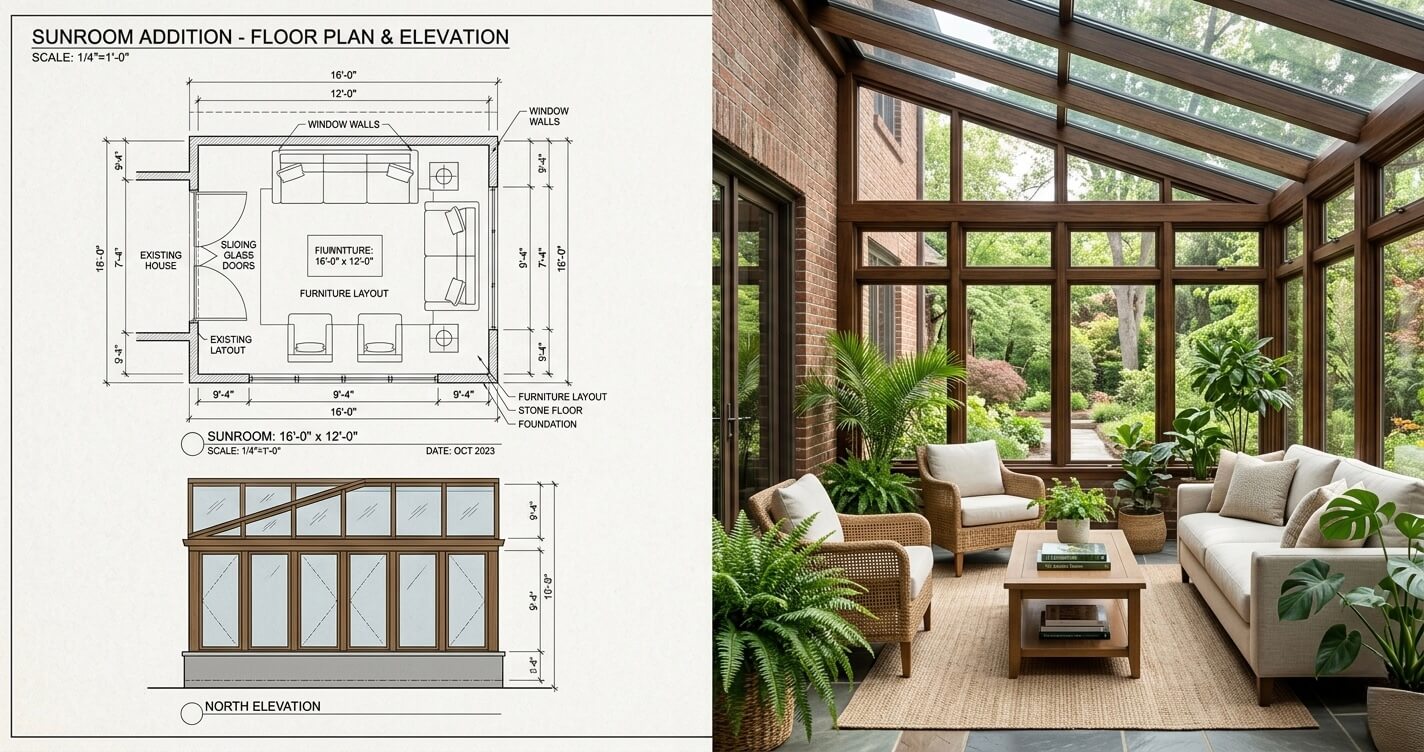
- Architectural and structural plans drawn to a minimum scale of ¼ inch = 1 foot, on sheets no smaller than 11 x 17 inches
- Site plan showing the location of the sunroom relative to property lines, existing structures, and any easements
- Foundation plan specifying the footing or slab design
- Framing plans for the floor and roof structure
- Window and door schedule including sizes, locations, and glass specifications
- Energy compliance documentation showing that insulation R-values and glazing U-factors meet Virginia Residential Code requirements
- Manufacturer’s evaluation report for any pre-fabricated sunroom system being used (ICC-ES or equivalent)
- HOA approval documentation if your Great Falls neighborhood operates under a homeowners association, Fairfax County requires this before processing certain permits
Why You Should Let Your Contractor Pull the Permits
Fairfax County highly recommends that homeowners have a licensed contractor pull permits as the responsible party, so the county can better assist in gaining compliance if any defective work is identified during inspections.
Beyond the county’s own recommendation, there are practical reasons this matters for Great Falls homeowners specifically:
- A licensed contractor who regularly works in Fairfax County knows the reviewers, understands what the plan review team looks for, and can address deficiencies quickly before they create project delays
- When a contractor pulls the permit as the responsible party, they are professionally accountable for code compliance, which is a meaningful form of protection for the homeowner
- Permit timelines in Fairfax County vary by season. Spring is consistently the busiest period for residential addition permit applications, and processing times can extend significantly from March through June. Getting your application submitted in late winter or early spring, or even in the fall for projects planned the following year, is the most reliable way to keep your project on schedule
For a deeper look at what the Fairfax County permitting process involves across all remodeling project types, our guide to Remodeling permits in Fairfax County covers the full process in detail.
What Happens If You Skip the Permit
This deserves a direct answer because it comes up regularly: homeowners sometimes ask whether a sunroom addition really needs a permit, particularly for smaller or prefabricated builds. The answer in Fairfax County is unambiguous; yes, it does.
Building without a permit creates three specific problems that are worse than the permitting process itself:
- Safety risk: Building code requirements for structural loads, wind resistance, energy performance, and electrical safety exist because they work. A sunroom built without inspections may have structural deficiencies that aren’t visible until there’s a problem
- Resale complications: Buyers’ agents and home inspectors in Northern Virginia, in McLean VA, Fairfax VA, Arlington VA, and throughout the region, routinely identify unpermitted additions. When an unpermitted sunroom is flagged in a transaction, the seller either carries the cost of retroactive permitting (which can require opening walls and rebuilding non-compliant elements) or accepts a lower sale price as a concession
- Insurance exposure: Many homeowner’s insurance policies exclude unpermitted structures from coverage. If an unpermitted sunroom is damaged or causes damage to the rest of the home, you may be left without coverage
The permitting process in Fairfax County is genuinely straightforward when you work with a licensed contractor who knows the system. It is not something to avoid, it’s something to plan for.
Final Thoughts
Great Falls VA is one of the finest residential settings in all of Northern Virginia; large lots, mature landscapes, and properties that were built with space and quality in mind. A sunroom addition, when planned carefully and executed by the right contractor, honors that setting. It extends the home intelligently, captures what makes the property special, and creates a space that becomes genuinely central to daily life in a way that few other additions can.
Homeowners across Northern Virginia, in Great Falls, McLean VA, Fairfax VA, Arlington VA, and throughout the region, are making smart, lasting investments in their properties by adding sunrooms that are designed for their homes and built to perform. The ones that deliver the strongest results are always the ones where the planning was done right before the first shovel went in the ground.
US Home Design Build works with homeowners across Great Falls and Northern Virginia to plan and build sunroom additions that are thoughtfully designed, properly permitted, and built to last. If you’re ready to explore what a sunroom addition could look like for your property, reach out to our team for a consultation. We serve homeowners throughout Great Falls, McLean VA, Fairfax VA, Arlington VA, Falls Church, Vienna, and the surrounding Northern Virginia communities.
Phone: 703-202-3520
Website: www.ushdb.com
Address: 8200 Greensboro Dr #900, McLean VA 22102
