
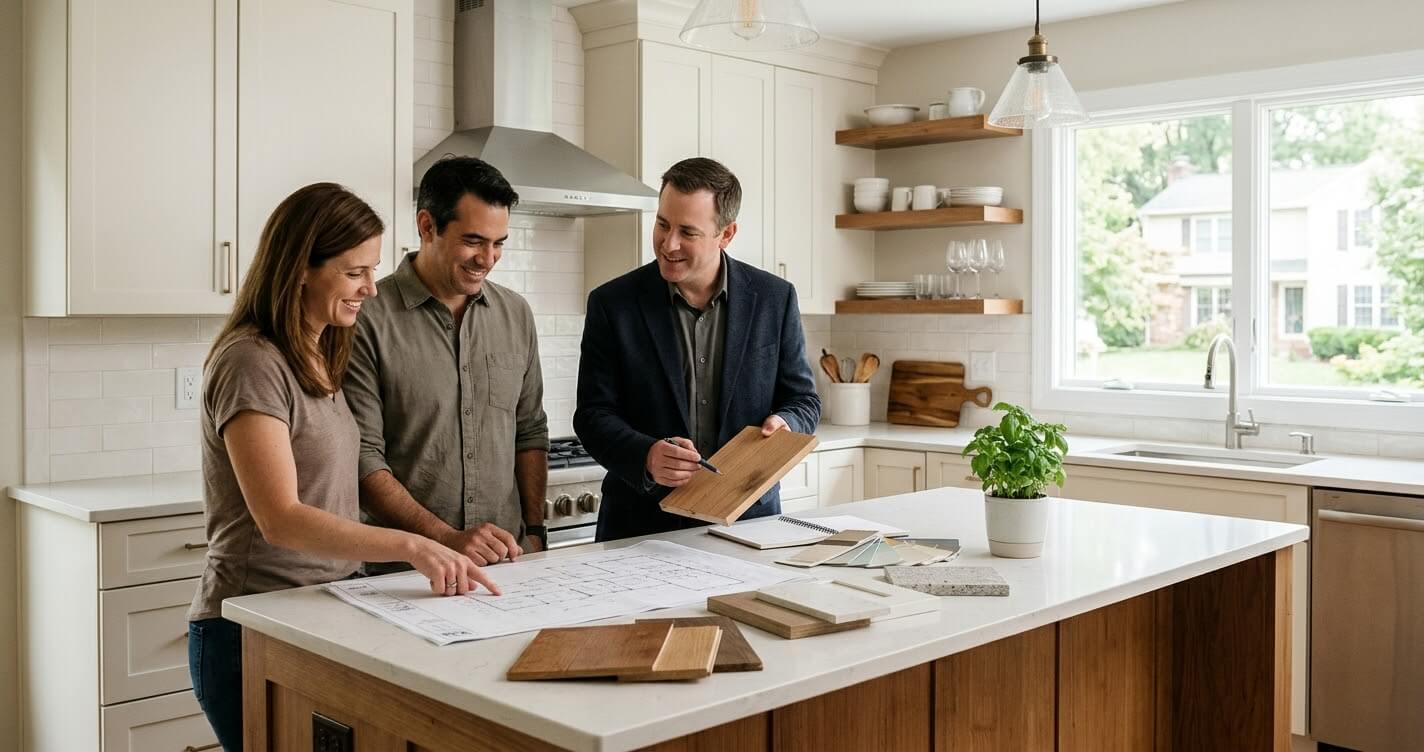
Design-build remodel cost Northern Virginia homeowners pay in 2026 depends on three variables: the scope of work, the contract structure, and how early the design team and builder lock a budget. A single design-build agreement places design, pricing and construction under one firm. That structure changes where money is spent and where cost risk sits.
Short answer: Most Northern Virginia design-build remodels cost between roughly $18,000 for a full bathroom and $400 or more per square foot for whole-house work. Design-build rarely lowers the starting price, but it can reduce redesign, change orders and schedule drift.
Remodeling demand remains high nationally. Harvard’s Joint Center for Housing Studies projects that annual U.S. homeowner spending on improvements and repairs will reach about $518 billion by the end of 2026, according to its Leading Indicator of Remodeling Activity revised April 15, 2026. That level of activity keeps competition for skilled trades and materials firm in Northern Virginia.
US Home Design Build is a design-build remodeling and construction firm serving homeowners across Northern Virginia, including Fairfax County, McLean, Vienna, Reston, Great Falls and Burke. Our design-build team prices projects with designers, estimators and project managers working together, so the figures in this guide reflect how budgets move from first sketch to final inspection.
How Design-Build Pricing Works in Northern Virginia
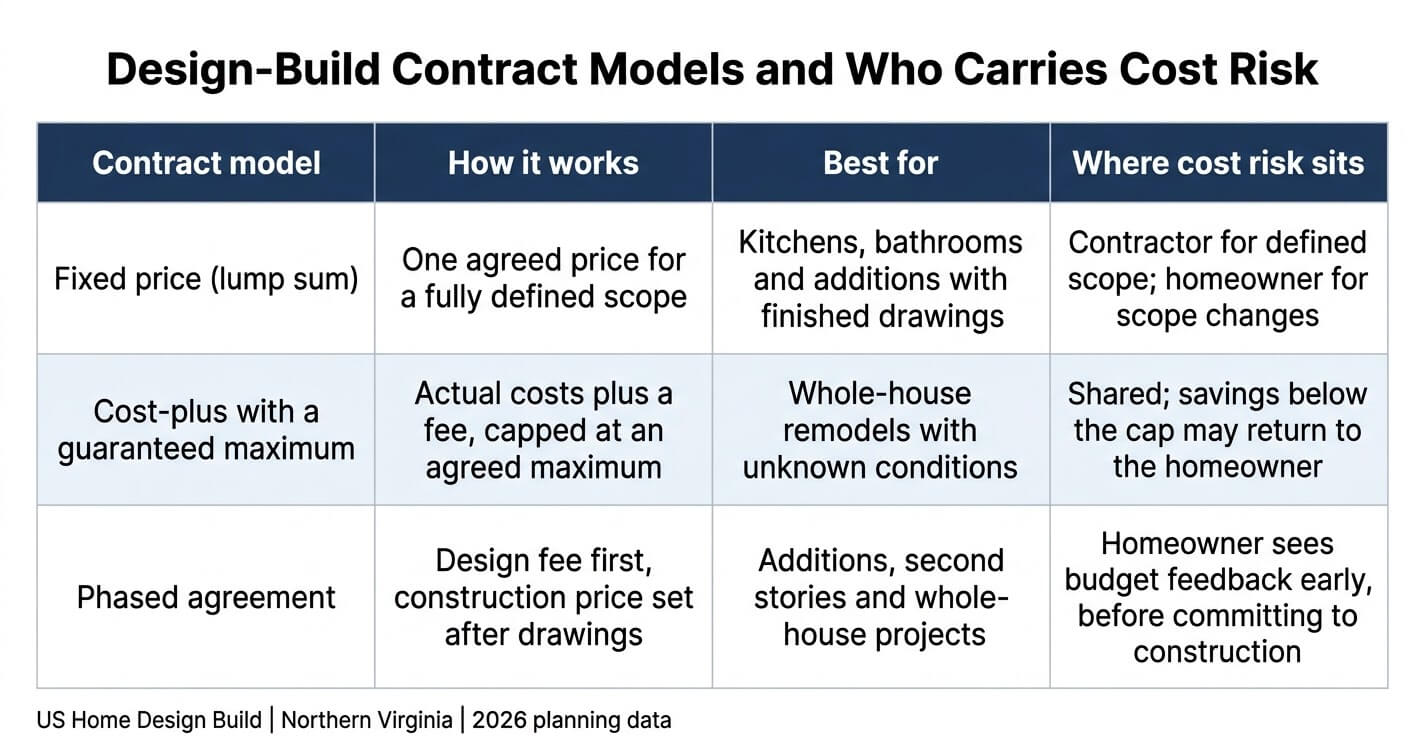
Design-build pricing puts design, budgeting and construction into one contract with one accountable firm. Homeowners pay under a fixed-price, cost-plus or phased agreement. The structure you choose decides who carries the risk of cost changes.
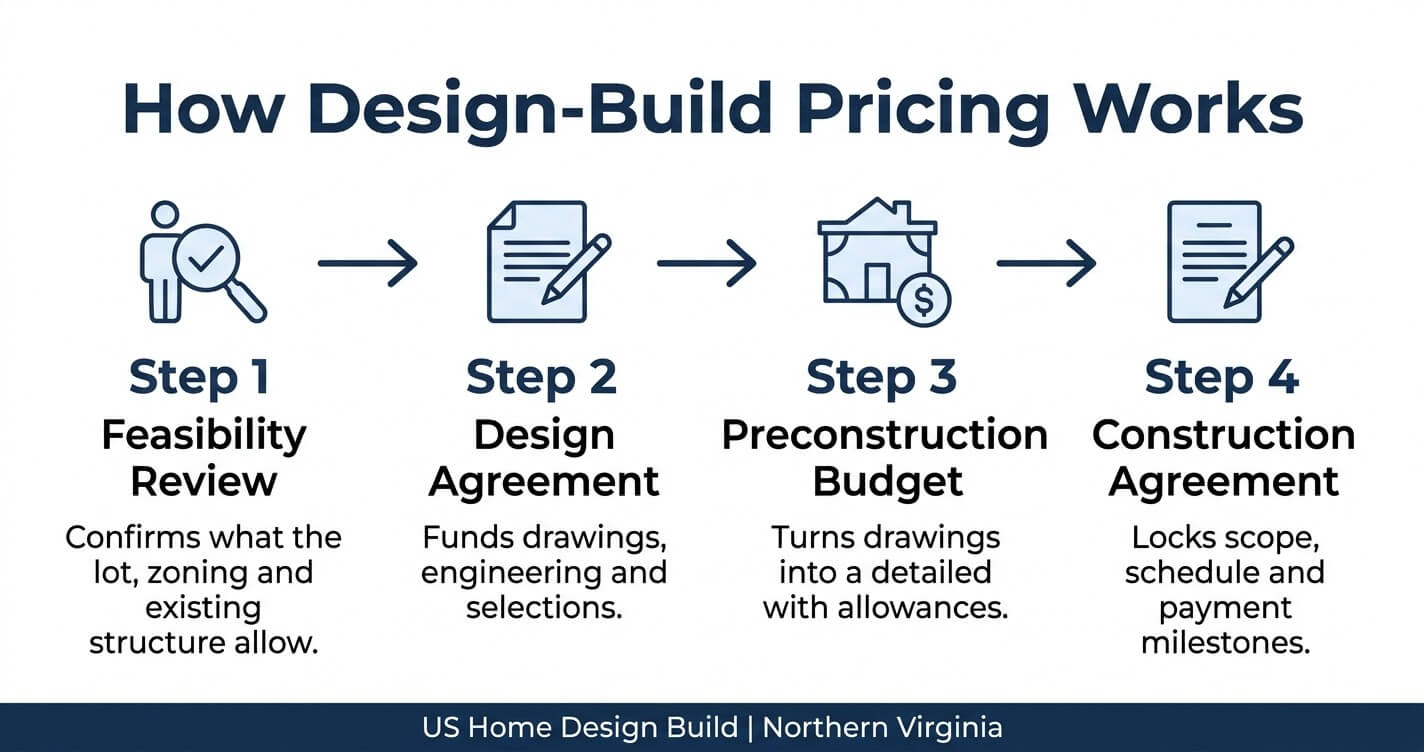
A design-build project moves through four pricing stages. A feasibility review confirms what the lot, zoning and existing structure allow. A design agreement then funds drawings, engineering and selections. A preconstruction budget converts those drawings into a detailed price with allowances. Finally, a construction agreement locks scope, schedule and payment milestones.
Allowances deserve close attention. An allowance is a placeholder budget for items not yet selected, such as tile, plumbing fixtures or cabinet hardware. When a homeowner selects products above the allowance, the difference is added to the contract. Unrealistic allowances are one of the most common reasons a remodel looks cheaper on paper than it is in practice.
Table 1: Design-Build Contract Models and Who Carries Cost Risk
For a full explanation of the model itself, read our Design-Build Northern Virginia: 2026 Complete Guide.
Design-Build Remodel Cost Northern Virginia: 2026 Planning Ranges
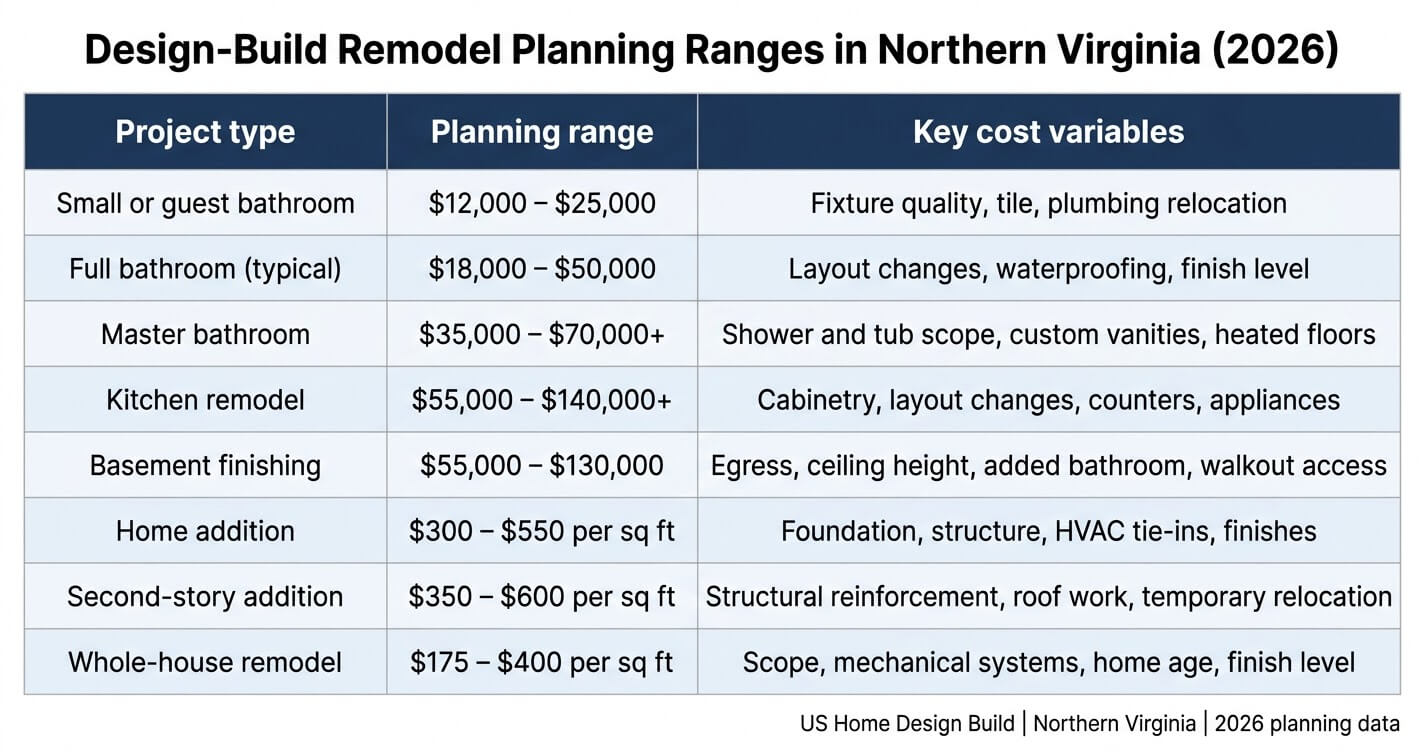
Design-build remodel cost Northern Virginia homeowners should plan for ranges from about $18,000 for a full bathroom to $175–$400 per square foot for whole-house work. Final pricing depends on size, finish level, structural changes and the age of the home.
The ranges below are planning figures, not quotes. Projects in higher-end markets such as McLean and Great Falls often trend toward the upper end because of finish expectations and site complexity. A detailed estimate requires drawings, site conditions and product selections.
Table 2: Design-Build Remodel Planning Ranges in Northern Virginia (2026)
Homeowners who want scope-specific detail can review our Kitchen Remodeling Services and Bathroom Remodeling Services pages. Those planning larger projects can explore our Home Additions page for per-square-foot considerations.
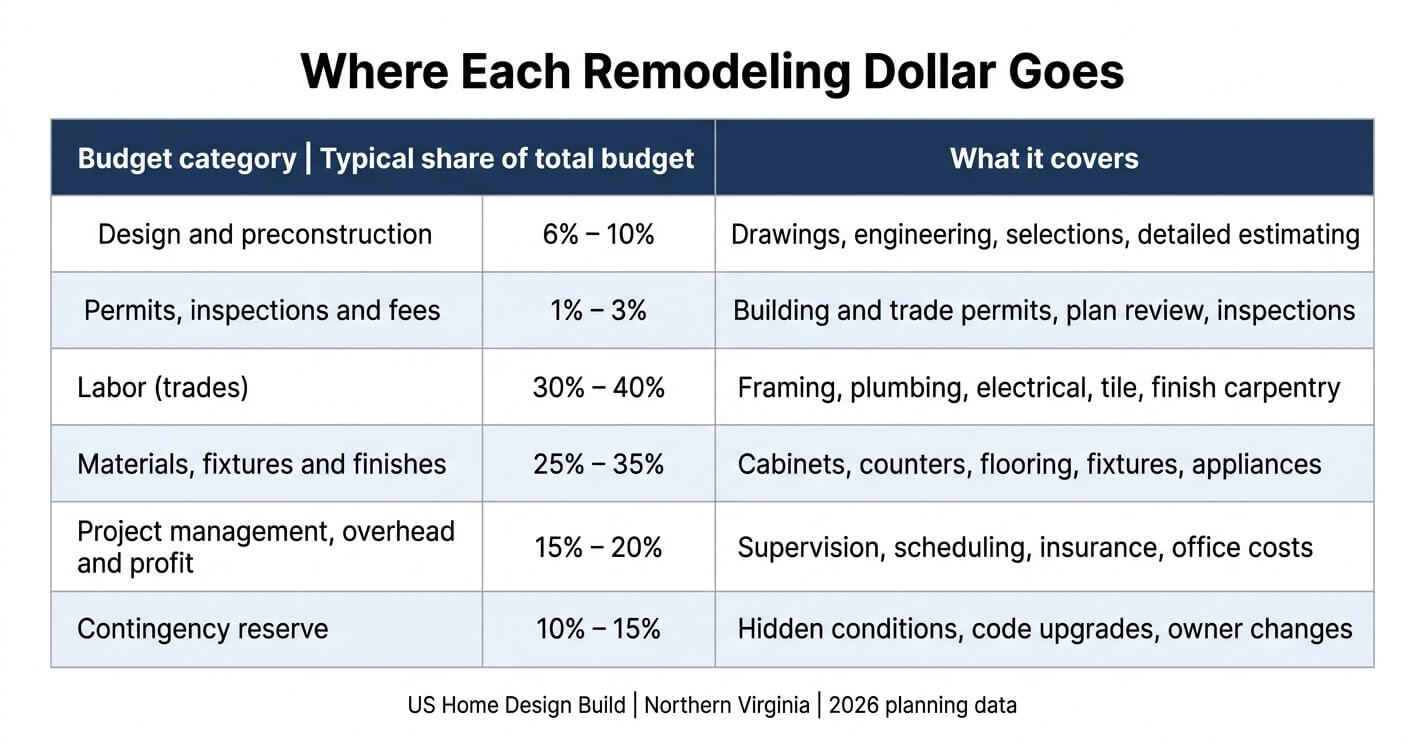
Where Every Remodeling Dollar Goes
Labor and materials typically consume 55% to 75% of a remodeling budget. Design, permits, project management and contingency make up the rest. Each category should appear as its own line in your estimate.
An itemized estimate is the fastest way to compare proposals fairly. A single lump-sum number hides whether a contractor included design, permits and contingency. Ask every firm to show the same categories so you compare scope, not just totals.
Table 3: Where Each Remodeling Dollar Goes
Design-Build vs. General Contractor: How Process and Total Cost Compare
With design-build, one firm owns design and construction under one contract. With a traditional general contractor, a separate architect designs first and contractors bid on finished drawings. The first approach gives earlier cost feedback; the second can offer more competing bids.
Table 4: Design-Build vs. Traditional General Contractor: Process Comparison
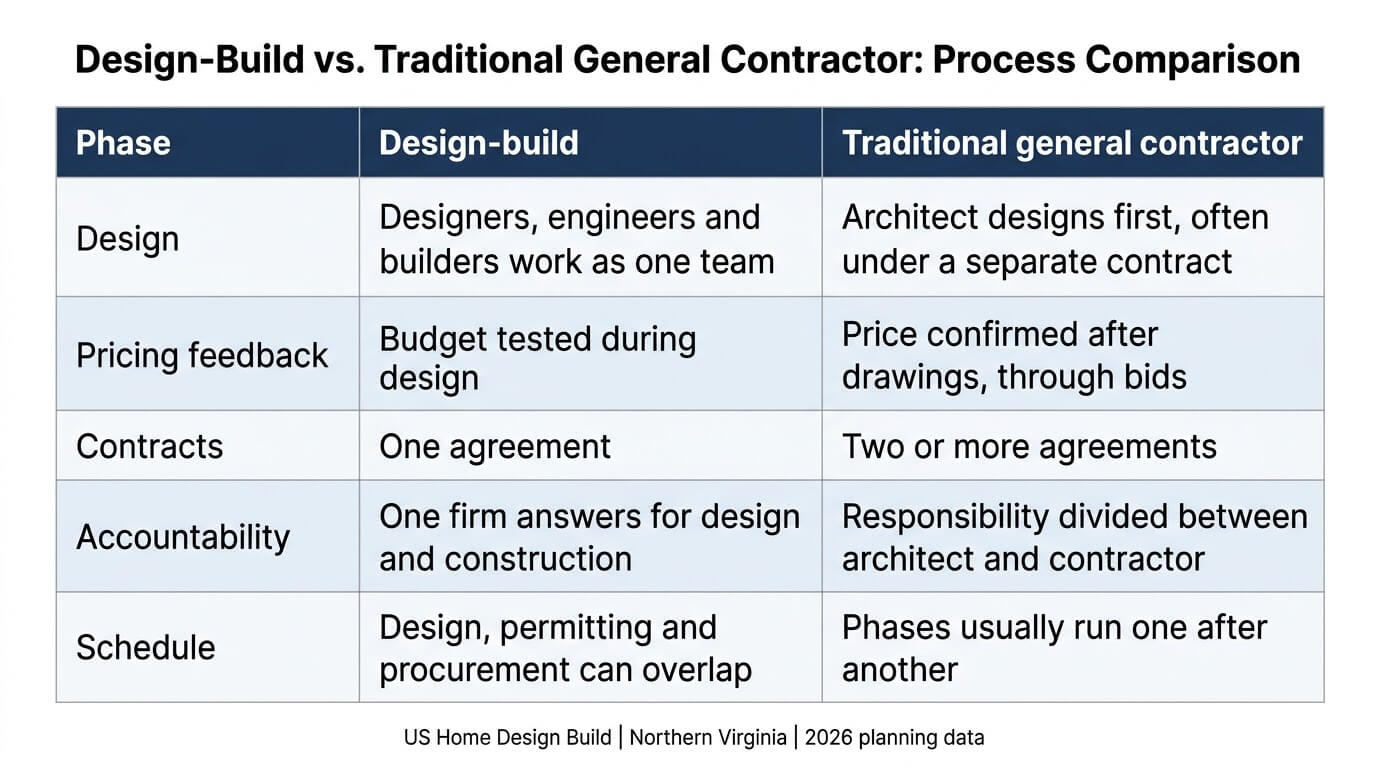
Table 5: Design-Build vs. General Contractor: Cost Items Compared
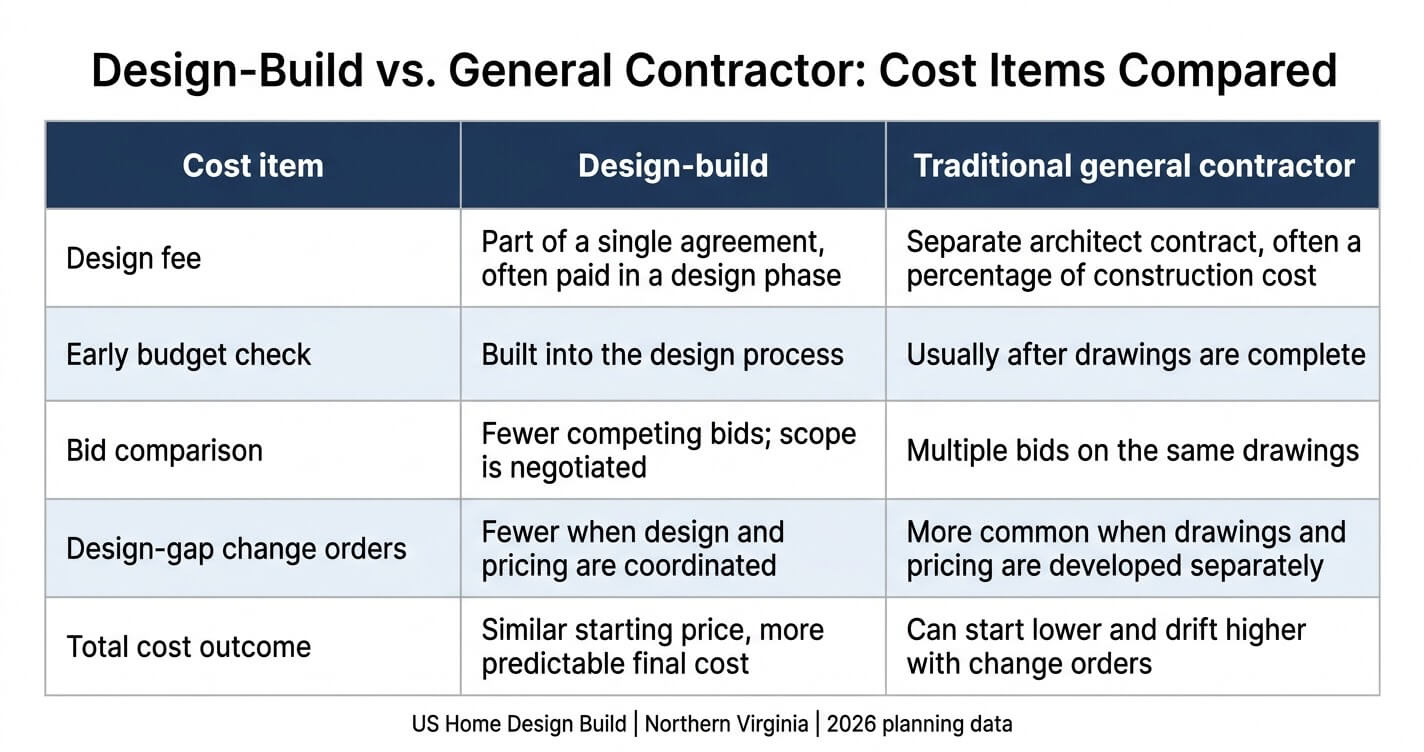
The Construction Industry Institute and Penn State University studied 351 projects ranging from 5,000 to 2.5 million square feet. The study found design-build projects finished 33.5 percent faster and cost 6.1 percent less than traditional design-bid-build projects. These were largely commercial and institutional projects, so residential results vary.
Where Design-Build Saves Money and Where It Costs More
Design-build saves money mainly by reducing redesign, change orders and schedule drift. It can cost more upfront because design fees are paid early and competitive bidding is limited. The savings are real, but they are not guaranteed on every project.
Table 6: Where Design-Build Saves Money and Where It Costs More
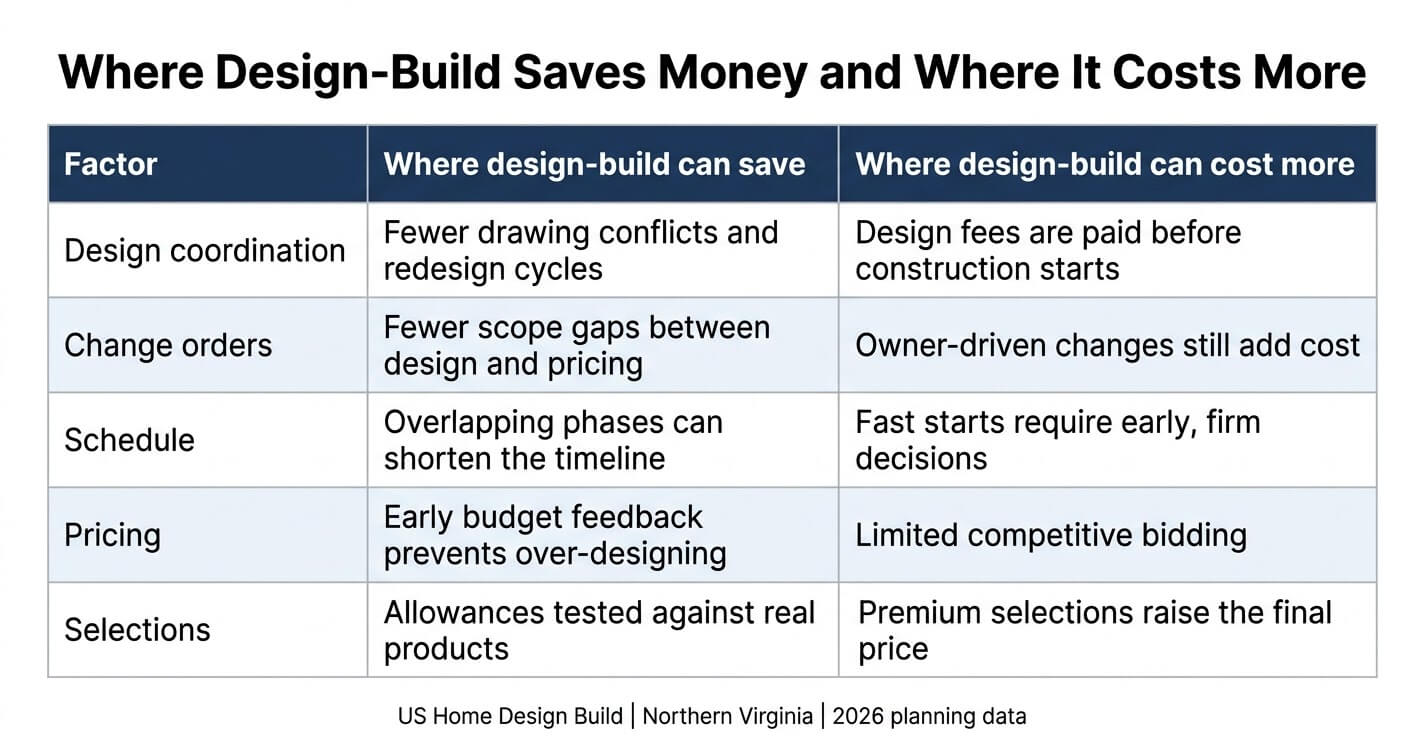
A more recent Construction Industry Institute study, released through the Design-Build Institute of America, found design-build projects averaged 3.8 percent less cost growth than design-bid-build projects and 0.3 percent less cost per square foot. The same research found design-build delivered projects 102 percent faster from design through completion. The data covers mostly non-residential work, so homeowners should treat it as directional.
Homeowners considering a similar project may benefit from discussing their options with an experienced design-build team before finalizing budgets or timelines.
What Drives Remodel Costs in Northern Virginia
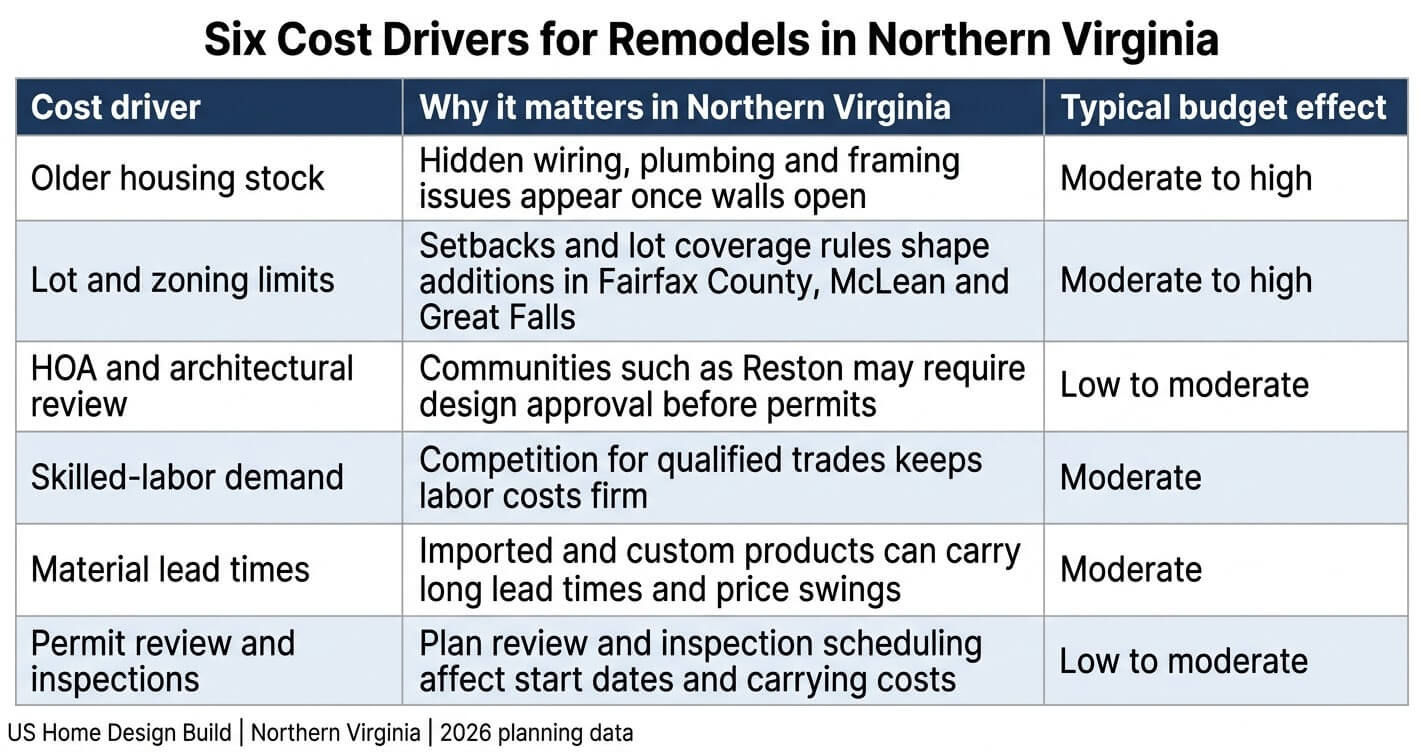
Older homes, tight lots, HOA review, skilled-labor demand, material lead times and permit review are the six biggest local cost drivers. Early site investigation and a realistic contingency reduce the effect of each one.
Homes in Fairfax County, Vienna and Falls Church often include older framing, plumbing and electrical systems that only reveal their condition after demolition. Lot constraints in established neighborhoods can also limit where an addition fits, which changes design and cost before construction begins.
Table 7: Six Cost Drivers for Remodels in Northern Virginia
Permits and Licensing: What Fairfax County and Virginia Require
Fairfax County requires a building permit for additions, structural changes, basement finishing and some kitchen remodels. Trade permits may apply to plumbing, electrical and mechanical work. Virginia law also requires your contractor to hold a state license matched to the project value.
Fairfax County’s Department of Code Compliance states that building permits cover new construction, additions and alterations, and lists interior alterations such as finishing a basement, converting space into a bedroom and some kitchen remodels as work that can require a permit. Adding or removing a wall also triggers a permit, and trade permits for plumbing, electrical and mechanical work may apply.
Table 8: Fairfax County Permit Triggers for Common Remodeling Work
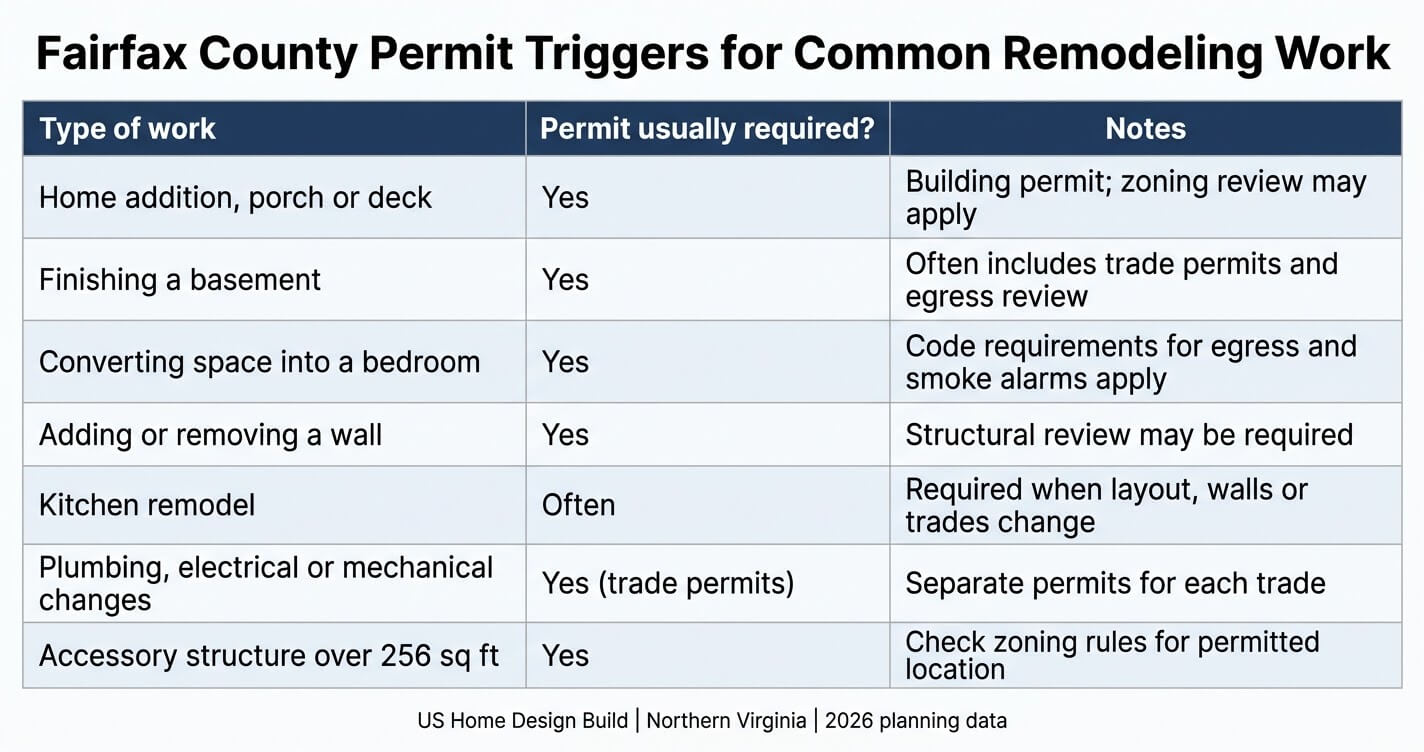
Permit applications are submitted through Fairfax County’s Planning and Land Use System, and fees follow the county’s published schedule. Review the Fairfax County Land Development Services Permit Library and the Land Development Services Fee Schedule before budgeting. Permit fees are small relative to total cost; the larger effect is review time, which is why a design-build team that handles submissions can protect your schedule.
For project-specific steps, see our Kitchen Remodeling Permit Fairfax County VA guide and our Basement Finishing Permit Fairfax County VA guide.
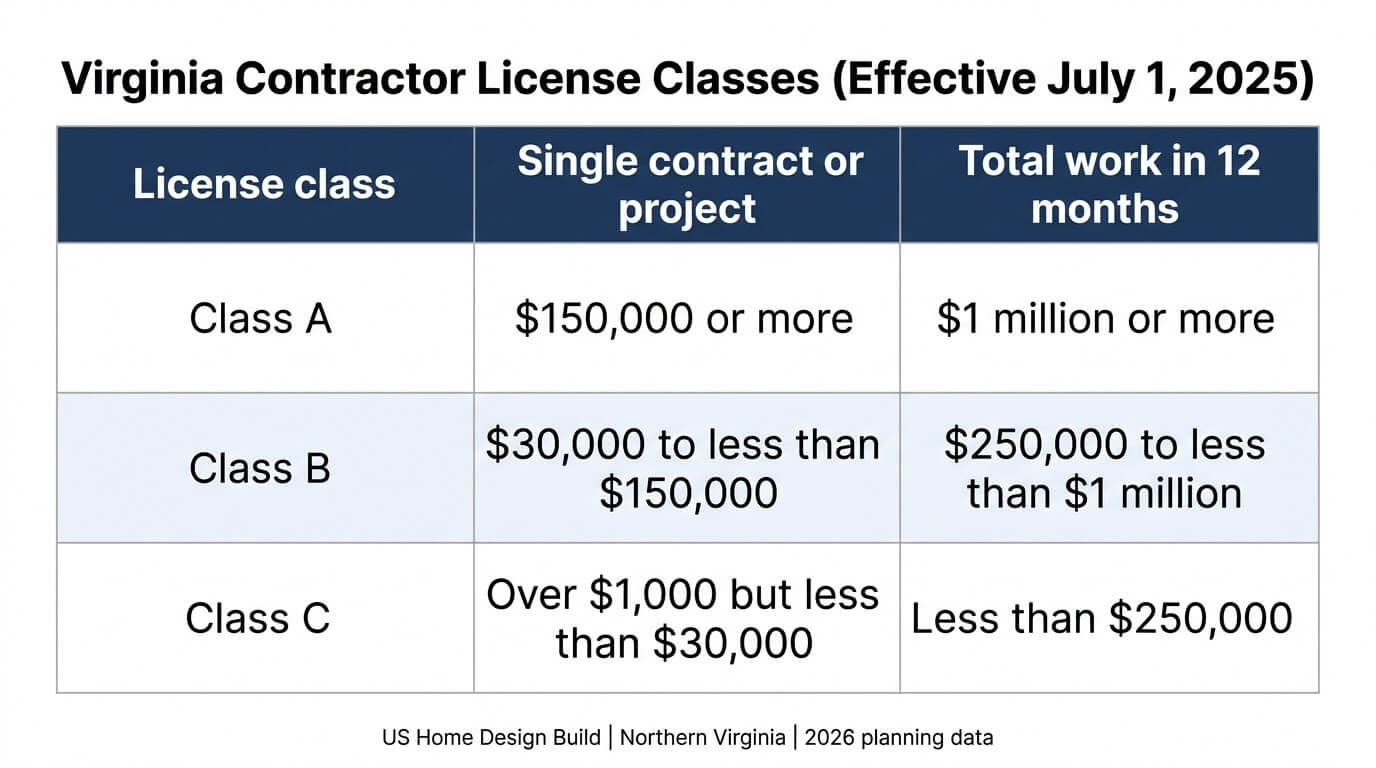
The Code of Virginia, Section 54.1-1100, defines the three contractor license classes. Class A applies to single contracts of $150,000 or more or $1 million or more of work in 12 months. Class B covers $30,000 to under $150,000 per contract, and Class C covers contracts over $1,000 and under $30,000. Guides published before July 2025 may still show older, lower limits.
Table 9: Virginia Contractor License Classes (Effective July 1, 2025)
Homeowners can confirm a license through the Virginia Department of Professional and Occupational Regulation. Local business organizations such as the Fairfax County Chamber of Commerce and the Northern Virginia Chamber of Commerce are also useful places to check a firm’s standing in the community.
How Much Contingency Should You Budget?
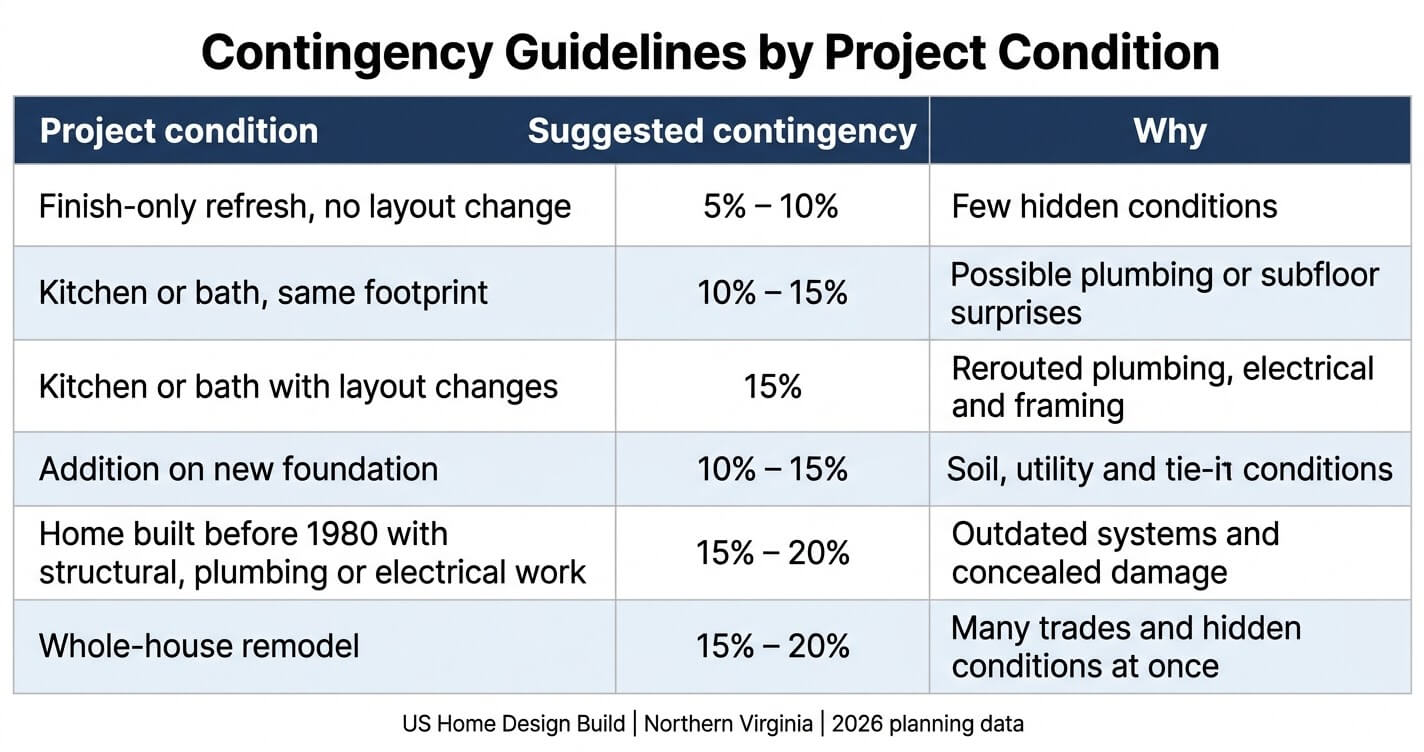
Budget 10% to 15% contingency for most Northern Virginia remodels and 15% to 20% for older homes or projects that change structure, plumbing or electrical systems. Contingency is a reserve for unknowns, not a padding line.
Contingency covers hidden conditions, code-required upgrades and owner-requested changes. In many design-build contracts, unspent contingency is returned or credited, but this varies, so confirm it in writing before you sign. The percentages below are common planning guidance, not a guarantee for any single project.
Table 10: Contingency Guidelines by Project Condition
How to Control Design-Build Remodel Cost Without Cutting Quality
Cost control starts before drawings are final. Lock selections early, keep plumbing walls in place where possible, and set allowances that match real products. These steps prevent most budget drift.
Controlling design-build remodel cost Northern Virginia projects comes down to disciplined decisions at the design stage, when changes are cheapest.
- Finalize selections before pricing. Tile, fixtures, cabinetry and appliances should be chosen before the construction price is locked.
- Preserve the footprint where it makes sense. Moving plumbing, load-bearing walls and mechanical runs raises cost faster than upgrading finishes.
- Use realistic allowances. Ask what product and quality level each allowance assumes.
- Phase the scope. Separating a kitchen from a later bathroom or basement can spread cost without sacrificing design coherence.
- Avoid mid-construction changes. Change orders after framing or rough-in carry the highest premium.
- Match spending to home value. Our guide to the 30% rule for home renovations in Northern Virginia explains how to set a spending ceiling.
- Plan large projects as a system. If you are weighing a major scope, our whole house remodel planning and budgeting guide covers sequencing and budgeting.
Common homeowner mistakes
- Comparing totals without comparing what each estimate includes.
- Setting allowances too low to make a proposal look competitive.
- Skipping contingency on homes built before 1980.
- Starting construction before permits and selections are complete.
- Choosing on price alone without checking license class and project history.
Questions to Ask Before Signing a Design-Build Contract
Ask how the price is structured, what is included, and how changes are handled. A clear answer to each question protects your budget and shows how the firm operates.
- Is the price fixed, cost-plus with a maximum, or phased?
- What does the design fee cover, and is it credited toward construction?
- Which allowances are included, and what product level does each assume?
- How much contingency do you recommend, and what happens to unspent funds?
- How are change orders priced and approved?
- Who submits permits and manages Fairfax County inspections?
- What is your Virginia license class and number?
- What is the payment schedule, and how does it tie to completed work?
The Virginia Board for Contractors’ consumer information sheet recommends that the initial down payment be about 10% of the total. A payment schedule far above that deserves a clear explanation before you sign.
For a broader vetting framework, read our guide to how to choose a home remodeling contractor in Northern Virginia.
Frequently Asked Questions
How much does a design-build remodel cost in Northern Virginia?
Most projects range from about $18,000 for a full bathroom to $175–$400 per square foot for a whole-house remodel in 2026.
Kitchens commonly fall between $55,000 and $140,000 or more, and additions between $300 and $550 per square foot. Your final design-build remodel cost Northern Virginia figure depends on scope, finishes and home age.
Is design-build more expensive than hiring a general contractor?
Not necessarily. The starting price is often similar, but design-build can reduce change orders and redesign costs.
Traditional bidding can produce a lower starting number, and design-build adds design fees early. Compare total cost after change orders, not just the first quote.
What are design fees in a design-build remodel?
Design fees pay for drawings, engineering and selections before construction begins.
They are usually a defined phase in the contract. Ask whether the fee is credited toward the construction price.
How much contingency should I budget for a remodel in Northern Virginia?
Plan for 10% to 15% on most projects and 15% to 20% on older homes or structural work.
Confirm in your contract whether unspent contingency is returned or credited.
Do I need a permit for a remodel in Fairfax County?
Yes, for additions, basement finishing, wall changes, bedroom conversions and many kitchen remodels.
Trade permits may also apply to plumbing, electrical and mechanical work. Confirm with Fairfax County Land Development Services before work begins.
How long does a design-build remodel take in Northern Virginia?
Design and permitting commonly take 6 to 12 weeks, and construction runs from weeks for a bathroom to several months for an addition.
Timelines vary with scope, permit review and product lead times. A firm that overlaps design and procurement can shorten the total schedule.
How do I compare design-build quotes?
Compare scope, allowances, contingency and payment schedule line by line, not just the total.
Ask each firm for an itemized estimate using the same categories, and verify license class through Virginia DPOR.
Final Thoughts on Design-build remodel cost Northern Virginia
Design-build remodel cost Northern Virginia projects are easiest to control when the budget is tested during design, allowances are realistic and contingency is planned from day one. Design-build does not guarantee a lower price, but it gives homeowners earlier cost feedback, one point of accountability and fewer gaps between drawings and pricing. With our design-build team serving Fairfax County, McLean, Vienna, Reston, Great Falls and Burke, we see the same pattern across projects: clear scope and early decisions protect both budget and schedule.
Planning a similar project in Northern Virginia? Contact US Home Design Build to discuss your goals, budget, and timeline with our team.
You can also see directions and reviews on our US Home Design Build Google Business Profile.
